MP Board Class 9th General English Grammar Subject-Verb Concord

MP Board Solutions for Class 9 Textbook General English Grammar Subject-Verb Concord Questions and Answers aids you to prepare all topics in it effectively. You need not worry about accuracy of Madhya Pradesh State Board Solutions for Class 9 English Composition: Visual Stimulus as they are given adhering to latest exam pattern and syllabus guidelines. You Can Download MP Board Class 9 English Solutions Questions and Answers, Notes, Summary, Guide pdf on is page. Enhance your subject knowledge by preparing from Chapterwise MP Board Solutions for Class 9 English and clarify your doubts on corresponding topics.

MP Board Class 9th General English Grammar Subject-Verb Concord

Kick start your preparation by using our online resource Madhya Pradesh State Board Solutions for Class 9 Textbook General English Grammar Subject-Verb Concord. You can even download MP Board Solutions for Class 9 English free of cost rough direct links available on our page. Clear your queries and understand concept behind in a simple manner. Simply tap on concept you wish to prepare chapterwise and go rough it.

किसी sentence में जब subject का verb के साथ सही तालमेल होता है तभी वाक्य शुद्ध होता है। अर्थात् subject के वचन (number) तथा पुरुष (Person) के अनुसार ही verb में आवश्यक परिवर्तन किया जाना चाहिए।

जैसे-
Bird is flying in the sky.
Birds are flying in the sky.
I was singing
They were singing.

इस प्रकार के तालमेल के लिए निम्नलिखित नियम हैं
(1) दो या उससे अधिक Singular subject and से जोड़े जाएँ तो उनके साथ प्रायः Plural का verb आता है। जैसे
(i) Sita and Gita are twins.
(ii) You and your sister do this job well.

(2) यदि दो singular nouns (संज्ञाएँ) एक ही व्यक्ति या वस्तु का बोध कराती हैं, तो वहाँ singular verb का प्रयोग होता है। जैसे
(i) You and I am wrong.
(ii) My brother and guide has come.

(3) अगर singular कर्ता से पहले Each या Every का प्रयोग होता है तो singular verb का प्रयोग होता है। जैसे
(i) Every day brings hope.
(ii) Each student is prepared.

(4) Either….or, neither…..nor, के बाद हमेशा singular verb आती है। जैसे-
(i) Neither is he happy nor sad.
(ii) Either Ram or Shyam has done this work.

(5) यदि कर्ता को or, nor से जोड़ा जाए और वचन भिन्न हो तो बहुवचन की क्रिया (verb) का प्रयोग होता है। जैसे
(i) Either the boy or his friends have done this.

(6) Collective Noun के साथ पूरे समूह का भाव व्यक्त करने के लिए एकवचन क्रिया (verb) का प्रयोग करते हैं। परन्तु अगर एकवचन क्रिया का बोध कराना हो तो Plural verb का प्रयोग करते हैं। जैसे
(i) The police were chasing the thief.
(ii) The committee has decided this.

(7) जो Noun देखने में बहुवचन लगते हैं पर भाव में एकवचन ही होते हैं उनके साथ singular verb का प्रयोग करते हैं। जैसे
The wages of sin is death.

(8) कुछ Noun देखने में Singular लगते हैं परन्तु उनका अर्थ Plural होता है। उनके साथ Plural verb का प्रयोग करते हैं। जैसे
People are sad.

(9) कभी-कभी हम Verb का निकटतम Plural Subject के साथ मेल कर देते हैं। इस तरह वास्तविक subject की अनदेखी हो जाती है। हमें इस गलती से सावधान रहना चाहिए। जैसे-
(i) Neither of the women was present.
(ii) The quality of the oranges was good.

(10) Plural Noun जो किसी देश का नाम है या किताब का नाम है उसके बाद singular verb का प्रयोग होता है। जैसे
(i) The United States has a strong army.
(ii) The Gathering is a good novel.

Exercise-1

Fill in the blanks with correct words from those in brackets.
1. No news …………………….. bad news. (is/are)
2. The meeting …………………….. chosen a president. (has/have)
3. Each of the suspected men …………………….. been interrogated. (has/have)
4. Rice and curry …………………….. his favorite dish. (is/are)
5. All work and no play …………………….. Jack a dull boy. (make/makes)
Answer:
1. is,
2. has,
3. has,
4. are,
5. makes.

Exercise-2

Correct the following sentences.
1. Ten thousand rupees are a good sum.
2. Bread and butter are my food.
3. He and not you deserve this reward.
4. This pair of scissors are sharp.
5. Either you or your brother have done this.
6. The jury were of one mind.
7. None of them are rotten.
8. He as well as his parents are illiterate.
9. The king and poet are here.
10. Your spectacles is dirty.
Answer:
1. Ten thousand rupees is a good sum.
2. Bread and butter is my food.
3. He and not you deserve this reward.
4. This pair of scissors is sharp.
5. Either you or your brother has done this.
6. The jury was of one mind.
7. None of them is rotten.
8. He as well as his parents is illiterate.
9. The king and poet is here.
10. Your spectacles are dirty.

We believe information shared regarding MP Board Solutions for Class 9 Textbook General English Grammar Subject-Verb Concord Questions and Answers as far as our knowledge is concerned is true and reliable. In case of any queries or suggestions do leave us your feedback and our team will guide you at soonest possibility. Bookmark our site to avail latest updates on several state board Solutions at your fingertips.
MP Board Class 9th English The Rainbow Workbook Solutions Chapter 2 The Victory

MP Board Solutions for Class 9 English The Rainbow Workbook Solutions Chapter 2 The Victory Questions and Answers aids you to prepare all topics in it effectively. You need not worry about accuracy of Madhya Pradesh State Board Solutions for Class 9 English Chapter 2 The Victory as they are given adhering to the latest exam pattern and syllabus guidelines. You Can Download MP Board Class 9 English Solutions Questions and Answers, Notes, Summary, Guide pdf on is page. Enhance your subject knowledge by preparing from Chapterwise MP Board Solutions for Class 9 English and clarify your doubts on corresponding topics.

MP Board Class 9th English The Rainbow Workbook Solutions Chapter 2 The Victory

Kick start your preparation by using our online resource Madhya Pradesh State Board Solutions for Class 9 English The Rainbow Workbook Solutions Chapter 2 The Victory. You can even download MP Board Solutions for Class 9 English free of cost rough direct links available on our page. Clear your queries and understand concept behind in a simple manner. Simply tap on concept you wish to prepare chapterwise and go rough it.

The Victory Vocabulary and Pronunciation

A. All the following sentences have one incorrect spelling. Encircle the incorrect one, write the correct spellings and rewrite the
sentences.

(i) He ordered his brave jounals.
Answer:
He ordered his brave soldiers.

(ii) Alexander was very happi.
Answer:
Alexander was very happy.

(iii) He quietly slipped from the scene.
Answer:
He quietly slipped from the scene.

(iv) The women were welling.
Answer:
The women were wailing.

(v) How can a rober be a conqueror and a giver ?
Answer:
How can a robber be a conqueror and a giver ?

B. Why are the words in bold type more suitable in the context than those in brackets ?
Alexander the great (renoned, talented, big) had won many battles (encounters, fights, quarrels. His desire (wish, fancy, urge) as to conquer (defeat, overpower, capture) the world.
Answer:
Because the worlds in bold are used in broader sense. These words cover the meaning of all the three words given in bracket;.

2. Compare the meaning of the words :
riding
writhing
breeding
breathing
loading
loathing
ladder
lather
Answer:

  • riding — climbing
  • writhing — twisting, body without stopping
  • breading — (of animals) having sex and produce
  • breathing — the at of taking in air
  • loading — carrying
  • loathing — a strong feeling of hatred
  • ladder — a piece of equipment for climbing up and down a wall.
  • lather — a white mass of small bubbles that is produced by mixing soap with water.

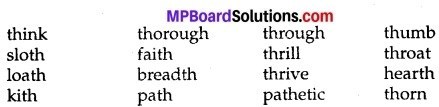
D.  Question 1.
Some of the most common English words which contain sound /O/ are three, thin, thank, thick, thing, thirsty, both, cloth etc.
Write some more English words which contain /O/ sound.
Answer:
MP Board Class 9th English The Rainbow Workbook Solutions Chapter 2 The Victory 1

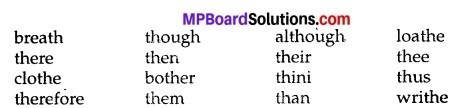
Question 2.
Some of the most common English words which contain sound/6/ are the, this, that, these, those, though, smooth, with etc.
Write some more English words which contain /6/ sound.
Answer:
MP Board Class 9th English The Rainbow Workbook Solutions Chapter 2 The Victory 2

Question 3.
Say these words and notice the difference in their pronunciation.
day — they
den — then
die — thy
breed — breathe
load — loathe
side — scythe
Now, find some similar examples and write them in the given space.
Answer:

  • bed – bathe
  • ladder — leather
  • dim — theme
  • rod — road
  • site — sight
  • breath — breathe
  • bliss — bless
  • sink — think

Listening Skill

1. Listen to the Iranian short story which tells about the Nature’s justification with each and everything.
Answer:
See workbook page 9.

On the basis of the text you have listed to, complete the following:

Question 1.
When the peasant reached the melon farm he was
Answer:
tired and thirsty.

Question 2.
The farmer rested under the
Answer:
shade of a nearby walnut tree.

Question 3.
He enjoyed the
Answer:
view of the spreading vives of big water melons.

Question 4.
The trees of walnuts were
Ans.
dangling.

Now, discuss with your friends :

Question 1.
In the beginning of the story the peasant is not happy with the act of the God because….:
Answer:
the small walnuts grew on an enormous tree while the big water melons hung from a flat and flimsy vine.

Question 2.
What would have happened if a melon had fallen upon the head of the peasant instead of the walnut ?
Answer:
If a melon had fallen upon the head of the peasant, he would have been injured seriously.

Question 3.
In the end of the story the peasant was thankful to God because
Answer:
He was clever not to let melons grow on big trees.

Speaking Skill

See workbook page 10.

Answer:
For self attempt

Reading Skill

Read the following passage carefully and answer the questions given below it.

See workbook page 10

Question 1.
Choose the correct answer

(i) Who is truly a great man ?
(a) a person whose name figures in history
(b) a person who would warmly welcome some unhappy old woman to put an end to her troubles
(c) a person who has won battles
Answer:
(b) a person who would warmly welcome some unhappy old woman to put an end to her troubles

(ii) The passage is intended for:
(a) the psychologists.
(b) the parents of school going children.
(c) the young people.
Answer:
(c) the young people.

(iii) The purpose of the passage is :
(a) to communicate the importance of material possession to the readers..
(b) to instill in the hearts of the young people, a strong desire to become truly noble human beings.
(c) to highlight the advantages of advanced civilization.
Answer:
(b) to instill in the hearts of the young people, a strong desire to become truly noble human beings.

Question 2.
Go through the passage again and answer the questions briefly:

(i) Give one reason for the unhappiness of human beings.
Answer:
They are not satisfied with what they have.

(ii) Mention the qualities of noble human beings.
Answer:
They are willing to embrace sorrows of their neighbour and thereby acts in order to create a truly peaceful and happy society.

(iii) The author tells the people that they have endless occasions to improve themselves. What are they ?
Answer:
Whether studying or participating in student organisations and extra curricular activities or solving problems that arise with your friends.

Question 3.
Write 2-3 sentences on each of the following subtitles :

(i) A truly great man does not have to be famous.
Answer:
He does not want to be famous. He wants only to serve the society selflessly. He embraces other’s sorrows and tries to create a peaceful- and loving society.

(ii) A truly noble being embraces the sorrows of others most willingly.
Answer:
It gives him real joy. He feels satisfied and happy. He wants to see smile on other’s face.

(iii) Various school activities opportunities for self improvement.
Answer:
Extra curricular activities. Games and sports. Problems that arise with our friends.

Question 4.
Mention the suggestions given by the author to next generation to become noble human beings.
Answer:
In order to become noble human beings the next generation should do the following

  • They should discipline themselves.
  • They should absorb knowledge and furnish themselves with the skills they will need for that day.

Question 5.
Mention the suggestions given to improve oneself.
Answer:
We should positively search out opportunities for improvement to face challenges in life squarely so that we might nature in a outstanding individuals.

Question 6.
What is he result of the superficial prosperity of our age?
Answer:
The superficial prosperity of our age only increases the fundamental affections which we experience as human beings.

Language Practice (Grammar)
Simple past

A. Study these sentences.

See workbook page 13.
Now, talk to your friends and frame five sentences on what they did yesterday/last week.

  1. They went On a picnic in a zoological park.
  2. They played various games there.
  3. They enjoyed/saw several birds and animals.
  4. They enjoyed delicious dishes.
  5. They drank soft drinks

B. Now, study these sentences.

See workbook page 14.

4. Now, talk to your parents or grandparents, and frame five sentences. Where they lived/studied (place) for (time period).
Example : My grandmother lived in Varanasi for a long time.

  1. My grandfather lived in Allahabad for a long time.
  2. It is a big city with great religious value.
  3. It had been a centre of political uplevel.
  4. It’gave the first Prime Minister of India.
  5. He was proud to be a part of it.

Simple Past and Past Continuous:

C. Study these sentences.

See workbook page 14.

Now, frame five sentences on this pattern.

  1. When Raman telephoned me yesterday, I was in bathroom.
  2. When Mrs. Sharma came to my house last week, my mother was not at home.
  3. When I reached the city, there was a curfew.
  4. The baby was sleeping when I came to her.
  5. The teacher was teaching -when the Principal entered the class. Simple Past and Past Perfect

D. Study these sentences :

See workbook page 15.

Now, put the verbs in brackets into the correct simple past or past perfect tense.
1. They ……………… just (come) from office when they ………… (meet).
2. She hardly (say) this, when Malasha …………. (plump) down her foot.
3. When they …………….. (go) out to play, their mothers ……………… (dress) them both in new frocks.
4. When he ……….. (reach) the railway station the train ……………. already (leave).
Answer:

  1. had, came, met
  2. had, said, plumped
  3. had, gone, dressed
  4. reached, had left

Writing Skill

A. You are the student- editor of your school magazine. Write a notice inviting the names of those who like to give articles, stories, cartoons etc. for the school magazine. (50 words)
Answer:

ABC School
Notice
School Magazine Section

Date 25 July 2011

This is a bring to all the students that the school magazine is to be published before winter break. Those who are interested in writing articles, stories, cartoons etc are invited to register their names and wrote-ups till 20 Aug 2011 to the undesigned during office hour between 2 to 4 pm in the Common Room.

Manish Gupta
Student Editor.

B. Narrate the popular encounter of Alexander with the Indian King Puru. (150 words)
Answer:
Alexander (356-323 B.C) was only 22 years old when he ascended the throne. He was a general. He divided his army into two units to effectively capture India. The first unit invaded India under his personal leadership. He defeated the North Indian States. The other unit was under commander Hephastian. It defeated the kingdoms on the bank of river Indus. The Indian kingdoms were disunited. As such, they did not pose any virtual challenge to any of his units. As a result, the Greek army conquered all kingdoms before uniting at Ohind. Kings like Ambi accepted defeat without even fighting his army. However, Alexander emerged victorious and made Porus a prisoner

We believe the information shared regarding MP Board Solutions for Class 9 English The Rainbow Workbook Solutions Chapter 2 The Victory Questions and Answers as far as our knowledge is concerned is true and reliable. In case of any queries or suggestions do leave us your feedback and our team will guide you at soonest possibility. Bookmark our site to avail latest updates on several state board Solutions at your fingertips.
MP Board Class 9th English The Rainbow Solutions Chapter 16 Where the Mind is without Fear

MP Board Solutions for Class 9 English The Rainbow Solutions Chapter 16 Where the Mind is without Fear Questions and Answers aids you to prepare all topics in it effectively. You need not worry about accuracy of Madhya Pradesh State Board Solutions for Class 9 English Chapter 16 Where the Mind is without Fear as they are given adhering to the latest exam pattern and syllabus guidelines. You Can Download MP Board Class 9 English Solutions Questions and Answers, Notes, Summary, Guide pdf on is page. Enhance your subject knowledge by preparing from Chapterwise MP Board Solutions for Class 9 English and clarify your doubts on corresponding topics.

MP Board Class 9th English The Rainbow Solutions Chapter 16 Where the Mind is without Fear

Kick start your preparation by using our online resource Madhya Pradesh State Board Solutions for Class 9 English The Rainbow Solutions Chapter 16 Where the Mind is without Fear. You can even download MP Board Solutions for Class 9 English free of cost rough direct links available on our page. Clear your queries and understand concept behind in a simple manner. Simply tap on concept you wish to prepare chapterwise and go rough it.

Where the Mind is without Fear Textual Exercises

Where the Mind is without Fear Vocabulary

A. The following words have special meanings in the poem. Write them.
high, free, walls, stream, awake, head, desert.
Answer:
Words – Special meanings in the poem
High – without any sense of shame
Free – without restrictions of caste, creed, religion etc.
Walls – petty consideration which divide the nation
Stream – flow
Awake – vigilant without any lethargy
Head – honour and position
Desert which is immune to any progress.

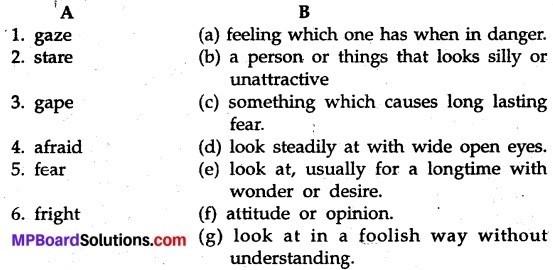
B. Match the words given in column A with their meanings given in column B.
A. – B
1. fear – (a) you
2. knowledge – (b) large sandy piece of land where nothing grows because there is no rain
3. thee – (c) nut having
4. desert – (d) feeling which one has when in danger
5. without – (e) things known.
Answer:
1(d), 2 (e), 3 (a), 4 (b), 5 (c)

C. Write the meanings of the following expressions :
in fear and trembling
for fear of/that
No fear!
without fear of favour
I fear
Answer:
in fear and trembling—deadly afraid
For fear of that—Fearing that something ill may not happen
No fear !—absence of fear
Without fear of favour—without any bias
I fear—I am afraid

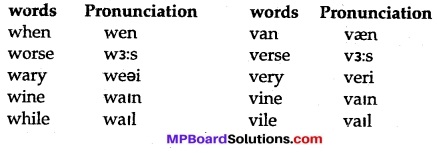
D. Pronounce the following words :
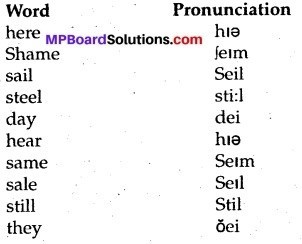
when, worse, wary, wine, while, van, verse, very, vine, vile
Answer:
MP Board Class 9th English The Rainbow Solutions Chapter 16 Where the Mind is without Fear 1
Comprehension

A. Read the first four lines of the poem and answer the questions.

  • WHERE the mind is without fear and the
  • head is held high;
  • Where knowledge is free
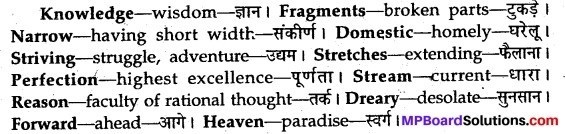
  • Where the world has not been broken up into fragments by narrow doniestic walls;

Questions :
1. What does the poet mean by ‘the head is held high’ ?
2. Explain what does the poet mean by ‘where knowledge is free’ ?
3. What are narrow domestic walls ?
Answer:
1. ‘The head is held high ‘means that the people of India should neither be afraid nor ashamed of anything.
2. By ‘where knowledge is free’ the poet means that education should be granted free of cost and free from all restrictions in India.
3. ‘Narrow domestic walls ‘are the considerations of caste, religion and provincialism’. They divide the nation into fragments.

B. Read the next four lines and answer the following questions:

  • Where words come out from the depth of truth,
  • Where tireless striving stretches its arms towards perfection;
  • Where the clear stream of reason
  • has not lost its way into the dreary desert sand of dead habit;

Questions :
1. Find out the line expressing, ‘Endless efforts are made to achieve the best quality.’
2. What do you understand by ‘clear stream of reason.’
3. What is the ‘dead habit’ according to the poet ?
Answer:
1. Where tireless striving stretches its arms towards perfect
2. ‘Clear stream of reason’ means ‘the free flow of good sense.’
3. Conventional customs which are immune to progress or growth.

C. Read the last four lines and answer the following questions:

  • Where the mind is led forward by Thee
  • into ever-widening thought and action
  • Into that ‘Heaven of freedom
  • My Father, let my country awake.

Questions :
1. What does the poet mean by ‘ever widening thought and action’ ?
2. Describe any two traits of character the poet wants to inculcate in his countrymen.
3. What does the poet mean by let my country awake ?
4. What is ‘Heaven of freedom’ according to the poet ?
Answer:
1. Our thoughts should not be narrow and our actions should be noble.
2. The poet wants to inculcate the qualities of truth and fearlessness in his countrymen.
3. It means that his countrymen should become vigilant and no longer remain ignorant.
4. ‘Heaven of freedom’ refers to the freedom of mind, speech and action.

Speaking Activity

A. Form four groups in the class. Each group will he assigned some lines of the poem. Discuss the particular lines in your group and express your opinion about the poet’s view.

Writing Activity

A Write a letter to your friend describing the contribution of a freedom fighter. (50 words)
Answer:
610 Dichaon Kalan,
New Delhi 43 23rd June,
2007 Dear Sham Lai
In my present letter I am describing the contribution of Lok Nayak Jai Prakash Narayan towards the freedom of our country. He was a great freedom fighter. He made up his mind to live and die for his country. He dedicated his life to the struggle for freedom. He was a selfless worker. He was the true follower of Gandhian principles. People called him ‘King without Crown.’ He was a symbol of light for the Janata Party. He created a great stir in political field and strengthened his party. He took great interest in the political development of the country.
Sincerely yours,
Tara Chand Sharma.

B. How can we get rid of narrow domestic walls? Express your views? (150 words)
Answer:
India is a land of different religions, castes, communities and regions. The British rulers sowed the seeds of hatred among the people of different religions in India. Our constitution lays down that India is a secular state. According to Gandhiji ‘we have to produce a society of those people who profess different religions’ but they live like brothers. Swami Ram lirath called the land of India his . own body. We stand in need of true patriotism.

Then there will be no communal riots in this holy land. The need of the hour is a single . national language even though some people may use English as link language. To get rid of narrow domestic walls, people of all provinces, castes, religions and linguistic groups must be taught to honour the national emblems like the National Flag and the National Anthem. Provinces should be organized on geographical and not on linguistic basis. Political parties should be organised not on the basis of caste, religion or region but on the principles of nationalism.

Think it over

A. All human beings are one. Caste, creed and colour divide people in small groups. Such divisions go on till we are left alone. Still there are such narrow domestic walls. Why?
Answer:
All human beings are one. This in mine or that of the otter is the consideration of those who have low mentality, Caste, creed and colour divide the people in small groups or water-tight compartments. They consider themselves as exclusively different and rival to each otter. The people of the so called upper castes consider themselves as superior to those who belong to lower castes. Such groups try to fight tooth and nail with one another. Sometimes communal riots take birth. Recently the Gujars came into direct. Confrontation with the Meenas. These divisions will divide the nation into small segments. They create narrow domestic walls due to the narrow mentality of the people.

B.Superstitions and prejudices hinder our progress. How?
Answer:
The belief that certain events cannot be explained by reason
science or that they bring good or bad luck is called superstition. It is a sign of ignorance and backwardness. It is based on fear of the unknown or mysterious. It is also against known laws of reasoning. Many good men and oculists dupe the people and cause havoc. They cause suspicion in the brains of the people. They win their hearts. Sometimes they urge the people to sacrifice some animal, bird or even a child. Superstitions cause a baseless fear of the unknown in our minds. They block our thinking faculty and hinder our progress. Superstitions and prejudices both have evil results. They cause rifts and disintegation in society.

C. How far has the idea of ‘Heaven of freedom’ been materialized in the modem world?
Answer:
India became free from the yoke of foreign rule six decades back. The Constitution of India has granted many rights to its citizens. These are right to life, liberty and security of person, right to freedom of speech, judicial remedy, freedom to movement, right to take part in the government of the country, some economic and social rights also. It is a pity that the idea of ‘Heaven of freedom’ is fake and hollow. It has not been materialized in the modern world. All the citizens do not enjoy these rights. All kinds of unjust descriminations prevail in the society.

Things to do

Question 1.
Go to the library and read the fundamental rights as described in the Constitution of India. Write them in the diary also.
Answer:
Fundamental Rights
Rights are social claims which are necessary for the development of man and his personality.

  1. A citizen possesses the right to equality before law.
  2. He has the right to freedom
  3. He has the right to life and personal liberty
  4. He enjoys the freedom of propagating and practising any religion
  5. He has the right to speak.
  6. He has the right to work, education and social security.
  7. tie has the right to vote and to contest elections.
  8. He has the right to hold public office.
  9. He has the right to criticize the government.
  10.  Right against exploitation.
  11. Right to constitutional remedies.
  12.  Right to freedom from want and fear.

Where the Mind is without Fear Additional Questions

Short-Answer Type Questions (In about 25 words)

Question 1.
What are the two qualities of mind presented in the poem?
Answer:
The two qualities of mind presented in the poem are fear-lessness and ever widening thought and action. Fearlessness means boldness. It enables a man to make struggles in life. Widening thought and action helps one in making progress.

Question 2.
Why does the poet compare ‘dead habit’ to ‘dreary desert sand’ ?
Answer:
The poet compares ‘dead habits’ to ‘dreary desert sands because both of them are immune to progress or growth. Dead habits stand for ‘Conventional Customs’ which pose many restrictions before a man of dynamic views. Old habits never change and dreary desert sands fail to yield any crop.

Question 3.
What are the positive and old qualities mentioned in this poem ?
Answer:
Perfection, free knowledge, truth and mind resulting in thought and action are positive qualities of a nation. Fear alone is the negative quality mentioned in this poem.

Question 4.
Give an account of the narrow walls and their effects.
Answer:
The narrow walls are the divisions of caste, religion and provincialism. They can divide the world into fragments like allies, communal groups and blocks. They can also shatter the world peace.

Long Answer Type Question

Question 1.
Make a list of the qualities that the poet wishes to be present in the world.
Answer:
The following is the list of qualities that the poet wishes to be present in the world.
The atmosphere of the world should be congenial and free from fear and shame. Knowledge should be free from all restrictions. The people should be truth-loving and rational in their approach. They shotted be the seekers of perfection and should always remain united. They should also be broad-minded. Their thoughts, speech and actions should be noble, rational, and progressive.

Where the Mind is without Fear Summary in English
The poet aspires that the atmosphere in this country should be free. Her people should neither be afraid nor be ashamed of anything. Knowledge should be imparted free of cost here. Her natives should be true and rational. Her people should not be divided by narrow considerations of caste, creed or colour. They should be broad – minded.

Where the Mind is without Fear Summary in Hindi

कवि कामना करता है कि उसके देश का वातावरण स्वच्छन्द हो। उसकी जनता को न तो भय हो और न ही वे किसी बात से लज्जित हों। वहाँ पर ज्ञान की प्राप्ति बिना किसी खर्च के हो। उसके निवासी सच्चे तथा विवेकपूर्ण हों। जाति, मत या रंग के संकुचित विचारों से उसके लोग विभाजित न हों। वे प्रगतिशील विचारों के हों।

Where the Mind is without Fear Word-Meanings

MP Board Class 9th English The Rainbow Solutions Chapter 16 Where the Mind is without Fear 2

We believe the information shared regarding MP Board Solutions for Class 9 English The Rainbow Solutions Chapter 16 Where the Mind is without Fear Questions and Answers as far as our knowledge is concerned is true and reliable. In case of any queries or suggestions do leave us your feedback and our team will guide you at soonest possibility. Bookmark our site to avail latest updates on several state board Solutions at your fingertips.
MP Board Class 9th English The Rainbow Solutions Chapter 15 How it all began

MP Board Solutions for Class 9 English The Rainbow Solutions Chapter 15 How it all began Questions and Answers aids you to prepare all topics in it effectively. You need not worry about accuracy of Madhya Pradesh State Board Solutions for Class 9 English Chapter 15 How it all began as they are given adhering to the latest exam pattern and syllabus guidelines. You Can Download MP Board Class 9 English Solutions Questions and Answers, Notes, Summary, Guide pdf on is page. Enhance your subject knowledge by preparing from Chapterwise MP Board Solutions for Class 9 English and clarify your doubts on corresponding topics.

MP Board Class 9th English The Rainbow Solutions Chapter 15 How it all began

Kick start your preparation by using our online resource Madhya Pradesh State Board Solutions for Class 9 English The Rainbow Solutions Chapter 15 How it all began. You can even download MP Board Solutions for Class 9 English free of cost rough direct links available on our page. Clear your queries and understand concept behind in a simple manner. Simply tap on concept you wish to prepare chapterwise and go rough it.

How it all began Textual Exercises

How it all began Vocabulary

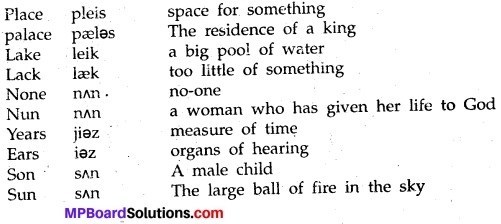
A. What are the different meanings of the following words, nursery, glass, cricket, watch, collector, interest, couple, record, encounter, country, bank
Answer:
Word – Meanings
Nursery : Children’s quarters; a room for children and their nurse, a plot of ground in which young plants are reared for transplantation; a fish – rearing pond; a place where animal life is developed.
Glass : A transparent, lustrous, hard and brittle substance; a drinking vessel ; a mirror ; a pair of spectales.
Cricket : A jumping and chirping insect, an open air game with ball, bats and wickets.
Watch : The act of watching; a guard, close observation, the place where a guard in kept; a small timepiece for the pocket.
Collector : One who collects revenue, the chief administrative . official of a district.
Interest : A legal concern; title; right, profit, advantage; welfare1 pecuniary stake.
Couple : A pair, a leash for two hounds; a married or engaged pair; two; a brace.
Record : A recorded Tate; register; official report of proceedings; a public document; the plate of gramophone; facts known.
Encounter: A hostile meeting; to meet with a person; an obstacle.
Country : A region; a territory of a nation; the land of one’s birth; rural districts.
Bank : A raised shelf of ground; artificial slope; ground at the edge of a river; flat topped mass of cloud; establishment for safe custody of money.

B. Use the following expressions in your own words.
large as lifer at large, by and large.
Answer:

  1. The old man’s poverty was as large as life.
  2. The robbers are still at Large.
  3. The people, by and large arc selfish.

C. Pronounce the following words given in pair and write their
meanings also. You can consult a dictionary.
place – palace
lake – lack
none – nun
years – ears
son – sun
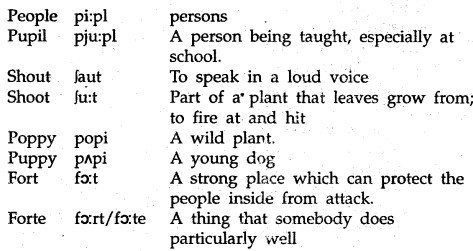
people – pupil
show – shoot
poppy – puppy
fort – forte.
Answer:
MP Board Class 9th English The Rainbow Solutions Chapter 15 How it all began 1
MP Board Class 9th English The Rainbow Solutions Chapter 15 How it all began 2

D. Pronounce the following.
Wints, Oxford, The observer, Pen. Allegra, Rhododendron, Leggie, Fontainebleau, Salim All, V”titer, Tughiaquabad.
Answer:
MP Board Class 9th English The Rainbow Solutions Chapter 15 How it all began 3

Comprehension

A. Answer each of the following questions in about 25 words.
1. What did the author do at the cricket ground?
2. Why was the homeward journey longer?
3. How did the author increase his information about birds and trees?
4. Where did the author learn the names of English wild flowers from?
5. How did tire author spend his weekends with the little child?
6. How was the author motivated to know more about trees and birds?
Answer:
1. The author used to go to the University Cricket ground. Allegra, his friend’s three-years old daughter used to accompany him. There he would watch the cricket game for a while. He used to buy ice-cream for the little girl.

2. Allegra was a fond collector of wild flowers. The author had to pick whatever flower she wanted. He used to pick up snow-drops, bluebells, periwinkles, lilies and many others. It took him much time to collect a handful of flowers. Therefore, the homeward journey was longer. It took them a longer time.

3. The author was unable to identify many birds and trees. He had little knowledge of the fauna and the flora. He was least interested in nature. He felt the lack of such information when he returned from abroad. He desired to increase his information. Therefore, he read books on trees, birds and insects minutely. He also accompanied , bird-watchers and horticulturists. Gradually, his fund of information increased.

4. The author was least interested in nature. He did not grow many flowers in his plot. His wife is in favour of growing vegetables. The author went abroad. There he used to go out for a walk with a three-year old girl. She asked him to pick up snow-drops and
bluebells. There were also periwinkles, lilies and many others. The author learnt the names of many English wild flowers from little Allegra.

5. The Wint family remained at home on weekends. The author spent most of the day sunning in their garden. He enjoyed hearing die chorus of thrushes and blackbirds from dawn to dusk. Lots of birds rested in their cherry and apple trees. He also played with
the little child.

6. The author was least interested in nature. He had little knowledge about the fauna and the flora so far as he remained in India. Oh his return from abroad, he left it. He was unable to identify more than a couple of dozen birds or trees. He felt that it was rewarding to know about them. His conscience motivated him to know more about trees and birds.

B. Answer each of the following questions in about 50 words.
1. What were the qualities of Allegra or Leggie?
2. Describe the private back garden of the author.
3. Justify the author’s visit to countryside on Sundays.
Answer:
1. Allegra (Leggi) was a three-year-old girl. She was the daughter of Mr. Guy Wint in Oxford. She was friendly to the author.  She gave him company She was fond of eating sandwiches and drinking milk. She was also fond of going on Walk with the author.
She watched the cricket game. She was fond of eating ice-cream. She was a keen collector of wild flowers. She used to urge the author to pick up the flowers of her choice. She used to climb the author’s shoulders and rest her chin on his head. She enjoyed the game of sticking flowers in the author’s turban and beard. She was of ever demanding type. She was a great chatterbox also.

2. The author had a private back garden. It was a small rectangular plot of green. It was enclosed on two adjacent ’sides by a barbed wire fence. The hedge was covered by creepers. His own apartment and his neighbour apartment formed its two sides. There in a fencing wall of hibiseus. There are four avocado trees and a tall eucalyptus in it. There is also a small patch of grass. They have grown more vegetables and less flowers in it. Many birds and stray cats share his bird – bath. The garden faces a squarish lawn. It is shared by other residents of the colony.

3. The author used to spend Sunday mornings in winter in the countryside. He carried a pair of binoculars and books on Indian birds. He used to visit the banks of the Jamuna behind Tilpat village. He also visited Surajkund. It is a dam which supplies water to its pool. The ruins of Tughlaqabad Fort were also his favourite haunts. He saw the troops of rhesus monkeys there His visit to countryside on Sundays is justified. It renews his acquaintance with birds and wild plants grown in Delhi.

How it all began Grammar

A. Study the following sentences.

  • Their son, Ben, was at a boarding school.
  • In the mornings I worked in my room.
  • His wife had converted to Buddhism..
  • I gave her a glass of molk.
  • The other two sides are formed by my neighbour’s and my own apartments.

The underlined words are prepositions. A preposition is a word that relates nouns, pronouns and noun clauses (small sentences inside a bigger one, working as nouns) in space, time, order and direction.
Now, pick out prepositions from the following sentences.
1. I spend Sunday mornings in my garden.
2. Surajkund supplies water to its pools.
3. There was a variety of wild plants.
4. I couldn’t identify more than a couple of dozen birds.
5. For the last many years I have maintained a record of the natural phenomena.
6. He always writes letters to his friends in ink.
7. What’s time by your watch ?
Answer:
1 (in), 2 (to), 3 (of), 4 (of), 5 (For, of), 6 (to, in), 7 (by).

Speaking Activity

A. Present an oral report of the natural phenomena around you. You can base your report on the details given in the lesson.
Answer:
New Delhi 28th July, 2007
I live in a village. It is located in the lap of nature. It is surrounded by woods and green fields. Cattle graze in the pastures. Birds perch and chirp on the trees. The snakes come out of their holes in the dark or when the holes are flooded with water. There ; are pools along the sandy paths. The trees blossom and birds come out of the flower plants. Bees collect honey from various flowers. The sight of the oxen and camels dragging carts or ploughing the fields is pleasant. We can see heaven on earth on a cloudy or rainy day.

B.Below are given some natural phenomena, visualise them and express your ideas orally. sunrise, sunset, rainbow.
Answer:
Sunrise, sunset and rainbow are a vital part of natural phenomena. The people awake at sunrise, pray to God and busy themselves in their daily chores. A sunny morning is an ideal morning during winter and rainy reason. The whole nature comes to life.
The workers in the fields and factories long for sunset. They finish their assigned jobs and return home to take rest. Even the animals grazing in the fields wait for the sunset. They meet their young ones then. The rainbow provides a pleasant sight. It is an arch of different colours that is formed in the sky when the sun shines through rain. Poets have praised these natural phenomena to the sky.

Writing Activity

A. Prepare a short introductory radio talk on ‘bird watching (50 words)
Answer:
Bird-watching is a pleasant activity. We see many birds in our day-today life. I am fond of seeing birds. I have seen many kinds of birds. They are of all kinds and colours. The ostrich is as large as a camel. I see a large number of bright red little robins singing in the garden every day. Black, white and red, big and small monkeys frighten the children. The dancing peacocks attract the passers-bys’ attention. The thrushes, black birds, sparrows, weaverbird, pigeons, parrots, eagles, wood peckers, cuckoos and nightingales enrich the atmosphere with their presence. Owls and crows are considered as ominous birds.

B. Make entries in your diary of the flora and fauna of your area.
Answer:
Gurgaon 24th August, 2007
I live in the rural area of Haryana. My house is located a few kilometres away from Sultanpur Jheel. I visit the lake almost every week to renew my acquaintance with the flora and fauna of our area.

Our area abounds in flora (or regional plants, flowers or trees) Apples, apricots, balsom, banana, black berry, bokhara plum, cobra flower, coconut, crab apple, daisy, date, fig, grapes, guava, Japanese plum, jasmine, lemon, lichi, lime, magnolia, malta, mango, marigold, mosamibi, mulberry, orange, papaya, pears, pineapple, plum, rose, sapodilla, sour cherry, sweet cherry, tamarind, are found here or there.

We can include apes, asses, buffaloes, bears, hounds, boars, bullocks, cats, chimpanzees, deer, elephants, foxes, giraffes, horses, hyenas, jackals, kangaroos, lambs, leopards, lions, mares, colts, mongooses, muskdeer, panthers, pigs, porcupines, rabbits, rams, rhinos, sheep, tiger, wolf and zebras in the list of fauna of our area.

Think it over

A. Just ponder over the inter-relations and interdependence among man, animals and plants.
Answer:
On the basis of our personal experience we can say with certainly that there is inter-relation and inter-dependence among man, animals and plants. Man drinks the milk of certain animals. He use the animals for his service in carrying loads or plugging his fields. He eats the flesh and sells the hides and turks of animals. He takes honey, medicines and oils from many plants. He uses the dung of animals for manure. Animals are reared by men. They feed on certain plants. Plants also depend on men for their proper upkeep. They would die if they are not properly taken care of. They also need the manure, given by the animals. Man benefits the most by selling animals and plants.

Things to do

Prepare a list of flowering plants and birds found in your surroundings also note down their distinctive features.

Name of
flowering Plants
Distinctive
features
Name of birdsDistinctive
features
Morning gloryBell shaped violet flowerParrotred beak, green
feathers
Marigoldgolden yellow
flowered plant
StarlingSmall bird noted
for chatter
PetuniaFunnel shaped
white, violet,
purple flower.
PeacockSplendid plumages and fanlike tail.

How it all began Additional Questions

Short Answer Type Questions (In about 25 words)

Question 1.
Where and with whom did the author spend a summer as a young man?
Answer:
As a youngman the author spent a summer with his friends, the Wints, in Oxford. Guy Wint was an official on the staff of the observer. His wife’s name was Freda. Their son was Ben and their daughter was Allegra (Leggie).

Question 2
Why did the author give company to Allegra for a walk everyday.
Answer:
The author’s friends, Guy Wint was on the staff of the observer. He remained in London most of the day. His wife Freda spent her day outside in meeting her fellow Buddhists. Their son was in boarding school. The author used to be alone at home when Allegra returned from the nursery school. He gave her a sandwich and a glass of milk. Nobody else was there at home. Therefore, the author gave her company for a walk everyday.

Question 3
How did the author reach the University Cricket grounds?
Answer:
The author was new in Oxford. He had no knowledge about the shortcuts there. Allegra knew the neighbourhood well. She led the author’s way. The paths ran through woods of oak, beech and rhododendron. Finally they reached the University Cricket grounds.

Question 4
What happened when Leggie (Allegra) felt tired on the return journey?
Answer:
On the return journey Leggie (Allegra) felt tired. The author made her climb up on his shoulders. She dangled her legs round her neck and rested her chin on his head. She stuck flowers in the author’s turban and beard. She enjoyed her game until they got home.

Long-Answer Type Question

Question 1.
Write a paragraph on ‘Grow More Trees.’
Answer:
Trees and forests precede man. They are the greatest purifiers in the world. They are the sanctuaries not only of animals and birds but also of many tribals and forest people. They give us fruit and herbs, wood and timber. They are the green lungs of the world. The poets call the trees as green gold. They maintain the ecological balance in the world. Trees give out oxygen and absorb carbon dioxide in the air. They provide shade and shelter to animals, birds and human beings in the scorching heat of summer. They bring rain and hold the soil tightly. Above all, they keep the land safe from soil erosion, floods and droughts.

How it all began Summary in English

The narrator Khushwant Singh was a youngman. He had his friend the Wints in Oxford. Guy Wint was working with the observer. He stayed in London most of the day. His wife, Freda had converted to Buddhism. Their son, Ben was at a boarding school.
The narrator’s companion was Allegra (Leggie). She was Wint’s three-years old daughter. The narrator worked in his room in the mornings. He, then walked with Allegra to University Cricket Grounds. He watched the game for a while and followed her back homewards. Allegra was an avid collector of wild Flowers.

The narrator had to pick the flowers of her choice in plenty. Then he , seated her on his shoulders. She stuck flowers in his turban and . beard. The narrator learnt the names of many English wild flowers from her. On weekends, the narrator spent most of the day sunning in the garden with Wint’s family. Their cherry and apple trees invited lots of birds. They sang through the day. Freda told him the difference between thrushes and blackbirds. The thrush sang each song twice. The songs of a variety of birds became familiar to the narrator. He also heard nightingales.

The narrator had no interest in nature before he went abroad. He foiled to identify many birds and trees. On returning to Delhi, he bought books, accompanied bird-watchers and horticulturists. His information about flora and fauna increased a great deal.
The narrator maintained a record of the natural phenomena he encountered in his private back-garden. It was a small rectangular plot of green enclosed by barbed wire fence and creepers. He had four avocado trees and a tail eucalyptus.

There was also a small patch of grass with some trees. He did not grow many flowers. They grew vegetables. His bird bath remains crowded with birds and stray cats. A squarish lawn was shared by other residents of Sujan Singh park. There were many large trees in it. Several nurseries in the neighbourhood attracted large number of birds. There were many wild trees and bushes Which attracted insects.

The narrator spent Sunday mornings in winter in the countryside at the banks of the Jamuna, Surajkund and the ruins of Tughlaqabad Fort. He visited those places every year to renew his familiarity with many birds and wild plants which grow all round Delhi.

How it all began Summary in Hindi

लेखक (खुशवंत सिंह) नवयुवक था। ऑक्सफोर्ड में विन्टज परिवार से उसकी मित्रता थी। गाई विन्ट, ऑब्जर्वर के साथ काम करता था। वह दिन में अधिकांश समय लन्दन में रहा करता था। उसकी पत्नी, फ्रेडा, ने बौद्ध धर्म कबूल कर लिया था। उनका बेटा बेन, एक छात्रावास स्कूल में था। अलेग्रा (लेनी), लेखक की साथिन थी। वह विन्ट की तीन वर्षीय लड़की थी। प्रातः के समय, लेखक, अपने कमरे में काम किया करता था। फिर वह अलेग्रा के साथ पैदल यूनिवर्सिटी क्रिकेट ग्राऊण्डज तक जाया करता था। थोड़ी देर तक वह खेल देखी करता था और फिर उसके पीछे-पीछे घर की तरफ चल देता था। अलेग्रा को जंगली फूल इकट्ठे करने का बड़ा चस्का था।

लेखक को ढेर सारे उसकी पसंद के फूल चुनने पड़ते थे। फिर वह उसे अपने कंधे के ऊपर बैठाता। वह उसकी पगड़ी। और दाढ़ी में फूल अटका देती। लेखक ने बहुत-सारे अंग्रेजी जंगली फूलों के नाम उसी से सीखे थे। सप्ताहान्त पर, लेखक, दिन का अधिकांश भाग विन्ट परिवार के साथ बाग में धूप सेकने में बिताता था। उनके चेरी और सेब के वृक्ष ढेर सारे पक्षियों को लुभाते थे। वे दिन भर गीत गाते रहते थे। थ्रशों और काले पक्षियों के बीच का अन्तर, फ्रेडा ने उसे समझाया। थ्रश, हर गीत को-दो बार गाता था। कवि, विभिन्न पक्षियों के गीतों से परिचित हो गया। उसने बुलबुलों को भी सुना। विदेश जाने से पहले, लेखक की प्रकृति में रुचि नहीं थी। वह बहुत से पक्षियों और वृक्षों की पहचान करने में असमर्थ था। दिल्ली लौटकर उसने पस्तकें खरीदीं तथा पक्षी निरीक्षकों और बागवानी के ज्ञाताओं की संगत की। वनस्पतियों तथा पशुवर्ग के बारे में उसका काफी ज्ञान बढ़ गया।

वह प्राकृतिक गोचर पदार्थों का रिकार्ड रखता था जिनके साथ उसके निजी पिछवाड़े वाले बाग में उसकी भेंट होती थी। यह काँटेदार तारों और बेलों से घिरा हुआ, हरियाली वाला छोटा-सा प्लाट था। उसके Avocadoकेचार वृक्ष तथा eucalyptus का एक लम्बा पेड़ था। कुछ वृक्षों वाला घास का एक छोटा-सा टुकड़ा भी था, उसने अधिक फल नहीं उगाए। वे सब्जियां उगाते थे। उसके पक्षी स्नानगृह में पक्षियों और आवारा बिल्लियों की भीड़ रहती थी। एक वर्गाकार घास के मैदान में सुजान सिंह पार्क के दूसरे निवासियों की भी साझेदारी थी। उसमें बहुत से विशाल वृक्ष थे। पड़ोस में स्थित कई नर्सरियाँ विशाल संख्या में पक्षियों को आकर्षित करती थीं। बहुत-से जंगली वृक्ष और झाड़ियाँ, कीड़े-मकोड़ों को आकर्षित करती थीं।
सर्दी के मौसम में लेखक ग्रामीण क्षेत्रों में जैसे जमुना के किनारे सूरजकुण्ड में और तुगलकाबाद किले के खण्डहरों में रविवार का प्रातःकाल बिताया करता था। बहुत से पक्षियों और समूची दिल्ली में उगने वाले जंगली पौधों के साथ अपने परिचय को ताजा करने के लिए वह उन स्थानों पर प्रत्येक वर्ष जाया करता था।

How it all began Word-Meanings

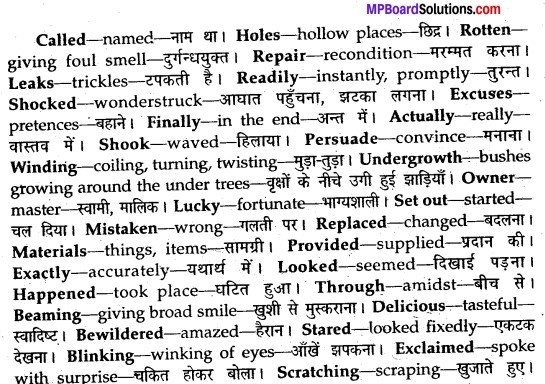
MP Board Class 9th English The Rainbow Solutions Chapter 15 How it all began 4
MP Board Class 9th English The Rainbow Solutions Chapter 15 How it all began 5

We believe the information shared regarding MP Board Solutions for Class 9 English The Rainbow Solutions Chapter 15 How it all began Questions and Answers as far as our knowledge is concerned is true and reliable. In case of any queries or suggestions do leave us your feedback and our team will guide you at soonest possibility. Bookmark our site to avail latest updates on several state board Solutions at your fingertips.
MP Board Class 9th English The Rainbow Workbook Solutions Chapter 1 Bharat Our Land

MP Board Solutions for Class 9 English The Rainbow Workbook Solutions Chapter 1 Bharat Our Land Questions and Answers aids you to prepare all topics in it effectively. You need not worry about accuracy of Madhya Pradesh State Board Solutions for Class 9 English Chapter 1 Bharat Our Land as they are given adhering to the latest exam pattern and syllabus guidelines. You Can Download MP Board Class 9 English Solutions Questions and Answers, Notes, Summary, Guide pdf on is page. Enhance your subject knowledge by preparing from Chapterwise MP Board Solutions for Class 9 English and clarify your doubts on corresponding topics.

MP Board Class 9th English The Rainbow Workbook Solutions Chapter 1 Bharat Our Land

Kick start your preparation by using our online resource Madhya Pradesh State Board Solutions for Class 9 English The Rainbow Workbook Solutions Chapter 1 Bharat Our Land. You can even download MP Board Solutions for Class 9 English free of cost rough direct links available on our page. Clear your queries and understand concept behind in a simple manner. Simply tap on concept you wish to prepare chapterwise and go rough it.

Bharat Our Land Vocabulary and Pronunciation

A. New words are formed by joining two words. They are called compound words.
Examples : Policeman, washer man
Now, write some compound words beginning with ‘any—’ Example : anywhere .
(a) anyhow
(b) anytime
(c) anything,
(d) anyone
(e) anybody.

B. The poet has used words like ‘Himvant’ and ‘Ganga’, make a list of other words which are not English words in the poem.
(a) Upanishads
(b) Buddha
(c) Bharat
(d) Brahma
(e) Aryan.

C. Notice the difference in the pronunciation of these two words- ‘cease’ and ‘sees’.
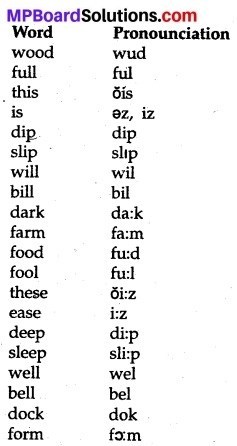
Now, pronounce the following words :
MP Board Class 9th English The Rainbow Workbook Solutions Chapter 1 Bharat Our Land 1
Answer:
For self attempt.

D. It is not describable to confuse/s/ and /f/ because many words are kept separate only by this difference. You must take special care with these phonemes (sounds). The replacement of /s/ by /f/ gives a bad effect to one’s speech.
Now ,listen,repeat and then write the following words in your notebook
so – show
sock – shock
ass – ash
mess – mesh
sort – short
sigh – shy
see – she
same – shame
Answer:
For self attempt.

Listening Skill

A. Listen to the poem ‘Sun’ by the same poet Subramaniya Bharati.
Answer:
See workbook page 2.

B. After listening to the poem recollect and answer the following questions (keep your book closed).

  • What’s the poem about ?
    The poem is about the Almighty God.
  • What are the last two lines of the poem ?
    You foster, you kill.
    You give water, you blow the wind, all good to you.
    If you find any difficulty in answering the above questions, read the poem again.

C. Listen to the lines of the poem ‘Bharat our Land’ and attention to the rhythm :

  • The mighty Himavant is ours.
  • The generous Ganga is ours.
  • The sacred Upanishads are ours.
  • The sunny golden land is ours.

Now say :

  • What are the major objects highlighted in the lines ?
    Himalayas, Ganga, Upanishads, Land. ;
  • Make a list of some words you recall from the poem.
    The Ganga is a holy river. There are four Upanishads. Great Himalayas lie in the north.

Speaking Skill

A. In the poem ‘Bharat our Land’ the poet praises our country. Getting inspiration from the same, let’s praise the following:

  • ‘Madhya Pradesh-our state’
  • ‘My sweet home’

You may use the following words/phrases : big/small, beautiful,
unique, specialities, memories, other things about it ‘
Answer:
Do yourself.

B. Life is like a journey. We meet many people in our life. They leave different impressions on us. Speak a few sentences:

  • about a close friend
  • about someone whom you met only once

Answer:
Do yourself.

Reading Skill

Read the poem carefully and answer the questions given below it.

See Workbook page 9.

Question 1.
What has our motherland given us ?
Answer:
Our motherland has given us many things such as the mighty Himalayas, the generous Ganga, sunny golden land etc.

Question 2.
Fill in the blanks using the word., from the poem.
The poem is about our ………………
Which saw father and mother ……………. and ……………..
A large number of ……………. lived their ………. lives and
Our mother …………… their words and …………………
Answer:
(a) country
(b) live, thrive
(c) ancestors, hoary, died
(d) lisped, grew in wisdom.

Question 3.
Find out words from the poem which mean the following.
(i) grey or white with age/very old ………………..
(ii) absorb ……………….
(iii) speech defect ………………..
(iv) bright/shining ………………….
Answer:
(i) hoary
(ii) suck
(iii) lisped
(iv) lustrous.

Writing Skill

A. Write a short composition, using the adjectives you have learned in the poem praising your city or place.
Answer:
I live in Indore, in Madhya Pradesh. It is the place where I was born and grew. It is a historical place. It has a great history. Many great men were born. They made this land known in the world. I love my city and feel proud.

B. Write the poem in prose form you have read in the text.
Begin like this : (150 words)
The Himalayas are our mountains. There is no equal of it on the earth.
Answer:
It is the source of many rivers such as Ganga, Brahmaputra etc. It is our protector. It protects us from many outer enemies. It also saves us from many unfavourable natural disasters. It brings cloud and rain. It makes the cool breeze blow, rivers and showers flow. We feel proud for having such a grand mountain symbolising our crown. It is the storehouse of a lot of herbs and other resources.

We believe the information shared regarding MP Board Solutions for Class 9 English The Rainbow Workbook Solutions Chapter 1 Bharat Our Land Questions and Answers as far as our knowledge is concerned is true and reliable. In case of any queries or suggestions do leave us your feedback and our team will guide you at soonest possibility. Bookmark our site to avail latest updates on several state board Solutions at your fingertips.
MP Board Class 9th English The Rainbow Solutions Chapter 14 Old Blockhead repairs his House

MP Board Solutions for Class 9 English The Rainbow Solutions Chapter 14 Old Blockhead repairs his House Questions and Answers aids you to prepare all topics in it effectively. You need not worry about accuracy of Madhya Pradesh State Board Solutions for Class 9 English Chapter 14 Old Blockhead repairs his House as they are given adhering to the latest exam pattern and syllabus guidelines. You Can Download MP Board Class 9 English Solutions Questions and Answers, Notes, Summary, Guide pdf on is page. Enhance your subject knowledge by preparing from Chapterwise MP Board Solutions for Class 9 English and clarify your doubts on corresponding topics.

MP Board Class 9th English The Rainbow Solutions Chapter 14 Old Blockhead repairs his House

Kick start your preparation by using our online resource Madhya Pradesh State Board Solutions for Class 9 English The Rainbow Solutions Chapter 14 Old Blockhead repairs his House. You can even download MP Board Solutions for Class 9 English free of cost rough direct links available on our page. Clear your queries and understand concept behind in a simple manner. Simply tap on concept you wish to prepare chapterwise and go rough it.

Old Blockhead repairs his House Textual Exercises

Old Blockhead repairs his House Vocabulary

A. Use the following in your sentences: far away, let, suddenly, a few, looking for, set out, a lot, pull down, look after, take care of, at the end.
Answer:
Our school is far away from here.
Let me sing a song on the stage.
Suddenly, the hare emerged from the bushes.
I have a few friends who will help me.
He is looking for a suitable job.
I set out on a long journey.
Ladies have a lot of work to do.
The bulldozer pulled down the building.
Who looks after the orphans?
A woman alone can take care of the children.
Who is standing at the end of the queue?


B. Give the meanings of :
look, look into, look ahead, look at, look down, look for, look in, look upon, look up, look here.
Answer:
Word – Meaning
Look – to direct ones eyes, to examine, to glance, at a thing.
Look into – to consider.
Look ahead – to look forward.
Look at – to see attentively.
Lookdown – to look with hatred.
Look for – to expect, to search for
Look in – to see horoughly
Look upon – to regard with specified feeling.
Look up – to respect, to consult
Look here – to pay attention.

C. Match the words given under ‘A’ with their meanings given under ‘B’.
A – B
1. owner – (a) suffering from decay
2. mistaken- (b) smile radiantly
3. rotten – (c) one who owns something.
4 beaming – (d) very pleasant to the taste
5. delicious – (e) wrong in one’s opinion or judgement.
Answer:
1. (c), 2. (e), 3 (a), 4. (b), 5. (d).

D. Write different meanings of the following, words and use them in your own sentences, call, idea, save, like, short.
Answer:
Word Meaning Usage

  1. Call Call to speak in a loud tone. She called her uncle for help.
  2. to pay a brief visit. I shall call at your house tomorrow.
  3. to name. Tara Chand is called Sonu.

Idea

  1. a plan. She has an idea to entrap you.
  2. conception. Human brain is full of ideas,
  3. Vague belief. Nuclear families are not good ideas.
  4. intention, aim. What is your idea about your career

Save

  1. to keep for future use. Save some money for the rainy days.
  2. to rescue. Military saves the country against foreign attacks.
  3. Except.’ Who will help you save your relatives

Like

  1. Similar. Sushma is like her brother.
  2. in the manner of. He behaves like a gentleman.
  3. to find pleasing. I like mangoes and oranges.

Short

  1. not long. Her temper is short now we, travelled a short distance on foot.
  2. lacking. The old man is short of money.

E. What is common in the pronunciation of the following words :
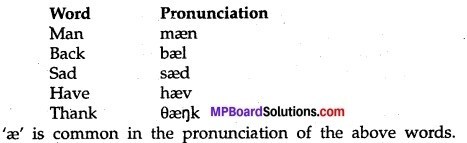
man, back, sad, have, thank

Answer:
MP Board Class 9th English The Rainbow Solutions Chapter 14 Old Blockhead repairs his House 1

Comprehension

A. Answer each of the following questions in about 25 words.
1. Describe the condition of the house as narrated by Ma Block¬head. . .
2. Why was the repair of the house urgent?
3. Why did Ma Blockhead dig the road?
4. After walking the dug road, where did old Blockhead reach?
Answer:
1. One day, Ma Blockhead attracted her husband’s attention towards their house. She said that their house needed repair. Its roof was leaking. Its walls had got holes in them.

2. The old couple lived in a little wooden house. It was far from other people. The roof of the house was full of holes. Besides, the walls of the house were rotten. Therefore, the repair of the house was urgent.

3. Ma Blockhead wanted to persuade her husband to repair the house. Thus they could save some money. Old Blockhead had made many excuses. However he had no money to run the household. So he needed some job to earn money. Ma Blockhead dug the road in order to make her husband work and repair the house

4. Ma Blockhead had dug a winding road. It started from their garden. It passed through bushes and undergrowth. It led back to their garden. Old Blockhead reached the house at the end of the road after walking the dug read. It was his own house.

B. Answer each of the following questions in about 50 words.
1. How was Old Blockhead persuaded to work?
2. What excuses did old Blockhead make?
3. Describe the reaction of old Blockhead when he came to know that he repaired his own house.
Answer:
1. The old Blockhead’s wooden house needed repair. Ma Blockhead asked her husband to repair it. He made silly excuses and showed his helplessness. Ma Blockhead told him that they had ; very little food. This persuaded him to work. But he had no place
to work. Therefore, she dug a winding road. She directed her husband to look for work in the house at the end of the road. Thus she urged him to work there.

2. Ma Blockhead asked her husband to repair their wooden house. Their roof was full of holes. Their walls were also rotten. Old Blockhead neither wanted to repair the house nor did he know how I to repair it. Therefore, he made excuses that he was busy tired and sick.

3. Ma Blockhead was. a clever lady. She due a winding road from their garden back to their garden. She made her husband find the job in her own wooden house. She made him repair his own house. She paid him well for the job. The mystery was out when he gave the money to his wife. He was highly delighted to learn that he had repaired his own house. Besides they would buy good food in plenty with his own earnings. He felt himself lucky.

Old Blockhead repairs his House Grammar

A. Read the following extracts of conversation :

  • “My dear husband” said Ma Blockhead sweetly, “I think you should repair this house.”
  • “Me? Did you say—me?” asked old Blockhead.
  • “Actually” said old Blockhead, “I don’t want to do it. And I don’t know how to do it.”

The above sentences are in Direct Naration.
We can give the exact meaning without using the speaker’s words.

  • Ma Blockhead told her husband politely that she thought he should repair that house.
  • Old Blockhead asked if she had said….him.
  • Old Blockhead said that actually he did not want to do that And he did not know how to do that.

The above sentences are in Indirect Speech.
Now, convert the following into indirect speech :
1. Ma Blockhead replied, “This is our house, isn’t it? Then we should repair it.”
2. A few days later, Ma Blockhead said to old Blockhead, “My dear husband, we had very little food left. I think it will be a good idea if you go out and look for work. If you work, we shall have money. When we have money, we can buy the things we needs.”
Old Blockhead asked Ma Blockhead if she knew where he could get a job. She replied, “I’ve heard that the owner of the house at the end of flus road is looking for someone to work there. Why don’t you try there? If you are lucky, you might get the job.”
Answer:
1. Ma Blockhead gave her husband a counter reply. She declared that that was their house and confirmed if it wasn’t. She further stressed that they should repair it.

2. A few days later, Ma Blockhead informed old Blockhead sweetly that they had very little food left. She thought it would be ; a good idea if he went out and looked for work. If he worked they would have money. When they had money, they could buy the things they needed.

Old Blockhead asked Ma Blockhead if she knew where he could get a job. She replied that she had heard that the owner of the house , at the end of that road was looking for someone to work there. She asked him why he didn’t try there. She further informed him that if he was (were) lucky, he might get the job.

Speaking Activity

A. Following are the events from the story, Discuss the order of the events among yourselves rearrange them and narrate it :
1. Old Blockhead has finished his work.
2. She dug a winding road.
3. No, no I repaired the house at the end of this road.
4. The roof of their house is at the end of this road.
5. Old Blockhead agreed to work at the house.
6. She took some money from her husband.
7. If you are lucky, you might get the job.
8. This is our house, isn’t it? Then we should repair it.
Answer:
Order of events in the story.
8, 2, 7, 5,1, 6, 3, 4.

Writing Activity

A. How can an idle person be motivated to work hard? Elaborate. (50 words).
Answer:
An idle person is a person who is not doing or having any work. He does not spend his time in doing anything particular. He is lazy by nature and avoids doing anything fruitful to self or others’. He simply whiles away his own or others time. He has silly pursuits. It is very difficult to urge him to work. He is the victim of his own nature.

He should be encouraged to work by citing ‘ examples of prosperous and successful persons. He should be prompted to do something by friendly coaxing or instructions. He should be apprised about the horrors of idleness and gainful uses of steady work. He should be told in emphatic words that work is true worship of God.

B. ‘A stitch in time saves nine’. Justify the statement. (150 words)
Answer:
If there is a little tear in. our clothes we should get it stitched at the earliest. If we fail to do so, the number of tears will go on 1 increasing. The proverb means that a small piece of work done now may save a lot of work later. We should act with prudence. The
proverb’one who repairs his gutters repairs his whole house’ conveys the same idea. If we have some disease, we should consult

some reliable doctor and undergo proper treatment. If we postpone the treatment the pimple will grow into an ulcer. It might also cause ; our death. Delays have dangerous consequences. Therefore, do not put off till tomorrow what you can do today. Accumulation of undone jobs makes your work harder. Therefore, finish your work.on schedule.

Violence and lawlessness should be quelled at the very outset. Postponenment can only complicate matters. Failure to get the damages repaired in buildings or vehicles may cause unnecessary expenditure. All bad habits grow from small indulgences. The French Revolution broke out because the French king failed to take timely action to redress the grievances of the masses.

Think it over

A. A man, who is in the habit of postponing his work, is not liked by people. Why?
Answer:
Timely action always brings the desired results. Delays have dangerous consequences. If a farmer does not sow seeds timely or waters his fields timely, his entire labour would go water. Every member of the family will dislike him. If a student puts off studying his subjects and shews poor results, his teachers and parents would dislike him. If the government delays in carrying out its duties, the masses will get angry and overthrow it. Nobody liked the French king when he failed to redress the grievances of the public by averting the outbreak of the French revolution. Idlers and shirkers are sinners and enemies of their own as well as of others.

B. Ma Blockhead managed to draw best out of old Blockhead. Putting such people into work is a witty idea. Think of some other ideas like this?
Answer:
A widow had five sons. They were all idle, stupid, shirkers, quarrelsome and disobedient. They were bullies arid headstrong. They did not listen to any body’s advice or instructions. The widow was sick of them. One day she fell ill and lay on her death bed. She called her sons. She told them that their father had hidden a treasure in the fields. She did not know the exact place. The sons went to the field and turned up the whole soil. They got disappointed not to find the silver or gold there. They sowed seeds. Bumper crop grew. The boys understood the truth of their mother’s statement. They developed the habit of obedience arid working hard. In this way the widow managed to draw best out of dolts or blockheads.

Things to do

1. Arrange your study room systematically everyday.
Answer:
To be done at home individually.

Old Blockhead repairs his House Additional Questions

Short Answer Type Questions (In about 25 words)

Question 1.
Who lived in a little village? What were they called and why?
Answer:
There lived a man and his wife in a little village. The man was called old Blockhead because he was a dolt He was quite ignorant of the ways of the world. He was short of brain. His wife was wise and tactful. However she was called Ma Blockhead because she was the Blockhead’s wife.

Question 2.
How did the old couple live?
Answer:
The old couple led a poor and miserable life. They were short of money. The roof of their wooden house was full of holes. It leaked during the rainy season. Its walls were also rotten. They had no money to get it replaced or repaired. The old man was an evading type. The woman was practical. However, they lived happily. The husband obeyed his wife and followed her directions.

Question 3.
When did Ma Blockhead say, “This is our house, isn’t it?”
Answer:
Ma Blockhead had asked her husband that they should repair that house. He made many excuses to evade her. He did not want to repair the house. He told her that he had a lot of work to do. 1 Hie was also tired and sick. These excuses irritated Ma Blockhead ‘ and she replied. ‘This is our house, isn’t it?’

Question 4.
Do you like old Blockhead? If not, why not?
Answer:
I do not like old Blockhead at ail. He is an irresponsible husband. He is not ready even to repair his leaking and rotten wooden house. His words are not reliable. Once he says that he has a lot of work to do. Again he says to his wife if she knows where he can get a job. He doesn’t provide his wife with proper food and shelter.

Long Answer Type Question (in about 50 words)

Question 1.
Compare and contrast the characters of old Blockhead and Ma Blockhead.
Answer:
Blockhead and Ma Blockhead are husband and wife. Both are aware about their rotten house and shortage of food. Old Blockhead is evasive of his responsibilities. He knows how to repair the house yet he shows his ignorance. He is money minded and blunt i spoken. He is a liar. Ma Blockhead is soft spoken. She is an ideal wife. She urges her husband to work and improve his way of life. She is the bursar, guide and manager of the household.

Old Blockhead repairs his House Summary in English

A blockhead and his wife Ma Blockhead lived in a small village. They lived in a little wooden house. Their roof” was full of holes and their walls were rotten. One day M Block head asked Old Block-head to repair the house. Old Blockhead told her that he was busy, tired and sick. These were all excuses. He neither wanted nor knew how to repair the house. Ma Blockhead had an idea. She dug a winding road from their garden, back to their garden. One day she asked her husband to look for work. Old Blockhead did not know where to get a job.

Ma Blockhead told him that the owner of the house at die end of the road was looking for some worker Old Blockhead followed the winding path and reached a little wooden house. A woman came out. She looked like his wife. Even the house looked like his own ‘ house.

The woman asked Old Blockhead to repair her house. Old Blockhead agreed to replace the roof and the walls. He pulled down the rotten walls and brought down the leaky roof. The woman looked after his food and drink so long as he worked there. He went home every evening. Old Blockhead finished his work in a week. The woman paid him well for the job. Old Blockhead reached home along the winding road through the bushes and undergrowth. He gave ‘ the money to his wife. The wife beamed with a smile. Now they could buy good food in plenty. He got amazed to see how his own house had been repaired. His wife shook with laughter and told him that he himself had repaired it. He learnt that the house at the end of the road was his own house.

Old Blockhead repairs his House Summary in Hindi

एक ब्लॉकहैड (महामूख) और उसकी पत्नी माँ ब्लॉकहैड किसी छोटे गाँव में रहते थे। वे लकड़ी के एक छोटे-से घर में रहते थे। उनकी छत, छेदों से भरी हुई थी और उनकी दीवारें सड़ी हुई थीं। एक दिन माँ ब्लॉकहैड ने ओल्ड ब्लॉकहैड से घर की मरम्मत करने के लिए कहा। ओल्ड ब्लॉकहैड ने उसे बताया कि वह व्यस्त, थका हुआ और बीमार है। ये सभी बहाने थे। वह न तो घर की मरम्मत करना चाहता था और न ही उसे वह काम आता था।

माँ ब्लॉकहैड को एक विचार आया। उसने अपने बाग से लेकर वापस अपने बाग तक एक मुड़ी-तुड़ी सड़क बनाई। एक दिन उसने काम ढूँढ़ने के लिए अपने पति से कहा। ओल्ड ब्लॉकहैड नहीं जानता था कि कहाँ काम तलाश करे। माँ ब्लॉकहैड ने . उसे बताया कि सड़क के सिरे वाले मकान का मालिक किसी काम करने वाले की तलाश में है। मुड़े-तुड़े रास्ते पर चलते हुए ओल्ड ब्लॉकहैड, लकड़ी के एक छोटे मकान के पास पहुँचा। एक महिला बाहर आई। वह उसकी पत्नी जैसी लगती थी। वह घर भी उसके अपने घर जैसा लगता था। महिला ने ओल्ड ब्लॉकहैड से कहा कि उसके घर की मरम्मत कर दे। ओल्ड ब्लॉकहैड, छत और दीवारों को बदलने के लिए सहमत हो गया। उसने दुर्गन्धयुक्त दीवारों और चूती हुई छत को भी गिरा दिया। जब तक उसने वहाँ काम किया, महिला ने उसक खाने और पीने की देखभाल रखी।

वह रोज शाम को अपने घर चला जाता था। ओल्ड ब्लॉकहैड ने एक सप्ताह में अपना काम समाप्त कर दिया। महिला ने उसके काम के बदले उसे अच्छी धनराशि दी। झाड़ियों के बीच से मुड़ी-तुड़ी सड़क पर चलते हुए, ओल्ड ब्लॉकहैड घर पहुँच गया। उसने अपनी पत्नी को धनराशि दी। पत्नी, खुशी से मुस्कराई। अब वे काफी मात्रा में अच्छा भोजन खरीद सकते थे। वह यह देखकर हैरान हो गया कि उसके अपने घर की मरम्मत कैसे हो गई। उसकी पत्नी जोर-जोर से हँसने लगी और उसे बताने लगी कि स्वयं उसी ने उसकी मरम्मत की थी। उसे पता चला कि सड़क के सिरे वाला मकान उसी का अपना मकान था। .

Old Blockhead repairs his House Word Meanings
MP Board Class 9th English The Rainbow Solutions Chapter 14 Old Blockhead repairs his House 2

We believe the information shared regarding MP Board Solutions for Class 9 English The Rainbow Solutions Chapter 14 Old Blockhead repairs his House Questions and Answers as far as our knowledge is concerned is true and reliable. In case of any queries or suggestions do leave us your feedback and our team will guide you at soonest possibility. Bookmark our site to avail latest updates on several state board Solutions at your fingertips.
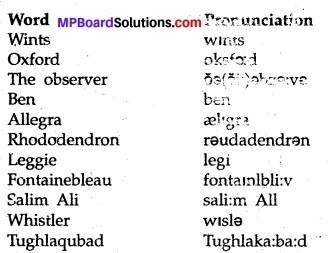
MP Board Class 9th English The Rainbow Solutions Chapter 13 Stopping by Woods on a Snowy Evening

MP Board Solutions for Class 9 English The Rainbow Solutions Chapter 13 Stopping by Woods on a Snowy Evening Questions and Answers aids you to prepare all topics in it effectively. You need not worry about accuracy of Madhya Pradesh State Board Solutions for Class 9 English Chapter 13 Stopping by Woods on a Snowy Evening as they are given adhering to the latest exam pattern and syllabus guidelines. You Can Download MP Board Class 9 English Solutions Questions and Answers, Notes, Summary, Guide pdf on is page. Enhance your subject knowledge by preparing from Chapterwise MP Board Solutions for Class 9 English and clarify your doubts on corresponding topics.

MP Board Class 9th English The Rainbow Solutions Chapter 13 Stopping by Woods on a Snowy Evening

Kick start your preparation by using our online resource Madhya Pradesh State Board Solutions for Class 9 English The Rainbow Solutions Chapter 13 Stopping by Woods on a Snowy Evening. You can even download MP Board Solutions for Class 9 English free of cost rough direct links available on our page. Clear your queries and understand concept behind in a simple manner. Simply tap on concept you wish to prepare chapterwise and go rough it.

Stopping by Woods on a Snowy Evening Textual Questions

Stopping by Woods on a Snowy Evening Vocabulary

A. Distinguish between the following words given in pair:
1. house and home.
2. woods and forests
3. snow and ice
4. watch and see
5. say and ask.
Answer:

  1. House : It is a place of dwelling.
    Home : A fixed residence inhabited by one’s family member lovingly.
  2. Woods : A place, where trees grow thickly, smaller than a forest.
    Forests : A large tract covered chiefly with trees and undergrowth
    (an extensive wood)
  3. Snow : The light white flakes in which frozen vapour falls to the earth.
    Ice : It is frozen water.
  4. Watch : To observe something keenly. A state of being on the look out for something.
    See : To look at something casually.
  5. Say : To utter or recite in speaking voice.
    Ask : To inquire, to put a question.

B. Add two more opposites to the given list.
1. known : strange, alien, unknown, ………………… , …………………..
2. village : city, town,……………… , ……………
3- easy : difficult, complex, hard, ………………… , …………………..
4. dark : light, pale, bright, ………………… , …………………..
5. deep : shallow, thin,………………… , …………………..
Answer:

  1. unfamiliar, odd
  2. capital, metropolis
  3. tough, intricate
  4. shining, luminous
  5. superficial, trivial.

C. Write some more synonyms for each of the following words.
1. sleep – slumber, ………………… , ………………….. ,………………… , …………………..
2. house – abode, ………………… , ………………….. ,………………… , …………………..
3. ask – demand, ………………… , ………………….. ,………………… , …………………..
4. mistake- error, ………………… , ………………….. ,………………… , …………………..
5. lovely – appealing, ………………… , ………………….. ,………………… , …………….
Answer:

  1. dozing, inactivity, death, dormancy,
  2. lodging, dwelling place, residence, place for habitation.
  3. request, enquire, entreat, appeal
  4. fault, lacuna, flaw, defect
  5. enchanting, charming, pleasing, attractive.

D. Say the following sentences and notice the difference in the pronunciation of the words ‘and’ and ‘but’
1. I need some bread and butter.
2. And miles to go before I sleep.
3. But I have promises to keep.
4. But she is at home.
5. They are poor but proud.
Answer:
MP Board Class 9th English The Rainbow Solutions Chapter 13 Stopping by Woods on a Snowy Evening 1

E. Say the following words and notice the difference in the vowel sounds :
wood, full, this, is, dip, slip, will, bill, dark, farm, food, fool, these, ease, deep, sleep, well, bell, dock, form
Answer:
MP Board Class 9th English The Rainbow Solutions Chapter 13 Stopping by Woods on a Snowy Evening 2

Comperhension

A. Read the first two stanzas of the poem given below and answer the following questions.

Whose woods these are I think I know.
His house is in the village though;
He will not see me stopping here
To watch his woods fill up with snow.
My little horse must think it queer
To stop without a farmhouse near.
Between the woods and frozen lake
The darkest evening of the year. 

Questions :
1. Who do you think is the real owner of the woods?
2. Find out the lines that convey the following meaning :
The poet stopped there to enjoy the beauty of the woods covered with snow.
3. What is strange about the poet’s stopping by woods?
Answer:
1. The real owner of the woods is a villager known to the poet.
2. He will not see me stopping here.
To watch his woods fill up with snow.
3. To stop without a farm house near on the darkest night of the year is strange about the poet’s stopping by woods.

B. Read the third and fourth stanzas given below and answer the following questions.

He gives his harness bells a shake
To ask if there is some mistake.
The only other sound’s the sweep
Of easy wind and downy flake.
The woods are lovely, dark and deep.
But I have promises to keep,
And miles to go before I sleep,
And miles to go before I sleep.

Questions :
1. Why does the horse give his harness bells a shake?
2. Why does the horse think it to be a mistake?
3. What other sounds are heard by the poet?
4. What do you understand by ‘downy flake’?
5. Why does the poet think of the ‘promises to keep’?
6. What message do the last two lines of the poem convey?
Answer:
1. The horse gives his harness bells a shake to draw the poet’s attention and ascertain whether there was some mistake on the part of his master.
2. The horse thinks it to be a mistake that his master should stay in the woods though there is no farmhouse nearby.
3. The other sounds heard by the poet ate the sweeping of easy
wind and downy flake.
4. ‘Downy flake’ means ‘soft and thin pieces or bails of ice’.
5. The poet thinks that he has miles to go before he steeps.
6. The last two lines of the poem convey that human beings . have (the poet has) much work to do before the end of his Journey.

Speaking Activity

A. Practise the following rhyming words,
know here lake sweep
though queer shake deep
Answer:
MP Board Class 9th English The Rainbow Solutions Chapter 13 Stopping by Woods on a Snowy Evening 3

B.The poet says about the woods :
The woods are lovely dark and deep.
Now, use the words given in brackets and say about the following:
(beautiful, green, sandy spacious, shallow, high, steep, full of water, airy).
1. The hills are …………… , …………… and …………..
2. The rivers are …………… , …………… and …………..
3. The house is …………… , ……………and ……………
Answer:

  1. green, high and steep,
  2. sandy shallow and full of water
  3. beautiful, airy and spacious.

Writing Activity

A. Have you ever been enchanted with a beautiful scene? Describe the scene and your feelings. (50 words).
Answer:
Once I happened to go to Simla. 1 left by the night train. The journey was very interesting. I was enchanted by the scenery on either side of the railway line. There were small waterfalls. There were villages scattered here and there. There were dark tunnels on the way. Pine trees could be seen at the high altitude. They added to the beauty of the landscape. Whenever there was a strong gust of wind, they produced a delightful rustling sound. There were tall trees along the circuitous paths. I was delighted to see the scenic beauty’ of the hills.

B. Compare the life in a city with the life in a village. (15 words)
Answer:

Life in a CityLife in a Village
Life in a city, is full of strain and hurry. The people live in small” and -ungested houses. There are few parks and there is no greenery. The people drink synthetic milk. They take loans and buy the items of luxury. They eat the food grains produced by the villagers. They are selfish and self centred. They are crooked and of unreliable integrity. They are non-cooperative. Everyone is after grinding his own axe. There is no breathing space in the thickly populated areas. The people are showy. Even their petty quarrels are settled in courts. Life is complicated. People suffer from various diseases. City life is full of all types of facilities but it is costly to procure them. The people live in nuclear families.The villagers live in the lap of nature. There are open fields, Persian wheels and tube wells. The people have plenty of live stock as buffaloes, cows, goat and sheep. They drink their fresh mOk. The ballocks and camels plough their fields. The country’s foodgrain is grown there. The villagers supply the surplus foodgrains to the city dwellers. The people in the villages are good natured, well mannered and extremely well behaved. They are liberal and cooperative. Villages are lined with trees and gardens. The people are not showy. They settle their petty disputes with ease and love. Life is simple. The people of the villages are healthy. There are insufficient facilities in villages. The people live in joint families.

Think it over

A. Wood is a place where nature is in its most beautiful form. The sounds that we hear in the woods have a musical effect.
B. What different sounds do’we hear in a wood in different sea-sons?
C. A frozen lake is like a playground. What games can be played there?
Answer:
A. woods are always full of musical sounds. Apes gibber; bears growl, bees hum, elephants trumpet, foxes yelp, hawks scream, jackals howl, lions roar, pigs grunt, tigers growl, birds chirp, crows caw, cuckoos warble, eagles scream,-frogs croak. Larks sing, the rustling trees and rippling streams all produce their own tunes and music. It is very pleasant to go to a wood in the morning. There are more times in the wood than in an orchestra.

B. There are six seasons in India. Rains, winter, summer/spring, hemant and autumn. Nature becomes alive in rainy season. The beasts, wild birds and insects sing with joy. They shiver in cold and their voices are suppressed. They hide themselves in their nests during summer. They hardly sing during spring, nature becomes young. The birds, animals and insects sing cheerful songs. During autumn, nature loses its freshness. The trees shed their leaves. Nature sings sorrowful songs then.

C. A frozen lake is like a playground for ice-hockey, skiing, skating, yatching, and skidding which can be played in it. Yaks and dogs drag sledges.

Things to do

Collect wild flowers growing in your surroundings. Dry them with the help of a blotting paper and stick them in your project book. Write a few lines about the activity you have done.
Answer:
Class-room activity.

Stopping by Woods on a Snowy Evening Additional Questions

Short Answer Type Questions (In about 25 words) .

Question 1.
When and where does the poet intend to stay?
Answer:
It is a dark and snowy evening. The poet has to stop by someone’s woods. He knows the name of the owner of the forest. The owner’s house is in a nearby village.

Question 2.
How and what will the poet enjoy there?
Answer:
The poet stops his horse in the woods. He cannot travel through the woods in pitch darkness. He would enjoy the beauty of nature. The sight of the falling mow will lend him joy. He will enjoy himself in the company of his horse.

Question 3.
How and why does the horse warn the poet?.
Answer:
The horse thinks it odd that the poet should stay in the lonely woods on a snowing evening. There was no farmhouse there and there was dead stilless all around. The horse warns the poet of his wrong decision by moving his neck.

Question 4.
What does the poet mean by ‘promises’ in the last stanza of the poem?
Answer:
By ‘promises’ in the last stanza of the poem, the poet means the duties, a human being has to perform. It reminds him of Pt. Nehru’s promise to do a lot of work for the progress of the nation before the end of his journey.

Long-Answer Type Questions (in about 50 words)

Question 1.
What is nature? How are we concerned with nature?
Answer:
We love and admire nature. Nature is an extraordinary fact which is full of energy. We can see nature all around us in rivers, insects, rocks, hills, glaciers. In a nutshell we can view nature in each and every particle of the universe. Nature is a vital part of our life. We are closely related to nature in various forms. We have tender feelings towards green trees and plants; weeds and leaves. By hurting nature, we hurt ourselves. The full moon in the sky gives us hearty joy. We must not lose communion with nature. The cool breeze at dawn provides us with fantastic experience of Nature. Our relation with Nature must be simple, guiltless and unclouded Nature calls us to have affection for others. If we live in harmony with nature we shall certainly feel proud to be a part of nature.

Question 2.
Woods are the clusters of trees. Give an account of your favourite trees.
Answer:
My house is located on a hill. There are many trees around my house. They are acacia, bamboo, banyan, birch, cactus, grafts, guavas, mangoes, palms, pines, polyalthia, tamarind, margosa, teak and the Mohwas. The Mohwa is however my favourite tree. Its flowers are delicious. To the people of central India it provides the most important article of food. Its flowers can be stored almost indefinitely. It has a large thick grey bark. The tree blooms at night and at dawn each short-lived flower falls to the ground. Its flowers taste like pressed figs. Sugar, puddings and other sweetmeats are made from them. A thick oil is extracted from the kernels of its fruit. It is also named the butter tree. The oil is used for cooking, making soap and candles. Its flowers, are the favourite food of deer, bears and peafowls. Its milky thick juice cures rheumatism. Its bark cures leprosy and heals wounds. Its flowers relieve cough and heart troubles. Its fruits cure T.B. and B.P.

Stopping by Woods on a Snowy Evening Summary in English

One dark evening, the poet has to stop by some known person’s woods. The owner’s house is in a nearby village. He would enjoy the beauty of falling snow. His horse thinks it odd. There was no farmhouse near. The horse moves his neck to warn him of his wrong decision. The poet realises drat he has much work to do before the end of his journey.

Stopping by Woods on a Snowy Evening Summary in Hindi

एक अंधियारी रात को कवि को किसी परिचित व्यक्ति के वनों में रुकना पड़ता है। मालिक का घर नजदीक वाले गाँव में है। वह गिरती हुई बरफ के सौन्दर्य का आनन्द लेगा। उसका घोड़ा इसे विचित्र समझता है। वहाँ नजदीक में कोई फार्म हाउस नहीं था। घोड़ा उसके गलत निर्णय के बारे में उसे सचेत करने के लिए अपनी गर्दन हिलाता है। कवि को एहसास होता है कि यात्रा को समाप्त करने से पहले उसे काफी काम करना है।

Stopping by Woods on a Snowy Evening  Word-Meanings

MP Board Class 9th English The Rainbow Solutions Chapter 13 Stopping by Woods on a Snowy Evening 4

We believe the information shared regarding MP Board Solutions for Class 9 English The Rainbow Solutions Chapter 13 Stopping by Woods on a Snowy Evening Questions and Answers as far as our knowledge is concerned is true and reliable. In case of any queries or suggestions do leave us your feedback and our team will guide you at soonest possibility. Bookmark our site to avail latest updates on several state board Solutions at your fingertips.
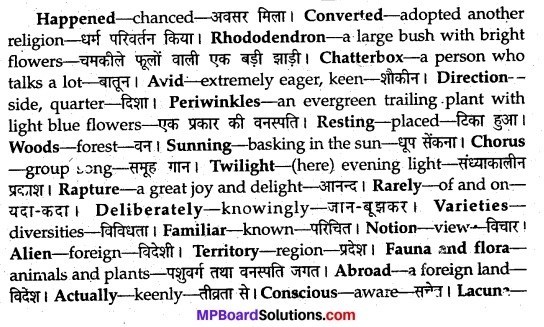
MP Board Class 9th English The Rainbow Solutions Chapter 12 The Poet and the Pauper

MP Board Solutions for Class 9 English The Rainbow Solutions Chapter 12 The Poet and the Pauper Questions and Answers aids you to prepare all topics in it effectively. You need not worry about accuracy of Madhya Pradesh State Board Solutions for Class 9 English Chapter 12 The Poet and the Pauper as they are given adhering to the latest exam pattern and syllabus guidelines. You Can Download MP Board Class 9 English Solutions Questions and Answers, Notes, Summary, Guide pdf on is page. Enhance your subject knowledge by preparing from Chapterwise MP Board Solutions for Class 9 English and clarify your doubts on corresponding topics.

MP Board Class 9th English The Rainbow Solutions Chapter 12 The Poet and the Pauper

Kick start your preparation by using our online resource Madhya Pradesh State Board Solutions for Class 9 English The Rainbow Solutions Chapter 12 The Poet and the Pauper. You can even download MP Board Solutions for Class 9 English free of cost rough direct links available on our page. Clear your queries and understand concept behind in a simple manner. Simply tap on concept you wish to prepare chapterwise and go rough it.

The Poet and the Pauper Textual Exercises

A. What is meant by the following expressions?
Fie, not at all, Sir, wonderful, that’s right, aside, bea-oo-tiful, Ah- h-choo
Answer:
‘Fie’ is an exclamatory word which means ‘shame’.
‘Not at all’ means ’in no case’
‘Sir’, a word of respect.
‘Wonderful’ means ‘amazing’
‘That’s right’ means ‘agreed, that’s quite right’.
‘Aside’ means ‘apart’ to or on one side’.
‘bea-oo-tiful’ means ‘pretty or good-looking’.
’Ah-h-choo1 means ’the sound of sneezing’.

B. Use the following words in your own sentences :
job, work, trade, employment, profession
Answer:
Words – Usage in sentences
Job – She has got the job of a clerk.
Work – Nobody works earnestly these days.
Trade – Two of a trade seldom agree.
Employment – There is shortage of employment in the country
profession – Teaching is a noble profession.

C. ‘Sweet’ and ‘charming’ adjectives are being used for ‘autumn’. What other adjectives can be used for ‘autumn’.
Answer:
Some other adjectives which can be used for ‘autumn’ are ‘pretty, heart-winning, winsome, capyivating.

D. Before the word ‘evening’ serene, tranquil and beautiful these adjectives have been used. Write other appropriate adjectives.
Answer:
Some other appropriate adjectives which can be used with evening are—calm, cool, pretty, fascinating, alluring.

E. Match the words given under A with the meanings given under B, list B has some extra items.
MP Board Class 9th English The Rainbow Solutions Chapter 12 The Poet and the Pauper 1
Answer:
1. (e); 2. (d), 3. (g), 4. (a), 5. (c), 6. (b).

F. Identify the theme of the lesson and list some more vocabulary items pertaining to the theme.
Answer:
The poet scolds the servant for being late in cooking food. He also scolds the pauper for using the word ‘hunger’. He calls it a worthless word. It shows the poet’s false and foul play. He directs the pauper to quench his starvation with the spring breeze. However, he craves to get food earlier though he is not hungry

G. Listen and repeat: Really, haven’t, belly, azure, minute, moment, hours, ours, sneeze.
Answer:
For self-attempt.

Comprehension

A. Answer each of the following questions in about, 25 words.
1. Compare the needs of the poet and the pauper.
2. Why did Bashambad need a job?
3. Why does Bashambad say that breeze was enough to satisfy one’s belly and nothing else was needed.
4. What class of people do Kunja Babu and Bashambad represent?
Answer:
1. Both the poet and the pauper needed something to wrap their bodies with, to avoid chilL Both were hungry. They needed something solid to eat.

2. Bashambad was starving. He had a little rice at half past ten and hadn’t had a bite since then. He needed a job to earn money for food. His hunger made him need a job.

3. Bashambad said that he needed something solid to remain alive. The poet got enraged and asked him to go away and eat rice, dal and curry to his fill. The pauper asked the poet where he should get those things. On seeing the poet angry, the pauper said that breeze was enough to satisfy one’s belly and nothing else was needed.

4. Kunja Babu was a celebrated poet. He belonged to the rich society. He owned a house, a lovely garden and even a cook. He led a luxurious life. He had woollen clothes. Bashambad represents the poor society. He needed work to earn food. This shows he lived like a pauper from hand to mouth. He did not have even a shawl to avoid shivering.

B. Answer each of the following questions in about 50 words:
1. Why so late? Does it take two hours to get the food ready? Characterise Kunja Babu in the light of his above statement.
2. Describe in brief the condition of the pauper.
Answer:
1. Kunj Babu was an idealist. He was not a practical man. He asked the pauper not to use the word ‘hunger’. He advised him not to make a fuss of his hunger. He bade him go away and satisfy his hunger there. Though it was the time for dinner yet he was not ready to feed an actually hungry person. He told the pauper that the spring breeze would suffice for all his needs. Soon after he scolds .The servant for preparing the dinner late. He lacked coordination in his thoughts, words and actions.

2. The pauper was not a beggar. He did not beg for food. He needed a job to satisfy his hunger. He could not help thinking about hunger though he was asked not to mention it. He agrees unwillingly to accompany the poet to his garden. The spring breeze made him sneeze and cough. It worsened his condition. His teeth started chattering. He had no shawl to save him from cold. He had a bitter experience at the poet’s house. The poet bade him go away. He was treated like a beggar.

The Poet and the Pauper Grammar

A. Study these sentences occurred in a dialogue.

  • Kunja : This is no place for you-you are trespassing.
  • Bashambad : I’ll go at once.
  • Kunja : I’m glad to hear you say so.
  • Bashambad : There’s a chill in the air.

The above are the speakers’ exact words : Direct speech is found in conversations in books, in plays, and quotations. In indirect speech we give the exact meaning of a remark or speech, without necessarily using the speakers’ words.
Examples : Thus we can write the aforesaid dialogue.

  • Kunja said that was no place for him. He was trespassing.
  • Bashambad said that he would go at once.
  • Kunja said that he was glad to hear him say so.
  • Bashambad said that there was a chill in the air.
  • Put the following statements into indirect speech.

Question 1.
Bashambad : I’m thinking even more about it now than I usually do. I had a little rice at half-past ten before I set out job hunting, and I haven’t had a bite since then.
Answer:
Bashambad told the poet that he was thinking even more about that then than he usually did. He had had a little rice at half-past ten before he had set out job hunting, and he hadn’t had a bite since then.

Question 2.
Kunja : If you must go on wheezing like this, you should wrap yourself in a blanket and huddle in a comer of your room.
Answer:
Kunja warned the pauper that if he must go on wheezing like that, he should wrap himself in a blanket and huddle in a comer of his room.

Speaking activity

A. You have gone through the one act play. Now sit in pairs and deliver the following dialogues with proper intonation.
Kunjabihari : What brings you here, my good man?
Bashambad : Sir, I,m starving. You’d talked about a job
Kunjabihari : A job ! work ! Who thinks of work in this sweet autumn weather?
Bashambad : No one does so of choice, sir, it’s this hunger that-
Kunjabihari : Hunger? Fie, fie, what a mean, paltry word ! Pray, do not repeat it before me!
Answers:
Kunjabihari : What do you want, man?
Bashambad : Sir, I want some work to earn money and satisfy my hunger.
Kunjabihari : Don’t talk of work in this fine autumn weather.
Bashambad : Hunger knows no season, Sir.
Kunjabihari : Beware! Don’t repeat the cursed word ‘hunger’.

B. What is the message conveyed to us by the one act play? You start like this:
Answer:
In my opinion the play conveys a very important message.Even the hungry person does not realise the genuine need of another hungry person. The hungry person needs food more than hol- low advice. The opinion of the strong is an order for the weak.

Writing Activity

A. Suppose you are Bashambad Babu, who has always been subdued, express how you feel at last. (50 words)
Answer:
I am Bashambad Babu. One day I was feeling hungry. I t told my problem to a poet. He checked me from repeating the word ‘hunger’. I agreed but I could not help thinking about hunger. I had not eaten anything since late morning. The poet stressed that moon beams, nectar of flowers and the spring breeze might suffice for all the needs. Again I was subdued. The poet bade me go out and eat rice to my fill. He got angry when I asked him for the place. At last, I was made to accompany him to the garden without a shawl. 1 I fell a victim to cough and cold. In the end, 1 challenged him and , felt free.

B. Discuss how the differences in stature of the poet and the poor man are depicted. Write whom do you admire more and why? (150 words)
Answer:
The poet and the poor man are world apart in stature. The poet is a worshipper of nature. He is least hospitable. Though he is himself hungry yet he does not feel the urgent need of the hungry pauper. Though it is dinner time yet he does not offer food or work to tire hungry pauper. He asks the pauper in a taunting manner to go away and feed himself on rice, dal and curry. It was a cruel joke. This was not a suggestion but a sarcastic remark.

He sermonises that moon beams, the nectar of flowers and the spring breeze meet all needs. He makes fun of the pauper when his teeth chatter in cold. The pauper is hungry. He needs work. He relates his problem , before a poet. The poet ridicules him. Though he is checked from repeating the word ‘hunger’ it does not get out of his mind. He does not enjoy the scenic beauty because he has no shawl.They have different physical, mental and financial statures.

Think it over

A. If a man is hungry his mind will be preoccupied with the thought of food. It would be difficult for him to talk about poetic expressions. But often poets and writers had gone through these unfulfilled basic demands and created master pieces. How?
Answer:
Poets are saintly and superhuman beings. They rejoice themselves in the lap of nature. They renounce all their pleasures. They forget food, drink and clothes. Their minds are never preoccupied with the thought of meeting their physical needs. They engross themselves in poetic pleasures. Many poets and writers”have led a life of want and penury. Yet they have created many pieces. It is due to their dedication and concentration in their own field.

B. Humour is the brighter part of life. Finding humour in day to day life generates optimistic view. Do you feel so?
Answer:
Life is an admixture of humour and pathos Humour is the brighter part of life. It lends us joy and cheer. Humour is spice of life. It creates special flavour. Pathos on the other hand creates an atmosphere of sadness and sorrow. It is never liked in any society.
Finding humour in day to day life generates optimistic view or the hopeful view of things. I also feel so,.

Things to do

Stage the one act play.
Take help of your teacher and your friends.
Answer:
Class-room Activity.

The Poet and the Pauper Additional Questions

Short-Answer Type Questions (In about 25 Words)

Question 1.
Give an account of the Autumn Season.
Answer:
India is a land of seasons. The autumn season is one of them. Tine poet calls it as sweet and charming. The evenings during autumn season are serene, tranquil and beautiful. The moon beams, the nectar of flowers and the breeze fulfill all the needs. The chill of the air is pleasant.

Question 2
Give an account of the pauper’s meeting with the poet
Answer:
A pauper came to the house of a poet. He asked the poet to give him a job because he was starving. The poet snubbed him of thinking of work in the sweet autumn weather. He also warned him against repeating the word ‘hunger’. The pauper sealed his tongue against his will. The poet suggested him to accompany him to the garden. The pauper agreed. However, he caught cough and cold and went away hungry.

Question 3
What does the lesson tell you about the pauper?
Answer:
A pauper was feeling hungry. He asked a poet for work.
The poet asked him to go away and eat rice, dal and curry. It was a cruel joke. The pauper could not get them anywhere.The poet bade him accompany him to his garden to enjoy the beauty of the night. The pauper agreed. The chilly air made him sneeze and cough. He had no wrap. He was forced to go away in order to save himself.

Question 4.
What does the lesson tell you about the poet?
Answer:
The poet was a fan of nature. He told the hungry pauper that the moon beams, the nectar of flowers and the spring breeze would suffice for all his needs. He did not realise that the hungry people did not relish poetic solutions and humorous talks. He was selfish. He himself was hungry but he did not give weight age to pauper’s need for food.

Long-Answer Type Question

Question 1.
Give an account of beggars in India.
Answer:
Begging is a profession in India. Beggars wear rags. Some beggars cover their bodies with ashes. Most of them are crippled or blind. Some beggars sit by the roadsides or outside their shrine.They cry and weep as if they are very hungry Beggars get every-thing without doing anything. Sadhiis and faqirs are also patronised by religious-minded people. Most of the beggars are idlers. They cause a great loss of labour to the nation. Their manual labour could have been utilised in mills and factories. They would have produced useful work. Some beggars arouse pity in the hearts of passers-by in the name of Allah. The healthy beggars should not be given any alms.

The Poet and the Pauper Summary in English

A pauper wanted a job from a poet because he was hungry. The poet said that it was foolish to think of work amidst sweet autumn weather. The poet advised him to enjoy the beauty of the moonlit night. The pauper needed some thing solid to eat. The poet asked him to go and eat rice, dal and curry to his fill. The pauper did not know where he could get them. He declared that he would fill his belly with breeze.

Both of them went out in the chilly air. The poor man started shivering because he had no wrap. The poet wrapped his shawl, closely. He called it a warm weather. The pauper agreed with him that , there was no cold. The poet praised the scenic beauty but the pauper started sneezing and coughing. The poet kept humming a poem and the pauper kept wheezing. The poet called him a kill joy (nuisance). He also bade him leave the garden. The pauper had to leave to save his life. The poet kept gazing at the moon. He scolded his servant for preparing the dinner late.

The Poet and the Pauper Summary in Hindi

एक दरिद्र व्यक्ति को एक कवि से काम चाहिए था क्योंकि वह भूखा था। कवि ने कहा कि मधुर पतझड़ के मौसम में काम के बारे में विचार करना मूर्खता है। कवि ने उसे नसीहत दी कि चांदनी रात के सौन्दर्य का आनन्द ले। दरिद्र को खाने के लिए कोई ठोस पदार्थ चाहिए था। कवि ने उससे कहा कि जाकर चावल, दाल और कढ़ी से अपना पेट भर ले। दरिद्र को यह ज्ञात नहीं था कि वे वस्तुएँ उसे कहां उपलब्ध होंगी। उसने घोषणा की कि वह हवा खाकर अपना पेट भर लेगा।

वे दोनों चिलचिलाती हवा में बाहर निकल गए। दरिद्र व्यक्ति ने काँपना शुरू कर दिया क्योंकि उसके पास कोई शाल नहीं था। कवि ने कसकर अपना शाल लपेट लिया। उसने मौसम को उष्ण बताया। दरिद्र उस के साथ सहमत हो गया और बोला कि सर्दी नहीं है। कवि ने नजारे की सुन्दरता की सराहना की परन्तु दरिद्र ने छींकना और खाँसना शुरू कर दिया। कवि एक कविता को गुनगुनाता रहा और दरिद्र पराई हुई आवाज में सांस लेता रहा। कवि ने उसे गुड़-गोबर करने वाला (कढ़ी बिगाड़/वाहियात व्यक्ति) कहा। उसने उसे बाग से चले जाने का भी आदेश दिया। अपना जीवन बचाने के लिए दरिद्र को जाना पड़ा। कवि एकटक दृष्टि से चांद को देखता रहा। देरी से भोजन बनाने के लिए उसने अपने नौकर को फटकारा।

The Poet and the Pauper Word-Meanings

MP Board Class 9th English The Rainbow Solutions Chapter 12 The Poet and the Pauper 2

We believe the information shared regarding MP Board Solutions for Class 9 English The Rainbow Solutions Chapter 12 The Poet and the Pauper Questions and Answers as far as our knowledge is concerned is true and reliable. In case of any queries or suggestions do leave us your feedback and our team will guide you at soonest possibility. Bookmark our site to avail latest updates on several state board Solutions at your fingertips.
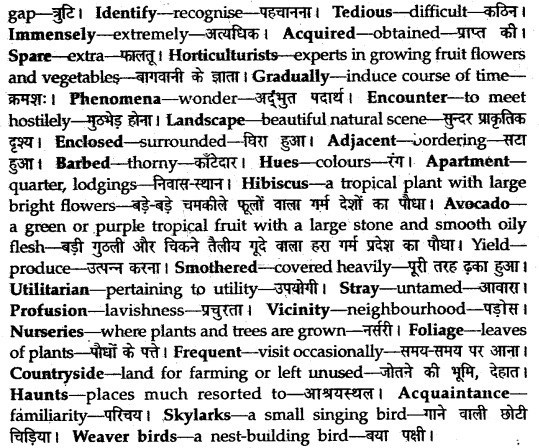
MP Board Class 9th English The Rainbow Solutions Chapter 11 Grandpa Fights an Ostrich

MP Board Solutions for Class 9 English The Rainbow Solutions Chapter 11 Grandpa Fights an Ostrich Questions and Answers aids you to prepare all topics in it effectively. You need not worry about accuracy of Madhya Pradesh State Board Solutions for Class 9 English Chapter 11 Grandpa Fights an Ostrich as they are given adhering to the latest exam pattern and syllabus guidelines. You Can Download MP Board Class 9 English Solutions Questions and Answers, Notes, Summary, Guide pdf on is page. Enhance your subject knowledge by preparing from Chapterwise MP Board Solutions for Class 9 English and clarify your doubts on corresponding topics.

MP Board Class 9th English The Rainbow Solutions Chapter 11 Grandpa Fights an Ostrich

Kick start your preparation by using our online resource Madhya Pradesh State Board Solutions for Class 9  English The Rainbow Solutions Chapter 11 Grandpa Fights an Ostrich. You can even download MP Board Solutions for Class 9 English free of cost rough direct links available on our page. Clear your queries and understand concept behind in a simple manner. Simply tap on concept you wish to prepare chapterwise and go rough it.

Grandpa Fights an Ostrich Textual Exercises

Grandpa Fights an Ostrich Vacabulary

A. Refer to the dictionary and find out the meanings of the following. Use them in sentences. You can use the sentences given in the dictionary as models.
Strange, instant, passion, emerge, unqeual, strides elude, dodging, terrific, desperate
Answer:

WordMeaningsUsage
Strange
Instant
Passion
Emerge
Unequal
Strides
Elude
odd
a short while
strong emotion
to come out
not at par with
big steps
to baffle
Her behaviour was quite strange.
I can beat my rival in an instant.
Fashion breeds passion.
Our team emerged victorious.
You have undertaken an unequal task.
A camel runs with strides.
Don’t try to elude or delude me.

B. Use the following expressions in your own words.
needless to say strange though it may seem
a glimpse of
in an instant
suddenly.
Answer:

  1. Needless to say that he is a cheat.
  2. Strange though it may seem yet it is true.
  3. I had a glimpse of her face.
  4. I can solve this sum in an instant.
  5. Suddenly the cat sprang upon the rat.

C. Pick out from this lesson some words that suggest :
1. movement .
2. surprise
3. anger.
Answer:

  1. go, walk run, climbed, started, gave chase, dating, emerge, bounding, expanding, rushed, circled, charged, step, sprawling, made off.
  2. Startled, dazed, wondered.
  3. aggressive, infuriated, enraged, spiteful.

D. Choose the correct word and fill in the blanks.
1. I was ……………… by tire maddening behaviour of the clerk at the post office, (infuriated, delighted, admired).
2. She’s made a …………….. recovery, (strange, miraculous, shocking)
3. I had to go to the …………………… (work-site work-sight, work-cite).
4. The dog was jumping around me, my face and hands …………….. (licking, liking, leaking)
5. My horse had a accident …………………. (feeble, small, slight)
Answer:

  1. infuriated
  2. miraculous
  3. work-site
  4. licking
  5. slight.

Comprehension

A. Answer each of the following questions in about 25 words.
1. Why did Grandpa decide to go through the ostrich camp?
2. Why did he feel quite safe in such a dangerous situation?
3. What was the only chance to keep him safe during the chase?
4. Why was the huge bird frightened?
5. Describe the unexpected withdrawal of the ostrich.
Answer:
1. Grandpa’s horse had met with a minor accident. He had no other mode of transport. He was a great walker. The passage through the hills was shorter by six miles. Therefore, he decided to go through the ostrich camp.

2. It was dangerous to cross an ostrich farmering the breeding season. The mate ostriches are violent then. They can trample a man to death. Grandpa had his pet dog with him. Even the biggest ostriches are scared even of a small dog. Therefore, he felt quite safe in such a dangerous situation.

3. The grandpa had nothing to defend himself. He turned and ran towards the fence. But it was an unequal race between a man and an ostrich. There was only one chance to keep him safe during the chase. It was to get behind a large bush and try to elude the bird. A dodging game was his only chance.

4. The huge bird came upon grandpa when he had fallen down. But it did not strike. By this time Grandpa’s dog had come there. Ostriches are mightily scared of the dogs. Therefore, the huge bird got frightened. On hearing the dog’s bark, he turned and ran off.

5. Grandpa had fallen down. The ostrich had come upon him. Grandpa was afraid that his end was near. He put up his hand to save his face. To his amazement, the ostrich did not strike. The ostrich heard the dog’s bark. It was afraid that the dog would bring about its end. In order to save its own life, the ostrich withdrew unexpectedly.

B. Answer each of the following questions in about 50 words.

1. Why did Grandpa dare to cross the ostrich farm?
2. Describe the nature and behaviour of ostriches as known to Grandpa.
3. There was an unequal race between Grandpa and the ostrich. Describe it.
4. What traits of character do you notice in Grandpa?
Answer:
1. Grandpa’s horse had met with an accident. So he had to come back on foot from his workplace. An ostrich camp lay on L the way. It was their breeding season. The grandpa’s dog was with him. He knew it well that he was quite safe in the company of his dog. The ostriches were mightily scared of even a small dog. The journey through the hills could save the grandfather a distance of six miles. Therefore, he dared to cross the ostrich farm. He was over confident that no harm could come to him so long as his dog was with him.

2. Grandpa was fairly familiar with the ways of ostriches. He knew that male birds were very violent in breeding season. They could attack on the slightest provocation. He also knows that they , are mightily scared of a dog. It was quite strange that even the biggest ostrich would run away at the sight of even a small dog. It would try to save its own life and never try to fight with even the pet dug.

3. Suddenly, a big male ostrich emerged from a prickly bush about a hundred yards away. He came bounding towards the grandpa. The grandpa turned and ran towards the fence. However, it was an unequal race. Grandpa’s steps were of the length of two or three feet. Hie ostrich’s steps were like strides of sixteen or twenty feet. It means the ostrich’s speed was eight times of the grandpa’s speed.

4. Grandpa had a bundle of good qualities. He was adventurous. He had the courage to go through the hills knowing well that there was an ostrich camp on the way. The male ostriches could even kill him during die breeding season. He was over confident of his dog’s help. He started a dodging game when an ostrich ran towards him. He caught-the ostrich by die wing. It was an act of fearlessness and courage. He covered his face with his hands when the ostrich was upon him. He was careful enough not to come directy in front of his deadly kick.

Grandpa Fights an Ostrich Grammar

A . Study these sentences.

  • Now and then I caught a glimpse of birds.
  • He began to turn or rather waltz.
  • All the while the ostrich kept opening and shutting his beak with loud snaps.
  • I don’t know whether it was the dog’s bark or my own shouting but what I was most anxious to avoid immediately happened.

The underlined words are connectors. In the first sentence ‘aid’ connects words, in the second sentence ‘or’ connects phrases in the third sentence ‘and’ connects clauses and in the fourth sentence ‘or’ connects phrases, ‘but’ and ‘whether’ connect clauses.

B. Fill in the blanks with appropriate connectors given in brackets.
1. He roamed the whole world over to find a real princess …………………….. there was always something wrong, (and, but)
2. He may offer either Mathematics ………………. Physics (nor, or)
3. The frock was spalshed ……………….. so were. Akoulya’s eyes ……………… nose, (nor, and but; or)
4. Some patients had died ………………. the doctor arrived, (before,after)
5. Their game plan was almost final …………. they were beginning to play well as a team, (but, and)
Answer:

  1. but
  2. or
  3. and, and
  4. before.
  5. and.

Speaking Activity

A. Discuss with your friends in the class and find out main characteristics of Ostriches.
Answer:
Class-room discussion.
The following are the main characteristics of ostriches. Almost all birds have four toes but an ostrich has only two toes. Its feet resemble those of the cattle and antelopes. Its inner toes have disappeared. The ostrich can fly as well as run. It can run at a speed of 34 km per hour.

Writing Activity

A. How will you save yourself if you are chased by a dog?
Answer:
It is a common sight that dogs chase human beings in dark and lonely places. If a man gets scared and starts running, he is sure to be bitten. If I am chased by a dog I shall call the dog as ‘Montu’ very affectionately. I will try to pat the dog. The best thing to avoid a chasing dog is to offer it a piece of bread. I shall also pick up some stone lying nearby and show it to the dog. The dog will definitely retreat because it is always careful about its own safety.

B. Make an entry in you diary of a day when you missed your school bus. (150 words)
Answer:
New Delhi. 7th March, 2007
I was appearing at the Secondary School’s Boards examination. My examination was scheduled to start on 6th March, 2007. I got ready to catch the school bus. Unforunately, I happened to miss it. I felt like a fish out of water. I was alone at the bus stop. I had not brought my mobile phone lest it should be lost in the school. I was sweating profusely. My school was located at a distance of ten kilometres. I had only twenty rupees in my pocket. No three wheeler could be hired with this petty amount. I found myself in a tight comer. Just then I noticed a neighbour coming towards me driving his car. His daughter too had to appear at the examination. He gave me a lift. He reached the school in time. Life revived in me due to that good Samaritan, my neighbour.

Think it over

A. An ostrich is a large bird. There is a proverb on the habit of this bird. Why shouldn’t we adopt ‘ostrich policy?’ Think.
Answer:
An ostrich is a very large African bird with a long neck and long legs. Ostriches cannot fly. But they can very fast. They are known for their ‘self-deluding’ methods. We should never adopt ‘ostrich policy’. We should rather obey the voice of our inner conscience. He who disobeys his inner voice loses confidence and “ultimately suffers.

B. When a person encounters a dangerous situation, he prepares himself to face it. Experience helps him? How?
Answer:
Life is full of obstacles. Everyone has to encounter a dangerous situation some time or the other. Those who get nervous have to pay through the nose. One should learn from one’s own and others’ experiences not-to lose heart but show his wit and manliness at such times. One must always remain prepared for the worst. One day I had picked up five oranges from a cart. My pockets were bulging with them. A policeman caught me. He locked me in a cabin. He went away to bring another policeman. In the mean while. I ate the oranges with fibre, barks and pips. The policemen arrived. They found no evidence against me. They released me with a cheerful face. A thief’s experience had helped me.

Things to do

We read about ‘disaster management.’ Collect information about the situation described below :
Answer:

DisasterWhat should be done
1. Fire breaks out in the schoolThe firebrigade should be in­formed, sand and water should be thrown on the fire.
2. There is an earthquake, the students are in the classes.They should either fun out in the open. They can also hide themselves under desks or tables.
3. There is a bus accident.The police should be informed. First aid should be given to the injured.
4. A building collapse 3 in your neighbourhood.The police should be informed.
To call up military. Garbage should be removed
The injured should be given first aid.

Grandpa Fights an Ostrich Additional Questions

Short-Answer Type Questions (In About 25 words)

Question 1.
What’ did grandpa do before joining Indian Railway? What was memorable for him during those days?
Answer:
Before joining Indian Railway Grandpa worked for sometime on the East African Railway. Grandpa’s encounter with an ostrich is the memorable event for him during those days.

Question 2.
Describe the attack of an ostrich on Grandpa.
Answer:
Grandpa was attacked by an ostrich. Grandpa began running towards the fence. But his steps of two or three feet were nothing in comparison to the ostrich’s strides of sixteen to twenty feet.

Question 3.
How did the Grandpa escape?
Answer:
Grandpa adopted the game of dodging with the ostrich. When the ostrich attacked Grandpa, Grandpa jumped sideways and it saved him. Moreover, the ostrich saw Grandpa’s dog. An ostrich is always frightened of a dog. So he ran away leaving him lying on the ground.

Question 4.
When did Grandpa think his end had come? What happened then?
Answer:
The Grandpa caught the ostrich’s wings. The ostrich’s turn and waltz quickly loosened Grandpa’s hold and he fell down. The ostrich came upon Grandpa. He stood with one foot raised to rip grandpa open. The Grandpa thought his end had come. He put up his hands to save his face.

Long Answer Type Question

Question 1.
Describe the Ostrich’s attack on Grandpa.
Answer:
Grandpa’s dog started barking and the Grandpa started shouting. It startled the ostriches and they began darting to and fro. Just then the dog saw a hare and chased him Suddenly a male ostrich emerged from a thicket about a hundred yards away. He stood still and stared Grandpa. For a moment it began spreading its wings. It also erected its tail and started bounding towards Grandpa. It pouhed on the Grandpa who held its wings tightly. A dodging game took place between the two. Ultimately the Grandpa fell down on the ground. His life was saved when his dog appeared on the scene.

Grandpa Fights an Ostrich Summary in English

Ruskin Bond’s grandpa had worked for some time on the East African Railway before he joined the Indian Railways. He had an encounter with an ostrich during his service in Africa.The author’s grandpa was working in the laying of a new railway line. His workplace was twelve miles away. He was returning on foot one day- To save half the distance, he took a short route through the hills. There lay an ostrich ‘camp’ on this way. This was the breeding season. The male birds are very dangerous then. But the grandpa felt safe with his dog. Even the biggest ostrich is afraid of a dog.

The grandpa got through the wire fencing of the farm. The ostriches were feeding some distance away. His dog chased a hare. He called the dog in vain. Just then he saw a big male os .rich com mg out of a bush about a hundred yards away. He stood still staring at the grandpa. Soon he spread his wings and came jumping towards the grandpa. Grandpa ran towards the fence. But the ostrich soon overtook him. There was a strange encounter. Grandpa took care to avoid his kick. He was soon breathless and helpless. He circled a big bush. He was likely to drop from tiredness. Somehow he held the ostrich’s wing. The frightened ostrich began to dance round and round. Grandpa kept clinging to the ostrich’s wing.

Suddenly the ostrich went into reverse. Grandpa fell down and the ostrich was upon him. The ostrich did not strike him. He was ready to rip grandpa open. Soon the ostrich jumped back and ran fast. Grandpa heard his dog bark. The dog and the grandpa were clear of the camp.

Grandpa Fights an Ostrich Summary in Hindi

भारतीय रेलवे में भर्ती होने से पहले रस्किन बांड के दादा ने कुछ समय के लिए पूर्वी अफ्रीका रेलवे में नौकरी की थी। अफ्रीका में नौकरी करने के दौरान उसकी एक शुतुर्मुर्ग-से भिड़न्त हो गई थी।
लेखक के दादा, नई रेलवे लाइन बिछाने का काम कर रहे थे। उसका कार्यस्थल बारह मील की दूरी पर था। एक दिन वे पैदल जा रहे थे। आधी दूरी बचाने के लिए उन्होंने पहाड़ियों के बीच छोटा रास्ता अपनाया। इस रास्ते पर शुतुर्मुर्गों का एक कैम्प था। यह प्रजनन की ऋतु थी। उस समय नर पक्षी बड़े भयानक होते हैं। परन्तु अपने कुत्ते के साथ होते हुए दादा सुरक्षित महसूस कर रहे थे। बड़े-से-बड़ा शुतुर्मुर्ग भी कुत्ते से डरता है। दादा, फार्म की बाड़ के बीच से गुजरे। कुछ दूरी पर शुतुर्मुर्ग भोजन खा रहे थे।

उसका कुत्ता एक खरगोश का पीछा करने लगा। उसने कुत्ते को बुलाया परन्तु व्यर्थ रहा। तभी उसने लगभग सौ गज की दूरी पर एक झाड़ी के बीच से आते हुए एक नर शुतुर्मुर्ग को देखा। वह शान्त खड़ा होकर दादा को घूरने लगा। तुरन्त उसने अपनी पंखें फैलाईं और उछलता-फांदता हुआ दादा की तरफ आया। दादा, बाड़ की तरफ दौड़े। परन्तु शुतुमुर्ग ने तत्काल उन पर काबू कर लिया। एक विचित्र मुठभेड़ (भिड़न्त) हुई। दादा ने उसकी ठोकर से बचने की चौकसी रखी। शीघ्र ही उसका सांस फूल गया और वह लाचार हो गया। वह एक बड़ी झाड़ी का चक्कर लगाने लगा। वह थककर गिरने ही वाला था। किसी तरह से उसने शुतुर्मुर्ग के पंख पकड़ लिये। भयभीत शुतुर्मुर्ग ने गोलाई में नाचना शुरू कर दिया। दादा, शुतुर्मुर्ग के पंख के साथ चिमटा

रहा। अचानक शुतुर्मुर्ग पीछे की तरफ मुड़ा। दादा नीचे गिर गए और शुतुर्मुर्ग उनके ऊपर चढ़ गया। शुतुर्मुर्ग ने उनके ऊपर प्रहार नहीं किया। वह दादा को चीर देने के लिए तैयार था। तुरन्त शुतुर्मुर्ग पीछे की तरफ उछला और तेज दौड़ने लगा। दादा ने अपने कुत्ते के भौंकने की आवाज सुनी। दादा और कुत्ता शिविर में से सुरक्षित निकल आए।

Grandpa Fights an Ostrich Word Meanings

MP Board Class 9th English The Rainbow Solutions Chapter 11 Grandpa Fights an Ostrich 1
MP Board Class 9th English The Rainbow Solutions Chapter 11 Grandpa Fights an Ostrich 2

We believe the information shared regarding MP Board Solutions for Class 9 English The Rainbow Solutions Chapter 11 Grandpa Fights an Ostrich Questions and Answers as far as our knowledge is concerned is true and reliable. In case of any queries or suggestions do leave us your feedback and our team will guide you at soonest possibility. Bookmark our site to avail latest updates on several state board Solutions at your fingertips.
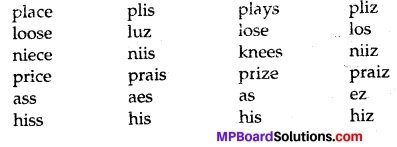
MP Board Class 9th English The Rainbow Solutions Chapter 10 Polonious Advice

MP Board Solutions for Class 9 English The Rainbow Solutions Chapter 10 Polonious Advice Questions and Answers aids you to prepare all topics in it effectively. You need not worry about accuracy of Madhya Pradesh State Board Solutions for Class 9 English Chapter 10 Polonious Advice as they are given adhering to the latest exam pattern and syllabus guidelines. You Can Download MP Board Class 9 English Solutions Questions and Answers, Notes, Summary, Guide pdf on is page. Enhance your subject knowledge by preparing from Chapterwise MP Board Solutions for Class 9 English and clarify your doubts on corresponding topics.

MP Board Class 9th English The Rainbow Solutions Chapter 10 Polonious Advice

Kick start your preparation by using our online resource Madhya Pradesh State Board Solutions for Class 9 English The Rainbow Solutions Chapter 10 Polonious Advice. You can even download MP Board Solutions for Class 9 English free of cost rough direct links available on our page. Clear your queries and understand concept behind in a simple manner. Simply tap on concept you wish to prepare chapterwise and go rough it.

Polonious Advice Textual Exercises

Polonious Advice Vocabulary

A. Match the following :
1. beware – (a) credit
2. generous – (b) rules of behaviour
3. precepts – (c) careful
4. loan – (d) showy
5. gaudy – (e) willing to give freely.
Answer:
1. (c), 2. (e), 3. (b), 4. (a), 5. (d).

B. Explain the meaning of the following words in the poem.
oft, thee, thou, thy.
Answer:
Oft means often at short intervals, many times; frequently
The means ‘you’
Thou means ‘you
They means yours.

C. Pronounce the following words.
here, Shame, sail, steel, day, hear, same, sale, still, they
Answer:
MP Board Class 9th English The Rainbow Solutions Chapter 10 Polonious Advice 1

Comprehension

A. Read the following lines from ‘Give thy thoughts may beware of thee’ and answer the following questions.

Give thy thoughts no tongue,
Nor any unproportion’d thought his act.
Be thou familiar, but by no means vulgar.
The friends thou hast, and their adoption tried,
Grapple them to thy soul with hoops of steel,
But do not dull thy palm with entertainment
Of each new hatch’d unfledg’d courage. Beware
Of entrance to a quairel; but, being in,
Bear’t that the opposed may beware of thee.

Questions
1. What advice has been given about a friend?
2. What should the young men do before materialising the thoughts?
Answers :
1. It has been advised that laertes should be familiar, firm and refined with his tested friends.
2. The young men should not express their thoughts. They should ’act thoughtfully.

B. Read the poem from ‘beware….. generous choice in that’ given below and answer the following questions :

Beware cf entrance to a quarrel, but, being in,
Bear’t that the opposed may beware of thee.
Give every man thy ear, but few thy voice;
Take each man’s censure, but reserve thy judgment.
Costly thy habit as thy purse can buy,
But not expressed in fancy; rich, not gaudy;
For the apparel oft proclaims the man;
Are of a most select and generous choice in that
Neither a borrower nor a lender be;
For loan oft loses both itself and friend,
And borrowing dulls the edge of husbandry.
This above all-to thine own self be true,
And it must follow, as the night the day,
Thou canst not then be false to any man.
Farewell; my blessing season this in thee !

Questions :
1. What does the poet say about the dress?
2. Discuss the disadvantages of borrowing and lending.
3. What has been said about night and day?
Answers :
1. The poet advises Laertes not to wear fancy, rich and gaudy clothes.
2. Both the loans and friends of the borrowers and lenders are lost.
3. As the night and day follow each other unfailingly, so also one must be true to one’s conscience unerringly.

Speaking Activity

A. Following are the two columns. In column ‘A’ we have what Polonious suggested to Laertes and in column ‘B’ the meaning of the suggestions ‘ which are not in order, you have to speak the original version loudly matching it with its proper meaning:

AB
1.  The wind sits in the shoulder of your sail.
2.  Give thy thoughts no tongue.
3.  The friends thou hast and their adoption tried, grapple them to thy soul with hoops of steel;
4.  Give every man thy ear, but few thy voice.
5.  Costly thy habits as thy purse can buy.
6.  rich not gaudy; For the apparel oft proclaims the man;
7. Neither a borrower nor a lender be; For loan oft loses both itself and friend,
8. be thou familiar but by no means vulgar.
(a) Don’t be too vocal to disclose your secrets.
(b) Let familiarity not breed con­tempt.
(c)  Don’t be extravagant.
(d) You have favourable environ­ment.
(e)  Money transaction affects friendship.
(f)  Test the men to whom you are going to keep friendship. Once they are tested keep them dose to you for ever.
(g) Listen more speak less.
(h) Be properly dressed, a man is judged by his dress.

Answer:
1. (d), 2. (a), 3. (f), 4. (g), 5. (c), 6. (h), 7. (e), 8. (b).

Writing Activity

A. Suppose your father had given you the similar piece of advice as given in the text. Convey it in the form of a letter to your friend. (50 words)
Answer:
V&P.O, Garauli Khurd,
Distt. Gurgaon,
Haryana 7th July,
2007 Dear Rakesh,
My father has given me the following pieces of advise. Do not form a false opinion about your school and your school fellows. Never form an opinion about anything without giving it a trial. Never anticipate evils. Never find fault with others. Never think that the other people in the world would dance to your tunes. Learn to live and adjust with others. Always settle your differences in an amicable way with others. Never conceive a prejudice against others. Never find fault in others. Never laugh at the poor and the helpless. Don’t treat yourself to be a king’s son to dictate to others. I am sure they will help me face men and matters successfully in life. Rest when we meet.
Yours sincerely,
Gaurav Bharadwaj

B. Write a letter to your younger brother who is going abroad, suggesting him some precepts. (150 words)
Answer:
V&RO Sadhrana
Distt. Gurgaon,
Haryana
8th July, 2007
Dear Har Narain,
It gave me great joy to learn that you are going to Australia for further studies. I wish you the safest journey and career.
It is-my moral duty to instruct you in the rules of behaviour. A man of loose tongue and loose character is hated in every society. You should ever take a step with due thought. Test the people before befriending them. Be firm and refined in the company of your true friends. Never fall a prey to sensual pleasures. Avoid drinking or smoking. Never involve yourself in avoidable quarrels. Listen to others’ counsels patiently but act wisely. Don’t be wasteful. Fashion breeds passion. Simple living and high thinking alone pay in life. Neither borrow nor lend. Don’t forget your culture.
I hope you will act on my instructions.
Your elder brother
Raghubir Singh Vashishtha

Think it over

A. The elders advise youngsters so that they can minimize their mistakes. Think on the importance of their advice.
Answer:
Importance of Elders’ Advice.Youngsters are prone to making many mistakes. Some serious mistakes land them into trouble. The advice of the elders minimizes their mistakes. Elders have longer experience than youngsters. They have seen life from all angles. Their advice serves as a searchlight in the hours of trouble. Their advice most often serves as guidelines. He, who follows the elders’ advice never falters or suffers.

B. One who learns from his own experiences is definitely prudent, but one who learns from other’s experiences is always wiser. How far do you agree?
Answer:
Experience is a great teacher. The experience of many people is always greater than the experience of an individual, ‘Many minds, many thoughts’ is an apt quotation. One who learns from his own experiences is definitely prudent. Individual suffering sometimes turns one’s direction. But the experience of others always guides one to tread the right path. Even the blind can travel smoothly when they are led by men of eyes. Books are a storehouse of experiences of others. One who reads more books becomes more experienced and wiser.

Things to do

Make a list of advice you receive at home, in school and on the playground.

SI. No.PlaceAdvice
1.HomeRise early in the morning.
Touch your parents’ feet.
Do your home work regularly.
2.SchoolAlways come in proper uniform.
Obey the rules of the school.
Be regular in your studies.
3.PlaygroundDon’t injure your rival Don’t play foul.
Obey your referee

Polonious Advice Additional Questions (in about 25 words)

Short Answer Questions

Question 1.
Give the importance of Good Manners in life.
Answer:
Good manners are a, key to success for every individual. . They help to win friends and maintain cordial relations among them.
All people like polite, disciplined and kind persons. Good manners , can make everybody happy and satisfied.

Question 2.
Give the role of fashions in one’s life.
Answer:
Fashions refer to a style of clothes, hair do etc. youngsters 5 are more crazy about fashions than others. Students adopt new fashions instantly. Fashions are a means of spending money for the rich. They become a harassment for the poor. Fashions have a great role in one’s life. They are a status symbol. The clothes often proclaim the man.

Question 3.
Give your views about the saying ‘Better alone than in Bad Company.’
Answer:
Bad company is more dangerous than a fierce enemy. It leads slowly and unawares towards wrong path and destruction.
Bad company spoils one’s life and ruins the career. Most of the drug addicts and criminals are products of bad company. A person is known by the company he keeps. Bad company tarnishes one’s image. It is difficult to resist the influence of bad company. Therefore it is better to be alone than in bad company.

Question 4.
‘Work is Worship’. Justify.
Answer:
We worship God to seek His blessings for success in our life. However, God helps those who help themselves. Idols worship is a futile practice. Great men are the products of only great works.The best way to pay them respect is to emulate them. Sincere work has magical effects. Man. is the maker of his own destiny.

Long Answer Type Questions (in about 50 words)

Question 1.
‘Honesty is the Best Policy’. Elaborate.
Answer:
Honesty is a godly quality. Honesty in thoughts, words and deeds saves one from scruples of mind. A liar has to tell scores of lies to prove his initial lie. Then there is always, the fear of being caught. Nobody trusts a dishonest man. Nobody would like to be associated with him. A liar is always held in contempt. Material things acquired through dishonest means seldom bring happiness. A dishonest man though rich lives in worries, stress and fears, on the other hand an honest man though poor leads a cheerful and contented life. It justifies that honesty is he best policy.

Question 2.
Uses of Tobacco and alcohol are harmful for health. Justify.
Answer:
One of the most widely spread of bad habits is the use of tobacco. It is smoked or chewed by men, women and even by children, almost all over the world. It is extremely difficult to get rid of the habit once it has been formed. Alcohol is taken in almost all cool and cold climates. Thus it is taken by people who live in the mountains. It is not a necessity for those who live in hot climates and plains of India. Alcohol is not necessary in any way to anybody.

Millions of people are beginning to do without it entirely. It should be avoided by the people in India altogether. Its regular use even in small quantities tends to create uncurable harm in many ways to various organs of the body. It lessens one’s energy, weakens the mental power and affects the liver. It is a slow but sure harbinger of death.

Polonious Advice Summary in English

Polonious asked Laertes to start sailing because the wind was favourable. He advised him to keep certain rules of behaviour in mind. Maintain your character. Den t express your views or act thoughtlessly: Be familiar, firm and refined with your tested friends. Don’t be pleasure-seeking. Prove heroic during quarrels. Hear others’ counsel but act wisely. Don’t wear gaudy clothes. Neither borrow nor lend. Obey your conscience to prove true to everybody.

Polonious Advice Summary in Hindi

पोलोनियस ने लियार्टेज से कहा कि यात्रा प्रारम्भ करे क्योंकि हवा अनुकूल थी। उसने आचरण के कुछ नियमों को मन में रखने के लिए उसे नसीहत दी। अपने चरित्र को बनाए रखना। न अपने विचारों को प्रकट करो और न ही विवेकहीनता से कार्य करो। अपने आजमाए हुए मित्रों के साथ मिल-जुलकर, दृढ़ तथा शुद्ध रहो। व्यसनी मत बनो। झगड़ों के मध्य वीरता का प्रदर्शन करो। दूसरों की सलाह को सुनो परन्तु बुद्धिमत्ता से काम करो। भड़कीले कपड़े मत पहनो, न उधार लो और न उधार दो। अपनी अन्तरात्मा का आदेश मानना और प्रत्येक व्यक्ति के प्रति सच्चे सिद्ध होना।

Polonious Advice Word-Meanings
MP Board Class 9th English The Rainbow Solutions Chapter 10 Polonious Advice 2
MP Board Class 9th English The Rainbow Solutions Chapter 10 Polonious Advice 3

We believe the information shared regarding MP Board Solutions for Class 9 English The Rainbow Solutions Chapter 10 Polonious Advice Questions and Answers as far as our knowledge is concerned is true and reliable. In case of any queries or suggestions do leave us your feedback and our team will guide you at soonest possibility. Bookmark our site to avail latest updates on several state board Solutions at your fingertips.