MP Board Class 7th Special English Grammar

Get Updated MP Board Solutions for Class 7 Special English Grammar Questions and Answers in PDF Format and download them free of cost. These are provided as per the latest exam pattern and syllabus. Access the topics of Chapter wise and communication skills, grammer part through the direct links available depending on the need. You can Download MP Board Class 7 English Solutions and can score highest grade in examination. Clear all your queries on the Mp Board Solutions for Class 7 English Chapter 21 Tansen Questions and Answers Subject by using the Madhya Pradesh State Board Solutions for existing.

MP Board Class 7th Special English Grammar

If you are eager to know about the Madhya Pradesh State Board Solutions for Class 7 English you will find all of them here. You can identify the knowledge gap using these MP Board Solutions for English PDF and plan accordingly. Don’t worry about the accuracy as they are given after extensive research by people having subject knowledge along side from the latest English Syllabus.

Some Parts of Speech

(1) NOUN: A noun is the name of a person, place or thing.
किसी प्राणी, स्थान अथवा वस्तु के नाम को Noun (संज्ञा) कहते हैं।

Kinds of Noun

  1. Proper Noun : Gita, Ram, Agra, Ganges.
  2. Common Noun : boy, girl, book, city, chair.
  3. Collective Noun : class, army, crowd, flock.
  4. Material Noun : gold, silver, iron, stone, wood.
  5. Abstract Noun : honesty, truth, poverty, childhood.

(2) PRONOUN: A pronoun is a word used in place of a noun.
Noun के स्थान पर प्रयोग किए जाने वाला शब्द Pronoun (सर्वनाम) कहलाता है।

  1. Personal Pronoun : I, me, my, we, our, us, you, your, thou, thine, thy, he, him, his, she, her, it, its, they, them, their.
  2. Demonstrative Pronoun : this, that, these, those, such.
  3. Interrogative Pronoun : who, what, which, whom.
  4. Relative Pronoun : who, which, that, whose, whom.
  5. Reflexive Pronoun : himself, myself, yourself, themselves.

(3) ADJECTIVE: An adjective is a word which qualifies a noun or a pronoun.
Noun अथवा Pronoun की विशेषता बतलाने वाले शब्द को Adjective (विशेषण) कहते हैं।

  1. Adjective of Quality : poor, rich, clever, foolish, honoured, red, good.
  2. Adjective of Quantity : some, much, little, enough,
  3. Adjective of Number : ten, eight, many, some
  4. Demonstrative Adjective: this, that, those, these, such.
  5. Interrogative Adjective : what, whose, which.

(4) VERB: A verb is a word which shows something done.
जिस शब्द से किसी कार्य के करने अथवा होने का बोध होता है, उसे Verb (क्रिया) कहते हैं।

Kinds of Verb
1. Transitive Verb : This kind of verb shows an action which passes over from the subject to the object.

Examples :

  1. Prem opens the door.
  2. The cow eats grass.

2. Intransitive Verb: This kind of verb shows an action which stops with its subject. It does not require object to complete its sense.
यह Verb अपने Subject के साथ ही पूरा अर्थ दे देता है। इसे Object की आवश्यकता नहीं होती है।

Examples :

  1. Kamla Sings.
  2. The sun rises in the east.

3. Linking Verb: This verb takes another word (complement) to complete its sense.
यह क्रिया अपना अर्थ पूरा करने के लिए अन्य पूरक शब्द (Complement) लेती है।

Examples:

  1. Ravi is a boy.
  2. Meghna was beautiful.

4. Adverb: An adverb is a word which modifes an adjective, verb or another adverb.
जो शब्द किसी विशेषण, क्रिया अथवा अन्य क्रिया विशेषण की विशेषता बतलाता है, क्रिया-विशेषण कहलाता है।

Kinds of Adverb

  1. Adverb of Time : now, then, when, before, always, never, again, late, soon, etc.
  2. Adverb of Place : here, there, where, everywhere, above, below, under, in, out, far, near, up, etc.
  3. Adverb of Number: once, twice, thrice, often, always, never, frequently, thirdly, etc.
  4. Adverb of Manner : well, thus, slowly, so, wisely, etc.
  5. Adverb of Degree of Quantity : much, more, most, little, wholly, enough, etc.
  6. Adverb of Reason: so, therefore, hence, accordingly, etc.

The Number

Number दो प्रकार के होते हैं
(1) Singular Number (एकवचन) Noun का वह रूप है जिससे एक प्राणी या वस्तु का बोध हो। जैसे-man, boy, girl, chair, etc.
(2) Plural Number (बहुवचन) Noun का वह रूप है जिससे एक से अधिक प्राणियों या वस्तुओं का बोट होता है।
जैसे-
man, boys, girls, chairs, etc.

Formation of Plurals
(बहुवचन बनाना)

Singular से Plural बनाने के लिए निम्नलिखित नियम होते हैं

1. Singular number के अन्त में ‘ड’ जोड़कर-
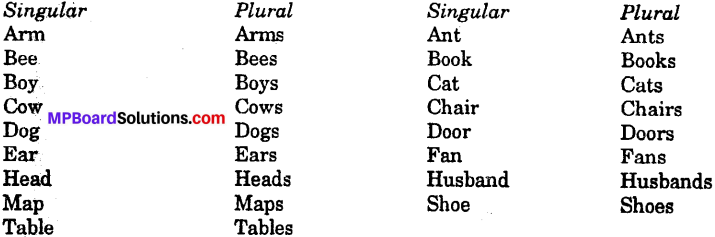
MP Board Class 7th Special English Grammar 1

2. जिन Nouns के अन्त में ‘g’, ‘sh’, ‘ss’, ‘ch’ या ‘x’ होता है, उनके अन्त में ‘es’ जोडकर

MP Board Class 7th Special English Grammar 2

3. जिन Nouns के अन्त में ‘y’ होता है और ‘y’ से पूर्व Vowel हो, तो उनका Plural बनाने के लिए ‘y के पश्चात् ” लगाया जाता है।

MP Board Class 7th Special English Grammar 3

4. जिन Nouns के अन्त में ‘y’ होता है और y’ से पूर्व Consonant हो, तो उनका Plural बनाने के लिए y’ को ” में बदलकर ‘es’ जोड़ दिया जाता है।

MP Board Class 7th Special English Grammar 4

5. जिन Nouns के अन्त में ‘o’ होता है उनका Plural बनाने के लिए उनके बाद में ‘es’ जोड़ा जाता है।

MP Board Class 7th Special English Grammar 5

6. जिन Nouns के अन्त में Fया ‘fe’ होता है, उनका Plural बनाने के लिए ‘ या ‘fe’ को ‘V’ में बदलकर ‘es’ जोड़ दिया जाता है।

MP Board Class 7th Special English Grammar 6

7. कुछ Nouns का Plural बनाने के लिए Singular के अन्दर का Vowel बदल देते हैं।

MP Board Class 7th Special English Grammar 7

8. कुछ Nouns के Singular और Plural एक-से (समान) ही होते हैं।

MP Board Class 7th Special English Grammar 8

9. कुछ Nouns सदैव Singular में ही प्रयोग किए जाते हैं।

MP Board Class 7th Special English Grammar 9

10. कुछ Nouns सदैव Plural में ही प्रयोग किए जाते हैं।

MP Board Class 7th Special English Grammar 10

EXERCISE

  1. निम्नलिखित Nouns को Plural में बदलो
    Baby, branch, bush, wolf, army, loaf, face, wife, child, buffalo, ox, goose, potato, chair, chief, woman, eye, fairy, monkey.
  2. निम्नलिखित Nouns को Singular में बदलो
    Benches, machines, cities, houses, flies, nice, tomatoes, taxes, calves, lives, bamboos, men.

The Gender

परिभाषा-Noun के जिस रूप में यह पता चले कि Noun पुरुष है या स्त्री या बेजान (निर्जीव) है, उसे Gender कहते हैं।

Gender चार प्रकार के होते हैं

  1. Masculine Gender (पुल्लिंग)-वे संज्ञाएँ जो पुरुष जाति से सम्बन्धित होती हैं, उन्हें Masculine (पुल्लिंग) कहते हैं। जैसे-man, dog, boy, horse आदि।
  2. Feminine Gender (स्त्रीलिंग)-वे संज्ञाएँ जो स्त्री जाति से सम्बन्धित होती हैं, उन्हें Feminine (स्त्रीलिंग) कहते हैं। जैसे-women, bitch (कुतिया) girl, mare (घोड़ी) आदि।
  3. Common Gender (उभयलिंग)-जिन Nouns से पुरुष और स्त्री दोनों का बोध होता है, Common Gender में होते हैं। जैसे-child, friends, pupil, (शिष्य) enemy आदि।
  4. Neuter Gender (नपुंसकलिंग)-जिन Nouns से निर्जीव वस्तु का बोध होता है, वे Neuter Gender में होते हैं। जैसे-chair, table, book, house आदि।

नोट-Commmon तथा Neuter Gender का लिंग परिवर्तन नहीं होता है।

CHANGE OF GENDER
(लिंग परिवर्तन)

Masculine से Feminine बनाने के नियम नीचे दिए गए हैं।
1. Singular number के अन्त में ” जोड़कर
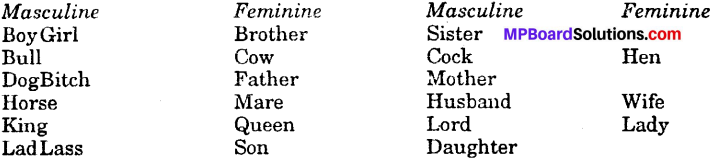
MP Board Class 7th Special English Grammar 11

2. Masculine के अन्त में ‘ess’ लगाकरMasculine

MP Board Class 7th Special English Grammar 12

3. Masculine के प्रथम अथवा अन्तिम शब्द को बदलकर।

MP Board Class 7th Special English Grammar 13

EXERCISE 2

निम्नलिखित Nouns के Opposite Gender लिखो।
(a) Cow, poet, land-lord, lad.
(b) Misterss aunt, hero, horse, king.
(c) Princess, brother, mother, girl, actor, man.

Degrees of Comparison

Adjective on to Degrees in

  1. Positive Degree
  2. Comparative degree
  3. Superlative Degree

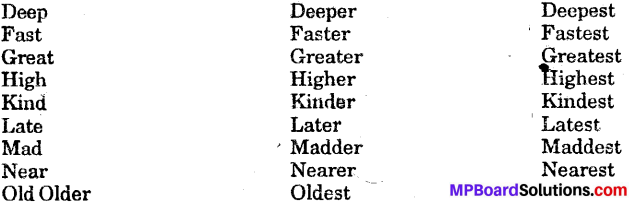
Comparative तथा Superlative बनाने के नियम
1. Positive Degree के अन्त में ‘er’ और ‘est’ लगाकर।

MP Board Class 7th Special English Grammar 14
MP Board Class 7th Special English Grammar 15

2. Positive Degree के अन्त में जब ‘e’ अक्षर होता है तो’ और ‘st’ लगाकर
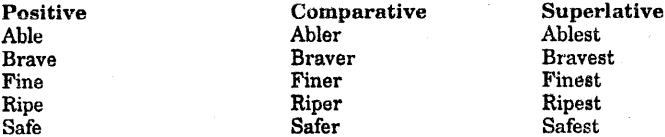
MP Board Class 7th Special English Grammar 16

3. Positive Degree के अन्त में यदि ‘ हो तो y’ को ‘ में बदलकर उसमें ‘err और ‘est’ लगाकर।

MP Board Class 7th Special English Grammar 17

4. Positive degree के पूर्व more यो most लगाकर

MP Board Class 7th Special English Grammar 18

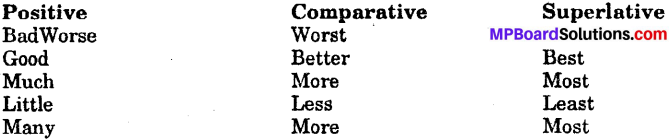
5. बिना किसी नियम के।
MP Board Class 7th Special English Grammar 19

EXERCISE 3

Write the comparative and superlative degrees of the following adjectives :

  • Wise, tall, long, good, bad, old, happy, little.
  • Rich, young, big, strong, ugly, holy.
  • Kind, up, able, safe, dry, useful.

EXERCISE 4

Fill in the blanks with the correct form of adjectives given in the brackets.

  1. Pen is ……………………………… than sword. (might)
  2. Shyam is ……………………………… than Ram (tall)
  3. Kolkata is the ……………………………… city in India. (busy)
  4. Shimla is ……………………………… than Delhi. (cold)
  5. He is the ……………………………… of all the brothers. (wise)
  6. Shipra is the ……………………………… of all the sisters. (pretty)
  7. Rohit is ……………………………… than Mohit. (Clever)

The Preposition

A Preposition is a word which is placed before a Noun or å Pronoun to show its relation with other words.
जो शब्द किसी Noun या Pronoun के पूर्व रखा जाता है और जो उसका सम्बन्ध अन्य शब्दा ते बताता है, Preposition कहलाता है। जैसे :

The pen is on the table.
इस वाक्य में ‘on’ Preposition है, जो pen का सम्बन्ध table से बताता है।

Some Important Prepositions – At, on, in, to, by, with, for, from, out, of, up, under, upon, about, before, behind, between, beneath, within, without.

Use of Some Prepositions
1. At, In: At छोटे स्थान के साथ प्रयोग किया जाता है। In बड़े स्थान के साथ प्रयोग किया जाता है।
जैसे

  • He lives at Bhopal.
  • We live in India.

2. In, Into : In स्थिति को बताता है और Into गति का बोध कराता है। जैसे

  • All the boys are in the classroom.
  • We bought the tickets and went into the hall.

3. With, By : with यंत्र के साथ प्रयोग होता है और by कार्य करने वाले के साथ प्रयोग किया जाता है। जैसे

  • We cut the apple with the knife.
  • The snake was killed by the farmer.

4. Since, For : Since निश्चित समय के साथ (जैसे दिन का नाम या तिथि आदि) और For समय की अवधि के साथ प्रयोग किया जाता है। जैसे

  • He has been ill Since Monday.
  • Raj Kumar has been absent for three days.

5. Between, Among : Between दो व्यक्तियों तथा Among दो से अधिक व्यक्तियों के लिए प्रयोग किया जाता है। जैसे

  1. Divide these mangoes between Raj and Ravi.
  2. The gentlemen divided his property among his four sons.

6. On, Upon : On गतिहीनता तथा Upon गतिशीलता के लिए प्रयोग किया जाता है।

जैसे-

  • The cat is sitting on the table.
  • The dog sprang upon the table.

7. In, Within : In समय की अवधि की समाप्ति का बोध कराता है और Within समय की अवधि के भीतर का बोध कराता है। जैसे

  • I shall come back in a week. (एक सप्ताह की समाप्ति पर)
  • I shall come within a week. (एक सप्ताह समाप्त हाने से पूर्व)

8. Below, Beneath : Below पद के संदर्भ में और Beneath स्थान के संदर्भ में प्रयोग किया जाता है। जैसे

  • Your brother is below my rank.
  • The lion sat beneath a tree.

9. Beside, Besides : Beside का अर्थ है-पास (by the side of) जब कि Besides का अर्थ है-अतिरिक्त। जैसे

  • The boys stood beside the teacher’s chair.
  • Besides the Principal other teachers spoke in the prayer assembly.

10. With, Without : With का अर्थ है-साथ और Without का अर्थ है-बिना (रहित)।

जैसे-

  • Come to me with your brother.
  • Come to the field without anything.

EXERCISE 6
Fill in the blank with suitable prepositions given in bracket :

  1. I went to Indore …………………………….. May. (on, in, at)
  2. She bought this pen …………………………….. ten rupees. (with, of, for)
  3. The monkey jumped …………………………….. the rive. (in, into, on)
  4. He ran …………………………….. the thief. (before, after, with)
  5. He started …………………………….. six …………………………….. the morning. (in, on, at)
  6. Kanıla plucked an apple …………………………….. the tree. (from, on, at with)
  7. The teacher beat him …………………………….. a cane. (by, with, from)
  8. I do not agree …………………………….. you. (on, by, with)

Conversion of Sentences

(1) Statements into Questions

  1. I see a bird – Do I see a bird ?
  2. He did his work. – Did he do his work ?
  3. The boy is writing a letter. – Is the boy writing a letter ?
  4. The teacher has taught the boys. – Has the teacher taught the boys ?
  5. She will come here. – Will she come here?

EXERCISE 7

Change the following setences from Statement into Questions :

  1. She is a good girl.
  2. The dog has a bone.
  3. The teacher is beating the boy.
  4. She will be reading the newspaper at this time.
  5. The horse was running.
  6. My mother had cooked food before 4 O’clock.
  7. The patient could not move.

(2) From positive into Negative

  1. Positive : I have a book.
    Negative : I have not a book.
  2. Positive : The girl is singing a song.
    Negative : The girl is not singing a song.
  3. Positive : He loves me.
    Negative : He does not love me.
  4. Positive : I bought a book yesterday.
    Negative : I did not buy a book yesterday.
  5. Positive : You will do this work today.
    Negative : You will not do this work today.
  6. Positive : I have done my work.
    Negative : I have not done my work.
  7. Positive : I play daily.
    Negative : I do not play daily.

EXERCISE 9

Change the following sentences from Positive to Negative :

  1. Pandit Jawaharlal Nehru was a great leader.
  2. My grand-father was a rich man in the village.
  3. She has a good doll to play with.
  4. I have three brothers and two sisters.
  5. You had a good time in Kashmir.
  6. The boys play hockey in the evening.
  7. Children like sweets.

Change of Voice

Voice दो प्रकार की होती है

  1. Active Voice,
  2. Passive Voice.

Active Voice: जब Verb द्वारा Subject की प्रधानता प्रकट होती है तो उसे Verb in the Active Voice कहते हैं। इस प्रकार के वाक्य में Subject स्वयं कार्य करता है।

जैसे-

  • He did his work.

Passive Voice : जब Verb द्वारा Object की प्रधानता प्रकट की जाती है तो उसे Verb in the Passive Voice कहते है।

जैसे-

  • His work was done by him.

Subject तथा Object की प्रधानता समझने के लिए निम्नलिखित वाक्यों पर ध्यान दीजिए :

  1. Active Voice : The cat killed the rat.
  2. Passive Voice : A rat was killed by the cat.

पहले वाक्य में Subject, Cat है, जो स्वयं कार्य करती है, परन्तु दूसरे वाक्य में उससे काम कराया गया है (अर्थात चूहे को मरवाया गया बिल्ली के द्वारा)। इस प्रकार दूसरे वाक्य में Rat को जो पहले वाक्य में Object था Subject बना दिया गया।

Active Voice से Passive Voice बनाने के नियम

  1. Active Voice के Object को Passive Voice में Subject बना दिया जाता है।
  2. Active Voice के Subject को Passive Voice में Object बना कर उससे पूर्व लगा दिया जाता है।
  3. Passive Voice में Main Verb सदैव अपनी Third Form में प्रयोग किया जाता है।
  4. Main Verb की Third Form के पूर्व Tense के अनुसार सहायक क्रिया प्रयोग की जाती है।

Tense के अनुसार क्रिया

1. Present Indefinite Tense : Is, are, am.

  • Active Voice : He writes a letter.
  • Passive Voice : A letter is written by him.
  • Active Voice :The girl sings songs daily.
  • Passive Voice : Songs are sung daily by the girl.
  • Active Voice : Harish helps me.
  • Passive Voice : I am helped by Harish.

2. Past Indefinite Tense : Was, were.

  • Active Voice : The boy wrote a letter.
  • Passive Voice : The letter was written by a boy.
  • Active Voice : The boy wrote two letters.
  • Passive Voice : Two letters were written by the boy.

3. Future Indefinite Tense : Will be, shall be.

  • Active Voice : He will write a letter.
  • Passive Voice : A letter will be written by him.
  • Active Voice : She will help me.
  • Passive Voice : I shall be helped by her.

4. Present Continuous Tense : Is being, are being, am being.

  • Active Voice : A letter is being written by him.
  • Passive Voice : A Letter is being written by him.
  • Active Voice : He is praising me.
  • Passive Voice : I am being praised by him.

5. Past Indefinite Tense : Was being, were being.

  • Active Voice : The man was selling eggs.
  • Passive Voice : Eggs were being sold by the man.
  • Active Voice : He was reading a book.
  • Passive Voice : A book was being read by him.

6. Present Perfect Tense : Has been, have been.

  • Active Voice : The boy has written an essay.
  • Passive Voice : An essay has been written by the boy.
  • Active Voice : The boy has eaten ten mangoes.
  • Passive Voice : Ten mangoes have been eaten by the boy.

7. Past Perfect Tense : Had been.

  • Active Voice : She had done her work.
  • Passive Voice : Her work had been done by her.

8. Future Perefect Tense : Will have been, shall have been.

  • Active Voice : The teacher will have taught the lesson.
  • Passive Voice : The lesson will have been taught by the teacher.

EXERCISE 9

Change the Voice :

  1. The boy writes a letter.
  2. The cat killed two rats.
  3. The teacher will beat me.
  4. Hari has killed a snake.
  5. He is plucking mangoes.
  6. He was not obeying his mother.
  7. Raj will have written the essay.
  8. The train had left the station before I reached there.

The Articles

A, An और The को Articles कहते हैं। ये भी Noun की विशेषता Adjective की भांति बताते हैं। Articles दो प्रकार के होते हैं
1. Indefinite Article : ‘a’ तथा ‘an’ दोनों Indefinite Articles हैं, क्योंकि ये सामान्य वस्तु की ओर संकेत करते हैं। जैसे

  • A dog bit a boy.
  • I saw an owl on an apple tree.

संकेत- ‘An’ का प्रयोग उन Nouns के पूर्व किया जाता है, जो Vowel से आरम्भ होते हैं। जैसेAn eye, an angel, an inkpot, an umbrella.

2. Definite Article : केवल The definite article है। यह विशेष वस्तु की ओर संकेत करता है। जैसे
(i) My father met the Principal.
(ii) Arun went to see the Taj which stands on the right bank of the Jamuna.

EXERCISE 10

Fill in the blanks with a, an, and the

  1. Hindi is …………………………………………. easy language.
  2. …………………………………………. English defeated …………………………………………. Germans
  3. …………………………………………. horse is …………………………………………. useful animal.
  4. He bought …………………………………………. camel …………………………………………. ox and …………………………………………. bullock.
  5. Give him …………………………………………. orange.
  6. …………………………………………. rose is …………………………………………. king of flowers.
  7. …………………………………………. hint to …………………………………………. wise is enough.
  8. She returned after …………………………………………. hour.

Direct and Indirect Narration

किसी अन्य व्यक्ति द्वारा कही हुई बात हम दो प्रकार से लिखते हैं-
(1) कहने वाले के मूल (असली) शब्दों में ज्यों का त्यों रखना। इसे Direct Speech कहते हैं। यह सदैव Inverted Commas “…….” में रखी जाती है।

जैसे-

  • Kamal says, “I am going.”

(2) कहने वाले की बात को अपने शब्दों में बदलकर रखना। इसे Indirect Speech कहते हैं।

जैसे-

  • Kamal Says that he is going.

संकेत-Indirect Speech में Inverted Commas नहीं दिये जाते हैं।

Direct Speech के दो भाग होते हैं

  1. Inverted Commas के पहले वाला भाग। इससे वाक्य को आरम्भ करते हैं। इसे Reporting Verb कहते हैं। उपर्युक्त वाक्य में Kamal says, Reporting Verb हैं।
  2. Inverted Commas के अन्दर लिखे हुए शब्द। इसे Reported Speech कहते हैं। उपर्युक्त वाक्य में “I am going”, Reported Speech है।

Direct Speech को Indirect Speech में बदलने के सामान्य नियम

  1. Reported Speech के Inverted Commas को Indirect Speech में हटा देते हैं।
  2. Reporting Verb तथा Reported Speech के बीच के Comma को हटा दिया जाता है।
  3. Reported Speech का प्रथम अक्षर जो सदैव Capital होता है, Indirect Speech में Small letter हो जाता है।
  4. Reprorting Verb तथा Reported Speech को that लगाकर जोड़ दिया जाता है।
  5. Reported Speech की क्रिया (जब Reporting Verb, Past Tense में होता है) Past Tense में बदल दी जाती है।
  6. Pronoun का Person बदल जाता है।
  7. समीपता प्रकट करने वाले शब्द बदल कर दूरी प्रकट करने वाले शब्द बन जाते हैं। नोट- अन्तिम तीन प्रकार के परिवर्तन कुछ नियमों के अनुसार किये जाते हैं, जिनका वर्णन आगे किया जा रहा है।

Rules For
The Change Of Tenses

Rule 1. यदि Reporting Verb, present अथवा Future Tense में होता है, तो Reported Speech के Verb का Tense, Indirect Speech में नहीं बदलता है।

MP Board Class 7th Special English Grammar 20

Example :
Direct : He says, “Mohan is a good boy.”
Indirect : He says that Mohan is a good boy.
Direct : She is saying, “The teacher went away.”
Indirect : She is saying that the teacher went away.
Direct : He will say, “The school will be closed.
”Indirect : He will say that the school will be closed.

2. जब Reporting Verb, Past Tense में होता है, तो Reported Speech के Verb का Tense, Indirect Speech में निम्नलिखित रूप में बदल जाता है-
Present Indefinite – बदलकर – Past Indefinite हो जाता है।
Present Imperfect – बदलकर – Past Imperfect हो जाता है।
Present Perfect – बदलकर – Past Perfect हो जाता है।
Present Continuous – बदलकर – Past Continuous हो जाता है।
Past Indefinite – बदलकर – Past Perfect हो जाता है।
Past Imperfect – बदलकर – Past Perfect हो जाता है।
Past Imperfect – बदलकर – Past Continuous हो जाता है।
Shall – बदलकर – Should या would हो जाता है।
Will – बदलकर – Would या Would हो जाता है।
May – बदलकर – Might हो जाता है।
Can – बंदलकर – Could हो जाता है।
Do not a does not – बदलकर – Did not हो जाता है।
Did not – बदलकर – Had not हो जाता है।
Is done u are done – बदलकर – Was या were done हो जाता है।
Was done – बदलकर – Had been done a To do (Infinizive) नहीं बदलता है।

EXAMPLES :
Direct’: Ram said, “Shyam runs.”
Indirect : Ram said that Shyam ran.
Direct : I said, “He is running.”
Indirect : I said that he was running.
Direct : I said, “He ran.”
Indirect : I said that he had run.
Direct : I said, “They will go.”
Indirect : I said that they would go.
Direct : I said, “He wants to go.”
Indirect : I said that he wanted to go.

3. परन्तु यदि Reported Speech, की क्रिया सदैव सत्य रहने वाला तथ्य अथवा आदत प्रकट करती है तो उसकी क्रिया Indirect में भी वर्तमान काल में रहती है।
जैसे-
Direct : He said, “The sun rises in the east.”
Indirect : He said that the sun rises in the east.”
Direct : He said, “Ram takes exercise daily.”
Indirect : He said that Ram takes exercise daily.

Rules For The Change Of Pronouns
1. Direct Speech at Indirect Speech में बदलते समय Reported Speech में First Person के Pronoun बदलकर Reporting Verb के Subject के Person के अनुसार हो जाते हैं, जैसे-
Direct : I said “I am going.”
Indirect : I said that I was going.
Direct : You said, “I am going.”
Indirect : You said that you were going.
Direct : He said, “I am going.”
Indirect : He said that he was going.

2. Reported Speech के Second Person के Pronouns, Indirect Speech में बदल कर Reporting Verb के Object के Person के अनुसार हो जाते हैं,
जैसे-
Direct : My father said to me, “You are a good boy.”
Indirect : My father told me that I was a good boy.
Direct : My father said to you, “You are a good boy.”
Indirect : My father told you that you were a good boy.
Direct : My father said to him, “You love your sister.”
Indirect : My father told him that he loved his sister.

3. Direct Speech of third person & Pronouns, Indirect Speech sf third person en
Direct : She said, “He has gone back.”
Indirect : She said that he had gone back.
Direct : He said, “They went to Africa.”
Indirect : He said that they had gone to Africa.

4. Reported Speech में जब ‘We’ कहने वाले तथा सुनने वाले दोनों के लिए आता है तो Indirect Speech में भी We ही रहता है।
जैसे-
Direct : I said to him, “We are friends.”
Indirect : I told him that we are friends.

3. Rules For The Change Of Words Showing Nearness
Direct Speech को Indirect Speech में बदलते समय Reorted Speech के निकटता प्रकट करने वाले शब्दों को दूरी प्रकट करने वाले शब्दों में इस प्रकार बदल दिया जाता है।
जैसे-

Examples :
Direct : He said, “Mohan will come now.”
Indirect : He said that Mohan would go then.
Direct : He said, “He is here today”.
Indirect : He said that he was There that day,

EXERCISE 11
Turn the following into Indirect narration :

  1. I said, “I am sick.”
  2. You said, “I shall write a letter today.”
  3. Hari said, “I broke my slate yesterday.”
  4. Raj said to Hari, “You are in the wrong on this point.”
  5. I said to hin, “You will go to the market now.”
  6. The teacher said to Radhey, “You have brought bad name to your school.”
  7. The teacher said, “Everybody knows that the earth is round.”
  8. The man said, “This is my house and that is yours.”

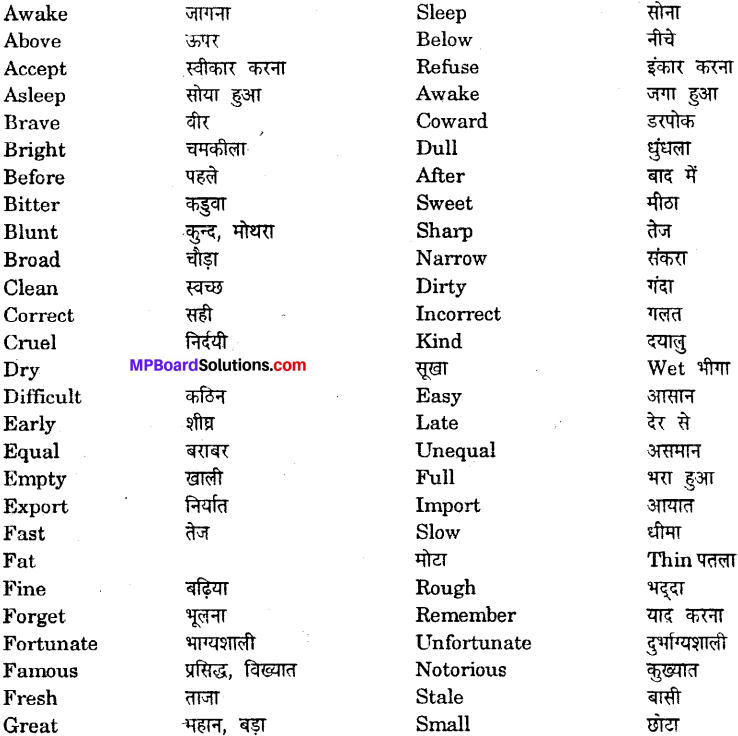
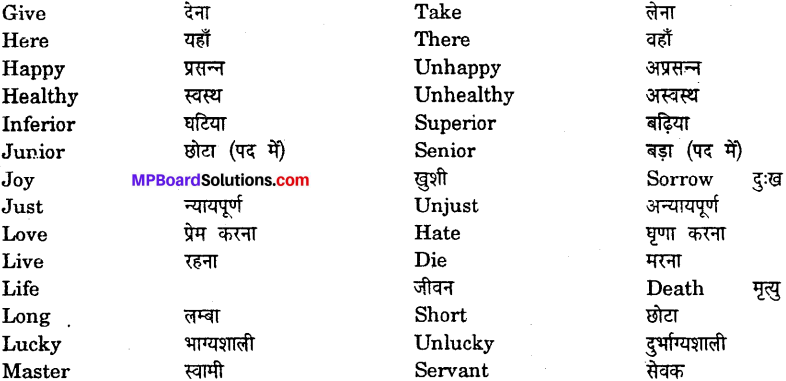
Opposite Words
(Antonyms विपरीतार्थक शब्द)
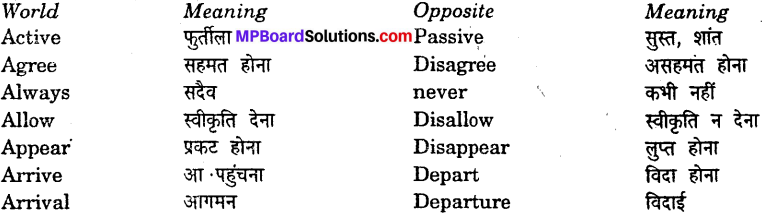
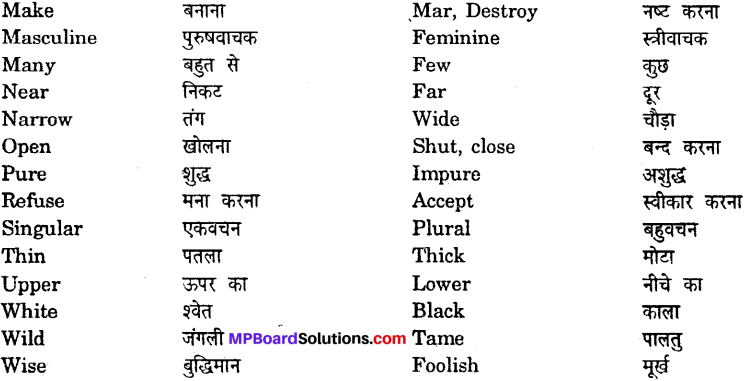
MP Board Class 7th Special English Grammar 21
MP Board Class 7th Special English Grammar 22
MP Board Class 7th Special English Grammar 23
MP Board Class 7th Special English Grammar 24

Exercise :
Give the antonyms (opposites) of the following :
Cold, beautiful, light, pure, narrow, small, difficult, careful, export, friend, high, cool, day, white, timid. easily, happy, fine, near.

We believe the information shared regarding MP Board Solutions for Class 7 English Chapter 21 Tansen Questions and Answers as far as our knowledge is concerned is true and reliable. In case of any queries or suggestions do leave us your feedback and our team will guide you at soonest possibility. Bookmark our site to avail latest updates on several state board Solutions at your fingertips.

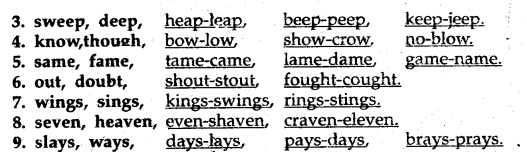
MP Board Class 7th Special English Letter and Application Writing

Get Updated MP Board Solutions for Class 7 Special English Letter and Application Writing Questions and Answers in PDF Format and download them free of cost. These are provided as per the latest exam pattern and syllabus. Access the topics of Chapter wise and communication skills, grammer part through the direct links available depending on the need. You can Download MP Board Class 7 English Solutions and can score highest grade in examination. Clear all your queries on the Mp Board Solutions for Class 7 English Chapter 21 Tansen Questions and Answers Subject by using the Madhya Pradesh State Board Solutions for existing.

MP Board Class 7th Special English Letter and Application Writing

If you are eager to know about the Madhya Pradesh State Board Solutions for Class 7 English you will find all of them here. You can identify the knowledge gap using these MP Board Solutions for English PDF and plan accordingly. Don’t worry about the accuracy as they are given after extensive research by people having subject knowledge along side from the latest English Syllabus.

1. Write an application to your Headmaster or Principal requesting him to remit your absence fine.
To,
The Headmaster,
Govt. High School,
Agra City.

Sir,
Last Month I remained absent from school for five days. I fell ill. I gave my application to Raj, a student of class VI.
Raj forgot to give the application to my class teacher. So, I was fined. I am a poor boy. I cannot pay the fine.
Kindly remit my absence fine.

Thanks

Yours obediently,
Naveen Kumar,
Class Vi
Date : 14th Sept. 2005

2. Write an application to the Headmaster of your school requesting him to exempt you for payment of tuition fee.
To,
The Headmaster,
Govt. High School.
Jabalpur Cantt.

Sir,
Most respectfully, I beg to state that my father is so poor that he cannot pay my school fees. He has a large family of seven members to support. His income is Rs. 600-a month. It is very difficult for us to make both ends meet.

I am student of class VIB of your school. I got very good marks in all the subjects in the last examination. I am a good hockey player of junior team and also obedient to all the teachers. I am regular in my studies as well as in attendance.

I am sure you will kindly grant me full fee concession.

Yours faithfully,
X
Date : February 4, 2006

3. Write an application to your principal requesting him to grant you sick leave.
To
The Principal,
Govt. Inter College,
Gwalior.

Sir,
Most respectully, I beg to say that I have been suffering from fever since last night. I am unable to attend college.
Kindly grant me sick leave for five days.

Your obedient pupil,
Naveen Chandra,
Class W-A.
Date : March’ 10, 2006

4. Write a letter to your mother fillingabout your new school.
25, Model Town,
Indore
July 20, 2006

My dear Mother,
I am glad to write that I like new school very much. My class-fellows are very kind to me. My teachers are very gentle. They always help us in studies and games.

The building of the school is grand. The school has beautiful park. It has two big playgrounds. Kindly pay my respects to father.

Your Loving Son,
Arun.

5. Write a letter to your father telling him how you are going with your studies.
F-20, Nehru Nagar,
Gwalior
December 5, 2005

My dear fathers,

I got your letter yesterday. You have asked me about my studies, Dear father, I am working well. I get up early in the morning and study for many hours.

I got good marks in the half-yearly examination.

Kindly pay my respects to dear mother and love to dear Alok and Meghna.

Yours affectionately,
Geeta Sharma

6. Write a letter to your friend congratulating him or her on his or her success in the examination.
Patel Nagar,
Bhopal
June 15, 2005

My dear Usha,
Yesterday I got the news of your success in the High School Examination. My father brought this happy news.

You passed the examination in the first class. I congratulate you on your success. Pay my respects to your parents.

Yours sincerely,
Hem Lata.

7. Write a letter of sympathy to a friend who has failed in the examination. Prem Puri, Indore
June 15, 2005
My dear Santhosh,

I am very sorry to learn that you failed in the High School Examination. It was all due to your illness.

You should not lose heart. Please work hard. This year you will get got marks.I have great sympathy with you.

Please pay my respects to your parents.

Yours sincerely,
Girish

8. Write a letter to your friend inviting him or her to tea.
Sadar Bazar, Jabalpur
May 20, 2006

My dear Sheela,
You will be glad to know that my birthday falls on May 25, 2006 I am giving a grand tea party to my friends on that day.

I request you to reach my house at 3 p.m.

Yours sincerely,
Rangina.

9. Write a letter to a book-seller ordering him to send you some books.
116, Nai Basti,
Raipur.
July 20, 2006
To,
The Manager,
Kamal Prakashan,
New Delhi.

Dear Sir,
I request you to send me the following books as per V.P.P. The books must be in a good condition.

Please send them as early as possible.

1. A.B.C. Grammer for class VI 5 Copies
2. Hamara Samaj 5 Copies
3. English Guide for class VI 5 Copies

Yours faithfully,
Vidhya Sagar

We believe the information shared regarding MP Board Solutions for Class 7 English Chapter 21 Tansen Questions and Answers as far as our knowledge is concerned is true and reliable. In case of any queries or suggestions do leave us your feedback and our team will guide you at soonest possibility. Bookmark our site to avail latest updates on several state board Solutions at your fingertips.

MP Board Class 7th Special English Translation

Get Updated MP Board Solutions for Class 7 Special English Translation Questions and Answers in PDF Format and download them free of cost. These are provided as per the latest exam pattern and syllabus. Access the topics of Chapter wise and communication skills, grammer part through the direct links available depending on the need. You can Download MP Board Class 7 English Solutions and can score highest grade in examination. Clear all your queries on the Mp Board Solutions for Class 7 English Chapter 21 Tansen Questions and Answers Subject by using the Madhya Pradesh State Board Solutions for existing.

MP Board Class 7th Special English Translation

If you are eager to know about the Madhya Pradesh State Board Solutions for Class 7 English you will find all of them here. You can identify the knowledge gap using these MP Board Solutions for English PDF and plan accordingly. Don’t worry about the accuracy as they are given after extensive research by people having subject knowledge along side from the latest English Syllabus.

Use of ‘Is, Are, Am’

हिन्दी वाक्यों की पहचान – वाक्य के अन्त में ‘है, हैं और हूं’ शब्द होते हैं। ये Present Tense (वर्तमान काल) के वाक्य होते हैं।

अनुवाद के नियम –

  1. हिन्दी वाक्य की अंग्रेजी बनाते समय पहले Subject (का) रखा जाता है। फिर Verb (क्रिया) का प्रयोग होता है।
  2. ‘है’ की अंग्रेजी is’ है जिसका प्रयोग Singular Subjects जैसे He, She, It, This तथा That के साथ किया जाता है।
  3. हैं’ तथा ‘हो’ की अंग्रेजी ‘are’ है। इसका प्रयोग Plural Subject जैसे These, Those के साथ किया जाता है।
  4. ‘हूं’ की अंग्रेजी ‘am’ है। I के साथ सदैव ‘am’ का प्रयोग किया जाता है।
  5. Negative वाक्यों की रचना Is, Are, Am के पश्चात् ‘not’ रखकर की जाती है।
  6. Interrogative वाक्यों की रचना करने के लिए is, are या am को Subject से पहले रखा जाता है। वास्य के अन्त में Full – stop (.) के स्थान पर प्रश्नवाचक चिन्ह (?) प्रयोग किया जाता है।

Examples:
(A) Affirmative Sentences (सकारात्मक वाक्य)

  1. हरी एक लड़का है।
    Hari is a boy.
  2. तुम एक विद्यार्थी हो।
    You are a student.
  3. मैं तुम्हारा मित्र हूं।
    I am your friend.
  4. ये गायें हैं।
    These are cows.

(B) Negative Sentences (निषेधात्मक वाक्य)

  1. वह अच्छा लड़का नहीं है।
    He is not a good boy.
  2. वे किसान नहीं हैं।
    They are not farmers.
  3. मैं भूखा नहीं हूं।
    I am not hungry.

(C) Interrogative Sentences (प्रश्नवाचक वाक्य)

  1. क्या यह एक पुस्तक है?
    Is this a book?
  2. क्या वे प्यासे हैं?
    Are they thirsty?
  3. क्या मैं बुरा हूं?
    Am I bad?

EXERCISE 1
Translate into English :

  1. सीता एक नर्स है।
  2. हम अच्छे लड़के हैं।
  3. मैं प्यासा हूं।
  4. यह स्लेट अच्छी नहीं है।
  5. मैं एक खिलाड़ी नहीं हूं।
  6. लड़के कक्षा में नहीं हैं।
  7. क्या तुम थके हो?

Vocabulary :

नर्स – nurse; प्यासा – thirsty; स्लेट – slate; खिलाड़ी – player; थका – tired.

Use of Was,’ and ‘Were’.

हिन्दी वाक्यों की पहचान – वाक्यों के अन्त में ‘था, थे, थी, थीं, शब्द होते हैं। ये Past Tense (भूतकाल) के वाक्य होते हैं।

अनुवाद के नियम –

  1. ‘था’, ‘थी’, की अंग्रेजी was होती है। He, She, It, This, That, I तथा Singular Subjects (एकवचन कता) के साथ ‘was’ का प्रयोग किया जाता है।
  2. ‘थे’ ‘थीं’ की अंग्रेजी ‘were’ होती है। We, You They, Those तथा Plural Subjects (बहुवचन के कर्ता) के साथ ‘were’ का प्रयोग किया जाता है।
  3. Negative Sentences की रचना was या were के पश्चात् not रखकर की जाती है
  4. Interrogative Sentences की रचना was या were को Subject (कता) के पूर्व रखकर की जाती है और वाक्य के अन्त में प्रश्नवाचक चिन्ह (?) लगाया जाता है।

Examples:
(A) Affirmative Sentences (सकारात्मक वाक्य)

  1. वह एक सैनिक था।
    He was a soldier
  2. वे खिलाड़ी थे।
    They were players.
  3. उसकी गायें खेत में थीं।
    His cows were in the field.

(B) Negative Sentences (निषेधात्मक वाक्य)

  1. तुम्हारा कलम काला नहीं था।
    Your pen was not black.
  2. वे कक्षा में नहीं थे।
    They were not in the class.
  3. तुम घर पर नहीं थे।
    You were not at home.

(C) Interrogative Sentences (प्रश्नवाचक वाक्य)

  1. क्या बर्तन गर्म था?
    Was the pot hot?
  2. क्या बन्दर घर में थे?
    Were the monkeys in the house?
  3. क्या वह कल बीमार था?
    Was he ill yesterday?

EXERCISE 2
Translate into English :

  1. वह एक लड़का था।
  2. तीन लड़कियां पार्क में थीं।
  3. तुम अपने पिता के साथ थे।
  4. गीता बदसूरत नहीं थीं।
  5. मैं कमरे में नहीं था।
  6. गन्ने मीठे नहीं थे।

Vocabulary :

पार्क – park; साथ – with; बदसूरत – ugly; गन्ना – sugarcane; मीठा – sweet.

Use of ‘Has, Have, Had’

हिन्दी वाक्यों की पहचान – जिन वाक्यों में इनका प्रयोग होता है, उनसे किसी के अधिकार में किसी वस्तु के होने का बोध होता है।

अनुवाद के नियम –

  1. ‘पास है’ अथवा ‘रखता है’ के लिए He, She, It और Singular Subjects (एकवचन कता) के साथ ‘Has’ का प्रयोग Present Tense में किया जाता है।
  2. I, You, We, They तथा Plural Subjects (बहुवचन कर्ता) के साथ ‘have’ का प्रयोग Prestent Tense में किया जाता है।
  3. ‘पास था’ या ‘रखता था’ या ‘रखते थे’ के लिए ‘had’ का प्रयोग Past Tense में किया जाता है।
  4. Negative वाक्य बनाने के लिए has, have या had के पश्चात् ‘no’ या ‘not’ का प्रयोग किया जाता है।
  5. Interrogative वाक्यों की रचना करते समय has, have, अथवा had को Subject के पूर्व रखा जाता है। वाक्य के अन्त में प्रश्नसूचक चिन्ह (?) का प्रयोग किया जाता है।

Examples:
(A) Affirmative Sentences (सकारात्मक वाक्य)

  1. कुत्ते के पास एक हड्डी है।
    The dog has a bone.
  2. मेरे पास एक अंगूठी है।
    I have a ring.
  3. लड़कों के पास कलम है।
    The boys have pens.
  4. तुम्हारे पास चाकू था।
    You had a knife.

(B) Negative Sentences (निषेधात्मक वाक्य)

  1. सुरेश के पास पुस्तक नहीं है।
    Suresh has no book.
  2. तुम्हारे पास ताला नहीं है।
    You have not a lock.
  3. लड़के के पास प्याला नहीं था।
    The boy had no cup.

(C) Interrogative Sentences (प्रश्नवाचक वाक्य)

  1. क्या तुम्हारे पास अंगूठी है?
    Have you a ring?
  2. क्या सीमा के पास दो रूपये हैं?
    Has Seema two rupees?
  3. क्या उसके पास उपन्यास था?
    Had he a novel?

EXERCISE 3
Translate into English :

  1. डाकिये के पास एक थैला है।
  2. उसके पास दो मकान हैं।
  3. मेरे पास एक रोचक पुस्तक है।
  4. कौवे की एक चोंच होती है।
  5. मेरे पास गेंद नहीं हैं।
  6. तुम्हारे पास दस रूपये नहीं थे।
  7. साधू के पास भोजन न था।
  8. क्या माली के पास एक गाय है?

Vocabulary :

डाकिया – postman; रोचक – interesting; चोंच – beak; साधू – saint; धन – money; माली – gardener.

Imperative Sentences (Orders and Requests)

हिन्दी वाक्यों की पहचान – इन वाक्यों में आज्ञा दी जाती है, प्रार्थना की जाती है, कुछ मांगा जाता है या उपदेश दिया जाता है।

अनुवाद के नियम –

  1. ऐसे वाक्यों की अंग्रेजी बनाने के लिए Verb (क्रिया) की First form को वाक्य के आरम्भ में रखा जाता है।
  2. ऐसे वाक्यों का कर्ता You’ होता है, जो लुप्त रहता है।
  3. ऐसे वाक्यों में ‘अपने’ की अंग्रेजी सदैव Your प्रयोग की जाती है।
  4. यदि वाक्य में ‘मत’ शब्द आया हो, तो उसके लिए Do not पहले रखते हैं।

Examples:
(A) Affirmative Sentences (सकारात्मक वाक्य)

  1. यहां आओं।
    Come here.
  2. पत्र लिखों।
    Write a letter.
  3. अपनी पुस्तक पढ़ों।
    Read your book.
  4. कृपया मुझे पानी दीजिए।
    Please give me water.
  5. वहां मत जाओ।
    Do not go there.

EXERCISE 4
Translate into English :

  1. वहां जाओं।
  2. बैंच पर खड़े हो जाओ।
  3. मुझे अपने दाँत दिखाओ।
  4. कृपया मेरी बात सुनो।
  5. धीरे – धीरे चलो।
  6. तेज मत भागो।
  7. अपने बड़ों का कहना मानो।

Vocabulary :

दांत – teeth; मेरी सुनो – listen to me; धीरे – धीरे – slowly; तेज – fast; कहना मानो – obey; सुबह सवेरे – early in the morning.

Present Indefinite Tense
Or
Simple Present Tense

इस काल के वाक्यों की पहचान – वाक्यों के अन्त में ‘ता है, ती हूं’ आदि शब्द आते हैं।

  1. Simple Sentences में He, She, It तथा एकवचन कर्ता के साथ Verb की First form के अन्त में ‘s’ या ‘es’ लगाया जाता है।
  2. I, You, We, They तथा बहुवचन कर्ता के साथ केवल Verb की First form प्रयोग की जाती है।
  3. Negative Sentences की रचना में He, She, It, तथा एकवचन कर्ता के साथ Verb की First form के पूर्व does not लगाया जाता है।
  4. I, You, We, They तथा बहुवचन कर्ता के साथ Verb की First form के पहले do not प्रयोग किया जाता है।
  5. ‘कभी नहीं’ के लिए क्रिया के पूर्व never लगाया जाता है। Never के साथ do या does का प्रयोग नहीं किया जाता है। परन्तु यदि कर्ता एकवचन है, तो क्रिया के अन्त में ‘s’ या ‘es’ का प्रयोग किया जाता है।
  6. Interrogative Sentences की रचना में Subject के पूर्व Do या Does प्रयोग करके कर्ता के पश्चात् Verb की First form का प्रयोग किया जाता है।

Examples:
(A) Affirmative Sentences (सकारात्मक वाक्य)

  1. राकेश खेलता है।
    Rakesh plays.
  2. सीमा वहां रोज जाती है।
    Seema goes there daily.
  3. मैं पत्र लिखता हूं।
    I write a letter.
  4. लड़के स्कूल जाते हैं।
    The boys go to school.

(B) Negative Sentences (निषेधवाचक वाक्य)

  1. यह लड़का नहीं पढ़ता है।
    This boy does not read.
  2. मोर यहां नहीं रहते हैं।
    The peacocks do not live here.
  3. वह यहां कभी नहीं आता है।
    He never comes here.

(C) Interrogative Sentences (प्रश्नवाचक वाक्य)

  1. क्या रवि पढ़ता है?
    Does Ravi read?
  2. क्या तुम वहां जाते हो?
    Do you go there?
  3. क्या लड़के शोर मचाते हैं?
    Do the boys make a noise?

EXERCISE 5
Translate into English :

  1. वह रोज गांव जाता है।
  2. हम शाम को खेलते हैं।
  3. सूर्य पूर्व में निकलता है।
  4. मेरे पिताजी मेरी देखभाल करते हैं।
  5. किरन नहीं खेलती है।
  6. तुम मेरा कहना नहीं मानते हो?
  7. वे कभी झूठ नहीं बोलते हैं।
  8. क्या बच्चा रात में सोता है?

Vocabulary:

रोज – daily; निकलना – rise; देखभाल करना – look after; कहना मानना – obey; झूठ बोलना – tell me lie; रोना – weep; धोबी – washer – man; तालाब – tank.

Present Continuous Tense

हिन्दी वाक्यों की पहचान –

  1. कार्य लगातार चलता रहता है, परन्तु समय दिया हुआ नहीं होता है।
  2. वाक्यों में अन्त में ‘रहा है, रही है, रहा हूं, रहे हैं, रही हैं’ आदि होते हैं।

अनुवाद के नियम –

  1. इस Tense के वाक्यों का अनुवाद करने के लिए Verb की पहली form के अन्त में ‘ing’ जोड़ कर उसके पूर्व is, are या am रख दिया जाता है। You, We, They तथा बहुवचन के साथ ‘are’ लगाया जाता है।
  2. I के साथ am लगाया जाता है।
  3. He, She, It, तथा एकवचन कर्ता के साथ is’ का प्रयोग किया जाता है।
  4. Negative Sentences में is, are, am के बाद not लगाकर अनुवाद किया जाता है।
  5. Interrogative Sentences की रचना is, are या am को वाक्य के पूर्व रखकर की जाती है और वाक्य के अन्त पर प्रश्नसूचक चिन्ह (?) लगाया जाता हैं।

Examples:
(A) Affirmative Sentences (सकारात्मक वाक्य)

  1. भूषण बाजार जा रहा है।
    Bhushan is going to bazaar.
  2. मैं अपना काम कर रहा हूं।
    I am doing my work.
  3. लड़के हॉकी खेल रहे हैं।
    The boys are playing hockey.

(B) Negative Sentences (निषेधवाचक वाक्य)

  1. लड़की नहीं नाच रही है।
    The girl is not dancing.
  2. तुम अपना काम नहीं कर रहे हो।
    You are not doing your work.
  3. मैं सो नहीं रहा हूं।
    I am not sleeping.

(C) Interrogative Sentences (प्रश्नवाचक वाक्य)

  1. क्या सुनील सो रहा है?
    Is Suneel sleeping?
  2. क्या वे अपने गांव जा रहे हैं?
    Are they going to their village?
  3. क्या मैं उसकी सहायता नहीं कर रहा हूं?
    Am I not helping here

EXERCISE 6
Translate into English :

  1. मैं कठिन परिश्रम कर रहा हूं।
  2. वह अपना कार्य कर रहा है।
  3. लड़कियां खाना बना रही हैं।
  4. रवि प्रश्न हल नहीं कर रहा है।
  5. मैं इस मकान में नहीं रह रहा हूं।
  6. लड़के मैच नहीं खेल रहे हैं।
  7. क्या कौवा पेड़ पर बैठा है?
  8. क्या लड़के नदी में नहा रहे हैं?

Vocabulary :

कठिन परिश्रम करना – to work hard; खाना बनाना – to prepare food; हल करना to solve; भेच – match; कौवा – crow; नदी – river; नहाना – to bathe.

Present Perfect Tense

इस काल के वाक्य की पहचान –

  1. इस काल के वाक्यों में काम समाप्त हो जाता है।
  2. वाक्यों के अन्त में ‘या है, ओं है, ई हूं, चुका हैं, चुके हैं, चुका हूं’ आदि होते हैं।

अनुवाद के नियम –

  1. Simple Sentence में जब कर्ता He, She, It अथवा एकवचन होता है उसमें Verb की Third form के पूर्व has लगाया जाता है।
  2. जिस वाक्य में कर्ता I, You, We, They अथवा बहुवचन होता है उसमें Verb की Third form के पूर्व have लगाया जाता है।

(B) Negative Sentences की रचना में has या have के पश्चात् not लगाकर Verb की Third form लगा दी जाती है।

(C)

  1. Interrogative Sentences में has या have को वाक्य के आरम्भ में कर्ता के पूर्व रखा जाता है।
  2. वाक्य के अन्त में प्रश्नसूचक चिन्ह (?) लगाया जाता है।

Examples:
(A) Affirmative Sentences (सकारात्मक वाक्य)

  1. राज खाना खा चुका है।
    Raj has eaten food.
  2. मैंने पत्र लिख लिया है।
    I have written the letter.

(B) Negative Sentences (निषेधवाचक वाक्य)

  1. उसने अपना काम समाप्त नहीं किया है।
    He has not finishied his work.
  2. उन्होंने अपना पाठ याद नहीं किया है।
    They have not learnt their lesson.

(C) Interrogative Sentences (प्रश्नवाचक वाक्य)

  1. क्या बच्चा सो गया है?
    Has the child slept?
  2. क्या लड़के खेल चुके हैं?
    Have the boys played?

EXERCISE 7
Translate into English :

  1. हरी खाना खा चुका है।
  2. वर्षा थम चुकी है।
  3. लड़के भोपाल चले गये हैं।
  4. मैं अपना काम कर चुका हूं।
  5. सूरज अभी नहीं छुपा है।
  6. गुरूजी ने पाठ नहीं पढ़ाया है।
  7. उन्होंने कभी झूठ नहीं बोला है।
  8. क्या लड़के मैच खेल चुके हैं?
  9. क्या तुमने कार्य समाप्त कर लिया है?

Vocabulary :

थम जाना – cease; छिपना – set; पढ़ना – teach; झूठ बोलना – tell a lie; कभी – never.

Past Indefinite Tense
Or
Simple Past Tense

इस काल के वाक्यो की पहचानवाक्यों के अन्त में ‘ता था’, ‘ते थे’, ‘ती थी’, अथा पढ़ा, दौड़ा, खाया, सोया आदि जैसी क्रिया लगी रहती है।

  1. Simple Sentences में Verb की दूसरी forrn का प्रयोग होता है।
  2. Negative Sentences में did not के बाद Verb की पहली form का प्रयोग होता है।
  3. Interrogative Sentences में वाक्य के आरंभ में Did लगाकर Verb की पहली form का प्रयोग किया जाता है और वाक्य के अंत में प्रश्नवाचक चिह्न (?) लगाया जाता है।

Examples:
(A) Affirmative Sentences (सकारात्मक वाक्य)

  1. कुत्ता भौंका।
    ‘The dog barked.
  2. लड़कियों ने गाना गाया।
    The girls sang a song.
  3. रीता ने पत्र पढ़ा।
    Reeta read the letter.
  4. बच्चे शाम में खेले।
    Children played in the evening.
  5. माँ ने खाना बनाया।
    Mother cooked food.

(B) Negative Sentences (निषेधवाचक वाक्य)

  1. मैं वहां नहीं गया।
    I did not go there.
  2. उसने पत्र नहीं लिखा।
    He did not write a letter.
  3. सुमित ने अपना पाठ नहीं याद किया।
    Sumit did not learn his lesson.
  4. पिताजी ने खाना नहीं खाया।
    Father did not eat food.
  5. वे लोग तेजी से नहीं दौड़े।
    They did not run fast.

(C) Interrogative Sentences (प्रश्नवाचक वाक्य)

  1. क्या पुलिस ने चोर को पकड़ा?
    Dil the police catch the thief?
  2. क्या तुमने पत्र लिखा? ।
    Did you write a letter?
  3. क्या आपने झूठ बोला?
    Did you tell a lie?
  4. क्या श्यामा ने घड़ी में चाबी दी?
    Did Shyama wind the watch?
  5. क्या बच्चे मैदान में गए?
    Did children go to the field?

EXERCISE 8
Translate into English :

  1. बच्चों ने भिखारी को भोजन दिए।
  2. पुलिस ने चोर का पीछा किया।
  3. राधा ने अपने भाई को मिठाई दी।
  4. उसका भाई पिछले साल फेल हो गया।
  5. हम लोग शाम में बाजार गए।
  6. तुमने मेरी सहायता नहीं की।
  7. मैंने व्यायाम नहीं किया।
  8. हम स्टेशन समय पर नहीं पहुंचे।
  9. रमण और चमन ने खाना नहीं खाया।
  10. बिल्ली ने दूध नहीं पिया।

Vocabulary :

भिखारी – beggar; भोजन – food; चोर – thief; पीछा किया – chased; मिठाई – sweets; शामevening; बाजार – market; व्यायाम – exercise.

Past Continuous Tense

वाक्यों की पहचान –

  1. यह भूतकाल में निरन्तरता से घटित क्रिया को प्रकट करता है।
  2. वाक्यों के अंत में ‘रहा था’, ‘रहे थे’, ‘रही थी’ आदि होते हैं।

अनुवाद के नियम –

  1. इस Tense के वाक्यों का अनुवाद करने के लिए Verb की पहली form के अंत में ‘ing जोड़कर उसके पूर्व was या were (कर्ता के अनुसार) रख दिया जाता है।
  2. एकवचन कर्ता के साथ ‘was’ एवं बहुवचन कर्ता के साथ ‘were’ का प्रयोग होता है।
  3. Interrogative Sentences में ‘was’ या ‘were’ को वाक्य के पूर्व में रख दिया जाता है। वाक्य के अंत में प्रश्नवाचक चिह्न (?) लगाया जाता है।
  4. Nagative Sentences में ‘was’ एवं ‘were’ के बाद ‘not’ का प्रयोग होता है।

Examples:
(A) Affirmative Sentences (सकारात्मक वाक्य)

  1. रमा पत्र लिख रही थी।
    Rama was writing a letter.
  2. बच्चे खेल रहे थे।
    Children were playing.
  3. चपरासी घंटी बजा रहा था।
    The Peon was ringing the bell.
  4. कुत्ता भौंक रहा था।
    The dog was barking.
  5. हम लोग कूद रहे थे।
    We were jumping.

(B) Negative Sentences (निषेधवाचक वाक्य)

  1. 1. बच्चे शोर नहीं मचा रहे थे।
    Children were not making a noise.
  2. 2. तुम लोग झूठ नहीं बोल रहे थे।
    You were not telling a lie.
  3. 3. वह नहीं सो रहा था।
    He was not sleeping.
  4. 4. राधा नहीं पढ़ रही थी।
    Radha was not studying.
  5. 5. वे लोग हंस नहीं रहे थे।
    They were not laughing

(C) Interrogative Sentences (प्रश्नवाचक वाक्य)

  1. क्या वह खाना बना रही थी?
    Was she cooking food?
  2. क्या वे बाजार जा रहे थे?
    Were they going to market?
  3. क्या पिताजी अखबार पढ़ रहे थे?
    Was father reading the newspaper?
  4. क्या वह मेरी सहायता कर रहा था
    Was he helping me?
  5. क्या लड़किया नांच रही थीं?
    Were the girls dancing?

EXERCISE 9
Translate into English:

  1. शिक्षक पढ़ा रहे थे।
  2. बर्फ गिर रही थी?
  3. नदी बह रही थी।
  4. चिड़ियां चहचहा रही थी।
  5. वह अपना कार्य कर रहा था?
  6. माँ खाना नहीं बना रही थी।
  7. लोग कुँआ नहीं खोद रहे थे।
  8. रचना गीत नहीं गा रही थी।
  9. प्रकाश खेल नहीं रहा था।
  10. कौआ काँव – काँव नहीं कर रहा था।

Vocabulary :

शिक्षक – teacher; बर्फ – snow; गिरना – to fall; नदी – river; बहना – to flow; कुँआ – well; खोदना – to dig; खेत – field.

Past Perfect Tense

इस काल के वाक्यों की पहचान

  1. यह भूतकाल में समाप्त हुए कार्यों को बताता है।
  2. यहां हिन्दी की क्रिया प्रायः ‘चुका था, चुके थे, चुकी थी’, आदि से समाप्त होती है।
  3. Affirmative sentences में had के साथ verb की तीसरी form का प्रयोग करते हैं।
  4. Negative Sentences में ‘had’ के बाद ‘not’ लगाते हैं।
  5. Interrogative Sentences बनाने के लिए Had को कर्ता से पहले प्रयोग करते हैं तथा वाक्य के अंत में प्रश्न चिह्न (?) लगाते हैं।
  6. यदि वाक्य में दो क्रियाएं हैं तो जो क्रिया पूरी हो चुकी थी उसके लिए Had + 3rd form और जो बाद में हुई थी उसके लिए Verb की 2nd form का प्रयोग करते हैं।

Examples:
(A) Affirmative Sentences (सकारात्मक वाक्य)

  1. वह कल तक भारत छोड़ चुका था।
    He had left India till yesterday.
  2. डॉक्टर के आने से पहले रोगी मर चुका था।
    The palient had died before the doctor arrived.
  3. जब मैं स्टेशन पहुंचा तो गाड़ी चल चुकी थी।
    When I reached the station the train had steamed off.

(B) Negative Sentences (निषेधवाचक वाक्य)

  1. रोहित ने अभी कपड़े नहीं बदले थे।
    Rohit had not changed the clothes yet.
  2. तेज आँधी आने से पहले हम घर नहीं पहुंचे थे।
    We had not reached home before a furious storm began to blow.
  3. जब मैं स्कूल पहुंचा, तो घंटी नहीं बजी थी।
    When I reached the school, the bell had not rung.

(C) Interrogative Sentences (प्रश्नवाचक वाक्य)

  1. क्या आप पत्र लिख चुके थे?
    Had you written the letter?
  2. क्या तुम्हारे आने से पहले नौकर कमरा साफ कर चुका था।
    Had the servant swept the room before you reached?
  3. क्या आप पहले कभी मुम्बई गए थे?
    Had you ever been to Mumbai before?

EXERCISE 10
Translate into English:

  1. सूर्य अस्त होने से पहले वे अपने घर पहुंच चुके थे।
  2. रामू ने अपने मालिक का सदा कहना माना था।
  3. अर्चना पहले ही स्कूल पहुंच चुकी थी।
  4. पुलिस के पहुंचने से पहले लोग चोर को पकड़ चुके थे।
  5. हमारे वहां पहुंचने से पहले माली पौधे को पानी दे चुका था।
  6. कमला ने मेरी आज्ञा का पालन नहीं किया था।
  7. रोगी अभी नहीं मरा था।
  8. वह पहले कभी शिमला नहीं गया था।
  9. तुम्हारे जागने से पहले सूर्योदय नहीं हुआ था।
  10. क्या मैच पहले ही आरंभ हो चुका था?

Vocabulary :

अस्त होना – to set; मालिक – master; सदा – always; कहना मानना – to obey; पकड़ना – to catch; माली – gardener.

Future Indefinite Tense
Or
Simple Future Tense

इस काल के वाक्यों की पहचान

  1. सामान्यतः इसकी क्रिया ‘गा, गे, गी’, से समाप्त होती है।
  2. First Person (I and We) के साथ shall तथा शेष persons के subjects के साथ will का प्रयोग होता है।
  3. Affirmative sentences में Ist Person के Subject के साथ shall तथा Verb की पहली form का प्रयोग होता है। शेष सभी कर्ताओं के साथ will एवं shall की Ist form लगाते हैं।
  4. Negative Sentences में Ist Person कर्ता के साथ shall not तथा अन्य कर्ताओं के साथ will not और verb की पहली form लगाते हैं।
  5. Interrogative Sentences में यदि Ist Person हो तो कर्ता से पहले shall तथा अन्य कर्ताओं से पहले will और बाद में verb की Ist from लगाते है। वाक्य के अंत में प्रश्नवाचक चिह्न का प्रयोग करते हैं।

Examples:
(A) Affirmative Sentences (सकारात्मक वाक्य)

  1. वह स्कूल जाएगा।
    He will go to school.
  2. वे अपने देश की सेवा करेंगे।
    They will serve their country
  3. हम लोग फुटबाल खेलेंगे।
    We shall play football.
  4. राधिका नाचेगी।
    Radhika will dance.

(B) Negative Sentences (निषेधवाचक वाक्य)

  1. हम गाना नहीं गाएंगे।
    We shall not sing a song.
  2. वे लोग आगरा नहीं जाएंगे।
    They will not go to Agra.
  3. दादी मां आज कहानी नहीं
    Grandmother will not tell a story today.

(C) Interrogative Sentences (प्रश्नवाचक वाक्य)

  1. क्या वे पांच बजे आएंगे?
    Will they come at five?
  2. क्या विद्यार्थी फुटबॉल खेलेंगे?
    Will the students play football?

EXERCISE 11
Translate into English :

  1. मैं आज सिनेमा देखने जाऊंगा।
  2. डॉक्टर आज आएगा।
  3. लड़कियां गीत गाएंगी।
  4. हम लोग मैच खेलेंगे।
  5. कल मैं उनको एक पत्र लिखूगा।
  6. मैं इस वर्ष परीक्षा नहीं दूंगा।
  7. कविता शाम को खाना नहीं बनाएगी।
  8. मजदूर हड़ताल नहीं करेंगे।
  9. मैं तुम्हें धोखा नहीं दूंगा।

Vocabulary :

परीक्षा – examination; खाना बनाना – to cook; मजदूर – labour, हड़ताल – strike; धोखा देना to deceive.

We believe the information shared regarding MP Board Solutions for Class 7 English Chapter 21 Tansen Questions and Answers as far as our knowledge is concerned is true and reliable. In case of any queries or suggestions do leave us your feedback and our team will guide you at soonest possibility. Bookmark our site to avail latest updates on several state board Solutions at your fingertips.

MP Board Class 9th English The Rainbow Workbook Solutions Chapter 17 On Saying Please

MP Board Solutions for Class 9 English The Rainbow Workbook Solutions Chapter 17 On Saying Please Questions and Answers aids you to prepare all topics in it effectively. You need not worry about accuracy of Madhya Pradesh State Board Solutions for Class 9 English Chapter 17 On Saying Please as they are given adhering to the latest exam pattern and syllabus guidelines. You Can Download MP Board Class 9 English Solutions Questions and Answers, Notes, Summary, Guide pdf on is page. Enhance your subject knowledge by preparing from Chapterwise MP Board Solutions for Class 9 English and clarify your doubts on corresponding topics.

MP Board Class 9th English The Rainbow Workbook Solutions Chapter 17 On Saying Please

Kick start your preparation by using our online resource Madhya Pradesh State Board Solutions for Class 9 English The Rainbow Workbook Solutions Chapter 17 On Saying Please. You can even download MP Board Solutions for Class 9 English free of cost rough direct links available on our page. Clear your queries and understand concept behind in a simple manner. Simply tap on concept you wish to prepare chapterwise and go rough it.

On Saying Please Vocabulary and Pronunciation

A. Read the following sentences choosing the most appropriate word from among the choices, they occur.
1. Where shall I send the (fore, fair, fare)?
2. With old people he was very (consider, considerable, considerate)
3. A journey with him was a (point, line, lesson) in natural courtesy.
Answer:

  1. fare
  2. considrate
  3. lesson.

B. Note the different meanings of the words ‘class’ in the following sentences.

  1. I was late for a class.
  2. Subhash Chandra Bose was in a different class from most of his contemporaries.
  3. He has a first class degree.
  4. I am against the class system.

C. Make words adding suffixes as given in the example and put proper stress.
e.g. grace — gracious.
Answer:
resent : resentment
friend : friendly
cheer : cheerful
solicit : solicilous
agree : agreeable
step : steple
polite : politely

D. Refer to your dictionary and find out the meanings of the following’phrases with ‘run’.

  1. be on the run : trying to avoid being captured.
  2. in the long run : finally
  3. a run on :
  4. in the short run : concerning the Immediate future.

E. Choose the correct word or phrase to complete each of the following statements and put a tick against it.

Question 1.
His gaietly was not a luxury.
(a) west
(b) waste
(c) wasteful
(d) wishful
Answer:
(c) wasteful

Question 2.
There is no for moral and intellectual damages in these matters.
(a) pay
(b) salary
(c) income
(d) allowance
Answer:
(d) allowance

Question 3.
She got a eye from her enemy.
(a) white
(b) black
(c) red
(d) yellow
Answer:
(c) red

Question 4.
I was utterly …………….
(a) pondless
(b) dollarless
(c) penniless
(d) rupeeless
Answer:
(c) penniless

Question 5.
There was an of excitement at the meeting.
(a) age
(b) action
(c) air
(d) acid
Answer:
(c) air

Listening Skill

A. Listen to the conversation between Anil and his teacher.
See workbook pages 124-125.

B. A drama on ‘Alexander’ was played on your school stage last week. Some of your friends were not present that day. Narrate the theme of the English drama so that they may know the facts.

Speaking Skill

Some sets of conversation have been given below. Write the dialogues in proper sequence and speak out in groups of two each.

Question 1.
Fine, thank you, And you! Will you please come with me?
I’m O.K., thanks. Hello Twinkle, how are you?
Answer:
a : How are you ?
b : Fine, thank you.
a : And you ?
b : I am also fine.
a : Hello Twinkle! How are you?
b : I’m O.K. thanks,
a : Will you please come with me?
b : Yes.

Question 2.
Goodbye! Priya. Have a nice evening. Thanks Sonal. See you tomorrow. Goodbye sonal.
Answer:
a : Goodbye! Priya
b : Goodbye Sonal.
a : See you tomorrow. Have a nice evening
b : Thanks Sonal.

Question 3.
I’m also fine. Please tell me about your parents. Hello Virendra! How are you?
They all are well. Fine, thanks. What about you ? .
Answer:
a : Hello Virendra How are you?
b : Fine, thanks.
a : Please tell me about your parents.
b : They all are well. What about you?
a : I’m also fine.

Reading Skill

Read the following passage answer the questions given below it. See workbook pages 126-127.

Question 1.
Choose the correct alternative.
(a) The passage discusses the problem of :
(i) the role of man in society
(ii) whether man by nature is good- or bad
(iii) improving the nature of man.
Answer:
(ii) whether man by nature is good- or bad

(b) The theory of ‘innate goodness’ holds that :
(i) all men are not equally good
(ii) one requires good circumstances to become good
(iii) man by nature is fundamentally good.
Answer:
(iii) man by nature is fundamentally good.

(c) The theory of ‘innate badness’ stresses that :
(i) the adverse circumstances make a person bad
(ii) man by nature is essentially bad
(iii) a person becomes bad only when he encounters an evil person.
Answer:
(ii) man by nature is essentially bad

(d) The theories of ‘innate goodness’ and ‘innate badness’ have helped :
(i) people to become good
(ii) us to classify people into ‘good’ or ‘bad’
(iii) us to understand human nature better.
Answer:
(iii) us to understand human nature better.

(e) The nobal tendencies in a man urges him
(i) to make many friends wherever he goes
(ii) to enjoy the company of the old people
(iii) to forget about saving his own skin and to help somebody in trouble.
Answer:
(iii) to forget about saving his own skin and to help somebody in trouble.

(f) The ignoble tendencies in a man urges him : .
(i) to cultivate rich people for exploitation
(ii) to trap others, to quarrel with them
(iii) to make friends with influential people.
Answer:
(ii) to trap others, to quarrel with them

Question 2.
Choose the correct answer :
(a) The passage is meant for :
(i) saints and religious leader
(ii) teachers
(iii) people in general
(iv) philosophers and thinkers.
Answer:
(iii) people in general

(b) The passage is based on deep study of :
(i) man and his environment
(ii) human nature
(iii) important religions of the world.
(iv) social evil in Indian society.
Answer:
(ii) human nature

Language Practice (Grammar)

Noun Clause
A. Study these sentences.
See workbook pages 129-130

Combine each of the following sets of sentences into one complex sentence containing a Noun Clause :

Question 1.
What do you want? Tell me at once.
Answer:
Tell me at once what you want.

Question 2.
He is a clever boy. It is quite clear.
Answer:
It is quite clear that he is a clever boy.

Question 3.
You have not done your homework. Will you explain why?
Answer:
Will you explain why you have not done your homework.

Question 4.
What is the truth? We do not know.
Answer:
We do not know what is the truth.

Question 5.
Honesty is a virtue. We all agree.
Answer:
We all agree that honesty is a virtue.

Question 6.
What purpose have you come for? Tell me about this.
Answer:
Tell me what purpose you have come for.

Question 7.
Someone suggested the solution to him. I should like to know about it.
Answer:
I should like to know him to suggest the solution.

B. Relative Clauses

See workbook page 131.

Fill in the blanks with a suitable relative pronoun. Add commas that are missing.

1. The person ……………… impressed me most was Mr Mukesh.
2. Mr Shashank ……………… application form we received. yesterday is a very promising candidate.
3. His mobile phone …………… you showed me yesterday is most valuable.
4. He has excellent references from his present …….. employers are ACME Engineering Ltd.
5. He was working in Mumbai ……………… they have their headquarters.
6. His qualifications …………….. ;.you commented on are excellent.
7. The thing ……………… impressed her most is his personality.
Answer:

  1. who
  2. whose
  3. which
  4. which
  5. where
  6. whom
  7.  that.

Noun Clauses

See workbook page 132.
Pick out the Noun Clauses from the given sentences.

Question 1.
Pankaj said that Radha was telling the truth.
Answer:
that Radha was telling the truth

Question 2.
It’s a fact that he is very honest.
Answer:
that he is very honest.

Question 3.
Nobody knows where he has hidden the money.
Answer:
where he has hidden the money.

Question 4.
I don’t know if Shanta is coming to school today.
Answer:
if Shanta is coming to school today.

Question 5.
The rumour that you were a prisoner was generally believed.
Answer:
that you were a prisoner

Question 6.
He asked me what I wanted.
Answer:
what I wanted.

Question 7.
Knowing that he was a fool, I did not talk to him at all.
Answer:
that he was a fool.

Relative Clause

See workbook pages 132-134.

Combine each of the following sets of sentences into one complex sentences containing an Adjective Clauses.

Question 1.
Here is a tourist. He has toured all over the world in six months.
Answer:
Here is a tourist who has toured all over the world in six months.

Question 2.
In the evening the traveller reached an inn. It belonged to a rich landlord.
Answer:
In the evening the traveller reached an inn that belonged to a rich landlord.

Question 3.
We played cricket together. Do you remember the times.
Answer:
Do you remember the times at which we played cricket together.

Question 4.
The band of robbers met together at night. Their object was to break into the house of a rich merchant.
Answer:
The band of robbers whose object was to break into the house of a rich merchant met together at night.

Question 5.
Many fairs are held every year at Hardwar. Hardwar is one of the most ancient cities of India.
Answer:
Many fairs are held every year at Hardwar which is one of the most ancient cities of India.

Question 6.
An intelligent boy should possess a retentive faculty. Your brother does not possess it.
Answer:
Your brother does not possess retentive faculty that an intelligent boy should have possess.

Question 7.
He has no influence over the people of the city. He cannot serve them.
Answer:
He, who has no influence over the people of the city, cannot serve them.

Writing Skill

A. You borrowed your friends favourite book. You want to return it, but can’t find it. Apologize and promise to return it as soon as possible. (56 words)
Answer:
My dear Rahul
I am really very sorry for I have misplaced your book. I don’t know what happened with it. I feel ashamed that I couldn’t return it promptly. I know it was your favourite one but I feel helpless. I am trying to find it and hope t o return it as soon as possible. I beg your pardon for this fault.
Yours
Manoj.

B. Write what you would do if you find a valuable piece of jewellery on a bench in a park. (75 words)
Answer:
It happens sometimes with someone that one finds something uncared. It puts one in% very critical situation. One gets confused to think what to do with it. But I am very clear about it. If I get such a thing like a jewellery on bench in a park first I would raise an alarm calling all the people all around the park. If someone clams for it I would try to confirm the identity of the real owner by asking about the description Of the jewellery. If it is confirmed I would hand it over to that claiment. If it is not managing committee of the park so that if anyone comes to search the officials may give it him/her.

We believe the information shared regarding MP Board Solutions for Class 9 English The Rainbow Workbook Solutions Chapter 17 On Saying Please Questions and Answers as far as our knowledge is concerned is true and reliable. In case of any queries or suggestions do leave us your feedback and our team will guide you at soonest possibility. Bookmark our site to avail latest updates on several state board Solutions at your fingertips.

MP Board Class 9th English The Rainbow Workbook Solutions Chapter 16 Where the Mind is without Fear

MP Board Solutions for Class 9 English The Rainbow Workbook Solutions Chapter 16 Where the Mind is without Fear Questions and Answers aids you to prepare all topics in it effectively. You need not worry about accuracy of Madhya Pradesh State Board Solutions for Class 9 English Chapter 16 Where the Mind is without Fear as they are given adhering to the latest exam pattern and syllabus guidelines. You Can Download MP Board Class 9 English Solutions Questions and Answers, Notes, Summary, Guide pdf on is page. Enhance your subject knowledge by preparing from Chapterwise MP Board Solutions for Class 9 English and clarify your doubts on corresponding topics.

MP Board Class 9th English The Rainbow Workbook Solutions Chapter 16 Where the Mind is without Fear

Kick start your preparation by using our online resource Madhya Pradesh State Board Solutions for Class 9 English The Rainbow Workbook Solutions Chapter 16 Where the Mind is without Fear. You can even download MP Board Solutions for Class 9 English free of cost rough direct links available on our page. Clear your queries and understand concept behind in a simple manner. Simply tap on concept you wish to prepare chapterwise and go rough it.

Where the Mind is without Fear Vocabulary and Pronunciation

Question 1.
A. Use the following words in your own sentences, mind, brain, habit, forward, fore-word
Answer:
Mind : You should mind your business.
Brian : His brain is sharp.
Habit : Cultivate good habits.
Forward : Look forward before moving on.
Fore-word : The foreword of this book is very confusing.

B. Write the meaning of the word let’ as used in the following sentences.
Let your body relax.
Let’s go.
If he thinks he can help me, just let him try.
I let the spare room.
Answer:
Do yourself.

C. Distinguish between :
wake and awake, sleep and asleep, fresh and afresh, rise and arise.
Answer:
Do yourself.

Question 2.
What do you notice in the pronunciation of these words, awake, asleep, afresh, arise.
Answer:
Do yourself.

Listening Skill

A. “Listen to the poem by Mathew Arnold and pay attention to its rhythm, rhyme and intonation.
See workbook page 119.
Now, tell, how many times the following words occurs in the poem., now, away, way.
Answer:
Do yourself.

B. Listen to the following words/ phrases repeat them,
let us away – shore ward blow
from the way – seaward flow
white horses play – let us away
toss in the spray – this way, this way
Answer:
Do yourself.

Speaking Skill

Some opinions are given below. First discuss in the group, the group leader will sum up views.
I think ………………

  • A criminal should be punished publicity.
  • Smoking should altogether be banned.
  • Nuclear weapons should be destroyed.

Why? / Why not?
Answer:
Do yourself.

Reading Skill

Read the following poem attentively and answer the questions given below it.
See workbook page 120.

Question 1.
Who can build a nation’s pillars deep ?
Answer:
Those who dare whole others fly can build a nation’s pillars deep.

Question 2.
Where in lies the greatness of a nation ?
Answer:
The greatness of a nation lies in its people’s strength.

Question 3.
What does ‘a people’ mean ? Explain.
Answer:
‘A people’ means a nation.

Question 4.
Pick out words/ phrases which have the following meanings :
(a) willing to do things which are difficult, dangerous or painful
(b) having a large distance from the top or surface to the bottom
(c) wealth
Answer:
(a) dare
(b) deep
(c) gold.

Writing Skill

A. Write a letter to your younger sister suggesting her how to prepare for the coming competitive examinations. (50 words)
Answer:
My dear Nisha
Today I received your letter. I am very happy to know that you are preparing for NTSE and Maths olympiad. These are career building exams. You can get wider opportunities through these exams. You should prepare for them seriously. If you need consult a good teacher collect previous years question so that you can be familiar with the pattern of exams. You can collect information through Internet. Concentrate upon these exams.
Yours
Askash.

B. Study the bar diagram given below.
On the basis of this bar diagram write an article ‘Key to Success’ for the school magazine. (150 words)
Answer:
Success is the name given to the achievement. Everyone has a goal in life and achieving that goal is the success. But it is a fact that everyone doesn’t succeed in achieving the goal. As per a survey report it has been assessed that hard labour and honesty are the to virtues which count most for getting success. Their percentage is respectively 80%o and 75%. Intelligence is another virtue” after them being 70% followed by talent. Which adds 50% success. Luck also matters but only 30 % while many contributes only 20 %. Contacts add only 15 % being the lowest. If one works in a proper direction one is sure to get success. But man rely on his hard labour most.

We believe the information shared regarding MP Board Solutions for Class 9 English The Rainbow Workbook Solutions Chapter 16 Where the Mind is without Fear Questions and Answers as far as our knowledge is concerned is true and reliable. In case of any queries or suggestions do leave us your feedback and our team will guide you at soonest possibility. Bookmark our site to avail latest updates on several state board Solutions at your fingertips.

MP Board Class 9th English The Rainbow Workbook Solutions Chapter 15 How it all began

MP Board Solutions for Class 9 English The Rainbow Workbook Solutions Chapter 15 How it all began Questions and Answers aids you to prepare all topics in it effectively. You need not worry about accuracy of Madhya Pradesh State Board Solutions for Class 9 English Chapter 15 How it all began as they are given adhering to the latest exam pattern and syllabus guidelines. You Can Download MP Board Class 9 English Solutions Questions and Answers, Notes, Summary, Guide pdf on is page. Enhance your subject knowledge by preparing from Chapterwise MP Board Solutions for Class 9 English and clarify your doubts on corresponding topics.

MP Board Class 9th English The Rainbow Workbook Solutions Chapter 15 How it all began

Kick start your preparation by using our online resource Madhya Pradesh State Board Solutions for Class 9 English The Rainbow Workbook Solutions Chapter 15 How it all began. You can even download MP Board Solutions for Class 9 English free of cost rough direct links available on our page. Clear your queries and understand concept behind in a simple manner. Simply tap on concept you wish to prepare chapterwise and go rough it.

How it all began Vocabulary and Pronunciation

A. What is the difference in meaning of the following words given in pair :
ago — before
also — too
most — many
journy — voyage
adjacent — neighbouring
Answer:
Do yourself

B. The compound word ‘neighourhood’ end in ‘hood’. Now write some more words with the suffix ‘hood’.
Answer:
Childhood, motherhood, boyhood, fatherhood, livelehood

C. Look at the common expressions of frequency. Study them carefully and point out the number of vowel sounds in them.
1. always
2. usually, regularly
3. often, frequently
4. gradually, slowly
Answer:
1. a, ay, 2. all, 3. o, te, re, erv, y, 4. ra, ua, y, o, y

D. Use the word ‘when’ in the beginning of a sentence and then in the middle of a sentence. What difference does it make? Example : When I returned, I felt tired.
I returned when I felt tired.
Now, frame some more sentences as shown above.

Question 1.
When I knew, I understood.
Answer:
I knew when I understood.

Question 2.
When he came, he gave me the information.
Answer:
He came when he gave me the information.

Listening Skill

Listen to the words.

See workbook page 111.

Now, recall the aforesaid.
Answer:
Do yourself.

Speaking Skill

Recall and repeat orally any two of the following.
See workbook pages 111-112.
Answer:
Do yourself.

Reading Skill

Read the following passage carefully and answer the questions given below it.
See workbook pages 112-113.

Question 1.
(a) How did the grandmother attend to her grandson ?
Answer:
The grandmother attend to her grandson with all attention.

(b) What did she do while she bathed ?
Answer:
She said her morning prayer in a monotonous sing song while she bathed.

(c) What does the author compare his grandmother with ?
Answer:
The author compares his grandmother with the winter landscape in the mountains.

(d) How did the grandmother take care of the study material of her grandson ?
Answer:
The grandmother tied them in a bundle and hand them to ‘he author.

(e) Why did she carry stale chapattis with her ?
Answer:
She carried stale chapattis to feed the village dogs.

(f) Why were grandmother and the author good friends ?
Answer:
Because the author spent his childhood days with her when his parents left him with her.

Question 2.
Find out the words from passage which have the following meaning:
(a) everything you can see when you look across a large area of land especially in the country……………
(b) serene – calm and peaceful, …………
(c) all the time, repeatedly……………
(d) never changing and therefore forming, ……………..
(e) spent time and / or energy doing nothing, ……………….
(f) the holy books of a particular religion, the Bible etc …………….
Answer:
(a) landscape
(b) serenity
(c) constantly
(d) monotonous
(e) hobbling
(f) scriptures.

Language Practice (Grammar)

Preposition
See workbook pages 114-116.

Pick out the preposition in the following sentences.
1. The two cats fought with each other for the cake.
2. The Pied Piper stepped into the street.
3. Rain, Rain go away to Spain.
4. Under the spreading chesnut tree we are happy.
5. We go to school everyday at 7 o’ clock in the morning.
6. We rowed across the backwaters and reached the house.
7. A sand storm blew over Delhi and tore down many temporary sheds.
Answer:

  1. with, for
  2. into
  3. to
  4. under
  5. to, at, in
  6. across
  7. over, down.

Writing Skill

A. Your sister collects stamps. Write a letter encouraging her to continue this hobby.
(50 words)
Answer:
Dear Rakhi
I am happy to know about your hobby of stamp collection. It’s really a good choice. You can know a lot of things through it. It earns your great knowledge, you can know the historical facts also. You keep it continued for ever.
Yours,
Anurag.

B. Write the various activities of the Nature Club of your school. (150 words)
Answer:
There is a Nature Club in our locality. Some of the youngsters of our society have organised if. Its functions are very productive. The members have divided the whole region in different section. They promote plantation, water conservation, rain water harvesting, education to children, cleanliness etc. They educate people the importance of nature in our life and teach them how we are damaging it, how we can cope up with nature. Now the government is also giving attention to this club.

We believe the information shared regarding MP Board Solutions for Class 9 English The Rainbow Workbook Solutions Chapter 15 How it all began Questions and Answers as far as our knowledge is concerned is true and reliable. In case of any queries or suggestions do leave us your feedback and our team will guide you at soonest possibility. Bookmark our site to avail latest updates on several state board Solutions at your fingertips.

MP Board Class 9th English The Rainbow Workbook Solutions Chapter 14 Old Blockhead repairs his House

MP Board Solutions for Class 9 English The Rainbow Workbook Solutions Chapter 14 Old Blockhead repairs his House Questions and Answers aids you to prepare all topics in it effectively. You need not worry about accuracy of Madhya Pradesh State Board Solutions for Class 9 English Chapter 14 Old Blockhead repairs his House as they are given adhering to the latest exam pattern and syllabus guidelines. You Can Download MP Board Class 9 English Solutions Questions and Answers, Notes, Summary, Guide pdf on is page. Enhance your subject knowledge by preparing from Chapterwise MP Board Solutions for Class 9 English and clarify your doubts on corresponding topics.

MP Board Class 9th English The Rainbow Workbook Solutions Chapter 14 Old Blockhead repairs his House

Kick start your preparation by using our online resource Madhya Pradesh State Board Solutions for Class 9 English The Rainbow Workbook Solutions Chapter 14 Old Blockhead repairs his House. You can even download MP Board Solutions for Class 9 English free of cost rough direct links available on our page. Clear your queries and understand concept behind in a simple manner. Simply tap on concept you wish to prepare chapterwise and go rough it.

Old Blockhead repairs his House Vocabulary and Pronunciation

Make sentences with each of the following compound words so as to bring out its meaning.
head-ache, head-dress, head-gear, head-less, head-line, head- block-ade, block-age, block-buster, block-head, block-house.

  1. Head-ache : I have several head-ache.
  2. Head-dress : It is my head dress.
  3. Head-gear : The need gear is not working.
  4. Head-less : I saw a headless statue.
  5. Head-lines : The news of cash for vote was the headline today
  6. Head-on : It was a serious head on collision.
  7. Block-ade : Block ade is illegal.
  8. Block-age : The doctors detected block age in his head.
  9. Block-buster: Amitabh Bachans films are still block buster.
  10. Block—head : He behaves like a totally block head.
  11. Block—house: It is a block house.

B. Use the following words in your own sentences.
mend, rectify, repair, restore, overhaul, replace.

  1. Mend : Mend your ways otherwise you will be in trouble.
  2. Rectify : He asked me to rectify the account.
  3. Repair : Your shoes needs repair.
  4. Restore : Sleep is the best way to restore energy.
  5. Overhaul : Our governing system needs complete overhauling.
  6. Replace : Please replace this defective TV.

C. What do you understand by the following questions?

Question 1.
Is anybody home ?
Answer:
Someone may not be there.

Question 2.
Is somebody home ?
Answer:
Someone may be there.

Question 3.
Is nobody home ?
Answer:
None may be there.

Question 4.
Is everybody home ?
Answer:
Everyone may be there.

D. What is meant by the following? Use them in sentences and point out consonant sounds in each word.

  1. Shout : to make loud noise- The teacher shouted at the boy.
  2.  Call : to give somebody a particular name— He called me.
  3. Howl : to make a long, loud cry— The baby was howling.
  4. Roar : to make a very loud, deep sound— The tiger was roaring in the forest.
  5. Scream : to give a loud, high cry because you are hurt, frightende, exited etc—The little children were scramming with excitinent
  6. Cry : to produce tears from your eyes because you are unhappy or hurt— The baby cried suddenly.
  7. Talk : to say things, to speak in order to give information-The boys are talking.
  8. Clamour: to demand something loudly— The employes began to clamour for their increment.
  9. Shriek : to give a loud, high shout— The gine shricked in fright.
  10. Yelp : to give a sudden short cry, usually of paon— The lod was yelping but noone paid attention on him.

Listening Skill

Listen to the items carefully, which Ma Blockhead needed to repair her house. three pieces of tin-sheets, two hundred and fifty bricks, eight liter of paint, twelve wooden planks, half kilogram of nails, one bag of cement and one bag of sand Now, answer the

Question 1.
How much paint did Ma Blockhead require ?
Answer:
Ma Blockhead required eight liter of paint.

Question 2.
How many bricks did she want ?
Answer:
She wanted two hundred and fifty bricks.

Question 3.
How may tin-sheets were needed by her ?
Answer:
Three pieces of tin-sheets were needed by her.

Question 4.
How much cement did she want ?
Answer:
She wanted one bag of cement.

Question 5.
How much sand was required ?
Answer:
One bag of sand was required.

Question 6.
How many wooden pranks did she need ?
Answer:
She needed twelve wooden pranks.

Question 7.
How much nails did she require ?
Answer:
She required half kilogram of nails.

Speaking Skill

Here are some events. You are required to speak their sub events one by one in proper sequence, the first one has been done for you :
See workbook page 106.
Answer:
For self attempt.

Reading Skill

Read the passage given below and answer the questions below it.
See workbook page 106.

Question 1.
Why did the man count nine camels?
Answer:
Because he mounted one of the ten camels and counted the rest.

Question 2.
How could he count ten camels again ?
Answer:
He counted the ten camels without mounting any of them

Question 3.
Whom did he curse for his confusion ?
Answer:
He cursed Saten for his confusion.

Question 4.
What kind of man was he ? Write your opinion,
Answer:
He was a foolish fellow. It was his fault or lack of presence of mind that he counted the camels wrongly. But instead of cursing himself, he cursed Satan.

Pick out the words from the passage which have the following meanings :
(a) to advise or try hard to persuade to do something…………….
(b) felt very sad ………….
(c) a worried, sad feeling after you have received an unpleasant SUl pi .
(d) causing or showing sadness
Answer:
(a) urge
(b) dismayed
(c) perplexed
(d) cursing.

Language Practice (Grammar)

Narration (Interrogative sentences)
Study these sentences
See workbook pages 107-108.
Rewrite the following in indirect speech.

Question 1.
The stranger said to the lady, “Why do you wish me go away now?”
Answer:
The stranger asked the lady why she wished him go away then.

Question 2.
Ravi’s father asked, “Are you going to keep me away all night?”
Answer:
Ravi’s father asked him weather he was going to keep him awake all night.

Question 3.
“Have you ever seen a met eorite falling? “, he asked the class.
Answer:
He asked the class weather they had ever seen a meteorite failing.

Question 4.
“What does it matter if your miss the train?”, Mrs. Ram said 30 her husband.
Answer:
Mrs. Ram asked her husband what it mattered if he had’/ blissed the train.

Question 5.
The porter asked the passenger, “Which train are you taking?”
Answer:
The porter asked the passenger which train he was taking.

Question 6.
My uncle said, “Do you really need so many pairs of boots?”
Answer:
My uncle asked whether he needed many pairs of boots.

Question 7.
She shouted to us, “Will you not come and save me from the clutches of this thief?
Answer:
She should to us weather they would not come and save to her from the clutches of that thief.

Writing Skill

A. You have saved two thousand rupees. Plan how you will spend them. (50 words)
Answer:
Two thousand rupees is a big sum for me. I shall spend it wisely. First I shall buy a shoes for my grand father and a blanket for grandmom. I shall buy a spectacle for my mother and a watch for my father. I shall buy some books. I shall donate some money to the school of blind.

B. Ma Blockhead finds a change in her house as well as in her husband. She is very happy and wants to share her feelings with her intimate friend through a letter. Write a letter expressing your feelings.(150 words)
Answer:
My dear Rehana.
Today I would like to share my happiness with you. I have just come from my mother’s house. You know I was a little annoyed with my husband. When I came back I founded my house was neat and clean, well arranged, the behaviour of my husband was completely changed. He was now very happy with me. He shared my pains. He cooperated me in household work. I am very happy now. I request you to come to me and share our joy.
Yours
Ma Blockhead.

We believe the information shared regarding MP Board Solutions for Class 9 English The Rainbow Workbook Solutions Chapter 14 Old Blockhead repairs his House Questions and Answers as far as our knowledge is concerned is true and reliable. In case of any queries or suggestions do leave us your feedback and our team will guide you at soonest possibility. Bookmark our site to avail latest updates on several state board Solutions at your fingertips.

MP Board Class 9th English The Rainbow Workbook Solutions Chapter 13 Stopping by Woods on a Snowy Evening

MP Board Solutions for Class 9 English The Rainbow Workbook Solutions Chapter 13 Stopping by Woods on a Snowy Evening Questions and Answers aids you to prepare all topics in it effectively. You need not worry about accuracy of Madhya Pradesh State Board Solutions for Class 9 English Chapter 13 Stopping by Woods on a Snowy Evening as they are given adhering to the latest exam pattern and syllabus guidelines. You Can Download MP Board Class 9 English Solutions Questions and Answers, Notes, Summary, Guide pdf on is page. Enhance your subject knowledge by preparing from Chapterwise MP Board Solutions for Class 9 English and clarify your doubts on corresponding topics.

MP Board Class 9th English The Rainbow Workbook Solutions Chapter 13 Stopping by Woods on a Snowy Evening

Kick start your preparation by using our online resource Madhya Pradesh State Board Solutions for Class 9 English The Rainbow Workbook Solutions Chapter 13 Stopping by Woods on a Snowy Evening. You can even download MP Board Solutions for Class 9 English free of cost rough direct links available on our page. Clear your queries and understand concept behind in a simple manner. Simply tap on concept you wish to prepare chapterwise and go rough it.

Stopping by Woods on a Snowy Evening Vocabulary and Pronunciation

A. Learn with the help of a dictionary the different usage of the following words:
know, deep, see.
Answer:
Do yourself.

B. Say the following words and notice the difference in the vowel sounds:
bell, bill, ball, bull, bail, be, bee, boil.
Answer:
Do yourself.

Listening Skill

Listen to the following poem twice.

See workbook pages 97-98.

Fill in the blanks using the missing lines.

Tell me not in mourful numbers,
Answer:
‘Life is but an empty dream’.
For the soul is dead that slumbers,
Ans. And the things are not what they seem.
Life is real life is earnest! ;
And the grave is not its goal,
Ans. Oust then art to dust returnest.
Was not spoken of the soul,
Ans. Not enjoyment and not sorrow.
Is our destined end or way.
But to act, that each tomorrow Finds us further than today.
In the world’s broad field of battle,
In the bivouac of life.
Answer:
Be not like dumb driven cattle;
Be a hero in the strife!

Speaking Skill

A The poem “Stopping by the Woods on a Snowy Evening” has many rhyming words. Now you add more words to the list:
MP Board Class 9th English The Rainbow Workbook Solutions Chapter 13 Stopping by Woods on a Snowy Evening 1
MP Board Class 9th English The Rainbow Workbook Solutions Chapter 13 Stopping by Woods on a Snowy Evening 2

B. Repeat the following lines giving attention to the rhyming words:
See workbook page 99.
Answer:
Do yourself.

Reading Skill

Read the given poem and answer the questions that follows: See workbook pages 99-100.

Question 1.
Where does the brook originate from ?
Answer:
The brook originates from the haunts of coot.

Question 2.
How does it sparkel ?
Answer:
It sparkles out among the fern to bicker down the valley.

Question 3.
What does the word ‘bicker’mean in this context ?
Answer:
‘Bicker’ means the dim light down the vally.

Question 4.
Describe the courses of the brook as suggested in the poem.
Answer:
The brook flows down from the haunts of coot making different sounds movement. It flows continuously.

Question 5.
What does the expression ‘hurty down’ suggest about the movement of the river ?
Answer:
It suggest that the flow is downwards. Its movement is very fast.

Question 6.
What does the ‘netted sunbeam’ mean? How does it dance?
Answer:
The ‘netted sunbeam’ means the sunnay that falls upon the water coming through the leaves and branches of the tree. It appess to dancing when the leaves shake with winds.

Question 7.
Who does ‘I’ refer to in the given lines ?
Answer:
‘I’ refers to the brook.

Question 8.
How does it chatter ?
Answer:
It chatter with its flowing sounds.

Writing Skill

A. Imagine you are going on a walk in woods. On the way you come across bushes, ferns, trees, streams, rocks, grasslands, slopes etc.
Write a paragraph using the above words. (50 words)
Answer:
I walk along in woods. It is really a unique experience. I come across bushes, thorns, ferns, trees, streams, rocks, grasslands, slopes etc. They all delight me in their own way. Bushes denour white the thorns and firms prick. Streams give pleasure and grasslands, fill with nature’s delight. It is really a bliss to have such experience.

B. ‘Planting saplings today is ensuring greenery tomorrow’. Write a short notice on the importance of preserving the environment through plantation drive in your village/city. (150 words)
Answer:
Our life is a part of nature. Every object of nature has its contribution in the maintenance of eco system. Trees and plants plays their measure rute. They add greenery to nature. They make wind blow and rains to rain to make the land fertile and soothe our life.
We get oxygen from them. They help and contribute to waliv conservation. They protect us from flood. But we by cutting trees, damage our own life. If we plant a new sapling todays it ensures greenery tomorrow and also guarantees our better future. It is our duty to save nature. Planting a new plant is our effort to maintain ; eco system.

We believe the information shared regarding MP Board Solutions for Class 9 English The Rainbow Workbook Solutions Chapter 13 Stopping by Woods on a Snowy Evening Questions and Answers as far as our knowledge is concerned is true and reliable. In case of any queries or suggestions do leave us your feedback and our team will guide you at soonest possibility. Bookmark our site to avail latest updates on several state board Solutions at your fingertips.

MP Board Class 9th Special English Grammar Type II

MP Board Solutions for Class 9 Special English Grammar Type II Questions and Answers aids you to prepare all topics in it effectively. You need not worry about accuracy of Madhya Pradesh State Board Solutions for Class 9 English Composition: Visual Stimulus as they are given adhering to latest exam pattern and syllabus guidelines. You Can Download MP Board Class 9 English Solutions Questions and Answers, Notes, Summary, Guide pdf on is page. Enhance your subject knowledge by preparing from Chapterwise MP Board Solutions for Class 9 English and clarify your doubts on corresponding topics.

MP Board Class 9th Special English Grammar Type II

Kick start your preparation by using our online resource Madhya Pradesh State Board Solutions for Class 9 Special English Grammar Type II. You can even download MP Board Solutions for Class 9 English free of cost rough direct links available on our page. Clear your queries and understand concept behind in a simple manner. Simply tap on concept you wish to prepare chapterwise and go rough it.

1. In the passage given-below one word has been omitted in each line. Write the missing word along with the word that comes before and the word that comes after it in your answer sheet against the correct blank number. Ensure that the word that forms your answer is underlined. (4 marks)

There was hardly political, social e.g. hardly any political
religious, agrarian, labor any other, (a)
problem which come under (b)
his purview and he did not (c)
deal on his own within the
framework of the (d)
principles which he held be
basic and (e)
fundamental. There hardly any
aspect of life (f)
in India which he influence
and fashion (g)
according his own pattern. (h)
Answer:
(a) labour or any
(b) which didn’t come
(c) and that he
(d) own or within
(e) held to be
(f) There was hardly
(g) he didn’t influence
(h) according to his.

2. In the following paragraph, one word has been omitted in each line. Write the missing word along with the word that comes before and the word that comes after it in your answer sheet against the correct blank number. Ensure that the word that forms your answer is underlined.

The holy man spoke Rama for e.g. spoke to Rama
a while. He then Rama’s mother (a)
that should send him to pray at the (b)
Kali Temple the village. He said (c)
that if prayed sincerely Kali (d)
would appear him and bless him. (e)
This he would make Rama’s fortune. (f)
Answer:
(a) then told Rama’s
(b) that she should
(c) Temple in the village
(d) if he prayed
(e) appear before him
(f) This way he.

3. In the following paragraph, one word has been omitted from each line. Write the missing word along with the word that comes before and the word that comes after it in your answer sheet against the correct blank number. Ensure that the word that forms your answer is underlined.

The holy man to Rama e.g., man spoke to
for a while. He to Rama’s mother (a)
that her son prayed sincerely (b)
to Kali village goddess ‘ (c)
he be blessed by her. (d)
This would his fortune and (e)
she would be free from worries. (f)
Answer:
(a) He said to
(b) that if her
(c) Kali the village
(d) he would be
(e) would change his
(f) from her worries.

4. In the following paragraph, one word has been omitted from each line. Write the missing word along with the word that comes before and the word that comes after it in your answer sheet against the correct blank number. Ensure that the word that forms your answer is underlined. (3 marks)

After the holy man had spoken Rama, e.g. spoken to Rama
he told Rama’s mother that should (a)
be sent to piay the Kali Temple at the (b)
village. He promised good lady that if (c)
this was done, Kali, the goddess appear, (d)
take pity on him and bless. Then all her (e)
worries would over. (f)
Answer:
(a) that he should
(b) pray at the
(c) promised the good
(d) goddess would appear
(e) bless him Then
(f) would be over.

5. In the passage given below one word has been omitted in each line. Write the missing word along with the word that comes before and the word that comes after it in your answer sheet against the correct blank number. Ensure that the word that forms your answer is underlined. (3 Marks)

Man’s increases by hard work. e.g. Man’s practice increases
If he does not it, his practice suffers. (a)
The lawyer is judged the cases that he wins (b)
The writers is examined (c)
by the of the readers and critics; whereas(d)
the typists is tested by his speed (e)
and the accuracy of his work. (f)
Answer:
(a) not do it
(b) judged by the
(c) writer’s capability is
(d) the opinion of
(e) typist’skill is
(f) àccuracy of his.

6. In the passage given below, one word has been omitted in each line. Write the missing word along with the word that comes before and the word that comes after it in your answer sheet against the correct blank number. Ensure that the word that forms your answer is underlined. (1/2 x 6 = 3 Marks)

There was a rich old man who in a palace, e.g. who lived in
There also lived nearby poor man in a hut. (a)
He on crumbs of food given by. others, (b)
But he cheerful and never complained. (c)
Once it happened that the poor man (d)
had to eat for a long while. So he (e)
went to the rich old man help. (f)
Answer:
(a) nearby a poor
(b) He survived on
(c) he remained cheerful
(d) it so happened
(e) had nothing to
(f) man for help

7. In the passage gien below, oie worcilias been omitted in each line. Write the missing word along with the word that comes before and the word that comes after it in your answer sheet against the correct blank number. Ensure that the word that forms your answer is underlined. (5 Marks)

The weather, in first-half e.g. in the first
of the English summer always known (a)
to be quite cold. But, what we aré at the (b)
moment here, is, I think rather exceptional (c)
summer—it is just too coki anyone’s liking. (d)
For, a cricketer, you have icy, chilly (e)
wiñds blowing your face, it certainly (f)
is far from a pleasant experience you are (g)
batting, bowling fielding. And, with (h)
the weather being what is right now, the (i)
visiting Indian team is finding it rather
tough to cope the conditions. (j)
Answer:
(a) summer is always
(b) are discussing at
(c) rather an exceptional
(d) cold for anyone’s’
(e) cricketer, if you
(f) blowing to your
(g) experience when you
(h) bowling or fielding
(i) what it is
(j) cope with the conditions.

8. In the passage given below, one word has been omitted in each line. Write the missing word along with the word that comes before and the word that comes after it in your answersheet against the correct blank number. Ensure that the word that forms your answer is underlined. (5 marks)

Within each the dialect areas, there is considerable e.g. each of the
variaticn in speech according education (a)
and social standing. Ther is
important polarity (b)
of uneducated educated speech in (e)
which former can be identified with (d)
the regional dialect most completely
latter moves (e)
away from dialect usage a form of (f)
English cuts across dialectical boundaries, so (g)
do features of uneducated use; a (h)
prominent example the double negative (j)
as in I don’t no cake. (J)
Answer:
(a) according to education
(b) is an important
(c) uneducated and educated
(d) which the former
(e) completely as latter
(f) usage to a form
(g) English that cuts
(h) do the features
(i) example is the
(j) don’t want no.

We believe information shared regarding MP Board Solutions for Class 9 Special English Grammar Type II Questions and Answers as far as our knowledge is concerned is true and reliable. In case of any queries or suggestions do leave us your feedback and our team will guide you at soonest possibility. Bookmark our site to avail latest updates on several state board Solutions at your fingertips.

MP Board Class 9th English The Rainbow Workbook Solutions Chapter 12 The Poet and the Pauper

MP Board Solutions for Class 9 English The Rainbow Workbook Solutions Chapter 12 The Poet and the Pauper Questions and Answers aids you to prepare all topics in it effectively. You need not worry about accuracy of Madhya Pradesh State Board Solutions for Class 9 English Chapter 12 The Poet and the Pauper as they are given adhering to the latest exam pattern and syllabus guidelines. You Can Download MP Board Class 9 English Solutions Questions and Answers, Notes, Summary, Guide pdf on is page. Enhance your subject knowledge by preparing from Chapterwise MP Board Solutions for Class 9 English and clarify your doubts on corresponding topics.

MP Board Class 9th English The Rainbow Workbook Solutions Chapter 12 The Poet and the Pauper

Kick start your preparation by using our online resource Madhya Pradesh State Board Solutions for Class 9 English The Rainbow Workbook Solutions Chapter 12 The Poet and the Pauper. You can even download MP Board Solutions for Class 9 English free of cost rough direct links available on our page. Clear your queries and understand concept behind in a simple manner. Simply tap on concept you wish to prepare chapterwise and go rough it.

The Poet and the Pauper Vocabulary and Pronunciation

A. Point out the difference in meaning and use the words/phrases in your sentences.
See workbook page 88.
Answer:
Do yourself.

B. Point out the difference.
e.g. Have you got a car? / Do you have a car?
(First one is American English and the other is British English) He lives on the second floor. / He lives on the third story. What colour is this? / What color is this?
There is no petrol in my car. / There is no gas in my car.
I like biscuits. / I like cookies.
Answer:
Do yourself.

C. Complete the sentence by choosing the second half . The first one is done for you as
1. What sort of philistine are you,
esquir?
respected sir?
Mr.?
sir?

2. His teeth-
shiver.
ctter.
loiter.
bitter.

3. I set out job-
haunting,
hunting
discovering
inventing.

4. Why stay indoors when there’s such a lovely garden to walkout.
walkon.
walk in.
walk up.
Answer:

  1. sir
  2. chatter
  3. hunting
  4. walk-up.

Listening Skill

A. Listen to the story of a greedy doctor how once he missed, a good offer, unfortunately.

See workbook page 90.

Make response to the following querries orally.
1. What might the doctor have felt looking at the wallet
2. Why did the lady feel humiliated?
3. How many notes were there in the wallet?
4. Who was in loss, the doctor or the lady?
5. What would he have thought later on?
6. If you. were a doctor what would have you done? Share your views with your classmates.
Answer:
Do yourself.

Speaking Skill

The following is an example of a conversation on telephone, use it for a mock talk on telephone. Arrange yourself in pairs: See workbook pages 90-91.
Answer:
Do yourself.

Reading Skill

Question 1.
Read the following passage carefully and answer the questions given below it.

See workbook page 91.

(i) ‘the recipient of the Nobel Prize for literature’ implies that:
(a) Rabindranath Tagore owned a prize for his nobal deeds.
(b) He was awarded Nobal Prize, the highest form of international recognition in the field of literature.
(c) He won an award for his honesty.
Answer:
(b) He was awarded Nobal Prize, the highest form of international recognition in the field of literature.

(ii) ‘an opponent of colonialism’ refers to :
(a) Rabindranath Tagore’s struggle against the policy of acquiring . colonies and keeping them dependent.
(b) his fight with those who developed agricultural land into . colonies.
(c) his struggle for the rights of labourers living in unauthorized colonies.
Answer:
(a) Rabindranath Tagore’s struggle against the policy of acquiring . colonies and keeping them dependent.

(iii) ‘Self-imposed trial’ signifies :
(a) a hard and difficult task performed for a big gain.
(b) a task taken up to impress people.
(c) a challenging duty or task imposed upon oneself of one’s own volition without being forced.
Answer:
(c) a challenging duty or task imposed upon oneself of one’s own volition without being forced.

(iv) Rabindranath Tagore ranks with Gandhiji as one of the great heroes of India because
(a) He opposed colonialism.
(b) He was a man of strong determination and indomitable courage.
(c) All of the above.
Answer:
(c) All of the above.

Question 2.
Complete the following statements with relevant information given in the passage.

1. Rabindranath Tagore received the Noble Prize for………
Answer:
literature.

2. He devoted his own funds for the establishment of………..
Answer:
Shantiniketan School for peace at Bolpur.

3. Despite his sorrows and misfortunes, he moved courageously forward
Answer:
along the path of his mission for peace and happiness of mankind.

4. A person awakened to his own great mission can overcome grief and use
Answer:
expedience as a springboard to the next stage in a reatine life.

Question 3.
With the help of the information given in the passage, describe Rabindranath Tagore as :

(a) a literary figure
Answer:
He was awardee Noble Prize for literature, and highest intenation award.

(b) a nationalist
Answer:
He was an opponent of colonialism.

(c) an educationist
Answer:
He established Shantiniketan School for peace at Bolpur.

Language Practice (Grammar)
Study these sentences.

See workbook pages 93-95.

Rewrite the following sentences in indirect speech.

Question 1.
He said, “I have done my best and can do no more.”
Answer:
He said that he had done his best and could do no more.

Question 2.
The old man said, “My sons, I am dying, I wish you to get all my wealth.”
Answer:
The old man addressed his sons and said that he was dying and he wished them to get all his wealth.

Question 3.
She said to me, “I thank you for the help you have given me.”
Answer:
She thanked me for the help I had given her.

Question 4.
“Do as I tell you at once”, said the teacher angrily.
Answer:
The teacher angrily ordered me to»do at as he told.

Question 5.
He said, ’Time is tip, you can go now.” .
Answer:
He said that time was up and he could go them.

Question 6.
I said to him. “I was doing my duty.”
Answer:
I told him that I had been doing my duty.

Question 7.
He said, “I shall go there.”
Answer:
He said that he should go there.

Writing Skill

A. Write a story for your school magazine. (50 words)
Answer:
Once two friends were passing through a jungle. One said that he was a true friend and believe in the theory a friend in need is a friend indeed. Suddenly a bear came. The first ran away and climbed a tree while the other lied on the ground holding his breath. The bear sniffed him and went away. The first who was on the tree came down and asked what did the bear do with him. The other, replied that the bear had advised him not to live with a friend who runs away in dagger.

B. Write about the peculiar traits of Kunja Bihari’s personality. (150 words)
Answer:
Kunj Babu was an idealist. He was not a practical man. He asked the pauper not to use the word hunger’. He advised him not to make a fuss so his hunger. He bade him go away and satisfy his hunger there. Though it was the time for dinner yet he was not ready to feed an actually hungry person. He told the pauper that the spring breeze would suffice,for all his needs. Soon after he scolds the servant for preparing the dinner late. He lacked coordination in his thoughts, words and actions.

We believe the information shared regarding MP Board Solutions for Class 9 English The Rainbow Workbook Solutions Chapter 12 The Poet and the Pauper Questions and Answers as far as our knowledge is concerned is true and reliable. In case of any queries or suggestions do leave us your feedback and our team will guide you at soonest possibility. Bookmark our site to avail latest updates on several state board Solutions at your fingertips.