MP Board Class 10th Science Solutions Chapter 7 Control and Coordination

MP Board Class 10th Science Solutions Chapter 7 Control and Coordination

MP Board Class 10th Science Chapter 7 Intext Questions

Class 10th Science Chapter 7 Intext Questions Page No. 119

Question 1.
What is the difference between a reflex action and walking?
Answer:
A reflex action is an automatic reaction for each stimulation in our body initiated by our sense responses e.g., we move our hand immediately after a contact with hot object. It is a direct controlled action. Walking is completely controlled by our brain. On the other hand, is a voluntary action. It requires complete coordination of muscles, bones, eyes etc.

Question 2.
What happens at the synapse between two neurons?
Answer:
The electrical impulse travels through axon and sets off the release of some chemicals (neurotransmitters) at the axon endings. These chemicals cross the gap or synapse, and start a similar electrical impulse in a dendrite of the next neuron.

Question 3.
Which part of the brain maintains posture and equilibrium of the body?
Answer:
Cerebellum is the part of the brain which maintains posture and equilibrium of the body.

Question 4.
How do we detect the smell of an agarbatti (incense stick)?
Answer:
Forebrain is responsible for thinking work. It has separate areas that are specialized for hearing, smelling, sight, taste, touch etc. The _ forebrain also has regions that collect information or impulses from various receptors. When the smell of an incense stick reaches us, out forebrain detects it. Then, the forebrain interprets it by putting it together with the information received from other receptors and also with the information already stored in the brain.

Question 5.
What is the role of the brain in reflex action?
Answer:
Reflex actions are sudden responses, which do not involve any thinking. A connection of detecting the signal from the nerves (input) and responding to it quickly (output) is called\a reflex arc. The reflex arcs can be considered as connections present between the input and output nerves which meets in a bundle in the spinal cord. The brain is only responsible of the signal and the response.

MP Board Solutions

Class 10th Science Chapter 7 Intext Questions Page No. 122

Question 1.
What are plant hormones?
Answer:
The chemicals present in plants which help coordinate growth, development and responses to the environment are called plant hormones.

Question 2.
How is the movement of leaves of the sensitive plant different from the movement of a shoot towards light?
Answer:

Movement of the leaves of sensitive plantMovement of shoot towards light
1. The movement is independent of growth1. The movement depends on growth.
2. Change in the amount of water in the cells of leaves causes the movements.2. The movement is regulated by plant growth hormones.
3. The movement is fast3. Shoot movement or stem growth is very slow.

Question 3.
Give an example of a plant hormone that promotes growth.
Answer:
Auxin is a growth-promoting plant hormone.

Question 4.
How do auxins promote the growth of a tendril around a support?
Answer:
A hormone called Auxin, synthesised at the shoot tip helps the cells to grow longer. When light is coming from one side of the plant, auxin diffuses towards the shady side of the shoot. The concentration of auxin stimulates the cells to grow longer on the side of the shoot which is away from light. Thus the plant appears to bend towards light.

Question 5.
Design an experiment to demonstrate hydrotropism.
Answer:
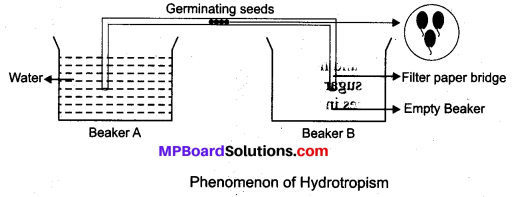
Take two small beakers and label them as A and B. Fill beaker A with water. Now, make a cylindrical-shaped roll from a filter paper and keep it as a bridge between beaker A and beaker B, as shown in the figure. Attach few germinating seeds in the middle of the filter paper bridge. Now, cover the entire set-up with a transparent plastic container so that the moisture is retained.
MP Board Class 10th Science Solutions Chapter 7 Control and Coordination 1
Phenomenon of Hydrotropism Observations:

  • The roots of the germinating seeds will grow towards beaker A.
  • This experiment demonstrates the phenomenon of hydrotropism.

Class 10th Science Chapter 7 Intext Questions Page No. 125

Question 1.
How does chemical coordination take place in animals?
Answer:
Chemical co-ordination take place by hormones Adrenal gland secrete adrenaline directly into the blood and carried to different parts of the body. Such animal hormones are part of the endocrine system which constitutes a second way of control and coordination in our body.

Question 2.
Why is the use of iodised salt advisable? .
Answer:
Iodine is main stimulator of thyroxine. It stimulates the thyroid gland to produce thyroxine hormone. It regulates carbohydrate, fat and protein metabolism in our body. Deficiency of this hormone results in the enlargement of the thyroid gland. This can lead to goitre, a disease characterized by swollen neck. Therefore, iodised salt is advised for normal functioning of the thyroid gland.

Question 3.
How does our body respond when adrenaline is secreted into the blood?
Answer:
Adrealine is secreted directly into the blood and carried to different parts of the body. The target organs or the specific tissues on which is acts include the heart. As a result, the heart beats faster, resulting in supply of more oxygen to our muscles. The blood to the digestive system and skin is reduced due to contraction of muscles around small arteries in these organs. This diverts the blood to our skeletal muscles. The breathing rate also increases because of the contractions of the diaphragm and the rib muscles.

Question 4.
Why are some patients of diabetes treated by giving injections of insulin?
Answer:
In diabetes, the level of sugar in the blood is too high and hence cause discomfort. Insulin, a naturally occuring chemical inside our pancreas act, as hormones andihelps in regulating the blood sugar levels. When due to very high suga- intake or improper secretion of insulin, balance of insulin decreasesin the body then insulin is injected to body. This is the reason why diabetic patients are treated by giving injections of insulin.

MP Board Solutions

MP Board Class 10th Science Chapter 7 NCERT Textbook Exercises

Question 1.
Which of the following is a plant hormone?
(a) Insulin
(b) Thyroxin
(c) Oestrogen
(d) Cytokinin
Answer:
(d) Cytokinin is a plant hormone.

Question 2.
The gap between two neurons is called a
(a) Dendrite
(b) Synapse
(c) Axon
(d) Impulse
Answer:
(b) The gap between two neurons is called a synapse.

Question 3.
The brain is responsible for:
(a) Thinking
(b) Regulating the heart beat
(c) Balancing the body
(d) All of the above
Answer:
(d) The brain is responsible for thinking, regulating the heart beat and balancing the body.

Question 4.
What is the function of receptors in our body? Think of situations where receptors do not work properly. What problems are likely to arise?
Answer:
Receptors are sensory structures (organs/tissues or cells) present all over the body. The receptors are either grouped in case of eye Or ear, or scattered in case of skin. Functions of receptors:
(i) They sense the external stimuli such as heat or pain.
(ii) They also trigger an impulse in the sensory neuron which sends message to the spinal cord. When the receptors are damaged, the external stimuli transferring signals to the brain are not felt. For example, in the case of damaged receptors, if we accidentally touch any hot object, then our hands might get burnt as damaged , receptors cannot perceive the external stimuli of heat and pain.

Question 5.
Draw the structure of a neuron and explain its function.
Answer:
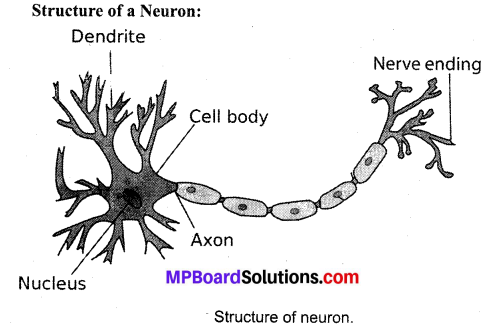
Neurons are the functional units of the nervous system.
Structure of a Neuron:
MP Board Class 10th Science Solutions Chapter 7 Control and Coordination 2

The three main parts of a neuron are axon, dendrite and cell body.

Functions of the three parts of a neuron:

  1. Axon: It conducts messages away from the cell body. It is the part by which information travels as an electrical impulse.
  2. Dendrite: It is the part where information is acquired, it receives information from axon of other cell or initiation point and conducts the messages towards the cell body.
  3. Cell body: It is the part where impulse get converted into a chemical signal forwarding transmission. It is mainly concerned with the maintenance and growth.

Question 6.
How does phototropism occur in plants?
Answer:
When growing plants detect light, a hormone called auxin, synthesised at ‘ the shoot tip, helps the cells to grow longer towards light. When light is coming from one side of the plant, Ans: auxin diffuses towards the shady side of the shoot. This concentration of auxin stimulates the cells to grow longer on the side of the shoot which is away from the light. Thus the plant appears to bend towards light, i,e, phototropism.

Question 7.
Which signals will get disrupted in case of a spinal cord injury?
Answer:
Spinal cord is made up of nerves which supply information to think about Nerves from all over the body meet in a bundle in the spinal cord on their way to the brain. Reflex arcs are formed in this spinal cord it self, although the information input also goes on to reach the brain. So if it is injured there is obstruction for carrying impulses to other parts.

Question 8.
How does chemical coordination occur in plants?
Answer:
Different plant hormones help to coordinate growth, development and response to the environment. When growing plants detect light, a hormone called auxin, synthesised at the shoot tip, helps the cells to grow longer. Gibberellins helps in the growth of the stem. Cytokinins promote cell division.

Question 9.
What is the need for a system of control and coordination in an organism?
Answer:
The maintenance of the body functions in response to changes in the body by working together of various integrated body systems is known as coordination. All the movements that occur in response to stimuli are carefully coordinated and controlled. In animals, the control and coordination movements are provided by nervous and muscular systems. The nervous system sends messages to and away from the brain. The spinal cord plays an important role in the relay of messages. In the absence of this system of control and coordination, our body will not be able to function properly. For example, when we accidentally touch a hot utensil, we immediately withdraw our hand. In the absence of nerve transmission, we will not withdraw our hand and may get burnt.

Question 10.
How are involuntary actions and reflex actions different from each other?
Answer:
Involuntary actions cannot be consciously controlled. For example, we cannot consciously control the movement of food in the alimentary canal. These actions are however, directly under the control of the brain. On the other hand, the reflex actions such as closing of eyes immediately when bright light is focussed show sudden response and do not involve any thinking. This means that unlike involuntary actions, the reflex actions are not under the control of brain.

Question 11.
Compare and contrast nervous and hormonal mechanisms for control and coordination in animals.
Answer:
Nervous system mechanism

  1. The information is conveyed in the form of electric impulse.
  2. The axons and dendrites transmit the information through a coordinated effort.
  3. The flow of information is rapid and the response is quick.
  4. Its effects are short lived.

Hormonal system mechanism

  1. The information is conveyed in the form of chemical messengers.
  2. The information is transmitted or transported through blood.
  3. The information travels slowly and the response is slow.
  4. It has prolonged effects.

Question 12.
What is the difference between the manner in which movement takes place in a sensitive plant and the movement in our legs?
Answer:
In a sensitive plant the cells change shape by changing the amount of water in them, resulting in swelling or shrinking and there fore leading to limited movements. Movement in our legs is voluntary action done by muscle tissue regulated by central nervous system.

MP Board Solutions

MP Board Class 10th Science Chapter 7 Additional Important Questions

MP Board Class 10th Science Chapter 7 Multiple Choice Questions

Question 1.
The brain box which protect internal part of brain is called:
(a) Skull
(b) Peripheral Nervous System
(c) Autonomic Nervous System
(d) Ribs
Answer:
(a) Skull

Question 2.
Secondary sexual characteristics are controlled by:
(a) Central Nervous System
(b) Peripheral Nervous System
(c) Autonomic Nervous System
(d) Endocrine gland
Answer:
(d) Endocrine gland

Question 3.
The activities of the internal organs are controlled by the:
(a) Central Nervous System
(b) Peripheral Nervous System
(c) Autonomic Nervous System
(d) Endocrine glands
Answer:
(a) Central Nervous System

Question 4.
Which pari of brain is the seat of intelligence and voluntary actions?
(a) Diencephalon
(b) Cerebrum
(c) Cerebellum
(d) Medulla oblongata
Answer:
(b) Cerebrum

Question 5.
Cell division in plant is affected by:
(a) Ethylene
(b) Auxin
(c) Gibberellin
(d) Cytokinin
Answer:
(d) Cytokinin

Question 6.
The gap between two neurons is known as……
(a) Synapse
(b) Synopsis
(c) Impulse
(d) Synaptic node
Answer:
(a) Synapse

Question 7.
Which of the follow ing is a plant hormone?
(a) Thyroxin
(b) Cytokinin
(c) Insulin
(d) Oestrogen
Answer:
(b) Cytokinin

Question 8.
Tropic movements are:
(a) In response to light
(b) In response to gravity
(c) Uni-directional
(d) Non – directional
Answer:
(c) Uni-directional

Question 9.
Artifical ripening of fruit is carried out by:
(a) Auxins
(b) Ethylene
(c) Abscisic acid (ABA)
(d) Gibberellins
Answer:
(b) Ethylene

Question 10.
The part of brain that controls respiration, heartbeat and peristalsisis:
(a) Cerebrum
(b) Cerebellum
(c) Pons
(d) Medulla
Answer:
(d) Medulla

Question 11.
The brain is responsible for:
(a) Thinking
(b) Regulating the heart beat
(c) Balancing the body
(d) All of the above
Answer:
(d) All of the above

Question 12.
Which of the following hormone is released by thyroid?
(a) Insulin
(b) Thyroxine
(c) Trypsin
(d) Pepsin
Answer:
(b) Thyroxine

Question 13.
Which body organ is surrounded by meninges?
(a) Heart and Lungs
(b) Brain and Heart
(c) Brain and Spinal Cord
(d) Spinal Cord and Lungs
Answer:
(c) Brain and Spinal Cord

Question 14.
The part of brain that controls muscular co-ordination is
(a) Cerebrum
(b) Cerebellum
(c) Pons
(d) Medulla
Answer:
(b) Cerebellum

Question 15.
Growth of the stem is controlled by:
(a) Gibberellin
(b) Auxin
(c) Abscisic acid
(d) Cytokinin
Answer:
(a) Gibberellin

Question 16.
Cause wilting of leaves? Which hormone
(a) Gibberellin
(b) Auxin
(c) Abscisic acid
(d) Cytokinin
Answer:
(c) Abscisic acid

Question 17.
Which of the following hormones contains iodine?
(a) Adrenaline
(b) Testosterone
(c) Thyroxine
(d) Insulin
Answer:
(c) Thyroxine

Question 18.
Which part of brain controls the posture and balance of the body?
(b) Cerebellum
(d) Medulla
Ans.
(b)

MP Board Solutions

MP Board Class 10th Science Chapter 7 Very Short Answer Type Questions

Question 1.
What is considered as the structural and functional unit of the nervous system?
Answer:
Neuron or Nerve cell.

Question 2.
What is called an automatic response to a stimulus which is not controlled by the brain?
Answer:
Reflex action.

Question 3.
How do plants respond to stimuli without any kind of nervous systems?
Answer:
Plants respond to stimuli without any kind of nervous systems with the help of plant hormones.

Question 4.
What are the other factors which control and coordinate in plants and animals other than CNS and reflex actions?
Answer:
Hormones.

Question 5.
What is phototropism?
Answer:
The movement of a plant’s part towards light is called phototropism.

Question 6.
What we call to:

  1. the movement of plant to the availability of water?
  2. the movement of plant to the earth’s gravity?

Answer:

  1. Hydrotropism.
  2. Geotropism.

Question 7.
Which system of our body is related to hormones which constitutes a second way of control and coordination in our body?
Answer:
Endocrine system.

Question 8.
How many Endocrine glands are situated in our brain? Name them.
Answer:
Three: Hypothalamus, pituitary and pineal glands.

Question 9.
What is considered as the reflex centre of the brain?
Answer:
Medulla oblongata.

Question 10.
Which structure is related to both nervous system and endocrine system in our body?
Answer:
Hypothalamus.

Question 11.
Which part of the brain maintains posture and equilibrium of the body?
Answer:
Cerebellum.

Question 12.
Name the substance important for synthesis of thyroxine.
Answer:
Iodine is essential for the synthesis of thyroxine.

Question 13.
How thyroxine initiate growth in our body?
Answer:
Thyroxine regulates carbohydrate, protein and fat metabolism in our body and provide proper energy which causes the best balance for growth.

Qusestion 14.
Who gave the term phytohormones?
Answer:
Thimann.

MP Board Solutions

MP Board Class 10th Science Chapter 7 Short Answer Type Questions

Question 1.
Write importance of control and coordination in living organisms.
Answer:

  • Control and coordination increase the chances of survival by responding to stimuli.
  • Different body parts function in coordination to each other as a single unit.

Question 2.
What is hyperglycemia?
Answer:
Hyperglycemia refers to high sugar level in blood. In general, diabetic patients has hyperglycemia due to insufficient release of insulin hormone. .

Question 3.
What are reasons for many drastic changes in appearance at 10-12 years of age?
Answer:
These changes are associated with puberty and are because of the secretion of testosterone in males and oestrogen in females.

Question 4.
Write down the functions performed by cerebrum.
Answer:
The cerebrum performs the following functions:

  • It controls our mental abilities like thinking, reasoning, learning, memorising etc.
  • It controls our feelings, emotions and speech.
  • It controls all involuntary functions.

Question 5.
What are the functions of cerebellum?
Answer:
Functions of cerebellum:

  • Maintains equilibrium or balance of the body.
  • Coordinates muscular movement.
  • Maintains posture of the body.

Question 6.
How soft and delicate brain is safe inside a human body?
Answer:
Brain is placed safely inside a bony box called cranium by the nature, within which there are 3 layers of fluid-filled (called cerebrospinal fluid) membranes (called meninges) which absorb external shock.

Question 7.
What is the role of the brain in reflex action?
Answer:
Brain has no role in reflex action response. Instead, spinal cord is the control center of a reflex action. In fact, brain becomes aware after the reflex arc has been formed.

Question 8.
What do you mean by reflex action? Give examples of reflex actions.
Answer:
It is defined as fast, unconscious, immediate, automatic and involuntary response of the body in parts or total (through effectors) to c «dmulus. It is monitored through spinal cord.

Examples of reflex actions:

  • Closing of eyes with bright light.
  • Knee-Jerk.
  • Withdrawal of body parts when pricked by a pin.

Question 9.
What are the different types of reflexes?
Answer:
There are two types of reflexes:

  • Unconditioned reflexes.
  • Conditioned reflexes.

Question 10.
What is reflex arc?
Answer:
The structural and functional unit that carries our reflex action is called a reflex arc. It consists of:

  • A receptor.
  • Sensory nerve (afferent)
  • Motor nerve (efferent)
  • Spinal cord.
  • Inter-neuron and effector

Question 11.
Write important functions of different plant hormones?
Answer:
The five major types of phytohormones and their functions are:

  • Auxins: Promote cell division, bending of shoot towards the source of light.
  • Cytokinins: Promote cell division.
  • Gibberellins: Stimulate stem elongation.
  • Abscisic acid: Inhibit growth, closing of stomata and dormancy.
  • Ethylene( gas hormone): Promotes fruit ripening and growth.

Question 12.
How is the movement of leaves of the sensitive plant different from the movement of a shoot towards light?
Answer:
The movement of leaves of the sensitive plant, (e.g. Mimosa pudica or touch-me-not) occurs in response to touch or contact stimuli. It is a growth independent movement (nastic movement).

The movement of shoot towards light is called photo-tropism. This type of movement is directional and is growth dependent.

Question 13.
Write some points about the character of nastic movement.
Answer:
Characters of Nastic Movements in plants:

  1. Growth independent movements.
  2. Time of action – immediate.
  3. Response to stimulus – Non-directional.
  4. Motive – Change in turgor.

Examples – Folding of leaves of touch-me-not (mimosa).

Question 14.
What is chemotropism?
Answer:
Directional movement of a plant or its part in response to chemicals is called chemotropism, e.g. outward growth of the shoot from origin.

Question 15.
Define geotropism.
Answer:
Roots move in the direction of gravity (positive + ve geotropism).
Shoots move (up) against direction of gravity (negative -ve geotropism).

MP Board Solutions

MP Board Class 10th Science Chapter 7 Long Answer Type Questions

Question 1.
What are the limitations of nervous system in human body? How it is overcomed?
Answer:
A chemical signal in the form of hormones would reach all cells of the body and provide the wide range of changes needed while nervous system in human body works or communicates using nerve impulses which are form of electrical impulses in limited nerve network. Electrical impulses are an excellent means of communication in human body but they have limitations like:

  • They reach only those cells that are connected by nervous tissue, not each and every cell in the animal body.
  • Cells cannot continually create and transmit electrical impulses.
  • Hormone or endocrine system is slower than nerve cells but potentially reach all cells of the body.

Question 2.
Why is the use of iodised salt advised? Why are some patients of diabetes treated by giving injections of insulin?
Answer:
It is advised to use iodised salt to prevent goiter (enlargement of the thyroid gland). Iodine is required for the proper functioning of thyroid. Iodine stimulates the thyroid gland to produce thyroxine hormone. This hormone regulates carbohydrate, fat and protein metabolism in our body. Diabetes is a condition in which sugar level in blood is very high. Insulin hormone is released by pancreas glands which regulates the blood sugar level.

In diabetic patients, pancreas stop releasing insulin hormone. If it is not secreted in proper amounts, the sugar level in the blood rises causing many harmful effects. Due to this reason, diabetic patients are treated by giving injections of insulin. The timing and amount of hormone released are regulated by feedback mechanisms. When the sugar levels in blood rise, they are detected by the cells of the pancreas which respond by producing more insulin. As the blood sugar level falls, insulin secretion is reduced.

Question 3.
How does adrenaline act during emergency?
Answer:
During emergency situations, adrenaline hormone is released into blood stream in large quantities. It increases the heartbeat and hence supplies more oxygen to the muscles. The increase in breathing rate also increases due to contractions of diaphragm and rib muscles. It raises the blood pressure and thus, enable the body to cope up with any stress or emergency. Adrenaline hormone is secreted by the adrenal glands. It helps to regulate heart beat, blood pressure and metabolism in the times of stress or emergency to cope up with the situation.

Question 4.
What happens at the synapse between two neurons?
Answer:
Synapse is a very small gap between the last portion of axon of one neuron and the dendron of the other neuron. It acts as a one way valve to transmit impulses. This is one directional flow of impulses because the chemicals are produced only on one side of the neuron i.e., the axon’s side. Via axon, the impulses travel across the synapse to the dendron of the other neuron.

In total, synapse performs the following tasks:

  1. It allows the information to pass from one neuron to another.
  2. It ensures the passage of nerve impulse in one direction only.
  3. It helps in information processing by combining the effects of all impulses received.

Question 5.
How do we detect the smell of any food?
Answer:
The fore-brain is the main thinking part of the brain. It has regions which receive sensory impulses from various receptors. Separate areas of the fore-brain are specialised for hearing, smell, sight and so on. Olfactoreceptors (present in nose) send the information about the smell of incense stick to fore-brain. The fore-brain interprets it along with information received from other receptors as well as with information that is already stored in the brain.

MP Board Solutions

MP Board Class 10th Science Chapter 7 Textbook Activities

Class 10 Science Activity 7.1 Page No. 115

  • Put some sugar in your mouth. How does it taste
  • Block your nose by pressing it between your thumb and index finger. Now eat sugar again. Is there any difference in its taste.
  • While eating lunch, block your nose in the same way and notice if you can fully appreciate the taste of the food you are eating.

Observations:

  • The sugar tastes sweet. The taste is combined perception of tongue and nose.
  • When we block our nose, the sugar taste different as now aroma through nose is hindering in proxiding the taste fell earlier. The olfactory receptors of nose are now blocked and we perceixe taste only due to gustatory receptors piesent on tongue.
  • Similarly, taste of the food also can not be fully appreciated with blocked nose.

Class 10 Science Activity 7.2 Page No. 121

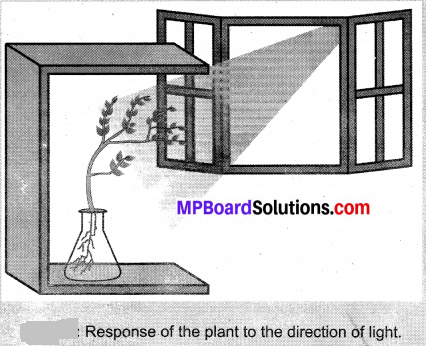
  • Fill a conical flask with water.
  • Cover the neck of the flask w’ith a wire mesh.
  • Keep two or three freshly germinated bean seeds on the wire mesh.
  • Take a cardboard box which is open from one side.
  • Keep the flask in the box in such a manner that the open side of the box faces light coming from a window.
MP Board Class 10th Science Solutions Chapter 7 Control and Coordination 3

  • After two or three days, you will notice that the shoots bend towards light and roots away from light.
  • Now turn the flask so that the shoots arc away from light and the roots towards light. Leave it undisturbed in this condition for a few days.
  • Have the old parts of the shoot and root changed direction?
  • Are there differences in the direction of the new growth?
  • What can we conclude from this activity?

Observations:

  • The old parts of shoot and root does not show’ noticeable changes in the direction.,
  • The new’ growth of parts of shoot and root show noticeable changes in the direction of the growth. Shoots bend towards light and roots bend away from it.
  • From this activity, we can conclude that shoot shows phototropism and the roots show geotropism.

Class 10 Science Activity 7.3 Page No. 123

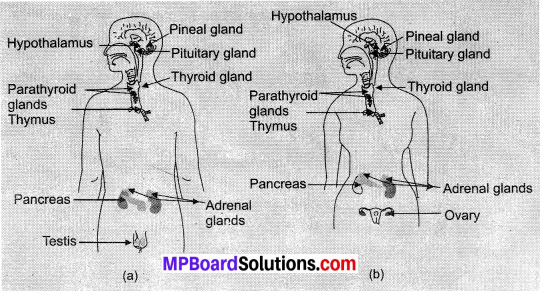
  • Look at Figure.
  • Identify the endocrine glands mentioned in the figure.
  • Some of these glands have been listed in Table and discussed in the text. Consult books in the library and discuss with your teachers to find out about other glands.
MP Board Class 10th Science Solutions Chapter 7 Control and Coordination 4
Endocrine glands in human beings (a) male, (b) female.

Observations:

  • The endocrine glands mentioned in the figure are: Hypothalamus, pituitary, pineal, thymus. Thyroid gland, parathyroid, adrenal, pancreas, testes and ovaries.

Class 10 Science Activity 7.4 Page No. 125

  • Hormones are secreted by endocrine glands and have specific fifhctions. Complete Table 7.1 based on the hormone, the endocrine gland or the functions provided.

Some important hormones and their functions.

S.No.Hormone

Endocrine Gland

Functions
1.Growth hormonePituitary glandSimulates growth in all organs
2.Thyroid glandRegulates metabolism for body growth
3.insulinRegulated blood sugar level
4.TestosteroneTestes
5.OvariesDevelopment of female sex organs, regulates menstrual cycle, etc.
6.AdrenalineAdrenal gland
7.Releasing hormonesStimulates pituitary gland to release hormones

MP Board Class 10th Science Solutions

MP Board Class 10th Science Solutions Chapter 12 Electricity

MP Board Class 10th Science Solutions Chapter 12 Electricity

MP Board Class 10th Science Chapter 12 Intext Questions

Class 10th Science Chapter 12 Intext Questions Page No. 200

Question 1.
What does an electric circuit mean?
Answer:
A continuous and closed path of an electric current is called an electric circuit.

Question 2.
Define the unit of current.
Answer:
The SI unit of electric current is ampere (A).
When I coulomb of electric charge flows through any cross. Section of a conductor in I second, the electric current flowing through it is said to be 1 ampere.
∵ 1 ampere = 1C/1s

Question 3.
Calculate the number of electrons constituting one coulomb of charge.
Answer:
The SI unit of electric charge is column, which is equivalent to the charge contained in nearly 6 × 10¹⁸ electrons.

Class 10th Science Chapter 12 Intext Questions Page No. 202

Question 1.
Name a device that helps to maintain a potential difference across a conductor.
Answer:
A source of electricity such as battery, cell, power supply etc. can maintain a potential difference.

Question 2.
What is meant by saying that the potential difference between two points is 1 V?
Answer:
One Volt is the potential difference between two points in a current-carrying conductor when 1 joule of work is done to move a charge of 1 coulomb from one point to the other.
KSEEB SSLC Class 10 Science Solutions Chapter 12 Electricity 96 Q 2
1 V = 1 Jc-1

Question 3.
How much energy is given to each coulomb of charge passing through a 6 V battery?
Answer:
W = VQ
= 6 × 1 = 6 joules
Hence 6 joules of energy is given to each coulomb of charge passing through a 6 V battery.

MP Board Solutions

Class 10th Science Chapter 12 Intext Questions page No. 209

Question 1.
On what factors does the resistance of a conductor depend?
Answer:
The resistance of a conductor depends upon main four factors which are given below:

  1. Length of the conductor.
  2. Cross-sectional area of the conductor.
  3. Natural of material of the conductor.
  4. Temperature of the conductor.

Question 2.
Will current flow more easily through a thick wire or a thin wire of the same material, when connected to the same source? Why?
Answer:
Thicker the wire, lower is the resistance of the wire. Hence, current flows more easily through a thick wire. It is because the resistance of a conductor is inversely proportional to its area of cross-section.

Question 3.
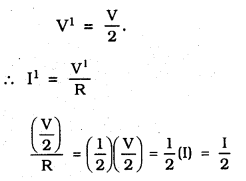
Let the resistance of an electrical component remains constant while the potential difference across the two ends of the component decreases to half of its former value. What change will occur in the current through it?
Answer:
As per ohm’s law, V = IR
\(\mathrm{I}=\frac{\mathrm{V}}{\mathrm{R}}\) —— (i)
Potential difference is half
KSEEB SSLC Class 10 Science Solutions Chapter 12 Electricity 103 Q 3
∴ Current flowing is also half of ts former value.

Question 4.
Why are coils of electric toasters and electric irons made of an alloy rather than a pure metal?
Answer:
a) Resistivity of iron = 10.0 × 10⁻⁸
Resistivity of Mercury = 94.0 × 10⁻⁸
Resistivity of an alloy is greater than iron. By this we conclude that, Iron is good conductor of heat comparing to Mercury.
b) Resistivity of silver is less, hence it is a good conductor of heat.

Question 5.
Use the data in Table 12.1 to answer the following:
Electrical resistivity of some substances at 20°C

MaterialResistivity (Ωm)
ConductorSilver1.60 x 10-8
Copper1.62 x 10-8
Aluminium2.63 x 10-8
Tungsten5.20 x 10-8
Nickel6.84 x 10-8
Iron10.0 x 10-8
Chromium12.9 x 10-8
Mercury94.0 x 10-8
Manganese1.84 x 10-6
AlloysConstantan49 x 10-6
Manganin44 x 10-6
Nichrome100 x 10-6
InsulatorsGlass1010 – 1014
Hard rubber1013 – 1016
Ebonite1015 – 1017
Diamond1012 – 1013
Paper (dry)1012

(a) Which among iron and mercury is a better conductor?
(b) Which material is the best conductor?
Answer:
(a) Resistivity of iron = 10.0 × 10⁻⁸ Ωm
Resistivity of mercury = 94.0 × 10⁻⁸ Ωm
Hence, resistivity of mercury is more than that of iron. This implies that iron is a better conductor than mercury.
(b) It can be observed from table that the resistivity of silver is the lowest among the listed materials. Hence, it is the best conductor.

Class 10th Science Chapter 12 Intext Questions page No. 213

Question 1.
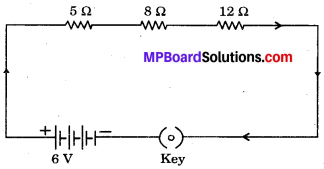
Draw a schematic diagram of a circuit consisting of a battery of ‘three cells of 2 V each, a 5 Ω resistor, an 8 Ω resistor, and a 12 Ω resistor, and a plug key, all connected in series.
Answer:
Schematic diagram of a circuit:
MP Board Class 10th Science Solutions Chapter 12 Electricity 1
Question 2.
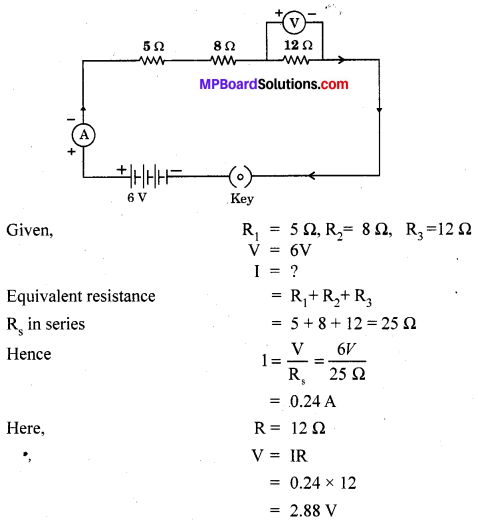
Redraw the circuit of question 1, putting in an ammeter to measure the current through the resistors and a voltmeter to measure the potential difference across the 12 Ω resistor. What would be the readings in the ammeter and the voltmeter?
Answer:
MP Board Class 10th Science Solutions Chapter 12 Electricity 2
Hence, reading in the ammeter would be 0.24 A and reading in voltmeter would be 2.88 V.

MP Board Solutions

Class 10th Science Chapter 12 Intext Questions Page No. 216

Question 1.
Judge the equivalent resistance when the following are connected in parallel:
(a) 1Ω, and 106 Ω
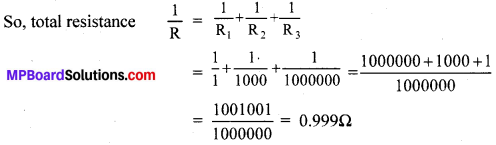
(b) 1 Ω, and 103 Ω and 106 Ω
Answer:
(a) 1 ohm and 106 times ohm
R1 = 1 ohm
R2 = 106 times = 1000000 ohm
Total resistance (parallel)
1/R = 1/R1 + 1/R2
= 1/1 + 1/1000000
= 1000000 + 1 /1000000
= 1000000/ 1000000
1/R = 1/1 ohm (approx.)
∴ Resistance = 1 ohm (approx.)

(b) Given R1 = 1 ohm
R2 = 103 ohm
R3 = 106 ohm
MP Board Class 10th Science Solutions Chapter 12 Electricity 3

Question 2.
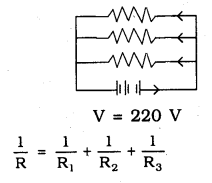
An electric lamp of 100Ω, a toaster of resistance 50Ω and a water filter of resistance 500Ω are connected in parallel to a 220 V source. What is the resistance of an electric iron connected to the same source that takes as much current as all three appliances, and what is the current through it?
Answer:
Resistance of Electric 1 amp R1 = 100Ω
Resistance of Tosser, R2 = 50Ω
Resistance of water filter, R3 = 50Ω
Potential difference, V = 220V
When these are connected in parallel,
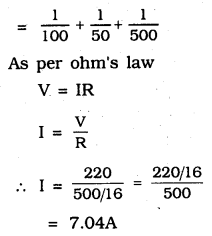
KSEEB SSLC Class 10 Science Solutions Chapter 12 Electricity 110 Q 2
KSEEB SSLC Class 10 Science Solutions Chapter 12 Electricity 110 Q 2.1
7.04A of electricity is obtained by three appliances
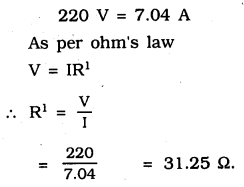
Resistance of an electric iron connected to the same source that takes as much current as all three appliances
KSEEB SSLC Class 10 Science Solutions Chapter 12 Electricity 110 Q 2.2
∴ Resistance of iron box = 31.25Ω
Electricity flowing through this = 7.04A.

Question 3.
What are the advantages of connecting electrical devices in parallel with the battery instead of connecting them in series?
Answer:
(i) In parallel circuit, if one electrical appliance stops working due to some defect, then all other appliances keep working normally. In series circuit, if one electrical appliance stops working due to some defect, then all other appliances also stop working.

(ii) In parallel circuits, each electrical appliance gets the same voltage as that of the power supply line. In series circuit, appliances do not get the same voltage, as that of the power supply line.

(iii) In the parallel connection of electrical appliances, the overall resistance of the household circuit is reduced due to which the current from the power supply is high. In the series connection, the overall resistance of the circuit increases too much due to which the current from the power supply is low.

Question 4.
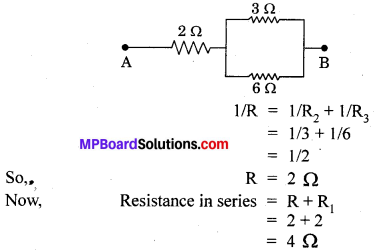
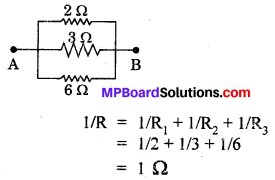
How can three resistors of resistances 2 Ω, 3 Ω, and 6 Ω be connected to give a total resistance of (a) 4Ω, (b) 1Ω?
Answer:
Given,
R1 = 2 Ω
R2 = 3 Ω
R3 = 6 Ω
(a) When R2 and R3 are connected in parallel with R1 in series we receive
MP Board Class 10th Science Solutions Chapter 12 Electricity 4
(b) When R1, R2, R3 are connected in parallel we receive
MP Board Class 10th Science Solutions Chapter 12 Electricity 5

Question 5.
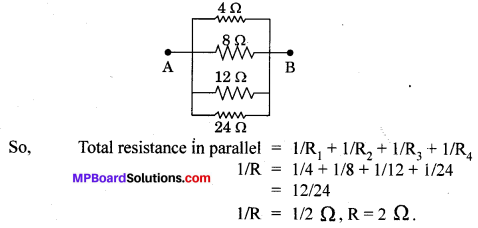
What is (a) the highest, (b) the lowest total resistance that can be secured by combinations of four coils of resistance 4 Ω, 8 Ω, 12 Ω, 24 Ω?
Answer:
(a) For highest resistance according to question resistances must be connected in series:
MP Board Class 10th Science Solutions Chapter 12 Electricity 6
4 Ω, 8 Ω, 12 Ω, 24 Ω
R1 = 4 Ω
R2 = 8 Ω
R3 = 12 Ω
R4 = 24 Ω
Total resistance in series = R1 + R2 + R3 + R4
= 4 + 8 + 12 + 24
= 48 Ω
Now, resistance is maximum when connected in series.

(b) For lowest resistance, resistances must be connected in parallel.
MP Board Class 10th Science Solutions Chapter 12 Electricity 7
Resistance is lowest when connected in parallel.

MP Board Solutions

Class 10th Science Chapter 12 Intext Questions Page No. 218

Question 1.
Why does the cord of an electric heater not glow while the heating element does?
Answer:
In cord of an electric heater, as current flows these become hot arid glows but in case of electric heater this will not happen.

Question 2.
Compute the heat generated while transferring 96000 coulomb of charge in one hour through a potential difference of 50 V.
Answer:
Given, Charge = 96000 coulomb
Time = 1 hour = 3600 seconds
Potential difference = 50 V Ω
As we know, I = Q/T
I = 96000/36000 = 80/3 amp.
V = I × R
50 = 80/3 × R
So, R = 15/8 Ω
Now, Heat = I2RT
= (80/3)2 × 15/8 × 3600
800 × 6000
= 4800000 joules or 4.8 × 10⁶ J

Question 3.
An electric iron of resistance 20Ω takes a current of 5 A. Calculate the heat developed in 30 s.
Answer:
As per Joule’s law
H = VIt
H = IR = 5A × 20Ω = 100V
I = 5A, t = 30 sec.
∴ H = 100 × 5 × 30 J
= 15000 J = 1.5 × 10⁴ J.

Class 10th Science Chapter 12 Intext Questions Page No. 220

Question 1.
What determines the rate at which energy is delivered by a current?
Answer:
The rate at which electric energy is dissipated or consumed in an electric circuit is termed as electric power.
P = VI.

Question 2.
An electric motor takes 5 A from a 220 V line. Determine the power of the motor and the energy consumed in 2 h.
Answer:
P = VI
V = 220V, and I = 5A.
Power P = 220 × 5 = 1100 W
Power of the motor = P × t
P = 1100 W.
t = 2 Hr 2 × 60 × 60 W
= 7200 S
∴ Energy consumed, E = 1100 × 7200 J
= 7920000
= 7.92 × 10⁶J.

MP Board Class 10th Science Chapter 12 NCERT Textbook Exercises

Question 1.
A piece of wire of resistance R is cut into five equal parts. These parts are then connected in parallel. If the equivalent resistance of this combination is R’, then the ratio \(\frac { R }{ R` } \) is –
(a) \(\frac { 1 }{ 25 }\)
(b) \(\frac { 1 }{ 5 }\)
(c) 5
(d) 25
Answer:
(d) 25

Question 2.
Which of the following terms does not represent electrical power in a circuit?
(a) I2R
(b) IR2
(c) VI
(d) \(\frac { { V }^{ 2 } }{ R } \)
Answer:
(b) IR2

Question 3.
An electric bulb is rated 220 V and 100 W. When it is operated on 110 V, the power consumed will be –
(a) 100 W
(b) 75 W
(c) 50 W
(d) 25 W
Answer:
(d) 25 W

Question 4.
Two conducting wires of the same material and of equal lengths and equal diameters are first connected in series and then parallel in a circuit across the same potential difference. The ratio of heat produced in series and parallel combinations would be-
(a) 1 : 2
(b) 2 : 1
(c) 1 : 4
(d) 4 : 1
Answer:
(c) 1 : 4

Question 5.
How is a voltmeter connected in the circuit to measure the potential difference between two points?
Answer:
Voltmeter is connected in parallel in the circuit to measure the potential difference between two points.

Question 6.
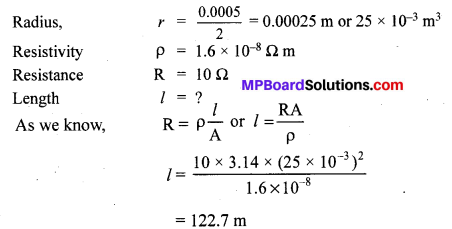
A copper wire has diameter 0.5 mm and resistivity of 1.6 × 10⁻⁸ Ω m. What will be the length of this wire to make its resistance 10 Ω? How much does the resistance change if the diameter is doubled?
Answer:
Given, Diameter = 0.5 mm = 0.0005 m
MP Board Class 10th Science Solutions Chapter 12 Electricity 8
So, the resistance is one-fourth if the diameter is doubled.

Question 7.
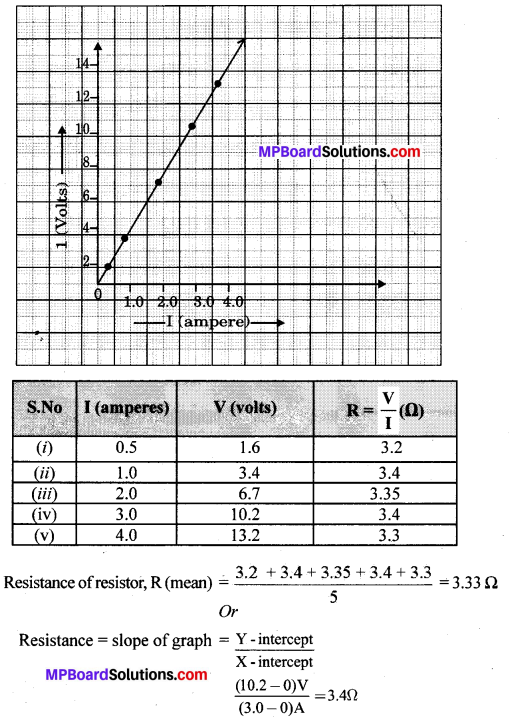
The values of current I flowing in a given resistor for the corresponding values of potential difference V across the resistors are given below:
MP Board Class 10th Science Solutions Chapter 12 Electricity 9
Plot a graph between V and I and calculate the resistance of that resistor are given below:
Answer:
MP Board Class 10th Science Solutions Chapter 12 Electricity 10 (2)
Question 8.
When a 12 V battery is connected across an unknown resistor, there is a current of 2.5 mA in the circuit. Find the value of the resistance of the resistor.
Answer:
Given, V = 12v
I = 2.5 mA = 2.5 × 10⁻³ A
As we know, R = \(\frac { V }{ 1 } \)
R = \(\frac{12 \mathrm{V}}{2.5 \times 10^{-3} \mathrm{A}}\) = 48000 Ω
So, R = 4.8 kΩ

Question 9.
A battery of 9 V is connected in series with resistors of 0.2 Ω, 0.3 Ω, 0.4 Ω, 0.5 Ω, and 12 Ω respectively. How much current would flow through the 12 Ω resistor.
Answer:
R1 = 0.2 Ω R2 = 0.3 Ω R3 = 0.4 Ω R4 = 0.5 Ω R5 = 12 Ω
MP Board Class 10th Science Solutions Chapter 12 Electricity 10
Given, V = 9 V
R5 = 0.2 Ω + 0.3 Ω + 0.4 Ω + 0.5 Ω + 12 Ω
= 13.4 Ω
According to formula I = \(\frac { V }{ R } \)
= \(\frac{9 \mathrm{V}}{13.4 \Omega}\)
= 0.67 A
0.67 A current would flow through the 12 Ω resistor.

Question 10.
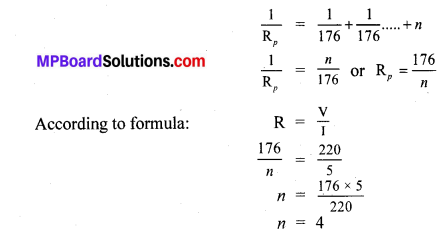
How many 176 Ω resistors (in parallel) are required to carry 5 A on a 220 V line?
Answer:
Given
I = 5 A V = 220 V
Now, Let the number of 176 Ω resistors be n.
MP Board Class 10th Science Solutions Chapter 12 Electricity 11
So, four resistors of 176 Ω are required to carry 5 A on a 220 V line.

Question 11.
Show how you would connect three resistors, each of resistance 6Ω, so that the combination has a resistance of (i) 9Ω, (ii) 4Ω.
Answer:
If resistors are connected in series 6Ω + 6Ω + 6Ω =18Ω This ia not correct
When they are connected in parallel
\(\frac{1}{6}+\frac{1}{6}+\frac{1}{6}=3\) This is also wrong,
i) When they are connected in parallel
KSEEB SSLC Class 10 Science Solutions Chapter 12 Electricity Ex Q 11
Two 6Ω resistors are connected in parallel
KSEEB SSLC Class 10 Science Solutions Chapter 12 Electricity Ex Q 11.1
If 3rd resistor of 6Ω and 3Ω are connected in series, it becomes 6Ω + 3Ω = 9Ω.
ii) When they are connected in series
KSEEB SSLC Class 10 Science Solutions Chapter 12 Electricity Ex Q 11.2
Resistance = 6Ω + 6Ω
= 12Ω
If 3rd resistor 6Ω is connected to 12Ω in parallel
KSEEB SSLC Class 10 Science Solutions Chapter 12 Electricity Ex Q 11.3
Total resistance = 4Ω.

Question 12.
Several electric bulbs designed to be used on a 220 V electric supply line, are rated 10 W. How many lamps can be connected in parallel with each other across the two wires of 220 V line if the maximum allowable current is 5 A?
Answer:
Here V = 220V
I – 5A
KSEEB SSLC Class 10 Science Solutions Chapter 12 Electricity Ex Q 12
∴ 110 lamps can be connected in parallel with each other across the two wires.

Question 13.
A hot plate of an electric oven connected to a 220 V line has two resistance coils A and B, each of 24Ω resistance, which may be used separately, in series, or in parallel. What are the currents in the three cases?
Answer:
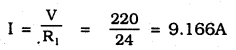
(i) If coils are connected separately V = 220 V
Resistance R1 = 240
As per ohm’s law, V = IR
KSEEB SSLC Class 10 Science Solutions Chapter 12 Electricity Ex Q 13
∴ If coils are connected separately 9.16A electricity flows in the coil.
(ii) If coils are connected in series
Resistance R2 = 24Ω + 24Ω = 48Ω
As per ohm’s law V = IR
KSEEB SSLC Class 10 Science Solutions Chapter 12 Electricity Ex Q 13.1
∴ If coils are connected in series 4.58A electricity flows.

Question 14.
Compare the power used in the 20 resistors in each of the following circuits:
(i) a 6 V battery in series with 1Ω and 2Ω resistors, and
(ii) a 4 V battery in parallel with 12Ω and 2Ω resistors.
Answer:
(i) Potential Difference V = 6V
If 1Ω and 2Ω resistors are connected in series, then Resistance
R = 1 + 2 = 3W.
As per ohm’s law
\(\mathrm{I}=\frac{6}{3}=2 \mathrm{A}\)
P(I2)R = (2)2 × 2 = 8W.
(ii) Potential difference V = 4V
If 12Ω and 2Ω resistors are connected in parallel, voltage is equal
Voltage of resistance 2 W is 4 volts
KSEEB SSLC Class 10 Science Solutions Chapter 12 Electricity Ex Q 14
∴ Power of 2Ω is 8 W.

Question 15.
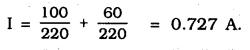
Two lamps, one rated 100 W at 220 V, and the other 60 W at 220 V, are connected in parallel to electric mains supply. What current is drawn from the line if the supply voltage is 220 V?
Answer:
Both lamps are connected in parallel potential difference = 220 V
Power = V × I.
KSEEB SSLC Class 10 Science Solutions Chapter 12 Electricity Ex Q 15

Question 16.
Which uses more energy, a 250 W TV set in 1 hr, or a 1200 W toaster in 10 minutes?
Answer:
250W TV set in used in 1 Hr, then its energy
= 250 × 3600 = 9 × 10⁵
energy of Toaster = 1200 × 600
If it is used in 10 minutes, then its power = 1200 × 600 × 7.2 × 105 J
∴ Energy of 250 W TV set is used in 1 Hr is greater than 1200 W toaster used in 10 minutes.

Question 17.
An electric heater of resistance 8Ω draws 15 A from the service mains 2 hours.
Calculate the rate at which heat is developed in the heater.
Answer:
P = I2R
R = 8Ω, I = 15A
P= (15)2 × 8 = 1800 J/s.
∴ Rate at which heat is developed in the heater
= 1800 J/s.

Question 18.
Explain the following:
(a) Why is the tungsten used almost exclusively for filament of electric lamps?
(b) Why arc the conductors of electric heating devices, such as bread-toasters and electric irons, majle of an alloy rather than a pure metal?
(c) Why is the series arrangement not used for domestic circuits?
(d) How does the resistance of a wire vary with its area of cross-section?
(e) Why are copper and aluminium wires usually employed for electricity transmission?
Answer:
(a) Tungsten used almost exclusively for filament of electric lamps because its melting point is very high and resistivity of tungsten is low, it has special property of glowing on heating, it does not oxidized.

(b) The conductors of electric heating devices such as bread toasters and electric irons are made of alloy because resistivity of an alloy is higher than metal so alloy produces large amount of heat. They do not get oxidized. Melting point is also high.

(c) As in series, circuit voltage is divided. Components of a series circuit receives only small voltage so the amount of current decreases and the device turn hot and do not work properly. Hence, series arrangement is avoided being used in domestic circuits.

(d) Resistance (R) of a wire is inversely proportional to its area of cross-section (A) i.e., when area of cross section decreases the resistance increases or vice versa.

(e) Copper and aluminium are usually used for electricity transmission because they are good conductors of electricity and also have low resistivity and do not get heated.

MP Board Solutions

MP Board Class 10th Science Chapter 12 Additional Important Questions

MP Board Class 10th Science Chapter 12 Multiple Choice Questions

Question 1.
SI unit of an electric current is equal to
(a) 6 × 10⁸ C
(b) 9.8 × 10¹⁰ C
(c) 1.6 × 10⁻¹⁹ C
(d) None of these
Answer:
(d) None of these

Question 2.
Which materials have changing resistivity?
(a) Conductors
(b) Semiconductors
(c) Non-metals
(d) Super metals
Answer:
(b) Semiconductors

Question 3.
If wire in a circuit is doubled its resistivity will be?
(a) Two times
(b) Ten times
(c) Zero
(d) half
Answer:
(d) half

Question 4.
A wire used in circuit must be
(a) Highly resistant
(b) Non resistance
(c) Have high melting point
(d) None of these
Answer:
(b) Non resistance

Question 5.
A heating w ire must have
(a) High melting point
(b) High conductivity to heat
(c) Both
(d) None
Answer:
(b) High conductivity to heat

Question 6.
SI unit of resistance is:
(a) Coulomb
(b) Ampere
(c) Ohm
(d) Ohm – meter
Answer:
(c) Ohm

Question 7.
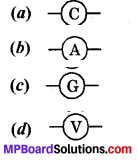
Symbol for use of voltmeter in circuit is:
MP Board Class 10th Science Solutions Chapter 12 Electricity 12
Answer:
MP Board Class 10th Science Solutions Chapter 12 Electricity 13

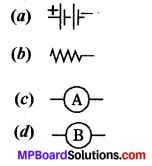
Question 8.
Symbol for use of battery in circuit is:
MP Board Class 10th Science Solutions Chapter 12 Electricity 14
Answer:
MP Board Class 10th Science Solutions Chapter 12 Electricity 15

Question 9.
Relation of potential difference and current is represented by:
(a) Joule’s law
(b) Ohm’s law
(c) Dalton’s law
(d) None
Answer:
(b) Ohm’s law

Question 10.
Formula which represents the relation among potential difference and current following in a circuit is:
(a) V = IR
(b) V = I/R
(c) l = Q/t
(d) R = p \(\frac { l }{ A } \)
Answer:
(a) V = IR

Question 11.
Kilo watt is a unit for:
(a) Power
(b) Electrical energy commercial
(c) Resistance
(d) Current flow in circuit
Answer:
(a) Power

Question 12.
Which one has less resistance?
(a) 10 watt bulb
(b) 15 watt LED
(c) 60 watt bulb
(d) 60 watt LED.
Answer:
(a) 10 watt bulb

Question 13.
In which type of combinations resistance is more?
(a) Series Combination
(b) Parallel combination
(c) both
(d) Single resistance unit.
Answer:
(a) Series Combination

Question 14.
Joule’s law formulation is
(a) H = IRT
(b) H = I2RT
(c) P = VI
(d) RT = PV
Answer:
(d) RT = PV

Question 15.
Hardest metal which can resist maximum heat is:
(a) Lead
(b) Tungsten
(c) Silver
(d) Carbon
Answer:
(b) Tungsten

Question 16.
If current passing a circuit is 10 A and wire is connected to 100 volt line resistant in the wire will be:
(a) 10 A
(b) 10 Ω
(c) 100 Ω
(d) O Ω
Answer:
(b) 10 Ω

Question 17.
An insulator has a resistivity equals to:
(a) 10-8 Ω m
(b) 10 Ω m
(c) 5 Ω m
(d) 10-18
Answer:
(a) 10-8 Ω m

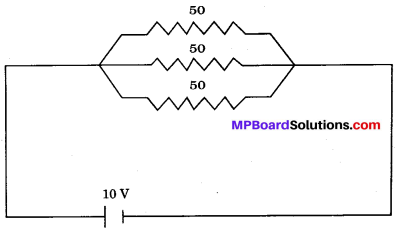
Question 18.
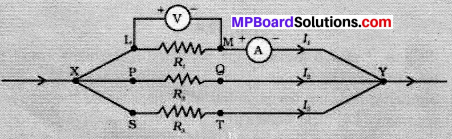
Calculate current-(I) in circuit given below:
(a) 0.6 A
(b) 20 A
(c) 50 A
(d) 10 A
MP Board Class 10th Science Solutions Chapter 12 Electricity 16
Answer:
(a) 0.6 A

Question 19.
If resistors are arranged in parallel with value 1 Ω, 2 Ω and 3 Ω Total resistant will be:
(a) more than 3 Ω
(b) less than 3 Ω
(c) less than 1 Ω
(d) equal to 1 Ω
Answer:
(b) less than 3 Ω

Question 20.
The changing 1 kWh to joule will be equal to
(a) 3.6 × 10⁶ J
(b) 3.6 × 10⁻⁶ J
(c) 1.6 × 10⁶ J
(d) 1 × 10⁶ J
Answer:
(a) 3.6 × 10⁶ J

MP Board Solutions

MP Board Class 10th Science Chapter 12 Very Short Answer Type Questions

Question 1.
What kind of circuit is required for flow of current ?
Answer:
Closed.

Question 2.
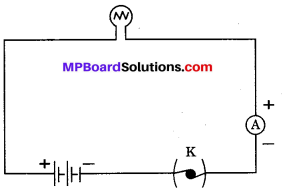
Draw a schematic diagram of a simple electric with battery, bulb, ammeter and key.
Answer:
MP Board Class 10th Science Solutions Chapter 12 Electricity 17

Question 3.
Express in formula form:

  1. net charge of a circuit
  2. time taken for production of a unit amount of current.

Answer:

  1. Q = It.
  2. t = Q/I.

Question 4.
What is the value of an electric charge for an electron?
Answer:
-1.6 × 10⁻¹⁹ C.

Question 5.
Formulate relationship between potential difference and current.
Answer:
V = IR.

Question 6.
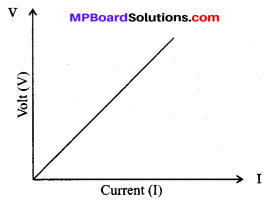
Draw the graph verifying ohm’s law.
Answer:
MP Board Class 10th Science Solutions Chapter 12 Electricity 18

Question 7
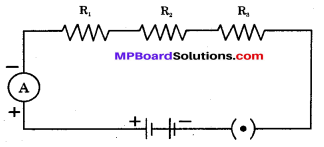
Draw circuit with three resistor in series combination.
Answer:
MP Board Class 10th Science Solutions Chapter 12 Electricity 19

Question 8.
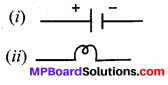
Represent with diagram:
(i) A cell
(ii) A bulb.
Answer:
MP Board Class 10th Science Solutions Chapter 12 Electricity 20

Question 9.
Which material has highest conductivity and least resistance?
Answer:
Super conductors.

Question 10.
Which quality of electrical energy is inversely proportional to electrical power?
Answer:
Resistance.

Question 11.
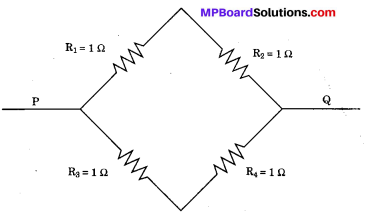
Calculate resistance between terminal P & Q of following diagram.
Answer:
MP Board Class 10th Science Solutions Chapter 12 Electricity 21
First R1 and R2 are in series.
So, R’ = R1 + R2 = 1 Ω + 1 Ω = 2 Ω.
then, R3 and R4 are in series
R” = R3 + R4 = 1 Ω + 1 Ω = 2 Ω
Now both R’ and R” are in parallel.
\(\frac { 1 }{ R } \) = \(\frac{1}{R^{\prime}}+\frac{1}{R^{\prime \prime}}+\frac{1}{2}+\frac{1}{2}=1\)
So, R = 1 Ω

Question 12.
If a circuit has open key will current flow from it?
Answer:
No.

Question 13.
If ammeter is not placed in circuit will current flow?
Answer:
Yes.

Question 14.
Which gas is filled in electric bulb?
Answer:
Argon.

Question 15.
Write the formula representing relationship between heat produced and current flowing in a circuit.
Answer:
H = I2RT.

Question 16.
Write the formula to calculate power generated by a circuit a with current M.
Answer:
Since, P = VI
Putting value of I, P = VM (I = m, Given)

Question 17.
Convert 5 kWh in joule.
Answer:
1 kWh = 3.6 × 10⁶ Joule
5 kWh = 5 × 3.6 × 106 J.
= 16 × 106 J
or 1.6 × 10⁷ J

Question 18
One volt ampere is equal to how many watt power?
Answer:
1 Watt Power.

MP Board Solutions

MP Board Class 10th Science Chapter 12 Short Answer Type Questions

Question 1.
What is electric current?
Answer:
Total charge which pass through a particular area in unit time is called electric current of that particular conductor.

Question 2.
What is potential difference?
Answer:
Movement of electron need a pressure difference among conductors. Hence, battery or current flow suppliers are added to circuit. This difference in potential is called potential difference.

Question 3.
Define Ohm’s law.
Answer:
Ohm’s law states that current flowing in a circuit is directly proportional to its potential difference. It is represented by formula,
V α I
or V = RI
or V = IR
Here, R is a constant known as resistance.

Question 4.
Why resistance is applied to a circuit?
Answer:
To control the current flow in desired way resistance is applied. Example- Regulator of fan give desired speed of wind flow by controlling flow of current which is being converted to physical energy by fan.

Question 5.
Write down the factors at which the resistance of the conductor depends.
Answer:

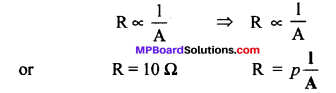
  1. Length of wire: Resistance is directly proportional to length R ∝ L.
  2. Area cross section: Resistance is inversely proportional to area cross section of a wire R ∝ 1/A.
  3. Nature of material.
  4. Temperature of the conductor.

Question 6.
Arrange the resistivity in decreasing order of following material,
Iron, Silver, Tungsten, Manganin and Glass
Answer:
Glass > Manganin > Iron > Tungsten > Silver.

Question 7.
Give reason for the following:

  1. Electric bulbs are usually filled with chemically inactive gases like nitrogen and argon.
  2. Copper and aluminium wires are usually employed for electricity transmission.
  3. Fuse wire is placed in series with the device.

Answer:

  1. Electric bulbs are usually filled with chemically inactive gases like nitrogen and argon because these gases do not react with the hot tungsten filament and hence, prolong the life of filament of the electric bulb.
  2. Copper and aluminium wires are usually employed for electricity transmission because copper and aluminium have low resistivity and thus, they are very good conductors of electricity.
  3. Fuse wire is placed in series with the device because when large current passes through the circuit the fuse wire gets heated up and melts and whole circuit breaks and the device is protected from the damage.

Question 8.
If R1 = 10 Ω, R2 = 20 Ω and R3 = 30 Ω, calculate the effective resistance when they are connected in series to a battery of 6 V. Also find the current flowing in the circuit.
(a) Current flows through different resistances, when these are joined in series, as shown in the below figure:
MP Board Class 10th Science Solutions Chapter 12 Electricity 22
(b) R1 = 10 Ω, R2 = 20 Ω, R3 = 30 Ω
Effective resistance, R = R1 + R2 + R3
R 10 + 20 + 30 = 60 Ω
Potential difference, V = 6V,
Current, I = ?
According to Ohm’s law
V = IR

Question 9.
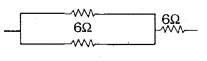
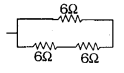
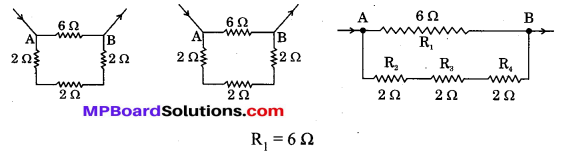
Find the resistance between points A and B in the circuit diagram given below
MP Board Class 10th Science Solutions Chapter 12 Electricity 23
Answer:
R2, R3, R4 are in series and have resultant resistance R
R’ = R2 + R3 + R4
= 2 + 2 + 2 = 6 Ω
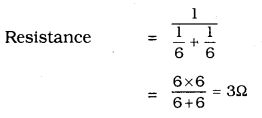
R’ is in parallel combination with R1
∴ Resultant resistance of the circuit (R’)
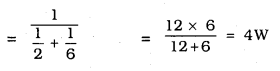
⇒ \(\frac { 1 }{ R } \) = \(\frac{1}{R_{1}}+\frac{1}{R_{1}}\) = \(\frac { 1 }{ 6 } \) + \(\frac { 1 }{ 6 } \) = \(\frac { 2 }{ 6 } \) = \(\frac { 1 }{ 3 } \)
∴ Resistance, R = 3 Ω.

MP Board Solutions

MP Board Class 10th Science Chapter 12 Long Answer Type Questions

Question 1.
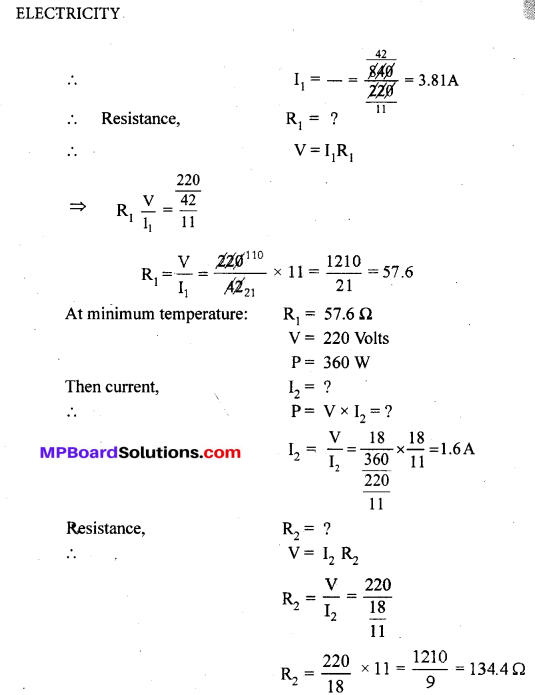
An electric iron consumes energy at a rate of 840 W when heating is at the maximum and 360 W when the heating is at the minimum. The voltage at which it is running is 220 V. What are the current and resistance in each case?
Solution:
At maximum heating:
The consumption of energy (electric) is given at the rate of 840 W at voltage 220 V.
P = 840 Ω, V = 220 V
Then current, I1 = ?
∴ P = V × I1
MP Board Class 10th Science Solutions Chapter 12 Electricity 24

Question 2.
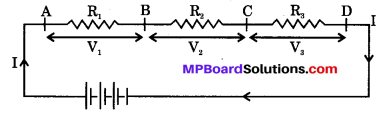
Three resistors of 5 Ω,10 Ω and 15 Ω are connected in series and the combination is connected to battery of 30 V. Ammeter and Voltmeter are connected in the circuit. Draw a circuit diagram to connect devices all the in correct order. What is the current flowing and potential difference across 10 Ω resistance?
Answer:
Current flowing I = ?
V2 = ?
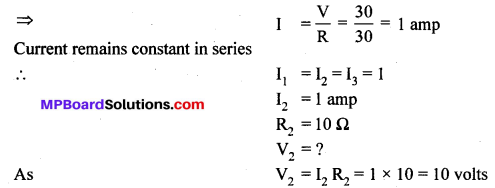
Total resistance, R = R1 + R2 + R3
= 5 + 10 + 15 = 30 Ω
Total potential difference, V = 30 volts
According to Ohm’s law V = IR
MP Board Class 10th Science Solutions Chapter 12 Electricity 25
Potential difference across 10 Ω is 10 volts.

Question 3.
Nichrome wire of length ‘l’ and radius ‘r’ has resistance of 10 Ω. How would the resistance of the wire change when:
(a) (i) Only length of the wire is doubled?
(ii) Only diameter of the wire is doubled? Justify your answer.
(b) Why element of electrical heating devices are made up of alloys?
Solution:
(a) Resistance, R ∝ 1
MP Board Class 10th Science Solutions Chapter 12 Electricity 26
(i) Resistance is directly proportional to the length of the conductor. If length of nichrome wire (I) is doubled its resistance also gets doubled.
∴ R’ new resistance = 20 Ω

(ii) The resistance of the wire is inversely proportional to the square of its diameter. If the diameter of the wire is doubled, its resistance becomes one-fourth.
∴ R’, new resistance = \(\frac { 10 }{ 4 } \) Ω = 2.5 Ω.

(b) The heating elements of electrical heating appliances are made up of nichrome alloy because,

  • Nichrome has very high resistivity due to which it produces a lot of heat on passing current.
  • Nichrome does not undergo oxidation easily even at high temperature, it can be kept red hot without burning.

Question 4.
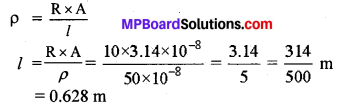
The resistance of a wire of 0.01 cm radius is 10 Ω. If the resistivity of the material of the wire is 50 × 10-8 ohm meter, find the length of the wire.
Answer:
Resistance of a wire, R = 10 Ω Radius, r = 0.01 × 10⁻² m
Resistivity, p = 50 × 10-8 ohm meter Length of the wire, l = ?
Area of cross section, A = πr2 = 3.14 × (0.01 × 1o-2)2 m2
= 3.14 × 0.01 × 0.01 × 10-4 m2
= 3.14 × 10⁻⁸ m2
MP Board Class 10th Science Solutions Chapter 12 Electricity 27

Question 5.
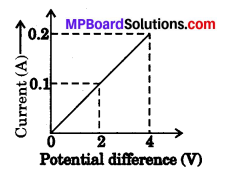
(a) Calculate the resistance of the wire using the graph.
(b) How many 176 Ω resistors in parallel are required to carry 5 A on a 220 V line?
(c) Define electric power. Derive relation between power, potential difference and resistance.
MP Board Class 10th Science Solutions Chapter 12 Electricity 28
Answer:
(a) Resistance of wire = Slope of the graph
According to Ohm’s law,
V = IR or R = \(\frac { V }{ I } \)
MP Board Class 10th Science Solutions Chapter 12 Electricity 29
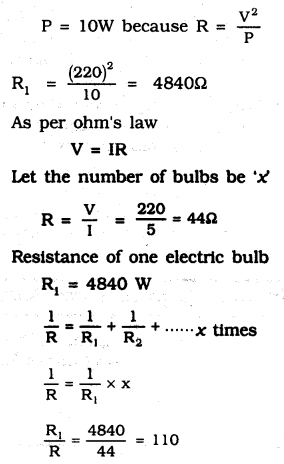
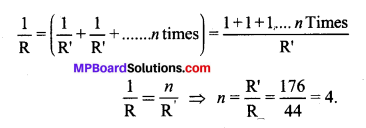
(b) Resistance, R1 = 176 Ω, No. of resistors = n,
Current, I = 5A
Potential difference, V = 220 volts, Resultant resistance = R According to Ohm s law,
V = IR, R = \(\frac { V }{ 1 } \) = \(\frac { 220 }{ 5 } \) = 44 Ω
MP Board Class 10th Science Solutions Chapter 12 Electricity 30
Thus, 4 resistors of 176 Ω in parallel combination are required to carry 5 A on a 220 V line.

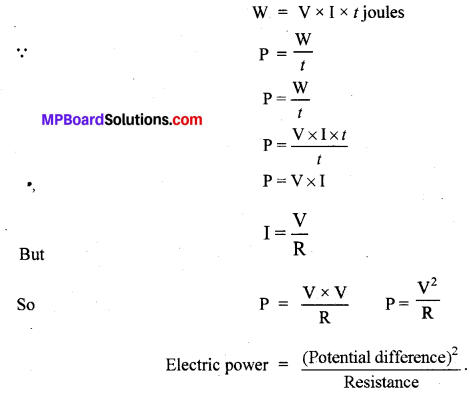
(c) Electric power is defined as the electrical work done per unit-time.
MP Board Class 10th Science Solutions Chapter 12 Electricity 31
The work done, W by current, I when it flows for time t under potential difference V is given by
MP Board Class 10th Science Solutions Chapter 12 Electricity 32

MP Board Solutions

MP Board Class 10th Science Chapter 12 NCERT Textbook Activities

Class 10 Science Activity 12.1 Pages No. 203.204

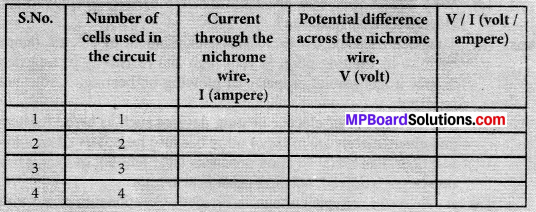
  • Set up circuit as shown in figure, consisting of a mchrome wire XY of length, say 0.5 m, an ammeter, a voltmeter and four cells of 1.5 V each (Nichrome is an alloy of nickel, chromium, manganese, and iron metals.)
  • First use only cell as the source in the circuit. Note the reading of the voltmeter V for the potential difference across the nichrome wire XY in the circuit. Tabulate them in table given.
  • Next connect two cells in the circuit and note the respective readings of the ammeter and voltmeter for the values of current through the nichrome wire and potential difference across the nichrome wire.
  • Repeat the above steps using three cells and then four cells in the circuit separately.
  • Calculate the ratio of V to 1 for each pair of potential difference V and current I.
    MP Board Class 10th Science Solutions Chapter 12 Electricity 33
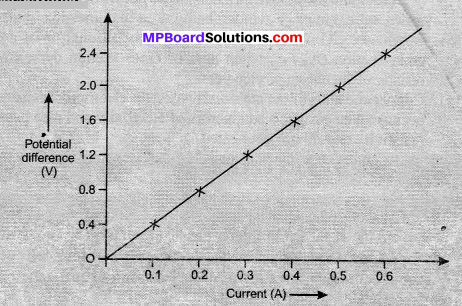
  • Plot a graph between V and 1, and observe the nature of the graph.

Observations:
MP Board Class 10th Science Solutions Chapter 12 Electricity 34
Approximately same value for \(\frac { V }{ I } \) will be obtained in each case. The straight line is obtained in the V – I graph. Thus, \(\frac { V }{ I } \) is a constant ratio.

Class 10 Science Activity 12.2 Page No. 205

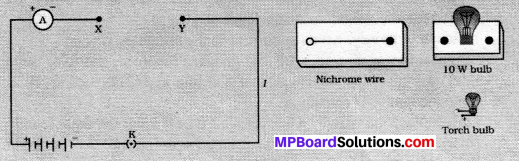
  • Take a nichrome wire, a torch bulb, a 10 W bulb and an ammeter (0-5 A range), a plug key and some connecting wires.
  • Set up the circuit by connecting four dry cells of 1.5 V each in series with the ammeter leaving a gap XY in the circuit as shown in Fig. 12.1.
    MP Board Class 10th Science Solutions Chapter 12 Electricity 35
  • Complete the circuit by connecting the nichrome wire in the gap XY. Plug the key. Note down the ammeter reading. Take out the key from the plug. [Note: Always take out the key from the plug after measuring the current the circuit.
  • Replace the nichrome wire with the torch bulb in the circuit and find the current through it by measuring the reading of the ammeter.
  • Now repeat the above step with the 10 W bulb in the gap XY.
  • Are the ammeter readings differ for different components in the gap XY? What do the above observations indicate?
  • You may repeat this Activity by keeping any material component in the gap. Observe the ammeter readings in each case. Analyse the observations.

Observations:

  • The current is different for different components as certain components offer an easy path for the flow of electric current while the others resist the flow.

Class 10 Science Activity 12.3 Page No. 206

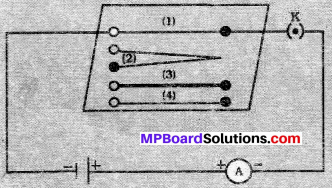
  • Complete an electric circuit consisting of cell, an ammeter, a nichrome wire of length l [say, marked (1)] ana a plug key, as shown in Fig. 12.2.
    MP Board Class 10th Science Solutions Chapter 12 Electricity 36
    Electric circuit to study the factors on which the resistance of conducting wires depends.
  • Figure 12.2. Electric circuit ti study the factors on which the resistance of conducting wires depends
  • Now, plug the key. Note the current in the ammeter.
  • Replace the nichrome wire by another nichrome wire of same thickness but twice the length, that is 2l [marked (2) in the Fig. 12.2],
  • Note the ammeter reading.
  • Now replace the wire by a thicker nichrome wire of the same length / [marked (3)]. A thicker wire has a larger cross-sectional area. Again note down the current through the circuit.
  • Instead of taking a nichrome wire, connect a copper wire [marked (4) in Fig. 12.2] in the circuit. Let the w ire be of the same length and same area of cross-section as that of the first nichrome wire [marked (1)]. Note the value of the current.
  • Notice the difference in the current in all cases.
  • Does the current depend in the length of the conductor?
  • Does the current depend on the area of cross-section of the wire used?

Observations:

  • The length of the conductor affects the current flow. Ammeter reading decreases to one-half when the length of the wire is doubled.
  • The cross-section of the wire also affects the current flow. The length and cross-section changes affect the resistance also.

Class 10 Science Activity 12.4 Page No. 210

  • Join three resistors of different values in series. Connect them with a battery, an ammeter and a plug key. as shown in Fig. 12.3. You may use the resistors of values like 1Ω, 2Ω, 3Ω etc, and a battery of 6 V for performing this Activity.
  • Plug the key. Note the ammeter reading.
  • Change the position if ammeter to anywhere in between the resistors. Note the ammeter reading each time.
  • Do you find any change in the value of current through the ammeter?MP Board Class 10th Science Solutions Chapter 12 Electricity 37

Observations:

  • The value of the current in the ammeter remains unchanged. This shows that it is independent of its position in the electric current. This shows that the current is the same in every part of a series combination.

Class 10 Science Activity 12.5 Page No. 211

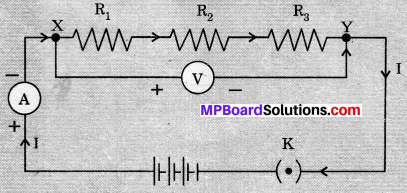
  • In Activity 12.4, insert a voltmeter across the ands X and Y of the series combination of three resistors, as shown in Fig. 12.4.
  • Plug the key in the circuit and note series combination of resistors. Let it be V. Now measure the potential difference across the two terminals of the battery. Compare the two values.
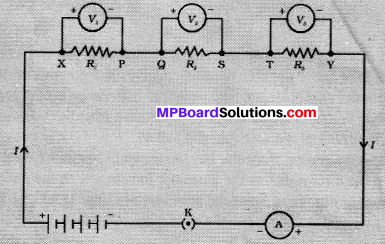
  • Take out the plug key and disconnect the voltmeter. Now insert the voltmeter across the ands X and P the first resistor, as shown in Fig. 12.4.
    MP Board Class 10th Science Solutions Chapter 12 Electricity 38
  • Plug the key and measure the potential difference across the first resistor. Lei it be V1.
  • Similarly, measure the potential difference across the first resistor, separately. Let these values be V3, and V2, respectively.
  • Deduce a relationship between V, V1, V2 and V3.

Observations:

• The potential difference (V) is equal to the sum of potential differences V1, V2, and V3.
• Total potential difference across a combination of resistors in series is equal to the sum of potential difference across the individual resistors,
V = V1 + V2 + V3

Class 10 Science Activity 12.6 Page No. 211

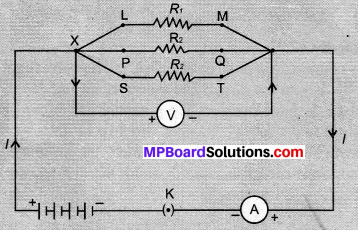
  • Make a parallel combination. X Y of three resistors having resistances R1, R2, and R3, respectively Connect it with a battery, a plug key and an ammeter, as shown in Fig. 12.5. Also connect a voltmeter in parallel with the combination of resistors
    MP Board Class 10th Science Solutions Chapter 12 Electricity 39
  • Plug the key and note the ammeter reading. Let the current be I. Also take the voltmeter reading. It gives the potential difference V, across the combination. The potential difference across each resistor is also V. This can be checked by connecting the voltmeter across each individual resistor (see Fig. 12.6).
  • Take out the plug from the key. Remove the ammeter and voltmeter from the circuit. Insert the ammeter in series with the resistor Rl, as shown in Fig. 12.6. Note the ammeter reading, 11.
    MP Board Class 10th Science Solutions Chapter 12 Electricity 40

Similarly, measure the currents through R2 and R3 Let these be I2, and I3, respectively. What is the relationship between I, I1, I2 and I3?

Observations:

  • The total current I, is equal to the sum of the separate currents through each branch of the combination,
    I = I1 + I2 + I3

MP Board Class 10th Science Solutions

MP Board Class 10th Social Science Solutions Chapter 21 Globalisation

In this article, we will share MP Board Class 10th Social Science Book Solutions Chapter 21 Globalisation Pdf, These solutions are solved subject experts from the latest edition books.

MP Board Class 10th Social Science Solutions Chapter 21 Globalisation

MP Board Class 10th Social Science Chapter 21 Text book Exercises

Objective Type Questions

Question 1.
Multiple Choice Questions
(Choose the correct answer from the following)

Question (i)
Globalisation has improved the standard of living of –
(a) Poor class
(b) Higher class
(c) Rural areas
(d) All classes of the society
Answer:
(c) Rural areas

Question (ii)
Which industries are closed due to globalisation –
(a) Large – scale industries
(b) Multinational companies
(c) Small – scale industries
(d) Industries of all type
Answer:
(d) Industries of all type

Question (iii)
The process of globalisation began in India from the year –
(a) 1947
(b) 1951
(c) 1991
(d) 2001.
Answer:
(c) 1991

Question (iv)
The World Trade Organisation was established in –
(a) 1985
(b) 1995
(c) 2001
(d) 2005.
Answer:
(b) 1995

Question (v)
The main basis of globalisation is –
(a) foreign trade
(b) internal trade
(c) agricultural trade
(d) small scale industry.
Answer:
(a) foreign trade

MP Board Solutions

Question 2.
Fill in the blanks: (MP Board 2009)

  1. At present the number of reserved industries is …………….
  2. Under globalisation the transportation of goods and services is ……………. between various countries.
  3. The companies who produce goods in different countries are called ……………. (MP Board 2009)

Answer:

  1. Eight
  2. Liberalised
  3. Mulitnational Companies.

MP Board Class 10th Social Science Chapter 21 Very Short  Answer Type Questions

Question 1.
What was the foreign policy of India prior to the year 1991?
Answer:
Liberalisation and Globalisation.

Question 2.
What are those companies called who produce in more than one country?
Answer:
Multinational Company.

Question 3.
Which consumer class is benefited more by globalisation?
Answer:
Higher Class.

MP Board Solutions

Question 4.
What do you understand by multinational companies?
Answer:
A company whose work is related to production and sale spread all over the world is known as multinational companies.

MP Board Class 10th Social Science Chapter 21  Short  Answer Type Questions

Question 1.
State the meaning of globalisation. Who have been benefited by globalisation?
Answer:
Globalisation is meant the working of whole world together with co – operation and co-ordination in the form of a market. Under the process of globalisation the restrictions on the inflow and outflow of goods and services from one country to another are withdrawn. Thereby the market prices start working freely in whole of the world. As a result the prices in all the countries becomes near about equal. In this way as a result of globalisation all the markets of the world are unified. The upper strata of our society is the most beneficiary of this system.

Question 2.
What is foreign trade?
Answer:
The foreign trade has linked all the countries of the world together. There are several big companies of the world, which are called multinational companies. These companies sell their products in several countries of the world. This is noticeable here that a multinational company is that who produces goods in more than one country. These companies produce goods on large scale and sell these produced goods in several countries.

Question 3.
What is the unification of market?
Answer:
India has adopted the New Economics Policy since 1991. The main objective of this policy is to take advantage of the progress of the world and technical knowledge and thus accelerate the economic development of the country. This policy has opened the way of liberalisation by avoiding the existing administrative restriction. Along with this the efforts has been made to motivate private investment and to attract the foreign capital. It can be said in brief that through the new policy a new chapter has began by linking the India market economy with the economy of the world.

MP Board Solutions

Question 4.
How are the small producers affected by globalisation?
Or
Write the effect of Globalization on the small producers? (MP Board 2009)
Answer:
All people have not been benefited by the globalisation, thus now it is clear that globalisation has affected the Indian economy in both the ways inversely and positively. The reality is this, that globalisation has benefited the industries and business and we have approached in the world market. Several Indian producers have got the form of multinational company.

The development rate of Indian economy has also become more than 9 per cent. Consumers are now getting world – level standardised goods. But in reality the people of all classes have not got the benefit of globalisation equally. Several small and tiny industries have been closed due to competition. The problems like poverty and unemployment prevailing in the developing countries like India have become more complicated.

Along with this due to the influence of developed countries upon. The World Trade Organisation, developing and backward countries are not getting the benefits of globalisation. The new labour – laws are not affecting the labour class favourably. Therefore the efforts are needed.

MP Board Class 10th Social Science Chapter 21 Long Answer Type Questions

Question 1.
What do you understand by globalisation? Explain the causes that motivate the process of globalisation.
Or
What is globalisation? Explain the causes that motivate this process. (MP Board 2009)
Answer:
Globalisation means opening ftp the economy to facilitate its integration with the world economy. In this situation economics are integrated with each other. In case of globalisation it becomes easy to sell goods and services abroad.

Factors Inspiring Globalisation:

1. Expansion of Technical Knowledge:
During last 50 years the technical knowledge has developed rapidly. The transport technology has made it possible to send goods upto distant places in a lower cost. Telecommunication facilities such as internet, mobile phone, fax etc. has made the task of connecting people with °ach other throughout the world very easy. Communication satellite has brought a revolutionary change by expanding these facilities. As a result globalisation has expanded rapidly.

2. Process of Liberalisation:
Till the middle of twentieth century the production was limited mainly within the boundaries of the countries. So many countries imposed strict restrictions to protect the goods produced by them from competition. India also during the decades of 1950 and 1960 had permitted only to import the necessary goods as machineries, fertilizers and petroleum etc. Several industries developed due to this policy and India became self – reliant in several sectors.

3. Expansion of Competition and Market:
Competition has a special importance in capitalist economic system. In this system different producing compaines in order to seek the hold on market take support of competition. For this purpose these companies along with cutting down the prices use advertisements and various medium of convincing and canvassing the buyers.

4. Expansion of Multinational Companies:
Multinational companies play a significant role in linking the distant countries with each other. These companies set up their factories for production purpose in those countries where they get cheaper labour and other means of production and due to this the capacity of these companies increasesto compete.

Question 2.
How do foreign trade helps in unifying the markets of various countries?
Answer:
During the decades of 1970 and 1990 some such changes took place due to which began the process of liberalising foreign trade. For example, dissolution of Union of Socialist Soviet of Russia, economic unification of Europe, emergence of Japan as a major power of the world and economic development of Korea, Singapore and Hongkong. As a result several countries agreed to liberalise the world trade.

This strengthen, the process of liberalization. After the establishment of The World Trade Organisation1 in 1955, almost all the countries of the world have reduced their taxes on imports and have opened the markets of their countries for other countries. So, the process of globalisation has gained speed.

MP Board Solutions

Question 3.
Explain the economic condition of India after the globalisation, and discuss the problems created by gloabaissation?
Or
Explain the main problems which are created by globalisation? (MP Board 2009, 2010)
Answer:
The following aspects are there undertaking The system of globalisation in India:
1. Industrialisation:
The industrialisation in the country has been accelerated due to the industrial policy declared in the year 1991 and the reforms done afterwards. Now number of industries reserved exclusively for public sector is reduced only to three. It means that the private sector has got sufficient opportunities for expansion.

2. Increase in Foreign Investment:
After the globalisation the multinational companies have increased their investment in India. These companies have shown their interest in such investment as cell phones, motorcars, electronic equipments, cold drinks, junk food materials and banking services. New opportunities of employment have been created by these industries and services.

3. Advantage to Indian Companies:
Globalisation has set up several Indian companies as multinational companies. These companies have expanded their activities at world level. For example, Tata Motars, Infosys, Ranbaxy, Asian Paints, Sunderm Fastners can be taken as examples which have now become multinational companies.

The Indian companies, in order to compete with foreign companies, have adopted the latest technology and have raised the standards of their production. There are some companies who have improved their condition by collaborating with multinational companies.

Problems Created by Globalisation:
This is not true to say that India has only benefited by globalisation. The reality is this, the globalisation has also created several problems. Following are these problems.

1. Impact on Small Producers:
Globalisation has adversely affected the several small industries of India. Small industries are not capable to compete with goods produced in foreign. As a result several small industries have closed.

2. Uncertainty of Employment:
Lives of labourers have been greatly affected by globalisation. These days due to growing competition, maximum employers like flexibility in providing employment to labourers. It means that the jobs of labourers are not secure. The factory owners, to minimize the cost, provide temporary employment to the labourers; so that they may not have to pay them salary round the year.

  1. Benefit not to all
  2. Regional disparities.

MP Board Class 10th Social Science Chapter 21 Additional Important Questions

Objective Type Questions

Question 1.
Multiple Choice Questions:
(Choose the correct answer from the following)

Question (i)
The New Industrial Policy was adopted since –
(a) 1989
(b) 1990
(c) 1991
(d) 1992.
Answer:
(c) 1991

Question (ii)
The main base of globalisation is –
(a) Multinational Companies
(b) Foreign Trade
(c) America
(d) European Union.
Answer:
(b) Foreign Trade

Question (iii)
New economic policy liberated the –
(a) Private sector
(b) Public sector
(c) Industrial sector
(d) Tertiary sector.
Answer:
(a) Private sector

Question (iv)
W.T.O. means –
(a) World Terrorist Organisation
(b) World Transport Organisation
(c) World Trade Organisation.
(d) World Temperate Organisation
Answer:
(c) World Trade Organisation.

Question 2.
Fill in the blanks:

  1. World bank is an International ……………… institution that extends financial assistance to member nation for development purposes.
  2. Financial Crunch is a situation in which the government ……………… falls drastically short of government expenditure.
  3. Privatisation is defined as transfer of ownership and control from the public sector to the ……………… sector.
  4. The private sector allowed to establish industries and
    business but subject to ……………… and ………………

Answer:

  1. Financial
  2. Revenue
  3. Private
  4. Control regulation

MP Board Solutions

Question 3.
True and False type questions:

  1. New Economic Policy or N.E.P. was adopted in 1995.
  2. Globalization means decreasing integration between different economics of the world.
  3. Privatisation means to bring most of the enterprises of the country under the ownership, control and management of the private sector.
  4. Liberalisation means to rid industry and trade of unnecessary restrictions and make them more competitive.

Answer:

  1. False
  2. False
  3. True
  4. True.

Question 4.
Match the following:
MP Board Class 10th Social Science Solutions Chapter 21 Globalisation img 1
Answer:

1. (c)
2. (a)
3. (d)
4. (b).

Answer in One – Two Words or One Sentence:

Question 1.
Define World Trade Organisation (WTO)?
Answer:
WTO is the global international organisation dealing with the rules of trade between nations.

Question 2.
When was WTO established?
Answer:
WTO was established on January 1, 1995.

Question 3.
Where is WTO located?
Answer:
WTO is located at Geneva, Switzerland.

Question 4.
What is GATT?
Answer:
GATT (General Agreement on Trade and Tariffs) was the forum for negotiating trade agreement between nations between 1947 – 1994.

MP Board Solutions

Question 5.
When did India become the member of WTO?
Answer:
India became the member of the WTO on January 1, 1995.

Question 6.
Mention two functions of WTO?
Answer:

  1. Administering WTO trade agreements.
  2. Forum for trade negotiations between countries.

MP Board Class 10th Social Science Chapter 21 Very Short  Answer Type Questions

Question 1.
Define sustainable development.
Answer:
Sustainable development is an economic development where necessities of generations are not compromised by the pleasure of present generation.

Question 2.
Explain the concept of sustainable economic development. Give two points?
Answer:

  1. Development should take place without polluting and damaging the environment.
  2. Development should be continuous and it should fulfil the needs and aspiration of the present and future generations.

MP Board Solutions

Question 3.
What is the role of WTO? What two benefits will India get by being a member of WTO?
Answer:
WTO is the global trade organisation dealing with the rules of trade between nations. India, as a member of WTO will be benefited in the following ways:

  1. Promotion and expansion of trade among countries.
  2. (a) Less restrictions on Indian exports.
    (b) Getting technology from developed countries.

Question 4.
Define Liberalisation?
Answer:
Liberalisation means freedom to the private sector to run those activities which were earlier confined to only public sector. Secondly, Private sectors have given many relaxations from the rules and regulations.

Question 5.
What is NRI?
Answer:
NRI (Non-Resident Indian) is an Indian who does not normally live and work in India, but in some other country. He holds Indian citizenship and Indian passport.

MP Board Class 10th Social Science Chapter 21 Short Answer Type Questions

Question 1.
Mention three freedoms given to the private sector industry by liberalisation?
Answer:

  1. Industrial licensing has been abolished except for five industries.
  2. Number of public sector industries has been reduced from 17 to 3.
  3. Freed from regulation like permission for importing materials.

Question 2.
Enlist main objectives of New Economic Policy?
Answer:
Following were the objectives of new economic policy:

  1. Liberalisation of the economy.
  2. Expansion of private sector.
  3. Encouragement of private foreign investment.
  4. Modernisation of agriculture.
  5. Controlling fiscal deficit.

Question 3.
What do you mean by disinvestment? How far did we succeed in this programme?
Answer:
Disinvestment means selling shares of its performing enterprise by the government. It is one method of privatization. Our programme of privatization through investments has succeeded to some extent only.

MP Board Solutions

Question 4.
Mention the functions of WTO?
Answer:
Functions of World Trade Organisation (WTO):

  1. Administering trade agreements between nations.
  2. Forum for trade negotiations.
  3. Handling trade disputes between nations.
  4. Monitoring national trade policy.
  5. Technical assistance and training for developing countries and.
  6. Cooperation with other international organisation.

Question 5.
How can you justify the presence and impact of globalisation?
Answer:
The presence and impact of globalisation can be justified by the following facts:

  1. Development of social consciousness.
  2. Fast and quick technological changes.
  3. Global form of modern business.
  4. Formation of International Monatory Fund (IMF).
  5. Foreign collaboration and joint ventures, financial and assistance.
  6. Globalisation of marketing through Cable TV network and satellite links and
  7. Introduction of internet facilities like e-mail and e- commerce services.

Question 6.
Explain in short meaning of the term ‘Globalization’. Write its main characteristics (features on related points) also?
Answer:
Meaning:
Globalization means integration, unification or integration of domestic economy with the world economy. Characteristics (Features or Related Points):

  1. Due to globalisation producers from outside can sell their goods and services in India. We can do the same with our goods and services.
  2. Entrepreneurs from other countries can invest in India and the Indian entrepreneur can also do the same in other countries.

Question 7.
Discuss some positive aspects of Globalisation and Liberalisation?
Answer:
Globalisation and Liberalisation have helped in rapid economic development.

  1. A large industrial base created; increase in industrial production.
  2. Proportion of people living below the poverty line less.
  3. Self – sufficient in food.
  4. Mobilised its savings.
  5. Generated its own resources for development.
  6. Large pool of scientists and technically skilled working person.
  7. Export – oriented industries.

Question 8
Differentiate between policy of restriction and policy of liberalization?
Answer:
Liberalization:
It means removing unnecessary trade restrictions and making the economy more competitive. New Economic policy liberated the private sector from strict control and licensing.

Restriction:
If restrictions are imposed on economic activities by government policies, it is called the policy of restriction or restrictive policy. No real economy is completely free of restrictions. When these restrictions are removed, it is called the policy of liberalization.

MP Board Solutions

Question 9.
What measures have been taken for globalisation of the economy of India?
Answer:
Free interaction among economies of the world in the field of trade finance, production techlnologies and investment is termed as globalisation of the economy. It encourages foreign trade and institutional investment. Following measures are adopted for it:

  1. Devaluation of rupee by 20% in July 1990 – 91.
  2. Full convertibility was offered in 1993-94 to encourage exports earnings.
  3. Long period trade policy of remove restrictions.
  4. Encouragement to open competition.
  5. Modification of custom and tariff.

Question 10.
What is sustainable development? What are its important features?
Answer:
The development, which takes care of the needs of present generation without compromising with the needs of future generation is termed as sustainable development.

Important features of sustainable development:

  1. Economic growth
  2. No or the least compromise with the necessities of the future generation
  3. Pollution free economic development
  4. No or the least depletion of non – renewable resources and
  5. Preservation of environmental and exhaustible resources.

Question 11.
Explain the meaning of World Trade Organisation?
Answer:
World Trade Organisation (WTO):
The global international organisation, working on multilateral trading system, where trade agreemeftts are negotiated and signed by a large majority of world’s trading nations and ratified in their parliaments are known as W.T.O. Its objective is to assist trade flowing smoothly, freely, fairly and predictable among nations. WTO was established on Jan 1, 1995 in Geneva, Switzerland. India also became its member on January 1,1995.

MP Board Class 10th Social Science Chapter 21 Long Answer Type Questions

Question 1.
Review the status of Indian economy before the new economic policy – 1991?
Answer:
1. Self – reliance:
The five – year plans imed at obtaining self – reliance. The dependency upon foreign aid was reduced in fulfilment of this aim. During this period self – reliance in agriculture sector was achieved and vast industrial sector was developed.

2. Foreign Trade:
In the year 1991 imports were kept under control. During this period only necessary goods like machineries, fertilizer and petroleum were mainly imported. To protect the domestic producers from foreign competition the policy of protection was adopted. Therefore, the trade during this period increase slowly. The contribution of India in total world trade in 1951 was near about. 1 per cent which reduced upto 0.6 percent in 1991.

3. National and Per Capita Income:
During the period of 1951 to 1991 the national income increased at the average rate of 4.0 per cent. But due to the rapid growth in population during this period the per capita income increased at a very slow speed.

4. Increase in the Opportunities of Employment:
During this period though the efforts were made to increase the job opportunities even then the problem increased day – by – day. The problem of unemployment became very complicated till 1991.

5. Crisis of Foreign Currency:
India adopted the policy of reducing imports between the years 1951 to 1991. But India needed foreign currency for the import of petroleum products machinery and other necessary goods. India had to take international loan to import these goods. Therefore, India was trapped in the crisis of foreign exchange.

6. Price rise:
During the period of planning India had to face the problem of continuous price rise. After the First Five-Year Plan during the years 1956 to 1991 the rate of inflation in India was between 5 to 6 per cent.

Question 2.
Explain briefly the key features of Indian economy after adoption of the New Economic Policy?
Answer:
Key Features of Indian Economy after adoption of New Economic Policy:
1. Industrial activities which were restricted for public sector were also opened up to private sector except for industries having national importance tike defence, space research etc.

2. Relaxation in regulations tike quota system, industrial licensing, concentration of economic power etc. This was meant to give freedom to the businesses to undertake activities having growth potential.

3. Permission to import raw material was eased to make/it more competitive for businesses to reduce cost and undertake better technology.

4. Pricing and distribution was made free to give businesses free hand to deal with pricing and distribution strategies.

5. Restriction on investement and increase in production capacity was eased to pave the way for industrial growth.

6. The economy was opened to integrate it with world economy in terms of flow of goods and services investment etc.

MP Board Solutions

Question 3.
Explain the process of globalisation?
Or
Give the meaning of globalisation and describe the steps taken in this direction?
Or
Write the main five factors which promote globalization? (MP Board 2009)
Answer:
Process of Globalisation or Steps taken for Globalisation:
1. Raising Foreign Equity Participation:
Prior to July 1999 f foreign equity participation was subjected to lot of approvals, sanctions and constraints. It was restricted to 40%. Now it has been increased to 51% and the approvals have been made routine work.

2. Devaluation of Rupee:
Rupee was devalued by 20% in July 1990 – 91. The devaluation was made to encourage exports and discourage imports. It also aimed at inflow of more foreign capital.

3. Convertibility of Rupee:
The government offered partial convertibility of rupee through the budget of 1992 – 93. Full convertibility was offered in 1993 – 94. Convertibility of rupee was aimed at encouraging export earnings.

4. Long Period Trade Policy:
The government announced foreign trade policy for a period of five years i.e. 1992 – 97. The sole purpose of this policy was liberalisation. It also removed restrictions on external trade.

5. Encouragement to Open Competition:
Exports and imports were left to market forces, government control was minimised.

6. Modification of Customs and Tariff:
In order to build up our competitive strength, customs and tariff policies were modified to promote international trade.

7. Modernisation of the Economy:
The new economic policy accords top priority to modern techniques and technology. It also promotes computers and electronics industries. It has made the Indian industries dynamic. All foreign collaborations concerning higher technology have been (created by the government.

8. Privatisation of the Company:
It means removing strict control over private sector and making them free to take necessary decisions. Now, the new policy tries to expand private sectors.

MP Board Class 10th Social Science Solutions Chapter 21 वैश्वीकरण

In this article, we will share MP Board Class 10th Social Science Book Solutions Chapter 21 वैश्वीकरण Pdf, These solutions are solved subject experts from the latest edition books.

MP Board Class 10th Social Science Solutions Chapter 21 वैश्वीकरण

MP Board Class 10th Social Science Chapter 21 पाठान्त अभ्यास

MP Board Class 10th Social Science Chapter 21 वस्तुनिष्ठ प्रश्न

सही विकल्प चुनकर लिखिए

प्रश्न 1.
वैश्वीकरण ने जीवन-स्तर में सुधार किया है
(i) गरीब वर्ग का
(ii) उच्च वर्ग का
(iii) ग्रामीण क्षेत्रों का
(iv) समाज के सभी वर्गों का।
उत्तर:
(ii) उच्च वर्ग का

प्रश्न  2.
वैश्वीकरण से कौन-से उद्योग बन्द हो गए हैं ?
(i) बड़े पैमाने के उद्योग
(ii) बहुराष्ट्रीय कम्पनियाँ
(iii) लघु उद्योग
(iv) सभी प्रकार के उद्योग।
उत्तर:
(iii) लघु उद्योग

प्रश्न  3.
भारत में वैश्वीकरण की प्रक्रिया प्रारम्भ हुई है –
(i) सन् 1947 में
(ii) सन् 1951 में
(iii) सन् 1991 में
(iv) सन् 2001 में
उत्तर:
(iii) सन् 1991 में

प्रश्न  4.
विश्व व्यापार संगठन की स्थापना हुई है –
(i) सन् 1985
(ii) सन् 1995
(iii) सन् 2001
(iv) सन् 2005
उत्तर:
(ii) सन् 1995

प्रश्न  5.
वैश्वीकरण का मुख्य आधार है
(i) विदेशी व्यापार
(ii) आन्तरिक व्यापार
(iii) उन्नत कृषि व्यापार
(iv) लघु उद्योग।
उत्तर:
(i) विदेशी व्यापार

रिक्त स्थानों की पूर्ति कीजिए

  1. वर्तमान में आरक्षित उद्योगों की संख्या ……………. है। (2009)
  2. वैश्वीकरण के अन्तर्गत विभिन्न अर्थव्यवस्थाओं के मध्य वस्तुओं एवं सेवाओं का ……………. आवागमन होता है।
  3. विभिन्न देशों में उत्पादन करने वाली कम्पनियों को ……………. कहा जाता है। (2009)

उत्तर:

  1. तीन
  2. एक देश से दूसरे देश में
  3. बहुराष्ट्रीय कम्पनी।

MP Board Solutions

MP Board Class 10th Social Science Chapter 21 अति लघु उत्तरीय प्रश्न

प्रश्न 1.
वर्ष 1991 से पूर्व भारत के विदेशी व्यापार की नीति क्या थी?
उत्तर:
वर्ष 1991 तक आयातों पर नियन्त्रण रखा गया। इस अवधि में केवल अनिवार्य वस्तुओं; जैसे-मशीनरी, उर्वरक और पेट्रोलियम का ही मुख्य रूप से आयात किया गया। देश के उत्पादकों को विदेशी प्रतियोगिता से बचाए रखने के लिए संरक्षण की नीति को अपनाया गया। परिणामस्वरूप इस अवधि में व्यापार धीमी गति से बढ़ा।

प्रश्न 2.
एक से अधिक देशों में उत्पादन करने वाली कम्पनियों को क्या कहा जाता है ? उत्तर-एक से अधिक देशों में उत्पादन करने वाली कम्पनियों को बहुराष्ट्रीय कम्पनी कहा जाता है। प्रश्न 3. वैश्वीकरण से किस उपभोक्ता वर्ग को अधिक लाभ हुआ है ?
उत्तर:
वैश्वीकरण का लाभ समाज के सभी उपभोक्ता वर्गों को नहीं मिला है। समाज के शिक्षित. कशल और सम्पन्न उपभोक्ता वर्ग के लोगों ने वैश्वीकरण से मिले नये अवसरों का सर्वाधिक एवं सर्वोत्तम उपयोग किया है। इसके विपरीत अशिक्षित एवं निर्धन उपभोक्ता वर्ग को लाभ में हिस्सा नहीं मिला है। इस प्रकार यह कहा जा सकता है कि समाज का कमजोर एवं निर्धन उपभोक्ता वर्ग वैश्वीकरण के लाभों से प्रायः वंचित ही रहा है।

प्रश्न 4.
बहुराष्ट्रीय कम्पनियों से आप क्या समझते हैं ?
उत्तर:
एक बहुराष्ट्रीय कम्पनी वह है जो एक से अधिक राष्ट्रों में उत्पादन करती हैं। ये कम्पनियाँ बड़े पैमाने पर उत्पादन करती हैं और उत्पादित वस्तुओं को अनेक राष्ट्रों में बेचती हैं।

MP Board Solutions

MP Board Class 10th Social Science Chapter 21 लघु उत्तराय प्रश्न

प्रश्न 1.
विदेशी व्यापार क्या है ?
उत्तर:
विदेशी व्यापार से आशय-“विदेशी व्यापार से आशय दो या दो से अधिक पृथक् सत्ताधारी राष्ट्रों के बीच वस्तुओं और सेवाओं के विनिमय से है।” यदि क्रेता और विक्रेता अलग-अलग सत्ताधारी देशों में रहते हों तो उनके बीच हुआ क्रय-विक्रय विदेशी व्यापार कहलाता है। इस प्रकार विदेशी व्यापार में वस्तुएँ एक देश की सीमाओं को पार करके दूसरे देश की सीमाओं में प्रवेश करती हैं। उदाहरण के लिए, बांग्लादेश तथा भारत के बीच होने वाला व्यापार विदेशी व्यापार कहलायेगा। विदेशी व्यापार तीन प्रकार का होता है –

  1. आयात व्यापार – आयात व्यापार से आशय दूसरे राष्ट्रों में माल अपने देश में मँगवाने से है।
  2. निर्यात व्यापार – निर्यात व्यापार से आशय अपने देश से विदेशों को माल भेजे जाने से है।
  3. निर्यात हेतु आयात – जब वस्तुएँ किसी एक देश में दूसरे देश से स्थानीय उपयोग के लिए आयात नहीं की गई हों वरन् वहाँ से किसी अन्य देश को निर्यात करने के उद्देश्य से आयात की गई हों, तो ऐसे व्यापार को “निर्यात हेतु आयात” कहते हैं।

प्रश्न 2.
बाजारों का एकीकरण क्या है ?
उत्तर:
बढ़ते हुए विदेशी व्यापार के कारण विभिन्न राष्ट्रों के बाजारों एवं उनमें बेची जाने वाली वस्तुओं में एकीकरण हुआ है। विदेशी व्यापार की बढ़ती हुई प्रवृत्ति ने अब विभिन्न राष्ट्रों के बाजारों को बहुत निकट ला दिया है। उन्नत प्रौद्योगिकी ने इस निकटता में महत्वपूर्ण भूमिका अदा की है और सम्पूर्ण विश्व को एक बड़े गाँव में बदल दिया है। यही वैश्वीकरण है, जहाँ विभिन्न राष्ट्रों के बाजार परस्पर जुड़कर एक इकाई के रूप में कार्य करते हैं। इससे सम्पूर्ण विश्व में बाजार शक्तियाँ स्वतन्त्र रूप से कार्य करने लगती हैं और परिणामस्वरूप वस्तुओं की कीमत सभी राष्ट्रों में लगभग समान हो जाती है। इस प्रकार वैश्वीकरण के परिणामस्वरूप सम्पूर्ण विश्व के बाजारों का एकीकरण हो जाता है।

प्रश्न 3.
वैश्वीकरण का छोटे उत्पादकों पर क्या प्रभाव पड़ा है ? (2009, 14)
उत्तर:
वैश्वीकरण का छोटे उत्पादकों पर प्रभाव-छोटे उत्पादकों पर वैश्वीकरण का बुरा प्रभाव पड़ा है। विदेशी उत्पादित माल से प्रतियोगिता करने में छोटे उद्योग सक्षम नहीं हैं। परिणामस्वरूप अनेक छोटे उद्योग बन्द हो गए हैं। बैटरी, संधारित्र, प्लास्टिक, खिलौने, टायर, डेयरी उत्पादों एवं खाद्य तेल के उद्योगों की स्थिति अत्यधिक खराब है। यहाँ यह उल्लेखनीय है कि भारत में लघु उद्योगों में कृषि के बाद सबसे अधिक लोगों को रोजगार प्राप्त है।

MP Board Solutions

MP Board Class 10th Social Science Chapter 21 दीर्घ उत्तरीय प्रश्न

प्रश्न 1.
वैश्वीकरण से आप क्या समझते हैं ? वैश्वीकरण की प्रक्रिया को प्रोत्साहित करने वाले कारणों की विवेचना कीजिए। (2009, 13)
अथवा
वैश्वीकरण को प्रोत्साहित करने वाले प्रमुख चार कारक लिखिए। (2009, 17)
उत्तर:
वैश्वीकरण का आशय – वैश्वीकरण का शाब्दिक अर्थ अर्थव्यवस्था को विश्व की अर्थव्यवस्था के साथ एकीकृत करने से लगाया जाता है। इसमें प्रत्येक राष्ट्र का अन्य राष्ट्रों के साथ वस्तु, सेवा, पूँजी एवं बौद्धिक सम्पदा का अप्रतिबन्धित आदान-प्रदान होता है। यह वस्तुतः खुली अर्थव्यवस्था की विचारधारा पर आधारित है जिसमें विश्व के विभिन्न राष्ट्रों के मध्य व्यापारिक दृष्टिकोण से सार्वजनिक सीमाओं को अधिक महत्व नहीं दिया जाता है, बल्कि व्यापारिक लेन-देन या तो स्वतन्त्र रूप से या सीमित नियन्त्रण के अधीन चलते रहते हैं। अत: यह कहा जा सकता है कि वैश्वीकरण एक ऐसी प्रक्रिया है जिसके अन्तर्गत सभी व्यापारिक क्रियाओं का अन्तर्राष्ट्रीयकरण हो जाता है और वे एक इकाई के रूप में कार्य करने लगती हैं।

वैश्वीकरण की प्रक्रिया को प्रोत्साहित करने वाले कारक

वैश्वीकरण की प्रक्रिया को प्रोत्साहित करने वाले कारक निम्नलिखित हैं –

(1) तकनीक – पिछले पाँच दशकों में तकनीक ज्ञान का तेजी से विकास हुआ है। परिवहन प्रौद्योगिकी ने अब लम्बी दूरियों तक वस्तुओं को कम लागत पर भेजना सम्भव बनाया है दूरसंचार सुविधाओं; जैसे-इन्टरनेट, मोबाइल फोन, फैक्स आदि ने विश्व भर में एक-दूसरे से सम्पर्क करने के कार्य को आसान बना दिया है। संचार उपग्रहों ने इन सुविधाओं का विस्तार कर क्रान्तिकारी परिवर्तन कर दिया है जिससे वैश्वीकरण का तेजी से विस्तार हुआ है।

(2) प्रतियोगिता – पूँजीवादी आर्थिक प्रणाली में प्रतियोगिता का विशेष महत्त्व होता है। इस प्रणाली में विभिन्न उत्पादक कम्पनियाँ बाजारों पर कब्जा करने का उद्देश्य से प्रतियोगिता का सहारा लेती हैं। इसके लिए ये कम्पनियाँ कीमत कम करने के साथ-साथ विज्ञापनों एवं प्रचार-प्रसार के विभिन्न माध्यमों का उपयोग करती हैं।

(3) बाजार का विस्तार – पिछले कुछ वर्षों में उपभोक्ताओं की आय में वृद्धि, उपभोक्ता प्रवृति, रुचि एवं आदतों में परिवर्तन आदि से वस्तुओं एवं सेवाओं की माँग में वृद्धि हुई है। प्रौद्योगिकी के विकास से उत्पादनों की किस्म एवं गुणवत्ता में सुधार हुआ है। फलतः नई-नई वस्तुओं का उत्पादन सम्भव हुआ है जिससे बाजारों का विस्तार हुआ है।

(4) बहुराष्ट्रीय कम्पनियों का विस्तार – बहुराष्ट्रीय कम्पनियों की पहली विशेषता यह है कि इनकी क्रियाएँ किसी राष्ट्र में सीमित न होकर अनेक राष्ट्रों में चलती हैं। ये कम्पनियाँ उन राष्ट्रों में उत्पादन के लिए कारखाने स्थापित करती हैं, जहाँ उन्हें सस्ता श्रम एवं अन्य साधन मिलते हैं। इससे उत्पादन लागत में कमी आती है तथा कम्पनियों की प्रतियोगिता करने की क्षमता बढ़ जाती है। बहुराष्ट्रीय कम्पनियाँ केवल वैश्वीकरण स्तर पर ही अपने उत्पादन नहीं बेचीं वरन अधिक महत्त्वपूर्ण यह है कि वे वस्तुओं और सेवाओं का उत्पादन विश्व स्तर पर करती हैं।

(5) उदारीकरण की प्रक्रिया – बीसवीं शताब्दी के मध्य तक उत्पादन मुख्यतः राष्ट्रों की सीमाओं के अन्दर ही सीमित था। अनेक राष्ट्रों ने अपने द्वारा उत्पादित वस्तुओं को विदेशी प्रतियोगिता से बचाने के लिए अनेक प्रकार के कठोर प्रतिबन्ध लगा दिये थे। किन्तु 1970 एवं 1990 के दशकों में अनेक ऐसे परिवर्तन हुए जिनसे ‘विदेशी व्यापार को उदार बनाने की प्रक्रिया प्रारम्भ हुई। सन् 1995 में विश्व व्यापार संगठन की स्थापना के बाद प्रायः विश्व के सभी राष्ट्रों ने अपने आयात करों में कमी की है और अपने राष्ट्रों के बाजार को अन्य राष्ट्रों के लिए खोल दिया है। परिणामस्वरूप वैश्वीकरण की प्रक्रिया को प्रोत्साहन मिला है।

प्रश्न 2.
विदेशी व्यापार विभिन्न देशों के बाजारों के एकीकरण में किस प्रकार मदद करता है ? लिखिए।
उत्तर:
विदेशी व्यापार ने आज विश्व के देशों को परस्पर जोड़ दिया है। विश्व की अनेक बड़ी कम्पनियाँ । जिन्हें बहुराष्ट्रीय कम्पनियाँ कहा जाता है, अपने उत्पादों की बिक्री अनेक राष्ट्रों में करती हैं। ये कम्पनियाँ बड़े पैमाने पर उत्पादन करती हैं और उत्पादित वस्तुओं को सभी देशों में बेचती हैं।

बढ़ते हुए विदेशी व्यापार के कारण विभिन्न राष्ट्रों के बाजार एवं उनमें बेची जाने वाली वस्तुओं में एकीकरण हुआ है। विदेशी व्यापार की बढ़ती हुई प्रवृत्ति ने अब विभिन्न राष्ट्रों के बाजारों को बहुत निकट ला दिया है।

बाजारों का एकीकरण – बढ़ते हुए विदेशी व्यापार के कारण विभिन्न राष्ट्रों के बाजारों एवं उनमें बेची जाने वाली वस्तुओं में एकीकरण हुआ है। विदेशी व्यापार की बढ़ती हुई प्रवृत्ति ने अब विभिन्न राष्ट्रों के बाजारों को बहुत निकट ला दिया है। उन्नत प्रौद्योगिकी ने इस निकटता में महत्वपूर्ण भूमिका अदा की है और सम्पूर्ण विश्व को एक बड़े गाँव में बदल दिया है। यही वैश्वीकरण है, जहाँ विभिन्न राष्ट्रों के बाजार परस्पर जुड़कर एक इकाई के रूप में कार्य करते हैं। इससे सम्पूर्ण विश्व में बाजार शक्तियाँ स्वतन्त्र रूप से कार्य करने लगती हैं और परिणामस्वरूप वस्तुओं की कीमत सभी राष्ट्रों में लगभग समान हो जाती है। इस प्रकार वैश्वीकरण के परिणामस्वरूप सम्पूर्ण विश्व के बाजारों का एकीकरण हो जाता है।

प्रश्न 3.
वैश्वीकरण के बाद भारत की आर्थिक स्थिति की व्याख्या कीजिए व वैश्वीकरण से उत्पन्न समस्याओं की विवेचना कीजिए।
अथवा
वैश्वीकरण से उत्पन्न प्रमुख समस्याओं का वर्णन कीजिए। (2009, 10, 15)
उत्तर:
वैश्वीकरण के बाद भारत की आर्थिक स्थिति

वर्ष 1991 के बाद देश की अर्थव्यवस्था में हुए सुधार एवं वैश्वीकरण के प्रभाव निम्नलिखित हैं –

(1) आयात-निर्यात – वर्ष 1991 में घोषित आयात-निर्यात नीति में निर्यात के विकास पर जोर दिया गया। इस उद्देश्य की प्राप्ति हेतु आयात एवं निर्यात पर लगे प्रतिबन्धों को कम किया गया। व्यापार नीति (2004-09) में आयातों एवं निर्यातों को और अधिक सुविधाजनक बनाया गया है। यहाँ यह उल्लेखनीय है कि भारत विश्व व्यापार संगठन का प्रारम्भ से ही सदस्य है। पिछले वर्षों में आयात शुल्क कम करने का भारतीय अर्थव्यवस्था पर अनुकूल प्रभाव पड़ा है। कुल विश्व व्यापार में भारत के विदेशी व्यापार का योगदान वर्ष 1990 में 0.6 प्रतिशत से बढ़कर वर्ष 2013 में 2.1 प्रतिशत हो गया।

(2) औद्योगीकरण – भारत सरकार ने विश्व अर्थव्यवस्था के साथ अन्त:सम्बन्ध स्थापित करने तथा वैश्वीकरण की प्रक्रिया में एक महत्त्वपूर्ण शक्ति के रूप में उभरने से सन् 1991 के मध्य से व्यापक आर्थिक सुधार का कार्यक्रम शुरू किया। वर्तमान में सार्वजनिक क्षेत्र के अन्तर्गत आरक्षित उद्योगों की संख्या केवल 2 रह गई है। इसका आशय यह है कि निजी क्षेत्र को अपने विस्तार के पर्याप्त अवसर प्राप्त हो गए हैं। अर्थव्यवस्था के अनेक क्षेत्र अब विदेशी निवेश के लिए खोल दिए गए हैं और वे नई औद्योगिक नीति के परिणामस्वरूप विकास की ओर अग्रसर हो रहे हैं।

(3) विदेशी निवेश में वृद्धि – वैश्वीकरण के बाद अनेक बहुराष्ट्रीय कम्पनियों ने भारत में अपने निवेश में वृद्धि की है। इससे देश में उत्पादन एवं प्रौद्योगिकी का विकास हुआ और रोजगार के अवसर उत्पन्न हुए। इस प्रकार कहा जा सकता है कि 1991 के बाद देश में विदेशी निवेश में वृद्धि हुई है और फलस्वरूप अर्थव्यवस्था को लाभ हुआ है।

(4) उपभोक्ता की प्रभुता – वैश्वीकरण के बाद विदेशी एवं स्थानीय उत्पादकों के मध्य परस्पर प्रतियोगिता में वृद्धि हुई है और परिणामस्वरूप अनेक वस्तुओं एवं सेवाओं की कीमतें कम हुई हैं। इससे उपभोक्ताओं को श्रेष्ठ वस्तुएँ प्राप्त हो रही हैं। फलस्वरूप उपभोक्ता वर्ग पहले की तुलना में उच्चतर जीवन स्तर का लाभ प्राप्त कर रहे हैं।

(5) भारतीय कम्पनियों को लाभ – वैश्वीकरण ने अनेक भारतीय कम्पनियों को बहुराष्ट्रीय कम्पनियों के रूप में स्थापित किया है। उदाहरण के लिए टिस्को, टाटा मोटर्स, रैनबैक्सी, हिन्डाल्को, इन्फोसिस आदि। इन कम्पनियों ने अन्तर्राष्ट्रीय स्तर पर अपने क्रियाकलापों का विस्तार किया है।

वैश्वीकरण से उत्पन्न समस्याएँ

वैश्वीकरण से उत्पन्न प्रमुख समस्याएँ निम्नलिखित हैं –

(1) श्रमिकों के जीवन पर प्रभाव – वैश्वीकरण के कारण श्रमिकों के जीवन पर व्यापक प्रभाव पड़ा है। बढ़ती प्रतिस्पर्धा के कारण अधिकांश नियोक्ता इन दिनों श्रमिकों को रोजगार देने में लचीलापन पसन्द करते हैं। इसका आशय है कि श्रमिकों का रोजगार अब सुनिश्चित नहीं है।

(2) छोटे उत्पादकों पर प्रभाव – छोटे उत्पादकों पर वैश्वीकरण का बुरा प्रभाव पड़ा है। विदेशी उत्पादित माल से प्रतियोगिता करने में छोटे उद्योग सक्षम नहीं हैं। परिणामस्वरूप अनेक छोटे उद्योग बन्द हो गए हैं। बैटरी, संधारित्र, प्लास्टिक, खिलौने, टायर, डेयरी उत्पादों एवं खाद्य तेल के उद्योगों की स्थिति अत्यधिक खराब है। यहाँ यह उल्लेखनीय है कि भारत में लघु उद्योगों में कृषि के बाद सबसे अधिक लोगों को रोजगार प्राप्त है।

(3) सभी लोगों को लाभ नहीं-वैश्वीकरण का लाभ समाज के सभी वर्गों को नहीं मिला है। शिक्षित, कुशल और सम्पन्न लोगों ने वैश्वीकरण से मिले नये अवसरों का सर्वोत्तम उपयोग किया है। इसके विपरीत, अनेक लोगों को लाभ में हिस्सा नहीं मिला है। इस प्रकार यह कहा जा सकता है कि समाज का कमजोर एवं गरीब वर्ग वैश्वीकरण के लाभों से दूर है।

(4) विकसित राष्ट्रों का आधिपत्य-वैश्वीकरण की प्रक्रिया विश्व व्यापार संगठन के निर्देशानुसार क्रियान्वित की जा रही है, किन्तु संगठन में विकसित राष्ट्रों का वर्चस्व अधिक है। ये राष्ट्र उन्हीं नीतियों एवं कार्यक्रमों का समर्थन करते हैं जिनसे उन्हें लाभ प्राप्त होता है। श्रमिकों के लिए इन राष्ट्रों ने अपने बाजार नहीं खोले हैं। इसी प्रकार कृषि को दी जाने वाली सब्सिडी पर भी कोई निर्णय नहीं हुआ है। अत: यह आवश्यक है कि विकसित राष्ट्रों के वर्चस्व को समाप्त किया जाए और वैश्वीकरण को विकसित किया जाए जिसमें सभी राष्ट्रों को लाभ हो।

(5) क्षेत्रीय असमानताएँ-वैश्वीकरण से क्षेत्रीय विषमताएँ बढ़ी हैं जिस प्रकार वैश्वीकरण से विकासशील राष्ट्रों की तुलना में विकसित राष्ट्रों को अधिक लाभ मिला है, ठीक उसी प्रकार राष्ट्र के अन्दर भी विकसित क्षेत्रों को पिछड़े क्षेत्रों की तुलना में अधिक लाभ प्राप्त हुआ है। इस प्रकार वैश्वीकरण के लाभ सभी क्षेत्रों के लोगों को प्राप्त नहीं हुए हैं।

MP Board Solutions

MP Board Class 10th Social Science Chapter 21 अन्य परीक्षोपयोगी प्रश्न

MP Board Class 10th Social Science Chapter 21 वस्तुनिष्ठ प्रश्न

बहु-विकल्पीय

प्रश्न 1.
निम्नलिखित में कौन-सी क्रिया आर्थिक सुधारों के अन्तर्गत आती है ?
(i) वैश्वीकरण
(ii) उदारीकरण
(iii) निजीकरण
(iv) उक्त सभी।
उत्तर:
(iv)

प्रश्न 2.
नवीन आर्थिक नीति को अपनाया गया –
(i) 1984
(ii) 1988
(iii) 1990
(iv) 1991
उत्तर:
(iv)

रिक्त स्थानों की पर्ति कीजिए

  1. प्रशासकीय नियन्त्रणों को कम करके स्वतन्त्र व्यापार की नीतियों को अपनाना ……………………… कहलाता है।
  2. वस्तुओं एवं सेवाओं की कीमतों में हुई वृद्धि को ……………………… कहा जाता है। (2014)

उत्तर:

  1. उदारीकरण
  2. मुद्रा-स्फीति

सत्य/असत्य

प्रश्न 1.
वैश्वीकरण से भारत में गरीबों को अधिक लाभ नहीं मिला है।
उत्तर:
सत्य

प्रश्न 2.
एक बहुराष्ट्रीय कम्पनी वह है जो केवल अपने राष्ट्र के लिए उत्पादन करती है।
उत्तर:
असत्य

प्रश्न 3.
विश्व व्यापार संगठन की स्थापना सन् 1995 में हुई थी।
उत्तर:
सत्य

प्रश्न 4.
वैश्वीकरण ने संचार प्रौद्योगिकी का विस्तार किया है।
उत्तर:
सत्य

प्रश्न 5.
वैश्वीकरण से क्षेत्रीय विषमताएँ कम हुईं।
उत्तर:
असत्य।

जोड़ी मिलाइए
MP Board Class 10th Social Science Solutions Chapter 21 वैश्वीकरण 1
उत्तर:

  1. → (ग)
  2. → (घ)
  3. → (क)
  4. → (ङ)
  5. → (ख)

एक शब्द/वाक्य में उत्तर

प्रश्न 1.
विश्व व्यापार संगठन के वर्ष 2006 में कितने सदस्य राष्ट्र थे ?
उत्तर:
149

प्रश्न 2.
किस वर्ष में भारत को विदेशी मुद्रा संकट का सामना करना पड़ा था ?
उत्तर:
1990 में

प्रश्न 3.
निर्यात व्यापार में वृद्धि के उद्देश्य से निजी उद्यमियों को उद्योग लगाने हेतु प्रेरित करने की योजना का नाम बताइए।
उत्तर:
विशेष आर्थिक क्षेत्र

प्रश्न 4.
आर्थिक सुधार कब प्रारम्भ हुए ? (2009)
उत्तर:
वर्ष 1991 में

प्रश्न 5.
वर्ष 1951 से 1991 की अवधि में राष्ट्रीय आय में औसत वृद्धि दर कितनी रही ?
उत्तर:
5.4.0%

MP Board Solutions

MP Board Class 10th Social Science Chapter 21 अति लघु उत्तरीय प्रश्न

प्रश्न 1.
वैश्वीकरण से किस उपभोक्ता वर्ग को अधिक लाभ हुआ है ?
उत्तर:
शिक्षित, कुशल और सम्पन्न लोगों ने वैश्वीकरण से मिले नये अवसरों का सर्वोत्तम उपयोग किया है।

प्रश्न 2.
श्रम विभाजन क्या है ?
उत्तर:
किसी वस्तु की उत्पाद प्रक्रिया को विभिन्न उप-क्रियाओं में बाँटना और प्रत्येक उपक्रिया को अलग-अलग श्रमिकों से कराना श्रम विभाजन कहलाता है।

MP Board Solutions

MP Board Class 10th Social Science Chapter 21 लघु उत्तरीय प्रश्न

प्रश्न 1.
वैश्वीकरण का सेवा क्षेत्र पर क्या प्रभाव पड़ा है ?
उत्तर:
वैश्वीकरण ने संचार प्रौद्योगिकी के क्षेत्र में नवीन लाभप्रद सेवाओं का विस्तार किया है। एक भारतीय कम्पनी द्वारा लन्दन स्थित कम्पनी के लिए पत्रिका का प्रकाशन और कॉल सेन्टर्स इसके उदाहरण हैं। इसके अतिरिक्त डाटा एन्ट्री, लेखाकरण, प्रशासनिक कार्य, इन्जीनियरिंग जैसी कई सेवाएँ भारत में उपलब्ध हैं। ये सेवाएँ विकसित राष्ट्रों को निर्यात की जाती हैं। भारत को ‘सॉफ्टवेयर की सेवाओं के निर्यात के द्वारा बड़ी मात्रा में विदेशी मुद्रा का अर्जन हो रहा है।

MP Board Solutions

MP Board Class 10th Social Science Chapter 21 दीर्घ उत्तरीय प्रश्न

प्रश्न 1.
वैश्वीकरण का अर्थ बताइए। वैश्वीकरण से किन लोगों को लाभ हुआ है ?
अथवा
वैश्वीकरण क्या है ? इससे उत्पन्न समस्याओं का वर्णन कीजिए। (2018)
उत्तर:
वैश्वीकरण – वैश्वीकरण का शाब्दिक अर्थ अर्थव्यवस्था को विश्व की अर्थव्यवस्था के साथ एकीकृत करने से लगाया जाता है। इसमें प्रत्येक राष्ट्र का अन्य राष्ट्रों के साथ वस्तु, सेवा, पूँजी एवं बौद्धिक सम्पदा का अप्रतिबन्धित आदान-प्रदान होता है। यह वस्तुतः खुली अर्थव्यवस्था की विचारधारा पर आधारित है जिसमें विश्व के विभिन्न राष्ट्रों के मध्य व्यापारिक दृष्टिकोण से सार्वजनिक सीमाओं को अधिक महत्व नहीं दिया जाता है, बल्कि व्यापारिक लेन-देन या तो स्वतन्त्र रूप से या सीमित नियन्त्रण के अधीन चलते रहते हैं। अत: यह कहा जा सकता है कि वैश्वीकरण एक ऐसी प्रक्रिया है जिसके अन्तर्गत सभी व्यापारिक क्रियाओं का अन्तर्राष्ट्रीयकरण हो जाता है और वे एक इकाई के रूप में कार्य करने लगती हैं।

वैश्वीकरण के लाभ –

वैश्वीकरण से उत्पन्न प्रमुख समस्याएँ निम्नलिखित हैं –

(1) श्रमिकों के जीवन पर प्रभाव – वैश्वीकरण के कारण श्रमिकों के जीवन पर व्यापक प्रभाव पड़ा है। बढ़ती प्रतिस्पर्धा के कारण अधिकांश नियोक्ता इन दिनों श्रमिकों को रोजगार देने में लचीलापन पसन्द करते हैं। इसका आशय है कि श्रमिकों का रोजगार अब सुनिश्चित नहीं है।

(2) छोटे उत्पादकों पर प्रभाव – छोटे उत्पादकों पर वैश्वीकरण का बुरा प्रभाव पड़ा है। विदेशी उत्पादित माल से प्रतियोगिता करने में छोटे उद्योग सक्षम नहीं हैं। परिणामस्वरूप अनेक छोटे उद्योग बन्द हो गए हैं। बैटरी, संधारित्र, प्लास्टिक, खिलौने, टायर, डेयरी उत्पादों एवं खाद्य तेल के उद्योगों की स्थिति अत्यधिक खराब है। यहाँ यह उल्लेखनीय है कि भारत में लघु उद्योगों में कृषि के बाद सबसे अधिक लोगों को रोजगार प्राप्त है।

(3) सभी लोगों को लाभ नहीं-वैश्वीकरण का लाभ समाज के सभी वर्गों को नहीं मिला है। शिक्षित, कुशल और सम्पन्न लोगों ने वैश्वीकरण से मिले नये अवसरों का सर्वोत्तम उपयोग किया है। इसके विपरीत, अनेक लोगों को लाभ में हिस्सा नहीं मिला है। इस प्रकार यह कहा जा सकता है कि समाज का कमजोर एवं गरीब वर्ग वैश्वीकरण के लाभों से दूर है।

(4) विकसित राष्ट्रों का आधिपत्य-वैश्वीकरण की प्रक्रिया विश्व व्यापार संगठन के निर्देशानुसार क्रियान्वित की जा रही है, किन्तु संगठन में विकसित राष्ट्रों का वर्चस्व अधिक है। ये राष्ट्र उन्हीं नीतियों एवं कार्यक्रमों का समर्थन करते हैं जिनसे उन्हें लाभ प्राप्त होता है। श्रमिकों के लिए इन राष्ट्रों ने अपने बाजार नहीं खोले हैं। इसी प्रकार कृषि को दी जाने वाली सब्सिडी पर भी कोई निर्णय नहीं हुआ है। अत: यह आवश्यक है कि विकसित राष्ट्रों के वर्चस्व को समाप्त किया जाए और वैश्वीकरण को विकसित किया जाए जिसमें सभी राष्ट्रों को लाभ हो।

(5) क्षेत्रीय असमानताएँ-वैश्वीकरण से क्षेत्रीय विषमताएँ बढ़ी हैं जिस प्रकार वैश्वीकरण से विकासशील राष्ट्रों की तुलना में विकसित राष्ट्रों को अधिक लाभ मिला है, ठीक उसी प्रकार राष्ट्र के अन्दर भी विकसित क्षेत्रों को पिछड़े क्षेत्रों की तुलना में अधिक लाभ प्राप्त हुआ है। इस प्रकार वैश्वीकरण के लाभ सभी क्षेत्रों के लोगों को प्राप्त नहीं हुए हैं।

MP Board Class 10th Social Science Solutions Chapter 14 प्रजातन्त्र के समक्ष प्रमुख चुनौतियाँ

In this article, we will share MP Board Class 10th Social Science Book Solutions Chapter 14 प्रजातन्त्र के समक्ष प्रमुख चुनौतियाँ Pdf, These solutions are solved subject experts from the latest edition books.

MP Board Class 10th Social Science Solutions Chapter 14 प्रजातन्त्र के समक्ष प्रमुख चुनौतियाँ

MP Board Class 10th Social Science Chapter 14 पाठान्त अभ्यास

MP Board Class 10th Social Science Chapter 14 वस्तुनिष्ठ प्रश्न

सही विकल्प चुनकर लिखिए

प्रश्न 1.
जनसंख्या की दृष्टि से भारत का विश्व में कौन-सा स्थान है? (2009,13)
(i) तीसरा
(ii) दूसरा
(iii) सातवाँ
(iv) पाँचवाँ।
उत्तर:
(ii) दूसरा

प्रश्न 2.
आतंकवादी किन माध्यमों से अपनी गतिविधियाँ संचालित करते हैं ?
(i) शान्ति वार्ता
(ii) शिक्षा
(iii) राजनीति
(iv) हत्या, अपहरण
उत्तर:
(iv) हत्या, अपहरण

प्रश्न 3.
नशामुक्ति के लिए मद्यनिषेध अभियान किसने चलाया था ? (2009)
(i) जवाहरलाल नेहरू
(ii) महात्मा गांधी
(iii) स्वामी विवेकानन्द
(iv) लाल बहादुर शास्त्री।
उत्तर:
(ii) महात्मा गांधी

प्रश्न 4.
हाईस्कूल पास करने के बाद छात्रों की शिक्षा में बेरोजगारी दूर करने की दृष्टि से किस बात पर जोर देना चाहिए?
(i) व्यवसायिक शिक्षा
(ii) आध्यात्मिक शिक्षा
(iii) राजनैतिक शिक्षा
(iv) नैतिक शिक्षा।
उत्तर:
(i) व्यवसायिक शिक्षा

सही जोड़ी बनाइए
MP Board Class 10th Social Science Solutions Chapter 14 प्रजातन्त्र के समक्ष प्रमुख चुनौतियाँ 1
उत्तर:

  1. → (ग)
  2. → (क)
  3. → (ख)
  4. → (ङ)
  5. → (घ)

MP Board Solutions

MP Board Class 10th Social Science Chapter 14 अति लघु उत्तरीय प्रश्न

प्रश्न 1.
प्रजातन्त्र के समक्ष कौन-कौनसी चुनौतियाँ हैं ?
उत्तर:
साम्प्रदायिकता, जातीयता, क्षेत्रवाद, आतंकवाद, निर्धनता तथा बेरोजगारी आदि प्रजातन्त्र के समक्ष प्रमुख चुनौतियाँ हैं।

प्रश्न 2.
साम्प्रदायिकता से क्या आशय है ?
उत्तर:
अपने पंथ के प्रति निष्ठा रखकर दूसरे पथों एवं सम्प्रदायों को घृणा की दृष्टि से देखना तथा व्यापक राष्ट्रहित की उपेक्षा कर स्वयं के पंथ या सम्प्रदाय के हितों की पूर्ति में कार्य करना साम्प्रदायिकता कहलाती है।

प्रश्न 3.
मादक या नशीला पदार्थ किसे कहा जाता है ? (2018)
उत्तर:
वे पदार्थ जिनके सेवन से मस्तिष्क शिथिल हो जाए, रक्त का संचार तेज हो और उत्तेजना से क्षणिक आनन्द की अनुभूति हो, उन्हें मादक पदार्थ कहते हैं।

प्रश्न 4.
बेरोजगारी से क्या आशय है ? (2016, 18)
उत्तर:
बेरोजगारी का अर्थ-बेरोजगारी से आशय ऐसी स्थिति से है जिसमें व्यक्ति वर्तमान मजदूरी की दर पर काम करने को तैयार होता है परन्तु उसे कार्य नहीं मिलता। बेरोजगारी की स्थिति में श्रम शक्ति और रोजगार के अवसरों की असमानता बढ़ती जाती है। इससे श्रमिकों की माँग की अपेक्षा पूर्ति अधिक होती है। ऐसी स्थिति में बहुत से व्यक्ति कार्य करने योग्य तो हैं परन्तु उन्हें कार्य नहीं मिल पाता है। इसे ही बेरोजगारी कहते हैं।

प्रश्न 5.
अशिक्षा स्वस्थ जनमत में किस प्रकार बाधक है ? लिखिए।
अथवा
“निरक्षरता प्रजातन्त्र के लिए अभिशाप है।” समझाइए।
उत्तर:
अशिक्षा के कारण नागरिकों में राजनीतिक सक्रियता और सहभागिता की कमी रहती है। राजनैतिक जागरूकता की कमी लोकतन्त्र के मार्ग में सबसे बड़ी बाधा है। साथ ही निरक्षरता के कारण लोगों में न केवल निर्धनता अपितु साम्प्रदायिकता, जातिवाद आदि की बुरी भावनाएँ पनपती हैं। इससे उनका मानसिक एवं भौतिक विकास नहीं हो पाता। इसलिए निरक्षरता प्रजातन्त्र के लिए अभिशाप है।

प्रश्न 6.
शहरी बेरोजगारी से आशय लिखिए।
उत्तर:
शहरी बेरोजगारी – शहरों में बड़ी संख्या में शिक्षा प्राप्त कर लोग बेकार बैठे रहते हैं या उन्हें अपनी योग्यता के अनुरूप रोजगार नहीं मिल पाता है। ग्रामीण क्षेत्रों से शहरों की ओर पलायन भी इसका एक बहुत बड़ा कारण है। मशीनीकरण व आधुनिकीकरण के कारण अवसरों की संख्या कम हो गयी है। संक्षेप में, शहरी बेरोजगारी में औद्योगिक बेरोजगारी तथा शिक्षित बेरोजगारी को सम्मिलित किया जाता है।

प्रश्न 7.
सामाजिक असमानता किसे कहते हैं?
उत्तर:
सामाजिक असमानता – सामाजिक असमानता से तात्पर्य वास्तविक रूप में देश में प्रचलित जातिवाद और क्षेत्रवाद से है जो स्वतन्त्रता और समानता के अधिकार को वास्तविक नहीं बनने दे रहे हैं।

MP Board Solutions

MP Board Class 10th Social Science Chapter 14 लघु उत्तरीय प्रश्न

प्रश्न 1.
जनसंख्या विस्फोट से क्या आशय है? समझाइए।
उत्तर:
जनसंख्या विस्फोट – जब जनसंख्या वृद्धि दर इतनी तेज हो जाती है कि देश में उपलब्ध संसाधन आवश्यकताओं की पूर्ति नहीं कर पाते तब इस स्थिति को ‘जनसंख्या विस्फोट’ कहा जाता है। जनसंख्या की तीव्र गति से वृद्धि हमारे आर्थिक विकास के सारे प्रयासों को विफल कर देती है।

हर देश में जब विकास होगा तो जन्म दर की तुलना में मृत्यु दर तीव्र गति से घटेगी और उसका परिणाम जनसंख्या में वृद्धि होगा। आज पैदा होने वाले बच्चे, जिन्हें अकाल शिशु-मृत्यु से बचा लिया जायेगा, 20-22 वर्ष बाद स्वयं बच्चे पैदा करेंगे।

प्रश्न 2.
साम्प्रदायिकता के चार कारण लिखिए। (2013)
अथवा
साम्प्रदायिकता क्या है? इसके प्रमुख कारण लिखिए। (2009)
उत्तर:
साम्प्रदायिकता मानवता और राष्ट्रीय एकता के लिये गम्भीर अभिशाप है।

साम्प्रदायिकता के कारण – साम्प्रदायिकता के मुख्य कारण निम्नलिखित हैं –

  1. फूट डालो और शासन करो की नीति – ब्रिटिश सरकार की देश को विभाजित करने की नीति ने साम्प्रदायिकता को बढ़ावा दिया है। परिणामतः देश में वर्षों से साथ रह रहे विभिन्न सम्प्रदायों के लोगों में अविश्वास की भावना बढ़ गई जो कि साम्प्रदायिकता के रूप में आज भी विद्यमान है।
  2. राजनीतिक स्वार्थ – राजनीतिज्ञों, नेताओं और सरकारों द्वारा राजनीतिक स्वार्थ के तहत चुनाव जीतने के लिये धर्मों एवं सम्प्रदायों की माँगों को स्वीकार कर लिया जाता है और उन्हें खुश करने के प्रयास किये जाते हैं।
  3. अशिक्षा – साम्प्रदायिकता का एक कारण लोगों का अशिक्षित होना है। अशिक्षित व्यक्तियों का दृष्टिकोण संकुचित होता है। वे अपना निर्णय स्वयं नहीं ले पाते। वे कथित गुरुओं के बहकावे में आ जाते हैं। तथाकथित गुरु अपने स्वार्थ के लिए उन्हें गुमराह करते हैं।
  4. भ्रामक प्रचार – देश में होने वाली हर छोटी घटना को कुछ देश तूल देकर प्रसारित करते हैं। इससे देश में साम्प्रदायिकता की भावना को प्रोत्साहन मिलता है।

प्रश्न 3.
नशे पर प्रतिबन्ध क्यों होना चाहिए? समझाइए। (2009)
उत्तर:
नशे पर प्रतिबन्ध – मादक पदार्थों के सेवन पर नियन्त्रण से व्यक्ति का शारीरिक और मानसिक सन्तुलन बना रहेगा। आर्थिक सम्पन्नता बढ़ेगी। परिवार में सुख शान्ति होगी। अपराध कम होंगे। कार्यकुशलता बढ़ने से देश के उत्पादन पर अनुकूल प्रभाव पड़ेगा और उसमें वृद्धि होगी। स्वास्थ्य में सुधार होगा। देश के विकास के लिये स्वस्थ नागरिक आवश्यक होते हैं हमारी भावी पीढ़ी स्वस्थ और सम्पन्न होगी। प्रत्येक राष्ट्र ने मादक पदार्थों के सेवन पर रोक लगाने के लिये नीति और नियम बनाये हैं और उन्हें लागू किया है। समाज में चेतना जगाने के लिये सामाजिक संस्थाएँ निरन्तर कार्य कर रही हैं।

प्रश्न 4.
जनसंख्या वृद्धि के चार कारण लिखिए। (2009, 13)
उत्तर:
जनसंख्या वृद्धि के कारण-भारत में जनसंख्या की तीव्र वृद्धि के कारण निम्नलिखित हैं –
(1) मृत्यु-दर में कमी – मृत्यु-दर से आशय एक वर्ष में प्रति हजार जनसंख्या के पीछे मृतकों की संख्या से है। इस दर में भारत में काफी कमी हुई है। भारत में मृत्यु-दर में कमी के अनेक कारण हैं। इनमें प्रमुख अकालों एवं महामारियों में कमी, चिकित्सा एवं स्वास्थ्य-सुधार कार्यक्रमों का विस्तार, स्त्रियों में शिक्षा-प्रसार, विवाह-आयु में वृद्धि, अन्धविश्वासों में कमी, जीवन-स्तर में वृद्धि आदि हैं।

(2) ऊँची जन्म-दर-जन्म-दर से आशय एक वर्ष में प्रति हजार जनसंख्या के पीछे बच्चों के जन्म से है। भारत में जनसंख्या वृद्धि का एक महत्वपूर्ण कारण यह है कि तुलनात्मक रूप से यहाँ जन्म-दर पर्याप्त ऊँची है। भारत में ऊँची जन्म-दर के अनेक कारण हैं; जैसे-बाल-विवाह, अनिवार्य विवाह, भाग्यवादिता, पारिवारिक मान्यता, धर्मान्धता, निम्न जीवन-स्तर तथा स्वास्थ्य सेवाओं का प्रसार।

(3) अशिक्षा तथा निम्न जीवन-स्तर-भारत में जनसंख्या वृद्धि का प्रमुख कारण यहाँ के निवासियों का निम्न जीवन-स्तर है। निर्धन व्यक्तियों के यहाँ धनी व्यक्तियों की अपेक्षा अधिक सन्तानें होती हैं। अशिक्षित होने के कारण ये लोग परिवार नियोजन का महत्त्व नहीं समझते। अत: जनसंख्या में तीव्र गति से वृद्धि होती है।

(4) जलवायु-भारत में जलवायु गर्म होने के कारण युवक-युवतियाँ शीघ्रता से सन्तान उत्पन्न करने योग्य हो जाते हैं। उनके विवाह जल्दी कर दिये जाते हैं। अतः अधिक सन्तानें उत्पन्न होती हैं जिसके कारण जनसंख्या तेजी से बढ़ती है।

प्रश्न 5.
जनसंख्या वृद्धि को रोकने के उपाय लिखिए। (2010, 11, 14)
उत्तर:
जनसंख्या वृद्धि रोकने के उपाय

जनसंख्या वृद्धि को रोकने के निम्नलिखित उपाय हैं –

  1. परिवार कल्याण – परिवार कल्याण द्वारा छोटे परिवारों के लाभों का प्रचार करना चाहिए जिससे प्रभावित होकर प्रत्येक व्यक्ति विभिन्न प्रकार के कृत्रिम साधनों को प्रयोग में लाने लगे।
  2. शिक्षा तथा सामाजिक सुधार – जब तक देश में शिक्षा की उचित व्यवस्था नहीं होगी, परिवार नियोजन कभी भी सफलतापूर्वक कार्य नहीं कर सकता। एक अविकसित देश का अज्ञानी व्यक्ति जो सामाजिक व धार्मिक अन्धविश्वासों में जकड़ा हुआ है, परिवार नियोजन के लाभों को समझ नहीं सकेगा। अतः शिक्षा का प्रसार होना चाहिए। शिक्षा द्वारा बाल-विवाह, जातिवाद आदि सामाजिक कुरीतियाँ स्वयं समाप्त हो जाएँगी जो जनसंख्या वृद्धि में सहायक होती हैं।
  3. आर्थिक विकास – जनसंख्या वृद्धि को रोकने के लिए समाज का समुचित आर्थिक विकास होना चाहिए। साथ ही कृषि, उद्योग, व्यापार, यातायात एवं संवाद-वाहन आदि सभी क्षेत्रों का सामूहिक विकास भी आवश्यक है इससे रोजगार के स्तर में वृद्धि होगी, आय और जीवन-स्तर में वृद्धि होगी, फलस्वरूप जनसंख्या वृद्धि पर रोक लग जायेगी।
  4. सामाजिक सुरक्षा कार्यक्रमों में वृद्धि – देश में सामाजिक सुरक्षा कार्यक्रमों में वृद्धि की जानी चाहिए, जिससे संकटकाल या वृद्धावस्था में सहारा पाने की दृष्टि से सन्तानोत्पत्ति की प्रवृत्ति को नियन्त्रित किया जा सके।
  5. विवाह की आयु सम्बन्धी नियमों का पालन – सरकार के विवाह की आयु सम्बन्धी नियमों का कठोरता से पालन करना चाहिए। जनसंख्या नीति के अनुसार, देश में लड़के व लड़कियों के लिए विवाह योग्य आयु क्रमश: 21 व 18 वर्ष है। इस सम्बन्ध में आवश्यक दण्ड व पुरस्कार की व्यवस्था भी होनी चाहिए।
  6. प्रेरणाएँ – सीमित परिवार के सन्देश को व्यापक स्तर पर फैलाने के लिए कुछ प्रेरणाओं को अपनाना आवश्यक होता है; जैसे-सीमित परिवार वालों को वेतन वृद्धि, मकान आवण्टन, कॉलेजों में प्रवेश, रोजगार आदि की अतिरिक्त सुरक्षा प्रदान की जाए।
  7. मनोरंजन के साधनों में वृद्धि – सन्तति निग्रह के लिए मनोरंजन के साधनों में वृद्धि की जानी चाहिए। मनोरंजन के साधनों के अभाव में सन्तान वृद्धि को प्रोत्साहन मिलता है।

MP Board Solutions

MP Board Class 10th Social Science Chapter 14 दीर्घ उत्तराय प्रश्न

प्रश्न 1.
मादक पदार्थों का शरीर पर क्या प्रभाव होता है ? लिखिए। (2009, 11, 14)
उत्तर:
आधुनिक समय में मादक पदार्थों का सेवन अधिक मात्रा में किया जाने लगा है। यह चिन्ता का विषय है। मादक पदार्थों का उत्पादन विश्व के कुछ ही राष्ट्रों में होता है पर उपयोग पूरे विश्व में होता है। ऊँची कीमत पर इनकी तस्करी होती है। शराब, सिगरेट, गांजा, भाँग, अफीम, चरस, कोकीन, मारफीन तथा हेरोइन आदि मादक पदार्थ हैं।

मादक पदार्थों के प्रभाव

  1. स्वास्थ्य पर प्रतिकूल प्रभाव – मादक पदार्थों के सेवन से व्यक्ति के स्वास्थ्य पर प्रतिकूल प्रभाव पड़ता है। धीरे-धीरे शरीर शिथिल होने लगता है और रोग उसे घेर लेते हैं।
  2. मानसिक कार्यक्षमता पर प्रभाव – व्यक्ति की शारीरिक और मानसिक कार्यक्षमता घट जाती है। ज्यादा कार्य करने की शक्ति नहीं रहती है।
  3. आर्थिक स्थिति पर प्रभाव – आर्थिक स्थिति खराब हो जाती है। परिवार पर होने वाला व्यय नशे की भेंट चढ़ जाता है। घरेलू झगड़े बढ़ जाते हैं। पारिवारिक कलह बढ़ने से बच्चों का विकास प्रभावित होता है।
  4. सामाजिक प्रतिष्ठा पर प्रभाव – सामाजिक प्रतिष्ठा पर विपरीत प्रभाव पड़ता है। नशा करने वाले व्यक्ति को समाज में अच्छी दृष्टि से नहीं देखा जाता। पूरे परिवार को इसे सहना पड़ता है। समाज पर इसका बुरा प्रभाव पड़ता है। परिवार अपमानित होता है।
  5. दुर्घटनाएँ – मादक पदार्थों के सेवन से दुर्घटनाएँ, झगड़े, व्यभिचार, चोरी आदि की घटनाएँ बढ़ने लगती हैं। समाज और देश में अशान्ति की स्थिति उत्पन्न हो जाती है व कानून व्यवस्था बिगड़ती है।
  6. अनैतिक व्यापार को बढ़ावा – मादक पदार्थों की तस्करी से अनैतिक व्यापार को बढ़ावा मिलता है। इससे शासन को मुश्किल होती है। इससे वर्ग संघर्ष की स्थिति उत्पन्न हो जाती है।

प्रश्न 2.
भारत में बेरोजगारी दूर करने के उपायों का वर्णन कीजिए। (2009, 15, 17)
अथवा
बेरोजगारी को दूर करने के पाँच उपाय लिखिए। (2012)
उत्तर:
भारत में बेरोजगारी दूर करने के उपाय

भारत में बेरोजगारी की समस्या के निवारण हेतु कुछ प्रमुख सुझाव निम्नलिखित हैं –

  1. जनसंख्या वृद्धि पर नियन्त्रण – बेरोजगारी की समस्या के समाधान हेतु जनसंख्या वृद्धि पर नियन्त्रण किया जाना आवश्यक है। इसके लिए परिवार कल्याण कार्यक्रम का व्यापक रूप से प्रचार व इसे क्रियान्वित किया जाना चाहिए, अन्यथा बेरोजगारी की समस्या कभी समाप्त न होने वाली समस्या बनकर रह जाएगी।
  2. कटीर एवं लघु उद्योगों का विकास – देश में अधिक-से-अधिक व्यक्तियों को रोजगार के अवसर उपलब्ध कराने के लिए कुटीर तथा लघु उद्योगों का विकास किया जाना चाहिए।
  3. जन-शक्ति नियोजन – आर्थिक विकास की आवश्यकता के अनुरूप शिक्षित और प्रशिक्षित एवं कार्य-कुशल, जन-शक्ति की आपूर्ति के लिए जन-शक्ति नियोजन आवश्यक है। इससे श्रमिकों को उनकी योग्यता एवं इच्छानुसार रोजगार उपलब्ध होगा तथा सेवायोजकों को आवश्यकतानुसार कुशल श्रमिकों की उपलब्धि हो सकेगी।
  4. शहरों की ओर ग्रामीण जनता के प्रवाह पर रोक – ग्रामीण क्षेत्र से आकर शहरों में बसने की प्रवृत्ति पर रोक लगानी चाहिए। इसके लिए गाँवों में रोजगार के अवसर उत्पन्न करने होंगे व अन्य आकर्षक पारिश्रमिक देना होगा।
  5. प्राकृतिक संसाधनों का समुचित उपयोग – भारत में प्राकृतिक संसाधनों के विपुल भण्डार हैं जिनका यथोचित उपयोग किया जाना चाहिए। इससे अधिकाधिक रोजगार के अवसर उपलब्ध होंगे और बेरोजगारी की समस्या को हल किया जा सकेगा।
  6. शिक्षा प्रणाली में परिवर्तन-बेरोजगारी की समस्या के समाधान हेतु वर्तमान शिक्षा प्रणाली में परिवर्तन करके उसे व्यवसायोन्मुख तथा विकास की आवश्यकताओं के अनुरूप बनाया जाना चाहिए, ताकि शिक्षित युवक अपना व्यवसाय प्रारम्भ कर सकें।
  7. रोजगार कार्यालयों का विस्तार-देश में रोजगार कार्यालयों की संख्या में वृद्धि की जानी चाहिए ताकि बेरोजगारी व्यक्ति इनके माध्यम से रोजगार प्राप्त कर सकें। इनके ऊपर कठोर नियन्त्रण भी होना चाहिए ताकि इनका कार्य निष्पक्ष एवं कुशलतापूर्वक हो सके।
  8. ग्रामीण निर्माण कार्यक्रमों का विस्तार- भारत के ग्रामों में सहायक धन्धों के अभाव में बड़ी मात्रा में मौसमी बेरोजगारी पाई जाती है। यदि ग्रामों में अन्य सहायक निर्माण कार्य चालू किये जायें तो मौसमी बेरोजगारी और अल्प-रोजगार कम हो सकते हैं।
  9. स्वयं रोजगार धन्धे-वर्तमान स्थिति में बेरोजगारी दूर करने के लिए हमें ऐसे कार्यों के विकास पर बल देना चाहिए जो बेरोजगार व्यक्तियों द्वारा चलाये जाएँ। भारत में ग्रामीण और शहरी क्षेत्र में अनेक ऐसे छोटे-छोटे कार्य हैं जो सुगमतापूर्वक बेरोजगारों द्वारा चलाये जा सकते हैं।

प्रश्न 3.
क्षेत्रवाद का राष्ट्रीय एकता पर क्या प्रभाव पड़ता है ? लिखिए।
उत्तर:
भारत एक विशाल राष्ट्र है। विशालता के कारण भौगोलिक, भाषायी, जातीय, साम्प्रदायिक तथा धार्मिक विभिन्नताओं का होना स्वाभाविक है। देश का कोई भाग उपजाऊ तथा कोई रेतीला तथा पथरीला है। भाषा की दृष्टि से अनेक भाषाएँ बोली जाती हैं। धर्म की दृष्टि से अनेक धर्मों के अनुयायी रहते हैं। इस प्रकार भारत में अनेक भाषाएँ, धर्म और रहन-सहन की विधियाँ पायी जाती हैं। परन्तु जब इन विभिन्नताओं के कारण विभिन्न वर्गों द्वारा अपनी भाषा, क्षेत्र, धर्म और अपने राज्यों के हितों को अधिक प्रधानता दी जाती है तो क्षेत्रीय आकांक्षाएँ जन्म लेती हैं।

क्षेत्रवाद का प्रभाव – क्षेत्रवाद राष्ट्र की एकता में बहुत बड़ी बाधा है। क्षेत्रवाद से प्रभावित होकर अनेक राजनीतिक दलों का निर्माण हुआ है। इनमें डी. एम. के., तेलुगूदेशम, अकाली दल तथा झारखण्ड दल आदि विशेष रूप से उल्लेखनीय हैं। ये दल क्षेत्रवाद की भावना से प्रेरित होकर कार्य करते हैं और राष्ट्रीय हितों की परवाह नहीं करते। इसी कारण मतदाता क्षेत्रवाद के आधार पर वोट डालते हैं और राष्ट्रीय हितों को अनदेखा कर देते हैं। क्षेत्रवाद आन्दोलनों को जन्म देता है। गोरखालैण्ड आन्दोलन, पंजाब के उग्रवादियों द्वारा खालिस्तान की माँग तथा कुछ वर्ष पूर्व दक्षिण के राज्यों द्वारा भारत से अलग होने की माँग इसके स्पष्ट उदाहरण हैं। अतः क्षेत्रवाद ने पृथक्वाद को जन्म दिया है। इनके कारण देश में समय-समय पर दंगे-फसाद आदि होते रहते हैं। इस प्रकार क्षेत्रवाद राष्ट्र की एकता में बाधक है।

प्रश्न 4.
आतंकवाद का समाज पर क्या प्रभाव पड़ता है ? इसे दूर करने के उपाय लिखिए। (2009, 15, 17)
अथवा
आतंकवाद का समाज पर क्या प्रभाव पड़ता है ? वर्णन कीजिए। (2010)
उत्तर:
मानव जाति के विरुद्ध कुछ व्यक्तियों या गिरोहों की हिंसा को आतंकवाद कहते हैं। यह लोकतन्त्र के विरुद्ध अपराध है। आतंकवाद पूरे विश्व की समस्या बन गया है। आतंकवादी विश्व भर में आतंकी गतिविधियाँ अपनाकर सबको भयभीत और असुरक्षित करना चाहते हैं। ये अनैतिक साधनों को भी न्यायसंगत ठहराते हैं। हिंसक गतिविधियों द्वारा राष्ट्र की अखण्डता और एकता को नष्ट करना चाहते हैं। कुछ विदेशी ताकतें, कट्टरपंथी ताकतें और अलगाववादी प्रवृत्तियाँ आतंकवाद को प्रोत्साहन दे रही हैं। ये विश्व शान्ति को भंग कर सबको भयभीत करना चाहते हैं। आतंकवादियों द्वारा अतिविकसित राष्ट्र अमेरिका की वर्ल्ड ट्रेड सेण्टर जैसी इमारत को ध्वस्त कर दिया गया। सारा विश्व इससे स्तब्ध रह गया। हजारों जानें गईं। अपार धन की हानि हुई और असुरक्षा की भावना बढ़ गई। आतंकवाद राज्य और समाज को बाँटने का कार्य करते हैं।

आतंकवाद के प्रभाव

  1. नागरिकों में असुरक्षा की भावना जागृत हो जाती है।
  2. आर्थिक विकास के मार्ग में बाधा आती है। जिस गति से विकास कार्य करने हैं उन्हें छोड़कर बचाव कार्य करने होते हैं। इससे शासकीय योजनाएँ प्रभावित होती हैं।
  3. जन-धन की बहुत हानि होती है। निरपराध लोग मारे जाते हैं। सरकारी और निजी सम्पत्ति को नुकसान पहुँचता है।
  4. आतंकवाद से अघोषित युद्ध जैसी स्थिति बन जाती है। कुछ राष्ट्र आतंकवाद को कूटनीतिक साधन के रूप में उपयोग करते हैं।

आतंकवाद को नियन्त्रित करने के उपाय

आज आतंकवाद एक विश्वव्यापी समस्या के रूप में खड़ा है। यह राष्ट्रों की भौगोलिक सीमाओं को लाँघ चुका है। इसके लिए सभी राष्ट्रों को मिलकर समाधान खोजना चाहिए। सरकार को कश्मीरी आतंकवाद से निपटने के लिए कड़ा रुख अपनाना चाहिए। सुरक्षा व्यवस्था की तैनाती में कमजोर बिन्दुओं की पहचान और उन्हें दूर करने की दिशा में कार्यवाही करना हमारी पहली प्राथमिकता होनी चाहिए एवं सम्पूर्ण देशवासियों को एकजुट होकर आतंकवाद का सामना करना चाहिए।

प्रश्न 5.
भारत में प्रजातन्त्र की सफलता में बाधक तत्वों को बताते हुए उन्हें करने के उपायों का वर्णन कीजिए।
अथवा
भारतीय प्रजातन्त्र की सफलता में बाधक किन्हीं पाँच तत्वों को लिखिए। (2012, 16, 18)
उत्तर:
प्रजातन्त्र की सफलता में बाधक तत्व

भारतीय प्रजातन्त्र का ढाँचा संविधान पर आधारित है और राजनीतिक दलों के सहयोग से यह व्यवस्था क्रियाशील है। समय के साथ-साथ व्यवस्थाओं में कुछ कमियों आ जाती हैं जो वर्तमान व्यवस्था को चुनौती देती हैं। भारतीय प्रजातन्त्र को भी अनेक चुनौतियों का सामना करना पड़ रहा है। इनमें प्रमुख निम्नलिखित हैं –

(1) निर्धनता और बेरोजगारी – देश की जनसंख्या का लगभग 26 प्रतिशत भाग निर्धनता रेखा के नीचे जीवन-निर्वाह कर रहा है। देश में शिक्षित और अशिक्षित करोड़ों नागरिकों को नियमित रोजगार का कोई साधन नहीं है। नागरिकों के उसी बड़े वर्ग के कारण लोकतन्त्र के संचालन में कठिनाई आती है।

(2) जातीयता, क्षेत्रीयता और भाषायी समस्याएँ – हमारे देश में बिना किसी भेद-भाव के सभी नागरिकों को स्वतन्त्रता और समानता के अधिकार प्रदान किए गए हैं किन्तु यथार्थ में देश में प्रचलित जातिवाद और क्षेत्रवाद स्वतन्त्रता और समानता के अधिकार को वास्तविक नहीं बनने दे रहे हैं। भारतीय प्रजातन्त्र में विश्वास करने वाले यह मानते थे कि भारत में धीरे-धीरे जातिवाद स्वतः समाप्त हो जाएगा। लेकिन व्यक्ति जब जाति को प्राथमिकता देकर राजनीतिक कार्य और व्यवहार निर्धारित करता है तब लोकतन्त्र के संचालन में अवरोध आना स्वाभाविक है।

(3) निरक्षरता – किसी भी देश में लोकतन्त्र की सफलता के लिए वहाँ के नागरिकों का साक्षर होना आवश्यक है। अशिक्षित लोग न तो अपने अधिकारों व कर्तव्यों को जानते हैं और न ही अपने मत का ठीक प्रयोग ही कर पाते हैं। इसलिए निरक्षरता प्रजातन्त्र के लिए अभिशाप है।

(4) सामाजिक कुरीतियाँ – भारतीय समाज परम्परागत समाज है। यहाँ प्रजातन्त्र की भावना के अनुकूल लोकमत की कम अभिव्यक्ति होती है। अभी भी हमारे समाज में अस्पृश्यता की भावना, महिलाओं के प्रति भेदभाव, जातीय श्रेष्ठता के भाव, सामन्तवादी मानसिकता, सामाजिक कुरीतियाँ व अन्धविश्वास आदि की भावना व्याप्त है। इस प्रकार के विचार लोकतन्त्र के मार्ग में बाधा हैं।

(5) संचार साधनों की नकारात्मक भूमिका – संचार साधनों के माध्यम से सरकार और नागरिकों के मध्य एक घनिष्ठ नाता बनता है। प्रजातन्त्र में सरकार द्वारा जनकल्याण की अनेक योजनाएँ और कार्यक्रम संचालित किए जाते हैं। जनसंचार के साधनों द्वारा इनका प्रसार केवल व्यावसायिक आधार पर किया जाता है। शासन और प्रशासन की सकारात्मक भूमिका के प्रति इनमें आकर्षण कम है जबकि जनमत बनाना और जनमत को दिशा देने में यह साधन प्रमुख भूमिका निभा सकते हैं। भारत में इनकी भूमिका इतनी सकारात्मक नहीं है जितनी होनी चाहिए।

प्रजातन्त्र की बाधाओं को दूर करने के उपाय

(1) निर्धनता और बेरोजगारी की समस्या के समाधान के लिए शासन के साथ-साथ सामाजिक जागरूकता की भी आवश्यकता है। व्यक्ति और समाज को मिलकर शासन की योजनाओं का लाभ उठाना होगा। व्यावसायिक शिक्षा और स्वरोजगार के प्रयासों में और तेजी की आवश्यकता है।

(2) शिक्षा के प्रति लोकचेतना को और अधिक विस्तार देने की आवश्यकता है। जातिवाद के विचार, क्षेत्रीयता की भावना और भाषायी अवरोधों का सम्बन्ध नागरिकों की मानसिकता से है। इन विचारों में परिवर्तन के लिए कार्य किया जा सकता है। हमें देश में निरक्षरता को दूर करने के लिए सामूहिक प्रयास करने की आवश्यकता है।

(3) देश में सामाजिक कुरीतियों के विरुद्ध कानून हैं किन्तु अनेक लोगों को इन कानूनों से भय नहीं है, सामाजिक कानूनों का पालन सुनिश्चित करने के प्रयास आवश्यक हैं।

(4) प्रजातन्त्र में भ्रष्टाचार को कम करने, समाप्त करने तथा अपराधों को नियन्त्रित करने की अत्यन्त आवश्यकता है। अपराधियों को जल्दी सजा दी जाए। इसके लिए न्याय प्रणाली में सुधार करने चाहिए। राजनीतिक दलों की संख्या को कानून बनाकर कम करना चाहिए। राजनेताओं के लिए नैतिकता और नैतिक सिद्धान्तों का प्रशिक्षण आयोजित होते रहना चाहिए राजनीतिक दलों में सुधार के लिए नये कानूनों की आवश्यकता है। संचार साधनों की बढ़ती भूमिका के कारण उनके लिए दिशा-निर्देश और कानूनों की आवश्यकता है।

MP Board Solutions

MP Board Class 10th Social Science Chapter 14 अन्य परीक्षोपयोगी प्रश्न

MP Board Class 10th Social Science Chapter 14 वस्तुनिष्ठ प्रश्न

बहु-विकल्पीय

प्रश्न 1.
भारत का क्षेत्रफल विश्व के कुल क्षेत्रफल का है – (2009)
(i) 1.8 प्रतिशत
(ii) 2.0 प्रतिशत
(iii) 2.4 प्रतिशत
(iv) 2.9 प्रतिशत
उत्तर:
(iii) 2.4 प्रतिशत

प्रश्न 2.
2001 की जनगणना के अनुसार भारत की साक्षरता है – (2009)
(i) 53.7 प्रतिशत
(ii) 64.8 प्रतिशत
(iii) 67.5 प्रतिशत
(iv) 70.5 प्रतिशत।
उत्तर:
(ii) 64.8 प्रतिशत

प्रश्न 3.
भारत में बेरोजगारी का कारण है – (2009)
(i) जनसंख्या वृद्धि की तेज गति
(ii) दोषपूर्ण शिक्षा प्रणाली
(iii) उद्योगों में मशीनीकरण
(iv) उक्त सभी।
उत्तर:
(iv) उक्त सभी।

प्रश्न 4.
हथियारों की दौड़ का सम्बन्ध है – (2009)
(i) गरीबों से
(ii) बेरोजगारी से
(iii) आतंकवाद से
(iv) अशिक्षा से।
उत्तर:
(iii) आतंकवाद से

रिक्त स्थानों की पूर्ति कीजिए

  1. साम्प्रदायिकता ……………….. के मार्ग में एक बड़ी बाधा है।
  2. नशामुक्ति के लिए मद्यनिषेध अभियान ……………….. ने चलाया था। (2014)
  3. ‘फूट डालो और राज्य करो’ की नीति ……………….. सरकार की थी।
  4. ……………….. के प्रसार से हमारे देश में मृत्यु दर तेजी से कम हो रही है।
  5. जनसंख्या की दृष्टि से विश्व में भारत का स्थान ……………….. है। (2012)

उत्तर:

  1. लोकतन्त्र एवं राष्ट्रीय एकता
  2. महात्मा गांधी
  3. अंग्रेज
  4. स्वास्थ्य सेवाओं के विस्तार व शिक्षा
  5. दूसरा।

सत्य/असत्य

प्रश्न 1.
मादक पदार्थों के सेवन से व्यक्ति के स्वास्थ्य पर प्रतिकूल प्रभाव होता है। (2013)
उत्तर:
सत्य

प्रश्न 2.
जनसंख्या की दृष्टि से भारत का विश्व में प्रथम स्थान है। (2014)
उत्तर:
असत्य

प्रश्न 3.
क्षेत्रवाद राष्ट्रीय एकता का मूलाधार है। (2016)
उत्तर:
असत्य

प्रश्न 4.
जनसंख्या विस्फोट से संसाधनों की कमी हो जाती है। (2010, 12, 15)
उत्तर:
सत्य

प्रश्न 5.
बेरोजगारी से लोकतन्त्र को कोई खतरा नहीं है। (2015)
उत्तर:
असत्य

जोड़ी मिलाइए
MP Board Class 10th Social Science Solutions Chapter 14 प्रजातन्त्र के समक्ष प्रमुख चुनौतियाँ 2
उत्तर:

  1. → (ख)
  2. → (ग)
  3. → (क)
  4. → (ङ)
  5. → (घ)

एक शब्द/वाक्य में उत्तर

प्रश्न 1.
2001 की जनगणना के अनुसार भारत की जनसंख्या बताइए। (2009)
उत्तर:
102.7 करोड़

प्रश्न 2.
चीन में कितने बच्चों के परिवार को आदर्श माना गया है ?
उत्तर:
एक बच्चा

प्रश्न 3.
किसी व्यवसाय में आय प्राप्त करने के लिए धन लगाने को क्या कहते हैं ?
उत्तर:
विनियोग

प्रश्न 4.
नशीले पदार्थों का प्रयोग, उसके व्यापार और लाने-ले जाने पर रोक को क्या कहते हैं ?
उत्तर:
मद्य निषेध

प्रश्न 5.
विश्व की कुल जनसंख्या का कितने प्रतिशत भाग भारत में निवास करता है ? (2007)
उत्तर:
16.87 प्रतिशत

प्रश्न 6.
जनसंख्या की दृष्टि से भारत का स्थान विश्व में कौन-सा है ? (2011)
उत्तर:
दूसरा।

MP Board Solutions

MP Board Class 10th Social Science Chapter 14 अति लघु उत्तरीय प्रश्न

प्रश्न 1.
ग्रामीण बेरोजगारी किसे कहते हैं ?
उत्तर:
कृषि क्षेत्र में वर्ष भर कार्य नहीं रहता। छ: माह किसान बेकार रहते हैं। पूँजी का अभाव होने के कारण कुटीर उद्योगों का विकास नहीं हो पाया है। उन्हें वर्ष भर कार्य नहीं मिल पाता और उनकी कमाई में बढ़ोत्तरी नहीं हो पाती। यही ग्रामीण बेरोजगारी है।

प्रश्न 2.
विनियोग से क्या आशय है ?
उत्तर:
किसी व्यवसाय में आय प्राप्त करने के लिए धन लगाना विनियोग कहलाता है।

MP Board Solutions

MP Board Class 10th Social Science Chapter 14 लघु उत्तरीय प्रश्न

प्रश्न 1.
आतंकवाद के चार कारणों का वर्णन कीजिए।
उत्तर:
आतंकवाद के कारण–आतंकवाद के प्रमुख कारण निम्नलिखित हैं –

  1. उपनिवेशवाद – शासकों द्वारा वर्षों तक अपनाई गई दमनकारी नीतियाँ उपनिवेश में नागरिकों के विद्रोह का कारण होती हैं। वे शासकों से छुटकारा पाने के लिए आतंकी गतिविधियाँ अपनाते हैं।
  2. सूचना प्रौद्योगिकी – पिछले दो दशकों में संचार साधनों में बहुत क्रान्ति आई है-टेलीविजन, इण्टरनेट, मोबाइल, फैक्स आदि के माध्यम से आतंकवादी संगठन इसका प्रयोग कर अपनी आतंकी गतिविधियाँ संचालित करने में सफल रहे.हैं।
  3. राष्ट्रों में द्वेष की भावना – एक देश द्वारा जब दूसरे देश में आतंकवादी गतिविधियों के संचालन के लिए आतंकवादी संगठनों को संरक्षण, प्रशिक्षण एवं आर्थिक सहायता दी जाती है तो ऐसी स्थिति में संचालित आतंकवाद सीमा पार संचालित आतंकवाद कहलाता है। भारत इससे प्रभावित है। भारत के पड़ोसी राष्ट्रों में अनेक आतंकवादी शिविर संचालित हो रहे हैं जो प्रशिक्षण देने का कार्य करते हैं और विश्व में आतंकवाद के प्रसार में मदद करते हैं।
  4. अपहरण व हथियारों का प्रयोग – आतंवादियों द्वारा हत्या, अपहरण, रायफल, हथगोले, मानव बम, जैविक हथियार, रासायनिक हथियारों का उपयोग आतंकवादी गतिविधियों के लिए किया जाता है।

प्रश्न 2.
साम्प्रदायिकता को दूर करने के उपाय बताइए। (2016)
उत्तर:
साम्प्रदायिकता को दूर करने के उपाय – साम्प्रदायिकता को दूर करने के लिए निम्न उपाय अपनाने चाहिए –

  1. शिक्षा द्वारा – शिक्षा के पाठ्यक्रम द्वारा सभी धर्मों की अच्छाइयाँ बतायी जाएँ और छात्रों को सहिष्णुता एवं सभी धर्मों के प्रति आदर भाव सिखाया जाए।
  2. सर्वधर्म कार्यक्रमों का आयोजन – सभी सम्प्रदाय के लोगों को मिल-जुलकर सामूहिक सम्मेलन व कार्यक्रम आयोजित करने चाहिए, जिससे आपसी मेलजोल से लोगों की पारस्परिक घृणा कम हो, साम्प्रदायिक वैमनस्य की भावना धीरे-धीरे समाप्त हो जाए।
  3. समान कानून – सरकार को कानून बनाते समय इस बात का ध्यान रखना चाहिए कि वे समान रूप से सभी नागरिकों पर लागू हों। इन्हें लागू करने में किसी भी प्रकार का भेद-भाव जाति, धर्म, भाषा और लिंग के आधार पर नहीं करना चाहिए।
  4. राजनीति में धर्म के प्रभाव पर नियन्त्रण – चुनाव के समय धर्म के आधार पर उम्मीदवार का चुनाव नहीं करना चाहिए। राजनीति में धर्म का प्रभाव बढ़ने से धर्मनिरपेक्षता की भावना में बाधा होती है। नेताओं को राष्ट्रहित का ध्यान रखना चाहिए न कि समुदाय के हितों का।

प्रश्न 3.
मादक पदार्थों के सेवन के कारण बताइए।
उत्तर:
मादक पदार्थों के सेवन के कारण – मादक पदार्थों के सेवन के निम्न कारण हैं –

  1. मानसिक परेशानी दूर करने के लिए भी व्यक्ति मादक पदार्थों का सेवन करता है। आज जीवन में इतनी उलझनें हैं कि व्यक्ति उनसे छुटकारा पाना चाहता है। दोस्तों के आग्रह पर भी व्यक्ति मादक पदार्थों का सेवन करने लगता है।
  2. शराब पार्टियों के बढ़ते चलन और मीडिया द्वारा इनका प्रदर्शन, मयखानों में डांस, बार रूम का बढ़ता चलन, पाश्चात्य संस्कृति का प्रभाव मादक पदार्थों के सेवन को बढ़ावा दे रहा है।
  3. उच्च वर्ग के समकक्ष दिखने, उनके सम्पर्क में आने और व्यावसायिक पार्टियों के आयोजन में अब मादक पदार्थों का उपयोग अधिक हो रहा है।
  4. नशे के बाद की पीड़ादायक स्थिति से छुटकारा पाने के लिए व्यक्ति बार-बार नशा करता है। ड्रग्स लेते रहने पर यह स्थिति अधिक विषम होती जाती है, इस कारण मादक पदार्थों का सेवन बढ़ता ही जाता है।

MP Board Solutions

MP Board Class 10th Social Science Chapter 14 दीर्घ उत्तरीय प्रश्न

प्रश्न 1.
जनसंख्या विस्फोट क्या है ? समाज पर पड़ने वाले प्रतिकूल प्रभावों को लिखिए। (2018)
अथवा
जनसंख्या वृद्धि के कारण उत्पन्न समस्याओं का वर्णन कीजिए।
उत्तर:
भारत में जनसंख्या वृद्धि के कारण उत्पन्न प्रमुख समस्याएँ निम्न प्रकार हैं –

  1. हमारे देश में जनसंख्या वृद्धि के परिणामस्वरूप भूमि पर दबाव निरन्तर बढ़ता जा रहा है। इससे भू-जोतों का आर्थिक विभाजन हुआ है तथा कृषि उत्पादकता में कमी आयी है।
  2. जनसंख्या में तेजी से वृद्धि होने पर प्रति व्यक्ति आय में वृद्धि धीमी हो जाती है। ऐसे में निवेश का बड़ा भाग जनसंख्या के भरण-पोषण में लग जाता है तथा आर्थिक विकास के लिए निवेश का एक छोटा-सा भाग ही बचता है।
  3. जनसंख्या में तीव्र गति से वृद्धि होने पर देश में बच्चों तथा वृद्ध व्यक्तियों की संख्या बढ़ रही है। ये लोग कार्यशील जनसंख्या (15 वर्ष 60 वर्ष तक की आयु) पर आश्रित हैं। इसका कारण यह है कि यह केवल खाने वाले होते हैं, उत्पादन करने वाले नहीं। आश्रितों की जनसंख्या बढ़ने पर देश पर भार बढ़ रहा है।
  4. जनसंख्या वृद्धि के कारण बेरोजगारी की समस्या निरन्तर बढ़ती जा रही है। सरकार जितने लोगों को रोजगार उपलब्ध कराती है उससे अधिक नये लोग बेरोजगारी की लाइन में आ जाते हैं!
  5. जनसंख्या वृद्धि के कारण सरकार को आवास, शिक्षा, स्वास्थ्य, जनकल्याण, कानून व्यवस्था एवं सुरक्षा पर अधिक व्यय करना पड़ता है। अतः विकास कार्यों के लिए धन का अभाव हो जाता है।
  6. जनसंख्या वृद्धि के परिणामस्वरूप वस्तुओं की माँग उनकी पूर्ति की अपेक्षा बहुत अधिक बढ़ जाती है जिससे वस्तुओं की कीमतें बढ़ जाती हैं। इसका आर्थिक विकास पर प्रतिकूल प्रभाव पड़ता है।

प्रश्न 2.
बेरोजगारी के दुष्परिणाम समझाइए।
उत्तर:
बेरोजगारी के दुष्परिणाम

बेरोजगारी के निम्नांकित दुष्परिणाम होते हैं –

  1. मानव शक्ति का आशय – कार्य करने योग्य व्यक्ति जब बेकार रहते हैं तो उनका श्रम व्यर्थ जाता है। इस तरह से बहुत से बेरोजगारों की श्रमशक्ति का उपयोग नहीं हो पाता है।
  2. आर्थिक विकास अवरुद्ध – बेरोजगारी की दशा में माँग घटती है, माँग के घटने से उत्पादन गिर जाता है। उत्पादन के कम होने से नये कल-कारखाने व उत्पादन-तकनीक में सुधार नहीं हो पाता है क्योंकि आय कम हो जाती है। पूँजी का निर्माण और विनियोग नहीं हो पाता। इससे देश के आर्थिक विकास में रुकावट आती है।
  3. संसाधनों की बर्बादी – देश में सरकार स्वास्थ्य और शिक्षा के लिए बहुत बड़ी धनराशि खर्च करती है। प्रशिक्षण पर भी व्यय होता है परन्तु बेरोजगारी के कारण यह सब व्यर्थ हो जाता है।
  4. सामाजिक समस्याएँ – बेरोजगारी मानसिक और सामाजिक असन्तोष को जन्म देती है। बेरोजगार असन्तुष्ट और परेशान व अभावग्रस्त रहते हैं। इससे चोरी, डकैती, बेईमानी, नशा आदि बुराइयाँ समाज में बढ़ जाती हैं। इस प्रकार बेरोजगार व्यक्ति का नैतिक स्तर भी गिर जाता है या दूसरे शब्दों में बेरोजगारी व्यक्ति का नैतिक स्तर गिरा देती है।
  5. राजनीतिक उथल-पुथल – बेरोजगारी के कारण एक बड़ा जनसमूह सरकार के विरुद्ध हो जाता है। उनमें असन्तोष और आक्रोश उत्पन्न हो जाता है। यह स्थिति राजनैतिक अस्थिरता को जन्म देती है। सरकार पर सदा संकट बना रहता है।

MP Board Class 10th Social Science Solutions Chapter 17 मुद्रा एवं वित्तीय प्रणाली

In this article, we will share MP Board Class 10th Social Science Book Solutions Chapter 17 मुद्रा एवं वित्तीय प्रणाली Pdf, These solutions are solved subject experts from the latest edition books.

MP Board Class 10th Social Science Solutions Chapter 17 मुद्रा एवं वित्तीय प्रणाली

MP Board Class 10th Social Science Chapter 17 पाठान्त अभ्यास

MP Board Class 10th Social Science Chapter 17 वस्तुनिष्ठ प्रश्न

सही विकल्प चुनकर लिखिए

प्रश्न 1.
मुद्रा का प्रमुख कार्य है –
(i) विनिमय का माध्यम
(ii) मूल्य संचय
(iii) स्थगित भुगतानों का मान
(iv) ये सभी।
उत्तर:
(iv) ये सभी।

प्रश्न 2.
साहूकारों की महत्त्वपूर्ण भूमिका रही है –
(i) औद्योगिक वित्त में
(ii) विकास वित्त में
(iii) कृषि वित्त में
(iv) इनमें से कोई नहीं
उत्तर:
(iii) कृषि वित्त में

प्रश्न 3.
विदेशी विनिमय बैंक का प्रमुख कार्य है –
(i) जमाएँ स्वीकार करना
(ii) ऋण देना
(iii) मुद्रा का विनिमय करना
(iv) ये सभी
उत्तर:
(iii) मुद्रा का विनिमय करना

रिक्त स्थानों की पूर्ति कीजिए

प्रश्न 1.
एक वस्तु से दूसरी वस्तु की अदला-बदली करके आवश्यकताओं की पूर्ति करना ……………. प्रणाली कहा जाता है।
उत्तर:
वस्तु-विनिमय

प्रश्न 2.
वित्तीय प्रणाली में वित्तीय संस्थायें धन उधार लेकर उसे अन्य जरूरतमन्दों को ……………. देता है।
उत्तर:
ऋण के रूप के उधार

प्रश्न 3.
स्व-सहायता समूह में सदस्यों की अधिकतम संख्या ……………. होती है।
उत्तर:
20

प्रश्न 4.
औद्योगिक बैंक उद्योगों को अल्पकालीन एवं दीर्घकालीन ……………. प्रदान करती हैं।
उत्तर:
ऋण

प्रश्न 5.
बचत बैंक लोगों की ……………. को एकत्रित करती हैं।
उत्तर:
बचत।

MP Board Solutions

MP Board Class 10th Social Science Chapter 17 अति लघु उत्तरीय प्रश्न

प्रश्न 1.
वस्तु-विनिमय प्रणाली की मुख्य समस्या क्या थी ?
उत्तर:
वस्तु-विनिमय प्रणाली की सबसे बड़ी कठिनाई यह थी कि कोई ऐसा व्यक्ति मिले जो एक व्यक्ति द्वारा उत्पादित वस्तु को स्वीकार करे एवं बदले में उसकी आवश्यकता की वस्तु को उपलब्ध कराए।

प्रश्न 2.
‘चिट फण्ड’ भारत के किस हिस्से में सर्वाधिक प्रचलित है ?
उत्तर:
चिट फण्ड योजनाओं का दक्षिण भारत के राज्यों में लम्बा इतिहास रहा है। दक्षिण भारत के गाँव में यह बहुत लोकप्रिय रहा है।

प्रश्न 3.
बैंक तथा गैर-बैंकिंग वित्तीय कम्पनियों में मुख्य अन्तर क्या है ?
उत्तर:
बैंक मध्यस्थ साख निर्माण करते हैं। वे जनता से जमाएँ लेकर निश्चित दर पर रिजर्व अनुपात रखते हुए बाकी धन उधार देते हैं जबकि गैर-बैंकिंग वित्तीय कम्पनियाँ साख का निर्माण नहीं करतीं। ये तो केवल तरलता निर्माण करती हैं।

प्रश्न 4.
भूमि विकास बैंक किसान को किस अवधि के ऋण देता है ?
उत्तर:
भूमि विकास बैंक किसानों को दीर्घकालीन ऋण देते हैं। यह बैंक भूमि में सुधार करने, कुआँ खोदने, नलकूप लगाने, कृषि यन्त्र खरीदने, ट्रैक्टर खरीदने आदि के लिए कम ब्याज पर 15 से 20 वर्ष की अवधि तक के लिए ऋण देते हैं। चूँकि इन बैंकों द्वारा भूमि की जमानत पर ऋण दिया जाता है, अतः इनका लाभ बड़े किसानों द्वारा अधिक उठाया जा रहा है।

प्रश्न 5.
राष्ट्रीय कृषि एवं ग्रामीण विकास बैंक का संक्षिप्त नाम क्या है ?
उत्तर:
इसे संक्षेप में ‘नाबार्ड’ कहते हैं।

प्रश्न 6.
देश में नोट छापने का कार्य किस बैंक द्वारा किया जाता है ?
उत्तर:
देश में नोट छापने का कार्य ‘रिजर्व बैंक ऑफ इण्डिया’ द्वारा किया जाता है।

प्रश्न 7.
देश का पहला मोबाइल बैंक किस प्रदेश में स्थापित किया गया है ?
उत्तर:
मध्य प्रदेश के खरगोन जिले में मोबाइल बैंक की स्थापना की गई है।

MP Board Solutions

MP Board Class 10th Social Science Chapter 17 लघु उत्तरीय प्रश्न

प्रश्न 1.
प्राचीन काल में किन-किन वस्तुओं का मुद्रा के रूप में प्रयोग किया जाता था ? लिखिए।
उत्तर:
प्राचीन युग का मनुष्य अपनी आवश्यकता की सभी वस्तुओं का उत्पादन स्वयं नहीं कर सकता था। फलतः उसने अपने द्वारा उत्पादित वस्तु का दूसरे व्यक्तियों द्वारा उत्पादित वस्तुओं से बदलना प्रारम्भ किया।

समय के साथ – साथ वस्तु-विनिमय प्रणाली की अनेक कठिनाइयाँ सामने आईं। फलतः ऐसी वस्तुओं की खोज की गई जो सभी व्यक्तियों को स्वीकार हो। प्रारम्भ में गाय, बकरी, सीप, मछली के काँटों, जानवरों की खाल, हाथी दाँत आदि को मुद्रा की इकाई के रूप में अपनाया गया।

प्रश्न 2.
साहूकारी व्यवस्था के दोषों को बताइए।
उत्तर:
साहूकारी व्यवस्था के दोष-साहूकारी व्यवस्था के निम्नलिखित दोष हैं –

  1. ब्याज की ऊँची दर-साहूकार बहुत ऊँची ब्याज की दर पर रुपया उधार देता है।
  2. ब्याज पर ब्याज लगाना-साहूकार ब्याज पर ब्याज लगाते हैं जिसके कारण ऋण का भार और भी बढ़ जाता है जो ऋणी को असहनीय हो जाता है।
  3. हिसाब में गड़बड़ी-साहूकार के पास केवल बहियाँ होती हैं जिन पर गलत लेखे किये जाते हैं। इन लेखों का न तो निरीक्षण होता है और न प्रकाशन। दूसरे, वे रुपया प्राप्त करके ऋणी का रसीद नहीं देते जिससे ऋणियों का शोषण होता है।
  4. बेगार कराना-कोई-कोई साहूकार बहुत प्रभावशाली होता है। वह विशेष अवसरों पर ऋणी की सेवाएँ आदि बेगार के रूप में निःशुल्क लेता है।

प्रश्न 3.
मुद्रा की परिभाषा दीजिए।
उत्तर:
मार्शल के अनुसार, “वे समस्त वस्तुएँ जो कि (किसी समय अथवा स्थान पर) बिना किसी सन्देह अथवा विशेष जाँच के बाद वस्तुओं और सेवाओं के खरीदने तथा व्यय के भुगतान के साधन के रूप में सामान्य रूप से स्वीकृत की जाती हैं।” इसी प्रकार प्रो. ऐली के अनुसार, “जो कोई वस्तु विनिमय के रूप में एक व्यक्ति से दूसरे व्यक्ति को स्वतन्त्रतापूर्वक हस्तान्तरित होती रहती है और जिसे ऋणों के अन्तिम भुगतान में साधारणतः ग्रहण कर लिया जाता है, मुद्रा कहलाती है।”

इस परिभाषा के आधार पर यह आवश्यक नहीं है कि मुद्रा केवल धातु निर्मित होनी चाहिए वरन् ऐसी मुद्रा हो सकती है जिसे विनिमय माध्यम एवं ऋणों के अन्तिम भुगतान के रूप में सामान्य स्वीकृति प्राप्त हो। इस आधार पर हम चैकों, हुण्डियों, विनिमय-पत्र को मुद्रा रूप में स्वीकार नहीं कर सकते, क्योंकि न तो इनका स्वतन्त्रतापूर्वक हस्तान्तरण होता है और न ये बिना विशेष जाँच के स्वीकार किये जाते हैं।

प्रश्न 4.
व्यापारिक बैंक किसे कहते हैं ?
उत्तर:
व्यापारिक बैंकों से आशय ऐसे बैंकों से है, जो सामान्य बैंकिंग का कार्य करते हैं। ये बैंक रिजर्व बैंक के अधीन कार्य करते हैं तथा बैंकिंग नियमन अधिनियम का पालन करते हैं। ये जनता का धन जमा के रूप में स्वीकार करते हैं तथा उन्हें ऋण उपलब्ध कराते हैं। इसके अतिरिक्त ये बैंक एजेन्सी सम्बन्धी तथा सामान्य उपयोगिता सम्बन्धी अनेक कार्य करते हैं।

प्रश्न 5.
वित्तीय प्रणाली से क्या तात्पर्य है ?
उत्तर:
जब हमारी आय, अपनी आवश्यकता से अधिक होती है, तब उसे सुरक्षित रूप से रखने और उससे लाभ कमाने के लिए वित्तीय संस्थाओं की जरूरत होती है। इस प्रकार वित्तीय संस्थाएँ हमारी अतिरिक्त आय या बचत को जमा के रूप में अपने पास रखती हैं और जिन व्यक्तियों को धन की आवश्यकता होती है, उन्हें ऋण के रूप में उधार देती हैं। अतः जमा के रूप में धन एकत्रित करने और ऋण देने की प्रक्रिया को वित्तीय प्रणाली के रूप में जाना जाता है। इस प्रकार अर्थव्यवस्था में धन या पूँजी की माँग एवं पूर्ति के मध्य समन्वय बनाये रखने की प्रक्रिया को वित्तीय प्रणाली कहा जाता है।

MP Board Solutions

MP Board Class 10th Social Science Chapter 17 दीर्घ उत्तरीय प्रश्न

प्रश्न 1.
मुद्रा के विकास पर एक लेख लिखिए।
अथवा
वस्तु विनिमय प्रणाली क्या है तथा इसकी मुख्य समस्या क्या है ? उसकी दो कठिनाइयों को उदाहरण सहित लिखिए। (2012)
[संकेत – मुद्रा का विकास’ शीर्षक का प्रथम भाग देखें।]
उत्तर:
मुद्रा का परिचय-‘मुद्रा’ शब्द का आविष्कार अंग्रेजी भाषा के ‘Money’ तथा लैटिन भाषा ‘Moneta’ के शब्द से हुआ है। कहा जाता है कि प्राचीन काल में मुद्रा, देवी जूनो (Goddess Juno) के मन्दिर में बनायी जाती थी और देवी जूनो को ही Moneta कहा जाता था। इटली की दन्त कथाओं के अनुसार देवी जूनो स्वर्ण की रानी का नाम है, इसलिए कुछ अर्थशास्त्रियों ने मुद्रा को स्वर्गीय आनन्द का प्रतीक माना है। ऐसा मत है कि प्राचीन समय में रोम के मन्दिर में ही मुद्रा की ढलाई होती थी जिससे इसका अंग्रेजी नामकरण ‘मनी’ हुआ।

मुद्रा का विकास

आज जो मुद्रा का स्वरूप देखने को मिलता है, उसके विकास का एक लम्बा इतिहास है। प्राचीन युग का मनुष्य भी अपनी आवश्यकता की सभी वस्तुओं का उत्पादन स्वयं नहीं कर सकता था। फलतः उसने अपने द्वारा उत्पादित वस्तु का दूसरे व्यक्तियों द्वारा उत्पादित वस्तुओं से बदलना प्रारम्भ किया। इसे ‘वस्तु विनिमय’ के रूप में जाना जाता है। यह प्रणाली काफी समय तक प्रचलित रही। समय के साथ-साथ वस्तु विनिमय प्रणाली की अनेक कठिनाइयाँ सामने आईं। परिणामस्वरूप ऐसी वस्तुओं की खोज की गई जो सभी व्यक्तियों को स्वीकार हो, किन्तु इस व्यवस्था में भी अनेक कठिनाइयाँ सामने आईं, जैसे प्रमापीकरण का अभाव, संचय की कठिनाई आदि। इससे धातुओं के उपयोग की प्रेरणा मिली। राजा एवं महाराजाओं ने जालसाजी को रोकने के लिए इन सिक्कों की तौल, आकार, रंग-रूप आदि को निर्धारित किया तथा इन सिक्कों की प्रामाणिकता के लिए उन पर सरकार की मुहर लगाई जाने लगी।

समय के साथ-साथ धातु मुद्रा की कठिनाइयाँ सामने आने लगी। फलतः बैंकिंग व्यवस्था के साथ-साथ पत्र मुद्रा का विकास हुआ। पत्र मुद्रा का विस्तार अनेक रूपों में हुआ; जैसे-लिखित प्रमाण-पत्र, प्रतिनिधि कागजी मुद्रा, परिवर्तनीय कागजी मुद्रा, अपरिवर्तनीय कागजी मुद्रा आदि । केन्द्रीय बैंक एवं व्यापारिक बैंक के विस्तार के साथ-साथ चैक, हुण्डी, ड्रॉफ्ट के रूप में साख मुद्राओं का विकास हुआ। वर्तमान में क्रेडिट कार्ड एवं ए. टी. एम. कार्ड के रूप में प्लास्टिक मुद्रा भी चलन में है। इस प्रकार स्पष्ट है कि वर्तमान में हम जो मुद्रा देख रहे हैं उसका एक लम्बा इतिहास है। इसे निम्न चार्ट द्वारा भी स्पष्ट किया जा सकता है –

मुद्रा का विकास क्रम
MP Board Class 10th Social Science Solutions Chapter 17 मुद्रा एवं वित्तीय प्रणाली 1

प्रश्न 2.
स्व-सहायता समूह किसे कहते हैं ? इसके गठन के क्या-क्या उद्देश्य हो सकते हैं ? लिखिए। (2009)
अथवा
स्व-सहायता समूह के गठन के कोई चार उद्देश्य लिखिए। (2009, 13)
उत्तर:
स्व-सहायता समूह-स्व-सहायता समूह निर्धन व्यक्तियों का एक स्वैच्छिक संगठन है। इन समूहों का गठन आपसी सहयोग द्वारा अपनी समस्याओं के समाधान के लिए किया जाता है। यह समूह अपने सदस्यों के बीच छोटी-छोटी बचतों को प्रोत्साहित करता है। इन बचतों को बैंक में जमा किया जाताहै। बैंक के जिस खाते में यह राशि जमा की जाती है, वह खाता समूह के नाम होता है। सामान्यतः एक समूह के सदस्यों की अधिकतम संख्या 20 होती है।

प्रायः समूह के सदस्य ऐसे व्यक्ति होते हैं जिनकी पहुँच बैंक आदि वित्तीय संस्थाओं तक नहीं होती। अतः समूह सदस्यों को बचत की ऐसी विधि सिखाता है, जो सदस्यों की आवश्यकताओं की पूर्ति हेतु उपयुक्त है। समूह सदस्यों को कम ब्याज दर पर आसानी से छोटे ऋण उपलब्ध कराता है। इन समूहों ने महिला सशक्तिकरण की दिशा में महत्वपूर्ण भूमिका निभाई है। समूह की बैंकिंग सम्बन्धित गतिविधियों का उद्देश्य समाज के उन निर्धन और पिछड़े व्यक्तियों को बैंकों से जोड़ना है जिनको अभी तक अनदेखा किया गया है। देश में स्व-सहायता समूह महिलाओं का हो सकता है, पुरुषों का हो सकता है या फिर महिला और पुरुष दोनों का मिश्रित हो सकता है, परन्तु यह देखा गया है कि महिला स्व-सहायता समूह अधिक सफल रहे हैं।

स्व-सहायता समूह के गठन के उद्देश्य

स्व-सहायता समूह के गठन के निम्नलिखित उद्देश्य हो सकते हैं –

  1. सामूहिक रूप से संगठित होकर कार्य करने की भावना विकसित करना।
  2. सदस्यों में बेहतर भविष्य के लिए बचत करने की आदत विकसित करना।
  3. सदस्यों में स्वावलम्बन की भावना का विकास करना।
  4. स्वास्थ्य, पोषण, शिक्षा और घरेलू हिंसा जैसे विषयों के प्रति जागृति उत्पन्न करना।
  5. सदस्यों को ऋण प्रदान करके स्वरोजगार के अवसरों का सृजन करना।
  6. सरकार, बैंक तथा अन्य स्वयंसेवी संस्थाओं की सहायता से कल्याणकारी गतिविधियों का संचालन आदि।

प्रश्न 3.
भारत में पायी जाने वाली निजी वित्तीय संस्थाएँ कौन-कौनसी हैं ? लिखिए।
उत्तर:
निजी वित्तीय संस्थाएँ

निजी क्षेत्र की वित्तीय संस्थाओं के अन्तर्गत उन संस्थाओं को रखा जाता है जिनका स्वामित्व निजी व्यक्तियों या संस्थाओं के हाथों में होता है; जैसे-जमींदार, चिट-फण्ड आदि। वर्तमान में अनेक व्यापारिक बैंक एवं बीमा कम्पनियाँ भी निजी क्षेत्र के अन्तर्गत कार्य कर रही हैं।

भारत में कार्यरत् निजी क्षेत्र की प्रमुख वित्तीय संस्थाएँ निम्नलिखित हैं –

(1) साहूकार-साहूकार या महाजन वह व्यक्ति है जो अपने ग्राहकों को समय-समय पर ऋण उपलब्ध कराता है। साहूकार दो प्रकार के होते हैं –

  • जमींदार या कृषक साहूकार, तथा
  • व्यावसायिक साहूकार।

(i) कृषक साहूकार या जमींदार-कृषक साहूकार वे व्यक्ति कहलाते हैं, जो मुख्य रूप से कृषि करते हैं लेकिन धनवान होने के कारण, धन उधार देने का कार्य सहायक व्यवसाय के रूप में करते हैं।
(ii) व्यावसायिक साहूकार-व्यावसायिक साहूकार वे व्यक्ति कहलाते हैं जिनका मुख्य व्यवसाय उधार देना ही होता है।

साहूकारों के कार्य करने का तरीका बहुत सरल होता है। ये अल्पकालीन, मध्यमकालीन व दीर्घकालीन तीनों प्रकार के ऋण देते हैं। ये उत्पादन व उपभोग दोनों कार्यों के लिए ऋण देते हैं। ऋण जमानत लेकर व बिना जमानत लिए दोनों प्रकार के होते हैं।

(2) जमींदार – इस प्रथा का प्रारम्भ 1793 में लार्ड कार्नवालिस ने बंगाल में किया था। जमींदार बड़े भू-स्वामी होते थे। इनका कार्य किसानों से लगान वसूल करना था। ये किसानों से लगान वसूल करके सरकार को देते थे। जमींदार आवश्यकता पड़ने पर किसानों को उनकी आवश्यकता पूर्ति के लिए ऋण भी दिया करते थे। इनके द्वारा किसानों को दिए गये ऋणों पर ब्याज की दर बहुत ऊँची होती थी। इनके द्वारा प्रदत्त ऋणों की शर्ते भी कठोर होती थीं। ये ऋण वसूली में निर्दयता का व्यवहार करते थे, जिससे किसानों का शोषण होता था।

फलस्वरूप सभी राज्यों ने कानून बनाकर जमींदारी प्रथा को पूर्णतः समाप्त कर दिया है किन्तु वर्तमान समय में भी जमींदारों द्वारा ग्रामीण क्षेत्रों में ऋण देने का कार्य किया जाता है।

(3) चिट-फण्ड – चिट-फण्ड भारत में पायी जाने वाली एक प्रकार की बचत योजना है। इसमें निर्धारित संख्या में सदस्य बनाये जाते हैं। ये सदस्य पूर्व निर्धारित समय अन्तराल के बाद एक निश्चित स्थान पर एकत्रित होकर, तयशुदा धनराशि एक स्थान पर एकत्रित करते हैं। फिर इस एकत्रित धनराशि की सदस्यों के बीच नीलामी की जाती है। इस नीलामी में जो सदस्य सबसे ऊँची बोली लगाता है, उसे एकत्रित धनराशि सौंप दी जाती है। इस प्रकार की चिट-फण्ड योजनाएँ किसी पंजीकृत वित्तीय संस्था या कुछ मित्र या रिश्तेदार आपस में मिलकर भी चलाते हैं। उद्देश्य में भिन्नता के साथ-साथ, अलग-अलग तरह की अनेक चिट-फण्ड योजनाएँ देश में चल रही हैं।

(4) व्यापारिक बैंक – सन् 1991 के बाद निजी क्षेत्र में अनेक बैंक स्थापित किए गए हैं। उदाहरणार्थ आई. सी. आई. सी. आई (ICICI) बैंक, एच. डी. एफ. सी. (HDFC) बैंक, इन्डस (INDUS) बैंक आदि निजी क्षेत्र की बैंक हैं। वर्तमान में निजी क्षेत्र में बैंकों का कार्यक्षेत्र बहुत अधिक बढ़ गया है। बीमा क्षेत्र भी निजी कम्पनियों के लिए खोल दिया गया है।

प्रश्न 4.
बैंकों के विभिन्न प्रकार कौन-कौनसे हैं? लिखिए
उत्तर:
बैंकों के प्रकार

भारत में निम्न प्रकार की बैंकें पायी जाती हैं –

(1) व्यापारिक बैंक (Commercial Bank) – व्यापारिक बैंक वह होती है जो साधारणतया व्यापार और उद्योग को अल्पावधि ऋण सहायता प्रदान करती है। ये बैंक जनता से जमाओं के रूप में नकदी प्राप्त करती हैं। जमाकर्ताओं की ये जमा उनके माँगने पर स्वयं उनको अथवा उनके आदेशानुसार किसी भी व्यक्ति अथवा संस्था को वापस लौटाती है। वर्तमान में ये बैंक इसके अतिरिक्त अन्य कार्य; जैसे-ड्राफ्ट, धन का हस्तान्तरण, लॉकर सुविधा आदि प्रदान करते हैं।

(2) औद्योगिक बैंक (Industrial Bank) – औद्योगिक बैंक वे होते हैं जो उद्योग-धन्धों की दीर्घकालीन वित्त सम्बन्धी आवश्यकताओं की पूर्ति करते हैं। इसके अतिरिक्त ये बैंक अंशों एवं ऋणों-पत्रों का अभिगोपन भी करते हैं। भारत में औद्योगिक विकास बैंक (IDBI), औद्योगिक वित्त निगम (IFC), राज्य वित्त निगम (SFC) तथा भारतीय औद्योगिक साख एवं विनियोग निगम (ICICI) आदि औद्योगिक बैंक के रूप में कार्य कर रहे हैं।

(3) विदेशी विनिमय बैंक (Foreign Exchange Bank) – ये बैंक विदेशी विनिमय में व्यापार करते हैं तथा विदेशी व्यापार की व्यवस्था करते हैं। इन बैंकों का प्रमुख कार्य विदेशी विनिमय की अर्थव्यवस्था करना होता है। ये बैंक विदेशी व्यापार के लिए उधार धन देने, सलाह देने, विदेशी बिलों को भुनाने, क्रय-विक्रय करने तथा आयात-निर्यात की व्यवस्था करने का कार्य करते हैं। ये बैंक विदेशी विनिमय दरों में स्थिरता बनाये रखने का कार्य करते हैं।

(4) सहकारी बैंक (Co-operative Bank) – सहकारिता की भावना को लेकर इन बैंकों का उदय हुआ है। ये बैंक परस्पर सहयोग के सिद्धान्त पर कार्य करती हैं। ये बैंक सहकारी समिति अधिनियम के अधीन पंजीकृत होते हैं। ये तीन स्तर पर पाये जाते हैं –

  1. राज्य स्तर पर (राज्य सहकारी बैंक)
  2. जिला स्तर पर (जिला सहकारी बैंक)तथा
  3. ग्राम स्तर पर (सहकारी साख समिति)।

(5) केन्द्रीय बैंक (Central Bank) – केन्द्रीय बैंक देश की सम्पूर्ण बैंकिंग व्यवस्था का शीर्ष होता है। यह बैंक या अन्य बैंकों से भिन्न होता है। इस बैंक का मुख्य कार्य देश की बैंकिंग प्रणाली को व्यवस्थित एवं सुसंगठित रूप से संचालित करना तथा देश के अन्य बैंकों पर प्रभावी ढंग से नियन्त्रण करना होता है। केन्द्रीय बैंक देश की आवश्यकतानुसार पत्र-मुद्रा का निर्गमन करता है, देश की साख एवं बैंकिंग प्रणाली का नियन्त्रण करता है तथा सरकार के वित्तीय प्रतिनिधि के रूप में कार्य करता है। भारत में रिजर्व बैंक ऑफ इण्डिया केन्द्रीय बैंक के रूप में कार्य करता है।

(6) अन्तर्राष्ट्रीय बैंक (International Bank) – अन्तर्राष्ट्रीय बैंकों के अन्तर्गत उन बैंकों को शामिल किया जाता है जिनकी स्थापना अन्तर्राष्ट्रीय आर्थिक समस्याओं को निपटाने तथा सदस्य राष्ट्रों को आर्थिक सहायता प्रदान करने के लिए की गयी है। इस दिशा में सन् 1945 में दो संस्थाओं विश्व बैंक तथा अन्तर्राष्ट्रीय मुद्रा कोष की स्थापना की गयी।

प्रश्न 5.
मुद्रा के प्रमुख कार्यों की व्याख्या कीजिए। (2009)
अथवा
मुद्रा के कोई दो कार्य लिखिए। (2016)
अथवा
मुद्रा किसे कहते हैं ? इसके प्रमुख कार्य लिखिए। (2009)
[संकेत : मुद्रा का आशय लघु उत्तरीय प्रश्न 3 के उत्तर में देखें
उत्तर:
मुद्रा के प्रमुख कार्य मुद्रा के प्रमुख कार्य निम्नलिखित हैं –

(1) विनिमय का माध्यम – यह मुद्रा का अत्यन्त महत्वपूर्ण कार्य है। इस कार्य द्वारा मुद्रा ने वस्तु विनिमय के दोहरे संयोग के अभाव की कठिनाई को दूर करके विनिमय रीति को व्यवस्थित और सरल बना दिया है अर्थात् प्रत्येक व्यक्ति अपनी वस्तु के बदले मुद्रा प्राप्त करता है और फिर उस मुद्रा से अपनी आवश्यकताओं की पूर्ति करता है। प्रो. मार्शल के अनुसार, “मुद्रा को केवल इसलिए प्राप्त नहीं किया जाता है कि वह स्वयं मूल्यवान होती है वरन् इसलिए कि इसके द्वारा वस्तुओं और सेवाओं को प्राप्त किया जा सकता है, क्योंकि उसमें सामान्य क्रय-शक्ति होती है।”

(2) मूल्य का मापक – मुद्रा का दूसरा महत्वपूर्ण कार्य मूल्य मापक के रूप में विभिन्न वस्तुओं एवं सेवाओं की विनिमय शक्ति को आँकने का रहा है। वस्तु विनिमय के अन्तर्गत विभिन्न वस्तुओं का अन्य वस्तुओं के रूप में मूल्य मापन एक कठिन कार्य था। मुद्रा के प्रचलन से अब यह कठिनाई दूर हो गयी है और सभी वस्तुओं व सेवाओं के मूल्यों को मुद्रा में मापा जा सकता है। प्रो. कोलबर्न के अनुसार, “यह माप या तुलना अत्यन्त महत्वपूर्ण है, क्योंकि सम्पूर्ण अर्थव्यवस्था में लाभ और हानि का अनुमान इसी के आधार पर लगाया जाता है।”

(3) मूल्य संचय का आधार – प्रत्येक व्यक्ति भविष्य की आवश्यकताओं को पूरा करने के लिए संग्रह करना आवश्यक समझता है। यदि यह संग्रह वस्तुओं के रूप में किया जाए तो यह स्पष्ट है कि वस्तुएँ कुछ समय पश्चात् नष्ट हो जाएँगी। मुद्रा के आविष्कार ने इस समस्या का समाधान किया। वर्तमान में प्रत्येक व्यक्ति मुद्रा को संग्रह करके रखता है, क्योंकि मुद्रा में वस्तुओं को क्रय करने की शक्ति होती है।

(4) मूल्य का हस्तान्तरण – मुद्रा द्वारा मूल्य का हस्तान्तरण एक व्यक्ति से दूसरे व्यक्ति और एक स्थान से दूसरे स्थान पर सरलतापूर्वक किया जा सकता है, क्योंकि इसमें सामान्य स्वीकृति का गुण पाया जाता है। जैसे कोई व्यक्ति आगरा छोड़कर इलाहाबाद बसना चाहता है तो वह आगरा में स्थित मकान व अन्य सम्पत्ति को मुद्रा में बेचकर उसी मुद्रा से इलाहाबाद में नया मकान व सम्पत्ति क्रय कर सकता है।

इसके साथ ही मुद्रा के माध्यम से उधार लेन-देन की प्रक्रिया बहुत सरल हो गई है। उपभोक्ता मुद्रा के माध्यम से अधिकतम सन्तुष्टि प्राप्त करता है तथा उत्पादक अपने उत्पादन की मात्रा को बढ़ाता है। संक्षेप में, मनुष्य के जीवन में मुद्रा अनेक महत्वपूर्ण कार्य करती है।

प्रश्न 6.
कृषि ऋण देने वाले संस्थाओं की विवेचना कीजिए।
उत्तर:
कृषि ऋण देने वाली संस्थाएँ

कृषि व्यवस्था, व्यापार तथा उद्योग-धन्धों से भिन्न होती है। अतः इसकी ऋण सम्बन्धी आवश्यकताएँ व्यापार तथा उद्योग-धन्धों की ऋण सम्बन्धी आवश्यकताओं से भिन्न होती हैं। यही कारण है कि कृषकों की आवश्यकता को पूरा करने के लिए कृषि बैंकों की स्थापना की गई। कृषि वित्त की आवश्यकताओं की पूर्ति अग्रलिखित कृषि बैंकों द्वारा की जा रही है –

(1) कृषि सहकारी बैंक – कृषि सहकारी बैंक किसानों को अल्पकालीन ऋणों की सुविधाएँ कम ब्याज की दर पर प्रदान करते हैं। भारत में सहकारी बैंकों की रचना त्रिस्तरीय है। सबसे नीचे ग्राम स्तर पर प्राथमिक सहकारी साख समिति होती है। इन समितियों के ऊपर केन्द्रीय सहकारी बैंक (या जिला सहकारी बैंक) होते हैं जो आवश्यकता पड़ने पर इन समितियों को ऋण देते हैं। इन केन्द्रीय सहकारी बैंकों के ऊपर राज्य सहकारी बैंक होते हैं। राज्य सहकारी बैंक जिला सहकारी बैंक की ऋण सम्बन्धी आवश्यकताओं की पूर्ति करता है। राज्य सहकारी बैंकों को जब ऋण सम्बन्धी आवश्यकता होती है तो राष्ट्रीय कृषि तथा ग्रामीण विकास बैंक (नाबार्ड) इनकी मदद करता है।

(2) भूमि विकास बैंक – भूमि विकास बैंक किसानों को दीर्घकालीन ऋण देते हैं। यह बैंक भूमि में सुधार करने, कुआँ खोदने, नलकूप लगाने, कृषि यन्त्र खरीदने, ट्रैक्टर खरीदने आदि के लिए कम ब्याज पर 15 से 20 वर्ष की अवधि तक के लिए ऋण देते हैं। चूँकि इन बैंकों द्वारा भूमि की जमानत पर ऋण दिया जाता है, अतः इनका लाभ बड़े किसानों को अधिक प्राप्त हो रहा है।

(3) क्षेत्रीय ग्रामीण बैंक – क्षेत्रीय ग्रामीण बैंक की स्थापना वर्ष 1975 में हुई थी। इन बैंकों की स्थापना विशेषकर दूर-दराज के ग्रामीण क्षेत्रों के लोगों को बैंकिंग सुविधाएँ पहुँचाने के उद्देश्य से की गई है। इन बैंकों द्वारा छोटे एवं सीमान्त कृषकों, कृषि श्रमिकों, ग्रामीण शिल्पकारों एवं छोटे उद्यमियों को ऋण प्रदान किये जाते हैं। देश में 30 जून, 2015 को क्षेत्रीय ग्रामीण बैंकों की 20,290 शाखाएँ कार्यरत् हैं।

(4) राष्ट्रीय कृषि तथा ग्रामीण विकास बैंक (नाबार्ड) – राष्ट्रीय कृषि एवं ग्रामीण विकास बैंक की स्थापना कृषि विकास हेतु ऋण उपलब्ध कराने के उद्देश्य से 12 जुलाई, 1982 को की गई। यह संस्था अनेक वित्तीय संस्थाओं; जैसे-राज्य भूमि विकास बैंक, राज्य सहकारी बैंक, वाणिज्यिक बैंक तथा क्षेत्रीय ग्रामीण बैंक को .पुनर्वित्त की सुविधाएँ प्रदान करती है। अपनी ऋण सम्बन्धी आवश्यकताओं की पूर्ति के लिए नाबार्ड भारत सरकार, विश्व बैंक तथा अन्य संस्थाओं से धन प्राप्त करता है।

MP Board Solutions

MP Board Class 10th Social Science Chapter 17 अन्य परीक्षोपयोगी प्रश्न

MP Board Class 10th Social Science Chapter 17 वस्तुनिष्ठ प्रश्न

बहु-विकल्पीय प्रश्न

प्रश्न 1.
लैटिन भाषा में मुद्रा को कहते थे – (2012)
(i) मोनेटा
(ii) जूनो
(iii) पैक्यूना
(iv) पैकस।
उत्तर:
(iii) पैक्यूना

प्रश्न 2.
व्यापारिक बैंकों का राष्ट्रीयकरण किस वर्ष में हआ ?
(i) 1975
(ii) 1969
(iii) 1965
(iv) 1962
उत्तर:
(ii) 1969

प्रश्न 3.
राष्ट्रीय कृषि तथा ग्रामीण विकास बैंक की स्थापना हुई थी –
(i) 12 जुलाई, 1982 को
(ii) 14 अगस्त, 1980 को
(iii) 30 जुलाई, 1975 को
(iv) 30 मई, 1985 को।
उत्तर:
(i) 12 जुलाई, 1982 को

रिक्त स्थानों की पूर्ति कीजिए

  1. वस्तुओं एवं सेवाओं का क्रय-विक्रय …………. के माध्यम से होता है।
  2. मनुष्य स्वभाव से भावी विपत्तियों से निपटने के लिए ……… करता है।
  3. स्व-सहायता समूह का एक स्वैच्छिक संगठन है।

उत्तर:

  1. मुद्रा
  2. बचत
  3. गरीब व्यक्तियों।

सत्य/असत्य

प्रश्न 1.
जमींदारी प्रथा का प्रारम्भ 1793 में लार्ड कार्नवालिस ने बंगाल में किया था।
उत्तर:
सत्य

प्रश्न 2.
साहूकारों का औद्योगिक वित्त में महत्वपूर्ण स्थान है।
उत्तर:
असत्य

प्रश्न 3.
चिट-फण्ड योजनाओं का दक्षिण भारत के राज्यों में लम्बा इतिहास रहा है।
उत्तर:
सत्य

प्रश्न 4.
क्षेत्रीय ग्रामीण बैंक छोटे एवं सीमान्त किसानों, कृषि श्रमिकों को ऋण प्रदान करते हैं।
उत्तर:
सत्य

प्रश्न 5.
केन्द्रीय बैंक का सम्बन्ध जनता से सीधा होता है।
उत्तर:
असत्य।

जोड़ी मिलाइए
MP Board Class 10th Social Science Solutions Chapter 17 मुद्रा एवं वित्तीय प्रणाली 2
उत्तर:

  1. → (ग)
  2. → (ङ)
  3. → (घ)
  4. → (क)
  5. → (ख)

एक शब्द/वाक्य में उत्तर

प्रश्न 1.
एच. डी. एफ. सी. (HDFC) बैंक सार्वजनिक क्षेत्र का बैंक है या निजी क्षेत्र का ?
उत्तर:
निजी क्षेत्र का

प्रश्न 2.
स्व-सहायता समूहों के माध्यम से बांग्लादेश में ग्रामीण बैंकों की स्थापना कब और किसने की ?
उत्तर:
1970 में, मोहम्मद यूनुस ने

प्रश्न 3.
भारत में बैंकों का राष्ट्रीयकरण कब हुआ ? (2012, 15, 18)
उत्तर:
14 जुलाई, 1969

प्रश्न 4.
भारत में सहकारी बैंकों की रचना किस प्रकार की है ?
उत्तर:
त्रिस्तरीय

प्रश्न 5.
क्षेत्रीय ग्रामीण बैंक की स्थापना किस वर्ष में की गई थी ?
उत्तर:
वर्ष 1975 में

MP Board Solutions

MP Board Class 10th Social Science Chapter 17 आत लघु उत्तराय प्रश्न

प्रश्न 1.
ICICI बैंक सार्वजनिक क्षेत्र का बैंक है या निजी क्षेत्र का ?
उत्तर:
निजी क्षेत्र का।

प्रश्न 2.
वस्तु विनिमय क्या है ?
उत्तर:
एक वस्तु के बदले में दूसरी वस्तु प्राप्त करना या अदला-बदली करना वस्तु विनिमय कहलाता है।

प्रश्न 3.
‘मुद्रा’ क्या है ?
उत्तर:
वह वस्तु है जो वस्तुओं तथा सेवाओं को खरीदने एवं ऋणों का भुगतान करने के लिए स्वीकार की जाती है।

प्रश्न 4.
पत्र मुद्रा से क्या आशय है ?
उत्तर:
वह कागजी मुद्रा है जिसे केन्द्रीय बैंक द्वारा सरकार की साख के आधार पर जारी किया जाता है।

प्रश्न 5.
विदेशी विनिमय से क्या आशय है ?
उत्तर:
एक राष्ट्र की मुद्रा के बदले में दूसरे राष्ट्र की मुद्रा प्राप्त करना विदेशी विनिमय कहलाता है।

MP Board Solutions

MP Board Class 10th Social Science Chapter 17 लघु उत्तरीय प्रश्न

प्रश्न 1.
ए. टी. एम. (ATM) क्या है ? (2015) इसके लाभ लिखिए। (2012)
उत्तर:
ए. टी. एम. (ATM) (Automated Teller Machine) – ए. टी. एम. से आशय एक ऐसी व्यवस्था से है जिसमें कभी भी पैसे निकाले जा सकते हैं। इसका कार्ड प्लास्टिक का बना होता है और इसमें धातु की एक चिप लगी रहती है, जिस पर बैंक एकाउण्ट से सम्बन्धित सभी विवरण दर्ज रहते हैं। ए. टी. एम. से एक दिन में एक निश्चित धनराशि ही निकाली जा सकती है। वास्तविकता यह है कि ए. टी. एम. ने बैंकिंग कार्य को बहुत सरल एवं सुविधाजनक बना दिया है।

प्रश्न 2.
केन्द्रीय बैंक से आप क्या समझते हैं ? इसके प्रमुख कार्य संक्षेप में लिखिए।
उत्तर:
केन्द्रीय बैंक – केन्द्रीय बैंक देश का राष्ट्रीय बैंक होता है। यह बैंक अन्य बैंकों से भिन्न होता है। इस बैंक का मुख्य कार्य देश की बैंकिंग प्रणाली को व्यवस्थित एवं सुसंगठित रूप से संचालित तथा देश के अन्य बैंकों पर प्रभावी ढंग से नियन्त्रण करना होता है। केन्द्रीय बैंक देश की आवश्यकतानुसार पत्र मुद्रा का निर्गमन करता है, देश की साख एवं बैंकिंग प्रणाली का नियन्त्रण करता है तथा सरकार के वित्तीय प्रतिनिधि के रूप में कार्य करता है। भारत में रिजर्व बैंक ऑफ इण्डिया केन्द्रीय बैंक के रूप में कार्य करता है।

MP Board Solutions

MP Board Class 10th Social Science Chapter 17 दीर्घ उत्तरीय प्रश्न

प्रश्न 1.
निम्नलिखित पर टिप्पणी लिखिए –
(i) राष्ट्रीय कृषि तथा ग्रामीण विकास बैंक
(ii) अन्तर्राष्ट्रीय बैंक।
उत्तर:
(i) राष्ट्रीय कृषि तथा ग्रामीण विकास बैंक (नाबार्ड) – राष्ट्रीय कृषि एवं ग्रामीण विकास बैंक की स्थापना कृषि विकास हेतु ऋण उपलब्ध कराने के उद्देश्य से 12 जुलाई, 1982 को की गई। इसे संक्षेप में ‘नाबार्ड’ कहते हैं। यह ग्रामीण एवं कृषि ऋणों से सम्बन्धित एक शीर्ष संस्था है। यह संस्था अनेक वित्तीय संस्थाओं; जैसे-राज्य भूमि विकास बैंक, राज्य सहकारी बैंक, वाणिज्यिक बैंक तथा क्षेत्रीय ग्रामीण बैंक को पुनर्वित्त की सुविधाएँ प्रदान करती है। अपनी ऋण सम्बन्धी आवश्यकताओं की पूर्ति के लिए ‘नाबार्ड’ भारत सरकार, विश्व बैंक तथा अन्य संस्थाओं से धन प्राप्त करता है।

(ii) अन्तर्राष्ट्रीय बैंक – अन्तर्राष्ट्रीय बैंकों के अन्तर्गत उन बैंकों को सम्मिलित किया जाता है जिनकी स्थापना अन्तर्राष्ट्रीय आर्थिक समस्याओं को निपटाने तथा सदस्य राष्ट्रों को आर्थिक सहायता प्रदान करने के लिए की गयी है। इस दिशा में 1945 में दो संस्थाओं विश्व बैंक तथा अन्तर्राष्ट्रीय मुद्रा कोष की स्थापना की गयी।

MP Board Class 10th Social Science Solutions Chapter 20 आर्थिक प्रणाली

In this article, we will share MP Board Class 10th Social Science Book Solutions Chapter 20 आर्थिक प्रणाली Pdf, These solutions are solved subject experts from the latest edition books.

MP Board Class 10th Social Science Solutions Chapter 20 आर्थिक प्रणाली

MP Board Class 10th Social Science Chapter 20 पाठान्त अभ्यास

MP Board Class 10th Social Science Chapter 20 वस्तुनिष्ठ प्रश्न

सही विकल्प चुनकर लिखिए

प्रश्न 1.
पूँजीवादी अर्थव्यवस्था में साधनों पर स्वामित्व होता है –
(i) सरकार का
(ii) निजी व्यक्तियों का
(iii) दोनों का
(iv) इनमें से कोई नहीं।
उत्तर:
(ii) निजी व्यक्तियों का

प्रश्न 2.
पूँजीवाद में आर्थिक शक्तियों का संचालक होता है
(i) लोकतन्त्र
(ii) मूल्य तन्त्र
(iii) राज्यतन्त्र
(iv) उक्त सभी।
उत्तर:
(ii) मूल्य तन्त्र

प्रश्न 3.
समाजवाद में उपभोक्ता की सम्प्रभुता
(i) बढ़ जाती है
(ii) स्थिर रहती है
(iii) अप्रभावित रहती है
(iv) समाप्त हो जाती है।
उत्तर:
(iv) समाप्त हो जाती है।

प्रश्न 4.
व्यक्तिगत स्वतन्त्रता का अभाव पाया जाता है
(i) पूँजीवादी में
(ii) मिश्रित अर्थव्यवस्था में
(iii) समाजवाद में
(iv) उक्त सभी में।
उत्तर:
(iii) समाजवाद में

प्रश्न 5.
भारतीय अर्थव्यवस्था में किस प्रणाली को अपनाया गया है ?
(i) पूँजीवादी प्रणाली
(ii) समाजवादी प्रणाली
(iii) मिश्रित अर्थव्यवस्था प्रणाली
(iv) उक्त में से कोई नहीं।
उत्तर:
(iii) मिश्रित अर्थव्यवस्था प्रणाली

रिक्त स्थानों की पूर्ति कीजिए

  1. पूँजीवाद में उत्पादन के साधनों पर ………………… का अधिकार होता है।
  2. ………………… को समाजवाद का जनक माना जाता है। (2015)
  3. ‘संयुक्त क्षेत्र’ का संचालन सरकार एवं ………………… दोनों द्वारा मिलकर किया जाता है।
  4. समाजवाद में उत्पत्ति के साधनों पर स्वामित्व ………………… का होता है।
  5. भारत में ………………… अर्थव्यवस्था को अपनाया गया है।

उत्तर:

  1. निजी व्यक्तियों
  2. कार्ल मार्क्स
  3. निजी उद्योगपतियों
  4. सरकार या समाज
  5. मिश्रित।

सही जोड़ी मिलाइए
MP Board Class 10th Social Science Solutions Chapter 20 आर्थिक प्रणाली 1
उत्तर:

  1. → (ग)
  2. → (क)
  3. → (ख)

MP Board Solutions

MP Board Class 10th Social Science Chapter 20 अति लघ उत्तरीय प्रश्न

प्रश्न 1.
पूँजीवाद में आर्थिक प्रणाली का संचालन किस यन्त्र द्वारा होता है ?
उत्तर:
पूँजीवादी अर्थव्यवस्था का संचालन मूल्य यन्त्र’ के द्वारा होता है। मूल्य तन्त्र से आशय अर्थव्यवस्था में विद्यमान माँग एवं पूर्ति की शक्तियों से है।

प्रश्न 2.
समाजवाद में उत्पत्ति के साधनों पर किसका अधिकार होता है ?
उत्तर:
समाजवाद में उत्पत्ति के साधनों का स्वामित्व सरकार या समाज के पास होता है।

प्रश्न 3.
मिश्रित अर्थव्यवस्था किन दो आर्थिक प्रणालियों का मिश्रण है ?
उत्तर:
मिश्रित अर्थव्यवस्था पूँजीवादी तथा समाजवादी आर्थिक प्रणालियों का मिश्रण है।

प्रश्न 4.
भारत में कौन-सी प्रणाली अपनाई गई है? (2009)
उत्तर:
भारत में मिश्रित अर्थव्यवस्था को अपनाया गया है।

प्रश्न 5.
मिश्रित अर्थव्यवस्था में उत्पत्ति के साधनों पर किसका अधिकार होता है?
उत्तर:
मिश्रित अर्थव्यवस्था में निजी एवं सरकारी दोनों प्रकार का नियन्त्रण होता है।

MP Board Solutions

MP Board Class 10th Social Science Chapter 20 लघु उत्तरीय प्रश्न

प्रश्न 1.
पूँजीवाद व समाजवाद किसे कहते हैं ? लिखिए।
उत्तर:
पूँजीवादपूँजीवाद का आशय-पूँजीवादी अर्थव्यवस्था को अनेक नामों से जाना जाता है; जैसे – बाजार अर्थव्यवस्था, निर्बाधवादी अर्थव्यवस्था, अनियोजित अर्थव्यवस्था आदि। पूँजीवाद को अग्र प्रकार से परिभाषित किया गया है –
लॉक्स तथा हट्स के अनुसार, “पूँजीवाद आर्थिक संगठन की एक ऐसी प्रणाली है, जिसमें निजी स्वामित्व पाया जाता है और मनुष्यकृत तथा प्रकृतिदत्त साधनों का निजी लाभ के लिए प्रयोग किया जाता है।

प्रो. जॉन स्ट्रेची के अनुसार, “पूँजीवाद शब्द से आशय उस आर्थिक प्रणाली से है जिसमें कारखानों एवं खेतों पर व्यक्तियों का स्वामित्व होता है। पूँजीवाद में व्यक्ति विश्व प्रेम या स्नेह से नहीं वरन् लाभ के उद्देश्य से कार्य करता है।”

इस प्रकार स्पष्ट है कि पूँजीवाद में वस्तुओं के उत्पादन एवं वितरण पर निजी व्यक्तियों का अधिकार होता है तथा वे संग्रहित पूँजी का उपयोग अपने लाभ के लिए करते हैं।

समाजवाद का आशय – समाजवाद का जन्म पूँजीवादी प्रणाली के दोषों को दूर करने के लिए हुआ है। कार्ल मार्क्स को समाजवाद का जनक माना जाता है। इस आर्थिक प्रणाली में उत्पत्ति के साधनों पर व्यक्तिगत स्वामित्व न होकर सामाजिक स्वामित्व होता है।

प्रो. एच. डी. डिकिन्सन के अनुसार, “समाजवाद समाज का एक ऐसा आर्थिक संगठन है, जिसमें उत्पादन के भौतिक साधनों पर सम्पूर्ण समाज का स्वामित्व होता है और उनका संचालन एक सामान्य योजना के अनुसार ऐसी संस्थाओं द्वारा किया जाता है जो सम्पूर्ण समाज के प्रति उत्तरदायी होती हैं। समाज के सभी सदस्य समान अधिकारों के आधार पर ऐसे समाजीकृत आयोजित उत्पादन के परिणामों के लाभ प्राप्त करने के अधिकारी होते हैं।”

प्रश्न 2.
पूँजीवादी आर्थिक प्रणाली की विशेषताएँ बताइए। (कोई पाँच) (2012, 13, 16)
उत्तर:
पूँजीवादी अर्थव्यवस्था के लक्षण या विशेषताएँ

  1. निजी सम्पत्ति – पूँजीवादी अर्थव्यवस्था के अन्तर्गत प्रत्येक व्यक्ति को सम्पत्ति प्राप्त करने, रखने, प्रयोग करने व खरीदने-बेचने का पूरा अधिकार होता है।
  2. अधिकतम लाभ – पूँजीवादी अर्थव्यवस्था का प्रमुख आधार अधिकतम लाभ प्राप्त करना होता है। इसमें व्यक्ति केवल उन्हें कार्यों को करता है जिनसे उसे अधिक लाभ मिलने की सम्भावना होती है।
  3. उद्यम का चुनाव करने की स्वतन्त्रता – पूँजीवादी अर्थव्यवस्था में व्यक्ति को अपनी इच्छानुसार किसी भी व्यवसाय को करने की स्वतन्त्रता होती है। यह बात श्रमिक, पूँजीवादी, किसान, उत्पादक, उपभोक्ता सभी पर लागू होती है।
  4. कीमत तन्त्र-पूँजीवादी अर्थप्रणाली में आर्थिक क्रियाओं के संचालन का कार्य कीमत यन्त्र द्वारा सम्पादित होता है, उदाहरणार्थ-एक उत्पादक उसी वस्तु का उत्पादन करेगा जिसकी माँग व कीमत अधिक है, जिससे उसे अधिकतम लाभ प्राप्त हो।
  5. साहसी का महत्त्व – पूँजीवादी प्रणाली में साहसी का महत्वपूर्ण स्थान होता है क्योंकि उसी के द्वारा उत्पादन के साधनों को एकत्रित करके उत्पादन कार्य संचालित किया जाता है तथा लाभ-हानि का जोखिम उठाया जाता है।

प्रश्न 3.
मिश्रित अर्थव्यवस्था से आप क्या समझते हैं ? मिश्रित अर्थव्यवस्था के दोष बताइए। (2017)
उत्तर:
“मिश्रित अर्थव्यवस्था वह आर्थिक प्रणाली है, जिसमें समाज के सभी वर्गों के आर्थिक कल्याण के लिए सार्वजनिक एवं निजी क्षेत्र को विशिष्ट भूमिकाएँ आबंटित की जाती हैं।”

मिश्रित अर्थव्यवस्था के दोष

(1) निर्बल नीति – मिश्रित अर्थव्यवस्था एक निर्बल आर्थिक नीति है, इसके अन्तर्गत निजी एवं सार्वजनिक क्षेत्र एक-दूसरे के पूरक के रूप में कार्य नहीं करते हैं। परिणामस्वरूप समन्वय के अभाव में दोनों ही क्षेत्र . परस्पर एक-दूसरे पर दोषारोपण करते रहते हैं जिससे अर्थव्यवस्था पर बुरा असर पड़ता है।

(2) अकुशलता – मिश्रित अर्थव्यवस्था से यह आशा की गयी थी कि इसमें पूँजीवाद एवं समाजवाद दोनों के गुणों का समावेश होगा परन्तु व्यवहार में इसमें एक भी व्यवस्था के गुण न आ सके। इस अर्थव्यवस्था में लालफीताशाही, भाई-भतीजावाद व भ्रष्टाचार जैसे अवगुण आ जाने के कारण कुशलता का अभाव होता है।

(3) राष्टीयकरण का भय – मिश्रित अर्थव्यवस्था में कुछ उद्योग तो स्वयं सरकार के हाथ में होते हैं साथ ही सरकार को यह अधिकार होता है कि वह जब चाहे किसी भी उद्योग को अपने हाथ में ले सकती है, फलस्वरूप निजी उद्यमियों के मस्तिष्क में सदैव राष्ट्रीयकरण का भय रहता है जिससे आर्थिक विकास की गति मन्द रहती है।

(4) राज्य का आर्थिक प्रभुत्व – मिश्रित अर्थव्यवस्था के अन्तर्गत सरकार धीरे-धीरे सार्वजनिक क्षेत्र में वृद्धि करती जाती है फलस्वरूप समाजवादी शक्तियों का प्रभुत्व बढ़ता जाता है तथा समस्त अर्थव्यवस्था परलोकतन्त्र के स्थान पर साम्यवाद की स्थापना का भय बना रहता है।

(5) आर्थिक अस्थिरता – मिश्रित अर्थव्यवस्था बहत लम्बे समय तक नहीं टिक पाती है। दीर्घकाल में यह व्यवस्था या तो पूँजीवादी व्यवस्था में बदल जाती है या फिर समाजवादी अर्थव्यस्था में। इसमें स्थायित्व की कमी होती है।

इस प्रकार यह कहा जा सकता है कि मिश्रित अर्थव्यवस्था के अनेक दोष हैं। एक कहावत है, “जो व्यक्ति दो घोड़ों की सवारी करता है, गिर जाता है परन्तु मिश्रित अर्थव्यवस्था के दोषों को ध्यान से देखा जाए तो पता चलता है कि यह दोष स्वयं व्यवस्था के न होकर उस सरकारी मशीनरी के हैं जो इस व्यवस्था को लागू करती है। यही कारण है कि मिश्रित अर्थव्यवस्था में अनेक दोषों के होते हुए भी यह आधुनिक समय में सबसे लोकप्रिय प्रणाली है।

MP Board Solutions

MP Board Class 10th Social Science Chapter 20 दीर्घ उत्तरीय प्रश्न

प्रश्न 1.
आर्थिक प्रणाली का अर्थ बताते हुए इसकी विशेषताएँ लिखिए। (2009, 12, 18)
उत्तर:
आर्थिक प्रणाली का आशय

किसी राष्ट्र में आर्थिक क्रियाओं का संचालन जिस व्यवस्था से होता है उसे आर्थिक प्रणाली कहा जाता है। समाज द्वारा निर्धारित इस व्यवस्था के द्वारा ही अर्थव्यवस्था से सम्बन्धित सभी निर्णय लिए जाते हैं, जैसे किन-किन वस्तुओं का उत्पादन किया जाना है, उत्पादन कैसे किया जाना है, उत्पादन किसके लिए किया जाना है आदि। इन्हीं निर्णयों के आधार पर ही अर्थव्यवस्था में उपभोग, उत्पादन, विनिमय एवं वितरण का निर्धारण होता है। राष्ट्र के निवासियों का जन-जीवन इन्हीं निर्णयों पर निर्भर करता है। इस प्रकार आर्थिक प्रणाली को निम्न प्रकार से परिभाषित किया जाता है –

प्रो. डार्फमेन के अनुसार, “अर्थव्यवस्था के अन्तर्गत उन सभी सामाजिक नियमों, परम्पराओं तथा संस्थाओं का समावेश होता है जो समाज के सदस्यों में विनिमय साध्य वस्तुओं और सेवाओं के उत्पादन, व्यापार तथा उपभोग के लिए सहयोग पर नियन्त्रण रखते हैं।”

ए. जे. ब्राउन के अनुसार, “आर्थिक प्रणाली एक साधन है जिसके द्वारा लोग अपनी आजीविका का उपार्जन करते हैं।”

इस प्रकार आर्थिक प्रणाली वह प्रणाली है जिसके अन्तर्गत आर्थिक क्रियाओं का संचालन होता है। आर्थिक क्रियाओं के अन्तर्गत किसी राष्ट्र में वस्तुओं और सेवाओं का उत्पादन, इनका उपभोग, विनिमय तथा उत्पत्ति के साधनों में उनके पारिश्रमिक के वितरण का समावेश होता है। अन्य शब्दों में कहा जा सकता है कि आर्थिक प्रणाली देश के आर्थिक जीवन को नियन्त्रित करती है और इसका कार्यक्षेत्र बहुत विस्तृत होता है।

आर्थिक प्रणाली की विशेषताएँ

आर्थिक प्रणाली की प्रमुख विशेषताएँ निम्नलिखित हैं –

  1. आर्थिक प्रणाली का मुख्य उद्देश्य आर्थिक समस्याओं को हल करना है।
  2. अर्थव्यवस्था की मुख्य समस्याएँ हैं-क्या उत्पादन किया जाए, उत्पादन किसके लिए किया जाए और उत्पादन कैसे किया जाए ?
  3. अर्थव्यवस्था में मानवीय आवश्यकताओं को सन्तुष्ट करने वाले साधन सीमित मात्रा में होते हैं।
  4. आर्थिक प्रणाली के द्वारा मानवीय आवश्यकताओं की सन्तुष्टि के लिए साधनों के प्रयोग के तरीकों का चुनाव किया जाता है।
  5. आर्थिक प्रणाली परिवर्तनशील होती है।
  6. आर्थिक प्रणाली का सम्बन्ध एक देश या देशों के समूह से होता है।

प्रश्न 2.
पूँजीवाद का अर्थ बताइए तथा इसके लक्षण लिखिए।
उत्तर:
पूँजीवाद का अर्थ – पूँजीवादी अर्थव्यवस्था को अनेक नामों से जाना जाता है; जैसे – बाजार अर्थव्यवस्था, निर्बाधवादी अर्थव्यवस्था, अनियोजित अर्थव्यवस्था आदि। पूँजीवाद को अग्र प्रकार से परिभाषित किया गया है –
लॉक्स तथा हट्स के अनुसार, “पूँजीवाद आर्थिक संगठन की एक ऐसी प्रणाली है, जिसमें निजी स्वामित्व पाया जाता है और मनुष्यकृत तथा प्रकृतिदत्त साधनों का निजी लाभ के लिए प्रयोग किया जाता है।

प्रो. जॉन स्ट्रेची के अनुसार, “पूँजीवाद शब्द से आशय उस आर्थिक प्रणाली से है जिसमें कारखानों एवं खेतों पर व्यक्तियों का स्वामित्व होता है। पूँजीवाद में व्यक्ति विश्व प्रेम या स्नेह से नहीं वरन् लाभ के उद्देश्य से कार्य करता है।”

इस प्रकार स्पष्ट है कि पूँजीवाद में वस्तुओं के उत्पादन एवं वितरण पर निजी व्यक्तियों का अधिकार होता है तथा वे संग्रहित पूँजी का उपयोग अपने लाभ के लिए करते हैं।

समाजवाद का आशय – समाजवाद का जन्म पूँजीवादी प्रणाली के दोषों को दूर करने के लिए हुआ है। कार्ल मार्क्स को समाजवाद का जनक माना जाता है। इस आर्थिक प्रणाली में उत्पत्ति के साधनों पर व्यक्तिगत स्वामित्व न होकर सामाजिक स्वामित्व होता है।

प्रो. एच. डी. डिकिन्सन के अनुसार, “समाजवाद समाज का एक ऐसा आर्थिक संगठन है, जिसमें उत्पादन के भौतिक साधनों पर सम्पूर्ण समाज का स्वामित्व होता है और उनका संचालन एक सामान्य योजना के अनुसार ऐसी संस्थाओं द्वारा किया जाता है जो सम्पूर्ण समाज के प्रति उत्तरदायी होती हैं। समाज के सभी सदस्य समान अधिकारों के आधार पर ऐसे समाजीकृत आयोजित उत्पादन के परिणामों के लाभ प्राप्त करने के अधिकारी होते हैं।”

पूँजीवाद के लक्षण –

  1. निजी सम्पत्ति
  2. अधिकतम लाभ
  3. उद्यम का चुनाव करने की स्वतन्त्रता
  4. कीमत तन्त्र
  5. साहसी का महत्त्व

प्रश्न 3.
मिश्रित अर्थव्यवस्था किसे कहते हैं एवं इस प्रणाली की क्या विशेषताएँ हैं? लिखिए। (2009, 11, 15)
उत्तर:
मिश्रित अर्थव्यवस्था का अर्थ

मिश्रित अर्थव्यवस्था में समाजवादी और पूँजीवादी तत्वों का राष्ट्र की आवश्यकतानुसार मिश्रण रहता है। यह एक इस प्रकार की आर्थिक प्रणाली है जिसमें पर्याप्त मात्रा में निजी क्षेत्र तथा सार्वजनिक क्षेत्र दोनों का सहअस्तित्व होता है। दोनों के कार्यकरण का क्षेत्र निर्धारित कर दिया जाता है, दोनों अपने-अपने क्षेत्र में तथा मिलकर इस प्रकार कार्य करते हैं जिससे राष्ट्र के सभी लोगों के आर्थिक कल्याण में वृद्धि होती है तथा आर्थिक विकास तीव्र गति से होता है। भारतीय योजना आयोग के अनुसार, “मिश्रित अर्थव्यवस्था में निजी एवं सार्वजनिक क्षेत्र घनिष्ठ रूप से सम्बन्धित होते हैं तथा दोनों एक इकाई के दो घटकों के रूप में कार्य करते हैं।”

मिश्रित अर्थव्यवस्था की विशेषताएँ

मिश्रित अर्थव्यवस्था की प्रमुख विशेषताएँ निम्नलिखित हैं –

(1) निजी और सार्वजनिक क्षेत्र का सहअस्तित्व – मिश्रित अर्थव्यवस्था में राष्ट्र की आर्थिक क्रियाओं को सार्वजनिक और निजी क्षेत्रों में बाँट दिया जाता है। दोनों ही क्षेत्र साथ-साथ कार्य करके राष्ट्र की आर्थिक प्रगति में योगदान करते हैं। निजी क्षेत्र के उपक्रमों का स्वामित्व एवं प्रबन्ध व्यक्तियों के हाथ में होता है और सार्वजनिक क्षेत्र के उपक्रम सरकार के स्वामित्व एवं प्रबन्ध में कार्य करते हैं।

(2) पूँजीवाद और समाजवाद के मध्य का मार्ग – मिश्रित अर्थव्यवस्था पूँजीवाद और समाजवाद के मध्य की एक स्थिति है। इसमें पूँजीवाद तथा समाजवाद के मिश्रित गुण पाये जाते हैं। निजी क्षेत्र में जो भी उत्पादन का कार्य किया जाता है, उसमें लाभ भावना बनी रहती है, जो पूँजीवाद की प्रमुख विशेषता है। सार्वजनिक क्षेत्र का जितना भी उत्पादन होता है अथवा सार्वजनिक क्षेत्र की जो भी सम्पत्ति होती है, उस पर सामूहिक रूप से सभी व्यक्तियों का अधिकार होता है। इस प्रकार इस व्यवस्था से समाजवाद के लाभ भी प्राप्त कर लिये जाते हैं। इस प्रकार मिश्रित अर्थव्यवस्था में पूँजीवाद व समाजवाद दोनों का तालमेल रहता है।

(3) एकाधिकारी प्रवृत्ति का नियन्त्रण – इसमें आय तथा धन के वितरण की असमानताएँ दूर करने के लिए प्रगतिशील कर, मृत्यु कर, उत्तराधिकारी कर तथा लाभों पर कर लगा दिये जाते हैं। इस दृष्टि से एकाधिकारी शक्तियों तथा प्रवृत्तियों को नियन्त्रित किया जाता है।

(4) सामाजिक सुरक्षा – मिश्रित अर्थव्यवस्था के अन्तर्गत सामाजिक सुरक्षा; जैसे-वृद्धावस्था पेंशन, बीमारी, बीमा, बेरोजगारी, आश्रितों को लाभ, दुर्घटना और मृत्यु के विरुद्ध बीमा आदि की व्यवस्था होती है।

(5) आर्थिक नियोजन – मिश्रित अर्थव्यवस्था में आर्थिक विकास नियोजन द्वारा किया जाता है, ताकि समस्त अर्थव्यवस्था का कार्यकरण सामाजिक कल्याण तथा तीव्र आर्थिक विकास की दृष्टि से हो सके।

(6) नियन्त्रित कीमत प्रणाली – मिश्रित अर्थव्यवस्था में कीमत प्रणाली को न तो बिल्कुल स्वतन्त्र छोड़ा जाता है और न पूर्णतः समाप्त ही किया जाता है। विभिन्न वस्तुओं की न्यूनतम व अधिकतम कीमतें निर्धारित कर दी जाती हैं।

(7) आधारभूत उद्योगों का राष्ट्रीयकरण – मिश्रित अर्थव्यवस्था में आधारभूत उद्योगों, जैसे-सुरक्षा सम्बन्धी उद्योग, डाक-तार, रेल तथा हवाई यातायात आदि का राष्ट्रीयकरण करके इन्हें सार्वजनिक क्षेत्र में रखा जाता है। इसका कारण यह है कि इन्हीं निजी क्षेत्र के भरोसे नहीं छोड़ा जा सकता है।

प्रश्न 4. पूँजीवाद के गुण एवं दोषों की व्याख्या कीजिए। (2011)
अथवा
पूँजीवादी प्रणाली के दोष लिखिए। (2009)
उत्तर:
पूँजीवादी प्रणाली के गुण

  1. स्वयं संचालित-पूँजीवादी प्रणाली में किसी भी प्रकार का नियन्त्रण नहीं होता है, प्रत्येक व्यक्ति अपनी निजी स्वार्थ-सिद्धि के उद्देश्य से कार्य करता है। इस अर्थव्यवस्था में सभी स्वयं संचालित होते हैं।
  2. उत्पादन में वृद्धि-इस प्रणाली में प्रत्येक उत्पादन अधिकतम लाभ प्राप्त करने की दृष्टि से उत्पादन में वृद्धि करना चाहता है।
  3. जीवन-स्तर में सुधार-पूँजीवाद में अधिक उत्पादन होने के कारण व्यक्तियों की आय अधिक होती है जिसके फलस्वरूप उनका जीवन-स्तर ऊँचा हो जाता है।।
  4. लचीलापन-लचीलापन इस प्रणाली का महत्वपूर्ण गुण है। यह समय तथा परिस्थितियों के अनुरूप स्वयं को परिवर्तित करती रहती है। अपने इसी गुण के कारण यह आज भी अधिकांश देशों में जीवित है।
  5. योग्यतानुसार पुरस्कार-पूँजीवाद के अन्तर्गत जो व्यक्ति जितना अधिक कार्यकुशल होता है, उसे उतना ही अधिक पुरस्कार मिलता है, परिणामस्वरूप व्यक्ति और अधिक उत्साह से कार्य करता है।
  6. अधिकतम सन्तुष्टि-पूँजीवाद में उपभोक्ता को सार्वभौमिक सत्ता प्राप्त होने के कारण उसको अधिकतम सन्तुष्टि की प्राप्ति होती है।

पूँजीवादी प्रणाली के दोष

  1. आर्थिक असमानताएँ-इस प्रणाली में धनी एवं निर्धन वर्ग की आय में बहुत अन्तर पाया जाता है। इस आर्थिक असमानता के कारण धनी और धनी व निर्धन और निर्धन होते चले जाते हैं।
  2. वर्ग संघर्ष-पूँजीवादी अर्थव्यवस्था में समाज दो वर्गों में विभाजित होता है। पूँजीपति व श्रमिक वर्ग। इन दोनों वर्गों के मध्य निरन्तर टकराव होता रहता है और यह टकराव धीरे-धीरे वर्ग संघर्ष का रूप धारण कर लेता है।
  3. बेरोजगारी-पूँजीवाद में श्रमिकों को सदैव बेरोजगारी का भय बना रहता है पूँजीपति जब चाहे श्रमिकों की छंटनी कर काम से निकाल देते हैं। इस तरह उनका रोजगार सुरक्षित नहीं रहता है।
  4. आर्थिक साधनों का अपव्यय-पूँजीवादी प्रणाली में एक ही वस्तु का उत्पादन अलग-अलग उत्पादों द्वारा किया जाता है जिसके प्रचार तथा विज्ञापन पर बहुत व्यय करना पड़ता है जिससे वस्तुओं का मूल्य बढ़ता है।
  5. आर्थिक शोषण-इस व्यवस्था के अन्तर्गत अधिकतम लाभ प्राप्त करने के लिए श्रमिकों को न्यूनतम मजदूरी देकर उनका अनुचित शोषण किया जाता है।

प्रश्न 5.
समाजवादी आर्थिक प्रणाली क्या है ? इसकी विशेषताओं की व्याख्या कीजिए।
अथवा
समाजवाद की विशेषताओं का वर्णन कीजिए। (2010)
अथवा
समाजवाद के कोई पाँच लक्षण समझाइए। (2009)
उत्तर:
समाजवादी आर्थिक प्रणाली से आशय – लघु उत्तरीय प्रश्न 1 के उत्तर में ‘समाजवाद का आशय’ शीर्षक देखें।

समाजवादी आर्थिक प्रणाली की विशेषताएँ

समाजवादी अर्थव्यवस्था की मुख्य विशेषताएँ निम्नलिखित हैं –

(1) उद्देश्यपूर्ण अर्थव्यवस्था-समाजवादी अर्थव्यवस्था के सुनियोजित लक्ष्य होते हैं और इन लक्ष्यों की पूर्ति के लिए विवेकपूर्ण सतत् प्रयास किये जाते हैं। अतः समाजवादी अर्थव्यवस्था व्यक्तिवादी अर्थव्यवस्था की भाँति अन्धी, उद्देश्यहीन व अविवेकपूर्ण नहीं होती। इसलिए समाजवादी अर्थव्यवस्था को व्यक्तिवादी अर्थव्यवस्था से भिन्न सामूहिकवादी अर्थव्यवस्था कहा जाता है।

(2) उत्पादन के साधनों पर सरकारी स्वामित्व-समाजवादी अर्थव्यवस्था में उत्पादन के साधनों पर व्यक्तिगत स्वामित्व के स्थान पर समाज का सामूहिक या सरकार का स्वामित्व होता है। देश के बड़े-बड़े उद्योगों, बैंक, बीमा कम्पनी, यातायात तथा संचार के साधनों आदि का राष्ट्रीयकरण कर दिया जाता है और देश की सरकार को यह पूर्ण अधिकार होता है कि वह उनका संचालन अधिकतम कल्याण के लिए करे।

(3) आर्थिक नियोजन-समाजवादी अर्थव्यवस्था में आर्थिक नियोजन महत्वपूर्ण स्थान रखता है। सरकार आर्थिक नियोजन की नीति को अपनाकर विभिन्न क्षेत्रों के लिए लक्ष्य निर्धारित करती है, क्षेत्रों में समन्वय स्थापित करती है तथा आर्थिक निर्णय लेती है। इसके लिए सरकार एक केन्द्रीय योजना अधिकारी नियुक्त करती है।

(4) प्रतियोगिता का अभाव-समाजवादी अर्थव्यवस्था में प्रतियोगिता सम्भव नहीं होती है। उत्पादन के सभी साधनों पर राज्य का अधिकार होता है। राज्य अर्थात् सरकार स्वयं साहसी एवं पूँजीगत का कार्य करता है। वह स्वयं ही किसी वस्तु का उत्पादन करने के लिए साधनों को एकत्र करता है एवं सम्पूर्ण उत्पादन व्यवस्था को संचालित करता है। इस प्रकार समाजवादी अर्थव्यवस्था में किसी प्रकार की प्रतियोगिता सम्भव नहीं होती है।

(5) सामाजिक कल्याण-समाजवादी अर्थव्यवस्था में व्यक्तिगत हित के स्थान पर सामाजिक कल्याण को महत्त्व दिया जाता है। इस प्रकार की अर्थव्यवस्था में आर्थिक क्रियाओं का विश्लेषण तथा उनके बीच समन्वय स्थापित करने का कार्य एक निश्चित योजना के अनुसार किया जाता है, जिसमें उत्पादन के साधनों को विभिन्न उद्योगों में इस प्रकार बाँटा जाता है कि समाज के सभी व्यक्तियों का अधिकतम कल्याण हो सके।

(6) आय की समानता-समाजवादी अर्थव्यवस्था में आय का वितरण समानता के आधार पर होता है। इस सन्दर्भ में यह महत्त्वपूर्ण है कि आय की समानता का यह आशय नहीं है कि कार्य की मात्रा या गुणवत्ता को ध्यान में रखे बिना सभी लोगों में आय का समान वितरण कर दिया जाए। इसका आशय केवल यह कि राष्ट्रीय आय को उत्पादन के सभी साधनों में उनके द्वारा दिये गये योगदान के अनुपात में समानता के आधार पर वितरित किया जाए।

(7) शोषण की समाप्ति-समाजवाद एक वर्ग रहित समाज है क्योंकि समाजवाद में उत्पादन के साधनों तथा उत्पादन पर सरकार का स्वामित्व होता है जिसके कारण समाज पूँजीपति तथा श्रमिक वर्ग में विभाजित नहीं हो पाता है। इसके अलावा उत्पादन भी सामाजिक हित में किया जाता है जिससे श्रमिकों का शोषण नहीं हो पाता है। उपभोक्ता को भी जीवन की सभी उपयोगी वस्तुएँ प्राप्त हो जाती हैं।

MP Board Solutions

MP Board Class 10th Social Science Chapter 20 अन्य परीक्षोपयोगी प्रश्न

MP Board Class 10th Social Science Chapter 20 वस्तुनिष्ठ प्रश्न

बहु-विकल्पीय प्रश्न

प्रश्न 1.
समाजवाद में क्या पाया जाता है ?
(i) वर्ग-संघर्ष
(ii) आर्थिक अस्थिरता
(iii) प्रेरणा का अभाव
(iv) निजी उद्यम।
उत्तर:
(iii) प्रेरणा का अभाव

प्रश्न 2.
मिश्रित अर्थव्यवस्था की मुख्य विशेषता है
(i) आर्थिक नियोजन
(ii) आर्थिक समानता
(iii) शोषण
(iv) कीमत तन्त्र।
उत्तर:
(ii) आर्थिक समानता

रिक्त स्थानों की पूर्ति कीजिए

  1. किसी देश में आर्थिक क्रियाओं का संचालन जिस व्यवस्था से होता है उसे ……………. कहा जाता है।
  2. पूँजीवाद में उत्पादन से सम्बन्धित सभी निर्णय ……………. की इच्छा के आधार पर लिये जाते हैं।
  3. मिश्रित अर्थव्यवस्था एक ऐसी आर्थिक प्रणाली है जिसमें ……………. एवं ……………. दोनों क्षेत्र साथ-साथ कार्य करते हैं।

उत्तर:

  1. आर्थिक प्रणाली
  2. उपभोक्ता
  3. सार्वजनिक निजी।

सत्य/असत्य

प्रश्न 1.
भारतीय अर्थव्यवस्था में पूँजीवादी प्रणाली को अपनाया जाता है। (2016)
उत्तर:
असत्य

प्रश्न 2.
मिश्रित अर्थव्यवस्था में असीमित व्यक्तिगत स्वतन्त्रता रहती है।
उत्तर:
असत्य

प्रश्न 3.
पूँजीवाद में केन्द्रीय संस्था अर्थव्यवस्था का संचालन करती है।
उत्तर:
असत्य

प्रश्न 4.
समाजवाद में केन्द्रीय नियोजन अनिवार्य है। (2017)
उत्तर:
सत्य

प्रश्न 5.
कीमत यन्त्र पूँजीवादी अर्थव्यवस्था में केन्द्रीय समस्याओं का हल करता है।
उत्तर:
सत्य

एक शब्द/वाक्य में उत्तर

प्रश्न 1.
वर्ग संघर्ष किस आर्थिक प्रणाली का लक्षण है ?
उत्तर:
पूँजीवादी

प्रश्न 2.
उत्पादन के साधनों पर समाज का स्वामित्व कौन-सी अर्थव्यवस्था में होता है ?
उत्तर:
समाजवादी

प्रश्न 3.
समाजवाद के प्रणेता का नाम लिखिए।
उत्तर:
कार्ल मार्क्स

प्रश्न 4.
समाजवादी अर्थव्यवस्था में केन्द्रीय समस्याएँ कौन हल करता है ?
उत्तर:
आर्थिक नियोजन

प्रश्न 5.
विश्व में मुख्यतः कितने प्रकार की आर्थिक प्रणालियाँ पाई जाती हैं ?
उत्तर:
तीन प्रकार की।

MP Board Solutions

MP Board Class 10th Social Science Chapter 20 अति लघु उत्तरीय प्रश्न

प्रश्न 1.
मूल्य तंत्र क्या है ?
उत्तर:
पूँजीवाद के अन्तर्गत किसी भी वस्तु का मूल्य उनकी माँग एवं पूर्ति की शक्तियों के द्वारा निर्धारित होता है। मूल्य निर्धारण की इस प्रक्रिया को मूल्य तंत्र कहा जाता है।

प्रश्न 2.
व्यापार चक्र किसे कहते हैं ?
उत्तर:
तेजी एवं मन्दी काल की पुनरावृत्ति होने की प्रवृत्ति को व्यापार चक्र कहा जाता है।

MP Board Solutions

MP Board Class 10th Social Science Chapter 20 लघु उत्तरीय प्रश्न

प्रश्न 1.
समाजवादी आर्थिक प्रणाली के गुण बताइए।
अथवा
समाजवादी अर्थव्यवस्था के कोई चार गुण लिखिए। (2014, 16)
उत्तर:
समाजवादी आर्थिक प्रणाली के गुण-समाजवादी आर्थिक प्रणाली के प्रमुख गुण निम्नलिखित हैं।

  1. आर्थिक स्थायित्व – समाजवाद में आर्थिक स्थायित्व रहता है, क्योंकि इसमें व्यापार चक्रों के उत्पन्न होने की सम्भावना लगभग समाप्त हो जाती है। अतः इस प्रणाली में सरकार द्वारा देश की माँग व पूर्ति में
    सन्तुलन रखा जाता है।
  2. बेरोजगारी की समाप्ति – इस प्रकार की प्रणाली में सरकार अर्थव्यवस्था का संचालन इस प्रकार करती है कि सभी को रोजगार मिल सके। योजनाओं में रोजगार को प्राथमिकता दी जाती है।
  3. साधनों का अधिकतम उपयोग – समाजवादी प्रणाली में साधनों की सभी प्रकार की बर्बादी और अपव्यय को रोका जाता है। इस व्यवस्था में केवल उन्हीं वस्तुओं एवं सेवाओं का उत्पादन करने का प्रयास किया जाता है जिनसे अधिकतम लोगों की आवश्यकताओं को सन्तुष्ट किया जा सके।
  4. श्रमिकों की कार्यक्षमता में वृद्धि – समाजवादी अर्थव्यवस्था में चूँकि श्रमिकों को उचित स्थान दिया जाता है, उनके रहन-सहन का स्तर ऊँचा किया जाता है, उन पर उत्तरदायित्व को बोझ लादा जाता है, इसलिए उनकी कार्यक्षमता में वृद्धि हो जाती है, जिसका देश की आर्थिक स्थिति पर अच्छा प्रभाव पड़ता है।
  5. वग-संघर्ष की समाप्ति – समाजवादी व्यवस्था में एक वर्गहीन समाज होता है, इस कारण वर्ग-संघर्ष का प्रश्न ही नहीं उठता। समाजवाद में व्यक्तिगत लाभ को पूर्णतः समाप्त कर दिया जाता है, जो वर्ग-संघर्ष का आधार होता है। समाजवाद में उत्पादन के साधनों पर सरकार का स्वामित्व होता है। अतः वर्ग-संघर्ष का अन्त हो जाता है।
  6. आर्थिक समानता – समाजवादी व्यवस्था में अनुपार्जित आय को प्रायः समाप्त कर दिया जाता है। निजी सम्पत्ति को समाप्त करके भूमि तथा पूँजी सरकार के हाथ में आ जाती है, जिसके कारण लगान, ब्याज तथा लाभ अधिकांश सरकार को प्राप्त होता है। इस प्रकार समाजवाद में धन के वितरण की असमानताओं को कम करके लोगों की आय को इस प्रकार निश्चित किया जाता है जिससे कि जनसंख्या के कुल कल्याण को अधिकतम किया जा सके।

प्रश्न 2.
समाजवाद के प्रमुख दोष बताइए।
उत्तर:
समाजवाद के दोष-समाजवाद के प्रमुख दोष निम्नवत् हैं –

(1) सत्ता का केन्द्रीयकरण – समाजवाद की प्रवृत्ति केन्द्रीयकरण की है। इस सन्दर्भ में डॉ. कुमारप्पा का कहना है कि “जिस प्रकार से पूँजीवाद ने सम्पत्ति को लिया है, जो वास्तव में व्यक्तियों की थी और इसको पूँजीपतियों के हाथ में संचित कर दिया है, उसी प्रकार समाजवाद उस शक्ति को ले लेता है जो वास्तव में व्यक्तियों की है और राज्यों में केन्द्रित कर देती है।”

(2) लाल फीताशाही व नौकरशाही-इस अर्थव्यवस्था में सभी कार्य कर्मचारियों द्वारा कराया जाता है क्योंकि सभी संस्थानों का स्वामित्व सरकार के हाथ में होता है। अतः कोई भी निर्णय शीघ्र नहीं हो पाता। एक निर्णय नीचे से ऊपर तक फाइलों में ही चक्कर काटता रहता है।

(3) प्रेरणा एवं साहस की कमी – समाजवादी अर्थव्यवस्था में व्यक्ति प्रतिस्पर्धा तथा लाभ भावना की कमी, उत्तराधिकार की समाप्ति आदि के कारण प्रेरित होकर कार्य नहीं करता है। समाजवाद के लाभ भावना की प्रेरणा को महत्व ज्यादा नहीं दिया जाता, जिसके फलस्वरूप अर्थव्यवस्था सरकारी मशीन से चलती है जो हमेशा उदासीन होकर कार्य करती है। इस अर्थव्यवस्था में प्रत्येक श्रमिक सरकारी कर्मचारी होता है, इसलिए उसे अधिक कार्य करने की प्रेरणा नहीं मिलती है।

(4) सीमित व्यक्तिगत स्वतन्त्रता – समाजवादी व्यवस्था में व्यक्ति की स्वतन्त्रता का अतिक्रमण हो जाता है। समाज के हित के लिए व्यक्ति की स्वतन्त्रता का बलिदान कर दिया जाता है। व्यक्ति की स्वतन्त्रता का इस सीमा तक अंकुश होता है कि वह अपनी इच्छानुसार अपने व्यवसाय का भी चुनाव नहीं कर सकता।

(5) साधनों का अविवेकपूर्ण वितरण – समाजवादी व्यवस्था में साधनों का वितरण मनमाने ढंग से होता है। साधनों के वितरण का कोई वैज्ञानिक व विवेकपूर्ण आधार नहीं होता है। कीमत यन्त्र के अभाव के कारण साधनों का उचित वितरण नहीं हो पाता है।

MP Board Solutions

MP Board Class 10th Social Science Chapter 20 दीर्घ उत्तरीय प्रश्न

प्रश्न 1.
पूँजीवादी अर्थव्यवस्था एवं समाजवादी अर्थव्यवस्था में अन्तर स्पष्ट कीजिए।
उत्तर:
पूँजीवादी एवं समाजवादी अर्थव्यवस्था में अन्तर
MP Board Class 10th Social Science Solutions Chapter 20 आर्थिक प्रणाली 2

MP Board Class 10th Social Science Solutions Chapter 3 Industries in India

In this article, we will share MP Board Class 10th Social Science Book Solutions Chapter 3 Industries in India Pdf, These solutions are solved subject experts from the latest edition books.

MP Board Class 10th Social Science Solutions Chapter 3 Industries in India

MP Board Class 10th Social Science Chapter 3 Text Book Exercise

Objective Type Questions

Question 1.
Multiple Choice Questions:
(Choose the correct answer from the following)

Question (a)
In which year the Industrial Policy of India was declared?
(a) 1947
(b) 1951
(c) 1948
(d) 1972.
Answer:
(c) 1948

Question (b)
The capital of cotton textile industry of India is:
(a) Ahmedabad
(b) Mumbai
(c) Allahabad
(d) Indore.
Answer:
(b) Mumbai

Question (c)
Where is the security paper mill located in India?
(a) Nepanagar
(b) Titagarh
(c) Saharanpur
(d) Hoshangabad.
Answer:
(b) Titagarh

MP Board Solutions

Question (d)
In which of the following industries, air pollution is maximum:
(a) Match sticks industry
(b) Paper industry
(c) Chemical industry
(d) Furniture industry.
Answer:
(c) Chemical industry

Question (e)
Madhya pradesh Rajya Laghu Vanopaj Vyapar Evam Vikas Sarkari Sangh was established in the year?
(a) 1984
(b) 1994
(c) 2004
(d) 1974.
Answer:
(a) 1984

MP Board Class 10th Social Science Chapter 3 Very Short Answer Type Questions

Question 1.
What is an industry?
Or
What do you mean by manufacturing industry? (MP Board 2009)
Answer:
The work of making or manufacturing things is called industry. In the process of manufacturing or making things man uses raw material and converts it into finished goods with the help of labour, energy and technology.

Question 2.
What is the raw material used in paper industry?
Answer:
The pulp made of bamboo, rubber wood and grass is the basic raw material of tlfe paper industry. Actually the raw materials from forest (53%), from agro products (23%), from waste paper (15%) and the other raw material (9%).

MP Board Solutions

Question 3.
Which is the biggest iron and steel industry in India?
Answer:
Tata Iron and Steel Industry located at Jamshedpur in Jharkhand is the biggest iron and steel industry in India.

Question 4.
What do you mean by pollution?
Answer:
Pollution is meant any undesirable change in the air, water or land which occurs due to undesirable changes, on account of any physical, chemical or biological factor and which adversely affects the health, safety or welfare of all living brings. For example, air pollution, sound pollution, water pollution and land pollution etc.

MP Board Class 10th Social Science Chapter 3 Short Answer Type Questions

Question 1.
In how many types the industries can be classified on the basis of ownership?
Answer:
On the basis of ownership the following types of industries are:

  1. Private industries – which are owned by an individual.
  2. Government industries – which are owned by the Government.
  3. Co – operative industries – which are owned by co – operative institutions.
  4. Mixed industries which are owned by two or more owners.

Question 2.
How many types of industries can be there on the basis of raw material used? (MP Board 2009, 2011)
Answer:
On the basis of raw material used in industrial units are divided into three parts:
(a) Agro – based:
Where raw materials is agricultural product e.g. cotton textile industry. –

(b) Mineral based:
Where raw materials is mineral e.g. Iron and Steel industry.

(c) Forest based:
Where raw material came forest product e.g. paper industry.

Question 3.
Why is iron and steel industry called a basic industry? (MP Board 2009, 2013)
Or
Iron – steel industry is a basic industry. Why? (MP Board 2009)
Answer:
Industries which are very important because many other industries depend on them for the supply of machines and other equipments necessary for the production of goods. Such industries are called Basic or Key industries.

Iron and Steel industry is a very important basic or key industry. Iron and Steel industries lay the foundations of other industries which include heavy engineering, ship building, automobiles etc.

MP Board Solutions

Question 4.
Where are paper units set up in West Bengal? (MP Board, 2011)
Answer:
The raw materials from agricultural products, forest and the pulp of bamboo and grass are abudantly available in the riverine zone of West Bengal and the marshland of Sunderban. There are the following area:

Titagarh, Ranigarh, Naihati, Kolkata, Kakinada, Bada Nagar, Shivraphooti etc. Where the 40% of country’s share is contained. On the other hand suitable climatic condition centrally setup labour availability and good networking are the boon for the of paper industry in West Bengal.

Question 5.
State the need of establishing cottage and small scale industry in local level?
Answer:
Small scale and cottage industries are the backbone of an economy. Some industries are based on agricultural and forest produces. These industries obtain the supply of raw material in the form of agricultural crops and forest products. In forest and village areas where the vanvasis and villagers twelve, there is an acute lack of industries. Therefore there is an urgent need to establish small and cottage industries.

MP Board Class 10th Social Science Chapter 3 Long Answer Type Questions
Question 1.
How many types of industries can be there on the basis of raw material used? (MP Board 2009)
Answer:
Types of industries in India:
On the basis of ownership, utility, size, raw material and nature of finished goods produced, types of industries can be classified as follows:

1. According to the Criterion of Ownership:
Industries can be classified into four types:

(a) Private industries:
which are owned by an individual,

(b) Government industries:
which are owned by Government,

(c) Co – operative industries:
which are owned by co – operative organisations.

(d) Mixed industries:
which are owned by two or more owners of the above types.

MP Board Solutions

2. On the Basis of Utility industries can be classified into two types:
(a) Basic industries:
Such industries which provide basis for other industries. The products of such industries are used for setting up and running other industrial units like iron and steel industry.

(b) Consumer industries:
Such industries which produce consumer goods like textiles, sugar, paper etc.

3. On the Basis of Size:
industries can be classified into four types:

(a) Large scale industries:
Industrial units where capital investment is 10 crores or more e.g., Tata Iron and Steel Co.

(b) Medium industries:
Where capital investment is between 5 and 10 crores e.g. Leather industry.

(c) Small scale industries:
Such industries in which capital investment is 2 to 5 crores e.g. lac industry.

(d) Cottage industries:
Where capital investment is nominal and which are run with the help of the family members. If such industries are located in a village they are called village or rural industries and if they are located in a town they are known as urban cottage industry.

4. On the Basis of the Type of Finished Goods:
Industries can be classified into two types:

(a) Heavy industries:
where heavy machines, articles etc. are produced e.g. tractor manufacturing units.

(b) Light industries: where small articles of daily use are manufactured e.g. toys.

5. On the Basis of Raw Material:
Industrial units can be divided into three types:

(a) Agro based industry:
where raw material is agricultural products e.g. cotton textile industry.

(b) Mineral based industries:
such units which use mineral as raw material e.g., Iron – Steel industry.

(c) Forest based industries:
where raw material are forest products e.g., paper industry.

MP Board Solutions

Question 2.
In which four areas the Iron and Steel Industry is located and why? State the area wise names of the plants?
Answer:
The first modern iron and steel plant was set up in a place ‘Portonovo’ in the State of Tamilnadu (India) in the year 1830. The first major plant of iron and steel was set up in ’Sakchi1, a place in Jharkhand State, in the year 1907 by Jamshedji Tata. This place is now known as Jamshedpur.

The Iron and Steel industry located in Jamshedpur is known as ‘Tata Iron and Steel Company.’ (TISCO). The main reason of localisation of this industry in these areas is that the raw materials used in this industry are heavy, cheap and full of impurities due to which it is uneconomical to transport heavy raw materials, therefore the production units themselve are set up there. The industry is mainly localised in four regions:

(a) Industries located in coal belt:
Burnpur, Hirapur, Kulti, Durgapur and Bokaro.

(b) Industries located iron – ore belt:
Bhilai, Rourkela, Bhadravati, Salem, Vijay Nagar, Chandrapur.

(c) Steel industries located in areas between coal and iron ore belt which have transport facilities: Jamshedpur

(d) Coastal area where iron and steel industry is located:
Vishakhapatanam.

Production of iron and steel:
The systematic development of Iron and Steel Industry of India after independence has resulted into sustained increase in die production in last few decades during 1970 – 1971 the production was 70 lakh tones which increased to 492 lakh tones in the year 2005 – 2006. The industry is giving direct employment to more than 5 lakh persons in India.

Question 3.
Describe the production and distribution details of the paper industry of India?
Answer:
Production of paper:
India ranks 20th in the world in respect of paper production as per independence paper production has increased thirty times. Out of the total production of paper in the country 53% is writing and printing paper, 22% is packing paper, 6% card board and 65% is news print and remaining paper is of other special variety. Production of all varieties of paper in India in’ the year 1950 – 1951 was 116 thousand tons, which rose to 3090 thousand tons in 2000 – 2001.

The main paper producing states in the country are Karnataka, Bihar, Jharkhand, Kerala, etc. In Hoshangabad of Madhya Pradesh the security paper mill is also there. There are more than 600 paper and straw based mills in the country which give direct employment to approximately 3 lakh people. In our country the demand for paper is more than the production therefore, this industry needs concentrated efforts to speed up the development further.

MP Board Solutions

Question 4.
Describe the contribution of industries in the national economy?
Or
What is the contribution of industries in national economoy? (MP Board 2009)
Explain the contribution of industries in the national‘economy? (MP Board 2009)
Answer:
According to the Industrial Commission India was an industrial country even before the Christian era. After independence the need for industrial development was felt for the economic development of the country. In the year 1950, the ‘National Planning Commission’ was set up.

Through Five Year Plans Targets for industrial development were set. Consequently, due to increasing contribution of industries in national development, achievement of following objectives could become possible.

  1. Increase in the production due to industrialisation; per capital income increased and consequently the standard of living improved.
  2. Increase in employment opportunities and the human resource strengthened.
  3. Rise in the national income and capital formation.
  4. Due to increased contribution of industries, other constituent units of the economy viz. agriculture, mineral, transportation etc., also progressed.
  5. Research is strengthened and the technology also develops.

Question 5.
Throw light on ‘industrial pollution’? (MP Board 2010)
Or
What is the Sound Pollution? (MP Board 2009)
Answer:
The pollution generated by industries is called industrial pollution. The industrial development has, on the one hand, played an important role in developing the economy, while it has a adversely affected the environment and it is assuming vast proportions day by day. Main types of industrial pollution are as under:

  1. Air pollution
  2. Water pollution
  3. Land pollution
  4. Sound or Noise pollution

There are other factors also responsible for atmosphere pollution but here we shall study this problem with regard to industrialisation.

Air pollution:
The poisonous gases and smoke emitted by the industrial plants are main cause of air pollution, The nature and quantum of industrial pollution depends on the type of industry, raw material used and manufacturing technique and process. From this point of view textile industry, chemical industries, metal industry, oil refineries and sugar industry cause more pollution as compared to some other industries.

Water pollution:
Water is necessary for life. Undesirable elements when get mixed up with water, they pollute the water. Water is used for production by industries. During the manufacturing processes harmful matter, salts, acids and chemicals etc. get mixed ,up with the water; this water then flows into rivers and water reservoirs.

Land pollution:
The supply of land is limited. Misuse of this resource can have serious effects. Disposal of industrial waste on the surface of the earth is known as land pollution. These waste matters are not natural and they do not get absorbed in the natural cycle (i.e. they are not bio – degradable); this adversely affects the quality of land, this is known as land pollution.

Sound or Noise pollution:
Any sound in the air which is irritating and hampers the functioning of mind properly i.e., noise, is the main form of sound pollution. A variety of machines are used in industries which produce constant noise. Generators also make constant noise. Consequently the workers working here become victims of deafness and many mental problems.

MP Board Solutions

Question 6.
State the measures to control industrial pollution? (MP Board 2009, 2012)
Answer:
The following steps can be taken to control the various types of industrial pollution:
Measures to control air pollution:

  1. Height of chimneys of the factories should be increased to reduce the effect of harmful gases.
  2. To adopt such technology which will spread less pollution.
  3. Pollution control devices should be installed in industries.
  4. Well before setting of the plant, trees and greenery should be developed there.
  5. Such sources of energy, like solar energy, should be used which will cause minimal pollution.

Measures to control water pollution:

  1. Chemical industries which pollute the water most should be set up away from rivers and water reservoirs.
  2. Waste – water of industries should not be directly disposed of in rivers or sources of water, instead this water should be treated and used for irrigation etc.
  3. Water treatment arrangements should be made at the time of setting up of the plant itself.
  4. Trees should be planted on road side and open land around the plant.
  5. The industrialists should be advised regularly to control water pollution and government should keep a watch on the industrial waste.

Measures to control land pollution:

  1. Industrial waste should not be thrown in the open, proper arrangements should be made for their disposal.
  2. The waste should be burnt by modern methods and the heat so generated could be utilized for energy production. Due to this about 80% waste is burnt and the pollution caused by burning the waste can be controlled.
  3. Bio – degradable waste can be used for preparing compost manure.
  4. The industrial units should be prohibited to dispose of industrial waste without treatment.
  5. Technology should be developed to recycle the industrial waste.

Measures to control noise pollution:

  1. Industries should be set up away from the cities.
  2. Modern technology should be used to reduce noise walls to absorb noise can be constructed.
  3. Proper maintenance of machinery should be done, this reduces noise, old ill maintained machines also produce more noise.
  4. The workers should compulsorily use ear – plugging device in plants which make excessive noise.
  5. Anti – sound pollution machines should be installed in the plants.

Question 7.
Chief Forest Produce and Small scale and Cottage Industries of Madhya Pradesh?
Answer:
In Madhya Pradesh different types of valuable forest produce are through which the state government earns huge income every year. The government has introduced several schemes to collect and make use of forest products. It is essential for the development of vanvasis, that a part of forest products is used in small scale and cottage industries which are established locally. In this way the economic and social progress of the local inhabitants can be achieved.

MP Board Class 10th Social Science Chapter 3 Additional Important Questions

Objective Type Questions

Question 1.
Multiple Choice Questions:
(Choose the correct answer from the following)

Question (a)
Which of the following raw material is related to the paper industry?
(a) Regur
(b) Pulp
(c) Soya
(d) Wood
Answer:
(b) Pulp

Question (b)
Coimbatore of Tamilnadu is the famous centre of:
(a) Paper
(b) Cotton
(c) Carbon
(d) Cardemom.
Answer:
(b) Cotton

Question (c)
‘Green House Effect’ is related to the:
(a) Water pollution
(b) Air pollution
(c) Land pollution
(d) Sound pollution.
Answer:
(b) Air pollution

MP Board Solutions

Question (d)
Cholera and Diarrhoea are the cause of:
(a) Insects
(b) Water
(c) Polluted water
(d) Polluted air.
Answer:
(c) Polluted water

Question (e)
The first large scale plant of iron and steel was set up?
(a) Sakchi
(b) Jamshedpur
(c) Tamilnadu
(d) Delhi
Answer:
(a) Sakchi

Question 2.
Fill in the blanks:

  1. The latest economic policy of libralisation and globalisation was geared up in ………………….
  2. Kulli and Burnpur Iron & Steel Company is located in the State of ………………….
  3. …………………….. Iron Pillar of the Gupta period is situated in Delhi.
  4. Bhopal gas tragedy was the result of ……………….. gas leaked in the atmoshphere.
  5. At present the number of reserved industries is …………………….. (MP Board 2009)
  6. Most paper producer state is ……………………. (MP Board 2009)
  7. Liberal policy for setting up and expansion of industry and investment is called ……………………
  8. Tata Iron steel Company is located at ……………………………
  9.  ………………… is called the Manchester of India for the production of cotton industry.
  10.  …………………. is the unit of measuring sound pollution.
  11. Bhillai Steel Plant is located in the State of ………………….

Answer:

  1. 1991
  2. West Bengal
  3. Mehrauli
  4. Methile
  5. two
  6. West Bengal
  7. Liberalisation
  8. Jamshedpur
  9. Ahmedabad
  10. Decibal
  11. Chhattisgarh.

Question 3.
True and False type questions:

  1. Nepa Nagar is famous the fertilizer industry.
  2. The first modern textile mills was established in Calcutta in 1918.
  3. Kanpur is called the Manchester of North India.
  4. Durgapur steel plant was established with the assistant of Germany.
  5. Industries should be set up away from the cities.

Answer:

  1. False
  2. False
  3. True
  4. False
  5. True.

Question 4.
Match the Cloumn:
MP Board Class 10th Social Science Solutions Chapter 3 Industries in India 1
Answer:

  1. (d)
  2. (b)
  3. (c)
  4. (a)

Answer in One – Two Words or One Sentence

Question 1.
When was the first cotton textile mill started in India?
Answer:
It started in Bombay in 1854.

Question 2.
When and where did the first jute mill start in India?
Answer:
At Calcutta in 1939.

Question 3.
Name the state where coir industry is most developed in India?
Answer:
In Kerala.

Question 4.
Name the main raw materials used for the production of paper?
Answer:
Bamboo, sabai – grass, sugarcane, bagasse, etc.

Question 5.
Divide the industries on the basis of division of labour?
Answer:

  1. Large scale Industry
  2. Mediumscale Industry.

MP Board Solutions

Question 6.
Classify industries on the basis of raw materials and finished products?
Answer:

  1. Heavy Industry
  2. Light Industry.

Question 7.
Name industries which are owned by the State Government or some agency of the Central Government?
Answer:
Public Sector Enterprises.

Question 8.
Give an example of Private Sector Industry?
Answer:
Tata Iron and Steel Company, Jamshedpur.

Question 9.
Name the industry which serves as basis to many industries?
Answer:
Basic Industry.

Question 10.
Name two basic industries?
Answer:

  1. Iron and Steel Industry
  2. Cement Industry.

Question 11.
On the basis of ownership, in which sector can the Bhilai Steel Plant be put?
Answer:
Public Sector.

Question 12.
Give an example of the consumer industry?
Answer:
Fast Food Industry.

Question 13.
When and where was the Modem Cotton Textile Industry set up in India?
Answer:
Near Kolkata in 1818.

Question 14.
In which two states in India has the Cotton Textile Industry developed the most?
Answer:

  1. Maharashtra
  2. Gujarat.

Question 15.
Name the two main centres of Cotton Textile Industry?
Answer:

  1. Mumbai
  2. Ahmedabad.

MP Board Solutions

Question 16.
How many jute factories are there at present in India?
Answer:
106 factories.

Question 17.
Name the two cities famous for producing woollen clothes?
Answer:

  1. Amritsar
  2. Ludhiana.

Question 18.
Name the two centres famous for manufacturing silk cloth?
Answer:

  1. Mysore
  2. Varanasi.

Question 19.
Name the two centres in India famous for producing the artificial silk?
Answer:

  1. Mumbai
  2. Delhi.

Question 20.
In which states is Silk Industry mainly located?
Answer:
Karnataka, West Bengal, J & K.

Question 21.
What is the place of India in the production of sugar in the world?
Answer:
First.

Question 22.
Where are most of the sugar industries located in India?
Answer:
Uttar Pradesh.

MP Board Solutions

Question 23.
Name the sector in which the maximum number of sugar mills are situated in India?
Answer:
Co – operative Sector.

Question 24.
When and where was the first Modem Iron and Steel Industry set up in India?
Answer:
At Jamshedpur in 1907.

Question 25.
Name the Centre of locomotive industry?
Answer:

  1. Chittaranjan
  2. Jamshedpur
  3. Varanasi.

Question 26.
Which place is well known for the manufacture of railway coaches in India?
Answer:
Perambur (Chennai) and Kapurthala (Punjab).

MP Board Class 10th Social Science Chapter 3 Very Short Answer Type Questions

Question 1.
Name the cities which are prominent producers of textile industry?
Answer:
Bombay, Ahmedabad, Coimbatore, Nagpur, Sholapur, Kolkata, Kanpur, Delhi, Indore, etc.

Question 2.
What is meant by agro – based industries?
Answer:
Industries which derive their raw material from agriculture are called agro – based industries.

Question 3.
What are the constituents of agro-based industries?
Answer:
Textile, sugar, vegetable oil and plantation industries derive their raw material from agriculture.

MP Board Solutions

Question 4.
Name the news print plant located in Madhya Pradesh?
Answer:
Nepanagar Newsprint Plant in Madhya Pradesh is located in Nepanagar.

Question 5.
Where is the steel industry mostly confined to?
Answer:
It is mostly confined to Chhota Nagpur Plateau bordering West Bengal Bihar, Orissa and Madhya Pradesh.

Question 6.
On the basis of ownership, classify the modem industry?
Answer:

  1. Public Sector Industry
  2. Private Sector Industry
  3. Joint Sector Industry
  4. Co – operative Sector Industry.

Question 7.
Name the four Iron and Steel Plants of India which have come up with foreign collaborations?
Answer:

  1. Bokaro (Russian Collaboration)
  2. Durgapur (British Collaboration)
  3. Rourkela (German Collaboration)
  4. Bhilai (Russian Collaboration).

Question 8.
What are light industries?
Answer:
Industries which use light raw materials and produce light goods are termed as light industries. Examples are electric fans, sewing machines, etc.

Question 9.
Why is Kapurthala famous for? Also name the state in which it is situated?
Answer:
Kapurthala is famous for the railway integral coach factory. It is the second coach factory of India. It is situated in Punjab.

Question 10.
When and where was the first cement factory set up in India? What is their number and production now?
Answer:
Near Chennai in 1904, the first cement factory was set up. 419 (200 mini and 119 large) factories as produced 1000 lakh tonnes of cement in 2000 – 2001.

MP Board Solutions

Question 11.
Name some physical facturs that effect location of industries?
Answer:
The physical factors are raw materials, power resources, water and favorable climate.

Question 12.
In which category of products would you put the following:
Grass, meat, coffee, iron ore.
Answer:

  1. Forest products : Grass
  2. Animal products : Meat
  3. Agricultural products : Coffee
  4. Mineral products : Iron ore.

Question 13.
Why cotton textile industry is situated in Maharashtra? (MP Board, 2012)
Answer:
Cotton textile industry is situted in Maharashtra because it is wtton growing area.

MP Board Class 10th Social Science Chapter 3 Short Answer Type Questions

Question 1.
Describe the industries on the basis of nature of industry?
Answer:
Village industry:
Industries that are run within the village with their traditional methods of production are called village industries.

Cottage industries:
These industries are characterised by hand manufacture of local raw material at home. It means that the industries are run by family members with their own labour and locally collected raw material.

Question 2.
Name the factors important for industrialisation?
Answer:
The factors important for industrialisations are:

  1. Availability of raw materials.
  2. Sufficient market for product.
  3. A dense network of efficient and speedy transport.
  4. Trade and commerce facilities.
  5. Availability of sufficient capital for investment.
  6. Skilled as well as unskilled labour force.

Question 3.
Make a distinction between basic and consumer industry?
Answer:
Basic Industry:
Basic industries are those industries which provide their finished goods as raw material to other industries.
Examples:
Iron and steel industry, heavy machine tools, petro chemicals, cement industry, etc.

Consumer Industry:
The industries which manufacture basically commodities of daily use are called consumer industries.
Examples:
Tooth paste, brush, pencil, fountain pen, hosiery industry, Modern bakery, biscuit industry, television, radio, etc.

MP Board Solutions

Question 4.
Distinguish between large – scale and small – scale industry?
Answer:
Large – scale Industry:

  1. Large – scale industries are those industries which manufacture huge quantities of finished goods.
  2. Here quantity of raw material and capital investment is very large and huge.
  3. Labour is required in large numbers.
  4. Women workers are not generally employed in these industries.
  5. Examples: Iron and Steel industry, Cotton Textile industry, Cement industry.

Small – scale Industry:

  1. These industries manufacture finished goods in small quantities.
  2. No huge quantity of raw material and capital is required in these industries.
  3. Labour is required in limited numbers.
  4. Women workers are employed in large numbers.
  5. Examples: Garments industry, Hosiery industry, Television and Radio industry.

Question 5.
Distinguish between Agro – based and Mineral – based industries?
Answer:
Agro – based industries:

  1. The industries which obtain raw materials from agriculture are called agro – based industries.
  2. These industries provide employment in rural areas.
  3. Agro – based industries are mostly in private or cooperative sectors.
  4. Examples: Jute sugar, cotton textile, vegetable oil and plantation.

Mineral – based industries:

  1. Industries based on minerals for their raw materials are termed as mineral – based industries.
  2. They provide employment both to rural and urban labour.
  3. These industries are generally located in public sector due to huge investments involved.
  4. Examples: Iron and steel industry, machine tools industry.

Question 6.
Differentiate between national industries and multinational industries?
Answer:
National Industries:

  1. When an industry is established by a single nation, it is known as a national industry.
  2. These industries are set up in a public sector.
  3. Nationalised industries come under this category such as Hindustan Steel Ltd.

Multinational Industries:

  1. When an industry is established in collaboration with other countries, it is known as multinational industry.
  2. These industries are set up in private sector.
  3. Multinational industries include Coca Cola, etc.

Question 7.
What are the importance of manufacturing industries?
Answer:
Importance of manufacturing industries are:

  1. Manufacturing industries are parameters of the economic development of a country.
  2. Exports of manufactured goods bring foreign exchange.
  3. The manufacturing industries reduce the dependence of people on agriculture by providing them employment opportunities.

Question 8.
Why do engineering industries have regional concentration?
Answer:
Engineering industries have regional concentration because:

  1. There is a good supply of iron and steel of special varieties from the nearby plants to these centres.
  2. These centres get plentiful supply of power at economical rates.
  3. Highly skilled labour Is available in large numbers in these areas.

MP Board Solutions

Question 9.
Describe briefly the distribution of silk textile industry in India?
Answer:
Mulberry, tasar, eri and munga silk are major silk varieties which are produced in India. There are 90 big and small silk mills producing silk and silk goods in the country. More than 90% of the country silk production comes form West Bengal, Karnataka, Jammu and Kashmir. India produces 8.5 lakh kg of silk and silk goods annually.

The main silk producing centres are:

  1. Murshidabad and Bankur in West Bengal.
  2. Anantnag, Baramula and Srinagar in Jammu and Kashmir.
  3. Bangalore, Kolar, Mysore and Belgaum in Karnataka.

Question 10.
Describe briefly the distribution of railway equipment industries in India?
Answer:
Distribution of Railway Equipment Industries in India are as:
Railway equipments include railway engines, wagons and coaches. Railway engines are of three types – steam, diesel and electric engines. Engines are manufactured at Varanasi in U.P., Jamshedpur in Jharkhand and Chittaranjan in West Bengal.

Rails and sleeper bars are manufactured at iron and steel plants. Railway coaches are manufactured at Perambur in Tamil Nadu, Bangolore in Karnataka, Kapurthala in Punjab and Kolkata in West Bengal. Railway wagons are made in private sector and at railway workshops like Delhi, Varanasi, etc.

MP Board Class 10th Social Science Chapter 3 Long Answer Type Questions

Question 1.
Describe the industries on the basis of size and scale of operation?
Answer:
On the basis of size and scale of operation the industries can be classified as:
1. Large scale indsutries:
Industries which use big power run machines and employ specialised labour giving rise to large scale production. Examples are iron and steel industries.

2. Medium scale industries:
These industries also employ large number of employees and use power machines in the production process but the amount of money spent is less than the large scale industries and the labour power used is also comparatively less.

3. Small scale industries:
Industries which employ less number of people and need less capital for starting the industry. They also use power but the amount of power used is much less than the other industries.

MP Board Solutions

Question 2.
Which are agro – based industries in India? What is their significance in Indian economy?
Answer:
Industries which draw raw material for their finished products from agriculture are called agro – based industries. Examples of agro – based industries are textile industry, sugar industry, vegetable oil industry, tea industry, jute industry and plantation industries, etc. These industries produce goods of daily consumers use and cater to the needs of common masses. Our industrial development, in fact, depends upon the agricultural development.

India is mainly an agriculture economy. The growth of its economy therefore depends upon the growth of agricultural production. Agro – based industries supply us food, cloth, packing material like jute, tea, and other articles of daily need. These industries have enhanced em-ployment opportunities to the teeming millions in villages.

Question 3.
Describe the five important ingredients of modem industry by giving suitable examples from India?
Answer:
Raw material, skilled, efficient and trained labour, capital availability of Power resources and transport facilities are the most important ingredients of modem industry. In fact, they are the factors on which localisation of industries depend. A factory tends to establish itself at places where these facilities are found:

1. Raw material:
It is the basic ingredient of a modern industry because it is the only important component that provides raw material which is transformed into the finished product.

2. Skilled, efficient and trained labour:
Another important in gredient is availability of efficient and qualified labour. Highly skilled and trained workforce is needed today as the production techniques have completely changed.

3. Capital:
It is also one of the most important factor of pro¬duction on which the modern industry depends.

4. Power:
The present industrial age is the machine age. All giant size machines have been installed by the industrial units. It is power only which runs them. Without the availability of power resources these machines are useless.

5. Market:
It is yet another important ingredient of modern industry. It means that there should be sufficient demand for goods being manufactured and their actual purchases.

6. Transport facilities:
These facilities are called the life lines of a country. Without them man and material cannot be sent from one place to another place. Hence the modern industry entirely depends on fast means of transport and communication for sending goods and messages.

Map Work

Question 1.
In the outline map of India show the following:
Bhilai, Ahmedabad, Bangalore, Cochin, Nepanagar, Jamshedpur, Visakhapatnam, Kanpur, Bhopal, Bombay (now Mumbai), Vijay Nagar?
Or
On an outline map of India show Mumbai? (MP Board 2009)
Answer:
MP Board Class 10th Social Science Solutions Chapter 3 Industries in India img 2

Question 2.
On an outline map of India, show the major iron and steel plants of the country?
Or
On an outline map of India, show iron and steel industries in Chhattisgarh?
Answer:
MP Board Class 10th Social Science Solutions Chapter 3 Industries in India img 3

Question 3.
On an outline map of India show the agriculture – based industry?
Answer:
MP Board Class 10th Social Science Solutions Chapter 3 Industries in India img 4

MP Board Class 10th Social Science Solutions Chapter 18 Economy: Service Sector and Infrastructure

In this article, we will share MP Board Class 10th Social Science Book Solutions Chapter 18 Economy: Service Sector and Infrastructure Pdf, These solutions are solved subject experts from the latest edition books.

MP Board Class 10th Social Science Solutions Chapter 18 Economy: Service Sector and Infrastructure

MP Board Class 10th Social Science Chapter 18 Text book Exercises

Objective Type Questions

Question 1.
Multiple Choice Questions
(Choose the correct answer from the following)

Question (i)
As the economy develops, the share of tertiary sector in the national income – (MP Board 2013)
(a) increases
(b) decreases
(c) increases, first then decreases
(d) decreases first, then increases.
Answer:
(a) increases.

Question (ii)
Help in the expansion of market –
(a) Means of transportation
(b) Means of communication
(c) Banks and financial institutions
(d) All of above.
Answer:
(d) All of above.

Question (iii)
Agriculture is included in – (MP Board 2009)
(a) Primary sector
(b) Secondary sector
(c) Tertiary sector
(d) Secondary and Tertiary both the sectors.
Answer:
(a) Primary sector.

Question (iv)
The tertiary sector provides employment – (MP Board 2009)
(a) Directly
(b) Indirectly
(c) Directly and indirectly both
(d) None of above.
Answer:
(b) Indirectly.

Question (v)
The reason for continuous development of tertiary sector is –
(a) Government interference
(b) Development of agriculture and industries
(c) Change in thinking
(d) All of above.
Answer:
(d) All of above.

MP Board Solutions

Question 2.
Fill in the blanks:

  1. The economy is divided into …………….. sectors. (MP Board 2009)
  2. The service sector is the …………….. sector of an economy.
  3. The total contribution of service sector in the year 200506 was …………….. in the gross domestic product.
  4. Education and health are the part of …………….. infrastructure. (MP Board 2009)
  5. The energy commission was formed in March ……………..

Answer:

  1. Three
  2. Third
  3. 54.2%
  4. Basic
  5. 1980.

Question 3.
Mach the coloumn:
MP Board Class 10th Social Science Solutions Chapter 18 Economy Service Sector and Infrastructure img 1
Answer:

(a) (ii)
(b) (iii)
(c) (i)
(d) (v)
(e) (iv)

MP Board Class 10th Social Science Chapter 18 Very Short Answer Type Questions

Question 1.
What does that part of the total population of a country called, which involves directly in the activities of production?
Answer:
Primary sector means Agriculture sector.

Question 2.
How does die percentage of occupational distribution of working population remain always?
Answer:
The occupational distribution of working population increases.

Question 3.
Name that sector of economy which cooperate in the execution of agriculture and industry.
Answer:
Tertiary (Service) Sector.

MP Board Solutions

Question 4.
Which type of services are called die services of doctor, teacher, barber, washerman and advocates? (MP Board 2009, Set A, Set D)
Answer:
Direct services.

Question 5.
What is tertiary sector?
Answer:
The sector of economy concerned with the services like education, medical, transport and communication are called the tertiary sector of national development.

MP Board Class 10th Social Science Chapter 18 Short Answer Type Questions

Question 1.
What is relation between the sector of economy and national income?
Answer:
Suppose in a country the income from primary sector is Rs.100 crore: Rs. 75 crores from secondary sector and Rs. 150 crores from tertiary sector, then the Gross Domestic Income will be Rs. 325 crores (100 + 75 + 150 = 325) and net income from foreign is Rs. 10 crores. Thus gross domestic income is Rs. 325 crores + Net income from foreign is Rs. 10 crores therefore National Income = Rs. 335 crores.
MP Board Class 10th Social Science Solutions Chapter 18 Economy Service Sector and Infrastructure img 2

By experience we know that with economic development, the income obtained from primary, secondary and tertiary sectors increases and so their comparative contribution also changes. It has been seen that owing to the economic development in a country, the contribution erf primary sector gradually decreases in the gross national income and the contribution of tertiary or service sector increases.

MP Board Solutions

Question 2.
Explain the primary and secondary sectors of economy with the help of examples?
Answer:
Generally, those activities are called the activities of ‘Primary Sector’ where natural resources are used directly, such as farming, digging of coal from mines or to get wood from forests. In backward and developing countries maximum population is involved in this sector only. But as the development starts in the economy the population shifts from primary sector and gets involved in secondary sector.

In the ‘Secondary Sector’, the natural products are changed into several useful forms through manufacturing, for example, making sugar from sugarcane or making cement from lime stone and then constructing a house. All the industries of this type are kept in secondary sector.

Question 3.
Discuss the contribution of service sector to agriculture and national income?
Answer:
Service sector is helpful in increasing the agricultural production by providing to farmers to buy high yeild seeds. Saving of farmers from natural calamities is done by insurance schemes. The importance of Service Sector is gradually increasing day – by – day with economic development. The activities of service sector are increasing rapidly in all sectors, whether it is urban or rural, i.e., the reason more than half of the national income is obtained from service sector.

Question 4.
Explain any four reasons for the development of tertiary sector in India?
Answer:
The four reasons are:

  1. Increase in employment.
  2. Helpful in expansion of market.
  3. Safety of agricultural crop.
  4. Contribution to national income.

MP Board Solutions

Question 5.
Describe the types of infrastructure?
Answer:
There are two types of infrastructure:

1. Economic Infrastructure:
It is mainly based on the energy, transport and communication. Railway, road, parks, dams not power station are such an infrastructure.

2. Social Infrastructure:
Education, health and medical facilities we included in this infrastructure. It means social infrastructure is helpful to the development of human resources.

Question 6.
What is the contribution of Indian services to the world?
Answer:
As a result of the development of tertiary (service) sector in the Indian economy, today several types of services are being provided to different countries of the world by India. As a result of new economic policy and liberalisation of foreign trade the importance and share of Indian tertiary sectors within and outside the country is increasing continuously.

The neighbouring countries of India, Europe and the countries of the world like America and England are being benefited by India through its tertiary sector. During last few years, India has shown a rapid progress in the export of its services. The export of services during last few years, has increased thrice.

The trade of service sector has raised upto 61.4 million American Dollars in 2005-06. Thus increase in trade is mainly seen in software services, business and communication services. In the year 2005, the share of India was 1.0 per cent of total export of goods of the world, while the share of India in the export of services was 2.3 percent.

MP Board Solutions

Question 7.
Explain briefly the importance of energy and transportation?
Answer:
The economic development of any country depends upon the available means of energy. The reason for this is that agriculture, industry, mining, transportation etc all require energy.Transportation occupies an important place in the economy of any country. Transport is important from economic and social both point of views.

Actually, transport is a means of communication. In the beginning, the transport in India was developed mainly from the point of view of commercial and administrative facilities and conveyance. But after independence, during five – year plans the expansion of transport was done with a view of total economic development.

MP Board Class 10th Social Science Chapter 18 Long Answer Type Questions

Question 1.
Why the division of economy is needed? Describe the sectors of economy?
Answer:
The manpower of any country performs various types of activities for its livelihood. Some do farming some work in factories or do trade or business. He obtains this income from all these activities only. Therefore it is necessary to understand the economy properly one should study those sectors of economy in which people are working.

1. Primary Sector:
The activities based directly on natural resources are called primary sector. Agriculture can be taken as an example. We have to depend, mainly upon natural resources like soil, rain, sunlight, air etc. to grow crops. Therefore agricultural crop is a natural product.

In the same way forestry, animal husbandry, mining etc. are also included in the primary sector. It can be said in brief that when we produce any commodity by using natural resources directly, then these are called the activities of primary sector.

2. Secondary Sector:
Under the activities of this sector the natural products are transformed into other forms through manufacturing system. For example, to make machine from iron or to make cloth from cotton etc. is the next step after the primary activities.

In this sector goods are not produced directly through nature but are manufactured through human efforts. These activities can be done in a factory or in a house. As this sector is related to sequential increase and various types of industries, therefore it is also called Industrial Sector.

3. Tertiary (Third) Sector:
The activities of this sector are far different from the primary and’secondary sector. The activities of tertiary sector do not produce goods at its own, but assist in the process of production.For example, to sell the goods produced by primary and secondary sectors, trains and trucks are needed to transport them to the whole sale and retail markets Godowns are required to store the goods manufactured by industries.

Loans from banks are required for the production of goods by the primary and secondary sectors. Telephones, Internet, post – offices, courier services are needed for the convenience of production and trade.

MP Board Solutions

Question 2.
Explain the importance of tertiary sector as a component of Income?
Answer:
The following main components of tertiary sector contribute its share to increase national income:
1. Increase in Employment:
The service sector provides employment to public directly and indirectly in both the forms. For example, 15.77 lakh people are employed in Indian railways. This number is highest in comparision to any other enterprise of the country. The contribution of transport, wholesale and retail trade, banks, teaching institutions, health services, tourism and hotel business is increasing job opportunities to a large extent.

2. Safety of Agricultural Crops and Development of Agriculture:
Saving of poor farmers from natural calamities also done through service sector. The uncertainty and risk of agricultural crops is eradicated by ‘Varsha Beema Yojna’ (Insurance Scheme against rain), ’Fasal Beema Yojna’ (Crop Insurance Scheme) and ‘Rashtriya Krishi Beema, Yojna’ (National Agriculture Insurance Scheme).

Along with this tertiary sector is helpful in increasing the production by providing capital to farmers to buy high yield seeds, fertilisers etc. In this manner tertiary sector improves the economic condition of farmers and helps in increasing farming production.

3. Balanced Economic Development:
In every country some areas get developed comparatively while some areas are left behind as backward ones. The backward areas are developed through the facilities of transport, communication and finance. The development of inaccessible and hilly areas is also possible due to the construction of roadways and railways.

4. Earning (Obtaining of) Foreign Exchange:
A large amount of foreign exchange is coming in the last few years through tertiary sector. We obtain foreign exchange from tourism and financial services along with shipping and air services.

In the recent years, there has been significant development in the sectors of software, call centres, education and health and now foreign currency is obtained through these services also. In the coming years, there is a big possibility of obtaining a large amount of foreign currency from the tertiary sector.

5. Security of the Country:
The tertiary sector has an important place in the security of the country. The means of transport and communications are required to transport the army up to the borders and to make proper arrangements for them. The contribution of tertiary sector is very important in several ways such as delivering army goods, making arrangements for fooding and living of the soldiers and conveying important information etc.

Question 3.
Explain the meaning of tertiary sector and describe the importance of tertiory?
Answer:
1.Tertiary (Third) Sector:
The activities of this sector are far different from the primary and’secondary sector. The activities of tertiary sector do not produce goods at its own, but assist in the process of production.For example, to sell the goods produced by primary and secondary sectors, trains and trucks are needed to transport them to the whole sale and retail markets Godowns are required to store the goods manufactured by industries.

2. Increase in Employment:
The service sector provides employment to public directly and indirectly in both the forms. For example, 15.77 lakh people are employed in Indian railways. This number is highest in comparision to any other enterprise of the country.

The contribution of transport, wholesale and retail trade, banks, teaching institutions, health services, tourism and hotel business is increasing job opportunities to a large extent.

3. Safety of Agricultural Crops and Development of Agriculture:
Saving of poor farmers from natural calamities also done through service sector. The uncertainty and risk of agricultural crops is eradicated by ‘Varsha Beema Yojna’ (Insurance Scheme against rain), ’Fasal Beema Yojna’ (Crop Insurance Scheme) and ‘Rashtriya Krishi Beema Yojna’ (National Agriculture Insurance Scheme).

Along with this tertiary sector is helpful in increasing the production by providing capital to farmers to buy high yield seeds, fertilisers etc. In this manner tertiary sector improves the economic condition of farmers and helps in increasing farming production.

Question 4.
Explain the meaning of infrastructure and state about its parts in brief?
Answer:
Infrastructure means all those facilities, activities and services, which help in the execution, development of the other sectors of production and are helpful in our daily life.

Types of Infrastructure:
Infrastructure on the basis of the activities included in the infrastructure is categorised into two parts.

1. Economic Infrastructure:
Infrastructure, which is mainly related to energy transport and communication, is called economic infrastructure. Railways, roads, ports, airports, dams, power stations etc. are kept under economic infrastructure. They have an important place in the economic development of a country, herefore they are also called basic economic facilities.

2. Social Infrastructure:
Social infrastructure is helpful in the development of human resource and in human capital formation. Education, health and medical facilities are included in it as its main parts. These make efficient, skilled and healthy manpower available” to the society. It improves the working capacity of the manpower due to which the production in the primary and secondary sectors increases rapidly. As a result of it the economy grows rapidly.

MP Board Solutions

Question 5.
What is the contribution of education and health in the ecdnomic development?
Answer:
Without social infrastructure such as education and health economic development is not possible. But it is seen that in the backward and developing countries due to lack of resources attention is not paid on education training and health.

Education:
Various programmes centred upon ‘Education For All have been implemented in India, right from the beginning, for the expansion of education. From the year 2004, an education cess 2 per cent has been imposed on all direct and indirect central taxes to gather the financial sources for the expansion of education. Along with expansion of basic education, schemes like mid – day meal, girls education, National literacy mission etc. are being implemented with this money. After the independence educational institution of every level have expanded rapidly.

Health:
After independence the government has emphasized specially on the expansion of health services in the country. The number of primary and community health centres was only 725 in year 1951, which raised to 1.72 lakh in the year 2005. The number of modern technique doctors has increased from 0.62 lakh to 6.65 lakh. During this period, programmes are being undertaken to control diseases such as malaria, leprosy, tuberculosis, aids, blindness, cancer and mental deformity.

Due to expansion of health facilities in the country on one hand the treatment of several serious diseases has become possible and on the other hand awareness has developed among people towards health. As a result, life expectancy at birth has increased rapidly in the country, for example, the male life expectancy was only 37.2 years in the year 1951 which rose to 63.9 years in 2005. Similarly, the female life expectancy during the same period raised from 36.2 years to 66.9 years.

MP Board Solutions

Question 6.
Why is the tertiary sector in India expanding? Give the reason for it.
Answer:
The main reasons responsible for the rapid increase in the contribution of tertiary sector in India are as follows:

1. After independence five – year plans were implemented in India. As a result the public sector has expanded rapidly in India. The services like hospitals, educational institutions, post and telegraph, transport, bank, insurance companies, local institution, defence services, judiciary etc.

have been expanded in the country. As a result, after independence these services have been expanded rapidly and their share in the economy is being increased.

2. The primary and secondary sectors have been expanded rapidly during last years. The green revolution along with industrial revolution has been successful in our country.

It has increased the demand for the facilities like transport, trade, storage and banking which has resulted in the rapid expansion of these facilities.

3. Generally, it is seen that with the increase in the income, the consumption of various services by the people is also increased. The people spend more and more on private hospitals, expensive schools, purchase of new goods, according to changing scenearo, use of vehicles, due to increase in income.

The demand for services has increased in villages along with cities. The share of service sector in the country has increased tremendously.

4. During last few years, several new services based on information and technology have become compulsory for living. Due to this the consumption along with production of these services have been increased enormously.

Tube lights, televisions, cable connections, mobile phones, motor cars, scooters and motor cycles, computers and internets, call centres etc., have expanded the market of consumer goods in India. As a result the contribution of services is increased.

MP Board Class 10th Social Science Chapter 18 Additional Important Questions

Objective Type Questions

Question 1.
Multiple Choice Questions:
(Choose the correct answer from the following)

Question (i)
Money and banking are die example of –
(a) Primary Sector
(b) Secondary Sector
(c) Tertiary Sector
(d) All Sector.
Answer:
(c) Tertiary Sector

Question (ii)
Communication Services in India was started in –
(a) 1737
(b) 1837
(c) 1937
(d) 2007
Answer:
(b) 1837

Question (iii)
‘United Telecom’ is a joint venture of –
(a) Indo – China
(b) Indo – Nepal
(c) Indo – Pak
(d) Indo – Srilanka
Answer:
(b) Indo – Nepal

Question (iv)
‘Swamium Charhtrbhuj’ is related to the means of –
(a) Transport
(b) Science
(c) Agriculture
(d) Industry
Answer:
(a) Transport

Question (v)
Service Sector provides employment –
(a) Directly
(b) Indirectly
(e) Directly and Indirectly Both
(d) None of the above
Answer:
(d) None of the above

Question 2.
Fill in the blanks:

  1. Agriculture is counted under the …………. sector.
  2. There are …………. major ports in India.
  3. The coastal line of India is …………. km long.
  4. India has to import …………. at total petroleum production.
  5. The activity of primary sector is ………….

Answer:

  1. Primary
  2. 12
  3. 75
  4. 80%
  5. Fisheries

MP Board Solutions

Question 3.
True and False type questions:

  1. Education and Health are the basic infrastructure.
  2. Half of national income is obtained from tertiary sector.
  3. ATM services are counted under tertiary sector.
  4. There are four sector of economic development in India.
  5. Agriculture is included in primary sector.(MP Board, 2009)

Answer:

  1. True
  2. True
  3. True
  4. False
  5. True

Answer in One-Two Words or One Sentence:

Question 1.
What is the ranking of Indian Economy in the group of world economy?
Answer:
Twelve rank as a big economy.

Question 2.
Most Indian trade takes place with which countries of Europe ?
Answer:
United Kingdom.

Question 3.
How much contribution of primary sector was in 1951?
Answer:
60%.

Question 4.
How much contribution of tertiary sector was in 1951?
Answer:
28%.

MP Board Solutions

Question 5.
What was the contribution of primary sector in 2006?
Answer:
21.7%.

Question 6.
What was the contribution of teritiary sector in 2005?
Answer:
More than 54.2%.

Question 7.
What is the length of coastline of India?
Answer:
7517 kilometres.

MP Board Class 10th Social Science Chapter 18 Very Short Answer Type Questions

Question 1.
What do you mean by National Income’s relation to tertiary sector?
Answer:
The importance of tertiary sector is gradually increasing day – by – day with economic development The activities of service sector are increasing rapidly in all sectors whether it is urban or rural; that is the reason more than half of the national income is obtained from tertiary sector.

Question 2.
What is the basis for calculating the national income and Gross Domestic Product of a country?
Answer:
The primary, secondary and tertiary sectors of economy are considered as the basis for calculating the national income and Gross Domestic Product (G.D.P.) of a country.

MP Board Solutions

Question 3.
What do you mean by communication satellite unit?
Answer:
The communication service which are operated through satellite. Measuring of ground water level, searching of minerals and petroleum materials, and preparing of Maps are implemented by Communication satellite unit.

Question 4.
What is status of Indian Economy regarding the World Bank report?
Answer:
According to the World Bank report, the Indian economy has became 12th big economy in the world based on GDP.

Question 5.
How does the risk factor of agriculture, industry and business remove?
Answer:
Through increasing the facilities of service sector.

MP Board Class 10th Social Science Chapter 18  Short Answer Type Questions

Question 1.
How is tertiary sector helpful in the expansion of market?
Answer:
Helpful in Expansion of Market:
Tertiary sector is helpful in the expansion of market of the commodities produced by primary and secondary sectors. Have you ever thought how do you get the apples of Kashmir or how do we know the price of camera to be purchased from England This is possible only because of Tertiary Sector. By the facilities of transport the goods and passengers are carried from one place to another. The decision of business deals or booking of hotels are done by the means of communication. All activities have become easy and convenient because of it.

MP Board Solutions

Question 2.
What do you mean by water transport?
Answer:
The waterways system of India is of two types first internal waterways and second coastal and oceanic waterways. The internal water transport is done through deep rivers and canals and boats and steamers are used for this. The coastline of India is 7517 Kilometre long and there are 13 major ports and 187 small ports on it. The major foreign trade of India is done through major ports.

MP Board Class 10th Social Science Chapter 18 Long Answer Type Questions

Question 1.
Describe the relations between Banking, Insurance and Finance sector?
Answer:
Banking, Insurance and Financial institutions have an important place for the rapid economic growth of the country. The reason is that these institutions make the capital available to the entrepreneurs for investment, by collecting the savings from the economy. Due to this there is expansion of economic activities and as a result, income, employment and the rate of development has increased.

After the nationalisation of the major banks of the country in 1969, the commercial banks have shown an immense progress. By the year 2006, the branches of all the banks of public sector have increased up to 70 thousand approximately. Along with banks of public sector, several commercial banks and financial institutions of private sector are also running in the country. These institutions also provide personal loans for domestic purposes along with industrial and business purpose. The financial institution has expanded rapidly due to decrease in rate of interest during last few years.

Cooperative banking system in the country has also expanded rapidly. In the rural areas, Co – operative Credit Committees provide loans for the development of the agriculture. The organisation of co – operative banks in India is three tier, first at State level is Apex Bank, Second at district level Central Co – operative banks and Primary Co – operative Societies are functioning at the third level.

MP Board Solutions

Question 2.
Describe the importance of rail transport and road transport ?
Answer:
Rail Transport:
In India railway is the most convenient means of transportation for transporting goods and passengers. The railways was started in 1853, when the first train ran 34 kilometres from Bombay to Thana. After this the all round development of railways took place. Till 2005 – 06, 63.3 thousand Kilometre railways lines were constructed in the country. As a result, now Indian Railways is the largest railway system in Asia and second largest system in the world.

Road Transport:
Roads have a special importance in India. As India is a country of villages, therefore roads have an important place from the viewpoint of increase in production and in the opportunities of employment. The total length of roads in India is approximately 33.4 lakh kilometre. At present, there are several ambitious schemes being implemented in which the ‘Swarnim Chaturbhuj Road’ Scheme is the most important scheme. The private sector is also now included in the construction work of roads.

Question 3.
What are the sources of energy? Discuss the position of electricity in India?
Answer:
Sources of Energy:
There are many sources of energy as electricity, coal, lignite, natural oil and gas etc. Among all these sources electricity is most important. The electricity is generated with the help of three main sources water, coal and atoms and these are known as hydroelectricity, thermal electricity and atomic energy. Hydroelectricity is produced by constructing dams on rivers. Coal is used to produce thermal power. Uranium and thorium are used in the production of atomic energy.

In India, 80 per cent of total production of electricity is produced by thermal power, which is mainly based on coal. The total store of coal in India is estimated to be 21 crore tonnes, but here the quantity of ash is higher in coal. Therefore, high quality coal is imported from Australia. Apart from the production of electricity the coal is used in steel plants, railways and to make bricks.

Natural oil and gas is a leading source of the production of energy. But India has to import about 80 per cent of total requirement of natural oil and petroleum.

Position of Electricity in India:
The demand for electricity in India has increased rapidly due to industrialisation, use of machines in agriculture, increase in urban population, and electrification of villages.

The efforts to increase the production of electricity were made immediately after independence only. As a result the production of electricity increased about 143.8 thousand megawatt in the year 2005 – 06 which was only 2.3 thousand megawatt in the year 1951. But the production of electricity has been low as compared to its demand and so the power crisis arose. At present the position is such that industries and agriculture both are not receiving sufficient electric supply. There is no continuous supply of electricity to cities and villages. Now private sector has also been given, permission to meet the increased demands.

MP Board Solutions

Question 4.
What do you mean by communication? What is its importance?
Answer:
The Indian Communication System is the largest one in the world. The communication service in the country was started first in 1837. But the expansion of these services has been very rapid only after the independence. The economic reforms, started from the year 1991 have made revolutionary changes in Tele Communication.

This sector has tremendously developed due to the partnership of private sector. Due to this the number of telepnones have increased to 19 crores by the end of the year 2006 and this number will reach up to 25 crores by the end of the year 2007 as estimated by a study.

Now the mobile sets have become very popular in urban as well as in rural areas. Due to the expansion of tele – communication services, India is now improving fast towards the knowledge based society. The rapidly increasing number of the customers of internet broad band is an example of it.

The popularity, and expansion of computers and communication technology has modernised the post – office system also. Due to this only now the Indian Postal network has become one of the developed networks of the world. India has developed the satellite system also, which is a multipurpose system. This is used for weather information, television, radio etc.

MP Board Class 10th Social Science Solutions Chapter 9 स्वतन्त्रता आन्दोलन से सम्बन्धित घटनाएँ

In this article, we will share MP Board Class 10th Social Science Book Solutions Chapter 9 स्वतन्त्रता आन्दोलन से सम्बन्धित घटनाएँ Pdf, These solutions are solved subject experts from the latest edition books.

MP Board Class 10th Social Science Solutions Chapter 9 स्वतन्त्रता आन्दोलन से सम्बन्धित घटनाएँ

MP Board Class 10th Social Science Chapter 9 पाठान्त अभ्यास

MP Board Class 10th Social Science Chapter 9 वस्तुनिष्ठ प्रश्न

सही विकल्प चुनकर लिखिए

प्रश्न 1.
बंगाल विभाजन का मूल उद्देश्य था (2011)
(i) बंगाल में प्रशासनिक व्यवस्था लागू करना
(ii) राष्ट्रवादी भावनाओं को दबाना
(iii) राष्ट्रवादी भावनाओं को बढ़ाना
(iv) इनमें से कोई नहीं।
उत्तर:
(ii) राष्ट्रवादी भावनाओं को दबाना

प्रश्न 2.
कांग्रेस का विभाजन हुआ (2011)
(i) नागपुर अधिवेशन में
(ii) सूरत अधिवेशन में
(iii) लाहौर अधिवेशन में
(iv) बम्बई अधिवेशन में
उत्तर:
(ii) सूरत अधिवेशन में

प्रश्न 3.
गांधीजी ने ‘खिलाफत आन्दोलन’ का समर्थन क्यों किया ?
(i) क्योंकि खलीफा भारतीय स्वतन्त्रता संघर्ष का समर्थक था
(ii) क्योंकि गाँधीजी अंग्रेजों के विरुद्ध मुसलमानों का समर्थन चाहते थे
(iii) क्योंकि खलीफा भारतीय सभ्यता एवं संस्कृति के प्रेमी थे
(iv) क्योंकि टर्की ने भारतीय स्वतन्त्रता का समर्थन किया।
उत्तर:
(ii) क्योंकि गाँधीजी अंग्रेजों के विरुद्ध मुसलमानों का समर्थन चाहते थे

प्रश्न 4.
रॉलेट एक्ट का उद्देश्य था (2011)
(i) सभी हड़तालों को गैर-कानूनी घोषित करना
(ii) आन्दोलनकारियों का दमन करना
(iii) सभी के मध्य समानता स्थापित करना
(iv) उपर्युक्त सभी।
उत्तर:
(ii) आन्दोलनकारियों का दमन करना

प्रश्न 5.
सविनय अवज्ञा आन्दोलन के कार्यक्रम में निम्नलिखित में से कौन शामिल नहीं है ?
(i) देशवासियों को नमक बनाना चाहिए
(ii) विदेशी वस्त्रों की होली जलाई जाए
(iii) हिंसात्मक साधनों से कानूनों का उल्लंघन किया जाए
(iv) शराब की दुकानों पर ध्यान दिया जाए।
उत्तर:
(iii) हिंसात्मक साधनों से कानूनों का उल्लंघन किया जाए

प्रश्न 6.
फारवर्ड ब्लॉक की स्थापना किसने की ? (2009,11)
(i) भगतसिंह
(ii) रास बिहारी बोस
(iii) चन्द्रशेखर आजाद
(iv) सुभाष चन्द्र बोस।
उत्तर:
(iv) सुभाष चन्द्र बोस।

प्रश्न 7.
जुलाई 1947 में ब्रिटिश संसद ने भारतीय स्वतन्त्रता अधिनियम पारित किया जिसके अनुसार दो निम्न स्वतन्त्र देशों का निर्माण हुआ (2011, 12)
(i) भारत-बांग्लादेश
(ii) भारत-पाकिस्तान
(iii) भारत-श्रीलंका
(iv) भारत-नेपाल।
उत्तर:
(ii) भारत-पाकिस्तान

रिक्त स्थानों की पूर्ति कीजिए

  1. 1905 में बंगाल प्रान्त में बंगाल, ………………., उड़ीसा सम्मिलित थे।
  2. ‘करो या मरो’ का नारा ………………. आन्दोलन में दिया गया।
  3. 1928 में क्रान्तिकारियों ने ………………. का गठन किया।
  4. भारत की स्वाधीनता के समय ………………. भारत के वाइसराय थे। (2009, 10)
  5. ………………. के नेतृत्व में भारत की रियासतों के विलीनीकरण का कार्य सम्पन्न हुआ।

उत्तर:

  1. बिहार, असम
  2. भारत छोड़ो
  3. हिन्दुस्तान समाजवादी प्रजातान्त्रिक सेना
  4. माउण्टबेटन
  5. सरदार बल्लभभाई पटेल।

MP Board Solutions

MP Board Class 10th Social Science Chapter 9 अति लघु उत्तरीय प्रश्न

प्रश्न 1.
बंगाल विभाजन कब और क्यों किया गया था ?
उत्तर:
बंगाल विभाजन 16 अक्टूबर, 1905 को प्रभावी रूप से लागू किया गया। लार्ड कर्जन का विचार था कि प्रशासनिक दृष्टि से एक लैफ्टीनेंट गवर्नर द्वारा इतने विशाल प्रान्त पर कुशलतापूर्वक शासन करना सम्भव ‘नहीं है, अतः कर्जन ने बंगाल को दो भागों में विभाजित करने की योजना बनाई। परन्तु बंगाल का यह विभाजन प्रशासनिक कारणों से नहीं बल्कि राजनैतिक कारणों से किया गया था। लार्ड कर्जन राष्ट्रीय चेतना के केन्द्र बंगाल पर आघात कर इसे कमजोर बनाना चाहता था। लार्ड कर्जन का एक उद्देश्य हिन्दू और मुसलमानों की संगठित शक्ति को तोड़कर उसे बाँटना था।

प्रश्न 2.
असहयोग आन्दोलन अचानक क्यों स्थगित हो गया ?
उत्तर:
असहयोग आन्दोलन का स्थगन-5 फरवरी, सन् 1922 को गोरखपुर के निकट चौरी-चौरा गाँव में पुलिस ने भीड़ पर गोली चलायी। जब उसका गोला-बारूद समाप्त हो गया तो पुलिसजनों ने अपने को थाने में बन्द कर लिया। भीड़ ने थाने में आग लगा दी, जिससे 22 सिपाही जलकर मर गये। गांधीजी अहिंसात्मक आन्दोलन में विश्वास करते थे। अतः इस हिंसात्मक घटना से उन्हें आघात लगा तो उन्होंने असहयोग आन्दोलन को स्थगित कर दिया।

प्रश्न 3.
खिलाफत और असहयोग आन्दोलन के क्या लक्ष्य थे ?
उत्तर:
खिलाफत आन्दोलन – प्रथम विश्व युद्ध समाप्त होने के बाद टर्की के साथ जो अन्यायपूर्ण व्यवहार किया गया था, उस पर वहाँ खिलाफत आन्दोलन प्रारम्भ हुआ। इसके समर्थन में भारत के अली भाइयों (मोहम्मद अली और शौकत अली) ने खिलाफत आन्दोलन आरम्भ किया।

असहयोग आन्दोलन – कांग्रेस ने 1920 में गांधीजी के नेतृत्व में असहयोग का नया कार्यक्रम अपनाया। जलियाँवाला बाग का हत्याकाण्ड, रॉलेट एक्ट का विरोध, ब्रिटिश सरकार की वादा खिलाफी का विरोध और स्वराज की प्राप्ति, ये असहयोग आन्दोलन के उद्देश्य थे।

प्रश्न 4.
आजाद हिन्द फौज ने अंग्रेजों पर आक्रमण कर किन स्थानों को अंग्रेजों से मुक्त कराया ?
उत्तर:
सुभाषचन्द्र बोस ने भारत-बर्मा सीमा पर युद्ध आरम्भ किया। फरवरी 1944 में आजाद हिन्द फौज ने अंग्रेजों पर आक्रमण कर रामू, कोहिया, पलेम, तिद्विम आदि को अंग्रजों से मुक्त कराया। अप्रैल 1944 में आजाद हिन्द फौज ने इम्फाल को घेर लिया परन्तु वर्षा के आधिक्य और रसद की कमी के कारण उन्हें लौटना पड़ा।

MP Board Solutions

MP Board Class 10th Social Science Chapter 9 लघु उत्तरीय प्रश्न

प्रश्न 1.
बंगाल विभाजन के पीछे ब्रिटिश शासन के क्या उद्देश्य थे ?
अथवा
बंगाल विभाजन का क्या उद्देश्य था ? लिखिए। (2009)
उत्तर:
बंगाल विभाजन के पीछे अंग्रेजों के निम्नलिखित उद्देश्य थे –

  1. ब्रिटिश सरकार के अनुसार बंगाल विभाजन का प्रमुख उद्देश्य बंगाल के प्रशासन को सुधारना था। लार्ड कर्जन के मत में बंगाल एक विशाल प्रान्त था, अतः समुचित प्रशासनिक संचालन के लिए उसका विभाजन करना आवश्यक था।
  2. बंगाल विभाजन का अन्य उद्देश्य बंगाल की संगठित राजनीतिक भावना को समाप्त करना तथा राष्ट्रीयता के वेग को कम करना था।
  3. इतिहासकारों के अनुसार बंगाल विभाजन का प्रमुख उद्देश्य जनता में फूट डालना था। पूर्वी बंगाल में मुसलमानों का बहुमत तथा पश्चिमी भाग में हिन्दुओं का बहुमत रखना जिससे हिन्दू-मुस्लिम एकता समाप्त हो जाए।

प्रश्न 2.
कांग्रेस का विभाजन भारतीय राष्ट्रीय आन्दोलन की दृष्टि से विनाशकारी सिद्ध हुआ। स्पष्ट कीजिए।
उत्तर:
1907 ई. में सूरत में कांग्रेस के अधिवेशन में कांग्रेस के उग्रराष्ट्रवादियों तथा उदारवादियों के मध्य खुलकर संघर्ष हुआ। उग्रराष्ट्रवादियों ने लाला लाजपतराय को अध्यक्ष पद पर खड़ा किया जिसका उदारवादियों ने विरोध किया। उदारवादी डॉ. रासबिहारी को अध्यक्ष बनाना चाहते थे।

सूरत अधिवेशन की घटना ने कांग्रेस के उदार और उग्रराष्ट्रवादी नेताओं को सोचने पर विवश किया किन्तु दोनों पक्षों के कुछ नेता मतभेदों को समाप्त करने पर एकमत नहीं हुए जिसके कारण अन्ततः कांग्रेस में विभाजन हो गया, जिसे ‘सूरत की फूट’ कहा जाता है। कांग्रेस का यह विभाजन भारतीय राष्ट्रीय आन्दोलन की दृष्टि से विनाशकारी सिद्ध हुआ। ब्रिटिश सरकार ने इसे अपनी जीत के रूप में लिया। वस्तुतः सूरत अधिवेशन से स्वाधीनता का नया अध्याय आरम्भ होता है।

प्रश्न 3.
स्वतन्त्रता संग्राम के इतिहास में 1929 के लाहौर अधिवेशन का क्या महत्त्व है ? (2014)
उत्तर:
कांग्रेस का 44वाँ अधिवेशन 1929 में लाहौर में हुआ। इस अधिवेशन के अध्यक्ष पं. जवाहर लाल नेहरू थे। अपने इसी अधिवेशन में कांग्रेस ने पूर्ण स्वराज्य की माँग का प्रस्ताव पास किया। स्वतन्त्रता प्राप्ति के लिए सविनय अवज्ञा आन्दोलन शुरू करने का निर्णय भी लिया गया। यह भी निर्णय लिया गया कि हर वर्ष 26 जनवरी का दिन सम्पूर्ण भारत में स्वतन्त्रता दिवस के रूप में मनाया जाए। इस प्रकार 26 जनवरी, 1930 को स्वतन्त्रता दिवस के रूप में मनाया गया। इसके मनाये जाने से जन-साधारण में एक बड़ा जोश पैदा हो गया और पूर्ण स्वराज्य का सन्देश घर-घर पहुँच गया। इसी कारण लाहौर अधिवेशन का भारतीय इतिहास में महत्त्वपूर्ण स्थान है।

प्रश्न 4.
सविनय अवज्ञा आन्दोलन चलाए जाने के क्या कारण थे? (2009, 10, 14, 15, 18)
उत्तर:
दिसम्बर 1929 के लाहौर कांग्रेस अधिवेशन में कांग्रेस कार्यसमिति को सविनय अवज्ञा आन्दोलन आरम्भ करने की स्वीकृति दी गई थी। वायसराय लार्ड इरविन ने लाहौर अधिवेशन के पूर्ण स्वाधीनता प्रस्ताव को मानने से इन्कार कर दिया था परन्तु गांधीजी अभी भी समझौते की आशा रखते थे। अतः उन्होंने 30 जनवरी, 1930 को लार्ड इरविन के समक्ष 11 माँगें प्रस्तुत की। गांधीजी ने यह भी घोषित किया कि माँगें स्वीकार न होने की स्थिति में सविनय अवज्ञा आन्दोलन आरम्भ किया जायेगा।

गांधीजी चाहते थे कि सरकार विनिमय की दर घटाए, भू-स्वराज कम करे, पूर्ण नशाबन्दी लागू हो, बन्दूकों को रखने का लाइसेंस दिया जाये, नमक पर कर समाप्त हो, हिंसा से दूर रहने वाले राजनीतिक बन्दी छोड़े जाएँ, गुप्तचर विभाग पर नियन्त्रण स्थापित हो, सैनिक व्यय में पचास प्रतिशत कमी हो, कपड़ों का आयात कम हो आदि। वायसराय ने इन माँगों को अस्वीकार कर दिया। अत: गांधीजी ने योजनानुसार सविनय अवज्ञा आन्दोलन आरम्भ किया।

प्रश्न 5.
गांधीजी के आरम्भिक आन्दोलनों की तुलना में भारत छोड़ो आन्दोलन किस प्रकार भिन्न है ? स्पष्ट कीजिए। (2009)
उत्तर:
अखिल भारतीय कांग्रेस कमेटी ने 8 अगस्त, 1942 को ‘भारत छोड़ो’ का प्रस्ताव मुम्बई में पारित किया। गांधीजी ने इस अवसर पर कहा कि “प्रत्येक भारतवासी को चाहिए कि वह अपने आपको स्वाधीन मनुष्य समझे। उसे स्वाधीनता की यथार्थतापूर्ण प्राप्ति या उसके हेतु किए गए प्रयत्न में मर मिटने को तत्पर रहना चाहिए।”

महाजन दम्पत्ति के अनुसार, “1942 का राष्ट्रीय आन्दोलन 1921 और 1930 के आन्दोलनों से अनेक बातों में भिन्न तथा विशेष था। पहले आन्दोलन इसलिए किये गये थे, ताकि भारत के लोगों को ब्रिटिश सरकार के विरुद्ध अन्तिम संग्राम के लिए तैयार किया जाए। उनका ध्येय देश में जागृति उत्पन्न करना था। वे लोग जो शताब्दियों से विदेशियों के नीचे पिस रहे थे उनके हृदय से भय दूर करना था और देश-प्रेम को भरना था। उनके सम्मुख स्वराज्य की स्थापना का ध्येय तो था परन्तु बहुत दूर था। 1942 के आन्दोलन करने वालों का यह निश्चय था कि यह आन्दोलन आजादी के लिए अन्तिम संग्राम है और इसलिए वे अपने ध्येय की पूर्ति के लिए सब कुछ बलिदान करने के लिए उद्यत थे।”

प्रश्न 6.
स्वतन्त्रता आन्दोलन के दौरान गांधीजी ने किन तरीकों को अपनाने के लिए कहा ?
उत्तर:
स्वतन्त्रता आन्दोलन के दौरान गांधीजी ने निम्न तरीकों को अपनाने को कहा –

(1) आन्दोलन में अहिंसा को अपनाना – प्रारम्भ से ही महात्मा गांधी के राजनीतिक विचारों का आधारभूत सिद्धान्त अहिंसा था। उन्होंने यह समझ लिया था कि भारत में शस्त्र की शक्ति अथवा हिंसा द्वारा अंग्रेजी राज्य को नहीं हटाया जा सकता। अत: उन्होंने कांग्रेस के क्रान्तिकारी विचार के कार्यकर्ताओं को समझाया कि वे अपने हिंसा के मार्ग के छोड़कर जनजागृति एवं संगठन को महत्त्व देकर ही संघर्ष करें। गांधीजी अहिंसा को कायरों का नहीं वरन् शक्तिशाली लोगों का हथियार मानते थे। गांधीजी के अनुसार, “अहिंसा एक ऐसा सच्चा हथियार है जिसमें सभी को जीतने की शक्ति होती है।”

(2) आन्दोलन में नैतिक साधनों के प्रयोग पर बल देना – अहिंसा के अतिरिक्त गांधीजी ने सत्य, नैतिकता, न्याय, पवित्रता तथा निर्भयता पर भी बल दिया। उनके अनुसार, “सत्य तथा अहिंसा एक ही सिक्के के दो पहलू हैं।” उनके मत में आदर्श आन्दोलनकारी वह है जो सत्य में भी निष्ठा रखता है। वे नैतिकता पर भी बल देते थे। उनके अनुसार नैतिकता से ही मनुष्य में आत्मबल का विकास होता है तथा आत्मबल वाला व्यक्ति निहत्था होकर भी बड़ी-से-बड़ी शक्ति को अपने अनुकूल बना सकता है। वे राजनीति तथा नैतिकता को अलग-अलग नहीं मानते थे।

(3) महात्मा गांधी द्वारा चलाये आन्दोलनों के साधन – महात्मा गांधी के आन्दोलन पूर्णतया अहिंसात्मक थे तथा उनके प्रमुख साधन थे-व्यक्तिगत सत्याग्रह, सामूहिक सत्याग्रह, विदेशी माल का बहिष्कार, शराब की दुकानों पर धरना तथा सरकारी नौकरियों का बहिष्कार।

ये विधियाँ अहिंसक तो थीं, पर कुछ कम क्रान्तिकारी न थीं, इनके कारण समाज के सभी वर्गों के लाखों लोग प्रभावित हुए। उनके अन्दर वीरता और आत्मविश्वास की भावना जागी। लाखों लोग निर्भय होकर सरकार का दमन झेलने लगे, जेल जाने लगे तथा लाठी-गोली का सामना करने लगे।

प्रश्न 7.
क्रान्तिकारी आन्दोलन का भारत के इतिहास में महत्त्व स्पष्ट कीजिए। (2010, 17)
उत्तर:
क्रान्तिकारियों ने राष्ट्रीय आन्दोलन को एक नई दिशा प्रदान की। अब ब्रिटिश सरकार के प्रति सहयोग की नीति से हटकर विरोध की नीति अपनाई गई। इसके लिए उन्हें पुलिस की लाठियों का शिकार होना पड़ा और अपने प्राणों की आहुति देनी पड़ी। इससे जन-आन्दोलन भड़क उठा और कई क्रान्तिकारी युवकों ने बदला लेने की कसम खाई। भगतसिंह, खुदीराम बोस, चन्द्रशेखर आजाद, रामप्रसाद बिस्मिल, बटुकेश्वर दत्त, वीर सावरकर जैसे अनेक क्रान्तिकारी युवकों ने ब्रिटिश अफसरों की हत्या करने तथा हथियारों को प्राप्त करने के लिए सरकारी खजाने एवं मालगोदामों को लूटने तक में भी संकोच नहीं किया। इन सबका उद्देश्य था, हर सम्भव प्रयत्न से अंग्रेजों को देश के बाहर खदेड़ना तथा देश को गुलामी की बेड़ियों से छुटकारा दिलाना। भगतसिंह ने फाँसी के तख्ते को चूमा, राम प्रसाद बिस्मिल तथा खुदीराम बोस ने यह कहते हुए हँसते-हँसते फाँसी का फन्दा अपने गले में डाल दिया –

“सरफरोशी की तमन्ना अब हमारे दिल में है,
देखना है जोर कितना बाजु-ए-कातिल में है।”

इसी तरह पुलिस के साथ मुठभेड़ में चन्द्रशेखर आजाद इलाहाबाद के अल्फ्रेड पार्क में शहीद हो गये।

इन क्रान्तिकारियों का बलिदान निष्फल नहीं गया। ब्रिटिश शासन डगमगाने लगा और उन्होंने सोच लिया कि भारत की धरती पर रहने के उनके कुछ ही दिन बाकी रह गये हैं।

प्रश्न 8.
कैबिनेट मिशन का क्या उद्देश्य था ? वह उन उद्देश्यों में कहाँ तक सफल रहा ?
उत्तर:
कैबिनेट मिशन – शिमला सम्मेलन की असफलता के बाद इंग्लैण्ड की नयी मजदूर दल की सरकार ने भारत की स्थिति की जानकारी लेने के लिए एक शिष्टमण्डल भारत भेजा। ब्रिटिश संसदीय शिष्टमण्डल ने अपनी रिपोर्ट में भारत में सत्ता को तुरन्त हस्तान्तरित किये जाने की अनुशंसा की। इस स्थिति में ब्रिटिश प्रधानमन्त्री लार्ड एटली ने कैबिनेट मिशन भारत भेजा।

कैबिनेट मिशन ने भारत के भावी स्वरूप को निश्चित करने वाली एक योजना 16 मई, 1946 को प्रस्तुत की। योजना के दो मुख्य भाग थे – अन्तरिम सरकार की स्थापना की तात्कालिक योजना तथा संविधान निर्माण की दीर्घकालीन योजना।

यह सत्य है कि कैबिनेट मिशन योजना में अनेक दोष थे फिर भी यह योजना अब तक प्रस्तुत की गयी योजनाओं से कहीं अधिक सारगर्भित तथा पर्याप्त सीमा तक व्यावहारिक थी। महात्मा गांधी के अनुसार, “यह उन परिस्थितियों में ब्रिटिश सरकार द्वारा प्रस्तुत की जा सकने वाली सर्वश्रेष्ठ योजना थी।”

MP Board Solutions

MP Board Class 10th Social Science Chapter 9 दीर्घ उत्तरीय प्रश्न

प्रश्न 1.
भारत छोड़ो आन्दोलन का क्या अर्थ है एवं यह कब शुरू हुआ ? भारतीय स्वतन्त्रता के इतिहास में इसके महत्त्व को लिखिए।
अथवा
भारत छोड़ो आन्दोलन कब शुरू हुआ था ? भारतीय स्वतन्त्रता के इतिहास में इसका महत्व लिखिए। (2018)
उत्तर:
भारत छोड़ो आन्दोलन

1942 के वर्ष में देश के राजनीतिक मंच पर एक ऐसा ऐतिहासिक आन्दोलन आरम्भ हुआ, जिसे ‘भारत छोड़ो आन्दोलन’ के नाम से जाना जाता है। यह यथार्थत: जन-आन्दोलन था। यह एक ऐसा अन्त:प्रेरित और स्वेच्छासूचक सामूहिक आन्दोलन था, जिसका जन्म राष्ट्र की स्वाधीनता के लिए स्व-प्रेरणा के फलस्वरूप हुआ था। अखिल भारतीय कांग्रेस कमेटी ने 8 अगस्त, 1942 को ‘भारत छोड़ो’ का प्रसिद्ध प्रस्ताव पास किया।

भारत छोड़ो आन्दोलन के अवसर पर महात्मा गांधी ने अपने उत्साहपूर्ण तथा जोशीले भाषण में भारतवासियों को ‘करो या मरो’ का ऐतिहासिक सन्देश दिया। इस सन्देश का आशय था कि स्वतन्त्रता की प्राप्ति के लिए भारतवासियों को अहिंसक ढंग से हर सम्भव उपाय करना चाहिए।

आन्दोलन का प्रारम्भ – भारत छोड़ो प्रस्ताव के पारित होने के दूसरे दिन ही ब्रिटिश सरकार ने महात्मा गांधी को गिरफ्तार कर लिया। परिणामस्वरूप ‘भारत छोड़ो’ आन्दोलन की आग सारे देश में फैल गयी। . प्रमुख राष्ट्रीय नेताओं को गिरफ्तार कर लेने के कारण इस आन्दोलन ने हिंसात्मक रूप ले लिया। जगह-जगह पर उग्र प्रदर्शन हुए। नगरों तथा गाँवों में विशाल जुलूस निकाले गये। स्थान-स्थान पर रेलवे स्टेशन, डाकखाने, तारघर तथा थानों को जला दिया गया।

बलिया, सतारा, बंगात तथा बिहार के कुछ स्थानों पर तो कुछ काल के लिए ब्रिटिश शासन का नामोनिशान ही मिटा दिया गया। इन स्थानों पर आन्दोलनकारियों ने स्वतन्त्र शासन की स्थापना कर दी, परन्तु ब्रिटिश सरकार ने भी कठोरता से अपना दमन चक्र चलाया। यह आन्दोलन 1945 तक किसी-न-किसी रूप में चलता रहा। यह सत्य है कि ब्रिटिश सरकार ने इस आन्दोलन का दमन कर दिया था, परन्तु इस जनजागृति ने ऐसे वातावरण का निर्माण किया कि कुछ वर्षों के बाद ही ब्रिटिश सरकार को भारत छोड़कर जाना पड़ा।

भारत छोड़ो आन्दोलन का महत्त्व – भारत के राष्ट्रीय आन्दोलन के इतिहास में भारत छोड़ो आन्दोलन’ का अपना विशेष महत्त्व है। यह सत्य है कि जिस लक्ष्य को प्राप्त करने के लिए आन्दोलन को प्रारम्भ किया गया था, वह तुरन्त प्राप्त नहीं हो सका, परन्तु इसके प्रभाव व्यापक रहे। इस आन्दोलन के कारण अमेरिका, चीन आदि विशाल राष्ट्रों को भारत के जन असन्तोष का ध्यान हुआ जिससे उन्होंने ब्रिटेन पर दबाव डाला कि वह भारत को स्वतन्त्र कर दे। साथ ही ब्रिटेन को भी यह ज्ञात हो गया कि वह अधिक दिनों तक भारत को पराधीन नहीं रख सकता। अन्य शब्दों में, इस आन्दोलन ने भारत की स्वतन्त्रता की पृष्ठभूमि तैयार कर दी थी।

प्रश्न 2.
क्रान्तिकारियों के बारे में आप क्या जानते हैं ? ब्रिटिश शासन के विरुद्ध उन्होंने कौनसे तरीके अपनाए ? (2011, 13)
उत्तर:
ब्रिटिश सरकार की प्रतिक्रियावादी नीति के फलस्वरूप 19वीं शताब्दी के अन्तिम दशक में भारत में क्रान्तिकारी राष्ट्रीयता का विकास हुआ। बंगाल विभाजन के बाद भारतीयों में क्रान्तिकारी भावना का तेजी से प्रसार हुआ। क्रान्तिकारी विचारधारा के अनुयायियों का विश्वास था कि अहिंसा और वैधानिक साधनों द्वारा राजनीतिक अधिकार प्राप्त नहीं किये जा सकते हैं। क्रान्तिकारी मानते थे कि हिंसा और भय दिखाकर स्वराज व स्वशासन प्राप्त किया जा सकता है। वे मातृभूमि को तत्काल विदेशी बन्धन से मुक्त करना चाहते थे। अपने उद्देश्य की प्राप्ति के लिए क्रान्तिकारियों ने गुप्त समितियों का गठन किया, युवकों को सैनिक प्रशिक्षण दिया, अस्त्र-शस्त्र एकत्र किये तथा समाचार-पत्रों और अन्य माध्यमों से क्रान्तिकारी विचारों का प्रसार किया। अपने उद्देश्य की प्राप्ति के लिए क्रान्तिकारियों ने बंगाल में अनुशीलन समितियों की स्थापना की। ये समितियाँ युवकों को भारतीय इतिहास और संस्कृति से अवगत कराती थीं तथा उनमें स्वतन्त्रता की भावना जागृत करती थीं। वे युवकों में त्याग और बलिदान की भावना उत्पन्न कर उन्हें मातृभूमि को विदेशी बन्धनों से मुक्ति प्राप्त करने के लिए तैयार करती थीं। इस कार्य के लिए क्रान्तिकारियों ने पिस्तौल, बन्दूक और गोला-बारूद का रास्ता चुना।

प्रमुख क्रान्तिकारी व घटनाएँ – इस विचारधारा के प्रमुख समर्थक थे-चापेकर बन्धु, रामप्रसाद बिस्मिल, खुदीराम बोस, अशफाक उल्ला खाँ, सावरकर बन्धु, चन्द्रशेखर आजाद तथा सरदार भगतसिंह ये सभी क्रान्तिकारी भीख माँगकर स्वराज्य प्राप्त करने में विश्वास नहीं करते थे। 1928 में दिल्ली में क्रान्तिकारियों की बैठक आयोजित की गई और ‘हिन्दुस्तान समाजवादी प्रजातान्त्रिक सेना’ का गठन किया गया। पंजाब में भगवती चरण व भगतसिंह ने ‘नौजवान भारत सभा’ का गठन किया।

ब्रिटिश सरकार ‘पब्लिक सेफ्टी बिल’ पास कराना चाहती थी। क्रान्तिकारियों ने इस बिल को रुकवाने के लिए केन्द्रीय असेम्बली में बम फेंकने की योजना बनाई। इस कार्य को सरकार भगतसिंह और बटुकेश्वर दत्त को सौंपा गया। जब 9 अप्रैल, 1929 को इस बिल पर असेम्बली में चर्चा चल रही थी, भगतसिंह ने असेम्बली में बम फेंक दिया। क्रान्तिकारियों का उद्देश्य किसी की हत्या करना नहीं था अपितु वे अपनी आवाज सरकार तक पहुँचाना चाहते थे। बाद में भगतसिंह तथा बटुकेश्वर दत्त पर मुकदमा चलाया गया। 23 मार्च, 1931 को ब्रिटिश सरकार द्वारा भगतसिंह, राजगुरु और सुखदेव को फाँसी के तख्ते पर लटका दिया गया।

1928 में लाहौर में ‘साइमन वापस जाओ’ आन्दोलन लाला लाजपतराय के नेतृत्व में शुरू हुआ। पुलिस में हुई झड़प के दौरान लाजपतराय की मृत्यु हो गई जिससे क्रान्तिकारियों भड़क उठे और पुलिस अधिकारी साण्डर्स की हत्या कर दी गई।

जतीन्द्रनाथ दास द्वारा भगतसिंह व अन्य क्रान्तिकारियों को जेल में सुविधाएँ दिए जाने की माँग को लेकर भूख हड़ताल की गयी और अन्ततः उन्होंने प्राणों की आहुति दे दी।

इधर ब्रिटिश सरकार की दमनकारी नीति के कारण और अनेक क्रान्तिकारियों नेताओं की मृत्यु से क्रान्तिकारी आन्दोलन को बहुत हानि हुई। चन्द्रशेखर आजाद ने इलाहाबाद के अल्फ्रेड पार्क में क्रान्ति की योजना बनाने के लिए 27 फरवरी, 1931 में क्रान्तिकारियों की एक बैठक बुलाई किन्तु दुर्भाग्य से ब्रिटिश पुलिस ने उन्हें घेर लिया। आजाद ने अन्तिम क्षण तक ब्रिटिश सिपाहियों से लोहा लिया किन्तु जब उन्हें लगा कि वे बच नहीं पाएंगे तो उन्होंने स्वयं को गोली मार ली और अन्तत: वे वीरगति को प्राप्त हुए। क्रान्तिकारी आन्दोलन में भारतीय वीरांगनाओं की भूमिका भी महत्वपूर्ण रही। श्रीमती सुशीला देवी, श्रीमती दुर्गा देवी, प्रेमवती आदि महिलाओं ने आन्दोलन में बढ़-चढ़कर हिस्सा लिया।

प्रश्न 3.
आजाद हिन्द फौज की स्थापना क्यों की गई थी एवं भारत की स्वतन्त्रता के लिए उसके योगदान को लिखिए। (2009, 18)
अथवा
आजाद हिन्द फौज का स्वतन्त्रता आन्दोलन में क्या योगदान था ? (2009)
उत्तर:
आजाद हिन्द फौज

जापानियों द्वारा ब्रिटिश सेना के अनेक सैनिक युद्धबन्दी बना लिये गये थे। उनमें एक सैनिक अधिकारी कैप्टन मोहन सिंह थे जिन्होंने भारतीय युद्धबन्दियों को संगठित करके फरवरी 1942 ई. में आजाद हिन्द फौज की स्थापना की। इस फौज की स्थापना का प्रमुख उद्देश्य भारत की मुक्ति के लिए संघर्ष करना था। सुभाष चन्द्र बोस 1943 ई. में जापान पहुँचे तो रास बिहारी बोस ने आजाद हिन्द फौज के संचालन का कार्य उनको सौंपा। सुभाष चन्द्र बोस ने आजाद हिन्द फौज का नेतृत्व सँभालने के पश्चात् घोषणा की कि, “ईश्वर के नाम पर मैं पवित्र शपथ लेता हूँ कि मैं भारत और उसके 38 करोड़ लोगों को स्वतन्त्र कराऊँगा और मैं इस पवित्र युद्ध को अपने जीवन की अन्तिम साँस तक जारी रखेंगा।” इसके अतिरिक्त सुभाष चन्द्र बोस ने “दिल्ली चलो” का नारा भी लगाया।

1944 ई. को रंगून (यंगून) से प्रस्थान कर बर्मा (म्यांमार) में अंग्रेजों को पराजित करने के पश्चात् भारत में प्रवेश किया। भारत की भूमि पर आजाद हिन्द फौज ने युद्ध किये तथा अनेक बार ब्रिटिश सेनाओं को परास्त किया। बर्मा (म्यांमार) भारत सीमा पार कर प्रथम बार 1944 ई. में आजाद हिन्द फौज ने भारत की स्वतन्त्र भूमि पर तिरंगा झण्डा फहराया। इसके पश्चात् नागालैण्ड तथा कोहिमा पर भी अधिकार कर लिया, परन्तु आगे उसे पराजय का मुख देखना पड़ा। 1945 ई. में एक वायुयान दुर्घटना में सुभाषचन्द्र बोस का स्वर्गवास हो गया। इसी वर्ष अंग्रेजी सरकार ने आजाद हिन्द फौज के सैनिकों पर जिनमें प्रमुख थे-सहगल, ढिल्लन तथा शाहनवाज खाँ आदि पर मुकदमा चलाया। देश भर में उनकी रक्षा के लिए आवाज उठी, अतः ब्रिटिश सरकार को मजबूर होकर आजाद हिन्द के सभी सैनिकों को मुक्त करना पड़ा जिससे भारतीय जनता में आजाद हिन्द फौज के प्रति एक अपार निष्ठा की भावना बढ़ी तथा भारत की नौ-सेना तथा वायुसेना को शासन के विरुद्ध विद्रोह करने की प्रेरणा मिली। वास्तव में आजाद हिन्द फौज ने ब्रिटिश साम्राज्य के पतन की क्रिया को और अधिक तीव्र कर दिया।

प्रश्न 4.
मुस्लिम लीग के कार्यों ने पाकिस्तान के निर्माण की पृष्ठभूमि कैसे तैयार की ? समझाइए।
उत्तर:
मुस्लिम लीग

20वीं शताब्दी के आरम्भ में साम्प्रदायिकता की भावना ने जोर पकड़ा। मुसलमानों का एक वर्ग कांग्रेस को मुस्लिम विरोधी मानने लगा था। अंग्रेज शासक भी कांग्रेस के आन्दोलनों को विद्रोह के रूप में देखते थे। इसलिए वे कांग्रेस की एक प्रतिद्वन्द्वी संस्था की स्थापना करना चाहते थे। ब्रिटिश सरकार के संकेतों को देखते हुए मुसलमानों का एक शिष्टमण्डल अक्टूबर. 1906 में आगा खाँ के नेतृत्व में भारत में भारत के वायसराय लार्ड मिण्टो से मिला और एक माँग-पत्र प्रस्तुत किया। माँगों में मुसलमानों के लिए अलग निर्वाचन क्षेत्र, विधानमण्डलों में मुसलमानों को अधिक स्थान, सरकारी नौकरियों और विश्वविद्यालयों की स्थापना में रियायतें और गवर्नर जनरल की परिषद् में मुसलमान प्रतिनिधि की नियुक्ति का आग्रह था।

अन्ततः लार्ड मिण्टो भारत में मुस्लिम साम्प्रदायिकता का जनक बना। इस प्रकार अंग्रेज सरकार से प्रोत्साहन प्राप्त करके आगा खाँ तथा अन्य मुस्लिम नेताओं ने 30 दिसम्बर, 1906 ई. में मुस्लिम लीग की स्थापना की। उन्होंने 1907 के लखनऊ अधिवेशन में लीग के संविधान को लागू किया।

मुस्लिम लीग के उद्देश्य –

  1. भारतीय मुसलमानों में ब्रिटिश राज के प्रति भक्ति भावना उत्पन्न करना।
  2. ब्रिटिश शासन के समक्ष मुसलमानों के राजनीतिक अधिकारों और हितों की रक्षा के लिए माँग करना।
  3. लीग के उद्देश्यों को हानि पहुँचाये बिना मुसलमानों एवं अन्य जातियों में यथासम्भव मेल-जोल रखना।

लीग के उद्देश्यों से स्पष्ट हो जाता है कि वह एक साम्प्रदायिक संस्था थी अतः राष्ट्रवादी मुसलमानों ने लीग की स्थापना का विरोध किया और वे कांग्रेस में ही बने रहे।

लीग द्वारा पाकिस्तान निर्माण की पृष्ठभूमि – मुस्लिम नेताओं के मन में पाकिस्तान की स्थापना का विचार अचानक नहीं हुआ अपितु यह धीरे-धीरे विकसित हुआ। 1930 में मुस्लिम लीग के इलाहाबाद अधिवेशन में डॉ. मोहम्मद इकबाल ने ‘सर्व इस्लाम’ की भावना से प्रेरित होकर पाकिस्तान की स्थापना के विचार को प्रस्तुत किया। अंग्रेजी विश्वकोष के अनुसार पाकिस्तान की सबसे पहली परिकल्पना एक पंजाबी मुसलमान रहमतअली के दिमाग की उपज थी। पूर्व में राष्ट्रवादी मुसलमान रहे मोहम्मद अली जिन्ना भी अन्ततः साम्प्रदायिक बन गये और अक्टूबर 1938 में उन्होंने द्विराष्ट्र सिद्धान्त’ की माँग की। 1941 में मुस्लिम लीग ने मद्रास अधिवेशन में पाकिस्तान के निर्माण को अपना मुख्य लक्ष्य बनाया। 1942 में क्रिप्स मिशन ने आग में घी का काम करते हुए पाकिस्तान की माँग को प्रोत्साहित किया और इस तरह अन्ततः भारत विभाजन पर कांग्रेस को आम सहमति बनानी पड़ी।

प्रश्न 5.
किन परिस्थितियों में भारत का विभाजन किया गया ? कांग्रेस ने भारत विभाजन क्यों स्वीकार किया ? (2011)
उत्तर:
माउण्टबेटन योजना और भारत का विभाजन

23 मार्च, 1947 को लार्ड वैवेल के स्थान पर लार्ड माउण्टबेटन नया गवर्नर जनरल बनकर भारत आया। ब्रिटिश सरकार ने उन्हें पूर्ण अधिकार देकर भारत भेजा था, जिससे वे कैबिनेट योजना के अनुसार गठित . संविधान सभा के माध्यम से भारतीयों को शासन सत्ता सौंप सकें। माण्उटबेटन ने भारतीय राजनीति का गहनता से अध्ययन किया। अनेक विभिन्न दलों के नेताओं से विचार-विमर्श करने के पश्चात् वे इस निष्कर्ष पर पहुँचे कि भारत में स्थायी शान्ति के लिए पाकिस्तान की योजना को स्वीकार करना आवश्यक है।

कांग्रेस के नेता विभाजन नहीं चाहते थे परन्तु लीग विभाजन के अलावा और कोई बात करने को तैयार नहीं थी। अन्ततः साम्प्रदायिकता पागलपन के ज्वार के समक्ष विवश होकर कांग्रेस को भारत विभाजन की सहमति देनी पड़ी। अन्तरिम सरकार की अपंगता, साम्प्रदायिक हिंसा का ज्वार, मुस्लिम लीग की हठधर्मिता, कांग्रेस नेताओं की विवशता तथा ब्रिटिश कूटनीति के परिणामस्वरूप भारत का विभाजन हुआ। माण्उटबेटन ने जो योजना प्रस्तुत की उसके अनुसार भारत को दो भागों, भारत तथा पाकिस्तान में विभाजित किये जाने तथा सत्ता का हस्तान्तरण 15 अगस्त, 1947 को करने सम्बन्धी प्रावधान किया गया। योजना में पंजाब, बंगाल, सिन्ध, असम, बलूचिस्तान के विषय में स्पष्ट नीति निर्धारित की गयी।

माउण्टबेटन की योजना को कांग्रेस ने स्वीकृति प्रदान की। मुस्लिम लीग समस्त बंगाल, असम, पंजाब, उत्तर-पश्चिमी सीमा प्रान्त तथा बलूचिस्तान को पाकिस्तान में मिलाना चाहती थी परन्तु माउण्टबेटन के दबाव के आगे उसे योजना को स्वीकार करना पड़ा।

MP Board Solutions

MP Board Class 10th Social Science Chapter 9 अन्य परीक्षोपयोगी प्रश्न

MP Board Class 10th Social Science Chapter 9 वस्तुनिष्ट प्रश्न

बहु-विकल्पीय

प्रश्न 1.
बंगाल विभाजन किसने किया? (2012)
(i) विलियम बैंटिंक
(ii) लार्ड रिपन
(iii) लॉर्ड कर्जन
(iv) महारानी विक्टोरिया।
उत्तर:
(iii)

प्रश्न 2.
साइमन कमीशन का विरोध करते हुए लाहौर में किस नेता का स्वर्गवास हो गया था ?
(i) विपिनचन्द्र पाल
(ii) लाला लाजपतराय
(iii) बाल गंगाधर तिलक
(iv) केशवदेव।
उत्तर:
(ii)

प्रश्न 3.
गांधीवादी के नेतृत्व में असहयोग का कार्यक्रम अपनाया गया
(i) 1908 में
(ii) 1912 में
(iii) 1918 में
(iv) 1920 में
उत्तर:
(iv)

प्रश्न 4.
दिसम्बर 1929 में हुए लाहौर अधिवेशन के अध्यक्ष थे
(i) मोतीलाल नेहरू
(ii) पं. जवाहरलाल नेहरू
(iii) महात्मा गांधी
(iv) मौलाना आजाद
उत्तर:
(ii)

प्रश्न 5.
स्वराज्य दल की स्थापना की
(i) चितरंजनदास ने
(ii) ऊधमसिंह ने
(iii) चन्द्रशेखर आजाद ने
(iv) अरविन्द घोष ने।
उत्तर:
(ii)

रिक्त स्थानों की पूर्ति कीजिए

  1. 1942 में …………….. मिशन भारत आया। (2009)
  2. बंगाल विभाजन का विरोध लोगों ने सड़कों पर …………….. गीत गाते हुए किया। (2012)
  3. ‘जय हिन्द’ का नारा …………….. ने दिया था। (2009, 17)
  4. 9 अगस्त, 1925 को क्रान्तिकारियों ने लखनऊ के निकट …………….. नामक स्थान पर गाड़ी रोककर सरकारी खजाना लूट लिया था। (2012)

उत्तर:

  1. क्रिप्स
  2. वंदेमातरम्
  3. सुभाष चन्द्र बोस
  4. काकोरी।

सत्य/असत्य

प्रश्न 1.
1938 में सुभाषचन्द्र बोस कांग्रेस के अध्यक्ष बने। (2009)
उत्तर:
सत्य

प्रश्न 2.
1929 के लाहौर अधिवेशन में ‘पूर्ण स्वराज्य’ का प्रस्ताव किया गया। (2009)
उत्तर:
सत्य

प्रश्न 3.
‘करो या मरो’ का नारा असहयोग आन्दोलन में दिया गया। (2013)
उत्तर:
असत्य

प्रश्न 4.
कांग्रेस का विभाजन सूरत अधिवेशन में हुआ। (2010, 18)
उत्तर:
सत्य

प्रश्न 5.
भारत 15 अगस्त, 1947 को आजाद नहीं हुआ। (2009)
उत्तर:
असत्य

जोड़ी मिलाइए
MP Board Class 10th Social Science Solutions Chapter 9 स्वतन्त्रता आन्दोलन से सम्बन्धित घटनाएँ 1
उत्तर:

  1. → (ख)
  2. → (क)
  3. → (घ)
  4. → (ङ)
  5. → (ग)

एक शब्द/वाक्य में उत्तर

प्रश्न 1.
रोलेट अधिनियम कब लागू हुआ ? (2009)
उत्तर:
मार्च 1919 में
उत्तर:

प्रश्न 2.
राष्ट्रीय आन्दोलन में पूर्ण स्वाधीनता दिवस किस दिन मनाया गया था ?
उत्तर:
26 जनवरी, 1930

प्रश्न 3.
‘साइमन कमीशन’ के अध्यक्ष कौन थे ?
उत्तर:
सर जॉन साइमन

प्रश्न 4.
किस क्रान्तिकारी ने पंजाब के पूर्व गवर्नर की गोली मारकर हत्या कर दी थी ? (2009)
उत्तर:
ऊधम सिंह

प्रश्न 5.
मोहम्मडन एंग्लो-ओरियण्टल कॉलेज की स्थापना किसने की थी ? (2009)
उत्तर:
सर सैयद अहमद खाँ

प्रश्न 6.
क्रिप्स मिशन भारत कब आया ? (2012)
उत्तर:
22 मार्च, 1942

प्रश्न 7.
फॉरवर्ड ब्लॉक की स्थापना किसने की ? (2013)
उत्तर:
सुभाषचन्द्र बोस

प्रश्न 8.
भारतीय स्वतन्त्रता अधिनियम कब पारित हुआ था ?
उत्तर:
4 जुलाई, 1947.

प्रश्न 9.
रोलेट एक्ट का कोई एक उद्देश्य लिखिए। (2010)
उत्तर:
आन्दोलनकारियों का दमन करना।

MP Board Solutions

MP Board Class 10th Social Science Chapter 9 अति लघु उत्तरीय प्रश्न

प्रश्न 1.
साइमन कमीशन का बहिष्कार क्यों किया गया ?
उत्तर:
साइमन कमीशन का बहिष्कार इसलिए किया गया, क्योंकि इसमें सभी सदस्य अंग्रेज थे और भारतीयों का इसमें कोई प्रतिनिधि नहीं था।

प्रश्न 2.
पूर्ण स्वराज्य के लक्ष्य को कब और कहाँ स्वीकार किया गया ?
अथवा
1929 के लाहौर कांग्रेस अधिवेशन की अध्यक्षता किसने की थी ? इसमें कौन-सा महत्त्वपूर्ण प्रस्ताव पारित किया गया ?
उत्तर:
दिसम्बर, 1929 में कांग्रेस का वार्षिक अधिवेशन में जो कि लाहौर में हुआ। इसके अध्यक्ष जवाहरलाल नेहरू थे। यहाँ कांग्रेस ने पूर्ण स्वराज्य को अपना लक्ष्य स्वीकार किया और इसकी प्राप्ति के लिए गांधीजी के नेतृत्व में सविनय अवज्ञा आन्दोलन चलाने का फैसला किया।

प्रश्न 3.
रॉलेट एक्ट क्या था ? समझाइए। (2014, 16)
उत्तर:
यह एक ऐसा कानून था जिसके अनुसार किसी भी व्यक्ति को बिना अभियोग चलाये अनिश्चित समय तक जेल में डाला जा सकता था। यह सन् 1919 में पारित हुआ था। रॉलेट एक्ट का प्रमुख उद्देश्य राष्ट्रीय आन्दोलनों को कुचलना था। अत: गांधीजी ने इस एक्ट का व्यापक विरोध किया।

प्रश्न 4.
“गांधीजी साधारण नागरिक थे। फिर भी सारी दुनिया उन्हें सम्मान देती है,” क्यों ? समझाइए।
उत्तर:
गांधी जी जनसाधारण के प्रतीक थे। वे सादा जीवन उच्च विचार में विश्वास रखते थे तथा जनता से उसी भाषा में बात करते थे जो भ्वह समझती थी। इसी कारण दुनिया उन्हें सम्मान देती है।

MP Board Solutions

MP Board Class 10th Social Science Chapter 9 लघु उत्तरीय प्रश्न

प्रश्न 1.
जलियाँवाला बाग हत्याकाण्ड की घटना को लिखिए। (2012, 14)
अथवा
जलियाँवाला बाग हत्याकाण्ड क्यों हुआ? इसके क्या परिणाम हुए ?
उत्तर:
जलियाँवाला बाग हत्याकाण्ड-रॉलेट अधिनियम मार्च 1919 में लागू किया गया। विरोध में पूरे देश से आवाज उठी। पंजाब में भी रॉलेट अधिनियम का विरोध हुआ। पंजाब में ब्रिटिश सरकार ने अनेक जगहों पर लाठी-गोली चलवाई। 10 अप्रैल को कांग्रेस के दो प्रभावशाली नेता डॉ. सत्यपाल और डॉ. सैफुद्दीन किचलू गिरफ्तार किए गए और उन्हें जेल भेज दिया गया। इन गिरफ्तारियों के विरोध में अमृतसर के जलियाँवाला बाग में 13 अप्रैल बैशाखी के दिन विरोध सभा हुई। जैसे ही सभा प्रारम्भ हुई जनरल डायर नामक एक सैनिक अधिकारी ने सभा को किसी भी प्रकार की चेतावनी दिये बिना अपने सैनिकों को सभा की भीड़ पर गोली चलाने का आदेश दिया। सैनिकों ने भीड़ पर गोली चलायी जिसके परिणामस्वरूप लगभग 800 से अधिक व्यक्ति मारे गये तथा 2000 के लगभग घायल हो गये। जलियाँवाला काण्ड से जनता में ब्रिटिश शासन के विरुद्ध व्यापक असन्तोष की भावना जागृत हुई। इसके बाद असहयोग आन्दोलन प्रारम्भ हो गया।

प्रश्न 2.
गांधीजी ने असहयोग आन्दोलन क्यों प्रारम्भ किया ? इसके क्या सिद्धान्त थे ?
अथवा
असहयोग आन्दोलन का संक्षिप्त वर्णन कीजिए। (2015)
उत्तर:
गांधीजी के नेतृत्व में 1920 में असहयोग आन्दोलन का नया कार्यक्रम अपनाया गया। जलियाँवाला बाग का हत्याकाण्ड एवं रॉलेट एक्ट का विरोध, अंग्रेजी सरकार की वादाखिलाफी का विरोध और स्वराज्य की प्राप्ति असहयोग आन्दोलन के उद्देश्य थे। असहयोग आन्दोलन के तीन आधारभूत सूत्र थे-कौंसिलों का बहिष्कार, न्यायालयों का बहिष्कार और विद्यालयों का बहिष्कार। इस आन्दोलन के निम्नलिखित कार्यक्रम थे –

  1. सरकारी उपाधियों का त्याग व अवैतनिक पदों का बहिष्कार।
  2. वकीलों और बैरिस्टरों द्वारा न्यायालयों का बहिष्कार।
  3. विदेशी वस्तुओं का बहिष्कार।
  4. स्थानीय संस्थाओं के मनोनीत सदस्यों द्वारा अपने पदों का त्याग।
  5. सरकारी उत्सवों का बहिष्कार।

प्रश्न 3.
असहयोग आन्दोलन के परिणाम बताइए।
उत्तर:
असहयोग आन्दोलन के परिणाम-इस आन्दोलन के निम्नलिखित परिणाम सामने आये –

  1. देश-भर में एक-सी विचारधारा व राष्ट्रीयता की भावना का प्रसार हुआ व विभिन्न सम्प्रदायों और प्रान्तों के लोग कांग्रेस के झण्डे के नीचे आ गये।
  2. हिन्दू-मुस्लिम एकता स्थापित हुई। गांधीजी ने सभी वर्गों के लोगों पर जादू-सा कर दिया था और सबको एक दिशा में चलने वाला एक पचरंगी दल बना लिया था।
  3. इस आन्दोलन ने ब्रिटिश शासन-व्यवस्था के ढाँचे को झकझोर दिया। अंग्रेजों को लगने लगा कि बिना उदारवादियों के सहयोग के वे आगे नहीं बढ़ पायेंगे।
  4. लोगों में विदेशी वस्तुओं के बहिष्कार तथा स्वदेशी वस्तुओं के प्रति लगाव की प्रवृत्ति जाग्रत हुई। परिणामस्वरूप कुटीर उद्योगों को प्रोत्साहन मिला।
  5. अंग्रेजी भाषा का महत्त्व जाता रहा और कांग्रेस ने हिन्दी को राष्ट्रभाषा के रूप में स्वीकार कर लिया।

प्रश्न 4.
साइमन कमीशन कब और क्यों भेजा गया था ? इसका भारतीयों द्वारा विरोध क्यों किया गया? (2016)
उत्तर:
साइमन कमीशन-1927 में ब्रिटिश सरकार ने सर जॉन साइमन की अध्यक्षता में 7 सदस्यों का एक कमीशन नियुक्त किया जिसका काम सरकार ने सामने यह रिपोर्ट प्रस्तुत करना था कि 1919 ई. का एक्ट कहाँ तक सफल रहा है। इस कमीशन का बहिष्कार इसलिए किया गया, क्योंकि इसमें सभी सदस्य अंग्रेज थे और भारतीयों का इसमें कोई प्रतिनिधि नहीं था। जहाँ यह कमीशन जाता था वहाँ हड़तालें होती थीं, काली झण्डियाँ दिखायी जाती थीं और ‘साइमन लौट जाओ’ का नारा लगाया जाता था। इसी आन्दोलन का नेतृत्व करते हुए पुलिस की लाठियों के प्रहार से लाला लाजपतराय का निधन हो गया।

प्रश्न 5.
‘स्वराज्य दल’ की स्थापना कब व किसने की थी ? इसके मुख्य उद्देश्य लिखिए।
उत्तर:
कांग्रेस के कुछ नेताओं, जिनमें प्रमुख थे-चितरंजन दास, मोतीलाल नेहरू, ने मार्च 1923 ई. में ‘स्वराज्य दल’ की स्थापना की। स्वराज्य दल के प्रमुख उद्देश्य निम्नलिखित थे –

  1. असहयोग की नीति का त्याग कर नवीन नीतियों पर चलना।
  2. नौकरशाही के कार्यों में कौंसिल में प्रवेश करके रुकावट डालना।
  3. विधान परिषद् का चुनाव लड़कर उसमें अपना पक्ष रखना।
  4. सरकारी अनुचित कार्यवाहियों के साथ असहयोग की भावना रखना।
  5. विधान परिषद् के चुनाव जीतकर संविधान को असफल तथा खोखला सिद्ध करना।

प्रश्न 6.
खिलाफत आन्दोलन क्या था ? इसके महत्त्व को बताइए।
उत्तर:
खिलाफत आन्दोलन असहयोग की एक महत्त्वपूर्ण घटना थी। इस आन्दोलन का प्रारम्भ प्रथम विश्व-युद्ध के बाद हुआ। खिलाफत आन्दोलन का मुख्य उद्देश्य इस्लाम के खलीफा सुल्तान को फिर से शक्ति दिलाना था। इसके समर्थन में भारत से अली बन्धुओं (मुहम्मद अली और शौकत अली) ने खिलाफत आन्दोलन प्रारम्भ किया। खिलाफत आन्दोलन में कांग्रेस के नेता भी सम्मिलित हुए और आन्दोलन को पूरे भारत में फैलाने में उन्होंने सहायता दी। किन्तु टर्की में इस आन्दोलन के समाप्त होते ही भारत के मुसलमानों ने भी इसे समाप्त कर दिया। खिलाफत आन्दोलन का महत्त्व-भारत के राष्ट्रीय आन्दोलन में खिलाफ तथा असहयोग आन्दोलन का विशेष महत्व रहा है। इसके कारण हिन्दू और मुस्लिम एकता को बल मिला जिससे स्वतन्त्रता आन्दोलन सबल बना।

प्रश्न 7.
क्रिप्स प्रस्ताव क्या थे ? सरकार ने इन प्रस्तावों को वापस क्यों लिया ??
उत्तर:
क्रिप्स 22 मार्च, 1942 को भारत आया। उसने पर्याप्त काल तक भारत के विभिन्न राजनीतिक दलों तथा सम्प्रदायों के नेताओं से वार्ता की तथा अपनी योजना प्रस्तुत की, परन्तु उसकी योजना को सभी राजनीतिक दलों द्वारा अस्वीकृत कर दिया गया। कांग्रेस ने इसे निम्नलिखित कारणों से अस्वीकृत कर दिया था –

  1. कांग्रेस मुख्यतया क्रिप्स योजना से इस कारण असन्तुष्ट थी, क्योंकि इसमें उसकी पूर्ण स्वाधीनता की माँग को स्वीकार नहीं किया गया था।
  2. क्रिप्स योजना में मुस्लिम लीग की भारत विभाजन की माँग को स्वीकार कर लिया गया था जिसके कांग्रेस पूर्णतया विरुद्ध थी।
  3. सम्पूर्ण प्रशासनिक शक्ति देशी नरेशों को प्रदान करके राज्यों की प्रजा के हितों की अवहेलना की गयी थी।
  4. कांग्रेस चाहती थी कि युद्धकाल में ही भारत में संसदीय शासन प्रणाली की स्थापना हो, परन्तु युद्धकाल में ब्रिटेन तनिक भी शक्ति का परित्याग नहीं करना चाहता था।

प्रश्न 8.
शिमला सम्मेलन क्यों बुलाया गया था ? यह क्यों असफल रहा ?
उत्तर:
शिमला सम्मेलन-लार्ड वैवेल ने घोषणा की कि 25 जन, 1945 को शिमला में एक सम्मेलन होगा। सम्मेलन में तय हुआ कि केन्द्रीय मन्त्रिमण्डल मिला-जुला होगा तथा उसमें 14 मन्त्री होंगे। इसमें 5 कांग्रेस, 5 लीग तथा 4 वायसराय द्वारा मनोनीत होंगे। वायसराय ने कांग्रेस तथा लीग को 8 से 12 नाम देने को कहा। कांग्रेस ने जो सूची वायसराय को भेजी, उसमें दो सदस्य मुस्लिम थे। परन्तु जिन्ना चाहते थे कि मुसलमान प्रतिनिधि लीग के सदस्यों में से ही लिये जायें। इसका कारण यह था कि जिन्ना कांग्रेस को हिन्दू संस्था सिद्ध करके, लीग को भारतीय मुसलमानों की एकमात्र प्रतिनिधि संस्था होने का दावा करना था।

लीग के असहयोग के कारण शिमला सम्मेलन असफल हुआ। सम्मेलन की असफलता का कारण जिन्ना का हठधर्मी होना था।

प्रश्न 9.
भारत छोड़ो आन्दोलन की असफलता के कारणों को स्पष्ट कीजिए।
उत्तर:
भारत छोड़ो आन्दोलन की असफलता के कारण-भारत छोड़ो आन्दोलन की असफलता के कारण निम्नलिखित थे –

  1. ब्रिटिश सरकार ने राष्ट्रीय नेताओं को अचानक गिरफ्तार कर लिया था।
  2. भारत छोड़ो आन्दोलन में योजना तथा संगठन का भी अभाव था।
  3. इस आन्दोलन की रूपरेखा तथा स्वरूप भी स्पष्ट नहीं था।
  4. ब्रिटिश सरकार की दमन नीति अत्यधिक कठोर थी।
  5. आन्दोलनकारियों के पास समुचित हथियारों तथा धन का भी अभाव था।

प्रश्न 10.
भारतीय स्वतन्त्रता संग्राम में नेताजी सुभाषचन्द्र बोस की भूमिका का वर्णन कीजिए।
उत्तर:
सुभाषचन्द्र बोस एक निर्भीक योद्धा थे और उनका स्थान विश्व के महानतम देश भक्तों में है। दिसम्बर 1940 में वे गुप्त रूप से देश छोड़कर निकल गये। वे मार्च 1941 में वायुयान द्वारा काबुल से बर्लिन पहुँच गये। देश से भाग निकलने तथा पेशावर और काबुल होकर जर्मनी जा पहुँचने की कहानी उनके साहसपूर्ण कार्य की वीरगाथा है। जून 1943 में बोस जापान जा पहुँचे। 5 जुलाई, 1943 को उन्होंने आजाद हिन्द फौज के गठन की घोषणा की। उस समय उसमें 60 हजार से कुछ अधिक भारतीय शामिल थे। उनका युद्ध-घोष था ‘दिल्ली चलो’। 21 अक्टूबर, 1943 को बोस ने स्वतन्त्र भारत की अस्थायी सरकार की स्थापना की। सुभाषचन्द्र बोस ने ही हिन्दुस्तान को ‘जय हिन्द’ का जयघोष दिया। उनके राजनीतिक जीवन में यह कथन अत्यधिक रोचक है, ‘जो व्यक्ति एक समय स्वराज दल का सक्रिय सदस्य था वह देश की स्वाधीनता के लिए आजाद हिन्द फौज का महासेनानायक बन गया।

MP Board Solutions

MP Board Class 10th Social Science Chapter 9 दीर्घ उत्तरीय प्रश्न

प्रश्न 1.
भारतीय स्वाधीनता अधिनियम क्या है ? इसके प्रमुख प्रावधानों को लिखिए। (2009, 17)
उत्तर:
भारतीय स्वतन्त्रता अधिनियम, 1947

माउण्टबेटन की योजनानुसार सरकार ने हस्तान्तरण की कार्यवाही को पूर्ण करने के लिए भारतीय स्वाधीनता अधिनियम’ का प्रारूप तैयार किया। प्रारूप को कांग्रेस और लीग के अनुमोदन के लिए भेजा गया। अनुमोदन प्राप्त करने के पश्चात् विधेयक को ब्रिटिश संसद ने पारित किया गया। 18 जुलाई, 1947 को इसने अधिनियम का रूप लिया।

प्रमुख प्रावधान – भारतीय स्वतन्त्रता अधिनियम में कुल 20 धाराएँ तथा दो परिशिष्ट थे। इसके प्रमुख प्रावधान निम्नलिखित थे –

  1. 15 अगस्त, 1947 ई. को भारत तथा पाकिस्तान नामक दो स्वतन्त्र राज्यों की स्थापना की जायेगी। ब्रिटिश सरकार द्वारा उन्हें सत्ता भी सौंप दी जायेगी।
  2. सिन्ध, उत्तर-पूर्वी सीमा प्रान्त, पश्चिमी पंजाब, बलूचिस्तान तथा असम का सिलहट जिला पाकिस्तान में तथा शेष भाग भारत में रहेगा।
  3. दोनों राज्यों की विधान सभाएँ अपने-अपने संविधानों का निर्माण करेंगी।
  4. दोनों राज्यों में नवीन संविधानों के निर्माण तक शासन 1935 ई. के अधिनियम के अनुसार चलता रहेगा।
  5. भारत तथा पाकिस्तान दोनों को राष्ट्र-मण्डल के सदस्य बने रहने या छोड़ने की भी स्वतन्त्रता होगी।
  6. 15 अगस्त, 1947 ई. से भारत सचिव का पद समाप्त कर दिया जायेगा।
  7. 15 अगस्त, 1947 ई. के पश्चात् ब्रिटिश शासन का दोनों राज्यों पर कोई अधिकार तथा नियन्त्रण नहीं रहेगा।
  8. भारतीय रियासतों को भारत अथवा पाकिस्तान दोनों में से किसी भी देश में सम्मिलित होने का अधिकार होगा।
  9. भारत तथा पाकिस्तान दोनों के लिए एक-एक गवर्नर जनरल होगा। गवर्नर जनरल की नियुक्ति उनके मन्त्रिमण्डल के परामर्श से की जायेगी।

प्रश्न 2.
बंगाल विभाजन के पीछे अंग्रेजों के क्या उद्देश्य थे? बंगाल विभाजन का राष्ट्रीय आन्दोलन पर क्या प्रभाव पड़ा?
अथवा
‘बंग-भंग’ आन्दोलन के प्रभाव लिखिए। (2009)
उत्तर:

बंगाल विभाजन के पीछे अंग्रेजों के निम्नलिखित उद्देश्य थे –

  1. ब्रिटिश सरकार के अनुसार बंगाल विभाजन का प्रमुख उद्देश्य बंगाल के प्रशासन को सुधारना था। लार्ड कर्जन के मत में बंगाल एक विशाल प्रान्त था, अतः समुचित प्रशासनिक संचालन के लिए उसका विभाजन करना आवश्यक था।
  2. बंगाल विभाजन का अन्य उद्देश्य बंगाल की संगठित राजनीतिक भावना को समाप्त करना तथा राष्ट्रीयता के वेग को कम करना था।
  3. इतिहासकारों के अनुसार बंगाल विभाजन का प्रमुख उद्देश्य जनता में फूट डालना था। पूर्वी बंगाल में मुसलमानों का बहुमत तथा पश्चिमी भाग में हिन्दुओं का बहुमत रखना जिससे हिन्दू-मुस्लिम एकता समाप्त हो जाए।

बंग-भंग और स्वदेशी आन्दोलन के प्रभाव

1905 के बंगाल विभाजन के दूरगामी परिणाम सामने आये जिनके कारण भारतीय स्वतन्त्रता आन्दोलन को एक नई दिशा मिली। इसक प्रमुख प्रभाव इस प्रकार थे –
(1) बंगाल विभाजन से न केवल बंगालियों में रोष उत्पन्न हुआ वरन् सम्पूर्ण राष्ट्र ने इसे अपना अपमान समझा। 16 अक्टूबर, 1905 ई. में बंगाल का विभाजन जब सरकारी रूप में मनाया गया तो राष्ट्रीय नेताओं ने सशक्त शब्दों में इसका विरोध किया। सुरेन्द्र नाथ बनर्जी ने कहा, “बंगाल का विभाजन हमारे ऊपर बम की तरह गिरा। हमने समझा कि हमारा घोर अपमान किया गया है।”

(2) भारतीय जनता ने बंगाल के विभाजन के विरोध में देश भर में अनेक सभाओं का आयोजन किया। सरकार ने भी क्रूरतापूर्वक दमन चक्र चलाया जिसका उत्तर जनता ने विदेशी कपड़ों का बहिष्कार करके तथा स्वदेशी आन्दोलन चलाकर दिया। स्थान-स्थान पर विदेशी कपड़ों की होली जलायी गयी।

(3) राष्ट्रीय शिक्षा के महत्त्व पर प्रकाश डाला गया तथा सरकारी शिक्षा संस्थाओं का बहिष्कार किया गया। इसके अतिरिक्त स्वतन्त्र राष्ट्रीय शिक्षा संस्थाओं की स्थापना की गयी।

(4) बंगला विरोधी आन्दोलन ने शिक्षा संस्थाओं के अतिरिक्त शिक्षा स्वदेशी उद्योगों की स्थापना के भी प्रयत्न किये जिससे व्यापारिक जनता तथा श्रमिकों में भी राष्ट्रीयता की भावना का विकास हुआ।

(5) बंगाल के विभाजन से बौद्धिक वर्ग में जागृति उत्पन्न हुई। कांग्रेस के बुद्धिजीवियों में उग्रता की भावना तीव्र हुई तथा वे पूर्णतया सरकार विरोधी हो गये। लाल-बाल-पाल राष्ट्रीय जन-नेता के रूप में उभरे।

(6) बंगाल के विभाजन के पश्चात् ही कांग्रेस उदारवादियों तथा उग्रराष्ट्रवादियों में विभाजित हो गयी। इसके अतिरिक्त देश में उग्रराष्ट्रवादी आन्दोलन भी प्रारम्भ हो गये। ब्रिटिश शासन के अत्याचारों के विरोध में देश के नवयुवकों ने संगठित होकर क्रांतिकारी गतिविधियाँ प्रारम्भ कर दी।

(7) बंग-भंग विरोधी आन्दोलन को मिले व्यापक जन-समर्थन से ब्रिटिश सरकार घबरा गयी, अतः हिन्दू और मुसलमानों को लड़ाने के लिए मुस्लिम साम्प्रदायिकता को प्रोत्साहन देना आरम्भ कर दिया। अन्य शब्दों में, “फूट डालो तथा राज्य करो” की नीति को प्रारम्भ किया।

(8) बंगाल-विभाजन के विरुद्ध तीव्र प्रतिक्रिया होने के कारण ब्रिटिश सरकार को इसे 1911 ई. में रद्द करना पड़ा जिससे कांग्रेस के उग्रराष्ट्रवादियों की प्रतिष्ठा बढ़ी।

कर्जन के छ: वर्ष के लम्बे शासनकाल में स्वाधीनता आन्दोलन की दिशा वास्तविक रूप में बदल दी।

स्वदेशी आन्दोलन उपनिवेशवाद के विरुद्ध भारतीयों का पहला सशक्त राष्ट्रीय आन्दोलन था। इसी के साथ भारतीय राष्ट्रीय आन्दोलन की नई चेतना का विकास हुआ।

प्रश्न 3.
‘सविनय अवज्ञा आन्दोलन’ का वर्णन कीजिए।
अथवा
सविनय अवज्ञा आन्दोलन का क्या अभिप्राय है ? इसके कार्यक्रम एवं महत्त्व पर प्रकाश डालिए।
उत्तर:
सन् 1930 ई. में लाहौर में हुए अधिवेशन में पूर्ण स्वाधीनता को अपना लक्ष्य घोषित किया और गांधीजी के नेतृत्व में सविनय अवज्ञा आन्दोलन प्रारम्भ करने का निश्चय किया गया। गांधीजी ने इस आन्दोलन में निम्न प्रमुख कार्यक्रम रखे –

  1. जगह-जगह नमक कानून तोड़कर नमक बनाया जाए।
  2. सरकारी कर्मचारी सरकारी नौकरियाँ को त्याग दें और छात्र सरकारी स्कूल-कॉलेजों का बहिष्कार करें।
  3. विदेशी वस्त्रों को त्याग कर उनकी होली जलायी जाए।
  4. स्त्रियाँ शराब, अफीम और विदेशी कपड़े की दुकानों पर धरना दें।
  5. जनता सरकार को कर न दे।

गांधीजी ने सविनय अवज्ञा आन्दोलन का शुभारम्भ कानून का उल्लंघन कर किया। 12 मार्च, 1930 को गांधीजी ने डाण्डी के लिए प्रस्थान किया और वहाँ 5 अप्रैल को पहँचे। यह घटना ‘डाण्डी-यात्रा’ के नाम से प्रसिद्ध है। मार्ग में जनता ने सत्याग्रहियों का अभूतपूर्व स्वागत किया। वहाँ उन्होंने नमक कानून तोड़ा। इस प्रकार देश में नमक कानून भंग करने का आन्दोलन चल पड़ा। आम जनता ने भी नमक कानून का उल्लंघन किया। यह सविनय अवज्ञा आन्दोलन का प्रारम्भ था। हिन्दुस्तान के सभी भागों में लोगों ने सरकारी कानूनों को भंग करना शुरू किया। स्त्रियों ने भी पर्दा छोड़कर इस आन्दोलन में भाग लिया। किसानों में भी सरकार को कर देने से इन्कार कर दिया। विदेशी कपड़े का बहिष्कार हुआ।

5 मार्च, 1931 को गांधीजी का वायसराय इरविन से समझौता हो गया और गांधीजी ने आन्दोलन स्थगित कर दिया। नवम्बर, 1931 ई. में गांधीजी ने कांग्रेस की ओर से लन्दन में द्वितीय गोलमेल सम्मेलन में भाग लिया और भारत के लिए पूर्ण स्वाधीनता की माँग की, परन्तु ब्रिटिश शासन ने उनकी माँग को स्वीकार नहीं किया। अत: 1932 ई. में कांग्रेस ने गांधीजी के नेतृत्व में पुनः सविनय अवज्ञा आन्दोलन शुरू किया। सरकार ने दमन-चक्र तेज किया। एक लाख से अधिक व्यक्ति गिरफ्तार हुए। 1934 ई. में गांधीजी ने आन्दोलन को समाप्त कर दिया।

सविनय अवज्ञा आन्दोलन का महत्त्व

यह सत्य है कि असहयोग आन्दोलन की तरह सविनय अवज्ञा आन्दोलन भी बीच में ही स्थगित कर दिया गया था जिससे जनता में कुछ निराशा फैली, परन्तु इस आन्दोलन ने कांग्रेस की शक्ति को भी बढ़ाया। जनता ने गांधीजी के नेतृत्व में अपार कष्टों को सहन किया तथा उनके आदेशों का पालन आँख मींचकर किया। ब्रिटिश सरकार को भी इस बार गांधीजी के व्यक्तित्व ने प्रभावित किया और वह समझ गयी कि उनके पीछे एक अपार जन बल है। इस आन्दोलन ने गांधीजी को एक विश्वविख्यात राजनीतिज्ञ बना दिया।

प्रश्न 4.
भारत छोड़ो आन्दोलन क्यों प्रारम्भ हुआ ? यह असफल क्यों हुआ ?
अथवा
भारत छोड़ो आन्दोलन की असफलता के क्या कारण थे? कोई पाँच कारण लिखिए। (2017)
उत्तर:
क्रिप्स मिशन के असफल हो जाने से तथा क्रिप्स के द्वारा कांग्रेस को असफलता के लिए उत्तरदायी ठहराये जाने के कारण भारतीय जनता में अत्यन्त असन्तोष तथा निराशा की भावना उत्पन्न हुई। क्रिप्स मिशन ने यह भी स्पष्ट कर दिया कि ब्रिटिश सरकार साम्प्रदायिकता के पक्ष को लेकर भारत को स्वतन्त्रता प्रदान नहीं करेगी। अन्य शब्दों में क्रिप्स मिशन का उद्देश्य भारत को स्वतन्त्रता प्रदान करना नहीं था, अत: भारत की स्वतन्त्रता के लिए भारत छोड़ो आन्दोलन चलाना आवश्यक हो गया।

आन्दोलन की असफलता के कारण

भारत छोड़ो आन्दोलन की असफलता के निम्न कारण थे –

  1. संगठन तथा निश्चित योजना का अभाव-भारत छोड़ो आन्दोलन आरम्भ करने से पूर्व महात्मा गांधी ने इसकी कोई स्पष्ट योजना नहीं बनायी थी कि इसे किस प्रकार संचालित किया जायेगा। अन्य शब्दों में किसी भी आन्दोलनकारी को यह ज्ञात नहीं था कि उन्हें क्या करना है ?
  2. ब्रिटिश शासन का शक्तिशाली होना-भारत छोड़ो आन्दोलन की असफलता का अन्य प्रमुख कारण ब्रिटिश शासन का आन्दोलनकारियों की अपेक्षा अत्यधिक शक्तिशाली होना था। आन्दोलनकारियों के पास धन तथा अस्त्र-शस्त्रों का अभाव था, अतः उन्हें बिन अस्त्र-शस्त्र के पुलिस तथा सेना का सामना करना पड़ता था।
  3. राष्ट्रीय नेताओं को बन्दी बनाया जाना–भारत छोड़ो आन्दोलन के प्रारम्भ होते ही ब्रिटिश सरकार ने प्रमुख राष्ट्रीय नेताओं को अचानक गिरफ्तार कर लिया था जिससे जनता समुचित मार्ग-दर्शन प्राप्त नहीं कर सकी तथा आन्दोलन को गहरा आघात लगा।
  4. मुस्लिम लीग की राजनीति-मुस्लिम लीग ने मुसलमानों को आन्दोलन से पृथक् रहने का परामर्श दिया जिससे मुसलमानों ने आन्दोलन में भाग नहीं लिया। इससे भी आन्दोलन पर गहरा आघात लगा।
  5. कठोर दमन चक्र-ब्रिटिश शासन ने भारत छोड़ो आन्दोलन का अत्यन्त क्रूरता तथा कठोरता के साथ दमन किया। पुलिस तथा सेना ने लाखों व्यक्तियों को बन्दी बनाया तथा हजारों व्यक्तियों को गोली से भून दिया। महिलाओं को अपमानित किया गया तथा सामूहिक जुर्माने का कर कठोरतापूर्वक वसूल किया गया।
  6. साम्यवादी दल का अलग रहना-साम्यवादी दल ने इस आन्दोलन से अपने को पूर्णतया पृथक् रखा क्योंकि द्वितीय विश्व युद्ध में इंग्लैण्ड तथा रूस दोनों ने मिलकर जर्मनी तथा जापान की फासिस्ट शक्तियों के विरुद्ध संघर्ष किया था। ऐसी दशा में भारतीय कम्युनिस्ट रूस के मित्र ब्रिटेन का विरोध नहीं करना चाहते थे। अतः उन्होंने भारत छोड़ो आन्दोलन से अपने को दूर रखा।
  7. राजकीय सेवाओं तथा उच्च वर्गका ब्रिटिश शासन के प्रति निष्ठावान होना-भारत छोड़ो आन्दोलन के समय ब्रिटिश शासन के राजकीय कर्मचारियों तथा पदाधिकारियों ने पूर्णतया वफादारी के साथ इस आन्दोलन को कुचलने में सहयोग दिया था। देशी राजाओं तथा जमींदार वर्ग ने भी इस आन्दोलन का विरोध किया था।

प्रश्न 5.
स्वतन्त्रता आन्दोलन में गांधीजी के योगदान का वर्णन कीजिए।
अथवा
महात्मा गांधी का राष्ट्रीय आन्दोलन में क्या योगदान था ?
उत्तर:
भारत के स्वतन्त्रता संग्राम में महात्मा गांधी का योगदान भारतीय स्वाधीनता संग्राम के इतिहास में महात्मा गांधी का स्थान सर्वोच्च है। गांधीजी ने भारत के स्वाधीनता संघर्ष को अहिंसा व सत्याग्रह के आधार पर चलाया। उनका कहना था कि सत्य और अहिंसा के मार्ग पर चलकर ही स्वराज हासिल किया जा सकता है। अंग्रेजों के प्रति असन्तोष प्रकट करने के लिए उन्होंने असहयोग आन्दोलन और सविनय अवज्ञा आन्दोलन आदि शुरू किये। इन आन्दोलनों ने भारत में अंग्रेजी साम्राज्य की नींव हिला दी।

1914 में गांधीजी भारत लौटे और आते ही भारत के राष्ट्रीय आन्दोलन में कूद पड़े। अहमदाबाद में साबरमती के किनारे एक आश्रम की स्थापना की और बिहार के चम्पारन जिले से किसानों की रक्षा के लिए गोरे कोठीवालों के अत्याचारों के विरुद्ध छोटे पैमाने पर सत्याग्रह किया। इसमें उन्हें पर्याप्त सफलता मिली। उन्होंने गाँव-गाँव जाकर लोगों के सामने पराधीन भारत की करुणावस्था का चित्र खींचा और देश के उत्थान हेतु कमर कसने के लिए लोगों को प्रेरित किया। भयभीत जनता को उन्होंने निर्भय बनाया। उन्हीं के प्रयासों से राष्ट्रीय आन्दोलन एक जन-आन्दोलन बन सका।

प्रथम विश्व युद्ध के पश्चात् 1919 ई. में ब्रिटिश सरकार ने रॉलेट एक्ट पास किया जिसका उद्देश्य भारतीयों को दबाना था। गांधीजी के आह्वान पर हिन्दू-मुसलमान इस एक्ट के विरोध में एकजुट हो गये। गांधीजी ने खिलाफत आन्दोलन में पूर्ण सहयोग दिया। खिलाफत कमेटी ने भी 31 अगस्त, 1920 को असहयोग आन्दोलन छेड़ दिया। इसके नेतृत्व की बागडोर गांधीजी के हाथों में दे दी गयी। साइमन कमीशन के विरोध में 1930 ई. में सविनय अवज्ञा आन्दोलन प्रारम्भ किया गया। 12 मार्च, 1930 को डाण्डी यात्रा से गांधीजी ने दूसरे सविनय अवज्ञा आन्दोलन का सूत्रपात किया। दूसरी गोलमेज परिषद में गांधीजी ने कांग्रेस के एकमात्र प्रतिनिधि के रूप में भाग लिया और वहाँ यह दावा किया कि कांग्रेस सम्पूर्ण देश और समस्त हितों का प्रतिनिधित्व करने वाली संस्था है।

कांग्रेस ने गांधी के नेतृत्व में बम्बई में 8 अगस्त को ‘भारत छोड़ो’ के ऐतिहासिक प्रस्ताव को पारित किया। गांधीजी ने इस प्रस्ताव पर बोलते हुए भारतीय जनता को ‘करो या मरो’ का सन्देश दिया। 9 अगस्त, 1942 को गांधीजी तथा कार्य-समिति के सभी नेताओं को गिरफ्तार कर किसी अज्ञात स्थान पर भेज दिया गया। इन आन्दोलनों ने भारत में अंग्रेजी राज्य की नींव हिला दी और अन्त में 15 अगस्त, 1947 को भारत आजाद हो गया।