MP Board Class 10th General Hindi व्याकरण पर्यायवाची

MP Board Class 10th General Hindi व्याकरण पर्यायवाची

एक अर्थ प्रकट करने के लिए प्रत्येक भाषा में कई शब्द होते हैं। ऐसे शब्द समानार्थी या पर्यायवाची शब्द कहलाते हैं। वास्तव में तो एक–एक शब्द के सभी पर्यायवाची शब्दों का अर्थ एक समान नहीं होता, उनमें सूक्ष्म अंतर होता है। हवा, प्रभंजन, समीर, झंझा पर्यायवाची शब्द हैं।

MP Board Solutions

नीचे कुछ पर्यायवाची शब्द दिए जा रहे हैं–

  • अग्नि – आग, पावक, अनल, वह्नि।
  • अमृत – सुधा, अमिय, सोम पीयूष।
  • आकाश – नभ, गगन, आसमान, अंबर।
  • आँख – नेत्र, लोचन, नयन, दृग।
  • कमल – सरोज, जलज, पंकज, राजीव।
  • घर – गृह, गेह, सदन, मंदिर।
  • चंद्रमा – शशि, विधु, चंद्र मयंक।
  • जल – पानी, नीर, वारि, सलिल।
  • पर्वत – शैल, गिरि, पहाड़, अचल।
  • पुष्प – फूल, कुसुम, सुमन, प्रसून।
  • बादल – मेघ, घन, पयोद, नीरद।
  • मनुष्य – नर, मानव, आदमी, मानुष।
  • रात – रात्रि, निशा, रैन, यामिनी।
  • राजा – नृप, भूप, नरेश, नरेन्द्र।
  • समुद्र – सागर, जलधि, सिंधु, रत्नाकर।
  • सूर्य – भानु, रवि, दिवाकर, आदित्य।
  • सिंह – शेर, मृगेन्द्र, नाहर, मृगराज।
  • सर्प – भुजंग, विषधर, नाग, साँप।
  • स्त्री – नारी, भार्या, कांता, वधू।
  • हवा – वायु, समीर, बयार, अनिल।
  • हाथी – गज, करी, नाग, गयंद।
  • घोड़ा – अश्व, बाजि, तुरंग, तुरग।
  • कृष्ण – हरि, केशव, घनश्याम, मोहन।
  • कोयल – कोकिला, पिक, अलि, श्यामा।
  • पक्षी – विहग, खग, पखेरू, चिड़िया।
  • पुत्र – सुत, तनय, बेटा, पूत।
  • पुत्री – सुता, तनया, बेटी, तनूजा।
  • महादेव – शिव, शंभु, शंकर, गिरीश।
  • माता – मां, जननी, अम्ब, मातृ।।
  • मोर – केकी, मयूर, कलापी, सारंग।
  • सरस्वती – शारदा, भारती, वीणापाणि, गिरा।
  • सोना – कंचन, कनक, हेम, स्वर्ण।
  • हनुमान – पवनसुत, महावीर, कपीश्वर, रामदूत।
  • आम – रसाल, आम्र, अमृतफल, सहकार।
  • दुःख – क्लेश, विषाद, वेदना, संताप।
  • विष – गरल, हलाहल, जहर, माहुर।
  • सेना – सैन्य, दल, चमू, फौज।
  • शत्रु – रिपु, अरि, अमित्र, वैरी।
  • सुंदर – ललित, रम्य, चारु, सुरम्य।
  • मित्र – सखा, मीत, सुहृद, अंतरंग।
  • लक्ष्मी – कमला, पद्मा, श्री, हरिप्रिया।
  • पत्थर – पाषाण, उपल, पाहन, प्रस्तर।
MP Board Class 10th Hindi Solutions

MP Board Class 8th Maths Solutions Chapter 13 Direct and Inverse Proportion Ex 13.1

MP Board Class 8th Maths Solutions Chapter 13 Direct and Inverse Proportion Ex 13.1

Question 1.
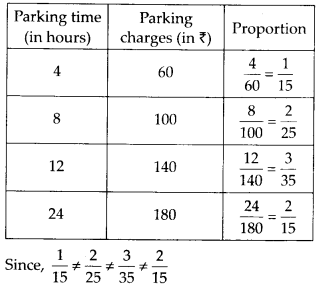
Following are the car parking charges near a railway station upto
4 hours ₹ 60
8 hours ₹ 100
12 hours ₹ 140
24 hours ₹ 180
Check if the parking charges are in direct proportion to the parking time.
Solution:
MP Board Class 8th Maths Solutions Chapter 13 Direct and Inverse Proportion Ex 13.1 1
∴ The parking timing is not in direct proportion with parking charges.

MP Board Solutions

Question 2.
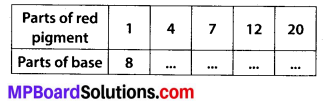
A mixture of paint is prepared by mixing 1 part of red pigments with 8 parts of base. In the following table, find the parts of base that need to be added.
MP Board Class 8th Maths Solutions Chapter 13 Direct and Inverse Proportion Ex 13.1 2
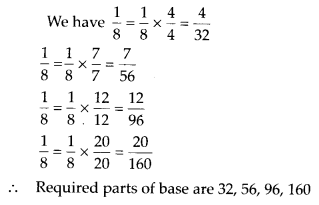
Solution:
MP Board Class 8th Maths Solutions Chapter 13 Direct and Inverse Proportion Ex 13.1 3

MP Board Solutions

Question 3.
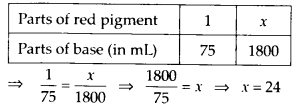
In Question 2 above, if 1 part of a red pigment requires 75 mL of base, how much red pigment should we mix with 1800 mL of base?
Solution:
Let x part of red pigment is mixed with 1800 mL of base.
MP Board Class 8th Maths Solutions Chapter 13 Direct and Inverse Proportion Ex 13.1 4

Question 4.
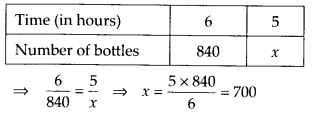
A machine in a soft drink factory fills 840 bottles in six hours. How many bottles will it fill in five hours?
Solution:
Let the number of bottles which will be filled in five hours be x
MP Board Class 8th Maths Solutions Chapter 13 Direct and Inverse Proportion Ex 13.1 5

MP Board Solutions

Question 5.
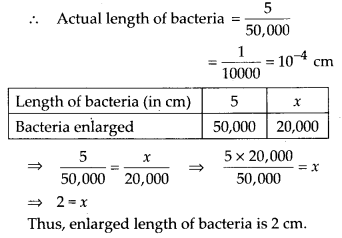
A photograph of a bacteria enlarged 50,000 times attains a length of 5 cm as shown in diagram. What is the actual length of the bacteria? If the photograph is enlarged 20,000 times only, what would be its enlarged length?
MP Board Class 8th Maths Solutions Chapter 13 Direct and Inverse Proportion Ex 13.1 6
Solution:
Let the enlarged length of bacteria be x cm.
∵ 50,000 times enlarged bacteria attains a length of 5 cm.
MP Board Class 8th Maths Solutions Chapter 13 Direct and Inverse Proportion Ex 13.1 7

MP Board Solutions

Question 6.
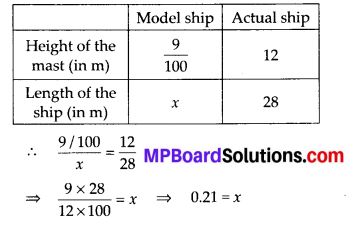
In a model of a ship, the mast is 9 cm high, while the mast of the actual ship is 12 m high. If the length of the ship is 28 m, how long is the model ship?
Solution:
Let x m be the length of the model ship when the height of the mast is 9 cm.
Now, according to question,
MP Board Class 8th Maths Solutions Chapter 13 Direct and Inverse Proportion Ex 13.1 8
Thus, length of the model ship = 0.21 m
= 21 cm

MP Board Solutions

Question 7.
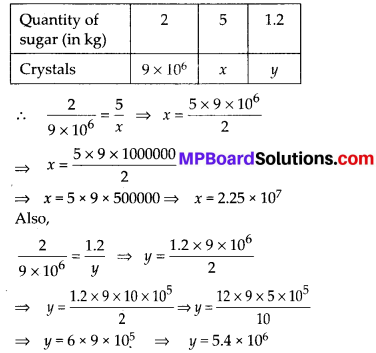
Suppose 2 kg of sugar contains 9 × 10⁶ crystals. How many sugar crystals are there in
(i) 5 kg of sugar ?
(ii) 1.2 kg of sugar ?
Solution:
Let the crystals contained by 5 kg and 1.2 kg of sugar be x and y respectively.
MP Board Class 8th Maths Solutions Chapter 13 Direct and Inverse Proportion Ex 13.1 9
Thus, 5 kg and 1.2 kg of sugar contains 2.25 × 10⁷ and 5.4 × 10⁶ crystals respectively.

MP Board Solutions

Question 8.
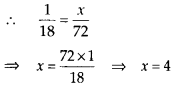
Rashmi has a road map with a scale of 1 cm representing 18 km. She drives on a road for 72 km. What would be her distance covered in the map?
Solution:
Let the distance covered in the map be x cm.
MP Board Class 8th Maths Solutions Chapter 13 Direct and Inverse Proportion Ex 13.1 10
Thus, the distance covered by her in the map is 4 cm.

MP Board Solutions

Question 9.
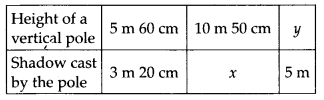
A 5 m 60 cm high vertical pole casts a shadow 3 m 20 cm long. Find at the same time
(i) the length of the shadow cast by another pole 10 m 50 cm high
(ii) the height of a pole which casts a shadow 5 m long.
Solution:
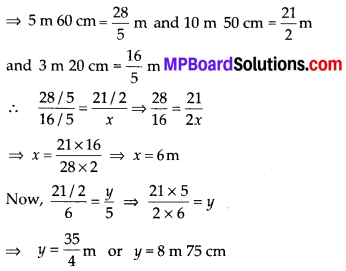
Let x be the length of shadow cast by the pole of a height 10 m 50 cm and y be the height of the vertical pole which cast a shadow 5 m long.
MP Board Class 8th Maths Solutions Chapter 13 Direct and Inverse Proportion Ex 13.1 11
MP Board Class 8th Maths Solutions Chapter 13 Direct and Inverse Proportion Ex 13.1 12

MP Board Solutions

Question 10.
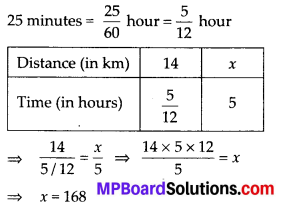
A loaded truck travels 14 km in 25 minutes. If the speed remains the same, how far can it travel in 5 hours?
Solution:
Let the distance travelled by truck in 5 hours be x km
MP Board Class 8th Maths Solutions Chapter 13 Direct and Inverse Proportion Ex 13.1 13
∴ Distance travelled by the truck in 5 hours is 168 km.

MP Board Class 8th Maths Solutions

MP Board Class 10th General Hindi व्याकरण शब्द विचार

MP Board Class 10th General Hindi व्याकरण शब्द विचार

प्रश्न 1.
शब्द की परिभाषा दें।
उत्तर-
शब्द की परिभाषा-निश्चित अर्थ को प्रकट करने वाले वर्ण-समूह को शब्द कहते हैं। जैसे-घर, रोटी, अर्थ, विचार, शब्द आदि।

प्रश्न 2.
शब्द के कितने रूप हैं? उदाहरण सहित समझाएँ।
उत्तरउत्पत्ति के आधार पर हिंदी में शब्द के चार भेद हैं

  1. तत्सम,
  2. तद्भव,
  3. देशज,
  4. विदेशी।

1. तत्सम-संस्कृत भाषा के ऐसे शब्द, जो हिंदी में भी अपने मूल रूप में प्रचलित हैं, तत्सम कहलाते हैं। जैसे-वायु, नारी, सत्य, छात्र, समुद्र आदि।
2. तद्भव-जो शब्द संस्कृत भाषा के शब्दों से बिगड़ कर हिंदी में प्रचलित हैं, तद्भव कहलाते हैं। जैसे-सपना (स्वप्न), दूध (दुग्ध)।
3. देशज-जो शब्द स्थानीय पदार्थ के रूप में, कार्य के रूप में अथवा ध्वनि के अनुसार प्रसिद्ध और प्रचलित हैं, देशज कहलाते हैं। ये शब्द देश की विभिन्न बोलियों से लिये गए हैं। जैसे–पेट, खिड़की, थूक, चीनी।
4. विदेशी-वे शब्द, जो अंग्रेज़ी, अरबी, फारसी, तुर्की, पुर्तगाली, फ्रांसीसी आदि विदेशी भाषाओं से हिंदी में आए हैं, विदेशी कहलाते हैं। जैसे-स्कूल, बटन, आलू, गरीब, किताब, लाश।

MP Board Solutions

MP Board Class 10th General Hindi व्याकरण शब्द विचार 1

प्रश्न 3.
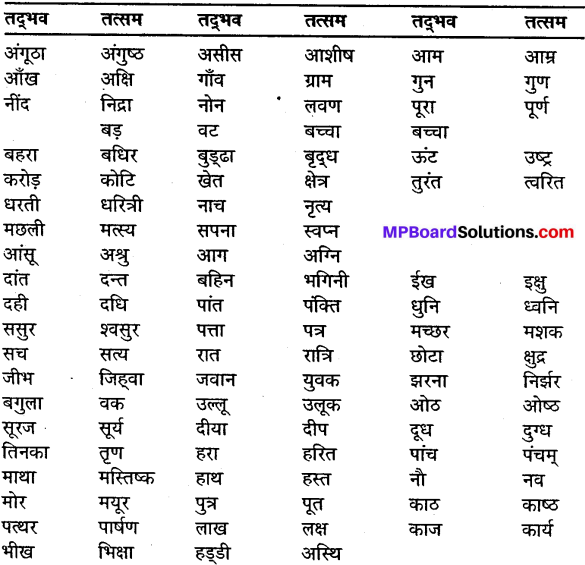
तत्सम एवं तद्भव शब्द रूपों के अन्तर उदाहरण सहित समझाएँ।
उत्तर-
तत्सम और तद्भव शब्द-

तत्सम शब्द-
हिंदी में संस्कृत के कुछ शब्दों को ज्यों का त्यों (यथावत्) ले लिया है। ऐसे शब्द तत्सम कहलाते हैं।

तद्भव शब्द-
संस्कृत के कुछ शब्द ऐसे हैं, जिनका रूप परिवर्तन करके हिंदी में अपनाया गया है। ऐसे शब्दों को तद्भव शब्द कहते हैं। यहाँ कुछ तद्भव शब्द और उनके तत्सम रूप दिए जा रहे हैं

MP Board Solutions

प्रश्न 4.
हिन्दी में प्रयुक्त होने वाले कुछ विदेशी शब्दों के उदाहरण दें?
उत्तर-
अंग्रेजी-स्टेशन, राशन, सिनेमा, टेलीविजन, टिकट, फीस, रेडियो, डॉक्टर, बैंक आदि।
अरबी-मौलवी, अदालत, अमीर, मालिक, दुनिया, फकीर, तारीख, किताब, कसर आदि।
फारसी-जिंदगी, बाग, चश्मा, खरगोश, चाकू, कारखाना, रूमाल, शिकायत, जल्दी, खरीद, तमाम, ज़मीन, फौज़, काग़ज़, हज़ार, दुकान, बादाम आदि।
पुर्तगाली-प्याला, आलू, साबुन, नीलाम, पिस्तौल, आदि।
ग्रीक-सुरंग, दाम आदि।
तुर्की-दारोगा, तमगा, काबू, लाश, कालीन, तोप आदि।
फ्रांसीसी-कूपन, अंगरेज़, कारतूस आदि।

MP Board Class 10th Hindi Solutions

MP Board Class 11th Maths Solutions Chapter 3 त्रिकोणमितीय फलन विविध प्रश्नावली

MP Board Class 11th Maths Solutions Chapter 3 त्रिकोणमितीय फलन विविध प्रश्नावली

प्रश्न 1.
सिद्ध कीजिए :
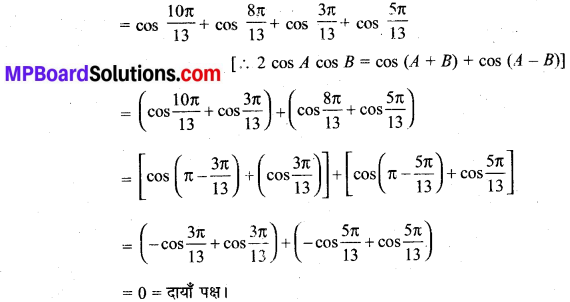
2 cos \(\frac{\pi}{13}\) cos\(\frac{9 \pi}{13}\) + cos\(\frac{3 \pi}{13}\) + cos\(\frac{5 \pi}{13}\) = 0.
हल:
बायाँ पक्ष =
2 cos \(\frac{\pi}{13}\) cos\(\frac{9 \pi}{13}\) + cos\(\frac{3 \pi}{13}\) + cos\(\frac{5 \pi}{13}\)
MP Board Class 11th Maths Solutions Chapter 3 त्रिकोणमितीय फलन विविध प्रश्नावली img-1

प्रश्न 2.
सिद्ध कीजिए : (sin 3x + sin x) sin x + (cos 3x – cos x) cos x = 0.
हल:
बायाँ पक्ष = (sin 3x + sin x) sin x + (cos 3x – cos x) cosx
= sin 3x sin x + sin2x + cos 3x cos x – cos2x
= (cos 3x cos x + sin 3x sin x) – (cos2 x – sin2x)
= cos 2x – cos 2x
= 0 [∵ cos (A – B) = cos A cos B + sin A sin B]
= दायाँ पक्ष।

प्रश्न 3.
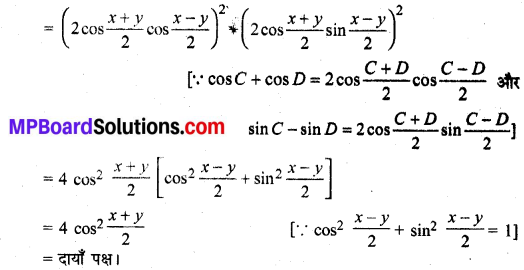
सिद्ध कीजिए : (cos x + cos y)2 + (sin x – sin y)2 = 4 cos2\(\frac{x+y}{2}\).
हल:
बायाँ पक्ष = (cos x + cos y)2 + (sin x – sin y)2
MP Board Class 11th Maths Solutions Chapter 3 त्रिकोणमितीय फलन विविध प्रश्नावली img-2

MP Board Solutions

प्रश्न 4.
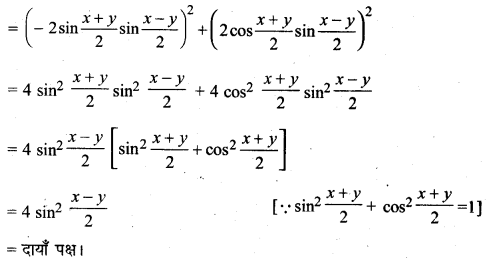
सिद्ध कीजिए : (cos x – cos y)2 + (sin x – sin y)2 = 4 sin\(\frac{x-y}{2}\).
हल:
बायाँ पक्ष = (cos x – cos y)2 + (sin x – sin y)2
MP Board Class 11th Maths Solutions Chapter 3 त्रिकोणमितीय फलन विविध प्रश्नावली img-3

प्रश्न 5.
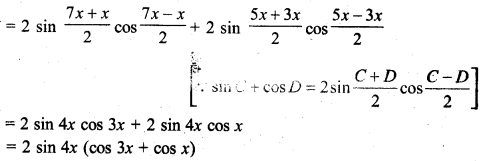
सिद्ध कीजिए : sin x + sin 3x + sin 5x + sin 7x = 4 cos x cos 2x sin 4x.
हल:
बायाँ पक्ष = sin x + sin 3x + sin 5x + sin 7x
= (sin 7x + sin x) + (sin 5x + sin 3x)
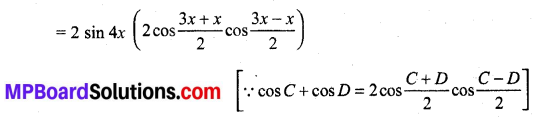
MP Board Class 11th Maths Solutions Chapter 3 त्रिकोणमितीय फलन विविध प्रश्नावली img-4
MP Board Class 11th Maths Solutions Chapter 3 त्रिकोणमितीय फलन विविध प्रश्नावली img-5
= 4 sin 4x cos 2x cos x
= 4 cos x cos 2x sin 4x
= दायाँ पक्ष।

प्रश्न 6.
सिद्ध कीजिए :
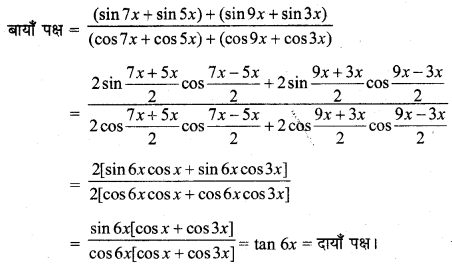
MP Board Class 11th Maths Solutions Chapter 3 त्रिकोणमितीय फलन विविध प्रश्नावली img-6
हल:
MP Board Class 11th Maths Solutions Chapter 3 त्रिकोणमितीय फलन विविध प्रश्नावली img-7

MP Board Solutions

प्रश्न 7.
सिद्ध कीजिए : sin 3x + sin 2x – sin x = 4 sin cos \(\frac{x}{2}\) cos \(\frac{3x}{2}\)
हल:
बायाँ पक्ष = sin 3x + (sin 2x – sin x)
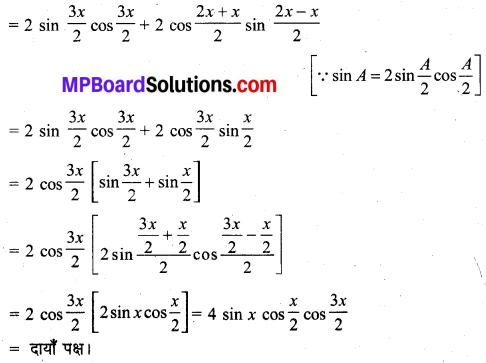
MP Board Class 11th Maths Solutions Chapter 3 त्रिकोणमितीय फलन विविध प्रश्नावली img-8

निम्नलिखित प्रत्येक प्रश्न में sin \(\frac{x}{2}\), cos \(\frac{x}{2}\), और tan \(\frac{x}{2}\), ज्ञात कीजिए।
प्रश्न 8.
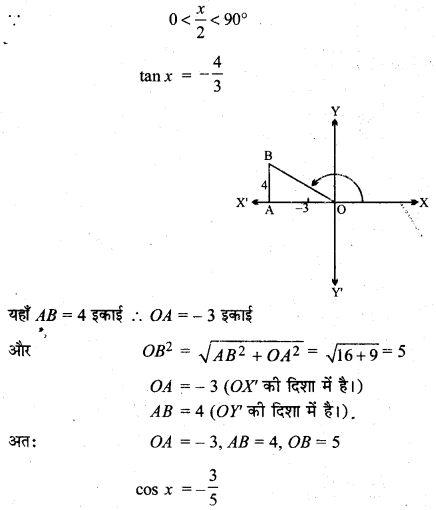
tan x = –\(\frac{4}{3}\), x द्वितीय चतुर्थाश में हैं।
हल:
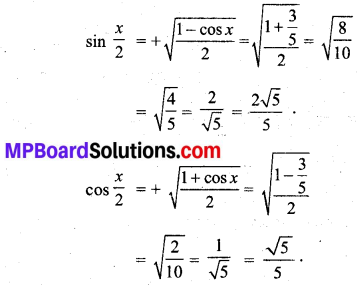
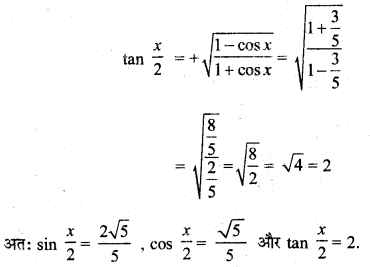
∵ x दूसरे चतुर्थांश में है, ∴ \(\frac{x}{2}\) पहले चतुर्थांश में है इसलिए sin \(\frac{x}{2}\), cos \(\frac{x}{2}\), और tan \(\frac{x}{2}\), धनात्मक होंगे।
MP Board Class 11th Maths Solutions Chapter 3 त्रिकोणमितीय फलन विविध प्रश्नावली img-9
MP Board Class 11th Maths Solutions Chapter 3 त्रिकोणमितीय फलन विविध प्रश्नावली img-10
MP Board Class 11th Maths Solutions Chapter 3 त्रिकोणमितीय फलन विविध प्रश्नावली img-11

प्रश्न 9.
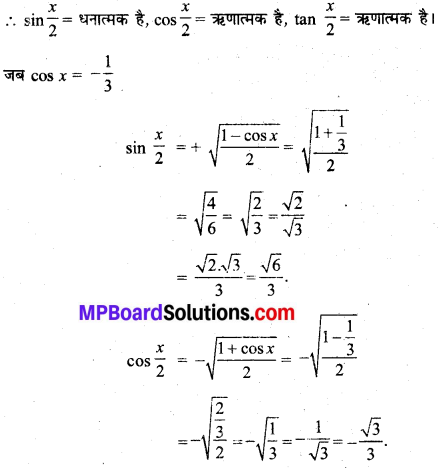
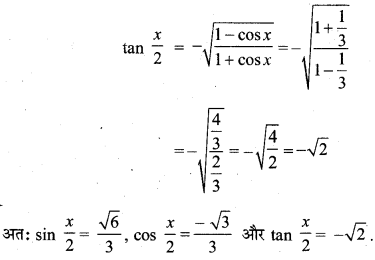
cos x = \(-\frac{1}{3}\), x तीसरे चतुर्थांश में है।
हल:
x, तीसरे चतुर्थांश में है।
अर्थात 180° < x < 270°
90° < \(\frac{x}{2}\) < 135
⇒ \(\frac{x}{2}\) दूसरे चतुर्थांश में है।
MP Board Class 11th Maths Solutions Chapter 3 त्रिकोणमितीय फलन विविध प्रश्नावली img-12
MP Board Class 11th Maths Solutions Chapter 3 त्रिकोणमितीय फलन विविध प्रश्नावली img-13

MP Board Solutions

प्रश्न 10.
sin x = \(\frac{1}{4}\) द्वितीय चतुर्थाश में है।
हल:
x, दूसरे चतुर्थांश में है।
⇒ 90° < \(\frac{x}{2}\) < 180°
2 से भाग देने पर 45° < \(\frac{x}{2}\) < 90°
⇒ \(\frac{x}{2}\) पहले चतुर्थाश में है
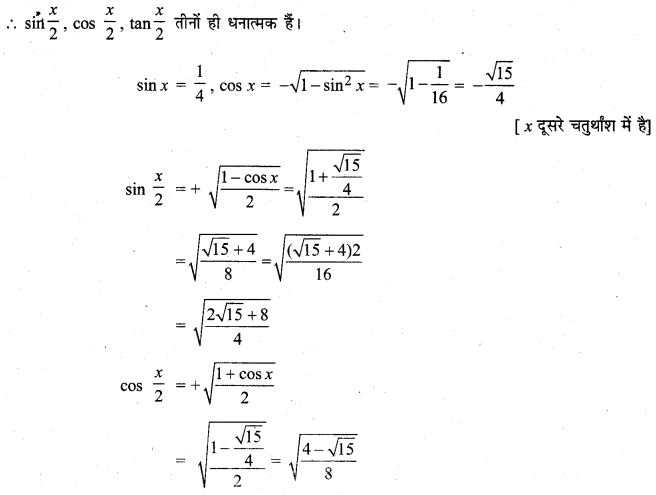
MP Board Class 11th Maths Solutions Chapter 3 त्रिकोणमितीय फलन विविध प्रश्नावली img-14
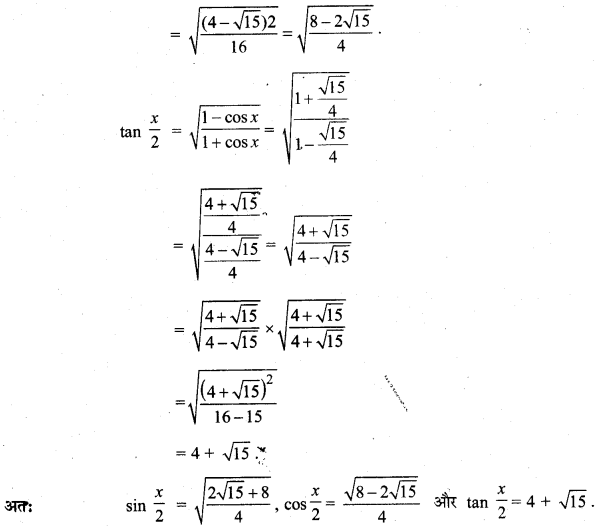
MP Board Class 11th Maths Solutions Chapter 3 त्रिकोणमितीय फलन विविध प्रश्नावली img-15

MP Board Class 11th Maths Solutions

MP Board Class 8th Maths Solutions Chapter 14 Factorization Ex 14.4

MP Board Class 8th Maths Solutions Chapter 14 Factorization Ex 14.4

Find and correct the errors in the following mathematical statements.
Question 1.
4(x – 5) = 4x – 5
Solution:
The given statement is incorrect.
The correct statement is 4(x – 5) = 4x – 20.

Question 2.
x(3x + 2) = 3x2 + 2
The given statement is incorrect.
The correct statement is x(3x + 2) = 3x2 + 2x.

Question 3.
2x + 3y = 5xy
Solution:
The given statement is incorrect.
The correct statement is 2x + 3y = 2x + 3y.

MP Board Class 8th Maths Solutions Chapter 14 Factorization Ex 14.4

Question 4.
x + 2x + 3x = 5x
Solution:
The given statement is incorrect.
The correct statement is x + 2x + 3x = 6x.

Question 5.
5y + 2y + y – 7y = 0
Solution:
The given statement is incorrect.
The correct statement is 5y + 2y + y – 7y = y.

Question 6.
3x + 2x = 5x2
The given statement is incorrect.
The correct statement is 3x + 2x = 5x.

Question 7.
(2x)2 + 4(2x) + 7 = 2x2 + 8x + 7
EH The given statement is incorrect.
The correct statement is (2x)2 + 4(2x) + 7
= 4x2 + 8x + 7.

Question 8.
(2x)2 + 5x = 4x + 5x = 9x
EH The given statement is incorrect.
The correct statement is (2x)2 + 5x = 4x2 + 5x.

MP Board Class 8th Maths Solutions Chapter 14 Factorization Ex 14.4

Question 9.
(3x + 2)2 = 3x2 + 6x + 4
Solution:
The given statement is incorrect.
The correct statement is (3x + 2)2
= (3x)2 + 2(3x)(2) + 22 = 9x2 + 12x + 4.

Question 10.
Substituting x = -3 in
(a) x2 + 5x + 4
gives (-3)2 + 5 (-3) + 4 = 9 + 2 + 4 = 15
(b) x2 – 5x + 4
gives (-3)2 – 5(-3) + 4 = 9 – 15 + 4 = -2
(c) x2 + 5x gives (-3)2 + 5 (-3) = -9 -15 = – 24
Solution:
(a) Incorrect statement
Substituting x = -3 in x2 + 5x + 4 gives
(-3)2 + 5(-3) + 4 = 9 – 15 + 4 = -2
(b) Incorrect statement
Substituting x = -3 in x2 – 5x + 4 gives
(-3)2 – 5(-3) + 4 = 9 + 15 + 4 = 28
(c) Incorrect statement
Substituting x = -3 in x2 + 5x gives
(-3)2 + 5(-3) = 9 – 15 = – 6

Question 11.
(y – 3)2 = y2 – 9
Solution:
The given statement is incorrect.
The correct statement is (y – 3)2 = y2 – 6y + 9

Question 12.
(z + 5)2 = z2 + 25
Solution:
The given statement is incorrect.
The correct statement is (z + 5)2 = z2 + 10z + 25

MP Board Class 8th Maths Solutions Chapter 14 Factorization Ex 14.4

Question 13.
(2a + 3b)(a – b) = 2a2 – 3b2
Solution:
The given statement is incorrect.
The correct statement is (2a + 3b)(a – b)
= 2a(a – b) + 3b(a – b)
= 2a2 – 2ab + 3ab – 3b2
= 2a2 + ab – 3b2

Question 14.
(a + 4)(a + 2) = a2 + 8
Solution:
The given statement is incorrect.
The correct statement is (a + 4) (a + 2)
= a(a + 2) + 4 (a + 2)
= a2 + 2a + 4a + 8 = a2 + 6a + 8

Question 15.
(a – 4)(a – 2) = a2 – 8
Solution:
The given statement is incorrect.
The correct statement is (a – 4) (a – 2)
= a(a – 2) – 4(a – 2) = a2 – 2a – 4a + 8
= a2 – 6a + 8

Question 16.
\(\frac{3 x^{2}}{3 x^{2}}\) = o
Solution:
The given statement is incorrect.
The correct statement is
\(\frac{3 x^{2}}{3 x^{2}}\) = 1

Question 17.
\(\frac{3 x^{2}+1}{3 x^{2}}\) = 1 + 1 = 2
Solution:
The given statement is incorrect.
The correct statement is
\(\frac{3 x^{2}+1}{3 x^{2}}=\frac{3 x^{2}}{3 x^{2}}+\frac{1}{3 x^{2}}=1+\frac{1}{3 x^{2}}\)

Question 18.
\(\frac{3 x}{3 x+2}=\frac{1}{2}\)
Solution:
The given statement is incorrect.
The correct statement is
\(\frac{3 x}{3 x+2}=\frac{3 x}{3 x+2}\)

MP Board Class 8th Maths Solutions Chapter 14 Factorization Ex 14.4

Question 19.
\(\frac{3}{4 x+3}=\frac{1}{4 x}\)
Solution:
The given statement is incorrect.
The correct statement is \(\frac{3}{4 x+3}=\frac{3}{4 x+3}\)

Question 20.
\(\frac{4 x+5}{4 x}\) = 5
Solution:
The given statement is incorrect.
The correct statement is
\(\frac{4 x+5}{4 x}=\frac{4 x}{4 x}+\frac{5}{4 x}=1+\frac{5}{4 x}\)

Question 21.
\(\frac{7 x+5}{5}\) = 7x
Solution:
The given statement is incorrect.
The correct statement is
\(\frac{7 x+5}{5}=\frac{7 x}{5}+\frac{5}{5}=\frac{7 x}{5}+1\)

MP Board Class 8th Maths Solutions


MP Board Class 10th General Hindi व्याकरण वर्तनी

MP Board Class 10th General Hindi व्याकरण वर्तनी

प्रश्न 1.
वर्तनी की परिभाषा दें।
उत्तर-
‘वर्तनी’ का अर्थ है उच्चारण के अनुरूप वर्ण-विन्यास। इसे अंग्रेजी में (spelling) कहते हैं। सामान्यतया लिखने की रीति को वर्तनी कहते हैं। वर्तनी की शुद्धता के लिए उच्चारण की शुद्धता आवश्यक है। यदि उच्चारण गलत हुआ तो वर्तनी भी गलत होती है।

MP Board Solutions

प्रश्न 2.
वर्तनी संशोधन के नियमों पर प्रकाश डालें।
उत्तर-
वर्तनी संबंधी कुछ नियम हैं, जिनका पालन करने से शब्दों के शुद्ध रूप लिखे जा सकते हैं।
1. किसी भी स्वर के साथ किसी अन्य स्वर की मात्रा नहीं लगनी चाहिए।

जैसे-

‘अ’ अिस, ओक, अपर-ये अशुद्ध रूप हैं।
इस, एक, ऊपर-ये शुद्ध रूप हैं।

2. भाववाची-ति, नि, धि, टि से समाप्त होने वाली स्त्रीलिंग संज्ञाओं की अंतिम ‘इ’ ह्रस्व होती है।

जैसे-

भक्ति, शक्ति, नीति, प्रीति, रीति, जाति आदि।

3. संस्कृत के तत्सम पुल्लिंग शब्द के अंतिम इ, उ, प्रायः ह्रस्व होते हैं।

जैसे-

कवि, कपि, हरि, रवि, वाल्मीकि, उदधि आदि।

4. तद्भव तथा विदेशी भाषाओं में आए पुल्लिंग शब्दों के अंतिम इ, उ दीर्घ होते हैं।

जैसे-

अंग्रेजी, फ्रांसीसी, आलू, भालू, डाकू, लड़ाकू।

5. ‘ऋ’ स्वर है। कभी-कभी उसका उच्चारण, रि, रु इस प्रकार करके इसी से शब्द लिखते हैं, वह अशुद्ध रूप है। ‘ऋ’ प्रारंभ में लगने वाले शब्द को ‘र’ से नहीं ‘ऋ’ से लिखना चाहिए

जैसे-

ऋतु लिखना चाहिए, रितु नहीं।
शुद्ध रूप-ऋचा, ऋग्वेद, ऋण, वृष्टि, कृषक, कृष्ण, तृण, तृष्णा आदि।

6. ‘घ’ तथा ‘ध’ वाले शब्द-‘घ’-घर, घोड़ा, घनश्याम, घड़ा, घमण्ड आदि।

‘ध’-धैर्य, धर्म, धन, धमाका, धाम आदि।

7. ‘व’ और ‘ब’ में अंतर-‘व’ के उच्चारण में होठ’ (ओठ) खुले रहते हैं और ‘ब’ के उच्चारण में बंद हो जाते हैं।

‘व’ वाले शब्द-वह, वर्ण, विवाहर, विश्व इत्यादि।
‘ब’ वाले शब्द-बाहर, बंद, बंदर, बँटवारा, बाप, बतासा, बनावट, बारात इत्यादि।

8. श, ष, स का अन्तर-‘श’ वाले शब्द-शहर, शरबत, शेर इत्यादि।

‘ष’ वाले शब्द-षट्कोण, नष्ट, कष्ट, राष्ट्र, युधिष्ठिर, विशिष्ट इत्यादि।
‘स’ वाले शब्द-समाज, सपेरा, समय, सावन, स्वागत, सरौता, सबेरा, स्वर्ग इत्यादि।

MP Board Solutions

प्रश्न 3.
परसर्ग या कारक चिह्न का प्रयोग कहाँ किया जाता है?
उत्तर-
परसर्ग या कारक चिह्न का प्रयोग-संज्ञा शब्दों के साथ होना चाहिए। इस प्रकार जैसे-राम ने, मोहन को, घर में सर्वनाम के साथ प्रयोग-जैसे-मैंने, आपने, उन्होंने, उनको, जिसको इत्यादि।

प्रश्न 4.
योजक चिह्न का प्रयोग सोदाहरण समझाइये।
उत्तर-
योजक चिह्न का प्रयोग समानपद में करना चाहिए।

जैसे-

माता-पिता,
भाई-बहन,
पाप-पुण्य,
सरस्वती – वन्दना,
शोध-संस्था,
रात-दिन आदि।

प्रश्न 5.
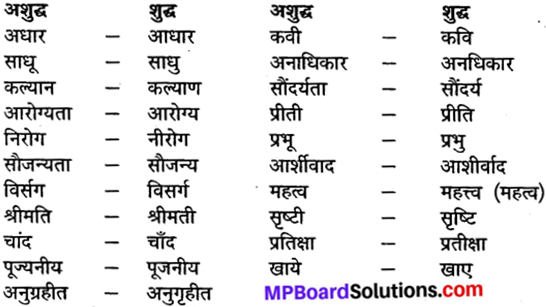
शुद्ध एवं अशुद्ध वर्तनी को उदाहरण सहित समझाएँ।
उत्तर-
जैसे-
MP Board Class 10th General Hindi व्याकरण वर्तनी 1

प्रश्न 6.
वर्ण तथा शब्द में क्या अंतर है?
उत्तर-
ध्वनि का लिखित रूप वर्ण कहलाता है। वर्ण भाषा की सबसे छोटी इकाई है। इन्हें विभाजित नहीं किया जा सकता, परन्तु वर्णों के सार्थक समूह से शब्दों का निर्माण होता है।

जैसे-

अ, आ, इ, ई वर्ण हैं जबकि र् + आ + म् + अ = ‘राम’ शब्द है।

प्रश्न 7.
हिन्दी की लिपि का नाम बताएँ।
उत्तर-
हिन्दी की लिपि का नाम देवनागरी लिपि है। प्रश्न 8. वर्तनी के नियमों में से कोई भी दो नियम लिखिए।
उत्तर-
1. किसी भी स्वर के साथ किसी अन्य स्वर की मात्रा नहीं लगती है।

जैसे-

अशुद्ध-ओक, शुद्ध-एक।

2. ‘ऋ’ स्वर का शुद्ध उच्चारण

जैसे-

रितु-अशुद्ध, ऋतु-शुद्ध शब्द है।

प्रश्न 9.
मानक वर्तनी क्या है? सोदाहरण समझाएँ।
उत्तर-
वर्तनी संबंधी कुछ महत्वपूर्ण नियम हैं। शुद्ध शब्द उच्चारण के लिए, उनका पालन करने से मानक शुद्ध वर्तनी प्रस्तुत होती है।
जैसे-
‘ष’ के स्थान पर ‘श’ संबंधी अशुद्धियाँ।
अशुद्ध शब्द – मानक (शुद्ध) वर्तनी
द्वेश – द्वेष
निर्दोष – निर्दोश

प्रश्न 10.
निम्नांकित शब्दों के (मानक) शुद्ध रूप लिखिए।
उत्तर-
अशुद्ध रूप – मानक (शुद्ध रूप)

  1. उज्वल – उज्ज्व ल
  2. क्षन – क्षण
  3. एकलौता – इकलौता
  4. सौंदर्यता – सौंदर्य
  5. आशीर्वाद – आशीर्वाद
  6. चाहिये – चाहिए
  7. अनाधिकार – अनधिकार
  8. मैथली – मैथिली
  9. उपरोक्त – उपर्युक्त
  10. अनुग्रहित – अनुगृहीत

MP Board Solutions

प्रश्न 11.
‘ऋ’ तथा ‘रि’ से बनने वाले कोई चार शब्द लिखिए।
उत्तर-
‘रि’ –

  1. रिगवेद
  2. रितु
  3. रिषि
  4. रिचा।।

‘ऋ’ –

  1. ऋग्वेद
  2. ऋतु
  3. ऋषि
  4. ऋचा।

MP Board Class 10th Hindi Solutions

MP Board Class 10th General Hindi व्याकरण प्रत्यय

MP Board Class 10th General Hindi व्याकरण प्रत्यय

प्रश्न 1.
प्रत्यय किसे कहते हैं?
उत्तर-
मूल शब्दों के अंत में जो शब्दांश जुड़कर नये शब्द बनाए जाते हैं, उन्हें प्रत्यय कहते हैं। दूसरे शब्दों में जो शब्दांश शब्द के अंत में जुड़कर नये-नये शब्दों का निर्माण करते हैं, उन्हें प्रत्यय कहते हैं।

MP Board Solutions

प्रश्न 2.
प्रत्यय कितने प्रकार के होते हैं? उत्तर-प्रत्यय दो प्रकार के होते हैं-कृत और तद्धित।

प्रश्न 3.
कृत प्रत्यय को सोदाहरण समझाएँ:
उत्तर-
कृत प्रत्यय-क्रिया शब्दों के अंत में जो शब्दांश जोड़े जाते हैं, वे कृत प्रत्यय कहलाते हैं,

जैसे-

पढ़ना + ई = पढ़ाई ; लिखना + ई = लिखाई।

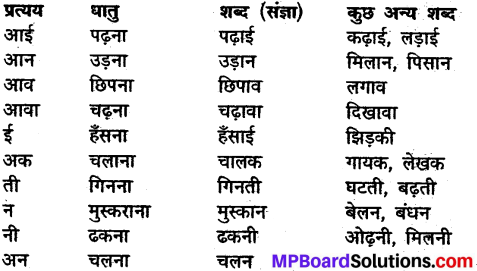
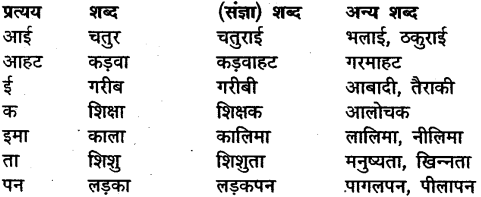
क्रिया में प्रत्यय जोड़कर संज्ञाएँ भी बनाई जाती हैं और विशेषण भी। संज्ञा बनाने वाले हिंदी के प्रमुख कृत् प्रत्यय निम्नलिखित हैं-
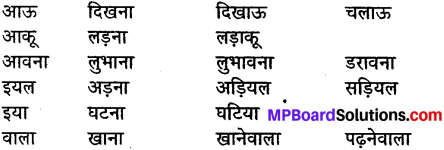
MP Board Class 10th General Hindi व्याकरण प्रत्यय img-1

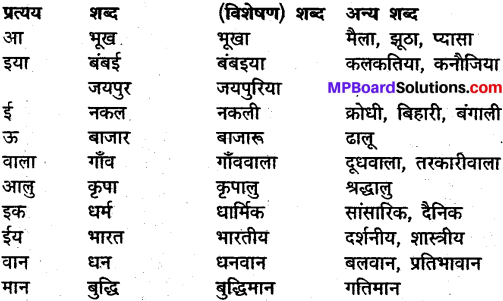
विशेषण बनाने वाले प्रत्यय
MP Board Class 10th General Hindi व्याकरण प्रत्यय img-2
MP Board Class 10th General Hindi व्याकरण प्रत्यय img-3

प्रश्न 4.
तद्धित प्रत्यय को सोदाहरण समझाएँ।
उत्तर-
तद्धित प्रत्यय-जो प्रत्यय संज्ञा, सर्वनाम, विशेषण के साथ जुड़कर नये शब्द बनाते हैं, उन्हें तद्धित प्रत्यय कहते हैं।

संज्ञा बनाने वाले तद्धित प्रत्यय-
MP Board Class 10th General Hindi व्याकरण प्रत्यय img-4

MP Board Solutions

विशेषण बनाने वाले तद्धित प्रत्यय-
MP Board Class 10th General Hindi व्याकरण प्रत्यय img-5

MP Board Class 10th Hindi Solutions

MP Board Class 8th Maths Solutions Chapter 14 Factorization Ex 14.3

MP Board Class 8th Maths Solutions Chapter 14 Factorization Ex 14.3

Question 1.
Carry out the following divisions.
(i) 28x4 ÷ 56x
(ii) -36y3 ÷ 9y2
(iii) 66pq2r3 ÷ 11qr2
(iv) 34x3y3z3 ÷ 51 xy2z3
(v) 12a8b8 ÷ (- 6a6b4).
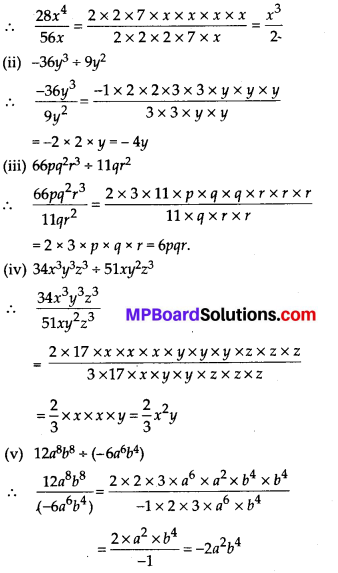
Solution:
(i) 28x4 ÷ 56x
MP Board Class 8th Maths Solutions Chapter 14 Factorization Ex 14.3 1

Question 2.
Divide the given polynomial by the given monomial.
(i) (5x2 – 6x) ÷ 3x
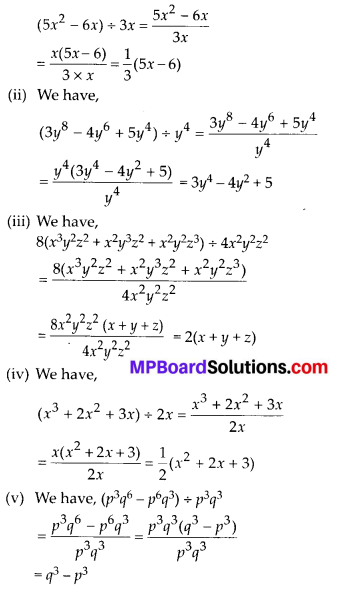
(ii) (3y8 – 4y6 + 5y4) ÷ y4
(iii) 8(x3y2z2 + x2y3z2 + x2y2z3) ÷ 4x2y2z2
(iv) (x3 + 2x2 + 3x) ÷ 2x
(v) (p3q6 – p6q3) ÷ p3q3
Solution:
(i) We have
MP Board Class 8th Maths Solutions Chapter 14 Factorization Ex 14.3 2

Question 3.
Work out the following divisions.
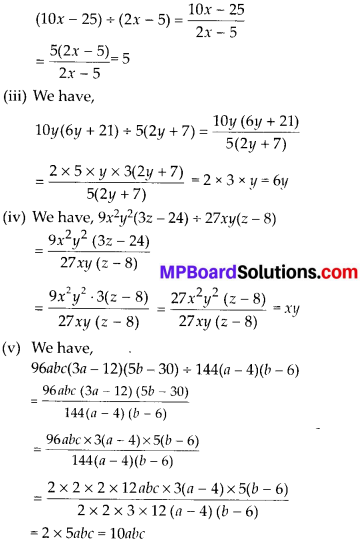
(i) (10x – 25) ÷ 5
(ii) (10x- 25) ÷ (2x- 5)
(iii) 10y(6y + 21) ÷ 5(2y + 7)
(iv) 9x2y2(3z – 24) ÷ 27xy(z – 8)
(v) 96abc(3a -12)(5b – 30) ÷ 144(a – 4)(b – 6)
Solution:
(i) We have,
(10x – 25) ÷ 5 = \(\frac{10 x-25}{5}\)
= \(\frac{5(2 x-5)}{5}\) = (2x – 5)

(ii) We have,
MP Board Class 8th Maths Solutions Chapter 14 Factorization Ex 14.3 3

MP Board Class 8th Maths Solutions Chapter 14 Factorization Ex 14.3

Question 4.
Divide as directed.
(i) 5(2x + 1 )(3x + 5) ÷ (2x + 1)
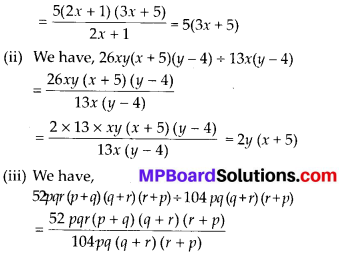
(ii) 26xy(x + 5)(y – 4) ÷ 13x(y – 4)
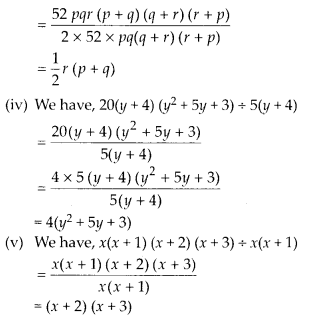
(iii) 52pqr (p + q)(q + r)(r + p) ÷ 104pq(q + r)(r + p)
(iv) 20(y + 4) (y2 + 5y + 3) ÷ 5(y + 4)
(v) x(x + 1)(x + 2)(x + 3) ÷ x(x + 1)
Solution:
(i) We have, 5(2x + 1)(3x + 5) ÷ (2x + 1)
MP Board Class 8th Maths Solutions Chapter 14 Factorization Ex 14.3 4
MP Board Class 8th Maths Solutions Chapter 14 Factorization Ex 14.3 5

Question 5.
Factorise the expressions and divide them as directed.
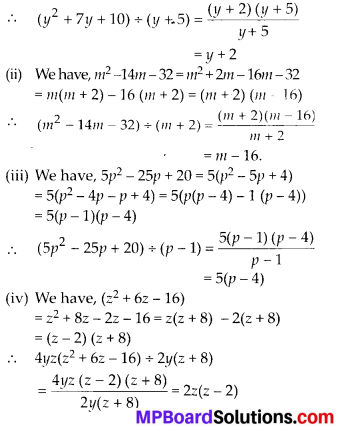
(i) (y2 + 7y + 10) ÷ (y + 5)
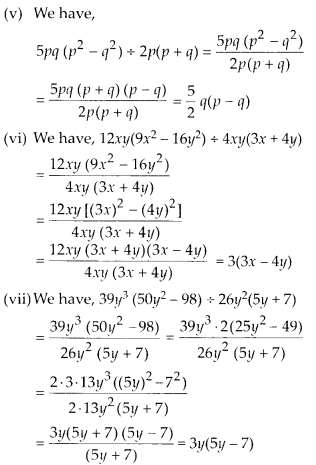
(ii) (m2 – 14m – 32) ÷ (m + 2)
(iii) (5p2 – 25p + 20) ÷ (p – 1)
(iv) 4yz(z2 + 6z – 16) ÷ 2y(z + 8)
(v) 5pq(p2 – q2) ÷ 2p(p + q)
(vi) 12xy(9x2 – 16y2) ÷ 4xy(3x + 4y)
(vii) 39y3(50y2 – 98) ÷ 26y2(5y + 7)
Solution:
(i) We have, y2 + 7y + 10
= y2 + 5y + 2y + 10
= y(y + 5) + 2(y + 5) = (y + 2) (y + 5)
MP Board Class 8th Maths Solutions Chapter 14 Factorization Ex 14.3 6
MP Board Class 8th Maths Solutions Chapter 14 Factorization Ex 14.3 7

MP Board Class 8th Maths Solutions

MP Board Class 11th Maths Solutions Chapter 3 त्रिकोणमितीय फलन Ex 3.4

MP Board Class 11th Maths Solutions Chapter 3 त्रिकोणमितीय फलन Ex 3.4

निम्नलिखित समीकरणों का मुख्य तथा व्यापक हल ज्ञात कीजिए (प्रश्न 1 से 4 तक) :
प्रश्न 1.
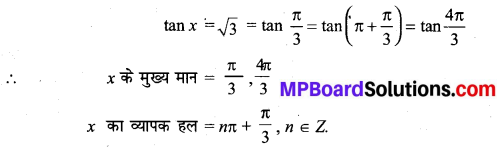
tan x = \( \sqrt{{3}} \).
हल:
MP Board Class 11th Maths Solutions Chapter 3 त्रिकोणमितीय फलन Ex 3.4 img-1

प्रश्न 2.
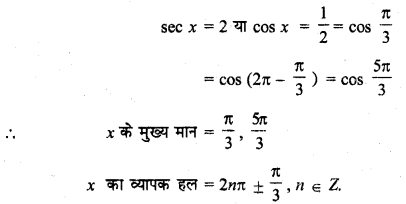
secx = 2.
हल:
MP Board Class 11th Maths Solutions Chapter 3 त्रिकोणमितीय फलन Ex 3.4 img-2

प्रश्न 3.
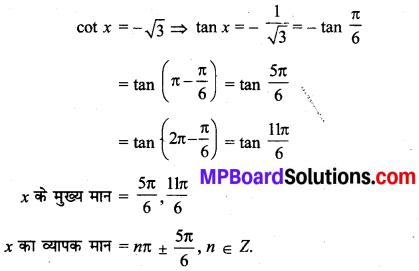
cot x = \(– \sqrt{{3}} \).
हल:
MP Board Class 11th Maths Solutions Chapter 3 त्रिकोणमितीय फलन Ex 3.4 img-3

MP Board Solutions

प्रश्न 4.
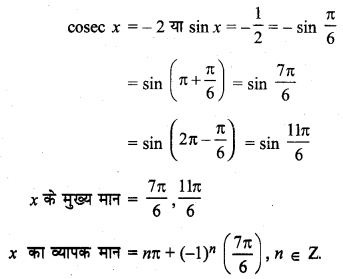
cosecx = – 2.
हल:
MP Board Class 11th Maths Solutions Chapter 3 त्रिकोणमितीय फलन Ex 3.4 img-4

निम्नलिखित में से प्रत्येक समीकरण का व्यापक हल ज्ञात कीजिए (प्रश्न 5 से 9 तक) :
प्रश्न 5.
cos 4x = cos 2x.
हल:
cos 4x = cos 2x
या cos 4x – cos 2x = 0
MP Board Class 11th Maths Solutions Chapter 3 त्रिकोणमितीय फलन Ex 3.4 img-5

प्रश्न 6.
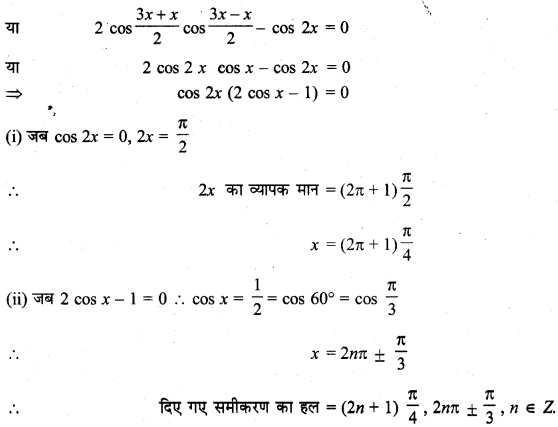
cos 3x + cosx – cos 2x = 0.
हल:
cos 3x + cos x – cos 2x = 0
MP Board Class 11th Maths Solutions Chapter 3 त्रिकोणमितीय फलन Ex 3.4 img-6

MP Board Solutions

प्रश्न 7.
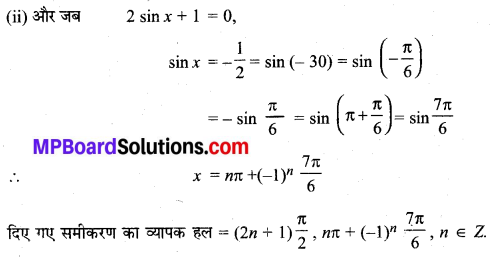
sin 2x + cos x = 0.
हल:
sin 2x + cos x = 0
∴ 2 sin x cos x + cos x = 0 [∴ sin 2x = 2 sin x cos x]
या cos x (2 sin x + 1) = 0
(i) जब cos x = 0, x = (2n + 1)\(\frac{\pi}{2}\)
MP Board Class 11th Maths Solutions Chapter 3 त्रिकोणमितीय फलन Ex 3.4 img-7

प्रश्न 8.
sec2 2x = 1 – tan 2x.
हल:
sec2 2x = 1 – tan 2x
या 1 + tan2 2x = 1 – tan 2x [∵ sec2A = 1 + tan2 A]
या tan2 2x + tan 2x = 0
या tan 2x (tan 2x + 1) = 0
∴ tan 2x = 0, y tan 2x + 1 = 0
MP Board Solutions

प्रश्न 9.
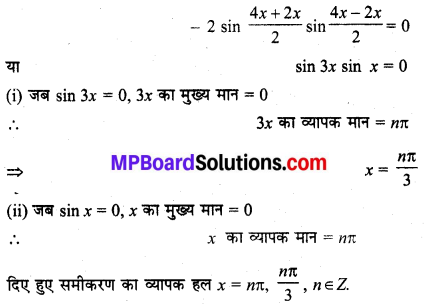
sin x + sin 3x + sin 5x = 0.
हल:
sin x + sin 3x + sin 5x = 0
या (sin 5x + sin x) + sin 3x = 0
या \(2 \sin \frac{5 x+x}{2} \cos \frac{5 x-x}{2}\) + sin 3x = 0 [∵ sin C + sin D = 2 \(\frac{C+D}{2} \cos \frac{C-D}{2}\)]
या 2 sin 3x cos 2x + sin 3x = 0
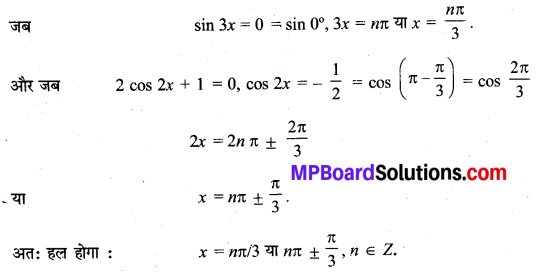
या sin 3 x (2 cos 2 x + 1) = 0
⇒ sin 3x = 0
या 2 cos 2x + 1 = 0
MP Board Class 11th Maths Solutions Chapter 3 त्रिकोणमितीय फलन Ex 3.4 img-9

MP Board Class 11th Maths Solutions

MP Board Class 8th Maths Solutions Chapter 8 Comparing Quantities Ex 8.3

MP Board Class 8th Maths Solutions Chapter 8 Comparing Quantities Ex 8.3

Question 1.
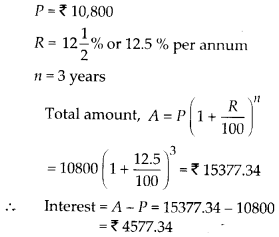
Calculate the amount and compound interest on
(a) ₹ 10,800 for 3 years at 12\(\frac{1}{2}\)% per annum compounded annually.
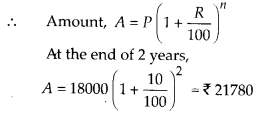
(b) ₹ 18,000 for 2\(\frac{1}{2}\) years at 10% per annum compounded annually.
(c) ₹ 62,500 for 1\(\frac{1}{2}\) years at 8% per annum compounded half yearly.
(d) ₹ 8,000 for 1 year at 9% per annum compounded half yearly.
(e) ₹ 10,000 for 1 year at 8% per annum compounded half yearly.
Solution:
(a) We have,
MP Board Class 8th Maths Solutions Chapter 8 Comparing Quantities Ex 8.3 13

(b) We have,
P = ₹ 18000
R = 10 % per annum
n = 2\(\frac{1}{2}\) years or 2.5 years
MP Board Class 8th Maths Solutions Chapter 8 Comparing Quantities Ex 8.3 14

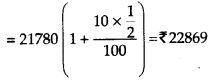
Now, we calculate S.I. on this amount for \(\frac{1}{2}\) year at 10 % per annum.
∴ Amount after 2.5 years
MP Board Class 8th Maths Solutions Chapter 8 Comparing Quantities Ex 8.3 15
∴ Interest = A – P = 22869 -18000 = ₹ 4869

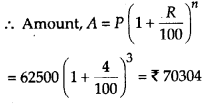
(c) We have,
P = ₹ 62500
R = 8 % per annum = 4 % per half year
n = 1\(\frac{1}{2}\) years = 3 half years
MP Board Class 8th Maths Solutions Chapter 8 Comparing Quantities Ex 8.3 16
∴ Interest = A – P = 70304 – 62500 = ₹ 7804

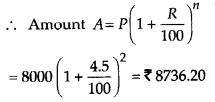
(d) We have,
P = ₹ 8000
R = 9 % per annum
= 4 % per half year
n = 1 year = 2 half years
MP Board Class 8th Maths Solutions Chapter 8 Comparing Quantities Ex 8.3 17
∴ Interest = A – P = 8736.20 – 8000 = ₹ 736.20

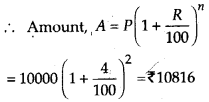
(e) We have,
P = ₹ 10000
R = 8% per annum = 4 % per half year
n = 1 year = 2 half years
MP Board Class 8th Maths Solutions Chapter 8 Comparing Quantities Ex 8.3 18
∴ Interest = A – P = 10816 -10000 = ₹ 816

MP Board Solutions

Question 2.
Kamla borrowed ₹ 26,400 from a bank to buy a scooter at a rate of 15% per annum compounded yearly. What amount will she pay at the end of 2 years and 4 months to clear the loan?
(Hint : Find 4 for 2 years with interest is compounded yearly and then find SI on the 2nd year amount for \(\frac{4}{12}\) years).
Solution:
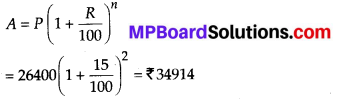
We have,
P = ₹ 26400
R = 15 % per annum
n = 2 years 4 months
At the end of 2 years,
MP Board Class 8th Maths Solutions Chapter 8 Comparing Quantities Ex 8.3 19
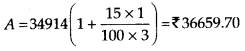
Now, P = ₹ 34914
R = 15 % per annum
n = 4 months = \(\frac{1}{3}\) years
At the end of 2 years and 4 months,
MP Board Class 8th Maths Solutions Chapter 8 Comparing Quantities Ex 8.3 20

Question 3.
Fabina borrows ₹ 12,500 at 12% per annum for 3 years at simple interest and Radha borrows the same amount for the same time period at 10% per annum, compounded annually. Who pays more interest and by how much?
Solution:
For Fabina, P = ₹ 12500
R = 12 % per annum
n = 3 years
For simple interest,
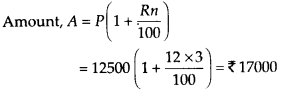
MP Board Class 8th Maths Solutions Chapter 8 Comparing Quantities Ex 8.3 21
Interest = 17000 – 12500 = ₹ 4500
For Radha, P = ₹ 12500
R = 10 % per annum
n = 3 years
As this is compound interest
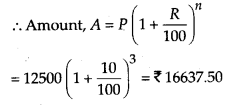
MP Board Class 8th Maths Solutions Chapter 8 Comparing Quantities Ex 8.3 22
Interest = 16637.50 -12500 = ₹ 4137.50
Hence, Fabina pays more interest by 4500 – 4137.50 = ₹ 362.50

MP Board Solutions

Question 4.
I borrowed ₹ 12,000 from Jamshed at 6% per annum simple interest for 2 years. Had I borrowed this sum at 6% per annum compound interest, what extra amount would I have to pay?
Solution:
We have, P = ₹ 12000
R = 6 % per annum
n = 2 years
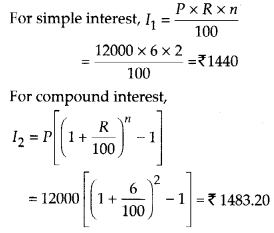
MP Board Class 8th Maths Solutions Chapter 8 Comparing Quantities Ex 8.3 23
So, the extra amount he would have to pay = 1483.20 -1440 = ₹ 43.20

MP Board Solutions

Question 5.
Vasudevan invested X 60,000 at an interest rate of 12% per annum compounded half yearly. What amount would he get
(i) after 6 months?
(ii) after 1 year?
Solution:
We have,
P = ₹ 60000
R = 12 % per annum = 6 % per half year
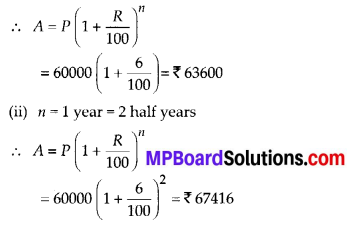
(i) n = 6 months = 1 half year
MP Board Class 8th Maths Solutions Chapter 8 Comparing Quantities Ex 8.3 24

Question 6.
Arif took a loan of ₹ 80,000 from a bank. If the rate of interest is 10% per annum, find the difference in amounts he would be paying after 1\(\frac{1}{2}\) years if the interest is
(i) compounded annually.
(ii) compounded half yearly.
Solution:
We have,
P = ₹ 80000
R = 10 % per annum = 5 % per half year
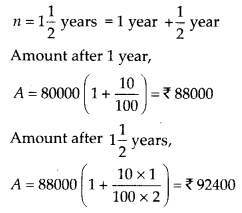
(i) If the interest is compounded annually
MP Board Class 8th Maths Solutions Chapter 8 Comparing Quantities Ex 8.3 25

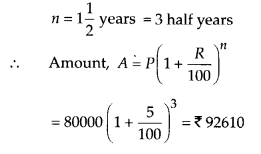
(ii) If interest is compounded half yearly
MP Board Class 8th Maths Solutions Chapter 8 Comparing Quantities Ex 8.3 26
∴ Difference in amounts = 92610 – 92400
= ₹ 210

MP Board Solutions

Question 7.
Maria invested ₹ 8,000 in a business. She would be paid interest at 5% per annum compounded annually. Find
(i) The amount credited against her name at the end of the second year.
(ii) The interest for the 3rd year.
Solution:
We have,
P = ₹ 8000
R = 5 % per annum
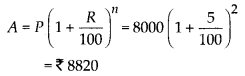
(i) n = 2 years
MP Board Class 8th Maths Solutions Chapter 8 Comparing Quantities Ex 8.3 27

(ii) n = 3 years
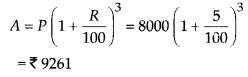
MP Board Class 8th Maths Solutions Chapter 8 Comparing Quantities Ex 8.3 28
Hence, interest for 3rd year = 9261 – 8820 = ₹ 441

MP Board Solutions

Question 8.
Find the amount and the compound interest on ₹ 10,000 for 1\(\frac{1}{2}\) years at 10% per annum, compounded half yearly. Would this interest be more than the interest he would get if it was compounded annually? Solution:
We have,
P = ₹ 10000
R = 10 % per annum = 5 % per half year
n = 1\(\frac{1}{2}\) years = 3 half years
(i) If interest is compounded half yearly
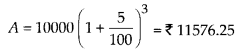
MP Board Class 8th Maths Solutions Chapter 8 Comparing Quantities Ex 8.3 29
Interest = 11576.25 – 10000 = ₹ 1576.25

(ii) If interest is compounded annually Amount after 1 year,
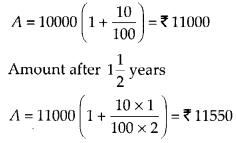
MP Board Class 8th Maths Solutions Chapter 8 Comparing Quantities Ex 8.3 30
Thus, more interest would be generated if interest is calculated half yearly.

MP Board Solutions

Question 9.
Find the amount which Ram will get on ₹ 4096, if he gave it for 18 months at 12\(\frac{1}{2}\) % per annum, interest being compounded half yearly.
Solution:
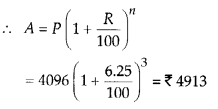
We have,
P = ₹ 4096
R = 12.5 % per annum = 6.25 % per half year
n = 18 months = 3 half years
MP Board Class 8th Maths Solutions Chapter 8 Comparing Quantities Ex 8.3 31

MP Board Solutions

Question 10.
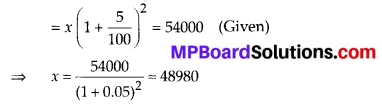
The population of a place increased to 54,000 in 2003 at a rate of 5% per annum
(i) find the population in 2001.
(ii) what would be its population in 2005?
Solution:
We have, population in 2003 = 54000
Rate = 5% per annum
(i) Let population in 2001 be x.
The population in 2003
MP Board Class 8th Maths Solutions Chapter 8 Comparing Quantities Ex 8.3 32
∴ Population = 48980 in 2001

(ii) For population in 2005
n = 2 years
MP Board Class 8th Maths Solutions Chapter 8 Comparing Quantities Ex 8.3 33

MP Board Solutions

Question 11.
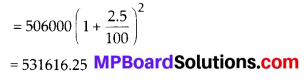
In a laboratory, the count of bacteria in a certain experiment was increasing at the rate of 2.5% per hour. Find the bacteria at the end of 2 hours if the count was initially 5,06,000.
Solution:
Initial count of bacteria = 506000
Rate = 2.5 % per hour
n = 2 hours
∴ Count after 2 hours
MP Board Class 8th Maths Solutions Chapter 8 Comparing Quantities Ex 8.3 34

MP Board Solutions

Question 12.
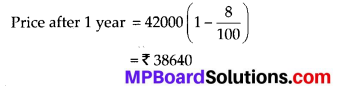
A scooter was bought at ₹ 42,000. Its value depreciated at the rate of 8% per annum. Find its value after one year.
Solution:
Initial price = ₹ 42000
Rate of depreciation = 8% per annum
n = 1 year
MP Board Class 8th Maths Solutions Chapter 8 Comparing Quantities Ex 8.3 35

MP Board Class 8th Maths Solutions