MP Board Class 6th Hindi Bhasha Bharti Solutions Chapter 1 विजयी विश्व तिरंगा प्यारा

MP Board Class 6th Hindi Bhasha Bharti Solutions Chapter 1 विजयी विश्व तिरंगा प्यारा

MP Board Class 6th Hindi Bhasha Bharti Chapter 1 पाठ का अभ्यास

विजयी विश्व तिरंगा प्यारा प्रश्न उत्तर MP Board Class 6th प्रश्न 1.
रिक्त स्थानों की पूर्ति कीजिए

(क) सदा शक्ति …………… वाला।
(ख) प्रेम सुधा …………… वाला।
(ग) स्वतन्त्रता के …………..रण में।
(घ) मिट जाय भय …………… सारा।
(ङ) तब होवे प्रण …………… हमारा।
उत्तर
(क) बरसाने
(ख) सरसाने
(ग) भीषण
(घ) संकट
(ङ) पूर्ण।

भाषा भारती कक्षा 6 पाठ 1 MP Board प्रश्न 2.
निम्नलिखित प्रश्नों के उत्तर लिखिए

(क) कवि के अनुसार हमारा ध्येय क्या है?
उत्तर
कवि के अनुसार हमारा ध्येय पूर्ण स्वतन्त्रता प्राप्त करना है।

(ख) झंडे को ऊँचा रखने से क्या तात्पर्य है?
उत्तर
हमारा देश हमेशा ही शक्ति का प्रेरणा स्रोत, प्रेमरूपी अमृत से संचित करने वाला, मातृभूमि के लिए वीरों के तन-मन से प्यारा है। इन्हीं कारणों से भारतवर्ष की विश्व में गौरवपूर्ण प्रतिष्ठा है। कवि चाहता है कि ऐसे गौरवशाली देश का राष्ट्रीय झण्डा ‘तिरंगा’ सदैव ऊँचा ही रहे।

(ग) कवि ने झंडे को ‘विजयी विश्व तिरंगा प्यारा’ क्यों कहा है?
उत्तर
कवि ने भारतीय झण्डे ‘तिरंगे’ को ‘विजयी विश्व तिरंगा प्यारा’ इसलिए कहा है क्योंकि कवि का मानना है कि ‘तिरंगा’ हमारी राष्ट्रीय भावनाओं का प्रमुख प्रेरणा स्रोत है। इसको देखकर प्रत्येक भारतीय स्वयं को गौरवान्वित महसूस करता है।

(घ) कवि वीरों को क्यों बुला रहा है ?
उत्तर
कवि मातृभूमि को स्वतन्त्र कराने के उद्देश्य से स्वयं के प्राणों की आहुति के लिए वीरों का आह्वान कर रहा है।

(ङ) तिरंगे को देखकर वीरों के मन में कौन-से भाव जाग्रत होते हैं ? .
उत्तर
तिरंगा विश्व में हमारी शान एवं विजय का प्रतीक है। यह वीरों के मन में शक्ति, जोश, आनन्द एवं साहस के भावों का संचार करने वाला है। तिरंगा हमें अपने देश की रक्षार्थ अपनी जान तक बलिदान करने के लिए प्रतिपल प्रेरित करता रहता है।

(च) स्वतंत्रता संग्राम में शत्रु की दशा कैसी है ?
उत्तर
स्वतंत्रता संग्राम में माँ भारती के वीर सपूतों के साहस व पराक्रम को देखकर शत्रु काँपने लगते हैं।

भाषा भारती कक्षा 6 हिंदी MP Board प्रश्न 3.
निम्नलिखित पंक्तियों का भाव स्पष्ट कीजिए

(क) मातृभूमि का तन-मन सारा।
झंडा ऊँचा रहे हमारा॥

(ख) स्वतंत्रता के भीषण रण में।
लखकर जोश बढ़े क्षण-क्षण में।

(ग) इस झंडे के नीचे निर्भय,
रहे स्वतंत्र यह अविचल निश्चय,

(घ) इसकी शान न जाने पाए.
चाहे जान भले ही जाए।

उत्तर
खण्ड ‘क’ : सम्पूर्ण पद्यांशों की व्याख्या देखें।

भाषा की बात

भाषा भारती कक्षा 6 Solutions MP Board प्रश्न 1.
निम्नलिखित शब्दों का शुद्ध उच्चारण कीजिए
स्वतन्त्रता, मातृभूमि, निर्भय, निश्चय, ध्येय, प्रण।
उत्तर
अपने अध्यापक महोदय की सहायता से अपनी कक्षा में शुद्ध उच्चारण कीजिए और अभ्यास कीजिए।

Mp Board Class 6 Hindi Chapter 1 प्रश्न 2.
निम्नलिखित शब्दों की वर्तनी शुद्ध कीजिए
पूरण, सान, विरो, ऊंचा।
उत्तर
पूर्ण, शान, वीरो, ऊँचा।

प्रश्न 3.
निम्नलिखित शब्दों के दो-दो पर्यायवाची शब्द लिखिए
सुधा, विश्व, झंडा, माता, शत्रु, तन।
उत्तर
सुधा – अमृत, अमिय
विश्व. – जगत, संसार
झंडा- ध्वज, पताका
माता – जननी, माँ
शत्रु – बैरी, अरि
तन – देह, शरीर।

प्रश्न 4.
निम्नलिखित शब्दों के विलोम शब्द लिखिएस्वतंत्र, शत्रु, नीचे, विजय।
उत्तर
शब्द – विलोम
स्वतंत्र – परतंत्र
शत्रु – मित्र

विजयी विश्व तिरंगा प्यारा सम्पूर्ण पद्यांशों की व्याख्या

(1) विजयी विश्व तिरंगा प्यारा।
झण्डा ऊंचा रहे हमारा॥
सदा शक्ति बरसाने वाला,
प्रेम सुधा सरसाने वाला;
वीरों को हरषाने वाला,
मातृभूमि का तन-मन सारा।
झण्डा ऊंचा रहे हमारा॥

शब्दार्थ-विजय = जीत प्राप्त करने वाला। तिरंगा = तिरंगा झण्डा । सुधा = अमृत। सरस = सुन्दर। हरषाना = खुश करना। तन = शरीर। सदा = हमेशा।

सन्दर्भ-प्रस्तुत पद्यांश हमारी पाठ्य पुस्तक ‘भाषा भारती’ के ‘विजयी विश्व तिरंगा प्यारा’ नामक पाठ से अवतरित है। यह श्री श्यामलाल ‘पार्षद’ द्वारा रचित है।

प्रसंग-प्रस्तुत पद्यांश में विश्व विजय के प्रतीक रूप में तिरंगे झण्डे के गौरव का वर्णन किया गया है।

व्याख्या-कवि की यह हार्दिक इच्छा है कि सारी दुनिया में जीत प्राप्त करने वाला हमारा यह तिरंगा हमेशा सबसे ऊँचाई पर फहराता रहे। हमेशा शक्ति का प्रेरणास्रोत, प्रेम रूपी अमृत से संचित करने वाला, वीरों को प्रमुदित (प्रसन्न) करने वाला एवं मातृभूमि के लिए तन तथा मन के समान प्यारा यह तिरंगा सदा दुनिया में सबसे ऊँचाई पर शान से फहराता रहे।

(2) स्वतन्त्रता के भीषण रण में,
लखकर जोश बढ़े क्षण-क्षण में;
काँपे शत्रु देखकर मन में,
मिट जाये भय संकट सारा।
झण्डा ऊँचा रहे हमारा॥

शब्दार्थ-भीषण रण = भयंकर संग्राम लखकर = देखकर । क्षण-क्षण = प्रत्येक पल। संकट = मुसीबत।

सन्दर्भ-पूर्व की तरह।

प्रसंग-प्रस्तुत पद्यांश में कवि ने तिरंगे झण्डे को जोश तथा प्रेरणा का उद्गम स्थल ठहराया है।

व्याख्या-आजादी के संग्राम को देखकर देश में वीरों का जोश हर क्षण बढ़ता जाता है तथा उनके जोश को देखकर ही दुश्मन भयभीत होकर मन ही मन काँपने लगता है एवं जो सब प्रकार के डर तथा मुसीबतों को समाप्त करने वाला है। ऐसा हर क्षण हमारे मन में जोश तथा उमंग का संचार करने वाला प्रिय तिरंगा झण्डा सारी दुनिया में सबसे ऊँचाई पर हमेशा फहराता रहे।

(3) इस झण्डे के नीचे निर्भय,
रहे स्वतन्त्र यह अविचल निश्चय;
बोलो भारत माता की जय,
स्वतन्त्रता है ध्येय हमारा।
झण्डा ऊंचा रहे हमारा॥

शब्दार्थ-निर्भय = बिना डर के। संकल्प = प्रतिज्ञा। ध्येय = उद्देश्य, लक्ष्य।

सन्दर्भ-पूर्व की तरह।

प्रसंग-प्रस्तुत पद्यांश में कवि ने आजादी के लक्ष्य की ओर कदम बढ़ाने का संकेत दिया है।

व्याख्या-इस झण्डे के नीचे रहते हुए निर्भय होकर हम स्वतन्त्रता प्राप्त करने के लक्ष्य पर डटे रहें। आओ भारत माता की जय बोलते हुए हम संकल्प (प्रतिज्ञा) करें कि स्वतन्त्रता प्राप्त करना ही हमारा सबसे ऊँचा उद्देश्य है। संगठन, हेलमेल तथा निडरता का प्रतीक तिरंगा सारी दुनिया में सबसे ऊँचाई पर लहराता रहे।

(4) आओ प्यारे वीरो, आओ,
देश धर्म पर बलि-बलि जाओ;
एक साथ सब मिलकर गाओ,
प्यारा भारत देश हमारा।
झण्डा ऊंचा रहे हमारा।’

शब्दार्थ-बलि = कुर्बान, बलिदान। सन्दर्भ=पूर्व की तरह।

प्रसंग-प्रस्तुत पद्यांश में कवि ने वीरों (बहादुरों) को अपने देश की आजादी के लिए अपना बलिदान करने को कहा है।

व्याख्या-भारत के प्यारे वीरो! आओ तथा देश की आजादी के लिए अपने प्राणों की बाजी लगा दो अथवा देश पर कुर्बान हो जाओ। सब समवेत स्वर में कहो कि भारत हमारा प्यारा देश है। समस्त विजय भावना का प्रतीक हमारा प्यारा झण्डा सबसे ऊँचाई पर लहराकर हमें जोश प्रदान करता रहे।

(5) इसकी शान न जाने पाये,
चाहे नान भले ही जाये;
विश्व विजय करके दिखलाएँ,
तब होवे प्रण पूर्ण हमारा।
झण्डा ऊंचा रहे हमारा॥

शब्दार्थ-शान = गौरव, प्रतिष्ठ। जान = प्राण। प्रण – प्रतिज्ञा। सन्दर्भ-पूर्व की तरह।

प्रसंग-कवि ने प्रस्तुत पद्यांश में तिरंगे के गौरव को चिरस्थायी बनाने का आह्वान किया है।

व्याख्या-भारत की शान एवं गौरव के प्रतीक इस तिरंगे की प्रतिष्ठा में तनिक भी कमी नहीं आनी चाहिए भले ही इसकी रक्षा के लिए हमें अपने प्राणों को कुर्बान करना पड़े। जब हम वास्तव में विजय प्राप्त कर लेंगे अर्थात् देश आजाद हो जायेगा तभी हमारा प्रण (प्रतिज्ञा) पूरा ठहराया जाएगा।


MP Board Class 6th Hindi Solutions

MP Board Class 10th English The Rainbow Solutions Chapter 13 Three Days to See

Are you seeking for the Madhya Pradesh Board Solutions 10th English Chapter 13 Three Days to See Questions and Answers PDF? If yes, then read this entire page. Here, we are giving a direct link to download MP Board Class 10th English Solutions Questions and Answers PDF which contains the chapter wise questions, solutions, and grammar topics. You can also get the shortcuts to solve the grammar related questions on this page.

MP Board Class 10th English The Rainbow Solutions Chapter 13 Three Days to See (Hellen Keller)

For the sake of students we have gathered the complete 10th English Chapter 13 Three Days to See Questions and Answers can provided in pdf Pattern. Refer the chapter wise MP Board Class 10th English Solutions Questions and Answers Topics and start the preparation. You can estimate the importance of each chapter, find important English grammar concepts which are having more weightage. Concentrate on the important grammar topics from Madhya Pradesh Board Solutions for 10th English Chapter 13 Three Days to See Questions and Answers PDF, prepare well for the exam.

Three Days to See Textbook Exercises

Three Days to See Vocabulary

I. There are different ways of seeing. Use the following in your own sentences.
notice, spot, glimpse, observe, witness, sight
Answer:

  • Notice—He got into the house without being noticed.
  • Spot—I spotted my uncle in the crowd.
  • Glimpse—She got a glimpse of mine between the half drawn curtains.
  • Observe—She observes keenly but speaks little.
  • Witness—His trade is witnessing a sharp fall these days.
  • Sight—We sighted land after twelve days at sea.

II. Write the meaning of the following and use them in your own sentences:
often, now and then, at times, look into, on the way, awe-inspiring sight, at midnight.

WordMeaningUsage in Sentence
1. OftenfrequentlyShe often comes to Delhi.
2. Now and thenfrom time to timeI like to see the films now and then.
3. At timesoccasionallyAt times, she accuses her neighbour.
4. Look intoto examineHis disappearance is being looked into by the police.
5. On the wayin midwayI visited her house on the way to school.
6. Awe-inspir­ing sightCausing fear and respectThe view from the summit is an awe-inspiring sight.
7. At midnightAround the middle of nightThieves entered his house at midnight.

Comprehension

A. Answer the following questions in about 25 words.

Question 1.
“It would be a blessing if each human being was stricken blind and deaf for a few days at some time during his early adult life.” Says Helen, what makes Helen think so?
Answer:
Helen thinks it a blessing if each human being was stricken blind and deaf for a few days at some time during his early adult life. Men of sight and hearing often ignore what they should see or hear. If once they lose these powers, then they would realise their importance and make their proper use lifelong.

Question 2.
Mention the things of interest that Helen found through tactile sense.
Answer:
Helen felt the delicate symmetry of a leaf, the smooth skin of a silver birch or the rough shaggy bark of a pine. She would touch the branches of trees to search for a bud in spring. She would feel the happy quiver of a bird.
She found all these things of interest through tactile sense.

Question 3.
Why does Helen’s heart cry out with longing to see the things in nature?
Answer:
Helen is blind. Therefore, she gets pleasure from objects of nature from mere touch. She longs in vain to see all the things. She realises that ‘Beauty is to see, not to touch’. She is sure that sight reveals more beauty than touch. Therefore, her heart cries out with longing because she fails to enjoy the divine beauty of nature.

Question 4.
What sort of people would Helen Keller like to see as soon as her eyesight is restored? .
Answer:
Helen Keller longs for the restoration of her eye-sight. She pines to see the natural beauty with her own eyes. She would like to see those people who had been kind, gentle and compassionate towards her. They had made her life worthliving.

Question 5.
What would Helen like to see in the eyes of her teacher? (M.P. Board 2017)
Answer:
Mrs Anne Sullivan Macy was Helen’s teacher. She had opened the outer world for Helen. Helen would like to see the strength of character in her teacher’s eyes. It had enabled her to stand firm during difficulties. She would also view her compassion for humanity.

Question 6.
Why would Helen like to let her eyes rest on the face of a baby?
Answer:
Helen had turned totally blind when she was a baby of only 19 months. She knew that she could get the vision of eagerness and innocent beauty only from the face of a baby. They were the monopolies of the babies alone. A developed person loses them. Therefore, she liked to let her eyes rest on the face of a baby.

Question 7.
What according to Helen are the small, simple things, that transform a house into a home?(M.P. Board 2016)
Answer:
A house is a building made for people to live in. A home is the place where one lives with love, regard and affection with one’s family. The warm colours in the rugs, the pictures on the walls and printed books are small things. However, they transform a house into a home.

Question 8.
What would the author like to intoxicate her eyes with, while walking in the woods?
Answer:
Helen would like to have a long walk in the woods in the afternoon. She would view the beauties of the world of nature. She would absorb in her heart the vast splendour which constantly unfolds itself. They would intoxicale her eyes with pleasure and make them meaningful.

Question 9.
What would the author like to see in a farm?
Answer: .
The author Helen Keller would pass through a farm on her return from the woods. She would like to see the horses or the tractors ploughing the field. She would also see the contented farmers and the colourful sunset.

Question 10.
What is the thrilling miracle that the author would like to witness at the dawn of the second day?
Answer:
On the second day, Helen would wake up at dawn. Night is transformed into day then. The sun awakens the sleeping earth with the magnificent panorama of light. These are the thrilling miracles for Helen.

Question 11.
What is Helen Keller’s admonition to those who would make full use of the gift of sight?
Answer:
Helen admonishes those who would make full use of sight. They should use their sight fully because it is the most delightful of senses. Who knows, tomorrow they would be struck blind.

Question 12.
Why does Helen say that sight must be the most delightful J of all the senses?
Answer:
Seeing is believing. One can’t get a true picture of nature without seeing it. Eyes are a great blessing of God. The world is dark without eyes. One realises the importance of eyes only on getting blind. He fails to have the full view of the world around. Sight is therefore, the most delightful of all the senses.

B. Answer the following questions in about 50 words.

Question 1.
How does Helen Keller remember her teacher, Mrs. Anne Sullivan?
Answer:
Mrs. Anne Sullivan Macy was Hellen Keller’s teacher. She had come to Helen when she was a child. Her kindness, gentleness and companionship had made Helen’s life worth living. She opened the outer world for her. She was sympathetic, tender and patient. She perfected the tough task of educating Helen. She had strength of character. It had enabled Helen to stand firm against all odds. She had an all embracing compassion.

Question 2.
Throw light on Helen’s love for nature, citing examples from the lesson.
Answer:
Helen Keller had a great love and admiration for nature. She enjoyed the beauty of nature not through sight but through touch. She found hundreds of things through mere touch. She felt the delicate symmetry of a leaf. She judged the smoothness of the skin of a silver birch by passing her loving hands on it. She did the same and felt the rough and shaggy bark of a pine. She searched the buds by touching the branches of trees in spring. Sometimes she felt the quiver of a bird by placing her soft hand on a small tree. She enjoyed long walks in the woods and saw the farms around.

Question 3.
Summarise the activities Helen would undertake on the second day.
Answer:
Helen would undertake the following activities on the second day:

  1. She would wake up at dawn. She would view how the night is replaced by the day.
  2. She would view the spread of light awakening the sleepy earth.
  3. She would have a hasty glimpse of the world, i.e. How the past changed and progressed through the ages?
  4. She would try to probe into the soul of man through his art of the ages
  5. She would see all that she knew through touch
  6. She would visit some theatre or movie. She would see the charming figures of the actors with her own eyes.

Question 4.
How would you conclude that Helen Keller was a great lover of art and theatre?
Answer:
Helen Keller was a great lover of art and theatre. Though she is blind yet she often attends theatrical performances of all sorts. Her companions make her understand the players’ actions. She knows that there is a great deal of rich and meaningful beauty in the art of the ages. A man of eyes must see them. She longed to probe into the soul of man through his art. She also longed to see the charming figures of actors in their colourful costumes, with her own eyes.

Question 5.
What are the things Helen is eager to see in New York?
Answer:
Helen was eager to see New York. She would see the busy schedule of the people there. People in large groups went there on their works. No other city is full of as many activities and conditions of men as New York. The city looks like heaven. The glittering spires and splendid buildings grant New York a heavenly sight. She would show her emotion towards the people’s smiling, determined and suffering faces.

Question 6.
What is Helen Keller’s advice to those who would make full use of their senses?
Answer:
Helen Keller is of the view that the world is full of varieties. They can cater to the needs of all the senses. Nature is full of charming sights which provide pleasure to eyes. The people should hear the music of voices, the songs of birds and the mighty strains of orchestra. The world is full of items which the mind longs to be touched by the hands. ‘Touch-me-not’ might be an exception. Don’t be immoral while touching something and smelling the perfume of flowers and various scents. They should taste everything worth tasting. Helen desired that men with senses must make full use of them.

Question 7.
The gift of eyesight is valued more and better by a blind person than by one who has it’. Justify this statement through the reflections expressed in the lesson by Helen Keller.
Answer:
A blind man can readily exchange his treasures with eyes. Eyes are the uppermost part of the face. A deaf and dumb person may walk around without stumbling. He can record whatever he has seen on paper. He can enjoy the stark beauty of nature. Seeing is believing and a blind man is no judge of colours. Nature manifests itself in various colours. Some men with sight have no sense of observation. A blind man values the gift of eye-sight more and better than a man with eyes.

Three Days to See Grammar

Study the following sentences:

  1. How was it possible to walk for an hour and see nothing worthy of note?
  2. I pass my hands lovingly about the smooth skin of a silver birch.
  3. I touch the branches of trees hopefully in search of a bud, the first sign of awakening Nature.
  4. I want to study the face and find in it the living evidence of the sympathetic tenderness.
  5. I should like to look into the loyal, trusting eyes of my dogs.
  6. I might see the patient horses ploughing the field.
  7. I should arise with the dawn and see the thrilling miracle by which night is transformed into day.

In the above sentences we notice that the underlined verb forms work as infinitives, participles or gerunds according to their use in the sentences.

The above underlined verbs are:

S.No.VerbForm
1.to walkinfinitive
2.(to) seeinfinitive
3.lovinggerund
4.awakeningparticiple
5.to studyinfinitive
6.(to) findinfinitive
7.livingparticiple
8.to lookinfinitive
9.trustingparticiple
10.seeinfinitive
11.ploughinggerund
12.ariseinfinitive
13.seeinfinitive
14.thrillingparticiple

Note the root form of the verb is called infinitive, the -ing form of verb used as a noun is called gerund and the form of verb which has the characteristic of verb as well as an adjective is called the participle.

Now name and underline non-finite verb forms in the following sentences:

Question 1.
I should like to see with my own eyes the fascinating figure of Hamlet.
Answer:
Like to see (Infinitive), fascinating (Participle).

Question 2.
The following morning, I should again greet the dawn anxious to discover new delights.
Answer:
Greet (Infinitive), to discover (Infinitive).

Question 3.
I stand at a busy comer, merely looking at people, trying by sight of them to understand something of their lives.
Answer:
Looking, trying (Gerund)-to understand (Infinitive).

Question 4.
There are many serious pursuits to which I should devote the few remaining hours.
Answer:
Remaining (Participle).

Speaking Skill

Question 1.
The word quiver appears in the text. Do you know how to pronounce it?
quiver kwiver
The ‘qu’ in a word is generally pronounced as ‘kw’.

(a) Say the following words aloud:
MP Board Class 10th English The Rainbow Solutions Chapter 13 Three Days to See 1
Answer:
MP Board Class 10th English The Rainbow Solutions Chapter 13 Three Days to See 2

(b) Do you need to say ‘kw’ ¡n these ‘qu’ words too? Check it in a dictionary:
queue quay
Answer:
queue kju: Quay ki:
It shows that we do not need to say ‘kw’ in the above words.

2. Life for the physically challenged is not easy. They want to be Independent but they need community support and special facilities. (Work in groups of three or four and discuss how we can help them to be on their own.)

Think of the facilities that can be provided within school (like differently designed classroom and furniture) and in public places like shops and cinemas.You might want to use some of these expressions when you talk to your partners:

  • I think we should
  • In my view/opinion…
  • Dont you think we should…?
  • I feel we should…
  • I think its absolutely important…
  • I’m not sure I agree.
  • I Perhaps we should.
  • I agree.
  • I think so too.
  • I That’s a great idea!
  • I Excellent suggestion!

I think we should support the physically handicapped in our own way. We should not nickname them. We should rather boost their morals. We should let them join and enjoy our festive occasions. We should develop friendly relations with them. We should learn about their problems and help them in their solutions. We should help them with money and material. We should not let them feel inferior. We should neither look down upon them nor neglect them. We should help them in securing their career.

Writing Skill

Question 1.
Close your eye’s for a while, how do you feel? Write your feelings. (50 words)
Answer:
God has granted us eyes to see with. Eyes are most important of all senses. I have experienced closing my eyes for a while. I feel that the world is dark. I cannot judge the colours, shape or size of the objects around me. It has filled me with a sense of suspicion and despair. I can only hear the sound of the various objects around me. I feel like striking against ‘some object. I feel totally confused.

Question 2.
How can the handicapped person be helped and encouraged to lead a happy life? Write your views.  (150 words)
Answer:
There is no equality in the world of human beings. Some are far above in social hierarchy whereas the others are much below. They are less fortunate. A great number of children are born normal in every respect. In spite of that there is a considerable number of handicapped children in every state and society. Those who are blind, polio victims or mentally retarded fall in the cetegory of the handicapped. Some persons become permanently disabled as a result of accidents at farms, factories or on the road.

It is a sin against God to look down upon them or to neglect them. It is our moral duty to give them the best type of help. We should not give them alms. It would turn them into beggars and generate inferiority complex in them. Rather, they should be given vocational training. This will enable them to earn their living independently. Some welfare associations and the government are doing a lot for them. They should be provided accommodation at cheaper rates. They should be given scholarships during school days. They also need community support throughout their lives.

Think It Over

Question 1.
It does not matter what good qualities you possess. What matters is how you display them? Think and mention a good quality of your friend which pleases you.
Answer:
Man is a bundle of qualities. You may be sincere, courteous, obedient, useful and truthful. These qualities are like cash and costly ornaments in one’s safe. If you display them, people will learn about them. Heroic qualities are revealed at the time of war. One of my friends is very hospitable to guests. It pleases me so much that I feel pride in being his friend.

Question 2.
Helen Keller once said, “The best and most beautiful things in the world cannot be seen or even touched. They must be felt with the heart.” Ponder over those things and write about them.
Answer:
There are many beautiful things in the world. We see, hear, smell, taste and touch them as per our requirement. They are visual or tactile things. The spiritual and mental qualities can neither be seen nor touched. Sympathy, kindness, compassion, gentleness, strength of character, tenderness, patience etc. are qualities of heart and soul. We can simply feel them with the heart. They ennoble one’s soul. They are counted among the best and the most beautiful things in the world.

Question 3.
In the lesson Helen Keller wants to see her teacher on the first day before anything else. Can you think, why? Write whatever comes into your mind.
Answer:
A teacher is the noblest creation (creature) of God. Teaching is still considered as a respectable profession. He leads an honest life and prepares students to face life. Helen’s teacher had all the qualities of head and heart. She opened the outer world for her. She was sympathetic, tender and patient. She helped Helen in the accomplishment of the difficult task of her education. She also enabled her to face the odds of life heroically. She had compassion for all humanity. She was a woman of character. Therefore, Helen wanted to see her teacher on the first day before anything else. It is because teachers are only next to God. They always cause the welfare of students.

Things To Do
Perform the action according to the instructions given in the table below. Also write the way you feel. Could you do it correctly?

S.No.Action to be performedInstructionCould you do it? Write the way you feel.
1.Take a jug of water and water the plants.Do it blind folded.
2.You have forgotten to bring your English textbook. Tell your friend the fact and re­quest him to give you his book.Do it without speaking a word. Use only gestures.
3.Bring football from the sports room to the playground.Hold your right-foot in your right hand and go hopping on one leg.

Answer:

  1. No, I could not do it. I felt dizzy.
  2. No, I could not do it. I felt like a fish out of water.
  3. Yes, I could do it. I feel pleasant.

Three Days to See Additional Important Questions

A. Read the passages and answer the questions that follow:

At times my heart cries out with longing to see all these things. If
I can get so much pleasure from mere touch, how much more beauty must be revealed by sight. And I have imagined what I should most like to see if I ivere given the use of my eyes, say, just three days… (Page 113)

Questions:
(a) The above extract is taken from
(i) The Last Leaf
(ii) The Bet
(iii) Three Days to See
(iv) Refund

(b) Find the word which means the same as ‘wish’.
(c) Find the word which means opposite to ‘sad’.
(d) What was the narrator’s calculation about sight?
Answer:
(a) (iii) Three Days to See
(b) Longing
(c) Pleasure
(d) The narrator’s calculation was that sight is the most delightful of all senses.

2. At midnight my temporary respite from blindness would cease, and permanent night would close in on me again. Naturally in those three days I should not have seen all I wanted to see. Only when darkness had again descended upon me should I realize how much I had left unseen… (Page 115)

Questions:
(a) Find the word which means same as ‘come down’.
(b) Find the word opposite in meaning to ‘permanent’.
(c) Give noun form of ‘naturally’.
(d) Could Helen see everything she desired to see in three days?
Answer:
(a) descended
(b) temporary
(c) Nature
(d) No, Helen desired to see a number of things. She could not see everything she desired to see in three days.

I. Match the following:
1. Darkness makes one – (a) the joys of sound
2. One who cannot see – (b) cries out with longing to see all the things.
3. Helen Keller’s heart at – (c) are insufficient to see all that times Helen wanted to see
4. Three days of sight – (d) finds things through more touch
5. Silence would teach one – (e) more appreciative of sight
Answer:
1. (e), 2. (d), 3. (b), 4. (c), 5. (a).

II. Pick up the correct choice.
(i) Three Days to See’ is written by:
(a) Hugh Chesterton
(b) John Milton
(c) Thor Heyerdahl
(d) Helen Keller
Answer:
(d) Helen Keller

(ii) A. I should devote to a …………. (hurried/hasty) glimpse of the world past and present.
B. I should try to…………… (prod/probe) into the soul of man through his art.
C. Now I begin my ……………… (rounds/trips) of the city.
D.Only when darkness had again …………… (descended/dismounted) upon me should I realize how much I had left unseen.
Answer:
A. hasty
B. probe
C. rounds
D. descended.

III. Write True’ or ‘False’.
1. Helen Keller had turned totally blind, deaf and dumb at the age of 19 years.
2. Helen longs her eyes to be restored just for three days.
3. On the first day she would look into the faces of her dear friends and an innocent baby.
4. On the second day she would view the magnificent ponorama qf light at sunrise.
5. She would spend the 3rd day in the works day world of the present.
Answer:

  1. False
  2. True
  3. True
  4. True
  5. True.

IV. Fill in the following blanks:

1. Helen Keller has now and then tested her ……………. friends to discover what they see.
2. The first day would be a ………….. day.
3. The city would become Helen’s on the second day.
4. Of all the senses, the ……………….. must be the most delightful.
5. Helen would see ………………. and she would be compassionate.
Answer:

  1. seeing
  2. busy
  3. destination
  4. sight
  5. suffering.

B. Short Answer Type Questions. , (In about 25 words)

Question 1.
What do you know about Helen Keller’s life?
Answer:
Helen Keller was born in 1880. She had turned totally blind,deaf and dumb when she was less than two years old. She learnt to read, write and even speak under the guidance of Mrs. Sullivan, her teacher. She graduated from Radcliff College at the age of 24. She published several books. She was no doubt a wonderful lady.

Question 2.
Does she curse the human beings to be blind and deaf like her?
Answer:
No, she does not curse the human beings to be blind and deaf like her. She wishes that they should have the experience of blindness and deafness for a short period. Blindness would make them more appreciative of sight. Similarly, silence (deafness/ dumbness) would teach them the joys of sound.

Question 3.
What was the result of Helen’s testing her seeing friends?
Answer:
Helen was blind. She wanted to test her seeing friends to discover whether they see or not and what they see. Most of the persons are least observant. One of her friends had recently returned from a long walk in the woods. When she was asked about her observations, she simply replied ‘Nothing in particular’.

Question 4.
What did Helen consider impossible?
Answer:
Helen was totally blind. She found hundreds of things of interest through mere touch. Her friend had told her that she had observed nothing in particular during her hour-long walk through the woods. She considered it impossible.

Question 5.
When does Helen consider herself fortunate?
Answer:
Helen feels the leaves, smooth skin of a silver birch and the rough bark of a pine. She also touches the branches of trees. She takes full interest in them. Sometimes she places her hand gently on a small tree. She feels the happy quiver of a bird in full song. Then, she considers herself fortunate.

Question 6.
Why does Helen like to gaze her teacher’s face?
Answer:
Mrs. Anne Sullivan Macy was Helen’s teacher. Her face had the living evidence of the sympathetic tenderness and patience. She had perfected the tough job of Helen’s education. Helen likes to gaze at i her teacher’s face to cherish its memory in her heart.

Question 7.
When would Helen realize that she had left much unseen?
Answer:
Helen’s temporary respite from blindness would come to an end at midnight. Permanent night would close in on her again. She would have left many things unseen. Darkness would again descend upon her. Then she would realize that she had left much unseen.

C. Long Answer Type Questions (In about 50 words)

Question 1.
‘Three Days to See’ is an apt title. Justify. (M.P. Board 2016)
Answer:
Helen Keller had got blind when she was under two years. She touched the things of her‘interest with her hands. She judged the symmetry, shape and size of the beautiful objects of nature through her hands. However, she was not mentally satisfied. She longed to see everything with her own eyes.

For this, she wanted her eyes restored just for three days. She would see her benefactors, the innocent babies and homely objects. She would also view things of art and natural beauty. She would see heroes in their colourful costumes and the lofty buildings. In the end she realizes that the period of three days was short. The story revolves round three days. Hence, it is an appropriate title.

Three Days to See Introduction

This is an extract from Helen Keller’s autobiography. In this extract she expresses her wish to spend three days with her eyesight restored. She tells us to make the best use of our senses and enjoy the beauty and pleasure around us.

Three Days to See Summary in English

Helen Keller had turned totally blind, deaf and dumb when she was only 19 months old. She faced the odds of life bravely and with determination. She considered it a blessing if each human being turned blind and deaf for a few days during his early adult life. Darkness would make him more appreciative of sight. Silence would teach him the joys of sound.

She asked a lady what she had observed in the woods. She got the reply ‘Nothing in particular’. She felt surprised. She herself found hundreds of things to interest her through mere touch. They gave her pleasure. She longed to have her eye sight restored for three days.

On the first day, she would like to see those persons who had made her life worth living. Her teacher was Mrs. Anne Sullivan Macy. She would outline her face to cherish it in her memory. She had enabled her to stand firm in the face of difficulties. She would also see all her dear friends and assess their inner beauty.

She would also observe the innocent beauty of a baby. She would also like to see the trusting and faithful eyes of her dog. She would also like to see her household goods especially the printed books. She would see the natural beauty in the woods and the horses ploughing the fields and the contented farmers.

On the second day she would view the panorama of light at sunrise. She would have a glimpse of the past and the present progress of mankind. She would see the artistic beauty. She would see the actions of the actors in a theatre or cinema hall.

On the third day she would view the revelation of beauty at dawn. She would see the working people in the city and the godly structures. I shall show my emotions by viewing the people’s smiles, determination and suffering. Again she would run to a theatre and appreciate the music of a funny play. Then the permanent darkness would make me realize how much I had left unseen.

She advised the people to make the most of all the senses and enjoy all the Godly blessings. Who knows when they might lose their senses of sight, smell, hearing, taste, and touch?

Three Days to See Summary in Hindi

हेलन केलर 19 महीने की आयु में पूर्णतः अंधी, बहरी और गूंगी हो गई थी। उसने जीवन की विषमताओं को वीरता तथा दृढ़ संकल्प से झेला। वह इसे वरदान समझेगी यदि प्रत्येक व्यक्ति अपनी पूर्व प्रौढ़ आयु में कुछ दिनों के लिए अंधा और बहरा हो जाए, अंधकार उन दृश्यों को अधिक सराहने वाला बना देगा। पौन रहना उसे ध्वनि के आनन्द से अवगत करा देगा।

उसने एक महिला से पूछा कि उसने वन में क्या देखा था। उसे उत्तर मिला कि ‘कोई विशिष्ट चीज नहीं’। वह आश्चर्य में पड़ गई। केवल स्पर्श मात्र से वह सैकड़ों चीजों को रोचक पाती थी। वे उसे आनन्द प्रदान करती थीं। वह इच्छा करती थी कि उसकी दृष्टि तीन दिनों के लिए वापस आ जाए। पहले दिन वह उन व्यक्तियों को देखना पसन्द करेगी जिन्होंने उसके जीवन को जीने योग्य (सार्थक) बनाया है। श्रीमती ऐने सुल्लीवान मेसी, उसकी अध्यापिका थीं, वह उसके चेहरे का रेखाचित्र बनाएगी ताकि सदा उनकी याद बनी रहे।

उन्होंने से विषमताओं का मुकाबला करने के लिए दृढ़ता से खड़ा होने के योग्य बनाया था। वह अपने सभी मित्रों को भी देखना चाहेगी और उनके आन्तरिक सौन्दर्य को आंकेगी। वह एक शिशु के निर्दोष सौन्दर्य को भी देखेगी। वह अपने कुत्ते का भरोसा करने वाली और वफादार आँखों को भी देखेगी। वह अपने घरेलू चीजों, विशेषकर छपी हुई पुस्तकों को भी देखना चाहेगी। वह वनों के प्राकृतिक सौन्दर्य, खेतों में हल को खींचते हुए घोड़ों और संतुष्ट किसानों को देखेगी।

दूसरे दिन वह सूर्योदय के प्रकाश के समूचे दृश्य को देखेगी। वह मानव की भूतकालीन तथा वर्तमान की प्रगति की झलक देखेगी। वह कलात्मक सौन्दर्य को देखेगी। वह किसी रंगमंच या सिनेमा हाल में अभिनेताओं की अदाओं को देखेगी। तीसरे दिन, वह ऊषाकाल में प्रस्फुटित होते हुए सौन्दर्य को देखेगी। वह शहर में कार्यशील व्यक्तियों तथा भव्य इमारतों को देखेगी।

वह लोगों की मुस्कान, दृढ़ संकल्प तथा कष्टों के प्रति अपने संवेग दिखाएगी। फिर वह रंगमंच में जाएगी और किसी हास्यपूर्ण नाटक के संगीत की सराहना करेगी। फिर पूर्ण रूप से अंधकार होने के कारण वह महसूस करेगी कि उसने कितनी बातें बिना देखे छोड़ दीं। उसने लोगों को नसीहत दी है कि सभी इन्द्रियों का पूर्ण आनन्द लें और भगवान द्वारा बख्शी हुई नियामतों का रसास्वादन करें, कौन जानता है कि किस समय उनकी दृष्टि, सूंघने, सुनने, चखने तथा स्पर्श करने की शक्तियां चली जाएं।

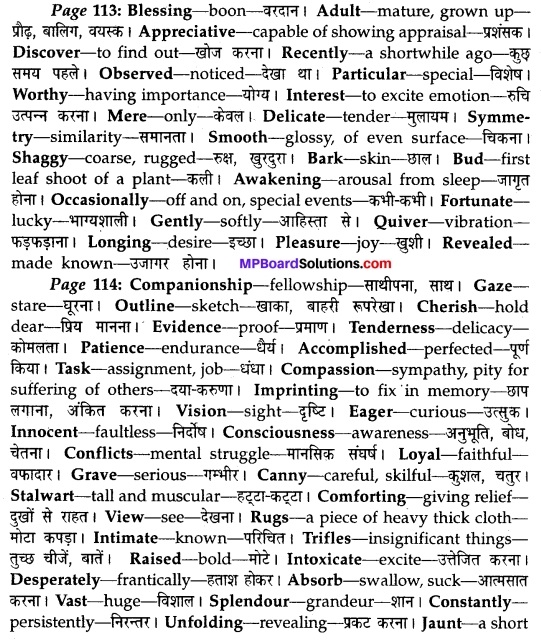
Three Days to See Word-Meanings

MP Board Class 10th English The Rainbow Solutions Chapter 13 Three Days to See 3
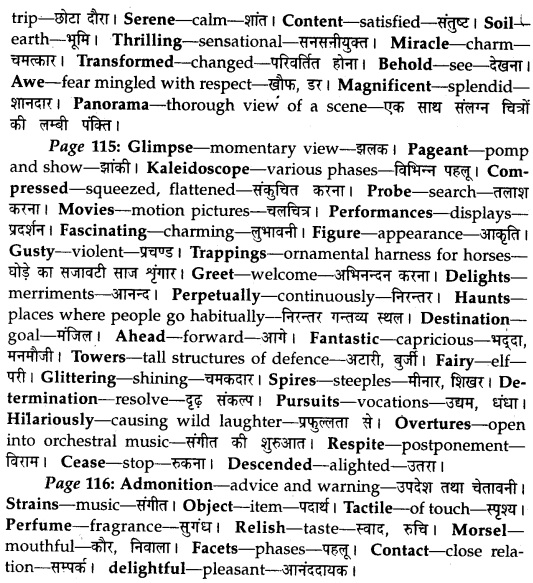
MP Board Class 10th English The Rainbow Solutions Chapter 13 Three Days to See 4

Three Days to See Some Important Pronunciations
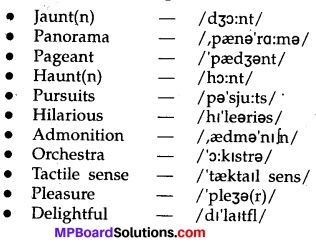
MP Board Class 10th English The Rainbow Solutions Chapter 13 Three Days to See 5

Hope that the above shaped information regarding the Madhya Pradesh Board Solutions for 10th English Chapter 13 Three Days to See Questions and Answers is useful for making your preparation effective. View our website regularly to get other subjects solutions.

MP Board Class 8th Hindi Sugam Bharti Solutions Chapter 10 अमीर खुसरो

In this article, we will share MP Board Class 8th Hindi Book Solutions Chapter 10 अमीर खुसरो Pdf, These solutions are solved subject experts from the latest edition books.

MP Board Class 8th Hindi Sugam Bharti Solutions Chapter 10 अमीर खुसरो

प्रश्न अभ्यास

Mp Board Class 8 Hindi Chapter 10 प्रश्न 1.
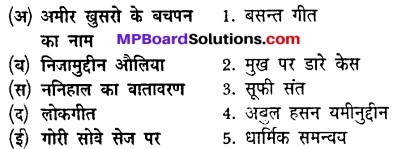
Class 8 Hindi Chapter 10 Mp Board
उत्तर
(अ) 4, (ब) 3, (स) 5, (द) 1, (ई) 2

(ख) सही विकल्प चुनकर रिक्त स्थानों की पूर्ति कीजिए

(अ) खुसरो के पिता ……………. थे। (मालदार, जागीरदार)
(ब) अमीर खुसरो पर ……………. संस्कारों का प्रभाव था। (विदेशी, भारतीय)
(स) पिता की मृत्यु के बाद खुसरो अपने … के घर आकर रहने लगे। (नाना, दादा).
(द) खुसरो ने ……………. में काव्य रचा। (मातृभाषा, लोकभाषा)
(ई) अमीर खुसरो का परिवार …………… देश से आकर भारत में बसा था। (तुर्की, पुर्तगाल)
उत्तर
(अ) खुसरो के पिता जागीरदार थे।
(ब) अमीर खुसरो पर भारतीय संस्कारों का प्रभाव था।
(स) पिता की मृत्यु के बाद खुसरो अपने नाना के घर आकर रहने लगे।
(द) खुसरो ने लोक भाषा में काव्य रचा।
(ई) अमीर खुसरो का परिवार तुर्की देश से आकर भारत में बसा था।

Class 8 Hindi Chapter 10 Mp Board प्रश्न 2.
अति लघु उत्तरीय प्रश्न

(अ)अमीर खुसरो का जन्म कब और कहाँ हुआ था?
(ब) खुसरो के गुरु कौन थे?
(स) अमीर खुसरो के मन को छूने वाले गीत कौन-से हैं?
(द) अमीर खुसरो को वैराग्य कब हुआ?
(ई) सूफी मत के अनुसार ईश्वर-प्राप्ति का क्या मार्ग है?
उत्तर
(अ) जागीरदार
(व) भारतीय
(स) नान
(द) लोकभाषा
(ई) तुर्की।

अमीर खुसरो कौन थे Class 8 MP Board प्रश्न 3.
लघु उत्तरीय प्रश्न

(अ) खुसरो की कृतियाँ हमें क्या शिक्षा देती हैं?
उत्तर
खुसरो की कृतियाँ हमें धर्म-निरपेक्षता, देश-प्रेम और इंसानी बराबरी की शिक्षा देती हैं। ते परस्पर नफ़रत नहीं, अपितु मेल-मिलाप और सच्चे हिन्दुस्तानी की तरह रहने की भी शिक्षा देती हैं।

(ब)
भारत देश की प्रशंसा अमीर खुसरो किस रूप में करते हैं?
उत्तर
भारत देश की प्रशंसा अमीर खुसरो ने माँ के रूप में करते हैं। वे भारत को अपने वतन के रूप में वर्णित करते हुए खूब प्रशंसा करते हैं।

(स)
खुसरो की रचनाओं में कौन-कौन से दर्शन समाहित हैं?
उत्तर
खुसरो की रचनाओं में वेदान्त, बौद्ध और इस्लाम दर्शन समाहित हैं।

(द)
‘मुकरी’ का उदाहरण देते हुए उसका अर्थ स्पष्ट कीजिए।
उत्तर
मकरी-‘मुकरी’ शब्द मकरना से बना है। मकरना का अर्थ है-कहकर बदल जाना या वादा करके बाद में कही गई बात से इनकार करना। मुकरी ऐसी पद्य रचना है जिसमें ‘हाँ’ कहकर ‘न’ कहा जाता है। जैसे’बह आवे तो शादी होय, उस बिन दूजा ओर न कोय। मीठे लागे बाके बोल, क्यों सखि साजन, ना सखि ढोला’ ऐसा लगता है जैसे सखि के साजन आ रहे हैं, किंतु कवि उसे साजन मानने से इनकार करता है और कहता है ‘साजन नहीं’ ढोल आ रहा है।

(ई)
खुसरो की अंतिम रचना कौन-सी थी, वह किस घटना से संबंधित थी?
उत्तर
खुसरो की अंतिम रचना थी
गोरी सोवे सेज पर, मुख पर डारे केस।
चल खुसरो घर आपने, रेन भई चहुँ देस।।
खुसरो की यह अंतिम रचना उनके गुरु के निधन
से उत्पन्न दुखद घटना से संबंधित थी।


भाषा की बात

Class 8 Hindi Chapter 10 Amir Khusro प्रश्न 1.
बोलिए और लिखिए
आत्मीय, कुशात्र, साहित्यिक, समन्वय, धर्मनिरपेक्षता, अश्रुधारा, वैराग्य।
उत्तर:
आत्मीय, कुशाग्र, साहित्यिक, समन्वय, धर्मनिरपेक्षता, अश्रुधारा, वैराग्य।

Amir Khusro Kaun The Class 8 MP Board प्रश्न 2.
नीचे दिए शब्दों की वर्तनी सुधारिएप्रसतुत, गुरू क्रपा, ननीहाल, जलवायू, अनुयाई।
उत्तर
प्रस्तुत, गुरुकृपा, ननिहाल, जलवायु, अनुयायी।

Amir Khusro Poetry In Hindi MP Board प्रश्न 3.
नीचे दिए वाक्यों में उपयुक्त विराम चिह लगाइए
(क) गांधी जी ने कहा था सदा सत्य बोलो
(ख) राम मोहन सौरभ और कमल घूमने गए
(ग) झूठ बोलना पाप की जड़ है शिक्षक ने कहा
(घ) बाजार से सब्जी ले आए इन्हें डलिया में रख दो
उत्तर
(क) गांधी जी ने कहा था, “सदा सत्य बोलो।”
(ख) राम, मोहन, सौरभ और कमल घूमने गए
(ग) “झूठ बोलना पाप की जड़ है” शिक्षक ने कहा
(घ) बाजार से सब्जी ले आए। इन्हें इलिया में रख दो।

क्लास 8 चैप्टर 10 MP Board प्रश्न 4.
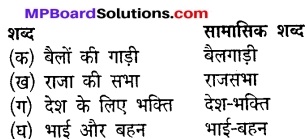
नीचे दिए विग्रह पदों के साभासिक शब्द बनाइए
उत्तर-
Mp Board Class 8 Hindi Chapter 10

Sugam Ganit Class 8 Solutions In Hindi Chapter 10 प्रश्न 5.
विलोम शब्दों की सही जोड़ी बनाइए
उत्तर-
प्रशंसा – निन्दा
रुचि – अरुचि
प्रेम – घृणा
नारी – पुरुप
प्रभावित – अप्रभावित

Mp Board Solution Class 8 Hindi Chapter 10 प्रश्न 6.
निम्नलिखित वाक्यों में शब्दों को सही क्रम में लिखिए
(क) एक जागीरदार थे पिता के खुसरो।
(ख) खुसरो ने काव्य रचा लोकभाषा में।
(ग) अंतिम रचना थी उनकी यह।
(घ) गुरु के संपर्क में आए वे यहीं।
(ङ) खुसरो भी मत अनुयायी इसी के बन गए।
उत्तर
(क) खुसरो के पिता एक जागीरदार थे।
(ख) खुसरो ने लोकभाषा में काव्य रचा।
(ग) उनकी यह अंतिम रचना थी।
(घ) वे यहीं गुरु के सम्पर्क में आए।
(ङ) खुसरो भी इसी मत के अनुयायी बन गए।

प्रमुख गद्यांशों की संदर्भ-प्रसंग सहित व्याख्याएं

1. “परमात्मा जब मुझसे पूछेगा कि तुम मेरे लिए क्या लाए हो, तो मैं खुसरो को पेश कर दूंगा।” ये उद्गार प्रसिद्ध संत हजरत निजामुद्दीन औलिया के अपने शिष्य के प्रति थे। गुरु कहा करते ये-“अगर कब्र में दो लोगों को दफन किया जाता, तो मैं चाहता कि खुसरो को मेरे साथ ही दफन किया जाए। ऐसी आत्मीय गुरुकृपा के पात्र थे अमीर खुसरो।

शब्दार्थ:
पेश-प्रस्तुत। उद्गार विचार। आत्मीय अपने लोग।

संदर्भ – प्रस्तुत पंक्तियाँ हमारी पाठ्य-पुस्तक ‘सुगम भारती’ (हिन्दी सामान्य) भाग-8′ के पाठ-10 ‘अमीर खुसरो’ से ली गई हैं।

प्रसंग – प्रस्तुत पंक्तियों में लेखक ने अमीर खुसरों की महान्ता को बतलाते हुए कहा है कि

Mp Board Class 8th Hindi Solution व्याख्या:
अमीर खुसरो के गुरु महान् और प्रसिद्ध सत हजरत निजामुद्दीन औलिया थे। वे खुसरो के प्रति अपार और एकमात्र प्रेमभाव रखते थे। इससे सस्पष्ट करने के लिए उन्होंने एक बार कहा भी था-जब वे परमात्मा के पास जायेंगे और परमात्मा उनसे पूछेगा कि वे उसके लिए क्या लायेंगे, तो वे उससे यही कहेंगे कि वे खुसरो को उसके लिए लाये हैं। गुरु संत हजरत निजामुद्दीन औलिया का प्रेमभाव और अपनापन खुसरो के प्रति एकमात्र भरा हुआ था। वे इसे सुस्पष्ट रूप से कहा करते थे-‘यों तो एक कब्र में एक ही आदमी को ही दफ़न किया जाता है। अगर एक ही जगह दो आदमियों को दफन किया जाना संभव हो तो ये चाहेंगे कि उनके साथ ही खसरो को भी दफ़न कर दिया जाए। इससे यह सिद्ध होता है कि खुसरी अपने गुरु के अनन्य एकमात्र सबसे बड़ा कृपा-पात्र थे।

विशेष:

  • खुसरो की बेजोड़ विशेषता बतलायी गयी है।
  • भाव आकर्षक है।

MP Board Class 12th English The Spectrum Solutions Chapter 3 A Father’s Letter

MP Board Solutions for 12th Textbook General English The Spectrum Solutions Chapter 3 A Father’s Letter Questions and Answers aids you to prepare all the topics in it effectively. You need not worry about the accuracy of the Madhya Pradesh Board Solutions for 12th English as they are given adhering to the latest exam pattern and syllabus guidelines.

You Can Download MP Board Class 12th English Solutions Questions and Answers Notes, Summary, Lessons: Pronunciation, Translation, Word Meanings, Textual Exercises. Enhance your subject knowledge by preparing from the Chapterwise MP Board Solutions for 12th English and clarify your doubts on the corresponding topics.

MP Board Class 12th English The Spectrum Solutions Chapter 3 A Father’s Letter (William Hazlitt)

Kick start your preparation by using our online resource MP Board Solutions for 12th English Chapter 3 A Father’s Letter Questions and Answers. You can even download the Madhya Pradesh Board Class 12th English Solutions Questions and Answers for free of cost through the direct links available on our page. Clear your queries and understand the concept behind them in a simple manner. Simply tap on the concept you wish to prepare in the chapter and go through it.

A Father’s Letter Exercises From The Text-Book

Word Power

निम्नलिखित खाली स्थानों को दिये गये Verbs से पूर्व dis-अथवा un-लगाकर भरिए–
[prove, agree, connect, veiled, load]
Answer:

  1. I almost always find that I disagree with his opinion.
  2. I am sure he is lying but it’s going to be hard to disprove his story.
  3. After a brief speech, the Queen unveiled the new statue.
  4. It took the men an hour to unload our things from the van.
  5. His phone was disconnected because he didn’t pay his last bill.

Comprehension

निम्न प्रश्नों के उत्तर दीजिए-

A Father’s Letter MP Board Class 12th English Question 1.
Why does the author choose this occasion to advise his son? [2009]
लेखक अपने पुत्र को सलाह देने के लिए यह अवसर क्यों चुनता है?
Answer:
The author chooses this occasion because his son is going to settle at school. This may be his first entrance into the world.
लेखक इस अवसर को इसलिए चुनता है क्योंकि उसका पुत्र स्कूल में जा रहा है। यह दुनिया में उसका सम्भवतः प्रथम प्रवेश है।

A Father’s Letter 12th Class MP Board Class 12th English Question 2.
What happens if we prejudge people and future events? [2009, 11, 13, 18]
क्या होता है यदि हम व्यक्तियों पर भविष्य की घटनाओं को लेकर पूर्वाग्रह से ग्रसित हो जाते हैं?
Answer:
If we prejudge people and future events, it is a bad reasoring and makes enemies of half the world. We should not think ill of them, till they behave ill of us.

यदि हम व्यक्तियों और भविष्य की घटनाओं को लेकर पूर्वाग्रह से ग्रस्त हो जाते हैं तो यह बुरी भावना है और आधी दुनिया हमारी शत्रु हो जाती है। जब तक वे हमारे साथ बुरा व्यवहार न करें, हमें भी उनके बारे में बुरा नहीं सोचना चाहिए।

A Father’s Letter Questions And Answers Question 3.
What reasons does the father give his son for the hostile behavior of his schoolmates?
स्कूल के साथियों के खराब व्यवहार के लिए पिता अपने पुत्र को क्या कारण बताता
Answer:
The father tells his son that the schoolmates are hostile because they are strangers to him. They knew as little of him as he did of them. Till now. the son was the leader among the boys. Now the other boys are his equals.

पिता पुत्र को बताता है कि स्कूल के साथी खराब व्यवहार करते हैं क्योंकि वे अजनबी हैं। वे उसे नहीं जानते और वह उन्हें नहीं जानता। अभी तक पुत्र साथियों का नेतृत्व करता था।. अब अन्य साथी उसके बराबर वाले हैं।

Lesson 3 A Father’s Letter MP Board Class 12th English Question 4.
What is the best way to disarm hostility? [2009, 11, 12, 16, 17]
शत्रुता खत्म करने का सर्वोत्तम तरीका क्या है?
Answer:
Do not think ill of others. Try to avoid the faults which you see in them. Never conceive a prejudice against others. This is the best way to disarm hostility.

दूसरों के विषय में बुरा मत सोचो। दूसरों की गलतियों से बचना सीखो। दूसरों के प्रति पूर्वाग्रह से ग्रस्त न हो। शत्रुता खत्म करने का यह सर्वोत्तम तरीका है।

Mp Board Class 12 English Book Solution Question 5.
What should we never despise anyone for?
किस बात के लिए हमें किसी से घृणा नहीं करनी चाहिए?
Answer:
We should never despise anyone for anything that he cannot help-least of all, for his poverty. In fact, we should never despise anyone at all. If we have contempt for others, it means that we are glad on the failings and misfortunes of others.

हमें कभी भी दूसरे की उस बात से घृणा नहीं करनी चाहिए जिसे वह दूर नहीं कर सकता। कम से कम उसकी गरीबी से। वास्तव में हमें किसी से घृणा नहीं करनी चाहिए। यदि हम दूसरों के प्रति घृणा भाव रखते हैं तो इसका अर्थ यह है कि हम दूसरों की असफलताओं व दुर्भाग्य पर प्रसन्न हैं।

Question 6.
What is the difference between playmates and schoolmates? [2015, 17]
खेलकूद के साथी और स्कूल के साथी में क्या अन्तर है?
Answer:
Playmates are friends who play with us. Schoolmates are friends who are with us in school.
खेल के साथी वे हैं जो हमारे साथ खेलते हैं। स्कूल के साथी वे हैं, जो हमारे साथ स्कू ल में पढ़ते हैं।

Question 7.
What is the author’s opinion on things and people we are yet to see and know?
जिन व्यक्तियों व वस्तुओं को हमें अभी देखना व जानना है, उनके विषय में लेखक की क्या राय है?
Answer:
We should never conceive prejudice against others because we know nothing of them. We should not think ill of them. We should also not anticipate evils. We should not expect things as we wish.

हमें दूसरों के प्रति पूर्वाग्रह से ग्रसित नहीं होना चाहिए क्योंकि हम उनके विषय में कुछ नहीं जानते। हमें उनके विषय में बुरा नहीं सोचना चाहिए। हमें बुराई का पूर्वानुमान नहीं करना चाहिए। हमें ऐसा नहीं सोचना चाहिये कि सब कुछ हमारे अनुसार चलेगा।

Question 8.
What, according to the author, does contempt imply?
लेखक के अनुसार नफरत का क्या अर्थ है?
Answer:
According to the author, contempt implies a triumph over and pleasure in the ill of others. It means that you are glad and congratulate yourself on others’ failings or misfortunes.

लेखक के अनुसार दूसरे के कष्ट में विजयी व आनन्दित महसूस करना नफरत है। इसका तात्पर्य यह होता है कि आप दूसरों की असफलताओं व दुर्भाग्य में प्रसन्न होते हैं।

Question 9.
What is the difference between life at home and life at school?
घर के जीवन में व स्कूल के जीवन में क्या अन्तर होता है?
Answer:
The differences are as under
अन्तर. निम्नवत् हैं-

  1. Exposure to the school is much more than it is in the house.
    घर से ज्यादा प्रदर्शन स्कूल में मिलता है।
  2. You may do as you please at home while in school you find competitors.
    आप घर में जो चाहे कर सकते हैं जबकि स्कूल में आपको बराबर के प्रतियोगी मिलते हैं।
  3. You are dependent on your parents at home while you have to take independent decisions at school.
    घर पर आप अपने माता-पिता पर निर्भर होते हैं जबकि स्कूल में आपको स्वतन्त्र निर्णय स्वयं लेने पड़ते हैं।

Question 10.
Explain ‘True quality is the only true morality or true wisdom’. [2011, 12]
“सच्चा गुण ही सच्ची नैतिकता अथवा सच्ची बुद्धिमत्ता है’ विवेचना करें।
Answer:
It means that we should believe in qualities in life. We should not be full of pride. We should remember that there are other people in the world besides ourselves. If we are able to live with values in the world, we need no lesson. Quality gives us the power to teach others directly or indirectly. Such a life becomes a model for others

इसका तात्पर्य है कि हमें जीवन में गुणों में विश्वास करना चाहिए। हमें घमण्ड नहीं करना चाहिए। हमें याद रखना चाहिये कि दुनिया में हमारे अलावा और भी लोग हैं। यदि हम जीवन-मूल्यों के साथ जीवन निर्वाह करते हैं तो हमें किसी शिक्षा की आवश्यकता नहीं है। गुण हमें प्रत्यक्ष या अप्रत्यक्ष रूप से दूसरों को शिक्षा प्रदान करना सिखाते हैं। ऐसा जीवन दूसरों के लिए उदाहरण बन जाता है।

Q. 11.
How does school life prepare a child to face the outside world?
किस प्रकार स्कूल का जीवन बच्चे को बाहर की दुनिया का सामना करने हेतु तैयार करता है? .
Answer:
School life prepares a child to face the outside world in the following ways :

  1. A child in school faces different kinds of people.
  2. A child gets used to unavoidable situations which prepare him for the life outside.
  3. A child learns to take decisions which help him for the outer world.
  4. A child faces many competitors which help him to face life.
  5. A child loses that protection in school which he enjoys in home. This prepares him to take on the world.

स्कूल का जीवन बच्चे को बाहरी दुनिया से अग्रलिखित प्रकार से सामना करना सिखाता

  1. बच्चा स्कूल में कई प्रकार के लोगों से मिलता है।
  2. बच्चे को अपरिहार्य स्थितियों का सामना करना पड़ता है जिससे वह बाहर के जीवन के लिये तैयार होता है।
  3. बच्चा निर्णय लेना सीखता है जिससे उसे बाहरी दुनिया के लिये सहायता मिलती है।
  4. बच्चे को अनेक प्रतियोगी मिलते हैं जिनसे उसे जीवन का सामना करने में मदद मिलती है।
  5. स्कूल में बच्चा उस सुरक्षा की भावना को प्राप्त नहीं कर पाता जो उसे घर में प्राप्त है।

इससे वह दुनिया का सामना करने के लिये तैयार होता है।

Language Practice

A. निम्न वाक्यों को ‘some or या ‘none of या ‘all’ से भरिए
Answer:

  1. All cars have wheels.
  2. None of this money is mine.
  3. Some of the people I work with are very friendly.

B. निम्न वाक्यों को पूर्ण कीजिए। a/an/one का प्रयोग करिए। नीचे दिये गये शब्दों का प्रयोग करिए
better, big, clean, different, new, old.
Answer:

  1. This cup is dirty. Can I have a clean one?
  2. I’m going to sell my car and buy a new one.
  3. That’s not a very good photograph but this is a better one.
  4. I want today’s newspaper. This is an old one.
  5. This box is too small. I need a big one.
  6. Why do we always go to the same restaurant? Let’s go to a different one.

C. ‘no’, ‘any’ or ‘none’ से वाक्य भरिए
Answer:

  1. There aren’t any pictures on the wall.
  2. The weather was cold but there was no wind.
  3. I wanted to buy some oranges but they didn’t have any in the shop.
  4. Everything was correct. There were no mistakes.
  5. How much luggage have you got? None.

D. every’ or all’ से वाक्य भरिए
Answer:

  1. Babita watches TV for about two hours every evening.
  2. The weather was nice yesterday, so we sat in the garden all afternoon.
  3. My sister likes cars. She buys a new one every year.
  4. Pintu gets up at 6:30 every morning.
  5. I saw Gita at the party. She wasn’t very friendly. She didn’t speak to me all evening.

E. निम्न वाक्यों को Some/AIV Most से भरिए। सम्भवतः आपको ‘of’ की आवश्यकता भी पड़ेगी-
Answer:

  1. All children like playing.
  2. Most of this money is yours.
  3. Most of the shops in the city centre close at 6:30.
  4. You can change your money in some banks.
  5. He’s lost some of his money.
  6. All birds can fly.
  7. I enjoyed most of the film but I didn’t like the ending.
  8. Some sports are very dangerous.
  9. We can’t find anywhere to stay. All the hotels are full.
  10. The weather was bad when we were on holiday. It rained all the time.

A Father’s Letter Summary

-William Hazlitt

प्रस्तुत अध्याय एक पिता द्वारा अपने पुत्र को लिखे गये पत्र के रूप में है। पिता द्वारा यह पत्र उस समय लिखा गया है जब उसका पुत्र स्कूल में प्रवेश ले रहा है। पिता ने अपने पुत्र को इस पत्र में अनेक शिक्षाप्रद बातें कहीं हैं। पत्र में सदैव आशावान रहने की सीख दी गयी है। जिन स्थितियों को आप बदल नहीं सकते, उन्हें सहन करने की सीख दी गयी है। यह भी शिक्षा दी गयी है कि कभी भी भविष्य को खराब मानकर नहीं चलना चाहिए। दूसरों के प्रति पूर्वाग्रह से ग्रसित नहीं होना चाहिए। उनमें निहित बुराइयों को दूर करने की कोशिश करनी चाहिए। कभी भी किसी की गरीबी का मजाक नहीं बनाना चाहिए। दूसरों के कष्ट में आनन्द नहीं उठाना चाहिए। हमें दुनिया से उतना सब प्राप्त करने की उम्मीद नहीं करनी चाहिए जो हमें अपने माता-पिता से प्राप्त होता है। सच्चा गुण ही सच्ची बुद्धिमत्ता है। जीवन की चुनौतियों व कष्टों का सामना करो वह भी बिना शिकायत के।

We believe the information shared regarding MP Board Solutions for 12th English Chapter 3 A Father’s Letter Questions and Answers as far as our knowledge is concerned is true and reliable. In case of any queries or suggestions do leave us your feedback and our team will guide you at the soonest possibility. Bookmark our site to avail latest updates on several state board Solutions at your fingertips.

MP Board Class 10th Sanskrit व्याकरण अशुद्धिसंशोधन-प्रकरण

MP Board Class 10th Sanskrit व्याकरण अशुद्धिसंशोधन-प्रकरण

Ashuddhi Sanshodhan In Sanskrit Class 10 MP Board १. वचन सम्बन्धी अशुद्धियाँ
अशुद्ध वाक्य – शुद्ध वाक्य
१. जीवाः प्राणेन जीवन्ति। – जीवाः प्राणैः जीवन्ति।
२. सर्वः बालिकाः गच्छिन्ति। – सर्वे बालिकाः गच्छन्ति।
३. सः पुरुषाः सन्ति। – ते पुरुषाः सन्ति।
४. तौ बालकः अस्ति। – सः बालकः अस्ति।
५. बालकः चपलः भवति। – बालकाः चपलाः भवन्ति।

२. लिङ्ग सम्बन्धी अशुद्धियाँ .
१. सः देवता अस्ति। – सा देवता अस्ति।
२. चतस्त्रः बालकाः सन्ति। – चत्वारः बालकाः सन्ति।
३. द्वे छात्रौ स्तः। – द्वौ छात्रौ स्तः।।
४. शरीरः अस्वस्थं अस्ति। – शरीरं अस्वस्थम् अस्ति।
५. सुरेशः मम मित्रः अस्ति। – सुरेशः मम मित्रम् अस्ति।

३. पुरुष सम्बन्धी अशुद्धियाँ
१. अहं फलम् खादति। – अहं फलं खादामि।
३. सः विद्यालयं गच्छसि। – सः विद्यालयं गच्छति।
३. तौ ग्रामं गच्छावः। – तौ ग्रामं गच्छतः।
४. ते पुस्तकानि पठामः। – ते पुस्तकानि पठन्ति।
५. स्र्वे द्राक्षाफलानि सर्वे द्राक्षाफलानि – खादिष्यथ। खादिष्यन्ति।

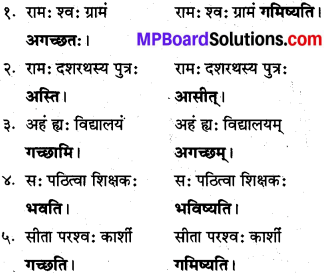
शुद्ध अशुद्ध वाक्य Pdf Sanskrit Class 9 MP Board ४. लकार सम्बन्धी अशुद्धियाँ
शुद्ध अशुद्ध वाक्य Pdf Sanskrit Class 6 MP Board

५. सामान्य अशुद्धियाँ
१. वर्तनी सम्बन्धी अशुद्धियाँ।
२. काल से सम्बन्धित अशुद्धियाँ।
३. कारक से सम्बन्धित अशुद्धियाँ।
४. उपसर्ग, प्रत्यय, विभक्ति सम्बन्धी अशुद्धियाँ।
५. वाक्य रचना सम्बन्धी अशुद्धियाँ। अशादियाँ।
६. लिंग सम्बन्धी अशुद्धियाँ।
७. वाक्य में पदों के क्रम सम्बन्धी अशुद्धियाँ।
८. कर्ता, कर्म और क्रिया के अन्वय (सम्बन्ध) सम्बन्धी अशुद्धियाँ।
९. विशेषण विशेष्य के अन्वय सम्बन्धी अशुद्धियाँ।
१०. पदों के अर्थ अवबोधन (समझना) सम्बन्धी अशुद्धियाँ।
११. तथ्य सम्बन्धी अशुद्धियाँ।
१२. अनुच्छेद के क्रम का अभाव सम्बन्धी अशुद्धियाँ।
१३. सामान्य अपवाद नियमों के विषय सम्बन्धी अशुद्धियाँ।
१४. सन्धि करने में अशुद्धियाँ।
१५. समास बनाने में अशुद्धियाँ।
१६. हलन्त, विसर्ग सम्बन्धी अशुद्धियाँ।
१७. अस्पष्ट लेखन सम्बन्धी अशुद्धियाँ।
१८. वाच्य सम्बन्धी अशुद्धियाँ।
१९. धातुओं के रूप सम्बन्धी अशुद्धियाँ।
२०. शब्द रूप सम्बन्धी अशुद्धियाँ।

वस्तुनिष्ठ प्रश्न

बहु-विकल्पीय

अशुद्धि संशोधन Class 10 संस्कृत MP Board प्रश्न १.
‘रामः गृहं गच्छन्ति’ वाक्य में अशुद्ध है-
(अ) रामः,
(ब) गृहं,
(स) गच्छन्ति,
(द) कोई नहीं।
उत्तर-
(स) गच्छन्ति,

Ashudhi Shodhan In Sanskrit Class 10 MP Board २.
“त्वं किम् करोति” में शुद्ध होगा
(अ) करोमि,
(ब) करोषि,
(स) कुर्वन्ति,
(द) कुरुतः।
उत्तर-
(ब) करोषि,

शुद्ध अशुद्ध वाक्य Pdf Sanskrit MP Board ३.
‘अहम्’ कर्ता के साथ क्रिया किस पुरुष की लगती है?
(अ) उत्तम,
(ब) मध्यम,
(स) प्रथम,
(द) अन्य।
उत्तर-
(अ) उत्तम,

शुद्ध अशुद्ध वाक्य Pdf Sanskrit Class 8 MP Board ४.
‘वर्तमान काल’ में लकार होता है
(अ) लृट्,
(ब) लोट
(स) लट्,
(द) लङ्।
उत्तर-
(स) लट्,

Sanskrit Shudh Ashudh Vakya MP Board ५.
‘सः’ में किस वचन का प्रयोग होता है?
(अ) एकवचन,
(ब) द्विवचन,
(स) बहुवचन,
(द) अनेक वचन।
उत्तर-
(अ) एकवचन,

1. रिक्त स्थान पूर्ति
१. सः अद्य ग्रामं ……………………………….।
२. रामः अयोध्यायाः नृपः ……………………………….
३. वयं श्वः देवालयं ……………………………….।
४. अहम् अधुना फलं ……………………………….।
५. कृष्णः ह्यः उद्याने ……………………………….
उत्तर-
१. गमिष्यति,
२. आसीत्,
३. गमिष्यामः,
४. खादामि,
५. अभ्रमत्।

सत्य/असत्य
१. ‘सः कार्यं करोति’, शुद्ध है।
२. ‘अहं पठति’, शुद्ध है।
३. ‘त्वं विद्यालयं गच्छति’, अशुद्ध है।
४. ‘सीता दुग्धं पिबति’, अशुद्ध है।
५. ‘मातोशिशुं पालयति’, शुद्ध है।
उत्तर-
१. सत्य,
२. असत्य,
३. सत्य,
४. असत्य,
५. सत्य।

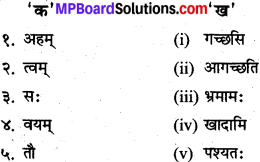
Sanskrit Shudh Ashudh Vakya Class 10 MP Board जोड़ी मिलाइए
Shudh Ashudh In Sanskrit MP Board
उत्तर-
१. → (iv)
२. → (i)
३. →(ii)
४. → (iii)
५. → (v)

MP Board Class 10th Sanskrit Solutions

MP Board Class 8th Hindi Sugam Bharti Solutions Chapter 11 आदर्श और वरदान

In this article, we will share MP Board Class 8th Hindi Book Solutions Chapter 11 आदर्श और वरदान Pdf, These solutions are solved subject experts from the latest edition books.

MP Board Class 8th Hindi Sugam Bharti Solutions Chapter 11 आदर्श और वरदान

प्रश्न अभ्यास
अनुभव विस्तार

Mp Board Class 8 Hindi Chapter 11 प्रश्न 1.
वस्तुनिष्ठ प्रश्न
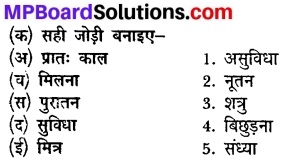
(क) सही जोड़ी बनाइए(अ) प्रातः काल
Mp Board Class 8 Hindi Chapter 11
उत्तर
(अ) 5, (ब) 4, (स) 2, (द) 1, (ई) 3

(ख) सही शब्द चुनकर रिक्त स्थानों की पूर्ति कीजिए

(अ) सुख का समय …………… व्यतीत हो जाता है। (शीघ्रता से, देर से)
(ब) छगन’ और दीनू की मित्रता भी …………… की सी मित्रता थी।. (राम-कृष्ण, कृष्ण-सुदामा)
(स) लिफाफे पर प्रेषक के स्थान पर लिखा था……। (डॉ. छगन चौधरी, दीनानाथ शमा)
(द) मेरे चिराग को तुमने ………….. से बचाया है। (जलने, बुझने)
उत्तर
(अ) शीघ्रता
(ब) कृष्ण-सुदामा
(स) डॉ. छगन चौधरी
(द) बुझने।

Class 8 Hindi Chapter 11 Mp Board प्रश्न 2.
अति लघु उत्तरीय प्रश्न
(अ) दीनू को डूबने से किसने बचाया?
(ब) नर्सिंग होम किसने खोला था?
(स) योग्यता सूची में शीर्ष स्थान पर किसका नाम या?
(द) छगन की पढ़ाई पूरी करवाने की जिम्मेदारी किसने ली?
(ई) नर्सिंग होम किस स्थान पर खोला गया था?
उत्तर-
(अ) दीनू को डूबने से छगन ने बचाया?
(ब) नर्सिंग होम छगन ने खोला था।
(स) योग्यता सूची में शीर्ष स्थान पर छगन का नाम था।
(द) छगन की पढ़ाई पूरी करवाने की जिम्मेदारी दीनानाथ शर्मा ने ली।
(ई) नर्सिंग होम रतनगढ़ में खोला गया था।

आदर्श और वरदान कहानी का सारांश लिखिए MP Board Class 8th प्रश्न 3.
लघु उत्तरीय प्रश्न

(अ)
सच्चे मन से की गई मित्रता की क्या विशेषता होती
उत्तर
सच्चे मन से की गई मित्रता टिकाऊ होती है। वह आदर्शमय होती है। वह प्रेरणादायक और वरदान के रूप में होती है। उसमें कोई स्वार्थ और भेदभाव नहीं होता है। वह एक-दूसरे के सुख-दुख की सहभागी बनकर दृढ़ होती है।

(ब)
छगन के चरित्र की कोई चार विशेषताएँ बताइए।
उत्तर
छगन के चरित्र की चार विशेषताएँ हैं

  • विनम्रता
  • मेहनती
  • आत्मीयता
  • कृतज्ञता।

(स)
दीनू और छगन एक-दूसरे को ऋणी क्यों मान रहे थे?
उत्तर
दीनू और छगन एक-दूसरे को ऋणी मान रहे थे। यह इसलिए कि वे दोनों एक-दूसरे के सहयोग को बार-बार याद कर रहे थे।

(द)
छगन की आर्थिक स्थिति कैसी थी?
उत्तर
छगन की आर्थिक स्थिति दयनीय थी। वह बकरियाँ चराता था। उसकी पढ़ाई का खर्चचलना कठिन था।

(ई)
दीनू और छगन की मित्रता की तुलना कृष्ण और सुदामा से क्यों की गई है?
उत्तर
दीनू और छगन की मित्रता की तुलना कृष्ण और सुदामा से की गई है। यह इसलिए कि उसमें निस्वार्थ था। वह निर्मल थी। उसमें अमीरी-गरीबी और ऊँच-नीच का कोई भेदभाव नहीं था। वह हृदय की गहराई और सच्चे मन से की गई थी।

भाषा की बात

आदर्श और वरदान कहानी का सारांश MP Board Class 8th प्रश्न 1.
बोलिए और लिखिएछात्रवृत्ति, निःस्वार्थ, स्तब्ध, आचरण, डॉक्टर।
उत्तर
छात्रवृत्ति, निःस्वार्थ, स्तब्ध, आचरण, डॉक्टर।

Mp Board Class 8 Chapter 11 प्रश्न 2.
निम्नलिखित शब्दों में ‘स’ ‘श’ ‘घ’ वर्णों को उचित स्थान पर रखकर अशुद्ध शब्दों को शुद्ध कीजिए
उत्तर
अशुद्ध शब्द  – शुद्ध शब्द
बरबश – बरबस
शिश्टता – शिष्टता
सीर्ष – शीर्ष
पुश्टि – पुष्टि
साशन – शासन
रासन – राशन।

Mp Board Class 8 Hindi Book Solution प्रश्न 3.
निम्नलिखित शब्दों को वर्णक्रमानुसार लिखिए
अचानक, आँखें, उन्हें, ईश्वर, आराम, आचरण, अच्छा, ऊपर, इधर, औकात, एक, उद्वेलित, ऐतिहासिक, अंगूर, अंबर।
उत्तर
अंगुर, अंबर, अच्छा, अचानक, आँखें, आचरण, शिष्टता आराम, इधर, ईश्वर, उद्वेलित, उन्हें, ऊपर, एक, ऐतिहासिक, औकात।

Mp Board Solution Class 8 Hindi प्रश्न 4.
निम्नलिखित शब्दों में से तत्सम, तद्भव, देशज और विदेशी शब्द अलग-अलग कीजिए
निमंत्रण, दरवाजा, मात्र, वृक्ष, नर्सिंग होम, स्कूल, छात्रवृत्ति, सुबक, छांह, सरपट, स्थानांतरण, तीव्र, पगडण्डी।
उत्तर-तत्सम शब्द-निमंत्रण, मात्र, वृक्ष, छात्रवृत्ति, स्थानान्तरण, तीव्र
तद्भव शब्द-छांह, दरवाजा देशज शब्द-सुबक, पगडण्डी, सरपट विदेशी शब्द-नर्सिंग होम, स्कूल।

प्रश्न 5.
‘आ’ उपसर्ग में ‘चरण’ शब्द जोड़कर बनता है-‘आचरण’। इसी प्रकार ‘आ’ उपसर्ग लगाकर पाँच शब्द बनाइए।
उत्तर
‘आ’ उपसर्ग लगाकर पाँच शब्द-आसमान, आधार, आसान, आहार, आराम।

प्रश्न 6.
रिक्त स्थान की पूर्ति कीजिए
(क) मेहनती व्यक्ति किसी भी काम में जान की …. ……. लगाने में पीछे नहीं हटते। (बाजी, होड़)
(ख) अपने पुत्र को सही सलामत देखकर माँ की आँखें …………. आईं। (भर, तर)
(ग) कृष्ण-सुदामा के मिलन की बड़ी सुखद ……….. थी। (घड़ी, जोड़ी)
(घ) शेर को सामने देख राहुल का कलेजा………. को आ गया। (मुँह, सिर)
(ङ) अतीत के पलों को याद कर आशीष के हों …………….. लगे। (फड़कने, कटने)
उत्तर
(क) बाजी
(ख) भर
(ग) घड़ी
(घ) मुँह
(ङ) फड़कने।

प्रमुख गद्यांशों की संदर्भ-प्रसंग सहित व्याख्याएँ

1. शर्माजी सरकारी दफ्तर में असफर थे। घर में सभी सुविधाएँ थीं। दीनू की सेवा में नौकर-चाकर लगे ही रहते थे। कहाँ दीनू, और कहाँ गरीब किसान का बेटा छगन! पर मित्रता ऊँच-नीच नहीं देखती है। हृदय की गहराई से एवं सच्चे मन से की गई मित्रता भी निःस्वार्थ एवं निर्मल होती है। एक-दूसरे के सुख-दुःख के सहभागी बनकर ही मित्रता के आदर्श की स्थापना की जा सकती है। छगन और दीनू की मित्रता भी कृष्ण-सुदामा की सी मित्रता थी।

शब्दार्थ:
दफ्तर-कार्यालय। ऊँच-नीच-भेदभाव । निर्मल-पवित्र । सहभागी-सहयोगी।

संदर्भ:
प्रस्तुत पंक्तियाँ हमारी पाठ्य-पुस्तक ‘सुगम भारती’ (हिन्दी सामान्य) भाग-8′ के पाठ-11 आदर्श और वरदान’ से ली गई हैं।

प्रसंग:
प्रस्तुत पंक्तियों में लेखक ने सच्ची मित्रता की विशेषता बतलाते हुए कहा है कि

व्याख्या
यों तो दीनानाथ शर्मा किसी सरकारी कार्यालय में एक अधिकारी थे। फलस्वरूप उन्हें हर प्रकार की सुविधाएँ थीं। उन्हें घर पर भी अपेक्षित साधन-सामग्री प्राप्त थी। उनकी सेवा-सत्कार के लिए किसी प्रकार की असुविधा नहीं थी। नौकर-चाकर उनके बेटे दीनू के लिए हमेशा लगे रहते थे। दूसरी ओर दीनू का दोस्त छगन बड़ा ही गरीव था। फलस्वरूप

MP Board Class 12th Biology Solutions Chapter 3 मानव जनन

MP Board Class 12th Biology Solutions Chapter 3 मानव जनन

मानव जनन NCERT प्रश्नोत्तर

प्रश्न 1.
रिक्त स्थानों की पूर्ति कीजिए

1. मानव …………… उत्पत्ति वाला है। (अलैंगिक/लैंगिक)
2. मानव ……………. हैं। (अंडप्रजक/सजीव प्रजक/अंडजरायुज)
3. मानव में ……………. निषेचन होता है। (बाह्य/आंतरिक)
4. नर एवं मादा युग्मक …………… होते हैं। (अगुणित/द्विगुणित)
5. युग्मनज ……………. होता है। (अगुणित/द्विगुणित)
6. एक परिपक्व पुटक से अंडाणु (ओवम) के मोचित होने की प्रक्रिया को ……………. कहते हैं।
7. अंडोत्सर्ग (ओव्यूलेशन) ……………. नामक हॉर्मोन द्वारा प्रेरित (इन्ड्यू स्ड) होता है।
8. नर एवं स्त्री के युग्मक के संलयन (फ्यूजन) को …………… कहते हैं।
9. निषेचन ……………. में संपन्न होता है।
10. युग्मनज विभक्त होकर ……………. की रचना करता है जो गर्भाशय में अंतर्रोपित (इंप्लांटेड) होता है।
11.भ्रूण और गर्भाशय के बीच संवहनीय सम्पर्क बनाने वाली संरचना को ……………. कहते हैं।
उत्तर

  1. लैंगिक
  2. सजीव प्रजक
  3. आंतरिक
  4. अगुणित
  5. द्विगुणित
  6. अंडोत्सर्ग
  7. LH एवं FSH
  8. निषेचन
  9. फैलोपियन नलिका
  10. भ्रूण
  11. अपरा (प्लेसैन्टा)।

प्रश्न 2.
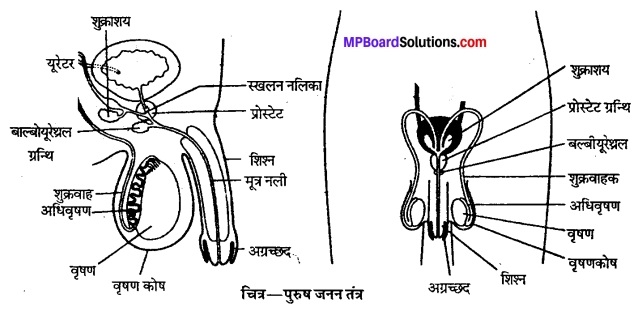
पुरुष जनन तंत्र का नामांकित आरेख बनाएँ।
उत्तर
MP Board Class 12th Biology Solutions Chapter 3 मानव जनन 1

प्रश्न 3.
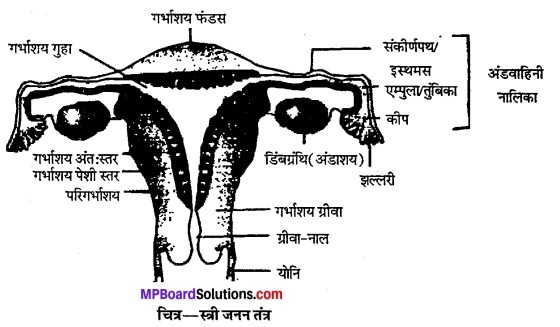
स्त्री जनन तंत्र का नामांकित आरेख बनाइए।
उत्तर
MP Board Class 12th Biology Solutions Chapter 3 मानव जनन 2

प्रश्न 4.
वृषण तथा अण्डाशय के बारे में प्रत्येक के दो-दो प्रमुख कार्यों का वर्णन कीजिए।
उत्तर-वृषण के कार्य-

  • शुक्राणुओं का निर्माण करना।
  • वृषण में स्थित अन्तराली कोशिकाओं द्वारा नर हॉर्मोन (टेस्टोस्टेरॉन) उत्पन्न करना जिसके कारण नर में द्वितीयक लैंगिक लक्षणों का विकास होता है।

अण्डाशय के कार्य-

  • अण्डाणु का निर्माण करना।
  • एस्ट्रोजन हॉर्मोन का स्त्रावण करना जो मादा में द्वितीयक लैंगिक लक्षणों के लिए उत्तरदायी है।

प्रश्न 5.
शुक्रजनक नलिका की संरचना का वर्णन कीजिए।
उत्तर
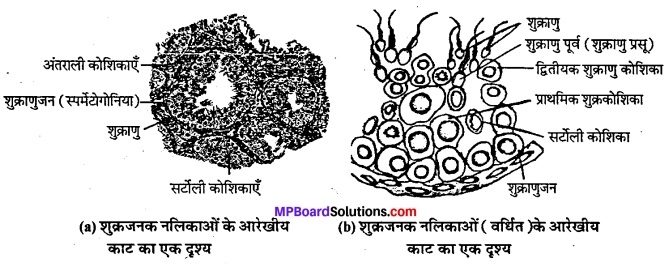
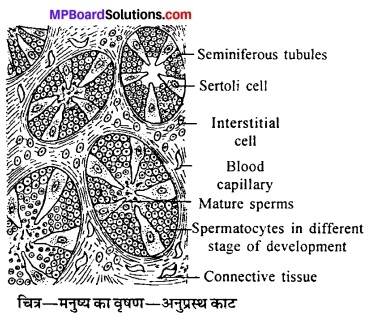
प्रत्येक वृषण पालिका के अंदर एक से लेकर तीन अतिकुंडलित शुक्रजनक नलिकाएँ (सेमिनिफेरस ट्यूबुल्स) होती है जिनमें शुक्राणु पैदा किए जाते हैं। प्रत्येक शुक्रजनक नलिका का भीतरी भाग दो प्रकार की कोशिकाओं से स्तरित होता है जिन्हें नर जर्म कोशिकाएँ (शुक्राणुजन/स्पर्मेटोगोनिया) और सर्टोली कोशिकाएँ कहते हैं । (चित्र (a) देखें)। र जर्म कोशिकाएँ अर्द्धसूत्री विभाजन (या अर्धसूत्रण) के फलस्वरूप शुक्राणुओं का निर्माण करती है जबकि सर्टोली कोशिकाएँ जर्म कोशिकाओं को पोषण प्रदान करती है। शुक्रजनक नलिकाओं के बाहरी क्षेत्र को अंतराली अवकाश (इंटरस्टीशियल स्पेस) कहा जाता है।

इसमें छोटी-छोटी रूधिर वाहिकाएँ और अंतराली कोशिकाएँ (इंटरस्टीशियल सेल्स) या लीडिंग कोशिकाएँ होती हैं (चित्र देखें)। लीडिंग कोशिकाएँ पुंजन (एंड्रोजन) नामक वृषण हॉर्मोन संश्लेषित व स्त्रावित करती हैं। यहाँ पर कुछ अन्य कोशिकाएँ भी होती हैं जो प्रतिरक्षात्मक कार्य करने में सक्षम होती हैं । वृषण की शुक्रजनक नालिकाएँ वृषण नलिकाओं के माध्यम से शुक्रवाहिकाओं में खुलती हैं। यह शुक्रवाहिका वृषण से चलकर अधिवृषण में खुलती हैं, जो प्रत्येक वृषण के पश्च सतह पर स्थित होती हैं। यह अधिवृषण शुक्रवाहक की ओर बढ़ते हुए उदर की ओर ऊपर जाती हैं और
MP Board Class 12th Biology Solutions Chapter 3 मानव जनन 3
चित्र
मूत्राशय के ऊपर की ओर लूप बनाती हैं । इसमें शुक्राशय से एक वाहिनी आती है और मूत्र मार्ग में स्खलनीय वाहिनी के रूप में खुलती है। ये नलिकाएँ वृषण से प्राप्त शुक्राणुओं का भंडारण तथा मूत्र मार्ग से इनका बाहर स्थानांतरण करती हैं।

प्रश्न 6.
शुक्राणुजनन क्या है ? संक्षेप में शुक्राणुजनन की प्रक्रिया का वर्णन कीजिए।
उत्तर

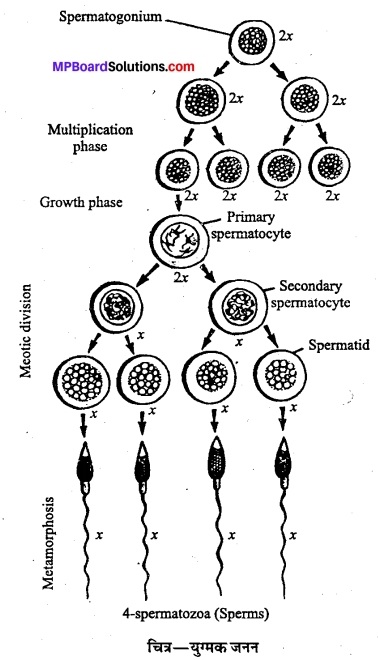
  • शुक्राणुजनन (Spermatogenesis)-
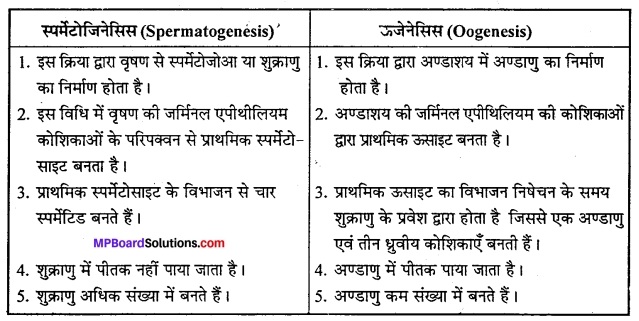
    प्रजनन अंगों में युग्मकों के निर्माण की प्रक्रिया को युग्मकजनन कहते हैं। जब युग्मकजनन की क्रिया वृषण में होती है तथा शुक्राणुओं का निर्माण होता है तब इसे
  • शुक्राणुजनन (Spermatogenesis) –
    कहते हैं। शुक्राणुओं का निर्माण जनन उपकला (Germinal Epithilium) द्वारा होता है। शुक्राणुजनन की क्रिया निम्नलिखित चरणों में पूर्ण होती है

MP Board Class 12th Biology Solutions Chapter 3 मानव जनन 4

1. द्विगुणन प्रावस्था (Multiplication Phase)-
वृषण में शुक्राणु नलिकाओं (Seminiferous tubules) की दीवार जर्मिनल एपिथीलियम से स्तरित होती है। कुछ जर्मिनल एपिथीलियम बड़े आकार की हो जाती हैं, जिसे स्पर्मेटोगोनियम (Spermatogonium) कहते हैं। जर्मिनल एपिथीलियम में समसूत्री विभाजन द्वारा स्पर्मेटोगोनियम का निर्माण होता है।

2. वृद्धि प्रावस्था (Growth Phase) –
इस प्रावस्था में स्पर्मेटोगोनियम भोज्य पदार्थ का संचय करके बड़े आकार की हो जाती है, जिसे प्राथमिक स्पर्मेटोसाइट (Primary spermatocyte) कहते हैं।

3. परिपक्वन प्रावस्था (Maturation Phase)-
इस प्रावस्था में प्राथमिक स्पर्मेटोसाइट का दो बार विभाजन होता है। प्रथम विभाजन अर्द्धसूत्री होता है, जिससे गुणसूत्र की संख्या आधी रह जाती है। इन अगुणित कोशिकाओं को द्वितीयक स्पर्मेटोसाइट (Secondary spermatocyte) कहते हैं। द्वितीयक स्पर्मेटोसाइट का दूसरा परिपक्वन विभाजन होता है, जिससे 4 कोशिकाएँ बनती हैं। इन कोशिकाओं को स्पर्मेटिड (Spermatid) कहते हैं। इन 4 स्पर्मेटिड से 4 शुक्राणुओं (Sperms) का निर्माण होता है।

प्रश्न 7.
शुक्राणुजनन की प्रक्रिया के नियमन में शामिल हॉर्मोनों के नाम बताइए।
उत्तर
शुक्राणुजनन की प्रक्रिया के नियमन में निम्न हॉर्मोन शामिल होते हैं-

  • गोनैडोट्रॉपिन रिलीजिंग हॉर्मोन
  • ल्यूटीनाइजिंग हॉर्मोन (LH)
  • फॉलिकल स्टीमुलेटिंग हॉर्मोन (FSH)
  • टेस्टोस्टेरॉन।

प्रश्न 8.
शुक्राणुजनन एवं वीर्यसेचन (स्परमियेशन) की परिभाषा लिखिए।
उत्तर

  • शुक्राणुजनन (Spermatogenesis)-
    अगुणित, अचल व शुक्राणु कोशिकाओं का चल (Motile) व प्रारुपिक शुक्राणु कोशिका में रूपान्तरण शुक्राणुजनन (Spermatogenesis) कहलाता है।
  • वीर्यसेचन (Spermiation)-
    शुक्राणुजनन के पश्चात् शुक्राणु का शीर्ष सरटोली कोशिकाओं में धंस जाते हैं तथा अंत में शुक्राणुजनन नलिका से मुक्त हो जाते हैं, यह प्रक्रिया वीर्यसेचन (Spermiation) कहलाती है।

प्रश्न 9.
शुक्राणु का नामांकित आरेख बनाइए।
अथवा
शुक्राणु की संरचना का नामांकित चित्र बनाइए एवं विभिन्न भागों का वर्णन कीजिए।
उत्तर
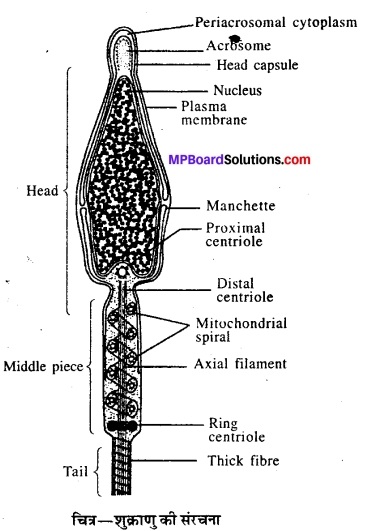
संरचना-शुक्राणु नर युग्मक है। यह अगुणित संरचना एवं नर जनन इकाई है। शुक्राणु जनन (Spermatogenesis) द्वारा शुक्राणु का निर्माण होता है।
शुक्राणु का शरीर तीन भागों में विभाजित किया जा सकता है

  1. सिर भाग (Head piece)
  2. मध्य भाग (Middle piece)
  3. पूँछ (Tail)

1. सिर भाग (Head piece)—सिर का .. आकार शंक्वाकार होता है। इस भाग पर ऐक्रोसोम पाया जाता है। यह शुक्राणु को अण्डाणु में प्रवेश के लिए सहायता करता है। इस भाग में केन्द्रक (Nucleus) एवं केन्द्रकीय पदार्थ (Nuclear mate- Middle piece Axial filament rial) पाये जाते हैं। इस भाग में समीपस्थ सेन्ट्रिओल पाया जाता है।

MP Board Class 12th Biology Solutions Chapter 3 मानव जनन 5

2. मध्य भाग (Middle piece)—इसमें अक्षीय तन्तु के आधारकाय (Basal body) पाया जाता है। अक्षीय तन्तु के चारों ओर माइटोकॉण्ड्रिया चित्र-शुक्राणु की संरचना का आवरण पाया जाता है। यह भाग शुक्राणु का ऊर्जा केन्द्र है।

3. पूँछ (Tail)—यह शुक्राणु का पिछला एवं पतला भाग है। इसमें अक्षीय तन्तु पाये जाते हैं । यह ऊर्जा की सहायता से प्रचलन कर सकता है।

प्रश्न 10.
शुक्रीय प्रद्रव्य (सेमिनल प्लाज्मा) के प्रमुख संघटक क्या है ?
उत्तर
शुक्रीय प्रद्रव्य (सेमिनल प्लाज्मा ) के प्रमुख संघटक हैं-फ्रक्टोज, कैल्सियम आयन, कुछ एन्जाइम व प्रोस्टाग्लैंडिन्स।

प्रश्न 11.
पुरुष की सहायक नलिकाओं एवं ग्रन्थियों के प्रमुख कार्य क्या हैं ?
उत्तर
पुरुष की सहायक नलिकाओं एवं ग्रन्थियों के प्रमुख कार्य निम्न हैं
1. सहायक नलिकाओं के कार्य

  • वृषण जालिका (Rete Testis)-
    शुक्रजनन नलिका से प्राप्त शुक्राणुओं को वास इफेरेन्शिया (Vas efferentia) तक पहुँचाना।
  • वास इफेरेन्शिया (Vas efferentia)-
    अधिवृषण तक शुक्राणुओं को पहुँचाना।
  • अधिवृषण (Epididymis)-
    शुक्राणुओं को अधिवृषण में संगृहीत किया जाता है । यहाँ शुक्राणुओं का परिपक्वन होता है।
  • शुक्रवाहक (Vas deference)-
    शुक्राणुओं का वहन करना तथा मूत्रमार्ग द्वारा बाहर स्थानान्तरित करना।

2. ग्रंथियों के कार्य

  • प्रोस्टेट ग्रन्थि (Prostate gland)-
    इस ग्रंथि का स्राव शुक्राणुओं को सक्रिय बनाता है एवं वीर्य को स्कंदन से रोकता है।
  • बल्बोयूरेथल ग्रन्थियाँ (Bulbourethral glands)-
    इसका स्राव मादा की योनि को चिकना कर मैथुन क्रिया को सुगम बनाता है।
  • शुक्राशय (Seminal vesicle)-
    इसका स्राव योनि मार्ग की अम्लीयता को समाप्त कर शुक्राणुओं की सुरक्षा करता है।

प्रश्न 12.
अण्डजनन क्या है ? अण्डजनन की संक्षिप्त व्याख्या कीजिए।
उत्तर
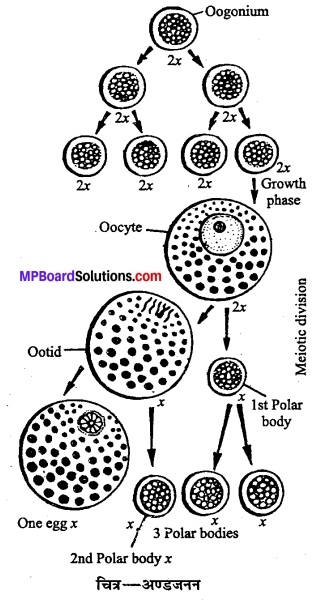
अण्डजनन-वह क्रिया है, जिसके द्वारा अण्डाशय के अन्दर अण्डाणु का निर्माण होता है। ये निम्नलिखित चरणों में पूर्ण होती हैं
MP Board Class 12th Biology Solutions Chapter 3 मानव जनन 6

  • प्रोलीफरेशन प्रावस्था-
    इस प्रावस्था में अण्डाशय के जनन स्तर की कोशिकाएँ विभाजित होकर कोशिका गुच्छ बनाती हैं, जिसे पुटिका (Follicle) कहते हैं। पुटिका की एक कोशिका बड़ी होकर ऊगोनियम बना देती है।
  • वृद्धि प्रावस्था-
    इस प्रावस्था में ऊगोनिया आकार में बढ़ जाती है, जिसे प्राथमिक ऊसाइट कहते हैं।
  • परिपक्वन प्रावस्था-
    इस प्रावस्था में प्राथमिक ऊसाइट में अर्द्धसूत्री विभाजन होता है। प्रथम अर्द्धसूत्री विभाजन असमान होता है, जिसमें से बड़ी कोशिका को द्वितीयक ऊसाइट तथा छोटी कोशिका को ध्रुवीय काय कहते हैं । द्वितीय अर्द्धसूत्री विभाजन में द्वितीयक ऊसाइट में फिर से असमान विभाजन होता है, जिसमें से बड़ी कोशिका अण्डाणु का निर्माण करती है। शेष बनी तीनों छोटी कोशिकाओं को ध्रुवीय काय कहते

प्रश्न 13.
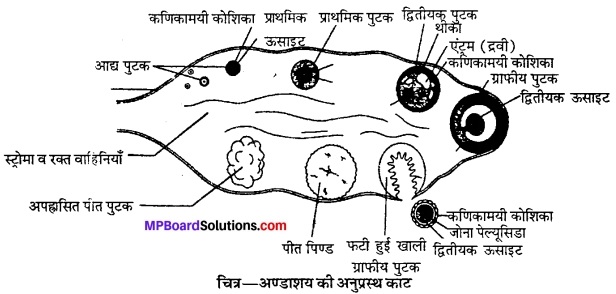
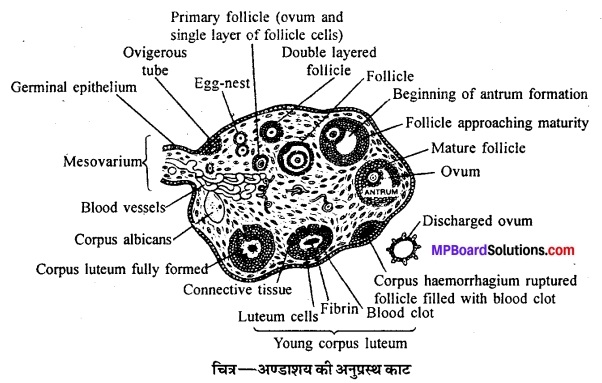
अण्डाशय की अनुप्रस्थ काट (ट्रांसवर्स सेक्शन) का एक नामांकित आरेख बनाइए।
उत्तर
MP Board Class 12th Biology Solutions Chapter 3 मानव जनन 7

प्रश्न 14.
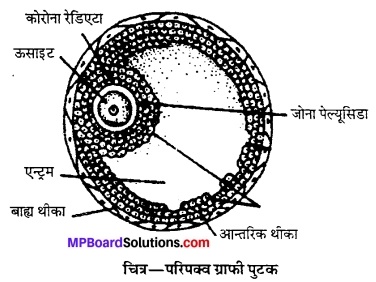
ग्राफी पुटक (ग्राफियन फॉलिकिल) का एक नामांकित आरेख बनाइए।
उत्तर
MP Board Class 12th Biology Solutions Chapter 3 मानव जनन 8

प्रश्न 15.
निम्नलिखित के कार्य बताएँ
(1) पीत पिंड (कॉर्पस ल्यूटियम)
(2) गर्भाशय अंत:स्तर (इंडोमैट्रियम)
(3) अग्रपिंडक (एक्रोसोम)
(4) शुक्राणु पुच्छ (स्पर्मटेल)
(5) झालर (फिम्ब्री)।
उत्तर
(1) पीत पिंड (कॉर्पस ल्यूटियम)-यह पीत पिंछ भारी मात्रा में प्रोजेस्ट्रॉन स्रावित करता है, जो कि गर्भाशय अंत:स्तर को बनाए रखने के लिए आवश्यक है।

(2) गर्भाशय अंतःस्तर (इंडोमैट्रियम)-गर्भाशय अंत:स्तर निषेचित अण्डाणु के अंतर्रोपण (इम्प्लांटेशन) तथा सगर्भता की अन्य घटनाओं के लिए आवश्यक है।

(3) अग्रपिंडक (एक्रोसोम)-अग्रपिंडक उन प्रक्रिण्वों (एंजाइम्स) से भरा होता है, जो अण्डाणु के निषेचन में मदद करते हैं।

(4) शुक्राणु पुच्छ (स्पर्म टेल)-शुक्राणु के मध्य खंड में असंख्य सूत्रकणिकाएँ (माइटोकॉन्ड्रिया) होती हैं, जो पूँछ को गति प्रदान करने के लिए ऊर्जा उत्पन्न करती हैं जिसके कारण शुक्राणु को निषेचन करने के लिए आवश्यक गतिशीलता प्रदान करना सुगम बनाता है।

(5) झालर (फिम्ब्री)-अण्डोत्सर्ग के दौरान अण्डाशय से उत्सर्जित अण्डाणु को संग्रह करने में ये झालर सहायक होते हैं।

प्रश्न 16.
सही या गलत को पहचानें
1. पुंजनों (एंड्रोजेन्स) का उत्पादन सर्टोली कोशिकाओं द्वारा होता है। (सही/गलत)
2. शुक्राणु को सर्टोली कोशिकाओं से पोषण प्राप्त होता है। (सही/गलत)
3. लीडिग कोशिकाएँ अण्डाशय में पाई जाती हैं। (सही/गलत)
4. लोडिग कोशिकाएँ पुंजनों (एंड्रोजेन्स) को संश्लेषित करती हैं। (सही/गलत)
5. अण्डजनन पीत पिंड (कार्पस ल्यूटियम) में सम्पन्न होता है। (सही/गलत)
6. सगर्भता के दौरान आर्तव चक्र (मेन्स्ट्रअल साइकिल) बंद होता है। (सही/गलत)
7. योनिच्छद (हाइमेन) की उपस्थिति अथवा अनुपस्थिति कौमार्य (वर्जिनिटी) या यौन अनुभव का विश्वसनीय संकेत नहीं है। (सही/गलत)
उत्तर

  1. गलत
  2. सही
  3. गलत
  4. सही
  5. गलत
  6. सही
  7. सही।

प्रश्न 17.
आर्तव चक्र क्या है ? आर्तव चक्र का नियमन कौन-से हॉर्मोन करते हैं ?
उत्तर
आर्तव चक्र (Menstruation)-प्राइमेट्स के मादाओं में पाये जाने वाले जनन चक्र को आर्तव चक्र/मासिक धर्म या रजोधर्म कहते हैं। स्त्रियों में रजचक्र/रजोधर्म/ऋतुस्राव 28/29 दिन का होता है। प्रथम रजचक्र तरुणावस्था (Puberty) में प्रारंभ होता है। इसे रजो दर्शन (Menarche) कहते हैं। आर्तव चक्र के समय स्त्रियों की योनि से महीने में एक बार रक्त स्राव होता है जो 3-5 दिनों तक जारी रहता पचास वर्ष की उम्र में यह चक्र लगभग समाप्त हो जाता है। इस अवस्था को रजोनिवृत्ति (Menopause) कहते हैं । गर्भवती महिलाओं में आर्तव चक्र रुक जाता है। आर्तव चक्र का नियमन निम्नलिखित हॉर्मोन करते हैं

  • गोनैडोट्रॉपिन
  • ऐस्ट्रोजन
  • ल्यूटीनाइजिंग हॉर्मोन
  • फॉलिकल स्टीमुलेटिंग हॉर्मोन (FSH) तथा
  • प्रोजेस्ट्रॉन।

प्रश्न 18.
प्रसव क्या है ? प्रसव को प्रेरित करने में कौन-से हॉर्मोन शामिल होते हैं ?
उत्तर
गर्भवती मादाओं के गर्भस्थ शिशु के बाहर निकलने की क्रिया को शिशु जन्म या प्रसव कहा जाता है। प्रसव एक जटिल तंत्रि-अंत:स्रावी (Neuro-endocrine) क्रियाविधि द्वारा प्रेरित होता है। प्रसव के लिए संकेत पूर्ण विकसित गर्भ एवं अपरा से उत्पन्न होते हैं, जो गर्भाशय में हल्के संकुचन को प्रेरित करते हैं। जिन्हें गर्भ उत्क्षेपन प्रतिवर्त (फीटल इंजेक्शन रिफ्लेक्स) कहते हैं । यह मातृ पीयूष ग्रंथि से ऑक्सीसीटोसीन गर्भाशय पेशी पर क्रिया करता है और इसके कारण गर्भाशय में तीव्र संकुचन प्रारंभ हो जाता है। गर्भाशय संकुचनों तथा ऑक्सीटोसीन स्राव के बीच लगातार उद्दीपक प्रतिवर्त के कारण यह संकुचन अत्यधिक तीव्र होता जाता है। इसके परिणामस्वरूप शिशु माता के गर्भाशय से जनन नाल द्वारा बाहर आ जाता है, इस प्रकार प्रसव की क्रिया सम्पन्न होती है। प्रसव क्रिया को प्रेरित करने वाले प्रमुख हॉर्मोन्स हैं

  • कार्टिसॉल
  • एस्ट्रोजन
  • ऑक्सीटोसीन।

प्रश्न 19.
“हमारे समाज में लड़कियों को जन्म देने का दोष महिलाओं को दिया जाता है।” बताइए कि यह क्यों सही नहीं है ?
उत्तर
स्त्री के गुणसूत्र का स्वरूप XX है तथा पुरुष में XY होता है । इसलिए स्त्री द्वारा उत्पादित सभी अगुणित युग्मकों में X लिंग गुणसूत्र होते हैं जबकि पुरुष युग्मकों (शुक्राणुओं)में लिंग गुणसूत्र या तो X या Y होते हैं, इसलिए 50% शुक्राणु में x लिंग गुणसूत्र होते हैं और दूसरे 50% शुक्राणु में Y लिंग गुणसूत्र होते हैं। इसलिए पुरुष एवं स्त्री युग्मकों के संलयन के पश्चात् युग्मनज में या तो XX या XY लिंग गुणसूत्र की संभावना होगी। यह इस बात पर निर्भर करेगा कि X या Y लिंग गुणसूत्र वाले शुक्राणुओं में से कौन अण्डाणु का निषेचन करता है। जिस युग्मनज में XX गुणसूत्र होंगे वह एक मादा (लड़की)के रूप में जबकि XY गुणसूत्र वाला युग्मनज नर शिशु (लड़का) के रूप में विकसित होगा। इसी कारण वैज्ञानिक रूप से यह कथन सत्य है कि एक शिशु के लिंग का निर्धारण उसके पिता द्वारा होता है। अत: लड़कियों को जन्म देने का दोष महिलाओं को देना सर्वथा अनुचित है।

प्रश्न 20.
एक माह में मानव अण्डाशय से कितने अण्डे मोचित होते हैं ? यदि माता ने समरूप जुड़वा बच्चों को जन्म दिया हो तो आप क्या सोचते हैं कि कितने अण्डे मोचित हुए होंगे? क्या आपका उत्तर बदलेगा यदि जन्मे हुए जुड़वा बच्चे, द्विअण्डज यमज हों?
उत्तर
प्रतिमाह आर्तव चक्र में अण्डाशय से एक अण्डा मोचित होता है। समरूप जुड़वा बच्चों को यदि किसी माता ने जन्म दिया हो तो दो अण्डे मोचित हुए होंगे। यदि जुड़वा बच्चे, द्विअण्डज यमज हों तो भी मेरा उत्तर नहीं बदलेगा।

प्रश्न 21.
क्या आप सोचते हैं कि कुतिया, जिसने 6 बच्चों को जन्म दिया है, के अण्डाशय के कितने अण्डे मोचित हुए थे ?
उत्तर
कुतिया जिसने 6 बच्चों को जन्म दिया है, के अण्डाशय से 6 अण्डे मोचित हुए थे।

मानव जनन अन्य महत्वपूर्ण प्रश्नोत्तर

मानव जनन वस्तुनिष्ठ प्रश्न

1. सही विकल्प चुनकर लिखिए

प्रश्न 1.
निषेचन का सम्बन्ध किससे है-

(a) जनद से युग्मक कोशिकाओं का निकलना
(b) नर युग्मक कोशिका का मादा युग्मक कोशिका पर स्थानान्तरण
(c) नर तथा मादा के जनन अंगों का जुड़ जाना
(d) नर युग्मक के केन्द्रक का मादा युग्मक के केन्द्रक से जुड़ जाना।
उत्तर
(d) नर युग्मक के केन्द्रक का मादा युग्मक के केन्द्रक से जुड़ जाना।

प्रश्न 2.
विदलन निषेचित अण्डों के विभाजन की ऐसी प्रक्रिया है जिसमें अण्डा
(a) विभाजित नहीं होता, केवल आकार में वृद्धि होती है
(b) लगातार विभाजित होता है, लेकिन आकार में वृद्धि नहीं होती है
(c) लगातार विभाजित होता है और आकार में वृद्धि होती है
(d) इनमें से कोई नहीं।
उत्तर
(b) लगातार विभाजित होता है, लेकिन आकार में वृद्धि नहीं होती है

प्रश्न 3.
भ्रूणीय झिल्लियाँ उपलब्ध कराती हैं
(a) भ्रूण की रक्षा
(b) भ्रूण का पोषण
(c) भ्रूण की रक्षा और पोषण
(d) उपर्युक्त में से कोई नहीं।
उत्तर
(c) भ्रूण की रक्षा और पोषण

प्रश्न 4.
जरावस्था (वयता) का विज्ञान कहलाता है
(a) कालक्रम विज्ञान
(b) दन्त विज्ञान
(c) स्त्री रोग विज्ञान
(d) वृद्ध रोग विज्ञान।
उत्तर
(d) वृद्ध रोग विज्ञान।

प्रश्न 5.
पुरुष की प्रोस्टेट ग्रन्थि का प्रतिरूप मादा में क्या है
(a) बर्थोलिन ग्रन्थि
(b) गर्भाशय
(c) भगशिश्न
(d) उपर्युक्त में से कोई नहीं।
उत्तर
(d) उपर्युक्त में से कोई नहीं।

प्रश्न 6.
मनुष्य होता है
(a) अण्डयुज
(b) जरायुज
(c) अण्डजरायुज
(d) उपर्युक्त में से कोई नहीं।
उत्तर
(b) जरायुज

प्रश्न 7.
मद चक्र होता है
(a) ऋतुस्राव का
(b) एस्ट्रोजन स्रावण का
(c) गर्भाधान का
(d) रजोनिवृत्ति का।
उत्तर
(a) ऋतुस्राव का

प्रश्न 8.
मानव सहित बहुत से स्तनियों में जरावस्था का कारण है
(a) वातावरण में विपरीत परिवर्तन
(b) आनुवंशिक कारकों तथा वातावरण के मध्य पारस्परिक प्रभाव
(c) कुपोषण तथा तनाव
(d) उपर्युक्त सभी।
उत्तर
(b) आनुवंशिक कारकों तथा वातावरण के मध्य पारस्परिक प्रभाव

प्रश्न 9.
मानव शरीर का कौन-सा अंग पुनर्जनन को प्रदर्शित करता है
(a) प्लीहा
(b) वृक्क
(c) मस्तिष्क
(d) यकृत।
उत्तर
(b) वृक्क

प्रश्न 10.
स्तनधारियों में निषेचन होता है
(a) अण्डवाहिनी कीप में
(b) फैलोपियन नलिका में
(c) गर्भाशय में
(d) योनि में।
उत्तर
(d) योनि में।

प्रश्न 11.
स्तनधारियों के वृषण को ढकने वाले सम्पुट का नाम है
(a) ट्यूनिका एल्बूजीनिया
(b) ट्यूनिका वैसकुलोसा
(c) ट्यूनिका वेजाइनेलिस
(d) ट्यूनिका झिल्ली।
उत्तर
(a) ट्यूनिका एल्बूजीनिया

प्रश्न 12.
सरटोली कोशिका पायी जाती है
(a) शशक के वृषण में
(b) मेढक के वृषण में
(c) स्तनधारी के वृषण में
(d) कॉकरोच केवृषण में।
उत्तर
(a) शशक के वृषण में

प्रश्न 13.
गैस्ट्रला की गुहा कहलाती है–
(a) ब्लास्टोसील
(b) सीलोम
(c) आर्केन्टेरॉन
(d) हीमोसील।
उत्तर
(c) आर्केन्टेरॉन

प्रश्न 14.
इम्प्लान्टेशन वह क्रिया है जिसमें
(a) अण्डे का निषेचन
(b) अण्डे की गति होती है
(c) अण्डे का विलोपन होता है
(d) गर्भाशय की भित्ती से ब्लास्टोसिस्ट बनता है।
उत्तर
(a) अण्डे का निषेचन

प्रश्न 15.
सेमिनिफेरस नलिकाएँ पायी जाती हैं—
(a) वृषण में
(b) अण्डाशय में
(c) वृक्क में
(d) फेफड़े में।
उत्तर
(a) वृषण में

2. सही जोड़ी बनाइए’

‘A’ – ‘B’

1. एक्रोसोम – (a) यूरेथ्रा
2. सरटोली कोशिकाएँ – (b) अण्डाशय
3. प्रोस्टेट ग्रंथि – (c) प्रोजेस्टीरॉन
4. कार्पस ल्यूटियम – (d) वृषण
5. ग्रैफियन पुटिकाएँ – (e) शुक्राणु।
उत्तर
1.(e), 2.(d), 3.(a), 4.(c), 5. (b).

‘A’ -‘B’

1. प्राथमिक जननांग – (a) रिलैक्सिन
2. अपरास्तनी अण्डे – (b) वृषण
3. पुनर्जनन – (c) अपीतकी
4. डिम्ब पुटिकाएँ – (d) यकृत
5. प्रसव – (e) अण्डाशय।
उत्तर
1.(b), 2.(c), 3.(d),4.(e), 5.(a)

3. एक शब्द में उत्तर दीजिए

1. शुक्राणु जनन के समय 24 प्राथमिक स्पर्मेटोसाइट से कितने शुक्राणु बनेंगे? .
2. स्तनियों में निषेचन कहाँ सम्पन्न होता है ?
3. अण्डजनन के दौरान एक अण्डे के बनने में कितने ध्रुवीय पिण्ड निकलते हैं ?
4. उस पदार्थ का नाम बताइए जो शुक्राणु को अण्डाणु में प्रवेश की सहायता के लिए शुक्राणुओं में बनता है।
5. डिम्ब पुटिका अण्डाशय से अण्डाणु के मुक्त होने की क्रिया का नाम बताइए।
6. 100 प्राथमिक स्पर्मेटोसाइट से कितने शुक्राणु तथा 100 प्राथमिक ऊसाइट से कितने अण्डाणु पैदा होंगे?
7. स्तनी शुक्राणु का कौन-सा भाग प्रकिण्व का स्रावण करता है, जिससे यह अण्डाणु में प्रवेश कर सके ?
8. मनुष्य की उस विकासीय अवस्था का नाम बताइए जिसमें यह गर्भाशय की दीवार में प्रत्यारोपित होता है।
9. एक अण्डाणु के निर्माण में कितने ध्रुवीय काय बनते हैं ? ।
10. शुक्राणु के द्वारा अण्डाणु के कोरोना रेडिएटा में प्रवेश करने के लिए कौन-सा प्रकिण्व स्रावित किया जाता है ?
11. किस अंग में कॉर्पस ल्यूटियम का निर्माण होता है ?
12. मानव निषेचन कहाँ होता है ?
13. मानव गर्भावस्था कितने दिनों की होती है ?
14. मनुष्य के शुक्राणु में कितने ऑटोसोम होते हैं ?
15. उस अवस्था का नाम बताइये जिसमें विकास कर रहा भ्रूण अण्डाशय की दीवार पर स्थापित होता है।
16. ग्रेफियन फॉलिकल से अण्ड के.बाहर निकलने की प्रक्रिया क्या कहलाती है ?
उत्तर

  1. 96
  2. अण्डवाहिनी,
  3. 2
  4. स्पर्मलाइसिन
  5. अण्डोप्सर्ग
  6. 400, 100
  7. सिर
  8. फीटल अवस्था,
  9. 3.
  10. स्पर्मलाइसिन
  11. अण्डाशय
  12. अण्डवाहिनी
  13. 240 दिन
  14. 22
  15. ब्लास्टुला
  16. अण्डोत्सर्ग।

मानव जनन अति लघु उत्तरीय प्रश्न

प्रश्न 1.
जायगोट से मॉरुला के बनने की क्रिया किस नाम से सूचित की जाती है ?
उत्तर
विदलन (Cleavage)।

प्रश्न 2.
प्रथम ऋतुस्राव को कहते हैं ?
उत्तर
मिनार्की (Menarche)।

प्रश्न 3.
स्पर्मेटोजेनेसिस उदाहरण है।
उत्तर
युग्मकजनन का।

प्रश्न 4.
गर्भाशय के अंदर फीटस का पोषण कौन करता है ?
उत्तर
अपरा (Placenta)।

प्रश्न 5.
गैस्ट्रला अवस्था में कितने जनन स्तर होते हैं ?
उत्तर
तीन।

प्रश्न 6.
गैस्टुला के मध्य जनन स्तर को किस नाम से सूचित किया जाता है ?
उत्तर
मीसोडर्म।

प्रश्न 7.
मानव शिशु का जन्म निषेचन के कितने दिन बाद होता है ?
उत्तर
280 दिन (9 माह 10 दिन)।

प्रश्न 8.
अपनी ही तरह के नयी पीढ़ी के जीवों को उत्पन्न करने की क्रिया कहलाती है।
उत्तर
प्रजनन।

प्रश्न 9.
दो अलग-अलग प्रभेद की कोशिकाओं के संलयन से होने वाला जनन किस नाम से सूचित किया जाता है ?
उत्तर
लैंगिक जनन।

प्रश्न 10.
यौवनारम्भ पश्चात् मनुष्य में कौन-सा युग्मकजनन जीवनपर्यन्त चलता रहता है ?
उत्तर
शुक्राणुजनन (Spermatogenesis)।

प्रश्न 11.
एक पचास वर्षीय स्त्री का रजचक्र समाप्त होना क्या कहलाता है ?
उत्तर
रजोनिवृत्ति (Menopause)

प्रश्न 12.
गर्भावस्था किसे कहते हैं ?
उत्तर
निषेचन से शिशु के जन्म (प्रसव) के बीच के समय को गर्भावस्था कहते हैं।

प्रश्न 13.
कॉर्पोरा केवरनोसा कहाँ पाया जाता है ?
उत्तर
कॉर्पोरा केवरनोसा शिश्न (Penis) में पाया जाता है।

प्रश्न 14.
हाथी, कुत्ता एवं बिल्ली का औसत गर्भकाल क्या है ?
उत्तर
हाथी 641 दिन, कुत्ता और बिल्ली 63 दिन।

प्रश्न 15.
उस हॉर्मोन का नाम लिखिए जो प्रसव के समय प्यूबिक सिम्फाइसिस का शिथिलन करता है।
उत्तर
रिलैक्सिन हॉर्मोन।

मानव जनन लघु उत्तरीय प्रश्न

प्रश्न 1.
रजोनिवृत्ति किसे कहते हैं ? समझाइये।
उत्तर
रजोनिवृत्ति–प्रत्येक स्त्री के प्रजनन काल (12-13 वर्ष की उम्र से 45-50 वर्ष की उम्र तक) में गर्भावस्था को छोड़कर प्रति 26 से 28 दिनों की अवधि पर गर्भाशय से रक्त तथा इसकी आन्तरिक दीवार की श्लेष्म का स्राव होता है। यह स्राव 3 या 4 दिन तक चलता है। इसे ऋतु स्त्राव, रजोधर्म, आर्तव या मासिक धर्म (Menses of Menstruation) कहते हैं, चूँकि यह एक निश्चित समयान्तराल पर बार-बार होता है, इस कारण इसे मासिक ऋतु स्राव चक्र (Menstruation Cycle) भी कहते हैं। स्त्रियों में 45-50 वर्ष के बाद ऋतु स्राव नहीं होता, इस अवस्था को रजोनिवृत्ति (Menopause) कहते हैं। रजोनिवृत्ति के बाद गर्भधारण की क्षमता समाप्त हो जाती है तथा स्तन भी ढीले हो जाते हैं। –

प्रश्न 2.
मनुष्य के वृषण के अनुप्रस्थ काट का केवल नामांकित चित्र बनाइए।
उत्तर
MP Board Class 12th Biology Solutions Chapter 3 मानव जनन 9

प्रश्न 3.
मादा प्रजनन तन्त्र में फैलोपियन नलिका कहाँ स्थित होती है ? इसका क्या महत्व है ?
उत्तर
मादा प्रजनन तन्त्र में फैलोपियन नलिका दो की संख्या में उदरगुहा के निचले प्रतिपृष्ठ हिस्से में अण्डाशय तथा गर्भाशय के बीच में स्थित होती है। प्रत्येक नलिका की लम्बाई लगभग 10 cm होती है। इसका एक सिरा स्वतंत्र तथा कीप के समान होता है, जबकि दूसरा सिरा गर्भाशय से जुड़ा रहता है । कोप के समान सिरा अण्डोत्सर्ग से निकले अण्डाणु को ग्रहण करके इसे अपने अन्दर की सीलिया की गति के प्रभाव से गर्भाशय में पहुँचाता है । अण्डाणु देहगुहा में स्वतंत्र होते समय पूर्णतः परिपक्व नहीं होता, अत: इसका परिपक्वन फैलोपियन नलिका में ही होता है। इन दो कार्यों के अलावा अण्डवाहिनी में ही निषेचन की क्रिया भी सम्पन्न होती है। इस प्रकार नलिका मादा प्रजनन तन्त्र का मुख्य भाग है।

प्रश्न 4.
पुरुषों में होने वाले द्वितीयक लैंगिक लक्षण लिखिए।
उत्तर

  1. आवाज भारी हो जाता है।
  2. चेहरे पर मूंछ व दाढ़ी निकल आता हैं तथा शरीर के अन्य भागों पर बाल निकल आते हैं।
  3. शरीर सुडौल और बलशाली हो जाता है।
  4. कंधे चौड़े हो जाते हैं।
  5. वृद्धि के कारण शरीर लम्बाई में बढ़ जाता है। उपरोक्त लैंगिक लक्षणों का विकास युवावस्था प्रारंभ होने का संकेत होता है । यह वृष्ण में टेस्टोस्टीरॉन बनना प्रारंभ होने के कारण होता है। यह परिवर्तन 12 वर्ष से 16 वर्ष की आयु में होता है।

मानव जनन दीर्घ उत्तरीय प्रश्न

प्रश्न 1.
स्पर्मेटोजिनेसिस और ऊजेनेसिस में अन्तर समझाइये।
उत्तर
स्पर्मेटोजिनेसिस और ऊजेनेसिस में अन्तर.
MP Board Class 12th Biology Solutions Chapter 3 मानव जनन 10

प्रश्न 2.
मनुष्य में कॉर्पस ल्यूटीयम के निर्माण तथा कार्य को समझाइए।
उत्तर
कॉर्पस ल्यूटीयम का निर्माण अण्डाशय में होता है। अण्डोत्सर्ग अर्थात् अण्डाणु के डिम्ब पुटिका तथा अण्डाशय से बाहर निकलने के बाद डिम्ब पुटिका में एक घाव बन जाता है, जिसमें रुधिर भरा रहता है। इस समय पुटिका को कॉर्पस हीमोरेजिकम (Corpus Haemorrhagicum) कहते हैं। जल्दी ही इस पुटिका की रुधिर से भरी गुहा में पुटिका कोशिकाएँ भर जाती हैं। अब इस पुटिका को कॉर्पस ल्यूटीयम (Corpus Lutium) कहते हैं।

कॉर्पस ल्यूटीयम के बनने और संरक्षण तथा अण्डोत्सर्ग (आदि पुटिका से डिम्ब पुटिका तक का बनना) का नियंत्रण पीयूष ग्रन्थि के हॉर्मोनों E.S.H. और L.H. के द्वारा होता है। यदि अण्डोत्सर्ग के बाद अण्डाणु का निषेचन हो जाता है तब तो कॉर्पस ल्यूटीयम गर्भ के सातवें महीने तक रहता है, लेकिन जब निषेचन नहीं हो पाता, तब यह विलुप्त हो जाती है। यह कॉर्पस ल्यूटीयम कुछ हॉर्मोन्स का निर्माण करता है जो गर्भधारण तथा दुग्ध निर्माण को प्रेरित करते हैं।

प्रश्न 3.
फैलोपियन नलिका की रचना एवं कार्य लिखिए।
उत्तर
स्त्री में लगभग 10-10 सेमी लम्बी दो नलिकाएँ उदर गुहा में जननांगों से संबंधित होती हैं जिनका एक सिरा स्वतंत्र तथा झालरदार होता है और अण्डाशय के पास स्थित होता है, इसे फिम्ब्री कहते हैं। इनका दूसरा सिरा गर्भाशय से जुड़ा रहता है । ये नलिकाएँ अण्डाशय से निकले अण्डाणु को फिम्ब्री द्वारा ग्रहण करके गर्भाशय में पहुँचाती हैं। अण्डाणुओं का निषेचन इन्हीं नलियों में होता है। इनकी दीवार पेशीय होती है तथा इनकी आन्तरिक सतह पर सिलिया पाये जाते हैं, जिनकी गति के कारण ही अण्डाणु फिम्बी में आता है। इन नलिकाओं को फैलोपियन नलिका या अण्डवाहिनी कहते हैं। कार्य–अण्डाणुओं को अण्डोत्सर्ग के बाद गर्भाशय में पहुँचाती हैं तथा निषेचन के लिए स्थान प्रदान करती हैं।

प्रश्न 4.
अण्डाशय की रचना लिखिए।
उत्तर
प्रत्येक स्त्री में गर्भाशय के दोनों तरफ एक-एक की संख्या में एक जोड़ी अण्डाशय मीजोवेरियम झिल्ली द्वारा सधे रहते हैं। प्रत्येक अण्डाशय के चारों तरफ एक कोशिका स्तर मोटी जनन उपकला पायी जाती है। इसके अन्दर दो भागों में विभाजित संयोजी ऊतक पाया जाता है, इसके बाहरी भाग को कॉर्टेक्स तथा भीतरी भाग को मेड्यूला कहते हैं। कॉर्टेक्स में हजारों की संख्या में विशिष्ट कोशिकाओं के समूह पाये जाते हैं, जिन्हें अण्डाशयी पुटिकाएँ कहते हैं। ये पुटिकाएँ चार विकासात्मक अवस्थाओं में होती हैं

MP Board Class 12th Biology Solutions Chapter 3 मानव जनन 11

  • आदि पुटक-इनके मध्य में एक अपेक्षाकृत बड़ी कोशिका होती है। इसको घेरे हुए अपेक्षाकृत छोटी कोशिकाएँ स्थित होती हैं।
  • प्राथमिक पुटक-ये आदि पुटकों से विकसित होते हैं।
  • वेसिकुलर पुटक-यह प्राथमिक पुटकों से बनता है। इसमें ऊसाइट के चारों तरफ कई कोशिका की मोटी स्तर पायी जाती है।

प्रश्न 5.
निषेचन की क्रिया-विधि का वर्णन एवं इसके महत्व को समझाइये।
उत्तर
निषेचन (Fertilization)—शुक्राणु (नर युग्मक) तथा अण्डाणु (मादा युग्मक) से मिलकर युग्मनज (Zygote) बनने की क्रिया को निषेचन कहते हैं। मनुष्य में अन्त:निषेचन पाया जाता है, अर्थात् इसके शुक्राणु और अण्डाणु मादा के शरीर के अन्दर मिलते हैं। जब मैथुन के अन्तिम चरण में नर अपने वीर्य को योनि में स्खलित कर देता है, तब गर्भाशय की ग्रीवा की सिरिंज अवशोषण क्रिया के कारण वीर्य गर्भाशय में चला जाता है । इस चलन में शुक्राणु की पूँछ इसकी मदद करती है। स्खलन के समय वीर्य में 20 करोड़ की संख्या में शुक्राणु होते हैं, लेकिन इनमें से अधिकांश योनि की दीवार के अम्लीय स्राव के कारण मर जाते हैं। इसके अलावा कुछ शुक्राणुओं की हानि मादा के जनन मार्ग के सँकरे और इसकी दीवार के चिपके होने के कारण होती है। शुक्राणुओं की इस बड़ी संख्या में से केवल कुछ शुक्राणु ही गर्भाशय में आते हैं और गर्भाशय में पूँछ की सहायता से 1.5 से 3 मिमी प्रति मिनट की चाल से चलते हुए अण्डवाहिनी में पहुँचते हैं यहाँ तक शुक्राणुओं की संख्या हजारों या सैकड़ों में ही रह जाती हैं ।

अण्डवाहिनी में आकर ये अण्डाणु के चारों तरफ अपने सिर के द्वारा चिपक जाते हैं। इन शुक्राणुओं में से एक शुक्राणु से सम्पर्क स्थान पर अण्डाणु की बाहरी दीवार फूलकर एक निषेचन शंकु (Fertilization cone) बना देती है। निषेचन शंकु सम्भवतः उसी शुक्राणु के साथ बनता है जो सबसे पहले अण्डाणु के सक्रिय भाग (Animal pole = अण्डाणु में एक तरफ कोशिकाद्रव्य की मात्रा अधिक होती है, इस भाग को सक्रिय ध्रुव लेकिन दूसरे अर्धांश में अपेक्षाकृत कम सान्द्र कोशिकाद्रव्य होता है, इस भाग को निष्क्रिय ध्रुव (Vegetal pole) कहते हैं) को स्पर्श करता है। एक शंकु के बनने के बाद अण्डाणु दूसरा शंकु नहीं बनाता जिससे अण्डाणु में केवल एक ही शुक्राणु प्रवेश कर सकता है ।

अण्डाणु की दीवार से चिपकने के बाद शुक्राणु का एक्रोसोम कुछ प्रकिण्वों को स्रावित करता है, जिन्हें सामूहिक रूप से स्पर्म लाइसिन (Sperm lysin) कहते हैं । इसके कारण अण्डाणु की दीवार घुलती जाती है और शुक्राणु धीरे-धीरे अण्डाणु में प्रवेश करता जाता है। ज्यों ही एक शुक्राणु अण्डाणु में प्रवेश करता है अण्डाणु में कुछ ऐसे परिवर्तन हो जाते हैं कि इसमें दूसरा शुक्राणु प्रवेश नहीं करता। शुक्राणु का पूँछ भाग अण्डाणु में प्रवेश नहीं करता, बल्कि अण्डाणु की सतह पर ही विलुप्त हो जाता है और इसका सिर अण्डाणु के केन्द्रक की तरफ आगे बढ़ जाता है। अण्डाणु के चारों तरफ की पुटिका कोशिकाएँ म्यूकोपॉलीसैकेराइड (Mucopolysaccharide) और हाइलूरोनिक अम्ल द्वारा एक-दूसरे से चिपकी रहती हैं।

इसके लिये शुक्राणु हाइलूरोनिडेज (Hyaluronidase) प्रकिण्व स्रावित करता है जो इन्हें अपघटित कर देता है। स्तनियों के शुक्राणुओं में होने वाले उन परिवर्तनों को जो निषेचन में मदद करते हैं, कैपेसिएशन कहते हैं। इस कैपेसिएशन (Capaciation) क्रिया के दौरान एक्रोसोम के चारों तरफ की झिल्ली टूट जाती है जिसके कारण एक्रोसोम द्वारा स्पर्म लाइसिन का स्राव होता है, जिसकी सहायता से अण्डाणु जोना रेडिएटा और जोना पेलुसिडा का भेदन होता है। इन दोनों के बाद अण्डाणु तथा शुक्राणु के सिर की प्लाज्मा झिल्लियाँ भी घुल जाती हैं, फलतः नर तथा मादा युग्मकों के केन्द्रक पास-पास आ जाते हैं और दोनों के कोशिकाद्रव्य मिल जाते हैं।

अब शुक्राणु का केन्द्रक अण्डाणु के केन्द्रक की ओर जाता है और दोनों मिलकर एक द्विगुणित केन्द्रक बना देते हैं इस अण्डाणु को युग्मनज कहते हैं। निषेचन की क्रिया पूर्ण होने में लगभग 2 – 2- 1/2 घण्टे का समय लगता है। अब निषेचित अण्डाणु गर्भाशय की गुहा की ओर बढ़ता है और लगभग सात दिनों में यह गर्भाशय की गुहा में पहुँच जाता है और यह यहीं पर गर्भाशय की दीवार में स्थापित हो जाता है। निषेचन के

बाद भ्रूणीय प्रावस्था प्रारम्भ होती है।
निषेचन का महत्व (Significance of Fertilization)
MP Board Class 12th Biology Solutions Chapter 3 मानव जनन 12

  • शुक्राणु के प्रवेश से ही अण्डाणु सक्रिय होता है।
  • निषेचन झिल्ली का निर्माण होता है, जिससे अन्य शुक्राणु अन्दर प्रवेश न कर सकें। मनुष्य में निषेचन झिल्ली का निर्माण नहीं होता है। .
  • निषेचन द्वारा गुणसूत्र की संख्या द्विगुणित हो जाती है।
  • यह आनुवंशिक लक्षणों को धारण करता है।
  • विभिन्न जीव जातियों में भिन्नताएँ निषेचन द्वारा होती हैं।
  • निषेचन के द्वारा अण्डे में घूर्णन होता है। .
  • अण्डाणु में सेन्ट्रिओल नहीं पाया जाता है, जिसे शुक्राणु से प्राप्त करता है एवं बार-बार विभाजित होता

प्रश्न 6.
निषेचित अण्डाणु से तीन जनन स्तरों के निर्माण को समझाइए। तीन जनन स्तरों से बनने वाले अंगों का नाम लिखिए।
उत्तर
निषेचित अण्डाणु में तीन जनन स्तर निर्माण का क्रम निम्नलिखित है

1. मॉरुला (Morula)-
निषेचित अण्डाणु फैलोपियन नलिका में पाया जाता है। निषेचन के बाद निषेचित अण्डाणु में विभाजन प्रारम्भ हो जाता है । विदलन (Cleavage) की क्रिया होलोब्लास्टिक (Holoblastic) होती है। इस क्रिया द्वारा गेंद के समान कोशिकाओं का समूह बनता है, जिसे मॉरुला (Morula) कहते हैं। 3 या 4 दिन के पश्चात् इसका रोपण गर्भाशय में होता है।

2. ब्लास्टुला (Blastula)—
जब गेंद के समान मॉरुला में ब्लास्टोसील (Blastocoel) गुहा का निर्माण हो जाता है, तब भ्रूण की इस अवस्था को ब्लास्टुला (Blastula) कहते हैं।
MP Board Class 12th Biology Solutions Chapter 3 मानव जनन 13

3. गैस्टुला अवस्था (Gastrula)-
भ्रूण की इस अवस्था में तीन जनन स्तर का निर्माण होता है। इसमें उपस्थित गुहा को आर्केण्ट्रॉन (Archenteron) एवं उपस्थित छिद्र को ब्लास्टोपोर (Blastopore) कहते हैं। इसमें तीन स्तर एक्टोडर्म, मीसोडर्म एवं एण्डोडर्म का निर्माण होता है।

तीन जनन स्तर का निर्माण (Formation of three Germinal layer)

1. एण्डोडर्म का निर्माण (Formation of Endoderm) –
एम्बियोब्लास्ट (Embryoblast) की कुछ कोशिकाएँ अलग होकर ब्लास्टोसील (Blastocoel) में आ जाती हैं। इन कोशिकाओं में तेजी से विभाजन होकर एककोशिकीय स्तर का निर्माण होता है। इस स्तर को एण्डोडर्म (Endoderm) कहते हैं। एम्बियोब्लास्ट की कोशिकाएँ जो एण्डोडर्म स्तर निर्माण में भाग नहीं लेती हैं, एक मोटे स्तर में एक बिम्ब के समान व्यवस्थित हो जाती हैं, जिसे भ्रूणीय बिम्ब (Embryonic disc) कहते हैं।

2. मीसोडर्म का निर्माण (Formation of Mesoderm)-
एण्डोडर्म के निर्माण के पश्चात् भ्रूण लम्बाई में वृद्धि करता है। इसका एक सिरा पतला एवं दूसरा सिरा मोटा हो जाता है। भ्रूणीय डिम्ब में उपस्थित कोशिकाएँ अलग होना प्रारम्भ कर देती हैं। डिम्ब डिस्क से अलग कोशिकाएँ मोटाई में वृद्धि करती हैं एवं भ्रूणीय डिम्ब सं अलग होकर मीसोडर्म स्तर का निर्माण करती हैं।

3. एक्टोडर्म का निर्माण (Formation of Ectoderm) –
भ्रूणीय डिस्क में बची हुई कोशिकाएँ विभाजित होती हैं एवं एक क्रम में व्यवस्थित होकर एक्टोडर्म का निर्माण करती हैं।
तीन जनन स्तर से बनने वाले अंग

1. एक्टोडर्म (Ectoderm) त्वचा की एपिडर्मिस, तंत्रिका तंत्र अंतरांग, ऐड्रीनल ग्रन्थि का मेड्यूलरी भाग, पीनियल काय, आँख की रेटिना, लेन्स, कॉर्निया, नेसल एपिथीलियम, मुखगुहा, मलाशय।

2. मीसोडर्म (Mesoderm) त्वचा का डर्मिस भाग, वृक्क, जनन अंग, हृदय, लसीका तंत्र, प्लीहा।
MP Board Class 12th Biology Solutions Chapter 3 मानव जनन 14

3. एण्डोडर्म (Endoderm)-आहार नाल का म्यूकोसा, आमाशय, आँत की ग्रन्थियाँ, यकृत, अग्नाशय, थायरॉइड, अग्र पीयूष, थायमस, फेफड़े, गिल, प्राथमिक जनन कोशिका।

MP Board Class 12th Biology Solutions

MP Board Class 7th Hindi Bhasha Bharti Solutions Chapter 17 और भी दूँ

MP Board Class 7th Hindi Bhasha Bharti Solutions Chapter 17 और भी दूँ

MP Board Class 7th Hindi Bhasha Bharti Chapter 17 पाठ का अभ्यास

बोध प्रश्न

कुछ और भी दूँ कविता का प्रश्न उत्तर MP Board Class 7th प्रश्न 1.
निम्नलिखित प्रश्नों के उत्तर दीजिए

(क) कवि मातृभूमि को क्या-क्या समर्पित करना चाहता है?
उत्तर
कवि मातृभूमि के लिए तन-मन-प्राण सब कुछ समर्पित करना चाहता है। वह अपने मस्तक, गीत तथा रक्त का एक-एक कण भी अपने देश की धरती के लिए अर्पित कर देना चाहता है। उसके मन में उठने वाली कल्पनाएँ तथा प्रश्न तथा सम्पूर्ण आयु (उम्र) भी मातृभूमि के लिए अर्पित करना चाहता है। सम्पूर्ण बाग-बगीचे, उनके फूल आदि मातृभूमि के लिए समर्पित हैं।

(ख) कवि अपने सर्वस्व समर्पण के बाद भी सन्तुष्ट क्यों नहीं है ?
उत्तर
कवि अपनी मातृभूमि की सेवा में सर्वस्व न्योछावर कर देना चाहता है। वह फिर भी सन्तुष्ट नहीं दिखता है। इसका कारण यह है कि वह इस सबके अतिरिक्त भी जो कुछ उसके पास है, उसे भी अर्पित कर देने की कामना करता है। कामनाएँ कभी भी शान्त नहीं हुआ करती।

(ग) कवि क्षमा-याचना क्यों कर रहा है?
उत्तर
कवि अपने गाँव, द्वार-घर-आँगन आदि सभी के प्रति अपने लगाव को छोड़कर मातृभूमि के लिए सर्वस्व प्रदान करना चाहता है। इसलिए वह इन सभी से क्षमा याचना करता है। इनकी अपेक्षा मातृभूमि के प्रति दायित्व महत्वपूर्ण है।

(घ) कविता का मुख्य सन्देश क्या है ?
उत्तर
कविता का मुख्य सन्देश है कि हम सभी अपनी मातृभूमि के लिए सर्वस्व त्यागकर उसकी सेवा करें। मोहरहित होकर तन-मन-प्राण से मातृभूमि की रक्षा के लिए तैयार रहें।

समर्पण पाठ कक्षा 7 MP Board प्रश्न 2.
निम्नलिखित भाव कविता की जिन पंक्तियों से प्रकट होते हैं, उन पंक्तियों को लिखिए
(क) मोहमाया के बन्धन को तोड़ना।
(ख) सम्पूर्ण आयु को समर्पण करना।
(ग) बलिदान के लिए तत्परता।
उत्तर
(क) तोड़ता हूँ मोह का बन्धन।
(ख) आयु का क्षण-क्षण समर्पित।
(ग) मन समर्पित, तन समर्पित, और यह जीवन समर्पित। चाहता हूँ देश की धरती, तुझे कुछ और भी हूँ।

चाहता हूँ कविता का भावार्थ Class 7 MP Board प्रश्न 3.
निम्नलिखित प्रश्नों के उत्तर सही विकल्प चुनकर दीजिए

(क) प्रस्तुत कविता का मुख्य भाव क्या है?
(1) मातृभूमि के प्रति आदर।
(2) मातृभूमि के लिए सर्वस्व समर्पण की चाह।
(3) मातृभूमि की महानता का गुणगान।
(4) मातृभूमि से क्षमा याचना।
उत्तर
(2) मातृभूमि के लिए सर्वस्व समर्पण की चाह।

(ख) कवि अपने जीवन, घर-परिवार और गाँव से क्षमा याचना करता है, क्योंकि वह
(1) इनके प्रति दायित्व निर्वाह नहीं करना चाहता।
(2) इनकी अपेक्षा देश के प्रति दायित्व निर्वाह को महत्वपूर्ण मानता है।
(3) इनके प्रति दायित्व निभाने में स्वयं को असमर्थ पाता है।
(4) इनसे छुटकारा पाना चाहता है।
उत्तर
(2) इनकी अपेक्षा देश के प्रति दायित्व निर्वाह को महत्त्वपूर्ण मानता है।

भाषा अध्ययन

चाहता हूं कविता का प्रश्न उत्तर MP Board Class 7th प्रश्न 1.
निम्नलिखित शब्दों के शुद्ध उच्चारण कीजिए
ऋण, स्वीकार, माँज, बाँध, शीश, आशीष, तृण।
उत्तर
उल्लिखित शब्दों को बार-बार पढ़िए और विशेष सावधानी से शुद्ध रूप में उच्चारण कीजिए। कठिनता के लिए अपने आचार्य महोदय की सहायता ले सकते हो।

Class 7 Hindi कुछ और भी दूँ Chhattisgarh State Board Solutions प्रश्न 2.
निम्नलिखित शब्दों का शुद्ध उच्चारण एवं लेखन कीजिए
कुछ और भी दूँ कविता का प्रश्न उत्तर MP Board Class 7th
उत्तर
छात्र/छात्राएँ स्वयं करें।

Aur Bhi Du Hindi Poem Question Answer MP Board Class 7th प्रश्न 3.
निम्नलिखित शब्दों का वाक्यों में प्रयोग कीजिए- .
समर्पित, आँगन, ध्वज, आशीष।
उत्तर

  1. मैं अपनी मातृभूमि के लिए सर्वस्व समर्पित करता हूँ।
  2. मेरे आँगन में फलदार पेड़ों के झुरमुट खड़े हैं।
  3. अपने हाथ में राष्ट्रीय ध्वज लिए हुए वीर सैनिक मातृभूमि की रक्षा के लिए आगे बढ़ रहे हैं।
  4. माँ का आशीष सदैव फलदायक होता है।

Man Samarpit Tan Samarpit Question Answer MP Board Class 7th प्रश्न 4.
इस कविता से अनुप्रास अलंकार वाली पंक्तियाँ छाँटकर लिखिए।
उत्तर

  1. मन समर्पित, तन समर्पित।
  2. गान अर्पित, प्राण अर्पित, रक्त का कण-कण समर्पित।
  3. शीश पर आशीष की छाया घनेरी।
  4. रक्त का कण-कण समर्पित।
  5. आयु का क्षण-क्षण समर्पित।
  6. नीड़ का तृण-तृण समर्पित।

प्रश्न 5.
रिक्त स्थानों की पूर्ति कीजिए
(क) माँ तुम्हारा ……..
(ख) ……………. फिर भी निवेदन
(ग) थाल में लाऊँ ……….
(घ) कर दया ………वह समर्पण।
उत्तर
(क) ऋण बहुत है, मैं अकिंचन,
(ख) किन्तु इतना कर रहा
(ग) सजाकर भाल जब भी
(घ) स्वीकार लेना।

प्रश्न 6.
नीचे लिखे शब्दों के पर्यायवाची दी गई वर्ग पहेली से छाँटकर लिखिए
फूल, पृथ्वी, माथा, खून, गृह।
वर्ग पहेली
समर्पण पाठ कक्षा 7 MP Board
उत्तर
फूल-प्रसून, पुष्प, सुमन । पृथ्वी-वसुधा, धारिणी, धरा, धरती। माथा-मस्तक, भाल, कपाल। खून-रक्त, रुधिर, लहू। गृह-घर, आवास, वास।

और भी दूँ सम्पूर्ण पद्यांशों की व्याख्या

1. मन समर्पित, तन समर्पित,
और यह जीवन समर्पित।
चाहता हूँ देश की धरती,
तुझे कुछ और भी हूँ।

शब्दार्थ-समर्पित = अर्पित किया हुआ, सौंपा हुआ; तन = शरीर; जीवन = प्राण या जिन्दगी।

सन्दर्भ-प्रस्तुत पंक्तियाँ “और भी ढूँ”, नामक कविता से अवतरित हैं। इसके रचयिता ‘रामावतार त्यागी’ हैं।

प्रसंग-कवि अपने प्रिय देश के लिए अपना सर्वस्व त्याग देने को तैयार है।

व्याख्या-कवि कहता है कि हे मेरे देश की धरती! तेरी सेवा के लिए मैं स्वयं तन-मन तथा अपने प्राण (सम्पूर्ण जिन्दगी) अर्पित करता हूँ। इस सब के अलावा दूसरी वस्तुएँ भी यदि मेरे पास है, तो उन्हें भी तेरे लिए अर्पित करने (त्यागने) के लिए तैयार हूँ।

2. माँ तुम्हारा ऋण बहुत है, मैं अकिञ्चन,
किन्तु इतना कर रहा, फिर भी निवेदन।
थाल में लाऊँ सजाकर भाल जब भी,
कर दया स्वीकार लेना वह समर्पण।

गान अर्पित, प्राण अर्पित,
रक्त का कण-कण समर्पित।
चाहता हूँ देश की धरती,
तुझे कुछ और भी हूँ।

शब्दार्थ-अकिञ्चन = दीन; भाल = मस्तक; समर्पण = अर्पित की हुई वस्तु; अर्पित = न्योछावर किया हुआ।

सन्दर्भ-पूर्व की तरह।

प्रसंग-कवि के अनुसार देशभक्त सर्वस्व अर्पित करने के बाद जो भी दूसरी वस्तु यदि उसके पास है तो वह उसे भी देश की सेवा में अर्पित कर देने को तैयार है।

व्याख्या-हे मातृभूमि, मुझ पर तेरे ऋण (कर्ज) का बोझ बहुत है। मैं दीन हूँ (उस कर्ज के बोझ को मैं किस तरह उठा सकूँगा)। फिर भी मैं यह निवेदन कर रहा हूँ कि जब भी अपने इस मस्तक को थाल में सजाकर लेकर आऊँ, तो मेरे इस समर्पण को (सेवा में दी गई इस वस्तु को) स्वीकार करने की कृपा करना। भक्ति भरा मेरा गीत भी तुम्हें अर्पित है, मेरे प्राण भी अर्पित हैं। साथ ही मेरे रक्त की (खून की) एक-एक बूंद भी तुम्हारे लिए अर्पित है। इस प्रकार हे मेरे देश की धरती ! मैं इसके अलावा भी कुछ और अर्पित करना चाहता हूँ।

3. माँज दो तलवार को, लाओ न देरी,
बाँध दो कसकर, कमर पर ढाल मेरी,
भाल पर मल दो, चरण की धूल थोड़ी,
शीश पर आशीष की छाया घनेरी,

स्वप्न अर्पित, प्रश्न अर्पित,
आयु का क्षण-क्षण समर्पित।
चाहता हूँ देश की धरती,
तुझे कुछ और भी हूँ।

शब्दार्थ-भाल = मस्तक; मल दो = लगा दो; आशीष = आशीर्वाद; घनेरी- घनी; स्वप्न- कल्पनाएँ, विचार; आयु = उम्र ; चरण = पैर।

मन्दर्भ-पूर्व की तरह।

प्रसंग-कवि अपनी मातृभूमि के आशीर्वाद को प्राप्त करके अपनी उम्र के प्रत्येक क्षण को देश की सेवा में अर्पित करना चाहता है।

व्याख्या-हे मातृभूमि-मेरी माँ! बिना किसी देर किए हुए तुम मुझे तलवार (युद्ध के लिए) दे दो। उसको और ढाल को-दोनों ही कसकर कमर में बाँध दो। साथ ही, मेरे मस्तक पर अपने चरणों (पैरों) की थोड़ी-सी धूल लगा दो तथा मेरे सिर पर अपने आशीर्वाद की घनी छाया कर दो (आशीर्वाद दीजिए)। मेरी कल्पनाएँ तथा मेरे प्रश्न सभी तेरी सेवा में अर्पित हैं। यहाँ तक कि मेरी उम्र का प्रत्येक क्षण भी तुम्हारी सेवा में अर्पित है। इस तरह, हे मेरे देश की धरती, मैं तुझे कुछ अन्य भी अर्पित कर देना चाहता हूँ।

4. तोड़ता हूँ मोह का बन्धन, क्षमा दो,
गाँव मेरे, द्वार घर-आँगन क्षमा दो;
आज सीधे हाथ में तलवार दे दो।
और बाएँ हाथ में ध्वज को थमा दो।

ये सुमन लो, यह चमन लो,
नीड़ का तृण-तृण समर्पित,
चाहता हूँ देश की धरती,
तुझे कुछ और भी हूँ।

शब्दार्थ-ध्वज पताका, झण्डा; थमा दो = पकड़ा दो सुमन = फूल; चमन = बगीचा; नीड़ = घोंसला; मोह = प्रेम।

सन्दर्भ-पूर्व की तरह।

प्रसंग- कवि अपने देश की सेवा के लिए सम्पूर्ण बन्धनों को समाप्त करके सब कुछ देश की सेवा में अर्पित कर देना चाहता है।

व्याख्या-हे मेरे देश ! तेरे लिए मैं मोह के (प्रेम के) जितने भी बन्धन है, उन सबको तोड़ देना चाहता हूँ। उसके लिए हे मेरे गाँव, तू मुझे क्षमा करना। मेरे घर-आँगन तथा द्वार, तुम सभी मुझे क्षमा करना। आज (अब समय आ गया है तब) तुम सभी मेरे सीधे हाथ में तलवार पकड़ा दो। इस तरह, हे मेरे देश ! ये सभी फूल, तथा बगीचा तथा मेरे घोंसले का तिनका-तिनका भी तेरी सेवा में अर्पित करता हूँ। इस प्रकार, मेरे पास जो भी अन्य वस्तु (यदि मेरे पास है) तो वह भी मैं, हे मेरे देश की धरती ! तेरी सेवा में अर्पित करता हूँ।

और भी दूँ शब्दकोश

समर्पित = त्यागा हुआ, अर्पित किया हुआ निवेदन = प्रार्थना; माँज = धोकर साफ कर दो, युद्ध के लिए; मोह = प्रेम; ध्वज – पताका, झण्डा; ऋण = कर्ज; भाल = मस्तक, माथा;आशीष = आशीर्वाद; सुमन = फूल, पुष्प; नीड़ = घोसा; अकिंचन = दीन; शीश = सिर; घनेरी-घनी; चमन – बगीचा; तृण = तिनका।

MP Board Class 7th Hindi Solutions

MP Board Class 8th Hindi Sugam Bharti Solutions Chapter 3 अहिंसा की विजय

In this article, we will share MP Board Class 8 Hindi Book Solutions Chapter 3 अहिंसा की विजय Pdf, These solutions are solved subject experts from the latest edition books.

MP Board Class 8th Hindi Sugam Bharti Solutions Chapter 3 अहिंसा की विजय

प्रश्न-अभ्यास

अनुभव विस्तार

Mp Board Class 8 Hindi Chapter 3 प्रश्न 1.
वस्तुनिष्ठ प्रश्न
(क) सही जोड़ी बनाइए
(अ) मगध की राजधानी – 1. श्रावस्ती
(ब) कोसल की राजधानी – 2. राजगृह
(स) महात्मा बुद्ध का शिष्य – 3. अंगुलिमाल
(द) डाकू का नाम – 4. प्रसेनजित
उत्तर-
(अ) 2,
(ब) 5,
(स) 4,
(द) 3

(ख) दिए गए विकल्पों से सही शब्द चुनकर रिक्त स्थानों की पूरि कीजिए।
(अ) महात्मा बुद्ध ने ……………… को धीरज बँधाया। (राजा, प्रजा)
(ब) अंगुलिमाल ……………. डाकू था। (सीधा-सादा, भयंकर)
(स) महात्मा बुद्ध ने अँगुलिमाल डाकू से ………………. कहा। (प्रेमपूर्वक, शान्तिपूर्वक)
उत्तर-
(अ) राजा,
(ब) भयंकर,
(स) प्रेमपूर्वक।

Class 8 Hindi Chapter 3 Ahinsa Ki Vijay MP Board प्रश्न 2.
अति लघु उत्तरीय प्रश्न
(अ) राजा प्रसेनजित क्यों चिंतित थे?
(ब) महात्मा बुद्ध ने डाकू को कैसे पहचाना?
(स) ‘ठहर जा’ किसने किससे कहा था?
(द) महात्मा बुद्ध के चेहरे पर सदैव मुस्कान क्यों रहती थी?
उत्तर-
(अ) राजा प्रसेनजित डाकू अँगुलिमाल के अत्याचार से चिंतित थे।
(ब) महात्मा बुद्ध ने डाकू को उसके भयंकर रूप से पहचाना।
(स) ‘ठहरा जा’ डाकू अँगुलिमाल ने महात्मा बुद्ध से कहा था।
(द) महात्मा बुद्ध के चेहरे पर सदैव मुस्कान अपने ज्ञान से रहती थी।

Class 8 Hindi Chapter 3 Mp Board प्रश्न 3.
लघु उत्तरीय प्रश्न
(अ) डाकू का नाम अंगुलिमाल क्यों पड़ा?
उत्तर-
(अ) अंगुलिमाल ने हजार आदमियों की हत्या करने की प्रतिज्ञा कर रखी थी। परंतु वह कितने आदमी मार चुका, इसका हिसाब रखना उसके लिए कठिन काम था। इसके लिए उसने एक युक्ति निकाली। वह जब भी किसी का वध करता तो उसकी एक अँगुली काट लेता। इस प्रकार उसके पास अँगुलियों की एक माला-सी बनती जा रही थी जिसे वह गले में डाले रहता। इसी कारण उसका नाम ‘अँगुलिमाल’ पड़ गया था।

(ब) पहरेदार के रोकने पर भी महात्मा बुद्ध जंगल में क्यों प्रवेश कर गए?
उत्तर-
(ब) पहरेदार के रोकने पर भी महत्मा बुद्ध जंगल में प्रवेश कर गए। यह इसलिए कि

  • उनका हृदय संसार के कष्टों को देखकर दुखी था।
  • उन्हें आत्मज्ञान हो गया। फलस्वरूप उन्हें किसी की चिंता नहीं थी और न उन्हें कोई डर ही था।

(स) महात्मा बुद्ध जंगल में जाते समय क्या विचार कर रहे थे?
उत्तर-
(स) महात्मा बुद्ध जंगल में जाते समय विचार कर रहे थे

“आदमी आदमी को क्यों मारता है? जीव, जीव को देखकर प्रसन्न क्यों नहीं होता?

(द) अँगुलिमाल का हृदय-परिवर्तन कैसे हुआ?
उत्तर-
(द) महात्मा बुद्ध ने अँगुलिमाल को शान्ति, दया और प्रेम का उपदेश दिया। इससे उसकी आँखें खुल गईं। उसके मन का अंधकार दूर हो गया। उसने अँगुलियों की माला तोड़ दी और कटार फेंक दी। उसने हिंसा का जीवन हमेशा के लिए छोड़ दिया। इस तरह उसका हृदय-परिवर्तन हुआ और वह महात्मा बुद्ध का शिष्य बन गया।

भाषा की बात

अहिंसा की विजय सारांश MP Board Class 8th प्रश्न 1.
बोलिए और लिखिएप्रतिभा, त्रस्त, त्राहि-त्राहि, युक्ति, निशस्त्र।
उत्तर-
प्रतिभा, त्रस्त, त्राहि-त्राहि, युक्ति, निशस्त्र।

अहिंसा की विजय कहानी का सारांश MP Board Class 8th प्रश्न 2.
सही वर्तनी पर गोला लगाइए
(अ) परसेनजित, प्रसेनजित, प्रसेनजत।
(ब) वर्तमान, वरतमान, वतर्मान।
उत्तर-
(अ) प्रसेनजित,
(स) वर्तमान।

Mp Board Class 8 Hindi Book Solution प्रश्न 3.
निम्नलिखित शब्दों का वाक्यों में प्रयोग कीजिएधीरज, सावधान, चीख-पुकार, चिंता, दृष्टि, प्रेमपूर्वक
उत्तर-
वाक्य-प्रयोग
शब्द – वाक्य
धीर- हमें विपत्ति में धीरज रखना चाहिए।
सावधान – सावधान होकर पढ़ो।
चीख-पुकार – दुर्घटना में चीख-पुकार होती है।
चिंता – महँगाई ने गरीबों की चिंता बढ़ा दी।
दृष्टि – हमें दया की दृष्टि रखनी चाहिए।
प्रेमपूर्वक – प्रेमपूर्वक रहने में ही आनंद है।

Ahinsa Ki Vijay Kahani Ka Saransh MP Board प्रश्न 4.
विपरीतार्थी शब्दों की जोड़ी बनाइए-
जन्म – दुखी
सुखी – अशांति
हिंसा – कठिन
सरल – मरण
शांति – अहिंसा
उत्तर-
विपरीतार्थी शब्दों की जोड़ी
जन्म – मरण
सुखी – दुखी
हिंसा – अहिंसा
सरल – कठिन
शांति – अशांति

Mp Board Class 8th Hindi Solution Chapter 3 प्रश्न 5.
समानार्थी शब्द पर गोला लगाइए
(1) पेड़ – वृक्ष, पानी, आग, जंगल
(2) राह – राजा, तरू, रास्ता, हवा
(3) आँख – सागर, नदी, नभ, नेत्र।
उत्तर-
समानार्थी शब्द
(1) पेड़ – वृक्ष
(2) राह – रास्ता
(3) आँख – नेत्र।

Ahinsa Ki Vijay Ka Saransh MP Board Class 8th प्रश्न 6.
निम्नलिखित पंक्तियों को ध्यान से पढ़िए और संज्ञा, विशेषण और क्रिया छाँटकर तालिका में लिखिए-
महात्मा बुद्ध रुक गए। तुरंत ही घनी झाड़ियाँ चीरती हुई एक विकराल मूर्ति आ खड़ी हुई। ऊँचा कद, काला शरीर, भयानक चेहरा, लाल आँखें, बिखरे बाल, बड़ी-बड़ी मूंछे, लंबी मजबूत भुजाएँ चौड़ा सीना, हाथ में कटार।
उत्तर-
Class 8 Hindi Sugam Bharti MP Board

प्रमुख गद्यांशों की संदर्भ-प्रसंग सहित व्याख्याएँ

1. ‘आदमी आदमी को मारता क्यों है? जीव, जीव को देखकर प्रसन्न क्यों नहीं होता?’ इन्हीं बातों पर विचार करते हुए महात्मा बुद्ध जंगल की राह बढ़े जा रहे थे कि अचानक उन्हें कोई कठोर और भारी आवाज़ सुनाई दी, ‘ठहर जा।’

शब्दार्थ-जीव-प्राणी। राह-रास्ता।

संदर्भ-प्रस्तुत पंक्तियाँ हमारी पाठ्य-पुस्तक ‘सुगम भारती’ (हिंदी सामान्य) भाग-8 के पाठ-3 ‘अहिंसा की विजय’ से ली गई है। इसके लेखक श्री भगवतशरण उपाध्याय हैं।

प्रसंग-प्रस्तुत पंक्तियों में लेखक ने हिंसा के प्रति महात्मा बुद्ध के विचारों पर प्रकाश डालते हुए कहा है कि

व्याख्या-महात्मा बुद्ध को अँगुलिमाल डाकू के अत्याचारों को सुनकर के बड़ी चिंता हुई। वे बार-बार यह सोचने लगे कि एक आदमी दूसरे से मिलकर रहने की बजाय उसे क्यों कष्ट पहुँचाता है। वह उसे क्यों मारता है? एक प्राणी को दूसरे प्राणी को देखकर प्रसन्न होना चाहिए। लेकिन ऐसा नहीं होता है, क्यों? इस तरह सोचते-विचारते हुए महात्मा बुद्ध अँगुलिमाल डाकू की ओर जंगल में आगे बढ़ रहे थे। उसी समय उन्हें एक भयंकर और भारी आवाज में रोकते हुए कहा, “ठहर जाओ। अब और आगे न बढ़ो।”

  • सांसारिक कष्टों को बड़े ही सटीक रूप में व्यक्त किया गया है।
  • भाषा-शैली आकर्षक है।

2. महात्मा बुद्ध ने उस पर अपनी दृष्टि डाली। उनकी नज़र में भय न था, प्यार था। उन्होंने प्रेमपूर्वक उस भयानक डाकू से कहा- “मैं तो ठहर गया, भला तू कब ठहरेगा?”

शब्दार्थ-दृष्टि-नज़र। भय-डर।

संदर्भ-पूर्ववत्।

प्रसंग-इन पंक्तियों में लेखक ने महात्मा बुद्ध की दया-दृष्टि पर प्रकाश डालते हुए कहा है कि
व्याख्या-जब अंगुलिमाल डाकू ने महात्मा बुद्ध को अपनी भयंकर और कठोर आवाज़ में रोकते हुए कहा, तब उन्होंने उसे बुरा नहीं माना। उन्होंने तो उसे अपनी दया दृष्टि से ही देखा। दूसरी बात यह कि वे उससे तनिक भी नहीं डरे। इस प्रकार उन्होंने उसे बड़े प्यार से यह प्रश्न किया, “अब तो मैं ठहर गया हूँ, लेकिन अब तुम मुझे यह बतलाओ कि तुम कब ठहरोगे?”

विशेष-

  • यह अंश प्रेरक है।
  • वाक्य प्रभावशाली है।

MP Board Class 12th English A Voyage Solutions Chapter 5 Our Casuarina Tree

MP Board Solutions for 12th English Chapter 5 Our Casuarina Tree Questions and Answers aids you to prepare all the topics in it effectively. You need not worry about the accuracy of the Madhya Pradesh Board Solutions for 12th English as they are given adhering to the latest exam pattern and syllabus guidelines.

You Can Download MP Board Class 12th English Solutions Questions and Answers Notes, Summary, Lessons: Pronunciation, Translation, Word Meanings, Textual Exercises. Enhance your subject knowledge by preparing from the Chapterwise MP Board Solutions for 12th English and clarify your doubts on the corresponding topics.

MP Board Class 12th English A Voyage Solutions Chapter 5 Our Casuarina Tree

Kick start your preparation by using our online resource MP Board Solutions for 12th English Chapter 5 Our Casuarina Tree Questions and Answers. You can even download the Madhya Pradesh Board Class 12th English Solutions Questions and Answers for free of cost through the direct links available on our page. Clear your queries and understand the concept behind them in a simple manner. Simply tap on the concept you wish to prepare in the chapter and go through it.

Our Casuarina Tree Textbook Exercises

Word Power

A. In the poem the word ‘lay’ is used in the sense of a ‘short narrative poem’. It is used in other contexts as verb and as noun. Given below are some words which in the poem are used in the sense given against them. Find their other uses:
rest — feel soothed
spring — grow
hail — welcome, greet
break on — strike, touch
trunk — body of a tree
consecrate — sanctify
Answer:

  • The other uses of the given words are as follows:
  • Rest — remaining substance
  • Hail — a shower of frozen rain
  • Trunk — a big box
  • Spring — a season
  • Break on — to interrupt
  • Consecrate — dedicate to the service of God.

B. Find the words for the following expressions in the poem:

1. Highest point of a tree, mountain, etc.
2. Associated with the place and circumstances of one’s place of birth.
3. A state of fainting or sub-consciousness.
4. Related to long and highest tradition in history.
5. A song or poem expressing grief over something sad.
6. A song sung at the burial of a dead person.
7. Time when it is growing dark.
8. A bodily state of hypnotism or magic-spell.
Answer:

  1. summit
  2. native clime
  3. slumbered
  4. classic
  5. eerie speech
  6. dirge
  7. darkling
  8. trance.

C. Match the words in column A with their meanings in column B.

‘A’ – ‘B’

(i) gallant – (a) top of a slope or hill
(ii) clusters – (b) splendour
(iii) casement – (c) young ones of animals and human beings
(iv) crest – (d) rounded pebbles on sea-shore
(v) offspring – (e) state of being quite forgotten
(vi) enmassed – (f) congealed
(vii) magnificence – (g) brave
(viii) shingle – (h) window
(ix) sublime – (i) shake involuntarily for fear or cold.
(X) tremble – (j) of the highest kind
(xi) oblivion – (k) bunches
Answer
(i) (g), (ii) (k),(iii) (h), (iv) (a),(v) (c),(vi) (f), (vii) (b),(viii) (d),(ix) (j),(x) (i),(xi) (e).

Comprehension

A. in the poem, there occur words or phrases that have a contextual meaning, other than their literal meaning. Far example the term ‘Oblivion s curse’ which in the present context means: ‘All things in the world are cursed to be forgotten with the passage of time, hut the memory of something may be eternalized in the works of art, like poetry sculpture, architecture, painting and music. Given below are some phrases from the poem. Explain in what sense they occur here:

Our Casuarina Tree Questions Answers MP Board Class 12th English Question 1.
The giant wears the scarf.
Answer:
The huge tree keeps up its glory and dignity.

Our Casuarina Tree Poem Questions Answers MP Board Class 12th English Question 2.
The water-lilies spring, link snow enmassed.
Answer:
The white coloured tiny lily flowers appear Like congealed snow.

Our Casuarina Tree Class 12 MP Board Class 12th English Question 3.
Dirge-like murmur.
Answer:
It signifies that the tree shares sad moments of the poetess and mourn along with her.

Our Casuarina Tree Summary In Hindi MP Board Class 12th Question 4.
sea breaking on a shingle beach.
Answer:
It signifies that the tree is also in deep grief over the sad demise of the poet’s brother.

Our Casuarina Tree Question And Answer MP Board Class 12th English Question 5.
earth lay tranced in adreamless swoon.
Answer:
The earth is in a state of magic spell quite unaffected by the dreams of human beings.

12th English Our Casuarina Tree Paragraph Question 6.
numbered with deathless trees.
Answer:
The poetess wishes for the long life of the tree.

B. Answer the following questions in 60 words each:

Our Casuarina Tree MP Board Class 12th English Question 1.
How is the creeper climbing up the tree?
Answer:
The poetess describes the trees in a very realistic manner. The creeper is compared with a python winding round and round, On its rugged trunk, there are deep sears up to the summit.

Our Casuarina Tree In Hindi MP Board Class 12th English Question 2.
How does the giant-tree wear the scarf?
Answer:
The giant-tree is standing in the house garden of the poetess. It stands like a giant. It grows very high up in the sky Its branches appear to be like scarfs at the top sitting in a gallant way. With its scarfs the poet means to say that it keeps up its dignity and high position because no other tree is as high as this one.

Question 3.
What does the poetess see when she opens her window in winter-morn?
Answer:
The tree gives delight to the poetess in many ways. When she opens her window in the winter she finds a gray baboon sitting like a statue over the crest of the tree. It watches the sunrise. On its lower boughs the little creatures leap and play while the cuckoos sing a welcome note for the day. The day becomes joyous for her.

Question 4.
Who exhales a dirge-like murmur and for what reason?
Answer:
The poetess personifies the big tree. She says that the tree was very much attached with the happenings in her family. When the poetess loses her brother and sister, she feels the tree is in a long mournful dirge-like murmur. The tree seems to share her sorrow.

Question 5.
Explain ‘Unknown, yet well known to the eye of faith’ with reference to the poem. (M.P. Board 2012)
Answer:
Here the poetess says that it is quite unreal to see a tree mourning or weeping. No one has ever seen it crying or wailing, but she says that it is still well-known fact for one’s faith. If one can believe, one can feel it to be real.

Question 6.
How does the poetess propose to sanctify her association with the tree and why?
Answer:
The poetess proposes to sanctify her association with the tree by composing songs in its honour. She wants to write sacred verses for it. The tree has become a very important part of her life. She feels herself closely associated and attached with the tree for it has been beloved to her brother and sister who are no more.

Question 7.
How does the poetess bless the tree?
Ans.
The poetess feels sad when she thinks that the tree would die one day. It would be a great loss for her and also for a number of other creatures who were comforted under its shrfde. So, she makes a wish for its long life. She wishes that her verses may change the destiny of the tree, though she knows that it is a faint hope. No one can change the cycle of nature, still she hopes for the long life of the tree. She wants that tree’s memory should never fade.

C. Answer the following questions in about 75 words each:

Question 1.
How does the poetess compare the creeper to a huge python? What characteristic of the tree has been highlighted by it?
Answer:
‘Our Casuarina Tree’ is a fine specimen of an ode in which the poetess highlights a tree and her emotional attachment with it. Humanising the tree, the poetess bestows all sorts of magnificence and grandeur to the tree. She compares it with a python-a big species of snake known for its huge size and dazzling spotted body. She says that the tree bears all similarities of the python. A creeper grows around its trunk, making deep scars over it and goes to its summit. It seems to be embracing the sky.

Question 2.
What does the poetess see when she opens her casement at dawn?
Answer:
The poetess describes the tree very minutely. The tree is magnificent and gives comfort to a lot of living beings. The poetess whenever in the dawn opens her casement, she feels great delight to see the tree cool and restive. During winter, she usually finds a gray baboon sitting like a statue alone at the top of the tree. It watches the sunrise with great concentration. In the lower boughs, she finds little creatures leaping and playing while far and near the songs of the cuckoos make a welcome note for the rising day.

Question 3.
For what reasons is the Casuarina tree dear to the poetess? (M.P. Board 2011)
Answer:
The Casuarina tree is dear to the poetess for many reasons. The first is its magnificence. It is tall and grand to look at. It is dazzling like a python. Its generosity is unique. It gives something to all-shade, cool breeze, and repose. One feels relaxed here.

The other reason that makes the tree dear to her is that the poetess has spent all her childhood under its shade. She has played there with her brother and sister who are no more alive. So, the tree is an integral part of her life for creating memories of her life. The tree reminds her of the happy time spent by her with her siblings.

Question 4.
How intense and heart-felt is the tree’s mourning for Abju and Aru?
Answer:
The poetess has humanised the tree. She makes lamentation and it mourns the death of her brother and sister. The tree shares her lamentation with its dirge-like murmur which the poetess seems to hear. She also feels the tree waiting like sea breaking on a shingle- beach. Though such an outburst is quite unnatural but the poetess wants to highlight the human features of the tree which seem to be so connected with the human affection.

Question 5.
The last stanza expresses the affection and kinship of the poetess with the tree. How does she express it?
Answer:
She is emotional in this stanza. The tree has great significance for the poetess. She says that it is more than her life itself. So, she bears all her high feeling of love, respect and importance. She dignifies it in all the possible ways, for it possesses many of her childhood memories. She used to play under its shade with her brother and sister who are no more alive. She, in the last stanza, reveals all her love and affection for the tree through her wishes for the long life of the tree. She wishes to immortalise the tree through her verses in which she would pen down her emotion.

Question 6.
What according to the poetess are the great curses of mortal existence?
Answer:
Our Casuarina Tree is a poem which blends all aspects of human life. The poet has humanised the existence of the tree. She has made the tree feel the pains and sufferings also. Through the tree the poetess reveals the realities of human life. Human life feels delights but also suffers pains. ‘Human Curses’ can include fear, hope, death and time are the curses of a mortal existence. No one can escape them. Everyone who is born has to undergo many testing times and situations. Everyone is destined to die and perish. So, no one can be happy for the rest of his life. Any moment can bring pain. We must be ready to meet all these curses.

Question 7.
The theme of the poem is a sense of awe, respect, affection and personal affinity towards the Casuarina tree for the reason that beneath it she had played with her brother and sister who are no more in the world?’ Explain the theme of the poem in the light of the statement.
Answer:
The theme of the poem ‘Our Casuarina Tree’ is an exposition of the poetess’s love, respect, affection, and personal affinity towards the tree. The reason behind it is that she has spent her childhood around the tree. She has played there with her brother and sister who are no more. She has grown under the tree. Many memories are attached with the tree. She has seen the tree sharing all the family situation. The tree is made to feel the loss of the brother and sister of the poetess. The poetess highlights the tree’s role in her life. She immortalises the tree through her verses. She also wishes for its long life and protection from oblivion’s curse.

Question 8.
Bring out the similes occurring in the poem. Explain them.
Answer:
Our Casuarina Tree is- an ode. It abounds in the use of similies. The tree has been humanised. The poetess uses a number of live similes in the poem, some of them are given here:

  • Like a huge python—highlights the hugeness and grandeur of the tree.
  • Like snow enmassed—white lily flowers look like congealed snow.
  • Like the sea breaking—the tree’s vastness and gravity compared with that of the sea.

Question 9.
How has the Casuarina tree been personified in the poem? (M.P. Board 2016)
Answer:
‘Our Casuarina Tree’ is a poem written to express the feeling of the poetess. It is not
merely the description of a tree but it is a tribute to the tree. The poetess presonifies the tree. She bestows all human feelings to the tree. The generous attitude of the tree is great. The tree comforts all. It also shares the joys and sorrows of the human beings. The poetess feels the tree shedding tears and lamenting at the death of her brother and sister. The tree is also destined to die like human being. Thus, it has been personified. It is not – unaffected from human curses as well.
Or
‘The poem is an Ode in form and elegy in spirit and tone.’ Explain with illustrations. Ans. ‘Our Casuarina Tree’ is a poem which highlights the tree’s contribution in the life of the poetess. It is an effort of the poetess to immortalise the tree through her verses. The tree is an inevitable part of her life. So, she is all respectful and highly dedicated to the tree which is more than her life. On the other hand, the poetess also remembers her brother and sister who died at a very early age. Here the poetess laments their death and also makes the tree feel and mourn it. She also talks about death, which is sure to come. Thus, this poem is an ode in form but an elegy in spirit.

D. Explain the following and add critical notes where necessary:

Question 1.
Like a huge python, winding round and round
The rugged trunk, indented deep with sears,
Up to its very summit near the stars,
A treeper climbs.
Answer:
The given lines describes the big and mighty casuarina tree. This oak-like tree grew in the garden of the poetess. She mentions the might and grandeur of the tree. The ‘rugged trunk’ and ‘deep sears’ shows the life of the tree. The tree shares all the good childhood memories of the poetess. The creeper winding its trunk shows how easily the tree has accepted the creeper. The poetess through her mention ‘summit near the stars’ shows how worthy the tree is to her. The tree has reached the position of stars not only in height but also in worth.

Question 2.
O sweet companions, loved with love intense,
For your sakes shall the tree be ever dear,
Blent with your images, it shall arise
In memory, till the hot tears blind mine eyes!
Answer:
In these lines, the poetess mentions the other great causes of why the tree is so close to her heart. She remembers her siblings, who are no more. She dedicate her love to the tree as the tree reminds her of happy bygone days that she spent with her brother and sister. The tree not only reminds her of her play-mates but also becomes the part of poetess in paying homage to them.

Question 3.
What is that dirge-like murmur that I hear
Like the sea breaking on a shingle-beach?
It is the tree’s lament, an eerie speech .
That haply to the unknown land may reach.
Answer:
This stanza humanises the tree and the poetess takes the tree one step further in becoming the part of her family. The stanza focuses on the sorrow that has been fallen ort the poetess due to the death of her siblings, the tree itself jeels the sorrow and laments with a ‘dirge-like murmur’. The poetess makes the tree the medium to express her sadness for the departed souls in the unknown land. The tree .being the intricate part of the household shares the same emotions as that of poetess.

Speaking Activity

The poem ‘Our Casuarina Tree has an eleven line stanza form in imitation of the one used by John , Keats in ‘To Autumn’. Look at Keats’ ode in the textbook and discuss in groups:

Question 1.
How is the stanza form similar?
Answer:
Our Casuarina Tree of Toru Dutt and Ode to Autumn by John Keats have 11 line stanzas with a slight difference.

Question 2.
How does the rhyming scheme of the poem differ from Keats’ Ode? Present your views in class after discussion.
Answer:
The rhyme scheme of both the poems differs a bit. In ‘Our Casuarina Tree’ and Ode to Autumn’ the rhyme scheme is abba while it is abab in Keats’s.

Writing Activity

In his short narrative poem, ‘Nutting’, Wordsworth records an experience of his childish act of disturbing the quiet life of a young tree by ‘dragging to earth both branch and bough’. When he turned round he felt a sense of pain’, when he beheld the mute tree. In this mood of thoughtful agony, he advises his sister, Dorothy:
”Then, dearest Maiden, move along these shades
In gentleness of heart; with gentle hand
Touch-for there is a spirit in the woods”.
You also must have had an experience to realize that there is a life and spirit in the words.

Convey your impressions in a letter to your younger brother on the following points:

  • Trees as best friends and companions to man.
  • Trees share our pains and joys and give comfort.
  • Aged trees look like our teachers and guides.
  • We can learn charity and benevolence from trees.
  • You have felt the presence of a Supreme Power in and around trees.
  • How can we be intimate with them?
  • Our duty towards them—to be kind, compassionate, respectful and affectionate as we are to our kith and kin.

Answer:
K-265
Laxmibai Enclave Gwalior
My Dear Anu
Today is ‘Environment Day’. I would like to draw your attention to some of my feelings. You know trees are our best friends. They have emotions too. They protect us from many dangers. They help us in many ways. They support our life. They keep air cool.

They save us from flood. They help our land in growing more crops. We learn many lessons of our life from trees. Trees are the most generous creations of God. They give us shade, fruits, flowers, medicines, leaves, wood, and many more that are of great value for us. They do not take anything in return from us.  I feel we, also have some duties towards them. We must protect them. We must plant more and more trees. We must be active to make efforts for their safety. I hope you will understand my feelings and will also do your best for saving the trees.
Yours
Ravikatit.

B. Discuss and analyze the poem ‘Our Casuarina Tree’ among your classmates and record conclusions in notes-form on the following points:

Question 1.
Whether the poem is an ode or an elegy or a blend of both? How?
Answer:
The poem is an ode with a touch of elegiac note. The poetess has a very high opinion about the tree. She describes it with all her noble feelings. She bestows all honour and dignity to the tree. The stanza form is regular with a rhyme scheme abba. But the humanization of the tree which laments and share sorrow gives elegy tone.

Question 2.
What human feelings are depicted in the poem?
Answer:
A feeling of close association with someone very near and dear has been depicted in the poem and forms the central idea.

Question 3.
How has the poetess humanised the Casuarina tree?
Answer:
The poetess humanises the Casuarina tree by showing it in mourning. When the poetess lost her brother and sister, when they were quite at their early age, the poetess says that she heard dirge-like mourning from the tree.

Question 4.
Pictorial quality.
Answer:
The poem abounds in charming pictorial quality which beautifies the poem. In the very first stanza, the image of python and the growth of creeper attract one to its beauty. The scene in winter also delights us. In each stanza, we have such images which heighten the quality of poem which adds more emotion to the poem.

Question 5.
How does the poetess blend imagery from eastern and western contexts? Take the help of the information given below:

OdeElegy
An ode is an address to some noble thoughts or ideas or abstraction or deity. It is lyrical and dignified in form and exalted in thought. The stanza form is, generally, regular. Langauge and style are refined.An elegy is a song of mourning on the death of some relative, friend or benefactor. There is in it scope for philosophical speculations on death and immortality. Dominant emotion is grief.

Answer:
The poetess blends the imagery from eastern and western context beautifully. The tree gives delight in both the contexts. While describing the Casuarina tree, the poetess has in her mind the banyan tree which grew in her house garden in Bengal.

Think It Over

After the study of the poem ‘Our Casuarina Tree’ the following points emerge for our consideration:

  • Trees have life. They have birth, growth and death as we have.
  • They have sensations and feelings. They also have pain and pleasures as we have.
  • They are our friends. They laugh, weep and sympathise with us. They give us shelter, fresh
  • Air, dry wood, food, oil and medicines. They bring rain and increase the lertility of our fields.
  • Since ages, they have been a source of aesthetic and spiritual joy to men, and so have been adored as dwellings of gods. The relation between trees and men is reciprocal. Now think over your duties towards trees’ and share your views with your classmates.

Answer:
As trees are an integral part of our life, we have a lot in our store to do for them, We should plant more and more trees. We should protect them from cutting for commercial purposes. We should explore new avenues for the growth of trees.

Things to Do

Indo-Anglian literature (popularly known as Indian Writing in English) is the name given to the literature composed in English by Indian writers. The first Indian writers in English were Kashi Prasad Ghose (1809-1873) and Michael Madhusudan Dutta (1827-1873). Since then hundreds of writers have contributed to the enrichment of this branch of literature. Given below are some well-known men of letters, who wrote in English and received universal recognition. Their important prose or poetic works are also given against them.

1. Toru Dutt — A Sheaf Gleaned in French Fields
2. Rabindranath Tagore – Gitanjali, for which he was awarded Nobel Prize for Literature in 1913
3. Sri Aurobindo – The Life Divine
4. Sarojini Naidu –

  • The Golden Threshold
  • The Bird of Time
  • The Broken Wing (all collections of poems)

5. Mahatma Gandhi – The Story of My Experiments with Truth
6. Jawaharlal Nehru – The Discovery of India
7. Mulk Raj Anand – Untouchable (novel), Coolie (novel)
8. R.K. Narayan –

  • Swami and Friends
  • The Guide
  • Malgudi Days

9. Anita Desai — Voices in the City
10. Khushwant Singh — Train to Pakistan
11. Nirad C. Chaudhan — APassagetoEngland
12. Nissim Ezekiel — A Time to Change
13. Sarvapalli Radhakrishnan — Indian Philosophy

Read some of these works to enrich your vision.
Answer:
Do yourself.

Our Casuarina Tree by Toru Dutt Introduction

The poem is anode with a touch of elegiac node. The process humanises the Casuarine tress. She very high opinion for the tree. She describes it with all her noble feelings. She stows all honour and digity to the tree.

Our Casuarina Tree Summary in English

This poem is a description of a Casuarina tree. Here, Casuarina tree is used for a big banyan tree which grew in the house garden of the poet. The creeper grew like a huge python winding round and round the tree. The tree grew very high. No other tree could grow near it. The birds and bees overflew around it with their sweet songs. Men used to repose under its shade. The poet was also delighted to rest here.

It looked very attractive during winter. The cuckoos used to hail the day from its boughs. It was very beautiful and vast. Its magnificence laid in the fact that the poet had several memories of her childhood under the tree. The memory of her dear one is also attached with it. It recalled the death of her brother and sister who died prematurely. The tree had shared all her mourning.

The tree has a classical value. At all times, one feels a trance like situation to her. The poet has hopour and love for the tree and it is for her dearer than life. She feels sad at the thought that the tree may perish one day. She wishes if she could save it. But no one can do it because it is a natural process and the tree will meet its end one day. Nothing is immortal-neither men nor trees. But still the poetess wishes that the tree will overcome all the curse of natural life and be always protected because of poetess’ love. The tree will remain alive in her poem.

Our Casuarina Tree Summary in Hindi

यह कविता एक कैसूरिना पेड़ का वर्णन है। यहाँ कैसूरिना वृक्ष एक विशाल बरगद के बारे में कहा गया है जो कवयित्री के घरेलू बगीचे में उग आया था। इसके साथ लगा हुआ आरोही पौधा एक विशाल अजगर की तरह गोल-गोल घूमते हुए बढ़ा। यह पेड़ काफी बड़ा हो गया। दूसरा कोई पेड़ इसके आसपास नहीं उग सका । पक्षी एवं मधुमक्खियाँ इसके ऊपर मंडराते थे और अपने मधुर गीत गाते थे। लोग इसके नीचे छाया में आराम करते थे। कवयित्री भी यहाँ आराम करके आनन्द महसूस करती थी।

यह जाड़े के दिनों में काफ़ी आकर्षक लगता था। कोयल इसके झुरमुट से दिन का स्वागत करती। यह काफ़ी सुन्दर और विशाल था। इसका सौन्दर्य इस तथ्य में भी था कि कवयित्री के बचपन की बहुत-सी यादें इसके साथ जुड़ी थीं। उसके प्रिय की याद भी इसके साथ जुड़ी थी। यह उसके भाई और बहन के असामयिक मृत्यु की ओर इशारा करती है। पेड़ ने भी उनके दुखों को भोगा था।

इसका पौराणिक महत्त्व भी है। हर बार लोग यहाँ योगमुद्रा को महसूस करते हैं। कवयित्री इसके प्रति इज्ज़त और प्यार की भावना रखती है और यह उसके लिए जीवन से भी अधिक प्रिय है। उसे इस सोच से दुख होता है कि एक दिन यह पेड़ समाप्त हो जाएगा। वह कामना करती है कि वह इसे बचा सके। लेकिन कोई भी इसे बचा नहीं सकता क्योंकि यह एक प्राकृतिक प्रक्रिया है और पेड़ का एक दिन अन्त होना ही है। कुछ भी अमर नहीं है-न मनुष्य न पेड़। परन्तु कवयित्री यह कामना करती है कि यह पेड़ हर तरह के शाप से बचा रहेगा और कवयित्री के असीमित प्यार से और उसकी कविता में हमेशा के लिए अमर हो जाएगा।

Our Casuarina Tree Word Meanings

MP Board Class 12th English A Voyage Solutions Chapter 5 Our Casuarina Tree img 1

Our Casuarina Tree Important Pronunciations

MP Board Class 12th English A Voyage Solutions Chapter 5 Our Casuarina Tree img 2

Our Casuarina Tree Stanzas for Comprehension

Read the following stanzas carefully and answer the questions that follow them:

1. But gallantly
The giant wears the scarf and flowers are hung
In crimson clusters all the boughs among.
Whereon all day are gathered bird and bee;
And oft at nights the garden over flows
With one sweet song that seems to have no close,
Sung darkling from our tree, while men repose. (Page 30)

Questions:

(i) Who does the ‘giant’ refer to?
(ii) In ………….. are gathered birds and bee.
(iii) What overflows the garden in nights?
(iv) Find a word which means the same as ‘collected’.
Answers:
(i) Casuarina tree is referred as the ‘giant’.
(ii) Crimson clusters.
(iii) The sweet songs of the birds and bees overflow the garden at nights.
(iv) Gathered means the same as collected.

2. But not because of its magnificence
Dear is the Casuarina to my soul;
Beneath it we have played; though years may roll,
O sweet companions, loved with love intense.
For your sakes, shall the tree be ever dear.
Blent with your images, it shall arise
In memory, till the hot tears blind mine eyes! (Page 31)

Questions:
(i) Why is the Casuarina tree dear to the poetess?
(ii) What did the poetess do under the tree?
(iii) Which memory is attached with the tree?
(iv) Find a word similar in meaning to ‘friends’.
Answers:
(i) Casuarina tree is very dear to the poetess because it is magnificent and is attached
with her childhood memories.
(ii) She played with her brother and sister under the tree.
(iii) The memory of her lost brother and sister is attached with the tree.
(iv) ‘Companions’ is similar in meaning to ‘friends’.

3. Therefore, I fain would consecrate a lay
Unto thy honour, Tree, beloved of those
Who now in blessed sleep for aye repose
Dearer than life to me, alas, were they! (Page 32)

Questions:
(i) What is beloved to the poetess?
(ii) What is dearer than life to the poetess?
(iii) What does the poetess want to do? Why?
(iv) Find a word from the stanza opposite in meaning to ‘dishonour’.
Answers:
(i) Casuarina tree is beloved to the poetess.
(ii) The brother and sister of the poetess are dearer than life to the poetess.
(iii) The poetess wants to write verses to immortalise the tree as her tribute to it and also pay homage and love to her dead siblings.
(iv) ‘Honour’ has opposite meaning to dishonour.

4. Mayst thou be numbered when my days are
done With deathless trees-like those in Borrowdale,
Under whose awful branches lingered pale
“Fear, trembling Hope, arid Death, the skeleton,
And Time the shadow” and though weak the verse
That would thy beauty fain, oh, fain rehearse,
May Love defend tree from Oblivion’s curse. (Page 32)

Questions:
(i) worries the poetess.
(ii) What are ‘human curses’?
(iii) What does the poetess wish?
(iv) Give a word opposite in meaning to ‘stable’.
Answers:
(i) Oblivion’s curse.
(ii) ‘Human Curses’ can include fear, hope, death and time.
(iii) The poetess wishes for the long life of the tree and tree becomes immortal like those in Borrowdale and her verse and love will always protect the tree from the curse.
(iv) Trembling.

We believe the information shared regarding MP Board Solutions for 12th English Chapter 5 Our Casuarina Tree Questions and Answers as far as our knowledge is concerned is true and reliable. In case of any queries or suggestions do leave us your feedback and our team will guide you at the soonest possibility. Bookmark our site to avail latest updates on several state board Solutions at your fingertips.