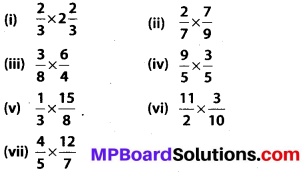
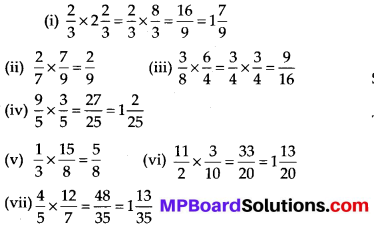
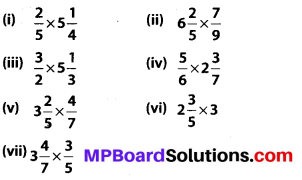
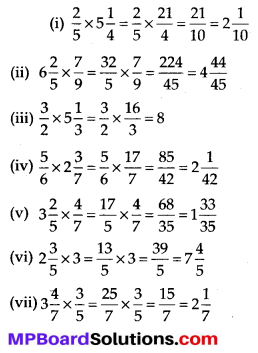
MP Board Class 7th Maths Solutions Chapter 3 Data Handling Ex 3.2

MP Board Class 7th Maths Solutions Chapter 3 Data Handling Ex 3.2

Question 1.
The scores in Mathematics test (out of 25) of 15 students are as follows:
19, 25, 23, 20, 9, 20, 15, 10, 5, 16, 25, 20, 24, 12, 20
Find the mode and median of this data. Are they same?
Solution:
Arranging the given scores in ascending order, we have 5, 9, 10, 12, 15, 16, 19, 20, 20, 20, 20, 23, 24, 25, 25
Mode of given data is that value of observation which occurs for the most number of times i.e., 20. 5.
Median of the given data is the middle observation when the data is arranged in ascending order i.e., 8th term = 20
Hence, mode of data = median of data.

MP Board Class 7th Maths Solutions Chapter 3 Data Handling Ex 3.2

Question 2.
The runs scored in a cricket match by 11 players are as follows:
6, 15, 120, 50, 100, 80, 10, 15, 8, 10, 15
Find the mean, mode and median of this data. Are the three same?
Solution:
Arranging the given scores in an ascending order, we have
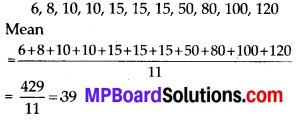
MP Board Class 7th Maths Solutions Chapter 3 Data Handling Ex 3.2 1
As 15 occurs for the most number of times.
∴ Mode = 15
Median = Middle term = 15
∴ All three mean, mode and median are not same.

MP Board Class 7th Maths Solutions Chapter 3 Data Handling Ex 3.2

Question 3.
The weights (in kg.) of 15 students of a class are: 38, 42, 35, 37, 45, 50, 32, 43, 43, 40, 36, 38, 43, 38, 47
(i) Find the mode and median of this data.
(ii) Is there more than one mode?
Solution:
Arranging the given weights in ascending order, we have 32, 35, 36, 37, 38, 38, 38, 40, 42, 43, 43, 43, 45,47, 50
(i) Mode = 38 and 43
Median = Middle term = 40
(ii) Yes, there are 2 modes for the given data i.e., 38 and 43.

Question 4.
Find the mode and median of the data: 13, 16, 12, 14, 19, 12, 14, 13, 14
Solution:
Arranging the given data in an ascending order, we have
12, 12, 13, 13, 14, 14, 14, 16, 19
14 occurs for the most number of times
∴ Mode = 14
Median = Middle observation = 14

MP Board Class 7th Maths Solutions Chapter 3 Data Handling Ex 3.2

Question 5.
Tell whether the statement is true or false:
(i) The mode is always one of the numbers in a data.
(ii) The mean is one of the numbers in a data.
(iii) The median is always one of the numbers in a data.
(iv) The data 6,4,3,8,9,12,13,9 has mean 9.
Solution:
(i) True, as mode of a given data is that value of observation which occurs for the most number of times. Therefore, it is one of the observations given in the data.
(ii) False, because mean may or may not be one of the numbers in the data.
(iii) False, because median may or may not be one of the numbers in the data
(iv) False, because

MP Board Class 7th Maths Solutions Chapter 3 Data Handling Ex 3.2 2

MP Board Class 7th Maths Solutions Chapter 3 Data Handling Ex 3.2

MP Board Class 7th Maths Solutions

MP Board Class 7th Maths Solutions Chapter 3 Data Handling Ex 3.1

MP Board Class 7th Maths Solutions Chapter 3 Data Handling Ex 3.1

Question 1.
Find the range of heights of any ten students of your class.
Solution:
Let the heights (in cm) of 10 students of our class be 125, 129, 131, 132, 134, 136, 139, 142, 144, 146
Highest observation = 146 cm
Lowest observation =125 cm
Range = Highest observation – Lowest observation
= (146 – 125) cm = 21 cm

Question 2.
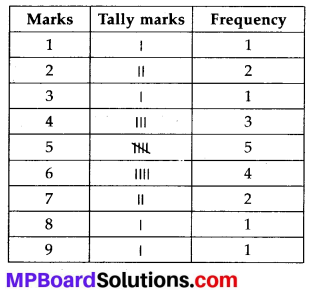
Organise the following marks in a class assessment, in a tabular form. 4, 6, 7, 5, 3, 5, 4, 5, 2, 6, 2, 5, 1, 9, 6, 5, 8, 4, 6, 7
Solution:
MP Board Class 7th Maths Solutions Chapter 3 Data Handling Ex 3.1 1
(i) Highest number = 9
(ii) Lowest number = 1
(iii) Range = (9 – 1) = 8
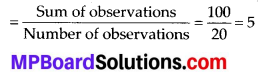
(iv) Sum of all the observations =4 + 6 + 7 + 5 + 3 + 5 + 4 + 5 + 2 + 6 + 2 + 5 + 1 + 9 + 6 + 5 + 8 + 4 + 6 + 7 = 100
Total number of observations = 20
Arithmetic mean
MP Board Class 7th Maths Solutions Chapter 3 Data Handling Ex 3.1 2

Question 3.
Find the mean of the first five whole numbers.
Solution:
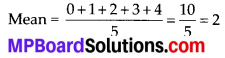
First five whole numbers are 0, 1, 2, 3 and 4.
MP Board Class 7th Maths Solutions Chapter 3 Data Handling Ex 3.1 3
Hence, the mean of first five whole numbers is 2.

Question 4.
A cricketer scores the following runs in eight innings: 58, 76,40, 35,46,45,0,100.
Find the mean score.
Solution:
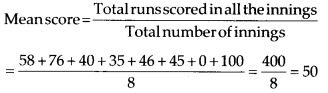
Runs scored by the cricketer in eight innings are 58, 76, 40, 35, 46, 45, 0 and 100.
MP Board Class 7th Maths Solutions Chapter 3 Data Handling Ex 3.1 4
Therefore, mean score is 50.

MP Board Class 7th Maths Solutions Chapter 3 Data Handling Ex 3.1

Question 5.
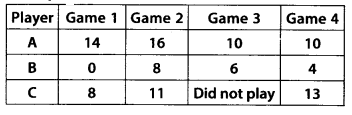
Following table shows the points of each player scored in four games:
MP Board Class 7th Maths Solutions Chapter 3 Data Handling Ex 3.1 5
Now answer the following questions:
(i) Find the mean to determine A’s average number of points scored per game.
(ii) To find the mean number of points per game for C, would you divide the total points by 3 or by 4? Why?
(iii) B played in all the four games. How would you find the mean?
(iv) Who is the best performer?
Solution:
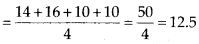
(i) A’s average number of points
MP Board Class 7th Maths Solutions Chapter 3 Data Handling Ex 3.1 6
(ii) To find the mean number of points per game for C, we will divide the total points by 3 because C played 3 games.
MP Board Class 7th Maths Solutions Chapter 3 Data Handling Ex 3.1 7
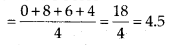
(iii) Mean of B’s Score
MP Board Class 7th Maths Solutions Chapter 3 Data Handling Ex 3.1 8
(iv) The best performer will have the greatest average among all. Now we can observe that the average of A is 12.5 which is more than that of B and C. Therefore, A is the best performer.

MP Board Class 7th Maths Solutions Chapter 3 Data Handling Ex 3.1

Question 6.
The marks (out of 100) obtained by a group of students in a Science test are 85, 76, 90, 85, 39, 48, 56, 95, 81 and 75. Find the:
(i) Highest and the lowest marks obtained by the students.
(ii) Range of the marks obtained.
(iii) Mean marks obtained by the group.
Solution:
The marks obtained by the group of students in a Science test can be arranged in ascending order as follows.
39, 48, 56, 75, 76, 81, 85, 85, 90, 95
(i) Highest marks = 95 Lowest marks = 39
(ii) Range = 95 – 39 = 56
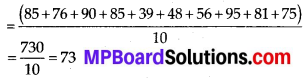
(iii) Mean marks
MP Board Class 7th Maths Solutions Chapter 3 Data Handling Ex 3.1 9

Question 7.
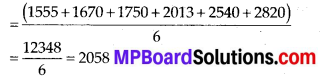
The enrolment in a school during six consecutive years was as follows:
1555, 1670, 1750, 2013, 2540, 2820
Find the mean enrolment of the school for this period.
Solution:
Mean enrolment
MP Board Class 7th Maths Solutions Chapter 3 Data Handling Ex 3.1 10

MP Board Class 7th Maths Solutions Chapter 3 Data Handling Ex 3.1

Question 8.
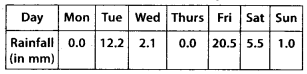
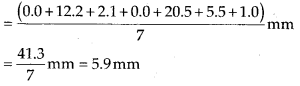
The rainfall (in mm) in a city on 7 days of a certain week was recorded as follows:
MP Board Class 7th Maths Solutions Chapter 3 Data Handling Ex 3.1 11
(i) Find the range of the rainfall in the above data.
(ii) Find the mean rainfall for the week.
(iii) On how many days was the rainfall less than the mean rainfall?
Solution:
(i) Range = (20.5 – 0.0) mm = 20.5 mm
(ii) Mean rainfall
MP Board Class 7th Maths Solutions Chapter 3 Data Handling Ex 3.1 12
(iii) For 5 days (i.e., Monday, Wednesday, Thursday, Saturday, Sunday), the rainfall was less than the mean rainfall.

Question 9.
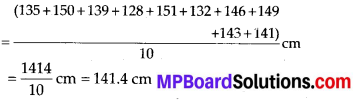
The heights of 10 girls were measured in cm and the results are as follows:
135, 150, 139, 128, 151, 132, 146, 149, 143, 141.
(i) What is the height of the tallest girl?
(ii) What is the height of the shortest girl?
(iii) What is the range of the data?
(iv) What is the mean height of the girls?
(v) How many girls have heights more than the mean height?
Solution:
Arranging the heights of 10 girls in an ascending order;
128, 132, 135, 139, 141, 143, 146, 149, 150, 151
(i) Height of the tallest girl = 151 cm
(ii) Height of the shortest girl = 128 cm
(iii) Range = (151 – 128) cm = 23 cm
(iv) Mean height
MP Board Class 7th Maths Solutions Chapter 3 Data Handling Ex 3.1 13
(v) The heights of 5 girls are greater than the mean height (i.e., 141.4 cm) and these heights are 143 cm, 146 cm, 149 cm, 150 cm and 151 cm.
MP Board Class 7th Maths Solutions Chapter 3 Data Handling Ex 3.1

MP Board Class 7th Maths Solutions

MP Board Class 7th Maths Solutions Chapter 2 Fractions and Decimals Ex 2.7

MP Board Class 7th Maths Solutions Chapter 2 Fractions and Decimals Ex 2.7

Question 1.
Find:
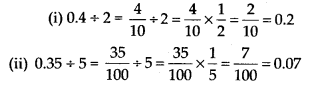
(i) 0.4 ÷ 2
(ii) 0.35 ÷ 5
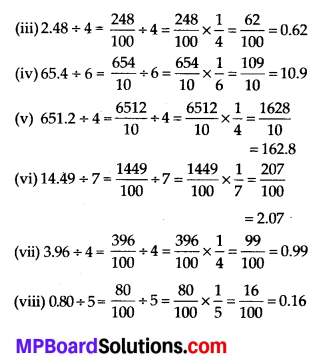
(iii) 2.48 ÷ 4
(iv) 65.4 ÷ 6
(v) 651.2 ÷ 4
(vii) 3.96 ÷ 4
(viii) 0.80 ÷ 7
Solution:
MP Board Class 7th Maths Solutions Chapter 2 Fractions and Decimals Ex 2.7 1
MP Board Class 7th Maths Solutions Chapter 2 Fractions and Decimals Ex 2.7 2

MP Board Class 7th Maths Solutions Chapter 2 Fractions and Decimals Ex 2.7

Question 2.
Find:
(i) 4.8 ÷ 10
(ii) 52.5 ÷ 10
(iii) 0.7 ÷ 10
(iv) 33.1 ÷ 10
(v) 272.23 ÷ 10
(vi) 0.56 ÷ 10
(vii) 3.97 ÷ 10
Solution:
We know that when a decimal number is divided by a multiple of 10 (i.e., 10,100,1000, etc.), the decimal point will be shifted to the left by as many places as there are zeros.
(i) 4.8 ÷ 10 = 0.48
(ii) 52.5 ÷ 10 = 5.25
(iii) 0.7 ÷ 10 = 0.07
(iv) 33.1 ÷ 10 = 3.31
(v) 272.23 ÷ 10 = 27.223
(vi) 0.56 ÷ 10 = 0.056
(vii) 3.97 ÷10 = 0.397

MP Board Class 7th Maths Solutions Chapter 2 Fractions and Decimals Ex 2.7

Question 3.
Find:
(i) 2.7 ÷ 100
(ii) 0.3 ÷ 100
(iii) 0.78 ÷ 100
(iv) 432.6 ÷ 100
(v) 23.6 ÷ 100
(vi) 98.53 ÷ 100
Solution:
We know that when a decimal number is divided by a multiple of 10 (i.e., 10, 100, 1000, etc.), the decimal point will be shifted to the left by as many places as there are zeros.
(i) 2.7 ÷ 100 = 0.027
(ii) 0.3 ÷ 100 = 0.003
(iii) 0.78 ÷ 100 = 0.0078
(iv) 432.6 ÷ 100 = 4.326
(v) 23.6 ÷ 100 = 0.236
(vi) 98.53 ÷ 100 = 0.9853

MP Board Class 7th Maths Solutions Chapter 2 Fractions and Decimals Ex 2.7

Question 4.
Find:
(i) 7.9 ÷ 1000
(ii) 26.3 ÷ 1000
(iii) 38.53 ÷ 1000
(v) 0.5 ÷ 1000
Solution:
We know that when a decimal number is divided by a multiple of 10 (i.e., 10, 100, 1000, etc.), the decimal point will be shifted to the left by as many places as there are zeros.
(i) 7.9 ÷ 1000 = 0.0079
(ii) 26.3 ÷ 1000 = 0.0263
(iii) 38.53 ÷ 1000 = 0.03853
(iv) 128.9 ÷ 1000 = 0.1289
(v) 0.5 ÷ 1000 = 0.0005

Question 5.
Find:
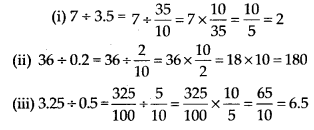
(i) 7 ÷ 3.5
(ii) 36 ÷ 2
(iii) 3.25 ÷ 0.5
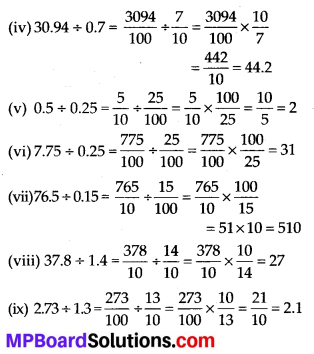
(iv) 30.94 ÷ 0.7
(v) 0.5 ÷ 0.25
(vi) 7.75 ÷ 0.25
(vii) 76.5 ÷ 0.15
(viii) 37.8 ÷ 1.4
(ix) 2.73 ÷ 1.3
Solution:
MP Board Class 7th Maths Solutions Chapter 2 Fractions and Decimals Ex 2.7 3
MP Board Class 7th Maths Solutions Chapter 2 Fractions and Decimals Ex 2.7 4

Question 6.
A vehicle covers a distance of 43.2 km in 2.4 litres of petrol How much distance wilt it cover in one litre of petrol?
Solution:
Distance covered in 2.4 Litres of petrol = 43.2 km
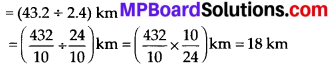
∴ Distance covered in 1 litre of petrol = (43.2 ÷ 2.4) km
MP Board Class 7th Maths Solutions Chapter 2 Fractions and Decimals Ex 2.7 5

MP Board Class 7th Maths Solutions Chapter 2 Fractions and Decimals Ex 2.7

MP Board Class 7th Maths Solutions

MP Board Class 7th Maths Solutions Chapter 2 Fractions and Decimals Ex 2.6

MP Board Class 7th Maths Solutions Chapter 2 Fractions and Decimals Ex 2.6

Question 1.
Find:
(i) 0.2 × 6
(ii) 8 × 4.6
(iii) 2.71 × 5
(iv) 20.1 × 4
(v) 0.05 × 7
(vi) 211.02 × 4
(vii) 2 × 0.86
Solution:
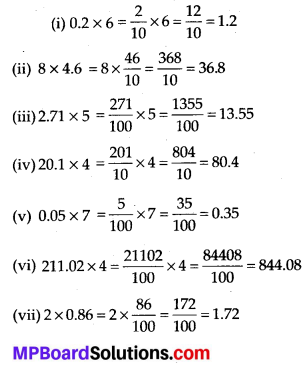
MP Board Class 7th Maths Solutions Chapter 2 Fractions and Decimals Ex 2.6 1

Question 2.
Find the area of rectangle whose length is 5.7 cm and breadth is 3 cm.
Solution:
Length = 5.7 cm and breadth = 3 cm
Area = Length × Breadth = (5.7 × 3) cm2 = 17.1 cm2

MP Board Class 7th Maths Solutions Chapter 2 Fractions and Decimals Ex 2.6

Question 3.
Find:
(i) 1.3 × 10
(ii) 36.8 × 10
(iii) 153.7 × 10
(iv) 168.07 × 10
(v) 31.1 × 100
(vi) 156.1 × 100
(vii) 3.62 × 100
(viii) 43.07 × 100
(ix) 0.5 × 10
(x) 0.08 × 10
(xi) 0.9 × 100
(xii) 0.03 × 1000
Solution:
We know that when a decimal number is multiplied by 10, 100, 1000, the decimal point in the product is shifted to the right by as many places as there are zeros.
(i) 1.3 × 10 = 13
(ii) 36.8 × 10 = 368
(iii) 153.7 × 10 = 1537
(iv) 168.07 × 10 = 1680.7
(v) 31.1 × 100 = 3110
(vi) 156.1 × 100 = 15610
(vii) 3.62 × 100 = 362
(viii) 43.07 × 100 = 4307
(ix) 0.5 × 10 = 5
(x) 0.08 × 10 = 0.8
(xi) 0.9 × 100 = 90
(xii) 0.03 × 1000 = 30

Question 4.
A two-wheeler covers a distance of 55.3 km in one litre of petrol. How much distance will it cover in 10 litres of petrol?
Solution:
Distance covered in 1 litre of petrol = 55.3 km
Distance covered in 10 litres of petrol = (10 × 55.3) km = 553 km

MP Board Class 7th Maths Solutions Chapter 2 Fractions and Decimals Ex 2.6

Question 5.
Find:
(i) 2.5 × 0.3
(ii) 0.1 × 51.7
(iii) 0.2 × 316.8
(iv) 1.3 × 3.1
(v) 0.5 × 0.05
(vii) 1.07 × 0.02
(viii) 10.05 × 1.05
(ix) 101.01 × 0.01
(x) 100.01 × 1.1
Solution:
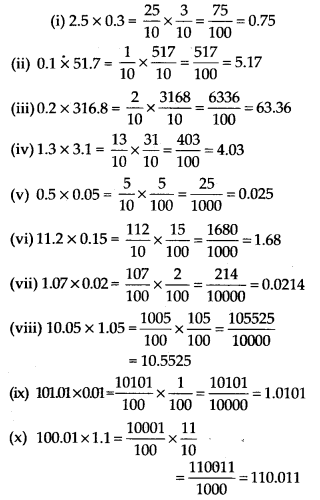
MP Board Class 7th Maths Solutions Chapter 2 Fractions and Decimals Ex 2.6 2

MP Board Class 7th Maths Solutions Chapter 2 Fractions and Decimals Ex 2.6

MP Board Class 7th Maths Solutions

MP Board Class 7th Maths Solutions Chapter 2 Fractions and Decimals Ex 2.5

MP Board Class 7th Maths Solutions Chapter 2 Fractions and Decimals Ex 2.5

Question 1.
Which is greater?
(i) 0.5 or 0.05
(ii) 0.7 or 0.5
(iii) 7 or 0.7
(iv) 1.37 or 1.49
(v) 2.03 or 2.30
(vi) 0.8 or 0.88.
Solution:
(i) 0.5 or 0.05
Converting these decimal numbers into like fractions, we obtain
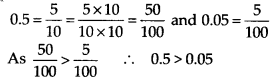
MP Board Class 7th Maths Solutions Chapter 2 Fractions and Decimals Ex 2.5 1

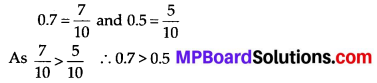
(ii) 0.7 or 0.5
Converting these decimal numbers into like fractions, we obtain
MP Board Class 7th Maths Solutions Chapter 2 Fractions and Decimals Ex 2.5 2

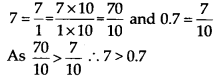
(iii) 7 or 0.7
Converting these decimal numbers into like fractions, we obtain
MP Board Class 7th Maths Solutions Chapter 2 Fractions and Decimals Ex 2.5 3

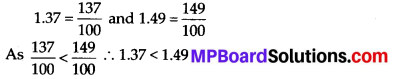
(iv) 1.37 or 1.49
Converting these decimal numbers into like fractions, we obtain
MP Board Class 7th Maths Solutions Chapter 2 Fractions and Decimals Ex 2.5 4

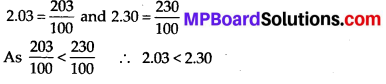
(v) 2.03 or 2.30
Converting these decimal numbers into like fractions, we obtain
MP Board Class 7th Maths Solutions Chapter 2 Fractions and Decimals Ex 2.5 5

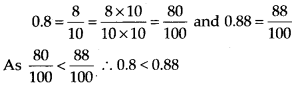
(vi) 0.8 or 0.88
Converting these decimal numbers into like fractions, we obtain
MP Board Class 7th Maths Solutions Chapter 2 Fractions and Decimals Ex 2.5 6

MP Board Class 7th Maths Solutions Chapter 2 Fractions and Decimals Ex 2.5

Question 2.
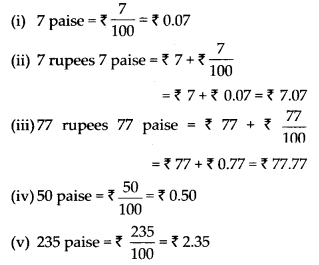
Express as rupees using decimals:
(i) 7 paise
(ii) 7 rupees 7 paise
(iii) 77 rupees 77 paise
(iv) 50 paise
(v) 235 paise.
Solution:
There are 100 paise in 1 rupee. Therefore, if we want to convert paise into rupees, we have to divide paise by 100.
MP Board Class 7th Maths Solutions Chapter 2 Fractions and Decimals Ex 2.5 7

Question 3.
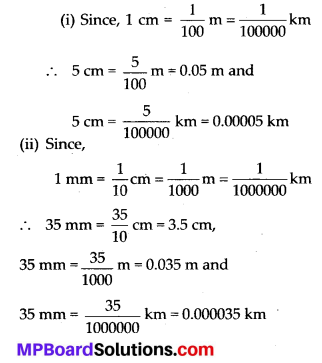
(i) Express 5 cm in metre and kilometre.
(ii) Express 35 mm in cm, m and km.
Solution:
MP Board Class 7th Maths Solutions Chapter 2 Fractions and Decimals Ex 2.5 8

MP Board Class 7th Maths Solutions Chapter 2 Fractions and Decimals Ex 2.5

Question 4.
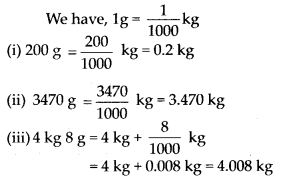
Express in kg:
(i) 200 g
(ii) 3470 g
(iii) 4 kg 8g
Solution:
MP Board Class 7th Maths Solutions Chapter 2 Fractions and Decimals Ex 2.5 9

Question 5.
Write the following decimal numbers in the expanded form:
(i) 20.03
(ii) 2.03
(iii) 200.03
(iv) 2.034
Solution:
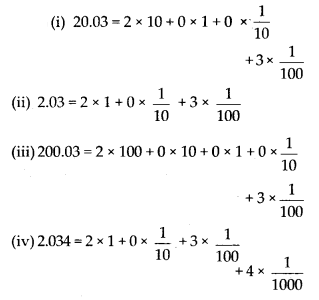
MP Board Class 7th Maths Solutions Chapter 2 Fractions and Decimals Ex 2.5 10

MP Board Class 7th Maths Solutions Chapter 2 Fractions and Decimals Ex 2.5

Question 6.
Write the place value of 2 in the following decimal numbers:
(i) 2.56
(ii) 21.37
(iii) 10.25
(iv) 9.42
(v) 63.352.
Solution:
MP Board Class 7th Maths Solutions Chapter 2 Fractions and Decimals Ex 2.5 11
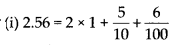
∴ Place value of 2 in 2.56 is ones.
MP Board Class 7th Maths Solutions Chapter 2 Fractions and Decimals Ex 2.5 12
∴ Place value of 2 in 21.37 is tens.
MP Board Class 7th Maths Solutions Chapter 2 Fractions and Decimals Ex 2.5 13
∴ Place value of 2 in 10.25 is tenths.
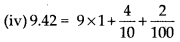
MP Board Class 7th Maths Solutions Chapter 2 Fractions and Decimals Ex 2.5 14
∴ Place value of 2 in 9.42 is hundredths.
MP Board Class 7th Maths Solutions Chapter 2 Fractions and Decimals Ex 2.5 15
∴ Place value of 2 in 63.352 is thousandths.

MP Board Class 7th Maths Solutions Chapter 2 Fractions and Decimals Ex 2.5

Question 7.
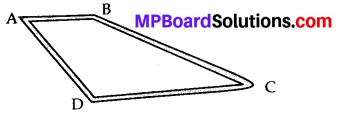
Dinesh went from place A to place Band from there to place C. A is 7.5 km from B and B is
12.7 km from C. Ayub went from place A to place D and from there to place C. D is 9.3 km from A and C is 11.8 km from D. Who travelled more and by how much?
MP Board Class 7th Maths Solutions Chapter 2 Fractions and Decimals Ex 2.5 16
Solution:
Distance travelled by Dinesh = AB + BC = (7.5 + 12.7) km = 20.2 km
Distance travelled by Ayub = AD + DC
= (9.3+ 11.8) km = 21.1 km
Difference = (21.1 – 20.2) km = 0.9 km
Hence, Ayub travelled 0.9 km more distance than Dinesh.

MP Board Class 7th Maths Solutions Chapter 2 Fractions and Decimals Ex 2.5

Question 8.
Shyama bought 5 kg 300 g apples and 3 kg 250 g mangoes. Sarala bought 4 kg 800 g oranges and 4 kg 150 g bananas. Who bought more fruits?
Solution:
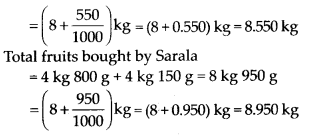
Total fruits bought by Shyama = 5 kg 300 g + 3 kg 250 g = 8 kg 550 g
MP Board Class 7th Maths Solutions Chapter 2 Fractions and Decimals Ex 2.5 17
Hence, Sarala bought more fruits.

Question 9.
How much less is 28 km than 42.6 km?
Solution:
(42.6 – 28.0) km = 14.6 km
Hence, 28 km is less than 42.6 km by 14.6 km.

MP Board Class 7th Maths Solutions Chapter 2 Fractions and Decimals Ex 2.5

MP Board Class 7th Maths Solutions

MP Board Class 7th Maths Solutions Chapter 2 Fractions and Decimals Ex 2.4

MP Board Class 7th Maths Solutions Chapter 2 Fractions and Decimals Ex 2.4

Question 1.
Find:
MP Board Class 7th Maths Solutions Chapter 2 Fractions and Decimals Ex 2.4 1
Solution:
MP Board Class 7th Maths Solutions Chapter 2 Fractions and Decimals Ex 2.4 2

MP Board Class 7th Maths Solutions Chapter 2 Fractions and Decimals Ex 2.4

Question 2.
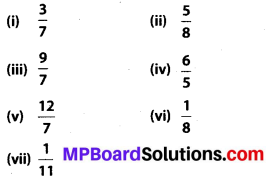
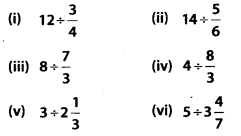
Find the reciprocal of each of the following fractions. Classify the reciprocals as proper fractions, improper fractions and whole numbers.
MP Board Class 7th Maths Solutions Chapter 2 Fractions and Decimals Ex 2.4 3
Solution:
(i) Reciprocal of \(\frac{3}{7}=\frac{7}{3}\). It is an improper fraction.
(ii) Reciprocal of \(\frac{5}{8}=\frac{8}{5}\). It is an improper fraction.
(iii) Reciprocal of \(\frac{9}{7}=\frac{7}{9}\). It is a proper fraction.
(iv) Reciprocal of \(\frac{6}{5}=\frac{5}{6}\). It is a proper fraction.
(v) Reciprocal of \(\frac{12}{7}=\frac{7}{12}\). It is a proper fraction.
(vi) Reciprocal of \(\frac{1}{8}\) = 8. It is a whole fraction.
(vii) Reciprocal of \(\frac{1}{11}\) = 11. It is a whole fraction.

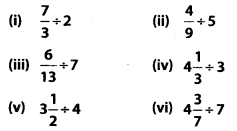
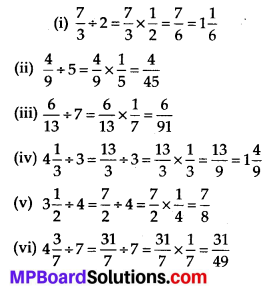
Question 3.
MP Board Class 7th Maths Solutions Chapter 2 Fractions and Decimals Ex 2.4 4
MP Board Class 7th Maths Solutions Chapter 2 Fractions and Decimals Ex 2.4 5

MP Board Class 7th Maths Solutions Chapter 2 Fractions and Decimals Ex 2.4

Question 4.
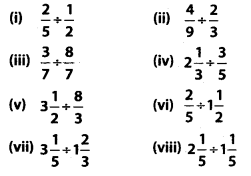
Find:
MP Board Class 7th Maths Solutions Chapter 2 Fractions and Decimals Ex 2.4 6
Solution:
(i) \(\frac{2}{5}÷\frac{1}{2}=\frac{2}{5} \times 2=\frac{4}{5}\)
MP Board Class 7th Maths Solutions Chapter 2 Fractions and Decimals Ex 2.4 12
MP Board Class 7th Maths Solutions Chapter 2 Fractions and Decimals Ex 2.4 8

MP Board Class 7th Maths Solutions Chapter 2 Fractions and Decimals Ex 2.4

MP Board Class 7th Maths Solutions

MP Board Class 7th Maths Solutions Chapter 2 Fractions and Decimals Ex 2.3

MP Board Class 7th Maths Solutions Chapter 2 Fractions and Decimals Ex 2.3

Question 1.
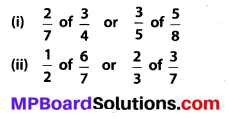
MP Board Class 7th Maths Solutions Chapter 2 Fractions and Decimals Ex 2.3 1
Solution:
MP Board Class 7th Maths Solutions Chapter 2 Fractions and Decimals Ex 2.3 2

Question 2.
Multiply and reduce to lowest form (if possible):
MP Board Class 7th Maths Solutions Chapter 2 Fractions and Decimals Ex 2.3 3
Solution:
MP Board Class 7th Maths Solutions Chapter 2 Fractions and Decimals Ex 2.3 4

Question 3.
Multiply the following fractions:
MP Board Class 7th Maths Solutions Chapter 2 Fractions and Decimals Ex 2.3 5
Solution:
MP Board Class 7th Maths Solutions Chapter 2 Fractions and Decimals Ex 2.3 6

Question 4.
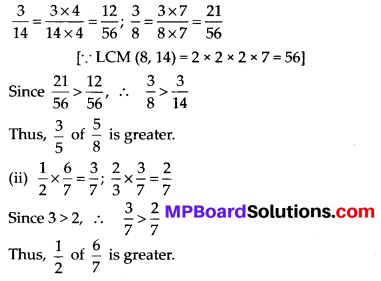
MP Board Class 7th Maths Solutions Chapter 2 Fractions and Decimals Ex 2.3 7
Solution:
Converting these fractions into like fractions, we obtain
MP Board Class 7th Maths Solutions Chapter 2 Fractions and Decimals Ex 2.3 8
Question 5.
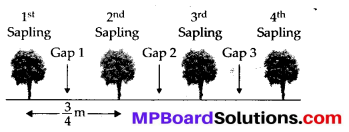
Saili plants 4 saplings, in a row, in her garden. The distance between two adjacent saplings is \(\frac{3}{4}\) m. Find the distance between the first and the last sapling.
Solution:
MP Board Class 7th Maths Solutions Chapter 2 Fractions and Decimals Ex 2.3 9
From the figure, it can be observed that gap between first and last sapling = 3 × Length of gap 1
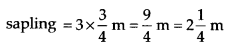
Therefore, distance between first and last
MP Board Class 7th Maths Solutions Chapter 2 Fractions and Decimals Ex 2.3 10

MP Board Class 7th Maths Solutions Chapter 2 Fractions and Decimals Ex 2.3

Question 6.
Lipika reads a book for \(1 \frac{3}{4}\) hours everyday. She reads the entire book in 6 days. How many hours in all were required by her to read the book?
Solution:
Time taken by Lipika to read the book per day = \(1 \frac{3}{4}\) hours = \(\frac{7}{4}\) hours
Number of days = 6
Total time taken by her to read the entire book = \(\frac{7}{4}\) × 6 hours = \(\frac{21}{2}\) hours
= \(=10 \frac{1}{2}\)hours

Question 7.
A car runs 16 km using 1 litre of petrol. How much distance will it cover using \(2 \frac{3}{4}\) litres of petrol?
Solution:
A car can run per litre of petrol = 16 km
Quantity of petrol = \(2 \frac{3}{4}\) litres = \(\frac{11}{4}\) litres
So, a car can run for \(\frac{11}{4}\) litres of petrol
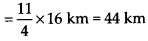
MP Board Class 7th Maths Solutions Chapter 2 Fractions and Decimals Ex 2.3 11

MP Board Class 7th Maths Solutions Chapter 2 Fractions and Decimals Ex 2.3

Question 8.
MP Board Class 7th Maths Solutions Chapter 2 Fractions and Decimals Ex 2.3 12
Solution:
MP Board Class 7th Maths Solutions Chapter 2 Fractions and Decimals Ex 2.3 13

MP Board Class 7th Maths Solutions

MP Board Class 7th Maths Solutions Chapter 2 Fractions and Decimals Ex 2.2

MP Board Class 7th Maths Solutions Chapter 2 Fractions and Decimals Ex 2.2

Question 1.
Which of the drawings (a) to (d) show:
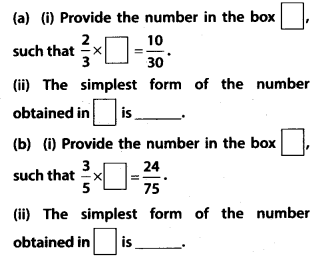
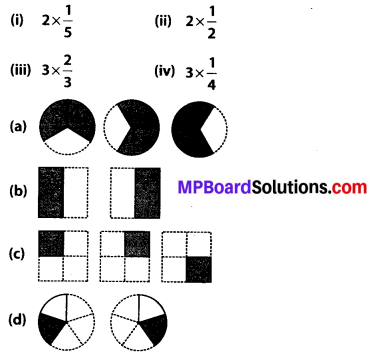
MP Board Class 7th Maths Solutions Chapter 2 Fractions and Decimals Ex 2.2 1
Solution:
(i) 2 × \(\frac{1}{5}\) represents addition of 2 figures, each representing 1 shaded part out of 5 equal parts. Hence, 2 × \(\frac{1}{5}\) is represented by (d)
(ii) 2 × \(\frac{1}{2}\) represents addition of 2 figures, each representing 1 shaded part out of 2 equal parts. Hence, 2 × \(\frac{1}{2}\) is represented by
(b) .
(iii) 3 × \(\frac{2}{3}\) represents addition of 3 figures, each representing 2 shaded parts out of 3 equal parts. Hence, 3 × \(\frac{2}{3}\) is represented by (a).
(iv) 3 × \(\frac{1}{4}\) represents addition of 3 figures, each representing 1 shaded part out of 4 equal parts. Hence, 3 × \(\frac{1}{4}\) is represented by (c).

Question 2.
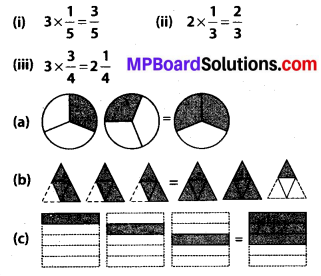
Some pictures (a) to (c) are given below. Tell which of them show:
MP Board Class 7th Maths Solutions Chapter 2 Fractions and Decimals Ex 2.2 2
Solution:
(i) 3 × \(\frac{1}{5}\) represents the addition of 3 figures, each representing 1 shaded part out of 5 equal parts and \(\frac{3}{5}\) represents 3 shaded parts out of 5 equal parts.
Hence, \(3 \times \frac{1}{5}=\frac{3}{5}\) is represented by (c).

(ii) \(2 \times \frac{1}{3}\) represents the addition of 3 figures, each representing 1 shaded part out of 3 equal parts and \(\frac{2}{3}\) represents 2 shaded parts out of 3 equal parts.
Hence, \(2 \times \frac{1}{3}=\frac{2}{3}\) is represented by (a).

(iii) \(3 \times \frac{3}{4}\) represents the addition of 3 figures, each representing 3 shaded parts out of 4 equal parts and \(2 \frac{1}{4}\) represents 2 fully shaded figures and one figure having 1 shaded part out of 4 equal parts.
Hence, \(3 \times \frac{3}{4}=2 \frac{1}{4}\) is represented by (b).

MP Board Class 7th Maths Solutions Chapter 2 Fractions and Decimals Ex 2.2

Question 3.
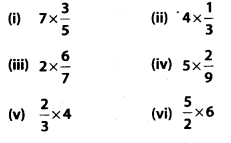
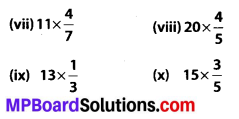
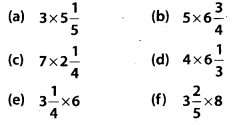
Multiply and reduce to lowest form and convert into a mixed fraction:
MP Board Class 7th Maths Solutions Chapter 2 Fractions and Decimals Ex 2.2 3
MP Board Class 7th Maths Solutions Chapter 2 Fractions and Decimals Ex 2.2 4
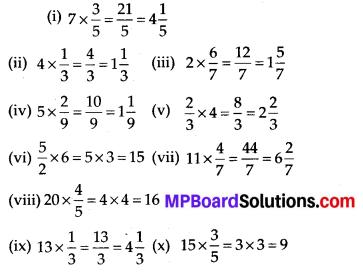
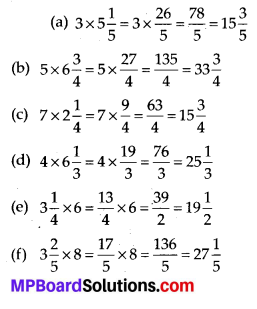
Solution:
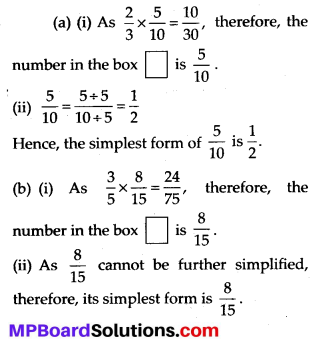
MP Board Class 7th Maths Solutions Chapter 2 Fractions and Decimals Ex 2.2 5

Question 4.
MP Board Class 7th Maths Solutions Chapter 2 Fractions and Decimals Ex 2.2 6
Solution:
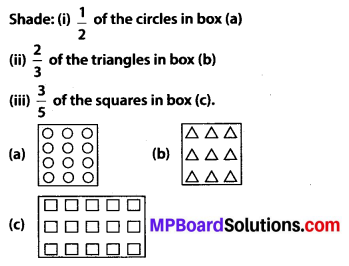
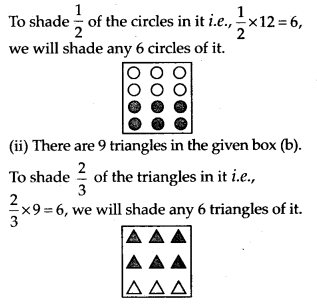
(i) There are 12 circles in the given box.
(a)
MP Board Class 7th Maths Solutions Chapter 2 Fractions and Decimals Ex 2.2 7

(iii) There are 15 squares in the given box (c). To shade \(\frac{3}{5}\) of the squares in it i.e., \(\frac{3}{5} \times 15=9\), we will shade any 9 squares of it.
MP Board Class 7th Maths Solutions Chapter 2 Fractions and Decimals Ex 2.2 8

MP Board Class 7th Maths Solutions Chapter 2 Fractions and Decimals Ex 2.2

Question 5.
MP Board Class 7th Maths Solutions Chapter 2 Fractions and Decimals Ex 2.2 9
Solution:
MP Board Class 7th Maths Solutions Chapter 2 Fractions and Decimals Ex 2.2 10

Question 6.
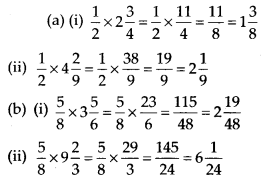
Multiply and express as a mixed fraction:
MP Board Class 7th Maths Solutions Chapter 2 Fractions and Decimals Ex 2.2 11
Solution:
MP Board Class 7th Maths Solutions Chapter 2 Fractions and Decimals Ex 2.2 12

Question 7.
Find:
MP Board Class 7th Maths Solutions Chapter 2 Fractions and Decimals Ex 2.2 13
Solution:
MP Board Class 7th Maths Solutions Chapter 2 Fractions and Decimals Ex 2.2 14

Question 8.
Vidya and Pratap went for a picnic. Their mother gave them a water bottle that contained 5 litres of water. Vidya consumed \(\frac{2}{5}\) of the water. Pratap consumed the remaining water.
(i) How much water did Vidya drink?
(ii) What fraction of the total quantity of water did Pratap drink?
Solution:
(i) Water consumed by Vidya
MP Board Class 7th Maths Solutions Chapter 2 Fractions and Decimals Ex 2.2 15
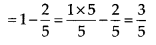
(ii) Fraction of remaining water
MP Board Class 7th Maths Solutions Chapter 2 Fractions and Decimals Ex 2.2 16
Thus, Pratap consumed \(\frac{3}{5}\) of the total quantity of water.

MP Board Class 7th Maths Solutions Chapter 2 Fractions and Decimals Ex 2.2

MP Board Class 7th Maths Solutions

MP Board Class 7th Hindi Sugam Bharti Solutions Chapter 11 योगी श्री अरविंद

MP Board Class 7th Hindi Sugam Bharti Solutions Chapter 11 योगी श्री अरविंद

MP Board Class 7th Hindi Sugam Bharti Chapter 11 प्रश्न-अभ्यास

वस्तुनिष्ठ प्रश्न
प्रश्न 1. (क)सही जोड़ी बनाइए
1. योग साधना केंद्र = (क) संदेश
2. स्वर्गिक = (ख) आंदोलन
3. स्वदेशी = (ग) नरेश
4. बड़ौदा = (घ) पांडिचेरी
उत्तर
1. (घ), 2. (क), 3. (ख), 4. (ग)

MP Board Solutions

प्रश्न (ख).
दिए गए शब्दों में से उपयुक्त शब्द चुनकर रिक्त स्थानों की पूर्ति कीजिए
1. अरविंद ने बड़ौदा कॉलेज में ……………. के पद पर कार्य किया। (प्रोफेसर/व्याख्याता)
2. योगीराज अरविंद का जन्म …………… में हुआ था। (दिल्ली/कोलकाता
3. श्री कृष्णघन व्यवसाय से …… (डॉक्टर/वैज्ञानिक)
4. बड़ौदा कॉलेज के प्राचार्य ……………. थे। (अरविंद/क्लार्क
उत्तर
1. प्रोफेसर
2. कोलकाता
3. डाक्टर
4. क्लार्क

MP Board Class 7th Hindi Sugam Bharti Chapter 11 अति लघु उत्तरीय प्रश्न

प्रश्न 2.
निम्नलिखित प्रश्नों के उत्तर एक-एक वाक्य में लिखिए

(क)
श्री कृष्णघन किस विचारधारा के व्यक्ति थे।
उत्तर
श्री कृष्णघन पश्चिमी विचारधारा के व्यक्ति

(ख)
श्री अरविंद ने किस परीक्षा में प्रथम श्रेणी प्राप्त को?
उत्तर
श्री अरविंद ने आई.सी.एस. परीक्षा में प्रथम श्रेणी प्राप्त की थी।

MP Board Solutions

(ग)
श्री अरविंद ने अंग्रेजी सेवा से क्यों वंचित रह गए?
उत्तर
श्री अरविंद घुड़सवारी की परीक्षा में अनुपस्थित रहने के कारण अंग्रेजी सेवा से वंचित रह गए।

(घ)
श्री अरविंद की आरम्भिक शिक्षा कहाँ हुई थी?
उत्तर
श्री अरविंद की आरंभिक शिक्षा दार्जिलिंग में हुई थी।

(ङ)
अरविंद द्वारा संपादित पत्रों के नाम लिखिए?
उत्तर
अरविंद द्वारा संपादित पत्रों के नाम ‘युगांतर’ तथा ‘वंदेमातरम्’ थे।

MP Board Class 7th Hindi Sugam Bharti Chapter 11 लघु उत्तरीय प्रश्न

प्रश्न 3.
निम्नलिखित प्रश्नों के उत्तर तीन से पाँच वाक्यों में लिखिए

(क)
श्री अरविंद को कौन-कौन सी भाषाएँ सीखने का अवसर मिला?
उत्तर
श्री अरविंद अंग्रेजी के अलावा ग्रीक, लैटिन, फ्रेंच भाषाएँ भी जानते थे। भारत वापस आकर इन्होंने बंगला तथा संस्कृत भाषा का भी अध्ययन किया था।

(ख)
प्राचार्य क्लार्क महोदय ने अरविंद की तुलना करते समय क्या कहा?
उत्तर
बड़ौदा कॉलेज के प्राचार्य क्लार्क महोदय ने जोन ऑफ आर्क से अरविंद की तुलना करते हुए कहा था कि यदि जोन ऑफ आर्क को स्वर्गिक संदेश सुनाई पड़ते हैं, तो श्री अरविंद को भी स्वर्गिक स्वप्न दिखाई पड़ते हैं।

MP Board Solutions

(ग)
श्री अरविंद ने नौकरी क्यों छोड़ दी थी?
उत्तर
श्री अरविंद नौकरी छोड़कर तिलक एवं विपिन चंद्रपाल के साथ मिलकर काम करने लगे। इन्होंने ‘युगांतर’ तथा ‘वंदेमातरम्’ अखबार भी निकाला।

(घ)
श्री अरविंद को योग-साधना करने का समय कब मिला?
उत्तर
1908 में दोबारा अलीपुर बम काण्ड में श्री अरविंद को शामिल माना गया, जिसकी वजह से एक वर्ष का कारावास हुआ। इसी जेल जीवन के दौरान योग-साधना करने का इनको समय मिला तथा योग के साधना पक्ष और सिद्धांत पक्ष दोनों का इन्होंने विधिवत् अध्ययन किया।

(ङ)
श्री अरविंद आश्रम की तीन विशेषताएँ लिखिए।
उत्तर
श्री अरविंद के आश्रम की विशेषताएँ

  • आश्रम प्रकृति की सुरम्य स्थली है, जहाँ जाकर
    मन सहज ही सात्विक विचारों में लग जाता है।
  • आध्यात्मिक विचारों के लिए उपयोगी भूमि
  • आश्रम प्राकृतिक घटाओं से घिरा तथा शांत वातावरण लिए था।

प्रश्न 4.
निम्नलिखित शब्दों का शुद्ध उच्चारण किजिए
विक्षुब्ध, शैशवावस्था, ख्याति, सात्विक, पुरस्कार, श्रेणी
उत्तर
छात्र स्वयं करें।

प्रश्न 5.
शुद्ध वर्तनी पर गोला लगाइए

  • नीधन, निधन, निघन, निःधन
  • बंचित, बन्चित, वंचित, वंचीत
  • सहधार्मिणी शहधर्मिणी, सह धरमिणी, सह धर्मीणी
  • पांडीचेरी पांडिचेरी, पान्डीचेरी, पांडिचेरी।

उत्तर

  • नीधन, निधन, निघन, निःधन
  • बंचित, बन्चित, बंचित, वंचीत
  • सहधर्मिणी शहधर्मिणी, सह धरमिणी, सह धर्मीणी
  • पांडीचेरी पांडिचेरी, पान्डीचेरी, पांडिचेरी।

प्रश्न 6.
निम्नलिखित शब्दों का वाक्यों में प्रयोग कीजिए .
व्यवसाय, राष्ट्रीय, परीक्षा, स्वप्न, बंदी

व्यबसाय- मेरे पिताजी लोहे का व्यवसाय करते हैं।
राष्ट्रीय- हमें राष्ट्रीय गान का सम्मान करना चाहिए।
परीक्षा- श्री अरविंद ने आई.सी.एस. की परीक्षा उत्तीर्ण की थी।
स्वप्न- वास्तव में दिन के स्वप्न सच नहीं होते।
बंदी- अंग्रेजों ने कई भारतीयों को बंदी बनाया था।

MP Board Solutions

प्रश्न 7.
उदाहरण के अनुसार ‘सु’ और ‘कु’ उपसर्ग जोड़कर दिए गए शब्दों से नए शब्द बनाइए
उदाहरण : सु + पुत्र = सुपुत्र कु+पुत्रकुपुत्र पात्र, डौल, योग, पथ, मति, मार्ग, चालक
उत्तर
सुपात्र, सुडौल, सुपथ, कुमति, सुमति, सुमार्ग, कुमार्ग, कुचालक, सुचालक।

प्रश्न 8.
निम्नलिखित वाक्यों में उद्देश्य और विधेय बताइए
(क) श्री कृष्णघन अरविंद के पिता थे।
(ख) अरविंद घुड़सवारी की परीक्षा में अनुपस्थित रहे।
(ग) स्वदेशी आंदोलन कोलकाता में तेज़ होने लगा।
(घ) अरविंद और सुभाष इस धरती के लाल थे।
(ङ) अरविंद आश्रम प्रकृति की सुरम्य स्थली है।
उत्तर
छात्र स्वयं करें

योगी श्री अरविंद पाठ का परिचय

प्रस्तुत पाठ में लेखक ने महान योगी श्री अरविंद का आध्यात्मिक चेतना तथा राष्ट्र के लिए योगदान को स्पष्ट किया है। श्री अरविंद का जन्म 15, अगस्त, 1872 को कोलकाता में हुआ था। इनके पिता पश्चिमी विचारधारा के व्यक्ति थे, इसीलिए इन्होंने श्री अरविंद को मात्र सात वर्ष की आयु में विदेश पढ़ने भेज दिया। 18 वर्ष की आयु में इन्होंने आई.सी.एस. की परीक्षा उत्तीर्ण की थी। उन्हें कई विदेशी भाषाओं का ज्ञान था। भारत में श्री अरविंद बड़ौदा कॉलेज में प्रोफेसर बने । वे यहाँ 13 वर्ष तक प्राचार्य बने रहे। इसी दौरान वे स्वाधीनता के दिवाने बन गए। इन्होंने अंग्रेजी विरोध में दो अखबार ‘युगांतर’ तथा ‘वंदेमातरम्’ निकाले। 1909 में इन्होंने ‘कर्मयोगी’ और ‘धर्म’ नामक दो साप्ताहिक पत्र निकाले। आंध्र विश्वविद्यालय ने 11 दिसंबर सन् 1948 को राष्ट्रीय पुरुस्कार देकर इनके प्रति श्रद्धा प्रकट की। 5 दिसंबर 1950 को इन्होंने अपनी मर्जी से महासमाधि ले ली।

योगी श्री अरविंद संदर्भ-प्रसंग सहित व्याख्या

1. अंग्रेजी संस्कार …. में लगाने लगे।

शब्दर्थ- शरीक = शामिल होना।

संदर्भ-प्रस्तुत पंक्तियाँ हमारी पाठ्य-पुस्तक ‘सुगम-भारती’ (हिंदी सामान्य) भाग-7 के पाठ 11 ‘योगी श्री अरविन्द’ से ली गई हैं। इसके रचयिता आर.जे. मौर्य

प्रसंग-इसमें श्री अरविंद के जेल से योग साधना को प्रकट किया गया है।

व्याख्या-1907 के बमकाण्ड में इन्हें पकड़ा गया किंतु बाद में छोड़ दिया गया। 1908 में इन्हें अलीपुर बमकाण्ड में पकड़ा गया, इन्हें एक वर्ष का कारावास हुआ। जेल में इन्होंने योग के साधना पक्ष और सिद्धांत पक्ष दोनों का अध्ययन किया। 1909 को जेल से आने के बाद उन्होंने अंग्रेजी में ‘कर्मयोगी’ और ‘धर्म’ नामक दो साप्ताहिक पत्र निकाले । अंग्रेजों से छिपकर श्री अरविंदचंद्रनगर चले गए, बाद में पाण्डिचेरी जाकर योग-साधना में लग गए।

MP Board Solutions

2. पाण्डिचेरी का ……………….. प्रभावित हुए थे।

शब्दार्थ-भूरि-भूरि = बहुत ज्यादा। संदर्भ-पूर्ववत्।

प्रसंग-इसमें श्री अरविंद आश्रम के संदर्भ में चर्चा की गई है।

व्याख्या-श्री अरविंद आश्रम अंतर्राष्ट्रीय योग-साधना केंद्र बन चुका है। इसका प्रबंध श्री अरविंद की शिष्या मीरा किया करती थी। यही वह स्थली है जहाँ उनका मन गहन विचारों में लग जाता है। इनकी पत्नी मृणालिनी देवी इनका हाथ बटाती थी। 1918 में इनकी पत्नी का देहांत हो गया। 1925 में लाला लाजपत राय ने इनकी तारीफ की। 1928 में इनकी मुलाकात रवींद्रनाथ ठाकुर से हुई तथा वे इनकी आध्यात्मिक चेतना से प्रभावित | हुए थे।

MP Board Class 7th Hindi Solutions

MP Board Class 7th Maths Solutions Chapter 2 Fractions and Decimals Ex 2.1

MP Board Class 7th Maths Solutions Chapter 2 Fractions and Decimals Ex 2.1

Question 1.
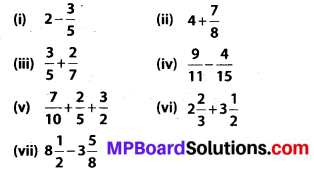
Solve:
MP Board Class 7th Maths Solutions Chapter 2 Fractions and Decimals Ex 2.1 1
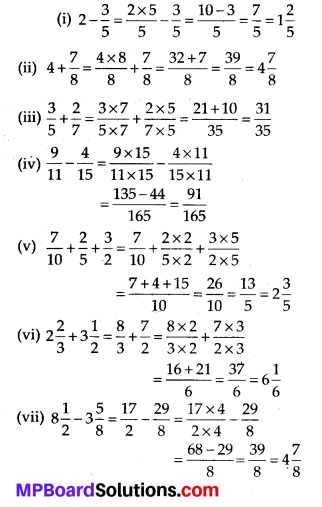
Solution:
MP Board Class 7th Maths Solutions Chapter 2 Fractions and Decimals Ex 2.1 2

Question 2.
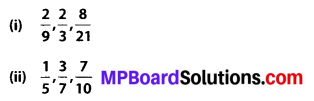
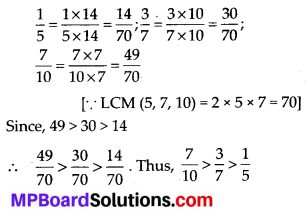
Arrange the following in descending order:
MP Board Class 7th Maths Solutions Chapter 2 Fractions and Decimals Ex 2.1 3
Solution:
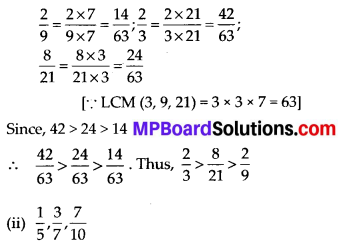
(i)
\(\frac{2}{9}, \frac{2}{3}, \frac{8}{21}\)
Converting them into like fractions, we obtain
MP Board Class 7th Maths Solutions Chapter 2 Fractions and Decimals Ex 2.1 4
Converting them into like fractions, we obtain
MP Board Class 7th Maths Solutions Chapter 2 Fractions and Decimals Ex 2.1 5

Question 3.
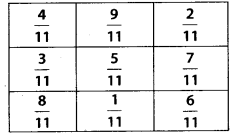
In a “magic square”, the sum of the numbers in each row, in each column and along the diagonals is the same. Is this a magic square?
MP Board Class 7th Maths Solutions Chapter 2 Fractions and Decimals Ex 2.1 6
(Along the first row \(\frac{4}{11}+\frac{9}{11}+\frac{2}{11}=\frac{15}{11}\)).
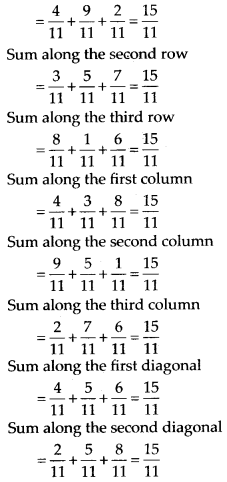
Solution:
Sum along the first row
MP Board Class 7th Maths Solutions Chapter 2 Fractions and Decimals Ex 2.1 7
Since, the sum of the numbers in each row, in each column and along the diagonals is the same.
Yes, it is a magic square.

MP Board Class 7th Maths Solutions Chapter 2 Fractions and Decimals Ex 2.1

Question 4.
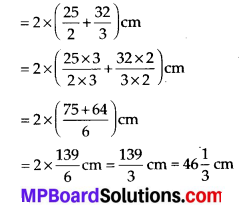
A rectangular sheet of paper is \(12 \frac{1}{2}\) cm long and \(10 \frac{2}{3}\) cm wide. Find its perimeter.
Solution:
Length = \(12 \frac{1}{2}\) cm = \(\frac{25}{2}\) cm and
Breadth \(=10 \frac{2}{3} \mathrm{cm}=\frac{32}{3} \mathrm{cm}\)
Perimeter = 2 × (Length + Breadth)
MP Board Class 7th Maths Solutions Chapter 2 Fractions and Decimals Ex 2.1 8

Question 5.
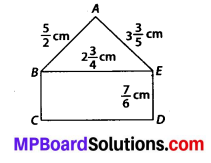
Find the perimeters of
(i) ∆ABE
(ii) the rectangle BCDE in this figure. Whose perimeter is greater?
MP Board Class 7th Maths Solutions Chapter 2 Fractions and Decimals Ex 2.1 9
Solution:
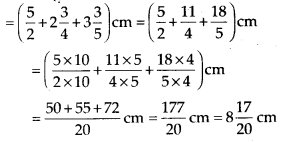
(i) Perimeter of rectangle
∆ABE = AB + BE + EA
MP Board Class 7th Maths Solutions Chapter 2 Fractions and Decimals Ex 2.1 10
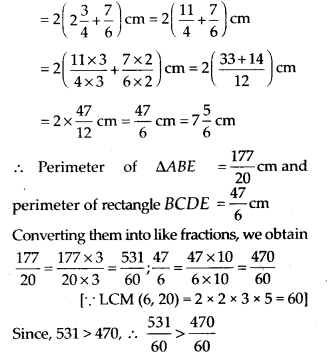
(ii) Perimeter of rectangle BCDE = 2(BE+DE)
MP Board Class 7th Maths Solutions Chapter 2 Fractions and Decimals Ex 2.1 11
MP Board Class 7th Maths Solutions Chapter 2 Fractions and Decimals Ex 2.1 12
So, \(\frac{177}{20}>\frac{47}{6}\)
Thus, perimeter of ∆ABE is greater

MP Board Class 7th Maths Solutions Chapter 2 Fractions and Decimals Ex 2.1

Question 6.
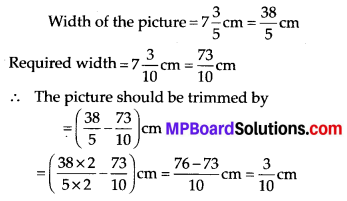
Salil wants to put a picture in a frame. The picture is \(7 \frac{3}{5}\) cm wide. To fit in the frame the picture cannot be more than \(7 \frac{3}{10}\) cm wide. How much should the picture be trimmed?
Solution:
MP Board Class 7th Maths Solutions Chapter 2 Fractions and Decimals Ex 2.1 13

Question 7.
Ritu ate 2 part of an apple and the remaining apple was eaten by her brother Somu. How much part of the apple did Somu eat? Who had the larger share? By how much?
Solution:
Part of an apple eaten by Ritu = \(\frac{3}{5}\)
Part of an apple eaten by Somu = 1 – (Part of an apple eaten by Ritu)
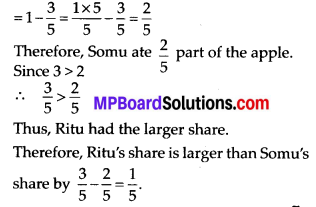
MP Board Class 7th Maths Solutions Chapter 2 Fractions and Decimals Ex 2.1 14

MP Board Class 7th Maths Solutions Chapter 2 Fractions and Decimals Ex 2.1

Question 8.
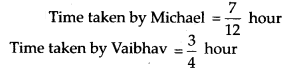
Michael finished colouring a picture in \(\frac{7}{12}\) hour. Vaibhav finished colouring the same picture in \(\frac{3}{4}\) hour. Who worked longer?
Solution:
MP Board Class 7th Maths Solutions Chapter 2 Fractions and Decimals Ex 2.1 15
Converting these fractions into like fractions, we obtain
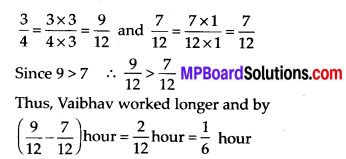
MP Board Class 7th Maths Solutions Chapter 2 Fractions and Decimals Ex 2.1 16

MP Board Class 7th Maths Solutions