MP Board Class 7th Hindi Sugam Bharti Solutions Chapter 16 नीति दशक

MP Board Class 7th Hindi Sugam Bharti Solutions Chapter 16 नीति दशक

MP Board Class 7th Hindi Sugam Bharti प्रश्न-अभ्यास

वस्तुनिष्ठ प्रश्न
Mp Board Class 7th Hindi Chapter 16 प्रश्न 1.
(क) सही जोड़ियाँ बनाइए
1. डार-पात = (क) लाख विकाय
2. जहाँ पुष्प. = (ख) सम लाभ
3. जहाँ सजन = (ग) फल, फूल
4. गुण कूँ गाहक = (घ) तहँ प्रीति
5. समय लाभ = (ङ) तहँ वास
उत्तर
1. (ग), 2. (ङ), 3. (घ), 4. (क), 5. (ख)

Mp Board Solution Class 7 प्रश्न (ख)
दिए गए शब्दों में से उचित शब्द का चयन कर रिक्त स्थानों की पूर्ति कीजिए
1. कबीर ने ……………… को दूर न करने की सलाह दी है। (प्रशंसक निंदक)
2. जब तक ………………. नहीं होता तब तक मित्र नहीं बनते। (वित्त/चित्त)
3. रहिमन ……………….. अंबु बिन, रवि ताकर रिप होय। (अंबुद/अंबुज)
4. विचार पूर्वक कार्य करने से ………….. राजी रहते हैं। (निजलोक सर्वलोक)
उत्तर
1. निंदक
2. वित्त
3. अंबुज
4. सर्वलोक।

MP Board Class 7th Hindi Sugam Bharti अति लघु उत्तरीय प्रश्न

Mp Board Class 7th Hindi प्रश्न 2.
निम्नलिखित प्रश्नों के उत्तर एक-एक वाक्य में लिखिए

(क)
कवि ने अमोल किसे कहा है?
उत्तर
कवि ने बोली को अमोल कहा है।

(ख)
कबीर के अनुसार तन-मन को निर्मल कौन करता है?
उत्तर
सबका मान करने से तन-मन निर्मल हो जाता है।

(ग)
वृंद कवि के अनुसार प्रेम का वास कहाँ होता है?
उत्तर
कवि द्वंद के अनुसार प्रेम का वास प्रेमी के हृदय में होता है।

(घ)
रहीम कवि ने अनुसार ऊख और प्रेम में गाँठ पड़ जाने से क्या होता है?
उत्तर
कवि ने अनुसार ऊख में गाँठ पड़ने से रस में कमी आती है जबकि प्रेम में गाँठ पड़ने से रस में कमी आती है जबकि प्रेम में गाँठ पड़ने पर प्रीत में कमी आती है।

(ङ)
बंद कवि ने सब लोगों के प्रसन्न रखने के लिए कौन-सा उपचार करने के लिए कहा है?
उत्तर
कवि के अनुसार कुछ भी निर्णय लेने से पहले सबकी सुननी चाहिए तथा स्वयं के और सबके विचारों से निष्कर्ष निकालना चाहिए।

MP Board Class 7th Hindi Sugam Bharti लघु उत्तरीय प्रश्न

Mp Board Solution Class 7 Hindi प्रश्न 3.
निम्नलिखित प्रश्नों के उत्तर तीन से पाँच वाक्यों में लिखिए

(क)
कबीर ने तराजू में तौलने के लिए किसे और क्यों कहा है?
उत्तर
कबीर ने बोली को तौलने के लिए कहा है क्योंकि बोली से बने बनाए घर उजड़ भी सकते हैं और संवर भी सकते हैं इसलिए सोच समझ कर बोलना चाहिए।

(ख)
कवि ने किस गुण की कीमत कौड़ी के समान बताई है?
उत्तर
कवि ने उस गुण की कीमत कौड़ी के समान बताई जिसे कोई स्वीकार नहीं करता अर्थात जिस गुण से समाज व लोगों को कोई लाभ नहीं होता वह ना के बराबर होता है।

(ग)
रहीम ने बबूल के पेड़ को क्यों खराब कहा है?
उत्तर
रहीम ने बबूल के पेड़ को इसलिए खराब कहा है क्योंकि उसमें कोई फल-फूल नहीं होते अर्थात जो व्यक्ति स्वयं स्वार्थी हो, यदि वह किसी को सीख दे तो वह अनर्थक लगता है।

(घ)
‘ससि सुकेस’ दोहे में किन-किन को एक समान बताया है?
उत्तर
‘ससि सुकेस’ दोहे में ससि, सुकेस, साहस, सलिल, मान तथा सनेह को एक समान कहा गया है क्योंकि ये सारे बढ़ने पर बढ़ते चले जाते है और घटने पर घटते चले जाते हैं।

(ङ)
वृंद कवि ने सज्जन और पुष्प की क्या विशेषाएँ बताई है?
उत्तर
जिस प्रकार पुष्प अपनी खुशबू और मनमोहकता से सबको सम्मोहित कर देता है उसी प्रकार एक सज्जन व्यक्ति समाज में अपने अच्छे और निस्वार्थ कार्यों से सबको आकर्षित करता है।

भाषा की बात

Mp Board Class 7 Hindi प्रश्न 4.
निम्नलिखित शब्दों के शुद्ध उच्चारण कीजिए
निर्मल, वित्त, अम्बुज, ऊख, प्रीति, स्नेह, सर्व
उत्तर
निर्मल, वित्त, अंबुज, ऊख, प्रीति, स्नेह, सर्व।

Sugam Bharti Class 7 प्रश्न 5.
निम्नलिखित शब्दों की वर्तनी शुद्ध कीजिएआमोल, मित्तर, शसि, सजजन, गांठ, जहाँ, चतूर
उत्तर
शब्द = शुद्ध वर्तनी
आमोल = अमोल
मित्तर = मित्र
सजजन = सज्जन
गांठ = गाँठ
जहाँ = जहाँ
चतूर = चतुर

Hindi Mp Board Class 7 MP Board प्रश्न 6.
निम्नलिखित शब्दों के दो-दो पर्यायवाची शब्द लिखिए
निर्मल, पुष्प, समय, पेड़
उत्तर
शब्द = पर्यायवाची शब्द
निर्मल = शुद्ध, स्वच्छ
पुष्प = फूल, कुसुम
समय = वक्त
पेड़ = तरु, वृक्ष

सुगम भारती हिंदी सामान्य कक्षा 7 MP Board प्रश्न 7.
नीचे दिए गए शब्दों में से उपसर्ग छाँटिएअमोल, निर्मल, सुकेस, सजन, सुवास, अनादर, दुर्भावना
उत्तर
Mp Board Class 7th Hindi Chapter 16

Sugam Math Class 7 Solutions MP Board प्रश्न 8.
निम्नलिखित शब्दों को पृथक-पृथक वाक्यों में प्रयोग कीजिए
तराजू, निंदक, मान, विचार, उपचार, वित्त
उत्तर
शब्द = वाक्य
तराजू = मनुष्य को स्वयं सद्भाव के तराजू में तोलना चाहिए।
निंदक = निंदक व्यक्ति की भी बुराई नहीं करनी चाहिए।
मान = बड़ों का मान करना चाहिए।
विचार = मनुष्य अपना विकास अच्छे विचारों के साथ करता है।
वित्त = आजकल जिसके पास वित्त होता है, सब उसके पीछे भागते हैं।

नीति दशक पाठ का परिचय

Mp Board Class 7th English Chapter 16 (कबीर)

प्रस्तुत पंक्तियों में कबीर के कुछ दोहों का वर्णन किया गया है जिनमें उन्होंने जीवन की कुछ सच्चाइयों से अवगत कराया है। उन्होंने कहा है कि व्यक्ति को बोलने से पहले सोचना चाहिए क्योंकि मुख से निकला प्रत्येक शब्द अमूल्य है। इसी प्रकार जब किसी गुण को सार्थकता मिलती है तब वह खूब फलता-फूलता है किंतु जब गुण का महत्त्व समाप्त हो जाता है तो वह कौड़ी के समान हो जाता है। निंदा करने वाले से निंदा नहीं करनी चाहिए बल्कि उसकी तरफ से मन निर्मल रखना चाहिए।

नीति दशक संदर्भ-प्रसंग सहित व्याख्या

1. बोली एक अमोल है, जो कोई बोले जानि।
हिये तराजू तौलि के, तब मुख बाहर आनि।।

शब्दार्थ – अमोल = अमूल्य; अमूल्य = अमूल्य, तौलि = तौलना; आनि = आना।

संदर्भ-प्रस्तुत दोहे की पंक्तियाँ हमारी पाठ्य-पुस्तक ‘सुगम भारती’ (हिंदी सामान्य) भाग-7 के पाठ-16 ‘नीति दशक’ से ली गई है। इसके रचचिता कबीर है।

प्रसंग-इसमें व्यक्ति की बोली के महत्त्व के बारे में बताया गया है।

Mp Board 7th Class Hindi Solution व्याख्या
प्रस्तुत दोहे में कबीर ने कहा है कि बोली अमूल्य होती है। मुँह से निकला प्रत्येक बोल वही जानता है जो वह बोलता है। हमें सोच-समझकर और तौल कर कुछ बोलना चाहिए।

विशेष

  • दोहे की भाषा प्रवाहमय है।
  • बोली को महत्त्व दिया गया है।

2. जब गुण कूँ गाहक मिले, तब गुण लाख बिकाइ।
जब गुण गाहक नहीं, तब कौड़ी बदले जाइ।

शब्दार्थ-गाहक = ग्राहक, ग्रहण करने वाला; कौड़ी = महत्त्वहीन।

संदर्भ-पूर्ववत्।

प्रसंग-इसमें गुण के महत्त्व को दर्शाया गया।

नीति दशक रहीम का परिचय

रहीम का जन्म सन् 1556 ई. में लाहौर में हुआ था। वे अकबर के संरक्षक बैराम खां के पत्र थे। उनका पूरा नाम अब्दुर्रहीम खानखाना था। अकबर के नौ रत्नों में वे भी एक थे। वे अकबर के प्रधान सेनापति, मंत्री और वीर योद्धा थे।

1. आप न काहू काम के, डार पात फल फूल ।
औरत को रोकत फिरे, रहिमन पेड़ बबूल।।

शब्दार्थ-रोकत-रोकना।

संदर्भ-प्रस्तुत दोहे की पंक्तियाँ हमारी पाठ्य-पुस्तक ‘सुगम-भारती’ (हिंदी सामान्य’) भाग-7 के पाठ-16 ‘नीति दशक’ से ली गई है। इसके रचयिता ‘रहीम’ हैं।

प्रसंग-इसमें उन लोगों के विषय में कहा गया है जो कपटी है।

व्याख्या-प्रस्तुत दोहे में रहीम ने उन लोगों के विषय में कहा है जो स्वयं कपटी और स्वार्थी हैं तथा सारे दिन पाप के कार्य करते हैं फिर भी दूसरों को गलत काम करने से रोकते हैं।

विशेष

  • भाषा सरल और प्रवाहमय है।
  • स्वार्थी लोगों द्वारा दी गई सीख को दर्शाया गया है।

2. समय लाभ समय लाभ सम लाभ नहिं,
समय चूंकि सम चूक।
चतुरन चित रहिमन लगी,
समय चूंकि की हूक ॥

शब्दार्थ-वित्तत = धन, पूंजी।

संदर्भ-पूर्ववत्।

प्रसंग-इसमें चतुर व्यक्तित्व के बारे में कहा गया है।

व्याख्या-प्रस्तुत दोहे में रहीम ने कहा है कि जब व्यक्तिको लाभ का समय मिले या ईश्वर अवसर प्रदान करे तो उसे ग्रहण कर लेना चाहिए। एक बार समय निकलने पर अवसर भी हाथ से चला जाता है। एक चतुर और समझदार व्यक्ति अवसर को अपने हाथ में नहीं जाने देता।

विशेष

  • भाषा सरल और प्रवाहमय है।
  • समय की सार्थकता को प्रकट किया गया है।

3. जब लगि वित्त न आपुने, तब लगि मित्त न कोय।
रहिमन अंबुज अंबु बिन, रवि ताकर रिपु होय।।

शब्दार्थ-मित्त = मित्र; अंबुज = कमल; अंबु = पानी; रवि = सर्य; रिपु = शत्रु, दुश्मन।

संदर्भ-पूर्ववत् ।
प्रसंग-इसमें स्वार्थ के बारे में कहा गया है।

व्याख्या- प्रस्तुत दोहे में बताया गया है कि जब तक हमारे पास पैसा होता है तब तक हमारे पास मित्र होते हैं और उसके नहीं रहने पर मित्र भी चले जाते हैं। इसी | तरह बिना पानी के सूर्य भी कमल का दुश्मन बन जाता है।

विशेष

  • भाषा सरल और प्रवाहमय है
  • इसमें लालच के संदर्भ में कहा गया है।

4. रहिमन खोजे ऊख में, जहाँ रसनि की खानि
जहाँ गाँठ तहं रस नहीं, यही प्रीति में हानि॥

शब्दार्थ-ऊख = गन्ना; रसनि = रस; खानिखान।

संदर्भ-पूर्ववत्
प्रसंग-इसमें प्रेम के मध्य ठीस को उजागर किया गया है।

व्याख्या-प्रस्तुत दोहे में रहीम ने गन्ने का उदाहरण लिया है कि जिस प्रकार गन्ने में रस भरा होता है और इससे आनंद भी मिलता है परंतु हमें उसकी गाँठों को नहीं भूलना चाहिए जिनमें रस नहीं होता उसी प्रकार अधिक प्रेम में भी गाँठ आ सकती है। .

विशेष

  • भाषा सरल और प्रवाहमय है।
  • इसमें सुख-दुख को दर्शाया गया है।

5. ससि सुकेस साहस सलिल मान सनेह रहीम।
बढ़त बढ़त बढ़ि जात है, घटत घटत घटि सीम।।

शब्दार्थ-ससि = चंद्रमा; सुकेस = बाल, सलिल = पानी, जल।

संदर्भ-पूर्ववत्।
प्रसंग-इसमें चंद्रमा, केस आदि के बढ़ने और घटने पर विचार किया गया है।

व्याख्या-प्रस्तुत दोहे में रहीम ने कहा है कि चंद्रमा, बाल, साहस, पानी, माम और प्रेम आदि जितनी तेजी से बढ़ते है उतनी तेजी से ही कम होते चले जाते हैं अर्थात जीवन में कुछ भी स्थिर नहीं है, सबकी नियती और चाल में अंतर आना स्वाभाविक है।

विशेष

  • निरतंरशीलता को दर्शाया गया है।
  • भाषा सरल एवं प्रवाहमय है।

नीति दशक वृंद का परिचय

वृंद का पूरा नाम वृंदावन दास था। वे रीतिकाल के सुप्रसिद्ध कवि थे। उनका जन्म सन् 1643 ई. में मेड़ना नामक गाँव में हुआ था, जो जोधपुर, राजस्थान में है। उनका कार्यक्षेत्र बहुत विस्तृत था। वे अपने आश्रदयाताओं के साथ सदा यात्रा करते रहे। वे कृष्णगढ़ नरेश महाराज राजसिंह के गुरु थे। वे उनके साथ औरगजेब की फौज में ढाका तक गए थे।

1. जहाँ सहन तहं प्रीति है, प्रीति तहाँ सुख ठौर।
जहाँ पुष्प तहं वास है, जहाँ बास तहं मौर।।

शब्दार्थ-ठौर = स्थान; प्रीति = प्रेम; पुष्प = फूल।

संदर्भ-इस दोहे के रचयिता महाकवि वृंद हैं।
प्रसंग-इसमें प्रेम की सार्थकता के बारे में बताया गया है।

व्याख्या-प्रस्तुत दोहे में महाकवि वृंद प्रेम की सार्थकता को प्रकट करते हुए कहते हैं कि सच्चे प्रेम का सुख तभी प्राप्त होता है जब प्रेमी भी प्रेम में डूबा हो। जहाँ फूलों का वास होगा, वहीं मोर भी घूमेगा। अतः प्रेम अतुल्नीय है।

विशेष

  • भाषा सरल एवं प्रवाहमय है।
  • प्रेम को अतुल्नीय बताया गया है।

2. सुनिए सबही की कही, करिए सहित विचार।
सर्व लोक राजी रहै, सो कीजे उपचार।।

शब्दार्थ-सर्वलोक = सभी लोग, सारा संसार; हिये = हृदय।

संदर्भ-पूर्ववत्।
प्रसंग-सब लोगों के सुनने पर बल दिया गया है।

व्याख्या-प्रस्तुत दोहे में कवि वृंद ने व्यक्ति विशेष से कहा है कि हमें कुछ भी निर्णय लेने से पहले सबकी राय सुननी चाहिए, तत्पश्चात विचार करना चाहिए। अंतत, ऐसा निर्णय लेना चाहिए, तत्पश्चात, विचार करना चाहिए। अंतत ऐसी निर्णय लेना चाहिए। जिसमें जिससे सभी संबंधित लोग एकमत हो। अर्थात हमें कोई भी कार्य जल्दबाजी में नहीं करना चाहिए।

विशेष

  • भाषा सरल एवं प्रवाहमय है।
  • इसमें कार्य की सार्थकता पर बल दिया गया है।

MP Board Class 7th Hindi Solutions

MP Board Class 7th Sanskrit Model Question Paper

MP Board Class 7th Sanskrit Model Question Paper (आदर्श प्रश्नपत्रम्)

प्रश्न 1.
(अ) सही विकल्प चुनकर लिखिए
(क) बदरीनाथधामास्ति
(i) गुजरातराज्ये
(ii) उड़ीसाराज्ये
(iii) कर्नाटकराज्ये
(iv) उत्तराखण्डराज्ये।
उत्तर:
(iv) उत्तराखण्डराज्ये

(ख) सिंह पीडितः आसीत्
(i) पिपासया
(ii) क्षुधया
(iii) ज्वरेण
(iv) शत्रुणा।
उत्तर:
(ii) क्षुधया

(ग) अपदं दूरगामी अस्ति
(i) पत्रम्
(ii) पक्षी
(iii) पशुः
(iv) मनुष्यः।
उत्तर:
(i) पत्रम्

(घ) पृथिव्याः उपग्रहः अस्ति
(i) बुधः
(ii) शनिः
(iii) चन्द्रः
(iv) शुक्रः।
उत्तर:
(iii) चन्द्रः

(ङ) लोकमान्यतिलकेन आरब्धः उत्सवः अस्ति
(i) दीपोत्सवः
(ii) होलिकोत्सवः
(iii) गणेशोत्सवः
(iv) स्वतन्त्रतादिवसोत्सवः।
उत्तर:
(iii) गणेशात्सवः

(ब) दिये गये शब्दों से रिक्त स्थानों की पूर्ति कीजिए
(खड्गं, मूलाधारः, पूर्णिमा, तक्षशिला, शूलपाणिः)
(क) धर्म एव भारतस्य एकतायाः ………….. अस्ति।
(ख) ………. विश्वविख्यातम् अध्ययनकेन्द्रमासीत्।
(ग) त्रिनेत्रधारी न च ……….. ।
(घ) …………. गृहीत्वा युद्धं कुरु।
(ङ) शुक्लपक्षे ………… तिथि भवति।
उत्तर:
(क) मूलाधारः
(ख) तक्षशिला
(ग) शूलपाणिः
(घ) खड्गं
(ङ) पूर्णिमा।

प्रश्न 2.
अधोलिखित गद्यांश को पढ़कर प्रश्नों के उत्तर लिखो-

एकस्मिन् पर्वते दुर्मुखः नाम महौजस्वी सिंहः वसति स्म। सः च सदैव बहूनां पशूनां वधं करोति स्म। एकदा सर्वे पशवः सिंहस्य समीपम् अगच्छन् अवदन् च मृगेन्द्र! त्वं सदैव पशूनां वधं कथं करोषि? प्रसीद वयं स्वयं तव भोजनाय प्रतिदिनम् एकैकं पशुं प्रेषयिष्यामः।

(क) पर्वते किं नाम सिंहः प्रतिवसति स्म? (पर्वत पर किस नाम का शेर रहता था?)
उत्तर:
पर्वते दुर्मुखः नाम सिंहः वसति स्म। (पर्वत पर दुर्मुख नाम का शेर रहता था।)

(ख) सः केषां वधं करोति स्म? (वह किनका करता था?)
उत्तर:
स: बहूनां पशूनां वधं करोति स्म। (वह बहुत से पशुओं का वध किया करता था।)

(ग) के सिंहस्य समीपम् अगच्छन्? (कौन शेर के पास आये थे?)
उत्तर:
सर्वे पशवः सिंहस्य समीपम् अगच्छन् स्म। (सभी पशु शेर के पास गये थे।)

(घ) वयं प्रतिदिन किं प्रेषयिष्यामः? (हम सब प्रतिदिन किसको भेजेंगे?)
उत्तर:
वयं प्रतिदिनं एकैकं पशु प्रेषयिष्यामः। (हम सब प्रतिदिन एक-एक पशु को भेजेंगे।)
अथवा

योगेन शरीरं चित्तम् अपि स्वस्थं भवति। “शरीरमाद्यं खलु धर्मसाधनम्” इति प्रसिद्धं वचनम्। स्वस्थ शरीर अध्ययनं सुकरं भवति। तेन चित्तस्य एकाग्रता भवति। कार्ये कौशलं जायते। योगस्य अभ्यासेन अनेके लाभाः सम्भवन्ति।

(क) शरीरं चित्तं न केन स्वस्थं भवति? (शरीर और चित्त किससे स्वस्थ होता है?)
उत्तर:
योगेन शरीरं चित्तं न स्वस्थं भवति। (योग से शरीर और चित्त स्वस्थ होता है।)

(ख) धर्मस्य आद्यं साधनं किम् अस्ति? (धर्म का आदि साधन क्या है?)
उत्तर:
धर्मस्य आद्यं साधनं शरीरं अस्ति। (धर्म का आदि साधन शरीर है।)

(ग) स्वस्थे शरीरे किं सुकरं भवति? (स्वस्थ शरीर में क्या आसान होता है?)
उत्तर:
स्वस्थ शरीरे अध्ययनं सुकरं भवति। (स्वस्थ शरीर में अध्ययन आसान होता है।)

(घ) कार्ये किं जायते? (कार्य करने पर क्या पैदा होता है?)
उत्तर:
कार्ये कौशलं जायते। (कार्य करने पर कुशलता पैदा होती है।)

प्रश्न 3.
अधोलिखित पद्यांश को पढ़कर प्रश्नों के उत्तर लिखो-
माता शत्रुः पिता वैरी, येन बालो न पाठितः।
न शोभते सभामध्ये, हंसमध्ये बको यथा।।

(क) यया बालो न पाठितः सा माता कीदृशी? (जिस माता के द्वारा बालक को शिक्षित नहीं कराया जाता बह माता कैसी होती है?)
उत्तर:
सा माता शत्रुः अस्ति। (वह माता शत्रु होती है)

(ख) येन बालो न पाठितः स पिता कीदृशः? (जिस पिता के द्वारा बालक को शिक्षित नहीं कराया जाता वह पिता कैसा होता है?)
उत्तर:
सः पिता वैरी अस्ति। (वह पिता बैरी होता है।)

(ग) यः न पठितवान् स: कुत्र न शोभते? (जो अशिक्षित है वह कहाँ शोभा नहीं देता?)
उत्तर:
सः सभामध्ये न शोभते। (वह सभा के बीच शोभा नहीं देता।)

(घ) यः न पठितवान् सः कथं न शोभते? (जो अशिक्षित है वह कैसे शोभा नहीं देता?)
उत्तर:
सः हंसमध्ये बको यथा न शोभते। (वह हंसों के बीच बगुले की तरह शोभा नहीं देता।)
अथवा

वरमेको गुणी पुत्रो न मूर्ख-शतान्यपि।
एकश्चन्द्रस्तमो हन्ति, न च तारागणा अपि॥

(क) कः पुत्रः वरम् अस्ति? (कौन-सा पुत्र श्रेष्ठ होता है?)
उत्तर:
गुणी पुत्रः वरम् अस्ति। (गुणवान पुत्र श्रेष्ठ होता है।)

(ख) कति मूर्खपुत्राः न वराणि? (कितने मूर्ख पुत्र अच्छे नहीं होते हैं?)
उत्तर:
शतानि मूर्खपुत्राः न वराणि। (सौ मूर्ख पुत्र अच्छे नहीं होते हैं।)

(ग) कः तमो हन्ति? (कौन अन्धकार को नष्ट कर देता है?)
उत्तर:
चन्द्रः तमो हन्ति। (चन्द्रमा अन्धकार को नष्ट कर देता है।)

(घ) क तमो न घ्नन्ति? (कौन अन्धकार को नष्ट नहीं कर पाते हैं?)
उत्तर:
ताराः तमो न घ्नन्ति। (तारे अन्धकार को नष्ट नहीं कर पाते हैं।)

प्रश्न 4.
(अ) पाठ्य पुस्तक से कण्ठस्थ किया हुआ एक श्लोक लिखो जो इस प्रश्न-पत्र में न हो।
उत्तर:
विद्या विवादाय धनं मदाय, शक्तिः परेषां परिपीडनाय।
खलस्य साधोः विपरीतमेतत्, ज्ञानाय दानाय च रक्षणाय।।

(ब) श्लोक को पूरा करो
जलबिन्दुं …………… क्रमशः …………. घटः।
स ………… सर्वविद्यानां ……….. च धनस्य च ॥
उत्तर:
निपातेन, पूर्यते, हेतु, धर्मस्य।

(स) पाठ्य पुस्तक से कण्ठस्थ की हुई एक सूक्ति लिखो।
उत्तर:
आचार: परमो धर्मः।

प्रश्न 5.
(अ) अधोलिखित प्रश्नों के उत्तर एक शब्द में लिखो
(क) प्रयत्नेन के विश्वप्रियाः? (प्रयत्न करने से कौन विश्वप्रिय बन गये?)
उत्तर:
भारतीयाः

(ख) के उत्सवप्रियाः भवन्ति? (कौन उत्सवप्रिय होते हैं?)
उत्तर:
जनाः

(ग) सिक्खानां दशमः गुरुः क आसीत्? (सिक्खों के दसवें गुरु कौन थे?)
उत्तर:
गुरुगोविन्दसिंहः

(घ) सुप्तोऽपि नेत्रे कः न निमीलयति? (सोने पर भी दोनों नेत्रों को कौन बन्द नहीं करती है?)
उत्तर:
मत्स्यः

(ङ) कस्य सहायतां प्रभुः करोति? (प्रभु किसकी सहायता करते हैं?)
उत्तर:
श्रमशीलस्य

(च) केन कार्याणि सिद्धयन्ति? (किससे कार्य सिद्ध हो जाते हैं)
उत्तर:
उद्यमेन

(ब) अधोलिखित प्रश्नों के उत्तर एक वाक्य में लिखो
(क) मठानि किमर्थ स्थापितानि? (मठों की स्थापना किसलिए की गई?)
उत्तर:
धर्मरक्षार्थं वेदान्ततत्त्वानां प्रचारार्थम् च मठानि स्थापितानि। (धर्म की रक्षा और वेदान्त तत्वों के प्रचार के लिए मठों की स्थापना की गई।)

(ख) कौ द्वौ पक्षौ भवतः? (कौन से दो पक्ष होते हैं?)
उत्तर:
शुक्लपक्षः कृष्णपक्ष: च इति दौ पक्षौ भवतः। (शुक्ल पक्ष और कृष्ण पक्ष नामक दो पक्ष होते हैं।)

(ग) भास्कराचार्यः किं प्रतिपादितवान्? (भास्कराचार्य ने क्या प्रतिपादित किया?)
उत्तर:
भास्कराचार्यः गुरुत्वाकर्षणसिद्धांत π (पै) इति गणितचिह्नस्य मानं त्रैराशिकनियमादीन् प्रतिपादितवान्। (भास्कराचार्य ने गुरुत्वाकर्षण सिद्धान्त, गणित चिह्न π (पाई) का मान, त्रैराशिक नियम आदि का प्रतिपादन किया।)

(घ) परोपकारः किमर्थ भवति? (परोपकार किसके लिए होता है)
उत्तर:
परोपकारः पुण्याय भवति। (परोपकार पुण्य के लिए होता है।)

(ङ) बालचरस्य प्रथमा प्रतिज्ञा का अस्ति? (बालचरस्य की पहली प्रतिज्ञा क्या है?)
उत्तर:
‘ईश्वरं स्वदेशं प्रति च कर्त्तव्यपालनं’ बालचरस्य प्रथमा प्रतिज्ञा अस्ति। (‘ईश्वर और अपने देश के प्रति कर्त्तव्य का पालन करना’ बालचर की पहली प्रतिज्ञा है।)

(च) सुलभा कस्य मूर्तिम् अपश्यत्? (सुलभा ने किसकी मूर्ति को देखा?)
उत्तर:
सुलभा मुनेः पतञ्जले: मूर्तिम् अपश्यत्। (सुलभा मे मुनि पतञ्जलि की मूर्ति को देखा।)

प्रश्न 6.
(अ) अधोलिखित शब्दों के रूप तीनों वचनों में लिखो-
(क) लेखनी-पञ्चमी विभक्ति
(ख) सर्व-तृतीया विभक्ति (पुल्लिङ्ग)
(ग) मधु-चतुर्थी विभक्ति।
उत्तर:
MP Board Class 7th Sanskrit Model Question Paper img 1

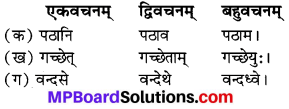
(ब) अधोलिखित के धातुरूप निर्देशानुसार तीनों वचनों में लिखो-
(क) पठ्-लोट्लकारः (आज्ञार्थकः), उत्तमपुरुषः।
(ख) गम् (गच्छ्)-विधिलिङ्लकारः, प्रथमपुरुषः।
(ग) वन्द-(आत्मनेपद) लट्लकारः, मध्यमपुरुषः।
उत्तर:
MP Board Class 7th Sanskrit Model Question Paper img 2

(स) अधोलिखित में रेखांकित शब्दों के कारक नाम लिखो-
(क) खगः वृक्षे निवसति।
(ख) रामः पठति।
(ग) हिमालयात् गङ्गा प्रभवति।
(घ) राजा ब्राह्मणाय धनं ददाति।
उत्तर:
(क) अधिकरणकारकम् (सप्तमी विभक्तिः)
(ख) कर्तृकारकम् (प्रथमा विभक्तिः)
(ग) अपादानकारकम् (पञ्चमी विभक्तिः)
(घ) सम्प्रदानकारकम् (चतुर्थी विभक्तिः)

प्रश्न 7.
(अ) अधोलिखित शब्दों के धातु और प्रत्यय अलग करो-
(क) विलिख्य
उत्तर:
विलिख्या = वि (उपसर्गः) + लिख् (धातुः) + य (ल्यप्)

(ख) कृतवान्
उत्तर:
कृतवान् = कृ धातुः + क्तवतु प्रत्ययः

(ग) लिखित्वा
उत्तर:
लिखित्वा = लिख (धातुः) + त्वा (क्त्वा प्रत्ययः)

(घ) क्रीडितः।
उत्तर:
क्रीडितः = क्रीड् धातुः + क्त प्रत्ययः

(ब) अधोलिखित के उपसर्ग अलग करो-
(क) उपकरोति
(ख) अनुधावति
(ग) पराजयते
(घ) उद्भवति।
उत्तर:
(क) उप
(ख) अनु
(ग) परा,
(घ) उत्।

(स) अधोलिखित में से अव्यय चुनकर लिखो-
(क) धेनु
(ख) अतः
(ग) नगरम्
(घ) पुरतः
(ङ) मा।
उत्तर:
(ख) अतः
(घ) पुरतः
(ङ) मा।

प्रश्न 8.
(अ) अधोलिखित शब्दों की सन्धि विच्छेद करके सन्धि का नाम लिखो-
(क) देवर्षिः
(ख) अजन्तः
(ग) पावकः
(घ) सुबन्तः।
उत्तर:
(क) देवर्षिः = देव + ऋषिः (स्वरसन्धिः)
(ख) अजन्तः = अच् + अनतः (व्यञ्जनसन्धिः)
(ग) पावकः = पौ + अकः (स्वरसन्धिः)
(घ) सुबन्तः = सुप् + अन्तः (व्यञ्जनसन्धिः)

(ब) अधोलिखित शब्दों के समास विग्रह करके समास का नाम लिखो-
(क) चौरभयम्
(ख) पंचवटी
(ग) उपकृष्णम्।
उत्तर:
(क) चौरभयम्-चौराद् भयम् (तत्पुरुषसमासः)
(ख) पंचवटी-पञ्चानां वटानां समाहारः (द्विगुसमास:)
(ग) उपकृष्णम्-कृष्णस्य समीपम् (अव्ययीभावसमासः)

(स) अधोलिखित संख्याओं को संस्कृत में लिखो-
(क) 14
(ख) 18
(ग) 16
उत्तर:
(क) 14-चतुर्दश
(ख) 18-अष्टादश
(ग) 16-षोडश।

प्रश्न 9.
अधोलिखित शब्दों से पत्र को पूरा करो-
(भ्रमणार्थं, स्वास्थ्यम्, प्रणामाः, परीक्षा, कुशलिनी)

खजूरीपन्थतः
3 जनवरी, 20……….

पूज्यमातः! …………..
अहम् ईश्वरस्य कृपया ………….. अस्मि।
भवत्याः ………….. कथम् अस्ति?
अहं अस्मिन् मासे ………. गमिष्यामि। आगामिमासे मम ……….. अस्ति। पितृचरणौ वन्दे।

भवत्याः पुत्री
शैलजा

उत्तर:
प्रणामाः, कुशलिनी, स्वास्थ्यम्, भ्रमणार्थम्, परीक्षा।

प्रश्न 10.
अधोलिखित में से किसी एक विषय पर पाँच वाक्यों में संस्कृत में निबन्ध लिखो
(क) मम विद्यालयः
उत्तर:

  1. मम विद्यालयः ‘खाईखेड़ा’ ग्रामे स्थितः अस्ति।
  2. विद्यालयस्य भवनम् अतीवसुन्दरम् अस्ति।
  3. अहं विद्यालयं गत्वा गुरून् प्रणमामि।
  4. विद्यालये एकम् उद्यानम् अपि अस्ति।
  5. विद्यालये एक विशालं क्रीडाक्षेत्रम् अस्ति।

(ख) पुस्तकम्
उत्तर:

  1. पुस्तकानि मह्यम् अतीव रोचन्ते।
  2. पुस्तकानि ज्ञानस्य भण्डारः भवन्ति।
  3. पुस्तकानि अस्माकं मित्राणि सन्ति।
  4. पुस्तकानां सङ्गति लाभप्रदा भवति।
  5. अस्माभिः पुस्तकानि रक्षणीयानि।

(ग) उद्यानम्
उत्तर:

  1. उद्यानम् अत्यन्तं रमणीयं भवति।
  2. बालकाः उद्यानं क्रीडन्ति।
  3. उद्याने तडागः अपि अस्ति।
  4. जनाः उद्यानं भ्रमणार्थं गच्छन्ति।
  5. खगाः वृक्षेषु निवसन्ति।

(घ) धेनुः।
उत्तर:

  1. धेनुः अस्माकं माता अस्ति।
  2. धेनूनां विविधाः वर्णाः भवन्ति।
  3. धेनुः तृणानि भक्षयति।
  4. धेनुः जनेभ्यः मधुरं पयः प्रयच्छति।
  5. वयं धेनुं मातृरूपेण पूजयामः।

अथवा
अधोलिखित शब्दों की सहायता से पाठ्य पुस्तक में चित्र देखकर संस्कृत में पाँच वाक्य लिखो-
(धेनुः, कृषकः, गृहाणि, वृक्षौ, क्षेत्रम्)
उत्तर:
(1) गोपालः धेनुम् दुहति।
(2) कृषकः तापं शीतं वृष्टिं सहित्वा कृषिकर्म करोति।
(3) ग्रामे बहूनि गृहाणि सन्ति।
(4) ग्रामे दौ वृक्षौ स्तः।
(5) प्रात:काले कृषकाः स्व-स्व क्षेत्रम् गत्वा कृषिकर्माणि कुर्वन्ति।

MP Board Class 7th Sanskrit Solutions

MP Board Class 7th Special English Solutions Chapter 1 My Land

Get Updated MP Board Solutions for Class 7 Special English Solutions Chapter 1 My Land Questions and Answers in PDF Format and download them free of cost. These are provided as per the latest exam pattern and syllabus. Access the topics of Chapter wise and communication skills, grammer part through the direct links available depending on the need. You can Download MP Board Class 7 English Solutions and can score highest grade in examination. Clear all your queries on the Mp Board Solutions for Class 7 English Chapter 1 My Land Questions and Answers Subject by using the Madhya Pradesh State Board Solutions for existing.

MP Board Class 7th Special English Solutions Chapter 1 My Land

If you are eager to know about the Madhya Pradesh State Board Solutions for Class 7 English you will find all of them here. You can identify the knowledge gap using these MP Board Solutions for English PDF and plan accordingly. Don’t worry about the accuracy as they are given after extensive research by people having subject knowledge along side from the latest English Syllabus.

My Land Text Book Exercise

Listen and Repeat

Fresh and Fair
Dear and Rare
Rich and Rare
Waver Braver

Comprehension

Choose the correct option-
(i) What do you think the poem is about?
(a) country and country-men
(b) village
(c) town
Answer:
(a) country and country-men

(ii) By what name does the poet call his country?
(a) great land
(b) native land
(c) mother land
Answer:
(b) native land

(iii) What does the poet say about the men in the poem?
(a) coward
(b) lazy
(c) brave
Answer:
(c) brave

(iv) List the words which have been used by the poet in the poem for native land
Answer:
dear and rare, true and bold, rare and fair.

Word Power

A. Use the words given below in on complete sentence each:
dear, rare, divine, pine
Answer:
Priya Gupta in Hardik’s dear friend.
Honesty is a rare thing these days.
Truth is a divine virtue.
She pines for her lover.

B. Make new words adding ‘en’ at the beginning of the word as shown in the example:

  1. rich – enrich
  2. list
  3. circle
  4. able
  5. title
  6. sure

Answer:

  1. enrich
  2. enlist
  3. en-circle
  4. enable
  5. entitle
  6. ensure.

C. Find words from this words square:
Class 7 English Chapter 1 MP Board
Answer:

  1. Flower
  2. Fresh
  3. Earl
  4. Dear
  5. Hat
  6. Dry
  7. Yes
  8. Squirrel
  9. Sharp
  10. Land
  11. Date
  12. Too
  13. Lay
  14. Air

Let’s Talk

‘C’ can be pronounced as:
‘K’ as in cow ‘s’ as in cell
Read aloud and according to their pronunciation separate the following words and write them in proper columns (work in pairs)
attendance Cell, Sentence, Cow, Crane, Correct, Historical Place, Clear, Inspector
Answer:
Class 7 English Chapter 1 My Land Summary MP Board

Let’s Write

A. Match the sentences given at the end with the correct pictures and rearrange the sentences to make a story. Write the complete story in your notebook.
1. Then she found a pup.
2. She brought it home, bandaged its leg and gave it milk and food.
3. Later Sangita had to keep it tied because it chased the hens from the neighbour’s house.
4. It was hurt in one leg. It was crying a lot.
5. Once Sangita went for a walk in the morning. She saw many beautiful flowers and birds on the way.
6. The puppy barked at all the cats in the street.
7. The dog started living with her. It folllowed her every where.
Answer:
The Correct order of sentence is.
5, 1, 4, 2, 3, 6, 7.

Once Sangita went for a walk in the morning she saw many beautiful flowers and birds on the way. Then she found a pup. It was hurt in one leg. It was crying a lot. She brought it home, bandaged its leg and gave it milk and food. Later Sangita had to keep it tied because it chased the hens from the neighbour’s house. The puppy barked at all the cats in the street, The dog started living with her. It followed her everywhere.

Let’s Di It

A. Read different situations of city and village life given in the circle and enlist them accordingly.
Class 7 English Chapter 1 Mp Board
Answer:
My Land Poem Questions And Answers MP Board

My Land Word Meanings

Page: Rare – uncommon विरली, Native land – land of birth जन्म भूमि, Braver – bolder अधिक सुरवीर, Waver – shake हिलना, डोलना, Freely – willingly इच्छ से, Dull – tasteless स्वादरहित, Guard – protect रक्षा करना, Virtue – good qualities सदुगुणा, Reward – return for sevice पुरस्कार, Foe – enemy शत्रु, Border – boundary सीमा, Pine – to suffer कष्ट झेलना

My Land Stanzas for Comprehension

Read the extracts given below and answer the questions that follow each :
A. She is rich and rare land:
O, she a fresh and fair land:
She is a dear and rare land,
This native land of mine.

Class 7 English Chapter 1 My Land MP Board Question.
1. Complete the sentence: She is a rich and ……….
2. Complete the sentence: She is a fresh and ………
3. Complete the sentence: She is a dear and ……….
4. Give the meaning of native land.
Answer:
1. She is a rich and rare land.
2. She is a fresh and fair land.
3. She is a dear and rare land.
4. Native land means the land of one’s birth.

B. No men than hers are braver,
Her women’s hearts ne’er waver;
I’d freely die to save her,
And think my lot divine.

Mp Board Class 7th English Chapter 1 Question.
1. Which country’ people are the bravest?
2. How are the women’s hearts there?
3. What would the poet do to save his land?
4. Use the word ‘lot’ in a sentence.
Answer:
1. The people of the poet’s country are the bravest.
2. There the women’s hearts are not fickle.
3. The Poet would freely die to save his mother land.
4. Nobody knows what is in his lot.

C. She’s not a dull or cold land;
No! she’s a warm and bold land,
Oh! she’s a true and old land;
This native land of mine.

My Land Poem Class 7th MP Board Question.
1. Give the meaning of cold.
2. Give the meaning of warm.
3. Is the poet’t country dull or cold?
4. Complete the sentence: She is a true and ……….
Answer:
1. Cold here means heartless.
2. Warm here means full of kindly feelings.
3. The peot’t country is neither dull nor cold.
4. She is a true and old land.

D. Could beauty ever guard her,
And virtue still reward her,
No foe would cross her border,
No friend within it pine.

Class 7th English Chapter 1 My Land MP Board Question.
1. which are the two qualities of the poet’s land?
2. Would the foe ever cross her border?
3. Give the antonyms of : beauty, ever, friend, virtue, reward.
4. Use the word ‘within’ in your own sentence.
Answer:
1. Beauty and virtue are the two qualities of the poet’t land.
2. No, the foe would never cross her border.
3. Ugliness, never, foe, vice, punish.
4. I shall return within a week.

We believe the information shared regarding MP Board Solutions for Class 7 English Chapter 1 My Land Questions and Answers as far as our knowledge is concerned is true and reliable. In case of any queries or suggestions do leave us your feedback and our team will guide you at soonest possibility. Bookmark our site to avail latest updates on several state board Solutions at your fingertips.
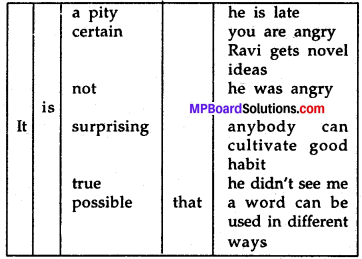
MP Board Class 7th General English Solutions Chapter 3 The Wise Man-II

Get Updated MP Board Solutions for Class 7 General English Chapter 3 The Wise Man-II Questions and Answers in PDF Format and download them free of cost. These are provided as per the latest exam pattern and syllabus. Access the topics of Chapter wise and communication skills, grammer part through the direct links available depending on the need. You can Download MP Board Class 7 English Solutions and can score highest grade in examination. Clear all your queries on the Mp Board Solutions for Class 7 English Chapter 21 Tansen Questions and Answers Subject by using the Madhya Pradesh State Board Solutions for existing.

MP Board Class 7th General English Solutions Chapter 3 The Wise Man-II

If you are eager to know about the Madhya Pradesh State Board Solutions for Class 7 English you will find all of them here. You can identify the knowledge gap using these MP Board Solutions for English PDF and plan accordingly. Don’t worry about the accuracy as they are given after extensive research by people having subject knowledge along side from the latest English Syllabus.

The Wise Man-II Textual Exercises

Read and Learn (पढ़ो और याद करो)
Students should do themselves. (छात्र स्वयं करें।)

Comprehension (बोध प्रश्न) :

(A) Answer the questions given below :
(निम्नलिखित प्रश्नों के उत्तर दीजिए)

Mp Board Class 7th English Chapter 3 Question 1.
What did the thugs ask Bhola ?
(व्हॉट डिड द ठग्स, आस्क् भोला?) ठगों ने भोला से क्या पूछा ?
Answer:
The thugs asked Bhola if he would sell his mangoes.
(द ठग्स् आस्कड् भोला इफ ही वुड सैल हिज़ मैंगोज़।) ठगों ने भोला से पूछा कि क्या वह अपने आम बेचेगा।

Class 7th English Chapter 3 The Wise Man 2 MP Board Question 2.
Did Bhola agree to sell the green mangoes ?
(डिड भोला एग्री टू सैल द ग्रीन मैंगोज़ ?)
क्या भोला आम बेचने के लिए तैयार हुआ ?
Answer:
No, Bhola did not agree to sell the green mangoes.
(नो, भोला डिड नॉट एग्री टू सैल द ग्रीन मैंगोज़।)
नही, भोला हरे आम बेचने के लिए तैयार नहीं हुआ।

Class 7th Mp Board English Question 3.
Did Bhola’s wife like chutney ?
(डिड भोलाज़ वाईफ लाइक चटनी ?)
क्या भोला की पत्नी चटनी पसन्द करती थी ?
Answer:
Yes, Bhola’s wife liked chutney very much.
(यस, भोलाज़ वाईफ लाइक्ड् चटनी वैरी मच।)
हाँ, भोला की पत्नी चटनी बहुत पसन्द करती थी।

Class 7 English Chapter 1 Mp Board Question 4.
What was the bet ?
(व्हॉट वॉज़ द बैट ?) शर्त क्या थी?
Answer:
The two thugs made a bet with Bhola that they would give him one thousand rupees if his wife does not get angry with him for bringing mangoes in exchange of a horse. And Bhola would pay them the same amount if she goes against his decision.
(द टू ठग्स मेड अ बैट विद भोला दैट दे बुड गिव हिम वन थाऊसन्ड रूपीज़ इफ हिज़ वाइफ डज़ नॉट गैट एंग्री विद हिम फॉर ब्रिग्रिंग मैंगोज इन एक्सचेन्ज ऑफ अ हॉर्स। एण्ड भोला वुड पे देम द सेम अमाउन्ट इफ शी गोज़ अगेन्स्ट हिज़ डिसीशन।)
दो ठगों ने भोला से शर्त लगाई कि वे भोला को एक हजार रुपये देंगे, अगर उसकी पत्नी उस पर एक घोड़े के बदले में आम ले जाने पर क्रोधित नहीं होगी। और भोला उन्हें उतनी ही रकम देगा, अगर वह उसके निर्णय के विरुद्ध गई।

Question 5.
Who won the bet?
(हू वन द बैट ?)
शर्त कौन जीता ?
Answer:
Bhola won the bet.
(भोला वन द बैट।)
शर्त भोला जीता।

Question 6.
How did Bhola plan to spend the money?
(हाउ डिड भोला प्लैन टू स्पेन्ड द मनी ?)
भोला ने पैसे खर्च करने की क्या योजना बनाई ?
Answer:
Bhola planned to buy another horse with the money.
(भोला प्लैन्ड टू बाइ ऐनअदर हॉर्स विद द मनी।)
भोला ने पैसों से एक दूसरा घोड़ा खरीदने की योजना बनायी।

(B) Tick the correct option :
(सही विकल्प पर चिन्ह लगाएँ)

(i) Where did Bhola meet the thugs ?
(व्हेयर डिड भोला मीट द ठग्स् ?)
भोला ठगों से कहाँ मिला ?
(a) Bhopal (भोपाल) भोपाल
(b) Village (विलेज) गाँव
(c) Market (मार्केट) बाजार
Answer:
(c) Market (मार्केट) बाजार।

(ii) What did the thugs say to Bhola ?
(व्हॉट डिड द ठग्स् से टू भोला ?)
ठगों ने भोला से क्या कहा?
(a) to have a bet
(टू हैव अ बैट)
शर्त लगाने को
(b) to throw the mangoes
(टू थ्रो द मैंगोज़)
आम फेंकने को
(c) to sell the mangoes
(टू सैल द मैंगोज़)
आम बेचने को
Answer:
(c) to sell the mangoes
(टू सैल द मैंगोज़)
आम बेचने को।

(iii) How much money was offered in the bet ?
(हाउ मच मनी वॉज़ औफर्ड इन द बैट ?)
शर्त में कितना पैसा लगाया गया ?
(a) A hundred rupees
(अ हन्ड्रेड रुपीज़)
सौ रुपये
(b) Ten thousand rupees
(टेन थाउसंड् रुपीज़)
दस हज़ार रुपये
(c) One thousand rupees
(वन थाउसंड़ रुपीज़)
एक हज़ार रुपये।
Answer:
(c) One thousand rupees
(वन थाउसंड् रुपीज़)
एक हज़ार रुपये।

(iv) With whom did Bhola return home?
(विद हम डिड भोला रिटर्न होम ?)
भोला घर किसके साथ लौटा ?
(a) the thugs
(द ठग्स्) ठगों
(b) friends
(फ्रेन्ड्स) दोस्तों
(c) Strangers (स्ट्रेन्जर्स) अपरिचितों।
Answer:
(a) the thugs (द ठग्स्) ठगों।

(v) Did the thugs suceed in their plan ?
(डिड द ठग्स, सक्सीड इन देयर प्लैन ?)
क्या ठग अपनी योजना में कामयाब हुए ?
(a) No
(नो) नहीं
(b) Yes
(यस) हाँ
(c) I am not sure
(आइ एम नॉट श्योर)
मैं पूरी तरह सुनिश्चित नहीं हूँ।
Answer:
(a) No (नो) नहीं।

Word Power (शब्द सामथ्र्य) :

(A) The mango is called “The king of fruits”. Now match these :
(आम को ‘फलों का राजा’ कहा जाता है। अब इन्हें मिलाइए)
MP Board Class 7th General English Chapter 3 The Wise Man-II 1
MP Board Class 7th General English Chapter 3 The Wise Man-II 2
Answer:

  1. → (d)
  2. → (c)
  3. → (b)
  4. → (a)
  5. → (e)

(B) Pick the odd word out and encircle it.
MP Board Class 7th General English Chapter 3 The Wise Man-II 3

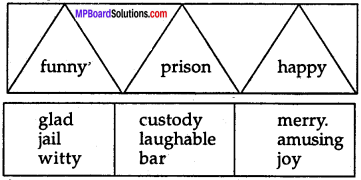
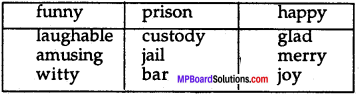
(C) Match the two columns :
(दोनों कालम का मिलान करें)
MP Board Class 7th General English Chapter 3 The Wise Man-II 4
Answer:

  1. → (a)
  2. → (f)
  3. → (b)
  4. → (c)
  5. → (d)
  6. → (e)

Grammar in Use (व्याकरण का प्रयोग):

(A) Use of ‘for, to :

(a) Complete the sentences using ‘to’ or ‘for’:
(निम्न वाक्यों में ‘to’ या ‘for’ लगाकर वाक्य पूरा कीजिए)

(1) They made a plan …………….. deceive him
(2) The mangoes are …………….. my wife.
(3) She always agrees …………….. my decisions.
(4) You will pay the same amount …………….. us.
(5) His wife was waiting …………….. her husband.
(6) What have you brought …………….. me?
(7) I sold the horse …………….. a donkey.
(8) I exchanged the donkey …………….. a sheep.
(9) A hen is cheaper …………….. feed than a sheep.
(10) I shall use money …………….. buy another horse.
Answers:
(1) to
(2) for
(3) to
(4) to
(5) for
(6) for
(7) for
(8) for
(9) to
(10) to.

(B) Fill in the blanks with these words :
(इन शब्दों से खाली स्थान भरें)
(little, a little, few, a few)

(1) I have ……………. time to stay.
(2) He knows ……………. of the story.
(3) I have ……………. milk so we can’t have tea.
(4) They have ……………. coins.
(5) He has ……………. friends, as he is new to Indore.
(6) She left Bhopal ……………. days ago.
Answers:
(1) a little
(2) a little
(3) little
(4) a few
(5) a few
(6) a few

Let’s Talk (आओ बात करें):

Work in Pairs (जोड़ों में कार्य करें)

(A) With your partner’s help, fill in the blanks with appropriate words from the table given below and complete the story.)
(अपने साथी की सहायता से नीचे दी गई तालिका से उचित शब्द का चयन करते हुए खाली स्थान भरिए और कहानी पूरी करिए।)
(to market, basket, more, many more, what happened, stumbled, full, looking, were thrown out, broke.)

(1) A woman was carrying a……….of eggs.
(2) She was going………to sell them.
(3) She thought she would get………money by ___ selling.
(4) Then she would buy………..hens.
(5) She was not……….on the road.
(6) Do you know……………?
(7) She. …………
(8) All the eggs …………
(9) Most of them. …………
Answers:
(1) basket, full
(2) to market
(3) more
(4) many more
(5) looking
(6) what happened
(7) stumbled
(8) were thrown out
(9) broke.

Let’s Write (आओ लिखें):

Suppose you went to market yesterday. Describe about it in sentences of your own. Use the words given below in your sentences.
(मानलो, कल आप बाजार गए थे। अपने वाक्यों में इसका वर्णन करिए। नीचे दिए शब्दों का अपने वाक्यों में प्रयोग कीजिए।)
(huslte and bustle, shopkeepers bargaining with customers, colourful lighting, swings, sweetshops, eateries, fancy goods and clothes shops.)
Answer:
Yesterday, I went to the market. There was hustle and bustle of vehicles. There were different shops of different articles like sweet shops eateries, fancy goods and clothes shops. Shopkeepers were bargaining with customers. Shops were decorated with colourful lighting. Children were swinging on the swings.

Let’s Do It (आओ इसे करें):

Read the given story and answer the questions given below it:
(दी गई कहानी को पढ़िए और इसके नीचे दिए गए प्रश्नों का उत्तर दीजिए।)

(A)
Question 1.
What happened when Deepak and Bhola were walking through the forest ?
(व्हॉट हैपन्ड व्हेन दीपक एण्ड भोला वर् वॉकिंग श्रू द फॉरेस्ट ?)
जब दीपक व भोला जंगल में जा रहे थे तब क्या हुआ?
Answer:
When Deepak and Bhola were walking through the forest, a bear attacked them.
(व्हेन दीपक एण्ड भोला वर वॉकिंग यू द फॉरेस्ट, अ बीयर अटैक्ड् देम्।)
जब दीपक व भोला जंगल से जा रहे थे, तब एक भालू ने उन पर आक्रमण किया।

Question 2.
What did Deepak do ?
(व्हॉट डिड दीपक डू?)
दीपक ने क्या किया ?
Answer:
Deepak climbed a tree and sat there.
(दीपक क्लाइम्ब्ड् अट्री एण्ड सैट देयर।)
दीपक एक पेड़ पर चढ़कर बैठ गया।

Question 3.
What did Bhola do ?
(व्हॉट डिड भोला डू?)
भोला ने क्या किया ?
Answer:
Bhola fell to the ground and played dead.
(भोला फैल टू द ग्राउण्ड एण्ड प्लेड डेड।)
भोला जमीन पर गिर गया और शव के समान अभिनय करने लगा। किया?

Question 4.
What did the bear do?
(व्हॉट डिड द बीयर डू?) भालू ने क्या किया ?
Answer:
The bear came to Bhola and sniffed. It sniffed his face, decided he was dead and lumbered off.
(द बीयर केम टू भोला एण्ड स्निफ्ड्। इट स्निफ्ड् हिज़ फेस, डिसाइडिड ही वॉज़ डेड एण्ड लम्बर्ड ऑफ।)
भालू भोला के पास आया और उसे सूंघने लगा। उसने उसका मुँह सूंघा और तय किया कि वह मर चुका है और भारी कदमों से चला गया।

Question 5.
What did Deepak say to Bhola when the bear had gone?
(व्हॉट डिड दीपक से टू भोला व्हेन द बीयर हैड गौन?) दीपक ने भोला से क्या कहा जब भालू चला गया ?
Answer:
After the bear had gone Deepak asked Bhola what the bear whispered in his ear.
(आफ्टर द बीयर हैड गौन दीपक आस्क्ड भोला व्हॉट द बीयर व्हिस्पर्ड इन हिज़ ईयर।)
भालू के जाने के बाद दीपक ने भोला से पूछा कि भालू उसके कान में क्या फुसफुसाया।

Question 6.
What did Bhola say to him ?
(व्हॉट डिड भोला से टू हिम ?)
भोला ने उससे क्या कहा ?
Answer:
Bhola said to Deepak that someone who deserts his friend in times of danger is not a good person at all.
(भोला सेड टू दीपक दैट समवन हू डैज़र्टस् हिज़ फ्रेन्ड् इन टाइम्स ऑफ डेंजर इज़ नॉट अ गुड पर्सन एट ऑल।)
भोला ने दीपक से कहा कि जो अपने दोस्त को बुरे वक्त में छोड़ दे वह अच्छा इंसान नहीं होता।

Question 7.
Was Deepak a good friend ?
(वॉज़ दीपक अगुड फ्रेन्ड् ?)
क्या दीपक अच्छा दोस्त था?
Answer:
No, Deepak was not a good friend.
(नो, दीपक वॉज़ नॉट अ गुड फ्रेन्ड्।)
नहीं, दीपक एक अच्छा दोस्त नहीं था।

(B) Match the following words with their meanings :
(निम्न शब्दों को उनके अर्थ से मिलान कीजिए)
MP Board Class 7th General English Chapter 3 The Wise Man-II 5
MP Board Class 7th General English Chapter 3 The Wise Man-II 6
Answer:

  1. → (d)
  2. → (a)
  3. → (e)
  4. → (c)
  5. → (b)

Pronunciations & Translation

Two thugs were watching Bhola in the market exchanging his things. They made a plan to deceive him. They went to Bhola and asked him.
(टू ठग्स वर वाचिंग भोला इन द मार्केट एक्सचेंजिंग हिज थिंग्स। दे मेड अ प्लान टू डिसीव हिम। दे वैन्ट टू भोला एण्ड आस्क्ड हिम)
अनुवाद – दो ठग बाजार में भोला को अपनी वस्तुएँ बदलते हुए देख रहे थे। उन्होंने उसे ठगने की योजना बनाई। वे भोला के पास गये और उससे पूछा
The first : Will you sell these mangoes, Sir thug
(द फर्स्ट ठग : विल यू सेल दीज मेन्गोज, सर ?)
अनुवाद – पहला ठग : क्या आप इन आमों को बेचेंगे, श्रीमान् ?
Bhola : No, not at all, these are for my wife.
She likes mango chutney very much.
(भोला : नो, नॉट ऐट ऑल, दीज आर फॉर माइ वाइफ.शी लाइक्स मेंगो चटनी वैरी मच।) अनुवाद- भोला नहीं, बिल्कुल नहीं, ये मेरी पत्नी के लिए हैं वह आम की चटनी बहुत अधिक पसन्द करती है।
Second : If she sees the mangoes, she will be thug angry with you.
(सेकण्ड ठग : इफ शी सीज द मेंगोज, शी विल बी एंग्री विद यू।)
अनुवाद – दूसरा ठग : यदि वह इन आमों को देखेगी तो वह आपसे नाराज होगी।
Bhola : Why ? Why will she be angry with me?
(भोला : व्हाई ? व्हाई विल शी बी एंग्री विद मी ?)
अनुवाद – भोला : क्यों ? वह मुझसे क्यों नाराज होगी ?
The second : Because you sold the horse and thug bought these cheap mangoes
(द सेकण्ड : बिकॉज यू सोल्ड द हॉर्स एण्ड बॉट दीज चीप ठग मेंगोज।)
अनुवाद – दूसरा ठग : क्योंकि तुमने घोड़ा बेचकर इन सस्ते आमों को खरीद लिया।
Bhola : Ho, ho, ho! No chance of it! She is an obedient wife. She always agrees to my decisions.
(भोला : हो, हो, हो! नो चान्स ऑफ इट! शी इज एन ओबीडिएण्ट वाइफ. शी ऑल्वेज एग्रीज टू माइ डिसीजन्स।)
अनुवाद – भोला (हँसते हुए) : हो, हो, हो! इसकी कोई संभावना नहीं है। वह एक आज्ञाकारी पत्नी है। वह सदैव मेरे निर्णयों से सहमत होती है।
The first : Alas ! But not this time. Will you have thug a bet on it ?
(द फर्स्ट ठग : अलास ! बट नॉट दिस टाइम विल यू हैव अ बैट ऑन इट ?)
अनुवाद – पहला ठग : हाय! परन्तु इस बार नहीं होगा। क्या तुम इसकी शर्त लगाओगे ?
Bhola : Why not ? What will be the terms ?
(भोला : व्हाई नॉट ? व्हाट विल बी द टर्स ?)
अनुवाद – भोला : क्यों नहीं ? क्या शर्ते होगी ?
The second : We shall give you a thousand rupees thug if your wife does not get angry with you. You will pay the same amount to us if she goes against your decision.
(द सेकण्ड : वी शैल गिव यू अ थाउजेण्ड (रूपीज इफ योर ठग वाइफ डज नॉट गैट एंग्री विद यू। यू विल पे द सेम अमाउण्ट टू अस इफ शी गोज अगेन्स्ट योर डिसीजन.)
अनुवाद – दूसरा ठग : हम तुम्हें एक हजार रूपये देंगे यदि तुम्हारी पत्नी तुम पर नाराज नहीं होगी। तुम हमें इतने ही रूपये दोगे यदि वह तुम्हारे निर्णय के खिलाफ जाती है।
Bhola : Though it is a very large amount, I am certain you will lose the bet.
(भोला : दो इट इज अ वैरी लार्ज अमाउण्ट, आई एम सर्टन यू विल लूज द बेट.)
अनुवाद – भोला : यद्यपि यह एक बहुत बड़ी राशि है, मुझे निश्चय है कि तुम शर्त हार जाओगे।
Bhola came back home with the two strangers. His wife was eagerly waiting for him.
(भोला केम बैक होम विद द टू स्ट्रेन्जर्स। हिज वाइफ वाज ईगरली वेटिंग फॉर हिम.)
अनुवाद – भोला : दो अजनबियों के साथ घर वापस आया। उसकी पत्नी उसका व्याकुलता से इन्तजार कर रही थी।
Shanti : Did you get rid of the horse ?
(शान्ति : डिड यू गैट रिड ऑफ द हॉर्स ?)
अनुवाद – शान्ति : क्या तुम्हें घोड़े से छुटकारा मिल गया ?
Bhola smiled and replied, “Yes, my dear.”
(भोला स्माइल्ड एण्ड रिप्लाइड, “यस, माइ डीयर)
अनुवाद- भोला मुस्कराया और उत्तर दिया, “हाँ प्रिये।”
Shanti : What have you brought for me and who are these gentlemen ?
(शांति : व्हाट हैव यू ब्रॉट फॉर मी एण्ड हू आर दीज जेन्टलमैन ?)
अनुवाद – शान्ति : आप मेरे लिए क्या लाए हो और ये सज्जन कौन है ?
Bhola : I have brought something special for you and these gentlemen are my new friends.
(भोला : आइ हैव ब्रॉट समथिंग स्पेशल फॉर यू एण्ड दीज जेन्टलमैन आर माइ न्यू फ्रेन्ड्स।)
अनुवाद – भोला : मैं तुम्हारे लिए कुछ विशेष चीज लाया हूँ और ये सज्जन मेरे नये दोस्त हैं।
Shanti : What is it?
(शान्ति : व्हाट इज इट ?)
अनुवाद-शान्ति : यह क्या है ?
Bhola : Have patience dear ! I sold the horse for a donkey.
(भोला : हैव घेशेन्स डीयर ! आइ सोल्ड द हॉर्स फॉर अडंकी।)
अनुवाद – भोला : प्रिये, धैर्य रखो ! मैने एक गधे के बदले घोड़े को बेच दिया।
Shanti : Oh, good! We shall use it in our field.
(शान्ति : ओह, गुड ! वी शैल यूज इट इन अवर फील्ड)
अनुवाद-शान्ति : वाह अच्छा है! हम इसे अपने खेत में प्रयोग करेंगे।
Bhola : But dear! I exchanged the donkey for a sheep.
(भोला : बट डीयर! आइ एक्सचेंज्ड द डंकी फॉर अशीप.)
अनुवाद – भोला : लेकिन प्रिये! मैंने गधे के बदले एक भेड़ ले ली।
Shanti : That’s even better. We shall have plenty of wool.
दैट्स इवन बैटर। वी शैल हैव प्लेन्टी ऑफवूल.)
अनुवाद – शान्ति : यह भी अच्छा है। हमारे पास बहुत सा ऊन होगा।
Bhola : But then I sold it for a hen.
(भोला : बट दैन आई सोल्ड इट फॉर अ हैन.)
अनुवाद-भोला : लेकिन तब मैंने एक मुर्गी के लिए इसे बेच दिया।
Shanti : How wise you are! A hen is cheaper to feed than a sheep.
(शान्ति : हाउ वाइज यू आर ! अ हैन इज चीपर टू फीड दैने अ शीप।)
अनुवाद-शान्ति : आप कितने बुद्धिमान हो! एक मुर्गी को भेड़ की अपेक्षा पालना अधिक सस्ता है।
Bhola : But dear! I exchanged the hen for a basket of mangoes.
(भोला : बट डीयर! आइ एक्सेचेंज्ड द हैन फॉर अबास्केट ऑफ मेंगोज।)
अनुवाद-भोला : लेकिन प्रिये! मैंने मुर्गी के बदले एक टोकरी आम ले लिए।
Shanti : That’s the best bargain you have ever made in your life. I have been longing for mango-chutney for more than a fortnight.
(शान्ति : दैट्स द बेस्ट बारगेन यू हैव एवर मेड इन योर लाइफ आई हैव बीन लाँगिंग फॉर मेंगो चटनी फॉर मोर दैन अ फोर्टनाइट.)
अनुवाद-शान्ति : यह आपके जीवन का सबसे अच्छा मोलभाव है। मेरी इच्छा पन्द्रह दिनों से अधिक समय से आम की चटनी खाने की हो रही थी।
Bhola : Here is the basket full of mangoes. Now take this and make two types of chutney, first sweet for us and sour chutney for my clever friends.
(भोला : हीयर इज द बास्केट फुल ऑफ मेंगोज. नाउ टेक दिस एण्उ मेक टू टाइप्स ऑफ चटनी, फर्स्ट स्वीट फॉर अस एण्ड सोर चटनी फॉर माइ क्लेवर फ्रेन्ड्स.)
अनुवाद-भोला : यहाँ आमों से भरी टोकरी है। अब इसे लो और दो प्रकार की चटनी बनाओ, हमारे लिए मीठी और मेरे चतुर दोस्तों के लिए खट्टी चटनी बनाओ।
Shanti went into the house with the mangoes. The two thugs heard their conversation with great surprise.
(शान्ति वैन्ट इनटू द हाउस विद द मेन्गोज. द टू ठग्स हर्ड देयर कन्वर्सेशन विद ग्रेट सरप्राइज.)
अनुवाद-शान्ति : आमों के साथ घर में गई। दोनों ठगों ने अत्यन्त आश्चर्य के साथ उनकी बात-चीत को सुना।
The first : Bhola, you have won the bet, here is thug the amount.
(द फर्स्ट ठग : भोला, यू हैव वन द बैट, हीयर इज द अमाउण्ट।)
अनुवाद-पहला ठग : भोला, तुम शर्त जीत गये हो, यह तुम्हारा धन है।
Bhola : Thank you Sir, So kind of you!
(भोला : बैंक यू सर, सो काइण्ड ऑफ यू!)
अनुवाद-भोला : धन्यवाद श्रीमान्, आप कितने अच्छे हैं!
The second : One thing more, Sir, would you please thug tell me how you will spend this money?
(द सेकण्ड : वन थिंग मोर, सर, वुड यू प्लीज टैल मी हाउ यू विल स्पेन्ड दिस मनी?)
अनुवाद – दूसरा ठग : एक बात और, श्रीमान् जी, क्या आप मुझे यह बताओगे कि इस धन को आप कैसे खर्च करेंगे ?
Bhola : I shall buy another horse.
(भोला : आइ शैल बाय एनआदर हॉर्स।)
अनुवाद-भोला : मैं एक दूसरा घोड़ा खरीदूंगा।

The Wise Man-II Word Meanings

Against (अगेन्स्ट्)-विरुद्ध, खिलाफ;Agrees (एग्रीज़) – सहमत होता है ; Amount (अमाउन्ट)-रकम, धनराशि; Angry (एंग्री)-गुस्से में, क्रोधित; Bargaining (बार्गेनिंग) – मोलभाव, सौदाकारी; Bet (बैट)-शर्त; Brought (ब्रॉट) – लाया; Certain (सर्टेन)-निश्चित, पक्का; Cheaper (चीपर)-सस्ता; Conversation (कन्वरसेशन)-बातचीत, वार्तालाप; Deceive (डिसीव)-धोखा देना, ठगना; Decisions (डिसिज़न्स)-निर्णय, फैसले; Eagerly (ईगरली) -उत्सुकतापूर्वक; Exchange (एक्सचेन्ज)-आदान-प्रदान; Fortnight (फोर्टनाइट)-पक्ष, पखवाड़ा; Longing (लॉगिंग)-लालसा; Lose (लूज़)-खोना; Obedient (ओबिडिएन्ट)-आज्ञाकारी; Patience (पेशेन्स्)-धैर्य, सहनशीलता; Cheaper (चीपर)-सस्ता; Pay (पे)-वेतन, भुगतान; Plenty (प्लैन्टी)-पर्याप्त Longing for (लॉन्गिंग फॉर)-इच्छा कर रही; Replied (रिप्लाइड)-जवाब दिया; Sold (सोल्ड)-बेचा; Sour (सॉर)-खट्टा; Strangers (स्ट्रेन्जर्स)-अजनबी, अपरिचित; Successful (सक्सेसफुल) -कामयाब; Surprise (सरप्राइज़)-आश्चर्य; Terms (टर्मस्)-समझौते; Thug (ठग)-ठग; Waiting (वेटिंग) -प्रतीक्षा में; Wise (वाइज़)-बुद्धिमान; Won (वन)-जीता।

We believe the information shared regarding MP Board Solutions for Class 7 English Chapter 21 Tansen Questions and Answers as far as our knowledge is concerned is true and reliable. In case of any queries or suggestions do leave us your feedback and our team will guide you at soonest possibility. Bookmark our site to avail latest updates on several state board Solutions at your fingertips.
MP Board Class 7th General English Solutions Chapter 4 Anita Feeds Appu

Get Updated MP Board Solutions for Class 7 General English Chapter 4 Anita Feeds Appu Questions and Answers in PDF Format and download them free of cost. These are provided as per the latest exam pattern and syllabus. Access the topics of Chapter wise and communication skills, grammer part through the direct links available depending on the need. You can Download MP Board Class 7 English Solutions and can score highest grade in examination. Clear all your queries on the Mp Board Solutions for Class 7 English Chapter 21 Tansen Questions and Answers Subject by using the Madhya Pradesh State Board Solutions for existing.

MP Board Class 7th General English Solutions Chapter 4 Anita Feeds Appu

If you are eager to know about the Madhya Pradesh State Board Solutions for Class 7 English you will find all of them here. You can identify the knowledge gap using these MP Board Solutions for English PDF and plan accordingly. Don’t worry about the accuracy as they are given after extensive research by people having subject knowledge along side from the latest English Syllabus.

Anita Feeds Appu Textual Exercises

Read and Learn (पढ़ो और याद करो):
Students should do themselves. (छात्र स्वयं करें।)

Comprehension (बोध प्रश्न) :
Answer the questions given below :
(निम्नलिखित प्रश्नों के उत्तर दीजिए)

Lesson 4 Anita Feeds Appu MP Board Class 7th Question 1.
Why is Anita very excited today?
(व्हाइ इज़ अनीता वैरी एक्साइटेड टूडे ?)
अनीता आज बहुत उत्तेजित क्यों है?
Answer:
Anita is very excited today to see Appu at her door.
(अनीता इज़ वैरी एक्साइटेड टूडे टू सी अप्पू एट हर डोर।)
अपने घर के दरवाजे पर अप्पू को देखकर अनीता आज बहुत उत्तेजित है।

Anita Feeds Appu MP Board Class 7th Question 2.
Where has she seen the elephants before ?
(व्हेअर हैज़ शी सीन द एलीफेन्ट्स बिफोर?) उसने हाथियों को पहले कहाँ देखा है ?
Answer:
She has seen the elephants in the movies and cartoon shows.
(शी हैज़ सीन द एलीफेन्ट्स इन द मूवीज़ एण्ड कार्टून शोज़।)
उसने हाथियों को चलचित्रों और कार्टून शो में देखा है।

Mp Board Class 7th English Chapter 4 Question 3.
How did Appu drink a bucketful of water?
(हाउ डिड अप्पू ड्रिंक अ बकेटफुल ऑफ वाटर ?) अप्पू ने एक बाल्टी पानी किस तरह पिया?
Answer:
Appu drank a bucketful of water at one go.
(अप्पू इँक अ बकेटूल ऑफ वाटर एट बन गो।) अप्पू ने एक प्रूट में ही एक बाल्टी भर पानी पी लिया।

Class 7 English Chapter 4 Anita Feeds Appu MP Board Question 4.
What did Appu do with his trunk ?
(व्हॉट डिड अप्पू डू विद हिज़ ट्रंक?)
अप्पू ने अपनी सूंड़ से क्या किया?
Answer:
Appu took the bananas in his trunk and put them into his mouth with it.
(अप्पू टूक द बनानाज़ इन हिज ट्रंक एण्ड पुट दैम इन्टू हिज़ माउथ विद इट।)
अप्पू ने अपनी सूंड से केलों को उठाया और उन्हें इसके द्वारा अपने मुख में रख लिया।

Anita Likes To Ride An Elephant MP Board Class 7th Question 5.
How did the Mahout help the children ride Appu?
(हाउ डिड द महावत हैल्प द चिल्ड्रेन राइड अप्पू ?)
महावत ने अप्पू पर सवारी करने में बच्चों की किस तरह सहायता की?
Answer:
The Mahout helped the children climb on to the elephant’s back by making them seated in the howdah.
(द महावत हैल्प्ड द चिल्ड्रन क्लाइम्ब ऑन टू द एलीफेन्ट्स बैक बाई मैकिंग दैम सीटेड इन द हौदा।)
महावत ने हौदा में बच्चों को बैठाकर हाथी की पीठ पर चढ़ने में उनकी सहायता की।

Anita Was Very MP Board Class 7th Question 6.
Have you ever had an elephant ride? Do you like it? Why?
(हैव यू एवर हैड ऐन एलीफेन्ट राइड? डू यू लाइक इट? व्हाय?)
क्या तुमने कभी हाथी पर सवारी की है? क्या तुमने इसे पसन्द किया? क्यों?
Answer:
Yes, I had an elephant ride when I was in class VI. I went to visit the National Park with my parents. Yes, I liked it very much.
(यस, आइ हैड ऐन एलीफेन्ट राइड हैन आइ वॉज़ इन क्लास सिक्स्थ। आइ वेन्ट टू विज़िट द नेशनल पार्क विद माइ पेरेन्ट्स। यस, आइ लाइक्ड इट वैरी मच।)
हाँ, मैंने हाथी पर सवारी की है जब मैं कक्षा छः में पढ़ता था। मैं अपने माता-पिता के साथ नेशनल पार्क देखने के लिए गया था। हाँ, मैंने इसे बहुत पसन्द किया।

Word Power (शब्द सामर्थ्य):

(A) Match the word with their meanings :
(निम्न शब्दों का उनके अर्थों से मिलान कीजिए)
Lesson 4 Anita Feeds Appu MP Board Class 7th
Answer:

  1. → (b)
  2. → (a)
  3. → (d)
  4. → (c)
  5. → (f)
  6. → (g)
  7. → (e)

(B) Fill in the blank spaces with the proper words and then complete the puzzle :
(उचित शब्दों से रिक्त स्थानों की पूर्ति कीजिए और फिर पहेली पूरी कीजिए)
Anita Feeds Appu MP Board Class 7th
Answer:

  1. The banana tree was in Anita’s courtyard.
  2. Elephant can gobble up a whole tree.
  3. The mahout took the children for a ride.
  4. Anita was very excited that day.
  5. Anita thought she can never balance on back of an elephant.
  6. Anita’s mother wanted to watch the elephant eating.
  7. Anita and her friends were a little afraid while sitting on the howdah.

Mp Board Class 7th English Chapter 4

Grammar in Use (व्याकरण का प्रयोग) :

Make sentences of your own using the following phrases :
(निम्नलिखित वाक्याशों का प्रयोग करते हुए अपने वाक्य बनाइए)

1. Bread : a loaf of bread, a slice of bread, a kilo of bread
2. Soap : a cake of soap, a bar of soap
3. Paper : a ream of paper, a piece of paper, a sheet of paper
4. Furniture : a piece of furniture, furniture in a room.
5. Chalk : a piece of chalk, a kilo of chalk, a box of chalk
Answer:
1. (a) He was eating a loaf of bread.
(b) Please give me a slice of bread.
(c) Raj’s mother asked him to bring a
kilo of bread from the market.

2. (a) Rita always kept a cake of soap in her purse.
(b) Meena was washing her clothes with a bar of soap.

3. (a) He bought a ream of paper for making History notes.
(b) Please give me a piece of paper to note down her address.
(c) The teacher took the students’ attendance on a sheet of paper that day.

4. (a) The sofa-set in that shop is a marvellous piece of furniture I had ever seen.
(b) There was no furniture in the room.

5. (a) A naughty student threw a piece of chalk on the teacher.
(b) Please bring a kilo of chalk from that shop.
(c) I have brought a box of chalk for writing on the black-board.

Let’s Talk (आओ बात करें):

Ask the following questions in your class and complete the table :
(निम्न प्रश्नों को अपनी कक्षा में पछिए और तालिका को पूरा कीजिए)

  1. Would you like to share your room with our pet animals?
  2. Will your parents agree to it?
  3. Does this pet take a lot of space ?

Answer:
Class 7 English Chapter 4 Anita Feeds Appu MP Board

Let’s Write (आओ लिखों):

(A) Discuss in groups about the animals you know and how are they useful to us. Complete your description using some of these words.
(जानवरों के बारे में समूह में चर्चा कीजिए जिन्हें तुम जानते हो और वे किस प्रकार से तुम्हारे लिए उपयोगी हैं।)
Answer:
Children may discuss in different groups about the different per animals using the clues given in the question. Like

Appu Went To Answer MP Board Class 7th Group A
Camel is called the ‘Ship of the desert’. It carries heavy load on its back. It is used by caravan of travellers to travel in desert. It can live without water for several days.

Class 7 English Chapter 4 Mp Board  Group B
Cow gives us milk and is worshipped in the society as Guamata. Cow dung is used as a fuel.

Group C
Donkey carries load on its back. It is used by washerman to carry pile of clothes. Similarly, they can discuss about the sheep and the elephant.

(B) Read the notes and write about the monkey.
(निम्न संकेतों को पढ़ो और बन्दर के बारे में लिखिए।)
Answer:
Students can write about the Matroo monkey using the notes as follows:

Matroo monkey lives on trees. Its family consists of other monkeys. Children and some monkeys are its friends. It likes to play and jump on the trees. It eats fruits and always remains happy. Its fur is graybrown in colour, but face is red and eyes are black. It is medium sized.

Let’s Do It (आओ इसे करें) :

(A) Read the names of animals given below and classify them in the following table :
Answer:
(नीचे दिए गए जानवरों के नाम पढ़िए और उनका निम्नलिखित तालिका में वर्गीकृत करिए।)
peacock, wolf, dog, pigeon, tiger, fish, bear, crocodile, sparrow, cow, goat, frog.
Answer:
Anita Likes To Ride An Elephant MP Board Class 7th

(B) Given below is a table with the names of some animals. Complete the table by filling in the colour, food, size and the place they live in.
(नीचे दी गई तालिका में कुछ जानवरों के नाम हैं। तालिका को इनके रंग, भोजन, आकार और इनके रहने के स्थान भरकर पूर्ण कीजिए।)
Answer:
Anita Was Very MP Board Class 7th

Pronunciation & Traslation

Anita is very excited today. She has read a story about Appu, the elephant and seen an elephant in the movies and cartoon shows on T.V. But today she is surprised to see Appu at her door.

(अनीता इज वैरी एक्साइटेड टूड़े शी हैज रैड अ स्टोरी अबाउट लाप्पू, द एलीफेन्ट एण्ड सीन एन एलीफेन्ट इन द मूवीज एण्ड कार्टून शोज ऑन टी.वी. बट टुडे सी इज सरप्राईज्ड टू सी अप्पू ऐट हर डोर.)
अनुवाद-अनीता आज बहुत उत्साहित है। उसने अप्पू हाथी के बारे में एक कहानी पढ़ी है तथा उसने हाथी को फिल्मों में और कार्टून कार्यक्रमों में टी.वी. पर देखा है। परन्तु वह अप्पू को अपने दरवाजे पर देखकर हैरान है।
Anita : Ma, Ma, give me some bananas and sugarcane. I want to feed Appu. (अनीता : माँ, माँ, गिव मी सम बनानाज एण्ड सुगरकेन।
आइ वान्ट टू फीड अप्पू।) अनुवाद-अनीता : माँ, माँ, मुझे कुछ केले और गन्ना दे दो। मैं अप्पू को खिलाना चाहती हूँ।
(Ma : What are you talking about ?)
(माँ : व्हाट आर यू टॉकिंग अबाउट?)
अनुवाद-माँ : तुम किसके बारे में बात कर रही हो?
Anita : Ma, you won’t believe it! Appu, the elephant is at our gate.
(अनीता : मौं, यू वोन्ट बिलीव इट! अप्पू द एलीफेन्ट इज ऐट अवर गेट.)
अनुवाद-अनीता : माँ, आपको विश्वास नहीं होगा! अप्पू, हाथी हमारे दरवाजे पर खड़ा है।
Ma : Appu, the elephant!
(माँ : अप्पू, हाथी!)
अनुवाद-माँ : अप्पू, हाथी!
(anxiously) Where is your father ?
(एन्कशसली) व्हेयर इज योर फादर?
अनुवाद-(उत्सुकता से) तुम्हारे पिताजी कहाँ हैं?
Anita : He is right there outside and Bhaiya is giving Appu some water to drink. Oh Ma! He can drink a bucketfut of water at one go!
(अनीता : ही इज राइट देअर आउटसाइड एण्ड भैया इज गिविंग अप्पू सम वाटर टू ड्रिंक. ओह माँ ! ही कैन ड्रिंक अ बकेटफुल ऑफ वाटर ऐट वन गो!)
अनुवाद-अनीता : वे इस समय बाहर हैं और भैया अप्पू को कुछ पानी पीने को दे रहे हैं। अरे माँ, वह एक साथ एक बाल्टी पानी पी सकता है।
Ma : And he can eat a whole tree at one go too!
(माँ : एण्ड ही कैन ईट अ होल ट्री ऐट वन गो टू।)
अनुवाद-माँ : और वह एक बार में ही पूरा पेड़ खा सकता है।
Anita : Yes, yes I want to feed the elephant. Can I take these bananas and sugarcane to feed him ?
(अनीता : येस, येस आई वान्ट टू फीड द एलीफेन्ट. कैन आइ टेक दीज बनानाज एण्ड सुगरकेन टू फीड हिम?)
अनुवाद-अनीता : हाँ, हाँ, मैं हाथी को खिलाना चाहती हूँ। क्या मैं इन केलों और गन्ने को उसे खिलाने के लिए ले सकती हूँ?
Ma: Oh ! Yes, and also take some leaves of the banana tree from the courtyard.
(माँ : ओह, येस, एण्ड ऑल्सो टेक सम लीव्स ऑफ द बनानाज ट्री फ्रॉम द कोर्टयार्ड.)
अनुवाद-माँ : अरे! हाँ, और बरामदे से कुछ केले के पत्ते भी ले लो।
Anita : Thank you, Ma. (अनीता : बैंक यू, माँ।)
अनुवाद-अनीता : धन्यवाद, माँ।
Ma : Come, I’ ll go with you. It’s fun to watch an elephant gobbling up food. The Mahout will be happy if we feed the elephant.
(माँ : कम, आइ विल गो विद यू. इट्स फन टू वाच एन एलीफेन्ट गोबलिंग अप फूड. द महावत विल बी हैप्पी इफ वी फीड द एलीफेन्ट.)
अनुवाद-माँ : आओ, मै तुम्हारे साथ चलती हूँ। एक हाथी को भोजन को निगलते हुए देखने में आनन्द आएगा। यदि हम हाथी को खिलाएँगै तो महावत को भी प्रसन्नता होगी।
Anita : Ma, see how the elephant is taking the bananas in his trunk and putting them into his mouth. He is using his trunk like a hand.
(अनीता : माँ, सी हाउ द एलीफेन्ट इज टेकिंग द बनानाज इन हिज ट्रन्क एण्ड पुटिंग दैम इन्टू हिज माउथ. ही इज यूजिंग हिज ट्रंक लाइक अ हैण्ड.)
अनुवाद-अनीता : माँ, देखो हाथी कैसे अपनी सैंड में केले ले रहा है और उन्हें अपने मुंह में रख रहा है। वह एक हाथ की तरह अपनी सूंड़ का प्रयोग कर रहा है।
Ma : Oh! Yes, he is.
(माँ : ओह! येस, ही इज.)
अनुवाद-मा: ओ! हाँ वह ऐसा ही कर रहा है।
Anita : Do you notice how he drinks water ?
He sucks it all from the bucket.
(अनीता : डू यू नोटिस हाउ ही ड्रिंक्स वाटर? ही सक्स इट ऑल फ्रॉम द बकेट.)
अनुवाद- अनीता : क्या आप देखते हैं कि वह कैसे पानी पीता है? वह बाल्टी से पूरा पानी चूस लेता है।
Mahout : Children! Would you like to ride Appu ?
(महावत : चिल्ड्रन! वुड यू लाइक टू राइड अप्पू?)
अनुवाद-महावत : बच्चो! क्या तुम अप्पू की सवारी करना पसन्द करोगे।
Anita : I don’t think I can balance myself up there. I’ll fall off as he walks.
(अनीता : आइ डॉन्ट थिंक आइ कैन बैलेन्स माइसेल्फ अप देअर. आइ विल फॉल ऑफ एज ही वाक्स.)
अनुवाद-अनीता : मुझे नहीं लगता कि मैं वहाँ अपना सन्तुलन बना पाऊँगी। जैसे ही वह चलेगा मैं गिर जाऊँगी।
Mahout : No, no. I’ll show you how to ride an elephant.
(महावत : नो, नो. आइ विल शो यू हाउ टू राइड एन एलीफेन्ट.)
अनुवाद-महावत : नहीं, नहीं। मैं तुम्हे दिखाऊँगा कि हाथी पर सवारी कैसे करनी है।
Anita and some other children together : How ?
(अनीता एण्ड सम अदर चिल्ड्रन टूगेदर : हाऊ?)
अनुवाद- अनीता और दूसरे बच्चे एक साथ : कैसे?
Mahout : Well we have a howdah and more than six children can easily fit into it. Come children, l’ Il take you for a nice elephant ride. Appu will be glad too.
(महावत : वैल, वी हैव अ हौदा एण्ड मोर दैन सिक्स चिल्डन कैन इजिली फिट इनटू इट. कम चिल्ड्रन, आइ विल टेक यू फॉर अ नाइस एलीफेन्ट राइड. अप्पू विल बी ग्लेड टू.)
अनुवाद-महावत : ठीक है हमारे पास एक हौदा है और छह से अधिक बच्चे आसानी से इसमें समा सकते हैं। आओ बच्चो, मैं तुमको एक अच्छी हाथी की सवारी के लिए ले जाऊँगा। अप्पू भी प्रसन्न होगा।
So Anita, Anjum, Arif, Bala and Bhola all gather around the Mahout and he helps them climb on to the elephant’s back and sit in the howdah. They are excited and a little scared too as Appu stands up and starts walking towards the park. They wave out to the other children who are following them. Now they are really happy.
(सो अनीता, अन्जुम, आरिफ, बाला एण्ड भोला ऑल गैदर अराउण्ड द महावत एण्ड ही हेल्प्स दैम क्लाइम्ब ऑन टू द एलीफेन्ट्स बैक एण्ड सिट इन द हौदा. दे आर एक्साइटेड एण्ड अ लिटल स्केअर्ड ट् एज अप्पू स्टेण्ड्स अप एण्ड स्टार्ट्स वॉकिंग टूव द पार्क. दे वेव आउट टू द अदर चिल्ड्रन हू आर फॉलोइंग दैम. नाउ दे आर रियली हैप्पी.)
अनुवाद-अनीता, अंजुम, आरिफ, बाला और भोला सभी महावत के चारों ओर इकट्ठे हो जाते हैं और वह उन्हें हाथी की पीठ पर बैठने और हौदे में बैठने में मदद करता है। वे उत्साहित हैं और कुछ डरे हुए हैं जैसे ही अप्पू खड़ा होता है और पार्क की ‘ओर चलना शुरू करता है। वे दूसरे बच्चों जो उनके पीछे चल रहे हैं, को हाथ हिलाते है। अब वे वास्तव में खुश हैं।

Anita Feeds Appu Word Meanings

Courtyard (कोर्टयार्ड)-आँगन; Excited (एक्साइटेड)-उत्तेजित; Cartoon (कार्टून)-कार्टून; Gobbling (गॉब्लिग)-निगलते हुए; Balance (बैलेन्स) -सन्तुलन; Surprised (सरप्राइज्ड)-अचम्भित; Believe (बिलीव)-विश्वास करना; Right there (राइट देअर) -ठीक वहाँ; To feed (टू फीड)-खिलाना; To watch (टू वॉच)-रखवाली करना; To fall off (टू फॉल ऑफ)-गिर पड़ना; To ride (टू राइड)-सवारी करना; To help (टू हैल्य)-सहायता करना; At one go (एट वन गो)-एक बार में; Guava (गुआवा)-अमरूद; Suck (सक) चूसना; Scared (स्केअर्ड)-डरा हुआ; Notice (नोटिस)-ध्यान देना; Follow (फॉलो)-पीछा करना; Movie (मूवी) -चलचित्र; Towards (टुवर्ड्स)- की ओर।

We believe the information shared regarding MP Board Solutions for Class 7 English Chapter 21 Tansen Questions and Answers as far as our knowledge is concerned is true and reliable. In case of any queries or suggestions do leave us your feedback and our team will guide you at soonest possibility. Bookmark our site to avail latest updates on several state board Solutions at your fingertips.
MP Board Class 7th Sanskrit Solutions Chapter 8 गुरुगोविन्दसिंहः

MP Board Class 7th Sanskrit Solutions Surbhi Chapter 8 गुरुगोविन्दसिंहः

MP Board Class 7th Sanskrit Chapter 8 अभ्यासः

Mp Board Class 7 Sanskrit Chapter 8 प्रश्न 1.
एक शब्द में उत्तर लिखो
(क) सिक्खानाम् दशमः गुरुः कः आसीत्? [सिक्खों के दसवें गुरु कौन थे?]
उत्तर:
गुरुगोविन्दसिंहः

(ख) सिक्खधर्मप्रवर्तकः कः आसीत्? [सिख धर्म के प्रवर्तक कौन थे?]
उत्तर:
गुरुनानकः

(ग) गुरुगोविन्दसिंहस्य मातुः नाम किम्? [गुरुगोविन्दसिंह की माता का नाम क्या था?]
उत्तर:
गुजरी

(घ) गुरुगोविन्दसिंहस्य मुक्तिः कुत्र अभवत्? [गुरुगोविन्दसिंह की मुक्ति कहाँ हुई थी?]
उत्तर:
नान्देड़ प्रान्ते

(ङ) ईश्वरीयदीक्षा का? [ईश्वरीय दीक्षा क्या थी?]
उत्तर:
खालसा।

Class 7 Sanskrit Chapter 8 Mp Board प्रश्न 2.
एक वाक्य में उत्तर लिखो
(क) सिक्खानां पञ्च बाह्यचिह्नानि कानि? [सिक्खों के पाँच बाहरी चिह्न कौन-कौन से हैं?]
उत्तर:
सिक्खानां पञ्च बाह्य चिह्नानि-केशबन्धनं, कङ्कतिका अस्थापनं, कङ्कणधारणं, कट्यां वस्त्रधारणं, सर्वदा खड्गंधारणम् इति।
[सिक्खों के पाँच बाहरी चिह्न हैं-केशबन्धन (पगड़ी), कंघी रखना, कड़ा धारण करना, कमर में फेंटा बांधना, सदा तलवार धारण करते रहना।]

(ख) गुरुगोविन्दस्य जननं कदा अभवत्? [गुरुगोविन्द का जन्म कब हुआ थ?]
उत्तर:
गुरुगोविन्दस्य जननं १६६६ तमे वर्षे कार्तिक शुक्ल सप्तम्यां पटना नगरे अभवत्। [गुरुगोविन्द का जन्म सन् १६६६ ई. में कार्तिक महीने की शुक्लपक्ष की सप्तमी को पटना नगर में हुआ था।

(ग) कुत्र धर्माः विकासं प्राप्ताः? [धर्मों ने कहाँ पर विकास प्राप्त किया है?]
उत्तर:
भारते बहवः धर्माः विकास प्राप्ताः। [भारत में बहुत से धर्मों ने विकास प्राप्त किया है।]

(घ) विदेशीयाः कीदृशाः आसन्? [विदेशी कैसे थे?]
उत्तर:
विदेशीयाः भारतीय संस्कृतेः विनाशकाः आसन्। [विदेशी भारतीय संस्कृति का विनाश करने वाले थे।]

(ङ) आचार्येण केषां कथा श्राविताः? [आचार्य ने किनकी कथा सुनाई?]
उत्तर:
आचार्येण गुरुगोविन्दसिंहस्य कथा श्राविताः। [आचार्य ने गुरुगोविन्दसिंह की कथा सुनाई।]

Mp Board Class 7 Sanskrit Solution प्रश्न 3.
कोष्ठक के शब्दों का प्रयोग करके खाली स्थानों को भरो (गुरुजी, आत्मविश्वासेन, खड्गं, भगवतः)
(क) एकमेव …………. ज्योतिः सर्वेषु ज्वलति।
(ख) गुरुगोविन्दसिंहः …………. कार्यं कृतवान्।
(ग) वाहे …………. की फतह।
(घ) ………… गृहीत्वा युद्धं कुरू।
उत्तर:
(क) भगवतः
(ख) आत्मविश्वासेन
(ग) गुरुजी
(घ) खड्गं।

Mp Board Class 7th Sanskrit Solution प्रश्न 4.
सम्बोधन लिखो(गुरु, आर्य, महोदय, अनुज)
उत्तर:
पुल्लिग :
गुरो!, आर्य! महोदय!, अनुज!

स्त्रीलिंग :
आर्ये!, महोदये!, अनुजे!

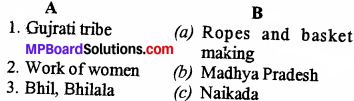
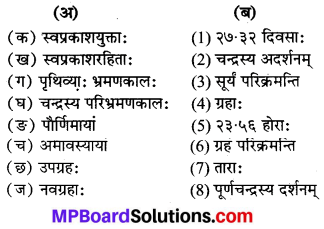
Mp Board Solution Class 7 Sanskrit प्रश्न 5.
उचित का मेल करो
Mp Board Class 7 Sanskrit Chapter 8
उत्तर:
(क) → (5)
(ख) → (4)
(ग) → (2)
(घ) → (1)
(ङ) → (3)

Mp Board 7th Class Sanskrit Book प्रश्न 6.
क्रम स्थापित करो
(क) गुरुगोविन्दसिंहः हिन्दूशक्ति सङ्घटितवान्।
(ख) गुरुगोविन्दस्य मृत्युः १७०८ तमे वर्षे अभवत्।
(ग) माता गुजरी पिता तेगबहादुरः च आस्ताम्।
(घ) गुरु नानकः सिक्खधर्मप्रवर्तकः आसीत्।
(ङ) गुरुगोविन्दस्य जननम् कार्तिकशुक्लसप्तम्याम् अभवत्।
उत्तर:
(घ) गुरु नानकः सिक्खधर्मप्रवर्तकः आसीत्।
(ङ) गुरुगोविन्दस्य जननम् कार्तिकशुक्लसप्तम्याम् अभवत्।
(ग) माता गुजरी पिता तेगबहादुरः च आस्ताम्।
(क) गुरुगोविन्दसिंहः हिन्दूशक्ति सङ्घटितवान्।
(ख) गुरुगोविन्दस्य मृत्युः १७०८ तमे वर्षे अभवत्।

गुरुगोविन्दसिंहः हिन्दी अनुवाद

छात्रा: :
आचार्य! नमस्कार। शिक्षकः-उपविशन्तु सर्वे।

Mp Board 7 Class Sanskrit कुलदीपः :
आर्य! पूर्व धर्मसंरक्षकाणां वीरपुरुषाणां विवेकानन्द, शिवाजी, महाराणाप्रतापः इत्यादीना विषये श्रुतम्, किन्तु गुरुगोविन्दसिंहस्य विषये न जानामि।

प्रतापः :
महोदय! वय गुरुगोविन्दसिंहस्य चरिः नातुमिच्छामः।

Mp Board Class 7th Sanskrit Book विनीता :
श्रीमान्! तस्य चरित्रस्य किं वैशिष्ट्यम्। – शिक्षकः-गुरुगोविन्दसिंहस्य शौर्य, धैर्य, त्यागः, दूरदृष्टिः, सेवाभावनादिकं विशिष्टम् आसीत्। सः आबाल्यात् जनानां शक्तिं जागरयितुम् आत्मविश्वासेन कार्यं कृतवान्। समाजं संस्कर्तुम्, अखण्डतां स्थापयितुं धर्मे निष्ठा वर्धयितुं अहर्निशं प्रयत्नं कृतवान्। एषः सिक्खानां धर्मगुरुः आसीत्।

अनुवाद :
छात्र-आचार्य जी! नमस्कार। शिक्षक-सभी बैठ जायें।

कक्षा 7 संस्कृत पुस्तक Mp Board कलदीप :
आर्य! प्राचीनकाल के धर्म की रक्षा करने वाले वीर पुरुषों में विवेकानन्द, शिवाजी, महाराणा प्रताप इत्यादि के विषय में तो सुना है, परन्तु गुरुगोविन्दसिंह के विषय में नहीं जानता हूँ।

प्रताप :
महोदय! हम गुरुगोविन्दसिंह के चरित्र को जानना चाहते हैं।

Mp Board Class 7th Sanskrit विनीता :
श्रीमन्! उनके चरित्र की क्या विशेषता है?

शिक्षक :
गुरु गोविन्दसिंह में शूरवीरता, धैर्य, त्याग, दूरदृष्टि और सेवाभावना आदि विशेषता थी। उन्होंने बचपन से ही मनुष्यों में शक्ति जागृत करने के लिए आत्मविश्वास से कार्य किया। समाज को संस्कारित करने के लिए, अखण्डता (एकता) स्थापित करने के लिए, धर्म के प्रति निष्ठा बढ़ाने के लिए दिन और रात उन्होंने प्रयत्न किया। ये सिक्खों के धर्मगुरु थे।

Class 7 Sanskrit Chapter 8 MP Board प्रतापः :
सिक्खाः नाम के?

शिक्षकः :
सिक्खधर्मानुयायिनः सिक्खाः। यथा जैनधर्म तथा सिक्खधर्मः। भारते बहवः धर्माः विकासं प्राप्ताः। अतः सर्वे धर्माः समानाः।

कक्षा 7 संस्कृत पुस्तक Pdf Mp Board कुलदीपः :
किं गुरुगोविन्दसिंहः सिक्खधर्मस्य प्रवर्तकः?

शिक्षकः :
गुरुनानकः एव सिक्खधर्मस्य प्रवर्तकः। सः एव तेषां प्रथमः गुरुः आसीत्। गुरुगोविन्दसिंहः तु दशमः अन्तिमश्च गुरुः आसीत्।

Class 7th Sanskrit Mp Board विनीता :
गुरुगोविन्दस्य जननं कदा अभवत्।

शिक्षकः :
१६६६ तमे वर्षे कार्तिक-शुक्ल-सप्तम्यां तस्य जननम् पटनानगरे अभवत्। गुजरी तस्य माता, महात्यागी समाजसेवकः गुरुतेगबहादुरः तस्य पिता आस्ताम्। पिता इव गुरुगोविन्दः अपि समाजसेवानिरतः आसीत्।

Sanskrit Class 7 Chapter 8 MP Board अनुवाद :
प्रताप-सिक्ख कौन होते हैं? शिक्षक-सिक्ख धर्म के अनुयायी सिक्ख होते हैं। जैसे जैन धर्म होता है, वैसे ही सिक्ख धर्म होता है। भारतवर्ष में बहुत से धर्मों ने विकास प्राप्त किया। इसलिए सभी धर्म समान हैं। कुलदीप-क्या गुरुगोविन्दसिंह सिक्ख धर्म के प्रवर्तक थे?

शिक्षक :
गुरुनानक ही सिक्ख धर्म के प्रवर्तक थे। वे ही उनके सबसे पहले गुरु थे। गुरु गोविन्दसिंह तो दशवें और अन्तिम गुरु थे।

विनीता :
गुरुगोविन्द का जन्म कब हुआ?

शिक्षक :
सन् १६६६ ई. के वर्ष में कार्तिक महीने की शुक्ल पक्ष की सप्तमी (२२ दिसम्बर, १६६६ ई.) को उनका जन्म पटना नगर में हुआ था। गूजरी उनकी माता थीं तथा महान त्यागी, समाज सेवक गुरु तेगबहादुर उनके पिता थे। पिता की भाँति ही गुरुगोविन्द भी समाजसेवा में लगे रहने वाले थे।

कुलदीपः :
समाजसेवार्थ गुरुगोविन्दः किं कृतवान्?

शिक्षकः :
तस्मिन् समये भारतीयसंस्कृतेः विनाशकस्य क्रूरस्य मुगलशासकस्य औरङ्गजेबस्य शासनमासीत्। तादृशस्थितौ दुष्टशक्तिं निग्रहितुं प्रजासु धर्मजागरणं कृतवान्। पीड्यमान जनानां सङ्घटनं रचितवान्। सामान्यजनानां विचारेषु परिवर्तनमानीतवान् आत्मविश्वासंचजनयितुं प्रोत्साहदत्तवान्। देशहिताय आत्मरक्षणाय च खड्गं धरन्तु इति आदिष्टवान्।

प्रतापः :
अधुना अपि सिक्खाः खड्गं धरन्ति वा?

शिक्षकः :
‘खालसा’ दीक्षा स्वीकृत्य न केवलं खड्गम् अपितु पञ्च बाह्यचिह्नानि धर्तुं गुरुगोविन्दः आदिष्टवान्। तानि च केशबन्धनं कङ्कतिका-स्थापनं, कङ्कणधारणं, कट्यां वस्त्रधारणं, सर्वदा खड्गं धारणमिति। एतानि चिह्नानि समर्पणं, परिशुद्धता, दैवभक्तिः, शीलं, शौर्यम्, इत्येतान् भवान् स्मारयन्ति।

अनुवाद :
कुलदीप :
समाज की सेवा के लिए गुरुगोविन्द ने क्या किया?

शिक्षक :
उस समय भारतीय संस्कृति का विनाश करने वाले मुगल शासक औरंगजेब का शासन था। उस अवस्था में दुष्ट शक्ति को नियंत्रित करने के लिए (दबाने के लिए) प्रजा में धर्म का जागरण किया। पीड़ित किये जाते लोगों का संगठन बनाया। साधारण लोगों के विचारों में बदलाव लाया गया। आत्मविश्वास पैदा करने के लिए प्रोत्साहन भी दिया। देशहित के लिए तथा आत्मरक्षा के लिए तलवार धारण करें, ऐसा आदेश दिया।

प्रताप :
आज भी सिक्ख तलवार धारण करते हैं क्या?

शिक्षक :
“खालसा” दीक्षा को स्वीकार करके न केवल तलवार ही वरन् पाँच बाहरी (पहचान) चिह्न धारण करने के लिए गुरुगोविन्दसिंह ने आदेश दिया और वे केशबन्धन (पगड़ी), कंघी लगाये रहना, कड़ा धारण करना, कमर में वस्त्र (फेंटा) धारण करना और सदा तलवार धारण किये रहना इत्यादि थे। ये चिह्न समर्पण, पवित्रता, दैवभक्ति, शीलता, शूरवीरता इत्यादि भावों की याद दिलाते रहते हैं।

कलदीपः :
‘खालसा’ दीक्षा नाम किम्?

शिक्षकः :
‘खालसा’ नाम ईश्वरीयदीक्षा। ईश्वरस्य निश्चल-आराधने एव तीर्थयात्रा, दानं, दया, तपः, संयमनञ्च अस्तीति यः भावयति यस्य हृदये पूर्णज्योतिषः प्रकाशोऽस्ति सः एव खालसा भवति।

विनीता :
पुनरपि कथं समाज प्रेरितवान्?

शिक्षकः :
गुरुगोविन्दसिंहः वीररसे सहजकविः आसीत्। तस्य चण्डीचरितम्’ इति काव्ये ‘स्वयं वीरगतिं प्राप्नुयाम्’ इति प्रेरणावाक्यैः समाज प्रेरितवान्। ‘विचित्रनाटकम्’ इति पुस्तके स्ववीरगाथां सूचितवान्।

अनुवाद :
कुलदीप-‘खालसा’ दीक्षा किसका नाम है?

शिक्षक :
‘खालसा’ ईश्वरीय दीक्षा का नाम है। ईश्वर की निश्चल आराधना में ही तीर्थयात्रा, दान, दया, तप और संयम के जो भाव पैदा होते हैं (तथा) जिसके हृदय में पूर्ण ज्योति का प्रकाश होता है, वही खालसा होता है।

विनीता :
फिर भी समाज को किस तरह प्रेरणा दी?

शिक्षक :
गुरुगोविन्द सिंह वीररस के सहज कवि थे। उनके ‘चण्डीचरित’ नामक काव्य में अपने आप वीरगति को’ प्राप्त करें’ ऐसे प्रेरणापरक वाक्यों से समाज को प्रेरित किया। ‘विचित्र नाटकम्’ नामक पुस्तक उनकी वीरता की गाथा को सूचित करती है।

प्रताप: :
गुरुगोविन्दस्य अन्यवैशिष्ट्यानि कानि?

शिक्षकः :
कबीर: गुरुनानक: सूरदासादयः भक्ताः आसन्। गुरुगोविन्दस्तु वीरभक्तः आसीत्। सः हिन्दूशक्ति सङ्घटितवान्। सर्वे समानाः एकमेव भगवतः ज्योतिः सर्वेषु ज्वलति इति तस्य अचलः विश्वासः आसीत्। सज्जनानां संरक्षाणाय, दुष्टानां विनाशाय ‘खड्गं गृहीत्वा युद्धं कुरु’ ‘खड्गस्यजयोऽस्तु’ इति निनादं कुर्वन् बहूनि युद्धानि कृतवान्। १६८९ वर्षस्य एप्रिल मासतः मृत्युपर्यन्यतं शत्रून् भायितवान् तेषां हृदयेषु कम्प नं जनितवान्। हिन्दूधर्मञ्च संरक्षितवान्।

अनुवाद :
प्रताप :
गुरुगोविन्द की दूसरी विशेषताएँ क्या

शिक्षक :
कबीर, गुरुनानक, सूरदास आदि के भक्त थे। गुरुगोविन्द तो वीर (और) भक्त थे। उन्होंने हिन्दुओं की शक्ति का संगठन किया। ‘सभी में समान रूप से एक ही भगवान की ज्योति जलती है’ ऐसा उनका पक्का विश्वास था। सज्जनों की रक्षा के लिए और दुष्टों के विनाश के लिए “तलवार ग्रहण करके युद्ध करो”, “तलवार की विजय हो”, ऐसी घोषणा (युद्ध ध्वनि) करते हुए बहुत से युद्ध किए। सन् १६८९ के वर्ष के अप्रैल महीने से अपनी मृत्यु पर्यन्त (तक) शत्रुओं को भयभीत कर दिया, उनके हृदय में कम्पन पैदा कर दिया और हिन्दू धर्म की रक्षा की।

विनीता :
तस्य मुक्तिः कदा अभवत्।

शिक्षकः :
गुरुगोविन्दसिंहस्य ४२ तमे वयसि १७०८ तमे वर्षे अक्टोबर सप्तमे दिनाङ्के महाराष्ट्रस्य ‘नान्देड़’ प्रान्ते गुरुगोविन्दः मुक्तिं प्राप्तवान्।
तस्य उद्घोषं स्मरामः।
‘वाहे गुरुजी का खालसा-वाहे गुरुजी की फते’
(खालसा ईश्वरीयः भवनि-ईश्वरस्य विजयः निश्चित:)

अनुवाद :
विनीत :
की मुक्ति कब हुई?

शिक्षक :
गुरुगोविन्द के बयालीस वर्ष की आयु में सन् १७०८ के वर्ष में अक्टूबर के महीने की सातवीं दिनांक को महाराष्ट्र के ‘नान्देड़’ प्रान्त में गुरुगोविन्द ने मुक्ति प्राप्त की।

उनके उपदेश को याद करते हैं’-
वाहे गुरुजी का खालसा-वाहे गुरुजी की फते’ (जब खालसा ईश्वरीय हो जाता है, तब ईश्वर की विजय निश्चित है।)

गुरुगोविन्दसिंहः शब्दार्थाः

आबाल्यात् = बचपन से। आत्मविश्वासेन = आत्मविश्वास से। वर्धितुम् = बढ़ाने के लिए। विनाशाय = विनाश के लिए। मृत्युपर्यन्तम् = मृत्यु तक। संरक्षितवान् = संरक्षण किया। कङ्कतिका-स्थापन = कंघी लगाये रहना। भायितवान् = भयभीत कर दिया।

MP Board Class 7th Sanskrit Solutions

MP Board Class 7th Special English Solutions Chapter 16 The Pied Piper of Hamelin-I

Get Updated MP Board Solutions for Class 7 Special English Solutions Chapter 16 The Pied Piper of Hamelin-I Questions and Answers in PDF Format and download them free of cost. These are provided as per the latest exam pattern and syllabus. Access the topics of Chapter wise and communication skills, grammer part through the direct links available depending on the need. You can Download MP Board Class 7 English Solutions and can score highest grade in examination. Clear all your queries on the Mp Board Solutions for Class 7 English Chapter 16 The Pied Piper of Hamelin-I Questions and Answers Subject by using the Madhya Pradesh State Board Solutions for existing.

MP Board Class 7th Special English Solutions Chapter 16 The Pied Piper of Hamelin-I

If you are eager to know about the Madhya Pradesh State Board Solutions for Class 7 English you will find all of them here. You can identify the knowledge gap using these MP Board Solutions for English PDF and plan accordingly. Don’t worry about the accuracy as they are given after extensive research by people having subject knowledge along side from the latest English Syllabus.

The Pied Piper of Hamelin-I Text Book Exercise

Read and learn

Mp Board Class 7th English Chapter 16

Comprehension

A. Answer these questions:

Mp Board Class 7th English Chapter 16 Question 1.
What was Anand doing?
Answer:
Anand was trying to learn by heart some interesting verses about rats. He was reading these verses abroad.

Class 7 English Chapter 16 MP Board Question 2.
What made Ravi and Ashok smile at Anand?
Answer:
This made Ravi and Ashok smile at him (Anand).

Class 7th English Chapter 16 MP Board Question 3.
How did the rats make the people uncomfortable?
Answer:
The rats ate all grains, flour, bread and cheese. They got into their shoes, hats and pockets. They lay in beds and cradles of children and bit the babies. They attacked and killed kittens and puppies. They confronted dogs and cats. In this way, the rats made the people uncomfortable.

Class 7 English Chapter 16 Question Answer MP Board Question 4.
Where did the people go one day?
Answer:
One day the people went to the Town Hall in a body to meet the Mayor.

The Pied Piper Of Hamelin Class 7 MP Board Question 5.
Where was the Mayor?
Answer:
The Mayor with his councillors was in the Town Hall.

Mp Board Class 7 English Solutions Question 6.
What were the councillors in constant fear of?
Answer:
The councillors were in constant fear of losing their jobs. They feared that they would be turned out of office if nothing was done about getting the people of Hamelin rid of the wicked rats.

Question 7.
How much time did the Mayor want to settle things?
Answer:
First of all, the Mayor required a month’s time to settle things. But the people shouted. Finally, he requested them to give him a week’s time.

Question 8.
What did the Mayor promise the people?
Answer:
The Mayor promised the people to get them rid of the rats. He asked them for a week’s time for this work.

B. Say True or False.

  1. Ashok was reading verses aloud. T / F
  2. Anand told the story of the Pied Piper. T / F
  3. The pfeople were not afraid of rats. T / F
  4. All the grain was eaten up. T / F
  5. The rats were afraid of cats and dogs. T / F

Answer:

  1. False
  2. True
  3. False
  4. True
  5. False.

C. Fill in the blank spaces by choosing the correct option
1. All the grain was eaten up by …………
(i) rats
(ii) cats
(in) dogs
Answer:
(i) rats

2. Rats attacked the poor little …………
(i) babies
(ii) kittens and puppies
(iii) goats
Answer:
(ii) kittens and puppies

3. One day ………… went in a body to the twon hall.
(i) the people
(ii) the Mayor
(iii) a lady
Answer:
(i) the people

4. What is …………… doing?
(i) the people
(ii) the Mayor
(iii) Ravi
Answer:
(ii) the Mayor

5. I am not giving you fine words. I am ………… too.
(i) happy
(ii) robbed of
(iii) worried
Answer:
(iii) worried

Word Power

A. Give one word for

  1. Father’s father…………
  2. Member of the council ………..
  3. A place where printing is done ……….
  4. The first citizen of India …………
  5. A baby cat ………….

Answer:

  1. Grandfather
  2. Councillor
  3. Press
  4. President
  5. kitten

B. Encircle the odd one.

  1. flour, wheat, bread, vegetable.
  2. children, kitten, puppies, neighbour
  3. the President, the Governor, the Chief Minister, the teacher
  4. tree, plant, flower, jug
  5. Diwali, Id, Holi, month

Answer:

  1. vegetable
  2. neighbour
  3. the teacher
  4. jug
  5. month.

Grammar in Use

Fill in the blank spaces with ‘besides’ ‘however’
1. Sita, Geeta, Reeta wanted to go to cinema. Sita ………… could not go because her mother was ill, ……….. she had to complete her homework.
2. Little boy fought bravely. He could not ………… defeat the robber ………. other men came to fight with him.
3. The merchant wanted to get money out of the farmer. The farmer ………. was not so simple, his story was even better than the merchant’s and so the merchant had to pay.
Answer:
1. however, besides
2. however, besides,
3. however.

Let’s Talk

Imagine that you are really troubled by rats in your house. Tell the class what do the rats do.
Answer:
The rats eat up all the food items. They enter the people’s shoes, hats and pockets. They lie in the beds and cradles. They kill kittens and puppies. They even bite the small babies.

Let’s Write

Based on your discussion with your friends write a note on the topic. How rats trouble you in the house.
Use the following clues, nibble, food, wheat, clothes, toys, cat, chasing, them.
How rats trouble you in the house.
Answer:
How Rates Trouble you in the House:
The rats eat up cooked food and grain like wheat, barley, gram, millet and maize. They nibble our clothes and tear holes in them. They nibble the toys and bite babies, kittens and puppies. They chase cats and dogs.

Let’s Do it

Collect stories and poems about rats and share them with your class.
Answer:
Class-room Activity

The Pied Piper of Hamelin-I Word Meaning

Class 7 English Chapter 16 MP Board

We believe the information shared regarding MP Board Solutions for Class 7 English Chapter 16 The Pied Piper of Hamelin-I Questions and Answers as far as our knowledge is concerned is true and reliable. In case of any queries or suggestions do leave us your feedback and our team will guide you at soonest possibility. Bookmark our site to avail latest updates on several state board Solutions at your fingertips.
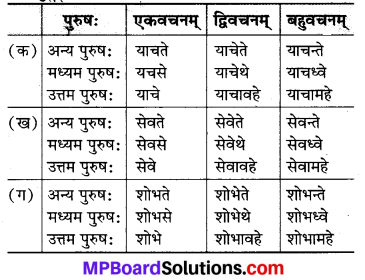
MP Board Class 7th General English Solutions Chapter 5 The Crowded Train

Get Updated MP Board Solutions for Class 7 General English Chapter 5 The Crowded Train Questions and Answers in PDF Format and download them free of cost. These are provided as per the latest exam pattern and syllabus. Access the topics of Chapter wise and communication skills, grammer part through the direct links available depending on the need. You can Download MP Board Class 7 English Solutions and can score highest grade in examination. Clear all your queries on the Mp Board Solutions for Class 7 English Chapter 21 Tansen Questions and Answers Subject by using the Madhya Pradesh State Board Solutions for existing.

MP Board Class 7th General English Solutions Chapter 5 The Crowded Train

If you are eager to know about the Madhya Pradesh State Board Solutions for Class 7 English you will find all of them here. You can identify the knowledge gap using these MP Board Solutions for English PDF and plan accordingly. Don’t worry about the accuracy as they are given after extensive research by people having subject knowledge along side from the latest English Syllabus.

The Crowded Train Textual Exercises

Read and Learn (पढ़ो और याद करो) :
Students should do themselves.
(छात्र स्वयं करें।)

Comprehension (बोध प्रश्न) :

(A) Tick the correct option:
(सही विकल्प पर चिन्ह लगाएँ)

The Crowded Train Lesson 5 MP Board Class 7th Question 1.
Where did Vinod go?
(व्हेयर डिड विनोद गो?)
विनोद कहाँ गया?
(a) Bhopal. (भोपाल)
(b) Indore. (इन्दौर)
(c) Gwalior. (ग्वालियर)
Answer:
(a) Bhopal.

Lesson 5 The Crowded Train MP Board Class 7th Question 2.
Why did Vinod decide to travel by A/C Class?
(व्हाय डिड विनोद डिसाइड टू ट्रेवल बाइ ए/सी क्लास?)
विनोद ने ए/सी क्लास से जाने का फैसला क्यों किया?
(a) He had a lot of money. (ही हैड अलॉट ऑफ मनी।)
उसके पास बहुत पैसा था।
(b) The train was overcrowded.
(द ट्रेन वॉज़ ओवरक्रोउडेड।)
गाड़ी में ज्यादा भीड़ थी।
(c) He was sick.
(ही वॉज़ सिक।)
वह बीमार था।
Answer:
(b) The train was overcrowded.

The Crowded Train MP Board Class 7th Question 3.
The other passengers in the coach……..
(द अदर पैसेन्जर्स इन द कोच……….)
(डिब्बे में दूसरे यात्रियों………)
(a) did not look to be rich.
(डिड नॉट लुक टू बी रिच।)
अमीर नहीं लग रहे थे।
(b) were poorly dressed.
(वर पूअरली ड्रैस्ड्।)
फटेहाल कपड़े पहने थे।
(c) had valid tickets.
(हैड वैलिड टिकैट्स।)
के पास सही टिकटें थीं।
Answer:
(c) had valid tickets.

Mp Board Class 7th English Chapter 5 Question 4.
The young man who got in just when the train moved………..
(द यंग मैन हू गॉट इन जस्ट व्हेन द ट्रेन मूव्ड…..)
(नौजवान जो तभी अंदर आया जब ट्रेन चली…..)
(a) was well dressed.
(वॉज़ वेल ड्रैस्ड्।)
अच्छे कपड़े पहने था।
(b) did not seem to have a job.
(डिड नॉट सीम टू हैव अ जॉब।)
बेरोजगार लग रहा था।
(c) was carrying a new suitcase.
(वॉज़ कैरिइंग अ न्यू सूटकेस।)
एक नई अटैची उठाये था।
Answer:
(b) did not seem to have a job.

The Crowded Train Class 7 MP Board Question 5.
Who did not have a valid ticket?
(हू डिड नॉट हैव अ वैलिड टिकैट?)
किसके पास एक सही टिकट नहीं थी?
(a) Vinod. (विनोद)
(b) All other passengers.
(ऑल अदर पैसेंजर्स।)
बाकी सभी यात्री।
(c) The youngman.
(द यंगमैन।)
नौजवान।
Answer:
(a) Vinod.

(B) Read the following sentences and arrange them in the order in which they have occurred in the story :
(निम्नलिखित वाक्यों को पढ़िए तथा उन्हें कहानी में घटित क्रमानुसार व्यवस्थित कीजिए।)
Answers:

  1. Vinod wanted to go back to Indore.
  2. He was surprised to see an unusually large crowd on the platform.
  3. He noticed some seats were vacant in the A/C coach.
  4. As the train moved a poorly dressed youngman with a worn out suitcase jumped into the coach.
  5. All the passengers were surprised to see such a man in the A/C coach.
  6. The T.T.E appeared.
  7. Vinod paid the difference.

Word Power (शब्द सामर्थ) :

(A) Use these phrases in the following sentences :
(इन वाक्यांशों को निम्न वाक्यों में प्रयोग कीजिए)
(worn-out, well-dressed, poorly-dressed, highly priced, over crowded, vacant seat, valid ticket.)

  1. He is a …………. person.
  2. A …………. lady walked into the shop.
  3. Meena bought a …………. dress.
  4. My coat is really ………….
  5. Rashid found that the train was ………….
  6. It was very difficult to find a …………. in the overcrowded train.
  7. We must have a …………. for travelling in a train.

Answers:

  1. poorly dressed
  2. well dressed
  3. highly priced
  4. worn out
  5. overcrowded
  6. vacant seat
  7. valid ticket.

(B) Encircle the odd word :
(विषम शब्द पर गोला खीचिए)
Answer:
Mp Board Class 7 English Solutions

(C) Complete the following crossword puzzle using the given clues :
(दिए गए संकेतों से निम्न वर्ग पहेली को पूर्ण करिए।)

  1. (down) : one who travels on a public or private conveyance
  2. (across) : this runs on rails
  3. (across) : a piece of paper that gives the right to admission in a train or a bus
  4. (down) : a place near a railway track for passengers to get on and off the trains
  5. (across) : a large number of people gathered together
  6. (down) : a luxury bus used for longer journeys
  7. (across) : a structure across a river, road, etc.
  8. (across) : suitcases or other bags for carrying a traveller’s belongings
  9. (down) : a natural flow of water from one place to another

Answer:
English Class 7 Mp Board

Grammar in Use (व्याकरण का प्रयोग):

(A) Read this sentence carefully.
(वाक्य को सावधानीपूर्वक पढ़िए)

1. He had no ticket at all.
Now read the follwing sentence.
(अब निम्न वाक्य को पढ़िए)
2. Did he have no ticket at all ?
(This is a question-Interrogative sentence.)
Notice. the change in the Verbs.
Now change the following statements into questions :
Answer:
(a) Did the man have a bag ?
(b)Did the T.T.E. have a hat ?
(c) Did he get into A/C coach ?
(d) Did Vinod live in Indore ?
(e) Did Vinod pay the difference ?
(f) Did the passengers start whispering ?

(B) Rearrange the words to make meaningful sentences and use capitals where ever necessary.
(शब्दों को पुनः व्यवस्थित कर अर्थपूर्ण वाक्य बनाइए एवं आवश्यकतानुसार बड़े अक्षर का प्रयोग कीजिए।)
Answer:
(a) Vinod lived in Indore
(b) He travelled in an A/C coach
(c) He decided to pay the difference
(d) The youngman was poorly dressea
(e) Vinod kept the money ready in his hand.

(C) Use the prefix ‘re’, ‘un’ to write the new words and write their meaning in the blank spaces.
(‘re’, ‘un’ उपसर्ग का प्रयोग कर नये वाक्य बनाइए और रिक्त स्थानों में उनके अर्थ भरिए।)
Answer:
Mp Board Solution Class 7

(D) Use the suffix ‘ful’ to write the new words and write their meanings in blank spaces.
(‘Ful’ प्रत्यय का प्रयोग कर नये शब्द लिखिए और खाली स्थानों में उनके अर्थ लिखिए।)
Answer:
MP Board Class 7th General English Chapter 5 The Crowded Train 4

Let’s Talk (आओ बात करें):

Discuss with your friends and write as many combinations as you can from the given table. (Work in pairs/groups)
(अपने मित्रों से चर्चा कीजिए और नीचे दी गई तालिका में से संयोग कर जितने शब्द बना सकते हैं, उन्हें लिखिए।) (जोड़ी-समूह में कार्य करें।)
Answer:
Students can make pairs among themselves and can make the combinations as follow :
MP Board Class 7th General English Chapter 5 The Crowded Train 5
MP Board Class 7th General English Chapter 5 The Crowded Train 6
Students can make more of such combination from the given table.

Let’s Write (आओ लिखें) :

(A) Using the clues, write a paragraph about a journey which you undertook.
(निम्न संकेतों का प्रयोग कर आपके द्वारा की गई एक यात्रा के बारे में एक अनुच्छेद लिखिए।)
Answer:
I went to Jaipur in the month of January 2006. I had to attend a marriage there. I with my friend Mohit planned to go by bus and requested my mother to prepare some poories and pack them in a wrapper with some jam. We were only two friends who started from house but on the bus stand of Gwalior we found other people about ten in number were also going there. We both knew all of them because they were also our relatives. We reached Jaipur and attended the party. At 12 in the night we started back because we had to give our preparatory test on next day. Both of us enjoyed the journey very much.

(B) Write an application to the Principal of your school to grant you four days’ leave as you are going out of station.

Let’s Do It (आओ इसे करें):

(A) Role Play (work in pairs) :
भूमिका निभाना
(जोड़ों में कार्य करें)

Read the given telephonic conversation in the class in groups of two. Repeat with at least four groups.
दी गई टेलीफोन वार्ता को दो-दो के समहों में कक्षा में पढ़िए। कम से कम चार समूहों के साथ दुहराइए।
Answer:
Students can read themselves the given telephonic conversation in the groups of two.
छात्र दिये गये दूरभाष को स्वयं पढ़ें व बोलें।

(B) Get a railway reservation form the Railway reservation window and fill it.
(रेलवे आरक्षण खिड़की से एक रेल आरक्षण फॉर्म लें और इसे भरें)
Answer:
Students can take the reservation form from the Railway reservation counter and fill it with the help of their teacher.
छात्र अपने शिक्षक की सहायता से स्वयं रिजर्वेशन फॉर्म भरें।

Pronunciation & Translation

Vinod finished his work at the office and bought a few things to take back to Indore. He had come on an official visit to Bhopal in the morning and planned to reach home by night. As he reached Bhopal railway station he noticed that the train was overcrowded and it would be impossible for him to travel by second class.

(विनोद फिनिश्ड हिज वर्क ऐट द ऑफिस एण्ड बॉट अ फ्यू थिंग्स टू टेक बैक टू इन्दौर. ही हैड कम ऑन एन ऑफिशियल विजिट टू भोपाल इन द मॉर्निंग एण्ड प्लान्ड टू रीच होम बाइ नाइट. एज ही रीच्ड भोपाल रेलवे स्टेशन ही नोटिस्ड दैट द ट्रेन वॉज़ ओवरक्राउडेड एण्ड इट वुड बी इम्पॉसीबिल फॉर हिम टू ट्रेवल बाइ सेकण्ड क्लास.)

अनुवाद-विनोद ने दफ्तर में अपना कार्य समाप्त किया और कुछ वस्तुएँ इन्दौर ले जाने के लिए लाया। वह सुबह दफ्तर के काम से भोपाल आया था और उसने रात में ही घर वापस जाने की योजना बनाई। जैसे ही वह भोपाल रेलवे स्टेशन पहुँचा उसने देखा कि रेलगाड़ी में काफी अधिक भीड़ थी और उसके लिए दूसरी श्रेणी से यात्रा करना असंभव था।

He had no time either to change his travel plans or to buy a new ticket. He noticed that there were some vacant seats in the AC coaches.

(ही हैड नो टाइम आइदर टू चेन्ज हिज ट्रेवल प्लान्स ऑर टू बाय अ न्यू टिकिट. ही नोटिस्ड दैट देअर वर सम वेकेन्ट सीट्स इन द ए.सी. कोचेज.)

अनुवाद-उसके पास अपनी योजना में परिवर्तन करने या नया टिकिट खरीदने का समय नहीं था। उसने देखा कि ए.सी. कोचों में कुछ खाली सीटें थीं।

He boarded the train and decided to travel in an AC coach. He intended to pay the difference as soon as the TTE arrived. He got into the coach and sat down on one of the two vacant seats.

(ही बोर्डेड द ट्रेन एण्ड डिसाइडेड टू ट्रेवल इन एन ए.सी. कोच. ही इन्टेन्डेड टू पे द डिफरेन्स एज सून एज द टी.टी.ई. एराइव्ड. ही गॉट इन्ट्रद कोच एण्ड सैट डाउन ऑन वन ऑफदट्र वेकेन्ट सीट्स.)

अनुवाद-वह रेल में चढ़ गया और एक ए.सी. कोच में यात्रा करने का निर्णय लिया। उसका इरादा बाकी अंतर की राशि देने का था जैसे ही टी.टी.ई. आता। वह कोच में चढ़ गया और दो खाली सीटों में से एक पर बैठ गया।

The other passengers in the coach appeared to be rich businessman. They were well-dressed. Just as the train was about to start, a poorly-dressed young man with a worn-out suitcase jumped in and sat down. He looked as if he had no job. The young man’s coat was tight and short at the back.

(द अदर पैसेन्जर्स इन द कोच अपीयर्ड टू बी रिच बिजनेसमैन. दे वर वैल-ड्रैस्ड. जस्ट एज द ट्रेन वॉज़ अबाउट टू स्टार्ट, अ पूअर्ली-ड्रैस्ड यंग मैन विद अ वॉर्न-आउट सूटकेस जम्ड इन एण्ड सैट डाउन. ही लक्ड एज इफ ही हैड नो जॉब. द यंग मैन्स कोट वॉज़ टाइट एण्ड शॉर्ट ऐट द बैक.)

अनुवाद-कोच में दूसरे यात्री धनी व्यापारी प्रतीत हो रहे थे। वे अच्छे वस्त्र पहने हुए थे। तभी जैसे ही रेलगाड़ी चलने वाली थी, एक गन्दे वस्त्र पहने हुआ युवक एक टूटे-फूटे सूटकेस के साथ अंदर कूदा और बैठ गया। वह बेरोजगार नजर आता था। युवक का कोट तंग था और पीछे से छोटा था।

He seemed to be a little out of place with all the rich people as co-passengers around him. Some of them started whispering while others felt uncomfortable due to his presence. Two of the passengers stopped reading newspapers and looked up and down at the young man and then started reading again.

(ही सीम्ड टू बी अ लिटिल आउट ऑफ प्लेस विद ऑल द रिच पीपुल एज को-पैसेन्जर्स अराउण्ड हिम. सम ऑफ दैम स्टार्टेड विस्परिंग व्हाइल अदर्स फैल्ट अनकम्फर्टेबल ड्यू टू हिज प्रेजेन्स. टू ऑफ द पैसेन्जर्स स्टॉप्ड रीडिंग न्यूजपेपर्स एण्ड लुक्ड अप एण्ड डाउन एट द यंग मैन एण्ड दैन स्टार्टेड रीडिंग अगेन.)

अनुवाद-वह अपने सह-यात्रियों से जो सब धनी लोग थे, से कुछ अलग-सा प्रतीत हो रहा था। उनमें से कुछ ने कानाफूसी करना आरम्भ कर दिया जबकि अन्य उसकी उपस्थिति से असुविधा अनुभव करने लगे। दो यात्रियों ने अखबार पढ़ना बन्द कर दिया और युवक को ऊपर से नीचे देखा और फिर पढ़ना शुरू कर दिया।

Vinod was surprised to see such a man in an AC coach. He recalled how crowded the train was. But he wondered if the young man would be able to pay the fare for the AC class.

(विनोद वॉज़ सरप्राइज्ड टू सी सच अ मैन इन एन ए.सी कोच. ही रिकॉल्ड हाउ क्राउडेड द ट्रेन वॉज़ बट ही वन्डर्ड इफ द यंग मैन वुड वी एबल टू पे द फेअर फॉर द ए.सी. क्लास.)

अनुवाद-विनोद एक ए.सी. कोच में इस प्रकार के व्यक्ति को देखकर आश्चर्यचकित हुआ। उसे याद आया कि रेलगाड़ी कितनी खचाखच भरी थी। पर उसे आश्चर्य था कि क्या वह युवक ए.सी. श्रेणी का भाड़ा चुका सकेगा।

Vinod thought perhaps the young man expected that no one would come to check the tickets and he would be able to travel even without a ticket. But just after half an hour, the TTE appeared Vinod held out the ticket and the money to pay the difference.

(विनोद थॉट परहैप्स द यंग मैन एक्सपेक्टेड दैट नो वन वुड कम टू चैक द टिकिट्स एण्ड ही वुड बी एबल टू ट्रेवल ईवन विदआउट अ टिकट बट जस्ट आफ्टर हॉफ एन ऑवर, द टी.टी. ई. अपीयर्ड. विनोद हैल्ड आउट द टिकिट एण्ड द मनी टू पे द डिफरेन्स.)

अनुवाद-विनोद ने सोचा कि शायद वह युवक आशा करता होगा कि कोई भी टिकट चैक करने नहीं आएगा और वह बिना टिकट यात्रा कर सकेगा। लेकिन केवल आधा घण्टे बाद ही टी.टी.ई. आ गया। विनोद ने टिकट और बाकी राशि बाहर निकाल लिए।

The young man sat still. Had he no ticket at all ? Vinod wondered why he was so calm. Is he not afraid of the law ? Will he pay the penalty for travelling without a ticket ? The T.T.E. moved towards him and he showed the ticket very calmly. He had a valid ticket for travelling in the AC coach.

(द यंग मैन सैट स्टिल. हैड ही नो टिकट ऐट ऑल ? विनोद वन्डर्ड व्हाई ही वॉज़ सो काम. इज ही नॉट एफ्रेड ऑफ द लॉ ? विल ही पे द पेनल्टी फॉर ट्रेवलिंग विदआउट अ टिकट ? द टी.टी.ई. मूव्ड टुवर्ड्स हिम एण्ड ही शोड द टिकट वैरी कामली. ही हैड अ वैलिड टिकट फॉर ट्रेवलिंग इन द ए.सी. कोच.)

अनुवाद-युवक स्थिर बैठा रहा। क्या उसके पास टिकट नहीं था? विनोद आश्चर्यचकित था कि वह इतना शान्त क्यों था? क्या उसे कानून से डर नहीं था? क्या वह बिना टिकट, यात्रा करने का दण्ड भुगतेगा? टी.टी.ई. उसकी ओर आया और उसने बहुत शान्तिपूर्वक टिकट दिखाया। उसके पास ए.सी कोच में सफर करने के लिए मान्य टिकट था।

The Crowded Train Word Meanings

Overcrowded (ओवरक्राउडेड)-बहुत अधिक भीड़ से युक्त; Official visit (ऑफिशियल विज़िट)-अधिकारिक निरीक्षण; Board (बोर्ड)-चढ़ना; Calm (कॉम)-शान्त; Intend (इन्टेण्ड)-इरादा करना; Worn out (वॉर्न आउट) -फटा हुआ; Poorly dressed (पूअरली ड्रेस्ड)-फटेहाल कपड़े पहने हुए; Well dressed (वेल ड्रेस्ड)-अच्छी पोशाक पहने हुए; Vacant seat (वेकेन्ट सीट)-खाली स्थान; Valid ticket (वेलिड् टिकैट)-उचित टिकट; Uncomfortable (अनकम्फर्टेबल)-आरामदायक न होना; Penalty (पेनल्टी)-दण्ड; A/c coaches (ए/सी कोचेज़) -वातानुकूलित डिब्बे; Appeared (अपीअड)-दिखायी दिया।

We believe the information shared regarding MP Board Solutions for Class 7 English Chapter 21 Tansen Questions and Answers as far as our knowledge is concerned is true and reliable. In case of any queries or suggestions do leave us your feedback and our team will guide you at soonest possibility. Bookmark our site to avail latest updates on several state board Solutions at your fingertips.
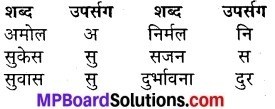
MP Board Class 7th Special English Solutions Chapter 10 Thomas Alva Edison

Get Updated MP Board Solutions for Class 7 Special English Solutions Chapter 10 Thomas Alva Edison Questions and Answers in PDF Format and download them free of cost. These are provided as per the latest exam pattern and syllabus. Access the topics of Chapter wise and communication skills, grammer part through the direct links available depending on the need. You can Download MP Board Class 7 English Solutions and can score highest grade in examination. Clear all your queries on the Mp Board Solutions for Class 7 English Chapter 10 Thomas Alva Edison Questions and Answers Subject by using the Madhya Pradesh State Board Solutions for existing.

MP Board Class 7th Special English Solutions Chapter 10 Thomas Alva Edison

If you are eager to know about the Madhya Pradesh State Board Solutions for Class 7 English you will find all of them here. You can identify the knowledge gap using these MP Board Solutions for English PDF and plan accordingly. Don’t worry about the accuracy as they are given after extensive research by people having subject knowledge along side from the latest English Syllabus.

Thomas Alva Edison Text Book Exercise

Read and Learn

A. Learn these phrases:

(a lot of time, a large sum of money, in order to, talking machine, turn off)

B. Fill in the blank spaces using the phrases given above in their correct forms:

  1. Scientists and inventors spend …………. to invent new things.
  2. Alexander Fleming worked very hard ………… find out penicillin mould.
  3. General Lefferts offered Edison ………… to buy his new invention.
  4. The modem gramophone is a type of …………. invented by Thomas Alva Edison.
  5. Mr. Vajpayi’s house was absolutely dark because all the lights had been ………..

Answer:

  1. a lot of time
  2. in order to
  3. a large sum of money
  4. talking machine
  5. turned off.

Comprehension

A. Answer the questions given below: (in not more than three or four sentences each).

Class 7 English Chapter 10 Thomas Alva Edison MP Board Question 1.
What was young Tom doing one day? Why was he doing so?
Answer:
One day young Tom was trying to find out if he could hatch eggs. He had learnt from his father that a duck sits on its eggs and hatches them. Having been much bigger than a duck, he felt sure that he could also sit on duck’s eggs and hatch them.

Mp Board Class 7th English Chapter 10 Question 2.
When did Tom start his experiments?
Answer:
At the age of eight, Tom started his experiments. He had set up his own laboratory by that time.

Thomas Alva Edison Class 7 MP Board Question 3.
Why did young Edison lose many of his jobs?
Answer:
Young Edison spent a lot of time experimenting with a view to finding out new things. But his employers felt that he was wasting his time. They could not tolerate it (at their cost). Therefore he lost many of his jobs.

Mp Board Class 7 English Chapter 10 Question 4.
What was Edison’s first important invention?
Answer:
Edison’s first important invention was a machine for sending messages. In those days only one message could be sent along a wire at a time. Edison’s invention made it possible to send a number of messages at the same time.

Class 7 English Chapter 10 Mp Board Question 5.
How did Edison get the money he needed for starting a laboratory and factory?
Answer:
A pertain General named Lefferts bought Edison’s new machine.

Lesson 10 Thomas Alva Edison MP Board Class 7th Question 6.
What is a talking machine? What is a ‘talkie’?
Answer:
A talking machine is one that can talk. The modem gramophone is simply an improvement on this talking machine. A ‘talkie’ is a talking picture. This is the modern cinema.

Class 7th English Chapter 10 Thomas Alva Edison MP Board Question 7.
Why did the Americans turn off their electric lights for a while when Edison died?
Answer:
Edison had invented the electric light. Therefore, when Edison died, the Americans turned off their electric lights for a while as a mark of respect to the wonderful inventor.

B. Read the following sentences and tick true (T) or (F) false:

  1. Thomas Alva Edison is the inventor of gramophone and electric bulb. T / F
  2. Edison was born in England. T / F
  3. Edison made telegraphy more useful. T / F
  4. General Lefferts offered 40,000 dollars to buy Edison’s new invention. T / F
  5. Edison’s most important and useful invention is electric bulb. T / F
  6. Edison produced the first ’talkie’ or talkings picture in 1915. T / F

Answer:

  1. True
  2. False
  3. True
  4. True
  5. True
  6. False

Word Power

A. Write one word for every clue given below:

  1. A person who helps somebody assistant
  2. A person who has invented something ………….
  3. A thin wire that produces light when the electricity passes through it …………
  4. Scientific test that is carried out to gain new knowledge ………..
  5. To a very high degree ……….
  6. A machine that produces writing similar to print ………..
  7. The person who gives somebody a job to do for payment ……….

Answer:

  1. assistant
  2. Inventor
  3. Filament
  4. Experiment
  5. Extreme
  6. Typewriter
  7. Employer.

B. Use the following words in the sentences given below:
(intelligent, experiments, messages, telegraph, operator, respect)

  1. Edison learnt telegraphy and started working as …………
  2. We can send ……….. more through telegraph.
  3. Americans ………… Edison because of his contribution as a scientist.
  4. Edison’s mother knew that he was very ………….
  5. Madam Curie did several …………. as a scientist.

Answer:

  1. telegraph operator
  2. messages
  3. respect
  4. intelligent
  5. experiments.

Grammar in Use

A. Form nouns ending in ‘-er’ from the verbs in the list given below and give their meanings in the way the example does. You can use a dictionary or ask your teacher.
(speak, suffer, sweep, teach, drive, observe, borrow, employ, build, rule)
Example :
A          B                                        C
drive driver One who drives a car motor cycle, scooter etc.
Thomas Alva Edison Class 7 MP Board
B. Write ten meaningful sentences from this table:
Mp Board Class 7th English Chapter 10
Answer

  1. The young man worked hard in order to come first.
  2. Ram and Gopal practised every day in order to win the match.
  3. The team practised every day in order to, win the match.
  4. The two brothers worked hard in order to come first.
  5. Ram and Gopal played very cleverly in order to win the match.
  6. The team played very cleverly in order to win the match.
  7. Ram and Gopal worked hard in order to come first.
  8. The young man played very cleverly in order to win the match.
  9. The young man practised every day in order to win the match.
  10. The two brothers played very cleverly in order to win the match.

C. Re-arrange the words in the following sentences and rewrite them to make meaningful sentences:

  1. jobs / lost / Edison / many /. /
  2. the / bet / is / what / ? /
  3. his / life / worked / till / the very end / Edison / hard / of /.
  4. was / lucky / father / how / your / . /
  5. surprised / very / am l\l.

Answer

  1. Edison lost many jobs
  2. What is the bet?
  3. Edison worked hard till the very end of his life.
  4. How lucky was your father!
  5. I am very surprised.

Let’s Talk

Talk to your partner and say ‘yes’ or ‘no’ and tick the correct option.

  1. Scientists and inventors have made the greatest contribution to mankind. Yes/No
  2. Education is not necessary for all. Yes/No
  3. Telephone was invented by Graham, Bell Yes/No
  4. Oxygen is not essential for living beings. Yes/No
  5. We should hurt animals. Yes/No
  6. Flaying and exercise are not good for health. Yes/No
  7. We should always try to speak the truth. Yes/No
  8. Always help your friends and neighbours. Yes/No

Answer:

  1. Yes
  2. No
  3. Yes
  4. No
  5. No.
  6. No.
  7. Yes
  8. Yes

Let’s Write

Write a paragraph on
1. Electric bulb
2. Gramophone
Answer:
1. Electric Bulb
Electricity has caused wonders. The electric bulb was the most important and useful invention. Edison worked for about two years before he invented the first electric bulb. He used the best material and made the filament. The first electric bulb was produced in 1879. Electric bulbs provide electric lights to us. It is economical than most other burning oils. It gives bright light and illumines large space.

Thomas Alva Edison Question Answer MP Board Class 7th 2. Gramophone
Edison invented the first talking machine. It looked very funny. However, it could talk. It was a new machine. The modern gramophone or record player is an improvement on the talking machine. The present day telephones and wireless sets are also talking machines. We can play the records on the gramophone of our choice and hear songs. The modem cinema is called a talkie due to the same.

Let’s Do It

Take a cotton pad. Soak it in water and put some gram seeds on it. Watch the seeds bud out in a day or two. You will have to wet the cotton pad every day. Record what you observe everyday for five days.
Answer:
Class-room Activity

Thomas Alva Edison Word Meanings

Class 7 English Chapter 10 Thomas Alva Edison MP Board

We believe the information shared regarding MP Board Solutions for Class 7 English Chapter 10 Thomas Alva Edison Questions and Answers as far as our knowledge is concerned is true and reliable. In case of any queries or suggestions do leave us your feedback and our team will guide you at soonest possibility. Bookmark our site to avail latest updates on several state board Solutions at your fingertips.
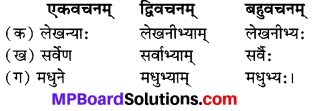
MP Board Class 7th Special English Solutions Chapter 21 Tansen

Get Updated MP Board Solutions for Class 7 Special English Solutions Chapter 21 Tansen Questions and Answers in PDF Format and download them free of cost. These are provided as per the latest exam pattern and syllabus. Access the topics of Chapter wise and communication skills, grammer part through the direct links available depending on the need. You can Download MP Board Class 7 English Solutions and can score highest grade in examination. Clear all your queries on the Mp Board Solutions for Class 7 English Chapter 21 Tansen Questions and Answers Subject by using the Madhya Pradesh State Board Solutions for existing.

MP Board Class 7th Special English Solutions Chapter 21 Tansen

If you are eager to know about the Madhya Pradesh State Board Solutions for Class 7 English you will find all of them here. You can identify the knowledge gap using these MP Board Solutions for English PDF and plan accordingly. Don’t worry about the accuracy as they are given after extensive research by people having subject knowledge along side from the latest English Syllabus.

Tansen Text Book Exercise

Read and Learn

Tansen Was Very MP Board Class 7th

Comprehension

A. Complete the following sentences using correct option:

Tansen Was Very MP Board Class 7th Question 1.
Tansen was very ………….
(a) Talented
(b) Dull
(c) Lazy
Answer:
(a) Talented

Class 7 English Chapter 20 Tansen Question 2.
Tansen’s father’s name was ………..
(a) Shekharan Misra
(b) Chandan Misra
(c) Mukandan Misra
Answer:
(c) Mukandan Misra

Tansen Sang Raga Megh At The Durbar Question 3.
His father was devoted to ………..
(a) Mohammad Kaif
(b) Mohammad Khalid
(c) Mohammad Ghaus.
Answer:
(c) Mohammad Ghaus.

Lesson 20 Tansen MP Board Class 7th Question 4.
Hussaini was ………..
(a) Rani Mrignayani’s Courtier
(b) Tansen’s wife.
(c) Both
Answer:
(c) Both

Tansen Father Name Was MP Board Class 7th Question 5.
Chief conspirator against Tansen was………..
(a) Rafeeq Miyan
(b) Iqbal Miyan
(c) Shaukat Miyan
Answer:
(c) Shaukat Miyan

B. Read the following senteneces and tick \ true (T) or false (F)

  1. Tansen sang Raga Megh at the durbar. T / F
  2. Saraswati and Roopwati sang raga Deepak to save Tartsen. T / F
  3. Akbar was impressed by Tansen’s talent as a singer and a musician T / F
  4. Shaukat Miyan wanted to ruin Tansen T / F
  5. Tansen was saved by Saraswati and Roopwati. T / F
  6. Akbar did not offer precious presents to Tansen T / F
  7. Tansen was one of Akbar’s Navaratnas’. T / F

Answer:

  1. False
  2. False
  3. True
  4. True
  5. True
  6. False
  7. True.

C. Comprehension

Tansen’s Father Name Was MP Board Class 7th Question 1.
How was Tansen’s life saved?
Answer:
Tansen started singing Deepak Raga. The lamps lit up all of a sudden as a result of the heat given off by the raga. It could bum Tansen to ashes. Just then, Saraswati and Roopwati began to sing raga Megh. It brought down rain. Thus Tansen’s life was saved by his daughter and her friend.

Tansen Father Was Devoted To MP Board Class 7th Question 2.
Why did Akbhar punish Tansen’s enemies?
Answer:
Tansen’s enemies wanted to ruin him. Akbar came to know about their conspiracy. Therefore, he punished Tansen’s enemies.

Tansen’s Father’s Name Was MP Board Class 7th Question 3.
When did Tansen die?
Answer:
Tansen died in 1585.

Question 4.
Why do people go to Gwalior?
Answer:
Tansen’s tomb is at Gwalior. This place has become a pilgrimage for singers, musicians and all the music lovers. Therefore, the people go to Gwalior to pay their homage.

Question 5.
How did Tansen come into contact with Swami Haridas?
Answer:
Tansen used to go to dense forests to enjoy the beauty of nature. He learnt how to imitate the calls of different birds and animals, One day, swami Haridas and his disciples were crossing the forest. Tansen roared like a lion. It frightened Swami Haridas and his disiciples. One of the disciples found Tansen and presented him before Swamiji. Thus Tansen came into contact with Swami Haridas.

Word Power

A. Use the following phrases in the sentences given below:
(Jealous of, fond of, due to, called upon, afraid of.)

  1. Akbar was very…………..Tansen.
  2. All the people were…………the tiger and escaped in fear.
  3. Shaukat Miyan and some other courtiers were……….Tansen.
  4. Tansen’s life was saved……….his daughter and her friend.
  5. Akbar frequently……….Tansen and listened to his ragas and music.

Answer:

  1. fond of
  2. afraid of
  3. jealous of
  4. due to
  5. called upon

B. Match the following words with their meanings:
Answer:
MP Board Class 7th Special English Chapter 21 Tansen 2

Grammar in Use

A. Use the following ‘Adverbs’ to complete the sentences given below:
(extremely, naturally, surely, actually, affectionately, certainly)

  1. Grammar is………involved in each and every sentence.
  2. My friend will………..come on my birthday.
  3. ……….. Tansen was a great singer and musician.
  4. Mohammad Ghaus………. invited Tansen to his house.
  5. I Will……….come to join you.

Answer:

  1. actually
  2. certainly
  3. Naturally
  4. affectionately
  5. surely

B. Fill in the blank spaces using correct forms of the verbs. (Past perfect)

  1. Sheela ………… food before her mother came to the office, (cook)
  2. Mr. Ramlal ……….. his house when he went abroad (sell)
  3. Ramesh ………… the lights before he went to sleep (switch off).
  4. The thief……….before the police reached there, (escape)
  5. The patient ……….. before the doctor arrived. (die)

Answer:

  1. had cooked
  2. had sold
  3. had switched
  4. escaped
  5. had died.

Let’s Talk

Talk to your friends about different qualities Tansen had as a child. Also discuss about his qualities as a singer and a musician. Enlist all the qualities you have discussed. Make a profile with the help of your friends and teachers.
Answer:
For self attempt

Find Answer to the following questions.

Question 1.
Why was Tansen Akbar’s favourite? Give reasons.
Answer:
Tansen was Akbar’s favourite for the following reasons. Akbar was a great lover of music. He listened to Tansen’ music for hours and hours. Akbar used to visit Tansen’s house frequently to listen to his music. He often gave Tansen precious presents.

Question 2.
What tells you that the emperor was fond of him?
Answer:
The emperor used to visit Tansen’s house frequently to listen to his music. He also called Tansen at his darbar whenever he desired to listen to his music. Akbar punished Tansen’s conspirantors when he came to know About their evil plot. These factors show that the emperor was fond of him.

Question 3.
What in the story tells you that the courtiers were jealous of him?
Answer:
The courtiers started conspiring against Tansen. Shaukat Ali made the king direct Tansen to sing Raga Deepak. It was a plot against Tansen’s life. It shows that the courtiers were jealous of him.

Question 4.
What was the conspiracy against Tansen?
Answer:
To make Tansen sing raga Deepak was a plot against his life. The proper singing of raga Deepak would give off immense heat. It would burn the singer into ashes. Indirectly, it was shaukat Ali’s conspiracy against Tansen.

Question 5.
How did Tansen overcome the threat to his life?
Answer:
An idea flashed in Tansen’s mind. He taught his daughter Saraswati and her friend Roopwati to sing raga Megh. Tansen sang Raga Deepak properly. It gave off immense heat. It could bum him alive, just then the two girls sang raga Megh. It made the rain drops fall down. It also deactivated the damaging effect of raga Deepak. Ultimately Tansen overcame the threat to his life.

Let’s Write

Write Tansen’s biography in about ten sentences using information from the lesson.

  1. birth
  2. Childhood
  3. father
  4. Guru.
  5. Marriage
  6. Akbar’s Navratan
  7. Raga Deepak and after
  8. Tomb at Gwalior

Note :
1. biography : the story of a person’s life written by some body else.
2. autobiography : the story of a person’s life written by the person himself/ herself.
Answer:
Tansen’s Biography, Tansen was born at Behat, a small village near Gwalior. He was the only child of his parents. He was a naughty but a talented and adventurous child. Sri Mukandan Misra was his father. Swami Haridas was his guru. Tansen was married to Bjussaini. Tansen joined Akbar’s courts as one of his ‘Navartnas’ He sang the Raga. Deepak properly and successfully. His daughter and her friend saved his life by singing Raga Mesh. However, he fell seriously ill and died in 1585 His tomb at Gwalior is a place of pilgrimage for music lovers.

Let’s Do It

Draw a picture of Akbar’ durbar with Tansen singing Raga Deepak.
Answer:
For self attempt.

Tansen Word Meanings

MP Board Class 7th Special English Chapter 21 Tansen 3

We believe the information shared regarding MP Board Solutions for Class 7 English Chapter 21 Tansen Questions and Answers as far as our knowledge is concerned is true and reliable. In case of any queries or suggestions do leave us your feedback and our team will guide you at soonest possibility. Bookmark our site to avail latest updates on several state board Solutions at your fingertips.