MP Board Class 7th Science Solutions Chapter 12 Reproduction in Plants

MP Board Class 7th Science Solutions Chapter 12 Reproduction in Plants

Reproduction in Plants Intex Questions

Question 1.
Boojho wants to know if there is any advantage of vegetative propagation?
Answer:
Plants produced by vegetative propagation take less time to grow and bear flowers and fruits earlier than those produced from seeds. The new plants are exact copies of the parent plant, as they are produced from a single parent.

Question 2.
Boojho wants to know how the male gamete in the pollen grain reaches the female gamete present in the ovule?
Answer:
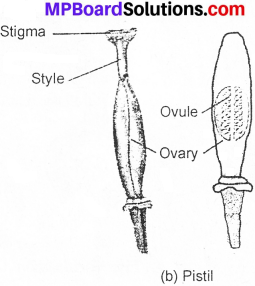
The ovary contains one or more ovules.

MP Board Solutions

Question 3.
Boojho wants to know why flowers are generally so colorful and fragrant. Is it to attract insects?
Answer:
Yes.

Activities

Activity – 1
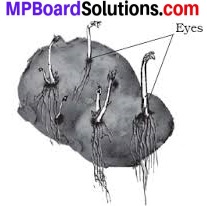
Take a fresh potato. Observe the scars on it with the help of a magnifying glass. You may find buds in them. These scars are also called “eyes”. Cut a few pieces of a potato, each with an eye and bury them in the soil. Water the pieces regularly for a few days and observe their progress?
Answer:
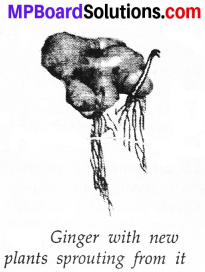
MP Board Class 7th Science Solutions Chapter 12 Reproduction in Plants img 1
MP Board Class 7th Science Solutions Chapter 12 Reproduction in Plants img 2

Reproduction in Plants Text Book Exercises

Question 1.
Fill in the blanks:

  1. Production of new individuals from the vegetative part of parent is called ……………………….
  2. A flower may have either male or female reproductive parts Such a flower is called …………………….
  3. The transfer of pollen grains from the another to the stigma of the same or of another flower of the same kind is known as ………………………….
  4. The fusion of male and female gametes is termed as ………………………
  5. Seed dispersal takes place by means of …………………………. , ……………………… and …………………………….

Answer:

  1. Vegetative propagation
  2. unisexual flowers
  3. pollination
  4. fertilisation
  5. wind, insects, water.

Question 2.
Describe the different methods of asexual reproduction. Give examples?
Answer:
The various methods of asexual reproduction are:

  1. Vegetative propagation, for example stem cutting of rose or champa.
  2. Budding, for example reproduction in yeast by budding.
  3. Fragmentation, for example fragmentation in spirogyra.
  4. Spore formation, for example reproduction in fern.

MP Board Solutions

Question 3.
Explain what you understand by sexual reproduction?
Answer:
In this type of reproduction male gamete (sperm) combines tie female gamete (ovum) in animals to form zygote.

Question 4.
State the main difference between asexual and sexual reproduction?
Sexual Reproduction:

  1. It occurs both in lower and the higher organisms but mostly in higher plants and animals.
  2. In it, there is fusion of the two (male and female) gametes and for this the sexes are required.
  3. The new individual formed is identical to the parent.

Asexual Reproduction:

  1. Usually occurs in lower organisms.
  2. Only one parent is sufficient in asexual reproduction.
  3. The new individual formed is similar but not identical to the parents.

Question 5.
Sketch the reproductive parts of a flower?
Answer:
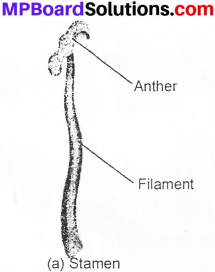
MP Board Class 7th Science Solutions Chapter 12 Reproduction in Plants img 3
MP Board Class 7th Science Solutions Chapter 12 Reproduction in Plants img 4

Question 6.
Explain the difference between self – pollination and cross – pollination?
Answer:
self – pollination:
The transfer of pollen from the another to the stigma of a flower is called pollination.
If the pollen lands on the stigma of the same flower it is called self – pollination.

cross – pollination:
When the pollen of a flower lands on the stigma of another flower of the same plant, or that of a different plant of the same kind, it is called cross – pollination.
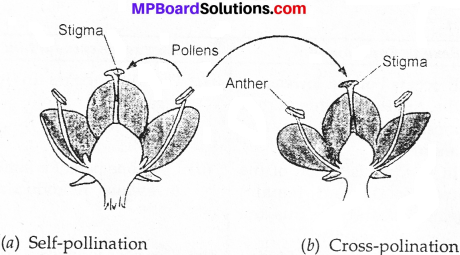
MP Board Class 7th Science Solutions Chapter 12 Reproduction in Plants img 5 and 6

Question 7.
How does the process of fertilisation take place in flowers?
Answer:
Fertilization is the process in which male and female gametes fuse together. In flowering plants the pollen fuses with ovules present in the overy to form a zygote, which later on develops into seed.
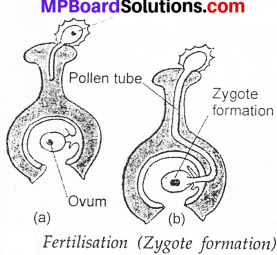
MP Board Class 7th Science Solutions Chapter 12 Reproduction in Plants img 7 and 8

Question 8.
Describe the various ways by which seeds are dispersed?
Answer:
In nature same kind of plants grow at different places. This happens because seeds are dispersed to different places. Sometimes after a walk through a forest or a field or a park, we may have found seeds or fruits sticking to our clothes. Seeds and fruits of plants are carried away by wind, water and animals.

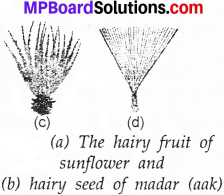
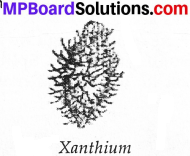
Winged seeds such as those of drumstick and maple [Fig.(a) and (b)], light seeds of grasses or hairy seeds of aak (Madar) and hairy fruit of sunflower [Fig. (a), (b)], get blown off with the wind to far away places. Some seeds are dispersed by water. These fruits or seeds usually develop floating ability in the form of spongy or fibrous outer coat as in coconut. Some seeds are dispersed by animals, especially spiny seeds with hooks which get attached to the bodies of animals and are carried to distant places. Examples are Xanthium and Urena.
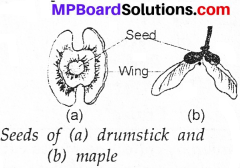
MP Board Class 7th Science Solutions Chapter 12 Reproduction in Plants img 8
MP Board Class 7th Science Solutions Chapter 12 Reproduction in Plants img 9
Some seeds are dispersed when the fruits burst with sudden jerks. The seeds are scattered far from the parent plant. This happens in the case of castor and balsam.
MP Board Class 7th Science Solutions Chapter 12 Reproduction in Plants img 10

Question 9.
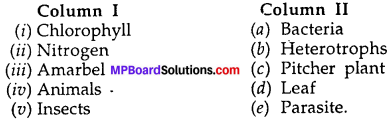
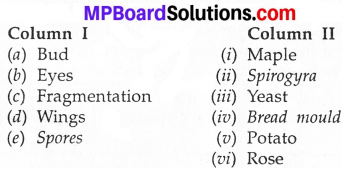
Match items in Column I with those in Column II
MP Board Class 7th Science Solutions Chapter 12 Reproduction in Plants img 11
Answer:

(a) – (iii)
(b) – (v)
(c) – (ii)
(d) – (i)
(e) – (iv).

Question 10.
Tick the correct answer:

Question (a)
The reproductive part of a plant is the?
(i) leaf
(ii) stem
(iii) root
(iv) flower.
Answer:
(iii) root

Question (b)
The process of fusion of the male and the female gametes is called?
(i) fertilisation
(ii) pollination
(iii) reproduction
(iv) seed formation.
Answer:
(i) fertilisation

Question (c)
Mature ovary forms the?
(i) seed
(ii) pistil
(iii) stamen
(iv) fruit.
Answer:
(iv) fruit.

MP Board Solutions

Question (d)
A spore producing plant is?
(i) rose
(ii) bread mould
(iii) potato
(iv) ginger.
Answer:
(iii) potato

Question (e)
Bryophyllum can reproduce by its?
(i) stem
(ii) leaves
(iii) roots
(iv) flower.
Answer:
(ii) leaves

Extended Learning – Activities and Projects

Question 1.
Make your own cactus garden by collecting pieces cut from different kinds of cacti. Grow the variety in one single flat container or in separate pots?
Answer:
Do yourself.

Question 2.
Visit a fruit market and collect as many local fruits as possible. If many fruits are not available, you can collect tomatoes and cucumbers (these are fruits, though we use them as vegetables). Make drawings of the different fruits. Split the fruits and examine the seeds within. Look for any special characteristics in the fruits and their seeds?
Answer:
Do yourself.

Question 3.
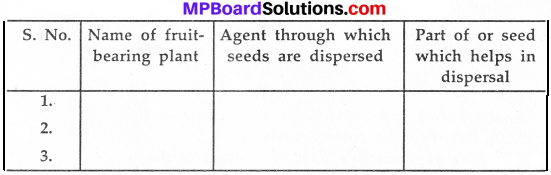
Think of ten different fruit – bearing plants. Remember that many vegetables are also fruits of the plants. Discuss with your teacher, parents, farmers, fruit growers and agricultural experts (if available nearby) and find out the manner of their dispersal. Present your data in the form of a table as shown below:
MP Board Class 7th Science Solutions Chapter 12 Reproduction in Plants img 12
Answer:
Do yourself

Question 4.
Suppose there is one member of a particular kind of organism in a culture dish, which doubles itself in one hour through asexual reproduction. Work out the number of members of that kind of organism which will be present in the culture dish after ten hours. Such a colony of individuals arising from one parent is called a “clone”?
Answer:
Do yourself.

Reproduction in Plants Additional Important Questions

Objective Type Questions

Question 1.
Choose the correct alternative:

Question (a)
………………………… is formed in female reproductive part of plant.
(a) pollen grain
(b) pollination
(c) female gamete
(d) stigma.
Answer:
(d) stigma.

Question (b)
The process of reaching pollen grains to stigma is called as …………………….
(a) pollination
(b) budding
(c) fission
(d) fertilisation.
Answer:
(a) pollination

MP Board Solutions

Question (c)
In plants, male and female reproductive organs are found in ………………………….
(a) leaves
(b) flowers
(c) roots
(d) stem.
Answer:
(b) flowers

Question (d)
Those living beings who have male and female reproductive organs differently are called ………………………….
(a) asexual
(b) bisexual
(c) unisexual
(d) None of these.
Answer:
(c) unisexual

Question (e)
Zygote is formed:
(a) by fusion of two male gamete
(b) by fusion of two female gametes
(c) by fusion of male and female gametes
(d) by all the above methods.
Answer:
(c) by fusion of male and female gametes

Question (f)
Which one of the following organisms shows budding?
(a) Hydra
(b) Spirogyra
(c) Amoeba
(d) Paramecium.
Answer:
(a) Hydra

Question 2.
Fill in the blanks:

  1. ……………………. are parts of flower.
  2. Once the pollen grains reach stigma, they form …………………………..
  3. ……………………… are formed in pollen grains.
  4. The long thread like structure of carpel is called as ………………………
  5. The grain like structure in ovary is called as …………………………
  6. ………………………….. is formed in ovule.
  7. Formation of a new plant from the stem of sugarcane is known as ………………………..
  8. The fusion of sperm and egg is known as ………………………..
  9. We can count the age of a tree through its ……………………….
  10. The cells involved in sexual reproduction are called ………………………….
  11. Fusion of gametes gives rise to a single cells called ……………………….
  12. The process of fusion of gametes is called ………………………….. in animals and plants.
  13. Animals having both reproductive organs are called ………………………….

Answer:

  1. Stamen and carpel
  2. Male gametes
  3. Male gametes
  4. Ovules
  5. Female gametes
  6. Zygote
  7. Vegetative reproduction
  8. Fertilisation
  9. Annual rings
  10. Gametes
  11. Zygote
  12. Fertilisation
  13. Hermaphrodite.

MP Board Solutions

Question 3.
Which of the following statements are true (T) or false (F):

  1. The process of development in human and butterfly are the same because they both start from a zygote.
  2. The most common type of reproduction in amoeba and paramecium is budding.
  3. The common method of reproduction in yeast is budding.
  4. Asexual reproduction is more common than the sexual reproduction.
  5. Reproduction by spores is a method of asexual reproduction.
  6. Cutting and grafting are natural means of reproduction.
  7. A fertilized egg becomes a seed.
  8. Plants can have indefinite growth but animals do not.
  9. Insect pollinated flowers are brightly coloured.
  10. Flowers which possess stamens and carpel are called unisexual.
  11. Wind pollinated flowers produce pollen grains in large quantity.

Answer:

  1. False
  2. False
  3. True
  4. True
  5. True
  6. False
  7. True
  8. True
  9. True
  10. False
  11. True

Question 4.
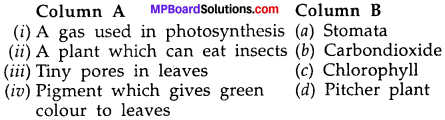
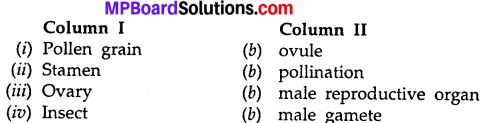
Match the items in Column A with Column B:
MP Board Class 7th Science Solutions Chapter 12 Reproduction in Plants img 13
Answer:

(i) – (d)
(ii) – (c)
(iii) – (a)
(iv) – (b).

Reproduction in Plants Very short Answer type Questions

Question 1.
Name two organisms which reproduce by two types of asexual methods. What are the methods?
Answer:
Amoeba reproduces by binary fission. Hydra reproduces by budding.

Question 2.
What is meant by reproduction?
Answer:
It is a process by which an organism gives birth to produce its own kind to maintain its species.

Question 3.
What are the two methods of reproduction in plants and animals?
Answer:
The two methods of reproduction in plants and animals are:

  1. Asexual reproduction.
  2. Sexual reproduction.

MP Board Solutions

Question 4.
What is pollination?
Answer:
It is the process of transference of pollen grains from the stamens to the stigma of the carpel of flower.

Question 5.
What do you call for the male reproductive organ of flower?
Answer:
The male reproductive organ of a flower is called ‘stamen’.

Question 6.
What do you call for the female reproductive organ of the flower?
Answer:
The female reproductive organ of the flower is called a “carpel”.

Question 7.
What is growth?
Answer:
The process in which the change in size and shape of the organism along with the increase in weight is called growth.

Question 8.
What kind of development takes place in dog and cat?
Answer:
The development in dog and cat takes place inside the body of female. The female gives birth to young ones after a definite period. This type of development is called internal development.

MP Board Solutions

Question 9.
What is the difference between sperm and ovum?
Answer:
Sperm is a male gamete while ovum is a female gamete. Sperm is mobile while ovum is non-mobile, the movement of sperm is attributed to mitochondria present in sperm.

Question 10.
In which part of the flower is the ovule found?
Answer:
In the ovary part of carpel of the flower the ovule is found.

Question 11.
Where does fertilisation occur in a flowering plant?
Answer:
In flowering plants, the fertilisation occurs in the ovary of the carpel of the flower.

Question 12.
How many types of gametes are there?
Answer:
Gametes are the fundamental units of reproduction. They are of two types :

  1. Male gametes or sperms
  2. Female gametes or ovum.

Question 13.
What is fertilisation process?
Answer:
The fusion of male and female gametes to form a zygote during sexual reproduction is called fertilisation.

Reproduction in Plants short Answer type Questions

Question 1.
How do insects help in cross – pollination?
Answer:
Insects get attracted towards flowers either due to their bright color or fragrance or nectar. In the process of collecting nectar from flowers some of the pollens get stuck to their legs and body. If such an insect visits another flower, he transfers pollens to this flower and thus completes the process of cross-pollination.

Question 2.
What are the organs in human which produce the gametes?
Answer:
In humans the parents are separate as mother and father. Mother (female) possesses the ovary and the father (male) possesses the testes. The ovary produces the ovum (female sex cell) and the testes produces the sperm.

MP Board Solutions

Question 3.
What is budding?
Answer:
Budding is a type of a sexual reproduction in which an individual is produced as an out growth called bud from the parent organism. It takes place in certain animals like Hydra and in non green plant cells of yeast.

Question 4.
How do plants developed from a seed?
Answer:
The embryo inside the seed has two distinct parts. One part produces root system, and the other shoot system under favourable conditions of water, air, light and temperature. The root system developed under the soil and shoot system above the soil. Due to cell division elongation of different parts takes place and a new plant is obtained.

Question 5.
Give some examples of growth in plants and animals?
Answer:
Examples of growth in plants:

  1. A small seedling gets developed into a fully developed tree.
  2. Growth of plant in length.
  3. Growth of stem in thickness.

Examples of growth in animals:

  1. An egg is developed into an organism by the division of cells.
  2. A small child grows into a fully developed adult.
  3. A wound is healed up by the division of cells in the surrounding region.

Question 6.
Explain with examples “fission”?
Answer:
When the body of an individual after a certain period of growth divides mitotically into two or more parts, it is known as fission reproduction. When a fission results in the formation of two daughters, it is known as binary fission. When fission results in the formation of two daughters, it is known as multiple fission.

Question 7.
How does reproduction take place in fungs by budding?
Answer:
A bulb like structure formed on body is known as bud. As the reproduction takes place through this bud, it is called as budding. Such types of buds are formed on the bodies of organisms like hydra, yeast etc. This bud increases gradually and detaches itself from parent body and develops in the form of new organism. In corel and sponge also reproduction takes place by budding.

MP Board Solutions

Question 8.
What is called as vegetative reproduction?
Answer:
The new plant develops when branches of these plants are burried in soil during rainy season. The new saplings are produced from various parts such as root, stem, leaf of plants. This type of propagation or reproduction in plants is called as vegetative propagation.

Question 9.
What is difference between fertilisation and pollination?
Answer:
Pollination is the transference of male gametes (pollen grain) from pollen sac to stigma and the fertilisation is fusion of male gamete (pollen grain) and female gamete (egg cell) in the ovary of a flower. Fertilisation is followed by the formation of embryo. Embryo is enclosed within the seed.

Question 10.
What are the advantages of vegetative reproduction?
Answer:
Advantages of vegetative reproduction:

  1. It helps in rapid propagation of plant species in some region. Examples: bamboo, sugarcane, potato crop etc.
  2. Those plants, whose seeds are not capable of germination, can be reproduced by vegetative reproduction e.g. garlic,
  3. There is 100 percent possibility of survival of plants by this method.
  4. The species having high qualities can be conserved.
  5. The plants reproduced by this method get the fruits earlier.

Reproduction in Plants Long Answer type Questions

Question 1.
What are the different ways in which reproduction in plants can take place?
Ans. Reproduction in plants can be classified in three main groups:

  1. Sexual reproduction,
  2. Asexual reproduction, and
  3. Vegetative reproduction.

In asexual reproduction, the new individuals are reproduced from a single parent. Here one cell undergoes division into two new individuals. In sexual reproduction, two parents are needed to produce one new individual. In vegetative propagation, a few cells of plant body propagate to form a new plant.

MP Board Solutions

Question 2.
Write the various steps involved in the formation of a plant seed, starting from pollination?
Answer:
There are following steps involved from pollination to the formation of the seed:

1. Fertilisation:
The process of fusion of male and female gamete in sexual reproduction is called fertilisation.

2. Pollination:
The male part of plant is stamen. It consists of the filament and the anther. The anther has pollen grains.The female part is made up of stigma, style and ovary. The ovary has ovule. The stigma receives of pollen grains. The process of transfer of pollen from anther to stigma is known as pollination.

3. Seed formation:
The whole ovary after fertilisation is converted into the fruit while the ovule is converted into the seed.

Question 3.
What is meant by the terms external fertilisation and internal fertilisation?
Answer:
Internal fertilisation:
The reproductive process remains incomplete till the male and female gamete do not fuse with each other. In some animals the process of fertilisation occurs inside the female body. This is called internal fertilization. After that female either lay eggs or given birth to young one. For example, dog, cat, bird, human etc.

External fertilisation:
In some animals the female release ovum or egg outside and the male drops sperms on these. This type of fertilization is called external fertilization. The zygote so formal undergoes regular and specific changes with rime to form a new individual.

MP Board Solutions

Question 4.
What are the reproductive organs in a flower? How does pollination take place? What is a seed?
Answer:
The reproductive organs of a plant develop on a special reproductive appendage called flower. The male reproductive, organs are stamen. The stamens bear anthers where pollen grains (the male gametes) are produced. The female reproductive organ is pistil. It consists of stigma, style and ovary. Inside the ovary (the female – gametes) are developed.

Pollination is the transfer of pollen grains from another to stigma of either the same flower (self pollination) or of another flower (cross pollination). The pollen grains are carried to the stigma by air, insects water in aquatic plants or by animals. Seed is the structure formed by the fusion of ovule and pollen grains in the ovary. The seeds germinate after their dispersion, into new plants.

Question 5.
Explain reproduction by spore formation in fungus with neat diagram?
Answer:
Spore formation:
You might have seen white powder like substance on leather objects during rainy season. These small particles are spores of fungus. Small spherical structures are in yeast, fungus, moss, fern and microbes during unfavourable circumstances. They have protective layer around them and remain floating in air. During favourable conditions, the protective layer breaks open and new organism is formed.
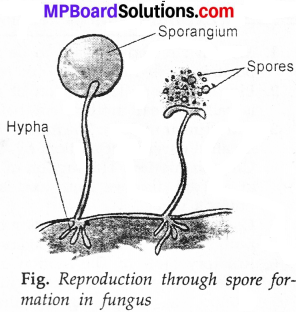
MP Board Class 7th Science Solutions Chapter 12 Reproduction in Plants img 14.

Question 6.
What are spores? When do they form?
Answer:
Several plants produce spores which germinate to produce new individual plants e.g., rhizopus, mucus and moss etc. It is the mechanism to overcome the unfavourable conditions.
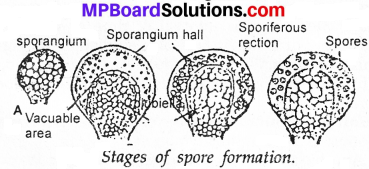
MP Board Class 7th Science Solutions Chapter 12 Reproduction in Plants img 15

Question 7.
Draw a neat diagram to show reproduction through spore formation in fern?
Answer:
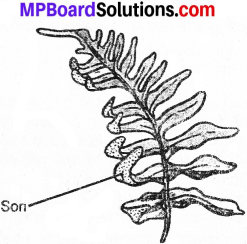
MP Board Class 7th Science Solutions Chapter 12 Reproduction in Plants img 16

MP Board Class 7th Science Solutions

MP Board Class 7th Science Solutions Chapter 11 Transportation in Animals and Plants

MP Board Class 7th Science Solutions Chapter 11 Transportation in Animals and Plants

Transportation in Animals and Plants Intex Questions

Question 1.
Why is the color of blood red?
Answer:
Because blood contains a red pigment called hemoglobin.

Question 2.
Paheli wonders which side of the heart will have oxygen – rich blood and which side will have carbon dioxide  rich blood?
Answer:
Right side of heart has blood rich in oxygen and left side of heart has blood rich in carbon dioxide.

Question 3.
Paheli wants to know whether other animals also urinate?
Answer:
Yes.

MP Board Solutions

Question 4.
Boojho wants to know why plants absorb a large quantity of water from the soil, then give it off by transpiration?
Answer:
Because transpiration helps in suction of water.

Activities

Activity – 1
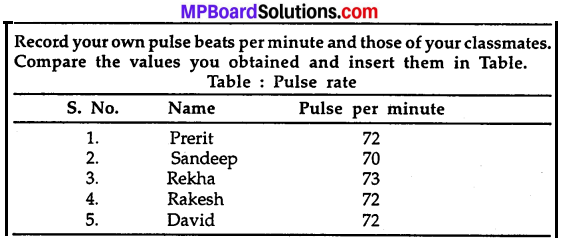
Record your own pulse beats per minute and those of your classmates? Compare the values you obtained and insert them in Table?
Table:
Pulse rate
MP Board Class 7th Science Solutions Chapter 11 Transportation in Animals and Plants img 1

Activity – 2
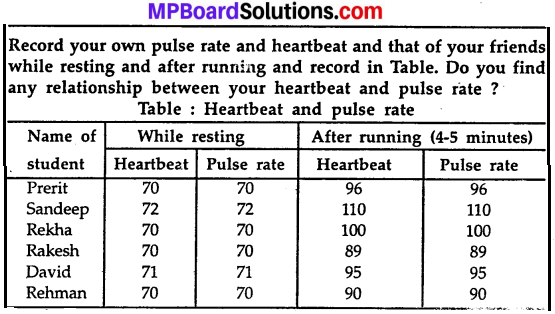
Record your own pulse rate and heartbeat and that of your friends while resting and after running and record in Table? Do you find any relationship between your heartbeat and pulse rate?
Table:
Heartbeat and pulse rate
MP Board Class 7th Science Solutions Chapter 11 Transportation in Animals and Plants img 2

Transportation in Animals and Plants Text Book Exercises

Question 1.
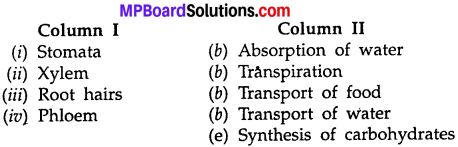
Match structures given in Column I with functions given in Column II.
MP Board Class 7th Science Solutions Chapter 11 Transportation in Animals and Plants img 3
Answer:

(i) – (b)
(ii) – (d)
(iii) – (a)
(iv) – (c)

Question 2.
Fill in the blanks:

  1. The blood from the heart is transported to all parts of the body by the …………………..
  2. Haemoglobin is present in ……………………….. cells.
  3. Arteries and veins are joined by a network of ………………………..
  4. The rhythmic expansion and contraction of the heart is called …………………………
  5. The main excretory product in human beings is ………………………….
  6. Sweat contains water and ……………………..
  7. Kidneys eliminate the waste materials in the liquid form called ……………………….
  8. Water reaches great heights in the trees because of suction pull caused by ……………………..

Answer:

  1. Arteries
  2. Red blood
  3. Capillaries
  4. Heart beat
  5. Urine
  6. Urea
  7. Urine
  8. Transpiration.

MP Board Solutions

Question 3.
Choose the correct alternative:

Question (a)
In plants, water is transported through?
(a) Xylem
(b) Phloem
(c) Stomata
(d) Root hair.
Answer:
(a) Xylem

Question (b)
Water absorption through roots can be increased by keeping the plants?
(a) In the shade
(b) In dim light
(c) under the fan
(d) covered with a polythene bag.
Answer:
(b) In dim light

Question 4.
Why is transport of materials necessary in a plant or in an animal? Explain.
Answer:
Transport of material is necessary in plant or animal because due to it the nutrients are made available to all the parts of the body. If the transport of necessary nutrients does not take place in the body, the body will not be able to survive. For example, in plants
roots absorb water and leaves prepare food utilising the water.

The food is also required by root. So, there is no utility of water absorbed by the roots if it does not reach leaf or food prepared by leaf if it does not reach root. Thus, the process of transportation is necessary.

MP Board Solutions

Question 5.
What will happen if there are no platelets in the blood?
Answer:
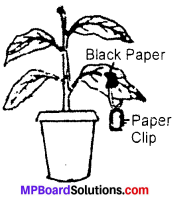
The blood platelets are responsible for the clotting of the blood. Without the platelets, blood cannot be clot. So, if there is any cut, blood will continue to flow out and ultimately the person die.

Question 6.
What are stomata? Give two functions of stomata?
Answer:
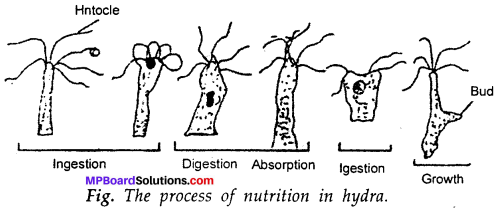
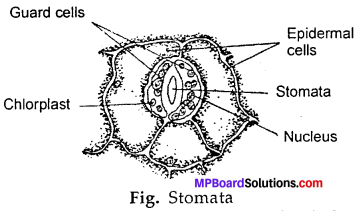
The small pores in leaves and stems of plants are called stomata.
Functions of Stomata:

  1. It absorb oxygen from air.
  2. It helps in the transportation of water.

Question 7.
Does transpiration serve any useful function in the plants? Explain.
Answer:
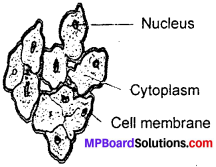
Yes, transpiration is an important function in plants. Plants absorb mineral nutrients and water from the soil. Not all the water absorbed is utilised by the plant. The water evaporates through the stomata present on the surface of the leaves by the process of transpiration. The evaporation of water from leaves generates a suction pull (the same that you produce when you suck water through a straw) which can pull water to great heights in the tall trees. Transpiration also cools the plant.

Question 8.
What are components of blood?
Answer:
Red blood cells (RBC), while blood cells (WBC), plasma and platelets are the components of blood.

Question 9.
Why is blood needed by all the parts of a body?
Answer:
Blood is needed by all the parts of a body because it carries digested food and oxygen to all parts of body. It also carries away the waste products.

MP Board Solutions

Question 10.
What makes the blood look red?
Answer:
A red coloured pigment called hemoglobin gives the blood red color.

Question 11.
Describe the function of the heart?
Answer:
The main function of heart is to collects and distributes blood from and to all parts of the body. The right auricle and ventricle receives blood with carbon dioxide from all the parts of the body. The collected blood is then pumped to the lungs for the purification. In lungs, the exchange of gases take place and purified blood is sent back to the left auricle. After that purified blood is sent to all the parts of the body through arteries.

Question 12.
Why is it necessary to excrete waste products?
Answer:
Waste products are harmful for the body, so it is necessary to excrete waste products.

Question 13.
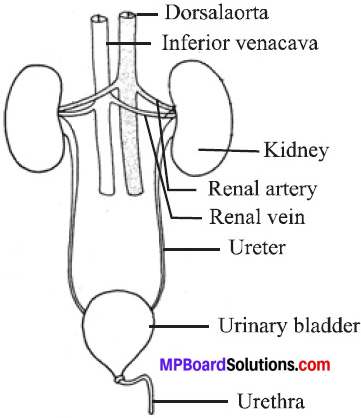
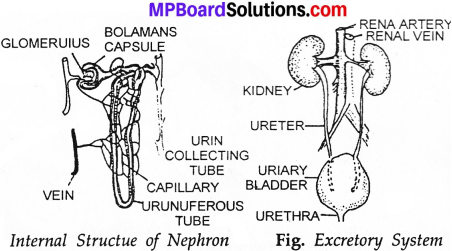
Draw a diagram of the human excretory system and label the various parts?
Answer:
Human Excretory System Diagram:
MP Board Class 7th Science Solutions Chapter 11 Transportation in Animals and Plants img 4.2

Extended Learning – Activities and Projects

Question 1.
Find out about the blood groups and their importance?
Answer:
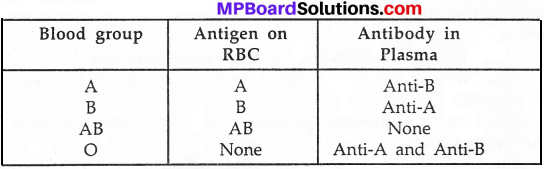
Carl Landesteiner (1900) discovered that there are two types of antigens present on the plasma membrane of the RBC. These are antigen A and antigen B. These are also called corpuscle factors. There are also two types of antibodies present in the plasma. These are antibody A (Anti – A) and antibody B (Anti – B).

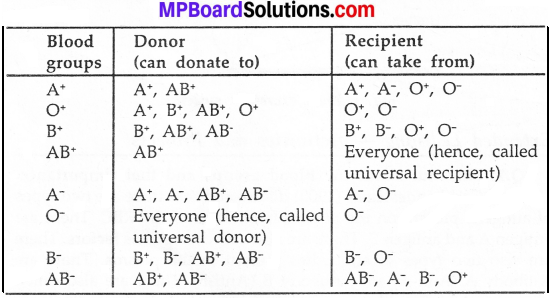
These are also called plasma factors. The blood is classified into four groups on the basis of the presence or absence of these antigens. These groups are A, B, AB and O. This system of classification of blood is called: ‘ABO’ system. The following table shows the types of blood groups and their antigens and antibodies:
MP Board Class 7th Science Solutions Chapter 11 Transportation in Animals and Plants img 5

Along with the A and B antigens or antibodies, many people have another factor called the Rh factor. This is an antigen first found in Rhesus monkey (hence, called the Rh factor). People whose red blood cells contain the Rh antigen are said to be Rh positive (Rh+). People who lack it are called Rh negative (Rh).

A person with Rhblood does not have Rh antibody (which destroys Rh antigen) naturally. But, as and when an Rh antigen enters the blood, it develops Rh antibody and destroys the antigen. If a person with blood group A has Rh antigen, his/her blood is said to be A+(A positive).

Similarly if a person’s blood group is B and he/she does not have Rh antigen, then his/her blood group is B(B negative). So, we have eight blood groups: A+, B+, AB+, O+, A+, B+, AB+ and O+.
MP Board Class 7th Science Solutions Chapter 11 Transportation in Animals and Plants img 6

Question 2.
When a person suffers from chest pain, the doctor immediately takes an ECG? Visit a doctor and get information about ECG? You may even look up an encyclopedia or the internet?
Answer:
An electrocardiogram (ECG or EKG, abbreviated from the German Electrocardiogram) is a graphic produced by an electrocardiograph, which records the electrical activity of the heart over time. Analysis of the various waves and normal vectors of depolarization and repolarization yields important diagnostic information.

  1. It guides therapy and risk stratification for heart patients.
  2. It helps detect electrolyte disturbances. It allows for the detection of conduction abnormalities.
  3. It is used as a screening tool for ischemic heart disease during a cardiac stress test.
  4. It is occasionally helpful with non – cardiac

In 1856, Kollicker and Mueller discovered the electrical activity of the heart when a frog sciatic nerve/gastrocenemius preparation fell onto an isolated frog heart and both muscles contracted synchronously. Alexander muirhead attached wires to a feverish patient’s wrist to obtain a record of the patient’s heartbeat while studying for his DSc (in electricity) in 1872 at St Bartholomew’s Hospital.

This activity was directly recorded and visualized using a Lippmann capillary electrometer by the British physiologist John Burdon Sanderson. The first to systematically approach the heart from an electrical point – of – view was Augustus Waller, working in St Mary’s Hospital in Paddington, London. His electrocardiograph machine consisted of a Lippmann capillary electrometer fixed to a projector.

The trace from the heartbeat was projected onto a photographic plate which was itself fixed to a toy train. This allowed a heartbeat to be recorded in real time. In 1911 he still saw little clinical application for his work. The break through came when Willem Einthoven, working in Leiden, The Netherlands, used the string galvanometer invented by him in 1901, which was much more sensitive than the capillary electrometer that Waller used. Einthoven assigned the letters P, Q, R, S and T to the various deflections, and described the electrocardiographic features of a number of cardiovascular disorders. In 1924, he was awarded the Nobel Prize in Medicine for his discovery.

MP Board Solutions

Transportation in Animals and Plants Additional Important Questions

Objective Type Questions

Question 1.
Choose the correct alternative:

Question (a)
The cells in blood that fight against the disease causing germs are called?
(a) Platelets
(b) White blood cells
(c) Red blood cells
(d) None of these.
Answer:
(b) White blood cells

Question (b)
Which of these is responsible for clotting of blood?
(a) Platelets
(b) White blood cells
(c) Red blood cells
(d) none of these.
Answer:
(a) Platelets

Question (c)
Smallest filtering units in kidneys are called?
(a) ventricles
(b) auricles
(c) vessels
(d) nephrons.
Answer:
(d) nephrons.

MP Board Solutions

Question (d)
Urine is stored in till excreted?
(a) Ureter
(b) Kidney
(c) Urinary bladder
(d) Urethra.
Answer:
(c) Urinary bladder

Question (e)
Instrument used to measure heart beat is called?
(a) thermometer
(b) nanometer
(c) stethoscope
(d) none of these.
Answer:
(c) stethoscope

Question (f)
How many times heart of an healthy person beats in one minute?
(a) 70
(b) 71
(c) 72
(d) 73
Answer:
(c) 72

Question (g)
Which one of the following is not an excretory organ?
(a) Lever
(b) Skin
(c) Kidney
(d) Oesophagus.
Answer:
(d) Oesophagus.

MP Board Solutions

Question (h)
The tube by which all the wastes are thrown out is known as?
(a) ureters
(b) urethra
(c) urinary bladder
(d) none of these.
Answer:
(b) urethra

Question 2.
Fill in the blanks:

  1. The fluid part of the blood is called …………………………
  2. One type of cells are the red blood cells which contain a red pigment called …………………….
  3. There are the ……………………… types of blood vessels in the body.
  4. …………………….. carry oxygen rich blood from the heart to all parts of the body.
  5. The number of pulse beats per minute is called the ………………………
  6.  …………………… are the vessels which carry carbon dioxide rich blood from all parts of the body back to the heart.
  7. The heart has …………………….. chambers.
  8. The walls of the chambers of the heart are made up of ……………………
  9. Your heart is roughly the size of your ……………………………
  10. The English Physician, William Harvey discovered the circulation of ………………………….
  11. The parts involved in excretion forms the …………………… system.
  12. The kidneys, ureters, bladder and urethra form the ……………………………… system
  13. Birds, Insects and lizard excrete ………………………………. in semi – solid form.
  14. A …………………………………. is a group of cells not perform  specialized function in an organism.
  15. The vascular tissue for the transport of water and nutrients in the plant is called the ………………………..
  16. Water and mineral nutrients are absorbed by roots from the ………………………….

Answer:

  1. Plasma
  2. Hemoglobin
  3. Two
  4. Arteries
  5. Pulse rate
  6. Veins
  7. Four
  8. Muscles
  9. Fist
  10. Blood
  11. Excretory
  12. Excretory
  13. Uric acid
  14. Tissue
  15. Xylem
  16. Soil.

MP Board Solutions

Question 3.
Which of the following statements are true (T) or false (F):

  1. Circulatory system consists of the heart and blood vessels.
  2. Oxygenated blood flows in arteries.
  3. Valves are there in inner walls of veins.
  4. White blood cells to not protect our body from diseases.
  5. Blood is red due to platelets.
  6. In humans, blood flows through arteries and veins and the heart acts as a pumping organ.
  7. The heart is protected by a membrane called paracardium.
  8. Veins carry blood from all parts of the body back to the heart.
  9. Artery carry blood from the heart to all parts of the body.
  10. Our body requires at least 2 to 3 litres of water everyday.
  11. In humans, excretion involves the removal of sweat, urea and faces.
  12. All organisms nave same method of waste removal from their body.
  13. The xylem and phloem together make up the vascular system in plants.
  14. In older plants vacuoles contain the excretory products.

Answer:

  1. True
  2. True
  3. True
  4. False
  5. False
  6. True
  7. True
  8. True
  9. True
  10. True
  11. True
  12. False
  13. True
  14. True.

Transportation in Animals and Plants Very Short Answer Type Questions

Question 1.
Name the transport medium in human beings?
Answer:
Blood.

Question 2.
White blood corpuscles is called as soldiers. Why?
Answer:
They have no definite shape. They work in our body like soldiers whenever any harmful micro – organism, virus or foreign body enters inside our body then these corpuseles prevent their entry and destroy them.

Question 3.
If blood does not coagulate after injury, then what will happen?
Answer:
The people can be died.

MP Board Solutions

Question 4.
How does the red blood corpuscles deliver oxygen to each part of body?
Answer:
Hemoglobin reacts with oxygen and forms a temporary compound called as oxyhemoglobin which breaks again in every part of body and donates oxygen.

Question 5.
Write the names of different blood vessels?
Answer:
The names of different blood vessels are arteries, veins and capillaries.

Question 6.
Write functions of hemoglobin?
Answer:
Hemoglobin containing iron and this hemoglobin reacts with oxygen and forms a temporary compound called as oxyhemoglobin which breaks again in every part of body and donates oxygen.

Question 7.
Why is the blood red in color?
Answer:
The blood is red in color due to the presence of an iron containing pigment hemoglobin.

Question 8.
What will happen if the blood rich in oxygen and the blood rich in carbon dioxide mix with each other?
Answer:
The net oxygen content of blood Will be reduced and hence body will suffer from lack of oxygen.

Question 9.
What is pulse rate?
Answer:
The number of beats per minute is called the pulse rate.

Question 10.
What is the resting pulse rate of a normal person?
Answer:
A resting person, usually has a pulse rate between 72 and 80 beats per minute.

MP Board Solutions

Question 11.
Where is heart located?
Answer:
The heart is located in the chest cavity with its lower tip slightly tilted towards the left.

Question 12.
What are the two upper chamber of hearts?
Answer:
Atria.

Question 13.
What are ventricles?
Answer:
The two lower chambers of heart are called ventricles.

Question 14.
Define excretion?
Answer:
Excretion is a process through which the metabolic wastes are excreted out from the body.

Question 15.
Name the various organs of excretion in human?
Answer:
Various excretory organs of humans are skin, lungs and kidneys.

Question 16.
How does excretion occur in unicellular animals?
Answer:
In unicellular animals excretion takes place by diffusion process.

MP Board Solutions

Question 17.
What is transpiration?
Answer:
Transpiration is a process of evaporation of water from the surface of the leaf in the form of water vapours. It helps:

  1. To generate pulling force for the upward movement of water.
  2. To get rid of excess of water.
  3. To maintain the temperature because of cooling effect.

Question 18.
What is excretion?
Answer:
Excretion is the process of the removal of the waste product from the body of a plant or an animal. The different organisms eliminate their waste in different ways.

Question 19.
Write the names exretory materials in plants?
Answer:
The excretory materials in plants are a gum, rain and latex.

Transportation in Animals and Plants Short Answer Type Questions

Question 1.
Name the various blood vessels and write their functions?
Answer:
There are three blood vessels:
1. Arteries:
These are the blood vessels which carry or transport oxygenated pure blood from heart to all other parts of the body.

2. Veins:
These are blood vessels which collects the deoxygenated impure blood from the whole body and send it to the heart.

3. Capillaries:
These are the network of thin tube like structures which connect the arteries and veins together.

Question 2.
What is blood? What are the components of blood?
Answer:
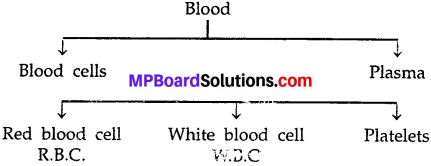
Blood is a fluid tissue that circulates and transport the material within the cells. It is red in color due to the presence of a pigment called hemoglobin. Various components of bloods are blood cells and plasma.
MP Board Class 7th Science Solutions Chapter 11 Transportation in Animals and Plants img 7

Question 3.
What is the main difference between artery and a vein?
Answer:
Differences between arteries and veins:
Artery:

  1. It carries pure blood from heart to the different organs of the body.
  2. Blood flows with jerks with high pressures.
  3. They always carry oxygenated rich blood.
  4. It has no valve.
  5. Its wall is thick.

Vein:

  1. It collects impure blood from different parts of the body.
  2. Blood flows smoothly with low pressure.
  3. They always carry carbon dioxide rich blood.
  4. Semilunar valves are present.
  5. Its wall is thin.

MP Board Solutions

Question 4.
What is meant by excretion? Explain its need for the sustenance of the individual?
Answer:
Excretion is a process of removal of metabolic waste materials from the body. If excretory matter is present in the body It will disturb the metabolic activities going or in different parts of the body. It will disturb metabolic activity in body. So it is necessary to excrete out all the metabolic wastes from the body.

Question 5.
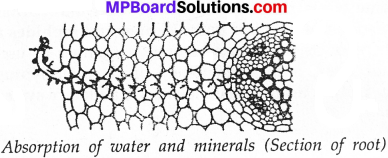
Describe the process of water and mineral absorption in plants?
Answer:
In higher plants root system is well developed. The tertiary roots possess root hairs. They absorb mineral salt and water in the form of dilute solution through endosmosis. The cells of root hair transfer this solution to the epidermal cells. Through diffusion process absorbed solution reaches in the xylem vessels and from it lifts up and then reaches up to the top of the plant.

Question 6.
How do the exchange of gases occur in plants?
Answer:
In case of plants the lower surface of leaves have small pores called stomata. These are provided by two guard cells which control the opening or closing of the stomata. When the concentration of O2 gas increases during photosynthesis the guard cells open and O2 gas is given out and if concentration CO2 gas increases during respiration, the guard cells cause CO2 gas to go out of the cells. This is how the exchange of gases occur in plants.

Question 7.
How does liver help in the process of excretion?
Answer:
Liver plays a major role in excreting waste products of the body. Urea, the chief introgenous waste materials is formed in the liver. The break down of amino acids which takes place in it results in the accumulation of nitrogenous wastes. These nitrogenous wastes break down further into ammonia. Ammonia is a very toxic, therefore, liver converts ammonia along with CO2, into urea with the help of specific enzymes. This urea is eventually thrown out by kidneys.

Question 8.
Why is the process of excretion important for living?
Answer:
As a result of metabolism various toxic substances are continuously formed. These wastes (carbon dioxide, ammonial compounds, other salts) if allowed to accumulate in the body (cells), would disturb the chemical composition of the protoplasm and produce toxic effects, crippling the life activities. Hence their elimination is most important. This is done by the process of excretion.

MP Board Solutions

Question 9.
Why do doctors examine the urine to diagnose a disease? What do they examine in urine?
Answer:
The concentration of various wastes in the urine depends upon the functioning of various organs or organ system in the body. So the examination of urine of a person gives a good idea about his/her general health. The doctors, therefore use the urine test to diagnose disease in the body. For example, presence of excess sugar in urine indicates malfunctioning of pancreas. Presence of excess urea or uric acid indicates the malfunctioning of kidneys.

Transportation in Animals and Plants Long Answer Type Questions

Question 1.
How many types of blood corpuscles are there? Write their functions?
Answer:
There are three types of blood corpuscles:
1. Red blood corpuscles:
They are elliptical or spherical in shape. Hemoglobin containing iron is present in them. This hemoglobin reacts with oxygen and forms a temporary compound called as oxyhemoglobin which breaks again in every part of body and donates oxygen.

2. White blood corpuscles They have no definite shape, They work in our body like soldiers. Whenever any harmful microorganism, virus or foreign body enters inside our body then these corpuscles prevent their entry and destroy them.

3. Blood platelets:
Whenever there is bleeding due to injury, these platelets move there and coagulates the blood, as a result excess blood does not flow.

4. Plasma:
It is the fluid medium which transports digested food as well as metabolic waste products.

MP Board Solutions

Question 2.
Write functions of blood?
Answer:
Various functions of blood are:

  1. The red blood cells carry oxygen to different parts of the body.
  2. The white blood cells fight against the disease causing germs and bacteria and kill them.
  3. The platelets of blood help in clotting of blood.
  4. The plasma carries CO2 from the body.
  5. It regulates our body temperature.
  6. It carries digested and absorbed food and hormones to different organs.
  7. The waste products are taken into excretory organs through blood.

Question 3.
Describe the “pulmonary circulation of blood?”
Answer:
The deoxygenated blood is collected from various organs of the body by two veins called superior and inferior vena cava. They join to form a main vein which empties the blood into the right auricle. From here it enters the right ventricle and is pumped into the right pulmonary artery which caries it to the lungs. Here the carbon – dioxide oxygen exchange takes place. The oxygenated blood is carried by the pulmonary vein to the left auricle. This part of the circulation is called the pulmonary circulation.

Question 4.
Explain structure of heart and draw it’s diagram?
Answer:
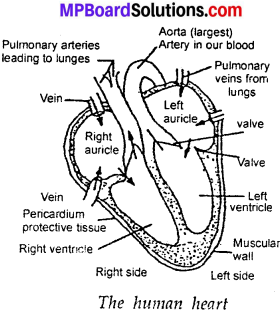
Our heart is situated in the left side of our chest. It is divided into four chambers. The upper two chambers collect the blood from veins and are known as auricles. The lower two chambers are meant for distribution of the blood in various parts of the body and are known as the ventricles.
MP Board Class 7th Science Solutions Chapter 11 Transportation in Animals and Plants img 8
Right auricle gets the impure blood which is sent to right ventricle. From right ventricle the blood is thrown to pulmonary arteries which carry this. blood to lungs for put if cation, which is collected by pulmonary veins and now it is in a purified state.

It is brought to left auricle and then to left ventricle from where it is thrown into aorta which is responsible for distribution of this pure blood to various parts of the body. Aorta is divided into various arteries which are divided into five capillaries. After exchange of materials these capillaries form the veins which bring blood to the right auricle.

MP Board Solutions

Question 4.
Define the systematic circulation of blood. Draw the diagram of schematic diagram of circulation?
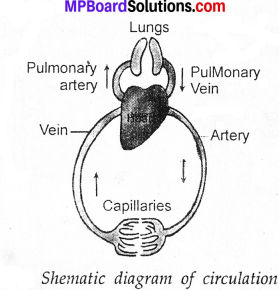
Answer:
The oxygenated blood from the left auricle enters the left ventricle and is then pumped into the aorta and carried to all parts of the body by arteries and capillaries. This part of the circulation is known as systemic circulation.
MP Board Class 7th Science Solutions Chapter 11 Transportation in Animals and Plants img 9

Question 5.
Describe “blood transfusion?”
Answer:
Blood is a very vital component of our body and we cannot afford to lose it. In case of serious injury, accident or during an operation, we may lose a considerable quantity of blood from our body. In such cases blood from another healthy person is transferred to the patient. This is called blood transfusion. The blood of all human beings falls in any one of the following groups A, B, AB or O. Transfusion should be done carefully and only after checking the blood group of the patient.

Question 6.
“Excretion is process to eliminate the waste by products from the body”. Justify the statement?
Answer:
The nitrogenous waste ammonia is converted into urea by the liver. The renal artery carry the urea of kidneys. Each kidney consists of number of coiled tubes called Nephron. There are about ten million nephron in each kidney of an adult man. The Nephron is the functional unit of the kidney.

One end of the nephron is cup shaped called Bowman’s capsule. The renal artery branches into millions of capillaries in the form of coil in the each Bowman’s capsule. This coil or capillaries of renal artery in the Bowman’s capsule is called Glomerules. The blood is filtered through the walls of capillaries of glomerulus.

This is a selective filteration. The bigger molecules of sugars, salts and nitrogenous wasters are filtered. This selective filteration is termed as dialysis. Thus, the glomerulus acts as dialysis bag of the kidney. The filterate from glomerulur in the Bowman’s capsule passes through the tiny tubule.

Where major part of glucose and other useful substances is reabsorbed. It is sent back into the blood of the renal vein. The waste liquid called urine, containing nitrogenous waste is sent to the urinary bladder through collecting tubule and uretere. From urinary bladder it is eliminated from the body through urethera.
MP Board Class 7th Science Solutions Chapter 11 Transportation in Animals and Plants img 10 and 11

Question 7.
What are the various waste materials excreted from the human body?
Answer:
Excretion is done by following organs:
1. Kidneys:
These excrete urea, salts, water etc. through urine.

2. Skin:
Skin possesses sweat glands. These glands absorb urea, salts and a large quantity of water from the blood capillaries near by and excrete them through their pores on the skin in the form of sweat.

3. Liver:
Liver is not a direct excretory organ. Liver cells convert more toxic ammonia into less toxic urea and uric acid and then pass them to the kidneys through the blood for excretion. Liver also censer toxic substances. It removable salts in bile juice. These bile salts are formed due to break down of hemoglobin. If bile salts are not remove. They cause jaundice. Bile salts are removed through intestine.

MP Board Solutions

Question 8.
Write a short note on “excretion in plants”?
Answer:
Plants, have no special organs for excretion. product of respiration i.e. carbon dioxide is partly us phtosynthesis. The excess amount of carbon dioxide escape the stomata and lenticles. Some of the waste products of photosynthesis an in vacuoles in the leaves and bark of trees. The plant them by sheddingthe leaves and bark.

Some waste products are transformed into harm and stored inside the plant body. Rubber and raphides a of such products. Plants also secrete a number of uses like gum, latex, resin, sandalwood oil and eucalyptus
MP Board Class 7th Science Solutions Chapter 11 Transportation in Animals and Plants img 12

Question 9.
Describe the process of absorption and transportation of water and minerals in plants?
Answer:
The plant root have root hairs which absorb water and minerals in the form of solution from soil. This process is called absorption. This water and minerals are then transported to other parts of plant i.e., stem, leaves and flowers through a special tissue called xylem. Then food is synthesised within leaves of plant and is transported in all parts of plant including roots, through phloem. This produces is called transportation.

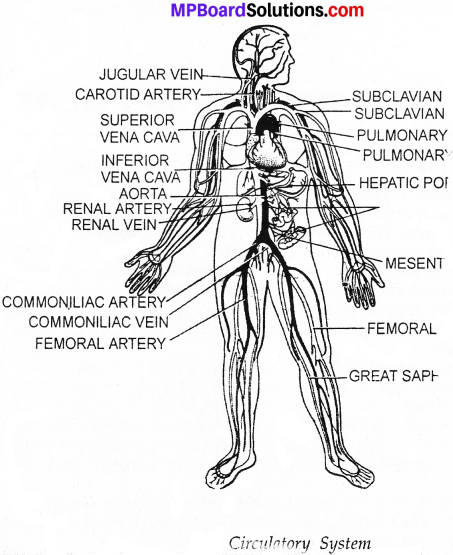
Question 10.
Draw a neat diagram to show circulatory system?
Answer:
MP Board Class 7th Science Solutions Chapter 11 Transportation in Animals and Plants img 13

MP Board Class 7th Science Solutions

MP Board Class 7th Science Solutions Chapter 10 Respiration in Organisms

MP Board Class 7th Science Solutions Chapter 10 Respiration in Organisms

Respiration in Organisms Intex Questions

Question 1.
Bhoojho wants to know if cockroaches, snails, fish, earthworms, ants and mosquitoes also have lungs?
Answer:
Yes.

Question 2.
Boojho has seen in television programmes that whales and dolphins often come up to the water surface? They even release a fountain of water sometimes while moving upwards? Why do they do so?
Answer:
Whales and dolphins take in air during inhalation. They exhale out the air on the surface. The water vapour condenses and we see the condensed water vapour as the fountain.

MP Board Solutions

Question 3.
Paheli wants to know whether roots, which are under ground also take in oxygen? If so, how?
Answer:
Yes. Roots take up air from the air spaces preseht between the soil particles.

Activities

Activity – 1
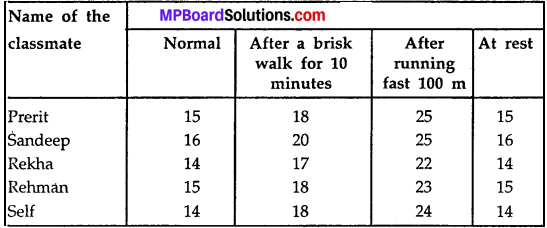
If you try you can count your rate of breathing. Breathe in and out normally. Find out how many times you breathe in and breathe out in a minute? Did you inhale the same number of times as you exhaled? Now count your breathing rate (number of breaths/minute) after brisk walk and after running. Record your breathing rate as soon as you finish and also after complete rest. Tabulate your findings and compare your breathing rates under different conditions with those of your classmates.

Table:
Changes in breathing rate under different conditions:
MP Board Class 7th Science Solutions Chapter 10 Respiration in Organisms image 1

Activity – 2
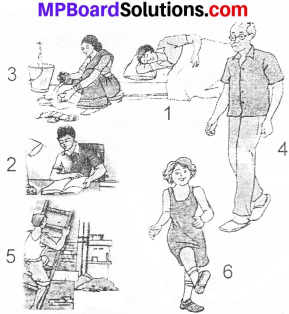
Figure shows the various activities carried out by a person during a normal day. Can you say in which activity, the rate of breathing will be the slowest and in which it will be the fastest? Assign numbers to the pictures in the order of increasing rate of breathing according to your experience.
MP Board Class 7th Science Solutions Chapter 10 Respiration in Organisms image 2

Activity – 3
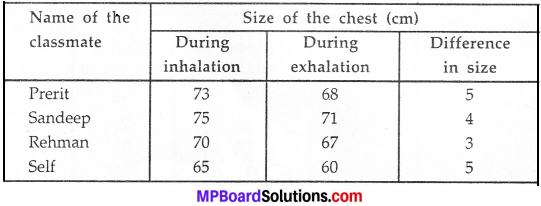
Take a deep breath. Measure the size of the chest with a measuring tape and record your observations in Table. Measure the size of the chest again when expanded and indicate which classmate shows the maximum expansion of the chest.
Answer:
Effect of breathing on the chest size of some classmates:
MP Board Class 7th Science Solutions Chapter 10 Respiration in Organisms image 3 - Copy

Respiration in Organisms Text Book Exercise

Question 1.
Why does an athlete breathe faster and deeper than usual after finishing the race?
Answer:
During the race, the athlete has to run very fast. The demand for energy at that time increases, which increase the demand for more supply of oxygen. Thus, athlete has to breathe faster and deep to inhale more oxygen.

Question 2.
List the similarities and differences between aerobic and anaerobic respiration?
Answer:
Similarities:
Both aerobic and anaerobic respiration produce energy and give out carbon dioxide.

Differences:
Aerobic respiration require oxygen while anaerobic respiration does not require oxygen. In aerobic respiration large amount of energy is released while in anaerobic respiration small amount of energy is released.

Question 3.
Why do we often sneeze when we inhale a lot of dust laden air?
Answer:
We sneeze to get rid of the unwanted particles like dust from air body. It allows only clean and dust free air to enter our body.

MP Board Solutions

Question 4.
Take three test – tubes. Fill \(\frac{1}{2}\)th of each with water. Label them A, B and C. Keep a snail in test – tube A, a water plant in test – tube B and in C, keep snail and plant both. Which test – tube would have the highest concentration of CO2?
Answer:
Test – tube A.

Question 5.
Tick the correct answer:

Question (a)
In cockroaches, air enters the body through?
(a) lungs
(b) gills
(c) spiracles
(d) skin.
Answer:
(c) spiracles

Question (b)
During heavy exercise, we get cramps in the legs due to the accumulation of?
(a) carbon dioxide
(b) lactic acid
(c) alcohol
(d) water.
Answer:
(b) lactic acid

Question (c)
Normal range of breathing rate per minute in an average adult person at rest is?
(a) 9 – 12
(b) 15 – 18
(c) 21 – 24
(d) 30 – 33
Answer:
(b) 15 – 18

Question (d)
During exhalation, the ribs?
(a) move outwards
(b) move downwards
(c) move upwards
(d) do not move
Answer:
(b) move downwards

Question 6.
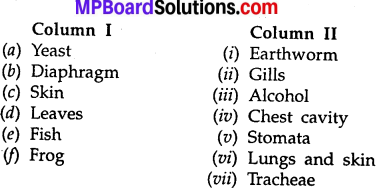
Match the items in Column I with those in Column II:
MP Board Class 7th Science Solutions Chapter 10 Respiration in Organisms image 4
Answer:

(a) – (iii)
(b) – (iv)
(c) – (i)
(d) – (v)
(e) – (ii)
(f) – (vi)

Question 7.
Mark if the statement is true and if it is false:

  1. During heavy exercise the breathing rate of a person slows down.
  2. Plants carry out photosynthesis only during the day and respiration only at night.
  3. Frogs breathe through their skins as well as their lungs.
  4. The fishes have lungs for respiration.
  5. The size of the chest cavity increases during inhalation.

Answer:

  1. False
  2. False
  3. True
  4. False
  5. True

MP Board Solutions

Question 8.
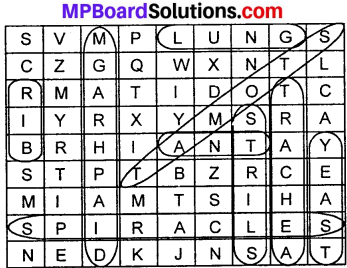
Given below is a square of letters in which are hidden different words related to respiration in organisms. These words may be present in any direction – upwards, downwards, or along the diagonals. Find the words for your respiratory system. Clues about those words are given below the square?

  1. The air tubes of insects
  2. Skeletal structures surrounding chest cavity
  3. Muscular floor of chest cavity
  4. Tiny pores on the surface of leaf
  5. Small openings on the sides of the body of an insect
  6. The respiratory organs of human beings
  7. The openings through which we inhale
  8. An anaerobic organism
  9. An organism with tracheal system

Answer:

  1. Trachea
  2. Rib
  3. Diaphragm
  4. Stomats
  5. Spiracles
  6. Lung
  7. Strils
  8. Yeast
  9. Ant.

MP Board Class 7th Science Solutions Chapter 10 Respiration in Organisms image 5

Question 10.
The mountaineers carry oxygen with them because:
(a) At an altitude of more than 5 km there is no air.
(b) The amount of air available to a person is less than that available on the ground.
(c) The temperature of air is higher than that on the ground.
(d) The pressure of air is higher than that on the ground.
Answer:
(b) The amount of air available to a person is less than that available on the ground.

Extended Learning – Activities and Projects

Question 1.
Observe fish in an aquarium. You will find flap like structures on both sides of their heads. These are flaps which cover the gills. These flaps open and close alternately. On the basis of these observations, explain the process of respiration in the fish?
Answer:
Do with the help of your subject teacher.

Question 2.
Visit a local doctor. Learn about the harmful effects of smoking. You can also collect material on this topic from other sources. You can seek help of your teacher or parents. Find out the percentage of people of your area who smoke. If you have a smoker in your family, confront him with the material that you have collected?
Answer:
Do yourself.

Question 3.
Visit a doctor. Find out about artificial respiration? Ask the doctor:
(a) When does a person need artificial respiration?
(b) Does the person need to be kept on artificial respiration temporarily or permanently?
(c) From where can the person get supply of oxygen for artificial respiration?
Answer:
Do yourself.

MP Board Solutions

Question 4.
Measure the breathing rate of the members of your family and some of your friends? Investigate:
(a) If the breathing rate of children is different from that of adults?
(b) If the breathing rate of males is different from that of females?
If there is a difference in any of these cases, try to find the reason?
Answer:
Do with the help of your parents.

Respiration in Organisms Additional Important Questions

Objective Type Questions

Question 1.
Choose the correct alternative:

Question (a)
The life processes that provide energy are?
(a) respiration
(b) nutrition
(c) both respiration and nutrition
(d) none of these.
Answer:
(c) both respiration and nutrition

Question (b)
In …………………… respiration, there is an exchange of gases between the cells and the blood?
(a) aerobic
(b) anaerobic
(c) external
(d) internal.
Answer:
(d) internal.

Question (c)
In the cell, the food (glucose) is broken down into carbon dioxide and water using?
(a) hydrogen
(b) nitrogen
(c) oxygen
(d) none of these.
Answer:
(c) oxygen

MP Board Solutions

Question (d)
Which of the following is not a feature of respiration?
(a) involvement of enzymes
(b) occur outside the cells
(c) release of energy
(d) is a chemical process.
Answer:
(d) is a chemical process.

Question (e)
During heavy exercise, the breathing rate in an adult can increase upto?
(a) 25 times per minute
(b) 30 times per minute
(c) 35 times per minute
(d) none of these.
Answer:
(a) 25 times per minute

Question (f)
The percentage of oxygen and carbon dioxide in inhaled air is –
(a) 21%, 0.04%
(b) 20%, 0.10%
(c) 21%, 1.0%
(d) 20%, 1.0%.
Answer:
(a) 21%, 0.04%

Question (g)
The percentage of oxygen and carbondioxide in exhalted air is –
(a) 16.4%, 4.4%
(b) 21%, 1.0%
(c) 16.4%, 3.4%
(d) 16.4%, 0.04%.
Answer:
(a) 16.4%, 4.4%

Question 1.
Fill in the blanks:

  1. All living organisms require ………………………… to perform various life process.
  2. The liver and ……………………… are found near the stomach.
  3. The exhaled air has a higher percentage of carbon dioxide as compared to the ……………………………… air.
  4. Breathing is a process at organ levels, whereas respiration is a ……………………….. process.
  5. When breakdown of glucose occurs with the use of oxygen, it is called …………………….. respiration.
  6. The taking in of air rich in oxygen into the body is called …………………………
  7. The number of times a person breathes in a minute is termed as the ………………………….
  8. Lungs are present in the ……………………….. cavity.
  9. During inhalation, ribs move up and outwards and diaphragm moves ………………………..
  10. Insects have a network of air tubes called ……………………….. for gas exchange.
  11. Like all other living cells of the plants, the root cells also need oxygen to ………………………. energy.

Answer:

  1. energy
  2. pancreas
  3. inhaled
  4. cellular
  5. aerobic
  6. inhalation
  7. breathing rate
  8. chest
  9. down
  10. tracheae
  11. generate.

MP Board Solutions

Question 3.
Which of the following statements are true (T) or false (F):

  1. Respiration is a type of combustion at ordinary temperature.
  2. Breathing is a process that takes place at the cellular level.
  3. Oxygen is released during the process of respiration.
  4. During respiration the plants – take CO2 and release Or
  5. Respiration involves on exchange of gases.
  6. Cellular respiration takes place in the cells of all organisms.
  7. Anaerobic respiration do not takes places in the muscle cells to fulfill the demand of energy.
  8. The giving out of air rich in carbon dioxide is known as exhalation.
  9. A breathe means one inhalation plus one exhalation.
  10. On an average, an adult human being at rest breathes in and out 15 to 18 times in a minute.
  11. A cockroach has small openings on the sides of its body.
  12. Gills are not supplied with blood vessels for exchange of gases.
  13. The end product of anaerobic respiration are carbon dioxide and water.
  14. In earthworm, the exchange of gases occurs through the moist skin.

Answer:

  1. True
  2. False
  3. False
  4. True
  5. True
  6. True
  7. False
  8. True
  9. True
  10. True
  11. True
  12. False
  13. True
  14. True

Respiration in Organisms Very Short Answer Type Questions

Question 1.
Where does cellular respiration takes place?
Answer:
Cells of organisms.

Question 2.
Write the equation for breakdown of food in anaerobic respiration?
Answer:
MP Board Class 7th Science Solutions Chapter 10 Respiration in Organisms image 6 - Copy

Question 3.
Write the equation for breakdown of food in aerobic respiration?
Answer:
MP Board Class 7th Science Solutions Chapter 10 Respiration in Organisms img t

Question 4.
What are anaerobes?
Answer:
There are some organisms such as yeast that can service in the absence of air. They are called anaerobes.

Question 5.
What is yeast?
Answer:
Yeast is single – celled organisms.

Question 6.
Write the uses of yeast?
Answer:
Yeast respire anaerobically and during this process yield alcohol. So, they are used to make beer and wine.

Question 7.
Which chemical reaction takes place in internal respiration?
Answer:
Glucose + Oxygen → Carbon dioxide + Water + Energy.

Question 8.
Give an example of an oxygen respiration?
Answer:
In human beings.

Question 9.
Name the parts of digestive system of humans?
Answer:
The parts of digestive systems are mouth, oesophagus, stomach, intestine and anus.

MP Board Solutions

Question 10.
Name two processes of respiration?
Answer:
Inhalation and exhalation are the two processes of respiration.

Question 11.
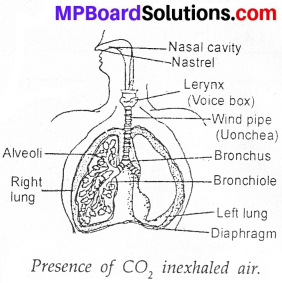
Name the parts of respiratory system of human?
Answer:

  1. Nostrils
  2. Trachea
  3. Lungs with alveali, and
  4. Diaphragm.

Question 12.
What waste materials are produced during respiration?
Answer:
Carbon dioxide is produced as the waste material during respiration.

Question 13.
Define respiration?
Answer:
The process of breaking down of food by using oxygen, to form carbon dioxide and release energy required for various life activities, is called respiration.

Question 14.
Name the fuels used for the production of energy during respiration?
Answer:
Glucose is oxidized to give out energy.

Question 15.
Which organs of plants participate in respiration?
Answer:
There is no special organ in plants for breathing.

Question 16.
Write the names of organs in human respiratory system in sequence?
Answer:
Nostrils → Nasal cavity → Pharynx → Tracheae → Lungs.

Question 17.
What is importance of hairs present in the noise?
Answer:
These small hairs present in nose act as filters. These prevent dust particles and harmful germs to enter into respiratory track.

Question 18.
Name the organs of the body from which blood freshly enriched with oxygen goes into the heart?
Answer:
The lungs helps the blood to get freshly enrichment of oxygen.

Question 19.
What happens during breathing?
Answer:
During breathing, oxygen enriched air is inhaled which reaches lungs. Here, oxygen centers blood and unwanted water vapour and carbon dioxide are released out during breathing.

MP Board Solutions

Question 20.
What is breathing?
Answer:
The process of taking oxygen and leaving of carbon dioxide during respiration is called breathing.

Question 21.
Write the name of gases which are involved in breathing?
Answer:
Carbon dioxide and oxygen.

Question 22.
How will you prove that we exhale CO2 gas during respiration?
Answer:
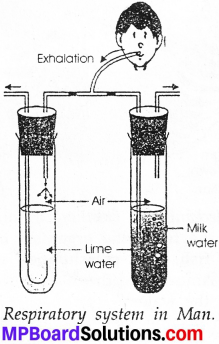
Pass the exhaled air given out by us into lime water. It will turn milky in colour. We know that CO2 gas turn lime water milky This confirms that we exhale CO2 gas in respiration.

Question 23.
What do we exhale?
Answer:
We exhale air rich in carbon dioxide.

Question 24.
Do we exhale only carbon dioxide or a mixture of gases along with it?
Answer:
We exhale a mixture of gases along with carbon dioxide.

Question 25.
How do ribs and diaphragm move during inhalation?
Answer:
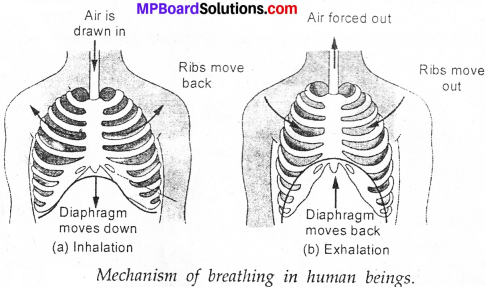
During inhalation, ribs move up and outwards and diaphragm moves down.

MP Board Solutions

Question 26.
Which is the respiratory organ for earthworm?
Answer:
Skin.

Question 27.
Can we survive in water?
Answer:
No.

Question 28.
How do fish breathe under water?
Answer:
Gills in fish help them to use oxygen dissolved in water. Gills are projections of the skin. Gills are well supplied with blood vessels for exchange of gases.

Question 29.
What is the function of gills?
Answer:
The fishes and other aquatic animals respire through gills or similar structure.

Question 30.
Can you guess what would happen if a potted plant is over watered?
Answer:
The roots will not get air to respire, so the roots will die and hence the whole plant will also die.

Respiration in Organisms Short Answer Type Questions

Question 1.
What is respiration?
Answer:
All the living organisms perform a number of vital activities. The energy is obtained by the oxidation of food or respiration. When the living organisms are completely at the stage of rest, even then they require some minimum amount of energy for the maintainance of cells and tissues. Thus, respiration is one of the most important process for living organisms.

Question 2.
Define respiration with the help of chemical equation?
Answer:
The process in which the oxidation of absorbed food is takes place by the CO2 which is inhaled by breathing and energy is released out is called respiration. Chemical equation of nutrition is as follows:
C6H12O2 + 6O2 → 6CO2 + 6H2O + 673 kcal (Energy)

Question 3.
Why does our body need a transporting system?
Answer:
Our body needs a transporting system to:

  1. Transport oxygen to body cells from lungs.
  2. Transport food to body cells from liver.
  3. Transport waste material from body cells to excretory organs.
  4. Maintains body temperature constant.

MP Board Solutions

Question 4.
Write difference between oxy – respiration and anoxy – respiration?
Answer:
The differences between the oxy – respiration and anoxy – respiration:
oxy – respiration:

  1. It takes place in presence of O2
  2. The end products are CO2 and H2O.
  3. The energy released is more.

Anoxy – respiration:

  1. It takes place without oxygen.
  2. The end products are ethyl alcohol and CO2.
  3. The energy released

Question 5.
Describe the various types of respiratory organs found in animals?
Answer:
In animals, there are definite respiratory organs for exchange of gases.

  1. In earthworm and leech exchange of gases takes place through moist, thin and vascular skin.
  2. In insects the trachea are the repiratory organs.
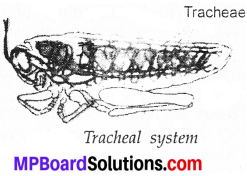
  3. In fishes the gills are the respiratory organs.
  4. Higher animals like mammal and birds including man have lungs for respiration.

Question 6.
Describe the importance of respiration in plants?
Answer:

  1. It takes place in the presence of oxygen.
  2. It is completed in cytoplasm and mitochondria of cell.
  3. It involves the complete oxidation of glucose into CO2, and
  4. H2O + C2H2O2 + 6O2 → 6CO2 + energy + 6H2O.
  5. It occurs in all the living cell of the organisms.
  6. It is day night process.
  7. Energy is released in this process.

Question 7.
Name the organs associated with the following functions:

  1. digestion
  2. absorption of minerals
  3. respiration, and
  4. excretion of carbon – dioxide in man.

Answer:

1. Digestion. Mouth, stomach, oesophagus, pharynx, small intestine, large intestine.

2. Absorption of minerals.
In Animals : Small intestine
In plants : Root hairs.

3. Respiration.
In Animals : Nose, trachaea, larynx, lung.
In plants. Stomata and lenticells.

4. Excretion of carbon – dioxide.
In Animals : Kidneys, ureters, urinary bladder, urethra.

MP Board Solutions

Question 8.
State the difference between respiration and breathing?
Answer:
Differences between Respiration and Breathing:
Respiration:

  1. It takes place inside the cells.
  2. The exchange of gases takes place between blood and the tissues of the body.
  3. In this process nutrients are oxidised to liberate energy.

Breathing:

  1. It takes place at the surface of the respiratory organs.
  2. The exchange of gases takes place between the blood and the external environment.
  3. The nutrients are not oxidised to liberate energy.

Question 9.
Name the major components of urine?
Answer:
The kidney, ureter, bladder, and urethra are the organs used in the removal of urine from the body. Renal artery carry urea and uric acid along with the large amount of water with the blood into the kindneys, when this blood enters into glomerulus, the solid wastes filter here while the water is diffused out from the network of blood capillaries into the uriniferous tubules. The ques mixture is called as urine.

Question 10.
If a person drinks very little water per day? The volume of urine decreases? In what ways does it affect the body?
Answer:
If a person drinks very little water per day. The volume of urine decreases. Large amount of water will dissolve large quantity of urea in it and large amount of urine will pass out from the body. If someone drinks lesser amounts of water, the concentration of urea in the cells and its larger quantity is very harmful for the body.

Question 11.
What is saliva? What are the functions of saliva?
Answer:
Saliva is a digestive secretion produced by three layered salivary glands, the paroted submaxillary and sunblingual present in our mouth cavity. This soften and lubricants food for easier swallowing and converts starch into reducing sugars. The salivary amylase. enzyme of saliva acts of starch in a neutral medium.

Question 12.
How does the food digested in the stomach?
Answer:
After some time from mouth the food reach inside the stomach. The gastric glands of stomach secrete the gastric juices. The gastric juice containes three enzymes. These are pepsin, renin and HCI. The HCI makes the medium acidic, and inhibites the bacterial growth and prevents the food. The renin curdiles the milk protein to be hydrololysed by pepsin. The pepsin reacts with proties and changes into peptides.

Respiration in Organisms Long Answer Type Questions

Question 1.
Define the respiratory organs in animals?
Answer:
The process of respiratory system in animals possess following organs:

  1. Nasal cavity
  2. Larynx
  3. Trachea
  4. Bronchi
  5. Lungs.

In animals some organs like gills and lungs are developed for the purpose of exchange of gases. The amount of CO2 produced after respiration cannot be utilised by animals as in plants. This is also true for the production of oxygen which is required for respiration. Mitochondria are the site of respiration in both plants and animals.

The process of break – down of glucose in the presence of oxygen and some enzymes into CO2. And water, which is accompanied with release of energy is very complex. Materials like proteins and fats are also consumed during respiration to produce energy.

MP Board Solutions

Question 2.
Write difference between photosynthesis and respiration?
Answer:
The difference between respiration and photosynthesis are:
Photosynthesis:

  1. It takes place only in green plants.
  2. It requires energy.
  3. It requires CO2 and H2O.
  4. It releases oxygen and make food.
  5. It is a building up process.
  6. It takes place in the chloroplast of the plant cell.

Respiration:

  1. It takes place in all plants and animals.
  2. It releases energy.
  3. It releases CO2 and H2O.
  4. It requires oxygen and oxidise the food.
  5. It is a breaking down process.
  6. It takes place in mitochondira of a cell.

Question 3.
Draw the labelled diagram to show respiratory system in man?
Answer:
The process of respiration is aimed to release energy
MP Board Class 7th Science Solutions Chapter 10 Respiration in Organisms image 8

Question 4.
What is the difference in the amount of carbon choxide in the inhaled and the exhaled air? How will you test the presence of CO2 in the exhaled air?
Answer:
Excess carbon dioxide is present in exhaled air as compared inhaled air.

Test to indicate the presence of CO2 in the exhaled air:
Take two test tubes. Fill each of them half with freshly prepared lime water. Fix stoppers with two holes in both the test tubes. Insert glass tubes in both the stoppers. The lime water through which exhaled air is passed turns milky. This shows that more CO2 is present in exhaled air.
MP Board Class 7th Science Solutions Chapter 10 Respiration in Organisms image 9

Question 5.
Draw diagrams to show movements of rib and diaphragm during breathing?
Answer:
MP Board Class 7th Science Solutions Chapter 10 Respiration in Organisms image 10

Question 6.
How do the following organism breathe? Amoeba, fish, frog, grasshopper, earthworm?
Answer:
Amoeba:
Amoeba breathes by diffusion of gases in between body surface and the water.

Fish:
Fish breathe with gills. The gills are special organs. They help fish to extract dissolved oxygen from the water.

Frog:
Frog can breathe through skin and lungs. In water if breathes through skin whereas in air through lungs.

Grasshopper:
The grasshopper and other insects have holes and air tubes those help them to breathe.

Earthworm:
It breathes through its moist body surface.

MP Board Solutions

Question 7.
Describe the breathing in cockroach with diagram?
Answer:
A cockroach has small openings on the sides of its body. Other insects also have similar openings. These openings are called spiracles, bisects have a network of air tubes called tracheae for gas exchange. Oxygen rich air rushes through spiracles into the tracheal tubes, diffuses into the body tissue, and reaches every cell of the body. Similarly, carbon dioxide from the cells goes into the tracheal tubes and moves out through spiracles. These air tubes or tracheae are found only in insects and not in any other group of animals.
MP Board Class 7th Science Solutions Chapter 10 Respiration in Organisms img u

MP Board Class 7th Science Solutions

MP Board Class 7th Science Solutions Chapter 1 Nutrition in Plants

MP Board Class 7th Science Solutions Chapter 1 Nutrition in Plants

Nutrition in Plants Intext Questions

Question 1.
Boojho wants to know how plants prepare their own food?
Answer:
Plants are the only that can prepare food for themselves by using water, carbon dioxide and minerals.

Question 2.
Paheli wants to know why our body cannot make food from carbon dioxde, water and minerals like plants do?
Answer:
Our body do not have chlorophyll.

Question 3.
Boojho wants to know how water and minerals absorbed by roots reach the leaves?
Answer:
Water and minerals are transported to the leaves by the vessels which run like pipes throughout the roots, stems and leaves of the plant. They form a continuous path or passage for the nutrients to reach the leaves.

Question 4.
Paheli wants to know what is so special about the leaves that they can synthesize food but other parts of the plant cannot?
Answer:
Because the leaves have a green pigment called chlorophyll.

MP Board Solutions

Question 5.
Boojho has observed some plants with deep red, violet or brown leaves. He wants to know whether these leaves also carry out photosynthesis?
Answer:
No.

Question 6.
Paheli wants to know whether mosquitoes, bed bugs, lice and leeches that suck our blood are also parasites?
Answer:
Lice are parasites. Mosquitoes are not parasites because they suck blood to incubit their eggs and not for nutrition.

Question 7.
Boojho is confused. If the pitcher plant is green and carries out photosynthesis, then why does it feed on insects?
Answer:
Because these plants do not get enough nutrition from the soil as required.

Question 8.
Boojho wants to know how these organisms acquire nutrients. They do not have mouths like animals do. They are not like green plants as they lack chlorophyll and cannot make food by photosynthesis?
Answer:
These organisms acquire food from dead organisms.

Question 9.
Paheli is keen to know whether her beautiful shoes, which she wore on special occasions, were spoiled by fungi during the rainy season. She wants to know how fungi appear suddenly during the rainy season?
Answer:
The fungal spores are generally present in the air. When they land on wet and warm things they germinate and grow During rainy season, there are more chances of things getting wet So, fungi spoil more things in rainy season.

Question 10.
Boojho says once his grandfather told him that his wheat fields were spoiled by a fungus. He wants to know if fungi cause diseases also?
Answer:
Yes, fungi causes diseases in plants, animals and humans. However, some fungi are also used is medicines.

Nutrition in Plants Text book Exercises

Question 1.
Why do organisms need to take food?
Answer:
Food is needed by all living organisms for the following purposes:

  1. Get energy to do work.
  2. Build up body.
  3. Improve resistance power against diseases and protects us from infections.
  4. Replacement and repairing damaged part in the body.
  5. Maintain the functions of the body.

MP Board Solutions

Question 2.
Distinguish between a parasite and a saprotroph?
Answer:
Distinguish Parasite and Saprotroph:
Parasite:

  1. They derives nutrients from the body of some other living organisms.
  2. They use the heterotrophic mode of nutrition.
  3. They mostly live on or in the host.
  4. Examples: Tapeworm, Round warm, Cuscutta, Puccinia, etc.

Saprotroph:

  1. They derives nutrients from dead and decaying organisms.
  2. They use saprotrophic mode of nutrition.
  3. They live on dead and decaying stuff.
  4. Examples: Mushrooms, Bacteria, Yeast, etc.

Question 3.
How would you test the presence of starch in leaves?
Answer:
Starch Test:
Take the green leaf to be tested. Boil it in water for 5 minutes (approximately). Keep it in the 60% angle amyle alcohol at 60°C till it becomes colourless. Now take the colourless leaf out from alcohol and wash it with cold water. Also pour few drops of dilute iodine solution on the leaf. The leaf becomes very blue with the solution which proves the presence of starch is the leaf.

MP Board Solutions

Question 4.
Give a brief description of the process of synthesis of food in green plants?
Answer:
The leaves have a green pigment called chlorophyll. It helps leaves to capture the energy of the sunlight. This energy is used to synthesize (prepare) food from carbon dioxide and water. Since the synthesis of food occurs in the presence of sunlight, it is called photosynthesis (Photo: light: synthesis: to combine).

So we find that chlorophyll, sunlight, carbon dioxide and water are necessary to carry out the process of photosynthesis. It is a unique process on the earth. The solar energy is captured by the leaves and stored in the plant in the form of food. Thus, sun is the ultimate source of energy for all living organisms.

During photosynthesis, chlorophyll containing cells of leaves, in the presence of sunlight, use carbon dioxide and water to synthesise carbohydrates. The process can be represented as an equation.
MP Board Class 7th Science Solutions Chapter 1 Nutrition in Plants img-1
During the process oxygen is released. The carbohydrates ultimately get converted into starch. The presence of starch in leaves indicates the occurrence of photosynthesis. The starch is also a carbohydrate.
MP Board Class 7th Science Solutions Chapter 1 Nutrition in Plants img-2

Question 5.
Show with the help of a sketch that the plants are the ultimate source of food?
Answer:
MP Board Class 7th Science Solutions Chapter 1 Nutrition in Plants img-3

Question 6.
Fill in the blanks:

  1. Green plants are called …………….. since they synthesise their own food.
  2. The food synthesised by the plants is stored as ……………..
  3. In photosynthesis solar energy is captured by the pigment called ……………..
  4. During photosynthesis plants take in …………….. and release

Answer:

  1. Autotrophs
  2. Starch
  3. Chlorophyll
  4. Carbon dioxide, oxygen.

MP Board Solutions

Question 7.
Name the following:

  1. A parasitic plants with yellow, slender and tubular stem.
  2. A plant that has both autotrophic and heterotrophic mode of nutrition.
  3. The pores through which leaves exchange gases.

Answer:

  1. Cuscuta (Amarbel)
  2. Pitcher plant
  3. Stomata.

Question 8.
Tick the correct answer:
(a) Amarbel is an example of –
(i) Autotroph
(ii) Parasite
(iii) Saprotroph
(iv) Host.
Answer:
(ii) Parasite

(b) The plant which trape and feeds on insects is –
(i) Cuscuta
(ii) China rose
(iii) Pitcher plant
(iv) Rose.
Answer:
(iii) Pitcher plant.

Question 9.
Match the items given in Column I with those in Column II:
MP Board Class 7th Science Solutions Chapter 1 Nutrition in Plants img-4
Answer:

(i) (d)
(ii) (a)
(iii) (e)
(iv) (b)
(v) (c)

MP Board Solutions

Question 10.
Mark “T” if the statement is true and “F” if it is false:

  1. Carbon dioxide is released during photosynthesis. (T/F)
  2. Plants which synthesise their food themselves are called saprotrophs. (T/F)
  3. The product of photosynthesis is not a protein (T/F)
  4. Solar energy is converted into chemical energy during photosynthesis. (T/F)

Answer:

  1. False (F)
  2. False (F)
  3. True (T)
  4. True (T)

Question 11.
Choose the correct option from the following:
Which part of the plant gets carbon dioxide from the air for photosynthesis –
(i) Root hair
(ii) Stomata
(iii) Leaf veins
(iv) Sepals.
Answer:
(ii) Stomata.

Question 12.
Chose the correct option from the following:
Plants take carbon dioxide form the atmosphere mainly through their –
(i) Roots
(ii) Stem
(iii) Flowers
(iv) Leaves.
Answer:
(iv) Leaves.

Nutrition in Plants Additional Important Questions

Objective Type Questions

Question 1.
Choose the correct alternative:

Question (i)
The green coloured pigment present in plants is ………….
(a) Xanthophyll
(b) Haemoglobin
(c) Chlorophyll
(d) None of these.
(c) Chlorophyll

Question (ii)
The life processes that provide energy are ……………
(a) Respiration
(b) Nutrition
(c) Both respiration and nutrition
(d) None of these.
Answer:
(c) Both respiration and nutrition

Question (iii)
Which of these are autotrophs …………..
(a) Green plants
(b) All plants
(c) All animals
(d) None of these.
Answer:
(a) Green plants

MP Board Solutions

Question (iv)
………….. changes solar energy into chemical energy.
(a) Oxygen
(b) Carbon – di – oxide
(c) Water
(d) Chlorophyll.
Answer:
(d) Chlorophyll.

Question (v)
………….. is saprophyte.
(a) Fungus
(b) Cuscuta
(c) Money plant
(d) Mosquito.
Answer:
(a) Fungus

Question 2.
Fill in the blanks:

  1. Resin, gum, latex are ……………. substances of plants.
  2.  …………….. is the mode of taking food by an organism and its utilisation by the body.
  3. The plant on which it climbs is called a ……………
  4. Plants which use saprotrophic mode of nutrition are called …………..
  5. Oxygen is produced during ……………..

Answer:

  1. Excretory
  2. Nutrition
  3. Host
  4. Saprotrophs
  5. Photosynthesis.

Question 3.
Which of the fallowing statements are true (T) or false (F):

  1. All organisms take food and utilise it to get energy for the growth and maintenance of their bodies.
  2. Chlorophyll and sunlight are not the essential requirements for photosynthesis.
  3. Solar energy is stored by the leaves with the help of chlorophyll.
  4. Oxygen is not produced during photosynthesis.
  5. Only a few plants adopt other modes of nutrition like parasitic and saprotraphic.

Answer:

  1. True (T)
  2. False (F)
  3. True (T)
  4. False (F)
  5. True (T).

MP Board Solutions

Question 4.
Match the items is Column A with Column B:
MP Board Class 7th Science Solutions Chapter 1 Nutrition in Plants img-9
Answer:

(i) (b)
(ii) (d)
(iii) (a)
(iv) (b).

Question 5.
Name the following :

  1. A plants food factory.
  2. Living on another organisms and derive food from them.
  3. A chlorophyll containing partner, which is an alga, and a fungus live together.

Answer:

  1. Leaf
  2. Parasitic
  3. Lichens

Nutrition in Plants Very Short Answer Type Questions

Question 1.
How many types of nutritions are there?
Answer:
There are two types of nutritions. These are holophytic nutrition and holozoic nutrition.

Question 2.
How do symbiotic live?
Answer:
Symbiotic live with host and parasite which depend on host benefit.

MP Board Solutions

Question 3.
What are autotrophs? Give examples.
Answer:
The organism who can prepare their own food utilising sunlight, carbon dioxde and water, are known as autotrophs.
Examples: All green plants are autotrophs.

Question 4.
Define photosynthesis?
Answer:
The process by which the green plants prepare their food using carbon dioxide and water in the presence of chlorophyll and light is called photosynthesis.

Question 5.
What is the function of chlorophyll?
Answer:
Chlorophyll helps leaves to capture the energy of the Sun.

Question 6.
What are algae?
Answer:
The slimy green patches in ponds or in other stagnant water bodies are called algae.

Question 7.
What is the purpose of starch test?
Answer:
To confirm the presence of starch in the green plants.

Question 8.
Name two herbivorous animals?
Answer:
Deer, cow.

Question 9.
Name two omnivorous animals?
Answer:
Dog, cat.

MP Board Solutions

Question 10.
Name two carnivorous animals?
Answer:
Tiger, lion.

Question 11.
Name two leguminous plants?
Answer:
Gram, pea.

Question 12.
Name two insectivorous plants?
Answer:
Sundew, Aldrovenda.

Question 13.
Which bacteria can convert nitrogen into soluble term?
Answer:
Rhizobium.

Question 14.
Define autotrophs?
Answer:
Green plants synthesise their food themselves by the process of photosynthesis. They are autotrophs.

Nutrition in Plants Short Answer Type Questions

Question 1.
How do the exchange of gases occur in plants?
Answer:
In case of plants the lower surface of leaves have small pores called stomata. These are provided by two guard cells which control the opening or closing of the stomata. When the concentration of O2 gas increases during photosynthesis the guard cells open and O2 gas is given out and if concentration of CO2 gas increases during respiration, the guard cells cause CO2 gas to go out of the cells. This is how the exchange of gases occur in plants.

Question 2.
How many types of heterotrophs are there? Give examples.
Answer:
Organisms which depend upon plants and other organisms for their food are called heterotrophs. Heterotrophs can further be classified as:

1. Herbivorous Animals:
The organisms or animals who eat plants and plant products.
Examples: cow, horse, goat, etc.

2. Carnivorous Animals:
The animals who eat flesh of other animals are called carnivorous.
Examples: lion, tiger, wolf, etc.

3. Omnivorous Animals:
The animals who eat both plant and animals are called ominivorous animals.
Examples: man, cat, dog, crow, etc.

MP Board Solutions

Question 3.
W’hat is the difference between ‘heterotrophs and autotrophs’?
Answer:
The differences between two are:

Heterotroph:

  1. These are organism which can not make their own food.
  2. They do not have chloroplast.

Autotroph:

  1. They can make their own food.
  2. They have chloroplast.

Question 4.
Give two examples of insectivorous plants?
Answer:
The plants which have the special system to trap the insects and kill them are called insectivorous plants. The pitcher plant and venus faly trap plants. In the pitcher plant, the leaf is modified in form of a pitcher. When any insect visits this pitcher it is trapped and killed in it.

Question 5.
What is the difference between holophytic and holozoic type of nutrition?
Answer:
Those living beings such as plants who prepare their own food are called autotrophic and this type of nutrition is called as holophytic type of nutrition.

Those living beings who cannot prepare their own food but depend on food prepared by some other living beings are called heterotopic. This type of nutrition is called holozoic nutrition.

MP Board Solutions

Question 6.
How is Sun the ultimate source of energy for all the living beings?
Answer:
Green plants prepare food utilising sunlight. All other organisms depend on green plants directly or indirectly for their nutrition. Thus, Sun is the ultimate source of energy.

Question 7.
How is holophytic nutrition different from holozoic nutrition?
Answer:
1. Holophytic nutrition is found in plants and lower forms of animals they consume liquid food as they lack digestive systems.

2. Holozoic nutrition is found in man and other higher forms of animals. There is a well developed digestive system in all of them. Hence, they can consume solid food.

Nutrition in Plants Long Answer Type Questions

Question 1.
Draw a diagram of stomata?
Answer:
MP Board Class 7th Science Solutions Chapter 1 Nutrition in Plants img-5

Question 2.
Give an experiment to demonstrate that light is necessary for photosynthesis?
Answer:
Take a broad leaved potted plant and keep it under dark for 24 – 48 hours. The plant is kept in dark to make the plant free from starch. After this fix a leaf still attached to the plant with a paper clip having paper black as shown in figure. Now keep the plant in light for few hours and test the leaf for starch. To test the leaf for starch, pluck the lgaf and kill its cells in boiling water. Remove the chlorophyll by boiling in alcohol. Wash the boiled leaf in water and treat with iodine solution.
MP Board Class 7th Science Solutions Chapter 1 Nutrition in Plants img-6
It is believed that the portion of the leaf, exposed to sunlight turned blue in colour while the covered portion did not undergo any change. You know that starch give blue colour with iodine solution. This was because the covered portion did not receive any sunlight. This shows that sunlight is necessary for photosynthesis.

MP Board Solutions

Question 3.
Describe the process of nutrition in hydra?
Answer:
In hydra, the tentacles help in ingesting the food (taking the food inside). The cells inside the body cavity wall secrete certain chemicals and enzymes to digest the food. The digested food is absorbed by the cells of the wall in the body cavity by diffusion. On eating food the hydra grows and reproduces by forming buds.
MP Board Class 7th Science Solutions Chapter 1 Nutrition in Plants img-7

Question 4.
Define cell with their structure
Answer:
The bodies of living organisms are made of tiny units called cells. Cells can be seen only under the microscope. Some organisms are made of only one cell. The cell is enclosed by a thin outer boundary, called the cell membrane. Most cells have a distinct, centrally located spherical structure called the nucleus (Fig.). The nucleus is surrounded by a jelly – like substance called cytoplasm.
MP Board Class 7th Science Solutions Chapter 1 Nutrition in Plants img-8

MP Board Class 7th Science Solutions

MP Board Class 7th Hindi Bhasha Bharti Solutions Chapter 24 बुन्देलखण्ड केशरी-महाराजा छत्रसाल

MP Board Class 7th Hindi Bhasha Bharti Solutions Chapter 24 बुन्देलखण्ड केशरी-महाराजा छत्रसाल

MP Board Class 7th Hindi Bhasha Bharti Chapter 24 पाठ का अभ्यास

बोध प्रश्न

प्रश्न 1. निम्नलिखित प्रश्नों के उत्तर लिखिए

(क) महाराजा छत्रसाल किस नाम से विख्यात हैं?
उत्तर
महाराजा छत्रसाल बुन्देलखण्ड केसरी’ के नाम से विख्यात हैं।

(ख) महाराजा छत्रसाल का जन्म कब और कहाँ हुआ था?
उत्तर
महाराजा छत्रसाल का जन्म ज्येष्ठ शुक्ल तृतीया, संवत् सत्रह सौ छह (1706) अर्थात् 4 मई सन् 1649 ई. को टीकमगढ़ जिले के मोर पहाड़ी नामक स्थान पर हुआ था।

(ग) वीर चम्पतराय आजीवन किसका विरोध करते रहे?
उत्तर
महाराजा छत्रसाल के पिता वीर चम्पतराय आजीवन मुगल शासक शाहजहाँ और औरंगजेब के धर्मान्ध शासन और बहुसंख्यक प्रजा के प्रति पक्षपातपूर्ण नीतियों का विरोध करते

MP Board Solutions

(घ) बालक छत्रसाल में कौन-कौन से गुण विद्यमान थे?
उत्तर
बालक छत्रसाल में साहस, शौर्य, आत्मविश्वास, वीरता और निर्भयता के गुण कूट-कूट कर भरे थे।

(ङ) घोड़े को ‘भले भाई’ की संज्ञा क्यों दी गई ?
उत्तर
देवगढ़ युद्ध के दौरान छत्रसाल बुरी तरह घायल हो । गए थे। उनका प्यारा घोड़ा रात-भर उनकी रक्षा करता रहा। दूसरे दिन छत्रसाल के भाई अंगद राय की पहचान करने के बाद ही घोड़े ने उन्हें छत्रसाल के शिविर में जाने दिया। स्वस्थ होने पर छत्रसाल ने अपने घोड़े को भले भाई’ की उपाधि दी।

(च) छत्रपति शिवाजी ने वीर छत्रसाल को कैसे प्रेरित किया ?
उत्तर
छत्रपति शिवाजी ने वीर छत्रसाल को स्वाधीनता का मंत्र और अपनी तलवार देकर बुन्देलखण्ड को स्वतंत्र कराने के लिए प्रेरित किया।

(छ) वीर छत्रसाल ने अपनी सेना कैसे तैयार की?
उत्तर
वीर छत्रसाल के पास साधनों का घोर अभाव था। संगी-साथी भी कम ही थे। उन्होंने अपनी माता के आभूषणों को बेचकर पाँच घोड़ों और पच्चीस सैनिकों की एक छोटी-सी सेना तैयार की। उनकी इस सेना में सभी वर्गों के लोग थे।

(ज) स्वामी प्राणनाथ ने महाराजा छत्रसाल को आशीर्वाद देते हुए क्या कहा ?
उत्तर
स्वामी प्राणनाथ ने छत्रसाल को आशीर्वाद देते हुए कहा
“छत्ता तेरे राज में, धक-धक धरती होय। जित-जित घोड़ा मुख करे, तित-तित फतै होय॥”

(झ) महाराजा छत्रसाल की शासन व्यवस्था का वर्णन कीजिए।
उत्तर
महाराजा छत्रसाल ने प्रजा की सुख-शान्ति और समृद्धि के लिए अनेक प्रयास किए। उन्होंने न्याय व्यवस्था को सरल बनाने के लिए पंचायती व्यवस्था की स्थापना की। वे अपराधियों को कठोर दण्ड देते थे। जिससे उनके राज्य में अपराध होना कम हो गए। उनके राज्य में बच्चे, बूढ़े और महिलाएँ निर्भीकतापूर्वक कहीं भी आ-जा सकते थे।

MP Board Solutions

प्रश्न 2.
खाली स्थान भरिए

(क) महाराजा छत्रसाल ने ………… में ‘भले भाई’ का स्मारक बनवाया।
(ख) बुन्देलखण्ड की ………… भूमि भी इस संग्राम से अछूती नहीं थी।
(ग) स्वामी प्राणनाथ ………… के गुरु थे।
(घ) छत्रपति शिवाजी ने ……….. का मंत्र दिया।
(ङ) वीर छत्रसाल ने अपने दुश्मनों के …….दिए।
उत्तर
(क) धुबेला
(ख) वीर प्रसूता
(ग) महाराजा छत्रसाल
(घ) स्वाधीनता
(ङ) बके छुड़ा।

प्रश्न 3.
दिए गए उत्तरों में से सही उत्तर छाँटकर लिखिए
(क) महाराजा छत्रसाल ने पालकी में लगाकर सम्मान बढ़ाया:
(अ) भूषण का
(ब) जगनिक का
(स) सेनापति का।
उत्तर
(अ) भूषण का

(ख) महाराजा छत्रसाल की समाधि स्थित है:
(अ) पन्ना में
(ब) धुबेला में
(स) महेबा में।
उत्तर
(ब) धुबेला में

(ग) वीर छत्रसाल का जन्म हुआ था :
(अ) मोर पहाड़ी पर
(ब) गोर पहाड़ी पर
(स) मड़ोर पहाड़ी पर।
उत्तर
(अ) मोर पहाड़ी पर

MP Board Solutions

भाषा अध्ययन

प्रश्न 1.
निम्नलिखित शब्दों को वाक्य में प्रयोग कीजिए
स्वाधीन, सम्मान, समृद्धि, शौर्य, ओज, निर्भय, चुनौती, उत्तरदायी।
उत्तर
(क) स्वाधीन-छत्रसाल ने स्वाधीन पन्ना राज्य की स्थापना की।
(ख) सम्मान-छत्रसाल के दरबार में कवियों को पूरा सम्मान मिलता था।
(ग) समृद्धि-छत्रसाल ने प्रजा की सुख-शान्ति और समृद्धि के लिए अनेक प्रयत्न किए।
(घ) शौर्य-बुन्देलखण्ड में आज भी छत्रसाल की शौर्य और वीरता के गीत गाए जाते हैं।
(ङ) ओज-धुबेला में स्थित छत्रसाल का समाधिस्थल आज भी उनके शौर्य और ओज का स्मरण करा रहा है।
(च) निर्भय-छत्रसाल के राज्य में सभी लोग निर्भय होकर रहते थे।
(छ) चुनौती-छत्रसाल ने मुगलों को चुनौती देते हुए अपनी मातृभूमि की रक्षा के लिए युद्ध किया।
(ज) उत्तरदायी-छत्रसाल ने अपने माता-पिता की मृत्यु के उत्तरदायी विश्वासघातियों को दण्डित किया।

प्रश्न 2.
‘प्र’ उपसर्ग लगाकर बनने वाले तीन शब्द लिखिए।
उत्तर

  1. प्रसूता
  2. प्रहार
  3. प्रसाद।

MP Board Solutions

प्रश्न 3.
निम्नलिखित शब्दों में आए मूल शब्द और प्रत्यय शब्दांश को अलग-अलग लिखिए
वीरता, अछूती, जागीरदार, मार्मिक, उत्तरदायी।
उत्तर
(क) वीरता – वीर + ता
(ख) अछूती – अछूत + ई
(ग) जागीरदार – जागीर + दार
(घ) मार्मिक – मर्म + इक
(ङ) उत्तरदायी – उत्तर + दाई।

प्रश्न 4.
निम्नलिखित वाक्यों को उनके सामने दिए गए काल के अनुसार बदलिए
(क) महाराज छत्रसाल का समाधिस्थल उनके शौर्य का स्मरण दिला रहा है। (भविष्यकाल)
(ख) वे भारत के वीर सपूत थे। (वर्तमानकाल)
(ग) शत्रु सैनिक जान बचाकर भागे। (भूतकाल)
उत्तर
(क) महाराजा छत्रसाल का समाधिस्थल उनके शौर्य का स्मरण दिलाएगा।
(ख) वे भारत के वीर सपूत हैं।
(ग) शत्रु सैनिक जान बचाकर भाग गए ।

प्रश्न 5.
संधि विच्छेद कीजिएअत्याचार, स्वाधीन, इच्छानुसार, आत्मोत्सर्ग, सहायतार्थ।
उत्तर
(क) अत्याचार = अति + आचार।
(ख) स्वाधीन = स्व + आधीन।
(ग) इच्छानुसार = इच्छा + अनुसार।
(घ) आत्मोत्सर्ग = आत्मा + उत्सर्ग।
(ङ) सहायतार्थ = सहायता + अर्थ।

प्रश्न 6.
निम्नलिखित मुहावरों का अर्थ लिखिए और वाक्य में प्रयोग कीजिए
दो-दो हाथ करना, छक्के छुड़ाना, नाकों चने चबाना, लोहा लेना।
उत्तर
(क) दो-दो हाथ करना – मुकाबला करना। वाक्य प्रयोग-छत्रसाल मुगलों से दो-दो हाथ करने से पहले उनकी रणनीति समझना चाहते थे।
(ख) छक्के छुड़ाना – निरुत्साह करना। वाक्य प्रयोग-देवगढ़ के युद्ध में छत्रसाल ने दुश्मन के छक्के छुड़ा दिए।
(ग) नाकों चने चबाना – तंग करना। वाक्य प्रयोग-छत्रसाल ने मुगल सत्ता को नाकों चने चबाने के लिए विवश कर दिया था।
(घ) लोहा लेना – युद्ध करना, लड़ना। वाक्य प्रयोग-वीर दुर्गादास राठौर मुगल सत्ता को चुनौती देकर अपनी मातृभूमि की रक्षा के लिए लोहा ले रहे थे।

MP Board Solutions

प्रश्न 7.
निम्नलिखित शब्दों के अर्थ शब्दकोश से खोजकर लिखिए
प्रसूता, धरोहर, अस्त्र, शस्त्र, क्षति, ललकार, आत्मोत्सर्ग, पारावार, स्मारक, सिपहसालार, आधिपत्य, प्रजावत्सल, फत्तै (फतह), राजी, रैयत, ताजी, बार, बाँकौ।
उत्तर
‘शब्दकोश’ शीर्षक का अवलोकन करें।

बुन्देलखण्ड केशरी-महाराजा छत्रसाल परीक्षोपयोगी गद्यांशों की व्याख्या

1. देवगढ़ विजय में छत्रसाल के पुरुषार्थ को कोई महत्व नहीं दिए जाने पर छत्रसाल ने राजा जयसिंह का साथ छोड़ दिया। अब छत्रसाल का उद्देश्य भी पूरा हो गया था। उनका अगला ध्येय अपनी मातृभूमि से मुगलों के आधिपत्य को समाप्त करना था। इस कार्य में सफलता पाने के लिए छत्रसाल ने छत्रपति शिवाजी से भेंट की। छत्रपति ने उन्हें स्वाधीनता का मंत्र और अपनी तलवार देकर बुन्देलखण्ड में स्वतंत्रता का अलख जगाने भेज दिया।

सन्दर्भ-प्रस्तुत गद्यांश हमारी पाठ्य पुस्तक ‘भाषा भारती’ के ‘बुन्देलखण्ड केसरी-महाराजा छत्रसाल’ नामक पाठ से अवतरित है। यह एक संकलित रचना है।

प्रसंग-प्रस्तुत गद्यांश में महाराजा छत्रसाल द्वारा मुगलों के चंगुल से अपनी मातृभूमि को स्वतंत्र कराने के उद्देश्य से छत्रपति शिवाजी से भेंट करने का वर्णन किया गया है।

व्याख्या-जयपुर के राजा जयसिंह की सेना में छत्रसाल एक वीर योद्धा थे। उन्होंने राजा जयसिंह के साथ अनेक युद्धों में भाग लिया एवं अपनी वीरता का परिचय दिया। देवगढ़ की विजय में भी छत्रसाल ने बड़ी बहादुरी का परिचय देते हुए युद्ध किया और देवगढ़ पर विजय प्राप्त की। परन्तु राजा जयसिंह द्वारा छत्रसाल की वीरता एवं बहादुरी को कोई महत्व न दिए जाने के कारण छत्रसाल ने राजा जयसिंह का साथ छोड़ दिया। वैसे भी जिस उद्देश्य के लिए छत्रसाल राजा जयसिंह की सेना में सम्मिलित हुए थे, वह उद्देश्य अब पूरा हो गया था। अब उनका अगला उद्देश्य मुगलों के चंगुल से अपनी मातृभूमि को स्वतंत्र कराना था। परन्तु यह कार्य इतना आसान नहीं था। इस उद्देश्य में सफलता प्राप्त करने के लिए उनका छत्रपति शिवाजी से मिलना और उनका मार्गदर्शन प्राप्त करना आवश्यक था। अतः छत्रसाल ने शिवाजी महाराज से भेंट की। भेंट होने पर शिवाजी ने छत्रसाल को स्वतंत्रता प्राप्त करने हेतु मंत्र दिया और अपनी तलवार उन्हें उपहारस्वरूप देकर स्वतंत्रता की ज्योति जलाने के लिए भेज दिया।

MP Board Solutions

2. स्वतंत्र पन्ना की स्थापना और राज्य विस्तार के बाद उन्होंने प्रजा की सुख-शान्ति और समृद्धि के लिए प्रयत्न किए। स्वामी प्राणनाथ के निर्देश पर पन्ना राज्य में हीरों की खदानों की खोज करवाई। उन्होंने न्याय व्यवस्था को सरल बनाने के लिए पंचायती व्यवस्था स्थापित की। वे अपराधियों को कठोर दण्ड देते थे जिससे उनके राज्य में अपराध होना कम हो गए। उनके शान्ति पूर्ण राज्य में बच्चे-बूढ़े और स्त्रियाँ निर्भीकतापूर्वक कहीं भी आ-जा सकते थे। महाराज छत्रसाल जैसे तलवार के धनी थे वैसे ही कशल और प्रजावत्सल शासक भी

सन्दर्भ-पूर्व की तरह।

प्रसंग-प्रस्तुत गद्यांश में महाराजा छत्रसाल की शासन व्यवस्था का प्रभावपूर्ण वर्णन किया गया है।

व्याख्या-महाराजा छत्रसाल द्वारा स्वतंत्र राज्य की स्थापना करने और अपने राज्य का विस्तार करने के बाद अपनी प्रजा की सुख-शान्ति तथा समृद्धि के अनेक प्रयास किए गए। अपने गुरु राज्य में अपराध होना कम हो गए। उनके शान्ति पूर्ण राज्य में बच्चे-बूढ़े और स्त्रियाँ निर्भीकतापूर्वक कहीं भी आ-जा सकते थे। महाराज छत्रसाल जैसे तलवार के धनी थे वैसे ही कशल और प्रजावत्सल शासक भी

सन्दर्भ-पूर्व की तरह।

प्रसंग-प्रस्तुत गद्यांश में महाराजा छत्रसाल की शासन व्यवस्था का प्रभावपूर्ण वर्णन किया गया है।

व्याख्या-महाराजा छत्रसाल द्वारा स्वतंत्र राज्य की स्थापना करने और अपने राज्य का विस्तार करने के बाद अपनी प्रजा की सुख-शान्ति तथा समृद्धि के अनेक प्रयास किए गए। अपने गुरु स्वामी प्राणनाथ के आदेश पर छत्रसाल ने पन्ना राज्य में हीरों की खदानों की खोज का काम शुरू किया। महाराजा छत्रसाल ने अपने राज्य में न्याय व्यवस्था को आसान बनाने के लिए पंचायती व्यवस्था की स्थापना की। उनके राज्य में अपराधियों को कठोर दण्ड दिया जाता था जिसके फलस्वरूप राज्य में अपराधों की संख्या बहुत कम हो गई थी। उनके राज्य में प्रजा सुखी थी, बच्चे, बूढ़े और महिलाएं बिना किसी भय के स्वतंत्रतापूर्वक कहीं भी आ-जा सकते थे। महाराजा छत्रसाल जिस प्रकार एक कुशल योद्धा थे उसी प्रकार वह शासन व्यवस्था में भी निपुण एवं पारंगत थे। वे अपनी प्रजा के सुख का ध्यान रखने वाले शासक थे।

बुन्देलखण्ड केशरी-महाराजा छत्रसाल शब्दकोश

प्रसूता = जन्म देने वाली; धरोहर = अमानत, धाती, पूर्वजों से प्राप्त सांस्कृतिक विरासत; अस्त्र = हाथ से चलाने वाले हथियार; शस्त्र = फेंक कर चलाने वाले हथियार; क्षति = हानि; ललकार = चुनौती देना; आत्मोत्सर्ग = स्वयं का बलिदान; पारावार = असीम; स्मारक = स्मरण हेतु बनाई गई कोई रचना;
सिपहसालार = सेनापति; आधिपत्य = अधिकार; प्रजावत्सल = प्रजा से पुत्रवत प्रेम करने वाला; फत्तै (फतह) = जीत, विजय; राजी = प्रसन्न, सुखी;  रैयत = प्रजा; ताजी = सजग; चुस्त = दुरुस्त; बार = बाल; बाँकी = टेढ़ा।

MP Board Class 7th Hindi Solutions

MP Board Class 7th Hindi Bhasha Bharti Solutions Chapter 23 कर्तव्य पालन

MP Board Class 7th Hindi Bhasha Bharti Solutions Chapter 23 कर्तव्य पालन

MP Board Class 7th Hindi Bhasha Bharti Chapter 23 पाठ का अभ्यास

बोध प्रश्न

प्रश्न 1.
निम्नलिखित प्रश्नों के उत्तर दीजिए

(क) कृष्ण ने अर्जुन को उपदेश कब दिया था ?
उत्तर
कुरुक्षेत्र के मैदान में जब अर्जुन युद्ध करने से पीछे हट रहा था तब श्रीकृष्ण ने उन्हें अपने कर्तव्यपथ पर डटे रहने के लिए उपदेश दिया था।

(ख) अर्जुन करुणा से क्यों भर उठते हैं?
उत्तर
कुरुक्षेत्र में युद्ध के मैदान में जब अर्जुन दोनों सेनाओं की ओर दृष्टि डालते हैं और वहाँ अपने ताऊ, दादा, मामा, भाई, पुत्र, मौसा, मित्र, गुरु तथा सुहृदयों आदि को देखते हैं तो उनका मन करुणा से भर उठता है।

(ग) अपने स्वजनों को युद्धभूमि में देखकर अर्जुन की क्या दशा हुई?
उत्तर
युद्ध के मैदान में अपने स्वजनों को सामने देखकर अर्जुन का बहुत बुरा हाल हुआ। उसका गला सूख गया। उसके पूरे शरीर में कम्पन्न होने लगा। उसके हाथ में थमा उसका प्रिय धनुष गाण्डीव गिर गया। उसके मन में भ्रम उत्पन्न हो गया। उसमें युद्ध के मैदान में खड़े रहने तक की शक्ति नहीं बची। उसके मन में अनायास अपनों के प्रति मोह उत्पन्न हो गया और उसने श्रीकृष्ण के सामने युद्ध न लड़ने की बात कही।

MP Board Solutions

(घ) अर्जुन युद्ध क्यों नहीं करना चाहता था ?
उत्तर
युद्ध के मैदान में दोनों सेनाओं की ओर दृष्टि डालने पर जब अर्जुन ने देखा कि दोनों ओर उसके परिजन एवं प्रियजन खड़े हैं तो उसका मन करुणा से भर गया और उसने श्रीकृष्ण के समक्ष युद्ध न करने की इच्छा व्यक्त की।

(छ) हम सुख-दुःख के बंधन से मुक्त कैसे हो सकते
उत्तर
हम सुख और दुःख दोनों स्थितियों में एकसमान रहकर सुख-दु:ख के बंधन से मुक्त हो सकते हैं।

(च) पाप-पुण्य के भ्रम से निकलने के लिए गुरुजी ने क्या उपाय बताया ? .
उत्तर
गुरुजी के अनुसार मनुष्य को कभी भी पाप-पुण्य के भ्रम में नहीं पड़ना चाहिए। पाप-पुण्य के भ्रम से निकलने के लिए उपाय बताते हुए गुरुजी ने कहा कि अतीत में किये गये पापों का अँधेरा पुण्य के एक ही कार्य से दूर हो जाता है।

प्रश्न 2.
निम्नलिखित पंक्तियों का अर्थ अपने शब्दों में लिखिए

(क) “कर्मण्येवाधिकारस्ते मा फलेषु कदाचन”।
उत्तर
श्रीकृष्ण कहते हैं कि हे मानव ! तुझे केवल कर्म करने का अधिकार है, उसका फल प्राप्त करने का कभी नहीं है। इसलिए मोह-माया को त्यागकर तू केवल अपने कर्म को कर, फल की इच्छा त्याग दे।

(ख) सुख और दुःख दोनों ही हमें बंधन में डालते हैं।
उत्तर
यह बिल्कुल ठीक है कि सुख और दुःख दोनों ही हमें बंधन में डालते हैं क्योंकि जब हमें सुख मिलता है तो हम इस चिन्ता में पड़ जाते हैं कि कहीं यह सुख हमसे छिन न जाये और जब हम दुःख में नहीं भी होते हैं तब भी इस चिन्ता में रहते हैं कि कहीं दु:ख न आ जाये। यही वह बंधन है जिससे हम मुक्त नहीं हो पाते हैं।

MP Board Solutions

प्रश्न 3.
रिक्त स्थानों की पूर्ति कीजिए

(क) युद्ध में तू प्राणों का उत्सर्ग कर ……….. को प्राप्त होगा।
(ख) तेरा यह आचरण किसी ………. पुरुष का आचरण नहीं है।
(ग) आपने मेरे मन से अज्ञानरूपी अंधकार का नाश
कर ज्ञान रूपी ……….” फैलाया है।
उत्तर
(क) स्वर्ग
(ख) श्रेष्ठ
(ग) प्रकाश

भाषा अध्ययन

प्रश्न 1.
शुद्ध वर्तनी छाँटिए

(क) कुरूक्षेत्र कुरुक्षेत्र कुरुछेत्र
(ख) पश्चात पशचात पश्चिात
(ग) निशचित निचित निश्चित
(घ) सामर्थ सामर्थ्य सामरथ्य
उत्तर
(क) कुरुक्षेत्र
(ख) पश्चात
(ग) निश्चित
(घ) सामर्थ्य।

प्रश्न 2.
दी गई वर्ग पहेली में से नीचे दिए गए शब्दों के विलोम शब्द छाँटिए
अंधकार, कर्म, अनिश्चय, लाभ, बंधन, ज्ञान, पुण्य।
उत्तर
अंधकार-प्रकाश, कर्म-अकर्म, अनिश्चयनिश्चय, लाभ-हानि, बंधन-मुक्त, ज्ञान-अज्ञान, पुण्य-पाप।

प्रश्न 3.
‘एकांकी’ में आए योजक चिह्न वाले शब्द छाँटकर लिखिए।
उत्तर
बात-चीत, माता-पिता, कृष्ण-अर्जुन, मेज-कुर्सी, धर्म-अधर्म, निश्चय-अनिश्चय, सुख-दुःख, कर्म-अकर्म, आमने-सामने, बंधु-बांधवों, पाप-पुण्य, जय-पराजय, लाभ-हानि, मोह-माया, क्या-क्या, अपने-अपने।

MP Board Solutions

प्रश्न 4.
दिए गए सामासिक पदों का विग्रह कीजिएपितृभक्त, सूत्रधार, सत्यवादी, युद्धारंभ, भगवद्गीता।।
उत्तर
पितभक्त =पिता का भक्त, सुत्रधार = सूत्र का धारक, सत्यवादी- सत्य का वादक (बोलने वाला), युद्धारंभ = युद्ध का आरम्भ, भगवद्गीता = भगवान की गीता।

प्रश्न 5.
दिए गए शब्दों में से तत्सम एवं तद्भव शब्द छाँटकर अलग कीजिए
वृक्ष, इच्छा, कर्त्तव्य, नमस्ते, सच, माता, अभिनय, मुंह।
उत्तर
तत्सम शब्द – वृक्ष, इच्छा, कर्तव्य, अभिनय।
तद्भव शब्द – नमस्ते, सच, माता, मुंह।

प्रश्न 6.
‘ही’ निपात के प्रयोग वाले वाक्य एकांकी से छाँटकर लिखिए।
उत्तर

  1. तेरा यह आचरण किसी श्रेष्ठ पुरुष का आचरण नहीं है और न ही तेरी कीर्ति को बढ़ाने वाला
  2. लेकिन केशव ! अपने ही बंधु-बांधवों से युद्ध कर न तो मैं विजय चाहता हूँ, न राज्य और न ही सुख।
  3. इसलिए इस विषय में तू व्यर्थ ही शोक कर रहा है।
  4. मैं रणभूमि में किस प्रकार भीष्म पितामह और द्रोणाचार्य के विरुद्ध लडूंगा? ये दोनों ही मेरे पूजनीय
  5. अपने ही गुरुजनों और बंधु-बांधवों का वधकर मेरा किसी भी प्रकार कल्याण नहीं होगा।
  6. बुद्ध में अपने ही स्वजनों का वध कर मुझे क्या फल मिलेगा?
  7. सुख और दुःख दोनों ही हमें बंधन में डालते हैं।
  8. उसी प्रकार अतीत में किये गये पापों का पुण्य अँधेरा पुण्य के एक ही कार्य से दूर हो जाता है।
  9. जब फल की इच्छा ही नहीं होगी तो हम कर्म क्यों करेंगे?
  10. तब तो कोई भी व्यक्ति न तो वृक्ष लगाता और न ही हमें उसके फल खाने को मिलते।

प्रश्न 7.
‘ईय’ प्रत्यय लगाकर शब्द बना है ‘पूजनीय’। इसी प्रकार के पाँच अन्य शब्द लिखिए।
उत्तर
शोभनीय, दर्शनीय, कल्पनीय, माननीय, । उल्लेखनीय।

कर्तव्य पालन परीक्षोपयोगी गद्यांशों की व्याख्या

1. मैं हूँसूत्रधार। आज मैं धर्म-अधर्म, निश्चय-अनिश्चय, सुख-दुख, कर्म-अकर्म आदि की ओर संकेत करने वाले एक ऐसे प्रसंग से आपका साक्षात्कार कराने जा रहा हूँ जिसने ‘श्रीमद्भगवद्गीता’ को जन्म दिया। कुरुक्षेत्र के मैदान में कौरव और पाण्डव की सेनाएँ युद्ध के लिए आमने-सामने खड़ी हैं। युद्धारम्भ के लिए शंखनाद हो चुका है।

सन्दर्भ-प्रस्तुत पंक्तियाँ ‘कर्त्तव्यपालन’ नामक पाठ से अवतरित हैं। इसकी रचयिता डॉ. छाया पाठक हैं।

प्रसंग-कुरुक्षेत्र के मैदान पर युद्ध के आरम्भ होने से पूर्व के दृश्य का वर्णन है।

व्याख्या-सूत्रधार के रूप में काल कुरुक्षेत्र के युद्धकाल का वर्णन करते हुए कहता है कि वह महाभारत युद्ध के एक ऐसे प्रसंग के बारे में बताना चाहता है जिसके कारण महान धर्म-ग्रन्थ ‘गीता’ की रचना हुई। महाभारतकाल का यह प्रसंग मानव के समक्ष अक्सर आने वाली विभिन्न विकट स्थितियों, जैसे-धर्म-अधर्म, निश्चय-अनिश्चय, सुख-दुख, कर्म-अकर्म आदि के समाधान हेतु एक मार्गदर्शक की-सी भूमिका निभाता है। कुरुक्षेत्र की रणभूमि में लड़ाई शुरू होने वाली है, बिगुल बज चुका है। एक ओर कौरवों की विशाल सेना खड़ी होती है तो दूसरी ओर पाण्डवों की सेना मोर्चा लिए हुए है।

MP Board Solutions

2. हे कृष्ण! अपने इन प्रियजनों को देखकर तो मेरा मुख सूखा जा रहा है। मेरे शरीर में कंप और रोमांच हो रहा है। हाथ से गाण्डीव धनुष गिर रहा है। मेरा मन
भी भ्रमितसा हो रहा है। मुझमें यहाँ खड़े रहने का भी सामर्थ्य नहीं है। इसलिए मैं युद्ध नहीं करना चाहता।

सन्दर्भ-पूर्व की तरह।

प्रसंग-कुरुक्षेत्र के मैदान में अर्जुन श्रीकृष्ण के समक्ष युद्ध लड़ने में अपनी असमर्थता व्यक्त कर रहा है।

व्याख्या-कुरुक्षेत्र के मैदान में श्रीकृष्ण अर्जुन के रथ को दोनों सेनाओं के बीचोबीच खड़ा कर देते हैं। दुश्मन सेना पर जैसे ही अर्जुन दृष्टि डालता है तो अपने नाते-रिश्तेदारों, परिजनों, शुभचिन्तकों इत्यादि को सामने देख उसके होश उड़ जाते हैं। वह श्रीकृष्ण के सम्मुख युद्ध न करने की बात कहता है। वह कहता है कि अपनों के विरुद्ध युद्ध लड़ने की सोचने मात्र से उसके शरीर में कँपकँपी छूट रही है। उसके हाथ से उसका प्रिय धनुष गाण्डीव भी छूटा जा रहा है। अपनों को सामने खड़ा देखकर उसका मन भ्रमित हो रहा है। उसमें तो मैदान में खड़ा रहने तक की शक्ति नहीं रह गई है। वह श्रीकृष्ण से कहता है कि वह इन परिस्थितियों में युद्ध नहीं करना चाहता।

कर्तव्य पालन शब्दकोश

आतुर = उतावला, अधीर, उत्सुक; तीर्थाटन = तीर्थयात्रा; सामर्थ्य = क्षमता, ताकत; जिज्ञासा = उत्सुकता; आचरण = व्यवहार; संशय = आशंका/संदेह;  उत्सर्ग = आत्म बलिदान दुविधा = अनिर्णय, अंतर्द्वन्द्व।

MP Board Class 7th Hindi Solutions

MP Board Class 7th Hindi Bhasha Bharti Solutions Chapter 22 महाराजा श्री अग्रसेन

MP Board Class 7th Hindi Bhasha Bharti Solutions Chapter 22 महाराजा श्री अग्रसेन

MP Board Class 7th Hindi Bhasha Bharti Chapter 22 पाठ का अभ्यास

बोध प्रश्न

प्रश्न 1.
निम्नांकित प्रश्नों के उत्तर लिखिए

(क) महाराजा अग्रसेनजी का जन्म कब और कहाँ हुआ?
उत्तर
महाराजा अग्रसेनजी का जन्म आज से 5125 वर्ष पूर्व आश्विन शुक्ल प्रतिपदा को हरियाणा राज्य के हिसार जिले के प्रताप नगर में हुआ था। उनके पिता का नाम महाराजा वल्लभ था।

(ख) अग्रवाल समाज के प्रवर्तक कौन थे तथा इस समाज के कितने गोत्र प्रचलित हैं ?
उत्तर
महाराजा श्री अग्रसेनजी अग्रवाल समाज के प्रवर्तक थे। इस समाज के 18 गोत्र प्रचलित हैं।

(ग) महाराजा अग्रसेन ने राज्य में किस परिपाटी का चलन प्रारम्भ किया ?
उत्तर
महाराजा अग्रसेन ने एक परिपाटी बनाई थी कि यदि कोई व्यक्ति उनके अग्रोहा राज्य में आकर बसता है, तो प्रत्येक व्यक्ति परिवार उसे एक ईंट और एक रुपया देगा।

(घ) अग्रसेनजी के राज्य में लोकतान्त्रिक शासन व्यवस्था कैसे बनाई गई ?
उत्तर
महाराजा अग्रसेन ने अपने राज्य में सुव्यवस्था बनाए रखने हेतु 18 गणराज्य बनाए। प्रत्येक गणराज्य से एक-एक निर्वाचित प्रतिनिधि होता था। ये प्रतिनिधि शासन परिषद के सदस्य होते थे। इनके परामर्श से ही राज्य का शासन चलता था।

(ङ) महाराजा अग्रसेन ने पशुबलि प्रथा क्यों बन्द की ?
उत्तर
स्वभाव से धार्मिक महाराजा श्री अग्रसेन को यज्ञों से बहुत लगाव था। उस समय यज्ञों में पशुबलि की कुप्रथा प्रचलित थी। उन्होंने सोचा कि यज्ञ जैसे पवित्र कार्य में पशुबलि क्यों? वे हिंसा को दुष्कर्म और घोर पाप मानते थे। वे कहते थे कि यदि हम किसी को जीवनदान नहीं दे सकते तो हमें किसी के प्राण लेने का कोई अधिकार नहीं है। अतः उन्होंने पशुबलि प्रथा पर रोक लगा दी।

MP Board Solutions

भाषा अध्ययन

प्रश्न 1.
पाठ में से संयोजक चिह्न वाले शब्द छाँटकर लिखिए। जैसे-देख-समझकर।
उत्तर
प्रस्तुत पाठ में प्रयुक्त संयोजक चिह्न वाले शब्द हैं-अपना अपना, अपनी-अपनी, ऊँच-नीच, जाति-पाँति, एक-एक, बड़े-बड़े, जन-जन, सोने-चाँदी इत्यादि।

प्रश्न 2. निम्नलिखित मुहावरों का वाक्यों में प्रयोग कीजिए
पाठ पढ़ाना, आमादा रहना, नींव रखना, पेट पालना, लकीर के फकीर, कूपमण्डूक।
उत्तर
(क) पाठ पढ़ाना-रानी लक्ष्मीबाई ने अपनी वीरता से अंग्रेजों को युद्ध-कौशल का अच्छा पाठ पढ़ाया।
(ख) आमादा रहना-वीरू की क्या कहें दरोगा जी ? वह तो सदैव लड़ने पर आमादा रहता है।
(ग) नींव रखना-1857 के गदर ने भारतीय स्वतन्त्रता संग्राम की नींव रखी।
(घ) पेट पालना-महँगाई के इस समय में गरीब के लिए अपना पेट पालना किसी चुनौती से कम नहीं है।
(ङ) लकीर के फकीर-लकीर के फकीर बने रहने से कुछ नहीं होगा। हमें समय के साथ बदलना सीखना होगा।
(च) कूपमण्डूक-हम अपनी उन्नति का खुद कितना ही विंदोरा क्यों न पीटें ? लेकिन दुनिया के परिदृश्य में हमारी स्थिति कूपमण्डूक जैसी ही है।

प्रश्न 3.
निम्नांकित शब्दों की वर्तनी शुद्ध करके लिखिए
अव्यवस्थीत, आर्दश, नीवार्चित, लक्ष्मि, अननय, वेश्य, दुस्कर्म, सहनूभूति।
उत्तर
अव्यवस्थित, आदर्श, निर्वाचित, लक्ष्मी, अनुनय, वैश्य, दुष्कर्म, सहानुभूति।

MP Board Solutions

महाराजा श्री अग्रसेन परीक्षोपयोगी गद्यांशों की व्याख्या

1. देवभूमि भारत को अवतारों की क्रीड़ास्थली कहा जाता है। इस पवित्र भूमि में भगवान श्रीराम, योगीराज श्रीकृष्ण, महात्मा बुद्ध, महावीर स्वामी और गुरु नानक जैसे महापुरुषों ने जन्म लिया। इसी पावन धरती में एक ऐसे ही महामानव का जन्म हुआ, जिसने समूची मानवता को सर्वप्रथम समाजवाद का पाठ पढाया। वह महान विभूति थे अग्रोहा नरेश महाराजा श्री अग्रसेन।

सन्दर्भ-प्रस्तुत गद्यांश ‘महाराजा अग्रसेन’ नामक पाठ से अवतरित है। यह एक संकलित रचना है।

प्रसंग-इन पंक्तियों में समय-समय पर भारतभूमि पर पैदा होने वाले महापुरुषों का वर्णन किया गया है।

व्याख्या-विश्व में अपने धर्मों, रीति-रिवाजों, भाषाओं, बोलियों एवं पहनावों के लिए सुप्रसिद्ध भारतभूमि जिसे देवभूमि भी कहा जाता है, सदैव से ही अनेक महापुरुषों की जन्मस्थली रही है। किसी ने ठीक ही कहा है कि इस पवित्र भूमि पर जन्म लेने के लिए मानव तो क्या ईश्वर तक लालायित रहते हैं। यह वही गौरवशाली भूमि है जिसने भगवान श्रीराम. योगीराज श्रीकृष्ण, महात्मा बुद्ध, महावीर स्वामी और गुरु नानक जैसे अनेक महापुरुषों को अपनी कोख से जन्म दिया है। इसी पावन भूमि पर एक ऐसे महान व्यक्ति का जन्म हुआ जिसने सम्पूर्ण मानव जाति को सबसे पहले समाजवाद का पाठ पढ़ाया। वह महामानव थे अग्रोहा नामक नगर के राजा महाराजा श्री अग्रसेन।

MP Board Class 7th Hindi Solutions

MP Board Class 7th Hindi Bhasha Bharti Solutions Chapter 20 महान् वैज्ञानिक : डॉक्टर चन्द्रशेखर वेंकटरमण

MP Board Class 7th Hindi Bhasha Bharti Solutions Chapter 20 महान् वैज्ञानिक : डॉक्टर चन्द्रशेखर वेंकटरमण

MP Board Class 7th Hindi Bhasha Bharti Chapter 20 पाठ का अभ्यास

बोध प्रश्न

प्रश्न 1.
निम्नांकित प्रश्नों के उत्तर दीजिए

(क) चन्द्रशेखर वेंकटरमण का जन्म कब और कहाँ हुआ था?
उत्तर
चन्द्रशेखर वेंकटरमण का जन्म 7 नवम्बर सन् 1888 ई. में दक्षिण भारत में तिरुचिरापल्ली नगर में हुआ था।

(ख) डॉक्टर रमण की विज्ञान के क्षेत्र में ख्याति फैलने की सबसे पहली घटना का उल्लेख कीजिए।
उत्तर
उच्च शिक्षा समाप्त करने के उपरान्त रमण ने लेखा विभाग की प्रतियोगी परीक्षा दी। परीक्षा में सफलता हेतु उन्होंने विज्ञान का विद्यार्थी होते हुए भी इतिहास, राजनीतिशास्त्र, संस्कृत आदि नए विषयों का अध्ययन किया। इस परीक्षा में भी उन्होंने प्रथम स्थान प्राप्त किया। उनकी नियुक्ति भारत सरकार के सहायक महालेखापाल के पद पर कलकत्ता में हो गई।

(ग) ‘लेनिन शान्ति पुरस्कार’ प्राप्त करते समय डॉ. रमण ने क्या कहा था ?
उत्तर
‘लेनिन शान्ति पुरस्कार’ प्राप्त करते समय डॉ. रमण ने कहा था-“मैंने अपने ज्ञान का उपयोग सैनिक कार्यों के लिए कभी नहीं किया। मैंने हमेशा यही कोशिश की है कि मेरी खोजों का इस्तेमाल रचनात्मक कार्यों में हो और इससे मानव जाति का कल्याण हो।”

MP Board Solutions

(घ) “राष्ट्रीय विज्ञान दिवस” कब और क्यों मनाया जाता है ?
उत्तर
‘रमण-प्रभाव’ की खोज 28 फरवरी, सन् 1928 ई. में हुई थी। इसलिए इस महान् घटना की याद में 28 फरवरी को ‘राष्ट्रीय विज्ञान-दिवस’ के रूप में मनाया जाता है।

(ङ) डॉ. रमण की क्या अभिलाषा थी?
उत्तर
डॉ. रमण की अभिलाषा थी कि हमारा देश वैज्ञानिक खोजों के मामले में अपने पैरों पर खड़ा हो जाये और हमें विदेशों का मुँह न ताकना पड़े।

प्रश्न 2.
सही विकल्प को चुनकर लिखिए

(क) डॉ. रमण को भौतिक विज्ञान का ‘नोबल पुरस्कार’ दिया गया
(अ) सन् 1914 ई. में
(ब) सन् 1930 ई. में
(स) सन् 1931 ई. में
(द) सन् 1920 ई. में।
उत्तर
(ब) सन् 1930 में

(ख) सन् 1954 ई. में भारत सरकार ने डॉ. रमण को उपाधि देकर सम्मानित किया
(अ) पद्म श्री
(ब) डॉक्टर ऑफ साइन्स
(स) भारत रत्न
(द) पद्म विभूषण।
उत्तर
(स) भारत रल

MP Board Solutions

(ग) डॉ. रमण प्रकाश सम्बन्धी खोज के विषय में गए थे-
(अ) न्यूयार्क
(ब) अमेरिका
(स) मास्को
(द) कनाडा।
उत्तर
(द) कनाडा

(घ) ‘रमण-प्रभाव’ की खोज हुई थी
(अ) 28 फरवरी, 1928 को
(ब) 28 फरवरी, 1931 को
(स) 28 फरवरी, 1911 को
(द) 28 फरवरी, 1930 को।
उत्तर
(अ) 28 फरवरी, 1928 को

(ङ) डॉ. रमण का पार्थिव शरीर पंच तत्व में विलीन हो गया
(अ) 24 नवम्बर, 1970 ई. को
(ब) 21 नवम्बर, 1970 ई. को
(स) 21 अक्टूबर, 1970 ई. को
(द) 21 दिसम्बर, 1970 ई. को।
उत्तर
(ब) 21 नवम्बर, 1970 ई. को।

भाषा अध्ययन

प्रश्न 1. सही शब्दों के सामने (✓) सही का चिन्ह लगाइए
(क) शिक्षा, सिछा, सीक्षा, शीछा।
(ख) आविश्कार, आविस्कार, आविष्कार, आवीष्कार
(ग) अनुशंधान, अनुसंधान, अनुसंधान, अनुसधांन
(घ) आसुतोष, आशुतोश, आशुतोष, आसूतोश।
(ङ) पुरुस्कार, पुरस्कार, पूरस्कार, पुरस्कार।
उत्तर
(क) शिक्षा
(ख) आविष्कार
(ग) अनुसंधान
(घ) आशुतोष
(ङ) पुरस्कार।

प्रश्न 2.
अपने परिवार के सदस्यों से बातचीत करके तालिका में जानकारी अंकित कीजिए
परिवार के सदस्य, जन्मतिथि, जन्म-स्थान, शिक्षा, रुचि, व्यवसाय, उपलब्धि।
(क) दादाजी
(ख) पिता जी
(ग) चाचा/ताऊ
(घ) माँ
(ङ) भाई/बहन।
उत्तर
इस तालिका को छात्र स्वयं तैयार करें, अपने घर के सदस्यों से पूछकर।

प्रश्न 3.
नीचे लिखी तालिका में कुछ शब्द दिए गए हैं। तालिका के अनुसार उनके सामने उपयुक्त खाने में उन्हें लिखिए।
शब्द-असाधारण, लकड़हारा, सफलता, अनुकृति, वैज्ञानिक, अभिमान, मिठाई वाला, भारतीय।
उत्तर
MP Board Class 7th Hindi Bhasha Bharti Solutions Chapter 20 महान् वैज्ञानिक डॉक्टर चन्द्रशेखर वेंकटरमण 2

प्रश्न 4.
नीचे के रेखाचित्र में एक उद्देश्य के साथ विभिन्न विधेय जोड़े जा सकते हैं।
उक्त तालिका से विभिन्न वाक्य बनाकर लिखिए।
MP Board Class 7th Hindi Bhasha Bharti Solutions Chapter 20 महान् वैज्ञानिक डॉक्टर चन्द्रशेखर वेंकटरमण 1
उत्तर

  1. रमण पहली बार विदेश गए।
  2. रमण प्रतिभाशाली थे।
  3. रमण नोबल पुरस्कार विजेता थे।
  4. रमण खोज में जुट गए।
  5. रमण भारत रत्न थे।

MP Board Solutions

महान् वैज्ञानिक : डॉक्टर चन्द्रशेखर वेंकटरमण परीक्षोपयोगी गद्यांशों की व्याख्या 

1. डॉ. रमण देश के महान वैज्ञानिक थे। उनका विश्वास था कि इस देश में प्रतिभाओं की कमी नहीं है। वे चाहते थे कि हमारा देश वैज्ञानिक खोजों के मामले में अपने पैरों पर खड़ा हो और हमें विदेशों का मुँह न ताकना पड़े। देशवासियों का यह पुनीत कर्तव्य है कि सभी उनके इस विश्वास को कायम रखें।

सन्दर्भ-प्रस्तुत गद्यांश “महान वैज्ञानिक : डॉक्टर चन्द्रशेखर वेंकटरमण” नामक पाठ से अवतरित है। यह एक निबन्ध विधा है।

प्रसंग-इन पंक्तियों में स्पष्ट किया गया है कि डॉ. रमण देश के एक महान वैज्ञानिक थे। साथ ही बताया है कि हमारे देश में विज्ञान सम्बन्धी खोज करने के लिए प्रतिभावान लोगों को प्रोत्साहित किया जाये।

व्याख्या-डॉक्टर चन्द्रशेखर वेंकटरमण उच्चकोटि के विज्ञानवेत्ता थे। वे इस बात को मानते थे कि हमारे देश भारतवर्ष में वान लोगों की कमी नहीं है। उनकी इच्छा थी कि हमारा देश ज्ञान के क्षेत्र में खोज करे और इन खोजों के आधार पर आत्र नर्भर हो जाये। विज्ञान के क्षेत्र में विशेष खोजों के लिए दूसरे देशों में की जाने वाली खोजों के लिए इन्तजार न करना पड़े। अब यह बात हमारे देशवासियों के लिए एक पवित्र कर्तव्य एवं दायित्व की बनती है कि हम उनके विश्वास को स्थायी रूप में मान्यता दें।

महान् वैज्ञानिक : डॉक्टर चन्द्रशेखर वेंकटरमण शब्दकोश

प्रतिनिधित्व – प्रतिनिधि का कार्य करना; व्याख्यान = भाषण; पार्थिव = मिट्टी का, पृथ्वी से सम्बन्धित; पंचतत्व = पाँच तत्व (पृथ्वी, जल, वायु, अग्नि, आकाश); विलीन = मिल जाना; पुनीत = पवित्र; कायम = स्थिर; अनुसंधान = खोज।

MP Board Class 7th Hindi Solutions

MP Board Class 7th Sanskrit व्याकरण-खण्डः

MP Board Class 7th Sanskrit व्याकरण-खण्डः

1. शब्दरूपाणि

(क) संज्ञा शब्द रूप

अकारान्त (पुल्लिङ्ग) राम :
MP Board Class 7th Sanskrit व्याकरण-खण्डः img 1
अनुकरण :
राम के समान ही बालक, गज, वानर, सूर्य, चन्द्र, नृप आदि सभी अकारान्त पदों के रूप चलेंगे।

MP Board Solutions

इकारान्त (पुल्लिङ्ग) हरि :
MP Board Class 7th Sanskrit व्याकरण-खण्डः img 2
अनुकरण :
हरि के समान ही मुनि, गिरि, रवि, कपि, कवि, निधि, मणि, ऋषि आदि शब्दों के रूप चलेंगे।

अकारान्त (स्त्रीलिङ्ग) रमा (लक्ष्मी) :
MP Board Class 7th Sanskrit व्याकरण-खण्डः img 3
अनुकरण :
रमा के समान ही लता, माया, वाटिका, बालिका, पाठशाला, विद्या, वसुन्धरा आदि स्त्रीलिंग शब्दों के रूप चलेंगे।

उकारान्तः (पुल्लिङ्ग) “भानु” शब्द :
MP Board Class 7th Sanskrit व्याकरण-खण्डः img 4
अनुकरण :
गुरु, तरु, शिशु, साधु इत्यादयः।

इकारान्त स्त्रीलिङ्ग “मति” शब्द :
MP Board Class 7th Sanskrit व्याकरण-खण्डः img 5
अनुकरण :
बुद्धि, गति, रात्रि इत्यादयः।

MP Board Solutions

ईकारान्तः स्त्रीलिङ्गः “लेखनी” शब्दः
MP Board Class 7th Sanskrit व्याकरण-खण्डः img 6
अनुकरण :
जननी, नदी, द्रोणी, गौरी इत्यादयः।

उकारान्तः स्त्रीलिङ्ग “धेनु” शब्दः
MP Board Class 7th Sanskrit व्याकरण-खण्डः img 7
अनुकरण :
रेणु, रज्जु इत्यादयः।

इकारात नपुंसकलिङ्ग “वारि” शब्दः
MP Board Class 7th Sanskrit व्याकरण-खण्डः img 8

उकारान्तः नपुंसकलिङ्ग “मधु” शब्दः
MP Board Class 7th Sanskrit व्याकरण-खण्डः img 9

(ख) सर्वनाम शब्द रूप

दकारान्तः पुल्लिङ्ग “एतद्” (यह) शब्दः
MP Board Class 7th Sanskrit व्याकरण-खण्डः img 10

दकारान्तः स्त्रीलिङ्ग “एतद्” (यह) शब्दः
MP Board Class 7th Sanskrit व्याकरण-खण्डः img 38

MP Board Solutions

दकारान्तः नपुंसकलिङ्ग “एतद्” (यह) शब्दः
MP Board Class 7th Sanskrit व्याकरण-खण्डः img 11
तृतीया से सप्तमी तक पुल्लिङ्ग के समान रूप होते हैं।

दकारान्तः पुल्लिङ्ग “यद्” (जो) शब्दः
MP Board Class 7th Sanskrit व्याकरण-खण्डः img 38

दकारान्तः स्त्रीलिङ्ग “यद्” (जो) शब्द :
MP Board Class 7th Sanskrit व्याकरण-खण्डः img 12

दकारान्तः नपुंसकलिङ्ग “यत्” (जो) शब्दः
MP Board Class 7th Sanskrit व्याकरण-खण्डः img 13
तृतीया से सप्तमी तक पुल्लिङ्ग के समान रूप होते हैं।

पुल्लिङ्ग “सर्व’ (सब) शब्दः
MP Board Class 7th Sanskrit व्याकरण-खण्डः img 14

स्त्रीलिङ्ग “सर्व” (सब) शब्दः
MP Board Class 7th Sanskrit व्याकरण-खण्डः img 15

नपुंसकलिङ्ग “सर्व” (सब) शब्दः
MP Board Class 7th Sanskrit व्याकरण-खण्डः img 16
तृतीया से सप्तमी विभक्ति एक पुल्लिङ्ग के समान रूप होते हैं। यद्-तद आदि सर्वनाम शब्दों में सम्बोधन नहीं होता है।

MP Board Solutions

2. धातुरूपाणि

(क) परस्मैपदम्-

“पठ्’ (पढ़ना) धातुः लोट्लकारः (आज्ञार्थ)
MP Board Class 7th Sanskrit व्याकरण-खण्डः img 17

“पठ्’ (पढ़ना) धातुः विधिलिङ्गलकारः
(चाहिए अर्थ)
MP Board Class 7th Sanskrit व्याकरण-खण्डः img 18

“गम्” (जाना) धातुः लोट्लकारः (आज्ञार्थ):
MP Board Class 7th Sanskrit व्याकरण-खण्डः img 19

“गम्” (जाना) धातुः विधिलिङ्गलकारः
(चाहिए अर्थ)
MP Board Class 7th Sanskrit व्याकरण-खण्डः img 20

(ख) आत्मनेपदम्-

“लभ्” (पाना) धातुः लट्लकारः (वर्तमानकाले):
MP Board Class 7th Sanskrit व्याकरण-खण्डः img 21

MP Board Solutions

“सेव” (सेवा करना) धातुः लट्लकारः
(वर्तमानकाले)
MP Board Class 7th Sanskrit व्याकरण-खण्डः img 39

“वन्द्” (वन्दना करना) धातुः लट्लकारः
(वर्तमानकाले)
MP Board Class 7th Sanskrit व्याकरण-खण्डः img 22
इसी तरह भाष्, यत्, रम्, सह, शिक्ष, रुच् (रोच्) वृत् (वत्), वृध् (वर्ध), शुभ् (शोभ) इत्यादि धातुरूप होते हैं।

3. संस्कृतसंख्या (११ तः २० पर्यन्तम्)

एकादश – ११ (बहुवचनं)
द्वादश – १२ (बहुवचनं)
त्रयोदश – १३ (बहुवचनं)
चतुर्दश – १४ (बहुवचनं)
पञ्चदश – १५ (बहुवचन)
षोडश – १६ (बहुवचन)
सप्तदश – १७ (बहुवचनं)
अष्टादश – १८ (बहुवचन)
नवदश, एकोनविंशतिः – १९ (बहुवचन)
विंशतिः – २० (बहुवचन)
MP Board Class 7th Sanskrit व्याकरण-खण्डः img 23

MP Board Solutions

4. कारकपरिचयः

जिसका सम्बन्ध साक्षात् क्रिया के साथ होता है, उसे कारक कहते हैं। कारक छः होते हैं। सम्बन्ध को कारक नहीं माना गया है किन्तु विभक्तियाँ सात होती हैं।-
MP Board Class 7th Sanskrit व्याकरण-खण्डः img 24

कतृकारकम् (प्रथमा विभक्तिः)
यथा-
रामः पठति।
श्यामः गच्छति।

कर्मकारकम् (द्वितीया विभक्तिः)
यथा-
रामः विद्यालयं गच्छति।
मोहनः पुस्तकं पठति।

करणकारकम् (तृतीया विभक्तिः)
यथा-
रामः बाणेन रावणं हन्ति।
सीता रामेण सह वनं गच्छति।

सम्प्रदानकारकम् (चतुर्थी विभक्तिः)
यथा-
राजा ब्राह्मणाय धनं ददाति।
गुरवे नमः।

MP Board Solutions

अपादानकारकम् (पञ्चमी विभक्तिः)
यथा-
वृक्षात् पत्रं पतति।
हिमालयात् गङ्गा प्रभवति।

सम्बन्धः (षष्ठी विभक्तिः)
यथा-
रामः दशरथस्य पुत्रः अस्ति।
सीतायाः पतिः रामः अस्ति।

अधिकरणकारकम् (सप्तमी विभक्तिः)
यथा-
खगः वृक्षे निवसति।
मीन: नद्याम् अस्ति।

सम्बोधनम्-
यथा-
भो राम ! भवान् कुत्र गच्छति?
हे मोहन ! अत्र आगच्छ।

प्रस्तुत पद्य के आधार पर कारकों को स्मरण करना सरल है।-
कर्ता कर्म च करणं सम्प्रदानं तथैव च।
अपादानाधिकरणमित्याहुः कारकाणि षट्॥

5. सन्धिपरिचयः

(क) स्वरसन्धिः

स्वरसन्धि के भेद, प्रयोग और अभ्यास-
दीर्घसन्धिः
अ/आ + अ/आ = आ – हिम + आलयः = हिमालयः
इ/ई + इ/ई = ई – रवि + इन्द्रः = रवीन्द्रः
उ/ऊ + उ/ऊ = ऊ – भानु + उदयः = भानूदयः
ऋ/ऋ + ऋ/ऋ = ऋ – पितृ + ऋणम्: = पितृणम्

MP Board Solutions

गुणसन्धिः
अ/आ + इ/ई = ए – सुर + इन्द्रः = सुरेन्द्रः
अ/आ + उ/ऊ = ओ – महा + उत्सवः = महोत्सवः
अ/आ + ऋ/ऋ = अर् – देव + ऋषिः = देवर्षिः
अ/आ + लृ = अल् – तव + लृकारः = तवल्कारः

वृद्धिसन्धिः
अ/आ + ए/ऐ = ऐ – सदा + एव = सदैव
अ/आ + ए/ऐ = ऐ – अत्र + एव = अत्रैव
अ/आ + ओ/औ = औ – महा + ओषधिः= महौषधिः
अ/आ + ओ/औ = औ – महा + ओजस्वी= महौजस्वी

यण सन्धिः
यदि असमान स्वर आगे आता है, तो-
MP Board Class 7th Sanskrit व्याकरण-खण्डः img 25

अयादि सन्धिः
यदि असमान स्वर आगे आता है, तो निम्न प्रकार से परिवर्तन होकर नया शब्द बन जाता है-
ए + असमानस्वरः = अय् – ने + अनम् = नयनम्
ऐ + असमानस्वरः = अय् – गै + अकः =गायक:
ओ + असमानस्वरः = अव् – पो + अनः = पवनः
औ + असमानस्वरः = आव् – पौ + अकः = पावकः

पूर्वरूप सन्धिः
ए + अ = ऽ (अवग्रह चिह्न) – वने + अपि = ‘वनेऽपि
ओ + अ = ऽ (अवग्रह चिह्न) – को + अपि = कोऽपि

MP Board Solutions

(ख) व्यञ्जनसंधि-

श्चुत्व सन्धिः
त् + ज् – सत् + जनः = सज्जनः
त् + च् – सत् + चित् = सच्चित्
स् + श् – कस् + चित् = कश्चित्

अन्यानि उदाहरणानि :
क् + ग् – दिक् + गजः = दिग्गजः
च् + ज् – अच् + अन्तः = अजन्तः
त् + द् – जगत् + ईशः = जगदीशः
प् + ब् – सुप् + अन्तः = सुबन्तः
ध् + द् – बुध् + धिः = बुद्धिः
द् + .त् – सद् + कारः = सत्कारः

अनुस्वार सन्धि :
(1) ‘म्’ के बाद यदि कोई भी व्यंजन अक्षर होता है, तो ‘म्’ का अनुस्वार \(\left( \dot { – } \right) \) हो जाता है।
सत्यम् + वद् = सत्यं वद
पुस्तकम् + पठति = पुस्तकं पठति

(2) ‘म्’ के बाद स्वर अक्षर के आने पर ‘म्’ अनुस्वार नहीं होता-
पुस्तकम् + आनय = पुस्तकम् आनय/पुस्तकमानय
सत्यम् + अस्ति = सत्यम् अस्ति/सत्यमस्ति

MP Board Solutions

6. समासपरिचयः

शब्दानाम् अर्थानुसारं योजनं समासः। (शब्दों के अर्थ के अनुसार योजन करना ही समान होता है।) यथा-
रामस्य भक्तः = रामभक्तः – रामस्य भक्तः
कार्यस्य आलयः = कार्यालयः – कार्यस्य आलयः।

1. तत्पुरुष समासः
(क) राष्ट्रभक्तः – राष्ट्रस्य भक्तः।
(ख) चौरभयम् – चौराद् भयम् ।
(ग) दीनदानम् – दीनाय दानम्।
(घ) राजपुरुषः – राज्ञः पुरुषः।

2. कर्मधारय समासः
(क) नीलकमलम् – नीलं कमलम्
(ख) कृष्णसर्पः – कृष्णः सर्पः
(ग) घनश्यामः – घन इव श्यामः

3. द्विगु समासः
प्रथमपदं सङ्ख्यावाचकं भवति।
(क) पञ्चवटी – पञ्चानां वटानां समाहारः।
(ख) अष्टाध्यायी – अष्टानाम् अध्यायानां समाहारः।

4. द्वन्द्वः समासः
अत्र पदद्वयं प्रमुखं भवति।
(क) रामलक्ष्मणौ-रामः च लक्ष्मणः च/रामश्च लक्ष्मणश्च
(ख) कृष्णार्जुनौ-कृष्णः च अर्जुनः च/कृष्णश्च अर्जुनश्च

5. बहुब्रीहि समासः
अन्यपदस्य अर्थस्य प्रधानता भवति।
(क) पीताम्बरः – पीतम् अम्बरं यस्य सः। (विष्णुः)
(ख) चन्द्रशेखरः – चन्द्रः शेखरे यस्य सः। (शिव:)

MP Board Solutions

6. अव्ययीभाव समासः
प्रथमशब्दः अव्ययम् भवति।
(क) उपकृष्णम् – कृष्णस्य समीपम्।
(ख) प्रतिगृहम् – गृहं गृहं प्रति।
(ग) यथाशक्ति – शक्तिम् अनतिक्रम्य।

7. अव्ययपरिचयः

अव्यय शब्द पर लिङ्ग, वचन और विभक्ति का प्रभाव नहीं होता, अतः इसके अर्थ में भी कोई परिवर्तन नहीं होता है।
MP Board Class 7th Sanskrit व्याकरण-खण्डः img 26

अव्यय प्रयोग (वाक्य रचना)-

  1. पुरा एका राज्ञी राज्यम् अकरोत्।
    (प्राचीन काल में एक रानी राज्य करती थी।)
  2. बालकाः तत्र क्षेत्रे क्रीड़न्ति।
    (बालक वहाँ मैदान में खेलते हैं।)
  3. सत्वरम् इह आगच्छः।
    (यहाँ शीघ्र आओ।)
  4. सः पुनः आगच्छति।
    (वह फिर आता है।)
  5. पृष्ठात् अधः सः पतति।
    (छत से नीचे वह गिरता है।)
  6. ग्रामम् परितः वृक्षाः सन्ति।
    (गाँव के चारों ओर वृक्ष हैं।)
  7. सा उच्चैः प्रालपत्।
    (उसने ऊँचे स्वर में विलाप किया।)
  8.  सः यथा विचारयति तथा करोति।
    (वह जैसा सोचता है, वैसा करता है।)
  9. सः पठति अतः विद्यालयम् गच्छति।
    (वह पढ़ता है, इसलिए विद्यालय जाता है।)
  10. धिक् ! कापुरुषम्।
    (कायर पुरुष को धिक्कार है।)
  11. सः सर्वत्र भ्रमति।
    (वह सब जगह घूमता है।)
  12. कक्षात् बहिः गच्छ।
    (कक्षा से बाहर जाओ।)
  13. सः मम पुरतः वसति एव।
    (वह मेरे सामने ही रहता है।)
  14. यदा गरंजति तदा वर्षति।
    जब गरजता है तब वर्षा होती है।
  15. मा लिख।
    (मत लिखो।)

8. प्रत्ययपरिचयः

क्त्वा प्रत्ययः-“कर” अथवा “करके” इसका अर्थ होता है।
MP Board Class 7th Sanskrit व्याकरण-खण्डः img 27

ल्यपप्रत्ययः :
“कर” अथवा “करके” के अर्थ में ल्यप होता है। ल्यप् प्रत्यय में धातु से पूर्व उपसर्ग हुआ करता है।
MP Board Class 7th Sanskrit व्याकरण-खण्डः img 28

MP Board Solutions

क्त, क्तवतु प्रत्ययौ- (क्त्य, क्तवतु प्रत्ययों का प्रयोग भूतकाल में होता है।)
MP Board Class 7th Sanskrit व्याकरण-खण्डः img 29

9. उपसर्गः

(उपसर्ग धातु शब्द से पहले प्रयुक्त होकर धातु अथवा शब्द के अर्थ को बदल देता है।)
यथा-
MP Board Class 7th Sanskrit व्याकरण-खण्डः img 30

नये शब्द-प्र + गतिः= प्रगति, अनु + भवति = अनुभवति, अप + करोति = अपकरोति, उत् + खनति = उत्खनति, उत् + लिखितः = उल्लिखितः, प्र + हारः = प्रहारः, आ + हारः = आहारः इत्यादि।

10. अनुवाद के नियम

संस्कृत में अनुवाद करने के लिए मुख्य रूप से हमें विभक्ति (कारक) वचन, लिङ्ग, पुरुष, शब्द और धातु का ज्ञान होना आवश्यक है। उदाहरण के लिए-प्रथम पुरुष के एकवचन के कर्ता के साथ धातु का प्रथम पुरुष एकवचन का रूप प्रयोग होगा।
जैसे-वह जाता है-सः गच्छति।
प्रथम पुरुष :
वह दोनों जाते हैं-तौ गच्छतः।

के कर्ता :
वे सब जाते हैं-ते गच्छन्ति।

मध्यम पुरुष :
तुम जाते हो-त्वम् गच्छसि।

के कर्ता :
तुम दोनों जाते हो-युवाम् गच्छथः।
तुम सब जाते हो-यूयम् गच्छथ।

उत्तम पुरुष :
मैं जाता हूँ-अहम् गच्छामि।

MP Board Solutions

के कर्ता :
हम दोनों जाते हैं-आवाम् गच्छावः।
हम सब जाते हैं-वयम् गच्छामः।

इस प्रकार शब्द और धातु के वचन व पुरुष समान होंगे। तीनों लिंग के शब्द रूप भिन्न होने पर भी धातु रूप एक ही प्रयोग किये जाते हैं। जैसे-
(1) लड़की पढ़ती है-बालिका पठति।
(2) लड़का पढ़ता है-बालकः पठति।
(3) पत्रः गिरता है-पत्रम् पतति।
संस्कृत के व्याकरण के नियमों को हम इस प्रकार जानेंगे।

पुरुष या कर्ता :
कर्ता (पुरुष) तीन प्रकार के होते हैं-प्रथम या अन्य पुरुष, मध्यम पुरुष, उत्तम पुरुष।

प्रथम या अन्य पुरुष :
जिसके सम्बन्ध में कोई बात की जाये। जैसे-वे, सीता, लड़के, वह, दोनों, वे सब आदि।

मध्यम पुरुष :
जिससे बात की जाए। जैसे-तुम, तुम दोनों, तुम सब।

उत्तम पुरुष :
जो बात करता है। जैसे-मैं, हम दोनों, हम सब।

तीनों पुरुष तीन वचनों के साथ प्रयोग होते हैं। इनका प्रयोग धातु रूपों के साथ उसी क्रम से होता है। इनके रूप इस प्रकार से चलते हैं-
MP Board Class 7th Sanskrit व्याकरण-खण्डः img 31

MP Board Solutions

इसी प्रकार से धातु रूप भी चलते हैं। यथा पठ् धातु के रूप (वर्तमान काल) में क्रमशः तीनों पुरुष के साथ बनाने पर अनुवाद इस प्रकार बनेगा-
MP Board Class 7th Sanskrit व्याकरण-खण्डः img 32

कारक, चिह्न और विभक्ति-
MP Board Class 7th Sanskrit व्याकरण-खण्डः img 33

वर्ण परिचय :
वर्ण दो प्रकार के हैं-स्वर और व्यंजन।

स्वर :
इन्हें किसी अन्य वर्ण के सहयोग के बिना उच्चारित किया जा सकता है। ये 13 हैं-
अ, आ, इ, ई, उ, ऊ, ऋ, ए, ऐ, ओ, औ, अं और अः।

व्यंजन :
व्यंजनों का उच्चारण करने के लिए स्वरों की सहायता की आवश्यकता होती है। व्यंजन 33 हैं-
क् ख् ग् घ् ङ च् छ् ज् झ् ञ ट ठ् ड् ढ् ण् त् थ् द् ध् न् प् फ् ब् भ् म् य् र् ल् व् श् ष् स् ह्।

इनका उच्चारण करने के लिए प्रत्येक व्यंजन में ‘अ’ स्वर मिलाना पड़ता है; यथा-कमल लिखने के लिए-
क् + अ = क; म् + अ = म; ल् + अ = ल = कमल।
इसी प्रकार प्रत्येक व्यंजन में स्वर अ को मिलाकर पढ़ते हैं।

वर्ण समूह और उच्चारण स्थान :
वर्णों के उच्चारण स्थान के आधार पर उनका समूह हाता है जो निम्नलिखित है-
MP Board Class 7th Sanskrit व्याकरण-खण्डः img 34

MP Board Solutions

वचन :
संस्कृत में तीन वचन होते हैं-एकवचन, द्विवचन, बहुवचन।

एकवचन :
इससे किसी एक व्यक्ति अथवा वस्तु का बोध होता है। जैसे- राम, सीता, गीता आदि।

द्विवचन :
इससे दो वस्तुओं आदि का बोध होता है। जैसे-दो बालक, दो पुस्तकें, दो फल आदि।

बहुवचन :
इससे दो से अधिक वस्तुओं, स्थान या व्यक्तियों का बोध होता है। जैसे-लड़के, किताबें, स्त्रियाँ, बालिकाएँ आदि।

संस्कृत में अनुवाद बनाते समय प्रत्येक शब्द तथा धातु के साथ इन तीनों वचनों में से वाक्यानुसार किसी का भी प्रयोग होता है।

विभक्तियों का प्रयोग  :
चिह्न के आधार पर वाक्य में उसी विभक्ति का प्रयोग होगा। यथा-
MP Board Class 7th Sanskrit व्याकरण-खण्डः img 35

लिङ्ग :
संस्कृत में तीन लिङ्ग होते हैं-पुल्लिङ्ग, स्त्रीलिङ्ग और नपुंसकलिङ्ग।

पुल्लिङ्ग :
पुरुषवाचक शब्द पुल्लिङ्ग कहलाते हैं। जैसे-राम, मोहन, सोहन आदि।

स्त्रीलिङ्ग :
स्त्रीवाचक शब्द स्त्रीलिङ्ग कहलाते हैं। जैसे-सीता, गीता, लता, नदी, स्त्री आदि।

MP Board Solutions

नपुंसकलिङ्ग :
जिन शब्दों से किन्हीं भौतिक वस्तुओं अथवा निर्जीव वस्तुओं आदि का बोध होता है। जैसे-फल, पुस्तक, कलम आदि।

(1) संस्कृत में अनुवाद कीजिए-
MP Board Class 7th Sanskrit व्याकरण-खण्डः img 36

(2) संस्कृत में अनुवाद कीजिए-

  1. यह घोड़ा मेरा है।
    एषः मम अश्वः।
  2. चोर भ्रमित हो गया।
    चौरः भ्रमितम् अभवत्।
  3. किसान चतुर था।
    कृषकः चतुरः आसीत्।
  4. चोर ने घोड़ा चुराया था।
    चौरः अश्वम् अचोरयत्।
  5. हमारा भारत महान है।
    अस्माकं भारतं महान् अस्ति।
  6. हमारे देश का साहित्य बहुत समृद्ध है।
    अस्माकं देशस्य साहित्यम् अति समृद्धम् अस्ति।
  7. चण्डरव नाम का एक सियार था।
    चण्डरवः नाम्नः एकः शृगालः आसीत्।
  8. चण्डरव ने शोर सुना।
    चण्डरवः ध्वनिं श्रुतवान्।
  9. महान व्यक्तियों का धन सम्मान है।
    महताम् जनानां धनं सम्मानम् अस्ति।
  10. प्रवासकाल में विद्या माता के समान है।
    प्रवासकाले विद्या मातृसमा अस्ति।
  11. मेरी माता कार्य के लिए बाहर जाती हैं।
    मम माता कार्याय बहिः गच्छति।

MP Board Solutions

(3) संस्कृत में अनुवाद कीजिए-

  1. मानव जीवन के चार प्रयोजन हैं।
    मानव जीवनस्य चतुः प्रयोजनानि सन्ति।
  2. ‘निर्वाण’ मोक्ष का दूसरा नाम है।
    निर्वाणं मोक्षस्य अपरं नाम अस्ति।
  3. वीर व्यक्ति प्रयत्न से पर्वत पार करते हैं।
    वीराः प्रयासेन पर्वतान् पारयन्ति।
  4. प्रयत्न से वैभव प्राप्त करते हैं।
    प्रयत्नेन वैभवं प्राप्नुवन्ति।
  5. मयूर भारत देश का राष्ट्रीय पक्षी है।
    मयूरः भारतदेशस्य राष्ट्रीय पक्षी अस्ति।
  6. व्याघ्र पशुओं में तेजस्वी तथा पराक्रमी है।
    व्याघ्रः पशुषु तेजस्वी पराक्रमी च अस्ति।
  7. हमारी राष्ट्रभाषा हिन्दी है।
    अस्माकं राष्ट्रभाषा हिन्दी अस्ति।
  8. गाँव के लोगों का जीवन सरल होता है।
    ग्रामस्य जनानां जीवनं सरलम् भवति।
  9. गाँव के हाट में विविध दुकानें होती हैं।
    ग्रामस्य हाटे विविधाः आपणाः सन्ति।
  10.  यह वीर बालक दुष्यन्त और शकुन्तला का पुत्र है।
    अयं वीरः बालक : दुष्यंतस्य शकुंतलायाः च पुत्रः अस्ति।

MP Board Class 7th Sanskrit Solutions

MP Board Class 7th Hindi Bhasha Bharti Solutions Chapter 19 ज्ञानदा की डायरी

MP Board Class 7th Hindi Bhasha Bharti Solutions Chapter 19 ज्ञानदा की डायरी

MP Board Class 7th Hindi Bhasha Bharti Chapter 19 पाठ का अभ्यास

बोध प्रश्न

प्रश्न 1.
निम्नलिखित प्रश्नों के उत्तर लिखिए

(क) ज्ञानदा का चयन किस प्रतियोगिता के लिए हुआ था?
उत्तर
ज्ञानदा का चयन राज्यस्तरीय शालेय हॉकी प्रतियोगिता के लिए हुआ था।

(ख) मौनिया नर्तक किस तरह नृत्य कर रहे थे ?
उत्तर
मौनिया नर्तक ढोलक और नगड़िया की थाप पर ! हाथ में पकड़े डण्डों को लय के साथ आपस में टकराते हुए अपने कदम बिना ताल चूके थिरका रहे थे।

(ग) ज्ञानदा को किस बात का दुःख था?
उत्तर
ज्ञानदा को इस बात का दुःख था कि वह हाफ बैक की जगह पर खेल रही थी। विपक्षी सेण्टर फारवर्ड खिलाड़ी गेंद लेकर उनके गोल की तरफ बढ़ी, तो उसने (ज्ञानदा ने) उसे रोकने के लिए गलत तरीके से ‘हाकी स्टिक’ अड़ा दी जिससे वह गिर पड़ी, उसका घुटना छिल गया।

MP Board Solutions

(घ) खेलों से हम कौन-कौन-से गुण सीखते हैं ?
उत्तर
खेलों से हमारे अन्दर अनुशासन, धैर्य, सहिष्णुता, उदारता और हार-जीत को समान रूप से लेने का गुण पैदा होता है।

(ङ) कोच ने ज्ञानदा की तारीफ क्यों की?
उत्तर
कोच ने ज्ञानदा की सूझबूझ और तत्काल निर्णय लेने के गुण के लिए तारीफ की।

प्रश्न 2.
खाली स्थान में उचित शब्द भरिए

(क) व्यक्तिगत उपलब्धि से अधिक टीम का हित ……… होता है। (सर्वोपरि, गौण)
(ख) मध्य प्रदेश में भोपाल को …….. कहते हैं। (क्रिकेट का गढ़, हॉकी का गढ़)
(ग) भोपाल में प्रतिवर्ष ……… हॉकी टूर्नामेण्ट आयोजित किया जाता है।
(सिंधिया स्वर्ण कप, औबेदुल्ला स्वर्ण कप)
(घ) हॉकी टीम में …………… खिलाड़ी होते हैं। (पाँच, ग्यारह)
(ङ) ज्ञानदा ने ………….. पर गोल किया। (पेनल्टी स्ट्रोक, पेनाल्टी कॉर्नर)
उत्तर
(क) सर्वोपरि
(ख) हॉकी का गढ़
(ग) औबेदुल्ला स्वर्णकप
(घ) ग्यारह
(ङ) पेनाल्टी कॉर्नर।

प्रश्न 3.
सही विकल्प चुनिए

1. ‘हॉकी के जादूगर’ के नाम से प्रसिद्ध हैं
(क) परगट सिंह
(ख) मेजर ध्यानचन्द
(ग) धनराज पिल्लई
(घ) अजीतपाल सिंह।
उत्तर
(ख) मेजर ध्यानचन्द

2. सांस्कृतिक कार्यक्रम में प्रस्तुत किया गया
(क) डांडिया नृत्य
(ख) गरबा नृत्य
(ग) मौनिया नृत्य
(घ) राई नृत्य।
उत्तर
(ग) मौनिया नृत्य

3. ज्ञानदा का चयन किस सम्भाग के लिए हुआ था ?
(क) सागर
(ख) रीवा
(ग) ग्वालियर
(घ) भोपाल
उत्तर
(घ) भोपाल

MP Board Solutions

4. ज्ञानदा किस पोजीशन (स्थान) पर खेल रही थी ?
(क) हाफ बैक
(ख) सेन्टर फारवर्ड
(ग) राइट आउट
(घ) लेफ्ट इन।
उत्तर
(क) हाफ बैक

5. ‘राष्ट्रीय खेल दिवस’ कब मनाया जाता है ?
(क) 29 अगस्त
(ख) 15 अगस्त
(ग) 26 फरवरी
(घ) 28 फरवरी।
उत्तर
(क) 29 अगस्त

प्रश्न 4.
तालिका से खेलों के नाम छाँटिए और नीचे लिखिए
MP Board Class 7th Hindi Bhasha Bharti Solutions Chapter 19 ज्ञानदा की डायरी 1
उत्तर

  1. टेबिल टेनिस
  2. क्रिकेट
  3. फुटबाल
  4. कैरम
  5. भारोत्तोलन
  6. कबड्डी
  7. गोल्फ
  8. खो-खो
  9. कुश्ती
  10. निशानेबाजी
  11. फुटबाल
  12. पोलो।

भाषा अध्ययन

प्रश्न 1. निम्नलिखित मुहावरों का अर्थ लिखिए
तथा इनके प्रयोग वाले वाक्य छाँटकर लिखिए
(क) नाम कमाना
(ख) झण्डे गाड़ना
(ग) समा बाँधना
(घ) खून पसीना बहाना
(ङ) कांटे की टक्कर
(च) ताकत झोंकना।
उत्तर
(क) प्रसिद्धि प्राप्त करना
(ख) सफलता दिखाना
(ग) सबको मोहित करना
(घ) कड़ी मेहनत करना
(ङ) बराबरी का मुकाबला
(च) पूरी तरह शक्ति लगा देना।
इन मुहावरों में प्रयोग होने वाले वाक्य

(ख) ग्वालियर के शिवाजी पवार, शंकर-लक्ष और क्रिस्टी ने भी हॉकी के क्षेत्र में अन्तर्राष्ट्रीय स्तर पर नाम के झण्डे गाड़े हैं।
(ग) यहाँ के लोक नृत्य ‘मौनिया’ ने तो जैसे समां बाँध दिया।
नोट-इसी तरह वाक्य छाँटकर छात्र स्वयं लिखें।

MP Board Solutions

प्रश्न 2.
निम्नलिखित शब्दों को वाक्यों में प्रयोग कीजिए
प्रतीक्षा, सम्भागीय, चयन, गौरव, चहल-पहल, स्वर्ण-पदक, जन्म-दिवस, कौशल, आक्रामक।
उत्तर

  1. मझे प्रतीक्षा करना बहुत कष्टदायी लगता है।
  2. सम्भागीय खेलों का आयोजन प्रतिवर्ष किया जाता
  3. मेरा चयन हॉकी की राष्ट्रीय टीम में कर लिया गया
  4. सम्भागीय हॉकी प्रजोगिता में खेलने के लिए सोनाली को गौरव प्राप्त है।
  5. स्टेशन पर जब रेलगाड़ी आती है तो वहाँ चहल-पहल बढ़ जाती है।
  6. मेजर ध्यानचन्द ने हॉकी के ओलम्पिक प्रतियोगिता में स्वर्ण पदक प्राप्त कराये।
  7. 29 अगस्त को ध्यानचन्द का जन्म-दिवस है। इस तिथि को राष्ट्रीय खेल दिवस के रूप में मनाया जाता
  8. ज्ञानदा ने बड़े कौशल से हॉकी का खेल खेलते हुए प्रतियोगिता में जीत हासिल की।
  9. सौरभ ने आक्रामक रुख अपनाते हुए एक गोल किया।

प्रश्न 3.
निम्नलिखित शब्दों के दो-दो अर्थ और उनके वाक्य प्रयोग कीजिए
पत्र, पृष्ठ, लक्ष्य, जीवन।
उत्तर
पत्र-पत्ता, चिट्ठी।
पृष्ठ-पीठ, पन्ना।
लक्ष्य-उद्देश्य, निशाना।
जीवन-ज़िन्दगी, जल।

प्रयोग
(क) पेड़ से पत्र गिरते हैं।
मुझे उसका पत्र मिला है।

(ख) उसकी पृष्ठ पर कील से घाव हो गया।
पुस्तक का पृष्ठ उलटिए।

(ग) हमें अपना लक्ष्य प्राप्त करना है।
उसने पक्षी पर लक्ष्य साधा।

(घ) वृक्षों में जीवन होता है।
वनों से जीवन प्राप्त होता है।

प्रश्न 4.
निम्नलिखित शब्दों से हिन्दी, उर्दू और अंग्रेजी के शब्द अलग-अलग छाँटकर तालिका में लिखिए
सीनियर, सम्भागीय, टीम, वर्ग, स्पर्धा, ओलम्पिक, टूनामेण्ट, राष्ट्रीय, मदद, जूनियर, रेलवे स्टेशन, मैनेजर, दल, मुताबिक, ट्रेन, कैप्टेन, जादूगर, खाना, तरीका, शहीद, खूबसूरत, स्टेडियम, मार्चपास्ट, शपथ, शबनम, दर्द, मुकाबला।
उत्तर
MP Board Class 7th Hindi Bhasha Bharti Solutions Chapter 19 ज्ञानदा की डायरी 2

प्रश्न 5.
‘सागर’ तथा ‘अनुसार’ शब्दों से पूर्व अन्य शब्द जोड़कर दो-दो नवीन शब्द बनाइए तथा उन्हें वाक्यों में प्रयोग कीजिए
उत्तर
शब्द

  1. (क) भव सागर , (ख) गंगा सागर।
  2. (क) नियमानुसार ,(ख) कथनानुसार।

प्रयोग

  1. (क) भवसागर कठिनाई से पार किया जाता है।
    (ख) मैं और मेरा मित्र स्नान करने गंगा सागर गये।
  2.  (क) हमे नियमानुसार काम करना अच्छा लगता है।
    (ख) उन्होंने आपके कथनानुसार ही अपना कार्यक्रम तैयार किया।

 ज्ञानदा की डायरी परीक्षोपयोगी गद्यांशों की व्याख्या

1. खेल हम सिर्फ जीतने या मनोरंजन के लिए नहीं खेलते। खेल हमें अनुशासन, धैर्य, सहिष्णुता, उदारता और हार-जीत को समान रूप से लेने का गुण सिखाते

सन्दर्भ-प्रस्तुत पंक्तियाँ ज्ञानदा की डायरी’ नामक पाठ से अवतरित हैं। इस पाठ को डायरी शैली में लिखा गया है।

प्रसंग-किसी भी खेल के खिलाड़ियों में खेल भावना का होना आवश्यक है।

व्याख्या-किसी भी खेल को जीत प्राप्त कर लेने अथवा एक विशेष मनोरंजन से मानसिक तनाव को न होने देने के लिए ही नहीं खेलते। खेल खेलने से हमारे अन्दर अनुशासन एवं धीरज रखने की भावना उत्पन्न होती है। इन्हीं दोनों गुणों से मनुष्य अपने जीवन को कुछ हद तक सफलता की सीढ़ी तक पहुँचा देता है। इन गुणों के अलावा हमारे अन्दर सहनशीलता, उदारता, (सभी को अपना ही मानने का गुण) हमारे अन्दर विकसित होने लगते हैं। खेल में हार हो अथवा जीत-इस हार-जीत को समान रूप से समझना चाहिए। इस प्रकार, ऊपर बताये गये अनेक गुण इन खेलों के खेलने से हम सीख जाते हैं।

MP Board Solutions

2. मैच के बाद, मेरी कोच ने मेरी सूझ-बूझ और तत्काल निर्णय लेने के लिए मेरी तारीफ की। तारीफ सुनकर मुझे बड़ा संकोच हुआ। खेल तो मिल-जुलकर ही खेला जाता है। व्यक्तिगत उपलब्धि से अधिक दल का हित सर्वोपरि होता है।

सन्दर्भ-पूर्व की तरह।

प्रसंग-प्रत्येक तरह के खेल में खिलाड़ियों के मेल-जोल से ही सफलता मिलती है।

व्याख्या-खेल में जीत पाकर खुशी हुई। खेल के बाद हम आगे चले, तो लेखिका की प्रशिक्षिका ने बताया कि खेल में उसी की सूझ-बूझ से सफलता मिली थी तथा जो निर्णय लेखिका ने उस क्षण लिया, वह बहुत ही अच्छा था, लाभकारी था। इस प्रकार प्रशिक्षिका ने लेखिका की प्रशंसा की। प्रशिक्षिका को अपनी तारीफ करते हुए सुन लेखिका को संकोच होने लगा। सही स्वभाव का व्यक्ति अपनी प्रशंसा सुनकर कभी भी घमण्डित नहीं होता, वह तो संकोच ही करता है। सभी खिलाड़ी अपने-अपने दायित्व को टीम में रहकर निभाते हैं। पूरा दल (टीम) सामूहिक जिम्मेदारी निभाता है, तो सफलता मिलती ही है। एक खिलाड़ी यदि व्यक्तिगत सफलता के लिए ही कार्य करता है तो सफलता प्राप्त होने में सन्देह रहता है।

ज्ञानदा की डायरी शब्दकोश

ख्याति = प्रसिद्धि स्पर्धा = होड़; नर्तक = नाचने वाला; उद्बोधन = बोलना, सम्बोधन; मुँह अंधेरे = सुबह के पहले का समय जब अँधेरा रहता है; चयन = चुना जाना, चुनाव में चुने जाने की प्रक्रिया; पंक्ति = कतार; मुताबिकअनुसार।

MP Board Class 7th Hindi Solutions