MP Board Class 8th Maths Solutions Chapter 4 Practical Geometry Ex 4.4

MP Board Class 8th Maths Solutions Chapter 4 Practical Geometry Ex 4.4

Question 1.
Construct the following quadrilaterals.
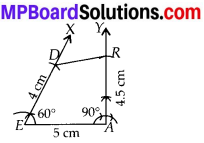
(i) Quadrilateral
DEAR
DE = 4 cm
EA = 5 cm
AR = 4.5 cm
∠E = 60°
∠A = 90°

MP Board Solutions

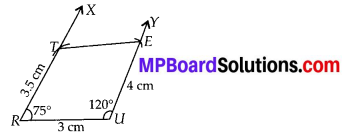
(ii) Quadrilateral
TRUE
TR = 3.5 cm
RU = 3 cm
UE = 4 cm
∠R = 75°
∠U = 120°
Solution:
(i) Steps of Construction:
Step-1: Draw EA = 5 cm.
Step-2: Make ∠AEX = 60° and ∠EAY = 90°.
Step-3 : Cut off arcs AR = 4.5 cm on \(\overrightarrow{A Y}\) and ED = 4 cm on \(\overrightarrow{E X}\).
Step-4: Join DR.
Hence, DEAR is the required quadrilateral.
MP Board Class 8th Maths Solutions Chapter 4 Practical Geometry Ex 4.4 1

MP Board Solutions

(ii) Steps of Construction :
Step-1: Draw RU = 3 cm.
Step-2 : Make ∠URX = 75° and ∠RUY = 120°
Step-3 : Cut off RT = 3.5 cm on \(\overrightarrow{R X}\) and UE = 4 cm on \(\overrightarrow{U Y}\).
Step-4: Join TE.
Hence, TRUE is the required quadrilateral.
MP Board Class 8th Maths Solutions Chapter 4 Practical Geometry Ex 4.4 2

MP Board Class 8th Maths Solutions

MP Board Class 8th Maths Solutions Chapter 4 Practical Geometry Ex 4.3

MP Board Class 8th Maths Solutions Chapter 4 Practical Geometry Ex 4.3

Question 1.
Construct the following quadrilaterals.
(i) Quadrilateral
MORE
MO = 6 cm
OR = 4.5 cm
∠M = 60°
∠O = 1050°
∠R = 105°

(ii) Quadrilateral
PLAN
PL = 4 cm
LA = 6.5 cm
∠P = 90°
∠A = 6.5 cm
∠N = 85°

MP Board Solutions

(iii) Parallelogram
HEAR
HE =5 cm
EA = 6 cm
∠B = 85°

(iv) Rectangle
OKAY
OK = 7 cm
KA = 5 cm
Solution:
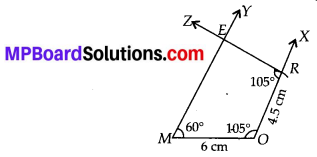
(i) Steps of Construction:
Step-1: Draw MO = 6 cm
Step-2 : Make ∠MOX = 105° and ∠OMY = 60°.
Step-3 : Cut off OR = 4.5 cm on OX.
Step-4 : At point R, draw ∠ORZ = 105° which cuts MY at E.
Hence, MORE is the required quadrilateral.
MP Board Class 8th Maths Solutions Chapter 4 Practical Geometry Ex 4.3 1

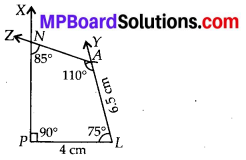
(ii) Here, ∠P = 90°, ∠A = 110°, ∠N = 85°
∴ ∠L = 360° – (∠P + ∠A + ∠N)
= 360° – (90° + 110° + 85°)
= 360°- 285° = 75° ….. (A)
Steps of Construction:
Step-1: Draw PL = 4 cm.
Step-2 : Make ∠LPX = 90° and ∠PLY = 75°. [From (A)]
Step-3 : Cut off LA = 6.5 cm on \(\overrightarrow{L Y}\).
Step-4: Draw ∠LAZ = 110° which cut \(\overrightarrow{P X}\) at point N.
Hence, PLAN is the required quadrilateral.
MP Board Class 8th Maths Solutions Chapter 4 Practical Geometry Ex 4.3 2

MP Board Solutions

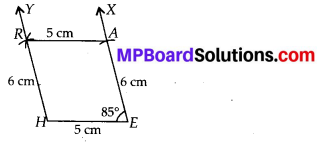
(iii) Since, opposite sides and angles of a parallelogram are equal i.e., ∠R = ∠E = 85°, HE = RA = 5 cm and EA = HR = 6 cm.
Steps of Construction:
Step-1: Draw HE = 5 cm.
Step-2 : Draw ∠HEX = 85°.
Step-3 : Cut off EA = 6 cm on \(\overrightarrow{E X}\)
Step-4: With H as centre and radius equal to 6 cm, draw an arc.
Step-5: With A as centre and radius equal to 5 cm, cut another arc on the arc drawn in step-4 at point R.
Step-6 : Join HR and RA.
Hence HEAR is the required parallelogram.
MP Board Class 8th Maths Solutions Chapter 4 Practical Geometry Ex 4.3 3

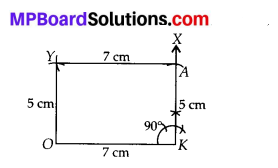
(iv) We know that each of the four angles of a rectangle is equal to 90° and opposite sides are also equal.
OK = YA and KA = OY
Steps of Construction:
Step-1: Draw OK = 7 cm.
Step-2 : Make ∠OKX = 90°.
Step-3 : Cut off KA = 5 cm on \(\overrightarrow{K X}\).
Step-4: With O as centre and radius equal to 5 cm, cut an arc.
Step-5: With A as centre and radius equal to 7 cm cut another arc on the arc drawn in step-4 at point Y.
Step-6 : Join OY and YA.
Hence, OKAY is the required rectangle.
MP Board Class 8th Maths Solutions Chapter 4 Practical Geometry Ex 4.3 4

MP Board Class 8th Maths Solutions

MP Board Class 8th Maths Solutions Chapter 4 Practical Geometry Ex 4.2

MP Board Class 8th Maths Solutions Chapter 4 Practical Geometry Ex 4.2

Question 1.
Construct the following quadrilaterals
(i) Quadrilateral
LIFT
LI = 4 cm
IF = 3 cm
TL = 2.5 cm
LF= 4.5 cm
IT =4 cm

(ii) Quadrilateral
GOLD
OL = 7.5 cm
GL = 6 cm
GD = 6 cm
LD = 5 cm
OD = 10 cm

MP Board Solutions

(iii) Rhombus BEND
BN = 5.6 cm,
DE = 6.5 cm
Solution:
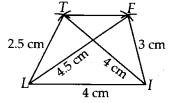
(i) Steps of Construction:
Step-1: Draw LI = 4 cm.
Step-2: With L as centre and radius equal to 2.5 cm, cut an arc.
Step-3: With I as centre and radius equal to 4 cm, cut another arc on the arc drawn in step-2 at point T.
Step-4 : With I as centre and radius equal to 3 cm, cut an arc.
Step-5: With L as centre and radius equal to 4.5 cm, cut another arc on the arc drawn in step-4 at point F.
Step-6 : Join LT, IT, LF, IF and TF.
Hence, LIFT is the required quadrilateral.
MP Board Class 8th Maths Solutions Chapter 4 Practical Geometry Ex 4.2 1

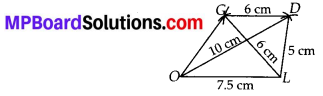
(ii) Steps of Construction:
Step-1: Draw OL = 7.5 cm.
Step-2: With L as centre and radius equal to 5 cm cut an arc.
Step-3 : With O as centre and radius equal to 10 cm, cut another arc on the arc drawn in step-2 at point D.
Step-4: With L as centre and radius equal to 6 cm, cut another arc.
Step-5: With D as centre and radius equal to 6 cm cut an arc on arc drawn in step-4 at point G.
Step-6 : Join LD, LG, OG, OD and DG. Hence, GOLD is the required quadrilateral.
MP Board Class 8th Maths Solutions Chapter 4 Practical Geometry Ex 4.2 2

MP Board Solutions

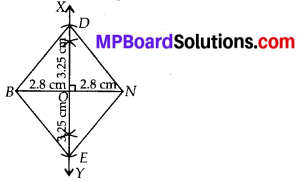
(iii) Here, BN = 5.6 cm and DE = 6.5 cm are given. These two sides are diagonals of a rhombus BEND. We know that diagonals of a rhombus bisect each other at right angles.

Steps of Construction:
Step-1: Draw BN = 5.6 cm.
Step-2 : Draw perpendicular bisector XY of BN which intersect BN at O.
Step-3 : Cut off OD = OF = 3.25 cm on \(\overrightarrow{\mathrm{OX}}\) and \(\overrightarrow{\mathrm{OY}}\) respectively.
Step-4 : Join BD, ND, BE and NE.
Hence, BEND is the required rhombus.
MP Board Class 8th Maths Solutions Chapter 4 Practical Geometry Ex 4.2 3

MP Board Class 8th Maths Solutions

MP Board Class 8th Maths Solutions Chapter 4 Practical Geometry Ex 4.1

MP Board Class 8th Maths Solutions Chapter 4 Practical Geometry Ex 4.1

Question 1.
Construct the following quadrilaterals.
(i) Quadrilateral
ABCD
AB = 4.5 cm
BC= 5.5 cm
MP= 5 cm
AD = 6cm
AC = 7 cm

MP Board Solutions

(ii) Quadrilateral
JUMP
JU = 3.5 cm
UM = 4 cm
MP = 5 cm
PJ = 4.5 cm
PU = 6.5 cm

(iii) Parallelogram
MORE
OR = 6 cm
RE = 4.5 cm
EO = 7.5 cm

(iv) Rhombus
BEST
BE = 4.5 cm
ET = 6 cm
Solution:
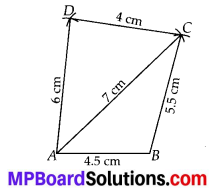
(i) Steps of Construction :
Step-1: Draw AB = 4.5 cm.
Step-2: With B as centre and radius equal to 5.5 cm, cut an arc.
Step-3 : With A as centre and radius equal to 7 cm, cut another arc on the arc drawn in step-2 at point C.
Step-4 : With C as centre and radius equal to 4 cm, cut off an arc. Also, with A as centre and. radius equal to 6 cm cut off another arc on the arc just drawn at point D.
Step-5 : Join BC, AC, CD and AD.
Hence, ABCD is the required quadrilateral.
MP Board Class 8th Maths Solutions Chapter 4 Practical Geometry Ex 4.1 1

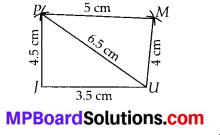
(ii) Steps of Construction :
Step-1: Draw JU = 3.5 cm.
Step-2: With J as centre and radius equal to 4.5 cm, cut an arc.
Step-3 : With U as centre and radius equal to 6.5 cm, cut another arc on the arc drawn in step-2 at point P.
Step-4: With P as centre and radius equal to 5 cm, cut off an arc.
Step-5: With U as centre and radius equal to 4 cm, cut another arc on the arc drawn in step-4 at point M.
Step-6 : Join JP, UP, UM and PM. Thus, JUMP is the required quadrilateral.
MP Board Class 8th Maths Solutions Chapter 4 Practical Geometry Ex 4.1 2

MP Board Solutions

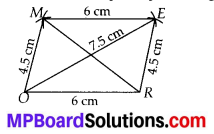
(iii) We know that opposite sides of a parallelogram are equal and parallel to each other.
∴ OR = ME and MO = ER.
Steps of Construction:
Step-1: Draw OR = 6 cm.
Step-2 : With R as centre and radius equal to 4.5 cm, cut an arc.
Step-3 : With O as centre and radius equal to 7.5 cm, cut another arc on the arc drawn in step-2 at point E.
Step-4: With E as centre and radius equal to 6 cm, cut an arc.
Step-5 : With O as centre and radius equal to 4.5 cm, cut an arc on the arc drawn in step-4 at point M.
Step-6 : Join RE, OE, OM and ME.
Hence, MORE is the required parallelogram.
MP Board Class 8th Maths Solutions Chapter 4 Practical Geometry Ex 4.1 3

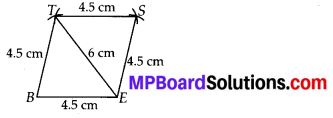
(iv) We know that all four sides of a rhombus are equal.
∴ BE = ES = ST = BT = 4.5 cm.
Steps of Construction:
Step-1: Draw BE = 4.5 cm.
Step-2: With B as centre and radius equal to 4.5 cm, draw an arc.
Step-3: With E as centre and radius equal to 6 cm, draw another arc, cutting the previous arc at point T.
Step-4: With E as centre and radius equal to 4.5 cm, cut an arc.
Step-5: With T as centre and radius equal to 4.5 cm, cut another arc on the previous arc at point S.
Step-6 : Join BT, ES, ET and ST.
Hence, BEST is the required rhombus.
MP Board Class 8th Maths Solutions Chapter 4 Practical Geometry Ex 4.1 4

MP Board Class 8th Maths Solutions

MP Board Class 8th Maths Solutions Chapter 3 Understanding Quadrilaterals Ex 3.4

MP Board Class 8th Maths Solutions Chapter 3 Understanding Quadrilaterals Ex 3.4

Question 1.
State whether True or False.
(a) All rectangles are squares.
(b) All rhombuses are parallelograms.
(c) All squares are rhombuses and also rectangles.
(d) All squares are not parallelograms.
(e) All kites are rhombuses.
(f) All rhombuses are kites.
(g) All parallelograms are trapeziums.
(h) All squares are trapeziums.
Solution:
(a) No, because in a square all sides are equal, but it is not true in case of rectangle.
(b) Yes, because both diagonals bisect each other and opposite sides are equal.
(c) Yes, because in square all sides are equal.
(d) No, all squares are parallelograms. Because all squares satisfies the conditions of a parallelogram.
(e) No, because only two pairs of consecutive sides are equal in kite whereas in rhombus all sides are of equal length.
(f) Yes, all rhombuses are kites.
(g) Yes, because in trapezium, there is only one pair of parallel opposite sides and in parallelograms, two pairs of opposite sides are parallel.
(h) Yes, because in trapezium, there is only one pair of parallel opposite sides and in square, two pairs of opposite sides are parallel.

MP Board Solutions

Question 2.
Identify all the quadrilaterals that have
(a) four sides of equal length
(b) four right angles
Solution:
(a) The quadrilaterals, those have four sides of equal length are square and rhombus.
(b) The quadrilaterals, those have four right angles, are square and rectangle.

Question 3.
Explain how a square is
(i) a quadrilateral
(ii) a parallelogram
(iii) a rhombus
(iv) a rectangle
Solution:
(i) A square is four sided, so it is a quadrilateral.
(ii) Since a square has opposite sides parallel and diagonals bisect each other, so it is a parallelogram.
(iii) Since square is a parallelogram with all 4 sides equal, so it is a rhombus.
(iv) Since square is a parallelogram with each angle a right angle, so it is a rectangle.

MP Board Solutions

Question 4.
Name the quadrilaterals whose diagonals
(i) bisect each other
(ii) are perpendicular bisectors of each other
(iii) are equal
Solution:
(i) The quadrilaterals in which diagonals bisect each other are rhombus, rectangle, square and parallelogram.
(ii) The quadrilaterals in which diagonals are perpendicular bisectors of each other are rhombus and square.
(iii) The quadrilaterals in which diagonals are equal are square and rectangle.

MP Board Solutions

Question 5.
Explain why a rectangle is a convex quadrilateral.

Solution:
When we draw the diagonals joining the end points of a rectangle it lies in its interior. So, it is a convex quadrilateral.

Question 6.
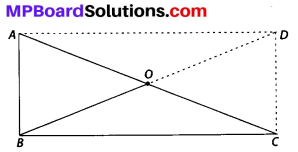
ABC is a right-angled triangle and O is the mid point of the side opposite to the right angle. Explain why O is equidistant from A, B and C. (The dotted lines are drawn additionally to help you).
MP Board Class 8th Maths Solutions Chapter 3 Understanding Quadrilaterals Ex 3.4 1
Solution:
Since ∆ABC is right angled at B. So ∠D = 90°, \(\overline{A D} \| \overline{B C}\) and \(\overline{A B} \| \overline{C D}\)
⇒ ABCD is a rectangle where AB = CD and AD = BC
AC and BD are the diagonals which bisects each other.
Thus AO = OC and BO = OD, also BO = OC which shows that O is equidistant from A, B and C.

MP Board Class 8th Maths Solutions

MP Board Class 8th Maths Solutions Chapter 3 Understanding Quadrilaterals Ex 3.3

MP Board Class 8th Maths Solutions Chapter 3 Understanding Quadrilaterals Ex 3.3

Question 1.
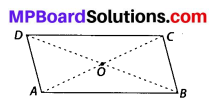
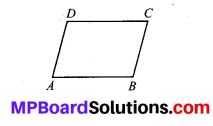
Given a parallelogram ABCD. Complete each statement along with the definition or property used.
MP Board Class 8th Maths Solutions Chapter 3 Understanding Quadrilaterals Ex 3.3 1
(i) AD = …..
(ii) ∠DCB = …….
(iii) OC = ……..
(iv) m∠DAB + m∠CDA =
Solution:
Given that ABCD is a parallelogram.
(i) AD = BC [∵ In a parallelogram opposite sides are equal]
(ii) ∠DCB = ∠DAB [∵ In a parallelogram opposite angles are equal]
(iii) OC = OA [∵ In a parallelogram diagonals bisect each other]
(iv) m∠DAB + m∠CDA = 180° [∵ Adjacent angles in a parallelogram are supplementary]

MP Board Solutions

Question 2.
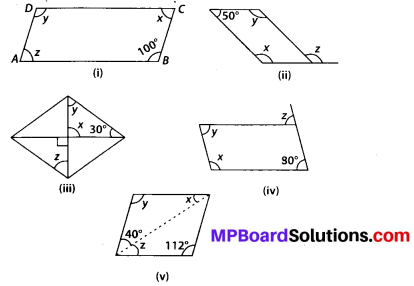
Consider the following parallelograms. Find the values of the unknowns x, y, z.
MP Board Class 8th Maths Solutions Chapter 3 Understanding Quadrilaterals Ex 3.3 2
Solution:
(i) ABCD is a parallelogram in which ∠B = 100° (given)
∴ ∠A + ∠B = 180° [∵ Sum of adjacent angles is 180°]
⇒ z +100° = 180°
⇒ z = 180° – 100° = 80°
Also ∠B = ∠D and ∠A = ∠C
[∵ Opposite angles are equal]
∴ ∠B = 100° = ∠D = y and ∠A = z = 80° = ∠C = x
∠ x = 80°, y = 100°, z = 80°.

(ii) y + 50° = 180° [∵ Sum of adjacent angles is 180°]
⇒ y = 180° – 50° = 130°
Also, y = x = 130° [∵ Opposite angles are equal in a parallelogram]
And 180°- z = 50° [Linear pair]
⇒ z = 180°- 50° ⇒ z = 130°

(iii) Clearly, x = 90°
[∵ Vertical opposite angles are equal] Also, x + y + 30° = 180°
[By using angle sum property of a triangle]
⇒ 90° + 30° + y = 180°
⇒ 120° + y = 180° ⇒ y = 180° – 120° = 60°
Since, alternate angles are equal in a parallelogram
∴ y = z = 60°
Thus x = 90°, y = 60° and z = 60°.

(iv) Since x + 80° = 180°
[Sum of adjacent angles is 180°] ⇒ x = 180° – 80° = 100°
Also 80° = y [∵ Opposite angles are equal in a parallelogram]
And x = 180° – z ⇒ 100° = 180° – 2° ⇒ 2 = 180° – 100° = 80°
Thus x = 100°, y = 80° and 2 = 80°.

(v) y = 112° [∵ Opposite angles are equal in a parallelogram]
y + x + 40° = 180°
[By angle sum property of a triangle]
⇒ 112°+ x+ 40° = 180°
⇒ x +152° = 180° ⇒ x = 180° – 152°
⇒ x = 28°
⇒ x = 2 = 28° [∵ Alternate angles are equal in a parallelogram]

MP Board Solutions

Question 3.
Can a quadrilateral ABCD be a parallelogram if
(i) ∠D + ∠B = 180°?
(ii) AB = DC = 8 cm, AD = 4 cm and BC = 4.4 cm?
(iii) ∠A = 70° and ∠C = 65°?
Solution:
(i) Yes, but need not be true.
(ii) No, because in a parallelogram opposite sides are equal but here AD ≠ BC.
(iii) No, because in a parallelogram opposite angles are equal but here ∠A ≠ ∠C.

Question 4.
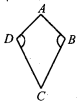
Draw a rough figure of a quadrilateral that is not a parallelogram but has exactly two opposite angles of equal measure.
Solution:
MP Board Class 8th Maths Solutions Chapter 3 Understanding Quadrilaterals Ex 3.3 3
We can draw a figure of a kite in which exactly two opposite angles are equal.
Hence ∠D = ∠B.

MP Board Solutions

Question 5.
The measures of two adjacent angles of a parallelogram are in the ratio 3 : 2. Find the measure of each of the angles of the parallelogram.
Solution:
Let ABCD be a given parallelogram.
Let ∠A = 3x and ∠B = 2x.
Since the sum of adjacent angles in a parallelogram is 180°
∴ m∠A + m∠B = 180°
⇒ 3x + 2x = 180°
⇒ 5x = 180° ⇒ x = 36°
MP Board Class 8th Maths Solutions Chapter 3 Understanding Quadrilaterals Ex 3.3 4
∴ m∠A = 3 × 36° = 108° and m∠B = 2 × 36° = 72°
Also, m∠A = m∠C = 108°
[∵ In a parallelogram opposite angles are equal]
and m∠B = m∠D = 72°.

MP Board Solutions

Question 6.
Two adjacent angles of a parallelogram have equal measure. Find the measure of each of the angles of the parallelogram.
Solution:
Let ABCD be a parallelogram, in which, let m∠A = m∠B = x
Since sum of two adjacent angles is 180°
∴ m∠A + m∠B = 180°
⇒ x + x = 180° ⇒ 2x = 180°
⇒ x = 90°
Also m∠A = m∠C = 90°
[∵ In a parallelogram opposite angles are equal]
and m∠B = m∠D = 90°.

Question 7.
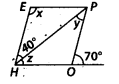
The given figure HOPE is a parallelogram. Find the angle measures x, y and z. State the
properties you use to find them.
MP Board Class 8th Maths Solutions Chapter 3 Understanding Quadrilaterals Ex 3.3 5
Solution:
y = 40°
[Since PO || HE ∴ alternate angles are equal]
70° = y + 2 [Exterior angle property of a triangle]
⇒ z = 70° – 40° = 30°
∠POH = 180° – 70° = 110° [Linear pair]
∠POH = x = 110° [Opposite angles are equal]
Thus x = 110°, y = 40°, 2 = 30°.

MP Board Solutions

Question 8.
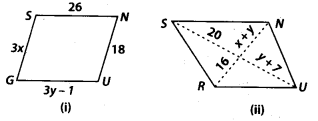
The following figures GUNS and RUNS are parallelograms. Find x and y. (Lengths are in cm)
MP Board Class 8th Maths Solutions Chapter 3 Understanding Quadrilaterals Ex 3.3 6
Solution:
(i) Since GUNS is a parallelogram.
∴ GS = NU and GU = SN
[∵ In a parallelogram opposite sides are equal]
⇒ 3x = 18 ⇒ x = 6
and 3y -1 = 26 ⇒ 3y = 1 + 26 = 27
⇒ y = 9
Thus x = 6 cm and y = 9 cm.

(ii) Since diagonals bisects each other in a parallelogram.
So, 20 = y + 7 ⇒ y = 13
Also, x + y= 16 ⇒ x = 16 – 13 = 3
Thus x = 3 cm and y = 13 cm.

Question 9.
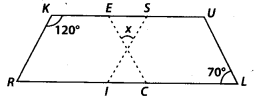
In the given figure both RISK and CLUE are parallelograms. Find the value of x.
MP Board Class 8th Maths Solutions Chapter 3 Understanding Quadrilaterals Ex 3.3 7
Solution:
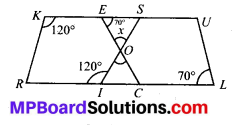
Since RISK and CLUE are parallelograms.
∴ ∠SKR = ∠RIS = 120° [∵ Opposite angles are equal]
Also, ∠ULC = ∠UEC = 70° [Opposite angles are equal]
∠RIS + ∠ISK = 180° [Adjacent angles are supplementary]
⇒ ∠ISK = 180° – 120° = 60°
MP Board Class 8th Maths Solutions Chapter 3 Understanding Quadrilaterals Ex 3.3 8
In ∆OES, we have
70° + x + 60° = 180° [Angle sum property]
⇒ x + 130° = 180°
⇒ x = 180° – 130° = 50°.

MP Board Solutions

Question 10.
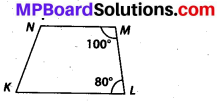
Explain how this figure is a trapezium. Which of its two sides are parallel?
MP Board Class 8th Maths Solutions Chapter 3 Understanding Quadrilaterals Ex 3.3 9
Solution:
In a trapezium, only one pair of opposite sides are parallel, whereas other pair of opposite sides are non-parallel.
∴ KLMN is a trapezium because MN || KL.
[∵ Sum of two adjacent interior angles is 180° = ( 80° + 100°)].

Question 11.
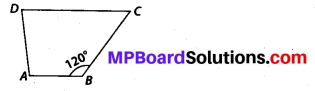
Find m∠C in given figure if AB || DC.
MP Board Class 8th Maths Solutions Chapter 3 Understanding Quadrilaterals Ex 3.3 10
Solution:
We are given, \(\overline{A B} \| \overline{D C}\)
∴ Sum of two adjacent interior angles is 180°
i. e., ∠B + ∠C = 180° ⇒ 120° + ∠C= 180°
⇒ ∠C = 180° -120° = 60°.
Thus ∠C = 60°.

MP Board Solutions

Question 12.
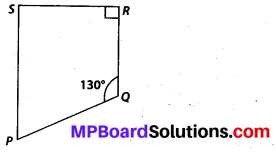
Find the measure of ∠P and ∠S if \(\overline{S P} \| \overline{R Q}\) in figure. (If you find m∠R, is there more than one method to find m∠P?)
MP Board Class 8th Maths Solutions Chapter 3 Understanding Quadrilaterals Ex 3.3 11
Solution:
Since \(\overline{S P} \| \overline{R Q}\)
Thus ∠R + ∠S = 180°
[∵ Sum of two adjacent interior angles is 180°]
⇒ 90° + ∠S = 180° ⇒ ∠S = 180° – 90° = 90°
∠P + ∠Q + ∠R + ∠S = 360° [∵ Sum of all angles of a quadrilateral is 360°]
⇒ ∠P + 310° = 360°
⇒ ∠P = 360° – 310°
⇒ ∠P = 50°
Thus ∠P = 50° and ∠S = 90°.
Also m∠P can be found as ∠P + ∠Q = 180°
[Adjacent angles are supplementary]
⇒ ∠P + 130° = 180°
⇒∠P = 180° -130° ⇒ ∠P = 50°

MP Board Class 8th Maths Solutions

MP Board Class 8th Maths Solutions Chapter 3 Understanding Quadrilaterals Ex 3.2

MP Board Class 8th Maths Solutions Chapter 3 Understanding Quadrilaterals Ex 3.2

Question 1.
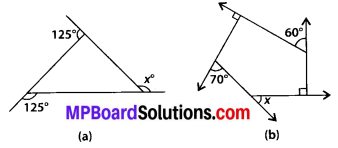
Find x in the following figures.
MP Board Class 8th Maths Solutions Chapter 3 Understanding Quadrilaterals Ex 3.2 1
Solution:
(a) Sum of the measures of the exterior angles of any polygon is 360°.
∴ 125° + 125° + x = 360°
⇒ 250° + x = 360°
⇒ x = 360° – 250° ⇒ x = 110°.
(b) Since, sum of the exterior angles of any polygon is 360°.
∴ x + 90° + 60° + 90° + 70° = 360°
⇒ x + 310° = 360° => x = 360° – 310°
∴ x = 50°.

MP Board Solutions

Question 2.
Find the measure of each exterior angle of a regular polygon of
(i) 9 sides
(ii) 15 sides.
Solution:
(i) Let each exterior angle of a regular polygon who has 9 sides is equal to x.
Sum of exterior angles of any polygon is 360°.
MP Board Class 8th Maths Solutions Chapter 3 Understanding Quadrilaterals Ex 3.2 2
Thus each exterior angle of a regular polygon of 9 sides is 40°.
(ii) Let each exterior angle of a regular polygon who has 15 sides is x.
Sum of all exterior angles of a polygon is 360°.
MP Board Class 8th Maths Solutions Chapter 3 Understanding Quadrilaterals Ex 3.2 3
Thus each exterior angle of a regular polygon of 15 sides is 24°.

MP Board Solutions

Question 3.
How many sides does a regular polygon have if the measure of an exterior angle is 24°?
Solution:
Total measure of all exterior angles = 360°
Measure of each exterior angle = 24°
Therefore, the number of sides = \(\frac{360^{\circ}}{24^{\circ}}\)
= 15
The polygon has 15 sides.

Question 4.
How many sides does a regular polygon have if each of its interior angles is 165°?
Solution:
Total measure of all exterior angles = 360°
Measure of each interior angle = 165°
Measure of each exterior angle = 180° – 165°
= 15°
Therefore, number of sides = \(\frac{360^{\circ}}{15^{\circ}}\) = 24

MP Board Solutions

Question 5.
(a) Is it possible to have a regular polygon with measure of each exterior angle as 22°?
(b) Can it be an interior angle of a regular polygon? Why ?
Solution:
(a) No, because 22° is not a divisor of 360°.
(b) No, because each interior angle is 180° – 22° = 158°, which is not a divisor of 360°.

Question 6.
(a) What is the minimum interior angle possible for a regular polygon? Why?
(b) What is the maximum exterior angle possible for a regular polygon?
Solution:
(a) Since each angle of an equilateral triangle is 60°.
And equilateral triangle is a regular polygon.
∴ Minimum interior angle is 60° for a regular polygon.
(b) Since minimum interior angle of a regular polygon is 60°.
∴ Each exterior angle of a regular polygon = 180° – 60° = 120°.
∴ Possible maximum exterior angle of a regular polygon is 120°.

MP Board Class 8th Maths Solutions

MP Board Class 8th Maths Solutions Chapter 3 Understanding Quadrilaterals Ex 3.1

MP Board Class 8th Maths Solutions Chapter 3 Understanding Quadrilaterals Ex 3.1

Question 1.
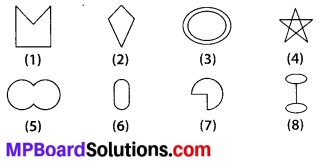
Given here are some figures.
MP Board Class 8th Maths Solutions Chapter 3 Understanding Quadrilaterals Ex 3.1 1
Classify each of them on the basis of the following.
(a) Simple curve
(b) Simple closed curve
(c) Polygon
(d) Convex polygon
(e) Concave polygon
Solution:
(a) Simple curve : It is a curve that does not intersect itself. (1), (2), (5), (6) and (7) are simple curve.
(b) Simple closed curve : A closed curve if it does not pass through one point more than once (1), (2), (5), (6) and (7) are simple closed curve.
(c) Polygon : A simple closed curve made up of only line segments is called a polygon.
(1) and (2) are polygons.
(d) Convex polygon : A polygon that has all its interior angles less than 180°.
(2) is a convex polygon.
(e) Concave polygon – A polygon that has at least one interior angle greater than 180°. (1) is a concave polygon.

Question 2.
How many diagonals does each of the following have?
(a) A convex quadrilateral
(b) A regular hexagon
(c) A triangle
Solution:
A diagonal is a line segment joining two non consecutive vertices.
(a) Convex quadrilateral : Convex quadrilateral has 2 diagonals.
(b) A regular hexagon : A regular hexagon has 9 diagonals.
(c) A triangle : It has 0 diagonal, i.e., no diagonal.

MP Board Solutions

Question 3.
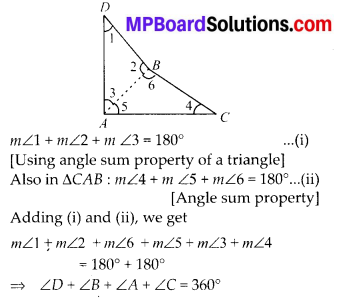
What is the sum of the measures of the angles of a convex quadrilateral? Will this property hold if the quadrilateral is not convex? (Make a non-convex quadrilateral and try!
Solution:
Sum of measures of four angles of a convex quadrilateral is 360°.
Example : Draw a figure given below and divide it into two triangles by joining AB, named CAB and DBA.
Now in ∆DBA, we have
MP Board Class 8th Maths Solutions Chapter 3 Understanding Quadrilaterals Ex 3.1 2
Which shows that a quadrilateral which is not convex also have sum of measure of its angles is 360°.

MP Board Solutions

Question 4.
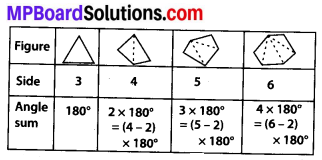
Examine the table. (Each figure is divided into triangles and the sum of the angles deduced from that).
MP Board Class 8th Maths Solutions Chapter 3 Understanding Quadrilaterals Ex 3.1 3
What can you say about the angle sum of a convex polygon with number of sides?
(a) 7
(b) 8
(c) 10
(d) n
Solution:
(a) If a convex polygon has 7 Sides, then angle sum = (7 – 2) × 180°
= 5 × 180° =900°.
(b) If a convex polygon has 8 sides, then angle sum = (8 – 2) × 180°
= 6 × 180° = 1080°.
(c) If a convex polygon has 10 sides, then angle sum = (10 – 2) × 180°
= 8 × 180° = 1440°.
(d) If a convex polygon has n sides, then angle sum = (n – 2) × 180°.

MP Board Solutions

Question 5.
What is a regular polygon? State the name of a regular polygon of
(i) 3 sides
(ii) 4 sides
(iii) 6 sides
Solution:
Regular polygon- A polygon, which has all sides of equal length and angles of equal measure is called a regular polygon.
(i) An equilateral triangle, as all 3 sides are equal and all 3 angles are also equal (= 60°).
(ii) A square, as it has all 4 sides equal and all 4 angles are also equal (= 90°).
(iii) A regular hexagon, as it has all 6 sides equal and all 6 angles equal (= 120°).

Question 6.
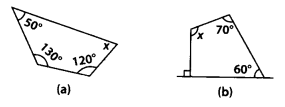
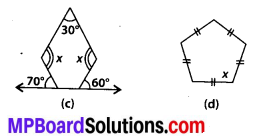
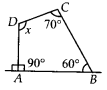
Find the angle measure x in the following figures.
MP Board Class 8th Maths Solutions Chapter 3 Understanding Quadrilaterals Ex 3.1 4
MP Board Class 8th Maths Solutions Chapter 3 Understanding Quadrilaterals Ex 3.1 5
Solution:
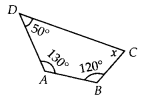
(a) Let ABCD be a given quadrilateral.
∵ Sum of all angles of a quadrilateral is 360°
∴ m∠A + m∠B + m∠C + m∠D = 360°
⇒ 130° + 120° + x + 50° = 360°
⇒ 300° + x = 360°
⇒ x = 360° – 300°
⇒ x = 60°.
MP Board Class 8th Maths Solutions Chapter 3 Understanding Quadrilaterals Ex 3.1 6

(b) Let ABCD be a given quadrilateral.
Sum of all angles of a quadrilateral is 360°.
∴ m∠A + m∠B + m∠C + m∠D = 360°
⇒ 90° + 60° + 70°’+ x = 360°
⇒ 220° + x = 360° D
⇒ x = 360° – 220°
⇒ x = 140°.
MP Board Class 8th Maths Solutions Chapter 3 Understanding Quadrilaterals Ex 3.1 7

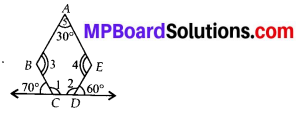
(c) Let ABCDE be a given polygon, which has 5 sides.
MP Board Class 8th Maths Solutions Chapter 3 Understanding Quadrilaterals Ex 3.1 8
Now, sum of angles = (5 – 2) × 180°
= 3 × 180° = 540°.
Also, m∠1 = 180° – 70° = 110° [By linear pair] and m∠Z = 180° – 60° = 120° [By linear pair]
Thus m∠1 + m∠2 + m∠3 + m∠4 + m∠5 = 540°
⇒ 110° + 120° + x + x + 30° = 540°
⇒ 260° + 2x = 540°
⇒ 2x = 540° – 260°
⇒ 2x = 280° ∴ x = 140°.

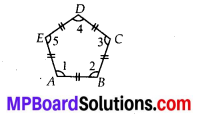
(d) Let ABCDE be a given pentagon.
MP Board Class 8th Maths Solutions Chapter 3 Understanding Quadrilaterals Ex 3.1 9
∴ Sum of angles of a given pentagon
ABODE = (5 – 2) × 180° = 540°.
∴ m∠1 + m∠2 + m∠3 + m∠4 + m∠5 = 540°
⇒ x + x + x + x + x = 540°
⇒ 5x = 540° ⇒ x = 108°.

MP Board Solutions

Question 7.
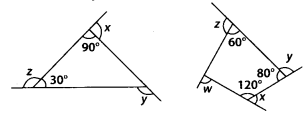
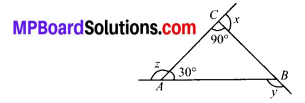
(a) Find x + y + z.
(b) Find x + y + z + w.
MP Board Class 8th Maths Solutions Chapter 3 Understanding Quadrilaterals Ex 3.1 10
Solution:
(a) Let ABC be a given triangle.
MP Board Class 8th Maths Solutions Chapter 3 Understanding Quadrilaterals Ex 3.1 11
Sum of angles of a triangle is 180°.
m∠A + m∠B + m∠C = 180°
⇒ 30° + m∠B + 90° = 180°
⇒ m∠B + 120° = 180°
⇒ m∠B = 180° – 120° = 60°
⇒ m∠B = 60° …(i)
Clearly, x + 90° = 180° [By linear pair]
⇒ x = 180° – 90° ⇒ x = 90° …… (ii)
Also z + 30° = 180° [By linear pair]
⇒ z = 180° – 30° ⇒ z = 150° …….. (iii)
and y + 60° = 180° [By linear pair]
⇒ y = 180° – 60° => y = 120° ……. (iv)
∴ By using (ii), (iii) and (iv), we get
x + y + z = 90° + 120° + 150°
⇒ x + y + z = 360°.

(b) Let ABCD be a given quadrilateral.
MP Board Class 8th Maths Solutions Chapter 3 Understanding Quadrilaterals Ex 3.1 12
Sum of angles of a quadrilateral is 360°.
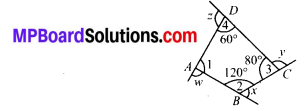
∴ m∠1 + m∠2 + m∠3 + m∠4 = 360°
⇒ m∠1 + 120° + 80° + 60° = 360° ⇒ m∠1 + 260° = 360°
⇒ m∠1 = 360° – 260° ⇒ m∠l = 100°
Clearly, w + 100° = 180° [By linear pair] ⇒ w = 180° – 100° = 80° ….(i)
x + 120° = 180° [By linear pair]
⇒ x = 180° – 120° = 60° y + 80° = 180°
⇒ y = 180° – 80° = 100° Also, z + 60° = 180°
⇒ z = 180° – 60° ⇒ z = 120° ….(iv)
Thus by (i), (ii), (iii) & (iv), we get
w + x + y + z = 80° + 60° + 100° + 120° = 360°

MP Board Class 8th Maths Solutions

MP Board Class 8th Maths Solutions Chapter 2 Linear Equations in One Variable Ex 2.6

MP Board Class 8th Maths Solutions Chapter 2 Linear Equations in One Variable Ex 2.6

Solve the following equations.

Question 1.
\(\frac{8 x-3}{3 x}=2\)
Solution:
We have, \(\frac{8 x-3}{3 x}\) = 2
⇒ 8x – 3 = 2 × 3
⇒ 8x – 3 = 6x ⇒ 8x – 6x = 3 ⇒ 2x = 3
⇒ x = \(\frac{3}{2}\), which is the required solution.

Question 2.
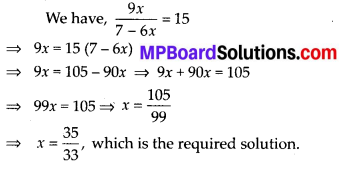
\(\frac{9 x}{7-6 x}=15\)
Solution:
MP Board Class 8th Maths Solutions Chapter 2 Linear Equations in One Variable Ex 2.6 1

MP Board Solutions

Question 3.
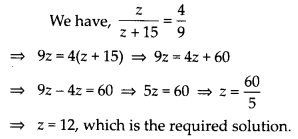
\(\frac{z}{z+15}=\frac{4}{9}\)
Solution:
MP Board Class 8th Maths Solutions Chapter 2 Linear Equations in One Variable Ex 2.6 2

Question 4.
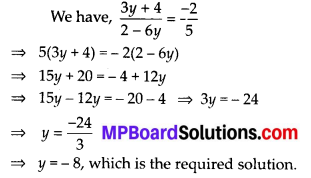
\(\frac{3 y+4}{2-6 y}=\frac{-2}{5}\)
Solution:
MP Board Class 8th Maths Solutions Chapter 2 Linear Equations in One Variable Ex 2.6 3

MP Board Solutions

Question 5.
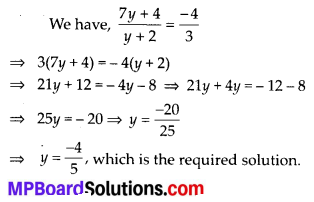
\(\frac{7 y+4}{y+2}=\frac{-4}{3}\)
Solution:
MP Board Class 8th Maths Solutions Chapter 2 Linear Equations in One Variable Ex 2.6 4

Question 6.
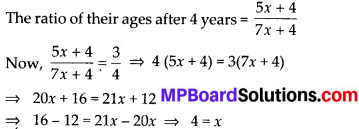
The ages of Hari and Harry are in the ratio 5 : 7. Four years from now the ratio of their ages will be 3 : 4. Find their present ages.
Solution:
Let the present ages of Hari and Harry be 5x and 7x respectively.
After 4 years, Hari’s age = (5x + 4) years and Harry’s age = (7x + 4) years
MP Board Class 8th Maths Solutions Chapter 2 Linear Equations in One Variable Ex 2.6 5
∴ Hari’s present age = 5x = 5 × 4 = 20 years and Harry’s present age = 7x = 7 × 4 = 28 years

MP Board Solutions

Question 7.
The denominator of a rational number is greater than its numerator by 8. If the numerator is increased by 17 and the denominator is decreased by 1, the number
obtained is \(\frac{3}{2}\). Find the rational number.
Solution:
Let the numerator of the rational number be x.
∴ The denominator is x + 8.
According to question, we have
New numerator = x + 17 and
New denominator = (x + 8) – 1 = x + 7
MP Board Class 8th Maths Solutions Chapter 2 Linear Equations in One Variable Ex 2.6 6
⇒ 2(x + 17) = 3(x + 7) ⇒ 2x + 34 = 3x + 21
⇒ 34 – 21 = 3x – 2x ⇒ 13 = x
Thus, numerator = x = 13
and denominator = x + 8 = 13 + 8 = 21
Hence, the rational number is \(\frac{13}{21}\).

MP Board Class 8th Maths Solutions

MP Board Class 8th Maths Solutions Chapter 2 Linear Equations in One Variable Ex 2.5

MP Board Class 8th Maths Solutions Chapter 2 Linear Equations in One Variable Ex 2.5

Solve the following linear equations.

Question 1.
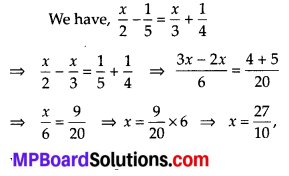
\(\frac{x}{2}-\frac{1}{5}=\frac{x}{3}+\frac{1}{4}\)
Solution:
MP Board Class 8th Maths Solutions Chapter 2 Linear Equations in One Variable Ex 2.5 1
which is the required solution.

MP Board Solutions

Question 2.
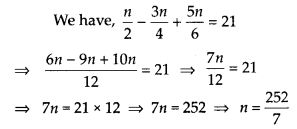
\(\frac{n}{2}-\frac{3 n}{4}+\frac{5 n}{6}=21\)
Solution:
MP Board Class 8th Maths Solutions Chapter 2 Linear Equations in One Variable Ex 2.5 2
⇒ n = 6, which is the required solution.

Question 3.
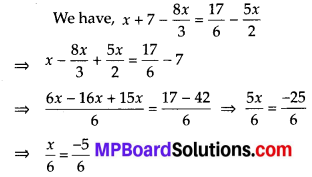
\(x+7-\frac{8 x}{3}=\frac{17}{6}-\frac{5 x}{2}\)
Solution:
MP Board Class 8th Maths Solutions Chapter 2 Linear Equations in One Variable Ex 2.5 3
⇒ x = -5, which is the required solution.

MP Board Solutions

Question 4.
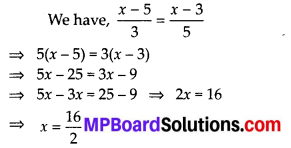
\(\frac{x-5}{3}=\frac{x-3}{5}\)
Solution:
MP Board Class 8th Maths Solutions Chapter 2 Linear Equations in One Variable Ex 2.5 4
⇒ x = 8, which is the required solution.

Question 5.
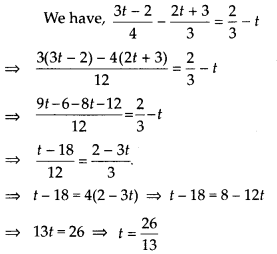
\(\frac{3 t-2}{4}-\frac{2 t+3}{3}=\frac{2}{3}-t\)
Solution:
MP Board Class 8th Maths Solutions Chapter 2 Linear Equations in One Variable Ex 2.5 5
⇒ t = 2, which is the required solution.

MP Board Solutions

Question 6.
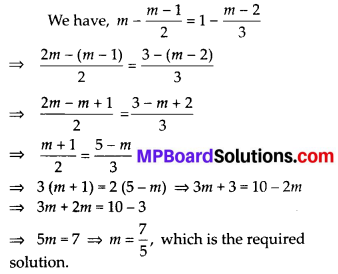
\(m-\frac{m-1}{2}=1-\frac{m-2}{3}\)
Solution:
MP Board Class 8th Maths Solutions Chapter 2 Linear Equations in One Variable Ex 2.5 6

Simplify and solve the following linear equations.

Question 7.
3(t – 3) = 5(2t + 1)
Solution:
We have, 3(t – 3) = 5(2t + 1)
⇒ 31 – 9 = 101 + 5
⇒ – 9 – 5 = 101 – 31 ⇒ -14 = 71
⇒ 1 = – 2, which is the required solution.

MP Board Solutions

Question 8.
15(y – 4) – 2(y – 9) + 5(y + 6) = 0
Solution:
We have,
15(y – 4) – 2(y – 9) + 5(y + 6) = 0
⇒ 15 y – 60 – 2y + 18 + 5y + 30 = 0
⇒ 18y – 12 = 0 ⇒ 18y = 12
MP Board Class 8th Maths Solutions Chapter 2 Linear Equations in One Variable Ex 2.5 7
⇒ y = \(\frac{2}{3}\), which is the required solution.

Question 9.
3(5z – 7) – 2(9z -11) = 4(8z – 13) – 17
Solution:
We have,
3(5z – 7) – 2(9z -11) = 4(8z – 13) – 17
⇒ 15z – 21 – 18z + 22 = 32z – 52 – 17
⇒ 15z – 18z – 32z = 21 – 22 – 52 – 17 – 70
⇒ -35z = -70 ⇒ z = \(\frac{-70}{-35}\)
⇒ z = 2, which is the required solution.

MP Board Solutions

Question 10.
0.25 (4f- 3) = 0.05(10f – 9)
Solution:
We have, 0.25(4f – 3) = 0.05(10f – 9)
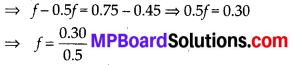
⇒ f – 0.75 = 0.5f – 0.45
MP Board Class 8th Maths Solutions Chapter 2 Linear Equations in One Variable Ex 2.5 8
⇒ f = 0.6, which is the required solution.

MP Board Class 8th Maths Solutions