MP Board Class 10th General English Grammar Clauses

Are you seeking for the Madhya Pradesh Board Solutions 10th General English Clauses Questions and Answers PDF? If yes, then read this entire page. Here, we are giving a direct link to download MP Board Class 10th English Solutions Questions and Answers PDF which contains the chapter wise questions, solutions, and grammar topics. You can also get the shortcuts to solve the grammar related questions on this page.

MP Board Class 10th General English Grammar Clauses

For the sake of students we have gathered the complete 10th General English Clauses Questions and Answers can provided in pdf Pattern. Refer the chapter wise MP Board Class 10th English Solutions Questions and Answers Topics and start the preparation. You can estimate the importance of each chapter, find important English grammar concepts which are having more weightage. Concentrate on the important grammar topics from Madhya Pradesh Board Solutions for 10th English Sentence Connectors Questions and Answers PDF, prepare well for the exam.

जब किसी sentence में एक subject और एक predicate (अर्थात् एक ही verb) हो तो वह simple sentence कहलाता है।

Example :

  • Subject + Predicate (Verb + other words)
    Harish is playing football.

Simple sentences जब जुड़कर complex sentences बन जाते हैं तो clauses कहलाते हैं।
Complex SentenceThis is the picture which was drawn by me.

Simple sentences to forest conjunction (योजक शब्द) से जोड़कर Complex sentence बनाया जाता है।

Clauses दो प्रकार के होते हैं-
(i) Principal Clause व
(ii) Subordinate Clause.
I love him because he is my son.
I love him वाक्य अपने आप में पूर्ण है। अतः यह Principal clause है। because he is my son को अकेले नहीं लिखा जा सकता। पूरे अर्थ के लिए यह I love him पर निर्भर है। अतः यह subordinate clause है।

Subordinate Clause तीन प्रकार के होते हैं :
(i) Noun Clause
(ii) Adverb Clause
(iii) Adjective Clause.
आपके पाठ्यक्रम में Noun Clause ही हैं।

Noun Clauses

वे Clauses जो Noun का कार्य करते हैं, Noun Clause कहलाते हैं। ये निम्न कार्य करते हैं

  1. Subject of a verb.
  2. The object of a transitive verb.
  3. The complement of a verb.
  4. The object of a preposition.

(1) Subject of a Verb
जब कोई Clause किसी verb के subject का कार्य करता है तो Noun Clause कहलाता है। जैसे-

That he is ill is not true.
(i) What he said.
(ii) That pleased me.
These two sentences can be combined to form a complex sentence.

What he said subordinate clause है। यह sentence । में subicet का कार्य करता है। What he said noun clause है तथा pleased का subject है।

Exercise 1

Combine the following sentences :
1. He is ill. It is not true.
2. What he says. That is wrong.
3. What he did. It was a mistake.
4. You pass or not. It doesn’t interest me.
5. Whom God loves. They die young.
Answer:
1. That he is ill is not true.
2. What he says is wrong.
3. What he did was a mistake.
4. Whether you pass or not doesn’t interest me.
5. Whom God loves die young.

(2) Object of a Transitive Verb
जब कोई simple sentence दूसरे simple sentence से इस तरह जुड़ता है कि जुड़कर उस sentence की Finite Verb के Object का कार्य करे तो इस तरह Noun का कार्य करने के CRU Noun Clause OEMICITI

Transitive verb में sentence का structure होता है–
Subject – Verb — Object Object कोई Noun/Pronoun होता है।

अतः निम्न sentence में
I know where he lives.

इस complex sentence में I know main clause व object के रूप में जुड़ा है। where he lives Noun clause

Exercise 2

Combine the following sentences :
1. Tell me this. Where the school is.
2. Lthink this. You are right.
3. Give it to me. What I gave you.
4. Mohan fears this. He may fail in the exams.
5. He found ………
He was late.
Answer:
1. Tell me where the school is.
2. I think that you are right.
3. Give me what I gave you.
4. Mohan fears that he may fail in the exams.
5. He found that he was late.

(3) Complement of a Verb

जब कोई Clause किसी Verb के Complement का कार्य करता है तब उसे भी Noun Clause कहते हैं।

जब कोई sentence दूसरे simple sentence में इस तरह जुड़ता है कि जुड़कर उसकी incomplete verbs के Noun complement का कार्य करे तो इस तरह जुड़ा वाक्य Noun clause कहलाता है। जैसे-

The problem is this.
How can we reach there in time?
Answer:
The problem is how we can reach there in time.

Exercise 3

Combine the following sentences :

1. I am.
What I am.

2. Her problem is this.
How she can become a doctor.

3. This is it.
How he became rich.

4. Gandhiji’s appeal was …….
We should give up bad customs.

5. The question was this.
How she could come to him.
Answer:

  1. I am what I am.
  2. Her problem is how she can become a doctor.
  3. This is how he became rich.
  4. Gandhiji’s appeal was that we should give up bad customs.
  5. The question was how she could come to him.

(4) Object of a Preposition

जब कोई simple sentence दूसरे simple sentence में इस तरह जुड़ता हे कि जुड़कर उस sentence के किसी Preposition का Object बन जाये तो वह Noun Clause कहलाता है जैसे-
Listen to What your mother says.
It all depends on how she does.

उपर्युक्त वाक्यों में prepositions to व on के बाद के शब्द subordinate noun clause हैं। इस प्रकार के clause के पहले oral Preposition अवश्य आता है

Exercise 4

Combine the following sentences :
1. Pay attention to the teacher’s words.
The teacher says the words,

2. Don’t jump upon conclusions.
You conclude conclusions.

3. He was punished for his misdeed.
He had done the misdeed.

4. Be careful about things.
You take things in your hands.

5. You will be answerable for your deed.
You do the deed.
Answer:

  1. Pay attention to what your teacher says.
  2. Don’t jump upon what you conclude.
  3. He was punished for what he had done.
  4. Be careful about what you take in your hands.
  5. You will be answerable for what you do.

Hope that the above shaped information regarding the Madhya Pradesh Board Solutions for 10th English Sentence Connectors Questions and Answers is useful for making your preparation effective. View our website regularly to get other subjects solutions.
MP Board Class 10th General English Grammar Non-finite Forms of Verbs

Are you seeking for the Madhya Pradesh Board Solutions 10th General English Non-finite Forms of Verbs Questions and Answers PDF? If yes, then read this entire page. Here, we are giving a direct link to download MP Board Class 10th English Solutions Questions and Answers PDF which contains the chapter wise questions, solutions, and grammar topics. You can also get the shortcuts to solve the grammar related questions on this page.

MP Board Class 10th General English Grammar Non-finite Forms of Verbs

For the sake of students we have gathered the complete 10th General English Non-finite Forms of Verbs Questions and Answers can provided in pdf Pattern. Refer the chapter wise MP Board Class 10th English Solutions Questions and Answers Topics and start the preparation. You can estimate the importance of each chapter, find important English grammar concepts which are having more weightage. Concentrate on the important grammar topics from Madhya Pradesh Board Solutions for 10th English Sentence Connectors Questions and Answers PDF, prepare well for the exam.

Infinitives, gerunds, and participles are known as non-finite forms of verbs.

(i) Infinitive

Verb के first form में to लगाने से infinitive बनता है। इसका प्रयोग Noun Adjective या Adverb के समान होता है।

जैसे-

  1. To obey the rules is our duty.
    (Noun subject of is)
  2. Will you like to go with me?
    (Noun object of like)
  3. This is not the matter to laugh at.
    (Adjective qualifies matter)
  4. They are ready to live with me.
    (Adverb modifies ready)
  5. He wept to see my adverse state.
    (Adverb modifies wept)

(ii) Gerund

Gerund Verb के first form में ing जोड़ने से बनता है इसका प्रयोग verb और Noun के सामान होता है।

जैसे-
I like walking
Telling lie is a sin.
Smoking is a bad habit.
She is fond of singing songs.

Note- that some verbs are followed only by gerunds and some by only infinitives.

Verbs followed only by gerunds are-
avoid, mind, afraid of, postpone, consider, enjoy, keep on, put off, delay, finish, insist on, dislike, give up, stop, appreciate, approve of, suggest.

Verbs followed only by infinitives are :
agree, arrange, attempt, decide, demand, desire, deserve, expect, fail, hope, learn, manage, offer, prepare, promise, refuse, seem, try, wish.

(iii) Participle

A participle is that form of the verb which partakes of the nature of both, a verb and an adjective.
Participle क्रिया का वह रूप है जो verb तथा adjective दोनें का कार्यकर्त है Participle तीन प्रकार के होता है :

1. Present Participle-Present Participle भी Gerund की तरह Verb में ing मगनेसे बनता है परन्तु यह Verb और Site Adjective का कार्य करता है जैसे-
Seeing me, he went away.

2. Past Participle यह Verb का III form हि होता है जैसे-
1. The rotten eggs were thrown away.
2. This is a faded flower.

3. Perfect Participle- इसमें having के साथ III form of verb का प्रयोग होता है
Having sold his old car, Ram bought a new one.

Exercise 1.

Fill in the blanks with an infinitive, gerund or a participle :
1. He went to England …………………… English. (to learn/for learning)
2. She likes …………………… idle. (sitting/to sit)
3. …………………… their work, they left the place. (Finishing/Having finished)
4. …………………… is his favorite past time. (Dancing/Dance)
5. …………………… pity of the parrot, the man freed it. (Taking/Took/To take)
Answer:
1. to learn,
2. sitting,
3. Having finished,
4. Dancing,
5. Taking.

Exercise 2

Underline the participles in the following sentences :
1. A burnt child dreads the fire.
2. Deceived by his father, he lost all hope.
3. Having rested, they continued their journey.
4. Loudly knocking at the gate, he demanded entrance.
5. He kept me waiting.
Answer:
1. burnt,
2. Deceived,
3. Having rested,
4. knocking,
5. waiting.

Hope that the above shaped information regarding the Madhya Pradesh Board Solutions for 10th English Sentence Connectors Questions and Answers is useful for making your preparation effective. View our website regularly to get other subjects solutions.
MP Board Class 10th General English Grammar Sentence Connectors

Are you seeking for the Madhya Pradesh Board Solutions 10th General English Grammar Sentence Connectors Questions and Answers PDF? If yes, then read this entire page. Here, we are giving a direct link to download MP Board Class 10th English Solutions Questions and Answers PDF which contains the chapter wise questions, solutions, and grammar topics. You can also get the shortcuts to solve the grammar related questions on this page.

MP Board Class 10th General English Grammar Sentence Connectors

For the sake of students we have gathered the complete 10th General English Grammar Sentence Connectors Questions and Answers can provided in pdf Pattern. Refer the chapter wise MP Board Class 10th English Solutions Questions and Answers Topics and start the preparation. You can estimate the importance of each chapter, find important English grammar concepts which are having more weightage. Concentrate on the important grammar topics from Madhya Pradesh Board Solutions for 10th English Sentence Connectors Questions and Answers PDF, prepare well for the exam.

Sentence Connector या Conjunction वो शब्द है जो दो शब्दों/दो वाक्यों या वाक्यांशों को एक-दूसरे के साथ जोड़ता है। जैसे-

Ram is slow, Rahim is equally slow.
Ram is as slow as Rahim.
He did not see me.
He had finished his work.
He did not see me until he had finished his work.
आपके पाठ्यक्रम में as, since, while, than, just because व until sentence connectors है।

1. As

(i) As का अर्थ होता है क्योंकि’ (because)। जब एक वाक्य दूसरे वाक्य का कारण हो तो ऐसे वाक्यों को ‘as’ से जोड़ दिया जाता है। जैसे-
He was happy. He had passed the examination.
As he had passed the examination, he was happy.

(ii) ढंग अथवा तरीके (manner) को प्रकट करने के लिए ‘as’ का प्रयोग किया जाता है। जैसे-
As you sow, so shall you reap.

(iii) पहले काम के समाप्त होने से पूर्व यदि दूसरा काम हो तो ऐसे वाक्यों को ‘as’ से जोड़ दिया जाता है। जैसे
I reached the place. He left.
As I reached the place, he left.

(iv) एक कार्य को करते हुए दूसरा कार्य करना हो तो ऐसे वाक्यों को ‘as’ से जोड़ा जाता है। जैसे
Ram sang. He read.
Ram read as he sang

(v) तुलना करने के लिए भी ‘as’ का प्रयोग होता है।
Mohan is intelligent. Raja is not so intelligent.
Raja is not as intelligent as Mohan.

2. Since

Since का प्रयोग होता है-
(i) समय प्रकट करने के लिए। जैसे-
She has been laughing since morning.
He is sick since his childhood.

(ii) किसी कारण को प्रकट करने के लिए।
Since he is my elder brother, I respect him.

3. Than

Than तुलना प्रकट करता है व ऐसे वाक्यों को जोड़ता है जिनसे तुलना प्रकट हो।
I am strong. She is stronger.
She is stronger than me.

4. Just because

Just because का अर्थ कारण मात्र होता है, जैसे-
He is ill, He should not play.
He should not play just because he is ill.

5. Until

Until का अर्थ है ‘जब तक नहीं’। इसका उपयोग निम्न प्रकार होता है
She did not come to me. She had finished her work.
She did not come to me until she had finished her work.

6. While

While at in ff your stat

(i) जितने समय तक, उतने समय तक
There is life. There is hope.
While there is life, there is hope.

(ii) साथ – साथ कार्य होना
Ram was reading. His brother was singing.
While Ram was reading, his brother was singing.

(iii) विरोधभास के लिए
The boy is happy. His younger brother is sad.
The boy is happy while his younger brother is sad. –

(iv) Although के रूप में (मगर while शुरूआत में लिखा जथा है)
I agree with you. I can’t accept your offer.
While I agree with you, I can’t accept your offer.

Exercise 1
Fill in the blanks with suitable connectors :
1. …………………….. it was raining, he did not go to school.
2. No song is sweeter …………………….. our National Anthem.
3. …………………….. I was going to school, I saw an accident.
4. We shall play …………………….. the bell goes.
5. Let us wait …………………….. the rain stops.
6. You are scolding the child …………………….. he ate a sweet.
7. There is no need to lose hope …………………….. you do not know him.
8. He composed the poem …………………….. he walked on the beach.
9. Plants breathe …………………….. animals do.
10. I have not met him …………………….. he returned from abroad.
Answer:
1. Since,
2. than,
3. While
4. until,
5. until,
6. just because,
7. as,
8. while,
9. as,
10. since.

Hope that the above shaped information regarding the Madhya Pradesh Board Solutions for 10th English Sentence Connectors Questions and Answers is useful for making your preparation effective. View our website regularly to get other subjects solutions.
MP Board Class 10th General English Grammar Modals

Are you seeking for the Madhya Pradesh Board Solutions 10th General English Grammar Modals Questions and Answers PDF? If yes, then read this entire page. Here, we are giving a direct link to download MP Board Class 10th English Solutions Questions and Answers PDF which contains the chapter wise questions, solutions, and grammar topics. You can also get the shortcuts to solve the grammar related questions on this page.

MP Board Class 10th General English Grammar Modals

For the sake of students we have gathered the complete 10th General English Grammar Modals Questions and Answers can provided in pdf Pattern. Refer the chapter wise MP Board Class 10th English Solutions Questions and Answers Topics and start the preparation. You can estimate the importance of each chapter, find important English grammar concepts which are having more weightage. Concentrate on the important grammar topics from Madhya Pradesh Board Solutions for 10th English Modals Questions and Answers PDF, prepare well for the exam.

Modals विशेष प्रकार की Helping verbs हैं जो मुख्य (Finite) Verb के Mood (भाव) को प्रकट करने में सहायता करते हैं।

Modals के बाद not लगाकर वाक्य Negative बन जाता।
Will, shall, should, would, can could, may, might, ought, need, dare, has to, have to, had to, ought to Modals हैं। आपके पाठ्यक्रम में सिर्फ can, could, may, must a might हैं।

Modals की प्रमुख विशेषताएँ निम्न हैं–
(1) यह कभी अकेला प्रयुक्त नहीं होता है वरन् सदैव किसी मुख्य क्रिया (main verb) के साथ ही आता है। जैसे
(i) You may come in.
(ii) I might go there.

Uses of Some Modals

1. Can
Can ‘का अर्थ है ‘सकना’। इसका प्रयोग ability (योग्यता), capacity (क्षमता). permission (अनुमति) या possibility (सम्भावना) व्यक्त करने के लिए होता है।

जैसे-
(a) योग्यता, क्षमता (ability, capacity) दर्शाने के लिए—
She can speak Gujarati.
(वह गुजराती बोल सकती है।) (योग्यता)

I can walk for three continuous hours.
(मैं तीन घण्टे तक लगातार चल सकता हूँ।) (क्षमता)

(b) अनुमति (Permission) देने के लिए
You can go now
(तुम अब जा सकते हो।)

You can wait at my home.
(आप मेरे घर पर प्रतीक्षा कर सकते हैं।)

(c) सम्भावना (possibility) दर्शाने के लिए-

The lost ring can be here.
(खोई हुई अँगूठी यहाँ हो सकती है।)

2. Could
Could, Can, का Past Tense है। इसका अर्थ है ‘सका’ या ‘सका था’। इसका प्रयोग भूतकाल की योग्यता या क्षमता तथा वर्तमान काल की विनम्र प्रार्थना व्यक्त करने में किया जाता है।

(a) क्षमता या योग्यता (power or ability) दर्शाने के लिए।

I could see him through the windows.
(मैं उसे खिड़की से देख सकता था।) (क्षमता)

He could work for twelve hours.
(वह बारह घण्टे तक कार्य कर सका।) (योग्यता)

(b) विनम्र प्रार्थना (polite request) करने के लिए

Could you lend me your pencil?
(क्या तुम मुझे अपनी पेंसिल उधार दे सकते हो ?)

Could you tell me the way to your home?
(क्या तुम मुझे अपने घर का रास्ता बता सकते हो ?)

3. May
‘May’ का भी अर्थ है ‘सकना’। यह ‘Can’ से अधिक औपचारिक (formal) शब्द है। इससे सम्भावना (possibility), नम्रतापूर्वक अनुमति (permission), उद्देश्य (purpose), इच्छा या आशीर्वाद के भावों का बोध होता है।

(a) सम्भावना (Possibility)
It may rain today.
(सम्भव है आज वर्षा हो।)

He may come tomorrow.
(सम्भव है वह कल आये।)

(b) अनुमति (permission) देना या माँगना

You may go now.
(तुम अब जा सकते हो।)

May I come in?
(क्या मैं अन्दर आ सकता हूँ ?)

(c) उद्देश्य (Purpose)
She works hard so that she may survive.
(वह कड़ी मेहनत करती है ताकि वह निर्वाह कर सके।)

We eat so that we may live.
(हम खाते हैं ताकि हम जीवित रह सकें।)

(d) इच्छा या आशीर्वाद (Wish)

May you live long?
(आप दीर्घायु हों ?)

May he come back safely.
(ईश्वर करे वह सुरक्षित लौटे।)

4. Might

Might, May का Past Tense है। इसका उपयोग निम्न प्रकार होता है-
(a) Indirect speech may fol Past Tense might होता है। जैसे-

Direct-She said, “She may come today”. Indirect-She said that she might come that day.
(उसने कहा कि वह उस दिन आ सकती है।)

(b) वाक्य में जब मुख्य क्रिया Past Tense में हो तो might का प्रयोग करना चाहिए। जैसे-

He took medicine so that he might get well.
(उसने दवा खाई ताकि वह अच्छा हो जाये।)

(c) Might में May की अपेक्षा अधिक दूर की सम्भावना प्रकट की जाती है। जैसे-
(Your elder son might become an engineer.
(तुम्हारा बड़ा लड़का इंजीनियर बन सकता है।)

5. Must
Must व Should दोनों के अर्थ हैं ‘चाहिए’ किन्तु should से अनिवार्यता या निष्कर्ष प्रकट नहीं होता है जबकि must से ये दोनों भाव प्रकट होते हैं। जैसे-
(a) अनिवार्यता (Necessity)-

We must reach school on time.
(हमें स्कूल समय पर पहुँचना चाहिए।)

We must pay our taxes.
(हमें अपने करों का भुगतान करना चाहिए।)

(b) निष्कर्ष (Conclusion)
He must be at home.
(वह अवश्य घर पर होना चाहिए।)

Exercise Fill in the blanks with can/could/may/might/ must:
1. ………………………… I come in?
2. Dr. Sharma is praised by everyone. He ………………………… be a good doctor.
3. This box is too light. You ………………………… lift it.
4. ………………………… you show me the way?
5. You ………………………… go to him just now.
6. She said that she ………………………… come that day.
7. She ………………………… run very fast.
8. Your examinations are near so you ………………………… work hard.
9. You ………………………… agree to it.
10. The thief ………………………… be anywhere.
Answer:
1. May,
2. must,
3. can,
4. Could,
5. must,
6. might,
7. can,
8. must,
9. may,
10. can.

Hope that the above shaped information regarding the Madhya Pradesh Board Solutions for 10th English Modals Questions and Answers is useful for making your preparation effective. View our website regularly to get other subjects solutions.
MP Board Class 10th General English Important Extracts from Poems

Are you seeking for the Madhya Pradesh Board Solutions 10th General English Reading Skills Important Extracts from Poems Questions and Answers PDF? If yes, then read this entire page. Here, we are giving a direct link to download MP Board Class 10th English Solutions Questions and Answers PDF which contains the chapter wise questions, solutions, and grammar topics. You can also get the shortcuts to solve the grammar related questions on this page.

MP Board Class 10th General English Important Extracts from Poems

For the sake of students we have gathered the complete 10th General English Reading Skills Important Extracts from Poems Questions and Answers can provided in pdf Pattern. Refer the chapter wise MP Board Class 10th English Solutions Questions and Answers Topics and start the preparation. You can estimate the importance of each chapter, find important English grammar concepts which are having more weightage. Concentrate on the important grammar topics from Madhya Pradesh Board Solutions for 10th English Important Extracts from Poems Questions and Answers PDF, prepare well for the exam.

Two extracts from different poems from the book will be asked, from which you will have to answer one. Each extract will be followed by two or three questions.

Read the following extracts carefully and answer the questions given below them.

(Lesson 15)

Ring out the old, ring in the new,
Ring, happy bells, across the snow;
The year is going, let him go;
Ring out the false, ring in the true.
Ring out the grief that saps the mind,
For those that here we see no more;
Ring out the feud of rich and poor,
Ring in redress to all mankind.

Questions:
(a) Name the poet.
(b) The grief ……………. the mind.
(i) saves (ii) saps
(c) Feud means :
(i) quarrels (ii) friendship
Answers:
(a) The poet is Alfred Lord Tennyson.
(b) (ii) saps.
(c) (i) quarrels.

(Lesson 7)

One angry moment often does
What we repent for years;
It works the wrong we ne’er make right
By sorrow or by tears.
The hand of peace is frank and warm,
And soft as ring dove’s wing;
And he who quells an angry thought
Is greater than a king.

Questions:
(a) The angry moment often makes us :
(i) to remember it (ii) to repent
(b) It works the wrong we never make :
(i) left (ii) right
(c) Name the poem.
Answers:
(a) (ii) to repent,
(b) (ii) right.
(c) Anger.

(Lesson 18)

Up ! up ! my Friend, and quit your books;
Or surely you’ll grow double :
Up ! Up! my Friend and clear your looks;
Why all this toil and trouble?
I The sun, above the mountain’s head,
A freshening luster mellow
Through all the long green fields has spread,
His first sweet evening yellow.

Questions:
(a) The poet wants us to leave our :
(i) books (ii) looks
(b) ‘Toil’ means :
(i) pain (ii) hard work
(c) Name the poet.
Answers:
(a) (i) books.
(b) (ii) hard work.
(c) (iii) The poet is William Wordsworth.

(Lesson 11)

I saw you toss the kites on high
And blow the birds about the sky;
And all around I heard you pass,
Like ladies’ skirts across the grass
O wind, a-blowing all day long,
O wind, that sings so loud a song !

Questions:
(a) About whom is the poet talking :
(i) the sky (ii) the wind
(b) The wind blows for :
(i) whole day (ii) whole night
(c) Who is the poet?
Answers:
(a) (ii) the wind.
(b) (i) whole day.
(c) The poem is written by Virginia Wolf.

(Lesson 4)

In your hearts the birds and sunshine,
In your thoughts, the brooklets flow,
But in mine is the wind of autumn.
And the first fall of snow.

Questions :
(a) In the hearts of the children there is :
(i) the moon and stars (ii) the birds and sunshine
(b) In the thoughts of the poet flows :
(i) brooklets (ii) the wind of autumn
(c) Name the poem.
Answers:
(a) (ii) the birds and sunshine.
(b) (ii) the wind of autumn.
(c) Children.

Hope that the above shaped information regarding the Madhya Pradesh Board Solutions for 10th English Important Extracts from Poems Questions and Answers is useful for making your preparation effective. View our website regularly to get other subjects solutions.

MP Board Class 10th General English Important Extracts from Prose

Are you seeking for the Madhya Pradesh Board Solutions 10th General English Reading Skills Important Extracts from Prose Questions and Answers PDF? If yes, then read this entire page. Here, we are giving a direct link to download MP Board Class 10th English Solutions Questions and Answers PDF which contains the chapter wise questions, solutions, and grammar topics. You can also get the shortcuts to solve the grammar related questions on this page.

MP Board Class 10th General English Important Extracts from Prose

For the sake of students we have gathered the complete 10th General English Reading Skills Important Extracts from Prose Questions and Answers can provided in pdf Pattern. Refer the chapter wise MP Board Class 10th English Solutions Questions and Answers Topics and start the preparation. You can estimate the importance of each chapter, find important English grammar concepts which are having more weightage. Concentrate on the important grammar topics from Madhya Pradesh Board Solutions for 10th English Important Extracts from Prose Questions and Answers PDF, prepare well for the exam.

Two extracts from different prose lessons from your textbook will be given. Each extract will be of 5 marks. 1 mark in each extract will be for vocabulary.

Read the extracts carefully and answer the questions given below them.

(Lesson 2)

But the brave boy didn’t want to die. He made up his mind that he would survive. Somehow, to the amazement of the physician, he did survive. When the mortal danger was past, he again heard the doctor and his mother speaking quietly. The mother was told that since the fire had destroyed so much flesh in the lower part of his body, it would have been better if he had died since he was doomed to be a lifetime cripple with no use at all of his lower limbs.

Once more the brave boy made up his mind. He would not be a cripple. He would walk. But unfortunately from the waist down, he had no motor ability. His thin legs just dangled there, all but lifeless.

Questions:
(a) The brave boy made up his mind to :
(i) die (ii) survive (iii) run
(b) The boy heard the doctor talking to his :
(i) mother (ii) father (iii) grandfather
(c) The word which means ‘disabled’ is :
(i) cripple (ii) mortal (iii) amazement
(d) What did the doctor tell his mother?
Answers:
(a) (ii) survive.
(b) (i) mother.
(c) (i) cripple.
(d) The doctor told his mother that since fire had destroyed the flesh in the lower part of his body, it would have been better if he died, since he was doomed to be a lifetime cripple.

(Lesson 16)

This went on for many years. When I was a little older, I asked my grandparents a question that had been bothering me for long.
‘Why should we eat the red rice always at the night when it is not so good, and give those poor people the better quality rice?’
My grandmother Krishtakka smiled and told me something I will never forget in my life.

‘Child, whenever you want to give something to somebody, give the best in you, never the second best. That is what I have learned from life. God is riot there in the temple, mosque or church. He is with the people. If you serve them with whatever you have, you have served God.’

Questions:
(a) The writer lived with :
(i) parents (ii) relatives (iii) grandparents
(b) Better quality rice was :
(i) white rice (ii) red rice (iii) yellow rice
(c) What should we give to somebody?
(d) Which word in the passage means ‘troubling’?
Answers:
(a) (iii) grandparents.
(b) (ii) white rice.
(c) We should give somebody the best that we have and never the second best.
(d) Bothering.

(Lesson 13)

Happiness, after all, is an inner state of mind. It is little dependent on outside environment. Happiness has very little to do, for instance, with whether you are rich or not rich. Some of the most miserable persons I have come across in my life are the rich people. It is true that poverty makes one miserable in a very acute way. But my point is that it is not wealth but co-ordination of one’s thought and action which removes inner conflicts. It is in that way that integration of personality is achieved.

Questions:
(a) removes inner conflicts.
(i) Wealth (ii) Peace of mind (iii) Co-ordination of one’s thought and action.
(b) Poverty makes one :
(i) criminal (ii) miserable (iii) unhappy
(c) Miserable means :
(i) unhappy (ii) poor (iii) sympathetic
(d) Who are some of the most miserable persons?
Answers :
(a) (iii) Co-ordination of one’s thoughts and actions.
(b) (ii) miserable.
(c) (i) unhappy.
(d) Some of the most miserable persons are the rich people.

(Lesson 14)
The wicked Kubuddhi then said, “Subuddhi, it j is you who have taken away all that gold. If you do not agree to give me my share of four hundred gold coins, I will take the matter to the court.”

Subuddhi was angry and said, “How dare you speak to me like that, you scoundrel. I’m not a thief.” A quarrel arose between the two friends and the matter was brought before the judge. Upon hearing the whole story, the judge did not know what to do since there were no witnesses.

Subuddhi had no witnesses but Kubuddhi said he had one the goddess of the forest. “If we go and ask her, she will be able to tell us which one of us stole the gold,” he suggested.

Questions:
(a) was blamed for stealing of gold?
(i) Subuddhi (ii) Kubuddhi
(iii) Kubuddhi’s father
(b) Kubuddhi’s share was :
(i) Hundred gold coins (ii) Five hundred gold coins (iii) Four hundred gold coins
(c) Which word in the passage is an antonym of‘ peace’?
(i) Angry (ii) Quarrel (iii) Scoundrel
(d) Why was the judge unable to give my judgment?
Answers:
(a) (i) Subuddhi
(b) (iii) Four hundred gold coins.
(c) (ii) Quarrel.
(d) The judge was unable to give any judgment since there were no witnesses.

(Lesson 8)

I bolted for a week in Delhi, the city of the great Sufi Saint Hazrat Nizamuddin, and appeared for the interview at DTD & P (Air) [Directorate of Technical Development and Production (Air)]. I did well at the interview. The questions were of a routine nature and did not challenge my knowledge of the subject. Then I proceeded to Dehradun for my interview at the Air Force Selection Board. At the Selection Board, the emphasis was more on “personality” than on intelligence. Perhaps they were looking for physical fitness and an articulate manner. I was excited but nervous, determined but anxious, confident but tense. I could only finish ninth in the batch of 25 examined to select eight officers for commissioning in the Air Force. I was deeply disappointed. It took me some time to comprehend that the opportunity to join the Air Force had just slipped through my fingers.

Questions:
(a) Who is the narrator :
(i) Dr. Kalam (ii) Mahatma Gandhi
(iii) Pt. Nehru
(b) At the Selection Board, the emphasis was on:
(i) intelligence (ii) personality (iii) strength
(c) The word ‘comprehend’ means to :
(i) give up (ii) understand (iii) accept
(d) What was the result of the interview at the Air Force?
Answers:
(a) (i) Dr. Kalam.
(b) (ii) personality.
(c) (ii) understand.
(d) He was not selected in the Air Force as 8 out of 25 examined were selected and he was at ninth position.

(Lesson 6)

One month later, the school organized the annual sports meet. Mamta wanted to participate in ; the 400 metre race. She was a fast runner. She used to walk long distances in her town. That had helped her develop strong leg muscles and good stamina. On top of that she was also tall for her age. She would be competing against the school champion, who had been winning the race for the past three years. ; Most girls laughed at her wish to win the race. After all, Mamta had never before participated in a race, i But she believed in herself. She knew she could run well. It was just a matter of rigorous practice. And she wanted to win for a very strong reason. She felt that winning against the school champion would
also helg her somehow in her basket ball game. So she started concentrating on her speed when she exercised in the morning,
Questions:
(a) The school organized the :
(i) annual sports meet (ii) debate competition (iii) dancing competition
(b) The school champion had been winning for past:
(i) 4 years (ii) 3 years (iii) 6 years
(c) The antonym of ‘distracting is’:
(i) competing (ii) concentrating (iii) winning
(d) For. which strong reason she wanted to win?
Answers:
(a) (i) annual sports meet.
(b) (ii) 3 years.
(c) (ii) concentrating.
(d) She wanted to win because she felt that winning against the school champion would also help her somehow in her basket ball game.

(Lesson 5)

Now, sneezing is not prohibited to anyone. Peasants sneeze, and chief’s of police sneeze, and even politicians sneeze; everyone sneezes. Naturally, Tcherviakoff did not feel embarrassed at what he had done. He wiped his nose with his handkerchief and glanced about him politely to make sure that he had not disturbed any one by his sneezing. And then he felt deeply ashamed. He saw that an old man who was sitting in front of him was painfully wiping his bald spot and the back of his neck with his glove and muttering something. He was, Tcherviakoff recognized, General Brizjaloff of the Department of Highways.

Questions:
(a) Tcherviakoff did not feel:
(i) happy (ii) embarrassed (iii) sad
(b) The old man belonged to the department of:
(i) Highways (ii) Railways (iii) Airways
(c) The word which means ‘to speak very slowly’ is:
(i) muttering (ii) wiping (iii) glance
(d) Why Tcherviakoff did not feel embarrassed in the beginning?
Answers:
(a) (ii) embarrassed.
(b) (i) Highways.
(c) (i) muttering.
(d) He did not feel embarrassed in the beginning because he felt that sneezing was not prohibited to anyone.

(Lesson 17)

Now, we all live in a big house which we call our native country. We have each of us been given, some one rupee, some two rupees, some three and some four. These rupees are not rupees with which we can buy things, but they are different powers we have been given. Each of us has powers of body, powers of mind and powers of character. Each of us has strength, time and intelligence, which can be used. As we leave school and go out into the world, we are tested as to how we are going to use these talents which we possess. Are we going to use them to buy useless hay or are we going to use them to spread light throughout our house, that is, our country? If we are going to be good citizens, then we shall use our powers and abilities to try to spread light into all parts of our country, that is, we shall spend ourselves in the service of our country.

Questions:
(a) By native country we mean :
(i) country we live in (ii) country of our birth (iii) foreign country
(b) From which lesson has the extract been taken?
(c) The synonym of ‘spread’ is :
(i) disperse (ii) gather (iii) collect
(d) What do good citizens do?
Answers:
(a) (ii) country of our birth.
(b) Torch Bearers.
(c) (i) disperse.
(d) Good citizens use their powers and abilities in the service of their country.

(Lesson 10)

I shivered with the cold, and my own ingratitude. The process of the division was finally over. Whatever the second brother demanded, my elder brother agreed to it with a smile. My second brother proposed to buy the share of land that was given to me and offered eighteen thousand rupees as the price.

In the evening, my elder brother took me along with him to show me the paddy fields that were to be mine. I quietly followed him. We moved from boundary to boundary. Everywhere, I could feel the imprints of his feet, his palm and his fingers. On the bosom of the paddy fields sparkled the pearls of my elder brother’s sweat. He was showing me the fields, as a father would introduce a stranger to family members.

Questions :
(a) Which process was over?
(i) shifting (ii) division (iii) multiplication
(b) The fields were of:
(i) wheat (ii) paddy (iii) maize
(c) Find out the synonym of ‘offered’ from the passage.
(d) Where did his elder brother take him?
Answers:
(a) (ii) division.
(b) (ii) paddy.
(c) Proposed.
(d) His elder brother took him to show the paddy fields that were in his share.

Hope that the above shaped information regarding the Madhya Pradesh Board Solutions for 10th English Important Extracts from Prose Questions and Answers is useful for making your preparation effective. View our website regularly to get other subjects solutions.

MP Board Class 10th General English Grammar Tenses

Are you seeking for the Madhya Pradesh Board Solutions 10th General English Grammar Tenses Questions and Answers PDF? If yes, then read this entire page. Here, we are giving a direct link to download MP Board Class 10th English Solutions Questions and Answers PDF which contains the chapter wise questions, solutions, and grammar topics. You can also get the shortcuts to solve the grammar related questions on this page.

MP Board Class 10th General English Grammar Tenses

For the sake of students we have gathered the complete 10th General English Grammar Tenses Questions and Answers can provided in pdf Pattern. Refer the chapter wise MP Board Class 10th English Solutions Questions and Answers Topics and start the preparation. You can estimate the importance of each chapter, find important English grammar concepts which are having more weightage. Concentrate on the important grammar topics from Madhya Pradesh Board Solutions for 10th English Tenses Questions and Answers PDF, prepare well for the exam.

परिभाषा- The tense of a verb shows the time of an event or action of a verb.

Verb के tense से किसी घटना या कार्य के समय का ज्ञान होता है।

अंग्रेजी में Tense तीन प्रकार के होते हैं
(i) Present tense,
(ii) Past tense,
(iii) Future tense.

(i) Present Tense (वर्तमान काल)- इस Tense से यह पता चलता है कि कार्य अब या अभी हुआ है।

जैसे-
I go to school.
(मैं स्कूल जाता हूँ।)

(ii) Past Tense (भूतकाल)-इस Tense से यह पता चलता है कि कार्य बीते हुए समय में हुआ है।

जैसे-
I went to school.
(मैं स्कूल गया।) .

(iii) Future Tense (भविष्य काल)-इस Tense से यह पता चलता है कि कार्य आने वाले समय में होगा।

जैसे-
I shall go to school.
(मैं स्कूल जाऊँगा।)

प्रत्येक Tense निम्नलिखित चार प्रकार का होता है-
1. Indefinite,
2. Continuous,
3. Perfect,
4. Perfect Continuous.

आपके पाठ्यक्रम में Past tense (भूतकाल) है।

Past Tense (भूतकाल)

1. Past Indefinite Tense- इस Tense में Singular तथा Plural दोनों प्रकार के subject के बाद Second Form की Verb आतीहै जैसे-
I ran. (में भागा)
He ran. (वह भागा)
They ran. (वे भागो)

Past Indefinite Tense को Simple Past Tense भी कहते हे
Structure – Subjcet + Verb II + Object etc.
As – I wrote a letter yesterday.
It rained heavily the last night.

Exercise 1
Fill in the blanks with the correct form of verbs given in brackets :
1. You ……… (buy) wool yesterday.
2. The train ……. (arrive) at 6.00 p.m.
3. He ……… (meet) me last Saturday.
4. I ……. (bend) the stick.
5. She ……. (break) the glass.
6. You ……. (get) a prize.
Answer:
1. bought,
2. arrived,
3. met,
4. bent,
5. broke,
6. got

इस Tense में Verb की Emphatic या strong form ‘did + Verb I’ द्वारा बनाई जाती है
जैसे-
I caught the thief.
I did catch the thief.

Negative या Interrogative बनाना
इस Tense के साधारण वख्यों में सहायक क्रिया नहीं होती, अत: Emphatic form की सहायता से Negative तथा Interrogative बनाते हैं

जैसे-
Raja bought a mango. (Affirmative) Raja did not bring a mango. (Negative) He came here yesterday. (Assertive) Did he come here yesterday? (Interrogative)

Exercise 2
Change the following sentences into negative :
1. She got a prize.
2. I wish I went there.
3. The cloth shrank.
4. Dinesh learned French.
5. He tore my shirt.
Answer:
1. She did not get a prize.
2. I wish I did not go there.
3. The cloth did not shrink.
4. Dinesh did not learn French. 5. He did not tear my shirt.

Exercise 3
Change the following sentences into interrogative :
1. She ate bananas.
2. His son copied the lesson.
3. The driver did not drive the car fast.
4. The ship sank into the water.
5. The girl did not wear glasses.
Answer:
1. Did she eat bananas?
2. Did his son copy the lesson?
3. Did the driver not drive the car fast?
4. Did the ship sink into the water?
5. Did the girl not wear glasses?

2. Past Continuous Tense :

इस Tense on Singular subject और ‘I’ के साथ was तथा Plural subject और you के साथ were के बाद verb में ‘ing’ जोड़कर बनाते हैं जैसे-

He was reading.
They were playing.

Structure Subject + was/were + verb: + ing object + other words.

Exercise 4
Rewrite the following sentences using correct form of the verb given in the brackets :
1. One of the ministers (lie).
2. She (cut) vegetables.
3. You (manage) the bank well.
4. Prices (increase) repidly.
5. Students (talk), while the teacher (teach) the lesson.
Answer:
1. One of the ministers was lying.
2. She was cutting vegetables.
3. You were managing the bank well.
4. Prices were increasing rapidly.
5. Students were talking, while the teacher was teaching the lesson.

3. Past Perfect Tense-

इस Tense में had के साथ verb की Third Form का प्रयोग करते हैं जैसे-

I had done my work.
You had told me about it.

Structure-Subject + had + verb III + object.

Exercise 5
Fill in the blanks with past perfect form of the verb given in brackets :

1. I ……. (take) bath before the sun rose.
2. The cloth …….. (shrink).
3. The boy …….. (tear) his shirt.
4. When the father reached, the son ……….. (pay) the fees.
5. The thief ran away after he ……….. (see) the police.
Answer:
1. had taken,
2. had shrunk,
3. had torn,
4. had paid,
5. had seen.

4. Past Perfect Continuous Tense-

इस Tense में had been के साथ verb में ing जोड़ते हैं जैसे-

I had been reading for an hour.
She had been singing since evening.

Structure–had been + verb + ing + object.

Exercise 6
Fill in the blanks with the correct form of the verb given in brackets :
1. I ………. (read) the Gita for 3 hours.
2. The teacher ………. (sit) here since evening.
3. He ……… (tell) lies since his birth.
4. Boys ……… (fly) kites for a month.
5. The king …….. (smell) the flower since morning.
Answer:
1. had been reading,
2. had been sitting,
3. had been telling,
4. had been flying,
5. had been smelling.

Hope that the above shaped information regarding the Madhya Pradesh Board Solutions for 10th English Tenses Questions and Answers is useful for making your preparation effective. View our website regularly to get other subjects solutions.

MP Board Class 10th General English Essay Writing

Are you seeking for the Madhya Pradesh Board Solutions 10th General English Writing Skills Essay Writing Questions and Answers PDF? If yes, then read this entire page. Here, we are giving a direct link to download MP Board Class 10th English Solutions Questions and Answers PDF which contains the chapter wise questions, solutions, and grammar topics. You can also get the shortcuts to solve the grammar related questions on this page.

MP Board Class 10th General English Essay Writing

For the sake of students we have gathered the complete 10th General English Writing Skills Essay Writing Questions and Answers can provided in pdf Pattern. Refer the chapter wise MP Board Class 10th English Solutions Questions and Answers Topics and start the preparation. You can estimate the importance of each chapter, find important English grammar concepts which are having more weightage. Concentrate on the important grammar topics from Madhya Pradesh Board Solutions for 10th English Essay Writing Questions and Answers PDF, prepare well for the exam.

1. My Ambition in Life

Introduction : Every person has some ambition 1 or the other in his life. ‘Where there is a will, there is a way’—so goes the saying.ust to have an ambition is not enough—there must be a strong effort to fulfil the ambition. Some may have an ambition to become a rich businessman, some an engineer, some a farmer ! and so on.

My Ambition : My ambition is to become a doctor. In my opinion it is a noble profession. It is the most challenging of all the professions. It is a twenty-four hourob. A doctor may have to attend ; an emergency call at 2 a. m. For this he may have to sacrifice his sleep and sometimes his food and rest too.

Reasons for My Ambition : I have a sensitive heart to feel other people’s sufferings. This inspires me to try to become a doctor. An inner voice directs me to serve the poor and the sick like Mother Teresa. I Thousands of people die in our villagesust because ! there are no doctors and medicines there. I prefer to work in a small villager rather than in a big city. I will not take any fee from the poor patients. Giving some service to a needy person brings satisfaction which is more precious than all the wealth of the world. I have experienced this when I gave my blood to a sick i child last year. His mother gave me the blessings that still keeps my heart warm.

My Efforts : To become a doctor I have opted ! science and biology. I study books on physiology and human anatomy which are not in my present 1 syllabus. I try to solve C.P.M.T. question papers. I have some scientific apparatus, dissection box etc. I do some experiments and dissect frogs etc. at home.

Conclusion : I feel that I have at least some qualities that are necessary for becoming a doctor. I hope to acquire other qualities soon. Moreover the blessings of my parents and good wishes of my teachers and friends will fulfil my ambition.

2. A Visit to a Historical Place

Introduction : Books give us only second and third-hand knowledge. It is said ‘Seeing is believing’. So to have a good knowledge of a thing, it is necessary to see it. Our school organized a historical tour of Agra last year.

We reached Agra at 7 p.m. by the express. Our history teacher had booked six rooms in the Govt. Tourist Bungalow in advance. We took dinner. Our teacher told us the programme of the next day. He also told us about the historical monuments of Agra.

Visit to the TaMahal etc : Next day first of all we visited the TaMahal. It was built by a Mughal emperor Shahahan in memory of his beloved queen Mumtaz Mahal. It is made of white marble. People say that it is beautiful but I see cruelty in its so-called beauty. The cruel Shahahan had cut the hands of the craftsmen who built the TaMahal. A famous Urdu poet has rightly said—Ek Shahanshah ne banwa ke hansi TaMahal, ham Garibon ki muhabbat ka udyaya hai majak.

Then we visited the Red Fort, Sikandara and Soamibagh, Dayalbagh. The magnificent Red Fort was built by Akbar the Great. Soamibagh is the Samadhi of Soamiji Maharaj, the founder-guru of Radhasoami Faith.

Conclusion : Next day we visited the Fatehpur Sikri. It is also built by Akbar. The two-day visit to Agra gave us real knowledge of the historical monuments.

3. My Favourite Leader

Introduction : A country is great because of her great leaders. We are fortunate that our motherland has given birth to hundreds of great leaders—Gautam Buddha, Ashoka the Great, Akbar the Great, Rani Laxmi Bai, Mahatma Gandhi, Subhash Chandra Bose, Nehru, Indira Gandhi etc. My Favourite leader is Indira Gandhi.

Indira’s Childhood : Indira was bom on November 19, 1917 at Anand Bhawan in Allahabad. Politics, patriotism, bravery and leadership were in her blood as she was the daughter of Jawaharlal Nehru. She had guidance of Gandhiji. She had formed a children’s brigade ‘Vanarsena’. It helped the Satyagrahis by giving them important messages, food etc. She was educated at Poona, Shanti Niketan, Oxford etc. But her education was often interrupted by her mother’s illness. At Anand Bhawan important political meetings were held. So she was brought up in a political and patriotic environment.

Her Informal Training in Leadership : Indira married Feroz Gandhi in 1942. Both took active part in the freedom movement. After the independence, her father Jawaharlal Nehru became the first Prime Minister of free India. She used to accompany her father to international conferences and meetings. She had an opportunity to meet the world leaders. Thus she had an informal training in leadership.

Her Political Career : She was elected President of the Indian National Congress in 1959. In Lai Bahadur Shastri’s Cabinet she became a Union Cabinet Minister. After Lai Bahadur Shastri’s death she became the first woman Prime Minister of India onanuary 24, 1966. She remained the Prime Minister till her death on October 31,1984 except for three years from 1977 to 1980. She was awarded the Bharat Ratna for her patriotism.

4. My Favourite Teacher
Or
The Person I Like Most

Introduction : The place of a teacher is very high in Indian culture—higher than God. The Saint poet Kabir has placed him higher than God in this famous couplet—‘Guru Gobind Dou Khare But real teachers are very rare. am fortunate that I have been a student of Sri Govind Sharma, our English Teacher and I like him the most.

His Personality : He is about thirty years. He is quite handsome and smart. He is our class teacher too. He has been teaching me for last four years. He has simple living but high thinking.

Teaching Method : His teaching method is so interesting that even a weak student understands his lessons. He uses audio-visual aids like Linguaphone, films, charts etc. in teaching English.

His Qualities : He is very punctual. He never comes late to school. Sometimes he takes extra classes on our request. He is always ready to help the students. Mr. Sharma treats us as his younger brothers. We also love and respect him. He plays football and cricket with us. He is very good at batting. He writes Hindi poems and stories. Last year he was honoured with State Award for his excellent teaching.

Conclusion : He says that real education is notust learning the value of money and reading books, but it is a good behaviour. One should become a real man full of human qualities. He does what he says. He is a real human being, full of love and sympathy for others. I wish him a long and happy life.

5. Pollution

Introduction: Albert Einstein once said, “There are two things that have no limit—first is God’s universe and second is man’s follies.” Pollution comes in the second thing, i.e., in man’s follies. It is a byproduct of scientific and industrial progress. Man went on racing blindly and thoughtlessly towards materialistic progress. He did not care to pause for a while whether his mad rat race might lead him to self-destruction. Most of the so-called boons of science proved to be curses in disguise, vehicles, roaring machines, disposable things—all have caused air, noise and water pollution. As a bad result of several inventions, the hole in the ozone sphere is growing bigger and bigger. It is feared that the earth temperature will increase causing terrible floods.

Causes : Today the scientists and the statesman of developed nations are worried about the pollution problem. There are several causes of pollution problem. Cars, buses and trucks release poisonous gases which cause air pollution. They are responsible for noise pollution too. The smoke of factories makes air polluted.

Noise Pollution: Loudspeakers, shriekinghoms of vehicles, aeroplanes—all fill the environment with deafening noise. Social and religious ceremonies like birthday parties, marriages, Akhand Kirtans— all are bound to create loud music, which has less music and more noise.
Water Pollution : Industrial refuse of textile industries and chemical industries are dumped into rivers. This makes water dirty and many fishes die. Death of fish further pollutes water. Many ships loaded with refuse are floating on seaust because they can neither be emptied nor the refuse can be destroyed without polluting air and water.

Effects : Pollution results in fatal diseases like cancer, high blood pressure, sleeplessness, asthma, deafness etc. Due to noise pollution students find it difficult to concentrate on studies. The old and the sick cannot have sould sleep because of loud noise. Water pollution causes water-borne diseases like cholera.

Remedy : It is high time to check pollution. Vehicles must be checked for pollution. More pollution causing old vehicles must be totally banned. Pollution Control Board Laws must be strictly implemented. Greed and desire for more wealth and material comforts are the real villain. Perhaps our ancient philosophy of witlessness is the real remedy.

6. My Hobby

Introduction : Hobby means some work done in free time. When a man gets time after doing his routine work, he wants to enjoy. At this time if he does some different work, it is called his hobby. Hobbies are many such as painting, playing on some instruments, photography, stamp-collecting, gardening etc.

My Hobby—My hobby is gardening. I think it is the best hobby. Plants and trees are very useful for our life. They not only provide us food to eat, but also serve us in many ways. They make the air fresh and cool for us. They check the air pollution also. Plants give us flowers. Trees give us fruits to eat and wood to bum. So I like trees and plants very much.

My Garden : There is no ground around our house. So I have planted several kinds of flowers in flower pots. I love flowers very much. I water the plants and care for them. I bring small plants from the nursery. I prepare the flower pots and then cultivate the plants. I give fertilizer to them. When buds appear, it gives me great pleasure. I wait for their blossoming into beautiful flowers. Sometimes when I get up in the morning and see the flowers myoy knows no bounds. My parents and other family members too become very happy to see them. Guests coming to our home appreciate my hobby.

Conclusion : Sometimes we sit in our small garden and do our home work or take tea and breakfast. It gives us greatoy. My mind becomes sharp and my memory is increased in the company of flowers. Sometimes I see flowers in my dream and my heart is filled with pleasure.

7. My Mother

Introduction : ‘A hand that rocks the cradle rules the world.’ The above saying holds true as a child is only a mother’s reflection. ‘Mother’ or ‘mama’ the first word spoken by a child holds in itself the essence of love and care.

We can’t compare the relation of a mother with any other relation. Mother not only gives us birth but she brings us up as well, looks after us and gives all her attention to our well-being. She does many sacrifices for us.

My mother : My mother Mrs. Pramila Devi is an ideal mother. She is a symbol of love and sacrifice. She gets up early in the morning and works late till night. She keeps the home neat and clean. When I get up she gives me warm water to wash my mouth. She gives me hot tea to drink. She prepares food with keen interest. The food is tasty to eat. She pays attention to all my needs.

Education and Other qualities : My mother is B.A. She has a good knowledge of several subjects especially of Hindi and English. She possesses a great experience of many arts. She knows knitting and sewing well. She instructs us in other fields too. My mother is religious. She worships God daily without fail.

Social side of my mother: My mother has good ; relations with our neighbours. She helps them at the time of their troubles. My mother helps the poor and the needy. She takes part in various social activities. She is a member of the Woman Organisation for helping the weaker sections of the society.

8. An Indian Festival
Or
Diwali

Introduction : Diwali is an important festival of Hindus. It often comes in the month of October or ; November every year. It is celebrated in the memory i of Lord Ram’s return to Ayodhya after 14 years of I exile. The people of Ayodhya welcomed Lord Ram graciously. They decorated their homes with flowers ; and lighted earthen lamps before their houses. Diwali is a rememberance of that day.

Preparations : Several days before people start preparing for this festival. They clean their houses and whitewash them. The merchants paint their shops and set them. The market gets a new look.

How Celebrated : People buy new clothes and new dresses. They buy many things for this festival. Children buy crackers. Ladies buy sarees and material for preparing sweets. People give presents to friends and relatives. Main days of celebration of Diwali are three—‘Dhan Teras’, ‘Roop Chaudas’ and ‘Diwali’ on Amavasya day. In the evening ladies and children bum candle and lamps. Many electric bulbs of several colours are also lighted.

Worship of Goddess Laxmi : On Diwali day people worship Goddess Laxmi. They pray her for health, wealth and happiness for the whole year. The rich and poor enjoy Diwali. Diwali also marks the end of the year.

Importance : Diwali is an all India festival. People of all parts of India and all communities celebrate it. It is a festival of national importance. It promotes national unity also.

For All People : All age groups of people enjoy the celebration of Diwali. The rich and the poor all celebrate it as per their capacity.

Conclusion : Some people gamble and drink wine. Some are injured at the time of bursting crackers due to carelessness. However, Diwali brings happiness to every home in India.

9. ’ Importance of Newspapers
Newspapers are the world’s mirrors.

—James Ellis

Introduction : The word News is made up of four letters N, E, W, and S. Each letter symbolises one direction. N stands for North, E for East, W for West and S for South. Hence, a newspaper is a paper that contains news of all directions—North, South, East and West.

A newspaper collects information about happenings in the world through news agencies and prints them on paper.

Contents of a Newspaper : A newspaper contains political, social, economical, religious and several other kinds of news. Everybody finds something of his/her interest in it. Children, young persons as well as old persons find newspaper interesting. There is a column for market report exhibiting wholesale prices of a lot of articles of daily use and quoting market value of shares and stocks of leading concerns. So a man of business is also interested in it. Art, music, entertainment, games, general knowledge and all such things are there in a newspaper.

There are advertisement of various kinds in the newspapers. They inform us about new and useful inventions. They are a source of income for the newspapers. Advertisements concerning matrimonial alliance provide immense relief to parents in choosing consorts for their sons or daughters. Assorted advertisements provide a deep relief to people of different sorts. Only because of these advertisments we get a newspaper within our reach price.

Importance of Newspapers : Newspapers guide and teach us. They try to educate and shape public opinion. They are necessary for a democratic society. They express the views of the public in a free and fearless manner. Most of us are too busy to think of the great problems of our country, so we rely upon the newspaper and accept the view they present to us. We can also express our views under the column ‘Letters to the Editor’.

Conclusion : Newspaper is a powerful weapon. It is a measuring rod to determine the length of democracy in a country. And as such it should be handled carefully. Rumours and sensational news create a nasty atmosphere. Newspapers must present constructive and objective .matter before their readers. They should not misuse freedom given to the press. Their criticism should not be biased. They should be impartial in their news and views.

10. Wonders of Science
Or
Science is a Good Servant
But a Bad Master

Introduction : It is the age of science. Science plays an important role in our life. It has made our life easier and comfortable. Science is a systematic way of knowledge and living.

Scientific Wonders : Science has given us many wonderful gifts. The various inventions of science are its wonders. We cannot imagine our life without science.

Various Inventions : Electricity is the most useful gift of science. It gives us light. Heaters, fans, coolers, refrigerators, computers etc., all work by electricity. It also runs machines and trains.

Medicines and Surgery : Science has given wonderful medicines. Vaccination helps us in preventing diseases like polio, cholera, small pox etc. It has brought down the death rate. Modem surgical equipment have made operations less painful.

Means of Communication : Today we amuse ourselves by watching television and listening to music on radio and tape recorder. Television has become a powerful medium of education and knowledge. UGC and IGNOU lessons on televisions are very useful. Fast means of transport and communication help us to reach distant places in a short time.

Computers: Scientists have invented computer. It is a wonderful invention. Computers can do complex calculations and work quickly. They have solved a lot of problems of man.

Disadvantages of Science : Everything has two sides. Science too has a dark side. The invention and production of atom bombs and other dangerous weapons are a great threat to the existence of humanity. They can destroy the world in seconds. Secondly, big factories, mills and other machines have polluted the atmosphere.

Conclusion : Science is a great help to modem man. If properly used it can make the life of man healthier and happier.

Hope that the above shaped information regarding the Madhya Pradesh Board Solutions for 10th English Essay Writing Questions and Answers is useful for making your preparation effective. View our website regularly to get other subjects solutions.

MP Board Class 10th General English Writing Task

Are you seeking for the Madhya Pradesh Board Solutions 10th General English Writing Skills Writing Task Questions and Answers PDF? If yes, then read this entire page. Here, we are giving a direct link to download MP Board Class 10th English Solutions Questions and Answers PDF which contains the chapter wise questions, solutions, and grammar topics. You can also get the shortcuts to solve the grammar related questions on this page.

MP Board Class 10th General English Writing Task (Based on Verbal / Visual Stimulus)

For the sake of students we have gathered the complete 10th General English Writing Skills Writing Task Questions and Answers can provided in pdf Pattern. Refer the chapter wise MP Board Class 10th English Solutions Questions and Answers Topics and start the preparation. You can estimate the importance of each chapter, find important English grammar concepts which are having more weightage. Concentrate on the important grammar topics from Madhya Pradesh Board Solutions for 10th English Writing Task Questions and Answers PDF, prepare well for the exam.

You will be given some points (verbal stimulus) or a-picture (visual stimulus) and will be asked to compose a short report, an article, a speech or description of about 80 words.

Verbal Stimulus

On the basis of the points given write para-graphs of about 80 words on the given topics.

1. God helps those who help themselves
A true saying ‘God helps those who help themselves’, expects to use our powers, given power to improve our lives, of community and country, more active are more successful, one should be independent for the country to progress.
Answer:
There is a saying which has a great deal of truth in it. It is “God helps those who help themselves.” And it is very true that God expects us to use all our powers. He has given us the power to improve our own lives, the life of the community and the life of our country. The more active we are in using our powers and talents the more likely we are to be successful in accomplishing our aims. We .should stand on our own legs and be independent if we really wish our country to progress.

2. Beware of False Friends
Forest, two travellers, meet bear, one climbs a tree, the other lies down as if dead, bear smells his head, goes away, first traveller ask what bear said, “Beware of friends who run away in danger. ”
Answer:
Ram and Shyam were once going through a forest. Shyam said to Ram, “Never fear ! No beast can harm you as long as I am with you”.

Just then they saw a bear coming towards them. Shyam climbed the nearest tree without caring for Ram. Ram (ay down on the ground as if dead. The bear smelt his head and went away.

Coming down Shyam asked Ram what the bear had said. Ram said, “Beware of false friends.”

3. Work and Play
Work and play-complements, each incomplete without other, sayings all works and nb play and all working days, holidays to play difficult like work, suitable admixture to be aimed in school, play also important part in education.
Answer:
Work and play are the complements of each other. In fact each is incomplete without the other. ‘Alt work and no play makesack a dull boy’ is true to the core, but the contrary, “if all working days had beeh holidays to play would have been as difficult as to work” holds equally good. Hence a suitable admixture, a due proportion of both is what should be aimed at in a school. For there is no denying the fact that play plays no less important a part in a child’s education than work.

4. Unemployment Problem
Unemployment problem-problem of providing work to the willing, capable people roam about for work, its involuntary joblessness, problem acute in our country, lives of unemployed are miserable, country cannot be a welfare state if the problem is unsolved.
Answer:
The problem of unemployment means the problem of providing work to those who are willing to work. A large number of educated and uneducated people, who are capable of work and are also willing to do it, roam here and there without anyone. So the problem of unemployment is involuntary joblessness. In our country this problem has assumed a large and acute form. There are a large number of pepole who are either partly employed or’ by holly unemployed. The lives of such people as weft as of their families are extremely miserable. India cannot claim to be a welfare state as long as this problem remains unsolved.

5. Cleanliness
Cleanliness consists in keeping everything clean, practised by all civilized nations, indispensable for 1 health, clean clothes and food save from diseases, next to godliness.
Answer:
Cleanliness consists in keeping our bodies, our clothes, our food and articles of daily use and the surroundings of our house clean and free from filth and impurities. Cleanliness is practised not by this nation or that, but by all civilized nations of the world. For the preservation of health, cleanliness is indispensable. Clean clothes and pure and clean food save a man from the attack of diseases which dirty clothes and impure food bring about. Cleanliness is next to godliness.

Visual Stimulus

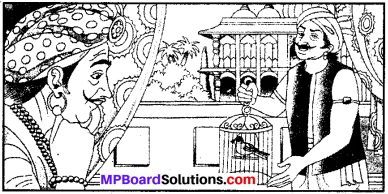
1. See the following picture and write a passage on it.
MP Board Class 10th General English Writing Task 1
Answer:
Once a man saw a pigeon whose excreta turned into gold. He thought of capturing it and became successful in it. But then he thought that if the king came to know about it he would punish him. Therefore he decided to present it to the king. He told the king about its quality and gave it to him. The king was first surprised and then pleased to have it. He rewarded the man for giving him this special gift.

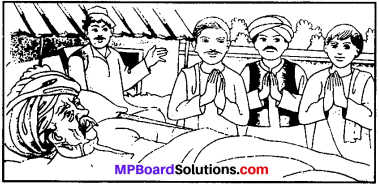
2. See the following picture and write a passage on it.
MP Board Class 10th General English Writing Task 2
Answer:
A rich merchant had four sons. When the merchant became old his three elder sons took over his business and thinking him to be useless threw him out of their house. The youngest son took care of him and started a small business by selling his father’s gold chain. By the help of his father’s experience, he became rich very soon while the other three sons being inexperienced had great losses. They, therefore, came back to take their father with them and joined hands before him. But the merchant disagreed to go with them.

3. Write a short paragraph on the table given below :

RiverLength (km)
Sindhu2,900
Brahmaputra2,900
Ganga2,510
Godavari1,450
Narmada1,290
Krishna1,290
Mahanadi890
Kaveri760

Answer:
Some Major Rivers of India
India is a country full of natural wealth. There are a lot of rivers in India. Hardly there is any other nation in the world that can boast of having so many rivers.

In the above table, the name of main rivers of India along with their lengths in kilometre are given. There are eight major rivers in India among which the length of three exceeds two thousand kilometres while the length of other three is above one thousand kilometres. From the table it is also clear that the rivers Sindhu and Brahmaputra are longest rives of India with a length of2,900 km and river Kaveri with a length of 760 km is the smallest river. Also, the famous holy river Ganga is the second-longest river of India with a length of 2,510 km.

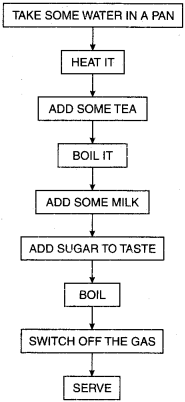
4. Read the following flow chart describing the preparation of tea. Write a suitable paragraph with its help.
MP Board Class 10th General English Writing Task 3
Answer:
Preparation of Tea
Take some water in a pan. Switch on the gas by opening its knob and light it. Heat the pan. Now add some tea to water and boil it. Now add some milk to it. Add sugar to Laste while letting it boil. Finally. switch off the gas and serve.

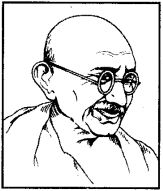
5. See the following picture and write a paragraph on it.
MP Board Class 10th General English Writing Task 4
Answer:
Mahatma Gandhi or Mohandas Karam Chand Gandhi was born on 2nd October, 1869 at Porbandar in Gujarat. He fought for India’s independence using principles of non-violence and Ahimsa. Apart from making India free he worked for the. unity of Hindus and Muslims. He was against untouchability and loved Harijans and the poor. He helped all. So was called Mahatma Gandhi. He was also called ‘Bapu’ and ‘Father of the Nation.’ He was shot dead by Nathuram Godse on 30anuary, 1948.

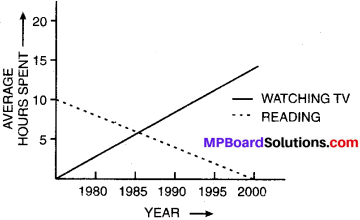
6. Given below is a graph showing time spent on watching T.V. and on reading in an Indian family. Write a short paragraph emphasizing the need to promote reading.
MP Board Class 10th General English Writing Task 5
Answer:
Declining Trend in Book Reading
Reading of books is very useful and important work. It is a life-long source of pleasure, instruction and inspiration. Before the coming of T.V. people spent a great part of their time in reading. Since T.V. started, hours spent in reading has declined. The graph depicts these facts. Before 1980 there was no countrywide T.V. Hence people devoted in an average about 8 hours on reading. In 1985 watching of T.V. took about 3 hours while reading declined to 6 hours. In 1990, people spent about 12 hours in watching T.V. and reading came down to 5 hours. In 1995, reading further declined to 3 hours and I watching T.V took about 14 hours. In the year 2000, I people spent an average of more than 18 hours on watching T.V. while reading has almost come down to 2 hours. It is a sad phenomenon because watching T.V. only entertains us, it instructs less while reading provides, both “instruction and delight.”

Hope that the above shaped information regarding the Madhya Pradesh Board Solutions for 10th English Writing Task Questions and Answers is useful for making your preparation effective. View our website regularly to get other subjects solutions.

MP Board Class 10th General English Note Making and Summarising

Are you seeking for the Madhya Pradesh Board Solutions 10th General English Writing Skills Note Making and Summarising Questions and Answers PDF? If yes, then read this entire page. Here, we are giving a direct link to download MP Board Class 10th English Solutions Questions and Answers PDF which contains the chapter wise questions, solutions, and grammar topics. You can also get the shortcuts to solve the grammar related questions on this page.

MP Board Class 10th General English Note Making and Summarising

For the sake of students we have gathered the complete 10th General English Writing Skills Note Making and Summarising Questions and Answers can provided in pdf Pattern. Refer the chapter wise MP Board Class 10th English Solutions Questions and Answers Topics and start the preparation. You can estimate the importance of each chapter, find important English grammar concepts which are having more weightage. Concentrate on the important grammar topics from Madhya Pradesh Board Solutions for 10th English Note Making and Summarising Questions and Answers PDF, prepare well for the exam.

In this part of your syllabus, you will be given a passage and you will be asked to make notes on it and then prepare a summary (short form) of the passage.

The division of marks is—

  • Note making → 3 marks
  • Summary → 3 marks

1. Read the following passage carefully, give a title, make notes and prepare its summary.

Man is made up of many, qualities, both good and bad, and among the latter is anger. The nature of every human being is such that anything that gives offense to his sentiments or goes against his principles, excites his anger. The evils which result from anger are many. Under its influence, a man loses his power of reasoning and judgment. Not being able to retain control over himself when angry, he does not know what he is doing or saying. Under its influence, a man puts off his balance to the extent that he forgets his duty towards his superiors and may even say things which are extremely insulting to them.
Answer:
(a) Title—Disadvantages of Anger.
(b) Notes—

  • Anger is harmful.
  • It results in to loss of reasoning, power andudgement.
  • A person when angry forgets his duty and insults his superiors.

(c) Summary—Anger is a harmful human quality which is caused when anything goes against one’s principles or wishes. In anger, a person loses his reasoning power, judgment and self-control. He forgets his duties towards superiors and insults them.

2. Read the following passage carefully, supply a title, make notes and prepare a summary.

Speech is a great blessing, but it can also be a great curse, for, while it helps us to make our intention and desires known to fellows, it can also, if we use it carelessly, make our attitude completely misunderstood. A slip of the tongue, the use of an unusual word, or of an ambiguous word, and so on, may create an enemy where we had hoped to win a friend. Again, different classes of people use different vocabularies and the ordinary speech of an educated man may strike an uneducated listener as showing pride; unwillingly we may use a word which bears a different meaning to our listener from what it does to men of our own class. Thus speech is not a gift to use lightly without thought but one which demands careful handling, only a fool will express himself alike to all kinds and conditions of men.
Answer:
(a) Title—Speech, a blessing and a curse.
(b) Notes—

  • Speech is a great blessing as well as curse.
  • If used carelessly, it can make our attitude misunderstood.
  • It can create an enemy or a friend.
  • Educated and uneducated classes use different vocabularies.
  • It should be used carefully.

(c) Summary—Speech is a blessing as well as a curse. It is a medium of expressing our thoughts and feelings. But it can lead to misunderstanding if words are used carelessly. The significance and meaning of words is not the same for all types of men. The educated and uneducated men do not express themselves in the same language. Hence the gift of speech should be used with great caution and tact.

3. Read the following passage carefully, give a title, make notes and prepare its summary.

Never was a time when there was more need ‘ for hard thinking than in the present hour. We see on all sides a seething mass of turbulent life. We are ‘ faced with a situation produced, if we can imagine it, by combination of varied movement which the ‘ European nations passed through during the last few centuries. The intellectual renaissance, the industrial revolution, the political struggle for freedom and democracy and the religious reformation, which the western nations faced individually and at different periods. India has to meet simultaneously each 1 magnified on account of the large area and population concerned. While great changes are taking place in every side of life, political and industrial, cultural
and social, there is a good deal of loose and middle thinking. The country seems to be marching forth into the unknown.
Answer:
(a) Title—A time for work.
(b) Notes—

  • There is a need of hard work and independent thinking in India.
  • We are facing political, economic and social problems together which the western nations faced individually and at different periods.
  • These problems are more serious in India due to its large area and population.
  • Possible efforts have to be taken to solve these problems as otherwise, its future is uncertain.

(c) Summary—There is an absolute need of hard work and independent thinking in India. We have to solve a large variety of political, economic and social problems all at the same time. No other country in the word ever faced so many problems at one time. These problems have become unusually serious on account of India’s vast area and \huge population. Unless all possible efforts are made to Solve these problems future of India will remain uncertain.

4. Read the following passage carefully, give a title, make notes and prepare its summary.

I want you to learn the lesson that all work is noble and that the greatest thing that man can do in this world is his duty. Whether you are rich or poor, high bom or low bom here is work for you to do. It makes no difference what the work is. If you do it well, you will have done your duty. When you think that a task has been given to you, which you think is too mean and low for you to do, recall to your mind the story of Peter, the Czar of Russia, working in the dock-yard and go and do your duty as he did.
Answer:
(a) Title—All work is noble.
(b) Notes—

  • All work is noble.
  • The greatest thing for a man to do is his duty.
  • One should do his duty well.
  • If one feels that his work is too low he should recall the story of Peter, the Czar of Russia.

(c) Summary—The writer wants us to leam the lesson that no work is low or high. The greatest thing in the world is to do our duty whatever it may be. We should perform our duty well. If the work that has been given to us, is not fit for us the writer advises us to recall the story of Peter, the Czar of Russia.

5. Read the following passage carefully, give a title, make notes and prepare its summary.

Remember that the character you form in your family, will, in all probability, follow you through life. As you are regarded by your own brothers and sisters at home, so in a great measure you will be regarded by others, when you leave your father’s house. If you are manly, kind and courteous at home, so you will continue to be and these traits of character will always make you beloved. But if you are peevish, ill-natured, harsh and uncourteous or over-bearing at home, among your own brothers and sisters, so you will be same outside, and instead of being beloved, you will be disliked.
Answer:
(a) Title—Character building.
(b) Notes—

  • The character formed at home follows throughout life.
  • As you are regarded at home, in the same way you are regarded outside.
  • One who is manly, kind and courteous is liked by all.
  • One who is peevish, ill-natured, harsh and uncourteous at home is same outside and is disliked by everybody.

(c) Summary—The character that a person forms at home follows him throughout life. A person who is manly, kind and courteous at home is same outside and is beloved. The one who is peevish, ill-natured, harsh and uncourteous at home is same outside and is disliked by everybody.

6. Read the following passage carefully, supply a title, make notes and prepare its summary.

One of the greatest principles which Gandhiji had taught and practised throughout his life was that of dignity of labour. All kind of useful work was equally worthy of respect. Gandhiji was never afraid or ashamed to do any kind of work. He showed his followers how to use the broom to sweep the house and the yard, how to dispose off night soil, how to teach and practice village and town sanitation. He himself collected the rubbish and covered it with clean earth. He never asked his followers to do anything which he could not do himself. The great lesson we can learn from his life is that every kind of work is honorable if it is done in a spirit of love and selfless service.
Answer:
(a) Title—Dignity of Labour.
(b) Notes—

  • Gandhiji taught dignity of labor.
  • He was never afraid or ashamed of any kind of work.
  • He taught his followers to sweep the house and the yard, dispose of night soil and sanitation.
  • He never asked anyone to do that which he could not do himself.
  • All work is honorable if done in a spirit of love and selfless service.

(c) Summary—Gandhiji taught and practiced dignity of labor throughout his life. He was never afraid or ashamed of any kind of work. He taught others to sweep the house, dispose of night soil, sanitation. He never asked anyone to do anything which he could not do himself. He taught the lesson that all work is honorable if done in a spirit of love and sacrifice.

Hope that the above shaped information regarding the Madhya Pradesh Board Solutions for 10th English Note Making and Summarising Questions and Answers is useful for making your preparation effective. View our website regularly to get other subjects solutions.