MP Board Class 9th English The Rainbow Workbook Solutions Chapter 14 Old Blockhead repairs his House

MP Board Solutions for Class 9 English The Rainbow Workbook Solutions Chapter 14 Old Blockhead repairs his House Questions and Answers aids you to prepare all topics in it effectively. You need not worry about accuracy of Madhya Pradesh State Board Solutions for Class 9 English Chapter 14 Old Blockhead repairs his House as they are given adhering to the latest exam pattern and syllabus guidelines. You Can Download MP Board Class 9 English Solutions Questions and Answers, Notes, Summary, Guide pdf on is page. Enhance your subject knowledge by preparing from Chapterwise MP Board Solutions for Class 9 English and clarify your doubts on corresponding topics.

MP Board Class 9th English The Rainbow Workbook Solutions Chapter 14 Old Blockhead repairs his House

Kick start your preparation by using our online resource Madhya Pradesh State Board Solutions for Class 9 English The Rainbow Workbook Solutions Chapter 14 Old Blockhead repairs his House. You can even download MP Board Solutions for Class 9 English free of cost rough direct links available on our page. Clear your queries and understand concept behind in a simple manner. Simply tap on concept you wish to prepare chapterwise and go rough it.

Old Blockhead repairs his House Vocabulary and Pronunciation

Make sentences with each of the following compound words so as to bring out its meaning.
head-ache, head-dress, head-gear, head-less, head-line, head- block-ade, block-age, block-buster, block-head, block-house.

  1. Head-ache : I have several head-ache.
  2. Head-dress : It is my head dress.
  3. Head-gear : The need gear is not working.
  4. Head-less : I saw a headless statue.
  5. Head-lines : The news of cash for vote was the headline today
  6. Head-on : It was a serious head on collision.
  7. Block-ade : Block ade is illegal.
  8. Block-age : The doctors detected block age in his head.
  9. Block-buster: Amitabh Bachans films are still block buster.
  10. Block—head : He behaves like a totally block head.
  11. Block—house: It is a block house.

B. Use the following words in your own sentences.
mend, rectify, repair, restore, overhaul, replace.

  1. Mend : Mend your ways otherwise you will be in trouble.
  2. Rectify : He asked me to rectify the account.
  3. Repair : Your shoes needs repair.
  4. Restore : Sleep is the best way to restore energy.
  5. Overhaul : Our governing system needs complete overhauling.
  6. Replace : Please replace this defective TV.

C. What do you understand by the following questions?

Question 1.
Is anybody home ?
Answer:
Someone may not be there.

Question 2.
Is somebody home ?
Answer:
Someone may be there.

Question 3.
Is nobody home ?
Answer:
None may be there.

Question 4.
Is everybody home ?
Answer:
Everyone may be there.

D. What is meant by the following? Use them in sentences and point out consonant sounds in each word.

  1. Shout : to make loud noise- The teacher shouted at the boy.
  2.  Call : to give somebody a particular name— He called me.
  3. Howl : to make a long, loud cry— The baby was howling.
  4. Roar : to make a very loud, deep sound— The tiger was roaring in the forest.
  5. Scream : to give a loud, high cry because you are hurt, frightende, exited etc—The little children were scramming with excitinent
  6. Cry : to produce tears from your eyes because you are unhappy or hurt— The baby cried suddenly.
  7. Talk : to say things, to speak in order to give information-The boys are talking.
  8. Clamour: to demand something loudly— The employes began to clamour for their increment.
  9. Shriek : to give a loud, high shout— The gine shricked in fright.
  10. Yelp : to give a sudden short cry, usually of paon— The lod was yelping but noone paid attention on him.

Listening Skill

Listen to the items carefully, which Ma Blockhead needed to repair her house. three pieces of tin-sheets, two hundred and fifty bricks, eight liter of paint, twelve wooden planks, half kilogram of nails, one bag of cement and one bag of sand Now, answer the

Question 1.
How much paint did Ma Blockhead require ?
Answer:
Ma Blockhead required eight liter of paint.

Question 2.
How many bricks did she want ?
Answer:
She wanted two hundred and fifty bricks.

Question 3.
How may tin-sheets were needed by her ?
Answer:
Three pieces of tin-sheets were needed by her.

Question 4.
How much cement did she want ?
Answer:
She wanted one bag of cement.

Question 5.
How much sand was required ?
Answer:
One bag of sand was required.

Question 6.
How many wooden pranks did she need ?
Answer:
She needed twelve wooden pranks.

Question 7.
How much nails did she require ?
Answer:
She required half kilogram of nails.

Speaking Skill

Here are some events. You are required to speak their sub events one by one in proper sequence, the first one has been done for you :
See workbook page 106.
Answer:
For self attempt.

Reading Skill

Read the passage given below and answer the questions below it.
See workbook page 106.

Question 1.
Why did the man count nine camels?
Answer:
Because he mounted one of the ten camels and counted the rest.

Question 2.
How could he count ten camels again ?
Answer:
He counted the ten camels without mounting any of them

Question 3.
Whom did he curse for his confusion ?
Answer:
He cursed Saten for his confusion.

Question 4.
What kind of man was he ? Write your opinion,
Answer:
He was a foolish fellow. It was his fault or lack of presence of mind that he counted the camels wrongly. But instead of cursing himself, he cursed Satan.

Pick out the words from the passage which have the following meanings :
(a) to advise or try hard to persuade to do something…………….
(b) felt very sad ………….
(c) a worried, sad feeling after you have received an unpleasant SUl pi .
(d) causing or showing sadness
Answer:
(a) urge
(b) dismayed
(c) perplexed
(d) cursing.

Language Practice (Grammar)

Narration (Interrogative sentences)
Study these sentences
See workbook pages 107-108.
Rewrite the following in indirect speech.

Question 1.
The stranger said to the lady, “Why do you wish me go away now?”
Answer:
The stranger asked the lady why she wished him go away then.

Question 2.
Ravi’s father asked, “Are you going to keep me away all night?”
Answer:
Ravi’s father asked him weather he was going to keep him awake all night.

Question 3.
“Have you ever seen a met eorite falling? “, he asked the class.
Answer:
He asked the class weather they had ever seen a meteorite failing.

Question 4.
“What does it matter if your miss the train?”, Mrs. Ram said 30 her husband.
Answer:
Mrs. Ram asked her husband what it mattered if he had’/ blissed the train.

Question 5.
The porter asked the passenger, “Which train are you taking?”
Answer:
The porter asked the passenger which train he was taking.

Question 6.
My uncle said, “Do you really need so many pairs of boots?”
Answer:
My uncle asked whether he needed many pairs of boots.

Question 7.
She shouted to us, “Will you not come and save me from the clutches of this thief?
Answer:
She should to us weather they would not come and save to her from the clutches of that thief.

Writing Skill

A. You have saved two thousand rupees. Plan how you will spend them. (50 words)
Answer:
Two thousand rupees is a big sum for me. I shall spend it wisely. First I shall buy a shoes for my grand father and a blanket for grandmom. I shall buy a spectacle for my mother and a watch for my father. I shall buy some books. I shall donate some money to the school of blind.

B. Ma Blockhead finds a change in her house as well as in her husband. She is very happy and wants to share her feelings with her intimate friend through a letter. Write a letter expressing your feelings.(150 words)
Answer:
My dear Rehana.
Today I would like to share my happiness with you. I have just come from my mother’s house. You know I was a little annoyed with my husband. When I came back I founded my house was neat and clean, well arranged, the behaviour of my husband was completely changed. He was now very happy with me. He shared my pains. He cooperated me in household work. I am very happy now. I request you to come to me and share our joy.
Yours
Ma Blockhead.

We believe the information shared regarding MP Board Solutions for Class 9 English The Rainbow Workbook Solutions Chapter 14 Old Blockhead repairs his House Questions and Answers as far as our knowledge is concerned is true and reliable. In case of any queries or suggestions do leave us your feedback and our team will guide you at soonest possibility. Bookmark our site to avail latest updates on several state board Solutions at your fingertips.
MP Board Class 9th General English The Spring Blossom Solutions Chapter 7 Am I a Child?

MP Board Solutions for Class 9 Textbook General English The Spring Blossom Solutions Chapter 7 Am I a Child? Questions and Answers aids you to prepare all topics in it effectively. You need not worry about accuracy of Madhya Pradesh State Board Solutions for Class 9 English Composition: Visual Stimulus as they are given adhering to latest exam pattern and syllabus guidelines. You Can Download MP Board Class 9 English Solutions Questions and Answers, Notes, Summary, Guide pdf on is page. Enhance your subject knowledge by preparing from Chapterwise MP Board Solutions for Class 9 English and clarify your doubts on corresponding topics.

MP Board Class 9th General English The Spring Blossom Solutions Chapter 7 Am I a Child?

Kick start your preparation by using our online resource Madhya Pradesh State Board Solutions for Class 9 Textbook General English The Spring Blossom Solutions Chapter 7 Am I a Child?. You can even download MP Board Solutions for Class 9 English free of cost rough direct links available on our page. Clear your queries and understand concept behind in a simple manner. Simply tap on concept you wish to prepare chapterwise and go rough it.

Am I a Child? Textual Exercises

Word Power

(a) Match these words with their meanings
(सुमेलित कीजिए।)
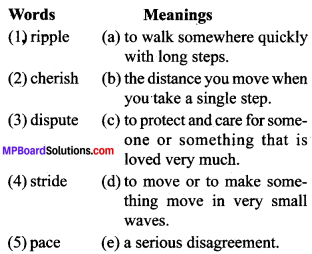
MP Board Class 9th General English The Spring Blossom Solutions Chapter 7 Am I a Child 1
Answer:
(1) → (d)
(2) → (c)
(3) → (e)
(4) → (a)
(5) → (b)

(b) Write antonyms of the following words
(विलोम शब्द लिखिए।)
Answer:

  1. lost – gained
  2. adult – minor
  3. behind – ahead
  4. life – death
  5. love – hate
  6. half – full
  7. now – later
  8. away – near
  9. tall – short
  10. new – old

How Much Have I Understood?

(a) Answer these questions in one or two sentences:
(निम्न प्रश्नों के उत्तर एक या दो वाक्यों में दीजिए)

Question 1.
What do you mean by ‘my dream world’?
(व्हॉट डू यू मीन बाइ ‘माइ ड्रीम वर्ल्ड’?)
‘मेरा स्वप्न संसार’ से क्या अर्थ है?
Answer:
A child lives in the world of dreams that is childhood fantasies consisting of dolls and toys, fairies and princesses as in the tales.
(अ चाइल्ड लिव्स इन द वर्ल्ड ऑफ ड्रीम्स दैट इज़ चाइल्डहुड फैन्टेसीज़ कन्सिस्टिंग ऑफ डॉल्स एण्ड टॉयज, फेयरीज़ एण्ड प्रिन्सेसेज़ एज़ इन द टेल्स।)
बच्चे स्वप्नों के संसार में रहते हैं जिसमें गुड़ियाँ व खिलौने, परियाँ व राजकुमारियाँ होती हैं जैसे कि कहानियों में।

Question 2.
What does the poet find herself unable to see?
(व्हॉट डज़ द पोएट फाइन्ड हरसेल्फ अनेबल ट्र सी?)
कवयित्री खुद को क्या देखने में असमर्थ पाती है?
Answer:
The poet is unable to see the reasons for adult disputes.
(द पोएट इज़ अनेबल टू सी द रीजन्स फॉर एडल्ट डिस्प्यूट्स।)
कवयित्री वयस्कों के विवादों का कारण जानने में असमर्थ है

Question 3.
What will happen to the poet soon?
(व्हॉट विल हैपन टू द पोएट सून?)
कवयित्री को जल्द ही क्या होने वाला है?
Answer:
The poet will soon step into a new world, the world of adult life.
(द पोएट विल सून स्टैप इनटू अ न्यू वर्ल्ड, द वर्ल्ड ऑफ एडल्ट लाइफ।)
कवयित्री जल्दी ही एक नई दुनिया में कदम रखेगी, वयस्कों के संसार में।

Question 4.
Write any two lines of the poem you like most.
(राइट एनी टू लाइन्स ऑफ द पोएम यू लाइक मोस्ट।)
अपनी पसन्द की कविता की कोई दो पंक्तियाँ लिखो।
Answer:
Students can write any two lines from the poem that they like most.
छात्र अपनी पसन्द की कोई भी दो पंक्तियाँ लिखें।

(b) Answer the following questions in three to four sentences.
(निम्न प्रश्नों के उत्तर तीन या चार वाक्यों में दीजिए।)

Question 1.
Write the things that indicate that the poet is still a child.
(राईट द थिंग्स दैट इन्डीकेट दैट द पोएट इज़ स्टिल अ चाइल्ड।)
वह बातें लिखिए जिनसे पता चलता है कि कवयित्री अभी बच्ची है।
Answer:
She could not look after herself, she pays a half fare on a bus to school and the does not see the reasons for adult disputes.
(शी कुड नॉट लुक आफ्टर हरसेल्फ, शी पेज़ अ हॉफ फेयर ऑन अ बस टू स्कूल एण्ड शी डज़ नॉट सी द रीज़न्स फॉर एडल्ट डिस्पयूट्स।)
वह अपना ख्याल नहीं रख सकती, उसे बस का आधा किराया देना पड़ता है तथा उसे वयस्कों के विवादों के कारण समझ में नहीं आते।

Question 2.
Write the things that indicate that the poet is on the threshold of an adulthood.
(राईट द थिंग्स दैट इन्डिकेट दैट द पोएट इज़ ऑन द ऐशहोल्ड ऑफ एन एडल्टहुड।)
वह बातें लिखिए जिनसे पता चलता है कि कवयित्री वयस्कता की देहलीज पर है।
Answer:
She is tall, she understands adult talk, she doesn’t love the teddy and toys. This indicates that she is older than a child but there are some things which show that she is still not an adult. Hence she is on the threshold of adulthood.

(शी इज़ टॉल, शी अन्डरस्टैण्ड्स एडल्ट टॉक शी डजन्ट लव द टैडी एण्ड टॉयज। दिस इन्डीकेट्स दैट शी इज़ ओल्डर दैन अ चाइल्ड बट देयर आर सम थिंग्स विच शो दैट शी इज़ स्टिल नॉट एन एडल्ट। हैन्स शी इज़ ऑन द धैशहोल्ड ऑफ एडल्टहुड।)

वह लम्बी है, उसे वयस्कों की बातें समझ आती हैं, उसे खिलौने अच्छे नहीं लगते। इससे लगता है कि वह बच्ची नहीं है लेकिन कुछ ऐसी चीजें हैं जो ये दिखाती हैं कि वह अब भी बच्ची है। अतः वह वयस्कता की देहलीज पर है।

Question 3.
The poet is unable to understand the reasons of the disputes among adults. Why? Think and answer
(द पोएट इज़ अनेबल टू अन्डरस्टैण्ड द रीजन्स ऑफ द डिस्प्यूट्स अमंग एडल्टस। व्हॉय? थिंक एण्ड आन्सर।)
कवयित्री वयस्कों के विवादों का कारण समझने में असमर्थ है। क्यों? सोचो व उत्तर दो।
Answer:
The poet is unable to understand the reasons of the disputes among adults because at her age reasoning power is not developed. Children are innocent and simple. They forget their quarrels quickly.
(द पोएट इज़ अनेबल टू अन्डरस्टैण्ड द रीजन्स ऑफ द डिस्प्यूट्स अमंग एडल्ट्स बिकॉज़ एट हर एज रीजनिंग पावर इज़ नॉट डेवलप्ड। चिल्ड्रन आर इनोसेन्ट एण्ड सिम्पल। दे फॉरगेट देयर क्वॉरल्स क्विकली।)
क्योंकि कवयित्री की उम्र में बच्चे सीधे-सादे होते हैं। वे अपने झगड़े जल्द भूल जाते हैं।

Question 4.
Write the Central idea of the poem.
कविता का केन्द्रीय भाव लिखिए।
Answer:
The poem tries to find out the strange feelings of an adolescent. She has just left behind childhood but has not yet stepped into adulthood. She has a twinge of regret in the passing away of childhood and air of expectation for the approaching adulthood.

Listening Time

Fill in the missing words.
(रिक्त स्थान भरो।)
Answer:
(a) Am I an adult or a child?
No! Not an adult-I do not see.
The reasons for adult disputes;
I am safe in non-understanding.
But does that means that I am a child?

(b) Am I a child or an adult?
No! Not a child now it’s not a teddy I love.
His cherished position is taken.
Just because my toys have lost their value.
Does that mean that I am an adult?

Speaking Time

Using the given words, speak a few sentences?
(दिये गये शब्दों का प्रयोग कर कुछ वाक्य बोलिए।)
doll, teddy, dispute, honest, parents, child, look after, friend, responsibility, adult, games, play, helping dream world, marks, doubt.
Answer:
You can speak sentences as follows
आप इस तरह के वाक्य बोल सकते हैं।
Dolls and teddy lose their interest when a child is becoming an adult. He/She comes out of the dream world. He/She does not understand the reason of adult disputes.

He/She is unable to take one’s own responsibility and his/her parents look after him/her.

Writing Time

Question 1.
Make a list of things (games/food items/toys etc.) you liked when you were quite small and the things you like to do now. Compare it with your friends.
(उन चीजों की सूची बनाओ जो तुम्हें बचपन में पसन्द थीं और जो तुम्हें अब पसन्द हैं। अपने दोस्तों से तुलना करो।)
Answer:
Students should do themselves.
(छात्र स्वयं करें।)

Question 2.
Write the poem ‘Am I a Child’ in your own words.
(कविता को अपने शब्दों मे लिखो)
Answer:
Students should do themselves.
(छात्र स्वयं करें।)

Things to do

Question 1.
How can you help the adults in solving their disputes? List the ways in which you can help them.
(तुम अपने बड़ों के झगड़े सुलझाने में उनकी किस प्रकार सहायता करोगे? तरीके सुझाओ।)
Answer:
We can help the adults in solving their disputes by making them understand their real cause. We can also help them by making them realise that they are losing their peace of mind and valuable time due to them. We can also ask them to be analytical and find its solution.

Question 2.
Discuss with your friends and list their views on the following:
(निम्न पर अपने मित्रों से चर्चा करो व उनके विचार लिखो)

(a) Things that we gain or learn from our adults.
(बातें जो हम अपने बड़ों से सीखते हैं।)
Answer:
The views of your friends may be as follows:
We learn accepting responsibility, taking care of ourselves, discipline, good manners and moral values such as honesty, sympathy, being fair, etc.

(b) Things that we don’t like but we have to listen to.
(बातें जो हमें अच्छी नहीं लगतीं पर हमें सुननी पड़ती हैं।)
Answer:
We have to listen things such as-sit properly, behave properly, drink milk, don’t sit among adult’s talk, dont’t watch T.V. sitting too close to it and for so much time, wake up early etc.

Question 3.
Collect information about the faculties of studies pertaining to different careers.
(विभिन्न क्षेत्रों में कार्य करने के लिए की जाने वाली पढ़ाई के बारे में सूचना इकट्ठी करो।)
Answer:
Students can collect information about studies pertaining to careers such as journalism, medicine, engineering, teaching, software etc. themselves.

Am I a Child? Central Idea of the Poem

The poem tries to find out the strange feelings of an adolescent. She has just left behind childhood but has not yet stepped into adulthood. She has a twinge of regret in the passing away of childhood and air of expectation for the approaching adulthood.

Am I a Child? Difficult Word Meanings

ripple (रिपल) to move or to make something move in very small waves छोटी-छोटी लहरों में आगे बढ़ना या बढ़ाना; cherish (चेरिश) protect and care for someone or something स्नेहपूर्वक देखभाल करना; dispute (डिस्प्यूट)-a disagreement between two people, groups or countries विवाद; stride (स्ट्राइड)-to walk with long steps in a particular direction लम्बे-लम्बे डग भरकर एक दिशा में चलना।

Am I a Child? Summary, Pronunciation & Translation

[1] Am I a child or an adult?
No! Not a child now my dolls are gone;
My dream world has rippled away.
I am tall, I understand adult talk,
But does that mean that I am an adult?

(एम आई अ चाइल्ड और एन एडल्ट?
नो! नॉट अ चाइल्ड नाउ माई डॉल्स आर गोन;
माई ड्रीम वर्ल्ड हेज़ रिपल्ड अवे,
आई एम टॉल, आई अन्डरस्टेण्ड एडल्ट टॉक,
बट डज़ दैट बीन दैट आई एम एन एडल्ट?)

हिन्दी अनुवाद :
मैं एक बच्ची हूँ या एक वयस्क?
नहीं! अब एक बच्ची नहीं-मेरी गुड़ियाएँ जा चुकी
हैं। मेरे सपनों का संसार लहराते हुए आगे बढ़ चुका हैं।
मैं लम्बी हो गई हूँ, मैं वयस्कों की बात समझती हूँ।
पर क्या इसका मतलब है कि मैं वयस्क हो गई हूँ?

[2] Am I an adult or a child?
No! Not an adult-I could’t look after myself;
The understanding is just not there.
I pay a half fare on a bus to school,
But does that mean that I am a child?

(एम आई एन एडल्ट ऑर ए चाइल्ड?
नो! नाट एन एडल्ट-आई कुडन्ट लुक आफ्टर मायसेल्फ;
द अण्डरस्टेडिंग इज़ जस्ट नॉट देयर।
आई पे अ हाफ फेयर ऑन अ बस टु स्कूल,
बट डज़ दैट मीन दैट आई एम अ चाइल्ड?)

हिन्दी अनुवाद :
क्या मैं एक वयस्क हूँ या बच्ची?
नहीं वयस्क नहीं-मैं अपनी देखभाल स्वयं नहीं कर सकती
अभी मुझमें समझदारी नहीं।
मैं स्कूल बस से स्कूल जाने का आधा किराया ही देती हूँ
पर इसका क्या यह मतलब है कि मैं बच्ची ही हूँ?

[3] Am I a child or an adult?
No! Not a child now-it’s not a teddy I love;
His cherished position is taken.
Just because my toys have lost their value,
Does that mean that I am an adult?

(एम आई ए चाइल्ड और एन एडल्ट?
नो! नॉट ए चाइल्ड नाउ-इट्स नॉट अ टेडी आई लव;
हिज़ चेरिस्ड पोजिशन इज़ टेकन।
जस्ट बिकाज़ माई टायज़ हेव लॉस्ट देअर वेल्यू,
डज़ दैट मीन दैट आइ एम एन एडल्ट?)

हिन्दी अनुवाद :
मैं एक बच्ची हूँ या एक वयस्क?
नहीं! अब बच्ची नहीं-अब मैं टेडी से प्यार नहीं करती;
उसकी प्यार से देखभाल अब नहीं रही।
क्योंकि मेरे खिलौनों ने अपनी कीमत खो दी है,
पर इसका क्या यह मतलब है कि मैं एक वयस्क हूँ?

[4] Am I an adult or a child?
No! Not an adult I do not see
The reasons for adult disputes;
I am safe in non-understanding.
But does that mean that I am a child?

(एम आई एन एडल्ट और अ चाइल्ड
नो! नाट एन एडल्ट-आई डू नाट सी
द रीज़न्स फोर एडल्ट डिस्प्यूट्स;
आई.एम सेफ इन नन-अण्डरस्टैडिंग।
बट डज़ दैट मीन दैट आई एम ए चाइल्ड?)

हिन्दी अनुवाद :
मैं एक वयस्क हूँ या बच्ची?
नहीं! एक वयस्क नहीं-मैं समझ नहीं सकती
वयस्कों के वाद-विवादों के कारण;
मैं ना समझ होने में सुरक्षित हूँ।
किन्तु क्या इसका मतलब है कि मैं एक बच्ची हूँ?

[5] Well, am I a child or an adult?
No! Not one or the other now;
One pace in front of childhood,
And one behind an adult.
Soon I shall stride into a new world,
The world of adult life. -Margaret Lawrence

(वेल एम आई अ चाइल्ड और एन एडल्ट?
नो! नॉट वन और दी आदर नाउ;
वन पेस इन फ्रन्ट ऑफ चाइल्डहुड,
एण्ड वन बिहाइन्ड एन एडल्ट।
सून आई शैल स्ट्राइड.इन्टू अ न्यू वर्ल्ड,
द वर्ल्ड ऑफ एडल्ट लाइफ।)

हिन्दी अनुवाद :
अच्छा, क्या मैं एक बच्ची हूँ या वयस्क?
नहीं! अभी न यह हूँ, न वह;
बचपन से एक कदम आगे,
और वयस्क से एक कदम पीछे।
शीघ्र ही मैं एक नये संसार में कदम रखेंगी,
जो वयस्क जीवन का संसार है।

We believe information shared regarding MP Board Solutions for Class 9 Textbook General English The Spring Blossom Solutions Chapter 7 Am I a Child? Questions and Answers as far as our knowledge is concerned is true and reliable. In case of any queries or suggestions do leave us your feedback and our team will guide you at soonest possibility. Bookmark our site to avail latest updates on several state board Solutions at your fingertips.
MP Board Class 9th General English The Spring Blossom Solutions Chapter 3 The School for Sympathy

MP Board Solutions for Class 9 Textbook General English The Spring Blossom Solutions Chapter 3 The School for Sympathy Questions and Answers aids you to prepare all topics in it effectively. You need not worry about accuracy of Madhya Pradesh State Board Solutions for Class 9 English Composition: Visual Stimulus as they are given adhering to latest exam pattern and syllabus guidelines. You Can Download MP Board Class 9 English Solutions Questions and Answers, Notes, Summary, Guide pdf on is page. Enhance your subject knowledge by preparing from Chapterwise MP Board Solutions for Class 9 English and clarify your doubts on corresponding topics.

MP Board Class 9th General English The Spring Blossom Solutions Chapter 3 The School for Sympathy

Kick start your preparation by using our online resource Madhya Pradesh State Board Solutions for Class 9 Textbook General English The Spring Blossom Solutions Chapter 3 The School for Sympathy. You can even download MP Board Solutions for Class 9 English free of cost rough direct links available on our page. Clear your queries and understand concept behind in a simple manner. Simply tap on concept you wish to prepare chapterwise and go rough it.

The School for Sympathy Textual Exercises

Word Power

(1) Correct the spelling of the following words:
(शब्दों की वर्तनी सही करके लिखें।)
Answer:

  1. panioncom – companion
  2. pplecri – cripple
  3. fortunemis – misfortune
  4. anityhum – humanity
  5. fortcom – comfort

(2) Match the following words with their correct meanings
(सुमेलित कीजिए)
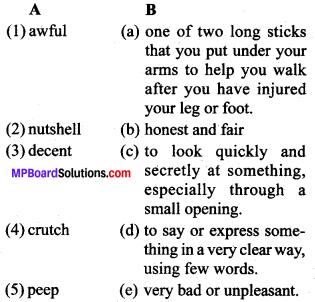
MP Board Class 9th General English The Spring Blossom Solutions Chapter 3 The School for Sympathy 1
Answer:
(1) → (e)
(2) → (d)
(3) → (b)
(4) → (a)
(5) → (c)

How Much Have I understood?

Answer the following questions
(निम्न प्रश्नों के उत्तर लिखिए)

Question 1.
Why do you think the writer wants to visit Miss Beam’s school?
(व्हाय डू यू थिंक द राईटर वॉन्ट्स टू विजिट मिस बीम्स् स्कूल?)
तुम्हारे विचारानुसार लेखक मिस बीम के स्कूल क्यों जाना चाहता है?
Answer:
The writer wants to visit Miss Beam’s school because he had heard a lot about it.
(द राईटर वॉन्ट्स टू विजिट मिस बीम्स् स्कूल बिकॉज ही हैड हर्ड अ लॉट अबाऊट इट।)
लेखक मिस बीम के विद्यालय जाना चाहता है क्योंकि उसने उसके बारे में बहुत कुछ सुन रखा है।

Question 2.
When the writer arrives at the school, he sees something unusual. What is it?
(व्हेन द राईटर एराइव्स एट द स्कूल ही सीज समथिंग अनयूजुअल, व्हॉट इज इट?)
जब लेखक विद्यालय आता है तो वह कुछ असाधारण देखता है। वह क्या है?
Answer:
The unusual thing that writer sees on arriving at the school was that a girl of about twelve, with her eyes covered with a bandage was being led carefully between the flower-beds by a little boy of eight.
(द अनयूजुअल थिंग दैट राईटर सीज़ ऑन एराइविंग एट द स्कूल वॉज़ दैट अ गर्ल ऑफ अबाऊट वैल्व, विद हर आईज़ कवर्ड विद अ बैन्डेज़ वॉज़ बींग लेड केअरफुली बिटवीन द फ्लावर-बैड्स बाई अ लिटल बॉय ऑफ एट।)
असाधारण बात जो लेखक ने देखी वह यह थी कि आँखों पर पट्टी बाँधे एक बारह वर्ष की लड़की को आठ वर्ष का एक लड़का फूलों की क्यारी के पास रास्ता बताता ले जा रहा था।

Question 3.
In which part of the school does the writer meet Miss Beam? ‘………..her round figure was likely to be comforting to a homesick child’. What does this mean?
(इन व्हिच पार्ट ऑफ द स्कूल डज द राईटर मीट मिस बीम? ……….”हर राउण्ड फिगर वॉज़ लाइकली टू बी कमफटिंग टू अ होमसिक चाइल्ड’, व्हॉट डज़ दिस मीन?)
विद्यालय के किस भाग में लेखक मिस बीम से मिलता है? ‘उनका गोलमटोल चेहरा ऐसे बच्चे को सांत्वना देने वाला था जिसे घर की याद सता रही हो।’ इसका क्या मतलब है?
Answer:
The writer meets Miss Beam inside the school. The given lines mean that she had such a comforting motherly appearance that a homesick child got the feeling that she was the member of his/her family.
(द राइटर मीट्स मिस बीम इनसाईड द स्कूल। द गिविन लाइन्स मीन दैट शी हैड सच अ कमफटिंग मदरली एपिअरेन्स दैट अ होमसिक चाइल्ड गॉट द फीलिंग दैट शी वॉज़ द मेम्बर ऑफ हिज़/हर फैमिली।)
लेखक मिस बीम से विद्यालय के अन्दर मिलता है। दी गई पंक्तियों का अर्थ है कि उनकी गोल-मटोल काया एक माँ सदृश व इतनी मृदु थी कि बच्चा उन्हें अपने घर का सदस्य समझता था व उसे घर की याद नहीं आती थी।

Question 4.
Which word in paragraph 3 suggests that Miss Beam’s school is perhaps a residential School?
(व्हिच वर्ड इन पैराग्राफ 3 सजेस्ट्स दैट मिस बीम्स स्कूल इज परहैप्स अ रेजिडेन्शिअल स्कूल?)
अनुच्छेद 3 में कौन-सा शब्द यह बताता है कि मिस बीम का विद्यालय एक आवासीय विद्यालय है?
Answer:
The word ‘homesick child’ suggests that Miss Beam’s school is perhaps a residential school.
(द वर्ड ‘होमसिक चाइल्ड सजेस्ट दैट मिस बीम्स स्कूल इज परहैप्स अ रेजिडेन्शिअल स्कूल।)
शब्द ‘घर की याद से परेशान या बेचैन’

Question 5.
What does the writer see in Miss Beam’s school that surprises and pains him? Is he right in thinking that not all the children are ‘healthy and active’?
(व्हॉट द राईटर इन मिस बीम्स स्कूल दैट सरप्राइजेज एण्ड पेन्स हिम। व्हाय? इज़ ही राईट इन थिकिंग दैट नॉट ऑल द चिल्ड्रन आर ‘हैल्दी एण्ड एक्टिव’?)
लेखक जो मिस बीम के स्कूल में देखता है उससे उसे आश्चर्य और दुःख होता है। क्यों? क्या उसकी यह सोच कि सभी बच्चे स्वस्थ व सक्रिय नहीं हैं सही है?
Answer:
In Miss Beam’s school writer sees that all the children are not healthy and active. This surprises and pains him. No, he is not right in thinking that not all the children are healthy and active because what he saw was not true. Children were merely pertending.

(इन मिस बीम्स स्कूल राईटर सीज़ दैट ऑल द चिल्ड्रन आर नॉट हैल्दी एण्ड एक्टिवा दिस सरप्राइजेज एण्ड पेन्स हिम। नो, ही इज नॉट राईट इन थिंकिंग दैट नाट ऑल द चिल्ड्रन आर हैल्दी एण्ड एक्टिव’ बिकॉज व्हॉट ही सॉ बाज़ नॉट टु। चिल्ड्रन वर मेयरली प्रिटेन्डिंग।)

मिस बीम के स्कूल में लेखक देखता है कि सभी बच्चे स्वस्थ व चुस्त नहीं हैं। यह उसे आश्चर्यचकित व दुःखी करता है। नहीं, वह सही नहीं है क्योंकि जो उसने देखा वह सच नहीं था। बच्चे महज ऐसा नाटक कर रहे थे।

Question 6.
How does Miss Beam give the children an idea of suffering in the world? How is the blind day educative to both the blind and the helpers?
(हाउ डज़ मिस बीम गिव द चिल्ड्रन एन आइडिया ऑफ सफरिंग इन द वर्ल्ड? हाउ इज़ द ब्लाइन्ड डे एजुकेटिव टू बोथ द ब्लाइन्ड एण्ड द हैल्पर्स?)
मिस बीम बच्चों को किस प्रकार दुनिया के कष्टों के बारे में जानकारी देती हैं? नेत्रहीन दिवस किस प्रकार अन्धे व उसके सहायकों के लिए शिक्षाप्रद है?
Answer:
Miss Beam gives the children an idea of suffering in the world by arranging artificial suffering. The blind day is educative to both, the blind and the helpers as the blind needs assistance of others in everything so he feels the suffering of a blind man and the helpers learn the duty to help others.

(मिस बीम गिव्स द चिल्ड्रन एन आइडिया ऑफ सफरिंग इन द वर्ल्ड बाइ अरेन्जिंग आर्टिफिशियल सफरिंग। द ब्लाइन्ड डे इज एजूकेटिव टू बोथ, द ब्लाइन्ड एण्ड द हैलपर्स एज द ब्लाइन्ड नीड्स असिस्टेन्स ऑफ अदर्स इन एव्रीथिंग सो ही फील्स द सफरिंग ऑफ अ ब्लाइन्ड मैन एण्ड द हैल्पर्स लर्न द ड्यूटी टू हैल्प अदर्स।)

मिस बीम बच्चों को दुनिया के कष्टों के बारे में कृत्रिम रूप से कष्ट अनुभव करा कर कराती हैं। नेत्रहीन दिवस बच्चों को नेत्रहीन व्यक्ति के कष्टों का बोध कराता है क्योंकि उन्हें उसकी विवशता का अनुभव होता है व उसके सहायक दूसरों की मदद करना सीखते हैं।

Question 7.
In what way is the dumb day more frightening than even the blind day?
(इन व्हॉट वे इज़ द डम्ब डे मोर फ्राइटनिंग दैन ईवन द ब्लाइन्ड डे?)
मूक दिवस, नेत्रहीन दिवस से ज्यादा भयावह क्यों है?
Answer:
The dumb day is more frightening than the blind day because the mouth is not bandaged like the eyes on blind day, so the child must use his will power.
(द डम्ब डे इज़ मोर फ्राइटनिंग दैन द ब्लाइन्ड डे बिकॉज़ द माउथ इज़ नॉट बैन्डेड लाइक द आईज़ ऑन ब्लाइन्ड डे, सो द चाइल्ड मस्ट यूज़ हिज़ विल पावर।)
मूक दिवस नेत्रहीन दिवस से ज्यादा भयावह है, क्योंकि मूक दिवस पर मुँह पर पट्टी नहीं बँधी होती। बच्चे को अपनी इच्छा शक्ति का प्रयोग करना होता है।

Question 8.
On which day is sitting down a relief? Why?
(ऑन व्हिच डे इज सिटिंग डाउन अरिलीफ? व्हाय?)
किस दिन बैठना राहत वाला होता है? क्यों?
Answer:
On blind day sitting down is a relief because if a child walks, he feels that he may be hit by something any moment.
(ऑन ब्लाइंड डे सिटिंग डाउन इज अ रिलीफ बिकॉज़ इफ अचाइल्ड बॉक्स, ही फील्स दैट ही मे बी हिट बाइ समथिंग एनी मोमेन्ट।)
नेत्रहीन दिवस पर बैठना राहत वाला होता है क्योंकि चलने में किसी भी पल टकराने का डर होता है।

Language Practice

(1) Choose the correct verb form from those in brackets
(सही शब्द चुनो।)

  1. The earth………………round the sun. (move, moves)
  2. The dates………………..good. (taste, tastes)
  3. The rain………..on your land. (fall, falls)

Answer:

  1. moves
  2. taste
  3. falls.

Listening Time

Fill in the missing words in the space given.
(रिक्त स्थान भरिए।)
Answer:
Miss Beam laughed “Oh, no” she said, “She’s not lame really, this is only her lame day. Nor are those others blind it is only their blind day.” I must have looked very much astonished, for she laughed again. “There you have an essential part of our system in a nutshell. In order to get these young minds to appreciate and understand misfortune, we make them share in misfortune too. In the course of the term every child has one blind day, one lame day, one deal day, one dumb day. During the blind day their eyes are bandaged, and it is a point of honour not to peep. The bandage is put on overnight, they wake up blind. This means that they need assistance in everything, and other children are told to help them and lead them about. It is educative to both of them-the blind and the helpers.”

Speaking Time

Answer the following questions seeing the diagram given in the book.
(पाठ्य-पुस्तक में दिए गए चित्र को देखकर निम्न प्रश्नों के उत्तर दो।)

  1. Whose learning achievement is higher?
  2. Do boys and girls differ in their feeling of patriotism?
  3. Whose risk taking ability is higher?
  4. Who are more creative?

Answer:

  1. Girls
  2. No
  3. Boys
  4. Girls.

Writing Time

Write a letter to your friend telling him/her about the lesson “School for Sympathy.”
(अपने मित्र को पाठ सहानुभूति विद्यालय के बारे में बताते हुए पत्र लिखो।)
Answer:
20, Budhwar Peth, Nagpur
12, December, 20…

Dear Mohan,

Hope you are fine there, I am also fine here. Today I am writing you this letter because I want to tell you about a school that does not teach thought but thoughtfulness. I read about such a thought provoking school in the lesson “The School for Sympathy’ in our text. I was really moved after reading it. It is about Miss Beam’s school and her innovative teaching method. In her school there is a blind day, a lame day, a deaf day and a dumb day for every child in the course of the term. It means that every child has to be a blind, a dumb, a deaf and a lame for a day so that he can experience himself the helplessness and problems of the disabled. It is educative to both the one who is disabled and the helper. The idea behind it is that only when we experience the state of the disability ourselves then only we really understand others miseries and sorrows.

After reading it I realized how unaware was I of others troubles and sometimes ignored them. It really touched my heart. You should also read it whenever you come here. Now.I am stopping to write. Rest is fine.

Yours as ever
Vikram

Things to do

Go to your school library and read any story about Helen Keller or any other successful blind/deaf/lame person and on the basis of your reading take notes and discuss it with your classmates. Ask your teacher to help you.
(अपने विद्यालय के पुस्तकालय में जाकर हेलेन केलर या अन्य किसी सफल अपंग या विकलांग व्यक्ति की कहानी पढ़िये। मुख्य बातें लिख लीजिए व अपनी कक्षा के अन्य बच्चों के साथ उन पर विचार करिये)
Answer:
Student should themselves read any story and make notes on their own or with the help of their teacher.
छात्र स्वयं करें।

The School for Sympathy Difficult Word Meanings

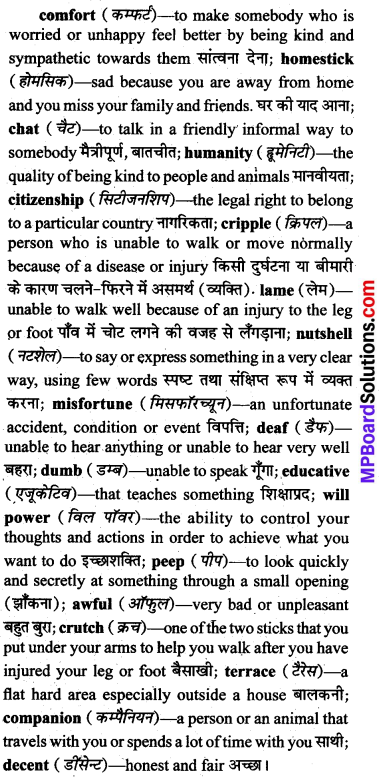
MP Board Class 9th General English The Spring Blossom Solutions Chapter 3 The School for Sympathy 2

The School for Sympathy Summary, Pronunciation & Translation

[1] I had heard a lot about Miss Beam’s school, but I did not get the chance to visit it till last week.

When I arrived at the school I saw a girl of about twelve, with her eyes covered with a bandage, being led carefully between the flower-beds by a little boy of eight. She stopped, and asked who it was that had come in, and he seemed to be describing me to her. Then they passed on.

(आई हैड हर्ड ए लॉट अबाउट मिस बीम्स स्कूल, बट आई डिड नाट गेट द चान्स टु विज़िट इट टिल लास्ट वीक।

व्हेन आई अराइव्ड एट द स्कूल आई सॉ अ गर्ल ऑफ अबाउट ट्वेलव, विद हर आइज कवर्ड विद अ बेन्डेज़, बीइंग लेड केअरफली बिटविन द फ्लावर-बेइज़ बाय अ लिटिल बॉय ऑफ एट। शी स्टॉप्ड, एण्ड आस्क्ड हू इट वाज दैड हैड कम इन, एण्ड ही सीम्ड टु डिस्क्राइबिंग मी टु हर। दैन दे पास्ड ऑन।)

हिन्दी अनुवाद :
मैंने मिस बीम के विद्यालय के बारे में काफी कुछ सुन रखा था, पर मुझे पिछले सप्ताह तक वहाँ जाने का कोई अवसर नहीं मिला था।

जब मैं विद्यालय पहुँचा तो मैंने लगभग बारह साल की एक बच्ची को देखा जिसकी आँखों पर पट्टी बँधी थी और जिसे लगभग आठ वर्ष का एक लड़का फूलों की क्यारियों के बीच साथ लेकर चल रहा था। वह रुकी और उसने पूछा कि कौन अन्दर आया है और ऐसा लगा कि वह उससे मेरे बारे में वर्णन कर रहा था। फिर वे चले गये।

[2] Miss Beam was all that I had expected middle-aged authoritative, kind and understanding. Her hair was beginning to turn grey, and her round figure was likely to be comforting to a homesick child.

We chatted for a little while, and when I asked her some questions about her teaching methods, which I had heard were simple.

(मिस बीम वाज ऑल दैट आई हैड एक्सपेक्टेड मिडिल एजेड-अथॉरिटेटिव, कांइन्ड एण्ड अण्डरस्टेडिंग। हर हेअर वाज बिगनिंग टु टर्न ग्रे, एण्ड हर राउण्ड फिंगर वाज लाइकली टु बी कम्फरटिंग टु अ होमसिक चाइल्ड।

वी चेटेड फोर अ लिटिल व्हाइल, एण्ड व्हेन आस्क्ड हर सम क्वेश्चन्स अबाउट हर टीचिंग मेथड्स, विच आई हैड हर्ड वर सिम्पल।)

हिन्दी अनुवाद :
मिस बीम जैसे कि मेरी अपेक्षा थी, मध्यम आयु की, दबदबा रखने वाली, दयालु और समझदार महिला थी। उनके बाल भूरे होना शुरू हो रहे थे, और उनकी गोलाकार आकृति किसी घर के प्रति अत्यन्त लगाव रखने वाले बालक के प्रति ममतामयी सकून देने वाली थी।

हम थोड़ी देर बातें करते रहे और जब मैंने उन्हें उनकी शिक्षण पद्धति के बारे में कुछ प्रश्न पूछे जो कि मैंने सुना था कि बहुत साधारण थे।

[3] “…….. We teach only those things that are simple and useful to pupils-spelling, adding, subtracting, multiplying, writing. The rest is done by reading to them and giving them interesting talks. There are practically no other lessons.

“…….. I have heard so much,” I said, “about the originality of your system.”

(वी टीच ओनली दोज थिंग्ज दैट आर सिम्पल एण्ड यूजफुल टु प्यूपिल्स-स्पेलिंग, ऐडिंग, सबट्रेक्टिंग, मल्टीप्लाइंग, राइटिंग। द रेस्ट इज़ डन बाइ रीडिंग टु देम एण्ड गिविंग देम इन्टरएस्टिंग टॉक्स। देअर आर प्रेक्टिकली नो अदर लेसन्स।

“आई हैव हर्ड सो मच”, आई सैड, “अबाउट द ऑरिजनेलिटी – ऑफ योर सिस्टम।”)

हिन्दी अनुवाद :
हम केवल उन्हीं वस्तुओं को सिखाते हैं जो छात्रों के लिए सरल एवं उपयोगी हों-वर्तनी, जोड़, गुणा, घटाना और लिखना सिखाया जाता है। शेष अध्यापन पढ़कर होता है और बच्चों से मनोरंजक बातें की जाती हैं। इसके अलावा कोई प्रायोगिक पाठ नहीं सिखाया जाता है। मैंने कहा “मैंने बहुत कुछ सुना है आपकी यथार्थता के विषय में”।

[4] Miss Beam smiled. “Ah, yes” she said. “I am coming to that. The real aim of this school is not to teach thought but thoughtfulness-humanity, kindness and citizenship. That is the ideal I have always had, and happily there are parents good enough to trust me to try and put it into practice. Look out of the window for a minute, will you?”

I went to the window, which looked out on a large garden and playground at the back.

(मिस बीम स्माइल्ड, “हा, यस” शी सेड, “आई एम कमिंग टु दैट। द रीअल एम ऑफ दिस स्कूल इज़ नाट टु टीच थॉट बट थॉटफुलनेस-हृयूमेनिटी, काइन्डनेस एण्ड सिटीजनशिप। दैट इज़ द आइडियल आई हेव आलवेज हैड, एण्ड हैप्पिली देअर आर पेरेण्ट्स गुड इनफ टु ट्रस्ट मी टु ट्राय एण्ड पुट इट इन्टु प्रेक्टिस। लुक आउट ऑफ द विन्डो फोर अ मिनट, विल यू?”

आई वेन्ट टु द विन्डो, विच लुक्ड आउट आन ए लार्ज गार्डन एण्ड प्लेग्राउण्ड एट द बेक।)

हिन्दी अनुवाद :
मिस बीम मुस्कराई, “अरे हाँ” वह बोली, “मैं उसी बात पर आ रही हूँ। इस विद्यालय का मुख्य उद्देश्य विचार सिखाना नहीं बल्कि विचारशील बनाना है जिसमें मानवता, दयालुता और नागरिकता समाहित हो। यह वही आदर्श है जो कि सदैव मेरे मन में रहा है, और खुशी की बात है कि अभिभावक मुझ पर भरोसा करते हैं और इसको अमल में लाने का प्रयास करते हैं।”

मैं खिड़की तक गया जो पीछे एक विशाल बगीचे और खेल के मैदान को दिखाती है।

[5] “What do you see?” Miss Beam asked. “I see some very beautiful grounds.” I said, “and a lot of jolly children. But what surprises me, and pains me too, is that they are not all healthy and active. As I came in I saw one poor little thing being led about because of some trouble with her eyes. And now I can see two more in the same condition, while there is a girl with a crutch just under the window watching the others at play. She seems to be a hopeless cripple.

(“व्हॉट डू यू सी?” मिस बीम आस्क्ड? “आई सी सम वेरी ब्यूटीफुल राउन्ड्स” आई सेड, “एण्ड अ लॉट ऑफ जॉली चिल्ड्रन। बट व्हाट सरप्राजेस मी, एण्ड पेन्स मी टू, इज़ दैट दे आर नॉट हेल्दी एण्ड एक्टिव। एंज़ आई केम इन आइ सॉ वन पुअर लिटिल थिंग बीईंग, लेड अबाउट बिकाज़ ऑफ सम ट्रबल विद हर आइज़। एण्ड नाउ आई केन सी टू मोर इन द सेम कन्डीशन, व्हाइल देअर इज़ अ गर्ल विद अ क्रच जस्ट अण्डर द विन्डो वाचिंग अदर्स एट प्ले। शी सीम्स टू बी अ होपलेस क्रिपल।”)

हिन्दी अनुवाद :
“आप क्या देखते हो ?” मिस बीम ने पूछा। “मैं कुछ बहुत सुन्दर मैदान देख रहा हूँ।” मैंने कहा, “और बहुत से प्रसन्न बच्चे परन्तु जो मुझे आश्चर्यजनक लगता है तथा कष्ट भी पहुँचाता है, वह है कि वे सभी स्वस्थ व सक्रिय नहीं हैं। जब मैं यहाँ आया तो मैंने देखा एक छोटी बच्ची को थाम कर ले जाया जा रहा था क्योंकि उसकी आँखों में कुछ तकलीफ थी। और अब मैं और दो को इसी तरह की स्थिति में देख रहा हूँ जहाँ खिड़की के ठीक नीचे एक बच्ची बैसाखी पर दूसरों को खेलते हुए देख रही है। वह एक निराश द्विव्योग प्रतीत होती है।”

[6] Miss Beam laughed. “Oh, no”, she said, “she’s not lame really, this is only her lame day. Nor are those others blind, it is only their blind day.” I must have looked very much astonished, for she laughed again. “There you have an essential part of our system in a nutshell. In order to get these young minds to appreciate and understand misfortune, we make them share in misfortune too.

(मिस बीम लाफ्ड “ओह, नो” शी सेड, “शी इज़ नाट लेम रीअली, दिस इज़ ओनली हर लेम डे। नॉर आर दोज अदर्स ब्लाइण्ड, इट इज़ ओनली देअर ब्लाइंड डे।” आई मस्ट हेव लुक्ड वेरी मच एस्टोनिश्ड, फोर शी लाफ्ड अगेन। “देअर यू हेव इन एसेंशियल पार्ट ऑफ अवर सिस्टम इन अ नटशेल। इन आर्डर टु गेट दीज़ यंग माइन्ड्स टु एप्रिशिएट एण्ड अन्डरस्टेन्ड मिसफायूँन, वी मेक देम शेयर इन मिसफाळून टू।)

हिन्दी अनुवाद :
मिस बीम हँसी। “अरे नहीं”, उन्होंने कहा, “वह वास्तव में लँगड़ी नहीं है, यह उसका केवल पंगू दिवस है। न ही वे दूसरे अन्धे हैं, यह उनका केवल अन्धदिवस है।” मैं बहुत अधिक आश्चर्यचकित दिखाई दिया होऊँगा क्योंकि वह फिर हँसी थीं। आपने हमारी पद्धति का एक आवश्यक भाग संक्षिप्त रूप में पाया। इन बाल मस्तिष्क को प्रेरित करने एवं दुर्भाग्य को समझाने के लिए हम उन्हें दुर्भाग्य में शामिल भी करवाते हैं।

[7] In the course of the term every child has one blind day, one lame day, one deaf day and one dumb day. During the blind day their eyes are bandanged, and it is a point of honour not to peep. The bandage is put on overnight, they wake up blind. This means that they need assistance in everything, and other children are told to help them and lead them about. It is educative to both of them the blind and the helpers.”

(इन द कोर्स ऑफ द टर्म एव्री चाइल्ड हेज वन ब्लाइंड डे, वन लेम डे, वन डीफ डे एण्ड वन डम्ब डे। ड्यूरिंग द ब्लाइंड डे, देअर आइज आर बेंडेज, एण्ड इट इज़ अ पॉइन्ट ऑफ ऑनर नाट टु पीप। द बेण्डेज इज़ पुट ऑन ओवरनाइट, दे वेक अप ब्लाइंड। दिस मीन्स दैट दे नीड असिस्टेन्स इन एव्रीथिंग, एण्ड अदर चिल्ड्रन आर टोल टु हेल्प देम एण्ड लीड देम अबाउट। इट इज़ एजुकेटिव टु बोथ ऑफ देम-द ब्लाइन्ड एण्ड द हेल्पर्स।”)

हिन्दी अनुवाद :
शिक्षा सत्र के दौरान हर एक बालक का एक अन्धदिवस, एक पंगु दिवस एक बधिर दिवस और एक मूक दिवस होता है। अन्ध दिवस के दौरान उनकी आँखों पर पट्टी बाँध दी जाती है और यह एक प्रतिष्ठा की बात होती है कि वे झाँके नहीं। पट्टी सारी रात को ही बँधी रहती है ताकि वे एक अंधे की तरह ही जागें। इसका अर्थ है कि उनको सहायता की जरूरत पड़ती है और अन्य बच्चों को उनकी सहायता करने को कहा जाता है। यह अंधे व उनके सहायकों दोनों के लिए ही शिक्षाप्रद होता है।

[8] “Everyone is very kind, “Miss Beam continued, “and it is really something of a joke, although of course, before the day is over the reality of the disability becomes clear even to the least thoughtful. The blind day is, of course, really the worst, but some of the children tell me that the dumb day is the most frightening. There, of course, the child must use will-power only because the mouth is not bandaged. But come down into the garden and see for yourself how the children like it.

(“एवीवन इज़ वेरी काइन्ड” मिस बीम कन्टीन्यूड, “एण्ड इट इज़ रीअली समथिंग ऑफ ए जोक, अल्दो, ऑफ कोर्स, बिफोर द डे इज़ ओवर द रियलिटी ऑफ द डिस्एबीलिटी बिकम्स क्लीअर इवन टु द लीस्ट थाटफुल। द ब्लाइंड डे इज़, ऑफ कोर्स, रिअली द वर्ट, बट सम ऑफ द चिल्ड्रन टेक मी दैट द डम्ब डे इज़ द मोस्ट फ्राइटनिंग। देअर, ऑफ कोर्स, द चाइल्ड मस्ट यूस विल पावर ओनली बिकाज़ द माउथ इज़ नाट बेन्डेज्ड। बट कम डाउन इन्टू द गार्डन एण्ड सी फोर युअरसेल्फ हाउ द चिल्ड्रन लाइक इट।”)

हिन्दी अनुवाद :
“यहाँ हर व्यक्ति दयावान है।” मिस बीम ने कहना जारी रखा,”और यह एक प्रकार का मजाक ही है। यद्यपि निश्चय ही, दिन समाप्त होने के पूर्व दिव्यांगता की वास्तविकता बहुत कम विचारवान को भी स्पष्ट हो जाती है। अन्धदिवस वास्तव में बहुत खराब है किन्तु कुछ बच्चों ने बताया कि मूक दिवस बहुत ही डरावना होता है। उसमें बालक को अपनी दृढ़ इच्छा शक्ति का पालन करना होता है क्योंकि मुँह पर पट्टी नहीं बाँधी जाती। परन्तु आप बगीचे में आइये व स्वयं देखिये कि बच्चे इसे कितना. पसन्द करते हैं।

[9] Miss Beam led me to one of the bandaged girls, a little merry thing. “Here’s a gentleman come to talk to you,” said Miss Beam, and left us.
“Don’t you ever peep?” I asked, by way of an opening.
“Oh, no”, she exclaimed, “that would be cheating! But i’d not idea it was so awful to be blind. You can’t see a thing. One feels one is going to be hit by something every moment sitting dawn such a relief.

(मिस बीम लेड मी टु वन ऑफ द बेन्डेज्ड गर्ल्स ए लिटिल मेरी थिंग। “हिअर इज़ अ जेन्टलमैन कम टु टाक टु यू” सेड मिस बीम एण्ड लेफ्ट अस।
“डोन्ट यू एवर पीप?” आई आस्क्ड, बॉय वे ऑफ एन ओपनिंग।
“ओह नो”, शी एक्सक्लेम्ड, “दैट वुड बी चीटिंग। बट आई हेड नो आइडिया इट वाज सो ऑफुल टु बी ब्लाइंड।. यू कान्ट सी ए थिंग। वन फील्स वन इज गोइंग टु बी हिट बाय समथिंग एव्री मोमेण्ट। सिटिंग डाउन इज सच ए रिलीफ।)

हिन्दी अनुवाद :
मिस बीम मुझे आँखों पर पट्टी बँधी एक बच्ची के पास ले गईं, एक छोटी प्रसन्न बच्ची।” यहाँ एक सज्जन तुमसे बात करने आये हैं”, मिस बीम ने कहा और हमें वहीं छोड़कर चली गईं।
“क्या तुम कभी बीच से झाँकती हो।” मैंने बात शुरू करने के इरादे से कहा।
“अरे नहीं”, वह बोल उठी, “यह तो धोखा देना होगा किन्तु मुझे पता नहीं था कि अन्धा होना कितना दुःखपूर्ण होगा। तुम किसी चीज को देख नहीं पाते हो। ऐसा लगता है कि तुम कभी भी किसी चीज से टकरा जाओगे। बैठना बड़ी राहत देता है।

[10] “Are your guides kind to you?” I asked.
“Pretty good. Not so careful as I shall be when it’s my turn. Those that have been blind already are the best. It’s terrible not to see. I wish you’d try!”
“Shall I lead you anywhere” I asked.

(“आर यूअर गाइड्स काइन्ड टु यू?” आई आस्क्ड।
“प्रेटी गुड। नाट सो केयरफुल एज आई शाल बी व्हेन इट्स माई टर्न। दोज दैट हेव बीन ब्लाइंड अलरेडी आर द बेस्ट। इट्स टेरिबल नाट टु सी। आई विश यू वुड ट्राय।”
“शाल आई लीड यू एनी व्हेयर” आई आस्क्ड।)

हिन्दी अनुवाद :
“क्या तुम्हारे मार्गदर्शक तुम्हारे प्रति दयालु हैं।” मैंने पूछा।
“काफी अच्छे। किन्तु इतने फिक्रवान नहीं जितना मैं होऊँगा जब मेरी बारी आयेगी। वे जो पहले से अंधे हैं, सर्वोत्तम हैं। नहीं देख पाना बहुत भयावह है। आप भी कोशिश करके देखिये न।”
“क्या मैं तुम्हें कहीं और ले चलूँ?” मैंने पूछा।

[11] “Oh, yes”, she said, “let’s go for a little walk. Only you must tell me about things. I shall be so glad when today’s over. The other bad days can’t be half as bad as this. Having a leg tied up and hopping about on a crutch is almost fun. I guess. Having an arm tied up is a little more troublesome, because you have to get your food cut up for you, and so on, but it doesn’t really matter. And as for being deaf for a day, I shan’t mind that-at least, not much. But being blind is so frightening. My head aches all the time, just from avoiding things that probably aren’t there. Where are we now?”

(“ओह, यस”, शी सेड, “लेट्स गो फोर अलिटिल वाक्। ओनली यू मस्ट टेल मी अबाउट थिंग्स। आई शेल बी सो ग्लेड व्हेन टुडेइज ओवर। दी अदर बेड डेज काण्ट मी हाफ एज बेड एस दिस। हेविंग अ लेग टाइट अप एण्ड होपिंग अलाइट ऑन अ क्रच इज आलमोस्ट फन। आई गेस। हेविंग एन आर्म टाइड अप इज अ लिटिल मोर ट्रबलसम, बिकाज़ यू हेव टु गेट युअर फुड कट अप फोर यू, एण्ड सो ऑन, बट इट डज़ नाट रीअली” मेटर। एण्ड एज़ फोर बीइंग डीफ फोर अ डे, आई शांट माइंड दैट-एट लीस्ट नाट मच। बट बीइंग ब्लाइंड इज सो फ्राइटनिंग। माई हेड एक्स ऑल द टाइम, जस्ट फ्रॉम अवाइडिंग थिंग्स दैट प्राबेबली आरण्ट देअर व्हेअर वी आर नाउ?”)

हिन्दी अनुवाद :
“अरे, हाँ।” उसने कहा, “आओ हम थोड़ी देर घूमने चलते हैं। आपको केवल आसपास की चीजों के बारे में बताना होगा। आज का दिन बीतने के बाद मैं बहुत प्रसन्न होऊँगी। अन्य बुरे दिन इतने बुरे नहीं होंगे जितना कि वह। एक टाँग बँधवा कर बैसाखियों पर वहाँ-वहाँ फुदकना बड़ा मजेदार होगा। मैं ऐसा अनुमान लगाती हूँ। और एक हाथ बँधवाकर थोड़ा कष्टदायी होता होगा, क्योंकि तुम्हें अपना भोजन अपने लिए काटकर खाना होगा। और अन्य बातें। खैर कोई बात नहीं। और जहाँ तक बहरा दिवस की बात है मुझे उसका बुरा नहीं लगेगा-कम से कम ज्यादा तो नहीं। किन्तु अन्धदिवस बहुत ही भयावह होता है। मेरा सिर दिन भर दुखता है केवल उन चीजों को नजरअंदाज करते हुए जो कि शायद वहाँ हैं ही नहीं। अब हम कहाँ हैं?

[12] “In the playground”, I said, “going towards the house. Miss Beam is walking up and down the terrace with a tall girl.”
“What has the girl got on?” My companion asked.
“I blue skirt and a pink blouse.”
“I think it’s Millie”, she said, “What colour is her hair?”
“Very light”, I said.
“Yes, that’s Millie. She’s the head girl. She’s very decent.”
“There’s an old man tying up roses”, I said.
“Yes, that’s Peter. He’s the gardener.”
“And here comes a dark girl in red, on crutches.”
“Yes”, she said, “that’s Berryl.”

(“इन द प्लेग्राउंड,” आई सेड, “गोइंग टु वर्ड्स द हाउस। मिस बीम इज़ वाकिंग अप एण्ड डाउन द टेरेस विद अटॉल गर्ल।”
“व्हाट हेज़ द गर्ल गॉट आन?” माइ कम्पेनियन ऑस्क्ड। “अ ब्ल्यू स्कर्ट एण्ड अ पिंक ब्लाउज।”
“आई थिंक इट्स मिली” शी सेड, “व्हाट कलर इज़ हर हेअर?”
“वेरी लाइट” आई सेड।
“यस दैट्स मिली। सी इज द हेड गर्ल, शी इज़ वेरी डिसेण्ट।”
“देअर इज़ एन ओल्ड मैन टाइंग अप रोज़ेज़” आई सेड।
“यस, दैट्स पीटर। ही इज द गार्डनर।”
“एण्ड हियर कम्स अ डार्क गर्ल इन रेड, आन क्रचेस।”
“यस,” शी सेड, “दैट्स बेरील।”)

हिन्दी अनुवाद :
“खेल के मैदान में” मैंने कहा, “घर की ओर जा रहे हैं। मिस बीम, छत पर एक लम्बी लड़की के साथ टहल रही हैं।”
“उस लड़की ने क्या पहना हुआ है।” मेरी साथिन ने पूछा।
“एक नीला स्कर्ट व गुलाबी ब्लाउज।”
“मैं सोचती हूँ, वह मिली है” उसने कहा, “उसके बालों का रंग क्या है?”
“बहुत हल्का” मैंने कहा।
“हाँ वह मिली ही है। वह प्रधान लड़की है, वह बहुत सभ्य है।”
“वहाँ एक वृद्ध महाशय हैं वे गुलाबों को बाँध रहे हैं।” मैंने कहा।
“हाँ वे पीटर हैं। वे माली हैं।” और यह एक काली लड़की आ रही है वह बैसाखी लिए लाल कपड़े पहनी हैं।”
“हाँ” उसने कहा, “वह बेरिल है।”

[13] And so we walked on, and in guiding this little girl about I discovered that I was ten times more thoughtful already than usual. I also realized that having to describe the surroundings to another, makes them more interesting.
When Miss Beam came to release me I was sorry. to go, and said so.
“Ah!” she replied. “Then there is something in my system after all.”
I walked back to the town murmuring (incorrectly as ever) the lines :
Can I see another’s woe,
And not share their sorrow too?
O no, never can it be,
Never, never, can it be.  – Simplified form EV Lucas

(एण्ड सो वी वाक्ड ऑन, एण्ड इन गाइडिंग दिस लिटिल गर्ल अबाउट आई डिस्कवर्ड दैट आई वाज टेन टाइम्स मोर थाट फुल अलरेडी देन युज्अल। आई अल्सो रियलाइज़्ड दैट हेविंग टु डिस्क्राइब द सराउडिंग्स टु अनादर, मेक्स देम मोर इंटरेस्टिंग।
व्हेन मिस बीम केम टु रिलीज़ मी आई वाज सारी टु गो, एण्ड सेड सो।
“आह!” शी रिप्लाइड “देन देअर इज़ समथिंग इन माय सिस्टम आफ्टर आल।”
आई वाक्ड बेक टु द टाउन मर्मरिंग (इनकरेक्टली एज़ एवर) द लाइन्स।
केन जाय सी अनादर्स वो,
एण्ड नाइट शेअर सॉरो टू?
ओ नो, नेवर केन इट बी,
नेवर नेवर केन इट बी।)

हिन्दी अनुवाद :
और हम इसी तरह चलते रहे, और इस छोटी बच्ची के निर्देशित करते हुए मैंने पाया कि मैं हमेशा से ज्यादा दूसरों के लिए दस गुना ज्यादा विचारवान बन गया हूँ। और मैंने यह भी महसूस किया कि दूसरों को आसपास के रहन-सहन के बारे में वर्णन करने से वह और ज्यादा दिलचस्प बन जाता है।
जब मिस बीम मुझे छोड़ने के लिये आईं तो मुझे वहाँ से विदा लेने में दुःख हो रहा था और मैंने उनसे यह कहा भी।
“अच्छा” मिस बीम ने उत्तर दिया, “तो फिर मेरी इस पद्धति में कुछ दम है।”
मैं निम्न पंक्तियाँ (हमेशा की तरह त्रुटिपूर्ण) गुनगुनाते हुए नगर की ओर वापस लौटा।
क्या मैं दूसरों के दुःखों को देख सकता हूँ, और उनके दुःख में भागीदार नहीं बन सकता?
अरे नहीं, यह कभी नहीं हो सकता,
कभी नहीं, कभी नहीं, यह नहीं हो सकता है?

We believe information shared regarding MP Board Solutions for Class 9 Textbook General English The Spring Blossom Solutions Chapter 3 The School for Sympathy Questions and Answers as far as our knowledge is concerned is true and reliable. In case of any queries or suggestions do leave us your feedback and our team will guide you at soonest possibility. Bookmark our site to avail latest updates on several state board Solutions at your fingertips.

MP Board Class 9th General English The Spring Blossom Solutions Chapter 2 Kasturba Gandhi

MP Board Solutions for Class 9 Textbook General English The Spring Blossom Solutions Chapter 2 Kasturba Gandhi Questions and Answers aids you to prepare all topics in it effectively. You need not worry about accuracy of Madhya Pradesh State Board Solutions for Class 9 English Composition: Visual Stimulus as they are given adhering to latest exam pattern and syllabus guidelines. You Can Download MP Board Class 9 English Solutions Questions and Answers, Notes, Summary, Guide pdf on is page. Enhance your subject knowledge by preparing from Chapterwise MP Board Solutions for Class 9 English and clarify your doubts on corresponding topics.

MP Board Class 9th General English The Spring Blossom Solutions Chapter 2 Kasturba Gandhi

Kick start your preparation by using our online resource Madhya Pradesh State Board Solutions for Class 9 Textbook General English The Spring Blossom Solutions Chapter 2 Kasturba Gandhi. You can even download MP Board Solutions for Class 9 English free of cost rough direct links available on our page. Clear your queries and understand concept behind in a simple manner. Simply tap on concept you wish to prepare chapterwise and go rough it.

Kasturba Gandhi Textual Exercises

Word Power

(A) Rearrange the following jumbled letters to make meaningful words that come from the lesson
(दिए गए अक्षरों को व्यवस्थित करके अर्थपूर्ण शब्द बनाइए।)
Answer:

  1. roprupseso – prosperous
  2. socutm – custom
  3. drcsae – sacred
  4. einetr – entire
  5. epapall – appeal

(B) Fill in the blanks with appropriate words given in order to make a meaningful passage.
(रिक्त स्थान भरो।)
country, history, vow, footsteps, speeches, pledge, joined, custom, prosperous, accompanied
Answer:
Ramdin was a very honest and hard-working man. He worked day and night and became prosperous. He was very fond of reading. Once he read the life history of Gandhiji. He was very much impressed and thought of doing something for his country. He took a pledge to walk on the footsteps of Gandhiji. His wife, an active lady also joined him. She accompanied him wherever he went for social upliftment, though in those days the custom of accompanying one’s husband was forbidden. She gave speeches wherever she went and took a vow to uplift the position of Indian women.

How Much Have I Understood?

(A) Choose the correct option and complete the sentences
(सही विकल्प चुनो)

Question 1.
Kasturba Gandhi was married at the age of ………..
(a) thirteen
(b) eighteen
(c) twenty one
(d) twenty two.
Answer:
(a) thirteen

Question 2.
She was taught by her ………..
(a) father
(b) mother
(c) brother
(d) husband.
Answer:
(d) husband.

Question 3.
In 1942, she was arrested for protesting against the arrest of …………
(a) Nehruji
(b) Gandhiji
(c) Lokmanya Tilak
(d) Gopal Krishna Gokhale.
Answer:
(b) Gandhiji.

(B) Answer the given questions in one or two sentences.
(निम्न प्रश्नों के एक या दो वाक्यों में उत्तर दीजिए।)

Question 1.
Who was Kasturba Gandhi?
(हु वास् कस्तूरबा गाँधी?)
कस्तूरबा गाँधी कौन थी?
Answer:
Kasturba Gandhi was the daughter of a prosperous businessman of Porbander; (Kathiawar).
(कस्तूरबा गाँधी वॉज़ द डॉटर ऑफ अ प्रॉस्परस बिजनेसमैन ऑफ पोरबन्दर (काठियावाढ़।)
कस्तूरबा गाँधी पोरबन्दर के एक समृद्ध व्यापारी की पुत्री थीं।

Question 2.
Who was she married to?
(हू वॉज़ शी मैरिड टू?)
उनका विवाह किससे हुआ?
Answer:
She was married to Mohandas Karamchand Gandhi (Mahatma Gandhi).
(शी वॉज़ मैरिड टू मोहनदास करमचन्द गाँधी (महात्मा गाँधी))
उनका विवाह मोहनदास करमचन्द गाँधी (महात्मा गाँधी) से हुआ।

Question 3.
Why was she arrested in 1939?
(व्हाय वॉज़ शी अरैस्टिड इन 1939?)
उन्हें 1939 में बन्दी क्यों बनाया गया?
Answer:
In 1939, she was arrested for participating in the Rajkot Satyagraha.
(इन 1939, शी वॉज़ अरैस्टिड फॉर पार्टिसिपेटिंग इन द राजकोट सत्याग्रह।)
1939 में उन्हें राजकोट सत्याग्रह में भाग लेने के कारण बन्दी बनाया गया।

Question 4.
What kind of life did she live?
(व्हॉट काइन्ड ऑफ लाइफ डिड शी लिव?)
उन्होंने कैसा जीवन बिताया?
Answer:
She lived a simple and austere life.
(शी लैड अ सिम्पल एण्ड ऑस्टिअर लाइफ।)
उन्होंने एक सादा व संयमी जीवन बिताया।

Question 5.
What was her special appeal to the women?
(व्हॉट वॉज़ हर स्पैशल अपील टू द विमेन?)
स्त्रियों से उनका विशेष निवेदन क्या था?
Answer:
Her special appeal to the women was to spin and wear khadi, boycott government schools and colleges and remove untouchability.
(हर स्पैशल अपील टू द विमेन वॉज़ टू स्पिन एण्ड वियर खादी, बॉयकॉट गवर्नमेन्ट स्कूल्स एण्ड कॉलेजेज़ एण्ड रिमूव अन्टचेबिलिटी।)
उनका स्त्रियों से विशेष निवेदन यह था कि वे सूत कातें, खादी पहनें, शासकीय स्कूलों व कॉलेजों का बहिष्कार करें तथा अस्पृश्यता छोड़ें।

Question 6.
What happened on 22 February, 1944?
(व्हॉट हैपन्ड ऑन 22 फेब्रुअरी, 1944?)
22 फरवरी, 1944 को क्या हुआ?
Answer:
Kasturba died in detention on 22 February, 1944.
(कस्तूरबा डाइड इन डिटेन्शन ऑन 22 फेब्रुअरी, 19441)
कस्तूरबा का 22 फरवरी, 1944 को नजरबन्द कैद में देहान्त हुआ।

Question 7.
What great events happened in the years 1897, 1915, 1918, 1932, 1939, 1944?
(व्हॉट ग्रेट ईवेन्ट्स हैपन्ड इन द ईयर्स 1897, 1915, 1918, 1932, 1939, 1944?)
इन वर्षों में कौन-सी महान घटनाएँ घटी?
Answer:
(a) In 1897-Women’s Satyagraha in South Africa.
(इन 1897-विमेन्स सत्याग्रह इन साऊथ एफ्रिका)।
1897 में-दक्षिण अफ्रीका में स्त्रियों का सत्याग्रह।

(b) 1915-Indigo workers compaign in Champaran, Bihar
(इन 1915- इन्डिगो, वर्कर्स कैम्पेन इन चम्पारन, बिहार।)
1915 में-चम्पारन, बिहार में नील बनाने वाले मजदूरों का आन्दोलन।

(c) In 1918-No Tax Campaign in Kaira, Gujarat.
(इन 1918- नो टैक्स कैम्पेनं इन कैरा, गुजरात।)
1918 में-कर न अदा करने का गुजरात के कैरा में आन्दोलन।

(d) In 1932-Picketing liquor and foreign cloth shops.
(इन 1932-पिकेटिंग लिकर एण्ड फॉरेन क्लॉथ शॉप्स।)
1932 में-शराब व विदेशी वस्त्रों की दुकानों पर धरना।

(e) In 1939-Rajkot Satyagraha.
(इन 1939-राजकोट सत्याग्रह।)
1939 में-राजकोट सत्याग्रह।

(f) In 1944 Death of Kasturba Gandhi.
(इन 1944-डैथ ऑफ कस्तूरबा गाँधी।)
1944 में-कस्तूरबा गाँधी की मृत्यु।

Question 8.
Write, who said to whom and why?
“The true religion of a woman is to follow the footsteps of her husband like Sita……”
(राइट, हू सेड टू हूम एण्ड व्हाय? “द ट्र रिलिजन ऑफ अ वुमन इज़ टू फॉलो द फुटस्टेप्स ऑफ हर हज़बेण्ड लाईक सीता……”)
(बताओ ये शब्द किसने, किससे और क्यों कहे? “किसी स्त्री का वास्तविक धर्म सीता…..”)
Answer:
These words were said by Kasturba Gandhi to the women of Vadhtal village to inspire them to encourage their husbands for not paying their revenue dues so that India may win Swaraj.
(दीज व वर सेड बाइ कस्तूरबा गाँधी टू द विमेन ऑफ वधतल विलेज टू इन्सपायर देम टू एन्करेज देअर हस्बेन्ड्स फॉर नॉट पेइंग देअर रेवन्यू ड्यूज़ सो दैट इण्डिया मे विन स्वराज।)
ये शब्द कस्तूरबा गाँधी द्वारा वधतल गाँव की स्त्रियों को प्रेरित करने के लिए कहे गए थे जिससे वे अपने पतियों को बकाया राजस्व न देने के लिए प्रोत्साहित करें ताकि भारत स्वराज प्राप्त कर सके।

(C) Write the answer to the following questions in four or five sentences
(चार या पाँच वाक्यों में उत्तर लिखिए।)

Question 1.
What did Kasturba address the women, of Vadhtal Village?
(व्हॉट डिड कस्तूरबा अड्रेस द विमेन ऑफ वधतल विलेज?)
कस्तूरबा ने वधतल की स्त्रियों से क्या कहा?
Answer:
Addressing the women of Vadhtal village, she said, “The true religion of a woman is to follow the footsteps of her husband like sati Sita. If she also encourages her husband to stick to the sacred pledges (of non-payment of the revenue dues) her progeny is sure to be brave and India will then win Swaraj.”

(अड्रेसिंग द विमेन ऑफ वधतल विलेज, शी सेड, “द ट्र रिलीजन ऑफ अ वुमन इज़ टू फॉलो द फुटस्टेप्स ऑफ हर हस्बेन्ड लाइक सती सीता। इफ शी ऑल्सो एन्करेजेज़ हर हस्बेन्ड टू स्टिक टू द सेकरेड प्लैजेज (ऑफ नन पेमेन्ट ऑफ द रेवन्यू ड्यूज़) हर प्रोजेनी इज़ श्योर टू बी ब्रेव एण्ड इन्डिया विल देन विन स्वराज।”)

वधतल गाँव की स्त्रियों को सम्बोधित करते हुए उन्होंने कहा कि स्त्रियों का सच्चा धर्म सती सीता की तरह अपने पति के पद चिन्हों पर चलना है। यदि वह अपने पति को अपनी पवित्र प्रतिज्ञा (राजस्व न चुकाने की प्रतिज्ञा) पर दृढ़ रहने के लिए प्रोत्साहित भी करती हैं तो उनकी संतति बहादुर होगी और तभी भारत स्वराज जीत सकेगा।

Question 2.
Mention the date (s) and reason (s) for Kasturba Gandhi’s arrests on different occasions.
(मेन्शन द डेट्स एण्ड रीजन्स फोर कस्तूरबा गाँधीज, अरेस्ट्स ऑन डिफ्रेन्ट ओकेजन्स।)
विभिन्न अवसरों पर कस्तूरबा गाँधी की गिरफ्तारी का दिनांक तथा कारण बताइए।
Answer:
Kasturba Gandhi was arrested in:
(कस्तूरबा गाँधी वॉज़ अरेस्टेड इन)
कस्तूरबा गाँधी की गिरफ्तारी हुई थी:

(a) In 1931 and 1932-for picketing liquor and foreign cloth shops.
(इन 1931 एण्ड 1932-फॉर पिकेटिंग लिकर एण्ड फॉरेन क्लॉथ शॉप्स।)
1931 व 1932 में-शराब व विदेशी वस्त्र की दुकानों पर धरना देने के लिए।

(b) In 1939-For participating in Rajkot Satyagraha.
(इन 1939-फोर पार्टिसिपेटिंग इन राजकोट सत्याग्रह।)
1939 में-राजकोट सत्याग्रह में भाग लेने के लिए।

(c) In August 1942-When proceeding to address a meeting of protest against the arrest of her husband.
(इन ऑगस्ट 1942 – व्हेन प्रोसीडिंग टू अड्रेस अ मीटिंग ऑफ प्रोटेस्ट अगेन्स्ट द अरैस्ट ऑफ हर हस्बेन्ड।)
अगस्त 1942 में-अपने पति की गिरफ्तारी के विरुद्ध सभा को सम्बोधित करने जाते समय।

Language Practice

Fill up the gaps with suitable prepositions given in the brackets (in, on, to, from, for till, after, with, at)
(रिक्त स्थान भरिए।)
Answer:
Rahul : Sir, where are we going this Sunday?
Mr. Khanna : The school is planning to take you to a dam.
Rahul : Which dam? Where is it?
Mr. Khanna : I can’t tell right now. It may be in Bhopal.
Rahul : What shall we do there?
Mr. Khanna : We’ll play games at there ground.
Rahul : How long are we going to stay there?
Mr. Khanna : We are going to stay there till 50’clock.
Rahul : May I take my younger brother along with me?
Mr. Khanna : No, You can’t. It’s a school picnic. Moreover we are going to a dam and you will be busy with your friends. Then, who is going to look after him?
Rahul : At what time are we going to leave?
Mr. Khanna : Go and get the information from the office.

Listening Time

(A) Write down the meaning against the words given below.
(शब्दों के सम्मुख उनके अर्थ लिखिए।)

  1. bear tolerate  – bare not wearing clothes.
  2. too in addition – to in the direction of.
  3. vein a blood vessel  – vain useless or meaningless.
  4. hair fine thread like strands growing from with very long the skin of mammals and other animals. – hare an animal hind legs.
  5. dear much loved  – deer a hoofed animal

(B) Your teacher will read out the directions, sentence by sentence on how to draw pictures. Draw what you hear.
(शिक्षक के निर्देश सुनकर आकृति बनाओ।)
Answer:
Students should do themselves with the help of their teacher.
(छात्र शिक्षक के निर्देशन में स्वयं करें।)

Speaking Time

Speak at least 5 sentences about your friend using these words
(अपने मित्र पर दिये गये शब्दों की सहायता से 5 वाक्य बोलो।)
honest, beautiful, handsome, hardworking sincere, courageous, tall, clever, civilized gentle.
Answer:
Students can do themselves.
(छात्र स्वयं करें।)

Writing Time

Do you know any simple minded person like Kasturba? Write at least a paragraph about him/her with the help of this lesson.
(किसी सादे व्यक्ति पर एक अनुच्छेद लिखो।)
Answer:
Students can write about any person around them themselves.
(छात्र स्वयं करें।)

Things to do

Paste the pictures of Indira Gandhi, Mother Teresa and Laxmi Bai. Write a paragraph on each one of them.
Answer:
Students should do themselves.
(छात्र स्वयं करें।)

Kasturba Gandhi Difficult Word Meanings 

prosperous (प्रॉस्परस)-rich and successful समृद्ध; indigo (इंडिगो)-dark blue dye नील; campaign (कैम्पेन)-a series of planned activities that are intended to achieve a particular social, commercial or political aim अभियान; progeny (प्रोजैनी)-a person’s children सन्तान; picketing (पिकोटिंग)-the activity of standing outside the entrance to a building in order to protest about something and stop people from entering that building धरना, आन्दोलन; protest (प्रोटेस्ट)-opposition to something विरोध; detention (डिटेन्शन)-the state of being kept in a place, especially a prison and prevented from leaving कैद; austere (ऑस्टीर)-simple and plain सीधा-सादा।

Kasturba Gandhi Summary, Pronunciation & Translation

[1] Kasturba Gandhi was the daughter of a prosperous businessman of Porbander (Kathiawar). She was married at the very young age of thirteen to Mohandas Karamchand Gandhi. Her father was a strong believer in prevalent customs and traditions. He did not believe in educating her. After her marriage, it was her husband who taught her to read and write. In 1897, she joined her husband in South Africa and worked there till 1914. Along with her husband, she led the women’s satyagraha there for which she was imprisoned.

(कस्तूरबा गाँधी वॉज द डॉटर ऑफ अ प्रॉस्परस बिज़िनेस मेन ऑफ पोरबन्दर (काठियावाड)। शी वाज़ मेरिड एट द वेरी यंग एज ऑफ थर्टीन टु मोहन दास करमचन्द गाँधी। हर फॉदर बाज़ अ स्ट्रांग बिलीवर इन प्रिविलेन्ट कस्टम्स एण्ड ट्रेडिशन्स। ही डिड नॉट बिलीव इन एजुकेटिंग हर। ऑफ्टर हर मेरिज, इट वाज़ हर हसबेंड हू टॉट हर टु रीड एण्ड राइट। इन 1897 शी जॉइन्ड हर हसबंड इन साउथ अफ्रीका एण्ड वर्ल्ड देअर टिल 1914। अलांग विथ हर हसबेंड, शी लेड द वीमन्स सत्याग्रह देयर फोर विच शी वाज़ इम्प्रिजन्ड।)

हिन्दी अनुवाद :
कस्तूरबा गाँधी पोरबन्दर (काठियावाड़) के एक धनवान व्यापारी की पुत्री थी। 13 वर्ष की बाल उम्र में ही उनका विवाह मोहनदास करमचन्द गाँधी से हो गया था। उनके पिता प्रचलित रीति-रिवाजों में अटूट विश्वास रखते थे। वे कस्तूरबा की शिक्षा में विश्वास नहीं करते थे। विवाह के पश्चात् उनके पति ने ही उन्हें लिखना-पढ़ना सिखाया। 1897 में वे अपने पति के साथ दक्षिण अफ्रीका रहने चली गयीं और वहाँ 1914 तक काम करती रहीं। अपने पति के साथ उन्होंने महिला सत्याग्रह आन्दोलन का नेतृत्व किया जिसके कारण उनको बन्दी बनाया गया।

[2] On his return to India in 1915, Kasturba joined her husband, Gandhi in the cause of the indigo workers in Champaran, Bihar and took an active part in the No Tax Campaign in Kaira, Gujarat in 1918.

(ऑन हिज़ रिटर्न टु इंडिया इन 1915, कस्तूरबा जॉइन्ड हर हसबेण्ड, गाँधीजी इन द कॉज़ ऑफ दी इंडिगो वर्कर्स इन चम्पारन, बिहार, एण्ड टुक ऐन एक्टिव पार्ट इन द नो टेक्स केम्पेन इन कैरा, गुजरात इन 1918)

हिन्दी अनुवाद :
1915 में भारत वापस आने पर कस्तूरबा ने गाँधी जी के बिहार के चम्पारन में नील (कपड़ों को लगाने वाला) की खेती करने वाले मजदूरों के आन्दोलन में अपने पति गाँधी जी का साथ दिया तथा गुजरात के कैरा में 1918 में टैक्स न देने के आन्दोलन में भी सक्रिय हिस्सा लिया।

[3] Kasturba not only took part in the campaign but also delivered significant speeches wherever she went. For instance, addressing the women of Vadhtal Village on 6 April 1918; she said : “the true religion of a woman is to follow the footsteps of her husband like Sita. If she also encourages her husband to stick to the sacred pledges (of non-payment of the revenue dues) her progeny is sure to be brave and India will then win swaraj.”

(कस्तूरबा नाट ओनली टुक पार्ट इन द कैम्पेन बट अल्सो डिलीवर्ड सिग्निफिकेंट स्पीचेस व्हेअरेवर शी वेन्ट फोर इन्सटेन्स, एड्रेसिंग द वीमेन ऑफ वढ़तल वीलेज ऑन 6 अप्रिल 1918, शी सेड “द ट्र रिलिजन ऑफ अ वुमन इज़ टु फॉलो द फुटस्टेप्स ऑफ हर हसबेंड लाइक सीता। इफ शी अल्सो इनकरेजेस हर हसबेण्ड टु स्टिक टु द सेक्रेड प्लींजेस (ऑफ नन-पेमेन्ट ऑफ द रेवेन्यू ड्यूज) हर प्रोजेनी इज़ श्युअर टु बी ब्रेव एण्ड इंडिया बिल देन विन स्वराज।)

हिन्दी अनुवाद :
कस्तूरबा ने आन्दोलन में न केवल हिस्सा लिया बल्कि वे जहाँ-जहाँ गईं वहाँ-वहाँ उन्होंने बहुत महत्त्वपूर्ण भाषण भी दिये। उदाहरण के लिए 6 अप्रैल, 1918 को वढ़तल ग्राम की सभा में वहाँ की महिलाओं को सम्बोधित करते हुए कहा-“किसी महिला का सही धर्म अपने पति के चरण चिन्हों पर सीता के समान चलना है। यदि वह अपने पति को पवित्र वचन पर (लगान की बकाया रकम को नहीं चुकाना) दृढ़तापूर्वक चलने के लिए प्रोत्साहित करती है तो उसकी आने वाली सन्तान बहादुर होगी और तब भारत स्वराज को जीतेगा।”

[4] In the First Non-coperation Movement launched by Gandhiji, she accompanied him and went from village to village. Along with her husband, she made a special appeal to women, asking them to spin and wear khadi, boycott government schools and colleges and remove untouchability. She was arrested in 1931 and again in 1932, for picketing liquour and foreign cloth shops.

(इन द फर्स्ट नन-कोआपरेशन मूवमेंट लॉन्च्ड बाय गाँधीजी, शी एकम्पनिड हिम एन्ड वेन्ट फ्रॉम विलेज टु विलेज। अलांग विद हर हसबेन्ड शी मेड ए स्पेशल अपील टु वीमेन आस्किंग देम टु स्पिन एंड वीअर खादी, बायकॉट गवर्नमेंट स्कूल्स एण्ड कॉलेजेस एण्ड रिमूव अनटचेबिलिटी। शी वाज अरेस्टेड इन 1931 एण्ड अगेन इन 1932, फोर पिकेटिंग लिक्वर एण्ड फॉरेन क्लॉथ शाप्स।)

हिन्दी अनुवाद :
गाँधीजी द्वारा प्रारम्भ प्रथम असहयोग आन्दोलन में वे गाँधीजी के साथ गाँव-गाँव गईं। अपने पति के साथ उन्होंने महिलाओं से विशेष अपील की कि वे सूत कातें, खादी पहनें, सरकारी स्कूल कालेजों का बहिष्कार करें तथा अस्पृश्यता को दूर करें। उन्हें 1931 में और फिर 1932 में शराब व विलायती वस्त्रों के विरुद्ध लोगों को रोकने के प्रयासों में गिरफ्तार किया गया।

[5] In 1939, she was arrested for participating in the Rajkot Satyagraha and was released only when Mahatma Gandhi began his fast. She was again arrested in August 1942, when proceeding to address a meeting of protest against the arrest of her husband and was lodged in a detention camp along with her husband in Pune. She looked after her husband when he undertook a twenty-one day fast in February 1943. Her health gradually broke down and she died in detention on 22 February 1944. During her entire life she worked whole-heartedly for the welfare of people and the removal of untouchability. She lived a simple and austere life.

(इन 1939 शी वाज़ अरेस्टेड फोर पार्टीसिपेटिंग इन द राजकोट सत्याग्रह एण्ड वॉज़ रिलीज़्ड व्हेन महात्मा गांधी बिगेन हिज फास्ट। शी वाज़ अगेन अरेस्टेड इन ऑगस्ट 1942 व्हेन प्रोसिडिंग टु एड्रेस अ मीटिंग ऑफ प्रोटेस्ट अगेन्स्ट दी अरेस्ट ऑफ हर हस्बेंड एण्ड वाज लॉज्ड इन अ डिटेशन केम्प अलांग विद हर हस्बेण्ड इन पुने। शी लुक्ड ऑफ्टर हर हसबेंड व्हेन ही अण्डरटुक अ टवेन्टी वन डे फास्ट इन फेब्रुअरी 1943. हर हेल्थ ग्रेजुअली ब्रोक डाउन एण्ड शी डाइड इन डिटेन्शन ऑन 22 फेब्रुअरी 1944. ड्यूरिंग हर इन्टायर लाइफ शी वड होल-हार्टेडली फोर द वेलफेयर ऑफ पीपुल एण्ड रिमूवल ऑफ अनटचेबिलीटी। शी लिव्ड अ सिंपल एण्ड ऑस्टीयर लाइफ।)

हिन्दी अनुवाद :
1939 में राजकोट सत्याग्रह में भाग लेने के लिए उन्हें गिरफ्तार किया गया और उन्हें तभी मुक्त किया गया जब गाँधीजी ने अपना उपवास शुरू किया। उन्हें अगस्त 1942 में जब वे अपने पति की गिरफ्तारी के विरुद्ध एक सभा को सम्बोधित करने जा रही थीं, पुनः गिरफ्तार किया गया और उन्हें पूना में उनके पति के साथ बन्दीगृह में रखा गया। फरवरी 1943 में जब गाँधीजी ने 21 दिन का उपवास का व्रत किया तब उन्होंने गाँधीजी की खूब देखभाल की। धीरे-धीरे उनका स्वास्थ्य खराब होता गया और 11 फरवरी, 1944 को उन्होंने बंदीगृह में ही प्राण त्याग दिये। अपने सम्पूर्ण जीवन में वे पूर्णत: हार्दिक रूप से जन कल्याण के लिए व छुआछूत मिटाने के लिए कार्य करती रहीं। उन्होंने एक सादा व संयमी जीवन बिताया।

We believe information shared regarding MP Board Solutions for Class 9 Textbook General English The Spring Blossom Solutions Chapter 2 Kasturba Gandhi Questions and Answers as far as our knowledge is concerned is true and reliable. In case of any queries or suggestions do leave us your feedback and our team will guide you at soonest possibility. Bookmark our site to avail latest updates on several state board Solutions at your fingertips.
MP Board Class 9th English The Rainbow Workbook Solutions Chapter 13 Stopping by Woods on a Snowy Evening

MP Board Solutions for Class 9 English The Rainbow Workbook Solutions Chapter 13 Stopping by Woods on a Snowy Evening Questions and Answers aids you to prepare all topics in it effectively. You need not worry about accuracy of Madhya Pradesh State Board Solutions for Class 9 English Chapter 13 Stopping by Woods on a Snowy Evening as they are given adhering to the latest exam pattern and syllabus guidelines. You Can Download MP Board Class 9 English Solutions Questions and Answers, Notes, Summary, Guide pdf on is page. Enhance your subject knowledge by preparing from Chapterwise MP Board Solutions for Class 9 English and clarify your doubts on corresponding topics.

MP Board Class 9th English The Rainbow Workbook Solutions Chapter 13 Stopping by Woods on a Snowy Evening

Kick start your preparation by using our online resource Madhya Pradesh State Board Solutions for Class 9 English The Rainbow Workbook Solutions Chapter 13 Stopping by Woods on a Snowy Evening. You can even download MP Board Solutions for Class 9 English free of cost rough direct links available on our page. Clear your queries and understand concept behind in a simple manner. Simply tap on concept you wish to prepare chapterwise and go rough it.

Stopping by Woods on a Snowy Evening Vocabulary and Pronunciation

A. Learn with the help of a dictionary the different usage of the following words:
know, deep, see.
Answer:
Do yourself.

B. Say the following words and notice the difference in the vowel sounds:
bell, bill, ball, bull, bail, be, bee, boil.
Answer:
Do yourself.

Listening Skill

Listen to the following poem twice.

See workbook pages 97-98.

Fill in the blanks using the missing lines.

Tell me not in mourful numbers,
Answer:
‘Life is but an empty dream’.
For the soul is dead that slumbers,
Ans. And the things are not what they seem.
Life is real life is earnest! ;
And the grave is not its goal,
Ans. Oust then art to dust returnest.
Was not spoken of the soul,
Ans. Not enjoyment and not sorrow.
Is our destined end or way.
But to act, that each tomorrow Finds us further than today.
In the world’s broad field of battle,
In the bivouac of life.
Answer:
Be not like dumb driven cattle;
Be a hero in the strife!

Speaking Skill

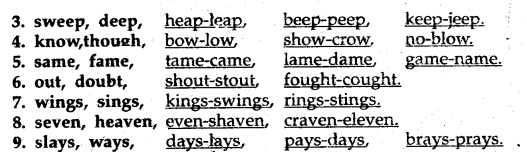
A The poem “Stopping by the Woods on a Snowy Evening” has many rhyming words. Now you add more words to the list:
MP Board Class 9th English The Rainbow Workbook Solutions Chapter 13 Stopping by Woods on a Snowy Evening 1
MP Board Class 9th English The Rainbow Workbook Solutions Chapter 13 Stopping by Woods on a Snowy Evening 2

B. Repeat the following lines giving attention to the rhyming words:
See workbook page 99.
Answer:
Do yourself.

Reading Skill

Read the given poem and answer the questions that follows: See workbook pages 99-100.

Question 1.
Where does the brook originate from ?
Answer:
The brook originates from the haunts of coot.

Question 2.
How does it sparkel ?
Answer:
It sparkles out among the fern to bicker down the valley.

Question 3.
What does the word ‘bicker’mean in this context ?
Answer:
‘Bicker’ means the dim light down the vally.

Question 4.
Describe the courses of the brook as suggested in the poem.
Answer:
The brook flows down from the haunts of coot making different sounds movement. It flows continuously.

Question 5.
What does the expression ‘hurty down’ suggest about the movement of the river ?
Answer:
It suggest that the flow is downwards. Its movement is very fast.

Question 6.
What does the ‘netted sunbeam’ mean? How does it dance?
Answer:
The ‘netted sunbeam’ means the sunnay that falls upon the water coming through the leaves and branches of the tree. It appess to dancing when the leaves shake with winds.

Question 7.
Who does ‘I’ refer to in the given lines ?
Answer:
‘I’ refers to the brook.

Question 8.
How does it chatter ?
Answer:
It chatter with its flowing sounds.

Writing Skill

A. Imagine you are going on a walk in woods. On the way you come across bushes, ferns, trees, streams, rocks, grasslands, slopes etc.
Write a paragraph using the above words. (50 words)
Answer:
I walk along in woods. It is really a unique experience. I come across bushes, thorns, ferns, trees, streams, rocks, grasslands, slopes etc. They all delight me in their own way. Bushes denour white the thorns and firms prick. Streams give pleasure and grasslands, fill with nature’s delight. It is really a bliss to have such experience.

B. ‘Planting saplings today is ensuring greenery tomorrow’. Write a short notice on the importance of preserving the environment through plantation drive in your village/city. (150 words)
Answer:
Our life is a part of nature. Every object of nature has its contribution in the maintenance of eco system. Trees and plants plays their measure rute. They add greenery to nature. They make wind blow and rains to rain to make the land fertile and soothe our life.
We get oxygen from them. They help and contribute to waliv conservation. They protect us from flood. But we by cutting trees, damage our own life. If we plant a new sapling todays it ensures greenery tomorrow and also guarantees our better future. It is our duty to save nature. Planting a new plant is our effort to maintain ; eco system.

We believe the information shared regarding MP Board Solutions for Class 9 English The Rainbow Workbook Solutions Chapter 13 Stopping by Woods on a Snowy Evening Questions and Answers as far as our knowledge is concerned is true and reliable. In case of any queries or suggestions do leave us your feedback and our team will guide you at soonest possibility. Bookmark our site to avail latest updates on several state board Solutions at your fingertips.
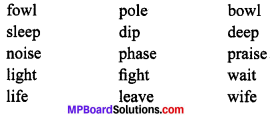
MP Board Class 9th Special English Grammar Type II

MP Board Solutions for Class 9 Special English Grammar Type II Questions and Answers aids you to prepare all topics in it effectively. You need not worry about accuracy of Madhya Pradesh State Board Solutions for Class 9 English Composition: Visual Stimulus as they are given adhering to latest exam pattern and syllabus guidelines. You Can Download MP Board Class 9 English Solutions Questions and Answers, Notes, Summary, Guide pdf on is page. Enhance your subject knowledge by preparing from Chapterwise MP Board Solutions for Class 9 English and clarify your doubts on corresponding topics.

MP Board Class 9th Special English Grammar Type II

Kick start your preparation by using our online resource Madhya Pradesh State Board Solutions for Class 9 Special English Grammar Type II. You can even download MP Board Solutions for Class 9 English free of cost rough direct links available on our page. Clear your queries and understand concept behind in a simple manner. Simply tap on concept you wish to prepare chapterwise and go rough it.

1. In the passage given-below one word has been omitted in each line. Write the missing word along with the word that comes before and the word that comes after it in your answer sheet against the correct blank number. Ensure that the word that forms your answer is underlined. (4 marks)

There was hardly political, social e.g. hardly any political
religious, agrarian, labor any other, (a)
problem which come under (b)
his purview and he did not (c)
deal on his own within the
framework of the (d)
principles which he held be
basic and (e)
fundamental. There hardly any
aspect of life (f)
in India which he influence
and fashion (g)
according his own pattern. (h)
Answer:
(a) labour or any
(b) which didn’t come
(c) and that he
(d) own or within
(e) held to be
(f) There was hardly
(g) he didn’t influence
(h) according to his.

2. In the following paragraph, one word has been omitted in each line. Write the missing word along with the word that comes before and the word that comes after it in your answer sheet against the correct blank number. Ensure that the word that forms your answer is underlined.

The holy man spoke Rama for e.g. spoke to Rama
a while. He then Rama’s mother (a)
that should send him to pray at the (b)
Kali Temple the village. He said (c)
that if prayed sincerely Kali (d)
would appear him and bless him. (e)
This he would make Rama’s fortune. (f)
Answer:
(a) then told Rama’s
(b) that she should
(c) Temple in the village
(d) if he prayed
(e) appear before him
(f) This way he.

3. In the following paragraph, one word has been omitted from each line. Write the missing word along with the word that comes before and the word that comes after it in your answer sheet against the correct blank number. Ensure that the word that forms your answer is underlined.

The holy man to Rama e.g., man spoke to
for a while. He to Rama’s mother (a)
that her son prayed sincerely (b)
to Kali village goddess ‘ (c)
he be blessed by her. (d)
This would his fortune and (e)
she would be free from worries. (f)
Answer:
(a) He said to
(b) that if her
(c) Kali the village
(d) he would be
(e) would change his
(f) from her worries.

4. In the following paragraph, one word has been omitted from each line. Write the missing word along with the word that comes before and the word that comes after it in your answer sheet against the correct blank number. Ensure that the word that forms your answer is underlined. (3 marks)

After the holy man had spoken Rama, e.g. spoken to Rama
he told Rama’s mother that should (a)
be sent to piay the Kali Temple at the (b)
village. He promised good lady that if (c)
this was done, Kali, the goddess appear, (d)
take pity on him and bless. Then all her (e)
worries would over. (f)
Answer:
(a) that he should
(b) pray at the
(c) promised the good
(d) goddess would appear
(e) bless him Then
(f) would be over.

5. In the passage given below one word has been omitted in each line. Write the missing word along with the word that comes before and the word that comes after it in your answer sheet against the correct blank number. Ensure that the word that forms your answer is underlined. (3 Marks)

Man’s increases by hard work. e.g. Man’s practice increases
If he does not it, his practice suffers. (a)
The lawyer is judged the cases that he wins (b)
The writers is examined (c)
by the of the readers and critics; whereas(d)
the typists is tested by his speed (e)
and the accuracy of his work. (f)
Answer:
(a) not do it
(b) judged by the
(c) writer’s capability is
(d) the opinion of
(e) typist’skill is
(f) àccuracy of his.

6. In the passage given below, one word has been omitted in each line. Write the missing word along with the word that comes before and the word that comes after it in your answer sheet against the correct blank number. Ensure that the word that forms your answer is underlined. (1/2 x 6 = 3 Marks)

There was a rich old man who in a palace, e.g. who lived in
There also lived nearby poor man in a hut. (a)
He on crumbs of food given by. others, (b)
But he cheerful and never complained. (c)
Once it happened that the poor man (d)
had to eat for a long while. So he (e)
went to the rich old man help. (f)
Answer:
(a) nearby a poor
(b) He survived on
(c) he remained cheerful
(d) it so happened
(e) had nothing to
(f) man for help

7. In the passage gien below, oie worcilias been omitted in each line. Write the missing word along with the word that comes before and the word that comes after it in your answer sheet against the correct blank number. Ensure that the word that forms your answer is underlined. (5 Marks)

The weather, in first-half e.g. in the first
of the English summer always known (a)
to be quite cold. But, what we aré at the (b)
moment here, is, I think rather exceptional (c)
summer—it is just too coki anyone’s liking. (d)
For, a cricketer, you have icy, chilly (e)
wiñds blowing your face, it certainly (f)
is far from a pleasant experience you are (g)
batting, bowling fielding. And, with (h)
the weather being what is right now, the (i)
visiting Indian team is finding it rather
tough to cope the conditions. (j)
Answer:
(a) summer is always
(b) are discussing at
(c) rather an exceptional
(d) cold for anyone’s’
(e) cricketer, if you
(f) blowing to your
(g) experience when you
(h) bowling or fielding
(i) what it is
(j) cope with the conditions.

8. In the passage given below, one word has been omitted in each line. Write the missing word along with the word that comes before and the word that comes after it in your answersheet against the correct blank number. Ensure that the word that forms your answer is underlined. (5 marks)

Within each the dialect areas, there is considerable e.g. each of the
variaticn in speech according education (a)
and social standing. Ther is
important polarity (b)
of uneducated educated speech in (e)
which former can be identified with (d)
the regional dialect most completely
latter moves (e)
away from dialect usage a form of (f)
English cuts across dialectical boundaries, so (g)
do features of uneducated use; a (h)
prominent example the double negative (j)
as in I don’t no cake. (J)
Answer:
(a) according to education
(b) is an important
(c) uneducated and educated
(d) which the former
(e) completely as latter
(f) usage to a form
(g) English that cuts
(h) do the features
(i) example is the
(j) don’t want no.

We believe information shared regarding MP Board Solutions for Class 9 Special English Grammar Type II Questions and Answers as far as our knowledge is concerned is true and reliable. In case of any queries or suggestions do leave us your feedback and our team will guide you at soonest possibility. Bookmark our site to avail latest updates on several state board Solutions at your fingertips.
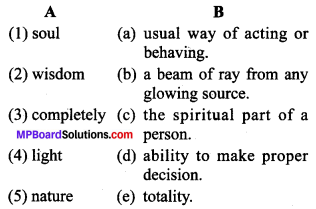
MP Board Class 9th English The Rainbow Workbook Solutions Chapter 12 The Poet and the Pauper

MP Board Solutions for Class 9 English The Rainbow Workbook Solutions Chapter 12 The Poet and the Pauper Questions and Answers aids you to prepare all topics in it effectively. You need not worry about accuracy of Madhya Pradesh State Board Solutions for Class 9 English Chapter 12 The Poet and the Pauper as they are given adhering to the latest exam pattern and syllabus guidelines. You Can Download MP Board Class 9 English Solutions Questions and Answers, Notes, Summary, Guide pdf on is page. Enhance your subject knowledge by preparing from Chapterwise MP Board Solutions for Class 9 English and clarify your doubts on corresponding topics.

MP Board Class 9th English The Rainbow Workbook Solutions Chapter 12 The Poet and the Pauper

Kick start your preparation by using our online resource Madhya Pradesh State Board Solutions for Class 9 English The Rainbow Workbook Solutions Chapter 12 The Poet and the Pauper. You can even download MP Board Solutions for Class 9 English free of cost rough direct links available on our page. Clear your queries and understand concept behind in a simple manner. Simply tap on concept you wish to prepare chapterwise and go rough it.

The Poet and the Pauper Vocabulary and Pronunciation

A. Point out the difference in meaning and use the words/phrases in your sentences.
See workbook page 88.
Answer:
Do yourself.

B. Point out the difference.
e.g. Have you got a car? / Do you have a car?
(First one is American English and the other is British English) He lives on the second floor. / He lives on the third story. What colour is this? / What color is this?
There is no petrol in my car. / There is no gas in my car.
I like biscuits. / I like cookies.
Answer:
Do yourself.

C. Complete the sentence by choosing the second half . The first one is done for you as
1. What sort of philistine are you,
esquir?
respected sir?
Mr.?
sir?

2. His teeth-
shiver.
ctter.
loiter.
bitter.

3. I set out job-
haunting,
hunting
discovering
inventing.

4. Why stay indoors when there’s such a lovely garden to walkout.
walkon.
walk in.
walk up.
Answer:

  1. sir
  2. chatter
  3. hunting
  4. walk-up.

Listening Skill

A. Listen to the story of a greedy doctor how once he missed, a good offer, unfortunately.

See workbook page 90.

Make response to the following querries orally.
1. What might the doctor have felt looking at the wallet
2. Why did the lady feel humiliated?
3. How many notes were there in the wallet?
4. Who was in loss, the doctor or the lady?
5. What would he have thought later on?
6. If you. were a doctor what would have you done? Share your views with your classmates.
Answer:
Do yourself.

Speaking Skill

The following is an example of a conversation on telephone, use it for a mock talk on telephone. Arrange yourself in pairs: See workbook pages 90-91.
Answer:
Do yourself.

Reading Skill

Question 1.
Read the following passage carefully and answer the questions given below it.

See workbook page 91.

(i) ‘the recipient of the Nobel Prize for literature’ implies that:
(a) Rabindranath Tagore owned a prize for his nobal deeds.
(b) He was awarded Nobal Prize, the highest form of international recognition in the field of literature.
(c) He won an award for his honesty.
Answer:
(b) He was awarded Nobal Prize, the highest form of international recognition in the field of literature.

(ii) ‘an opponent of colonialism’ refers to :
(a) Rabindranath Tagore’s struggle against the policy of acquiring . colonies and keeping them dependent.
(b) his fight with those who developed agricultural land into . colonies.
(c) his struggle for the rights of labourers living in unauthorized colonies.
Answer:
(a) Rabindranath Tagore’s struggle against the policy of acquiring . colonies and keeping them dependent.

(iii) ‘Self-imposed trial’ signifies :
(a) a hard and difficult task performed for a big gain.
(b) a task taken up to impress people.
(c) a challenging duty or task imposed upon oneself of one’s own volition without being forced.
Answer:
(c) a challenging duty or task imposed upon oneself of one’s own volition without being forced.

(iv) Rabindranath Tagore ranks with Gandhiji as one of the great heroes of India because
(a) He opposed colonialism.
(b) He was a man of strong determination and indomitable courage.
(c) All of the above.
Answer:
(c) All of the above.

Question 2.
Complete the following statements with relevant information given in the passage.

1. Rabindranath Tagore received the Noble Prize for………
Answer:
literature.

2. He devoted his own funds for the establishment of………..
Answer:
Shantiniketan School for peace at Bolpur.

3. Despite his sorrows and misfortunes, he moved courageously forward
Answer:
along the path of his mission for peace and happiness of mankind.

4. A person awakened to his own great mission can overcome grief and use
Answer:
expedience as a springboard to the next stage in a reatine life.

Question 3.
With the help of the information given in the passage, describe Rabindranath Tagore as :

(a) a literary figure
Answer:
He was awardee Noble Prize for literature, and highest intenation award.

(b) a nationalist
Answer:
He was an opponent of colonialism.

(c) an educationist
Answer:
He established Shantiniketan School for peace at Bolpur.

Language Practice (Grammar)
Study these sentences.

See workbook pages 93-95.

Rewrite the following sentences in indirect speech.

Question 1.
He said, “I have done my best and can do no more.”
Answer:
He said that he had done his best and could do no more.

Question 2.
The old man said, “My sons, I am dying, I wish you to get all my wealth.”
Answer:
The old man addressed his sons and said that he was dying and he wished them to get all his wealth.

Question 3.
She said to me, “I thank you for the help you have given me.”
Answer:
She thanked me for the help I had given her.

Question 4.
“Do as I tell you at once”, said the teacher angrily.
Answer:
The teacher angrily ordered me to»do at as he told.

Question 5.
He said, ’Time is tip, you can go now.” .
Answer:
He said that time was up and he could go them.

Question 6.
I said to him. “I was doing my duty.”
Answer:
I told him that I had been doing my duty.

Question 7.
He said, “I shall go there.”
Answer:
He said that he should go there.

Writing Skill

A. Write a story for your school magazine. (50 words)
Answer:
Once two friends were passing through a jungle. One said that he was a true friend and believe in the theory a friend in need is a friend indeed. Suddenly a bear came. The first ran away and climbed a tree while the other lied on the ground holding his breath. The bear sniffed him and went away. The first who was on the tree came down and asked what did the bear do with him. The other, replied that the bear had advised him not to live with a friend who runs away in dagger.

B. Write about the peculiar traits of Kunja Bihari’s personality. (150 words)
Answer:
Kunj Babu was an idealist. He was not a practical man. He asked the pauper not to use the word hunger’. He advised him not to make a fuss so his hunger. He bade him go away and satisfy his hunger there. Though it was the time for dinner yet he was not ready to feed an actually hungry person. He told the pauper that the spring breeze would suffice,for all his needs. Soon after he scolds the servant for preparing the dinner late. He lacked coordination in his thoughts, words and actions.

We believe the information shared regarding MP Board Solutions for Class 9 English The Rainbow Workbook Solutions Chapter 12 The Poet and the Pauper Questions and Answers as far as our knowledge is concerned is true and reliable. In case of any queries or suggestions do leave us your feedback and our team will guide you at soonest possibility. Bookmark our site to avail latest updates on several state board Solutions at your fingertips.
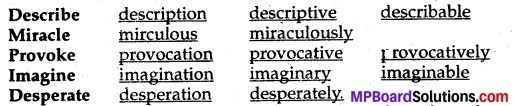
MP Board Class 9th Special English Grammar Type I

MP Board Solutions for Class 9 Special English Grammar Type I Questions and Answers aids you to prepare all topics in it effectively. You need not worry about accuracy of Madhya Pradesh State Board Solutions for Class 9 English Composition: Visual Stimulus as they are given adhering to latest exam pattern and syllabus guidelines. You Can Download MP Board Class 9 English Solutions Questions and Answers, Notes, Summary, Guide pdf on is page. Enhance your subject knowledge by preparing from Chapterwise MP Board Solutions for Class 9 English and clarify your doubts on corresponding topics.

MP Board Class 9th Special English Grammar Type I

Kick start your preparation by using our online resource Madhya Pradesh State Board Solutions for Class 9 Special English Grammar Type I. You can even download MP Board Solutions for Class 9 English free of cost rough direct links available on our page. Clear your queries and understand concept behind in a simple manner. Simply tap on concept you wish to prepare chapterwise and go rough it.

A variety of short questions involving the use of particular structures within a context (i.e. not in isolated sentences) Test type used will include, for example, gap-filling, cloze (gap filling exercise with blanks at regular intervals) sentence completion, sentence-reordering, editing, dialogue. Completion and sentence transformation, Not all elements in the grammar syllabus can be included in the question paper every year.

However, questions will be distributed over the following three broad areas: verb forms, sentence structure and others.

1. The following paragraph has not been edited. There is one error in each of the lines. Write the incorrect word and the correction in your answer sheet as given below against the s correct blank number. Remember to underline the word you have supplied. (1/2 x 8 = 4 marks)

Lila’s favourite subject in school was maths. She enjoys e.g. enjoy …………… enjoyed
solving problems, and was enthusiastic
for new problems (a)
done in class. But a lot many of her
friends found maths (b)
extremely difficult, and until they
thought it was a (c)
difficult subject they saw no point to work at it. (d)
Maths was the very least popular
subject in class. (e)
Then Lila decided to help three of her friend. She was (f)
patient and good in explaining things.
Her friends realised (g)
that maths is easy if they paid attention. (h)
Answer:
(a) for ………………… about
(b) lot many ………………… lot
(c) until ………………… till
(d) at ………………… on
(e) very least ………………… least
(f) friend ………………… friends
(g) in ………………… at
(f) is ………………… was

2. The following paragraph has not been edited. There is one error in each of the lines. Write the incorrect word and the correction in your answer sheet as given below against the correct blank number. Remember to underline the word you have supplied. (4 marks)

The Band-Aid was invented in New Jersey. e.g. enjoy ………… invented
Dickson was fretted as his wife
Josephine, cut (a)
herself again and again on
working in the (b)
kitchen. One day while he
was wrapping his (c)
wound once again on a bulky
bandage of gauze (d)
and tape, he was struck by a idea.
He put some (e)
gauze on a strip of the medical
tape and a (f)
Band-Aid was born. Billion of cuts
and scrapes (g)
later the Band-Aid is celebrating
it’s 75th birthday. (h)
Answer:
(a) fretted ………………… fretting
(b) on ………………… while
(c) his ………………… her
(d) on ………………… with
(ie) a ………………… an
(f) a ………………… the
(g) Billion ………………… Billions
(h) it’s ………………… its

3. The following passage has not been edited. There is one error in each of the lines. Write the incorrect word and the correction in your answer sheet as given below against the correct blank number. Remember to underline the word you have have supplied. (1/2 x 8 = 4 marks)

Longer before Newton. Aristotle and Galileo e.g. Longer ………… Long
have done a lot of research on the subject (a)
of gravity, Aristotle stating that a (b)
heavier object need fall to the Earth (c)
fastest than a lighter one. Legend has (d)
it that Galileo disproved those theories by (e)
throwing down objects with different weights (f)
from a Leaning tower of Pisa and (g)
proved that it took practically the (h)
same time to hit the ground.
Answer:
(a) have ……………….. had
(b) stating ……………….. stated
(c) need ……………….. needn’t
(d) fastest ……………….. fluster
(e) those ……………….. this
(f) with ……………….. Of
(g) a ……………….. the
(h) it ……………….. they

4. The following passage has not been edited. There is one error in each of the lines. Write the incorrect word and the correction in your answer sheet as given below against the correct blank number. Remember to underline the word that you have supplied.

Tests and examination are not
confined to school alone, e.g. examination …………………….. examinations
They are widely used at various (a)
Government and non-Government
level, (b)
Business and industry to is
using tests, (c)
Tests are used of the selection of
candidates (d)
and in some case they are one of
the criteria of (e)
s’ction. The success of a doctor is
tested àt his skill (f)
in diagnosis and cure. If he pass
this test (g)
his patient are extremely happy
aboutit. (h)
Answer:
(a) use …………………….. used
(b) level …………………….. levels
(c) is …………………….. are
(d) of …………………….. for
(e) case …………………….. cases
(f) lat …………………….. by
(g) pass …………………….. passes
(h) patient …………………….. patients

5. The following passage has not been edited. There is one error in each of the lines. Write the incorrect word and the correction in your answer sheet as given below against the correct blank number. Remember to underline the word you have supplied.

Mahatma Gandhi did not set out as evolve a e.g., as ……….. to
philosophy of life or formulate a system (a)
of beliefs or ideals. He had either the (b)
inclination nor the time for do so. (c)
He had, however, firm faith about truth (d)
and ahimsa and its practical application (e)
to life. They are said to be the (f)
constitute of his (g)
teachings and philosophies, (h)
Answer:
(a) of ………………………… for
(b) either ………………………… neither
(c) for ………………………… to
(d) about ………………………… in
(e) its ………………………… their
(f) They ………………………… These
(g) constitute ………………………… constituents
(h) philosophies ………………………… philosophy

6. The following passage has not been edited. There is one error in each of the lines. Write the incorrect word and the correction in your answer sheet as given below against the correct blank number. Remember to underline the word you have supplied.

More of the fun and excitement in your life comes e.g, More ………… Much
from use your senses. Senses open up a (a)
world who is full of sights, sounds, smells, (b)
tastes and dungs to touch. The
sharp your senses and the (c)
more you use it, more enjoyable each (d)
of this world’s become for you. (e)
For instant, a painter can see shades (f)
and shapes which little gifted (g)
people could not see. (h)
Answer:
(a) use ……………………… using
(c)the ……………………… that
(e) become ……………………… becomes
(g) little ……………………… less
(b) who ……………………… which
(d) i ……………………… them
(f) instant ……………………… instance
(h) could ……………………… can

7. The following passage has not been edited. There is one error in each of the lines. Write the incorrect word and the cor¬rection in your answer sheet as given below against the correct blank number. Remember to underline the word your have supplied.

Ha’nophilia arc one of the several e.g., is ………… are
sex linked genetic disorders which effects (a)
only males. This is because the disorders is (b)
caused with a.defective gene of the
X-chromosome. (c)
As the result, blood does not dot and
there is a (d)
risk for heavy bleeding even from
minor cuts (e)
and ihjuries. The disease is not affect
females, (f)
becatbe, from the two X-chromosomes
if one has (g)
the defective gene, then the other
do produce (h)
enough clotting factor.
Answer:
(a) effects …………………………. affects
(b) disorders …………………………. disorder
(c) with …………………………. by
(d) the …………………………. a
(e) for …………………………. of
(f) is …………………………. does
(g) from …………………………. between
(h) do …………………………. an

8. The following passage has not been edited. There is one error in each lines. Write the incorrect word and the correction in your answer sheet as given below against the correct blank number. Remember to underline the word that you have supplied. (½ x 8 = 4 Marks)

Even if Indians have a long history e.g. if ……… though
on them, they have a poor (a)
knowledge in maintaining homes, (b)
toilets, draperies on fridges. (c)
Modern detergents and soaps is (d)
very common in shelves, but (e)
people does not use them regularly, (j)
This cause the increase (g)
in a life of bacteria and viruses, (h)
Answer:
(a) on ……………………… behind
(b) in ……………………… about/of
(c) on ……………………… and
(d) is ……………………… are
(e) in ……………………… on
(f) does ……………………… do
(g) cause ……………………… causes
(h) a ……………………… the

9. The following passage has not been edited. There is one error in each of the lines. Write the incorrect word and the correction in your answer sheet as given below against the correct blank number. Remember to underline the word you supplied.

All life on earth can ultimately is e./g.. is ……… be
traced back on the sea. Creatures (a)
‘with limbs or fingers rather than (b)
Fins has evolved from fishes (c)
about 335 million years before, (d)
which remain a mystery. The new (e)
fossil find in a rock formation
near Scotland (j)
provides one of the few clues to
what has been (g)
happening on these 30 million years, (h)
Answer:
(a) on ………………………….. to
(b) or ………………………….. and
(c) has ………………………….. have
(d) before ………………………….. ago
(e) remain ………………………….. remains
(f) find ………………………….. found
(g) clue ………………………….. clues
(h) on ………………………….. over

10. The following passage has not been edited. There is one error in each of the lines. Write the incorrect word and the correction in your answer sheet as given below against the correct blank number. Remember to underline the word your have supplied.

Life was not as it seems to be. e.g., was …….. is
It is full of- up and downs, (a)
The grass always looks greener on the other side. (b)
We have a habit to grumbling, (c)
We are ever satisfied, (d)
We make our lives misery (e)
by expecting too much from everyone, (f)
This is what we face disappointment, (g)
So never expect anything and be happy, (h)
Answer:
(a) up ………………………… ups
(b) look ………………………… looks
(c) to ………………………… of
(d) ever ………………………… never
(e) misery ………………………… miserable
(f) expect ………………………… expecting
(g) what ………………………… why
(h) nothing ………………………… anything

11. The following passage has not been edited. There is one error in each line. Write the incorrect word and the correction in your answer sheet as given below against the correct blank number. Remember to underline the word you have supplied. (4 marks)
Ì’hanks to the current interest -for fitness e.g. for …………. in
and health that peoples are taking. (a)
In each locality, we find this da’s (b)
some centres and clubs is springing (c)
up and they are doing well in their (d)
new venture. But fortunately they (e)
are not within easy reach for all. (f)
Their fee are high and the centres (g)
suffer from lack in equipment and
many other essential services (h)
Answer:
(a) peoples ……………………. people
(b) this ……………………. these
(c) is ……………………. are
(d) do ……………………. doing
(e) fortunately ……………………. unfortunately
(f) all ……………………. many
(g) fee ……………………. fees
(h) in ……………………. of

12. That following passage has not been edited. There is one error in each of the lines. Write the incorrect word and the correction in your answer sheet as given below against the correct blank number. Remember to underline the word you have supplied. (½ x 8 = 4 Marks)

Rama was the boy from Tenali. 1-. e.g. the ……… a
loves to play pranks and didn’t take (a)
nothing seriously. His mother didn’t (b)
know what to do on him. She was sure (c)
he could be unable to do well in life. (d)
She hear that there was a wise man (e)
at the village. She told an holy man (f)
she was fed up with her son. She ask (g)
him to din any sense into Rama. (h)
Ans.
(a) loves …………………… loved
(b) nothing …………………… anything
(c) on …………………… with
(d) could …………………… would
(e) hear had …………………… heard
(f)an …………………… the
(g) ask …………………… asked
(h) any …………………… some

13. The following paragraph has not been edited. There is one mistake in each lines. Write the incorrect word and the correction in your answer sheet as given below against the correct blank numbei. Remember to underline the word you have supplied.

Rama lived in a village of Tenali. He loved e.g. a ……….. the
to play pranks and was always jokes. He (a)
refused to study but take anything seriously, (b)
His mother didn’t not know what to do (c)
with him. She feel he never would be (d)
enable to make something of himself. (e)
One day she take him to see a guru. She (f)
told the guru that he had had enough (g)
of her son. She asked him to get the
sense into Rama. (h)
Answer:
(a) jokes …………………….. joking
(b) but …………………….. or
(c) didn’t …………………….. did
(d) feel …………………….. felt
(e) enable …………………….. able
(f) take …………………….. took
(g) he …………………….. she
(h) the …………………….. some

14. The following passage has not been edited: There is one error in each of the lines. Write the incorrect word and the correction in your answer sheet as given below against the correct blank number. Remember to underline the word you have supplied. (½ x 8 = 4 Marks)

Rama was a naughty boy that lived e.g. that ……… who
in the village of Tenali. Her mother (a)
did not know what to do at him (b)
since he refused to study or did any (c)
work One day she take him to see (d)
a guru. She told an holy man (e)
that she were washing her hands (f)
off her son since he should (g)
make something about him. (h)
Answer:
(a) Her ………………………. his
(b) at ………………………. with
(c) did ………………………. do
(d) take ………………………. took
(e) an ………………………. the
(f) were ………………………. was
(e) since ………………………. and
(h) about ………………………. of

15. The following paragraph has not been edited. Thre is one error in each of the lines. Write the incorrect word and the correction in your answer sheet as given below against the correct blank number. Remember to underline the word you have supplied. (4 marks)

One day, the Nawab sent to his e.g. to ………. for
minister and asking him to (a)
measure the length into (b)
breadth of an entire earth (c)
from end to end but side to (d)
side. He also wished that a (e)
minister shoüld count all the (f)
star in the sky. The minister (g)
felt the Nawab was being too unfair to him. (h)
Answer:
(a) asking ……………………. asked
(b) into ……………………. and
(a) an ……………………. the
(d) but ……………………. and
(e) a ……………………. the
(f) should ……………………. could
(g) star ……………………. stars
(h) felt ……………………. feels

16. The following passage has not been edited. There is one error in each of the lines. Write the incorrect word and the correction in your answer sheet as given below against the correct blank number. Remember to underline the word that you

One moing, the Nawab call e.g. call …….. called
his minister and said to him (a)
that I wanted the length and (b)
breadth from the whole earth (c)
measured. He also to feel the (d)
need to have the stars in whole (e)
sky counted. The minister says (f)
that the task he have been (g)
set being impossible. (h)
Answer:
(a) said ……………………. told
(b) I ……………………. he
(c)from ……………………. of
(d) to ……………………. feel
(e) whole ……………………. the
(f) says ……………………. said
(g) have ……………………. had
(h) being ……………………. was

17. The ìillowing paragraph has not been edited. There is one error in each of the lines. Write the incorrect word and the correction in ýour answer sheet as given below against the correct blank number. Remember to underline the word you have supplied. (½ x 8 = 4 Marks)

When our earth was cover with water,
all creatures had to e.g. cover ……… cyere
swim on it. When the water subsided
and land appeared (a)
the sea creatures crawled out and
learnt to breathe (b)
and walk on land. When there are not
enough plants left to (c)
eat, they learnt to hunt and kill for the
food. Things are still (d)
changing and if one want to survive,
you will have to change (e)
too. Look even Mumbai has changed.
Fifty years past there (f)
were hill, gardens, beautiful villas where
now you see shops, (g)
traffics, crowds and slums, (h)
Answer:
(a) on ……………………. in
(b) breathing ……………………. to breathe
(c) are ……………………. were
(d) the ……………………. their
(e) one ……………………. you
(f) past ……………………. ago
(g) hill ……………………. hills
(h) traffics, crowds ……………………. traffic, crowd

18. The following passage has not been edited. There is one error in each of the lines. Write the incorrect word and the correction in your answer sheet as given below against the correct blank number. Remember to underline the word that you have supplied. (1/2 x 8 = 4 Marks)

One day, the Nawab sent words e.g. words ……… word
to his minister that I wanted (a)
entire earth measured from (b)
side to side and of end to end. (c)
He would also great appreciate (d)
it, if the minister count the (e)
stars and the sky as well. The (f)
minister say it was impossible, (g)
no one will do such a thing. (h)
Answer:
(a) I …………………….. He
(b) a …………………….. the
(c) of …………………….. from
(d) great …………………….. greatly
(e) of …………………….. from
(f) great …………………….. greatly
(g) of …………………….. from
(h) great …………………….. greatly

We believe information shared regarding MP Board Solutions for Class 9 Special English Grammar Type I Questions and Answers as far as our knowledge is concerned is true and reliable. In case of any queries or suggestions do leave us your feedback and our team will guide you at soonest possibility. Bookmark our site to avail latest updates on several state board Solutions at your fingertips.

MP Board Class 9th General English The Spring Blossom Solutions Chapter 1 O Light!

MP Board Solutions for Class 9 Textbook General English The Spring Blossom Solutions Chapter 1 O Light! Questions and Answers aids you to prepare all topics in it effectively. You need not worry about accuracy of Madhya Pradesh State Board Solutions for Class 9 English Composition: Visual Stimulus as they are given adhering to latest exam pattern and syllabus guidelines. You Can Download MP Board Class 9 English Solutions Questions and Answers, Notes, Summary, Guide pdf on is page. Enhance your subject knowledge by preparing from Chapterwise MP Board Solutions for Class 9 English and clarify your doubts on corresponding topics.

MP Board Class 9th General English The Spring Blossom Solutions Chapter 1 O Light!

Kick start your preparation by using our online resource Madhya Pradesh State Board Solutions for Class 9 Textbook General English The Spring Blossom Solutions Chapter 1 O Light!. You can even download MP Board Solutions for Class 9 English free of cost rough direct links available on our page. Clear your queries and understand concept behind in a simple manner. Simply tap on concept you wish to prepare chapterwise and go rough it.

O Light! Textual Exercises

Word Power

(i) Encircle the odd one among the similar sounding words:
(असमान शब्द छाँटिए)
Answer:
MP Board Class 9th General English The Spring Blossom Solutions Chapter 1 O Light! 1

(ii) Match the words with their meanings given as under:
(सुमेलित कीजिए)
MP Board Class 9th General English The Spring Blossom Solutions Chapter 1 O Light! 2
Answer:
(1) → (c)
(2) → (d)
(3) → (e)
(4) → (b)
(5) → (a)

How Much Have I Understood?

(A) Answer these questions in one or two sentences
(निम्न प्रश्नों के उत्तर एक या दो वाक्यों में दीजिए।)

Question 1.
What is the sun?
(व्हॉट इज़ द सन?)
सूर्य क्या है?
Answer:
The sun is the source of light.
(द सन इज़ द सोर्स ऑफ लाईट।)
सूर्य प्रकाश का स्रोत है।

Question 2.
Who is the poem addressed to?
(हू इज द पोऍम अड्रेस्ड टू?)
कविता किसको सम्बोधित है?
Answer:
The poem is addressed to light.
(द पोऍम इज़ एड्रेस्ड टू लाईट।)
कविता प्रकाश को सम्बोधित है।

Question 3.
Whose life and soul is the light?
(हूज़ लाइफ एण्ड सोल इज़ द लाईट?)
प्रकाश किसका जीवन व आत्मा है?
Answer:
The light is the life and soul of sun.
(द लाइट इज द लाइफ एण्ड सोल ऑफ सन)
प्रकाश सूर्य का जीवन व आत्मा है।

Question 4.
Is the light wisdom’s daughter?
(इज़ द लाइट विज़डम्स डॉटर?)
क्या रोशनी (प्रकाश) विवेक की पुत्री है?
Answer:
No, light is not wisdom’s daughter.
(नो, लाईट इज़ नॉट विजडम्स डॉटर।)
नहीं, रोशनी (प्रकाश) विवेक की पुत्री नहीं है।

(B) Answer these questions in three or four sentences.
(निम्न प्रश्नों के उत्तर तीन या चार वाक्यों में दीजिए।)

Question 1.
‘Light is the form of knowledge.’ Elaborate.
(‘लाईट इज़ द फॉर्म नॉलेज’ इलैबोरेट।)
‘प्रकाश ज्ञान का स्वरूप है।’ विस्तार से बताइये।
Answer:
When a man sleeps he only sees darkness. He cannot do anything. But when light comes he wakes up. He can do anything. An ignorant person is like a sleeping person. When he gets knowledge, he becomes powerful. So’we can say that light is the form of knowledge

(व्हेन अ मैन स्लीप्स ही ओनली सीज़ डार्कनेस। ही कैन नॉट डू एनीथिंग। बट व्हेन लाईट कम्स ही. वेक्स अप। ही कैन डू एनीथिंग। एन इगनोरेन्ट पर्सन इज़ लाइक अ स्लीपिंग पर्सन। व्हेन ही गेट्स नॉलेज, ही बिकम्स पावरफुल। सो वी कैन से दैट लाईट इज द फॉर्म ऑफ नॉलेज।)

जब कोई व्यक्ति सोता है तो उसे सिर्फ अन्धकार दिखाई देता है। वह कुछ भी करने में सक्षम नहीं होता। परन्तु जब सूर्य का प्रकाश फैलता है तो वह जाग उठता है। तब वह कुछ भी कर सकता है। एक अज्ञानी व्यक्ति भी सोए हुए व्यक्ति की तरह होता है। जब ज्ञान का प्रकाश उसके अज्ञान रूपी अन्धकार को दूर करता है तब वह प्रबुद्ध हो जाता है। इस प्रकार हम कह सकते हैं कि ज्ञान प्रकाश का स्वरूप है।

Question 2.
Why does the poet long for the light? Give some references from the poem.
(व्हॉय डज द पोएट लाँग फोर द लाईट? गिव सम रेफरेन्सेस फ्रॉम द पोऍम।)
कवि प्रकाश की इच्छा क्यों करता है? कविता से कुछ सन्दर्भ दीजिए।
Answer:
The poet longs for light because he wants to know from the light, the following things :
(a) When was it born?
(b) Who made it?
(c) What is it?
(d) What is its nature?

“(द पोऍट लॉग्स फॉर लाईट बिकॉज़ ही वॉन्ट्स टू नो फ्रॉम द लाईट, द फॉलोइंग थिंग्स:
(a) व्हेन वॉज़ इट बॉर्न?
(b) हू मेड इट?
(c) व्हॉट इज़ इट?
(a) व्हॉट इज़ इट्स नेचर?)

कवि प्रकाश की कामना इसलिए करता है क्योंकि वह उससे यह जानना चाहता है कि वह कबं पैदा हुआ, उसे किसने बनाया, वह क्या है तथा उसकी प्रकृति क्या है?

Question 3.
The poet has used the word ‘she’. Who has this word been referred to?
(द पोऍट हैज यूज्ड द वर्ड ‘शी’। हू हैज दिस वर्ड वीन रैफर्ड टू?)
कवि ने स्त्री सूचक ‘वह’ शब्द का प्रयोग किया है। इस शब्द.का इशारा किसकी ओर है?
Answer:
‘She’ refers to mother nature.
(‘शी’ रैफर्स टू मदर नेचर।)
उसका इशारा प्रकृति माता की ओर है।

Question 4.
Find out the lines of the poem where the poet praises the light.
(फाइन्ड आउट द लाइन्स ऑफ द पोऍम व्हेअर द पोऍट प्रेज़ेज़ द लाईट।)
वे पंक्तियाँ ढूँढ निकालिए जिनमें कवि ने उजाले की प्रशंसा की है।
Answer:
The lines are-
The sun is the body, you are its life-spark.
Perhaps you are wisdom’s clarity.
Perhaps you are the form of knowledge.

Listening Time

Complete the following stanza.
(निम्नलिखित पद्यांश को पूरा करिए।)
Answer:
O Light, who are you?
Daughter of the sun?
No, you are the sun’s life, his soul,
We praise you in the sun.
The sun is the body, you are its life-spark.

Speaking Time

(1) The sun is the source of light. Think for other sources of light and talk about those sources.
(प्रकाश के स्रोतों के बारे में लिखिए।)
Answer:

  1. Fire is the source of light.
  2. Electricity is the source of light.
  3. Moon is the source of light at night.
  4. Candle is the source of light.
  5. Stars are the source of light.

(2) In the morning when light spreads, darkness disappears. Discuss in groups and describe what happens when light fades?
(जब रोशनी कम हो जाती है तो क्या होता है वर्णन कीजिए)
Answer:

  1. When light fades sun disappears.
  2. When light fades it becomes dark.
  3. When light fades moon and stars appear.
  4. When light fades sky. becomes black.

Writing Time

Write the poem “O Light!” in prose form.
(कविता ‘ओ उजाले’ गद्यांश के रूप में लिखिए।)
Answer:
Students should do themselves.
(छात्र स्वयं करें।)

Things to do

(1) Make a list of the different planets of the solar system and draw a diagram in proper order.
(विभिन्न ग्रहों के नाम लिखो व चित्र बनाओ।)
Answer:
Different planets of the solar system are:

  1. Mercury
  2. Venus
  3. Earth
  4. Mars
  5. Jupiter
  6. Saturn
  7. Uranus
  8. Neptune.

Students can draw the diagram of the solar system themselves placing the planets in the above order.

(2) Light is the source of energy. Write at-least five different uses of light in our day to day life.
(प्रकाश के पाँच उपयोग लिखिए।)
Answer:
Uses of light:

  1. Light makes things visible.
  2. Light is the source of heat.
  3. Light kills harmful germs in the atmosphere.
  4. Light in the form of solar energy can be used to cook food.
  5. Solar energy is used to obtain electricity through solar cells.

O Light! Central Idea of the Poem

The poet says that light is the soul of the sun. Later on he calls this light as wisdom and knowledge. The poet says that the nature is the enchanter, for it has created light. In the end the poet praises the light to prosper and bring the light of knowledge in this world.

O Light! Difficult Word Meanings

soul (सोल)-spirit of a person आत्मा; Praise (प्रेज़)-to express admiration प्रशंसा करना; life spark (लाइफ स्पाक)-life giving light जीवनदायी प्रकाश; clarity (क्लैरिटी)-the quality of being expressed clearly स्पष्टता; merge (मज)-combine मिलना; she (शी)-mother nature (symbolical use) प्रकृति; bewitcher (बिवियर)-one who puts a magical spell (जादू करने वाला); prosper (प्रॉस्पर)-to be successful, समृद्ध होना।

O Light! Summary, Pronunciation & Translation

[1] O Light, who are you?
Daughter of the sun?
No, you are the sun’s life, his soul
We praise you in the sun.
The sun is the body, you are its life-spark
When were you born, O Light?
Who made you?

(ओ लाइट हू आर यू?
डॉटर आफ द सन?
नो, यू आर द सन्स लाइफ, हिज़ सोल!
वी प्रेज़ यू इन द सन द सन
इज़ द बॉडी, यू आर इट्स लाइफ स्पार्क
व्हेन वर यू बॉर्न, ओ लाइट?
हू मेड यू?)

हिन्दी अनुवाद :
हे रोशनी, तुम कौन हो?
सूर्य की पुत्री?
नहीं, तुम सूर्य का जीवन हो, उसकी आत्मा हो,
हम तुम्हारी सूर्य में स्तुति करते हैं।
सूर्य शरीर है, तुम उसके जीवन की चिंगारी हो
तुम कब पैदा हुईं, हे रोशनी?
तुम्हें किसने बनाया?

[2] O Light, what are you?
What is you nature?
Are you wisdom’s daughter?
But Wisdom sleeps.

(ओ लाइट, व्हॉट आर यू?
व्हॉट इज यूअर नेचर?
आर यू बिस्डम्स डॉटर?
बट विस्डम स्लीप्स।)

हिन्दी अनुवाद :
हे रोशनी, तुम क्या हो?
तुम्हारा स्वभाव कैसा है?
क्या तुम बुद्धि की पुत्री हो?
किन्तु बुद्धि तो सोई रहती है।

[3] Perhaps you are its clarity
Perhaps you are the form of knowledge.
O Light, for how long have you
befriended the sky?
And wherefore this love of it?
How do you completely merge in it?

(परहेप्स यू आर इट्स क्लैरिटी
परहेप्स यू आर द फॉर्म आफ नॉलेज
ओ लाइट फोर हाउ लांग हेव यू
बिफ्रेन्डड द स्काय?
एण्ड व्हेअर फोर दिस लव आफ इट?
हाउ डू यू कम्प्लीटली मर्ज इन इट?)

हिन्दी अनुवाद :
शायद तुम उसकी स्पष्टता हो।
शायद तुम ज्ञान का प्रकट रूप हो।
हे रोशनी, तुमने कब से
आकाश को अपना मित्र बनाये हुए हो?
किस तरह तुम उसमें पूर्णतः समा जाती हो?

[4] She who made you all is a magician
She is enchanter, the bewitcher
We praise her
Prosper O Light. – Subramania Bharti

(शी हू मेड यू ऑल इज़ ए मेजिशियन
शी इज़ इन्चान्टर, द बिविचर
वी प्रेज़ हर
प्रॉस्पर ओ लाइट)

हिन्दी अनुवाद :
वह जिसने तुम्हें बनाया पूरी तरह जादूगरनी है
वह मायावी मोहिनी शक्ति है।
हम उसकी स्तुति करते हैं
हे रोशनी, तुम खूब फलो फूलो।

We believe information shared regarding MP Board Solutions for Class 9 Textbook General English The Spring Blossom Solutions Chapter 1 O Light! Questions and Answers as far as our knowledge is concerned is true and reliable. In case of any queries or suggestions do leave us your feedback and our team will guide you at soonest possibility. Bookmark our site to avail latest updates on several state board Solutions at your fingertips.

MP Board Class 9th English The Rainbow Workbook Solutions Chapter 11 Grandpa Fights an Ostrich

MP Board Solutions for Class 9 English The Rainbow Workbook Solutions Chapter 11 Grandpa Fights an Ostrich Questions and Answers aids you to prepare all topics in it effectively. You need not worry about accuracy of Madhya Pradesh State Board Solutions for Class 9 English Chapter 11 Grandpa Fights an Ostrich as they are given adhering to the latest exam pattern and syllabus guidelines. You Can Download MP Board Class 9 English Solutions Questions and Answers, Notes, Summary, Guide pdf on is page. Enhance your subject knowledge by preparing from Chapterwise MP Board Solutions for Class 9 English and clarify your doubts on corresponding topics.

MP Board Class 9th English The Rainbow Workbook Solutions Chapter 11 Grandpa Fights an Ostrich

Kick start your preparation by using our online resource Madhya Pradesh State Board Solutions for Class 9 English The Rainbow Workbook Solutions Chapter 11 Grandpa Fights an Ostrich. You can even download MP Board Solutions for Class 9 English free of cost rough direct links available on our page. Clear your queries and understand concept behind in a simple manner. Simply tap on concept you wish to prepare chapterwise and go rough it.

Grandpa Fights an Ostrich Vocabulary and Pronunciation

A. Match ‘A’ with ‘B’
‘A’ – ‘B’
1. awful – (a) look steadily at Wit h wide open eyes.
2. agressive – (b) to escape – especially by means of a trick.
3. stare – (c) causing great fear
4. elude – (d) often
5. frequently – (e) quick to attack
Answer:
1. c, 2. e, 3. a, 4. b, 5. d.

B. Refer to a dictionary to find out the grammatical classes of the following words. Write the different forms of the words too.
Example : splendour (noun), splendid (adjective), splendidly (adverb)
Answer:
MP Board Class 9th English The Rainbow Workbook Solutions Chapter 11 Grandpa Fights an Ostrich 1

c. Distinguish between the following words given in pairs. . during and for, great and big, ‘as well as’ and ‘as’, forward and centre (in sports).

Listening Skills

Listen to the following sentences. Pay attention to the tones. See workbook page 81,
Answer:
For self attempt.

Speaking Skill

You have been to a national park. Now narrate the events right , from your preparations to the completion of it.

See workbook page 81.

Answer:
For self attempt

Reading Skill

Read the following passage carefully and answer the questions given below it.

See workbook page 82.

Question 1.
Answer these questions in brief :

(a) Haw was the writer driven to the shore ?
Answer:
A raging wave drove the writer to the shore.

(b) When the wave left him on the shore, how could he rescue himself ?
Answer:
Seeing himself nearer the mainland, the writer got upon his feet and endeavored to make on towards the land as fast as he could.

(c) Write any two efforts by which he saved himself.
Answer:
He hold his breath and raised himself upon water. He held his hold till the wave aboled and ran towards the mainland.

Question 2.
Pick out the words from the passage which have following meanings.
(a) An attempt to do something especially something new or difficult
(b) To keep a particular quality, feature etc
(c) Climbed or moved with difficulty or a lot of effort
(d) Diminished
Answer:
(a) endeavore
(b) preserre
(c) clambered
(d) abated.

Language Practice (Grammar)

A. Study these sentences.

See workbook pages 83-85

Fill in the blanks with appropriate connectors given in brackets :
1. She is ………….a nurse nor a doctor, ………………(neither, either)
2. She may go either to Mumbai ………………..to Agra, (or, nor)
3. He is poor…………….he deserves help, (as, as, so ,that)
4. The patient had died ………. the doctor arrived, (before,than)
5. Nitin is richer…………… his brother Pankaj. (as, than)
Answer:

  1. neither
  2. or
  3. so,that,
  4. before
  5. than.

Join these sentences with suitable connectors :

Question 1.
We opened the cage. The bird flew away.
Answer:
As we opened the cage the bird flew away.

Question 2.
The elephant can raise heavy logs. It is strong.
Answer:
The elephant is so strong that it can raise heavy logs.

Question 3.
Will you lend me your book ? I have lost mine.
Answer:
Will you lend me your book because I have lost mine.

Question 4.
I went home. I knocked at the door.
Answer:
I went home and knocked at the door.

Question 5.
Neha failed. She worked hard.
Answer:
Neha failed in spirit of her hard work.

Question 6.
Sonu took a taxi. It was raining.
Answer:
Since it was raining Sonu took a taxi.

Question 7.
We ran all the way. We were late for school.
Answer:
We ran all the way because we were late for school.

Writing Skill

A. Talk to some elderly person who has retired an active profession. Find out his daily routine. Then write a paragraph on ‘A’ memorable say in his life. (50 words)
Answer:
Last week I met Mr. Mehra my new neighbour. I talked to him for long. He told me that life is full of obstacles. Everyone has to encounter a dangerous situation some time or the other. Those who get nervous have to pay through the nose. One should learn from one’s own and other’s experiences not to lose heart but show hit wit and manliness at such times. One must always remain prepared for the worst. He told me an interesting story one day he had picked up five oranges from a cart. His pockets were bulging with them. A policeman. In the meanwhile. He ate the oranges with fibre, barks and pips. The policemen arrived. They found no evidence against I me. They released him with a cheerful face. A thief’s experience had helped him. It was a memorable day in his life.

B. Imagine: You went by ship to Lakshadweep with your friends. A storm drifts your ship to an known island. Write about your adventurous journey. (150 words)
Answer:
Once I had been to Lakshadweep with my friends. It was an adventurous moment of my life. We went by ship. We started in a pleasant weather condition. But just after a few km in the sea we saw that the situation of a storm was rising. Suddenly it grew dark and a huge storm in the sea arise. First it was no so terrible s but sonn its speed was alarming our ship lost its way and was drafted to some unknown direction. We lost our way and also the hope of our life. However after struggling for two days we came to an unknown island. It was not inhabited. We were a bit relaxed. Now then was the problem of food and drinkable water which we had no more with. We were searched to eat anything there. The storm cooled down the next day luckily and we made our way to a safe destination. At last we were safe. It was an unforgettable experience.

We believe the information shared regarding MP Board Solutions for Class 9 English The Rainbow Workbook Solutions Chapter 11 Grandpa Fights an Ostrich Questions and Answers as far as our knowledge is concerned is true and reliable. In case of any queries or suggestions do leave us your feedback and our team will guide you at soonest possibility. Bookmark our site to avail latest updates on several state board Solutions at your fingertips.