MP Board Class 10th Social Science Book Solutions सामाजिक विज्ञान in Hindi & English Medium

MP Board Class 10th Social Science Book Solutions सामाजिक विज्ञान in Hindi & English Medium

MP Board Class 10th Social Science Solutions Guide Pdf Free Download सामाजिक विज्ञान in both Hindi Medium and English Medium are part of MP Board Class 10th Solutions. Here we have given Madhya Pradesh Syllabus MP Board Class 10 Social Science Book Solutions Samajik Vigyan Pdf, Important questions for class 10 social science MP Board.

MP Board 10th Maths Solution

Students can also download MP Board 10th Model Papers to help you to revise the complete Syllabus and score more marks in your examinations.

MP Board Class 10th Social Science Book Solutions in Hindi Medium

सामाजिक विज्ञान कक्षा 10 MP Board 2020 Book Solutions in Hindi Medium

MP Board 10th Class Social Science Book Solutions Geography भूगोल

Social Science Class 10 MP Board Solutions History इतिहास

MP Board Social Science Book Class 10 Civics नागरिकशास्त्र

MP Board Class 10 Social Science Book Solution Economics अर्थशास्त्र

MP Board Class 10th Social Science Book Solutions in English Medium

MP Board 10th Class Social Science Book Geography Solutions

Social Science Class 10 MP Board History Solutions

Class 10 Social Science MP Board Civics Solutions

MP Board Social Science Book Class 10 Solutions Economics Solutions

MP Board Class 10th Social Science Syllabus

इकाई 1: भारत में संसाधन : प्रकार (10 Marks)
प्राकृतिक संसाधन-मृदा, बनावट, प्रकार, वितरण और संरक्षण।
वन एवं वन्य प्राणी-वनों के प्रकार एवं उपयोगिता, वनस्पति, वन्य प्राणी एवं उनकी सुरक्षा, समाप्त हो रहे वन्य प्राणी।
कृषि-मुख्य फसलें, कृषि का राष्ट्रीय अर्थव्यवस्था में योगदान, औषधीय उद्यान विधि, उसकी उपयोगिता एवं सुरक्षा।
जल संसाधन-प्रकार, स्रोत, वितरण एवं उपयोगिता एवं जल सुरक्षा।
खनिज संसाधन-प्रकार, वितरण, उपयोग, संरक्षा एवं आर्थिक महत्व।
शक्ति के साधन-प्रकार, पारम्परिक एवं गैर-पारम्परिक साधन, वितरण, उपयोग एवं संरक्षण।

इकाई 2: उद्योग – प्रकार, विशिष्ट उद्योगों का विवरण, राष्ट्रीय अर्थव्यवस्था में योगदान, औद्योगिक प्रदूषण एवं उसके नियन्त्रण के उपाय। (5 Marks)

इकाई 3: परिवहन, संचार एवं विदेशी व्यापार (5 Marks)
परिवहन-उपयोगिता एवं साधन : रेलमार्ग, सड़कमार्ग, वायुमार्ग, जलमार्ग, पाइप, पोत और पोताश्रय।
संचार-आधुनिक युग में संचार के साधनों की महत्ता, प्रमुख संचार के साधन, विदेशी व्यापार का आर्थिक विकास में योगदान, आयात एवं निर्यात।

इकाई 4: आपदा प्रबन्धन (5 Marks)
प्राकृतिक आपदाएँ – सूखा, बाढ़, भूकम्प, भूस्खलन, सुनामी।
मानवकृत आपदाएँ – आण्विक, जैविक एवं रासायनिक, बम विस्फोट।
सामान्य आपदाएँ – सावधानी एवं सुरक्षा।

इकाई 5: मानचित्र-पठन एवं अंकन (5 Marks)

इकाई 6: प्रथम स्वतन्त्रता संग्राम एवं उसके पश्चात् (10 Marks)
1857 का प्रथम स्वतन्त्रता संग्राम एवं प्रमुख क्रान्तिकारियों का परिचय, भारतीय राष्ट्रीय कांग्रेस का जन्म-उदारवाद एवं अनुदारवाद।

इकाई 7: स्वतन्त्रता आन्दोलन से सम्बन्धित घटनाएँ (10 Marks)
भारतीय स्वतन्त्रता संग्राम की महत्वपूर्ण घटनाएँ, जैसे-बंगभंग विरोधी आन्दोलन, 1947 में भारत विभाजन एवं प्रमुख विशेषताएँ।
स्वतन्त्रता संग्राम में मध्यप्रदेश का योगदान।

इकाई 8: स्वातन्त्र्योत्तर भारत की प्रमुख घटनाएँ (10 Marks)
कश्मीर समस्या, भारत के सीमावर्ती राष्ट्रों से सम्बन्ध, 1962 का चीन युद्ध, 1965 एवं 1971 के भारत-पाक युद्ध, बांग्लादेश का उदय, भारत में आपातकाल, भारत का आण्विक शक्ति के रूप में उदय।

इकाई 9: भारतीय संविधान (6 Marks)
संविधान सभा का गठन-प्रारूप समिति, भारतीय संविधान की विशेषताएँ।

इकाई 10: भारतीय प्रजातन्त्र की कार्यप्रणाली (7 Marks)
प्रशासनिक व्यवस्था संघात्मक शासन, प्रशासनिक शक्तियों का केन्द्र व राज्य सरकार के मध्य विभाजन, सरकार का स्वरूप व्यवस्थापिका, कार्यपालिका, न्यायपालिका, स्थानीय प्रशासन।

इकाई 11: प्रजातन्त्र के समक्ष प्रमुख चुनौतियाँ (7 Marks)
जनसंख्या विस्फोट, बेरोजगारी, साम्प्रदायिकता, आतंकवाद, मादक पदार्थों का सेवन, प्रजातन्त्र की सफलता में बाधक तत्व एवं उनको दूर करने के उपाय।

इकाई 12: आर्थिक विकास की कहानी (5 Marks)
आर्थिक विकास की प्राचीन एवं अर्वाचीन अवधारणा। राष्ट्रीय एवं प्रति व्यक्ति आय।
मानव विकास के संकेतक भौतिक-अभौतिक उदाहरण सहित, विकसित एवं विकासशील राज्य उदाहरण सहित, भारत में आर्थिक नियोजन, ग्रामीण विकास एवं रोजगार गारण्टी योजना।
मुद्रा एवं वित्तीय प्रणाली-प्राचीन मुद्रा का परिचय, वित्तीय प्रणाली, वित्त संस्थाएँ, जैसे-साहूकार, जमींदार, स्वसहायता समूह, चिट फण्ड, निजी वित्तीय संस्थाएँ एवं विभिन्न बैंक।

इकाई 13: सेवा क्षेत्र (5 Marks)
सेवा क्षेत्र-अर्थ एवं महत्व-आय के घटक के रूप में।
अधोसंरचना-आर्थिक एवं सामाजिक संस्थागत क्षेत्र में भारतीय सेवाओं का विश्व में योगदान।

इकाई 14: उपभोक्ता जागरूकता (5 Marks)
उपभोक्ता जागरूकता-आवश्यकता एवं महत्व-उपभोक्ता शोषण-कारण एवं निदान, वस्तुओं का मानकीकरण, शासन की भूमिका।

इकाई 15: आर्थिक प्रणाली एवं वैश्वीकरण (5 Marks)
आर्थिक प्रणाली-अर्थ, पूँजीवाद, समाजवाद एवं मिश्रित अर्थव्यवस्था के लक्षण, गुण एवं दोष। वैश्वीकरण-अर्थ, आवश्यकता, 1991 से पूर्व विकास एवं 1991 से वर्तमान तक सुधार, वैश्वीकरण के प्रभाव।

MP Board Class 10th Social Science Marking Scheme

इकाई क्र.इकाई का नामकालखण्डअंक
1.भारत में संसाधन2010
2.उद्योग0705
3.परिवहन, संचार एवं विदेशी व्यापार0605
4.आपदा प्रबन्धन0505
5.मानचित्र-पठन एवं अंकन0505
6.प्रथम स्वतन्त्रता संग्राम एवं उसके पश्चात्1510
7.स्वतन्त्रता आन्दोलन से सम्बन्धित घटनाएँ1510
8.स्वातंत्र्योत्तर भारत की प्रमुख घटनाएँ1510
9.भारतीय संविधान1206
10.भारतीय प्रजातन्त्र की कार्यप्रणाली1207
11.प्रजातन्त्र के समक्ष प्रमुख चुनौतियाँ1207
12.आर्थिक विकास की कहानी1005
13.सेवा क्षेत्र0805
14.उपभोक्ता जागरूकता0805
15.आर्थिक प्रणाली और वैश्वीकरण1005
पुनरावृत्ति20
कुल योग (पूर्णांक)100

MP Board Class 10th Social Science Syllabus in English Medium

सामाजिक विज्ञान कक्षा 10 MP Board

1. Indian Resources:
Types of Resources: Natural resources – Soil Formation types and distribution, soil conservation.
Forest and Wild Life: Forest types, Utility, Wild animals and their conservation Endangered animals.
Agriculture – Main crops. Contribution and Agriculture of National Economy, Flerbal Farms & their utility.
Water Resources – Types, Sources, Distribution of Agriculture, to National Economy Herbal Farms & their utility.
Water Resources – Types, Sources, Distribution, Use, Protection & Conservation.
Mineral Resources – Types, Distribution, Use, Conservation and Economic importance.
Power Resource – Types, Conventional & Non-Conventional, Distribution, Utilisation & Conservation.

2. Industry:
Types, Description of’ Special Industrial, Contribution of Industries to National Economy, Industrial Pollution and efforts for a solution.

3. Transport, Communication and Foreign Trade:
Transport – Utility and types – Railways, Roadways, Airways, Waterways, Pipeline Ports & Harbours.
Communication, Importance of Communication in modern days, Means of Communication. Contribution of foreign Trade to Indian Economy, Imports and Exports.

4. Disaster Management:
Natural Calamities – Drought, Flood, Earthquake, Landslides, Tsunami.
Man-Made Calamities – Nucleic, Biotic and Chemical, Bomb Blast.
General Calamities – Precautions and Security.

5. Maps – Reading and Marking

6. First Struggle of Freedom and after:
The first struggle for Freedom of 1857. Introduction to important revolutionaries, the birth of India National Congress, Moderates and Extremes.

7. Events related to the Independence Revolution
Important events of the Indian struggle for Independence, Revolution of Bange Bhang Partition of India in 1947 and its silent features, Contribution of Madhya Pradesh to the Freedom Struggle.

8. Major events of the Post-Independence period:
Kashmir Problem India’s relation with neighbouring countries, Chinese were with India in 1962, India-Pakistan war of 1965 and 1971, the birth of Bangladesh, emergency in India, Rise of India as atomic power.

9. Indian Constitution:
The organisation of Constitution Draft Committee, Salient Features of Indian Constitution.

10. Working of Indian Democracy:
Federal System, Division of Administrative Power between Centre and States, Organs of Government: Legislature, Executive and Judiciary, Local Administration.

11. Major Challenges before Democracy:
Increase in Population, Unemployment, Communalism, Terrorists, drug addiction;
Major Hindrance in Success of Democracy and measures for removal.

12. Story of Economic Development:
Ancient and modem concept of economic development. National Income & Per-capital Income, Indicators of human development, developing States with examples, Economic Planning in India, physical and non-physical with examples.
Money and Financial System: An Introduction to money in ancient time, Financial Institutions such as money lenders, Zamindars, Self helps groups, chit funds, private financial institutions and different types of banks.

13. Service Sector:
Service Sector – Meaning and Importance as a Component in Income, Infrastructure-Economic and Social Contribution of India’s Service sector in the World.

14. Consumer Awareness:
Consumer Awareness – Need and Importance, Consumer Exploitation, Causes and Remedies, Stadarlisation of Commodities, Government Role.

15. Economic System and Globalisation:
Economic System – Meaning, Capitalism, Socialism and Mixed Economy Characteristics, Merits and Demerties.
Globalisation – Meaning, Needs, Development Earlier to 1991 and Modern Reforms, Impact of Globalisation.

MP Board Class 10th Social Science Marking Scheme in English Medium

UnitSubject content/LessonMarksPeriod
1.Resources of India (I)0510
Resources of India (II)0510
2.Industries in India0507
3.Transport Communication and Foreign Trade0506
4.Map Reading and Depiction0505
5.Disaster Management0505
6.The First Freedom Struggle of 18570508
National Awakening and establishment of political organization in India0507
7.Freedom Movement and related Events0610
Contribution of Madhya Pradesh in Freedom Struggle0405
8.Important Events of the Post Independent India1015
9.Indian Constitution0612
10.The functioning of Indian Democracy0712
11.Main Challenges before Democracy0712
12.Economic Development & Planning0305
Money and Finance System0205
13.Economy: Service sector and infrastructure0508
14.Consumers Awareness0508
15.Economic System0306
Globalisation0204
Revision20
Total100180

We hope the given MP Board Class 10th Social Science Solutions Guide Pdf Free Download सामाजिक विज्ञान in both Hindi Medium and English Medium will help you. If you have any query regarding Madhya Pradesh MP Board Syllabus Class 10 Social Science Book Solutions Samajik Vigyan Pdf, drop a comment below and we will get back to you at the earliest.
MP Board Class 10th English Book Solutions The Rainbow, The Spring Blossom

MP Board Class 10th English Book Solutions The Rainbow, The Spring Blossom

Download MP Board Class 10th English Solutions Questions and Answers PDF here. You can get the chapterwise questions and answers for 10th English in the following sections of this page. Madhya Pradesh Board Solutons Questions and Answers will help you to improve your skills in grammar and also score highest marks in the exams. Students can easily learn Chapter wise Madhya Pradesh Board Solutions for 10th English by following the guide provided here. Learn all the topics of 10th English Madhya Pradesh Board Solutions and attempt all the questions in the exam with more confidence.

MP Board Class 10th English Book Solutions

Do you want to score the maximum marks in 10th English. Then, have a look at the MP Board Class 10th English Solutions Questions and Answers
PDF. Students can learn the English grammar, parts of speech, reading comprehension, fill in the blanks, other topics from Madhya Pradesh Solutions for 10th English PDF.

The Rainbow Textbook Special English Class 10th Solutions

The Rainbow Workbook Special English Class 10th Solutions

You can download MP Board The Rainbow Workbook(Special English) Class 10 Solutions and Answers.

MP Board Class 10th Special English Reading Skills

MP Board Class 10th Special English Reading Unseen Passages

MP Board Class 10th Special English Writing Skills

Short Composition

Long Composition

MP Board Class 10th Special English Grammar

The Spring Blossom Textbook General English Class 10th Solutions

You can download MP Board The Spring Blossom Textbook General English Class 10th Solutions, Questions and Answers, Notes, Summary, Lessons: Pronunciation, Translation, Word Meanings, Textual Exercises.

MP Board Class 10th General English Reading Skills

MP Board Class 10th General English Reading Unseen Passages

MP Board Class 10th General English Writing Skills

MP Board Class 10th General English Grammar

MP Board Class 10th General English Syllabus & Marking Scheme

Time: 3.00 Hours
Maximum Marks: 100

Unitwise Weightage

SectionTopicsMarks
AReading Skills
Reading Unseen Passages
15
BWriting Skills20
CGrammar20
DPrescribed Text Book45
Total100

Section A
Reading (15 Marks, 27 Periods)

A1, A2 & A3 Three unseen passages of total 450 words with a variety of questions including 3 marks for vocabulary.
The prose passage will be
Factual passage, e.g. instruction, description, report etc.
Discursive passage e.g. argumentative, interpretative, persuasive etc and
Literary passage, e.g. fiction, poetry, interview, biography etc in nature.
About 150 words in length (5 Marks)
There will be questions for local comprehension besides questions on vocabulary and comprehension of higher-level skills such as drawing inferences and conclusions.

Section B
Writing (20 Marks, 36 Periods)

B1 – Letter writing: One letter based on provided verbal stimulus and context. (6 Marks)
Types of Letter: informal: personal – such as to family and friends
Formal: letters of complaints, enquiries, requests, applications.

B2 – Note making and summarising: 6 Marks
(a) Students will be asked to make notes on the passage given (100 words). (3 Marks)
(b) The students will be asked to prepare a summary looking at the given notes. (3 Marks)

B3 – Composition: A short writing task based on a verbal and/or visual stimulus (diagram, picture, graph, map, chart, table, flow chart etc) (80 words) (8 Marks)
OR
an essay in about 200 words on topics of day to day life.
After given an example practice to a student to write an original composition for two or three years, the option of ‘Essay’ may be eliminated.

Section C
Grammar and Translation (20 Marks, 36 Periods)

A variety of short questions involving the use of particular structures within a context. Test Types used will include cloze, gap-filling, sentence completion, sentence- re-ordering, editing, dialogue-completion and sentence transformation. The grammar syllabus for this class will include the following areas for teaching:

  1. Use of non-finite
  2. Sentence connectives: as, since, while, then, just because, just until
  3. Clauses with what, where and how
  4. Past Tense
  5. Modals: can, could, may, must, might
  6. Translation (from Hindi to Eng) (05 marks)

Note: All other areas covered in Class IX will be tested in Class X as this is an integrated course for this area of learning.

Section D
Text Books (45 Marks, 81 Periods)

Prose (20 Marks)
D1 and D2 – Two extracts from different prose lessons included in the textbook (approximately 100 words each) (5 × 2 = 10 marks)
These extracts chosen from different lessons will be literary and discursive in nature. Each extract will be of 5 marks. One mark in each extract will be for vocabulary. 4 marks in each passage will be used for testing local and global comprehension besides a question on interpretation.

D3 – One out of two questions: extrapolative in nature based on any one of the prose lessons from the textbook to be answered in about 50 to 80 words. (6 Marks)

D4 – One out of two questions on drama text (local and global comprehension questions) (25-30 words) (4 Marks)

Poetry (10 Marks)
D5 – One out of two extracts from different poems from the prescribed reader, each followed by two or three questions to test the local and global comprehension of the set text. (3 Marks)

D6 – One out of two short answer type questions on the interpretation of themes and ideas contained in the poems to be answered in about 20-25 words each. (3 Marks)

D7 and D8 – Two out of three short answer type questions on the appreciation of the poems. (4 Marks) (15 Marks)

D9 – One out of two questions from supplementary Materials to interpret, evaluate and analyse character, the plot or situations occurring in the lessons to be answered in about 100 words. (7 Marks)

D10 & D11 – Two out of three short answer type questions of interpretative and evaluative nature based on lessons (2 × 2 = 4 Marks)

D12 & D13 – Two out of three short answer type questions based on factual aspects of the lessons. (2 × 2 = 4 Marks)

Book Prescribed:

  1. Text Book – The Spring Blossom
  2. WorkBook – The Spring Blossom

Compiled by M.P. Rajya Shiksha Kendra and Published by M.P. Text Book Corporation.

MP Board Class 10th Special English Syllabus & Marking Scheme

Time: 3.00 Hours
Maximum Marks: 100

Unitwise Weightage

SectionTopicsMarks
AReading Skills (Reading Unseen Passages)30
BWriting Skills30
CGrammar15
DPrescribed TextBook25
Total100

Section A: Reading (30 Marks)

Three unseen passages with a variety of comprehension questions, including 5 marks for word attack skills such as word formation and inferring meaning: (54 Periods)

  1. About 150 words in length (8 marks)
  2. About 200 words in length (8 marks)
  3. About 300 words in length (14 marks)

The total of the passages will be about 650 words. The passage will include one each of the following types:
Factual passage, e.g., instruction, description, report.
Discursive passage involving opinion, e.g., argumentative, persuasive or interpretative text.
Literary passage, e.g., extract from fiction, drama, poetry essay or biography.
In the case of a poetry extract, the text may be shorter than 150 words.

Section B: Writing (30 Marks)

Four writing tasks as indicated below: (54 Periods)

  1. A linguistically controlled task, where a student builds up a composition with guidance (5 marks)
  2. Short composition of not more than 50 words, e.g., a note or notice, message, telegram, short postcard.
  3. Composition based on a verbal and/or visual stimuli such as an advertisement; notice, newspaper cutting, table, diary extracts, notes, letter or other forms of correspondence (10 marks)
  4. Composition based on a verbal and/or visual stimuli such as a diagram, picture, graph, map, cartoon, or flow chart. (10 marks)

One of the longer (10 marks) compositions will draw on the thematic content of the Main Course Book…
At least one task will involve the production of a form of correspondence, e.g., a letter, postcard, note or notice.
One task will involve the production of discursive text in which the student is required to express his/her point of view on the topic given.

Section C: Grammar (15 Marks)

A variety of short questions involving the use of particular structures within a context (i.e., not in isolated sentences). Test types will include, for example., cloze (gap filling exercise with blanks at regular interval), sentences-completion, sentence-recording, editing, dialogue. Completion and sentence transformation. (27 Periods)
The grammar syllabus will be sampled each year, with marks allotted for different areas of the content of the syllabus prescribed for class IX as well as X as detailed below:
By the end of the course, students should be able to use the following accurately and appropriately in context.

1. Verbs forms
Tenses: Present/Past forms, Simple/Continuous forms, Perfect forms, Future time reference, Modals, Active and Passive Voice, Subject-Verb agreement, Non-finite verb forms (infinitive and participles)

2. Sentence Structure
Connectors, Types of Sentences: affirmative/interrogative sentences, negation exclamations, Types of phrases and clauses, Finite and non-finite clauses, noun clauses and phrases, adjective clauses and phrases, adverb and phrases, Indirect Speech, Comparison, Nominalisation

3. Other Areas
Determiners, Pronouns, Prepositions.

  1. Two extracts from different poems from the prescribed readers, each followed by two or three questions to test local and global comprehension of the set text. Each extract will carry four marks. (8 marks)
  2. One or two questions based on one of the drama texts from the prescribed reader to test local and global comprehension of the set text. An extract may or may not be used. (5 marks)
  3. One questions based on one of the prose text from the prescribed reader to test global comprehension and extrapolation beyond the set text. (4 marks)
  4. One extended questions based on one of the prose texts from the prescribed reader to test global comprehension and extrapolation beyond the set text. (8 marks)

Questions will test comprehension at different levels; literal inferential and evaluative.
At the end of class X, the Board’s three-hour examination will test reading and writing skills specified in the teaching/testing objectives together with representative samples of the literature and grammar objectives. The structure of the class X examination paper will be in accordance with the sample paper given in Grammar WorkBook.

Book Prescribed:

  1. Textbook – The Rainbow
  2. Workbook – The Rainbow

Compiled by M.P. Rajya Shiksha Kendra and Published by M.P. Text Book Corporation. Bhopal.

MP Board Class 10 Special English Blue Print of Question Paper

You can download MP Board Class 10th English Blueprint and Marking Scheme 2019-2020 in Hindi and English medium.

MP Board Class 10 English Blue Print of Question Paper 2

MP Board Class 10 General English Blue Print of Question Paper

MP Board Class 10 English Blue Print of Question Paper 1

MP Board Class 10 Special English Format of Question Paper Design

MP Board Class 10 English Format of Question Paper 2

MP Board Class 10 General English Format of Question Paper Design

MP Board Class 10 English Format of Question Paper 1

We are providing free MP Board Solutions for 10th English Books download links in the below sections for the convenience of students. So, students must use this wonderful opportunity and get the solutions and practice the questions. Read and understand the grammar concepts that are helpful to improve your reading, writing English skills. Also, practice more worksheets of Madhya Pradesh Board 10th English Worksheets to obtain good score in the final examination.

MP Board Class 10th Hindi Book Solutions वासंती, नवनीत

MP Board Class 10th Hindi Book Solutions वासंती, नवनीत

MP Board Class 10th Hindi Solutions Guide Pdf Free Download of हिंदी वासंती, नवनीत are part of MP Board Class 10th Solutions. Here we have given Madhya Pradesh Syllabus MP Board Class 10 Hindi Book Solutions Vasanti, Navneet Pdf Special and General.

Students can also download MP Board 10th Model Papers to help you to revise the complete Syllabus and score more marks in your examinations.

mp board class 10th maths solution

MP Board Class 10th Hindi Book Solutions Vasanti

Here we have given MP Board Class 10 General Hindi Vasanti Solutions Hindi Samanya Kaksha 10 (वासंती हिंदी सामान्य कक्षा 10).

Vasanti Hindi Book Class 10 Solutions

MP Board Class 10 General Hindi व्याकरण

MP Board Class 10th Hindi Book Solutions Navneet

Here we have given MP Board Class 10 Special Hindi Navneet Solutions Hindi Vishisht Kaksha 10 (नवनीत हिंदी विशिष्ट कक्षा 10).

Navneet Hindi Book Class 10 Solutions

पद्य खण्ड

गद्य खण्ड

MP Board Class 10 Special Hindi सहायक वाचन Solutions

MP Board Class 10 Special Hindi व्याकरण

MP Board Class 10 General Hindi Syllabus & Marking Scheme

समय : 3 घण्टे
पूर्णांक : 100

क्रमविषय सामग्रीअंककालखण्ड
1.पद्य खण्ड-
एक पद्यांश की व्याख्या
सौंदर्य-बोध पर आधारित प्रश्न
विषय-वस्तु पर आधारित प्रश्न
2540
2.गद्य खण्ड-
अर्थ ग्रहण संबंधी प्रश्न
विषय-वस्तु पर आधारित बोध प्रश्न
2540
3.गद्य की विद्याएँ
प्रमुख विधाओं का सामान्य परिचय
0510
4.व्याकरण-
संधि-भेद
समास-भेद
तत्सम, तद्भव, देशज एवं आगत शब्द
पर्यायवाची शब्द
वाक्य के प्रकार-रचना, अर्थ के आधार पर
वाक्य शुद्ध करना
विराम चिह्न
मुहावरे लोकोक्तियाँ
2030
5.अपठित बोध-
गद्यांश, पद्यांश-शीर्षक सारांश एवं प्रश्न
1015
6.पत्र लेखन0510
7.निबंध लेखन1015
पुनरावृत्ति20
योग100180

पाठ्य पुस्तक-वासंती (गद्य-पद्य संकलन)

पद्य खण्ड (25 Marks)

  • पद्य पाठों पर आधारित एक पद्यांश की सप्रसंग व्याख्या (5 Marks)
    (कविता का नाम, कवि का नाम, अर्थ)
  • काव्य-सौंदर्य पर आधारित प्रश्न (10 Marks)
  • विषय-वस्तु पर आधारित बोध-प्रश्न (10 Marks)

गद्य खण्ड (25 Marks)

  • गद्य पाठों पर आधारित अर्थग्रहण संबंधी प्रश्न (10 Marks)
  • विषय-वस्तु पर आधारित प्रश्न (15 Marks)

गद्य की विधाएँ (5 Marks)

  • प्रमुख विधाओं के सामान्य परिचय पर प्रश्न (5 Marks)

भाषा-बोध (20 Marks)

  • संधि-भेद, परिभाषा, उदाहरण आदि पर प्रश्न (2 Marks)
  • समास-भेद, परिभाषा, उदाहरण आदि पर प्रश्न (2 Marks)
  • तत्सम, तद्भव, देशज तथा आगत शब्द पर प्रश्न (2 Marks)
  • पर्यायवाची शब्द पर प्रश्न (2 Marks)
  • विलोम शब्द पर प्रश्न (2 Marks)
  • वाक्यांशों के लिए एक शब्द पर प्रश्न (2 Marks)
  • वाक्य के प्रकार (रचना और अर्थ के आधार पर) प्रश्न (2 Marks)
  • विराम चिह्न पर प्रश्न (2 Marks)
  • वाक्य शुद्ध करना पर प्रश्न (2 Marks)
  • मुहावरे/लोकोक्तियाँ पर प्रश्न (2 Marks)

अपठित बोध (10 Marks)

  • गद्यांश-शीर्षक, सारांश/प्रश्न (5 Marks)
  • पद्यांश-शीर्षक, सारांश प्रश्न (5 Marks)

पत्र लेखन (5 Marks)

  • अनौपचारिक पत्र, औपचारिक पत्र, निमंत्रण पत्र, पारिवारिक पत्र (5 Marks)

निबंध लेखन (10 Marks)

  • वर्णनात्मक विचारात्मक एवं समसामयिक विषयों पर निबंध लेखन (10 Marks)

प्रायोजना कार्य-

  1. क्षेत्रीय बोली-पहेलियाँ, चुटकुले, लोक गीत, लोक कथाओं का परिचय तथा खड़ी बोली में उनका अनुवाद।
  2. दूरदर्शन/आकाशवाणी के कार्यक्रम पर प्रतिक्रियाएँ/विश्लेषण।
  3. हिन्दी साहित्य का स्वतन्त्र पठन/टिप्पणी एवं प्रेरणाएँ।
  4. हस्तलिखित पत्रिका तैयार करना।
  5. म.प्र. से प्रकाशित होने वाली हिन्दी भाषा की पत्र-पत्रिकाओं की जानकारी।

टिप्पणी-
प्रायोजना कार्य से संबंधित विषय-वस्तु पर (अंक आवंटित न होने के कारण) परीक्षा में प्रश्न पूछे जाना अपेक्षित नहीं है।
निर्धारित पाठय-पुस्तक-वासंती (गद्य-पद्य संकलन)
मध्यप्रदेश राज्य शिक्षा केंद्र द्वारा संकलित एवं निर्मित तथा मध्यप्रदेश पाठ्यपुस्तक निगम द्वारा प्रकाशित।

MP Board Class 10 Special Hindi Syllabus & Marking Scheme

समय : 3 घण्टा
पूर्णांक : 100

क्रमविषय सामग्रीअंककालखण्ड
1.पद्य खण्ड –
पद्य साहित्य का विकास
कवि परिचय, व्याख्या, सौन्दर्य बोध एवं भाव तथा विषय-वस्तु पर आधारित प्रश्न
4 + 23 = 2740
2.गद्य खण्ड –
गद्य की विधाएँ
लेखक परिचय, व्याख्या, विषय-वस्तु एवं विचार बोध पर प्रश्न
4 + 19 = 2335
3.सहायक वाचन –
विविध पाठों पर आधारित प्रश्न
आंचलिक भाषा के पाठों में से प्रश्न
6 + 4 = 1015
4.भाषा बोध –
सन्धि, समास-भेद सहित
वाक्य के प्रकार (अर्थ के आधार पर), वाक्य परिवर्तन
अनेक शब्दों के लिए एक शब्द
1015
5.काव्य बोध –
काव्य की परिभाषा
भेद-मुक्तक काव्य, प्रबन्ध काव्य (महाकाव्य, खण्डकाव्य)
रस-परिभाषा, अंग, भेद, उदाहरण
अलंकार-वक्रोक्ति, अतिश्योक्ति, अन्योक्ति
छन्द-गीतिका, हरिगीतिका, उल्लाला, रोला
1015
6.अपठित बोध0510
7.पत्र-लेखन0510
8.निबंध-लेखन1020
पुनरावृत्ति20
सम्पूर्ण योग (पूर्णांक)100180

पाठ्य पुस्तक-नवनीत

पद्य खण्ड (27 Marks)

  • पद्य साहित्य का विकास-रीतिकाल तथा आधुनिक
    काल का सामान्य परिचय पर दो प्रश्न (2 + 2 = 4 Marks)
  • पद्य पाठों पर आधारित कवि का संक्षिप्त परिचय-रचनाएँ, काव्यगत विशेषताओं पर एक प्रश्न (5 Marks)
  • दो पद्यांश में से एक की सप्रसंग व्याख्या पर एक प्रश्न (5 Marks)
  • सौन्दर्य बोध पर आधारित दो प्रश्न (4 + 3 = 7 Marks)
  • भाव एवं विषय-वस्तुं पर आधारित दो प्रश्न (3 + 3 = 6 Marks)

गद्य खण्ड (23 Marks)

  • गद्य की विधाओं के विकास क्रम पर आधारित एक प्रश्न (4 Marks)
  • लेखक का संक्षिप्त परिचय, (रचनाएँ, भाषा-शैली) पर एक प्रश्न (5 Marks)
  • दो गद्यांश में से एक की सप्रसंग व्याख्या पर एक प्रश्न (5 Marks)
  • विचार बोध पर आधारित दो प्रश्न (3 + 2 = 5 Marks)
  • विषय बोध पर आधारित एक प्रश्न (4 Marks)

सहायक वाचन (10 Marks)

  • पाठों की विषय-वस्तु पर आधारित दो प्रश्न (3 + 3 = 6 Marks)
  • आंचलिक भाषा के पाठों पर आधारित दो प्रश्न (2 + 2 = 4 Marks)

भाषा बोध (10 Marks)

  • सन्धि भेद पर एक प्रश्न (2 Marks)
  • समास भेद पर एक प्रश्न (2 Marks)
  • वाक्य के प्रकार (अर्थ के आधार पर) पर एक प्रश्न (2 Marks)
  • वाक्य परिवर्तन पर एक प्रश्न (2 Marks)
  • अनेक शब्दों के लिए एक शब्द पर एक प्रश्न (2 Marks)

काव्य बोध (10 Marks)

  • काव्य की परिभाषा-भेद, मुक्तक काव्य, प्रबन्ध काव्य (महाकाव्य, खण्डकाव्य) पर एक प्रश्न (4 Marks)
  • रस-परिभाषा, अंग, भेद और उदाहरण पर एक प्रश्न (2 Marks)
  • अलंकार-वक्रोक्ति, अतिश्योक्ति, अन्योक्ति पर एक प्रश्न (2 Marks)
  • छन्द-गीतिका, हरिगीतिका, उल्लाला, रोला पर एक प्रश्न (2 Marks)

अपठित बोध (5 Marks)

  • गद्यांश/पद्यांश पर एक प्रश्न
  • शीर्षक, सारांश/प्रश्न पर एक प्रश्न

पत्र-लेखन (5 Marks)

  • पारिवारिक, विद्यालयीन एवं कार्यालयीन पत्र पर एक प्रश्न

निबन्ध-लेखन (10 Marks)

  • वर्णनात्मक, विचारात्मक, सामाजिक, सांस्कृतिक, ऐतिहासिक, वैज्ञानिक एवं समसामयिक विषयों पर निबन्ध-लेखन पर एक प्रश्न

प्रायोजना कार्य

  1. क्षेत्रीय बोली—पहेलियाँ, चुटकुले, लोकगीत, लोक कथाओं का परिचय तथा खड़ी बोली में उनका अनुवाद।
  2. दूरदर्शन/आकाशवाणी के कार्यक्रम पर प्रतिक्रियाएँ/विश्लेषण।
  3. हिन्दी साहित्य का स्वतन्त्र पठन/टिप्पणी एवं प्रेरणाएँ।
  4. हस्तलिखित पत्रिका तैयार करना।
  5. म. प्र. से प्रकाशित होने वाले हिन्दी भाषा के पत्र-पत्रिकाओं की जानकारी।

टिप्पणी- प्रायोजना कार्य से सम्बन्धित विषय-वस्तु पर (अंक आबण्टित न होने के कारण) परीक्षा में प्रश्न पूछे जाना अपेक्षित नहीं है।

MP Board Class 10 General Hindi Blue Print of Question Paper

You can download MP Board Class 10th Hindi Blueprint and Marking Scheme 2019-2020 in Hindi and English medium.

MP Board Class 10 Hindi Blue Print of Question Paper 1

MP Board Class 10 Special Hindi Blue Print of Question Paper

MP Board Class 10 Hindi Blue Print of Question Paper 2

We hope the given MP Board Class 10th Hindi Solutions Guide Pdf Free Download of हिंदी वासंती, नवनीत will help you. If you have any query regarding Madhya Pradesh Syllabus MP Board Class 10 Hindi Book Solutions Vasanti, Navneet Pdf Special and General, drop a comment below and we will get back to you at the earliest.

MP Board Class 10th Social Science Solutions Chapter 14 Main Challenges Before Democracy

In this article, we will share MP Board Class 10th Social Science Book Solutions Chapter 14 Main Challenges Before Democracy Pdf, These solutions are solved subject experts from the latest edition books.

MP Board Class 10th Social Science Solutions Chapter 14 Main Challenges Before Democracy

MP Board Class 10th Social Science Chapter 14 Textbook Exercises

Objective Type Questions

Mp Board Class 10th Social Science Chapter 14 Question 1.
Multiple Choice Questions:
(Choose the correct answer from the following)

Mp Board Class 10 Social Science Chapter 14 Question (i)
Indicate place of India in comparison to other countries of the world in respect of its total population. (MP Board 2009, 2013)
(a) Third
(b) Second
(c) Seventh
(d) Fifth.
Answer:
(b) Second

Class 10 Social Science Chapter 14 Mp Board Question (ii)
Which mode the terrorists adopt to carry out their terrorist activities?
(a) Peace talks
(b) Education
(c) Politics
(d) Murder and abduction.
Answer:
(d) Murder and abduction.

Chapter 14 Social Science Class 10 Mp Board Question (iii)
Who started the prohibition Movement against liquor consumption? (MP Board 2009)
(a) Jawaharlal Nehru
(b) Mahatma Gandhi
(c) Swami Vivekanand
(d) Lai Bahadur Shastri.
Answer:
(b) Mahatma Gandhi

Social Science Class 10 Mp Board Question (iv)
To remove unemployment, what steps should be taken by the Government for the students after they pass their high school examination?
(a) Vocational education
(b) Spiritual education
(c) Political education
(d) Moral education.
Answer:
(a) Vocational education

MP Board Class 10th Social Science Chapter 14 Very Short Answer Type Questions

Social Science Class 10 Mp Board Solutions Question 1.
What are the challenges before democracy?
Answer:
Population explosion, Unemployment, Terrorism.

Main Challenges Before Democracy Meaning In Hindi Question 2.
What is Communalism?
Answer:
The feeling under which a person considers the people of his own religion to be good but those of other religion as his enemies.

Mp Board Solution Class 10th Social Science Question 3.
What is drug or intoxcating thing?
Answer:
Drugs make the brain inactive, blood circulation becomes fast and such kick gives momentary pleasure. When intoxicating things are taken, the person loses control over himself the brain becomes inactive and the body also becomes inactive when the effect of the intoxicant is gone.

Mp Board Solution Class 10 Social Science Question 4.
What is the meaning of unemployment?
Answer:
Unemployment is a situation where people are willing to work on the prevalent rate of wages/salary but they do not find work. In the situation this gap between the available labour supply and opportunities for employment increases.

Mp Board Sst Solution Class 10 Question 5.
Illiteracy is a hurdle in the way of healthy public opinion, explain?
Answer:
In order to improve literacy, many programmes have been taken up by the government. While the government is committed to provide universal education for the 6-14 years of age group other measures are also being undertaken through different five year plans commissions and special committees. Special attention is also being paid to adult education and non formal education.

Mp Board Class 10th Social Science Solution Question 6.
What is Urban Unemployment?
Answer:
The number of educated unemployed youths is increasing because of two reasons youths acquire higher education in the hope of getting better employment opportunities so also there is an influx of working population from villages to urban areas. On the other hand due to mechanisation and modernisation need for large number of employees has diminished, as a result, employment opportunities have diminished so also unemployment in the industry sector has also increased.

Class 10th Mp Board Social Science Solution Question 7.
What is social inequality?
Answer:
The factors as untouchability, man – woman discrimination and sense of subordination create the phenomenon of social inequality in our society.

MP Board Class 10th Social Science Chapter 14  Short Answer Type Questions

Mp Board Solutions For Class 10 Social Science Question 1.
What do you mean by population explosion? Explain.
Or
Write the social causes of population explosion. (MP Board 2009)
Answer:
When the rate of growth of the population becomes very fast and assumes such proportions that the available resources fall short of the needs of the people, such situation is termed as Population explosion. All the efforts directed towards economic development of the country are nullified because of the fast growth of the population.

The geographical area of the Country is 2.4 per cent of the total geographical area of the world whereas, the country’s populations is 16.87 percent of the world’s population. India is second in the world so far as population is concerned while its place is seventh in the world in respect of the geographical area available. Because of the population explosion the problems of food, clothing and shelter have become grave.

Class 10th Social Science Mp Board Solution Question 2.
Write four reasons for spread of communalism?
Or
What is communalism? Write its main reasons. (MP Board 2009, 2013)
Answer:
Communalism tends to place one’s religious community above others, even above the nation. It divides the society, along religious lines. It is deterimental to country’s unity and security as well as to the process of national integration.

1. The policy of dividing the country is responsible for the spread of communalism in the country, as a result of which a sense of distrust has developed among people of different religions who were earlier living in harmony in the country.

2. The politicians and political leaders accept the unreasonable demands of the people of different sects and religions and please them for winning the elections and political gain.

3. Some political leaders also, for their selfish motives, do not make efforts to spread education amongst the illiterate people to eradicate unemployment and poverty, and only encourage the people to take religious education of their sects. In the absence of right education, rational thinking does not develop among them and their standard does not improve.

4. Some countries make exaggerated propaganda of small events and arouse communal feelings among the people of the country.

5. Sometimes the government also does not take right action timely; if this is done, the events taking a grave turn can be checked and riots can be prevented.

Class 10 Mp Board Social Science Solution Question 3.
Why should there be ban on drugs?
Answer:
Drug dependency creates a sense of insurgency and unrest, Due to unrest an individual involves in the act of antisocial and antinational activities. Therefore drugs should be banned for the social and national interests.

Mp Board Class 10 Social Science Solution Question 4.
Write four reasons of increase in population?
Or
Mention any five causes of population growth in India. (MP Board 2009, 2013)
Answer:

  1. Due to poverty more children are considered to be an economic asset.
  2. Children of people engaged in agriculture help them in agricultural operations, grazing the cattle and protecting the crops.
  3. Illiterate people are not able to appreciate the problems of over population and large family. They therefore, do not pay any attention towards this problem.
  4. The climate of India is hot. The girls here attain puberty in early age, due to early marriage they give birth to child early.
  5. The Indian society believes in old traditions where birth of a male child is given more importance.

Mp Board Class 10 Social Science Solutions Question 5.
What measures should be adopted to check the growth of population?
Answer:
Following steps are being taken in this direction:

  1. Family planning Programme has been implemented and constant propaganda and publicity is being done for its success.
  2. Family planning centres have been set up in dues and villages.
  3. The age of marriage has been increased to 18 years for girls and 21 year for the boys.
  4. Family planning programmes are being promoted and training programmes are being organised to make the programme effective.
  5. Promotion of the philosphy of two children in a family.
  6. Pay attention to wards basic maternity facilities.
  7. Immunisation and vaccination against certain diseases.
  8. Pay more attention towards women education.
  9. To associate social institutions in the family planning programme.

MP Board Class 10th Social Science Chapter 14 Long Answer Type Questions

Social Science Class 10th Mp Board Question 1.
What is the effect of drugs on the body? (MP Board 2009, 2001)
Answer:
These days the trend of drug addiction has increased which is a cause of concern. Drugs production takes place only in a few countries but their consumption is worldwide. They are smuggled because they fetch very high price.

The main effects of drugs are:

  1. Drug addiction adversely affects the health of the concerned person. The body becomes inactive and the person suffers from several diseases.
  2. The physical and mental efficiency deteriorates and the person is incapable to do more work.
  3. His financial condition also deteriorates. A major portion of the income is wasted on drugs which, otherwise, could have been utilised for family needs. Domestic quarrels increase and the development of children is adversely affected.
  4. Social status of the drug addicts is also adversely affected. They are not looked upon in the society as good people. The whole family has to suffer.
  5. Due to the consumption of drugs quarrels, thefts, sex crimes increase, and the law and order situation also deteriorates.
  6. Smuggling of drugs increases and the Government has to spend its energy and resources to control drug trafficking.

Question 2.
What measures should be adopted to remove unemployment from India? (MP Board 2009)
Or
Write the five measures to eradicate unemployment. (MP Board 2009, 2012)
Answer:
Ways and Means to Remove Unemployment:

1. Control the Size in Population:
The rising population should be controlled, this is necessary along with steps to increase employment opportunities.

2. Development of Small and Cottage Industries:
These industries help people engage themselves in part time employment. Capital investment is less and family members themselves run these industries. These industries help the farmers to work in their spare time according to their capacity and fruitfully put to use their labour and craftsmanship. They can invest their small savings and earn additional income for their family. The Government should also promote such industries by providing them capital.

3. Vocational Education:
There is need of change in the education system of the country. The students should be encouraged and helped to opt for employment oriented courses after passing high school examination this will enable them to get employment.

4. Investment in public sector should be made on a large scale to remove unemployment. In the private sector also setting up large industrial units which are labour intensive should be set up. Government should control and regulate setting up of capital intensive large industrial units where less human labour input is needed otherwise it will give rise to unemployment.

5. Development of Subsidiary Occupations:
In the rural areas subsidiary occupations like dairy development, pisciculture, poultry, horticulture and floriculture should be encouraged.

6. Training Facilities:
Facilities for training of unskilled workers should be organised, for this training centres should be opened as per the demand for labour in specific trades/sector, mobility of labour should be encouraged by giving them necessary help and assistance.

7. Extension of Rural Employment Schemes:
Development schemes for the rural areas should be extended further. More agriculture service centres should be opened. Self employment programme, ‘Jawahar Rojgar Yojna’, ‘Samriddhi Yojna’ etc. should be extended further. The ‘Prime Minister Rojgar Yojna’, Employment Guarantee Scheme etc., should also be extended in cities.

8. Development of Agriculture:
New schemes in the sector of agriculture should be introduced. Multi cropping, improved seeds, fertilisers, improved agricultural implements and new techniques in agriculture should be introduced. Timely loans should be provided for agriculture so that income from agriculture may increase and the agriculturists may save money for investment in agriculture itself.

Question 3.
Write how regionalism effects the National Unity?
Answer:
Besides casteism there are other problems like regional and linguistic feelings. The people even today prefer to identity them selves with their region. People work on the basis of regional feelings consequently impartiality in the state is affected. People of a particular region want that only their region should develop.

The Britishers, during their rule, developed some specific areas, here, good facilities were available in the field of education, communication etc. Such areas developed economically also. Those areas which lagged behind are now trying for the development of their area. Such regional feelings give rise to the demand for a separate state for themselves. In Andhra Pradesh people are asking for a separate Telangana State.

Demand for a separate Bundel Khand State and ‘Brij Pradesh’ are also made from time to time. When regional interests are given importance over national interests, then the democratic values are given less importance.Sometimes it is said that a particular region is for the people of that region only. This ideology is not only undemocratic but against the sprit of national integration and the Constitution.

Question 4.
What are the effects of terrorism on the society? What measures should be adopted to fight terrorism? (MP Board 2009)
Answer:
Impact and Effect of Terrorism:

1. A sense of insecurity prevails amongst the people.

2. Economic progress is hampered, instead of paying attention towards development activities, the Government has to pay attention towards combating terrorist activities and helping affected families, this adversely affects the government schemes.

3. There is considerable, loss of life and property. Innocent people are killed. Public and private property is damaged.

4. Terrorism poses a situation of undeclared war. Some countries are using terrorism as a diplomatic tool.

Measuers to Fight Terrorism:

  1. The youths are given constitutional safeguards for the protection of their interests.
  2. No religion groups should be allowed to play with the unity of the country in the name of minority.
  3. Feelings of nationhood should be encouraged.
  4. An over – all national attitude should be allowed to work for total development.
  5. The economically undeveloped regions should be given special grants for the development of the region.
  6. No exploitation of the people of one particular region be allowed by others.
  7. Those who encourage communalism should be punished.
  8. Textbook having communal spirit should be removed from the syllabus.
  9. They would be permitted to have their own educational institutions.
  10. The constitution prohibits every kind of discrimination committed against minorities.

Question 5.
Describe the factors which are adversely affecting the success of democracy in the country. Write what measures should be adopted for the success of democracy in the country. (MP Board 2012)
Answer:
1. Unemployment:
In the agriculture sector opportunities of gainful employment thoughout the year are not there farmers are unemployed of about six months in a year. Cottage industries have also not developed due to lack of capital; consequently they are unable to employ themselves round the year and their income is also not increasing.

2. Over – population:
The efficiency and capacity of people to work is also affected adversely. In our country a family with two children has been considered ideal whereas in our neighbouring country China, a family with only one child has been considered to be ideal. The pace, at which .the population of our country is increasing, it may soon exceed the population of China.

3. Illiteracy:
Democracy can be successful if the citizens are literate and educated. According to Census 2001 the percentage of literacy in India was 64.8, whereas women literacy was only 53.7 per cent. Although both men and women enjoy equal rights, lack of education pose many problems in successful running of democracy.

4. Social Evils:
Indian society is a traditional society. The people do not freely express themselves, free expression of ideas is a prerequisite in democracy.

Even today social evils like untouchability, discrimination against women, feeling of caste supremacy, superstition etc. are prevalent in the society these social evils do not allow democracy to become a part of our system.

Measures to Remove Bottlenecks of Democracy:
In the preamble of the Constitution, the objectives of the State Policy have been clearly defined. These objectives are democratic secular republic, equality liberty and fraternity for all the citizens, social, economic and political justice, dignity of the people, and protecting the unity and integrity of the people.

Soon after independence the Government, administration and the people are making constant efforts to achieve these objectives. But certain factors are coming in the way of achieving the above objectives.For removing poverty and unemployment, social awareness is also necessary besides government efforts. Individual and the society together should come forward to take the benefits of government schemes.

Vocational education and self – employment schemes need to be given a boost. Public awareness is necessary for spread of education. Casteism and caste feelings, regional feelings, linguistic issues, all these are related to the mental make up of the people. There is need to take stops to ensure that people follow the law. The election system also needs improvement therefore steps to improve the system are also necessary.

MP Board Class 10th Social Science Chapter 14 Additional Important Questions

Objective Type Questions:

Question 1.
Multiple Choice Questions:
(Choose the correct answer from the following)

Question (i)
The population of India is –
(a) 10.28 Million
(b) 10.28 Billion
(c) 1028 Crore
(d) Nope of these.
Answer:
(b) 10.28 Billion

Question (ii)
According to 2001 census, the percentage of literacy in India is – (MP Board 2009)
(a) 64.8%
(b) 65.8%
(c) 66.6%
(d) 75.4%
Answer:
(a) 64.8%

Question (iii)
The running of weapons is related to –
(a) Terrorism
(b) Unemployment
(c) Poverty
(d) Illiteracy
Answer:
(a) Terrorism

Question (iv)
secularism means
(a) Cooperation
(b) Non – Violence
(c) Movement
(d) Religious tolerence
Answer:
(d) Religious tolerence

Question (v)
Causes of unemployment in India is – (MP Board 2009)
(a) Fast growth of population
(b) Defective education system
(c) Use of modern technology in industries
(d) All of these
Answer:
(d) All of these

Question 2.
Fill in the blanks:

  1. ……………. unemployment is the latest form of unemployment.
  2. Criminalisation of politics is the great threat of our ……………..
  3. …………….. are injurious to health.
  4. The male literacy rate of India is ………………
  5. The literacy rate in Madhya Pradesh is ……………….
  6. Compulsory and free education to all children comprising the ………………. years age group.
  7. Region used for personal goles is called ………………

Answer:

  1. Agricultural
  2. democracy
  3. drugs
  4. 63.85%
  5. 43.45%
  6. 6-14
  7. Communalism.

Question 3.
True and False type questions:

  1. As per the census 1901, the country’s population was 23.8 crores.
  2. Population explosion hampers the economic growth.
  3. Mahatma Gandhi started the strong compaign to check drug addition.
  4. There is a ban on untouchability according to our society.

Answer:

  1. True
  2. True
  3. True
  4. False.

Question 4.
Match the column:
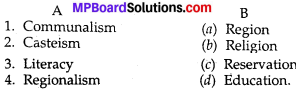
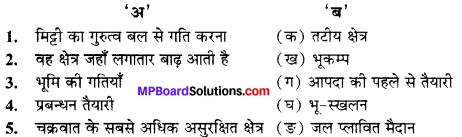
MP Board Class 10th Social Science Solutions Chapter 14 Main Challenges Before Democracy img 1
Answer:

1. (b)
2. (c)
3. (d)
4. (a)

Answer in One – Two Words or One Sentence:

Question 1.
What is Minorities?
Answer:
The religious groups in a country which are very less in numbers.

Question 2.
What do you mean by Regionalism?
Answer:
The attachment to a particular region and state by its people based on language, culture and economic interests.

Question 3.
What is meant by Separatism?
Answer:
Withdrawing from the national mainstream and forming a separate group or state.

Question 4.
What are the Linguistic States?
Answer:
The states formed on the basis of languages spoken by people of that area.

Question 5.
What is Casteism?
Answer:
A system which is based on division of society on the basis of castes.

Question 6.
What do you mean by Untouchability?
Answer:
A social system which prohibits the mixing with lower castes with people of lower caste.

Question 7.
What is Scheduled Caste?
Answer:
The castes listed with government as lower castes for whom special provisions have been made for their upliftment.

Question 8.
How can the evil of casteism removed?
Answer:
The evil of casteism can be removed by forming strong public opinion and expression against the casteism.

MP Board Class 10th Social Science Chapter 14 Very Short Answer Type Questions

Question 1.
What is adult education?
Answer:
All the adults who could not get opportunity of going to school are persued to literate themselves by the programmes of education adopted by various private and government agencies.

Question 2.
What is non – formal education?
Answer:
The education which is not necessarily imparted in the classrooms with the scheduled time table. The education outside the school with the available resources and without routine school hours is called non – formal education.

Question 3.
What were the forms of untouchability prevelent in the society past?
Answer:
Untouchables will not be given education, they could not eat with others, they could not live with the common people in the village. They could not even use the village well or tap.

Question 4.
What is Scheduled Tribes?
Answer:
The tribal people who have been regarded as undeveloped socially and economically and for whom special provisions have been made by the government.

Question 5.
What meaning is now given to the term ‘Regionalism’?
Answer:
The common meaning attached to the word region today is the unity based on languages as well as culture and economic interests. Preaching and propagting this type of feeling is called Regionalism.

Question 6.
Are the regional aspirations always wrong?
Answer:
No. In a democracy if the regional economic disparities are glaring, it is worthwhile to raise voice for the economic equality. It becomes bad only when the vested interests make political capital out of it and harbour the feeling of separatism.

Question 7.
How does economic inequality hinder the proper functioning of democracy in India?
Answer:
Economic disparity is a big hurdle in the way of democracy. It breeds the feeling of regionalism and resulting hatred and ill wills for each other.

MP Board Class 10th Social Science Chapter 14 Short Answer Type Questions

Question 1.
What are the three major social challenges before our society?
Answer:
The three major social challenges before our society are:

  1. Women’s social inequality and economic dependence.
  2. Untouchability, resulting in the traditional social, economic and political opperssion and suppression of the so called untouchables.
  3. Mass illiteracy which needs to be eradicated so that each individual understands the value of rights and obligations towards the society.

Question 2.
Write a short note on unemployment?
Answer:
When one is ready to do a job but fails to get one, it is called unemployment. This is a very grave problem which robs a man of all that is good in him. This problem should be tackled by setting up more and more industrial units, by imparting technical education to the youngmen, by helping the educated unemployed to start their own business establishments or mini – workshops.

Question 3.
Describe how Nepotism and Bribery are a challange to Indian democracy?
Answer:
Nepotism and Bribery reduce the efficiency of the government. This also results in frustration for the common man because he may not get his due as he has no powerful connections and is incapable of greasing the plam. This leads to violence and problems among the youth. Besides, people begin to curse the government for its failure to curb these mal – practices and loose faith in the democratic government.

Question 4.
Write four reasons why terrorism is resorted to?
Answer:

  1. Unemployment
  2. Poverty
  3. Political objectives
  4. Corruption
  5. Consumerism

MP Board Class 10th Social Science Chapter 14 Long Answer Type Questions

Question 1.
What is meant by untouchability? How does it hinder the growth of our country?
Answer:
One of the worst outcome of the caste system is called untouchability. This means that the people of upper caste would not even touch those of the lower caste. These people were not allowed to sit, eat and share their problems with the upper class people. It was the most inhuman aspect of Indian society. It hampers the growth and development of the society in the following ways:

1. A large section of the society is deprived of their right to contribute to the building of the society and the nation. Their talents and force go waste.

2.The people get divided into different castes that causes formation of different classes in the society. This harms to a great extent the unity of the country. Particularly in a country like India it has most damaging effects.

3. In a society based on castes, people tend to caste their votes at the time of election on caste basis. This deepens the gap between different castes. They can never come together.

Question 2.
What are the main causes of unemployment among the tribes of India?
Answer:
The people in the tribal regioins are uneducated. Inspite of the number of developmental schemes initiated by the government the tribals and other backward communities do not avail the .facilities. This is the reason that most of the people in these communities are unemployed. The problem of unemployment is due to the following reasons:

1. Industry is underdeveloped in our country. It is more in the . case of small scale and cottage industry. Nobody wants to invest money in the tribal area of the country because basic infra – structural facilities are lacking in these regions.

2. India as a whole suffers from paucity of capital. Moreover, it is not profitable to invest in the tribal regions unless government support is available.

3. The tribals therefore live by hunting and fishing. Members of these communities work as labours where factories have been opened but most of them do not get a settle and permanent job.

Question 3.
How is the spirit of communalism detrimental to national unity?
Answer:
Communalism means considering one’s own religion stiperior to that of others and to hate other religions. This type of feeling is a big hinderance in the way of the national unity of our country. The spirit of communalism is detrimental to national unity because:

1. Communalism results in riots and breach of peace National unity cannot be maintained under such circumstances.

2. Communalism gives rise to hatred and differences which harm the unity of the country. This sort of feeling is a grave danger to the democracy as well.

3. National unity is maintained with the feeling of respect for each other’s religion, caste, community and religion. Tolerance is a great virtue which is the essence of democratic norms and ideas. India is a secular state. It is as much as country of the Muslims, as of Christians Hindus and others who have been borned in India and are living here.

Question 4.
Write what measures should be adopted to arrest population growth?
Answer:
Steps to Solve the Problem of Population Growth:

The only way to arrest population growth in India is to drastically control the birth rate. The Government has formulated a population policy1 to arrest the growth of population in the country. Following steps are being taken in this direction:

  1. Family planning programme has been implemented and constant propaganda and publicity is being done for its success.
  2. Family Planning centres have been set up in cities and villages.
  3. The age of marriage has been increased to 18 years for girls and 21 years for the boys.
  4. Family planning programmes are being pfomoted and training programmes are being organised to make the programme effective.
  5. Promotion of the philosophy of two children family.
  6. Pay attention towards basic maternity facilities.
  7. Immunisation and vaccination against certain diseases.
  8. Pay more attention towards women education.
  9. To associate social institutions in the family planning programme.

Question 5.
Write what steps should be taken to remove unemployment from the country?
Answer:
Steps to Reduce Unemployment: Apart from the programmes of development of infrastructure, our government has undertaken several special programmes to generate employment opportunities in the country. Among them major programmes are:

  1. Jawahar Rozgar Yojna
  2. Nehru Rozgar Yojna
  3. Employment Assurance Scheme
  4. Prime Minister’s Rozgar Yojna
  5. Swama Jayanti Shahari Rozgar Yojna
  6. Swarna Jayanti Gram Swarozgar Yojna
  7. Job for 100 days
  8. Besides these programmes, skill development among yojna generation has also been raised. Central Board of Worker’s Education (CBWE) and ITI are doing significant work in this direction.

MP Board Class 10th Sanskrit व्याकरण अशुद्धिसंशोधन-प्रकरण

MP Board Class 10th Sanskrit व्याकरण अशुद्धिसंशोधन-प्रकरण

Ashuddhi Sanshodhan In Sanskrit Class 10 MP Board १. वचन सम्बन्धी अशुद्धियाँ
अशुद्ध वाक्य – शुद्ध वाक्य
१. जीवाः प्राणेन जीवन्ति। – जीवाः प्राणैः जीवन्ति।
२. सर्वः बालिकाः गच्छिन्ति। – सर्वे बालिकाः गच्छन्ति।
३. सः पुरुषाः सन्ति। – ते पुरुषाः सन्ति।
४. तौ बालकः अस्ति। – सः बालकः अस्ति।
५. बालकः चपलः भवति। – बालकाः चपलाः भवन्ति।

२. लिङ्ग सम्बन्धी अशुद्धियाँ .
१. सः देवता अस्ति। – सा देवता अस्ति।
२. चतस्त्रः बालकाः सन्ति। – चत्वारः बालकाः सन्ति।
३. द्वे छात्रौ स्तः। – द्वौ छात्रौ स्तः।।
४. शरीरः अस्वस्थं अस्ति। – शरीरं अस्वस्थम् अस्ति।
५. सुरेशः मम मित्रः अस्ति। – सुरेशः मम मित्रम् अस्ति।

३. पुरुष सम्बन्धी अशुद्धियाँ
१. अहं फलम् खादति। – अहं फलं खादामि।
३. सः विद्यालयं गच्छसि। – सः विद्यालयं गच्छति।
३. तौ ग्रामं गच्छावः। – तौ ग्रामं गच्छतः।
४. ते पुस्तकानि पठामः। – ते पुस्तकानि पठन्ति।
५. स्र्वे द्राक्षाफलानि सर्वे द्राक्षाफलानि – खादिष्यथ। खादिष्यन्ति।

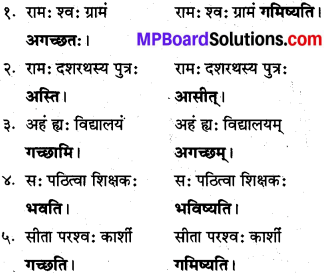
शुद्ध अशुद्ध वाक्य Pdf Sanskrit Class 9 MP Board ४. लकार सम्बन्धी अशुद्धियाँ
शुद्ध अशुद्ध वाक्य Pdf Sanskrit Class 6 MP Board

५. सामान्य अशुद्धियाँ
१. वर्तनी सम्बन्धी अशुद्धियाँ।
२. काल से सम्बन्धित अशुद्धियाँ।
३. कारक से सम्बन्धित अशुद्धियाँ।
४. उपसर्ग, प्रत्यय, विभक्ति सम्बन्धी अशुद्धियाँ।
५. वाक्य रचना सम्बन्धी अशुद्धियाँ। अशादियाँ।
६. लिंग सम्बन्धी अशुद्धियाँ।
७. वाक्य में पदों के क्रम सम्बन्धी अशुद्धियाँ।
८. कर्ता, कर्म और क्रिया के अन्वय (सम्बन्ध) सम्बन्धी अशुद्धियाँ।
९. विशेषण विशेष्य के अन्वय सम्बन्धी अशुद्धियाँ।
१०. पदों के अर्थ अवबोधन (समझना) सम्बन्धी अशुद्धियाँ।
११. तथ्य सम्बन्धी अशुद्धियाँ।
१२. अनुच्छेद के क्रम का अभाव सम्बन्धी अशुद्धियाँ।
१३. सामान्य अपवाद नियमों के विषय सम्बन्धी अशुद्धियाँ।
१४. सन्धि करने में अशुद्धियाँ।
१५. समास बनाने में अशुद्धियाँ।
१६. हलन्त, विसर्ग सम्बन्धी अशुद्धियाँ।
१७. अस्पष्ट लेखन सम्बन्धी अशुद्धियाँ।
१८. वाच्य सम्बन्धी अशुद्धियाँ।
१९. धातुओं के रूप सम्बन्धी अशुद्धियाँ।
२०. शब्द रूप सम्बन्धी अशुद्धियाँ।

वस्तुनिष्ठ प्रश्न

बहु-विकल्पीय

अशुद्धि संशोधन Class 10 संस्कृत MP Board प्रश्न १.
‘रामः गृहं गच्छन्ति’ वाक्य में अशुद्ध है-
(अ) रामः,
(ब) गृहं,
(स) गच्छन्ति,
(द) कोई नहीं।
उत्तर-
(स) गच्छन्ति,

Ashudhi Shodhan In Sanskrit Class 10 MP Board २.
“त्वं किम् करोति” में शुद्ध होगा
(अ) करोमि,
(ब) करोषि,
(स) कुर्वन्ति,
(द) कुरुतः।
उत्तर-
(ब) करोषि,

शुद्ध अशुद्ध वाक्य Pdf Sanskrit MP Board ३.
‘अहम्’ कर्ता के साथ क्रिया किस पुरुष की लगती है?
(अ) उत्तम,
(ब) मध्यम,
(स) प्रथम,
(द) अन्य।
उत्तर-
(अ) उत्तम,

शुद्ध अशुद्ध वाक्य Pdf Sanskrit Class 8 MP Board ४.
‘वर्तमान काल’ में लकार होता है
(अ) लृट्,
(ब) लोट
(स) लट्,
(द) लङ्।
उत्तर-
(स) लट्,

Sanskrit Shudh Ashudh Vakya MP Board ५.
‘सः’ में किस वचन का प्रयोग होता है?
(अ) एकवचन,
(ब) द्विवचन,
(स) बहुवचन,
(द) अनेक वचन।
उत्तर-
(अ) एकवचन,

1. रिक्त स्थान पूर्ति
१. सः अद्य ग्रामं ……………………………….।
२. रामः अयोध्यायाः नृपः ……………………………….
३. वयं श्वः देवालयं ……………………………….।
४. अहम् अधुना फलं ……………………………….।
५. कृष्णः ह्यः उद्याने ……………………………….
उत्तर-
१. गमिष्यति,
२. आसीत्,
३. गमिष्यामः,
४. खादामि,
५. अभ्रमत्।

सत्य/असत्य
१. ‘सः कार्यं करोति’, शुद्ध है।
२. ‘अहं पठति’, शुद्ध है।
३. ‘त्वं विद्यालयं गच्छति’, अशुद्ध है।
४. ‘सीता दुग्धं पिबति’, अशुद्ध है।
५. ‘मातोशिशुं पालयति’, शुद्ध है।
उत्तर-
१. सत्य,
२. असत्य,
३. सत्य,
४. असत्य,
५. सत्य।

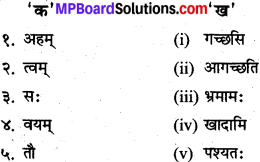
Sanskrit Shudh Ashudh Vakya Class 10 MP Board जोड़ी मिलाइए
Shudh Ashudh In Sanskrit MP Board
उत्तर-
१. → (iv)
२. → (i)
३. →(ii)
४. → (iii)
५. → (v)

MP Board Class 10th Sanskrit Solutions

MP Board Class 10th Hindi Navneet Solutions गद्य Chapter 2 महापुरुष श्रीकृष्ण

MP Board Class 10th Hindi Navneet Solutions गद्य Chapter 2 महापुरुष श्रीकृष्ण (निबन्ध, वासुदेव शरण अग्रवाल)

महापुरुष श्रीकृष्ण अभ्यास

बोध प्रश्न

महापुरुष श्रीकृष्ण अति लघु उत्तरीय प्रश्न 

प्रश्न 1.
“कृष्ण द्वैपायन” को देश किस नाम से जानता है?
उत्तर:
“कृष्ण द्वैपायन” को देश महर्षि वेदव्यास के नाम से जानता है।

प्रश्न 2.
भारतीय साहित्य का एक बड़ा भाग किस। चरित्र से अनुप्राणित है?
उत्तर:
भारतीय साहित्य का एक बड़ा भाग कृष्ण चरित्र। से अनुप्राणित है।

प्रश्न 3.
गीता शास्त्र के महान् उपदेशक कौन हैं?
उत्तर:
गीता शास्त्र के महान् उपदेशक श्रीकृष्ण हैं।

प्रश्न 4.
कृष्ण, बलदेव और कुन्ती पाण्डवों के घनिष्ठ सम्बन्धों का सूत्रपात किस स्थान पर हुआ?
उत्तर:
कृष्ण, बलदेव और कुन्ती पाण्डवों के घनिष्ठ सम्बन्धों का सूत्रपात हस्तिनापुर पर हुआ।

प्रश्न 5.
कृष्ण ने शिशुपाल का वध कर माहिष्मति की गद्दी पर किसे बैठाया?
उत्तर:
कृष्ण ने शिशुपाल का वध कर माहिष्मति की गद्दी पर उसके पुत्र धृष्टकेतु को बैठाया।

महापुरुष श्रीकृष्ण लघु उत्तरीय प्रश्न

प्रश्न 1.
भारतीय राष्ट्रीय जीवन पर किन दो समकालीन व्यक्तियों के उदात्त मस्तिष्क की गहरी छाप है?
उत्तर:
भारतीय राष्ट्रीय जीवन पर द्वैपायन कृष्ण और वसुदेव पुत्र कृष्ण के उदात्त मस्तिष्क की छाप है। संयोग से ये दोनों ही कृष्ण थे।

प्रश्न 2.
महर्षि वेद व्यास क्यों प्रसिद्ध हैं?
उत्तर:
महर्षि वेद व्यास ने महाभारत की रचना की है। इनके मस्तिष्क की अप्रतिहत प्रतिभा से आज तक हमारे धार्मिक जीवन और विश्वासों का प्रत्येक अंग प्रभावित है।

प्रश्न 3.
श्रीकृष्ण ने एक-दूसरे ही प्रकार के जगत में कब प्रवेश किया?
उत्तर:
बाल्यकाल की रमणीय लीलाओं को करने के बाद श्रीकृष्ण ने एक-दूसरे ही प्रकार के जगत में प्रवेश किया। वे वृन्दावन त्यागकर मथुरा आ गये। यहीं उनका साक्षात्कार जीवन के कठोर सत्यों से हुआ।

प्रश्न 4.
मस्तिष्क साधना हेतु श्रीकृष्ण कहाँ गये, वहाँ उन्हें क्या लाभ हुआ?
उत्तर:
मस्तिष्क साधना हेतु वे सान्दीपनि गुरु के गुरुकुल में प्रविष्ट हुए। कुल पुरोहित गर्गाचार्य और काशी के विद्याचार्य सान्दीपनि गुरु का श्रीकृष्ण पर विशेष प्रभाव था।

प्रश्न 5.
कृष्ण जन्म सम्बन्धी कुछ तथ्य लिखिए।
उत्तर:
कृष्ण जन्म सम्बन्धी कुछ तथ्य इस प्रकार हैं। उनका जन्म अष्टमी, बुधवार रोहिणी नक्षत्र में आधी रात के समय अपने मामा कंस के बन्दीगृह में हुआ था।

प्रश्न 6.
श्रीकृष्ण हस्तिनापुर क्यों गये? हस्तिनापुर जाकर कृष्ण ने क्या किया?
उत्तर:
श्रीकृष्ण और बलराम कुरुक्षेत्र में स्नान के लिए गये हुए थे। संयोग से कुन्ती भी पाण्डवों के संग आई हुई थी। वहाँ कृष्ण और पाण्डवों के बीच घनिष्ठ सम्बन्ध का सूत्रपात हुआ।

महापुरुष श्रीकृष्ण दीर्घ उत्तरीय प्रश्न

प्रश्न 1.
“श्रीकृष्ण का बाल-जीवन तो एक काव्य ही है”-इस उक्ति को सिद्ध कीजिए।
उत्तर:
कृष्ण का बाल-जीवन तो एक काव्य ही है। इस उक्ति का अभिप्राय यह है कि जन्म से लेकर अथवा उससे पूर्व ही, उनके सम्बन्ध के अतिमानवी चरित्रों का क्रम आरम्भ हो गया था। हमारे देश के बाल-वर्ग के लिए तो इन कथाओं की रसमय सामग्री अत्यन्त प्रिय वस्तु है। यमुना नदी और उसके समीप के पीलु वृक्षों पर लहलहाती हुई लताओं के कुंजों में कृष्ण के बाल चरित्र की प्रतिध्वनि आज भी जीवित कथाओं के रूप में देखने को मिलती है।

प्रश्न 2.
श्रीकृष्ण ने रमणीय बाल चरित्रों की सुखदायी भूमिका के रूप में कौन-कौन से कार्य किये?
उत्तर:
वृन्दावन में श्रीकृष्ण द्वारा बाल सखाओं के साथ की गयी बाल लीलाएँ, यमुना नदी और उसके कुंजों में रची गयी क्रीड़ाएँ, यमुना के कछारों में संगीत एवं नृत्य की चेष्टाएँ आदि सुखदायी भूमिका के रूप में की गयी थीं।

प्रश्न 3.
हस्तिनापुर से सम्पर्क के पश्चात् श्रीकृष्ण को जो अनुभव हुआ, उसे अपने शब्दों में लिखिए।
उत्तर:
हस्तिनापुर से सम्पर्क के पश्चात् श्रीकृष्ण और पाण्डवों के बीच घनिष्ठ सम्बन्ध का सूत्रपात हुआ जिसके कारण आज तक योगेश्वर कृष्ण और धनुर्धर पार्थ एक साथ स्मरण किये जाते हैं। कंस वध के समय ही कृष्ण अपनी राजनीतिक प्रवृत्ति का परिचय दे चुके थे। हस्तिनापुर की राजधानी के साथ सम्पर्क होने के बाद उस प्रवृत्ति को और भी उत्तेजना मिली।

प्रश्न 4.
श्रीकृष्ण के बुद्धि कौशल के आगे कौन-कौन से अराजक व्यक्तित्व परास्त हुए?
उत्तर:
श्रीकृष्ण के बुद्धि कौशल के आगे जरासंध, शिशुपाल, शाल्वराज, भौमनरक, मुर, वाणासुर, कलिंगराज और काशीराज जैसे अराजक व्यक्तित्व परास्त हुए।

प्रश्न 5.
“महाभारत का युद्ध भारतीय इतिहास की एक दारुण घटना है”-इस उक्ति की सार्थकता में अपने विचार प्रकट कीजिए।
उत्तर:
महाभारत का युद्ध भारतीय इतिहास की एक दारुण घटना है। इस प्रलयकारी युद्ध में दुर्योधन की ओर से गान्धार, वाल्हीक, काम्बोज, कैकय, सिंधु, मद्र, त्रिगर्त आदि देशों के योद्धा लड़े थे। युधिष्ठिर की ओर से विराट, पांचाल, काशि, चेटि, संजय आदि वंशों के योद्धा लड़े थे। ऐसे भयंकर विनाश को रोकने के लए कृष्ण से जो प्रयत्न हो सकता था, उन्होंने किया। पर वह प्रलयकारी युद्ध रुक न सका।

प्रश्न 6.
श्रीकृष्ण को सोलह कलाओं का अवतार क्यों कहा गया है?
उत्तर:
श्रीकृष्ण भारतीय जनमानस में सोलह कलाओं के अवतार माने जाते हैं। इसका तात्पर्य यह है कि जिस प्रकार भिन्न-भिन्न वस्तुओं के नापने के लिए भिन्न-भिन्न परिमाण (मापक यन्त्र) होते हैं, उसी प्रकार मानवी पूर्णता को प्रकट करने के लिए कला की नाप है। सोलह कलाओं से चन्द्रमा का स्वरूप सम्पूर्ण होता है। मानवी आत्मा का पूर्णतम विकास भी सोलह कलाओं के द्वारा प्रकट किया जाता है। कृष्ण में सोलह कलाओं की अभिव्यक्ति थी अर्थात् मनुष्य का मस्तिष्क मानवीय विकास का जो पूर्णतम आदर्श बना सकता है, वह हमें कृष्ण में मिलता है।

महापुरुष श्रीकृष्ण भाषा अध्ययन

प्रश्न 1.
निम्नलिखित शब्दों का समास विग्रह कीजिए
उत्तर:

  1. देवकी पुत्र = देवकी का पुत्र = तत्पुरुष समास।
  2. कृष्ण चरित्र = कृष्ण का चरित्र = तत्पुरुष समास।
  3. बन्दी गृह = बन्दी का गृह = तत्पुरुष समास।
  4. मेघ माला = मेघों की माला = तत्पुरुष समास।
  5. प्रतिध्वनि = प्रति + ध्वनि = अव्ययीभाव समास।

महापुरुष श्रीकृष्ण महत्त्वपूर्ण वस्तुनिष्ठ प्रश्न

महापुरुष श्रीकृष्ण बहु-विकल्पीय प्रश्न

प्रश्न 1.
कृष्ण का जन्म आज से कितने सहस्र वर्ष पूर्व हुआ था?
(क) पाँच सहस्र वर्ष
(ख) बीस सहस्र वर्ष
(ग) तीन सहस्र वर्ष
(घ) दस सहस्र वर्ष
उत्तर:
(क) पाँच सहस्र वर्ष

प्रश्न 2.
श्रीकृष्ण के बड़े भाई का नाम था
(क) नन्द
(ख) वासुदेव
(ग) गोपालक
(घ) बलराम।
उत्तर:
(घ) बलराम।

प्रश्न 3.
शिशुपाल दुष्ट और अत्याचारी तो था ही, साथ ही वह समर्थक था
(क) अर्जुन का
(ख) भीम का
(ग) दुर्योधन का
(घ) कृष्ण का।
उत्तर:
(ग) दुर्योधन का

प्रश्न 4.
श्रीकृष्ण ने निर्मोचन नामक राजधानी में सेना सहित मुर और नरक का वध करके किस प्रदेश को स्वतन्त्र किया?
(क) आसाम
(ख) कामरूप
(ग) उत्तर भारत
(घ) दक्षिण भारत।
उत्तर:
(ख) कामरूप

प्रश्न 5.
यह कथन किसका है-“कौरवों और पाण्डवों में बिना वीरों का नाश हुए ही शान्ति हो जाय यही मैं प्रार्थना करने आया हूँ।”
(क) कृष्ण
(ख) गांधारी
(ग) कुन्ती
(घ) धृतराष्ट्र।
उत्तर:
(क) कृष्ण

रिक्त स्थानों की पूर्ति

  1. महाभारत का युद्ध भारतीय इतिहास की बहुत ही …….. घटना है।
  2. कंस को राज्यच्युत करके कृष्ण ने …………. को सिंहासन पर प्रतिष्ठित किया।
  3. यदि मुझे वजधारी इन्द्र और कृष्ण में से एक को लेना पड़े तो मैं ………….. को लूँगा।
  4. दुर्योधन ने सब कुछ सुनकर कहा-“मैं ………….. के बराबर भी भूमि पाण्डवों के लिए नहीं छोड़ सकता।”
  5. ………… को हमारे देश के लेखकों ने सोलह कला का अवतार कहा है। (2016)

उत्तर:

  1. दारुण
  2. उग्रसेन
  3. कृष्ण
  4. सुई की नोंक
  5. कृष्ण।

सत्य/असत्य

  1. श्रीकृष्ण को सोलह कलाओं का अवतार कहा जाता है। (2012)
  2. कौरवों और पाण्डवों का युद्ध महाभारत के नाम से प्रसिद्ध है।
  3. गीताशास्त्र के उपदेशक दुर्योधन हैं।
  4. अर्जुन ने शिशुपाल का वध किया क्योंकि वह अत्याचारी शासक था।
  5. श्रीकृष्ण भारत की अमूल्य निधि हैं और वे भारतीय संस्कृति के गौरव हैं।

उत्तर:

  1. सत्य
  2. सत्य
  3. असत्य
  4. असत्य
  5. सत्य।

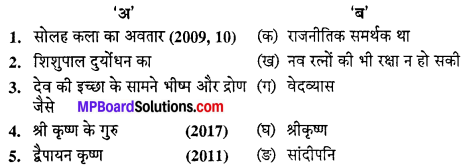
सही जोड़ी मिलाइए

MP Board Class 10th Hindi Navneet Solutions गद्य Chapter 2 महापुरुष श्रीकृष्ण img-1
उत्तर:
1. → (घ)
2. → (क)
3. → (ख)
4. → (ङ)
5. → (ग)

एक शब्द/वाक्य में उत्तर

  1. द्वैपायन कृष्ण को संसार किस नाम से जानता है? (2009)
  2. उग्रसेन के लोक पीड़ित पुत्र का क्या नाम था? (2011)
  3. पाण्डवों की माता का क्या नाम था?
  4. श्रीकृष्ण मस्तिष्क साधना हेतु किसके पास गये थे?
  5. श्रीकृष्ण सन्धि का प्रस्ताव लेकर कहाँ गये?
  6. गीताशास्त्र के महान् उपदेशक कौन है? (2013, 15)

उत्तर:

  1. वेदव्यास
  2. कंस
  3. कुन्ती
  4. गुरु सान्दीपनि
  5. हस्तिनापुर की राजसभा में
  6. श्रीकृष्ण।

महापुरुष श्रीकृष्ण पाठ सारांश 

भारतवर्ष में जिस महापुरुष के चरित्र से मानव जाति की भावनाओं, विचारों पर अमिट प्रभाव पड़ा है,उनमें श्रीकृष्ण’ का नाम सबसे ऊँचे शिखर पर है। आज से करीब पाँच हजार साल पूर्व एक ही समय में ऐसे दो महापुरुषों का जन्म भारत भूमि पर हुआ जिनके मस्तिष्क की छाप राष्ट्रीय जीवन पर आज भी स्थायी रूप से अंकित है। संयोग से उन दोनों का नाम ‘कृष्ण’ था। इनमें एक ‘द्वैपायन कृष्ण’ नाम से प्रसिद्ध हैं,जो महर्षि वेद-व्यास के नाम से जाने जाते हैं। दूसरे देवकी के पुत्र ‘श्रीकृष्ण’ थे जिन्हें मात्र ‘कृष्ण’ नाम से सम्बोधित किया जाता है।

कृष्ण की बाललीलाओं के हृदयस्पर्शी आख्यान, गीताशास्त्र के गूढ़ उपदेश तथा महाभारत के युद्ध में इनके विभिन्न प्रकार के कार्यों की कहानियाँ आज भी जीवन्त हैं। अष्टमी तिथि बुधवार, रोहिणी नक्षत्र योग के समय आधी रात के समय अपने मामा कंस के बन्दीगृह में कृष्ण ने जन्म लिया। उनका अधिकांश समय देश को अत्याचार एवं पीड़ाओं से मुक्त करने में व्यतीत हुआ। कृष्ण का बालजीवन एक काव्य-सा ही है। वृंदावन को त्यागकर मथुरा आने के समय तक उनकी बाल-लीलाएँ सुन्दर,सरस एवं सुखद हैं। यमुना नदी और उसके निकट के वृक्ष एवं बेलों पर उनके बाल चरित्रों की प्रतिध्वनि आज भी गुंजायमान है। मस्तिष्क की साधना हेतु सान्दीपनि मुनि के गुरुकुल में प्रवेश लिया।

सान्दीपनि ने विद्या के समाप्त होने पर कृष्ण को सत्य एवं धर्म के पथ पर चलने का उपदेश देकर विदा किया। इसके पश्चात् राजनीति में प्रवेश करके अनेक अत्याचारियों को मौत के घाट उतारा। कृष्ण की राजनीतिक सूझ-बूझ अद्भुत थी,इस सम्बन्ध में अर्जुन का यह कथन है-

“कृष्ण मन से जिसका अभिनन्दन करें, वह समस्त शत्रुओं पर विजयी होगा। महाभारत का युद्ध भारतीय इतिहास की एक दारुण घटना है। इसमें अनेक योद्धा धराशायी हुए। श्रीकृष्ण ने दुर्योधन से पाण्डवों को राज्य का कुछ भाग देने के लिए कहा लेकिन दुराग्रही दुर्योधन ने उनकी बात स्वीकार नहीं की फलस्वरूप महाभारत का युद्ध हुआ तथा कौरवों को पराजय का सामना करना पड़ा। कृष्ण सोलह कलाओं के अवतार हैं। वे मानवीय मूल्यों, आदर्शों एवं गुणों की अमूल्य निधि हैं। वे हमारी राष्ट्रीय संस्कृति के सर्वोत्तम रक्षक एवं प्रतिनिधि हैं। जिस प्रकार पूरब एवं पश्चिम के सागरों के मध्य प्रदेश को व्याप्त करके गिरिराज हिमालय पृथ्वी के मानदण्ड की भाँति सुशोभित है तद्नुरूप ब्रह्मधर्म एवं क्षात्रधर्म इन दो मर्यादाओं के मध्य श्रीकृष्ण चरित्र पूर्ण मानवी विकास का परिचायक है। भारत के जन-जन के मस्तिष्क में उनकी लीलाएँ,कलाएँ तथा अद्भुत राजनीतिक सूझ-बूझ की ज्योति आज भी प्रकाशमान है।

महापुरुष श्रीकृष्ण संदर्भ-प्रसंगसहित व्याख्या

(1) भातरवर्ष के जिन महापुरुषों का मानव-जाति के विचारों पर स्थायी प्रभाव पड़ता है, उनमें श्रीकृष्ण का स्थान प्रमुख है। आज से लगभग पाँच सहस्र वर्ष पूर्व एक ही समय में ऐसे दो व्यक्तियों का जन्म हुआ जिनके उदात्त मस्तिष्क की छाप हमारे राष्ट्रीय जीवन पर बहुत गहरी पड़ी है। संयोग से उन दोनों का नाम कृष्ण था। समकालीन इतिहास-लेखकों ने दोनों को भेद करने के लिए एक को ‘द्वैपायन कृष्ण’ कहा है, जिन्हें आज सारा देश महर्षि वेद-व्यास के नाम से जानता है और जिनके मस्तिष्क की अप्रतिहत् प्रतिभा से आज तक हमारे धार्मिक जीवन और विश्वासों का प्रत्येक अंग प्रभावित है। दूसरे देवकी पुत्र श्रीकृष्ण थे, जिन्हें अब वास्तव में ‘कृष्ण’ के नाम से पुकारते हैं।

कठिन शब्दार्थ :
स्थायी = हमेशा टिका रहने वाला। सहस्र = हजार। उदात्त = ऊँचे, महान्। अप्रतिहत् = अबाधित, जिसे कोई भी किसी प्रकार न रोक पाये। प्रतिभा = ज्ञान।।

सन्दर्भ :
प्रस्तुत गद्यांश हमारी पाठ्य-पुस्तक के पाठ, ‘महापुरुष श्रीकृष्ण’ से लिया गया है। इसके लेखक श्री वासुदेव शरण अग्रवाल हैं।

प्रसंग :
इस अंश में लेखक ने भारत में जन्मे दो कृष्णों के महत्त्व के बारे में बताया है।

व्याख्या :
श्री वासुदेव शरण अग्रवाल जी कहते हैं कि भारतवर्ष के जिन महापुरुषों का मानव जाति के विचारों पर स्थायी प्रभाव पड़ा है, उनमें श्रीकृष्ण का नाम महत्त्वपूर्ण है। आज से लगभग पाँच हजार वर्ष पूर्व भारत देश में एक ही समय पर दो व्यक्तियों ने जन्म लिया और इन दोनों के उदात्त मस्तिष्क की छाप हमारे राष्ट्रीय जीवन पर बहुत गहरी पड़ी है। इन दोनों महापुरुषों का नाम कृष्ण था। इतिहासकारों ने इनके अन्तर को स्थापित करते हुए एक को द्वैपायन कृष्ण अर्थात् महर्षि वेद व्यास कहा है और जिनके मस्तिष्क की अद्वितीय प्रतिभा से हमारे धार्मिक जीवन तथा विश्वासों का प्रत्येक अंग प्रभावित है। दूसरे कृष्ण, वासुदेव और देवकी के पुत्र थे जिन्हें आज सारा संसार ‘कृष्ण’ के नाम से ही जानता है।

विशेष :

  1. लेखक ने द्वैपायन कृष्ण और देवकी पुत्र कृष्ण के अन्तर को स्पष्ट किया है।
  2. भाषा सहज एवं सरल है।

(2) उस काल के जो भी उच्छृखल, लोकपीड़क सत्ताधारी थे, उन सबसे ही एक-एक करके कृष्ण की टक्कर हुई। जिस महापुरुष ने योग-समाधि के आदर्श को लेकर ब्रह्म स्थिति प्राप्त करने का उपदेश दिया हो, जिसका अपना जीवन अविचल ज्ञान-निष्ठा का सर्वोत्तम उदाहरण हो, उसके जीवन में कंस-निपात से लेकर निज वंश के विनाश तक की . कथा एक अत्यन्त करुण कहानी के रूप में पिरोई हुई है।

कठिन शब्दार्थ :
उच्छृखल = उद्दण्ड, धृष्ट। लोकपीड़क = समाज को पीड़ा देने वाले, जनता को दुःख देने वाले। सत्ताधारी = राजा, शासक। अविचल = अडिग। कंस-निपात = कंस के नाश।

सन्दर्भ :
पूर्ववत्।

प्रसंग :
इस कथा में लेखक ने कृष्ण के महान् कार्यों का वर्णन किया है।

व्याख्या :
लेखक श्री वासुदेव शरण अग्रवाल कहते हैं कि उस काल में जितने भी उद्दण्ड तथा जनता का शोषण करने वाले, उन्हें कष्ट देने वाले शासक थे, उन सभी से एक-एक करके श्रीकृष्ण का संघर्ष हुआ और अन्त में उन्होंने विजय भी प्राप्त की। जिस महापुरुष अर्थात् श्रीकृष्ण ने योग-समाधि के आदर्श को लेकर ब्रह्म स्थिति प्राप्त करने का उपदेश दिया हो, जिसका स्वयं का जीवन अडिग भाव से ज्ञान निष्ठा का सर्वश्रेष्ठ उदाहरण रहा हो, उसके जीवन में कंस के विनाश से लेकर अपने यदुवंश के विनाश तक की कथा एक अत्यन्त करुण कहानी के रूप में पिरोई हुई है।

विशेष :

  1. लेखक ने श्रीकृष्ण के लोकोपकारी कार्यों की ओर संकेत किया है।
  2. भाषा भावानुकूल है।

(3) कृष्ण का बाल-जीवन तो एक काव्य ही है। जन्म से लेकर अथवा उससे पूर्व ही, उनके सम्बन्ध के अतिमानवी चरित्रों का क्रम आरम्भ हो गया था और उनके वृन्दावन छोड़कर मथुरा आने के समय तक ये बाल-लीलाएँ आकाश में एकत्रित होने वाली सुन्दर सुखद मेघमालाओं की भाँति नाना वर्ण और रूपों से संचित होती रहीं। बिना कहे ही उन्हें हम जानते हैं।

कठिन शब्दार्थ :
अतिमानवी = अलौकिक, मानवीय क्रियाओं से परे। सुखद = सुख देने वाली। मेघ मालाओं = बादलों की पंक्तियों। नाना वर्ण = अनेक रंगों।

सन्दर्भ :
पूर्ववत्। प्रसंग-लेखक ने कृष्ण के बाल्यकाल की अद्भुत एवं अलौकिक घटनाओं की ओर संकेत किया है।

व्याख्या :
लेखक श्री वासुदेव शरण अग्रवाल कहते हैं कि श्रीकृष्ण के बाल जीवन की घटनाओं पर यदि हम दृष्टि डालें तो हम देखते हैं कि वे घटनाएँ तो अपने आप में एक काव्य ही हैं। जन्म से लेकर अथवा जन्म से पूर्व ही उनकी अलौकिक क्रियाओं एवं चरित्रों का वर्णन आरम्भ हो गया था। वृन्दावन छोड़कर मथुरा आने तक की उनकी सभी बाल लीलाएँ आकाश में छायी रहने वाली सुन्दर मेघ पंक्ति के समान अनेकानेक भावों और रूपों को अपने में समेटे हुए थीं। उनकी इन बाल लीलाओं एवं अलौकिक या अमानवीय चेष्टाओं को हम बिना कहे ही भली-भाँति जानते हैं।

विशेष :

  1. लेखक ने श्रीकृष्ण की अद्भुत बाल-लीलाओं की ओर संकेत किया है।
  2. भाषा भावानुकूल।

(4) इन रमणीय बाल चरित्रों की सुखदायी भूमिका तैयार करने के बाद भी श्रीकृष्ण ने एक दूसरे ही प्रकार के जगत में प्रवेश किया। उनका वृन्दावन छोड़कर मथुरा को आना उस जगत का देहली-द्वार है। यहाँ जीवन के कठोर सत्य उनकी प्रतीक्षा कर रहे थे। उनके द्वार का सबसे पहला परिवर्तन शूरसेन जनपद की राजनीति में हुआ। उग्रसेन के पुत्र लोकपीड़क कंस को राजच्युत करके कृष्ण ने उग्रसेन को सिंहासन पर प्रतिष्ठित किया।

कठिन शब्दार्थ :
सुखदायी = सुख देने वाली। रमणीय = मन को रमाने वाली। देहली-द्वार = महत्त्वपूर्ण प्रवेश द्वार। लोकपीड़क = जनता को सताने वाले। राजच्युत = राज्य से बाहर भगाकर। प्रतिष्ठित किया = बिठाया।

सन्दर्भ :
पूर्ववत्।

प्रसंग :
इस अंश में लेखक ने श्रीकृष्ण की रमणीय बाल लीलाओं के पश्चात् राजनीति के क्षेत्र में किये गये कार्यों का वर्णन किया है।

व्याख्या :
लेखक श्री वासुदेव शरण अग्रवाल कहते हैं कि बाल काल की रमणीय लीलाओं तथा जन-जीवन को सुख प्रदान करने वाली घटनाओं को अंजाम देने के पश्चात् उन्होंने दूसरे प्रकार के संसार में प्रवेश किया। उनका वृन्दावन छोड़कर मथुरा गमन करना उनके जीवन की सर्वप्रमुख घटना है। मथुरा आने पर उन्हें जीवन के कठोर सत्यों से जूझना पड़ा। उन्होंने शूरसेन जनपद की राजनीति में वहाँ के अत्याचारी शासक कंस को राज्यसत्ता से विमुख करके एक क्रान्तिकारी परिवर्तन किया। उन्होंने कंस को सत्ता से हटाकर तथा उसका वध करके उग्रसेन को सिंहासन पर बैठाया। इस प्रकार सबसे पहले उन्होंने जनपीड़क अत्याचारी कंस। के अत्याचारों से वहाँ की जनता को मुक्त कराया।

विशेष :

  1. लेखक ने कंस वध की घटनाओं की ओर। संकेत किया है।
  2. भाषा भावानुकूल।

(5) महाभारत का युद्ध भारतीय इतिहास की एक बहुत दारुण घटना है। इस प्रलयकारी युद्ध में दुर्योधन की ओर से गान्धार, वाल्हीक, काम्बोज, कैकय, सिंधु मद्र, त्रिगर्त। (कांगड़ा, सारस्वत गण, मालव और अंग) आदि देशों के योद्धा प्रवृत्त हुए। युधिष्ठिर की ओर से विराट, पांचाल, काशि, चेटि, संजय आदि वंशों के योद्धा युद्ध के लिए आये। ऐसे भयंकर विनाश को रोकने के लिए कृष्ण से जो । प्रयत्न हो सकता था, उन्होंने किया।

कठिन शब्दार्थ :
दारुण = ‘दुःखदायी, भयंकर। प्रलयकारी = विनाशकारी। प्रवृत्त हुए = युद्ध क्षेत्र में उतरे।

सन्दर्भ :
पूर्ववत्।

प्रसंग :
लेखक ने महाभारत की विनाश लीला का वर्णन करते हुए श्रीकृष्ण के उस युद्ध को रोके जाने हेतु किये गये प्रयासों का वर्णन किया है।

व्याख्या :
लेखक श्री वासुदेव शरण अग्रवाल कहते हैं कि महाभारत का जो युद्ध लड़ा गया था, वह भारतीय इतिहास की एक बहुत ही दुःखदायी घटना रही है। इस विनाशकारी युद्ध में दुर्योधन के पक्ष में गान्धार, वाल्हीक, काम्बोज, कैकय, सिंधु, मद्र और कांगड़ा, सारस्वत, मालव और अंग आदि देशों के योद्धा आये थे। युधिष्ठिर के पक्ष में विराट, पांचाल, काशि, चेटि, संजय आदि वंशों के योद्धा लड़ने के लिए जुटे थे। उस समय कृष्ण ने अपने बुद्धि-विवेक से इस विनाश को रोकने के लिए अथक प्रयास किये, लेकिन उनका कोई परिणाम नहीं निकला। फलतः युद्ध हुआ और युद्ध में जो विनाश हुआ उसका स्मरण कर हम आज भी भयभीत होने लगते हैं।

विशेष :

  1. लेखक ने महाभारत युद्ध के विनाश की ओर. संकेत किया है।
  2. भाषा भावानुकूल।

(6) कृष्ण को हमारे देश के लेखकों ने सोलह कला का अवतार कहा है। इसका तात्पर्य क्या है? यह स्पष्ट है कि भिन्न-भिन्न वस्तु को नापने के लिए भिन्न-भिन्न परिमाणों का प्रयोग किया जाता है। दूरी नापने के लिए और नाप है, काल के लिए और है तथा बोझे के लिए और है। इसी प्रकार मानवी पूर्णता को प्रकट करने के लिए कला की नाप है। सोलह कलाओं से चन्द्रमा का स्वरूप सम्पूर्ण होता है। मानवी आत्मा का पूर्णतम विकास भी सोलह कलाओं के द्वारा प्रकट किया जाता है। कृष्ण में सोलह कलाओं की अभिव्यक्ति थी अर्थात् मनुष्य का मस्तिष्क मानवीय विकास का जो पूर्णतम आदर्श बना सकता है, वह हमें श्रीकृष्ण में मिलता है।

कठिन शब्दार्थ :
परिमाण = मापने या नापने के यन्त्र, पूर्णतम आदर्श = ऐसा आकर्षक रूप जिसमें कोई अभाव न हो।

सन्दर्भ :
पूर्ववत्।

प्रसंग :
लेखक कृष्ण के सोलह कलाओं वाले अवतार के विषय में बता रहे हैं।

व्याख्या :
लेखक श्री वासदेव शरण अग्रवाल कहते हैं कि भारतीय संस्कृति में श्रीकृष्ण को सोलह कलाओं वाला अवतार माना गया है। इसका अर्थ यह है कि जिस प्रकार भिन्न-भिन्न वस्तुओं को नापने के लिए भिन्न-भिन्न मापक यन्त्रों का प्रयोग किया जाता है यथा दूरी नापने के लिए गज, मीटर आदि का, काल के लिए समय या वर्षों का और बोझ के लिए मन, सेर या किलोग्राम आदि का, इसी भाँति मानव की पूर्णता को नापने के लिए कला को आधार माना जाता है। चन्द्रमा में सोलह कलाएँ पूर्ण होती हैं और मानवी आत्मा का पूर्ण विकास भी सोलह कलाओं द्वारा ही प्रकट किया जाता है। कृष्ण में सोलह कलाओं की अभिव्यक्ति थी। इसका अभिप्राय यह है कि मनुष्य का मस्तिष्क मानवीय विकास का जो पूर्णतम आदर्श प्रस्तुत कर सकता है, वह हमें भगवान विष्णु के अन्य अवतारों में न मिलकर श्रीकृष्ण में ही मिलता है। अतः हम श्रीकृष्ण को सोलह कलाओं का अवतार कहते हैं।

विशेष :

  1. श्रीकृष्ण को लेखक ने सोलह कलाओं का पूर्ण अवतार माना है।
  2. भाषा भावानुकूल।

(7) कृष्ण भारतवर्ष के लिए एक अमूल्य निधि हैं, वे हमारी राष्ट्रीय संस्कृति के सर्वश्रेष्ठ प्रतिनिधि हैं। जिस प्रकार पूर्व और पश्चिम के समुद्रों के बीच प्रदेश को व्याप्त करके गिरिराज हिमालय पृथ्वी के मानदण्ड की तरह स्थित है उसी प्रकार ब्रह्म धर्म और क्षात्रधर्म-इन दो मर्यादाओं के बीच। की उच्चता को व्याप्त करके श्रीकृष्ण-चरित्र पूर्ण मानवी। विकास के मानदण्ड की तरह स्थित है।

कठिन शब्दार्थ :
गिरिराज = पर्वतों का राजा। क्षात्रधर्म = क्षत्रिय धर्म। ब्रह्मधर्म = ब्राह्मणों का धर्म।

सन्दर्भ :
पूर्ववत्।

प्रसंग :
इस अंश में लेखक ने श्रीकृष्ण को राष्ट्रीय संस्कृति का सर्वश्रेष्ठ प्रतिनिधि बताया है।

व्याख्या :
लेखक श्री वासुदेव शरण अग्रवाल कहते हैं कि श्रीकृष्ण भारतवर्ष के लिए अमूल्य निधि के तुल्य हैं। वे हमारी राष्ट्रीय संस्कृति के सर्वश्रेष्ठ प्रतिनिधि माने जाते हैं। जिस तरह पूर्व एवं पश्चिम के समुद्रों के मध्य, प्रदेश को व्याप्त करके पर्वत-राज हिमालय पृथ्वी का मानदण्ड बना हुआ है उसी तरह ब्राह्मण एवं क्षत्रिय धर्म की दो मर्यादाओं के बीच की उच्चता को धारण करके श्रीकृष्ण का चरित्र पूर्ण मानवी विकास का मानदण्ड बना हुआ है। कहने का भाव यह है कि श्रेष्ठ मानवता का मानदण्ड हम श्रीकृष्ण के चरित्र को मान सकते हैं।

विशेष :

  1. श्रीकृष्ण के चरित्र की महानता एवं उच्चता का वर्णन है।
  2. महाकवि कालिदास ने ‘कुमार सम्भव’ महाकाव्य। में-‘अस्ति उत्तरस्यां दिशि देवतात्मा हिमालयो नाम नगाधिराज’ ………….. श्लोक में इसी भाव को दर्शाया है।
  3. भाषा भावानुकूल।

MP Board Class 10th Hindi Solutions

MP Board Class 10th General English The Spring Blossom Solutions Chapter 2 The Power of Determination

Are you seeking for the Madhya Pradesh Board Solutions 10th General English The Spring Blossom Solutions Chapter 2 The Power of Determination Questions and Answers PDF? If yes, then read this entire page. Here, we are giving a direct link to download MP Board Class 10th English Solutions Questions and Answers PDF which contains the chapter wise questions, solutions, and grammar topics. You can also get the shortcuts to solve the grammar related questions on this page.

MP Board Class 10th General English The Spring Blossom Solutions Chapter 2 The Power of Determination

For the sake of students we have gathered the complete 10th General English The Spring Blossom Solutions Chapter 2 The Power of Determination Questions and Answers can provided in pdf Pattern. Refer the chapter wise MP Board Class 10th English Solutions Questions and Answers Topics and start the preparation. You can estimate the importance of each chapter, find important English grammar concepts which are having more weightage. Concentrate on the important grammar topics from Madhya Pradesh Board Solutions for 10th English Chapter 2 The Power of Determination Questions and Answers PDF, prepare well for the exam.

The Power of Determination Textual Exercises

Word Power

A. Match the words with their meanings.
(शब्दों को अर्थों से सुमेलित कीजिए।)
The Power Of Determination MP Board Class 10th
Answer:
1. → (b)
2. → (d)
3. → (a)
4. → (e)
5. → (c)

B. Read the sentences carefully and find out the antonyms of the words given below.
(दिये गये शब्दों के विलोम निम्न वाक्यों में ढूँढ़ो।)
(cool, strong, minor, lower, construct)

  1. A volcano may destruct anything that comes in its way.
  2. The director gave a major project to his subordinates.
  3. The boy became very weak after illness.
  4. Woollen clothes keep us warm.
  5. An upper berth is reserved for me.

Answer:

  1. destruct
  2. major
  3. weak
  4. warm
  5. upper.

How Much Have I Understood?

A. Answer these questions. (One or two sentences)
(निम्न प्रश्नों के उत्तर एक या दो वाक्यों में दीजिए।)

The Power Of Determination MP Board Class 10th Question 1.
What was the duty of the little boy?
(व्हॉट वॉज़ द ड्यूटी ऑफ द लिटिल बॉय?)
छोटे बालक का क्या कार्य था?
Answer:
The duty of the little boy was to come early to the school and fire the pot-bellied coal stove and warm the room before his teacher and classmates arrived.
(द ड्यूटी ऑफ द लिटिल बॉय वॉज़ टू कम अर्ली टू द स्कूल एण्ड फायर द पॉट-बैलीड कोल स्टोव एण्ड वॉर्म द रूम बिफोर हिज़ टीचर एण्ड क्लासमेट्स एराइव्ड.)
छोटे बालक का प्रातः विद्यालय में अपने शिक्षक व सहपाठियों से पूर्व आकर अँगीठी जलाकर कक्षा को गर्म करने का कार्य था।

The Power Of Determination Class 10 MP Board Question 2.
What was the condition of the little boy when he was taken out of the burning school building?
(व्हॉट वॉज़ द कण्डीशन ऑफ द लिटिल बॉय व्हेन ही वॉज़ टेकन आऊट ऑफ द बर्निंग स्कूल बिल्डिंग?)
जब छोटे बालक को जलती हुई विद्यालय की इमारत से बाहर निकाला गया तब उसकी क्या अवस्था थी?
Answer:
When the little boy was taken out of the burning school building he was unconscious and more dead than alive. He had major burns over the lower half of his body.
(व्हेन द लिटिल बॉय वॉज़ टेकन आऊट ऑफ द बर्निंग स्कूल बिल्डिंग ही वॉज़ अनकॉन्शिअस एण्ड मोर डेड दैन अलाइव। ही हैड मेजर बर्न्स ओवर द लोअर हाफ ऑफ हिज़ बॉडी.)
जब नन्हें बालक को जलती हुई स्कूल की इमारत से बाहर निकाला गया तब वह मूर्च्छित था व जीवित से ज्यादा मृत था। उसके शरीर के नीचे का हिस्सा मुख्य रूप से जला हुआ था।

Class 10 English Chapter 2 The Power Of Determination Question 3.
Why was the boy sent to hospital?
(व्हाय वॉज़ द बॉय सेन्ट टू हॉस्पिटल?)
बालक को अस्पताल क्यों भेजा गया?
Answer:
The boy had major burns in the lower half of his body so he was sent to the hospital.
(द बॉय हैंड़ मेजर बर्न्स इन द लोअर हाफ ऑफ हिज़ बॉडी सो ही वॉज़ सेन्ट टू द हॉस्पिटल।)
बालक के शरीर का निचला हिस्सा बुरी तरह जल गया था इसीलिए उसे अस्पताल ले जाया गया।

The Power Of Determination Question And Answer MP Board Class 10th Question 4.
What was the opinion of the doctor about the burnt boy?
(व्हॉट वॉज़ द ओपिनियन ऑफ द डॉक्टर अबाऊट द बर्ट बॉय?)
चिकित्सक का जले हुए बालक के बारे में क्या विचार था?
Answer:
The doctor said that the body would surely die and it was better for him as the lower half of his body was terribly burnt.
(द डॉक्टर सैड दैट द बॉय वुड श्योरली डाइ एण्ड इट वॉज़ बैटर फॉर हिम एज़ द लोअर हॉफ ऑफ हिज़ बॉडी वॉज़ टैरिब्ली बर्ट।)
चिकित्सक ने कहा कि बालक निश्चित रूप से मर जायेगा और वह उसके लिए अच्छा होगा क्योंकि उसके शरीर का निचला हिस्सा बुरी तरह जल गया था।

The Power Of Determination Story In Hindi MP Board Class 10th Question 5.
What did the boy decide after listening that he would surely die?
(व्हॉट डिड द बॉय डिसाइड आफ्टर लिसनिंग दैट ही वुड श्योरलि डाइ?)
बालक ने यह सुनने के बाद कि वह निश्चित रूप से मर जायेगा क्या निश्चय किया?
Answer:
The boy decided that he would survive.
(द बॉय डिसाइडिड दैट ही वुड सरवाइव।)
बालक ने निश्चय किया कि वह जीवित रहेगा।

The Power Of Determination Question Answer MP Board Class 10th Question 6.
What was the opinion of the doctor after the boy had survived?
(व्हॉट वॉज़ द ओपिनियन ऑफ द डॉक्टर आफ्टर द बॉय हैड सरवाइव्ड?)
बालक के जीवित रहने पर चिकित्सक का क्या मत था?
Answer:
The doctor said that since the flesh in the lower part of the boy’s body was destroyed he was doomed to be a lifetime cripple with no use at all of his lower limbs.
(द डॉक्टर सेड दैट सिन्स द फ्लेश इन द लोअर पार्ट ऑफ द बॉयज़ बॉडी वॉज़ डिस्ट्रॉयड ही वॉज़ डूम्ड टू बी अ लाइफटाइम क्रिपल विद नो यूज़ एट ऑल ऑफ हिज़ लोअर लिम्ब्स।)
चिकित्सक ने कहा कि चूँकि बालक के शरीर के निचले हिस्से का माँस जल गया था इसीलिए उसके शरीर का निचला भाग कार्य नहीं करेगा व वह आजीवन अपाहिज रहेगा।

B. Answer these questions. (Three or four sentences)
(निम्न प्रश्नों के उत्तर तीन या चार वाक्यों में दीजिए।)

The Power Of Determination Class 10 Questions And Answers Question 1.
What was the effect of the doctor’s words on the terribly burnt boy?
(व्हॉट वॉज द इफैक्ट ऑफ द डॉक्टर्स वर्ड्स ऑन द टैरिब्ली बर्ट बॉय?)
बुरी तरह से जले हुए बालक पर चिकित्सक के शब्दों का क्या प्रभाव हुआ?
Answer:
The terribly burnt boy on listening the doctor’s words decided that he would survive and would not be a cripple.
(द टैरिब्ली बर्ट बॉय ऑन लिसनिंग द डॉक्टर्स वर्ड्स डिसाइडिड दैट ही वुड सरवाइव एण्ड वुड नॉट बी अ क्रिप्ल।)
बुरी तरह जले बालक ने चिकित्सक के शब्द सुनकर यह निश्चय किया कि वह जीवित रहेगा और अपाहिज नहीं रहेगा।

The Power Of Determination Summary MP Board Class 10th Question 2.
How did the mother help the boy to overcome his disability?
(हाउ डिड द मदर हैल्प द बॉय टू ओवरकम हिज़ डिसेबिलिटी?)
माँ ने बालक की अपाहिज अवस्था को दूर करने में किस प्रकार सहायता की?
Answer:
The mother massaged the little legs of the boy everyday. She also took him into the yard on his wheelchair so that he may get fresh air. There the boy tried to walk.
(द मदर मसाज्ड द लिटिल लेग्स ऑफ द बॉय एवरीडे। शी ऑल्सो टुक हिम इन्टू द यार्ड ऑन हिज़ व्हीलचेयर सो दैट ही मे गेट फ्रेश एअर। देअर द बॉय ट्राइड टू वॉक।)
माँ बालक की नन्हीं टाँगों की रोज मालिश करती थी। वह उसको पहिए वाली कुर्सी पर खुली हवा में ले जाया करती थी जहाँ वह चलने की कोशिश करता था।

The Power Of Determination Question And Answer Class 10 Question 3.
How did the boy make himself able to walk and run?
(हाउ’डिड’ द बॉय मेक हिमसेल्फ एबल टू वॉक एण्ड रन?)
बालक ने चलना व दौड़ना कैसे शुरू किया?
Answer:
The boy threw himself from the wheelchair and pulled himself across the grass, dragged his legs behind him towards the fence when his mother took him out for getting fresh air. He somehow raised himself up on the fence and dragged along the fence. He used to do this everyday and gradually developed the ability to stand up, then to walk haltingly, walk by himself and then to run. His daily massages, iron persistence and strong determination gave life to his legs.

(द बॉय श्रू हिमसेल्फ फ्रॉम द व्हीलचेयर एण्ड पुल्ड हिमसेल्फ अक्रॉस द ग्रास, ड्रेग्ड् हिज़ लेग्स बिहाइण्ड हिम टुवर्ड्स द फेन्स व्हेन हिज़ मदर टुक हिम आऊट फॉर गेटिंग फ्रेश ऍयर। ही समहाउ रेज्ड् हिमसेल्फ अप ऑन द फेन्स एण्ड ड्रेग्ड् अलाँग द फेन्स। ही यूज्ड टू डू दिस एवरीडे एण्ड ग्रैज्युली डेवलप्ड द एबिलिटी टू स्टैण्ड अप, देन टू वॉक हॉल्टिंगली, वॉक बाइ हिमसेल्फ एण्ड देन टू रन। हिज़ डेली मसाजेस, आयरन परसिस्टेन्स एण्ड स्ट्राँग डिटर्मिनेशन गेव लाइफ टू हिज़ लेग्स।)

जब बालक की माँ उसे खुली हवा में ले गई तब उसने खुद को पहियों वाली कुर्सी से गिरा दिया व अपनी टाँगों को धकेलते हुए तारों की मुंडेर के पास ले गया। वह किसी तरह उसके सहारे खड़ा हुआ और उसके सहारे चलने लगा। वह यह नियमित रूप से करने लगा और धीरे-धीरे उसने खड़े होने, उसके बाद चलने और फिर दौड़ने की क्षमता उत्पन्न कर ली। उसकी रोज की मालिश, कोशिश व दृढ़ निश्चय ने उसकी टाँगों को जीवन दिया।

The Power Of Determination In Hindi MP Board Class 10th Question 4.
Describe the factors which enabled the boy to become the world’s fastest mile runner.
(डिस्क्राइब द फैक्टर्स व्हिच इनेबल्ड द बॉय टू बिकम द. वर्ड्स फास्टेस्ट माइल रनर।)
उन कारणों का वर्णन कीजिए जिनकी वजह से बालक दुनिया का सबसे तेज मील धावक बना।
Answer:
The strong determination of the boy helped him to give life to his legs and he could walk and run. So, when he began to walk after the accident he used to run for pleasure and satisfaction. This joy of running made him the world’s fastest mile runner.

(द स्ट्राँग डिटर्मिनेशन ऑफ द बॉय हैल्प्ड् हिम टू गिव लाइफ टू हिज़े लेग्स् एण्ड ही कुड वॉक एण्ड रन। सो, व्हेन ही बिगैन टू वॉक ऑफ्टर द ऐक्सिडेन्ट् ही यूज्ड टू रन फॉर प्लैज़र एण्ड सैटिस्फैक्शन। दिस जॉय ऑफ रनिंग मेड हिम द वल्र्ड्स फास्टेस्ट माइल रनर।)

बालक के दृढ़ निश्चय ने उसकी टाँगों को जिन्दगी दी और वह चलने व दौड़ने लगा। अतः दुर्घटना के बाद उसको चलना व दौड़ना खुशी देता था। इसीलिए वह खुशी पाने के लिए दौड़ता था। इसी खुशी ने उसे दुनिया का सबसे तेज मील धावक बनाया।

Question 5.
What do you learn from the story?
(व्हॉट डू यू लर्न फ्रॉम द स्टोरी?)
Answer:
The story shows that a person can achieve anything if he has strong determination. No difficulty stands in front of it.
(द स्टोरी शोज़ दैट अपर्सन कैन अचीव एनीथिंग इफ ही हैज़ स्ट्राँग डिटर्मिनेशन। नो डिफिकल्टी स्टैण्ड्स इन फ्रन्ट ऑफ इट।)
कहानी यह दर्शाती है कि व्यक्ति अपने दृढ़ निश्चय से कुछ भी पा सकता है। कोई भी परेशानी उसके दृढ़ निश्चय के सामने नहीं टिकती।

C. Complete the statements choosing the correct options.
(सही उत्तर चुनो।)

1. The boy made up his mind that he would ……………
(i) survive
(ii) not start the fire again
(iii) leave the school
(iv) change the doctor.
Answer:
(i) survive

2. The boy used to work out in his yard because he wanted ………..
(i) to develop life in his lifeless legs
(ii) to climb a hill
(iii) to take part in a wrestling competition
(iv) to strengthen his arm muscles.
Answer:
(i) to develop life in his lifeless legs

3. The thing that helped the boy to develop the ability to run was ………
(i) daily massage
(ii) iron persistence
(iii) resolute determination
(iv) all of these.
Answer:
(iv) all of these.

4. The name of the little disabled boy who later ran the world’s fastest mile is ………
(i) Pete Sampras.
(ii) Ben Johnson
(iii) Dr. Glenn Cunningham
(iv) Diago Maradona.
Answer:
(iii) Dr. Glenn Cunningham

Language Practice

Put the verbs in their correct forms.
(क्रिया का सही रूप लिखो।)

  1. It was dark, so I ……. a torch with me. (take)
  2. Mohan was very tired, so he ……… to bed early. (go)
  3. When the little boy woke up, he ………… the doctor telling his mother that her son ……… surely die. (hear, will)
  4. They listened to the joke and ……….. to laugh. (begin)
  5. The boy was very hungry, so he ……… his lunch. (have)

Answer:

  1. took
  2. went
  3. heard, would
  4. began
  5. had.

Listening Time

The teacher will read out the words and the students will repeat them.
(निम्न शब्दों को पढ़ो)
Answer:
The Power Of Determination Class 10 MP Board

Speaking Time

Put the given words in the proper column of the vowels.
(दिये गये शब्दों को सही जगह लिखिए)
Answer:
Class 10 English Chapter 2 The Power Of Determination

Writing Time

Write a letter to your friend who is disabled and depressed after an accident, telling him about the power of determination.
(अपने दुर्घटनाग्रस्त मित्र को दृढ़ निश्चय की क्षमता बताते हुए पत्र लिखो।)
Answer:
50, Raj Mahal Colony Indore (M.P)
10 October, 20….

Dear Rohan,
Hope that you are in a better condition now. I am also fine here.

I can understand the state which you are going through. But you should not get depressed as nobody has a control on accidents but one has the control on his will power and determination.

Strong determination can do anything. No difficulty can withstand in front of it. Dr. Glenn Cunningham who was the world’s fastest mile runner also met with a fire accident in his childhood. The doctor said that he won’t be able to survive. But he survived due to his determination though the lower part of his body was damaged and it was said that he would lead a disabled life. Again his strong determination failed all troubles and he could walk and run.

Therefore you should not be depressed and face the challenges of life boldly. I am sure you will also lead a normal life as before if you become determined for it.

Wishing you success.

Yours affectionately
Vijay

Things to do

Find out any other inspiring story and write it in your project file. You can look for such stories in newspapers, magazines or story books.
(कोई और. प्रेरणादायक कहानी ढूँढ़कर लिखो। तुम यह कहानियाँ अखबार, पत्रिकाओं व कहानियों की किताबों में ढूँढ़ सकते हो।)
Answer:
Students should do themselves.
(छात्र स्वयं करें।)

The Power of Determination Difficult word meanings

Pot-bellied (पाँट-बैलीड)-having a large stomach that sticks out (बड़े पेट का होना); Engulf (एंगल्फ)-to surround or cover somebody completely (पूरी तरह ढँक लोना); Faint (फेन्ट)-that cannot be seen, heard, or smelt (अदृश्य); Doom ( ड्म)-to make somebody certain to fail, die etc. certainty about a terrible event. (दुर्भाग्य, मृत्यु); Cripple (क्रिपल)-a person who is unable to walk or move normally because of disease or injury (अपाहिज); Motor (मोटर)-connected with movement of the body that is produced by muscles, connected with the nerves that control movement (राशिरिक गतिशीलता से सम्बन्धित); Dangle (डैंगल)-to hang or swing freely (झूलना, लटकना); Confine (कन्फाइन)-to have to stay in bed, in a wheelchair, etc. (बिस्तर पर अथवा पहियों वाली कुर्सी पर ही रहना); Picket fence (पिकेट फैन्स)-a piece of wood that is pointed at the bottom so that it can be fixed in the ground especially as part of fence (निगरानी के लिए छोटी-सी डाली); Stake (स्टेक)-a wooden or metal part that is pointed at one end and pushed into the ground in order to support something (खूटे से बाँधना, सहारा देना); Persistence (परसिस्टेन्स)-the factor of continuing to try to do something in spite of difficulties, especially when other people are against you and think that you are being annoying or unreasonable (असफलता या विरोध के होते हुए भी निरन्तर कार्य करते रहना;) Resolute (रेज़ोल्यूट)-having firm determination (दृढ़ निश्चयी)।

The Power of Determination Summary, Pronunciation & Translation

The little country schoolhouse was heated by an old-fashioned, pot-bellied coal stove. A little boy had the job of coming to school early each day to start the fire and warm the room before his teacher and his classmates arrived.

One morning they arrived to find the schoolhouse engulfed in flames. They dragged the unconscious little boy out of the flaming building more dead than alive. He had major burns over the lower half of his body and was taken to the nearby county hospital.

(द लिट्ल कन्ट्री स्कूलहाउज़ वॉज़ हीटेड बाई ऐन ओल्डफैशन्ड, पॉट-बेलीड कॉल स्टोव. अ लिटल बॉय हैड द जॉब ऑफ कमिंग टू स्कूल अर्ली ईच डे टू स्टार्ट द फायर ऐण्ड वॉर्म द रूम बिफोर हिज़ टीचर एण्ड हिज़ क्लासमेट्स अराईव्ड.)

वन मॉनिंग दे अइिव्ड टू फाइन्ड द स्कूलहाउज एन्गल्फ्ड इन फ्लेम्स। दे ड्रैग्ड द अनकॉन्शियस लिटल बॉय आउट ऑफ द फ्लेमिंग बिल्डिंग मोर डेड दैन अलाइव. ही हैड मेजर बर्न्स ओवर द लोअर हाफ आफ हिज बॉडी ऐण्ड वॉज़ टेकन टू द नीयरबाय काउन्टि हॉस्पिटल.)

अनुवाद :
उस छोटे से गाँव के विद्यालय भवन को गर्म किया जाता था एक बहुत पुराने ढंग के घड़े जैसे पेट के (आकार वाले) कोयले के चूल्हे से। एक छोटे से बालक का यह कार्य था कि रोज सुबह जल्दी आकर आग जलाना और कमरे को गर्म करना उसके शिक्षक और सहपाठियों के आने से पहले।

एक सुबह जब शिक्षक व अन्य छात्र पहुँचे तो उन्होंने विद्यालय भवन को आग में घिरा पाया। उन्होंने मृतप्रायः छोटे बालक को मूर्छित अवस्था में घसीटकर उस लपटों से घिरे भवन से बाहर निकाला। उसके शरीर का निचला भाग गम्भीर रूप से जला हुआ था। उसे पास के काउन्टि अस्पताल ले जाया गया।

From his bed the dreadfully ‘burned, semiconscious little boy faintly heard the doctor talking to his mother. The doctor told his mother that her son would surely die-which was for the best, really for the terrible fire had devastated the lower half of his body.

But the brave boy didn’t want to die. He made up his mind that he would survive. Somehow, to the amazement of the physician, he did survive. When the mortal danger was past, he again heard the doctor and his mother speaking quietly. The mother was told that since the fire had destroyed so much flesh in the lower part of his body, it would have been better if he had died, since he was doomed to be a lifetime cripple with no use at all of his lower limbs.

(फ्रॉम हिज़ बेड द ड्रेडफुली बर्ड, सेमि-कॉन्शियस लिटल बॉय फेन्टली हर्ड द डॉक्टर टॉकिंग टू हिज़ मदर. द डॉक्टर टोल्ड हिज मदर दैट हर सन वुड श्योरली डाई-विच वॉज़ फॉर द बेस्ट, रीयली फॉर द टेरिबल फायर हैड डिवास्टेटिड द लोअर हाफ ऑफ हिज़ बॉडी.

बट द ब्रेव बॉय डिडन्ट (डिड नॉट) वॉन्ट टू डाई. ही मेड अप हिज़ माईन्ड दैट ही वुड सरवाईव. समहाउ, टू द अमेजमेण्ट ऑफ द फिज़ीशियन, ही डिड सरवाईव. व्हेन द मॉर्टल डेंजर वॉज़ पास्ट, ही अगेन हर्ड द डॉक्टर एण्ड हिज़ मदर स्पीकिंग क्वाइटली. द मदर वॉज़ टोल्ड दैट सिन्स द फायर हैड डिस्ट्रॉयड सो मच फ्लेश इन द लोअर पार्ट ऑफ हिज़ बॉडी, इट वुड हैव बीन बैटर इफ ही हैड डाइड, सिन्स ही वाज़ डूम्ड टू बी अ लाइफटाइम क्रिपल विद नो यूज़ ऐट ऑल ऑफ हिज़ लोअर लिम्ब्स.)

अनुवाद :
भयंकर रूप से जली हुई हालत में अपने बिस्तर पर अर्द्ध-चेतन अवस्था में पड़े उस छोटे बालक ने अस्पष्ट रूप से चिकित्सक को अपनी माँ से बात करते हुए सुना। चिकित्सक ने माँ से कहा कि उसका पुत्र निश्चित रूप से नहीं बच पायेगा-जो कि वास्तव में अच्छा ही होगा-क्योंकि उस भयंकर आग ने उसके शरीर के निचले अर्द्ध भाग को अत्यधिक नुकसान पहुँचाया है।

परन्तु वह बहादुर बालक मरना नहीं चाहता था। उसने निश्चय कर लिया कि वो जियेगा और किसी प्रकार वह बच गया और चिकित्सक को विस्मित कर गया। जब प्राणों का संकट टल गया तो फिर उसने चिकित्सक और अपनी माँ को धीमी आवाज़ में बातें करते हुए सुना। माँ को बताया गया कि आग ने उसके शरीर के निचले भाग के माँस को लगभग नष्ट कर दिया है इसलिए अच्छा होता यदि उसकी मृत्यु हो जाती क्योंकि पैरों के काम न कर पाने के कारण वैसे भी वह जीवन भर अपंग के रूप में रहने को मजबूर है।

Once more the brave boy made up his mind. He would not be a cripple. He would walk. But unfortunately from the waist down, he had no motor ability. His thin legs just dangled, there, all but lifeless.

Ultimately, he was released from the hospital. Every day his mother would massage his little legs, but there was no feeling, no control, nothing. Yet his determination that he would walk was as strong as ever.

(वन्स मोर द ब्रेव बॉय मेड अप हिज माईन्ड. ही वुड नॉट बी अ क्रिपल ही वुड वॉक बट अनफॉर्चुनेलि फ्रॉम द वेस्ट डाउन, ही हैड नो मोटर एबिलिटि हिज़ थिन लेग्ज जस्ट डेंगल्ड देयर, ऑल बट लाइफलैस.

अल्टिमेट्लि, ही वॉज़ रिलीज्ड फ्रॉम द हॉस्पिटल ऐवरी डे हिज़ मदर वुड मसाज हिज़ लिटल लैग्सन, बट देयर वॉज़ नो फीलिंग, नो कन्ट्रोल, नथिंग यट हिज़ डिटरमिनेशन दैट ही वुड वॉक वॉज़ ऐज़ स्ट्रॉग ऐज़ एवर.)

अनुवाद :
एक बार फिर से उस बहादुर बालक ने निश्चय किया कि वह अपंग नहीं रहेगा। वह फिर से चलेगा। परन्तु दुर्भाग्य से उसकी कमर से लेकर नीचे तक के शरीर में चेतना नहीं थी। उसकी पतली टाँगे सिर्फ लटक रही थीं प्राणहीन अवस्था में।

अन्ततः उसे अस्पताल से छुट्टी दे दी गई। प्रतिदिन उसकी माँ उसकी पतली टाँगों की मालिश करती थी, परन्तु उनमें किसी प्रकार की चेतना नहीं थी, न नियन्त्रण, कुछ भी नहीं था। परन्तु इन सब के बाद भी उसका निश्चय कि वह एक दिन फिर से चलेगा उतना ही दृढ़ था।

When he wasn’t in bed, he was confined to a wheelchair. One sunny day his mother wheeled him out into the yard to get some fresh air. This day, instead of sitting there, he threw himself from the chair. He pulled himself across the grass, dragging his legs behind him.

He worked his way to the white picket fence bordering their, lot. With great effort, he raised himself up on the fence. Then, stake by stake, he began dragging himself along the fence, resolved that he would walk. He started to do this every day until he wore a smooth path all around the yard beside the fence. There was nothing he wanted more than to develop life in those legs.

(व्हेन ही वाजन्ट (वॉज नॉट) इन बेड, ही वॉज कन्फाइन्ड टू अ व्हीलचेयर वन सनी डे हिज़ मदर व्हील्ड हिम आऊट इन्टू द यार्ड टू गैट सम फ्रेश एशर. दिस डे, इन्सटेड ऑफ सिटिंग देयर, ही थ्रियू हिमसेल्फ फ्रॉफ द चेयर ही पुल्ड हिमसेल्फ अक्रॉस द ग्रास, ड्रैगिंग हिज़ लैग्स बिहाइन्ड हिम.

ही वड हिज़ वे टू द वाईट पिकेट फेन्स बॉर्डरिंग देयर लॉट. विद ग्रेट एफर्ट, ही रेज्ड हिमसेल्फ अप ऑन द फेन्स. देन, स्टेक बाई स्टेक, ही बिगैन ड्रेगिंग हिमसेल्फ अलॉग द फेन्स, रिज़ॉल्व्ड दैट ही वुड वॉक ही स्टार्टेड टु डू दिस एवरी डे अन्टिल ही वोर अ स्मूथ पाथ ऑल अराऊण्ड द यार्ड बिसाइड द फेन्स देयर वॉज़ नथिंग ही वॉन्टिड मोर दैन टू डेवलप लाइफ इन दोज़ लैग्ज़.)

अनुवाद :
जिस समय वो बालक अपने बिस्तर पर नहीं होता था उस समय वह एक पहिये वाली कुर्सी तक सीमित होता था। एक दिन जब धूप अच्छी खिली हुई थी उसकी माँ उसे उस कुर्सी में बिठाकर बाहर खुले अहाते में लेकर आई ताजी हवा के लिए। और दिनों के विपरीत वह कुर्सी पर बैठा नहीं रहा वरन् उसने स्वयं को कुर्सी से नीचे गिरा लिया। वह घास पर खुद को खींचने लगा अपने पैरों को पीछे घसीटते हुए।

वह घिसटते हुए जैसे-तैसे अपनी जमीन से लगे हुए लकड़ी के खुंटों वाली सफेद बाड़ तक पहुँचा। बहुत कठिनाई से प्रयत्नपूर्वक उसने खुद को बाड़ के सहारे खड़ा किया। फिर धीरे-धीरे एक-एक बूँटे को पकड़ कर वो खुद को घसीटने लगा इस दृढ़ निश्चय के साथ कि वह चलेगा। वह ऐसा नित्य करने लगा जिससे बाड़ के सहारे की जमीन घास विहीन हो गई। उसके पैरों में फिर से चेतनता आ जाए यही उसकी सबसे बड़ी इच्छा थी।

Ultimately, through his daily massages, his iron persistence and his resolute determination, he did develop the ability to stand up, then to walk haltingly, then to walk by himself-and then-to run.

He began to walk to school, then to run to school, to run for the sheer joy of running. Later in college he made to the track team.

Still later in Madison Square Garden, this young man who was not expected to survive, who would surely never walk, who could never hope to run-this determined young man. Dr. Glenn Cunningham, ran the world’s fastest mile!

(अल्टिमेट्ली, श्रू हिज़ डेली मसाजेस, हिज़ आइरन परसिसटेन्स ऐण्ड हिज़ रिजोल्यूट डिटरमिनेशन, ही डिड डेवलप द एबिलिटी टू स्टैण्ड अप, देन, टू वॉक हॉल्टिंगली, देन टू वॉक बाई हिमसेल्फ-ऐण्ड देन-टू रन.

ही बिगैन टू वॉक टू स्कूल, देन टू रन टू स्कूल, टु रन फॉर द शीयर जॉय ऑफ रनिंग लेटर इन कॉलेज ही मेड टू द ट्रैक टीम.

स्टिल लेटर इन मैडिसन स्क्वैर गार्डन, दिस यंग मैन हू वॉज़ नॉट एक्स्पेक्टिड टू सरवाइव, हू वुड श्योरली नेवर वॉक, हू कुड नेवर होप टू रन-दिस डिटरमाईन्ड यंग मैन, डॉक्टर ग्लेन कनिंघम, रैन द वल्र्ड्स फास्टेस्ट माईल!)

अनुवाद :
आखिरकार उसकी रोज़ की मालिश, एकनिष्ठ प्रयास और दृढ़ संकल्प के द्वारा वह खड़ा होने लगा, फिर धीरे-धीरे लड़खड़ाते हुए चलने लगा, फिर बिना सहारे के चलने लगा और फिर दौड़ने लगा।

वह अपने विद्यालय पैदल चल के जाने लगा, फिर दौड़ कर विद्यालय जाने लगा, फिर केवल दौड़ के आनन्द की खातिर दौड़ने लगा।

कालान्तर में मैडिसन स्क्वैर गार्डन में इस युवा ने जिसके जीवित बचने की आशा नहीं थी, जिसका फिर से चल पाना असम्भव था, जो कभी दौड़ने की आशा नहीं कर सकता था-इस दृढ़ निश्चयी युवा डॉक्टर ग्लेन कनिंघम ने विश्व में सबसे तेज एक मील की दौड़ पूरी की।

Hope that the above shaped information regarding the Madhya Pradesh Board Solutions for 10th English Chapter 2 The Power of Determination Questions and Answers is useful for making your preparation effective. View our website regularly to get other subjects solutions.

MP Board Class 10th Hindi Navneet Solutions गद्य Chapter 3 परम्परा बनाम आधुनिकता

MP Board Class 10th Hindi Navneet Solutions गद्य Chapter 3 परम्परा बनाम आधुनिकता (निबन्ध, हजारी प्रसाद द्विवेदी)

परम्परा बनाम आधुनिकता अभ्यास

बोध प्रश्न

परम्परा बनाम आधुनिकता अति लघु उत्तरीय प्रश्न  

Class 10 Hindi Mp Board परम्परा बनाम आधुनिकता प्रश्न 1.
परम्परा क्या है?
उत्तर:
परम्परा का शब्दार्थ है-एक से दूसरे को, दूसरे से तीसरे को तथा इसी तरह आगे को दिया जाने वाला क्रम।

Mp Board Hindi Chapters परम्परा बनाम आधुनिकता प्रश्न 2.
दो शताब्दी पूर्व किस प्रकार के नाटकों की रचना अनुचित जान पड़ती थी?
उत्तर:
दो शताब्दी पूर्व दुःखान्त नाटकों की रचना अनुचित जान पड़ती थी। यवन साहित्य में दुखान्त नाटकों की बड़ी प्रसिद्धि थी।

आधुनिकता का अर्थ Hindi MP Board Class 10th प्रश्न 3.
मनुष्य की महिमा किसे स्वीकार है?
उत्तर:
मनुष्य की महिमा आधुनिक समाज को स्वीकार है।

Mp Board Class 10 Hindi Book Solution प्रश्न 4.
अगली मानवीय संस्कृति का स्वरूप क्या होगा?
उत्तर:
अगली मानवीय संस्कृति मनुष्य की समता और सामूहिक मुक्ति की भूमिका पर खड़ी होगी।

Mp Board Hindi परम्परा बनाम आधुनिकता प्रश्न 5.
आधुनिकता को असंयत और विश्रृंखल होने से कौन बचाता है?
उत्तर:
आधुनिकता को असंयत और विशृंखल होने से परम्परा बचेाती है। यही परम्परा आधुनिकता को आधार देती है और उसे शुष्क तथा नीरस बुद्धि विलास बनने से बचाती है।

परम्परा बनाम आधुनिकता लघु उत्तरीय प्रश्न

नवनीत हिन्दी विशिष्ट कक्षा 10 Pdf MP Board Hindi प्रश्न 1.
भाषा की प्राप्ति किस प्रकार होती है?
उत्तर:
भाषा की प्राप्ति हमें परम्परा से होती है। यह भाषा काल-प्रवाह में बहती हुई, समकालीन सन्दर्भो को बिखेरती हुई, नये उपादानों को ग्रहण करती हुई आज हमें प्राप्त हुई है।

Mp Board Solution Class 10 Hindi प्रश्न 2.
नीति वाक्य में बुद्धिमान के विषय में क्या कहा गया है?
उत्तर:
नीति वाक्य में बुद्धिमान के विषय में कहा गया है कि बुद्धिमान व्यक्ति एक पैर से खड़ा रहता है और दूसरे से चलता है। कहने का भाव यह है कि बुद्धिमान व्यक्ति परम्परा और आधुनिकता को मिलाकर चलता है।।

Mp Board Class 10th Hindi Solutions प्रश्न 3.
साहित्य के जिज्ञासु समझने में गलती कब कर सकते हैं?
उत्तर:
साहित्य के जिज्ञासु परिवर्तित और परिवर्तमान मूल्यों को ठीक-ठीक नहीं जानने के कारण बहुत-सी बातों के समझने में गलती कर सकते हैं।

वासंती हिंदी सामान्य कक्षा 10 Pdf MP Board Hindi प्रश्न 4.
चित्तगत उन्मुक्तता पर कौन-सा नया अंकुश लग रहा है?
उत्तर:
चित्तगत उन्मुक्तता पर व्यष्टि मानव के स्थान पर समष्टि मानव की प्रधानता अंकुश लगा रही है।

प्रश्न 5.
आधुनिकता सम्प्रदाय का विरोध क्यों करती है?
उत्तर:
आधुनिकता सम्प्रदाय का विरोध इसलिए करती है क्योंकि आधुनिकता गतिशील प्रक्रिया है, जबकि सम्प्रदाय स्थिति संरक्षक।

परम्परा बनाम आधुनिकता दीर्घ उत्तरीय प्रश्न

प्रश्न 1.
परम्परा और आधुनिकता की तुलनात्मक व्याख्या कीजिए।
उत्तर:
परम्परा और आधुनिकता दोनों की गतिशील प्रक्रियाएँ हैं। दोनों में अन्तर केवल यह है कि परम्परा यात्रा के बीच पड़ा हुआ अन्तिम चरण है, जबकि आधुनिकता आगे बढ़ा हुआ गतिशील कदम है।

प्रश्न 2.
पाठ के आधार पर आधुनिकता के व्यापक अर्थ समझाइए।
उत्तर:
आधुनिकता अपने आप में कोई मूल्य नहीं है। मनुष्य ने जिन अनुभवों द्वारा जिन महान् मूल्यों को प्राप्त किया है उन्हें नये सन्दर्भो में देखना ही आधुनिकता है। आधुनिकता अकस्मात् आकाश से नहीं पैदा होती है। इसकी जड़ें भी परम्परा में समाई हुई हैं। परम्परा और आधुनिकता परस्पर विरोधी नहीं हैं अपितु एक-दूसरे के पूरक हैं।

प्रश्न 3.
साहित्य के क्षेत्र में इतिहास किस प्रकार मदद करता है?
उत्तर:
साहित्य के क्षेत्र में इतिहास निखरी दृष्टि देता है जिससे आधुनिकता का बोध होता है। बिना इतिहास की नयी दृष्टि प्राप्त किए व्यक्ति साहित्य का रसास्वादन नहीं कर सकता और न ही वह भविष्य के मानव चित्र को सरस एवं कोमल बना सकता है।

प्रश्न 4.
‘आधुनिकता अपने आप में कोई मूल्य नहीं है।’-इस कथन को स्पष्ट कीजिए।
उत्तर:
आधुनिकता अपने आप में कोई मूल्य नहीं है। इसका सम्बन्ध तो परम्परा से प्राप्त महान् मूल्यों को नये सन्दर्भो में देखने से होता है। परम्परा ही आधुनिकता को आधार देती है। अतः परम्परा के बिना आधुनिकता का कोई मूल्य नहीं है।

प्रश्न 5.
विचार-विस्तार कीजिए-‘कोई भी आधुनिक विचार आसमान में नहीं पैदा होता है।’
उत्तर:
विचार-विस्तार-लेखक का आशय यह है कि जो भी नया विचार आता है, उसकी जड़ें परम्परा से जुड़ी रहती हैं। कोई भी आधुनिक नया विचार यह दावा नहीं कर सकता कि वह परम्परा से कटा हुआ है। कार्य कारण के रूप में परम्परा की जड़ें बहुत गहराई तक इन आधुनिक विचारों में समाई रहती है।

परम्परा बनाम आधुनिकता भाषा अध्ययन

प्रश्न 1.
निम्नलिखित शब्द-समूह के लिए एक शब्द लिखिए
उत्तर:
(अ) निरन्तर चलने वाला = गतिशील
(ब) वह समय जो बीत चुका है = अतीत
(स) नीति का बोध कराने वाला वाक्य = नीति वाक्य
(द) मन के भाव = मनोभाव
(इ) महिमा से परिपूर्ण = महिमा मंडित।

प्रश्न 2.
निम्नलिखित शब्दों का सन्धि-विच्छेद करते हुए सन्धि का नाम बताइए
उत्तर:

  1. मनोभाव = मनः + भाव = विसर्ग सन्धि।
  2. पुनर्जन्म = पुनः + जन्म = विसर्ग सन्धि।
  3. निर्बल = निः + बल = विसर्ग सन्धि।
  4. प्राग्ज्योतिष = प्राक् + ज्योतिष = व्यंजन सन्धि।
  5. (अत्याधुनिक = अति + आधुनिक = गुण सन्धि।
  6. महर्षि = महा + ऋषि = गुण सन्धि।
  7. आर्योचित = आर्य + उचित = गुण सन्धि।
  8. पुनरुद्धार = पुनः + उद्धार = विसर्ग सन्धि।

प्रश्न 3.
निम्नलिखित पदों का समास विग्रह करते हुए समास का नाम लिखिए
उत्तर:

  1. इतिहास-सम्मत = इतिहास से सम्मत = तत्पुरुष समास।
  2. बाल लीला = बालपन की लीला = तत्पुरुष समास।
  3. काल प्रवाह = काल का प्रवाह = तत्पुरुष समास।
  4. परम्परा-प्राप्त = परम्परा से प्राप्त = तत्पुरुष समास।
  5. विचार-राशि = विचारों की राशि = तत्पुरुष समास।
  6. देवकी पुत्र = देवकी का पुत्र = तत्पुरुष समास।
  7. राजच्युत = राज से च्युत = तत्पुरुष समास।
  8. सत्ताधारी = सत्ता को धारण करने वाला = तत्पुरुष समास।

परम्परा बनाम आधुनिकता महत्त्वपूर्ण वस्तुनिष्ठ प्रश्न

परम्परा बनाम आधुनिकता बहु-विकल्पीय प्रश्न

प्रश्न 1.
परम्परा का शब्दार्थ है-
(क) एक से दूसरे को बढ़ाना
(ख) जीवन पद्धति को बढ़ाने वाला क्रम
(ग) दूसरे से तीसरे को बढ़ाना
(घ) उपर्युक्त सभी।
उत्तर:
(घ) उपर्युक्त सभी।

प्रश्न 2.
परम्परा और आधुनिकता है-
(क) एक-दूसरे के विरोधी
(ख) एक-दूसरे के पूरक
(ग) इनमें से कोई नहीं
(घ) ये दोनों।
उत्तर:
(ख) एक-दूसरे के पूरक

प्रश्न 3.
परम्परा बनाम आधुनिकता निबन्ध है- (2009)
(क) भावात्मक
(ख) विचारात्मक
(ग) विवरणात्मक
(घ) भावनात्मक।
उत्तर:
(ख) विचारात्मक

प्रश्न 4.
‘परम्परा बनाम आधुनिकता’ निबन्ध के लेखक हैं
(क) सरदार पूर्णसिंह
(ख) रामचन्द्र शुक्ल
(ग) आचार्य हजारीप्रसाद द्विवेदी
(घ) विद्यानिवास मिश्र।
उत्तर:
(ग) आचार्य हजारीप्रसाद द्विवेदी

प्रश्न 5.
‘सम्प्रदाय’ शब्द का प्रयोग आजकल निम्न अर्थ में लिया जाने लगा है। उसका मूल अर्थ है-
(क) गुरु परम्परा से प्राप्त आचार-विचार
(ख) मानव मन की इच्छाएँ
(ग) सहज विचार
(घ) इनमें से कोई नहीं।
उत्तर:
(क) गुरु परम्परा से प्राप्त आचार-विचार

रिक्त स्थानों की पूर्ति

  1. यह सत्य है कि परम्परा भी एक …………. प्रक्रिया की देन है।
  2. व्यष्टि-मानव के स्थान पर …………. मानव का प्राधान्य।
  3. कोई भी आधुनिक विचार …………. से नहीं पैदा होता है।
  4. परम्परा आधुनिकता को आधार देती है,उसे शुष्क और नीरस ………… बनने से बचाती है।
  5. परम्परा …………. नहीं हो सकती पर भूले इतिहास को खोज निकालने का सूत्र देती है।
  6. आधुनिकता ………… का विरोध करती है। (2012, 15)
  7. ‘परम्परा बनाम आधुनिकता’ …………. निबन्ध है।। (2014)

उत्तर:

  1. गतिशील
  2. समष्टि
  3. आसमान
  4. बुद्धि-विलास
  5. इतिहाससम्मत
  6. सम्प्रदाय
  7. विचारात्मक।

सत्य/असत्य

  1. परम्परा एक गतिहीन प्रक्रिया की देन है।
  2. सभी पुरानी बातें परम्परा नहीं कही जाती हैं।
  3. परम्परा का अर्थ विशुद्ध अतीत नहीं है, बल्कि एक निरन्तर गतिशील जीवन्त प्रक्रिया है।
  4. आधुनिकता क्या है? शब्दार्थ पर विचार करें,तो ‘अधुना’ या इस समय जो कुछ है वही आधुनिक है।
  5. परम्परा और आधुनिकता एक-दूसरे के पूरक हैं।

उत्तर:

  1. असत्य
  2. असत्य
  3. सत्य
  4. सत्य
  5. सत्य

सही जोड़ी मिलाइए

MP Board Class 10th Hindi Navneet Solutions गद्य Chapter 3 परम्परा बनाम आधुनिकता img-1
उत्तर:
1. → (घ)
2. → (ग)
3. → (क)
4. → (ङ)
5. → (ख)

एक शब्द/वाक्य में उत्तर

  1. आधुनिकता किस प्रकार की प्रक्रिया है?
  2. परम्परा किसको आधार प्रदान करती है?
  3. परम्परा और आधुनिकता का आपस में किस प्रकार का सम्बन्ध है?
  4. आधुनिकता को शुष्क और नीरस बुद्धि-विलास बनने से कौन बचाता है?
  5. परम्परा से हमें क्या प्राप्त होता है?

उत्तर:

  1. गतिशील
  2. आधुनिकता को
  3. परस्पर पूरक
  4. परम्परा
  5. मूल्यों का रूप।

परम्परा बनाम आधुनिकता पाठ सारांश

इस प्रकार परम्परा का अर्थ विशुद्ध अतीत नहीं है बल्कि एक निरन्तर गतिशील प्रक्रिया है। उसमें हमें जो कुछ मिलता है, उस पर खड़े होकर हम आगे के लिए कदम उठाते हैं। नीति काव्य में इसी बात को इस प्रकार कहा है ‘चलत्येकम् पादेन तिष्ठत्येकेन बुद्धिमान’ अर्थात् बुद्धिमान व्यक्ति एक पैर से खड़ा रहता है,दूसरे से चलता है। यह केवल व्यक्ति का सत्य नहीं है,सामाजिक सन्दर्भ में भी यही सत्य है। खड़ा पैर परम्परा है और चलता पैर आधुनिकता। दोनों का पारस्परिक सम्बन्ध खोजना बहुत कठिन नहीं,एक के बिना दूसरे की कल्पना भी नहीं की जा सकती।

प्रश्न उठता है कि आधुनिकता क्या है? इसका शाब्दिक अर्थ है कि इस समय जो कुछ है,वह आधुनिक है। लेकिन आधुनिक का यह अर्थ नहीं है, अपितु सभी भावों के मूल में पुराने संस्कार एवं अनुभव निहित हैं। आज से दो सौ वर्ष पूर्व लोग कर्मफल प्राप्ति को अपरिहार्य मानते थे तथा पुनर्जन्म में भी आस्था थी, परन्तु अब यह विश्वास डगमगाने लमा है। अब मानव में वर्तमान जीवन को समृद्ध एवं सफल बनाने की कामना जाग्रत हो गई है।

इतिहास हमारे लिए बड़ा सहायक प्रमाणित होता है। प्राचीन काल के मानवीय अनुभव हमारे साहित्यकारों की वाणी को एक नया आयाम प्रदान कर रहे हैं। आधुनिक समाज में यथार्थ रूप में मानव के गौरव को स्वीकारा गया है। भविष्य में मानवीय संस्कृति मानव की समानता एवं सामूहिक मुक्ति की भूमिका पर आश्रित होगी।

यदा-कदा मानव किसी प्रमुख विचारधारा को यथावत् सुरक्षित रखने की कोशिश करता है लेकिन वह ऐसा करने में कितना सफल होता है, यह विवाद का विषय है। आज सन्दर्भ परिवर्तित हो रहे हैं। पुरानी बातें भूतकाल के गर्भ में समा रही हैं। मानवीय मूल्यों का रूप कुछ परिवर्तित दृष्टिगोचर हो रहा है लेकिन कोई भी आधुनिक विचार अपने आप नहीं पनपता। उसकी आधारशिला परम्परा में निहित है।

निष्कर्ष रूप में हम कह सकते हैं कि परम्परा आधुनिकता की आधारशिला है। मानव अपने भावों को उन्नत एवं समृद्ध बनाने के लिए परम्परा से आधार ग्रहण करता है तथा उन्हें नवीन वातावरण में पल्लवित एवं पुष्पित करने का प्रयास करता है।

परम्परा बनाम आधुनिकता संदर्भ-प्रसंगसहित व्याख्या

(1) हमने अपनी पिछली पीढ़ी से जो कुछ प्राप्त किया है, वह समूचे अतीत की पुंजीभूत विचार राशि नहीं है। सदा नए परिवेश में कुछ पुरानी बातें छोड़ दी जाती हैं और नई बातें जोड़ दी जाती हैं। एक पीढ़ी दूसरी पीढ़ी को हूबहू वही नहीं देती, जो अपनी पूर्ववर्ती पीढ़ी से प्राप्त करती है। कुछ-न-कुछ छंटता रहता है, बदलता रहता है, जुड़ता रहता है। यह निरन्तर चलती रहने वाली प्रक्रिया ही परम्परा है।।

कठिन शब्दार्थ :
अतीत = बीते हुए समय की। पुंजीभूत = एकत्र। परिवेश = वातावरण। पूर्ववर्ती = पहले होने वाली।

सन्दर्भ :
प्रस्तुत गद्यांश ‘परम्परा बनाम आधुनिकता’ शीर्षक निबन्ध से लिया गया है। इसके लेखक डॉ. हजारी प्रसाद द्विवेदी हैं।

प्रसंग :
इस अंश में लेखक ने परम्परा का अर्थ बताया है।

व्याख्या :
लेखक हजारी प्रसाद द्विवेदी जी कहते हैं कि हमने अपने से पूर्व की पीढ़ी से जो कुछ भी प्राप्त किया है, वह सम्पूर्ण बीते हुए काल की एकत्रित विचार राशि नहीं है। सृष्टि का यह नियम है कि सदा नये वातावरण के आने पर कुछ पुरानी बातें त्याग दी जाती हैं और कुछ नई बातें जोड़ दी जाती हैं। एक पीढ़ी से दूसरी पीढ़ी को हूबहू पहली पीढ़ी की ही सब बातें प्राप्त नहीं होती हैं। उसमें से कुछ-न-कुछ घटता-बढ़ता रहता है, यदि कुछ छंटता है तो कुछ जुड़ता भी है। इसी निरन्तर चलने वाली प्रक्रिया को ही परम्परा कहा जाता है।

विशेष :

  1. परम्परा कोई नई चीज नहीं है अपितु एक हमेशा चलती हुई प्रक्रिया है।
  2. भाषा भावानुकूल।

(2) इस प्रकार परम्परा का अर्थ विशुद्ध अतीत नहीं है, बल्कि एक निरन्तर गतिशील जीवन प्रक्रिया है। उसमें हमें जो कुछ मिलता है, उस पर खड़े होकर आगे के लिए कदम उठाते हैं। नीति वाक्य में इसी बात को इस प्रकार कहा गया है-‘चलत्येकेम पादेन तिष्ठत्येकेन बुद्धिमान’ अर्थात् बुद्धिमान आदमी एक पैर से खड़ा होता है, दूसरे से चलता है।

कठिन शब्दार्थ :
अतीत = बीता हुआ। गतिशील= हमेशा चलती रहने वाली। जीवन्त = जीवन युक्त।

सन्दर्भ :
पूर्ववत्।

प्रसंग :
इस गद्यांश में लेखक ने बुद्धिमान व्यक्तियों का उदाहरण देकर परम्परा की गतिशीलता पर विचार प्रकट किये हैं।

व्याख्या :
लेखक डॉ. हजारी प्रसाद द्विवेदी कहते हैं कि परम्परा का शुद्ध या सही अर्थ बीता हुआ समय नहीं है बल्कि परम्परा तो एक हमेशा चलती रहने वाली जीवन्त प्रक्रिया है। उस मार्ग पर चलते हुए जो कुछ भी हमें प्राप्त होता है, हम उसी पर खड़े होकर आगे का रास्ता तय करते हैं। नीति वाक्य में इसी बात को दूसरे शब्दों में इस प्रकार कहा गया है कि बुद्धिमान व्यक्ति वह होता है जो एक पैर से खड़ा रहता है और दूसरे से चलता है। कहने का भाव यह है कि अतीत का ध्यान रखते हुए ही वह आगे की ओर चलता रहता है अर्थात् अतीत और वर्तमान में मेल रखता है।

विशेष :

  1. लेखक ने परम्परा का सही अर्थ बताया है।
  2. भाषा भावानुकूल है।

(3) आधुनिकता अपने आप में कोई मूल्य नहीं है। मनुष्य |ने अनुभवों द्वारा जिन महनीय मूल्यों को उपलब्ध किया है, उन्हें नये सन्दर्भो में देखने की दृष्टि आधुनिकता है। यह एक गतिशील प्रक्रिया है। संदर्भ बदल रहे हैं, क्योंकि नई जानकारियों से नए साधन और नए उत्पादन सुलभ होते जा रहे हैं। बहुत-सी पुरानी बातें भुलाई जा रही हैं, नई सामग्रियाँ और नए कौशल नवीन सन्दर्भो की रचना कर रहे हैं।

कठिन शब्दार्थ :
महनीय = महान्। उपलब्ध = प्राप्त। गतिशील = हमेशा चलती रहने वाली। सुलभ = सरलता से प्राप्त।

सन्दर्भ :
पर्ववत्।

प्रसंग :
इस गद्यांश में लेखक ने बताया है कि आधुनिकता पुरानी महान जीवन मूल्यों को नये सन्दर्भो में देखना होता है।

व्याख्या :
लेखक डॉ. हजारी प्रसाद द्विवेदी कहते हैं कि आधुनिकता का अपने आप में कोई मूल्य नहीं है। मनुष्य ने अपने जीवन में जिन महान् मूल्यों को प्राप्त किया है, उन्हें ही नये सन्दर्भो के रूप में देखना आधुनिकता है। यह निरन्तर चलने वाली एक प्रक्रिया है। सन्दर्भ समय एवं परिस्थिति के अनुसार बदलते रहते हैं क्योंकि नई जानकारियों से नए साधन और नए उत्पादन हमें प्राप्त होते जा रहे हैं। हम बहुत-सी पुरानी बातों को भूलते जा रहे हैं और नई सामग्री तथा नए कौशलों के उपयोग के द्वारा नवीन। सन्दर्भो की रचना कर रहे हैं।

विशेष :

  1. नये सन्दर्भो में किसी बात को देखना ही आधुनिकता है।
  2. भाषा भावानुकूल।

(4) कोई भी आधुनिक विचार आसमान से पैदा नहीं होता है। सबकी जड़ परम्परा में गहराई तक गई हुई है। सुन्दर से सुन्दर फूल यह दावा नहीं कर सकता कि वह पेड़ से भिन्न होने के कारण उससे एकदम अलग है। कोई भी पेड़ दावा नहीं कर सकता कि वह मिट्टी से भिन्न होने के कारण एकदम अलग है। इसी प्रकार कोई भी आधुनिक विचार यह दावा नहीं कर सकता कि वह परम्परा से कटा हुआ है। कार्य-कारण के रूप में, आधार-आधेय के रूप में परम्परा की एक अविच्छेद्य श्रृंखला अतीत में गहराई तक, बहुत गहराई तक गई हुई है।

कठिन शब्दार्थ :
अविच्छेद्य = विच्छेद रहित।

सन्दर्भ :
पूर्ववत्।

प्रसंग :
इस अंश में लेखक यह बताना चाहता है कि परम्परा के आधार के बिना कोई भी आधुनिकता फल-फूल नहीं सकती है।

व्याख्या :
लेखक श्री हजारी प्रसाद द्विवेदी कहते हैं कि कोई भी आधुनिक विचार अकस्मात् आकाश में गिरकर जमीन पर नहीं आता है। संसार की सभी बातों की जड़ परम्परा में गहराई तक जमी रहती है। लेखक एक उदाहरण देकर इस बात को स्पष्ट कर देना चाहता है कि जिस प्रकार सुन्दर से सुन्दर फूल का जो आज अस्तित्व है, उसके मूल में उसका वृक्ष या लता तथा वृक्ष या लता के मूल में मिट्टी का प्रभाव होता है। इसी भाँति कोई भी आधुनिक विचार यह दावा नहीं कर सकता कि वह परम्परा से बिल्कुल अलग है। सच तो यह है कि कार्य और कारण के रूप में अथवा आधार और आधेय के रूप में परम्परा की एक निरन्तर बहती हुई शृंखला अतीत में बहुत गहराई तक जमी हुई है। कहने का भाव यह है कि बिना परम्परा के कोई भी आधुनिकता नहीं आ सकती।

विशेष :

  1. आधुनिकता के मूल में परम्परा का होना आवश्यक है।
  2. भाषा भावानुकूल।

MP Board Class 10th Hindi Solutions

MP Board Class 10th Social Science Solutions Chapter 6 प्राकृतिक आपदाएँ एवं आपदा प्रबन्धन

In this article, we will share MP Board Class 10th Social Science Book Solutions Chapter 6 प्राकृतिक आपदाएँ एवं आपदा प्रबन्धन Pdf, These solutions are solved subject experts from the latest edition books.

MP Board Class 10th Social Science Solutions Chapter 6 प्राकृतिक आपदाएँ एवं आपदा प्रबन्धन

MP Board Class 10th Social Science Chapter 6 पाठान्त अभ्यास

Students can also download MP Board 10th Model Papers to help you to revise the complete Syllabus and score more marks in your examinations.

MP Board Class 10th Social Science Chapter 6 वस्तुनिष्ठ प्रश्न

सही विकल्प चुनकर लिखिए

आपदा प्रबंधन के प्रश्न उत्तर Class 10th MP Board प्रश्न 1.
सर्वाधिक बाढ़ प्रभावित राज्य (2009)
(i) बिहार
(ii) पश्चिमी बंगाल
(iii) असम
(iv) उत्तर प्रदेश।
उत्तर:
(ii) पश्चिमी बंगाल

आपदा प्रबंधन के प्रश्न उत्तर MP Board Class 10th प्रश्न 2.
भूकम्प की दृष्टि से भारत का अत्यधिक प्रभावित क्षेत्र – (2009)
(i) कच्छ
(ii) अरावली पर्वत
(iii) उड़ीसा तट
(iv) गोवा।
उत्तर:
(i) कच्छ

आपदा प्रबंधन कक्षा 10 अध्याय 1 MP Board प्रश्न 3.
दिसम्बर 2004 में सुनामी से सबसे अधिक जनहानि हुई थी
(i) तमिलनाडु में
(ii) गुजरात में
(iii) केरल में
(iv) उड़ीसा में।
उत्तर:
(i) तमिलनाडु में

आपदा प्रबंधन के प्रश्न उत्तर Chapter 6 MP Board Class 10th प्रश्न 4.
विश्व स्तर पर पहला भू शिखर सम्मेलन आयोजित हुआ था (2017)
(i) जापान (याकोहामा)
(ii) भारत (बंगलूरु)
(iii) ब्राजील (रियोडिजेनिरो)
(iv) यू. एस. ए. (न्यूयार्क)।
उत्तर:
(iii) ब्राजील (रियोडिजेनिरो)

MP Board Class 10th Social Science Chapter 6 अति लघु उत्तरीय प्रश्न

प्रश्न 1.
भूस्खलन को रोकने के लिए पहाड़ी सड़कों के किनारे क्या किया जाता है ?
उत्तर:
पहाड़ी स्थानों पर सड़कों के किनारे भूस्खलन को रोकने हेतु बनायी गयी पुख्ता दीवारें बहुत ही महत्त्वपूर्ण सिद्ध होती हैं।

प्रश्न 2.
अचानक उत्पन्न होने वाली प्राकृतिक आपदाएँ कौन-कौनसी हैं ? (2014)
उत्तर:
अचानक उत्पन्न होने वाली आपदाएँ–भूकम्प, सुनामी लहरें, ज्वालामुखी विस्फोट, भूस्खलन, बाढ़, चक्रवात, हिम स्खलन, बादल फटना इत्यादि।

प्रश्न 3.
तटबाँध का निर्माण किन क्षेत्रों के लिए उपयुक्त माना जाता है ?
उत्तर:
बाढ़ प्रभावित क्षेत्रों में तटबाँधों का निर्माण करके बाढ़ के प्रभाव को कम किया जा सकता है।

प्रश्न 4.
रिक्टर पैमाने पर क्या मापा जाता है ? (2013, 16)
उत्तर:
भूकम्प की मात्रा एवं तीव्रता।

MP Board Class 10th Social Science Chapter 6 लघु उत्तरीय प्रश्न

प्रश्न 1.
आपदाओं से क्या तात्पर्य है ?
उत्तर:
आपदा से आशय – आपदा एक मानवजनित या प्राकृतिक विपत्ति है जिससे निश्चित क्षेत्र में आजीविका तथा सम्पत्ति की हानि होती है, जिसकी परिणति मानवीय वेदना तथा कष्टों में होती है।

अतः वे समस्त घटनाएँ जो प्रकृति में व्यापक रूप से घटित होती हैं और मानव समुदाय को असुरक्षित एवं संकट में डालते हुए मानवीय दुर्बलताओं को दर्शाती हैं, आपदाएँ हैं। जैसे—भूकम्प, बाढ़, चक्रवात, सूखा, भूस्खलन, आग, आतंकवाद, नाभिकीय संकट, रासायनिक संकट, पर्यावरणीय संकट आदि।

प्रश्न 2.
सूखा एवं बाढ़ किसे कहते हैं ? लिखिए। (2011, 18)
उत्तर:
सूखा – सूखा एक प्रमुख आपदा है जो मानवीय चिन्ता का प्रमुख विषय रहा है। हमारे राष्ट्र में बहुत कम ऐसे क्षेत्र हैं, जहाँ सूखे की समस्या का सामना नहीं करना पड़ता है। किसी भी क्षेत्र में होने वाली सामान्य वर्षा में 25 प्रतिशत या उससे ज्यादा कमी होने पर उसे सूखे की स्थिति कहा जाता है। गम्भीर सूखे की स्थिति को हम तब कहते हैं जब या तो वर्षा में 50 प्रतिशत से अधिक की कमी हो या दो वर्षों तक निरन्तर वर्षा न हो।

सिंचाई आयोग की 1972 की रिपोर्ट के अनुसार देश के वे क्षेत्र जहाँ औसत वार्षिक वर्षा 75 सेमी. से कम हो, साथ ही कुल वार्षिक वर्षा में सामान्य से 25 प्रतिशत तक परिवर्तन हो, सूखाग्रस्त क्षेत्र कहा गया है।

बाढ़ – किसी बड़े भू-भाग में किन्हीं भी कारणों से हुआ जलभराव जिससे जन-धन की हानि होती है, बाढ़ कहलाती है। जलाशयों में पानी की वृद्धि होने या भारी वर्षा के कारण नदी के अपने किनारों को लाँघने या तेज हवाओं या चक्रवातों के कारण बाँधों के फटने से विशाल क्षेत्रों में अस्थायी रूप से पानी भरने से बाढ़ आती है।

प्रश्न 3.
भूस्खलन की आपदा से बचने के लिए प्रयुक्त तीन चरणों को लिखिए।
उत्तर:
भूस्खलन की आपदा से बचने के प्रमुख चरण निम्नलिखित हैं –
(1) आपदा संकट मानचित्रण – सर्वप्रथम आपदा संकट मानचित्रण करके भूस्खलन के क्षेत्रों का पता लगाना आवश्यक होता है। ऐसा करने से यह पता लग सकेगा कि बस्तियाँ बसाने के लिए कौन-कौनसे क्षेत्रों से बचा जाए।

(2) प्राकृतिक वनस्पति को बढ़ावा – पहाड़ी ढालों पर प्राकृतिक वनस्पति को बढ़ावा दिया जाना चाहिए। वनस्पतिविहीन ऊपरी ढालों पर उपयुक्त प्रजातियों के वृक्षों को रोपित करके पुनः वनस्पति युक्त बनाया जाना आवश्यक है।

(3) मजबूत बुनियाद के नक्शे मजबूत बुनियाद के साथ नक्शे तैयार करके बनाए गए भवन भूमि की संचलन शक्ति को सहन कर लेते हैं। भूमि के नीचे बिछाए गये पाइप तथा केबल्स लचीले होने चाहिए ताकि वे भूस्खलन से उत्पन्न दबाव का सामना आसानी से कर सकें।

भूस्खलन को रोकने का सबसे सस्ता और प्रभावी तरीका है वनस्पति आच्छादन का विस्तार करना। ऐसा करने से मिट्टी की ऊपरी परत निचली परत के साथ जुड़ जाती है। अत्यधिक अपवाह और भूक्षरण को भी इससे रोका जा सकता है।

प्रश्न 4.
सुनामी से क्या आशय है ?
उत्तर:
सुनामी – भूकम्प और ज्वालामुखी से महासागरीय धरातल में अचानक हलचल उत्पन्न होती है और महासागरीय जल का अचानक विस्थापन होता है। परिणामस्वरूप समुद्री जल में उर्ध्वाधर ऊँची तरंगें पैदा होती हैं। इन्हें सुनामी या भूकम्पीय समुद्री लहरें कहा जाता है।

सामान्यतया प्रारम्भ में सिर्फ एक ऊर्ध्वाधर तरंग ही उत्पन्न होती है, परन्तु कालान्तर में जल-तरंगों की एक श्रृंखला बन जाती है। महासागर में जल तरंग की गति जल की गहराई पर निर्भर करती है। जल तरंग का गति उथले समुद्र में कम और गहरे समुद्र में ज्यादा होती है। गहरे समुद्र में सुनामी लहरों की लम्बाई अधिक होती है और ऊँचाई कम। उथले समुद्र में किनारों पर इन लहरों की ऊँचाई 15 मीटर या इससे अधिक हो सकती है। इससे तटीय क्षेत्र में भीषण विध्वंस होता है।

प्रश्न 5.
हिमालय और भारत के उत्तर-पूर्वी क्षेत्र में अधिक भूकम्प क्यों आते हैं?
उत्तर:
भू-संरचना की दृष्टि से हिमालय नवीन पर्वतीय श्रृंखला वाला क्षेत्र है। यह पर्वतीय क्षेत्र अभी भी अपने निर्माण की अवस्था में है इसलिए समस्त हिमालय क्षेत्र सक्रिय भूकम्पीय क्षेत्रों के अन्तर्गत है। यहाँ निरन्तर ही प्राचीन काल से अनेक विनाशकारी भूकम्प आते रहे हैं। भारतीय हिमालय के मध्यवर्ती भाग में स्थित विशाल मैदान भी भूकम्प प्रभावित क्षेत्र है। 1988 में बिहार में भारत-नेपाल सीमा पर अंजारिया में विनाशकारी भूकम्प आया था जिसका प्रभाव मधुबनी और दरभंगा पर पड़ा था।

प्रश्न 6.
पश्चिमी और मध्य भारत में सूखे ज्यादा क्यों पड़ते हैं ?
उत्तर:
सूखे का सबसे महत्वपूर्ण कारण वर्षा का कम होना तथा असमान वितरण है। पश्चिमी तथा मध्य भारत में वर्षा की अनिश्चितता रहती है। यहाँ वर्षा केवल वर्षा ऋतु में ही होती है। इसलिए इसकी मात्रा कम रहती है। कई बार मानसून पवनें निश्चित समय से पूर्व ही समाप्त हो जाती हैं जिससे पश्चिमी और मध्य भारत में सूखे ज्यादा पड़ते हैं।

प्रश्न 7.
भारत में सुनामी प्रभावित प्रमुख क्षेत्र कौन-से हैं ? (2009, 11)
उत्तर:
सुनामी आपदा के क्षेत्र – समुद्रतटीय क्षेत्र सुनामी आपदा के प्रभाव क्षेत्र हैं। सुनामी आपदा के क्षेत्रों में प्रमुखतया तमिलनाडु, केरल, आन्ध्र प्रदेश, पाण्डिचेरी और अण्डमान-निकोबार द्वीपसमूह आदि हैं।

प्रश्न 8.
प्राकृतिक आपदाओं के लिए वनों का विदोहन (या विनाश) उत्तरदायी है। क्या यह सच है ? समझाइए। (2009, 14)
उत्तर:
प्राकृतिक आपदाएँ वे समस्त घटनाएँ हैं जो प्रकृति में विस्तृत रूप से घटित होती हैं और जिनका प्रभाव विनाशकारी होता है; जैसे – सूखा, बाढ़, भूकम्प, भूस्खलन एवं सुनामी आदि। इन आपदाओं के लिए प्रमुख रूप से वनों का विदोहन उत्तरदायी है। वनों से ही मिट्टी को पोषण तत्व प्राप्त होते हैं, मृदा अपरदन से रक्षा होती है, वर्षा में वृद्धि होती है। वन विनाश से प्राकृतिक जल धाराओं का सूखना, वर्षा कम होने से भूमिगत जल स्तर का नीचा होना, नदियों के जल स्तर का गिरना जिससे सूखे की प्राकृतिक आपदा का सामना करना पड़ रहा है। इस प्रकार स्पष्ट है कि प्राकृतिक आपदाओं के लिए वनों का विनाश (विदोहन) उत्तरदायी है।

प्रश्न 9.
महामारी कैसे फैलती है ? स्पष्ट कीजिए। (2009, 13)
अथवा
महामारी आपदा से आप क्या समझते हैं ? इसके प्रमुख कारण लिखिए। (2009)
उत्तर:
महामारी को किसी ऐसे रोग या स्वास्थ्य सम्बन्धी अन्य घटना के रूप में परिभाषित किया जाता है जो असाधारण या अप्रत्याशित रूप से बड़े पैमाने पर फैल जाती है। महामारी या प्रकोप की स्थिति तब होती है जब किसी रोग विशेष से ग्रस्त मामलों की संख्या अनुमान से बहुत अधिक हो जाती है। कोई भी महामारी तेजी के साथ या अचानक फैल सकती है।

महामारी के प्रमुख कारण विषाणु, जीवाणु, प्रोटोजोआ अथवा कवक होते हैं। खाद्य पदार्थ एवं पेयजल का प्रदूषण, बारिश के मौसम में मच्छरों की वृद्धि, पर्यटक एवं प्रवासी लोगों की अत्यधिक भीड़ तथा वातावरण पर प्राकृतिक आपदाओं का प्रभाव भी महामारी का प्रकोप लाता है।

प्रश्न 10.
आपदा प्रबन्धन से क्या आशय है ? आपदा प्रबन्ध के मुख्य तत्व बताइए। (2009, 13, 15, 17)
अथवा
“आपदा प्रबन्धन का ज्ञान प्रत्येक विद्यार्थी को होना चाहिए।” क्यों ? (2010)
उत्तर:
आपदा प्रबन्धन का आशय – आपदा प्रबन्धन क्रियाकलापों की एक ऐसी श्रृंखला है जो आपदा से पहले और उसके बाद ही नहीं बल्कि एक दूसरे के समानान्तर भी चलती रहती है। यह व्यवस्था विस्तार और संकुचन मॉडल से भी अधिक है। इस व्यवस्था में यह मानकर चला जाता है कि आपदा सम्भावित समुदाय के भीतर आपदा की रोकथाम, उसके दुष्प्रभाव को कम करने, जवाबी कार्यवाही और सामान्य जीवन स्तर पर लौटने के लिए पर्याप्त उपाय होते हैं, तथापि विभिन्न घटक, संकट और समुदाय की असुरक्षा की सम्भावना के बीच सम्बन्ध के आधार पर विस्तारित तथा संकुचित होते रहते हैं। अर्थात् आपदा प्रबन्धन ऐसे क्रियाकलापों का एक समूह है जो आपदा के पूर्व या बाद की स्थिति के क्रम में न होकर एक-दूसरे के साथ-साथ चलती हैं।

आपदा प्रबन्धन के चार मुख्य तत्व निम्नलिखित हैं –

  1. पहले से तैयारी – इसके अन्तर्गत समुदाय को आपदा प्रभाव से निपटने के लिए पहले से तैयार रहना चाहिए।
  2. राहत एवं जवाबी कार्यवाही – आपदा से पहले, आपदा के दौरान और आपदा के तुरन्त बाद किए गए ऐसे उपाय जिससे यह सुनिश्चित हो सके कि आपदा के प्रभाव कम से कम हों।
  3. सामान्य जीवन स्तर पर लौटना – ऐसे उपाय जो कि भौतिक आधारभूत सुविधाओं के पुनर्निर्माण तथा आर्थिक एवं भावनात्मक कल्याण की प्राप्ति में सहायक हों।
  4. रोकथाम और दुष्प्रभाव कम करने के लिए योजना – आपदाओं की गम्भीरता तथा उनके प्रभाव को कम करने के उपाय।

MP Board Class 10th Social Science Chapter 6 दीर्घ उत्तरीय प्रश्न

प्रश्न 1.
बाढ़ आपदा के लिए उत्तरदायी कारकों का वर्णन करते हुए उसके नियन्त्रण के उपाय बताइए।
अथवा
बाढ़ नियन्त्रण के कोई चार उपाय लिखिए। (2016)
[संकेत : ‘बाढ़ नियन्त्रण के उपाय’ शीर्षक देखें।]
उत्तर:
बाढ़ के उत्तरदायी कारण

बाढ़ आपदा के लिए प्रमुख उत्तरदायी कारण निम्नलिखित हैं –

(1) बाँध, तट बाँध एवं बैराज का टूटना-भारत में तटबन्ध टूटने, बाँध टूटने और बैराज से अधिक पानी छोड़े जाने के कारण बाढ़ आती है जिसे ‘क्लेश फ्लड’ कहते हैं। अविवेकपूर्ण तरीके से तट बन्धों का निर्माण होने, पुराने व जीर्ण हो रहे बाँधों के कारण बाढ़ों का खतरा निरन्तर बना रहता है।

(2) नदियों में गाद की मात्रा बढ़ना-हिमालय क्षेत्र में बहने वाली नदियों में मिट्टी और गाद पानी के साथ बहकर मैदानों एवं समुद्र तटीय क्षेत्रों में जमा हो जाती है। एक अनुमान के अनुसार हिमालय से निकलने वाली गण्डक और सरयू नदियों से प्रतिवर्ष 10 लाख घन फुट मिट्टी जल के साथ बहकर उत्तर प्रदेश के मैदानों में जमा हो रही है। इससे नदियों का तल उठ रहा है और उनकी जल सतह ऊपर उठ रही है। अब प्रतिवर्ष इनकी ये धारा ही बाढ़ का रूप धारण कर रही है।

(3) भूस्खलन होना-पर्वतीय क्षेत्रों में भूस्खलन द्वारा नदी का मार्ग अवरुद्ध होने से जलाशय बन जाते हैं और फिर उनके अचानक टूटने से प्रलयकारी बातें आती हैं। हिमालय क्षेत्र में भूस्खलन एक आम क्रिया है।

(4) सडक और निर्माण कार्यों से जल निकासी में व्यवधान पर्वतीय क्षेत्रों में सड़कों के निर्माण, वन कटाई, अनियन्त्रित खनन से पहाड़ों की भूमि अस्थिर हो गई है। हिमालय क्षेत्र में एक किमी. लम्बी सड़क बनाने में औसतन 60,000 घन मीटर मलबा निकलता है। हिमालय क्षेत्र में लगभग 50,000 किमी. लम्बी सड़कों का निर्माण हो चुका है। सड़क निर्मित एकत्रित मलबा भी बाढ़ों को आमन्त्रित करता है।

इसके अतिरिक्त अन्य कारणों में नदियों पर निर्मित बाँधों में तल-छट भरना व पर्यावरण विनाश एवं मृदा अपरदन और निक्षेपण अधिक होना बाढ़ के लिए उत्तरदायी कारण हैं।

बाढ़ नियन्त्रण के उपाय

बाढ़ नियन्त्रण के लिए निम्नलिखित उपाय किये जा सकते हैं –

  1. नदियों के ऊपरी क्षेत्रों में अनेक जलाशय बनाये जा सकते हैं।
  2. सहायक नदियों व धाराओं पर अनेक छोटे-छोटे बाँधों का निर्माण किया जाना चाहिए जिससे मुख्य नदी में बाढ़ के खतरे को कम किया जा सके।
  3. नदियों के ऊपरी जल संग्रहण क्षेत्रों में सघन वृक्षारोपण किया जाना चाहिए।
  4. मैदानी क्षेत्रों में अनुपयुक्त भूमि पर जल संग्रहण किया जाना चाहिए।
  5. नदियों के किनारों की भूमि पर मानवीय बस्तियों के अतिक्रमण पर रोक लगाई जानी चाहिए।
  6. नदियों के जल ग्रहण क्षेत्रों में वन विनाश को नियन्त्रित करना चाहिए।
  7. पर्वतीय क्षेत्रों में सड़क निर्माण के समय विस्फोटकों का सीमित उपयोग कर भूस्खलन पर नियन्त्रण किया जाना चाहिए।

बाढ़ सम्भावित क्षेत्रों में किसी भी बड़े विकास कार्य की अनुमति नहीं देनी चाहिए। बाढ़ क्षेत्रों में भवनों का निर्माण मजबूत होना चाहिए।

प्रश्न 2.
भूकम्प आपदा का अर्थ बताते हुए भारत में भूकम्प प्रभावित क्षेत्रों का वर्णन कीजिए।
उत्तर:
‘भूकम्प’ शब्द दो शब्दों से मिलकर बना है, भू + कम्प; जहाँ भू का अर्थ पृथ्वी, कम्प का अर्थ काँपना है। जब पृथ्वी की सतह अचानक हिलती या कम्पित होती है, तो इसे भूकम्प कहते हैं। अर्थात् पृथ्वी के अन्दर अचानक हलचलों के कारण भूकम्प उत्पन्न होते हैं।

भूकम्प उत्पत्ति के कारण

इसके प्रमुख कारण निम्नलिखित हैं –

  1. ज्वालामुखी उद्भेदन – भूकम्प की उत्पत्ति का एक मुख्य कारण ज्वालामुखी उद्गार है। जब तप्त एवं तरल लावा भूपटल की शैलों को तोड़कर वेग के साथ बाहर निकलता है, तो भूपटल वेग से काँप उठता है जिसके परिणामस्वरूप भूकम्प आते हैं।
  2. भू-असन्तुलन – भूगर्भ में भ्रंशों के सहारे उत्पन्न निर्बल क्षेत्र में शैलों का सन्तुलन बिगड़ जाता है। सन्तुलन बिगड़ने के कारण शैलों में कम्पन उत्पन्न होने लगता है और भूकम्प आ जाते हैं।
  3. प्लेट विवर्तनिकी – भू प्लेटों के किनारे जब एक-दूसरे से आपस में रगड़ते हैं तो उससे चट्टानों में भ्रंशन और चटकन द्वारा भूकम्प उत्पन्न होते हैं। प्रायद्वीपीय दक्षिणी भारत में प्लेट विवर्तनिकी भूकम्प आते हैं।

भारत में भूकम्प प्रभावित क्षेत्र

भूकम्प के विवरण एवं प्रभाव के आधार पर भारत को पाँच क्षेत्रों में बाँटा जाता है

  1. अत्यधिक प्रभावित क्षेत्र
  2. अत्यधिक खतरा प्रभावित क्षेत्र
  3. मध्यम प्रभावित क्षेत्र
  4. निम्न खतरा प्रभावित क्षेत्र, तथा
  5. सामान्य क्षेत्र।

देश में सबसे खतरा प्रभावित क्षेत्र हैं हिमालय, जिसके अन्तर्गत हिमाचल प्रदेश, उत्तराखण्ड, उत्तर बिहार तथा पूर्वोत्तर भारत शामिल हैं। इसके अतिरिक्त कच्छ भी अधिक खतरा प्रभावित क्षेत्र है। इसके अतिरिक्त कोंकण तट भी अधिक खतरा प्रभावित क्षेत्र है।

मध्य भारत, राजस्थान, महाराष्ट्र, कर्नाटक, उड़ीसा, तमिलनाडु, आन्ध्र प्रदेश, झारखण्ड तथा छत्तीसगढ़ भूकम्प से कम प्रभावित क्षेत्र हैं। देश के अन्य भाग मध्यम खतरा प्रभावित क्षेत्र के अन्तर्गत आते हैं।

प्रश्न 3.
सखा और बाढ़ में क्या सामान्य है ? किस प्रकार उचित योजना के द्वारा सुखे और बाढ़ की स्थितियों को नियन्त्रित किया जा सकता है ? विवेचना कीजिए।
अथवा
सूखा आपदा से निपटने के लिए कोई चार उपाय लिखिए। (2012)
[संकेत – सूखे के दुष्प्रभाव को कम करने के उपाय’ शीर्षक को देखें।]
उत्तर:
सूखा और बाढ़ में क्या सामान्य ? – भारत की विशालता और भौतिक विभिन्नता के कारण यहाँ बाढ़ एक सामान्य आपदा है। देश में वर्षा का 80 प्रतिशत से अधिक भाग मानसून द्वारा प्राप्त होता है। मानसूनी वर्षा की कमी या अधिकता क्रमशः सूखे या बाढ़ को जन्म देती है।

सूखे के दुष्प्रभाव को कम करने के उपाय

इस दिशा में निम्नलिखित कदम प्रभावशाली हो सकते हैं –

  1. सूखे पर नजर रखना – इसके अन्तर्गत वर्षा पर निरन्तर नजर रखना, पानी के संग्रह स्थलों में पानी की मात्रा पर नजर रखना तथा उपलब्ध जल की मात्रा की उसकी आवश्यक मात्रा से तुलना आदि को सम्मिलित किया जाता है।
  2. जल संरक्षण – इसमें घरों तथा कृषि क्षेत्रों में वर्षा के पानी को संचित किया जाता है। यह उपलब्ध पानी की मात्रा को बढ़ा देता है। जल संचय वर्षा के पानी को निचले क्षेत्र या तालाबों आदि में एकत्र करके या इसे पृथ्वी के अन्दर अवशोषित कराकर किया जाता है। इससे कृषि के लिए उपलब्ध पानी की मात्रा बढ़ जाती है।
  3. सिंचाई के साधनों को बढ़ाना – सिंचाई सुविधाओं का विस्तार, सूखे से असुरक्षा को कम करता है।
  4. वनारोपण – वनारोपण या वृक्ष लगाने का कार्य बड़े पैमाने पर किया जाना चाहिए जिससे वर्षा के पानी को व्यर्थ में बहने से रोका जा सके। वर्षा को आकर्षित किया जा सके।
  5. आजीविका योजना – सूखे के प्रभाव को कम करने के लिए खेती से हटकर रोजगार के अवसर बढ़ाना, सामुदायिक वनों से गैर काष्ठ वन उपज संग्रह करना, बकरी पालन, बढ़ईगीरी करना, आदि शामिल हैं।

प्रश्न 4.
सामान्य आपदाओं से क्या तात्पर्य है ? प्रमुख सामान्य आपदाओं का वर्गीकरण करते हुए उनके कारण, प्रभाव और बचाव के उपायों को स्पष्ट कीजिए।
अथवा
घरों में लगने वाली आग की रोकथाम की बुनियादी युक्तियाँ लिखिए। (2009)
अथवा
घर में आग से बचाव के कोई चार उपाय लिखिए। (2012, 16)
[संकेत : ‘आग से बचाव के उपाय’ शीर्षक देखें।]
उत्तर:
सामान्य आपदाएँ
सामान्य आपदाएँ वे घटनाएँ हैं जो दैनिक कार्यों के सम्पादन के दौरान घटित होती हैं एवं क्षति पहुँचाती हैं;
जैसे – आग, सड़क दुर्घटनाएँ, रेल एवं यातायात दुर्घटनाएँ, महामारी आदि।

(1) आग
आग अत्यन्त खतरनाक होती है। चक्रवात, भूकम्प, बाढ़ आदि सभी प्राकृतिक आपदाओं को मिलाकर जितने लोगों की मृत्यु होती है उससे कहीं अधिक लोग आग से जलकर मरते हैं।

आग लगने के कई कारण होते हैं बिजली के हीटर पर खाना पकाते समय होने वाली दुर्घटनाएँ, बिजली की वाइंडिंग क्षमता से अधिक भार, कमजोर वाइंडिंग, कूड़ा-करकट में लगी आग, आगजनी, बारूदी पदार्थ आदि।

आग से बचाव के उपाय –

  1. आग से बचाव के बुनियादी नियम और बाहर निकलने का रास्ता सदैव ध्यान में रखा जाये।
  2. घर के भीतर अत्यधिक ज्वलनशील पदार्थ न रखें।
  3. जब घर से बाहर जाएँ तो बिजली और गैस के सभी उपकरण बन्द करके जाएँ।
  4. घर में एक अग्निशमन यन्त्र अवश्य रखें और प्रयोग करना सीखें।
  5. बिजली के एक ही सॉकिट में बहुत सारे उपकरण न लगाएँ।
  6. आग लगने पर दमकल विभाग को बुलाएँ, उन्हें अपना पता तथा पानी की प्रकृति और स्थान की सूचना दें।

(2) सड़क दुर्घटनाएँ
सड़क व्यवस्था बेहतर सम्पर्क और सेवा के लिए बनाई जाती है। लेकिन वाहन चालकों की जल्दबाजी व लापरवाहियों के कारण सड़क दुर्घटनाओं की संख्या बढ़ती जा रही है, इसके प्रमुख कारण निम्नलिखित हैं –

  1. यातायात नियमों का उल्लंघन।
  2. नशे की हालत में वाहन चलाना।
  3. तीव्र गति से गाड़ी चलाना।
  4. वाहनों तथा सड़कों के रख-रखाव में कमी।

बचाव के उपाय –

  1. वाहन तभी चलाएँ जब आप उसके लिए पर्याप्त सक्षम हों।
  2. वाहन चलाते समय मोबाइल पर बात न करें।
  3. दो पहिया वाहन सदैव हेलमेट पहनकर चलाएँ।
  4. अपने से अगली गाड़ी से आगे निकलने का अनावश्यक प्रयास न करें।
  5. सड़क से सम्बन्धित संकेतों का ज्ञान होना चाहिए तथा उनका पालन करना चाहिए।
  6. वाहन चलाते समय गति को अचानक तेज या कम न करें।
  7. सड़क को पार करते समय सड़क के दोनों तरफ देखें।

(3) रेल दुर्घटनाएँ
रेल दुर्घटनाएँ, रख-रखाव की कमी, मानवीय त्रुटि या तोड़-फोड़ की कार्यवाही के कारण पटरी से उतरने से होती हैं।

सुरक्षा के उपाय –

  1. रेल क्रॉसिंग पर सिग्नल और स्विंग बैरियर का ध्यान रखें, उनके नीचे से निकलने का प्रयास न करें।
  2. मानवरहित क्रॉसिंग पर वाहन से नीचे उतरकर दोनों ओर देखिए। रेलगाड़ी के दिखाई न देने पर ही लाइन पार कीजिए।
  3. रेल से यात्रा करते समय अपने साथ ज्वलनशील पदार्थ नहीं ले जाने चाहिए।
  4. रेलगाड़ी में सफर करते समय दरवाजे पर खड़े न हों और न ही बाहर की तरफ झुकें।
  5. आपातकालीन चेन को बिना आवश्यकता के न खींचें। आपातकालीन खिड़की का दुर्घटना के समय बाहर निकलने हेतु उपयोग न करें।

(4) हवाई दुर्घटनाएँ
हवाई यात्रा में यात्री की सुरक्षा अनेक कारकों से प्रभावित होती है। हवाई यात्रा निम्न स्थितियों में जोखिम पूर्ण हो जाती है; जैसे तकनीकी समस्या, आग, जहाज उतरने तथा उड़ने की अवस्थाएँ, पहाड़ी क्षेत्रों में आने वाले तूफान, अपहरण एवं बमो से आक्रमण।

सुरक्षा के उपाय –

  1. विमान चालक दल द्वारा सुरक्षा के सम्बन्ध में जो बातें बताई जाएँ उन पर ध्यान दें।
  2. सुरक्षा अनुदेश कार्ड को ध्यानपूर्वक पढ़ें।
  3. निकटतम आपातकालीन खिड़की का पता होना तथा आपातकाल के दौरान इसे खोलने की विधि का ज्ञान होना चाहिए।
  4. कुर्सी पर बैठते समय सुरक्षा पेटी को बाँधकर रखना चाहिए।

(5) महामारी आपदा
महामारियाँ रोग एवं मृत्यु के लिए जिम्मेदार होती हैं। महामारियों से समाज में विघटन होता है और आर्थिक हानि भी। महामारियों से ऐसे लोग अधिक प्रभावित होते हैं जो कुपोषित होते हैं या दूषित वातावरण में रहते हैं, जहाँ जलआपूर्ति घटिया होती है एवं जहाँ पर स्वास्थ्य सेवाओं की सुलभता नहीं होती, जिन व्यक्तियों की रोग प्रतिरोधक क्षमता कमजोर होती है वे महामारी से ज्यादा प्रभावित होते हैं। यदि किसी स्थान पर प्राकृतिक आपदा (ज्वालामुखी, बाढ़, चक्रवात, सुनामी) पहले आ चुकी हो तो महामारी का प्रकोप जीवन के लिए भयावह स्थितियाँ उत्पन्न कर देता है।

बचाव के उपाय –

  1. महामारी को नियन्त्रित करने हेतु स्वास्थ्य सेवाओं का राज्य स्तर से लेकर ग्राम स्तर तक विस्तारित किया जाना आवश्यक है। अत: राज्य, जिला, उपकेन्द्र तथा ग्राम स्तर पर स्वास्थ्य कर्मियों एवं नौं को पूर्व तैयारी एवं तालमेल बनाना आवश्यक होता है।
  2. महामारियों के घटने की आशंका किसी क्षेत्र में है तो जवाबी कार्यवाही के रूप में उसकी आकस्मिक कार्ययोजना तैयार की जानी चाहिए तथा नियमित निगरानी प्रणाली को बढ़ावा दिया जाना चाहिए।
  3. उपलब्ध दवाओं, टीकों, प्रयोगशाला इकाइयों, डॉक्टरों और सहयोगी स्टाफ की संख्या दर्शाने वाली सूची तैयार की जानी चाहिए जिससे आवश्यकता पड़ने पर उनका उपयोग सम्भव हो सके।
  4. महामारियों एवं उनके सुरक्षा उपायों पर आधारित प्रशिक्षण, सभी स्तरों पर कार्यरत् अधिकारियों एवं कर्मचारियों को दिया जाना चाहिए इससे क्षमता निर्माण के साथ बेहतर ढंग से आपात स्थिति में कार्य लिया जा सकता है।
  5. टीकाकरण द्वारा वैयक्तिक बचाव तथा दुष्प्रभाव को सीमित किया जा सकता है।
  6. संक्रमण के वाहकों को कई विधियों द्वारा नियन्त्रित किया जाना चाहिए;

जैसे –

  1. स्वच्छता अवस्थाएँ सुधारकर
  2. रोगाणुओं के प्रजनन स्थलों को नष्ट करके
  3. कूड़ा-करकट के उचित निस्तारण द्वारा, तथा
  4. जल स्रोतों को शुद्ध करके।

प्रश्न 5.
रासायनिक आपदाएँ क्या हैं ? प्रमुख रासायनिक आपदाओं के उदाहरण देते हुए रोकथाम के उपाय बताइए।
उत्तर:
रासायनिक आपदाएँ

औद्योगिक व रासायनिक आपदाएँ मानव प्रदत्त आपदाएँ हैं। इनकी शुरुआत बड़ी तेजी से बिना किसी चेतावनी के हो सकती है।

रासायनिक गैस रिसाव मानवीय गलती, प्रौद्योगिकी खराबी अथवा प्राकृतिक क्रियाकलापों से हो सकती है।

उदाहरण – रासायनिक गैस रिसाव (2-3 दिसम्बर, 1984) भोपाल में घटने वाली अभी तक की सबसे विनाशकारी औद्योगिक रासायनिक आपदा है। यह त्रासदी एक प्रौद्योगिकी घटना का परिणाम थी। इसमें हाइड्रोजन, साइनाइड तथा अन्य अभिकृत उत्पादों सहित 4-5 टन मिथाइलआइसोसाइनेट (एमआईसी) नामक अत्यन्त जहरीली गैस यूनियन कार्बाइड के कीटनाशक कारखाने से रात 12 बजे रिसी और हवा के साथ चारों तरफ फैल गई। सरकारी आँकड़ों के अनुसार इससे लगभग 3,600 लोग मरे और अनेक रोगग्रस्त हो गए।

रोकथाम के उपाय

  1. खतरनाक रसायनों के उपयोग, भण्डारण तथा बचाव के तरीके से सम्बन्धित जानकारी सरल भाषा में आम नागरिक तक पहुँचाना।
  2. रिहायशी क्षेत्रों को औद्योगिक क्षेत्रों से अलग एवं दूर रखा जाना चाहिए। औद्योगिक व आवासीय क्षेत्रों के मध्य हरित पट्टी होनी चाहिए।
  3. दुर्घटना की स्थिति का सामना करने की समझ विकसित करने हेतु समय-समय पर नकली अभ्यास (मॉकड्रिल) करना चाहिए।
  4. जहरीली पदार्थों के भण्डार की क्षमता सीमित होनी चाहिए।
  5. अग्निरोधी चेतावनी प्रणाली में सुधार करना चाहिए।
  6. उद्योग के लिए बीमा और सुरक्षा सम्बन्धी कानून सख्ती से लागू होने चाहिए।

प्रश्न 6.
भारत के रेखामानचित्र पर अपने रहने की स्थिति को बिन्दु के द्वारा दर्शाइए। उसमें भूकम्प प्रभावित मुख्य क्षेत्र, सूखा, बाढ़, भूस्खलन एवं सुनामी संभावित प्राकृतिक आपदाओं से प्रभावित संभावित क्षेत्रों को दर्शाइए।
उत्तर:
MP Board Class 10th Social Science Solutions Chapter 6 प्राकृतिक आपदाएँ एवं आपदा प्रबन्धन 1

प्रश्न 7.
आपदा प्रबन्धन पर एक लेख लिखिए। (2018)
उत्तर:
आपदा प्रबन्धन

आपदा प्राय: एक अनापेक्षित घटना है। यह ऐसी ताकतों से घटित होती है जो मनुष्य के नियन्त्रण में नहीं है। यह थोड़े समय में बिना चेतावनी के घटित होती है जिसकी वजह से मानव जीवन के क्रियाकलाप अवरुद्ध हो जाते हैं और बड़े पैमाने पर जान-माल की हानि होती है। आपदा पश्चात् रहने के स्थान, भोजन, कपड़ा, सामाजिक एवं चिकित्सा जैसी सहायता में बाहरी सहयोग की आवश्यकता पड़ती है।

लम्बे समय तक भौगोलिक साहित्य आपदाओं को प्राकृतिक बलों का परिणाम मानता रहा है और मानव को इनका अबोध एवं असहाय शिकार। परन्तु प्राकृतिक बल ही आपदाओं का एकमात्र कारक नहीं है। आपदाओं की उत्पत्ति का सम्बन्ध मानव क्रियाकलापों से भी है। कुछ मानवीय गतिविधियाँ तो प्रत्यक्ष रूप से इन आपदाओं के लिए उत्तरदायी हैं; जैसे…..भोपाल गैस त्रासदी, चेरनोबिल नाभिकीय आपदा, युद्ध, सी. एफ. सी. (क्लारोफ्लोरो कार्बन) गैसें वायुमण्डल में छोड़ना, ग्रीन हाउस गैसें, ध्वनि, वायु, जल, मिट्टी सम्बन्धी पर्यावरणीय प्रदूषण।

कुछ मानवीय गतिविधियाँ परोक्ष रूप से आपदाओं को बढ़ावा देती हैं; जैसे – वनों के विनाश से भूस्खलन और बाढ़। यह सर्वमान्य सत्य है कि पिछले कुछ वर्षों में मानवीकृत आपदाओं की संख्या और परिमाण दोनों में ही वृद्धि हुई। ऐसी घटनाओं से बचने के लिए प्रयत्न भी किए गए। इस सन्दर्भ में अब तक सफलता नाममात्र ही हाथ लगी, परन्तु इन मानवीकृत आपदाओं में से कुछ का निवारण सम्भव है। इसके विपरीत प्राकृतिक आपदाओं पर रोक लगाने की सम्भावना बहुत कम है। इसलिए सबसे अच्छा तरीका है इनके प्रभाव को कम करना और इनका प्रबन्ध करना। इस दिशा में विभिन्न स्तरों पर कई प्रकार के ठोस कदम उठाए गये हैं, जिसमें भारतीय राष्ट्रीय आपदा प्रबन्ध संस्थान की स्थापना, 1993 में रियोडिजेनिरो (ब्राजील) में भू शिखर सम्मेलन और मई, 1994 में याकोहोमा (जापान) में आपदा प्रबन्ध पर संगोष्ठी आदि प्रयास प्रमुख हैं।

आपदा प्रबन्धन की मुख्य बातें

आपदा प्रबन्धन चार बातों को महत्व देता है –

(1) पहले से तैयारी-इसके अन्तर्गत समुदाय को आपदा के प्रभाव से निपटने के लिए पहले से तैयार रहना चाहिए। इसके लिए जरूरी है –

  1. सामुदायिक जागरूकता और शिक्षा
  2. समुदाय, स्कूल, व्यक्ति के लिये आपदा प्रबन्धन योजनाएँ तैयार करना
  3. मॉक ड्रिल, प्रशिक्षण, अभ्यास
  4. सामग्री और मानवीय कौशल संशोधन दोनों प्रकार के संसाधनों की सूची
  5. समुचित चेतावनी प्रणाली
  6. पारस्परिक सहायता व्यवस्था
  7. असुरक्षित समूहों की पहचान करना।

(2) राहत कार्यवाही – इसके अन्तर्गत आवश्यक बातें हैं –

  1. आपात केन्द्र (नियन्त्रण कक्ष) को चालू करना
  2. आपदा प्रबन्ध योजनाओं को कार्यरूप देना
  3. स्थानीय समूहों की सहायता से सामुदायिक रसोई स्थापित करना
  4. संसाधन जुटाना
  5. वर्तमान स्थिति के अनुसार चेतावनी देना
  6. समुचित आश्रय और टॉयलेट की व्यवस्था करना
  7. रहने के लिए अस्थायी व्यवस्था करना
  8. प्रभावितों को ढूँढ़ने और उनका बचाव करने के लिए दल भेजना
  9. खोज एवं बचाव दल तैनात करना।

(3) सामान्य जीवन स्तर पर लौटना और पुनर्वास ऐसे उपाय जो कि भौतिक आधारभूत सुविधाओं के पुनर्निर्माण तथा आर्थिक एवं भावनात्मक कल्याण की प्राप्ति में सहायक हों –

  1. समुदाय को स्वास्थ्य और सुरक्षा उपायों की जानकारी देना
  2. जिनके परिजन बिछड़ गये हैं, उन्हें दिलासा देने का कार्यक्रम
  3. अनिवार्य सेवाओं सड़कों, संचार सम्पर्क की पुनः शुरुआत
  4. आश्रय/अस्थायी आवास सुलभ कराना
  5. निर्माण के लिए मलबे में से प्रयोग लायक सामग्री एकत्र करना
  6. आर्थिक सहायता उपलब्ध कराना
  7. रोजगार के अवसर ढूँढ़ना
  8. नये भवनों का पुनः निर्माण कराना।

(4) रोकथाम और दुष्प्रभाव को कम करने के लिए योजना – आपदाओं की गम्भीरता तथा उनके प्रभाव कम करने के उपाय –

  1. भूमि उपयोग की योजना तैयार करना
  2. जोखिम क्षेत्रों में बसावट को रोकना
  3. आपदा रोधी भवन बनाना
  4. आपदा घटने से भी पहले जोखिम को कम करने के तरीके तलाशना
  5. सामुदायिक जागरूकता और शिक्षा।

MP Board Class 10th Social Science Chapter 6 अन्य परीक्षोपयोगी प्रश्न

MP Board Class 10th Social Science Chapter 6 वस्तुनिष्ठ प्रश्न

बहु-विकल्पीय प्रश्न

प्रश्न 1.
भोपाल में रासायनिक गैस का रिसाव हुआ था
(i) दिसम्बर 1984
(ii) दिसम्बर 1987
(iii) दिसम्बर 1988
(iv) दिसम्बर 1990
उत्तर:
(i) दिसम्बर 1984

प्रश्न 2.
मानवजनित आपदा है (2012, 15)
(i) सूखा
(ii) बाढ़
(iii) भूस्ख लन
(iv) सड़क दुर्घटना।
उत्तर:
(iv) सड़क दुर्घटना।

प्रश्न 3.
निम्नलिखित में जैविक आपदा है
(i) बम विस्फोट
(ii) बर्ड फ्लू
(iii) ज्वालामुखी
(iv) सुनामी।
उत्तर:
(ii) बर्ड फ्लू

प्रश्न 4.
आपदा प्रबन्ध पर संगोष्ठी हुई थी
(i) यू. एस. ए. (शिकागो) में
(ii) जापान (याकोहामा) में
(iii) भारत (नई दिल्ली) में
(iv) सिंगापुर में।
उत्तर:
(ii) जापान (याकोहामा) में

रिक्त स्थानों की पूर्ति कीजिए

  1. आपदा के कारण जीवन तथा सम्पत्ति की बड़े ……………….. होती है।
  2. भारत में तटीय ……………….. सर्वाधिक चक्रवात सम्भावित क्षेत्रों में से एक है। (2011)
  3. विश्व के समुद्र तटीय क्षेत्र ……………….. के प्रभाव क्षेत्र हैं।
  4. नदी के अतिरिक्त जल का आस-पास की भूमि पर फैल जाना ……………….. कहलाता है।

उत्तर:

  1. पैमाने पर हानि
  2. उड़ीसा
  3. सुनामी आपदा
  4. बाढ़।

सत्य/असत्य

प्रश्न 1.
आपदाओं के कारण होने वाले नुकसान को आपदा-प्रबन्धन के द्वारा कम किया जा सकता है। (2018)
अथवा
आपदा प्रबन्ध द्वारा आपदाओं से होने वाली हानि को कम किया जा सकता है। (2009)
उत्तर:
सत्य

प्रश्न 2.
खतरा = सकट × क्षमता / असुरक्षा
उत्तर:
असत्य

प्रश्न 3.
राजस्थान के शुष्क एवं अर्द्ध-शुष्क क्षेत्र जिनमें प्रति दो वर्ष में सूखा पड़ता है।
उत्तर:
सत्य

प्रश्न 4.
सड़क निर्मित एकत्रित मलबा भी बाढ़ों को नियन्त्रित करता है।
उत्तर:
असत्य

प्रश्न 5.
औद्योगिक व रासायनिक आपदाएँ मानवप्रदत्त आपदाएँ हैं।
उत्तर:
सत्य

जोड़ी मिलाइए
MP Board Class 10th Social Science Solutions Chapter 6 प्राकृतिक आपदाएँ एवं आपदा प्रबन्धन 2
उत्तर:

  1. → (घ)
  2. → (ङ)
  3. → (ख)
  4. → (ग)
  5. → (क)

एक शब्द/वाक्य में उत्तर

प्रश्न 1.
29 अक्टूबर, 1999 को एक भीषण-चक्रवात भारत के किस राज्य में आया था ?
उत्तर:
ओडिशा

प्रश्न 2.
देश में सर्वाधिक भूकम्प प्रभावित क्षेत्र कौन-सा है ? (2010)
उत्तर:
कच्छ

प्रश्न 3.
प्रदूषण, आग, गैस तथा अन्य रासायनिक पदार्थों का रिसना किस प्रकार का संकट है ?
उत्तर:
मानवकृत संकट

प्रश्न 4.
2004 सुनामी का अधिकेन्द्र कहाँ था ?
उत्तर:
सुमात्रा (इण्डोनेशिया)

प्रश्न 5.
भारत में 26 दिसम्बर, 2004 को आयी सुनामी से कितने लोगों को जान से हाथ धोना पड़ा था।
उत्तर:
3 लाख से अधिक।

MP Board Class 10th Social Science Chapter 6 अति लघु उत्तरीय प्रश्न

प्रश्न 1.
भूस्खलन क्या है ?
उत्तर:
गुरुत्वाकर्षण या अन्य कोई प्राकृतिक या मानवीय कारकों के प्रभावी होने के कारण शैलों के मलबे का तेजी से ढलानों पर से नीचे की ओर खिसकना भूस्खलन कहलाता है।

प्रश्न 2.
बाढ़ की पूर्व सूचना तथा चेतावनी कैसे दी जाती है ?
उत्तर:

  1. बाढ़ की पूर्व सूचना तथा चेतावनी केन्द्रीय जल आयोग द्वारा दी जाती है।
  2. देशभर में 132 केन्द्र बाढ़ की पूर्व सूचना तथा चेतावनी देते हैं।
  3. इन केन्द्रों से वर्ष भर में 6,000 से अधिक घोषणाएँ की जाती हैं।

प्रश्न 3.
बाढ़ों के उत्पन्न होने के प्रकार बताइए।
उत्तर:

  1. बाढ़ें धीरे-धीरे आती हैं। बाढ़ों के आने में घण्टों का समय लगता है।
  2. भारी वर्षा, बाँधों के टूटने, चक्रवात तथा समुद्री तूफान आदि के कारण बाढ़ें अचानक भी आती हैं।

प्रश्न 4.
ज्वार किस प्रकार सुनामी लहर उत्पन्न करते हैं ?
उत्तर:
यह अनुभव किया गया है कि ज्वार विवर्तनिक प्लेट पर दबाव डालते हैं जो कि प्लेट में हलचल उत्पन्न करता है। परिणामस्वरूप भूकम्प और ज्वालामुखी विस्फोट होते हैं। इनसे सुनामी उत्पन्न हो जाते हैं।

MP Board Class 10th Social Science Chapter 6 लघु उत्तरीय प्रश्न

प्रश्न 1.
आपदा के प्रभाव बताइए।
उत्तर:
आपदा के प्रभाव –

  1. आपदा समाज की सामान्य कार्यप्रणाली को बाधित करती है। इससे बहुत बड़ी संख्या में लोग प्रभावित होते हैं।
  2. आपदा के कारण जीवन तथा सम्पत्ति की बड़े पैमाने पर हानि होती है।
  3. आपदा समुदाय को प्रभावित करती है जिसमें क्षतिपूर्ति के लिए बाहरी सहायता की आवश्यकता होती है।
  4. सभी आपदाओं; जैसे – भूकम्प, बाढ़, चक्रवात, सूखा, भूस्खलन, आग, महामारी आदि के अपने विशिष्ट प्रभाव होते हैं।

प्रश्न 2.
‘आपदाएँ मानव जाति एवं पर्यावरण के लिए खतरा हैं।’ स्पष्ट कीजिए।
उत्तर:
आपदाएँ मानव जाति एवं पर्यावरण के लिए गम्भीर खतरा हैं। क्षति पहुँचाने की क्षमता के माप को खतरा कहते हैं। अत्यधिक असुरक्षा एवं संकट बड़े खतरे वाली आपदा से जुड़े होते हैं। यदि असुरक्षा या संकट बहुत कम हैं तो आपदा का खतरा भी बहुत कम होता है। संकट और असुरक्षा से आपदा का खतरा उत्पन्न होता है; जैसे – मृत्यु होना, चोट लगना, सम्पत्ति का नुकसान होना, आजीविका में कठिनाई उत्पन्न होना, आर्थिक गतिविधियों में बाधाएँ आना या वातावरण को क्षति पहुँचाना।
MP Board Class 10th Social Science Solutions Chapter 6 प्राकृतिक आपदाएँ एवं आपदा प्रबन्धन 3
आपदाएँ कठिनाई उत्पन्न करती हैं, विकास से प्राप्त लाभों को हानि पहुँचाती हैं और हम विकास के क्षेत्र में कई वर्ष पीछे खिसक जाते हैं।

प्रश्न 3.
भारत में आपदाओं या संकटों का वर्गीकरण किस प्रकार किया जा सकता है ? संक्षेप में स्पष्ट कीजिए।
अथवा
आपदा के प्रकारों का उल्लेख कीजिए। (2014)
अथवा
आपदाओं से क्या तात्पर्य है ? यह कितने प्रकार की होती हैं ? (2014)
[संकेत : ‘आपदा का आशय’ पाठान्त अभ्यास के प्रश्न 1 के उत्तर में देखें।]
उत्तर:
भारत में कई प्रकार के संकट देखे गए हैं, जो हमारे लिए व्यापक चिन्ता का कारण हैं। संकटों की सूची बहुत लम्बी है। इनका वर्गीकरण कई प्रकार से किया जाता है। आपदाओं या संकटों का वर्गीकरण निम्नानुसार है –

  1. आकस्मिक संकट – भूकम्प, सुनामी लहरें, ज्वालामुखी विस्फोट, भूस्खलन, बाढ़, चक्रवात, हिमस्खलन, मेघ विस्फोट इत्यादि। अर्थात् ऐसे संकट अचानक उत्पन्न होते हैं।
  2. संकट जो धीरे – धीरे प्रकट होते हैं सूखा, ओले, पर्यावरण अवक्रमण, मरुस्थलीकरण इत्यादि।
  3. औद्योगिक/प्रौद्योगिक दुर्घटनाएँ – प्रणालीगत खराबी, आग, विस्फोट, रासायनिक रिसाव इत्यादि।
  4. महामारी – जल/खाद्य आधारित रोग, संक्रामक रोग इत्यादि।
  5. युद्ध।

प्रश्न 4. प्राकृतिक आपदाएँ व मानवकृत आपदाएँ क्या हैं ? स्पष्ट कीजिए।
उत्तर:
प्राकृतिक आपदाएँ – सूखा, बाढ़, भूकम्प, भूस्खलन एवं सुनामी। वे समस्त घटनाएँ हैं जो प्रकृति में विस्तृत रूप से घटित होती हैं और जिनका प्रभाव विनाशकारी होता है।
मानवकृत आपदाएँ – आणविक, जैविक एवं रासायनिक बम विस्फोट, प्राकृतिक आपदाएँ या संकट। मानवकृत आपदाएँ वे संकट हैं जो मानवीय महत्वाकांक्षा व प्रयासों से सम्बन्धित हैं तथा इनके प्रभाव विनाशकारी होते हैं।

प्रश्न 5.
सूखा आपदा के लिए प्रमुख उत्तरदायी कारक कौन-कौनसे हैं ?
उत्तर:
सूखा आपदा के लिए उत्तरदायी कारक-सूखा एक प्राकृतिक आपदा है। सूखे की स्थिति हेतु मुख्य उत्तरदायी कारक निम्नलिखित हैं –

  1. भूमि प्रबन्धन की उपेक्षा हो।
  2. सिंचाई के पारम्परिक स्रोतों; जैसे – तालाब, कुआँ और टंकी की उपेक्षा।
  3. सामुदायिक वनों का विनाश।
  4. वन विनाश से प्राकृतिक जलधाराओं का सूखना, वर्षा कम होने से भूमिगत जल स्तर का नीचे जाना, नदियों के जल स्तर का गिरना।
  5. अनिश्चित क्षेत्रों में अर्थव्यवस्था का अस्त-व्यस्त होना।
  6. फसल चक्र में तीव्र परिवर्तन।
  7. वातावरण के आपसी सम्बन्ध टूटने से कृषि उद्योग एवं घरेलू कार्य में पानी की माँग में अभूतपूर्व वृद्धि।
  8. जल संसाधनों के दोहन की दोषपूर्ण व्यवस्था।

प्रश्न 6.
भारत में सूखा प्रभावित प्रमुख क्षेत्र कौनसे हैं ?
उत्तर:
भारत में सूखा आपदा प्रभावित क्षेत्र–भारत में सूखा आपदा से प्रभावित क्षेत्र प्रमुखतया निम्नलिखित हैं –

  1. राजस्थान क्षेत्र – राजस्थान के शुष्क एवं अर्द्ध-शुष्क क्षेत्र जिनमें प्रति दो वर्षों में सूखा पड़ता है।
  2. गुजरात, पंजाब, पश्चिमी उत्तर प्रदेश, तमिलनाडु, रायलसीमा और तेलंगाना क्षेत्र में लगभग तीन वर्षों में सूखा पड़ता है।
  3. पूर्वी उत्तर प्रदेश, दक्षिणी कर्नाटक तथा विदर्भ क्षेत्र में औसतन चार वर्षों में सूखा पड़ता है।
  4. पश्चिम बंगाल, मध्य प्रदेश, छत्तीसगढ़, तटीय आन्ध्र प्रदेश, मध्य महाराष्ट्र, केरल, बिहार और उड़ीसा में औसतन प्रति पाँच वर्षों में सूखा पड़ता है।

प्रश्न 7.
बाढ़ के प्रभावों को स्पष्ट कीजिए। (2017)
उत्तर:
बाढ़ के प्रभाव बाढ़ एक विनाशकारी आपदा है। मानव जीवन को बाढ़ निम्नलिखित प्रकार से प्रभावित करती है –

  1. सम्पत्ति की हानि – तेज गति से बहने वाले पानी के कारण भवनों को हानि पहुँचती है। कमजोर नींव के ऊपर बने भवन बाढ़ के कारण ढह जाते हैं। जान-माल को खतरा हो जाता है।
  2. मृत्यु तथा जनस्वास्थ्य – बाढ़ में डूबने से लोगों और मवेशियों की मृत्यु हो जाती है। महामारी, अतिसार, विषाणु संक्रमण तथा मलेरिया जैसे रोगों का फैलाव आम बात है।
  3. जल आपूर्ति में व्यवधान – बाढ़ के कारण पीने का पानी दूषित हो जाता है, जिससे पीने के स्वच्छ पानी का अभाव हो जाता है।
  4. फसलें एवं खाद्य आपूर्ति – अचानक आने वाली बाढ़ों से फसलें तथा भण्डारित अनाज खराब हो जाते हैं।
  5. मृदा संरचना में परिवर्तन – बाढ़ से मृदा के गुण बदल जाते हैं। ऊपरी सतह के अपरदन के कारण मृदा कम उपजाऊ हो जाती है। समुद्री जल के कारण भूमि लवणीय हो जाने का खतरा उत्पन्न हो जाता है।

प्रश्न 8.
भूकम्प के प्रभाव बताइए।
उत्तर:
भूकम्प के प्रभाव – भूकम्प से बड़े पैमाने पर हानि होती है। यदि यह अधिक जनसंख्या घनत्व वाले क्षेत्र में आता है तो जान-माल की भारी क्षति होती है। संचार और यातायात के साधन नष्ट हो जाते हैं, उद्योग एवं विकास के कार्य में बाधा पहुँचती है। रास्ते अवरुद्ध होने से लोगों की सहायता करने में बाधाएँ आती हैं। इसके प्रमुख प्रभाव निम्नलिखित हैं –

  1. भौतिक हानि
  2. मानव एवं जीव-जन्तु की मृत्यु
  3. जनस्वास्थ्य पर प्रभाव
  4. जल आपूर्ति प्रभावित
  5. परिवहन नेटवर्क में बाधा, तथा
  6. विद्युत आपूर्ति और संचार सेवा में बाधा।

प्रश्न 9.
भूकम्प के दुष्प्रभाव को कम करने के उपाय बताइए।
उत्तर:
भूकम्प के दुष्प्रभाव को कम करने के लिए निम्न उपाय करने चाहिए –

  1. भूकम्प प्रभावित क्षेत्रों में भवनों का डिजाइन व वास्तुकला इन्जीनियरी के सहयोग से होना चाहिए। भवन निर्माण से पहले मिट्टी की किस्म का विश्लेषण कराना उपयुक्त होता है। नरम मिट्टी के ऊपर मकान नहीं बनाए जाने चाहिए। मुलायम मिट्टी पर निर्माण कार्य करने के लिए भवन डिजाइन में सुरक्षा उपाय अपनाये जाने चाहिए।
  2. भारतीय मानक ब्यूरो ने भूकम्परोधी इमारतों के निर्माण सम्बन्धी नियम तथा दिशा-निर्देश जारी किए हैं। हम सभी को उनका पूर्णरूप से पालन करना चाहिए।
  3. अस्पतालों, विद्यालयों तथा दमकल केन्द्र का निर्माण भूकम्प से सुरक्षा को ध्यान में रखकर किया जाना चाहिए।
  4. वास्तुकारों, बिल्डरों, ठेकेदारों, डिजाइनरों, सरकारी अधिकारियों, समान मालिकों के लिए संवेदीकरण और प्रशिक्षण कार्यक्रमों के द्वारा जागरूकता विकसित की जानी चाहिए।

प्रश्न 10.
भारत में भूस्खलन प्रभावित क्षेत्रों का वर्णन कीजिए।
उत्तर:
भूस्खलन के क्षेत्र – भारत में भूस्खलन आपदा के प्रमुख क्षेत्र हैं –

(1) अत्यधिक प्रवण क्षेत्र-अस्थिर हिमालय पर्वत की युवा शृंखलाएँ, अण्डमान और निकोबार, पश्चिमी घाट और नीलगिरि के अधिक वर्षा वाले क्षेत्र, उत्तर पूर्वी क्षेत्र, भूकम्प प्रभावी क्षेत्र और अत्यधिक मानव क्रियाकलाप वाले क्षेत्रों को जिनमें सड़क और बाँध निर्माण आदि शामिल हैं, अत्यधिक भूस्खलन वाले क्षेत्रों में रखे जाते हैं।

(2) अधिक सुमेद्यता क्षेत्र-अधिक प्रवण क्षेत्र अत्यधिक प्रवण क्षेत्रों से मिले हैं। हिमालय क्षेत्र के सारे राज्य और उत्तरी पूर्वी भाग (असम राज्य को छोड़कर) इस क्षेत्र में शामिल हैं।

(3) मध्यम और कम सुमेद्यता क्षेत्र-हिमालय के कम वृष्टि वाले क्षेत्र, लद्दाख और हिमाचल प्रदेश में स्फीति अरावली पहाड़ियों के कम वर्षा वाले क्षेत्र, पश्चिमी व पूर्वी घाट, दक्कन पठार के वृष्टि छाया क्षेत्र ऐसे इलाके हैं जहाँ कभी-कभी भूस्खलन होता है। इनके अलावा झारखण्ड, उड़ीसा, छत्तीसगढ़, मध्य प्रदेश, महाराष्ट्र, आन्ध्र प्रदेश, कर्नाटक, तमिलनाडु, गोवा और केरल में खदानें और भूमि धंसने से भूस्खलन होता रहता है।

MP Board Class 10th Social Science Chapter 6 दीर्घ उत्तरीय प्रश्न

प्रश्न 1.
सुनामी आपदा के कारण व इसके प्रभाव बताइए।
अथवा
सुनामी किसे कहते हैं ? इसके मुख्य कारणों का विवरण दीजिए।
[संकेत : सुनामी का आशय-पाठान्त अभ्यास के लघु उत्तरीय प्रश्न 4 का उत्तर देखें।]
उत्तर:
सुनामी आपदा के कारण

समुद्री जल कभी भी शान्त नहीं रहता है। समुद्री जल में हलचल होना स्वाभाविक है। भूकम्प और ज्वालामुखी का समुद्री क्षेत्रों में आना ही सुनामी आपदा का प्रमुख कारण है। जब समुद्री क्षेत्रों के धरातल में अचानक ज्वालामुखी या भूकम्प के उद्भेदन की क्रिया होती है तो समुद्री जल में गतिशीलता बढ़ती है जिसके कारण समुद्री जल में ऊँची तरंगें उत्पन्न होती हैं जो जल हानि और सम्पदा विनाश का कारण बनती हैं।

सुनामी आपदा के प्रभाव

समुद्री तट पर पहुँचने के पश्चात् सुनामी तरंगें अत्यधिक मात्रा में ऊर्जा छोड़ती हैं। इससे समुद्र का जल तेजी से तटीय क्षेत्रों में घुस जाता है तथा बन्दरगाहों, शहरों, कस्बों, अनेक प्रकार के ढाँचों, इमारतों और बस्तियों को हानि पहुँचाता है। समुद्र तट पर जनसंख्या का सघन बसाव होता है और ये क्षेत्र बहुत-सी मानव गतिविधियों के केन्द्र होते हैं। यहाँ दूसरी प्राकृतिक आपदाओं की तुलना में सुनामी अधिक हानि पहुँचाती है। दिसम्बर 2004 में आई सुनामी लहरों से 5,00,000 लोग अकाल मृत्यु का शिकार हुए। दूसरी प्राकृतिक आपदाओं की तुलना में सुनामी के प्रभाव को कम करना कठिन है। किसी अकेले देश या सरकार के लिए सुनामी जैसी आपदा से निपटना भी आसान नहीं है। अतः इसके लिए अन्तर्राष्ट्रीय स्तर के प्रयास आवश्यक हो जाते हैं। अकेले, भारत में 26 दिसम्बर, 2004 को आयी सुनामी से तीन लाख से अधिक लोगों को जान से हाथ धोना पड़ा था।

बचाव के उपाय – सुनामी चेतावनी यन्त्र विकसित करके समुद्र तटीय क्षेत्रों में मछुआरों एवं समुद्री पोतों की रक्षा की जा सकती है।

MP Board Class 10th English The Rainbow Solutions Chapter 3 Of Expense

Are you seeking for the Madhya Pradesh Board Solutions 10th English Chapter 3 Of Expense Questions and Answers PDF? If yes, then read this entire page. Here, we are giving a direct link to download MP Board Class 10th English Solutions Questions and Answers PDF which contains the chapter wise questions, solutions, and grammar topics. You can also get the shortcuts to solve the grammar related questions on this page.

MP Board Class 10th English The Rainbow Solutions Chapter 3 Of Expense (Francis Bacon)

For the sake of students we have gathered the complete 10th English Chapter 3 Of Expense Questions and Answers can provided in pdf Pattern. Refer the chapter wise MP Board Class 10th English Solutions Questions and Answers Topics and start the preparation. You can estimate the importance of each chapter, find important English grammar concepts which are having more weightage. Concentrate on the important grammar topics from Madhya Pradesh Board Solutions for 10th English Chapter 3 Of Expense Questions and Answers PDF, prepare well for the exam.

Of Expense Textbook Exercises

Of Expense Vocabulary

I. Find single words in the lesson which have roughly the meanings given below:

Mp Board Class 10 English Chapter 3 Question 1.
wonderfully fine
Answer:
magnificent

Of Expense Summary In Hindi MP Board Question 2.
to fall to a lower or worse state
Answer:
decay

Class 10 English Chapter 3 Mp Board Question 3.
the quality of being dishonest
Answer:
baseness

Class 10 English Chapter 3 Of Expense MP Board Question 4.
the great respect and admiration which people have for a person, country etc. often publically expressed
Answer:
estimation

Mp Board Class 10th English Chapter 3 Question 5.
the money used or needed for a purpose
Answer:
gettings

II. Use the following words in your own sentences.
hardly, scarcely, barely
Answer:
Hardly—We had hardly begun our walk, when it began to rain. Scarcely—There were scarcely fifty students present in the class. Barely-I barely had time to catch the train.

III. Say the following words and notice the difference in their pronunciation and meaning.
expense – expanse
estate – state
choose – chose
riches – reaches
beside – besides
diet – deity
Answer:
Mp Board Class 10 English Chapter 3

Comprehension

A. Answer the following questions in about 25 words.

Mp Board Class 10 English Workbook Solutions Chapter 3 Question 1.
How should prudent spending of riches be done?
Answer:
Riches are meant to be spent wisely. They are not meant to be wasted. They should be spent for honour and good actions. They should be spent keeping in view the worth of the occasion. Such spendings are known as prudent spendings.

Chapter 3 English Class 10 Mp Board Question 2.
What are the two motives for the sacrifice of all other possessions?
Answer:
Every man has a number of possessions. They include his estate, his regular income and his casual gettings. Honour and good actions are the two motives for the sacrifice of all other possessions.

Of Expense Questions And Answers MP Board Question 3.
What is Bacon’s advice on extraordinary expenses?
Answer:
In the essay ‘Of Expense’, Francis Bacon gives us an advice. He says that we should limit our extraordinary expenses, keeping in view the worth of the occasion. This means, the people should be discreet in spending money.

Of Expense Summary In English MP Board Question 4.
What are Bacon’s views on servants and employees?
Answer:
Bacon holds adverse views on servants and employees. He says that servants and employees are tricksters. They might deceive you if they spend your money on your behalf. They may also exploit you by keeping some money with them.

10th Class English Chapter 3 Question Answer MP Board Question 5.
Why should one keep one’s expenses within the limits of one’s income?
Answer:
Some people are quite spendthrift. They spend lavishly. They don’t keep their expenses within the limits of their income. They become the object of decay, sooner or later. Hence one should keep one’s expenses within the limits of one’s income.

Question 6.
What will be the fate of a man who is plentiful in expenses of all kinds?
Answer:
Some people do not realise the importance of economy. They do not believe in the habit of saving. They are plentiful in incurring expenses of all kinds. As a result they spend whatever they earn. Thus their fockets are emptied continuously and they fall into the grip of decay.

Question 7.
Where does one tend to be plentiful in expense?
Answer:
One tends to be plentiful in matters of diet and in the hall. These are important matters. Besides he should be saving in costumes, in stable and the like. Otherwise the economic balance will be disturbed.

Question 8.
Why is hasty selling disadvantageous?
Answer:
Sometimes a man wants to dispose of his estate. He should be very careful in it. If we make undue haste in selling our estate, we would be duped by the middleman. It would pinch us lifelong because haste makes waste.

B. Answer the following questions in about 50 words.

Question 1.
Sum up the salutary rules for expenditure suggested by Bacon in the lesson.
Answer:
Bacon has suggested the following salutary rules for expenditure in the lesson ‘Of Expense’. Bacon instructs his readers to be discreet in spending money. According to him, one should spend only a fixed portion of his income. The servants and employees should not be relied on. People should keep a proper balance between their gettings and spendings. They should never be wasteful in their expenditure. They should always be thoughtful in spending. It would save them from many dangers.

Question 2.
What does Bacon want to convey, when he says “To turn all to certainties’?
Answer:
Bacon is in favour of turning all to certainties. He instructs his readers to curtail their ordinary expenses. An individual must not spend more than half of his earnings. He should keep the balance between his earnings and expenditure. He should not depend on his servants and employees because they would bring only sorrow and uncertainty. He should be aware of the fact that his indiscreet spending would definitely bring pain in his life.

Question 3.
Distinguish between ordinary and extraordinary expenses in the light of the views expressed by Bacon. (M.P. Board 2016)
Answer:
Francis Bacon refers to two types of expenses. He terms them as ordinary and extraordinary expenses. Ordinary expenses are normal, usual and unavoidable routine expenses. They can be calculated in advance. Expenses on food, milk, fees for the children and payment of bills are necessary expenses. Extraordinary expenses are those expenses which are casual. They cannot be foreseen. The expenses on medicine, entertainment of guests, purchase of fashion items etc. come under this category.

Question 4.
How should riches be spent and husbanded to the best advantage? Support your answer with textual references.
Answer:
Riches are meant to be spent and not to be wasted. We should not depend on servants, employees or others in managing our financial matters. The wearer alone knows where the shoe pinches. Nobody else will feel pain while wasting your money. A prudent person always saves half of his earnings to avoid himself from sorrow. Riches should be spent keeping in view one’s own estate. There should be a healthy balance between the ordinary and the extraordinary expenses. The financial matters should be in one’s own hands.

Question 5.
How far are the views of Bacon relevant to the present time?
Answer:
Bacon was of the view that his readers should be discreet in spending money. We should spend only a fixed portion of our income and save the rest for the rainy day. We should personally look after our financial matters. His views are partially relevant to the present time. The way of life has totally changed now. Ladies and children have an upper hand in spending the money. The salaried people with a fixed singie income live from hand to month. Therefore, the question of saving money is a silly thought in the present scenario. Still we should save some amount to avoid future uncertainties.

Grammar

Study the following sentences.

1. Extraordinary expenses must be limited by the worth of the occasion.
2. Ordinary expense ought to be limited by a man’s estate.
3. Bills may be less than’ the estimation abroad.
4. But wounds cannot be cured without searching.
5. In clearing of a man’s estate, he may as well hurt himself in being too sudden, as in letting it run on too long.

The underlined verbs are Modals Auxiliaries. They are also called defective verbs because they cannot be used in all tenses and moods.
Study the chart carefully

12
Primary AuxiliariesModal Auxiliaries
be: am, is, are, was, were do, does, did, have, has, hadcan, could, may, might, shall, should, will, would, must (am to, is to, are to, have to etc.) ought to, used to, need, dare.

List out Primary and Modal Auxiliary separately from the text ‘Of Expense’
Answer:

Primary AuxiliariesModal Auxiliaries
are, be, is, has, havemust (be, may be), ought to, may, will, shall, cannot, need, can, will, may

Speaking Skill

Deliver the following dialogues between two friends in the market in a proper manner:
Mrs. Ansari—Mrs. Gupta looks very busy nowadays.
Mrs. Sharma—Does she? Formerly she used to return home early in the evening from the office.
Mrs. Ansari—Yes, but now she has taken up a new project. Mrs. Sharm. This is indeed a good news. She is definitely doing a good job.
Mrs. Ansari—Now she is going to buy a car very shortly and is also planning to have a flat in a posh colony.
Answer:
Mrs. Ansari told Mrs. Sharma that Mrs. Gupta looked very busy these days.
Mrs. Sharma felt surprised and asked Mrs. Ansari if she (Mrs. Gupta) actually did (look very busy these days). She added that formerly Mrs. Gupta used to return home early in the evening from the office. .
Mrs. Ansari replied in the affirmative but intervened saying that she had taken a new project. Mrs. Sharma called that a good news. She (Mrs. Sharma) added that she (Mrs. Gupta) was definitely doing a good job.
Mrs. Ansari endorsed Mrs. Sharma’s words. She appreciated that she (Mrs. Gupta) was going to buy a car very shortly and was also planning to have a flat in a posh colony.

Now converse in pairs what you would do to make a progress. These hints will help you.

  • Then your activity intelligently
  • work hard and manage your time
  • choose a field of your choice
  • invest in shares

Hardik—I have become a property agent.
Shivam—Do you have previous experience in this line?
Hardik—Yes, I have been working with a property dealer for the last five years.
Shivam—What are the basic requirements of this task?
Hardik—Hard work and time management.
Shivam—Which area have you chosen?
Hardik—I have chosen the area around Bhopal. I have arranged the initial money.
Shivam—May God grant you progress in your ambition!

Writing Skill

Question 1.
Write a short note on ‘proper money management’. (50 words)
Answer:
Money is not meant to be wasted. It is rather to be spent usefully and meaningfully. Every penny has its own value. It should be spent judiciously. Assess the utility of the item you undertake to purchase. Money should be spent open heartedly on necessities. It should be spent half heartedly on comforts. The purchase of luxuries should be neglected. Spend on the maintenance of assets. Spend on the health and education. Spend the least on fashion items. Eat well and clothe yourself well. Money should add to your joy and curtail your sorrow.

Question 2.
Your friend Rajesh residing at 21/4 Adhartal, Jabalpur, is very extravagant. Write a letter suggesting him how extravagance is to be minimized. (150 ivords)
Ans.
V.&.P. O. Sadhrana
A 3/12, Shivaji Enclave
To
21/4 Adhartal, Jabalpur,
17th July, 20xx
Dear Rajesh.
I have come to know that you are very extravagant. You buy unnecessary items and pile them up in your room. They consume most of your earnings. Moreover, they get outdated quite soon and are disposed off at dire cheap rates.

I advise you to think twice about the utility of the items before purchasing them. Consider its price and durability. See that the item you have purchased is needed badly in your house. It should not be a source of dispute or unpleasantness in your family. These considerations will minimize your extravagance. Hope, you will act upon my advice. With love.

Yours,
Subhash Vasistha

Think It Over

Question 1.
If you think you are being trapped into a pit, stop digging it. Think how far it is applicable to our financial behaviour. Elaborate.
Answer:
We should be very prudent in our financial behaviour! We are living in kalyug. Every relation has gone to the dogs. The people do not hesitate to cheat you by sweet but tricky words. There are dupes who would ask you to dig a pit and then bury you into it. In other words, they would urge you to spend your savings in some so-called fruitful business and rob you on the pretext of providing you with a chance to earn more. If at any stage, you smell their mischief, you should wind up your dealings with them, and stop digging the pit if you think you are being trapped into it.

Question 2.
Bacon says that one should make a good choice of servants and change them as often as conditions permit. Think why he wants us to change them and write your opinion.
Answer:
Bacon was called by Pope as the wisest of mankind. He has guided us to manage our financial matters ourselves. He calls servants double-edged swords. They rob their masters with both hands. They save money while making purchases. They also make silly purchases of unwanted items. On staying together for years the servants of a house/locality form a clique. They cause all types of harm to their masters and their families. They cause murders, robberies and kidnappings. Therefore, one should make a good, choice of servants and change them as often as conditions permit lest it should be too late.

Things To Do

One should buy more assets and less liabilities. Assets bring profits whereas liabilities cause expenses. As a student, classify the following things according to your needs. house, car, fixed deposit, land, education, motorcycle Add some more assets and liabilities to the list.
Answer:
MP Board Class 10th English The Rainbow Solutions Chapter 3 Of Expense 2

Of Expense Additional Important Questions

A.Read the passage and answer questions that follow:

1. Besides, he that clears at once will replace; for finding himself out of straits, he will revert to his customs; but he that cleareth by degrees induceth a habit of frugality, and gaineth as well upon his mind as upon his estate. Certainly, who hath a state to repair, may not despise small things; and commonly it is less dishonourable to abridge petty charges, than to stop to petty gettings. A man ought warily to begin charges which once begun will continue: but in matters that return not he may be more magnificent. (Page 19)

Questions:
(a) The above passage is taken from:
(i) The Happy Prince
(ii) Of Expense
(iii) The Bet
(iv) Refund
(b) Find a word from the above passage that is similar in meaning to ‘tradition’.
(c) Find a word from the above passage that is opposite in meaning to ‘dull’.
(d) Why will the person return to his customs?
Answers:
(a) (ii) Of Expense
(b) custom
(c) magnificent
(d) He will return to his customs because he will find himself out of straits.

I. Match the following:

1. Riches are for – (a) expenses of all kinds
2. Spending is for – (b) without searching
3. Wounds cannot be cured – (c) timorous and less subtle
4. New servants are more – (d) spending
5. Don’t be plentiful in – (e) honour and good actions
Answer:
1. (d), 2. (e), 3. (b), 4. (c), 5. (a).

II. Pick up the correct choice:

(i) (a) Extraordinary expense must be limited by the (worth/necessity) of the occasion.
(b) Ordinary expense ought to be limited by a man’s (state/estate).
(c) Bills may be less than the (estimate/estimation) abroad.
(id) If he is(wasteful/plentiful) in diet, he must be saving in apparel.
Answer:
(a) worth
(b) estate
(c) estimation
(d) plentiful.

(ii) (a) Man’s ordinary expenses (ought/ought to) be but to the half of his receipts.
(b) Wounds cannot be cured without (search/ searching)
(c)If he be painful in the hall to be saving in the (stable, cowshed)
(d) (Hasty/Hurried) selling is commonly as disadvantageous as interest.
Answer:
(a) ought to
(b) searching
(c) stable
(d) Hasty.

III. Write ‘True’ or ‘False’.

1. ’Of Expense 1 is a guide to show us how we should manage our financial matters.
2. Alexander Pope called Francis Bacon the ’luckiest of mankind’.
3. Ordinary expenses must not be subject to deceit and abuse of servants.
4. The employees should be changed often.
5. He that cleareth by degrees induceth a habit of frugality.
Answer:
1. True, 2. False, 3. True, 4. True, 5. True.

IV. Fill in the following blanks:

1. Certainly who hath …………. may not despise small things.
2. Riches are for ……….. and spending for honour and good actions
3. It is no ………….. for the greatest to descend and look into their own estate.
4. New servants are more ………….. and less subtle.
5. He that is ……….. in expenses of all kinds will hardly be preserved from decay.
Answer:

  1. a state to repair
  2. spending
  3. baseness
  4. timorous
  5. plentiful.

B. Short Answer Type Questions (In about 25 words)

Question 1.
Give a brief life-sketch of Francis Bacon.
Answer:
Francis Bacon was born in 1561 at York House in London. He sought his education at Trinity College, Cambridge. He became a member of Parliament in 1584. He wrote several papers on public affairs. His essays are full of worldly wisdom. Alexander Pope has rightly said that he was ‘the wisest of mankind’.

Question 2.
What is Bacon’s opinion about old and new servants?
Answer:
A prudent person should manage his financial affairs himself. If he has no time to do so, he should choose well those whom he employs. The present-day servants are a nuisance. Most of them are criminals or run away from law. The rule ‘Old is gold/ does not hold good in their case. The new servants prove more timorous and less subtle.

Question 3.
What is the basic need of the present man?
Answer:
The basic need of the present man is to be frugal. If he happens to be plentiful in some kind of expense, then he should be economical in some other expense. If he is plentiful in matters of diet, he should be saving in clothes. If he spends more on watching films, he should save in some other items.

Question 4.
What happens to a person who is plentiful in expenses of all kinds?
Answer:
Every man gets a fixed income. One can hardly make both the ends. If we fail to spend the hard-earned money economically it would be spent in total. Then what will happen during rainy days? The person concerned will fall in the grip of decay and will become a borrower. Hence, it is wise to be wise in spending money.

C. Long Answer Type Questions (In about 50 words)

Question 1.
What are the modes of expenditure of the present day city-dwellers?
Answer:
The city-dwellers are the most extravagant fellows in the present day world. They hold nuclear families which have no place for the aged persons. They spend their monthly income in advance. They pay the heavy bills of the items purchased on installments. They spend less on food items and more on clothes and items of decoration. Medicines, and education of children and transportation consume the better part of their incomes. They spend unduly on celebrations.

Of Expense Introduction

This essay teaches us how we should manage our financial matters. The author instructs his readers to be discreet in spending money. He wants them to spend only a fixed portion of their income to avoid future uncertainties.

Of Expense Summary in English

Riches are for spending honourably and in noble actions. Extraordinary expenses must be limited by the worth of the occasion and by a man’s estate. We should spend the money thoughtfully so that the servants might not deceive us or abuse our money. A wise man’s expenses never exceed half of his irıcome. There is no harm for a great man to look into his own estate to avoid sorrow.

If we are plentiful in some kind of expense, we must be frugal in certain other kinds. He who is plentiful in expenses of all kinds will meet decay. Hasteful clearing of one’s estates hurts one a great deal. It proves disadvantageous. Clearing the estates by degrees induces a habit of frugality. It proves advantageous both financially and mentally. A man ought to begin charges carefully. It is not silly to curtail petty charges in comparison with stopping to petty earnings.

Of Expense Summary in Hindi

धनराशि, सम्मानपूर्वक ढंग से और नेक कामों में खर्च करने के लिए है। समय को तथा मनुष्य की हैसियत को देखकर असाधारण खर्चों को सीमित करना चाहिए। हमें धनराशि को सोच-समझकर खर्च करना चाहिए ताकि नौकर हमें धोखा नहीं दे सकें और हमारी धनराशि का दुरुपयोग नहीं कर सकें। किसी बुद्धिमान व्यक्ति का खर्च उसकी आधी आमदनी से अधिक नहीं बढ़ता है। दुख से बचने के लिए अपनी हैसियत (सम्पत्ति) को ध्यान में रखने में किसी महान् पुरुष को कोई हानि नहीं है।

यदि हम किसी खर्च में मुक्तहस्त हो जाते हैं तो हमें किन्हीं दूसरे खर्चों में किफायती (कृपण) होना चाहिए। जो सभी खर्चों में मुक्तहस्त होता है वह बर्बाद हो जाता है। यदि अपनी भूसम्पत्ति का जल्दबाजी में सौदा किया जाएगा तो वह काफी दुख का कारण बन जाएगा । वह हानिकारक सिद्ध होता है, क्रमिक रूप से भूसम्पत्ति का निपटारा करना किफायतसारी (कृपणता) की प्रवृति को प्रोत्साहित करता है। यह आर्थिक तथा मानसिक दोनों रूपों में लाभप्रद सिद्ध होता है। मनुष्यों को सावधानीपूर्वक आदेय प्रारम्भ करने चाहिएं। हलकी-फुलकी आमदनी को समाप्त करने की तुलना में छोटे आदेयों को घटाना मूर्खता नहीं है।

Of Expense Word-Meanings

MP Board Class 10th English The Rainbow Solutions Chapter 3 Of Expense 3
MP Board Class 10th English The Rainbow Solutions Chapter 3 Of Expense 4

Of Expense Some Important Pronunciations

MP Board Class 10th English The Rainbow Solutions Chapter 3 Of Expense 5

Hope that the above shaped information regarding the Madhya Pradesh Board Solutions for 10th English Chapter 3 Of Expense Questions and Answers is useful for making your preparation effective. View our website regularly to get other subjects solutions.