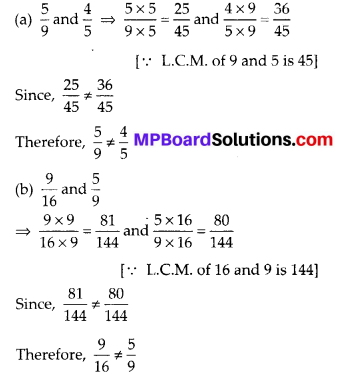
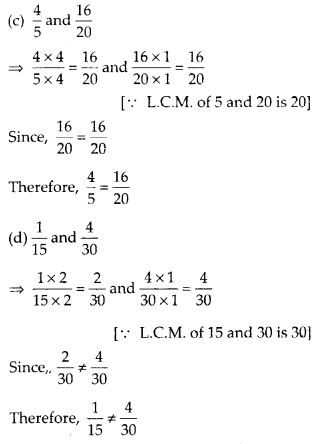
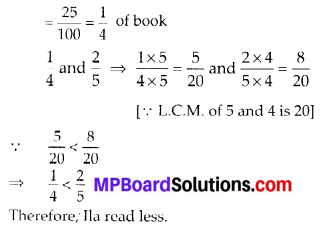
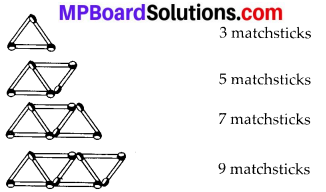
MP Board Class 6th Maths Solutions Chapter 10 Mensuration Ex 10.1

MP Board Class 6th Maths Solutions Chapter 10 Mensuration Ex 10.1

Question 1.
Find the perimeter of each of the following figures:
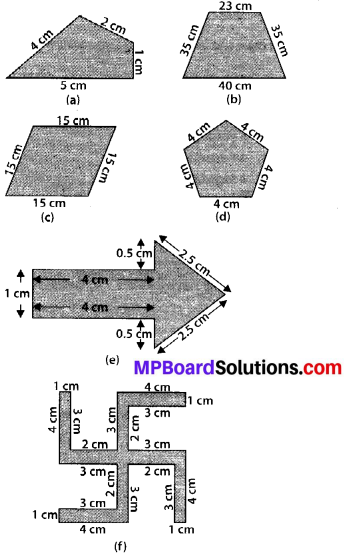
MP Board Class 6th Maths Solutions Chapter 10 Mensuration Ex 10.1 1
Solution:
(a) Perimeter = Sum of all the sides
= 4 cm + 2 cm + 1 cm + 5 cm = 12 cm

(b) Perimeter = Sum of all the sides
= 23 cm + 35cm + 40 cm + 35cm = 133 cm

(c) Perimeter = Sum of all the sides
= 15 cm + 15 cm + 15 cm + 15 cm = 60 cm

(d) Perimeter = Sum of all the sides
= 4 cm + 4 cm + 4 cm + 4 cm + 4 cm = 20 cm

(e) Perimeter = Sum of all the sides
= 1 cm + 4 cm + 0.5 cm + 2.5 cm + 2.5 cm + 0.5 cm + 4 cm = 15 cm

(f) Perimeter = Sum of all the sides
= 4 cm + 1 cm + 3 cm + 2 cm + 3 cm + 4 cm + 1 cm + 3 cm + 2 cm + 3 cm + 4 cm + 1 cm + 3 cm + 2 cm + 3 cm + 4 cm + 1 cm + 3 cm + 2 cm + 3 cm = 52 cm

Question 2.
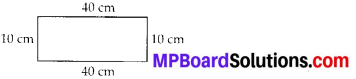
The lid of a rectangular box of sides 40 cm by 10 cm is sealed all round with tape. What is the length of the tape required?
Solution:
Total length of tape required
= Perimeter of rectangle
= 2 (length + breadth)
= 2 (40 +10) cm = 2 × 50 cm = 100 cm = 1 m
MP Board Class 6th Maths Solutions Chapter 10 Mensuration Ex 10.1 2
Thus, the total length of tape required is 100 cm or 1 m.

Question 3.
A table-top measures 2 m 25 cm by 1 m 50 cm. What is the perimeter of the table-top?
Solution:
Length of table-top = 2 m 25 cm = 2.25 m
Breadth of table-top = 1 m 50 cm = 1.50 m
Perimeter of table-top = 2 × (length + breadth)
= 2 × (2.25 + 1.50) m
= 2 × 3.75 m = 7.50 m
Thus, perimeter of table-top is 7.5 m.

MP Board Class 6th Maths Solutions Chapter 10 Mensuration Ex 10.1

Question 4.
What is the length of the wooden strip required to frame a photograph of length and breadth 32 cm and 21 cm respectively?
Solution:
Length of wooden strip
= Perimeter of photograph
= 2 × (length + breadth)
= 2 (32 + 21) cm = 2 × 53 cm = 106 cm
Thus, the length of the wooden strip required is 106 cm.

Question 5.
A rectangular piece of land measures 0.7 km by 0.5 km. Each side is to be fenced with 4 rows of wires. What is the length of the wire needed?
Solution:
Since 4 rows of wires are needed. Therefore, the total length of wire is equal to 4 times the perimeter of land.
Perimeter of land = 2 × (length + breadth)
= 2 × (0.7 + 0.5) km = 2 × 1.2 km = 2.4 km
= 2.4 × 1000 m = 2400 m
Thus, the length of wire
= 4 × 2400 m = 9600 m = 9.6 km

Question 6.
Find the perimeter of each of the following shapes:
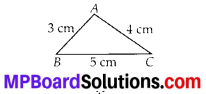
(a) A triangle of sides 3 cm, 4 cm and 5 cm.
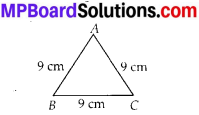
(b) An equilateral triangle of side 9 cm.
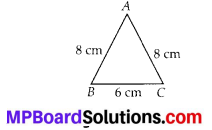
(c) An isosceles triangle with equal sides 8 cm each and third side 6 cm.
Solution:
(a) Perimeter of ∆ABC
= AB + BC + CA
= 3 cm+ 5 cm+ 4 cm
= 12 cm
MP Board Class 6th Maths Solutions Chapter 10 Mensuration Ex 10.1 3
(b) Perimeter of equilateral ∆ABC
= 3 × side
= 3 × 9 cm
= 27 cm
MP Board Class 6th Maths Solutions Chapter 10 Mensuration Ex 10.1 4
(c) Perimeter of ∆ABC
= AB + BC + CA
= 8 cm + 6 cm + 8 cm
= 22 cm
MP Board Class 6th Maths Solutions Chapter 10 Mensuration Ex 10.1 5

Question 7.
Find the perimeter of a triangle with sides measuring 10 cm, 14 cm and 15 cm.
Solution:
Perimeter of triangle
= Sum of all three sides
= 10 cm + 14 cm + 15 cm = 39 cm
Thus, perimeter of triangle is 39 cm.

MP Board Class 6th Maths Solutions Chapter 10 Mensuration Ex 10.1

Question 8.
Find the perimeter of a regular hexagon with each side measuring 8 m.
Solution:
Perimeter of a regular hexagon
= 6 × length of one side
= 6 × 8m
= 48m
Thus, the perimeter of the regular hexagon is 48 m.

Question 9.
Find the side of the square whose perimeter is 20 m.
Solution:
Perimeter of square = 4 × side
⇒ 20 m = 4 × side ⇒ side = \(\frac{20}{4}\) m = 5m
Thus, the side of square is 5 m.

Question 10.
The perimeter of a regular pentagon is 100 cm. How long is its each side?
Solution:
Perimeter of regular pentagon = 5 × side
⇒ 100 cm = 5 × side ⇒ side = \(\frac{100}{5}\) cm = 20 cm
Thus, the side of regular pentagon is 20 cm.

MP Board Class 6th Maths Solutions Chapter 10 Mensuration Ex 10.1

Question 11.
A piece of string is 30 cm long. What will be the length of each side if the string is used to form:
(a) a square?
(b) an equilateral triangle?
(c) a regular hexagon?
Solution:
Length of string = Perimeter of each shape
(a) Perimeter of square = 4 × side
⇒ 30 cm = 4 × side ⇒ side = \(\frac{30}{4}\) cm = 7.5 cm
Thus, the length of each side of square will be 7.5 cm.

(b) Perimeter of equilateral triangle = 3 × side
⇒ 30 cm = 3 × side ⇒ side = \(\frac{30}{3}\) cm = 10 cm
Thus, the length of each side of equilateral triangle will be 10 cm.

(c) Perimeter of regular hexagon = 6 × side
⇒ 30 cm = 6 × side ⇒ side = \(\frac{30}{6}\) cm = 5 cm
Thus, the length of each side of regular hexagon will be 5 cm.

Question 12.
Two sides of a triangle are 12 cm and 14 cm. The perimeter of the triangle is 36 cm. What is its third side?
Solution:
Let the length of third side be x cm. Length of other two sides are 12 cm and 14 cm.
Now, perimeter of triangle = 36 cm
⇒ 12 + 14 + x = 36 ⇒ 26 + x = 36
⇒ x = 36 – 26 ⇒ x = 10
Thus, the length of third side is 10 cm.

Question 13.
Find the cost of fencing a square park of side 250 m at the rate of Rs. 20 per metre.
Solution:
Side of square park = 250 m
Perimeter of square park = 4 × side
= 4 × 250 m = 1000 m
Since, cost of fencing for 1 metre = Rs. 20
Therefore, cost of fencing for 1000 metres
= Rs. 20 × 1000 = Rs. 20,000

Question 14.
Find the cost of fencing a rectangular park of length 175 m and breadth 125 m at the rate of Rs. 12 per metre.
Solution:
Length of rectangular park = 175 m
Breadth of rectangular park = 125 m
Perimeter of park = 2 × (length + breadth)
= 2 × (175 + 125) m = 2 × 300 m = 600 m
Since, cost of fencing park for 1 metre = Rs. 12
Therefore, cost of fencing park for 600 m = Rs. 12 × 600 = Rs. 7,200

Question 15.
Sweety runs around a square park of side 75 m. Bulbul runs around a rectangular park with length 60 m and breadth 45 m. Who covers less distance?
Solution:
Distance covered by Sweety
= Perimeter of square park = 4 × side
= 4 × 75 m = 300 m
Thus, distance covered by Sweety is 300 m.
Now, distance covered by Bulbul
= Perimeter of rectangular park
= 2 × (length + breadth)
= 2 × (60 + 45) m = 2 × 10⁵ m = 210 m
Thus, Bulbul covers a distance of 210 m.
So, Bulbul covers less distance.

Question 16.
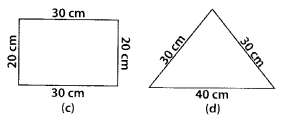
What is the perimeter of each of the following figures? What do you infer from the answers?
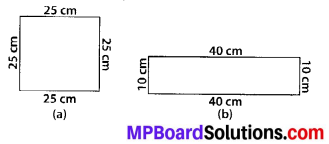
MP Board Class 6th Maths Solutions Chapter 10 Mensuration Ex 10.1 6

MP Board Class 6th Maths Solutions Chapter 10 Mensuration Ex 10.1 7
Solution:
(a) Perimeter of square = 4 × side
= 4 × 25 cm = 100 cm

(b) Perimeter of rectangle
= 2 × (length + breadth)
= 2 × (40 + 10) cm = 2 × 50 cm = 100 cm

(c) Perimeter of rectangle
= 2 × (length + breadth)
= 2 × (30 + 20) cm = 2 × 50 cm = 100 cm

(d) Perimeter of triangle = Sum of all sides
= 30 cm + 30 cm + 40 cm
= 100 cm
Thus, all the figures have same perimeter.

MP Board Class 6th Maths Solutions Chapter 10 Mensuration Ex 10.1

Question 17.
Avneet buys 9 square paving slabs, each with side of \(\frac{1}{2}\) m. He lays them in the form of a square.
(a) What is the perimeter of his arrangement [see fig. (i)]?
(b) Shari does not like his arrangement. She gets him to lay them out like a cross. What is the perimeter of her arrangement [see fig. (ii)]?
(c) Which has a greater perimeter?
(d) Avneet wonders if there is a way of getting an even greater perimeter. Can you find a way of doing this? (The paving slabs must meet along complete edges i.e. they cannot be broken.)
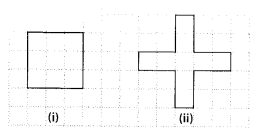
MP Board Class 6th Maths Solutions Chapter 10 Mensuration Ex 10.1 8
Solution:
(a) Side of one small square = \(\frac{1}{2}\) m
∴ Side of given square = \(\frac{3}{2}\) m
Perimeter of square = 4 × side
= 4 × \(\frac{3}{2}\) m = 6 m

(b) Perimeter of given figure
= Sum of all sides = 20 × \(\frac{1}{2}\) m = 10 m

(c) The arrangement cross has greater perimeter.
(d) It is not possible to determine the arrangement with perimeter greater than 10 m.
MP Board Class 6th Maths Solutions

MP Board Class 6th Maths Solutions Chapter 7 Fractions Ex 7.6

MP Board Class 6th Maths Solutions Chapter 7 Fractions Ex 7.6

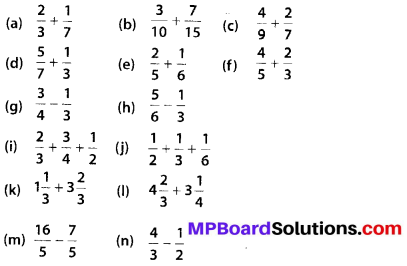
Question 1.
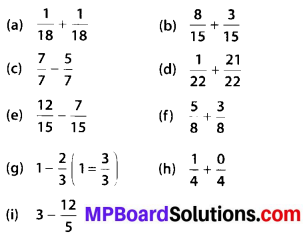
Solve:
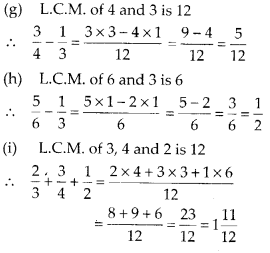
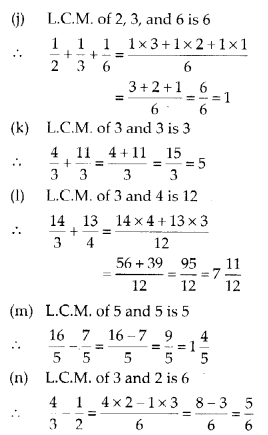
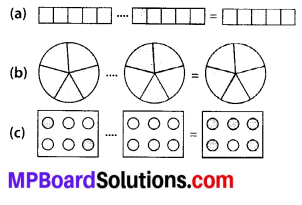
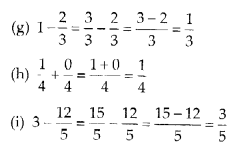
MP Board Class 6th Maths Solutions Chapter 7 Fractions Ex 7.6 1
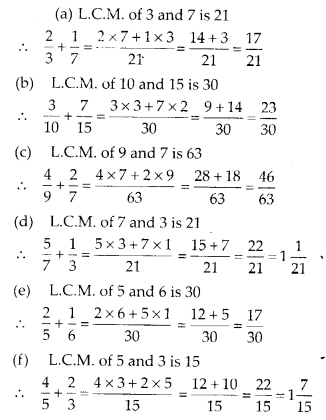
Solution:
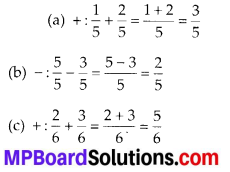
MP Board Class 6th Maths Solutions Chapter 7 Fractions Ex 7.6 2
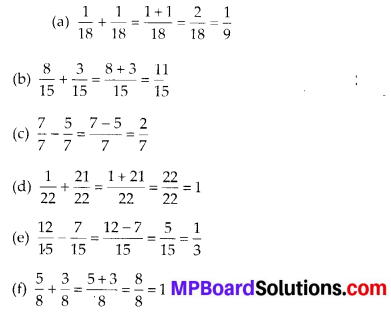
MP Board Class 6th Maths Solutions Chapter 7 Fractions Ex 7.6 3
MP Board Class 6th Maths Solutions Chapter 7 Fractions Ex 7.6 4

Question 2.
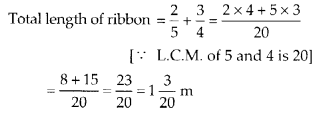
Sarita bought \(\frac{2}{5}\) metre of ribbon and Lalita \(\frac{3}{4}\) metre of ribbon. What is the total length of the
ribbon they bought?
Solution:
Ribbon bought by Sarita = \(\frac{2}{5}\) m
And Ribbon bought by Lalita = \(\frac{3}{4}\) m
MP Board Class 6th Maths Solutions Chapter 7 Fractions Ex 7.6 5
Therefore, they bought 1\(\frac{3}{20}\) m of ribbon.

MP Board Class 6th Maths Solutions Chapter 7 Fractions Ex 7.6

Question 3.
Naina was given 1\(\frac{1}{22}\) piece of cake and Najma was given 1\(\frac{1}{3}\) piece of cake. Find the total amount of cake was given to both of them.
Solution:
Cake taken by Naina = 1\(\frac{1}{2}\) piece
And cake taken by Najma = 1\(\frac{1}{3}\) piece
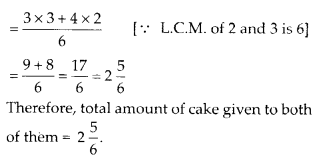
Total cake taken = \(1 \frac{1}{2}+1 \frac{1}{3}=\frac{3}{2}+\frac{4}{3}\)
MP Board Class 6th Maths Solutions Chapter 7 Fractions Ex 7.6 6

MP Board Class 6th Maths Solutions Chapter 7 Fractions Ex 7.6

Question 4.
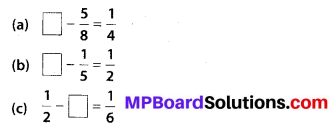
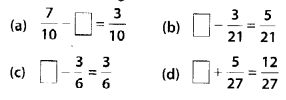
Fill in the boxes:
MP Board Class 6th Maths Solutions Chapter 7 Fractions Ex 7.6 7
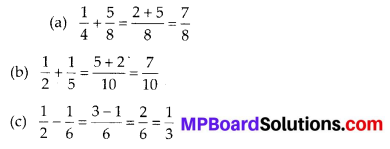
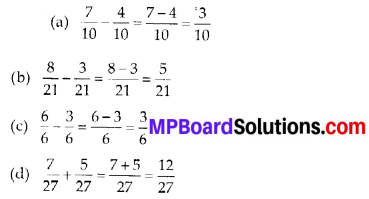
Solution:
MP Board Class 6th Maths Solutions Chapter 7 Fractions Ex 7.6 8

Question 5.
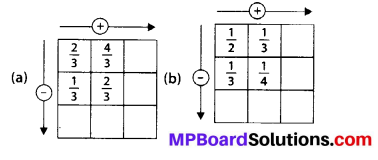
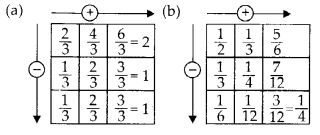
Complete the addition-subtraction box.
MP Board Class 6th Maths Solutions Chapter 7 Fractions Ex 7.6 9
Solution:
MP Board Class 6th Maths Solutions Chapter 7 Fractions Ex 7.6 10

MP Board Class 6th Maths Solutions Chapter 7 Fractions Ex 7.6

Question 6.
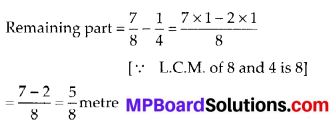
A piece of wire \(\frac{7}{8}\) metre long broke into two pieces. One piece was \(\frac{1}{4}\) metre long. How long is the other piece?
Solution:
Total length of wire = \(\frac{7}{8}\) metre
Length of first part = \(\frac{1}{4}\) metre
MP Board Class 6th Maths Solutions Chapter 7 Fractions Ex 7.6 11
Therefore, the length of remaining part is \(\frac{5}{8}\) metre

Question 7.
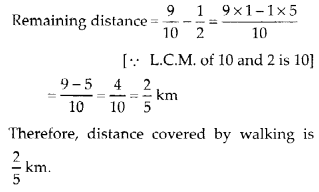
Nandini’s house is \(\frac{9}{10}\) metre km from her school. She 10
walked some distance and then took a bus for \(\frac{1}{2}\) metre km to reach the school. How far did she walk?
Solution:
Total distance between school and house = \(\frac{9}{10}\) km
Distance covered bv bus = \(\frac{1}{2}\) km
MP Board Class 6th Maths Solutions Chapter 7 Fractions Ex 7.6 12
Therefore, distance covered by walking is \(\frac{2}{5}\) km.

MP Board Class 6th Maths Solutions Chapter 7 Fractions Ex 7.6

Question 8.
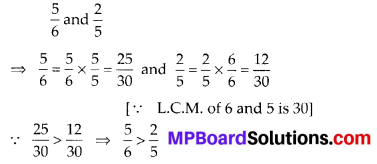
Asha and Samuel have bookshelves of the same size partly filled with books. Asha’s shelf is \(\frac{5}{6}\) th full and Samuel’s shelf is \(\frac{2}{5}\)th full. Whose bookshelf is more full? By what fraction?
Solution:
MP Board Class 6th Maths Solutions Chapter 7 Fractions Ex 7.6 13
∴ Asha’s bookshelf is more covered than Samuel.
Difference \(=\frac{25}{30}-\frac{12}{30}=\frac{13}{30}\)

MP Board Class 6th Maths Solutions Chapter 7 Fractions Ex 7.6

Question 9.
Jaidev takes 2\(\frac{1}{5}\) minutes to walk across the school ground. Rahul takes \(\frac{7}{4}\) minutes to do the same. Who takes less time and by what fraction?
Solution:
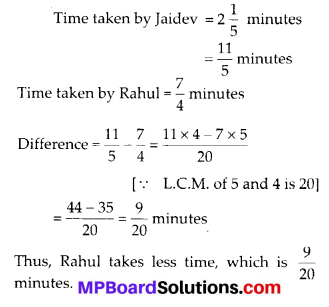
MP Board Class 6th Maths Solutions Chapter 7 Fractions Ex 7.6 14

MP Board Class 6th Maths Solutions

MP Board Class 6th Maths Solutions Chapter 11 Algebra Ex 11.5

MP Board Class 6th Maths Solutions Chapter 11 Algebra Ex 11.5

Question 1.
State which of the following are equations (with a variable). Give reason for your answer. Identify the variable from the equations with a variable
(a) 17 = x + 7
(b) (t – 7) > 5
(c) \(\frac{4}{2}\) = 2
(d) (7 × 3) – 19 = 8
(e) 5 × 4 – 8 = 2x
(f) x – 2 = 0
(g) 2m < 30
(h) 2n + 1 = 11
(i) 7 = (11 × 5) – (12 × 4)
(j) 7 = (11 ×2) + p
(k) 20 = 5y
(l) \(\frac{3q}{2}\) < 5
(m) z + 12 > 24
(n) 20 – (10 – 5) = 3× 5
(o) 7 – x = 5
Solution:
(a) 17 = x + 7 is an equation with variable as both the sides are equal. The variable is x.
(b) (t – 7) > 5 is not an equation as L.H.S. is greater than R.H.S.
(c) \(\frac{4}{2}\) = 2 is not an equation with variable.
(d) (7 × 3) – 19 = 8 is not an equation with variable.
(e) 5 × 4 – 8 = 2x is an equation with variable as both the sides are equal. The variable is x.
(f) x – 2 = 0 is an equation with variable as both the sides are equal. The variable is
(g) 2m < 30 is not an equation as L.H.S. is less than R.H.S.
(h) 2n + 1 = 11 is an equation with variable as both the sides are equal. The variable is n.
(i) 7 = (11 × 5) – (12 × 4) is not an equation with variable.
(j) 7 = (11 × 2) + p is an equation with variable as both the sides are equal. The variable is p.
(k) 20 = 5y is an equation with variable as both the sides are equal. The variable is
(l) \(\frac{3q}{2}\) < 5 is not an equation as L.H.S. is less than R.H.S.
(m) z + 12 > 24 is not an equation as L.H.S. is greater than R.H.S.
(n) 20 – (10 – 5) = 3 × 5 is not an equation with variable.
(o) 7 – x = 5 is an equation with variable as both the sides are equal. The variable is x.

Question 2.
Complete the entries in the third column of the table.
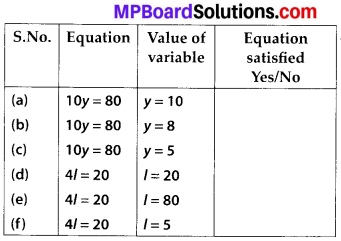
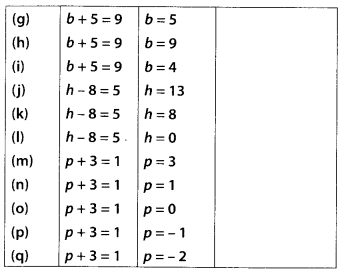
MP Board Class 6th Maths Solutions Chapter 11 Algebra Ex 11.5 1
MP Board Class 6th Maths Solutions Chapter 11 Algebra Ex 11.5 2
Solution:
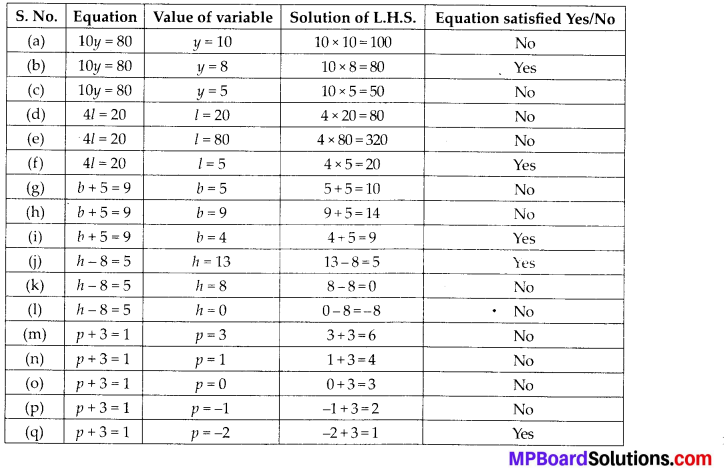
MP Board Class 6th Maths Solutions Chapter 11 Algebra Ex 11.5 3

Question 3.
Pick out the solution from the values given in the bracket next to each equation. Show that the other values do not satisfy the equation.
(a) 5m = 60        (10, 5, 12, 15)
(b) n + 12 = 20      (12, 8, 20, 0)
(c) p – 5 = 5       (0, 10, 5, -5)
(d) \(\frac{q}{2}\) = 7   (7, 2, 10, 14)
(e) r – 4 = 0     (4, -4, 8, 0)
(f) x + 4 = 2      (-2, 0, 2, 4)
Solution:
(a) 5m = 60
Putting the given values in L.H.S., we get
5 × 10 = 50
∵ L.H.S. ≠ R.H.S.
∴ m = 10 is not the solution.
5 × 5 = 25
∵ L.H.S. ≠ R.H.S.
∴ m = 5 is not the solution.
5 × 12 = 60
∵ L.H.S. = R.H.S.
∴ m = 12 is a solution.
5 x 15 = 75
∵ L.H.S. ≠ R.H.S.
∴ m = 15 is not the solution.

(b) n + 12 = 20
Putting the given values in L.H.S., we get
12 + 12 = 24
∵ L.H.S. ≠ R.H.S.
∴ n = 12 is not the solution.
8 + 12 = 20
∵ L.H.S. = R.H.S.
∴ n = 8 is a solution.
20 + 12 = 32
∵ L.H.S. ≠ R.H.S.
∴ n = 20 is not the solution.
0 + 12 = 12
∵ L.H.S. ≠ R.H.S.
∴ n = 0 is not the solution.

(c) p – 5 = 5
Putting the given values in L.H.S., we get
0 – 5 = -5
∵ L.H.S. ≠ R.H.S.
∴ p = 0 is not the solution.
10 – 5 = 5
∵ L.H.S. = R.H.S.
∴ p = 10 is a solution.
5 – 5 = 0
∵ L.H.S. ≠ R.H.S.
∴ p = 5 is not the solution.
-5 – 5 = -10
∵ L.H.S. ≠ R.H.S.
∴ p = -5 is not the solution.

(d) \(\frac{q}{2}\) = 7
Putting the given values in L.H.S., we get
\(\frac{7}{2}\)
∵ L.H.S. ≠ R.H.S.
∴ q = 7 is not the solution.
\(\frac{2}{2}\) = 1
∵ L.H.S. ≠ R.H.S.
∴ q = 2 is not the solution.
\(\frac{10}{2}\) = 5
∵ L.H.S. ≠ R.H.S.
∴ q = 10 is not the solution.
\(\frac{14}{2}\) = 7
∵ L.H.S. = R.H.S.
∴ q = 14 is a solution.

(e) r – 4 = 0
Putting the given values in L.H.S., we get
4 – 4 = 0
∵ L.H.S. = R.H.S.
∴ r = 4 is a solution.
-4 – 4 = -8
∵ L.H.S. ≠ R.H.S.
∴ r = -4 is not the solution.
8 – 4 = 4
∵ L.H.S. ≠ R.H.S.
∴ r = 8 is not the solution.
0 – 4 = -4
∵ L.H.S. ≠ R.H.S.
∴ r = 0 is not the solution.

(f) x + 4 = 2
Putting the given values in L.H.S., we get
-2 + 4 = 2
∵ L.H.S. = R.H.S.
∴ x = -2 is a solution.
0 + 4 = 4
∵ L.H.S. ≠ R.H.S.
∴ x = 0 is not the solution.
2 + 4 = 6
∵ L.H.S. ≠ R.H.S.
∴ x = 2 is not the solution.
4 + 4 = 8
∵ L.H.S. ≠ R.H.S.
∴ x = 4 is not the solution.

MP Board Class 6th Maths Solutions Chapter 11 Algebra Ex 11.5

Question 4.
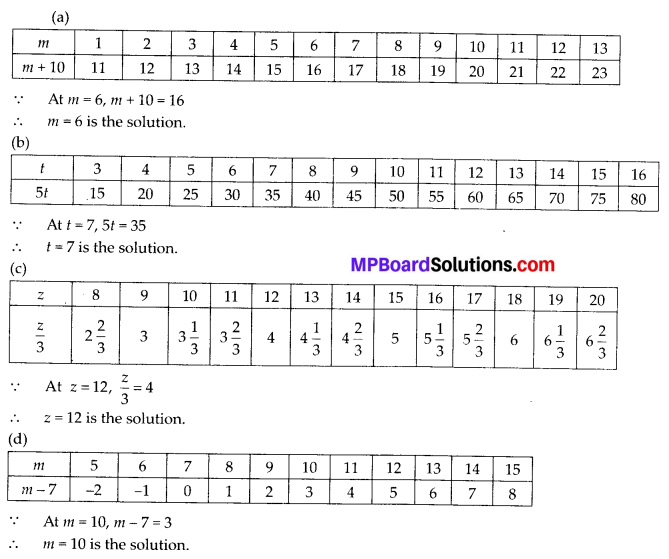
(a) Complete the table and by inspection of the table, find the solution to the equation m + 10 = 16.
MP Board Class 6th Maths Solutions Chapter 11 Algebra Ex 11.5 4
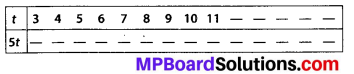
(b) Complete the table and by inspection of the table, find the solution to the equation 5t = 35.

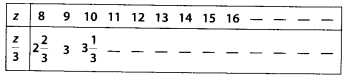
(c) Complete the table and find the solution of the equation z/3 = 4 using the table
MP Board Class 6th Maths Solutions Chapter 11 Algebra Ex 11.5 6
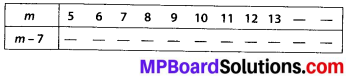
(d) Complete the table and find the solution to the equation m – 7 = 3.
MP Board Class 6th Maths Solutions Chapter 11 Algebra Ex 11.5 7
Solution:
MP Board Class 6th Maths Solutions Chapter 11 Algebra Ex 11.5 8

Question 5.
Solve the following riddles, you may yourself construct such riddles.
Who am I?
(i) Go round a square
Counting every corner
Thrice and no more!
Add the count to me
To get exactly thirty four!

(ii) For each day of the week
Make an upcount from me
If you make no mistake
You will get twenty three!

(iii) I am a special number
Take away from me a six!
A whole cricket team
You will still be able to fix!

(iv) Tell me who I am
I shall give a pretty clue!
You will get me back
If you take me out of twenty two!
Solution:
(i) According to given information, we have
3(4) + x = 34 ⇒ 12 + x = 34
⇒ x = 34 – 12 ⇒ x = 22

MP Board Class 6th Maths Solutions Chapter 11 Algebra Ex 11.5

(ii) According to given information, we have
x + 7 = 23
⇒ x = 23 – 7 ⇒ x = 16

(iii) According to given information, we have
x – 6 = 11
⇒ x = 11 + 6 ⇒ x = 17 .

(iv) According to given information, we have
x = 22-x ⇒ x + x = 22 ⇒ 2x = 22
⇒ x = \(\frac{22}{2}\) ⇒ x = 11

MP Board Class 6th Maths Solutions

MP Board Class 6th Maths Solutions Chapter 7 Fractions Ex 7.5

MP Board Class 6th Maths Solutions Chapter 7 Fractions Ex 7.5

Question 1.
Write these fractions appropriately as additions or subtractions:
MP Board Class 6th Maths Solutions Chapter 7 Fractions Ex 7.5 1
Solution:
MP Board Class 6th Maths Solutions Chapter 7 Fractions Ex 7.5 2

Question 2.
Solve:
MP Board Class 6th Maths Solutions Chapter 7 Fractions Ex 7.5 3
Solution:
MP Board Class 6th Maths Solutions Chapter 7 Fractions Ex 7.5 4
MP Board Class 6th Maths Solutions Chapter 7 Fractions Ex 7.5 5

MP Board Class 6th Maths Solutions Chapter 7 Fractions Ex 7.5

Question 3.
Shubham painted \(\frac{2}{3}\) of the wall space in his room. His sister Madhavi helped and painted \(\frac{1}{3}\) of the wall space. How much did they paint together?
Solution:
Fraction of wall painted by Shubham = \(\frac{2}{3}\)
Fraction of wall painted by Madhavi = \(\frac{1}{3}\)
Total painting by both of them \(=\frac{2}{3}+\frac{1}{3}=\frac{2+1}{3}=\frac{3}{3}=1\)
Therefore, they painted complete wall.

Question 4.
Fill in the missing fractions.
MP Board Class 6th Maths Solutions Chapter 7 Fractions Ex 7.5 6
Solution:
MP Board Class 6th Maths Solutions Chapter 7 Fractions Ex 7.5 7

MP Board Class 6th Maths Solutions Chapter 7 Fractions Ex 7.5

Question 5.
Javed was given \(\frac{5}{7}\) of a basket of oranges. What fraction of oranges was left in the basket?
Solution:
Consider the total number of oranges to be the whole portion or 1.
Fraction of oranges left = \(1-\frac{5}{7}\)
MP Board Class 6th Maths Solutions Chapter 7 Fractions Ex 7.5 8
Thus, \(\frac{2}{7}\) oranges was left in the basket.

MP Board Class 6th Maths Solutions

MP Board Class 6th Maths Solutions Chapter 11 Algebra Ex 11.4

MP Board Class 6th Maths Solutions Chapter 11 Algebra Ex 11.4

Question 1.
Answer the following:
(a) Take Sarita’s present age to be y years
(i) What will be her age 5 years from now?
(ii) What was her age 3 years back?
(iii) Sarita’s grandfather is 6 times her age. What is the age of her grandfather?
(iv) Grandmother is 2 years younger than grandfather. What is grandmother’s age?
(v) Sarita’s father’s age is 5 years more than 3 times Sarita’s age. What is her father’s age?
(b) The length of a rectangular hall is 4 metres less than 3 times the breadth of the hall. What is the length, if the breadth is b metres?
(c) A rectangular box has height h cm. Its length is 5 times the height and breadth is 10 cm less than the length. Express the length and the breadth of the box in terms of the height.
(d) Meena, Beena and Leena are climbing the steps to the hill top. Meena is at step s, Beena is 8 steps ahead and Leena 7 steps behind. Where are Beena and Meena? The total number of steps to the hill top is 10 less than 4 times what Meena has reached. Express the total number of steps using s.
(e) A bus travels at v km per hour. It is going from Daspur to Beespur. After the bus has travelled 5 hours, Beespur is still 20 km away. What is the distance from Daspur to Beespur? Express it using v.
Solution:
(a) Sarita’s present age = y years
(i) After 5 years, her age will be (y + 5) years.
(ii) 3 years ago, her age was (y – 3) years.
(iii) Age of her grandfather = 6 × (Sarita’s age) = (6 × y) years = 6y years
(iv) Age of her grandmother = age of her grandfather – 2 years = (6y – 2) years
(v) Age of her father = 3 (Sarita’s age) + 5 years = (3y + 5) years

(b) Breadth of the hall = b m
Length of the hall = 3 (breadth) – 4m = 3b m – 4 m = (3b – 4) m

(c) Height of the box = h cm
Length of the box = 5 × height = 5 h cm
Breadth of the box = Length – 10 cm = (5h – 10) cm

(d) Meena’s position = s
Beena’s position = 8 steps ahead = s + 8
Leena’s position = 7 steps behind = s – 7
∴ Total number of steps = 4s – 10

(e) Speed of the bus = v km/h
Distance travelled in 5 hours = 5v km
Remaining distance = 20 km
Therefore, total distance = (5v + 20) km

MP Board Class 6th Maths Solutions Chapter 11 Algebra Ex 11.4

Question 2.
Change the following statements using expressions into statements in ordinary language.
(For example. Given Salim scores r runs in a cricket match, Nalin scores (r + 15) runs. In ordinary language – Nalin scores 15 runs more than Salim.)
(a) A notebook costs ₹ p. A book costs ₹ 3 p.
(b) Tony puts q marbles on the table. He has 8 q marbles in his box.
(c) Our class has n students. The school has 20n students.
(d) Jaggu is z years old. His uncle is 4z years old and his aunt is (4z – 3) years old.
(e) In an arrangement of dots there are r rows. Each row contains 5 dots.
Solution:
(a) A book costs 3 times the cost of a notebook.
(b) The number of marbles in Tony’s box is 8 times the marbles on the table.
(c) Total number of students in the school is 20 times the number of students in our class.
(d) Jaggu’s uncle is 4 times older than Jaggu and Jaggu’s aunt is 3 years younger than his uncle.
(e) The total number of dots is 5 times the number of rows.

MP Board Class 6th Maths Solutions Chapter 11 Algebra Ex 11.4

Question 3.
(a) Given Munnu’s age to be x years, can you guess what (x – 2) may show?
{Hint: Think of Munnu’s younger brother.)
Can you guess what (x + 4) may show? What (3x+ 7) may show?
(b) Given Sara’s age today to be y years. Think of her age in the future or in the past.
What will the following expression indicate? y + 7, y – 3, y + \(4 \frac{1}{2}\), y – \(2 \frac{1}{2}\).
(c) Given n students in the class like football, what may 2n show? What may \(\frac{n}{2}\) show?
(Hint: Think of games other than football).
Solution:
(a) Munnu’s age = x years Age of his. younger brother who is 2 years younger than him = (x – 2) years
Age of his elder brother who is 4 years elder than him = (x + 4) years
Age of his father whose age is 7 years more than thrice of his age = (3x + 7) years

(b) Sara’s present age = y years
Her age in past = (y – 3), (y – \(2 \frac{1}{2}\))
Her age in future = (y + 7), (y + \(4 \frac{1}{2}\))

(c) Number of students like football = n
Number of students like hockey is twice the number of students liking football,
i. e., 2n
Number of students like tennis is half the number of students liking football,
i.e., \(\frac{n}{2}\)

MP Board Class 6th Maths Solutions

MP Board Class 6th Maths Solutions Chapter 11 Algebra Ex 11.3

MP Board Class 6th Maths Solutions Chapter 11 Algebra Ex 11.3

Question 1.
Make up as many expressions with numbers (no variables) as you can from three numbers 5, 7 and 8. Every number should be used not more than once. Use only addition, subtraction and multiplication.
(Hint : Three possible expressions are 5 + (8 – 7), 5 – (8 – 7), (5 × 8) + 7; make the other expressions.)
Solution:
(a) (8 × 5) – 7
(b) (8 + 5) – 7
(c) (8 × 7) – 5
(d) (8 + 7) – 5
(e) 5 × (7 + 8)
(f) 5 + (7 × 8)
(g) 5 + (8 – 7)
(h) 5 – (7 + 8)

Question 2.
Which out of the following are expressions with numbers only?
(a) y + 3
(b) (7 × 20) – 8z
(c) 5 (21 – 7) + 7 × 2
(d) 5
(e) 3 x
(f) 5 – 5n
(g) (7 × 20) – (5 × 10) – 45 + p
Solution:
(c) and (d) have expressions with numbers only.

Question 3.
Identify the operations (addition, subtraction, division, multiplication) in forming the following expressions and tell how the expressions have been formed.
(a) z + 1, z – 1, y + 17, y – 17
(b) 17y, \(\frac{y}{17}\), 5z
(c) 2y + 17, 2y – 17
(d) 7m, – 7m + 3, – 7m – 3
Solution:
(a) z + 1 = 1 added to z
z – 1 = 1 subtracted from z
y + 17 = 17 added to y
y – 17 = 17 subtracted from y

(b) 17y = y multiplied by 17
\(\frac{y}{17}\) = y divided by 17
5z = z multiplied by 5 .

(c) 2y + 17 = First y multiplied by 2, then 17 added to the product
2y – 17 = First y multiplied by 2, then 17 subtracted from the product

(d) 7m = m multiplied by 7
-7m + 3 = First m multiplied by -7, then 3 added to the product
-7m – 3 = First m multiplied by -7, then 3 subtracted from the product

MP Board Class 6th Maths Solutions Chapter 11 Algebra Ex 11.3

Question 4.
Give expressions for the following cases.
(a) 7 added to p
(b) 7 subtracted from p
(c) p multiplied by 7
(d) p divided by 7
(e) 7 subtracted from – m
(f) -p multiplied by 5
(g) -p divided by 5
(h) p multiplied by – 5
Solution:
(a) p + 7
(b) p – 7
(c) 7p
(d) \(\frac{p}{7}\)
(e) -m – 7
(f) -5p
(g) \(\frac{-p}{5}\)
(h) -5p

Question 5.
Give expressions in the following cases.
(a) 11 added to 2m
(b) 11 subtracted from 2m
(c) 5 times y to which 3 is added
(d) 5 times y from which 3 is subtracted
(e) y is multiplied by – 8
(f) y is multiplied by – 8 and then 5 is added to the result
(g) y is multiplied by 5 and the result is subtracted from 16
(h) y is multiplied by – 5 and the result is added to 16.
Solution:
(a) 2m + 11
(b) 2m – 11
(c) 5y + 3
(d) 5y – 3
(e) -8y
(f) -8y + 5
(g) 16 – 5 y
(h) -5y + 16

MP Board Class 6th Maths Solutions Chapter 11 Algebra Ex 11.3

Question 6.
(a) Form expressions using t and 4. Use not more than one number operation. Every expression must have t in it.
(b) Form expressions using y, 2 and 7. Every expression must have y in it. Use only two number operations. These should be different.
Solution:
(a) t + 4, t – 4, 4 – t, 4t, \(\frac{t}{4}\), \(\frac{4}{t}\)
(b) 2 y + 7, 2y – 7, 7y + 2,7y – 2 and so on.

MP Board Class 6th Maths Solutions

MP Board Class 6th Maths Solutions Chapter 7 Fractions Ex 7.4

MP Board Class 6th Maths Solutions Chapter 7 Fractions Ex 7.4

Question 1.
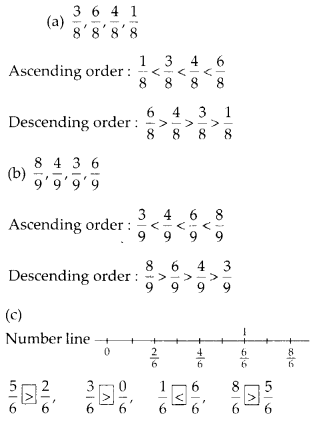
Write shaded portion as fraction. Arrange them in ascending and descending order using correct sign ‘<‘ ‘=’ ‘>’ between the fractions:
MP Board Class 6th Maths Solutions Chapter 7 Fractions Ex 7.4 1
(c) Show \(\frac{2}{6}, \frac{4}{6}, \frac{8}{6}\) and \(\frac{6}{6}\) on the number line. Put appropriate signs between the fractions given.
MP Board Class 6th Maths Solutions Chapter 7 Fractions Ex 7.4 2
Solution:
MP Board Class 6th Maths Solutions Chapter 7 Fractions Ex 7.4 3

MP Board Class 6th Maths Solutions Chapter 7 Fractions Ex 7.4

Question 2.
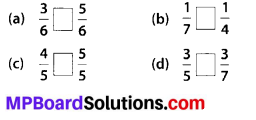
Compare the fractions and put an appropriate sign.
MP Board Class 6th Maths Solutions Chapter 7 Fractions Ex 7.4 4
Solution:
(a)
\(\frac{3}{6}\) and \(\frac{5}{6}\) are like fractions.
Also, denominator of \(\frac{5}{6}\) is greater than denominator of \(\frac{3}{6}\)
MP Board Class 6th Maths Solutions Chapter 7 Fractions Ex 7.4 61

(b)
\(\frac{1}{7}\) and \(\frac{1}{4}\) are unlike fractions with same numerator. Also, denominator of \(\frac{1}{7}\) is greater than denominator of \(\frac{1}{4}\)
MP Board Class 6th Maths Solutions Chapter 7 Fractions Ex 7.4 62

(c)
\(\frac{4}{5}\) and \(\frac{5}{5}\) are like fractions.
Also, numerator of \(\frac{5}{5}\) is greater than numerator of \(\frac{4}{5}\)
MP Board Class 6th Maths Solutions Chapter 7 Fractions Ex 7.4 63

(d) \(\frac{3}{5}\) and \(\frac{3}{7}\) are unlike fractions with same numerator. Also, denominator of \(\frac{3}{7}\) is greater than denominator of \(\frac{3}{5}\).
MP Board Class 6th Maths Solutions Chapter 7 Fractions Ex 7.4 64

MP Board Class 6th Maths Solutions Chapter 7 Fractions Ex 7.4

Question 3.
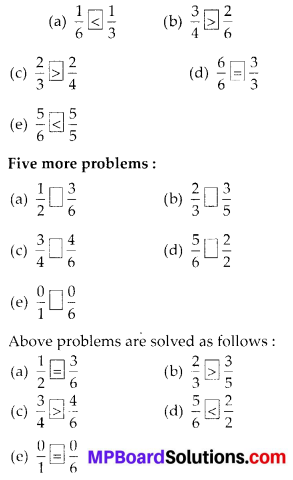
Make five more such pairs and put appropriate signs.
Solution:
MP Board Class 6th Maths Solutions Chapter 7 Fractions Ex 7.4 6

MP Board Class 6th Maths Solutions Chapter 7 Fractions Ex 7.4

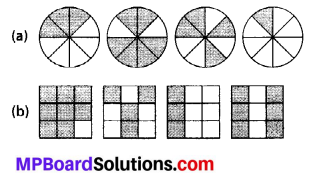
Question 4.
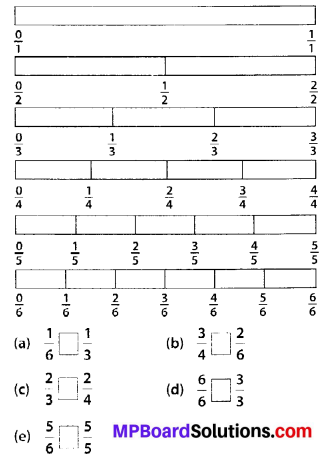
Look at the figures and write ‘<‘ or ‘>’, ‘=’ between the given pairs of fractions.
MP Board Class 6th Maths Solutions Chapter 7 Fractions Ex 7.4 7
make five more such problems and solve them with your friends.
Solution:
MP Board Class 6th Maths Solutions Chapter 7 Fractions Ex 7.4 8

MP Board Class 6th Maths Solutions Chapter 7 Fractions Ex 7.4

Question 5.
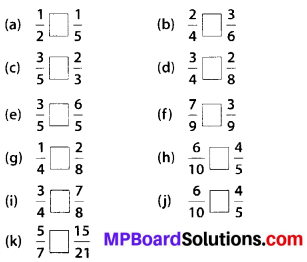
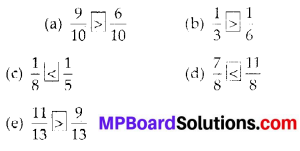
How quickly can you do this ? Fill appropriate sign (‘<‘, ‘=’, ‘>’)
MP Board Class 6th Maths Solutions Chapter 7 Fractions Ex 7.4 11
Solution:
(a) \(\frac{1}{2}\) and \(\frac{1}{5}\) are unlike fractions with same numerator. Also denominator of \(\frac{1}{5}\) is greater than denominator of \(\frac{1}{2}\).
MP Board Class 6th Maths Solutions Chapter 7 Fractions Ex 7.4 66

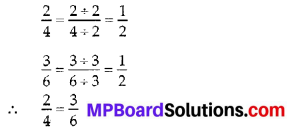
(b) \(\frac{2}{3}\) and \(\frac{3}{6}\) are unlike fractions with different numerator.
MP Board Class 6th Maths Solutions Chapter 7 Fractions Ex 7.4 12

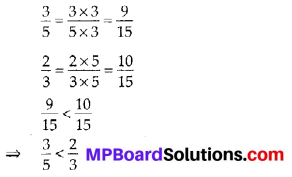
(c) \(\frac{3}{5}\) and \(\frac{2}{3}\) are unlike fractions with different numerator.
MP Board Class 6th Maths Solutions Chapter 7 Fractions Ex 7.4 13

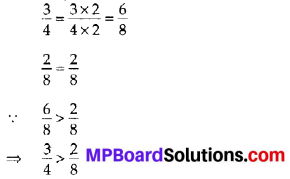
(d) \(\frac{3}{4}\) and \(\frac{2}{8}\) are unlike fractions with different numerators.
MP Board Class 6th Maths Solutions Chapter 7 Fractions Ex 7.4 14

(e) \(\frac{3}{5}\) and \(\frac{6}{5}\) are like fractions. Also, numerator of \(\frac{6}{5}\) is greater than numerator of \(\frac{3}{9}\).
MP Board Class 6th Maths Solutions Chapter 7 Fractions Ex 7.4 15

(f) \(\frac{7}{9}\) and \(\frac{3}{9}\) are like fractions. Also, numerator of \(\frac{7}{9}\) is greater than numerator of \(\frac{3}{9}\).
MP Board Class 6th Maths Solutions Chapter 7 Fractions Ex 7.4 16

(g) \(\frac{1}{4}\) and \(\frac{1}{2}\) are unlike fractions with different numerators.
MP Board Class 6th Maths Solutions Chapter 7 Fractions Ex 7.4 17
MP Board Class 6th Maths Solutions Chapter 7 Fractions Ex 7.4 18
MP Board Class 6th Maths Solutions Chapter 7 Fractions Ex 7.4 50

MP Board Class 6th Maths Solutions Chapter 7 Fractions Ex 7.4

Question 6.
The following fractions represent just three different numbers. Separate them into three groups of equivalent fractions, by changing each one to its simplest form.
MP Board Class 6th Maths Solutions Chapter 7 Fractions Ex 7.4 19
MP Board Class 6th Maths Solutions Chapter 7 Fractions Ex 7.4 20
Solution:
MP Board Class 6th Maths Solutions Chapter 7 Fractions Ex 7.4 21
MP Board Class 6th Maths Solutions Chapter 7 Fractions Ex 7.4 22

Question 7.
Find answers to the following. Write and indicate how you solved them.
MP Board Class 6th Maths Solutions Chapter 7 Fractions Ex 7.4 23
MP Board Class 6th Maths Solutions Chapter 7 Fractions Ex 7.4 24
Solution:
MP Board Class 6th Maths Solutions Chapter 7 Fractions Ex 7.4 25
MP Board Class 6th Maths Solutions Chapter 7 Fractions Ex 7.4 60

MP Board Class 6th Maths Solutions Chapter 7 Fractions Ex 7.4

Question 8.
Ila read 25 pages of a book containing 100 pages. Lalita read \(\frac{2}{5}\) of the same book. Who read less ?
Solution:
Ila read 25 pages out of 100 pages.
Fraction of reading the pages
MP Board Class 6th Maths Solutions Chapter 7 Fractions Ex 7.4 26

Question 9.
Rafiq \(\frac{3}{6}\) of an hour, while Rohit exercised for \(\frac{3}{4}\) of an hour. Who exercised for a longer time?
Solution:
Rafiq exercised \(\frac{3}{6}\) of an hour.
Rafiq exercised \(\frac{3}{4}\) of an hour.
Since, \(\frac{3}{4}>\frac{3}{6}\)
Therefore, Rohit exercised for a longer time.

MP Board Class 6th Maths Solutions Chapter 7 Fractions Ex 7.4

Question 10.
In a Class A of 25 students, 20 passed in first class; in another class B of 30 students, 24 passed in first class. In which class was a greater fraction of students getting first class?
Solution:
In class A, 20 passed in first class out of 25.
∴ Fraction of first class passed students \(=\frac{20}{25}=\frac{4}{5}\)
In class B, 24 passed in first class out of 30.
∴ Fraction of first class passed students \(=\frac{24}{30}=\frac{4}{5}\)
Hence, both classes have same fraction of student getting first class.

MP Board Class 6th Maths Solutions

MP Board Class 6th Maths Solutions Chapter 11 Algebra Ex 11.2

MP Board Class 6th Maths Solutions Chapter 11 Algebra Ex 11.2

Question 1.
The side of an equilateral triangle is shown by l. Express the perimeter of the equilateral triangle using l.
Solution:
Side of equilateral triangle = l
Therefore, perimeter of equilateral triangle = 3 × side = 3l

MP Board Class 6th Maths Solutions Chapter 11 Algebra Ex 11.2

Question 2.
The side of a regular hexagon (see fig.) is denoted by l.
MP Board Class 6th Maths Solutions Chapter 11 Algebra Ex 11.2 1
Express the perimeter of the hexagon using l. (Hint: A regular hexagon has all its six sides equal in length.)
Solution:
Side of regular hexagon = l
Therefore, perimeter of regular hexagon = 6 × side = 6l

Question 3.
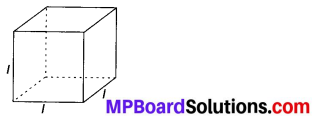
A cube is a three-dimensional figure as shown in the given figure. It has six faces and all of them are identical squares. The length of an edge of the cube is given by l. Find the formula for the total length of the edges of a cube.
MP Board Class 6th Maths Solutions Chapter 11 Algebra Ex 11.2 2
Solution:
Length of one edge of a cube = l
Number of edges in a cube = 12
Therefore, total length of the edges of a cube = 12 × l = 12l

MP Board Class 6th Maths Solutions Chapter 11 Algebra Ex 11.2

Question 4.
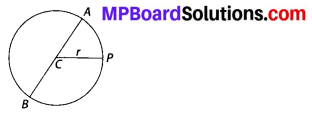
The diameter of a circle is a line which joins two points on the circle and also passes through the centre of the circle. (In the adjoining figure, AB is a diameter of the circle; C is its centre.) Express the diameter of the circle (d) in terms of its radius (r).
MP Board Class 6th Maths Solutions Chapter 11 Algebra Ex 11.2 3
Solution:
Since, diameter of the circle is always twice the radius of the circle.
Therefore, d = 2r

Question 5.
To find sum of three numbers 14, 27 and 13, we can have two ways:
(a) We may first add 14 and 27 to get 41 and then add 13 to it to get the total sum 54 or
(b) We may add 27 and 13 to get 40 and then add 14 to get the sum 54.
Thus, (14 + 27) + 13 = 14 + (27 + 13)
This can be done for any three numbers. This property is known as the associativity of addition of numbers. Express this property which we have already studied in the chapter on Whole Numbers, in a general way, by using variables a, b and c.
Solution:
(a + b) + c = a + (b + c), where a, b and c are any three numbers.

MP Board Class 6th Maths Solutions

MP Board Class 6th Maths Solutions Chapter 11 Algebra Ex 11.1

MP Board Class 6th Maths Solutions Chapter 11 Algebra Ex 11.1

Question 1.
Find the rule which gives the number of matchsticks required to make the following matchstick patterns. Use a variable to write the rule.
(a) A pattern of letter T as MP Board Class 6th Maths Solutions Chapter 11 Algebra Ex 11.1 1
(b) A pattern of letter Z as MP Board Class 6th Maths Solutions Chapter 11 Algebra Ex 11.1 2
(c) A pattern of letter U as MP Board Class 6th Maths Solutions Chapter 11 Algebra Ex 11.1 3
(d) A pattern of letter V as MP Board Class 6th Maths Solutions Chapter 11 Algebra Ex 11.1 4
(e) A pattern of letter E as MP Board Class 6th Maths Solutions Chapter 11 Algebra Ex 11.1 5
(f) A pattern of letter S as MP Board Class 6th Maths Solutions Chapter 11 Algebra Ex 11.1 6
(g) A pattern of letter A as MP Board Class 6th Maths Solutions Chapter 11 Algebra Ex 11.1 7
Solution:
(a) Number of matchsticks required to make one MP Board Class 6th Maths Solutions Chapter 11 Algebra Ex 11.1 8
∴ Number of matchsticks required to
make a pattern of letter T as MP Board Class 6th Maths Solutions Chapter 11 Algebra Ex 11.1 9

(b) Number of matchsticks required to make one MP Board Class 6th Maths Solutions Chapter 11 Algebra Ex 11.1 10
∴ Number of matchsticks required to make a pattern of letter Z as MP Board Class 6th Maths Solutions Chapter 11 Algebra Ex 11.1 11

(c) Number of matchsticks required to make one MP Board Class 6th Maths Solutions Chapter 11 Algebra Ex 11.1 12
∴Number of matchsticks required to make a pattern of letter U as MP Board Class 6th Maths Solutions Chapter 11 Algebra Ex 11.1 13

(d) Number of matchsticks required to make one MP Board Class 6th Maths Solutions Chapter 11 Algebra Ex 11.1 14
Number of matchsticks required to make a pattern of letter V as MP Board Class 6th Maths Solutions Chapter 11 Algebra Ex 11.1 15

(e) Number of matchsticks required to make one MP Board Class 6th Maths Solutions Chapter 11 Algebra Ex 11.1 16
∴ Number of matchsticks required to make a pattern of letter E as MP Board Class 6th Maths Solutions Chapter 11 Algebra Ex 11.1 17

(f) Number of matchsticks required to make one MP Board Class 6th Maths Solutions Chapter 11 Algebra Ex 11.1 18
∴ Number of matchsticks required to make a pattern of letter S as MP Board Class 6th Maths Solutions Chapter 11 Algebra Ex 11.1 19

(g) Number of matchsticks required to make one MP Board Class 6th Maths Solutions Chapter 11 Algebra Ex 11.1 20
∴ Number of matchsticks required to make a pattern of letter A as MP Board Class 6th Maths Solutions Chapter 11 Algebra Ex 11.1 21

Question 2.
We already know the rule for the pattern of letters L, C and F. Some of the letters from Q.1 (given above) give us the same rule as that given by L. Which are these? Why does this happen?
Solution:
Part (a) & (d) i.e., letter T and V have same rule as that given by L.
Because the number of matchsticks required in each of them is 2.

Question 3.
Cadets are marching in a parade. There are 5 cadets in a row. What is the rule which gives the number of cadets, given the number of rows? (Use n for the number of rows.)
Solution:
Let number of rows = n
Number of cadets in each row = 5
Therefore, total number of cadets = 5M

MP Board Class 6th Maths Solutions Chapter 11 Algebra Ex 11.1

Question 4.
If there are 50 mangoes in a box, how will you write the total number of mangoes in terms of the number of boxes? (Use b for the number of boxes.)
Solution:
Let number of boxes = b
Number of mangoes in each box = 50
Therefore, total number of mangoes = 50b

Question 5.
The teacher distributes 5 pencils per student. Can you tell how many pencils are needed, given the number of students? (Use s for the number of students.)
Solution:
Let number of students = s
Number of pencils distributed to each student = 5
Therefore, total number of pencils needed = 5s

Question 6.
A bird flies 1 kilometer in one minute. Can you express the distance covered by the bird in terms of its flying time in minutes? (Use t for flying time in minutes.)
Solution:
Let flying time of the bird be t minutes.
Distance covered by the bird in 1 minute = 1 km
∴ Distance covered by the bird in t minutes = 1 × t km = t km

MP Board Class 6th Maths Solutions Chapter 11 Algebra Ex 11.1

Question 7.
Radha is drawing a dot Rangoli (a beautiful pattern of lines joining dots) with chalk powder. She has 9 dots in a row. How many dots will her Rangoli have for r rows? How many dots are there if there are 8 rows? If there are 10 rows?
Solution:
Number of dots in each row = 9
Number of rows = r
Therefore, total number of dots = 9r
When there are 8 rows, then number of dots = 9 × 8 = 72
When there are 10 rows, then number of dots = 9 × 10 = 90

Question 8.
Leela is Radha’s younger sister. Leela is 4 years younger than Radha. Can you write Leela’s age in terms of Radha’s age? Take Radha’s age to be x years.
Solution:
Radha’s age = x years
Since, Leela is 4 years younger than Radha.
Therefore, Leela’s age = (x – 4) years.

Question 9.
Mother has made laddus. She gives Vome laddus to guests and family members; still 5 laddus remain. If the number of laddus mother gave away is l, how many laddus did she make?
Solution:
Number of laddus gave away = l
Number of remaining laddus = 5
∴ Total number of laddus = (l + 5)

MP Board Class 6th Maths Solutions Chapter 11 Algebra Ex 11.1

Question 10.
Oranges are to be transferred from larger boxes into smaller boxes. When a large box is emptied, the oranges from it fill two smaller boxes and still 10 oranges remain outside. If the number of oranges in a small box are taken to be x, what is the number of oranges in the larger box?
Solution:
Number of oranges in a small box = x
Number of smaller boxes = 2
Therefore, total number of oranges in smaller boxes = 2x
Number of remaining oranges = 10
Thus, number of oranges in the larger box = 2x + 10

Question 11.
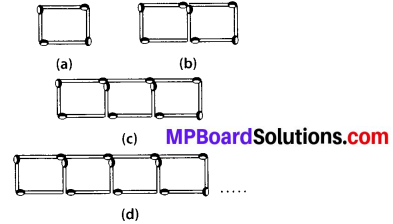
(a) Look at the following matchstick pattern of squares (see fig.).The squares are not separate. Two neighbouring squares have a common matchstick.
Observe the patterns and find the rule that gives the number of matchsticks in terms of the number of squares. (Hint: If you remove the vertical stick at the end, you will get a pattern of Cs.)
MP Board Class 6th Maths Solutions Chapter 11 Algebra Ex 11.1 22
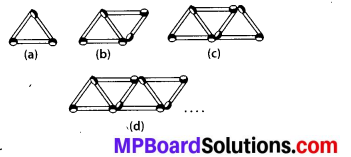
(b) The given figure gives a matchstick pattern of triangles. As in Exercise 11 (a) above, find the general rule that gives the number of matchsticks in terms of the number of triangles.
MP Board Class 6th Maths Solutions Chapter 11 Algebra Ex 11.1 23
Solution:
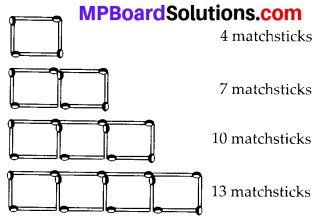
(a)
MP Board Class 6th Maths Solutions Chapter 11 Algebra Ex 11.1 24
If we remove 1 matchstick from each figure, then they make multiples of 3, i.e., 3, 6, 9, 12, …………
So the required equation = 3x + 1, where x is number of squares.

(b)
MP Board Class 6th Maths Solutions Chapter 11 Algebra Ex 11.1 25
If we remove 1 matchstick from each figure, then they make multiples of 2, i.e., 2, 4, 6, 8, ………..
So the required equation = 2x + 1, where x is number of triangles.

MP Board Class 6th Maths Solutions

MP Board Class 8th Hindi Bhasha Bharti विविध प्रश्नावली 3

MP Board Class 8th Hindi Bhasha Bharti Solutions विविध प्रश्नावली 3

वस्तुनिष्ठ प्रश्न

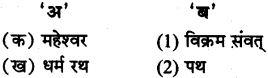
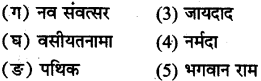
(1) सही जोड़ी बनाइए
MP Board Class 8th Hindi Bhasha Bharti विविध प्रश्नावली 3 1
MP Board Class 8th Hindi Bhasha Bharti विविध प्रश्नावली 3 2
उत्तर-
(क) → (4)
(ख) → (5)
(ग) → (1)
(घ) → (3)
(ङ) → (2)

(2) सही विकल्प चुनिए
(1) सिर घोट-मोट पर चुटिया थी लहराती, थी तोंद लटककर घुटनों को छू जाती। पंक्ति में कौन-सा रस है ?
(क) अद्भुत,
(ख) हास्य,
(ग) शान्त,
(घ) करुण।

MP Board Solutions

(2) ‘वन’ का पर्यायवाची शब्द है
(क) गिरि,
(ख) अरण्य,
(ग) तटिनी,
(घ) अचल।

(3) सूर्य की परिक्रमा लगभग ……………………………. दिनों में पूरी करती है
(क) 360 दिन
(ख) 306 दिन,
(ग) 365 दिन,
(घ) 365 दिन।

(4) इतिहास से सम्बन्धित शब्द के लिए प्रयुक्त होगा
(क) इतिहासिक,
(ख) ऐतिहासिक,
(ग) इतिहासिक,
(घ) येतिहासिक।
उत्तर-
(1) (ख) हास्य,
(2) (ख) अरण्य,
(3) (ग) 365 दिन,
(4) (ख) ऐतिहासिक।

(3) रिक्त स्थानों की पूर्ति कीजिए,,
(1) सम्राट विक्रमादित्य ने ……………………………. संवत् का प्रचलन प्रारम्भ किया था।
(2) महेश्वर को सूर्यवंश के राजा ……………………………. ने बसाया था।
(3) भगवान राम ……………………………. से ही विजय प्राप्त करने पर बल देते हैं।
(4) रौद्र रस का स्थायी भाव ……………………………. है।
(5) महाराजा की बातों से ………. विश्वास हो गया।
उत्तर-
(1) विक्रम,
(2) मान्धाता,
(3) धर्मरथ,
(4) क्रोध,
(5) पक्का

MP Board Class 8th Hindi Bhasha Bharti अति लघु उत्तरीय प्रश्न

(1) धर्मरथ के चार घोड़े कौन-कौन से हैं ?
उत्तर-
पाठ-18 के (ख) अभ्यास के बोध प्रश्न प्रश्न 4 के खण्ड (घ) को देखिए।

(2) महेश्वर पर किन-किन सभ्यताओं का प्रभाव पड़ा
उत्तर-
महेश्वर पर मौर्य, सातवाहन और गुप्तकालीन सभ्यता का प्रभाव पड़ा है।

(3) ‘बुक ऑफ इण्डियन बर्ड्स’ पुस्तक के लेखक का नाम बताओ।
उत्तर-
‘बुक ऑफ इण्डियन बर्ड्स’ पुस्तक के लेखक का नाम सलीम अली है। सलीम अली का पूरा नाम सली भाईजुद्दीन अब्दुल अली था।

(4) मोहन ने गाँधीजी की किस बात पर चलने का प्रयास किया है?
उत्तर-
मोहन ने गाँधीजी की अन्याय के सामने सिर न झुकाने की बात पर चलने का प्रयास किया है।

MP Board Class 8th Hindi Bhasha Bharti लघु उत्तरीय प्रश्न

(1) रावण की मृत्यु किस कारण हुई थी ?
उत्तर-
रावण लंका का राजा था। उसने अपने राज्य को धन-धान्य आदि से सुसम्पन्न बना दिया था। वह बहुत शक्तिशाली राजा था। उसकी सेना विशाल और सभी प्रकार के हथियार आदि से सुसज्जित थी। स्वयं रावण भी विद्वान एवं विज्ञानी था, परन्तु वह राम के विरुद्ध हुए युद्ध में मारा गया। इसका एकमात्र कारण था-उसमें घमण्ड और अभिमान की अधिकता। रावण में सत्य-शील, यम-नियम, दम, दया आदि का नामोनिशान नहीं था। इसी कारण वह युद्ध में मारा गया।

MP Board Solutions

(2) तलवार के पराक्रमी वीरों के नाम बताइए।
उत्तर-
भारतवर्ष में अनेक पराक्रमी वीर हुए हैं जिन्होंने देश की आजादी के लिए अपने पराक्रम को तलवार के द्वारा दिखाया। इन तलवार के पराक्रमी वीरों में महाराज शिवाजी और महाराणा प्रताप सिंह का नाम प्रसिद्ध है।

(3) पूर्णिमान्त और अमान्त किसे कहते हैं ?
उत्तर-
उत्तर भारत में माह का आरम्भ कृष्ण पक्ष प्रतिपदा से होता है और पूर्णिमा से अन्त होता है, अतः इसे पूर्णिमान्त कहते हैं परन्तु दक्षिण भारत में माह का आरम्भ शुक्ल पक्ष प्रतिपदा से होता है और अन्त अमावस्या को होता है, अतः इसे अमान्त कहते हैं।

(4) शारदीय और बासन्तीय नवरात्रि किसे कहते हैं ?
उत्तर-
शरद ऋतु में आश्विन महीने की शुक्ल पक्ष की प्रतिपदा से नवमी तक का समय शारदीय नवरात्रि का होता है जबकि बासन्तीय नवरात्रि का समय चैत्र मास की शुक्ल पक्ष की प्रतिपदा से नवमी तक का समय हुआ करता है।

(5) सुन्दरता की मृगतृष्णा किन दृश्यों से पता चलती है?
उत्तर-
दूर्वादल, सरिता और सरोवरों, पर्वतों, वनों तथा बावड़ियों और सुन्दर झरनों से सुन्दरता की मृगतृष्णा का पता चलता है।

(6) वसीयतनामे के न्याय को जाते समय मिली युवती ने राजा को अन्धा क्यों कहा?
उत्तर-
वसीयतनामे के न्याय को जाते समय मिली युवती ने राजा को अन्धा इसलिए कहा कि वह जवान हो गयी थी। वह विवाह करना भी चाहती थी परन्तु उसके विवाह के लिए किसी “वर’ की खोज नहीं कर पा रहा था।

(7) शेरसिंह ने मोहन और बच्चों से किस बात पर शर्मिंदगी व्यक्त की?
उत्तर-
शेरसिंह ने मोहन के ऊपर अकारण ही हाथ उठाकर, उस पर अत्याचार किया था। अपने इसी व्यवहार के लिए उसने मोहन और बच्चों से शर्मिंदगी व्यक्त की।

(8) निम्नलिखित शब्दों के विलोम शब्द लिखिए-
प्रथम, सफलता, अनुराग, माँग, सम्मुख।
उत्तर-
शब्द – विलोम
प्रथम – अन्तिम
सफलता – असफलता
अनुराग – विराग
माँग – पूर्ति
सम्मुख – विमुख

MP Board Class 8th Hindi Bhasha Bharti दीर्घ उत्तरीय प्रश्न

(1) धर्मरथ के माध्यम से रचनाकार हमें क्या शिक्षा देना चाहता है ? समझाइए।
उत्तर-
धर्मरथ के माध्यम से रचनाकार हमें शिक्षा देना चाहता है कि हमारे अन्दर शौर्य, धैर्य, सत्य और शील के क्रमशः दो पहिए एवं ध्वजा-पताकाएँ हैं। रथ को खींचने वाले चार घोड़े-बल, विवेक, यम और परोपकार होते हैं। इन चार घोड़ों को क्षमा, दया, समता की रस्सी से जोता हुआ होता है। ईश्वर का भजन ही श्रेष्ठ ज्ञान से सम्पन्न सारथी होता है। संसार युद्ध में प्रयुक्त हथियार (ढाल, तलवार, फरसा, शक्ति, धनुष) के रूप में हमें वैराग्य, सन्तोष, दान, बुद्धि तथा श्रेष्ठ विज्ञान का प्रयोग करना चाहिए। तरकश रूपी निर्मल और अडिग मन तथा यम-नियम और संयम के बाण; ब्राह्मणों तथा गुरु की पूजा का कवच है, तो निश्चय ही हमें अपने बाहरी और आन्तरिक शत्रुओं पर विजय अवश्य मिलेगी। उपर्युक्त सद्गुण रूपी धर्मरथ मनुष्य को अपराजेय शक्ति देता है।

(2) गुड़ी पड़वा किस उपलक्ष्य में तथा किस प्रकार मनाया जाता है ?
उत्तर-
गुड़ी पड़वा का अर्थ ध्वज या झण्डी प्रतिपदा होता है। लोक परम्परा के अनुसार माना जाता है कि इसी दिन श्रीरामचन्द्रजी ने किष्किन्धा के राजा बाली का वध करके उसके स्वेच्छाचारी राज का अन्त किया था। बाली वध के पश्चात् वहाँ की प्रजा ने पताकाएँ फहराकर उत्सव मनाया था। इन पताकाओं को महाराष्ट्र में गुड़ी पड़वा कहते हैं। आजकल वहाँ आँगन में बाँस के सहारे गुड़ी खड़ी की जाती है। चैत्र शुक्ल प्रतिपदा को गुड़ी पड़वा कहते हैं।

(3) शिवमंगल सिंह ‘सुमन’ पथिक से क्या कहना चाहते हैं ? समझाइए।
उत्तर-
शिवमंगल सिंह ‘सुमन’ पथिक से कहना चाहते हैं कि उसे अपने मार्ग से कहीं भी भटक नहीं जाना चाहिए। उसके मार्ग में कठिनाइयों-बाधाओं के काँटे आ सकते हैं; अनेक सौन्दर्यपूर्ण दृश्य सामने आकर तुम्हें प्रलोभित कर सकते हैं, लेकिन वे वास्तविक रूप से वैसे नहीं हैं जो दीखते हैं। उनकी सुन्दरता मृगतृष्णा के समान है। भ्रम है।

पथिक को अपने कर्तव्य पालन के कठिन कर्म के मार्ग पर आगे ही आगे बढ़ते जाना चाहिए। अपनी कल्पनाओं को (स्वप्नों को) साकार करो। यदि तुम्हें प्रथम प्रयास में असफलता मिले भी तो निराश होकर मार्ग भटक मत जाना।

कर्त्तव्य पालन के मार्ग में हमारे शत्रु बाधक बन सकते हैं। उत्तरदायित्व के निर्वाह में कदम-कदम पर बाधाएँ आयेंगी। तुम्हें अपने छोड़ जायेंगे। अकेले रह सकते हो, लेकिन कर्त्तव्य पथ का त्याग मत करना।

उत्तरदायित्व के निर्वाह में प्रेम बाधक नहीं बन जाए, इसका तुम्हें ध्यान रखना होगा। स्वतन्त्रता की रक्षा के लिए भारत माँ माँग कर रही है कि आहुति दो। उस समय तुम्हें दुविधा (असमंजस) में नहीं पड़ना चाहिए। अपने कर्त्तव्य पथ पर अग्रसर होते जाना ही परमधर्म है।

MP Board Solutions

(4) रूपक अलंकार को उदाहरण सहित समझाइए।
उत्तर-
रूपक अलंकार-उपमेय और उपमान के अभेद वर्णन को रूपक अलंकार कहते हैं अर्थात् जब उपमेय को उपमान का रूप दे दिया जाता है, तो वहाँ रूपक अलंकार होता है।

उदाहरण-

“अति आनन्द उमगि अनुरागा।
चरन सरोज पखारन लागा॥”

इन पंक्तियों में ‘चरन सरोज’ उपमेय और उपमान हैं। इनमें । अभेद आरोप प्रस्तुत किया गया है, अतः यहाँ रूपक अलंकार है।

(5) निम्नलिखित पंक्तियों का भावार्थ लिखिए-
“किसी लोलुप नजर ने यदि हमारी मुक्ति को देखा।
उठेगी तब प्रलय की आग जिस पर क्षार सोई है।”
उत्तर-
भारत देश के हम नागरिकों ने अपने देश की सीमा को विस्तृत करना कभी नहीं चाहा है। साथ ही, हमने किसी अन्य देश की धन सम्पत्ति पर भी अपना कब्जा जमाने की इच्छा नहीं की है, लेकिन बिना किसी चूक के यह बात करने से नहीं रुकेंगे तथा कभी रुके भी नहीं हैं कि हम खून दे सकते हैं, लेकिन अपने प्रिय राष्ट्र (भारत) की जमीन का एक टुकड़ा भी नहीं देंगे। यदि किसी लालच भरी दृष्टि वाले देश ने इस पर आक्रमण करने की अथवा हमारे देश की आजादी को कुचलने की कोशिश की भी तो तत्काल ही विनाश की आग फूट पड़ेगी यद्यपि युद्ध की आग राख के अन्दर छिपी हो सकती है। कहने का तात्पर्य यह है कि हमारे अपने प्रिय देश पर किसी लालची दृष्टि वाले शत्रु-देश ने आक्रमण करने की कुचेष्टा की तो उस समय विनाश लीला की अग चारों ओर फैल जायेगी यद्यपि हम युद्ध नहीं चाहते। हम तो सदैव से शान्ति दूत रहे हैं।

(6) निम्नलिखित पंक्ति को पढ़कर प्रश्नों के उत्तर दीजिए
“राधा का मुख मानो कमल समान अति सुन्दर”
(1) पंक्ति में उपमेय क्या है ?
(2) पंक्ति में उपमान क्या है ?
(3) वाचक शब्द क्या है ?
(4) प्रयुक्त अलंकार का नाम लिखिए।
उत्तर-
(1) पंक्ति में ‘राधा का मुख’ उपमेय है।
(2) पंक्ति में ‘कमल’ उपमान है।
(3) मानो समान अति सुन्दर’ वाचक शब्द है।
(4) पंक्ति में प्रयुक्त अलंकार ‘उत्प्रेक्षा’ है।

(7) ‘अपना स्वरूप’ कहानी का सार अपने शब्दों में लिखिए। उक्त पाठ वर्तमान में पाठ्य-पुस्तक से हटा दिया गया है।
उत्तर-
कहानीकार विजय गुप्ता ने इस कहानी में बहुत सफलता से यह स्पष्ट करने की कोशिश की है कि मनुष्य अपने विचारों की छाया दूसरों में देखता है। अच्छे विचारों वाले व्यक्ति को सभी लोग अच्छे लगते हैं और बुरे विचार वाले आदमी को सभी आदमियों में अनेक बुराइयाँ दीखती हैं। अतः हमें अपने स्वभाव को उत्तम से उत्तम बनाना चाहिए। इस तरह हम पूर्ण रूप से गुणवान बन सकते हैं।

बीरबल नामक व्यक्ति अपने सुन्दर वातावरण वाले गाँव से किसी शहर में जाता है। शहर में घूमते-घूमते उसने एक दुकान पर कोई वस्तु ऐसी देखी जिसमें वहाँ से गुजरने वाले प्रत्येक व्यक्ति की परछाईं दिखाई पड़ती थी। दुकानदार ने उसको बताया कि यह दर्पण है। उस दर्पण को लेकर वह घर लौट पड़ता है। अपनी पत्नी के लिए माला भी लाता है। पत्नी माला को पहनती है। लालचवश वह दर्पण को देखती है। उसमें वह अपनी परछाईं देखकर अचम्भित हो उठती है और वह सोचती है कि उसका पति सौतन लेकर आया है। उसकी सास और ससुर भी अपनी आकृति देखकर बहू के कथन से सहमत नहीं होते हैं। अन्त में बीरबल सबको बताता है कि यह दर्पण है। इसमें प्रत्येक आदमी को परछाईं वैसी ही दीखती है जैसा वह होता है।
इसलिए हमें अपने विचारों से उत्तम बनना चाहिए, अच्छे से अच्छा दिखने के लिए।

(8) ‘नन्हा सत्याग्रही’ पाठ से क्या शिक्षा मिलती है ? अपने शब्दों में लिखिए।
उत्तर-
इस पाठ से हमें यह शिक्षा मिलती है कि हमें कभी भी अन्याय और अत्याचार को चुपचाप सहन नहीं करना चाहिए बल्कि उसके विरुद्ध आवाज उठानी चाहिए। यदि उसके लिए संघर्ष भी करना पड़े तो हमें पीछे नहीं हटना चाहिए। उक्त पाठ वर्तमान में पाठ्य-पुस्तक से हटा दिया गया है।

(9) शिवमंगल सिंह ‘सुमन’ द्वारा रचित ‘पथिक से कविता के कम से कम दो पद्यांश लिखिए।
उत्तर-
पाठ 16 के ‘सम्पूर्ण पद्यांशों की व्याख्या’ शीर्षक के अन्तर्गत देखें।

(10) ‘वसीयतनामे का रहस्य’ कहानी से क्या शिक्षा मिलती है ?
उत्तर-
पाठ 17 के आधार पर विद्यार्थी स्वयं लिखें।

(11) रेडक्रास संस्था के उद्देश्यों को लिखिए।
उत्तर-
रेडक्रास संस्था के कुछ प्रमुख उद्देश्य निम्नलिखित हैं

  1. युद्धकाल में घायल एवं बीमार सैनिकों को चिकित्सीय सहायता उपलब्ध कराना।
  2. नर्सिंग एवं एम्बूलैन्स कार्य।
  3. मातृत्व एवं शिशु देखभाल।
  4. विभिन्न प्राकृतिक आपदाओं के कारण विस्थापित लोगों को सहायता प्रदान करना।
  5. विभिन्न देशों के मध्य शान्ति की स्थापना करना एवं उसे बनाये रखना।

MP Board Solutions

(12) निम्नलिखित अपठित गद्यांश को पढ़कर प्रश्नों के उत्तर दीजिए
विद्यालय में छात्र का चरित्र निर्माण होता है। निष्कपट और नि:स्वार्थ भाव से सेवा करने का पाठ भी यहीं सीखता है। गुरु की आज्ञा का पालन और राष्ट्रप्रेम का सन्देश भी यहीं मिलता है। यथाशक्ति मानवता को पोषित करने का भाव भी यहीं मिलता है। वास्तव में विद्यालय व्यक्तित्व निर्माण की कार्यशाला और राष्ट्रधर्म को अंकुरित करने की पौधशाला है।
(1) गुरु की आज्ञा मानने का सन्देश कहाँ मिलता
(2) रेखांकित शब्दों की सन्धि-विच्छेद कीजिए।
(3) पंक्तियों में आए सामासिक पद छाँटकर विग्रह कीजिए।
(4) विद्यालय में छात्र क्या-क्या सीखता है ?
उत्तर-
(1) गुरु की आज्ञा मानने का सन्देश विद्यालय में ही मिलता है।
(2) विद्यालय- विद्या + आलय, निष्कपट-नि: + कपट, नि + स्वार्थ = निः + स्वार्थ, राष्ट्रप्रेम = राष्ट्र + प्रेम, यथाशक्ति = यथा + शक्ति, राष्ट्रधर्म = राष्ट्र + धर्म, पौधशाला = पौध + शाला।
(3) यथाशक्ति, कार्यशाला, राष्ट्रधर्म।

MP Board Class 8th Hindi Solutions