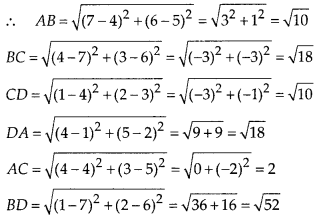
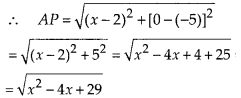
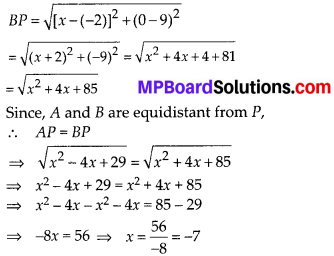
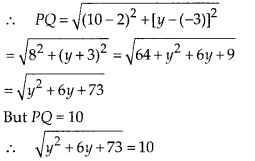
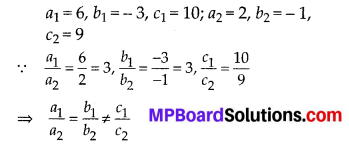
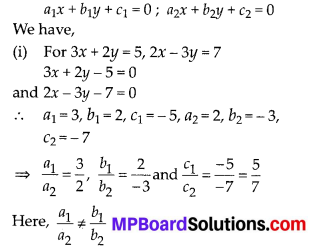
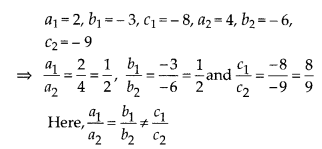
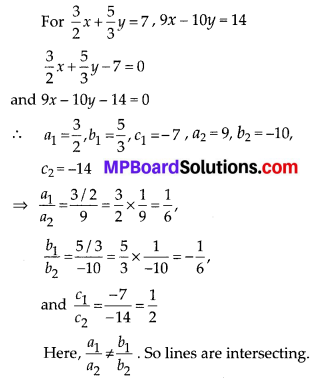
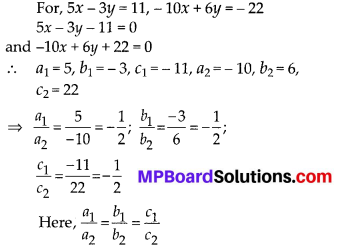
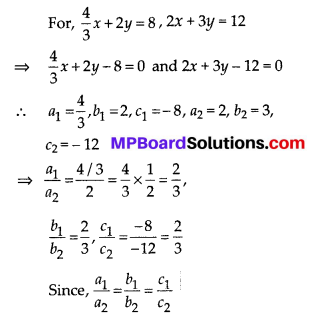
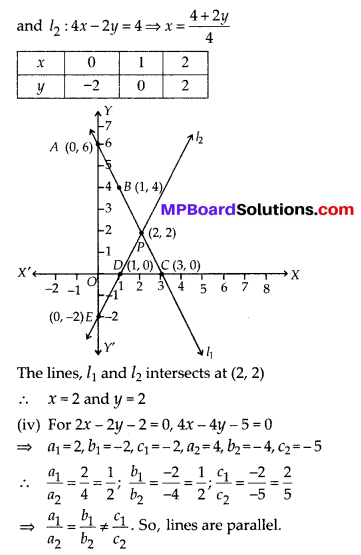
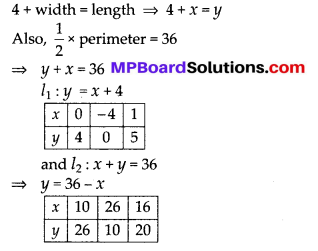
MP Board Class 10th Maths Solutions Chapter 5 Arithmetic Progressions Ex 5.2

In this article, we will share MP Board Class 10th Maths Book Solutions Chapter 5 Arithmetic Progressions Ex 5.2 Pdf, These solutions are solved subject experts from the latest edition books.

MP Board Class 10th Maths Solutions Chapter 5 Arithmetic Progressions Ex 5.2

MP Board Class 10th Maths Solutions Chapter 5 Arithmetic Progressions Ex 5.2

Question 1.
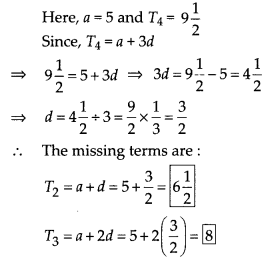
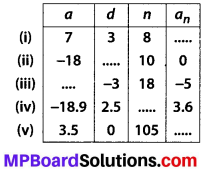
Fill in the blanks in the following table, given that a is the first term, d the common difference and an the nth term of the A.P.
Solution:
MP Board Class 10th Maths Solutions Chapter 5 Arithmetic Progressions Ex 5.2 1
Solution:
(i) an = a + (n- 1)d
a8 = 7 + (8 – 1)3 = 7 + 7 × 3 = 7 + 21
⇒ a8 = 28

(ii) an = a + (n – 1)d
⇒ a10 = -18 + (10 – 1)7 ⇒ 0 = -18 + 9d
⇒ 9d = 18 ⇒ d = \(\frac{18}{9}=2\)
∴ d = 2

(iii) an = a + (n – 1)d
⇒ -5 = a + (18 – 1) × (-3)
⇒ -5 = a + 17 × (-3)
⇒ -5 = a – 51 ⇒ a = -5 + 51 = 46
Thus, a = 46

(iv) an = a + (n – 1)d
⇒ 3.6 = -18.9 + (n – 1) × 2.5
⇒ (n – 1) × 2.5 = 3.6 + 18.9

MP Board Class 10th Maths Solutions Chapter 5 Arithmetic Progressions Ex 5.2 2
⇒ n = 9 + 1 = 10
Thus, n = 10

(v) an = a + (n- 1)d
⇒ an = 3.5 + (105 – 1) × 0
⇒ an = 3.5 + 104 × 0 ⇒ an = 3.5 + 0 = 3.5
Thus, an = 3.5

Question 2.
Choose the correct choice in the following and justify:
(i) 30th term of the AP: 10,7,4, , is, ….,
(A) 97
(B) 77
(C) -77
(D) -87

(ii) 11th term of the AP: -3, \(-\frac{1}{2}\), 2, …. ,is
(A) 28
(B) 22
(C) -38
(D) -48\(\frac{1}{2}\)
Solution:
(i) (C): Here, a = 10, n = 30
∵ T10 = a + (n – 1)d and d = 7 – 10 = -3
∴ T30 = 10 + (30 – 1) × (-3)
⇒ T30 = 10 + 29 × (-3)
⇒ T30 = 10 – 87 = -77

(ii) (B): Here, a = -3, n = 11 and
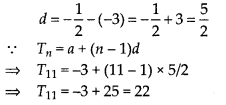
MP Board Class 10th Maths Solutions Chapter 5 Arithmetic Progressions Ex 5.2 3

MP Board Class 10th Maths Solutions Chapter 5 Arithmetic Progressions Ex 5.2

Question 3.
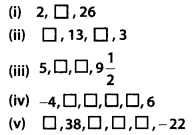
In the following APs, find the missing terms in the boxes:
MP Board Class 10th Maths Solutions Chapter 5 Arithmetic Progressions Ex 5.2 50
Solution:
(i) Here, a = 2, T3 = 26
Let common difference = d
∴ Tn = a + (n- 1 )d
⇒ T3 = 2 + (3 – 1)d
⇒ 26 = 2 + 2 d
⇒ 2d = 26 – 2 = 24

MP Board Class 10th Maths Solutions Chapter 5 Arithmetic Progressions Ex 5.2 4
MP Board Class 10th Maths Solutions Chapter 5 Arithmetic Progressions Ex 5.2 51

(ii) Let the first term = a
and common difference = d
Here, T2 = 13 and T4 = 3
T2 = a + d = 13, T4 = a + 3d = 3
T1 – T2 = (a + 3d) – (a + d) = 3 – 13
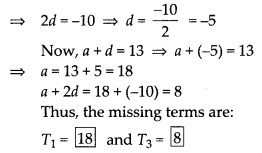
MP Board Class 10th Maths Solutions Chapter 5 Arithmetic Progressions Ex 5.2 5

(iii)
MP Board Class 10th Maths Solutions Chapter 5 Arithmetic Progressions Ex 5.2 6

(iv) Here, a = – 4, T6 = 6
∵ Tn = a + (n -1 )d
T6 = – 4 + (6 – 1)d ⇒ 6 = -4 + 5d ⇒ 5d = 6 + 4 = d = 10 – 5 = 2
T2 = a + d = -4 + 2 =-2
T3 = a + 2d = -4 + 2(2) = 0
T4 = a + 3d = -4 + 3(2) = 2
T5 = a + 4d = -4 + 4(2) = 4

MP Board Class 10th Maths Solutions Chapter 5 Arithmetic Progressions Ex 5.2 52

(v) Here, T2 = 38 and T6 = -22
∴ T2 = a + d = 38, T6 = a + 5d = -22
⇒ T6 – T2 = a + 5d – (a + d) = -22 – 38 -60
⇒ 4d = -60 ⇒ d = \(\frac{-60}{4}\) = -15
a + d = 38 ⇒ a + (-15) = 38
⇒ a = 38 + 15 = 53
Now,
T3 = a + 2d = 53 + 2(-15) = 53 – 30 = 23
T4 = a + 3d = 53 + 3(-15) = 53 – 45 = 8
T5 = a + 4d = 53 + 4(-15) = 53 – 60 = -7
Thus missing terms are
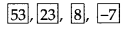
MP Board Class 10th Maths Solutions Chapter 5 Arithmetic Progressions Ex 5.2 53

MP Board Class 10th Maths Solutions Chapter 5 Arithmetic Progressions Ex 5.2

Question 4.
Which term of the AP: 3, 8, 13, 18, is 78?
Solution:
Let the nth term be 78
Here, a = 3 ⇒ T1 = 3 and T2 = 8
∴ d = T2 – T1 = 8 – 3 = 5
And, Tn = a + (n- 1 )d
⇒ 78 = 3 + (n – 1) × 5 ⇒ 78 – 3 = (n -1) × 5
⇒ 75 = (n – 1) × 5 ⇒ (n – 1) = 75 ÷ 5 = 15
⇒ n = 15 + 1 = 16
Thus, 78 is the 16th term of the given AP.

Question 5.
Find the number of terms in each of the following APs:
(i) 7,13,19, …….. ,205
(ii) 18, \(15 \frac{1}{2}\), 13, …… ,-47
Solution:
(i) Here, a = 7,d = 13 – 7 = 6
Let total number of terms be n.
∴ Tn = 205
Now, Tn = a + (n – 1) ×d
= 7 + (n – 1) × 6 = 205
⇒ (n – 1) × 6 = 205 – 7 = 198
⇒ n – 1 = \(\frac{198}{6}=33\)
∴ n = 33 + 1 = 34
Thus, the required number of terms is 34.

(ii)
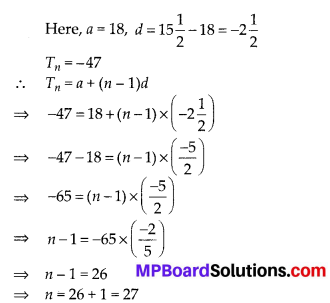
MP Board Class 10th Maths Solutions Chapter 5 Arithmetic Progressions Ex 5.2 7
Thus, the required number of terms is 27.

MP Board Class 10th Maths Solutions Chapter 5 Arithmetic Progressions Ex 5.2

Question 6.
Check whether -150 is a term of the AP:
11, 8, 5, 2…
Solution:
For the given AP,
we have a = 11, d = 8 -11 = -3
Let -150 be the nth term of the given AP
∴ Tn = a + (n – 1 )d
⇒ -150 = 11 + (n – 1) × (-3)
⇒ -150 – 11 = (n – 1) × (-3)
⇒ -161 = (n – 1) ⇒ (-3)
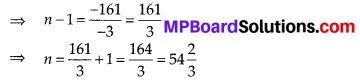
MP Board Class 10th Maths Solutions Chapter 5 Arithmetic Progressions Ex 5.2 8
But n should be a positive integer.
Thus, -150 is not a term of the given AP

MP Board Class 10th Maths Solutions Chapter 5 Arithmetic Progressions Ex 5.2

Question 7.
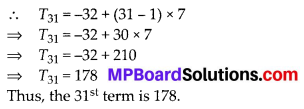
Find the 31st term of an AP whose 11th term is 38 and the 16th term is 73.
Solution:
Here, T11 = 38 and T16 = 73
Let the first term = a and the common difference = d.
Tn = a + (n – 1 )d
Then, Tn = a + (11 – 1)d = 38
⇒ a + 10d = 38 …(1)
and T16 = a + (16 – 1)d = 73
⇒ a + 15d = 73 …(2)
Subtracting (1) from (2), we get
(a + 15d) – (a + 10d) = 73 – 38
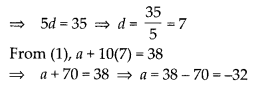
MP Board Class 10th Maths Solutions Chapter 5 Arithmetic Progressions Ex 5.2 9
MP Board Class 10th Maths Solutions Chapter 5 Arithmetic Progressions Ex 5.2 10

Question 8.
An AP consists of 50 terms of which 3rd term is 12 and the last term is 106. Find the 29th term.
Solution:
Here, n = 50, T3 = 12, Tn = 106
⇒ T50 = 106
Let the first term = a and the common difference = d
Tn = a + (n – 1 )d
T3 = a + 2d = 12 …(1)
T50 = a + 49d = 106 …(2)
Subtracting (1) from (2), we get
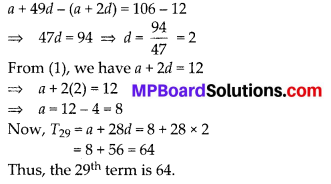
MP Board Class 10th Maths Solutions Chapter 5 Arithmetic Progressions Ex 5.2 11

MP Board Class 10th Maths Solutions Chapter 5 Arithmetic Progressions Ex 5.2

Question 9.
If the 3rd and the 9th terms of an AP are 4 and -8 respectively, which term of this AP is zero?
Solution:
Here, T3 = 4 and T9 = -8
Tn = a + (n – 1)d
T3 = a + 2d = 4 …. (1)
T9 = a + 8d = – 8 …. (2)
Subtracting (1) from (2), we get
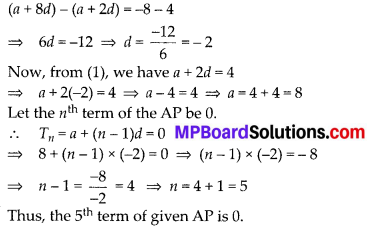
MP Board Class 10th Maths Solutions Chapter 5 Arithmetic Progressions Ex 5.2 12

Question 10.
The 17th term of an AP exceeds its 10th term by 7. Find the common difference.
Solution:
Let a be the first term and d the common difference of the given AP
Now, using n = a + (n – 1 )d, we have
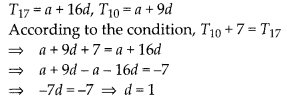
MP Board Class 10th Maths Solutions Chapter 5 Arithmetic Progressions Ex 5.2 13
Thus, the common difference is 1.

MP Board Class 10th Maths Solutions Chapter 5 Arithmetic Progressions Ex 5.2

Question 11.
Which term of the AP : 3, 15, 27, 39,… will be 132 more than its 54th term?
Solution:
Here, a = 3, d = 15 – 3 = 12
Using Tn = a + (n – 1 )d, we get
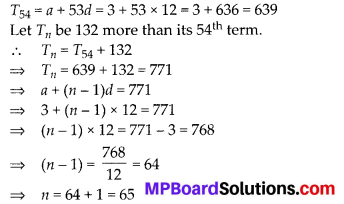
MP Board Class 10th Maths Solutions Chapter 5 Arithmetic Progressions Ex 5.2 14
Thus, 132 more than 54th term is the 65th term.

Question 12.
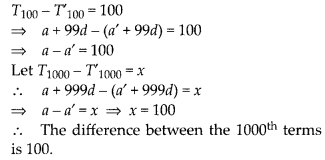
Two APs have the same common difference. The difference between their 100th terms is 100, what is the difference between their 1000th terms?
Solution:
Let for the 1st AP, the first term = a and common difference = d

MP Board Class 10th Maths Solutions Chapter 5 Arithmetic Progressions Ex 5.2 15
And for the 2nd AP, the first term = a and common difference = d

MP Board Class 10th Maths Solutions Chapter 5 Arithmetic Progressions Ex 5.2 16
According to the condition,
MP Board Class 10th Maths Solutions Chapter 5 Arithmetic Progressions Ex 5.2 17

MP Board Class 10th Maths Solutions Chapter 5 Arithmetic Progressions Ex 5.2

Question 13.
How many three-digit numbers are divisible by 7?
Solution:
The first three-digit number divisible by 7 is 105.
The last such three-digit number divisible by 7 is 994.
∴ The AP is 105,112,119, ,994
Let n be the required number of terms Here, a = 105, d = 7 and n = 994
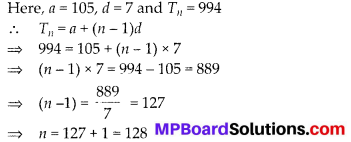
MP Board Class 10th Maths Solutions Chapter 5 Arithmetic Progressions Ex 5.2 18
Thus, 128 numbers of 3-digits are divisible by 7.

Question 14.
How many multiples of 4 lie between 10 and 250?
Solution:
The first multiple of 4 beyond 10 is 12.
The multiple of 4 just below 250 is 248.
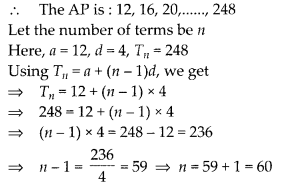
MP Board Class 10th Maths Solutions Chapter 5 Arithmetic Progressions Ex 5.2 19
Thus, the required number of terms is 60.

MP Board Class 10th Maths Solutions Chapter 5 Arithmetic Progressions Ex 5.2

Question 15.
For what value of n, are the nth terms of two APs: 63,65,67 … and 3,10,17, …. equal?
Solution:
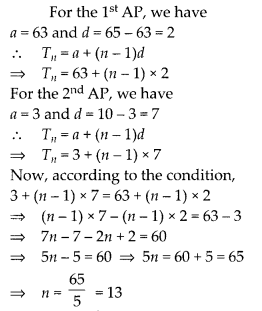
MP Board Class 10th Maths Solutions Chapter 5 Arithmetic Progressions Ex 5.2 20
Thus, the 13th terms of the two given AP’s are equal.

Question 16.
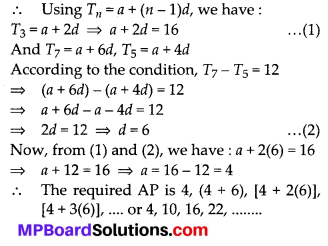
Determine the AP whose third term is 16 and the 7th term exceeds the 5th term by 12.
Solution:
Let the first term = a and the common difference = d
MP Board Class 10th Maths Solutions Chapter 5 Arithmetic Progressions Ex 5.2 21

MP Board Class 10th Maths Solutions Chapter 5 Arithmetic Progressions Ex 5.2

Question 17.
Find the 20th term from the last term of the AP : 3, 8, 13, …, 253.
Solution:
We have, the last term (l) = 253
Here, d = 8 – 3 = 5
Since, the nth term before the last term is given by l – (n – 1 )d
We have 20th term from the last term = l – (20 – 1) × 5 = 253 – 19 × 5 = 253 – 95 = 158

Question 18.
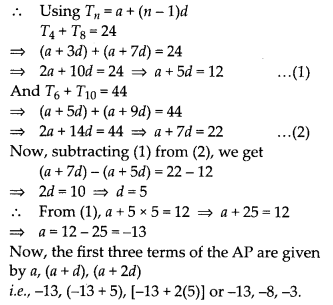
The sum of the 4th and 8th terms of an AP is 24 and the sum of the 6th and 10th terms is 44. Find the first three terms of the AP.
Solution:
Let the first term = a and the common difference = d
MP Board Class 10th Maths Solutions Chapter 5 Arithmetic Progressions Ex 5.2 22

Question 19.
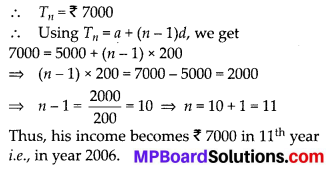
Subba Rao started work in 1995 at an annual salary of ₹ 5000 and received an increment of ? 200 each year. In which year did his income reach ₹ 7000?
Solution:
Here, a = ₹ 5000 and d = ₹ 200
Let, in the nth year Subba Rao gets ₹ 7000.
MP Board Class 10th Maths Solutions Chapter 5 Arithmetic Progressions Ex 5.2 23

MP Board Class 10th Maths Solutions Chapter 5 Arithmetic Progressions Ex 5.2

Question 20.
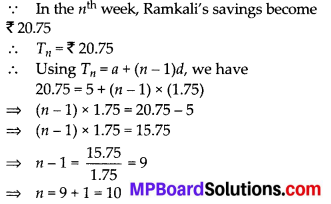
Ramkali saved ₹ 5 in the first week of a year and then increased her weekly savings by ₹ 1.75. If in the nth week, her weekly savings become ₹ 20.75, find n.
Solution:
Here, a = ₹ 5 and d = ₹ 1.75
MP Board Class 10th Maths Solutions Chapter 5 Arithmetic Progressions Ex 5.2 24
Thus, the required number of weeks is 10.
MP Board Class 10th Maths Solutions Chapter 3 Pair of Linear Equations in Two Variables Ex 3.7

In this article, we will share MP Board Class 10th Maths Book Solutions Pair of Linear Equations in Two Variables Ex 3.7 Pdf, These solutions are solved subject experts from the latest edition books.

MP Board Class 10th Maths Solutions Chapter 3 Pair of Linear Equations in Two Variables Ex 3.7

Question 1.
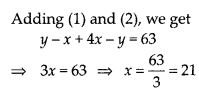
The ages of two friends Ani and Biju differ by 3 years. Ani’s father Dharam is twice as old as Ani and Biju is twice as old as his sister Cathy. The ages of Cathy and Dharam differ by 30 years. Find the ages of Ani and Biju.
Solution:
Let the age of Ani = x years
and the age of Biju’s = y years
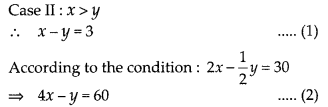
Case I:
y > x
According to 1st condition : y – x = 3 …. (1)
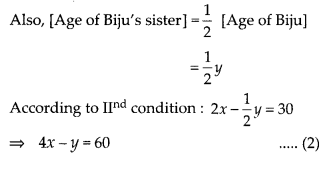
∵ [Age of Ani’s father] = 2[Age of Ani] = 2x years
MP Board Class 10th Maths Solutions Chapter 3 Pair of Linear Equations in Two Variables Ex 3.7 1
MP Board Class 10th Maths Solutions Chapter 3 Pair of Linear Equations in Two Variables Ex 3.7 2
Substituting the value of x in equation (1),
we get y – 21 = 3 ⇒ y = 3 + 21 = 24
∴ Age of Ani = 21 years
Age of Biju = 24 years
MP Board Class 10th Maths Solutions Chapter 3 Pair of Linear Equations in Two Variables Ex 3.7 3
Substituting the value of y in equation (1),
we get 19 – y = 3 ⇒ y = 16
∴ Age of Ani = 19 years
Age of Biju = 16 years

MP Board Class 10th Maths Solutions Chapter 3 Pair of Linear Equations in Two Variables Ex 3.7

Question 2.
One says, “Give me a hundred, friend! I shall then become twice as rich as you”. The other replies, “If you give me ten, I shall be six times as rich as you”. Tell me what is the amount of their (respective) capital? [From the Bijaganita of Bhaskara II]
[Hint: x + 100 = 2(y – 100), y + 10 = 6(x – 10)]
Solution:
Let the capital of 1st friend = ₹ x,
and the capital of 2nd friend = ₹ y
According to the condition,
x + 100 = 2(y -100)
⇒ x + 100 – 2y + 200 = 0
⇒ x – 2y + 300 = 0 … (1)
Also, 6(x – 10) = y + 10 ⇒ 6x – y – 70 = 0 …. (2)
From (1), x = -300 + 2y (3)
Substituting the value of x in equation (2), we get
6[-300 + 2y] – y – 70 = 0
⇒ -1870 + 11y = 0
MP Board Class 10th Maths Solutions Chapter 3 Pair of Linear Equations in Two Variables Ex 3.7 4
Now, Substituting the value of y in equation (3), we get, x = – 300 + 2y
= – 300 + 2(170) = – 300 + 340 = 40
Thus, 1st friend has ₹ 40 and the 2nd friend has ₹ 170.

MP Board Class 10th Maths Solutions Chapter 3 Pair of Linear Equations in Two Variables Ex 3.7

Question 3.
A train covered a certain distance at a uniform speed. If the train would have been 10 km/h faster, it would have taken 2 hours less than the scheduled time. And, if the train were slower by 10 km/h; it would have taken 3 hours more than the scheduled time. Find the distance covered by the train.
Solution:
Let the actual speed of the train = x km/hr
and the actual time taken = y hours
Distance = speed × time
According to 1st condition: (x +10) × (y – 2) = xy
⇒ xy – 2x + 10y – 20 = xy
⇒ 2x – 10y + 20 = 0 … (1)
According to 2nd condition: (x -10) × (y + 3) = xy
⇒ xy + 1ox -10y – 30 = xy
⇒ 3x – 10y – 30 = 0 ….(2)
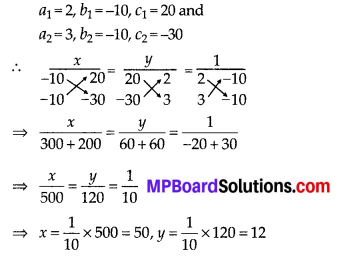
Using cross multiplication for solving (1) and (2), we get
MP Board Class 10th Maths Solutions Chapter 3 Pair of Linear Equations in Two Variables Ex 3.7 5
Thus, the distance covered by the train = 50 × 12 km = 600 km.

MP Board Class 10th Maths Solutions Chapter 3 Pair of Linear Equations in Two Variables Ex 3.7

Question 4.
The students of a class are made to stand in rows. If 3 students are extra in a row, there would be 1 row less. If 3 students are less in a row, there would be 2 rows more. Find the number of students in the class.
Solution:
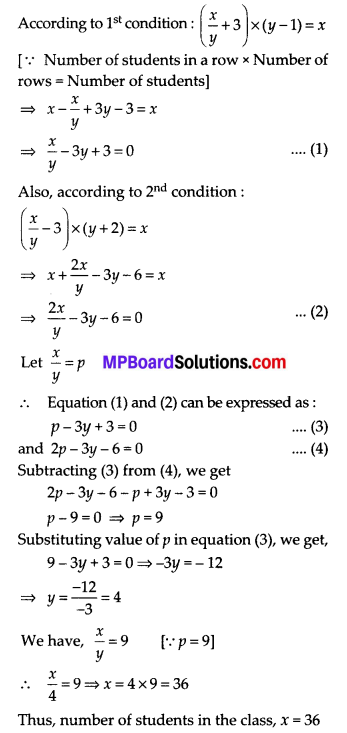
Let the number of students = x
and the number of rows = y
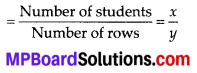
∴ Number of students in each row
MP Board Class 10th Maths Solutions Chapter 3 Pair of Linear Equations in Two Variables Ex 3.7 6
MP Board Class 10th Maths Solutions Chapter 3 Pair of Linear Equations in Two Variables Ex 3.7 7

Question 5.
In a ∆ABC, ∠C = 3 ∠B = 2(∠A + ∠B). Find the three angles.
Solution:
Sum of angles of a triangle = 180°
∴ ∠A + ∠B + ∠C = 180° … (1)
∵ ∠C = 3∠B = 2(∠A + ∠B) … (2)
From (1) and (2), we have ∠A + ∠B + 2 (∠A + ∠B) = 180°
⇒ ∠A + ∠B + 2∠A + 2∠B = 180°
⇒ ∠A + ∠B = 60° …. (3)
Also, ∠A + ∠B + 3∠B = 180°
⇒ ∠A + 4∠B = 180° ….(4)
Subtracting (3) from (4), we get
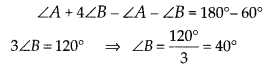
∠A + 4∠B – ∠A – ∠B = 180°- 60°
MP Board Class 10th Maths Solutions Chapter 3 Pair of Linear Equations in Two Variables Ex 3.7 8
Substituting ∠B = 40° in (4) we get,
∠A + 4(40°) = 180°
⇒ ∠A = 180° – 160° = 20°
∴ ∠C = 3∠B = 3 × 40° = 120°
Thus, ∠A = 20°, ∠B = 40° and ∠C = 120°.

MP Board Class 10th Maths Solutions Chapter 3 Pair of Linear Equations in Two Variables Ex 3.7

Question 6.
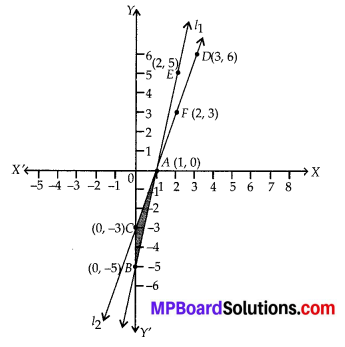
Draw the graphs of the equations 5x – y = 5 and 3x – y = 3. Determine the co-ordinates of the vertices of the triangle formed by these lines and they-axis.
Solution:
To draw the graph of 5x – y = 5, we get

x120
y05-5

and for equation 3x – y = 3, we get

x230
y36-3

Plotting the points (1, 0), (2, 5) and (0, -5), we get a straight line l1. Plotting the points (2, 3), (3, 6) and (0, -3), we get a straight line l2.
MP Board Class 10th Maths Solutions Chapter 3 Pair of Linear Equations in Two Variables Ex 3.7 9
From the figure, obviously, the vertices of the triangle formed are A(l, 0), B(0, -5) and C(0,-3).

Question 7.
Solve the following pair of linear equations:
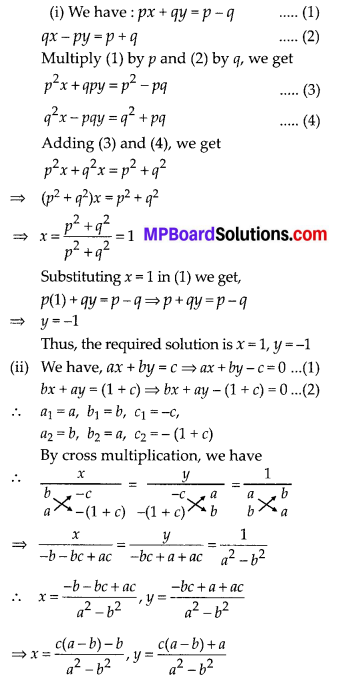
(i) px + qy = p – q, qx – py = p + q
(ii) ax + by = c, bx + ay = 1 + c
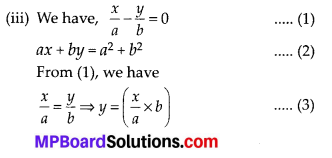
(iii) \(\frac{x}{a}-\frac{y}{b}\)= 0, ax + by = a2 + b2
(iv) (a – b)x + (a + b)y = a2 – 2ab – b2,
(a + b)(x + y) = a2 + b2
(v) 152x – 378y = -74, – 378x + 152y = -604
Solution:
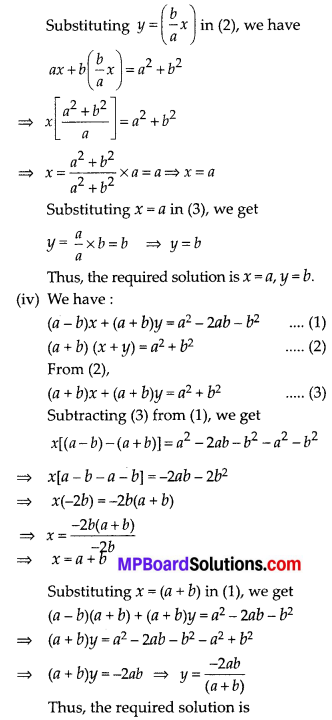
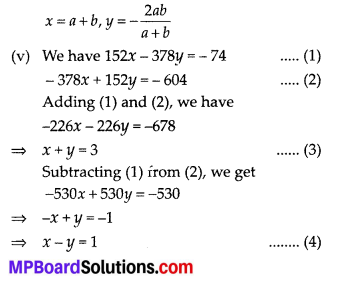
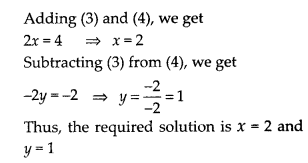
MP Board Class 10th Maths Solutions Chapter 3 Pair of Linear Equations in Two Variables Ex 3.7 10
MP Board Class 10th Maths Solutions Chapter 3 Pair of Linear Equations in Two Variables Ex 3.7 11
MP Board Class 10th Maths Solutions Chapter 3 Pair of Linear Equations in Two Variables Ex 3.7 12
MP Board Class 10th Maths Solutions Chapter 3 Pair of Linear Equations in Two Variables Ex 3.7 13
MP Board Class 10th Maths Solutions Chapter 3 Pair of Linear Equations in Two Variables Ex 3.7 14

MP Board Class 10th Maths Solutions Chapter 3 Pair of Linear Equations in Two Variables Ex 3.7

Question 8.
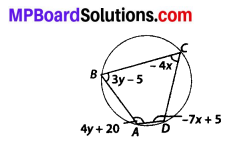
ABCD is a cyclic quadrilateral (see figure). Find the angles of the cyclic quadrilateral.
MP Board Class 10th Maths Solutions Chapter 3 Pair of Linear Equations in Two Variables Ex 3.7 15
Solution:
ABCD is a cyclic quadrilateral.
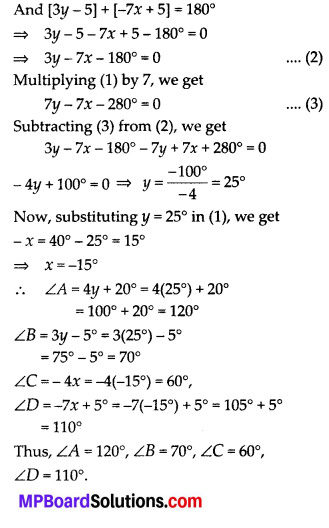
∴ ∠A + ∠C = 180° and
∠B + ∠D = 180°
⇒ [4y + 20] + [- 4x] = 180°
⇒ 4y – 4x + 20° -180° = 0
⇒ 4y – 4x – 160° = 0
⇒ y – x – 40° = 0 … (1)
MP Board Class 10th Maths Solutions Chapter 3 Pair of Linear Equations in Two Variables Ex 3.7 16

MP Board Class 10th Maths Solutions Chapter 1 Real Numbers Ex 1.4

In this article, we will share MP Board Class 10th Maths Book Solutions Chapter 1 Real Numbers Ex 1.4 Pdf, These solutions are solved subject experts from the latest edition books.

MP Board Class 10th Maths Solutions Chapter 1 Real Numbers Ex 1.4

Question 1.
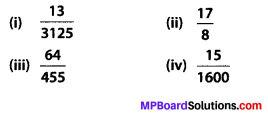
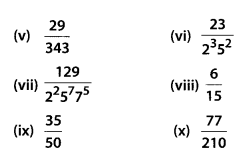
Without actually performing the long divison, state whether the following rational numbers will have a terminating decimal expansion or a non-terminating repeating decimal expansion:
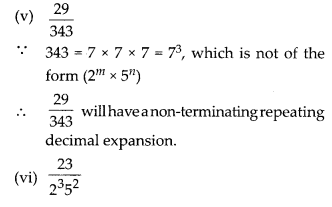
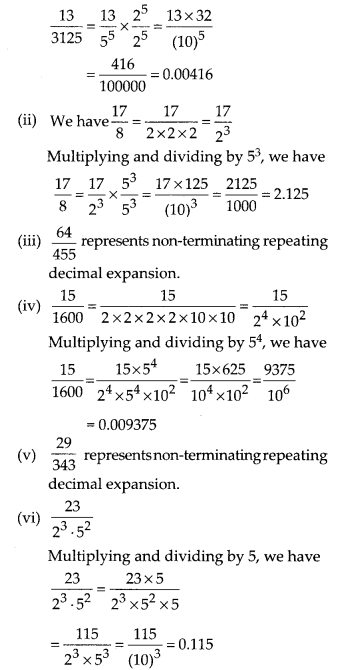
MP Board Class 10th Maths Solutions Chapter 1 Real Numbers Ex 1.4 1
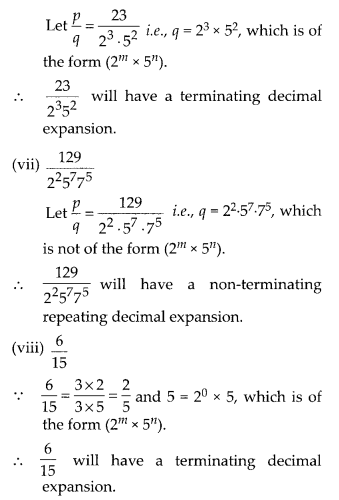
MP Board Class 10th Maths Solutions Chapter 1 Real Numbers Ex 1.4 2
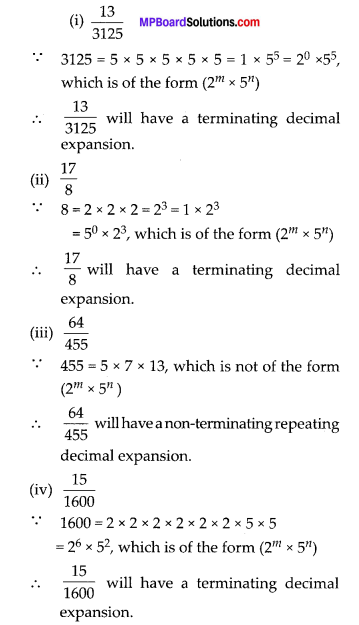
Solution:
MP Board Class 10th Maths Solutions Chapter 1 Real Numbers Ex 1.4 3
MP Board Class 10th Maths Solutions Chapter 1 Real Numbers Ex 1.4 4
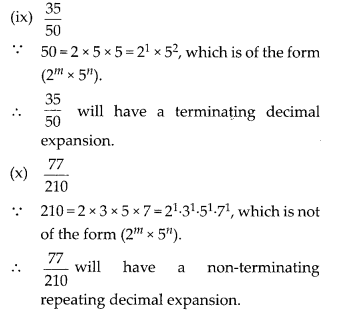
MP Board Class 10th Maths Solutions Chapter 1 Real Numbers Ex 1.4 50
MP Board Class 10th Maths Solutions Chapter 1 Real Numbers Ex 1.4 60

MP Board Class 10th Maths Solutions Chapter 1 Real Numbers Ex 1.4

Question 2.
Write down the decimal expansions of those rational numbers in Question 1 above which have terminating decimal expansions.
Solution:
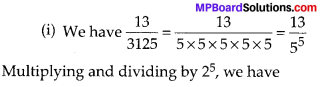
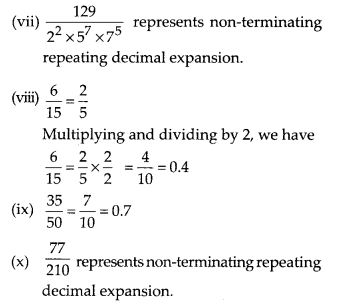
MP Board Class 10th Maths Solutions Chapter 1 Real Numbers Ex 1.4 5
Multiplying and dividing by 25, we have
MP Board Class 10th Maths Solutions Chapter 1 Real Numbers Ex 1.4 6
MP Board Class 10th Maths Solutions Chapter 1 Real Numbers Ex 1.4 70

MP Board Class 10th Maths Solutions Chapter 1 Real Numbers Ex 1.4

Question 3.
The following real numbers have decimal expansions as given below. In each case, decide whether they are rational or not. If they are rational, and of the form \(\frac{p}{q}\), what can you say about the prime factors of q?
(i) 43.123456789
(ii) 0.120120012000120000….
(iii) \(43 . \overline{123456789}\)
Solution:
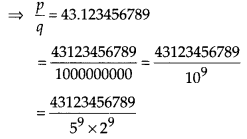
(i) 43.123456789
∴ The given decimal expansion terminates.
∴ It is rational of the form \(\frac{p}{q}\)
MP Board Class 10th Maths Solutions Chapter 1 Real Numbers Ex 1.4 7
Hence, p = 43123456789 and q = 29 × 59
Prime factors of q are 29 and 59.

(ii) 0.120120012000120000…
∵ The given decimal expansion is neither terminating nor repeating.
∴ It is irrational number, hence cannot be written in p/q form.

(iii) \(43 . \overline{123456789}\)
∵ The given decimal expansion is non-terminating repeating.
∴ It is rational number.
MP Board Class 10th Maths Solutions Chapter 1 Real Numbers Ex 1.4 8
Multiplying both sides by 1000000000, we have
1OOOOOOOOOx = 43123456789.123456789…
… (2)
Subtracting (1) from (2), we have
(1000000000x) – x
= (43123456789.123456789 ) – 43.123456789…
⇒ 999999999x = 43123456746
MP Board Class 10th Maths Solutions Chapter 1 Real Numbers Ex 1.4 9
Here, p = 4791495194 and q = 111111111, which is not of the form 2m × 5n i.e., the prime factors of q are not of the form 2m × 5n.

MP Board Class 10th Science Solutions Chapter 8 How do Organisms Reproduce?

MP Board Class 10th Science Solutions Chapter 8 How do Organisms Reproduce?

MP Board Class 10th Science Chapter 8 Intext Questions

Class 10th Science Chapter 8 Intext Questions Page No. 128

Question 1.
What is the importance of DNA copying in reproduction?
Answer:
The chromosomes in the nucleus of a cell contain information for inheritance of features from parents to next generation in the form of DNA (Deoxyribo Nucleic Acid) molecules. The DNA in the cell nucleus is the information source for making proteins. Hence DNA copying is important in reproduction.

Question 2.
Why is variation beneficial to the species but not necessarily for the individual?
Answer:

If a population of reproducing organisms were suited to particular niche and if the niche were drastically altered, the population could be wiped out. However, if some variations were to be present in a few individuals in these populations, there would be some chance for them to survive.

Thus, if there were a population of bacteria living in temperature waters and if the water temperature were to be increased by global warming, most of these bacteria would die, but the few variants resistant to heat would survive and grow further. Variation is thus useful for the survival of species over time. Variation is not useful for all organisms.

MP Board Solutions

Class 10th Science Chapter 8 Intext Questions Page No. 133

Question 1.
How does binary fission differ from multiple fission?
Answer:
Binary fission: It is a simple kind of division which formate new individual. In binary fission, a single cell divides into two equal halves but it is possible only with very simple single cell kind. Amoeba and Bacteria divide by binary fission.

Multiple fission: Another type of simple division is multiple fission, in this, a single cell divides into many daughter, cells, e.g., Plasmodium divide by multiple fission.

Binary fissionMultiple fission
In this fission, one cell split into two equal halves during cell division.
Eg: Bacteria.
Here one organism divide into many daughter cells simultaneously.
Eg: yeast.

Question 2.
How will an organism be benefited if it reproduces through spores?
Answer:
The spores are covered by thick walls that protect them until they come into contact with another moist surface and can begin to grow. Thus organism be benefited if it reproduces through spores.

Question 3.
Can you think of reasons why more complex organisms cannot give rise to new individuals through regeneration?
Answer:
Multicellular organisms are not simply a random mass of cells but a carefully organized entity of tissues and organs are placed at definite positions in the body to form organ systems. These systems are well coordinated to perform specific functions. Hence complex organisms cannot reproduce through fragmentation.

Question 4.
Why is vegetative propagation practised for growing some types of plants?
Answer:
Advantages of vegetative propagation:

  • Used in methods such as layering or grafting, to grow many plants like sugarcane, roses or grapes for agricultural purposes.
  • Plants raised can bear more flowers and fruits in comparison to plants produced from seeds.
  • Plants such as banana, orange, rose and jasmine which have lost the capacity to produce seeds can be propagated.
  • All plants produced by vegetative propagation are genetically similar enough to the parent plant.

Question 5.
Why is DN Acopying an essential part of the process of reproduction?
Answer:
The consistency of DNA copying during reproduction is important for the maintenance of body design features that allow the organism to use that particular niche. Because of this DNA copying is an essential part of the process of reproduction.

Class 10th Science Chapter 8 Intext Questions Page No. 140

Question 1.
How is the process of pollination different from fertilization?
Answer:
Pollination is movement of pollens from one plant to another plant’s or its own plant’s stigma. It may require certain agents called pollinators such as air, water birds or some insects to perform. Fertilization, is a complex process, it involves the fusion of the male and female gametes. It occurs inside the ovule and leads to the formation of zygote.

Question 2.
What is the role of the seminal vesicles and the prostate gland?
Answer:
Along the path of the vas deferens, gland like the prostrate and the seminal vesicles add their secretions so that the sperms are now in a fluid which makes their transport easier and this fluid also provides nutrition.

Question 3.
What are the changes seen in girls at the time of puberty?
Answer:
The changes seen in girls at the time of puberty are:

  1. Development of secondary sexual characteristics.
  2. Growth in breast size and darkening of skin of the nipples.
  3. Growth of hair in the genital area and other areas of skin like underarms, face, hands and legs.
  4. Growth in the size of uterus and ovary hence, start of menstrual cycle periodically.

Question 4.
How does the embryo get nourishment inside the mother’s body?
Answer:
The embryo gets nutrition form the mother’s blood with the help of a special tissue called placenta. This is a disc which is embedded in the uterine wall. It contains villi on the embryo’s side of the tissue on the mother’s side are blood spaces, which surround the villi. This provides a large surface area for glucose and oxygen to pass from the mother to the embryo. The developing embryo will also generate waste substances which can be removed by transferring them into the mother’s blood through the placenta.

Question 5.
If a woman is using a copper-T, will it help in protecting her from sexually transmitted diseases?
Answer:
Copper-T will helps in protecting her from sexually transmitted diseases by helping to prevent infections of diseases.

MP Board Solutions

MP Board Class 10th Science Chapter 8 NCERT Textbook Exercises

Question 1.
Asexual reproduction takes place through budding in:
(a) amoeba
(b) yeast
(c) plasmodium
(d) leishmania
Answer:
(b) yeast

Question 2.
Which of the following is not system in human beings? a part of the female reproductive
(a) ovary
(b) uterus
(c) vas deferens
(d) fallopian tube
Answer:
(c) vas deferens

Question 3.
The anther contains:
(a) sepal
(b) ovules
(c) carpel
(d) pollen grains
Answer:
(d) pollen grains

Question 4.
What are the advantages of sexual reproduction over asexual reproduction?
Answer:
In case of asexual reproduction, new generations are produced by one organism. But in sexual reproduction, new generations are produced by two organisms (male and female). In case of sexual reproduction germ cells are produced in testes and these secrete a hormone testosterone. In human beings also develop special tissues for this purpose.

Question 5.
What are the functions performed by the testis in human beings?
Answer:
They are the glands where sperm and testosterone are generated and present in male body. The testes are contained in the scrotum and are composed of dense connective tissue. Functions of testes are as follows:

  • It produces sperms, which contain haploid set of chromosomes of
  • It produces testosterone, which initiate secondary sexual characteristics

Question 6.
Why does menstruation occur?
Answer:
Since the ovary releases one egg every month, the uterus also prepares itself every month to receive a fertilised egg. Thus its lining becomes thick and spongy. This would be required for nourishing the embryo if fertilisation had taken place. Now, however, this lining is not needed any longer. So the lining slowly breaks and comes out through the vagina as blood and mucous. This cycle takes place roughly every month and is known a menstruation. It usually lasts for about two to eight days.

Question 7.
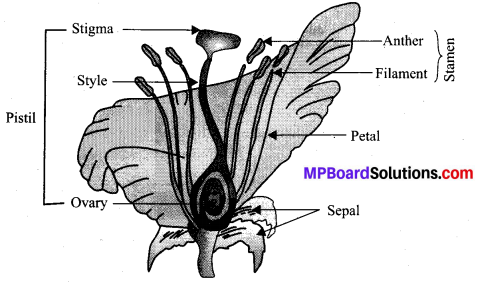
Draw a labelled diagram of the longitudinal section of a flower.
Answer:
MP Board Class 10th Science Solutions Chapter 8 How do Organisms Reproduce 1
Longitudinal section flower.

Question 8.
What are the different methods of contraception?
Answer:

Many ways have been devised to avoid pregnancy. These contraceptive methods fall in a number of categories. One category is the creation of a mechanical barrier so that sperm does not reach the egg. Condoms on the penis or similar coverings worn in the vagina can serve this purpose.

Another category of contraceptives acts by changing the hormonal balance of the body so that eggs are not released and fertilisation cannot occur. These drugs commonly need to be taken orally as pills. However, Since they change hormonal balances, they can cause side effects too. Other contraceptive devices such as the loop or the copper-T are placed in the uterus to prevent pregnancy. Again, they can cause side effects due to irritation of the uterus. Surgery can also be used for removed of unwanted pregnancies.

Question 9.
How are the modes for reproduction different in unicellular and multicellular organisms?
Answer:
In unicellular organisms, reproduction occurs by the division of the entire cell. The modes of reproduction in unicellular organisms can be fission, budding etc. whereas in multi cellular organisms, specialised reproductive organs are present. Therefore, they can be reproduced by complex reproductive methods such as vegetative propagation, spore formation etc. In more complex multicellular organisms such as human beings and plants, the mode of reproduction is sexual reproduction.

Question 10.
How does reproduction help in providing stability to populations of species?
Answer:
Reproduction is the process of producing new individuals of the same species by existing organisms of a species. So, it helps in providing stability to population of species by giving birth to new individuals as the rate of birth must be at par with the rate of death to provide stability to population of a species.

Question 11.
What could be the reasons for adopting contraceptive methods?
Answer:
Contraceptive methods are mainly adopted because of the following reasons:

  • It prevent unwanted pregnancies.
  • It control rise in population and birth rate.
  • It prevent sexually transmitted diseases.

MP Board Solutions

MP Board Class 10th Science Chapter 8 Additional Important Questions

MP Board Class 10th Science Chapter 8 Multiple Choice Questions

Question 1.
All individuals produced by an organism are:
(a) Genetically similar
(b) Non-identical
(c) Fission
(d) Moneociuos
Answer:
(a) Genetically similar

Question 2.
Sexual reproduction is completed by _______ division:
(a) Mitotic
(b) Meiotic and mitotic both
(c) Meiosis
(d) Mitotic at some stages .
Answer:
(c) Meiosis

Question 3.
In yeast cell, division results in:
(a) Offspring
(b) Bud
(c) Clone
(d) Branch
Answer:
(b) Bud

Question 4.
Which of the following organisms undergo multiple fission?
(a) Paramecium
(b) Plasmodium
(c) Amoeba
(d) All of the above
Answer:
(b) Plasmodium

Question 5.
Hydra reproduces asexually through:
(a) Budding
(b) Binary fission
(c) Multiple fission
(d) Vegetative propagation
Answer:
(a) Budding

Question 6.
In which plant, the site of origin of new plants is node?
(a) Potato tuber
(b) Onion bulb
(c) Rhizome ginger
(d) All of the above
Answer:
(d) All of the above

Question 7.
In which of the following, asexual reproduction takes place through binary fission?
(a) Amoeba
(b) Yeast
(c) Plasmodium
(d) Leishmania
Answer:
(b) Yeast

Question 8.
Which of the following is in human beings?
(a) Ovary
(b) Uterus
(c) (a) and (b)
(d) Fallopian tube
(e) (a), (b) and (d)
Answer:
(e) (a), (b) and (d)

Question 9.
The anther, a part of male flower have:
(a) Sepals
(b) Ovules
(c) Carpel
(d) Pollen grains
Answer:
(d) Pollen grains

Question 10.
The information for making proteins is provided by:
(a) Rough endoplasmic reticulum
(b) DNA
(c) Hormones
(d) Enzymes
Answer:
(b) DNA

Question 11.
Nature of gametes are usually:
(a) Haploid
(b) Diploid
(c) Both (a) and (b)
(d) None of the above
Answer:
(a) Haploid

Question 12.
With the help of which tissues embryo gets nutrition from the mother’s blood?
(a) Zygote
(b) Uterus only
(c) Placenta
(d) None of these
Answer:
(c) Placenta

Question 13.
Which of the following is not a part of the male reproductive system in human beings?
(a) Testes
(b) Uterus
(c) Vas deferens
(d) Urethra
Answer:
(b) Uterus

Question 14.
Binary fission in some organisms occurs in definite orientation in relation to the cell structures. One such organisms is:
(a) Leishmania
(b) Plasmodium
(c) Amoeba
(d) Bacteria
Answer:
(c) Amoeba

Question 15.
Plants that have lost their capacity to produce seeds, reproduce by:
(a) Spores
(b) Vegetative propagation
(c) Fission
(d) Regeneration
Answer:
(a) Spores

Question 16.
A stamen consists of two parts namely:
(a) Anther and style
(b) Anther and filament
(c) Stigma and style
(d) Filament and style
Answer:
(b) Anther and filament

Question 17.
A bisexual flower contains:
(a) Stamens only
(b) Carpels only
(c) Either stamens or carpels
(d) Both stamens and carpels
Answer:
(d) Both stamens and carpels

Question 18.
Germinated seeds do not contains:
(a) Sepals
(b) Cotyledon
(c) Plumule
(d) Radicle
Answer:
(a) Sepals

Question 19.
A feature of reproduction that is common to amoeba, spirogyra and yeast is that:
(a) they reproduce asexually
(b) they are all unicellular
(c) they reproduce only sexually
(d) they are all multicellular
Answer:
(a) they reproduce asexually

Question 20.
Which of the part of flower ripens to form a fruit?
(a) Ovule
(b) Ovary
(c) Carpel
(d) Egg cell
Answer:
(b) Ovary

Question 21.
The testes perforin the following function/functions:
(a) Produce testosterone
(b) Produce sperms
(c) Produce male gametes and hormone
(d) Produce sperms and urine
Answer:
(b) Produce sperms

Question 22.
Where does fertilisation take place in human beings?
(a) Uterus
(b) Vagina
(c) Cervix
(d) Fallopian Tube
Answer:
(d) Fallopian Tube

Question 23.
Condom is a method of control that falls under the following category:
(a) Surgical method
(b) Hormonal method
(c) Mechanical method
(d) Chemical method
Answer:
(c) Mechanical method

Question 24.
The common passage for sperms and urine in the male reproductive system is:
(a) Ureter
(b) Seminal vesicle
(c) Urethra
(d) Vas deferens
Answer:
(c) Urethra

Question 25.
In sperm, which part dissociates after fertilization?
(a) Acrosome
(b) Tail
(c) Head
(d) Middle piece
Answer:
(b) Tail

MP Board Solutions

MP Board Class 10th Science Chapter 8 Very Short Answer Type Questions

Question 1.
Which life process is not essential to maintain the life of an individual organism but important for the survival of species?
Answer:
Reproduction.

Question 2.
How a species can get a danger of being extinct?
Answer:
If individuals of any species stops reproducing, then that species can get a danger of being extinct.

Question 3.
How an individual is able to make a copy of itself?
Answer:
DNA copying is a process at cellular level which enables an individual to make copy of it self.

Question 4.
Write the name of process by which Hydra reproduces.
Answer:
Budding only.

Question 5.
Generally, how many individuals are involved in asexual reproduction?
Answer:
One.

Question 6.
Write the name of some common method of asexual reproduction.
Answer:
Vegetative propagation, budding, fragmentation and spore formation.

Question 7.
Which type of flower is called unisexual flowers?
Answer:
A flower which have either male or female reproductive parts is called unisexual flowers.

Question 8.
What is pollination?
Answer:
The transfer of pollen grains from the anther to the stigma of the same or of another flower of the same kind is known as pollination.

Question 9.
What do you understand by term fertilisation?
Answer:
The fusion of male and female gametes is termed as fertilisation.

Question 10.
How seed is dispersed?
Answer:
Seed dispersal takes place by means of wind, water and animals.

MP Board Class 10th Science Chapter 8 Short Answer Type Questions

Question 1.
How does plasmodium undergo fission?
Ans.
Plasmodium divides into many daughter cells through multiple fission.

Question 2.
How spirogyra reproduces by fragmentation?
Answer:
An individual spirogyra breaks up into many smaller pieces, each fragment grows into new individual.

Question 3.
Which cells are responsible for budding in hydra?
Answer:
Regenerative cells.

Question 4.
Name the structure into which following develops: the plumule and radicle?
Answer:
Plumule develops to shoot while radicle form root of a plant.

Question 5.
On which plant can you find buds on its leaves?
Answer:
Bryophyllum.

Question 6.
Write the scientific name of the bread mould.
Answer:
Rhizopus.

Question 7.
Where are the testes located in human beings?
Answer:
In abdominal cavity, in scrotum.

Question 8.
For what specific reason have the testes specific location?
Answer:
As testes, requires lesser temperature, to produce sperm than of abdominal cavity.

Question 9.
Correlate the rate of general body growth and maturation of reproductive tissue during puberty.
Answer:
When reproductive tissues (organs) begin to mature, body growth rate slows down.

Question 10.
Where does the zygote get implanted in human beings?
Answer:
In the wall of uterus.

Question 11.
Which two important substances are delivered to developing embryo through placenta?
Answer:
Glucose and oxygen.

Question 12.
How change in hormonal balance prevents pregnancy?
Answer:
It prevents the release of eggs.

Question 13.
Name the tissue in mother’s body that provides nutrition to developing embryo?
Answer:
Placenta provides nutrition to developing embryo.

Question 14.
Write one side effect of loop placed in uterus.
Answer:
It may cause permanent irritation and excessive and prolong bleeding in uterus.

Question 15.
Which structures need to be blocked in males and females respectively to prevent pregnancy?
Answer:
Vas deferens in male (vasectomy), fallopian tube in female (tubectomy).

Question 16.
Why is children sex ratio alarmingly declining in our country.
Answer:
Abortions based on sex selections.

Question 17.
Name the chemical methods of preventing pregnancy.
Answer:
Morning over oral pills.

Question 18.
Name some of the devices used as mechanical method for preventing pregnancy.
Answer:
Loop, copper T, condoms.

Question 19.
Name the only mammal(s) which lays eggs.
Answer:
Echidna and duck-billed platypus.

Question 20.
What is parthenogenesis?
Answer:
Parthenogenesis is a type of asexual reproduction. In this case, embryo development takes places without fertilisation. A few species of insects, bees, wasps, birds and lizards (e.gKomodo dragon lizard) reproduce this way.
Question 21.
Give an example of an organism which reproduces by:
(a) Fragmentation
(b) Spore formation
(c) Stems
Answer:
(i) Spirogyra.
(ii) Bacteria, fungi (rhizopus), moss, algae.
(iii) Plants like potato (tuber), onion (bulb) reproduce by vegetative propagation of stems.

Question 22.
Discuss various artificial vegetative propagation techniques.
Answer:
Various artificial vegetative propagation techniques are:

  1. Cutting
  2. Layering
  3. Grafting
  4. Tissue culture

Question 23.
What is grafting? What are different types of grafting techniques?
Answer:
In grafting, one part of a plant is inserted into another plant in a way that both of them will unite and grow together as a single plant. Different methods of grafting are:

  • Approach grafting
  • Cleft grafting
  • Bud grafting
  • Tongue grafting

Question 24.
Name some:

  1. Plants which are reproduced by vegetative propagation.
  2. Plants which have unisexual flowers.
  3. Plants which have bisexual flowers.
  4. Plants with self-pollination.
  5. Plants that do cross-pollination.

Answer:

  1. Rose, sweet potatoes, bryophyllum.
  2. Coconut, papaya, watermelon.
  3. Lily, rose, sunflower.
  4. Beans, peas, tomatoes.
  5. Grasses, catkins, maple trees.

Question 25.
What is germination?
Answer:
The seed contains the future plant or embryo which develops into a seedling under appropriate conditions. This process is known as germination.

Question 26.
What is cross-pollination?
Answer:
Cross-pollination is the process of transfer of pollen from the anther of a flower to stigma of a flower of another plant of the same species or closely related species.

Question 27.
Explain hormonal pills of contraception.
Answer:
Oral contraceptives: In this method, tablets or drugs are taken orally by females to check pregnancy These contain small doses of hormones in forms of pills that prevent the release of eggs and thus, fortilisation cannot occur.

MP Board Solutions

MP Board Class 10th Science Chapter 8 Long Answer Type Questions

Question 1.
Why simply copying of DNA in a dividing cells not enough to maintain continuity of life?
Answer:
Copying of DNA preserve and pass specific characters of a generation to next generation offsprings. In reproduction, it is very important to create DNA copy. It determines the body design of an individual. But variation in genotype is also important,, because sometimes existing genotype don’t find its potential to survive in changing surroundings. So, genotype must have some alterations which are caused by variations only. Hence, simply copying of DNA in a dividing cells is not enough to maintain continuity of life.

Question 2.
Describe in brief the fragmentation mode of asexual reproduction.
Answer:
Fragmentation: Many lower organisms, use fragmentation mode of asexual reproduction for its growth e.g., algae. When water and nutrients are available in sufficient amount algae grow and multiply rapidly by fragmentation. An algae breaks up to multiple fragments. These fragments or pieces grow into new individuals.

Question 3.
Explain budding in yeast.
Answer:
The yeast is a single-celled organism. The small bulb-like projection come out from the yeast cell in favourable time and is called a bud. The bud gradually grows and gets dettached from the parent cell and forms a new yeast cell. The new yeast cell grows, matures and produces more yeast cells.

Question 4.
Describe the process of implantation.
Answer:
A week after the sperm fertilizes the egg, the fertilized egg (zygote) undergo development and become a multicelled blastocyst. The blastocyst fix itself into the lining of the uterus, called the endometrium. The hormone estrogen causes the endometrium to become thick and rich with blood. Progesterone and other hormone released by the ovaries, keeps the endometrium thick with blood so that the blastocyst can absorb nutrients from uterus. This process is called implantation.

Question 5.
Explain the following.

  1. Hermaphrodites
  2. Unisexual
  3. Syngamy

Answer:

  1. Hermaphrodites are bisexual organisms which possess both male and female reproductive organs. Examples: earthworm, leech, starfish.
  2. Animals which have different male and female individuals as birds, mammals etc.
  3. The process of fusion of male gamete with female gamete is called syngamy.

Question 6.
What is contraception? Discuss natural and barrier method of contraception.
Answer:
Contraception or birth control methods include: condoms, the diaphragm, the contraceptive pill, implants, IUDs (intrauterine devices), sterilization and the morning after pill and many more some of best methods are given below:

  • Natural method: It involves avoiding the chances of meeting of sperms and ovum. In this method, the sexual intercourse is avoided by the couple from day 10th to 17th of the menstrual cycle of female as in this period, ovulation is expected and therefore, the chances of fertilisation are very high.
  • Barrier method: In this method, the fertilisation of ovum and sperm is checked out with the help of artificially developed barriers. Barriers are developed for both males and females. Most common barrier available in market are condoms.

Question 7.
Describe implants and surgical methods of contraception
Answer:
Contraceptive devices are also developed as the loop or copper-T to prevent pregnancy. Surgical methods are also used to block the gamete transfer. It includes the blocking of vas deferens to prevent the transfer of Sperms known as vasectomy. Similarly, tubectomy in the fallopian tubes of the female can be blocked so that the egg will not reach the uterus.

Question 8.
Discuss fertilization in flowering plants.
Answer:
There are two main procedures of completing fertilization in flowering plants, which are:
(i) Pollination
(ii) Fertilisation

(i) Pollination: Pollination is a very important part of the life cycle of a flowering plant which results in seeds that grow into new plants. It is part of the sexual reproduction process of flowering plants. Flowers are the structures of flowering plants that contain all the specialized parts needed for sexual reproduction. Plants have gametes, which contain half the normal number of chromosomes for that plant species. Male gametes are found inside tiny pollen grains on the anthers of flowers. Female gametes are found in the ovules of a flower. Pollination is the process that brings these male and female gametes together. The wind or animals, especially insects and birds, pick up pollen from the male anthers and carry it to the female stigma. Flowers have to encourage animals to pollinate them.

(ii) Fertilisation: After pollination, when pollen has landed on the stigma of a suitable flower of the same species, various process occurs in the making of seeds. A pollen grain on the stigma grows a tiny tube, all the way down the style to the ovary. This pollen tube carries a male gamete to meet a female gamete in an ovule. In a process called fertilization, the two gametes join. The fertilised ovule form a seed, which contains a food store and an embryo that grow into a new plant. The ovary develops into a fruit to protect the seed.

Question 9.
Inside womb, how does a child receive food, oxygen and water? Discuss.
Answer:
As a mother eats something the nutrient like glucose, proteins, fats, vitamins, etc. are absorbed into the mother’s blood by the small intestine. The nutrients flow to the placenta, and then transferred to the baby’s bloodstream through the umbilical cord. The baby’s waste products (like CO2) are disposed of in the mother’s blood stream as well. In the placenta, the mothers blood flows into a network of blood Vessels and capillaries. Molecules in the mother’s blood like glucose, proteins, fats, oxygen etc. flow out of the mother’s blood supply and are absorbed into another network of blood vessels and capillaries containing the baby’s blood supply. The baby’s blood then flows through the umbilical cord back to the baby. It is the complete process of baby’s nutrition inside womb.

Question 10.
Discuss the advantages and disadvantage of autogamy or self¬pollination.
Answer:
Advantages of autogamy:

It is a sure method of seed formation. Scent and Nectar are not needed by the flower to attract insects. Parent characteristics are preserved in off spring’s. Small quantity of pollen is required for pollination. Flowers need not be large or attractive. Disadvantages of autogamy plants lose their vigor in their future generations due to repeated self-pollination. Since, there is no variation, no genetic improvement occurs in offsprings. Weak characteristics of the plant are inherited by the next generations.

MP Board Solutions

MP Board Class 10th Science Chapter 8 Textbook Activities

Class 10 Science Activity 8.1 Page No. 129

  • Dissolve about 10 gin of sugar in 100 mL of water.
  • lake 20 mL of this solution in a test tube and add a pinch of yeasl granules to it.
  • Put a cotton plug on the mouth of the test tube and keep it in a warm place.
  • Alter 1 or 2 hours, put a small drop of yeast culture from the test tube on a slide and cover it with a coverslip.
  • Observe the slide under a microscope.

Observations:

  • Formation of yeast cells can be seen. Some of them, shows chain budding.

Class 10 Science Activity 8.2 Page No. 129

  • Wet a slice of bread, and keep it in a cool, moist and dark place.
  • Observe the surface of the slice with a magnifying glass.
  • Record your observation for a week.

Observations:

  • A layer of while cottony mass is seen over the surface of slice. These inercase in size and number and after a week, the layer turns black show ing formation of spores or sporangia.

Class 10 Science Activity 8.3 Page No. 129

  • Observ e a permanent slide of Amoeba under a microscope.
  • Similarly observe another permanent slide of Amoeba show-ing binary fission.
  • Now, compare the observation of both the slides.

Observations:

  • The permanent slide of amoeba shows normal cytoplasm and nucleus. Nucleus can be seen dividing and construction in cytoplasm can also be seen. The binary fission with two daughter cells is observed in the other slide.

Class 10 Science Activity 8.4 Page No. 129

  • Collect water from a lake or pond that appears dark green and contains filamentous structures.
  • Put one or two filaments on a slide.
  • Put a drop of glycerin on these filaments and cover it with a coverslip
  • Observe the slide under a microscope.
  • Can you identify different tissues in the Spimgyra filaments.

Observations:

  • Spirogyra filament consists of many cells which are attached linearly to form a filament.

Class 10 Science Activity 8.5 Page No. 132

  • Take a potato and observe its surface. Can notches be seen?
  • Cut the potato into small pieces such that some pieces contain a notch or bud and some do not.
  • Spread some cotton on a tray and wet it. Place the potato pieces on this cotton. Note where the pieces with the buds are placed.
  • Observe changes taking place in these potato pieces over the next few days. Make sure that the cotton is, kept moistened.
  • Which arc the potato pieces that give rise to fresh green shoots and roots.

Observations:

  • The,potato undergoes various changes in few days. The buds in notches show growth of young shoots and roots. The pieces which do not have eye buds do not show any growth.

Class 10 Science Activity 8.6 Page No. 132

  • Select a money-plant.
  • Cut some pieces such that they contain at least one leaf.
  • Cut out some other portions between two leaves.
  • Dip one end of all the pieces in water and observe over the next few days.
  • Which ones grow’ and give rise to fresh leaves?
  • What can you conclude from your observations ?

Observations:

  • The leaves at the nodes show formation of fresh leaves. The formation of branch from axillary buds axil of leaf is also observ ed.
  • The leaves that undergo photosynthesis show tendency to grow into a new plant through vegetative propagation.

Class 10 Science Activity 8.7 Page No. 135

  • Soak a few seeds of Bengal gram (chana) and keep them overnight.
  • Drain the excess water and cover the seeds with a wet cloth and leave them for a day. Make sure that the seeds do not become dry.
  • Cut open the seeds carefully and observe the different parts.
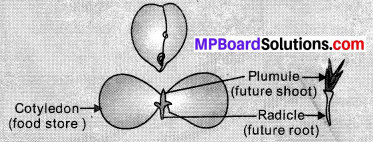
  • Compare your observations with the Fig. 8.2 and sec if you can identify all the parts.

Observations:

  • The parts identified includes- cotyledon which stores food, plumule which is a future shoot radicle that is a future root.

MP Board Class 10th Science Solutions Chapter 8 How do Organisms Reproduce 2

Germination.

MP Board Class 10th Science Solutions

MP Board Class 10th Maths Solutions Chapter 3 Pair of Linear Equations in Two Variables Ex 3.1

In this article, we will share MP Board Class 10th Maths Book Solutions Pair of Linear Equations in Two Variables Ex 3.1 Pdf, These solutions are solved subject experts from the latest edition books.

MP Board Class 10th Maths Solutions Chapter 3Pair of Linear Equations in Two Variables Ex 3.1

Question 1.
Aftab tells his daughter, “Seven years ago, I was seven times as old as you were then. Also, three years from now, I shall be three times as old as you will be”. (Isn’t this interesting?) Represent this situation algebraically and graphically.
Solution:
At present: Let Aftab’s age = x years
His daughter’s age = y years
Seven years ago : Aftab’s age = (x – 7) years
His daughter’s age = (y – 7)years
According to the condition,
[Aftab’s age] = 7[His daughter’s age]
⇒ [x – 7] = 7[y – 7] = x – 7 = 7y – 49
⇒ x – 7y – 7 + 49 = 0 ⇒ x – 7y + 42 = 0 …. (1)
After three years : Aftab’s age = (x + 3) years
His daughter’s age = (y + 3) years
According to the condition,
[Aftab’s age] = 3[His daughter’s age]
⇒ [x + 3] = 3[y + 3]
⇒ x + 3 = 3y + 9 ⇒ x — 3y + 3 — 9 = 0
⇒ x — 3y – 6 = 0 …. (2)
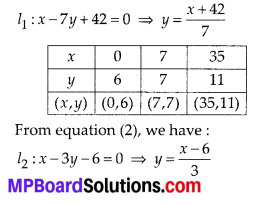
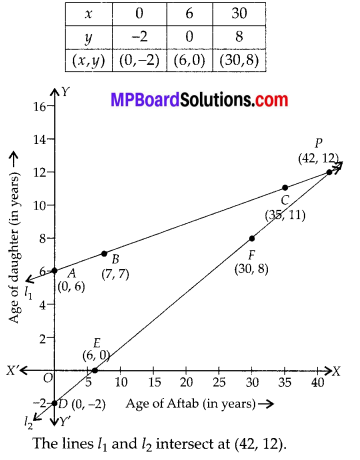
Graphical representation of equation (1) and (2): From equation (1), we have :
MP Board Class 10th Maths Solutions Chapter 3-Pair of Linear Equations in Two Variables Ex 3.1 1
MP Board Class 10th Maths Solutions Chapter 3-Pair of Linear Equations in Two Variables Ex 3.1 2

MP Board Class 10th Maths Solutions Chapter 3-Pair of Linear Equations in Two Variables Ex 3.1 3

Question 2.
The coach of a cricket team buys 3 bats and 6 balls for ₹ 3900. Later, she buys another bat and 3 more balls of the same kind for ₹ 1300. Represent this situation algebraically and geometrically.
Solution:
Let the cost of a bat = ₹ x
and the cost of a ball = ₹ y
Cost of 3 bats = ₹ 3x
and cost of 6 balls = ₹ 6y
Again, cost of 1 bat = ₹ x
and cost of 3 balls = ₹ 3y
Algebraic representation:
Cost of 3 bats + Cost of 6 balls = ₹ 3900
⇒ 3x + 6y = 3900 ⇒ x + 2y = 1300 …. (1)
Also, cost of 1 bat + cost of 3 balls = ₹ 1300
⇒ x + 3y = 1300 …. (2)
Thus, (1) and (2) are the algebraic representations of the given situation.
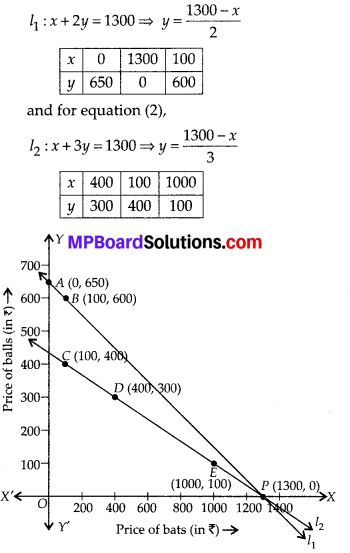
Geometrical representation:
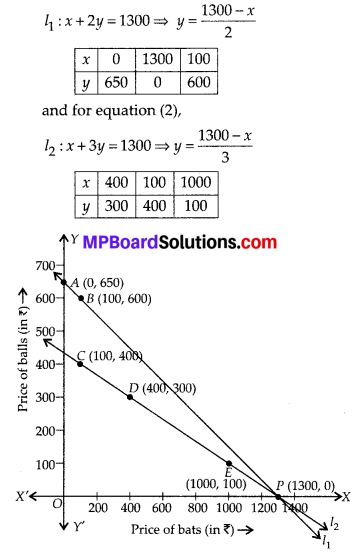
We have for equation (1),
MP Board Class 10th Maths Solutions Chapter 3-Pair of Linear Equations in Two Variables Ex 3.1 5
We can also see from the obtained graph that the straight lines representing the two equations intersect at (1300, 0).

MP Board Class 10th Maths Solutions Chapter 3 Pair of Linear Equations in Two Variables Ex 3.1

Question 3.
The cost of 2 kg of apples and 1 kg of grapes on a day was found to be ₹ 160. After a month, the cost of 4 kg of apples and 2 kg of grapes is ₹ 300. Represent the situation algebraically and geometrically.
solution:
Let the cost of 1 kg of apples = ₹ x
And the cost of 1 kg of grapes = ₹ y
Algebraic representation:
2x + y = 160 … (1)
and 4x + 2y = 300
⇒ 2x + y = 150 … (2)
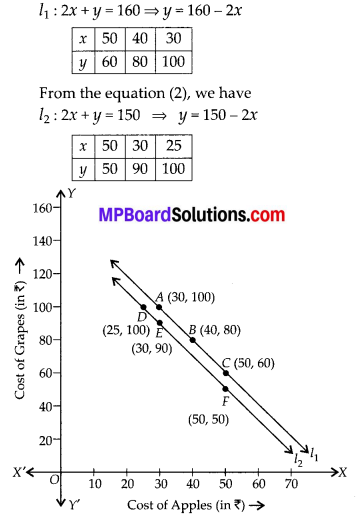
Geometrical representation:
We have, for equation (1),
MP Board Class 10th Maths Solutions Chapter 3-Pair of Linear Equations in Two Variables Ex 3.1 4
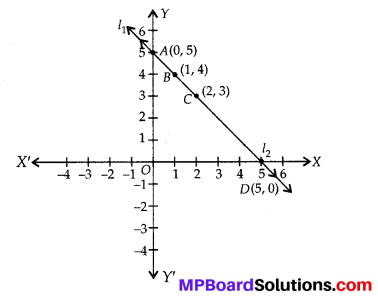
The straight lines l1 and l2 are the geometrical representations of the equations (1) and (2) respectively. The lines are parallel.

MP Board Class 10th Maths Solutions Chapter 13 Surface Areas and Volumes Ex 13.1

In this article, we will share MP Board Class 10th Maths Book Solutions Chapter 13 Surface Areas and Volumes Ex 13.1 Pdf, These solutions are solved subject experts from the latest edition books.

MP Board Class 10th Maths Solutions Chapter 13 Surface Areas and Volumes Ex 13.1

Unless stated otherwise, take π = \(\frac{22}{7}\)

Question 1.
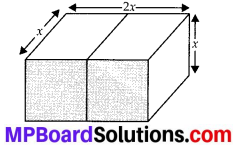
2 cubes each of volume 64 cm3 are joined end to end. Find the surface area of the resulting cuboid.
Solution:
Volume of each cube = 64 cm3
MP Board Class 10th Maths Solutions Chapter 13 Surface Areas and Volumes Ex 13.1 1
Let the edge of each cube = x
∴ x3 = 64 cm3
⇒ x = 4 cm
Now, Length of the resulting cuboid (l) = 2x cm = 8 cm
Breadth of the resulting cuboid (b) = x cm = 4 cm
Height of the resulting cuboid (h) = x cm = 4 cm
∴ Surface area of the cuboid = 2 (lb + bh + hl)
= 2 [(8 × 4) + (4 × 4) + (4 × 8)] cm2
= 2 [32 + 16 + 32] cm2 = 2 [80] cm2
= 160 cm2.

MP Board Class 10th Maths Solutions Chapter 13 Surface Areas and Volumes Ex 13.1

Question 2.
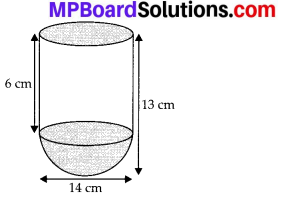
A vessel is in the form of a hollow hemisphere mounted by a hollow cylinder. The diameter of the hemisphere is 14 cm and the total height of the vessel is 13 cm. Find the inner surface area of the vessel.
Solution:
For hemispherical part,
radius (r)= \(\frac{14}{2}\) = 7cm
∴ Curved surface area = 2πr2
= 2 × \(\frac{22}{7}\) × 7 × 7cm2
= 308cm2 7
Total height of vessel = 13 cm
MP Board Class 10th Maths Solutions Chapter 13 Surface Areas and Volumes Ex 13.1 2
∴ Height of cylinder = (13 – 7)cm = 6 cm and radius(r) = 7 cm
∴ Curved surface area of cylinder = 2πrh
= 2 × \(\frac{22}{7}\) × 7 × 6cm2 = 264cm2 7
∴ Inner surface area of vessel = (308 + 264)cm2 = 572 cm2

Question 3.
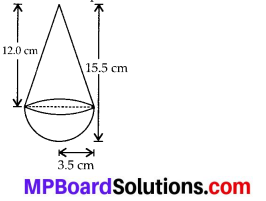
A toy is in the form of a cone of radius 3.5 cm mounted on a hemisphere of same radius. The total height of the toy is 15.5 cm. Find the total surface area of the toy.
Solution:
Let h be the height of cone and r be the radius of cone and hemisphere.
MP Board Class 10th Maths Solutions Chapter 13 Surface Areas and Volumes Ex 13.1 3
∴ h = [height of toy – radius of hemi sphere]
= (15.5 – 3.5) cm = 12 cm
Also l2 = h2 + r2 = 122 + (3.5)2 = 156.25 cm2
∴ l = 12.5 cm
Curved surface area of the conical part = πrl
Curved surface area of the hemispherical part = 2πr2
∴ Total surface area of the toy = πrl + 2πr2
= πr(l + 2 r)
= \(\frac{22}{7} \times \frac{35}{10}\) (12.5 + 2 × 3.5) cm2
= 11 × (12.5 + 7) cm2 = 11 × 19.5 cm2
= 214.5 cm2

MP Board Class 10th Maths Solutions Chapter 13 Surface Areas and Volumes Ex 13.1

Question 4.
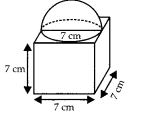
A cubical block of side 7 cm is surmounted by a hemisphere. What is the greatest diameter the hemisphere can have? Find the surface area of the solid.
Solution:
Let side of the block, l = 7 cm
MP Board Class 10th Maths Solutions Chapter 13 Surface Areas and Volumes Ex 13.1 4
∴ The greatest diameter of the hemisphere = 7 cm
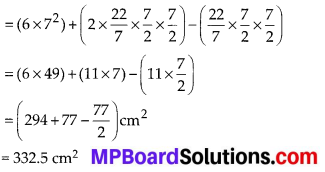
Surface area of the solid = [Total surface area of the cubical block] + [C.S.A. of the hemisphere] – [Base area of the hemisphere]
= 6 × l2 + 2πr2 – πr2
[where l = 7 cm and r = \(\frac{7}{2}\) cm]
MP Board Class 10th Maths Solutions Chapter 13 Surface Areas and Volumes Ex 13.1 5

Question 5.
A hemispherical depression is cut out from one face of a cubical wooden block such that the diameter l of the hemisphere is equal to the edge of the cube. Determine the surface area of the remaining solid.
Solution:
Let l be the side of the cube.
MP Board Class 10th Maths Solutions Chapter 13 Surface Areas and Volumes Ex 13.1 6
∴ Diameter of the hemisphere = l
⇒ Radius of the hemisphere (r) = \(\frac{l}{2}\)
Curved surface area of hemisphere = 2πr2
= 2 × π × \(\frac{l}{2} \times \frac{l}{2}=\frac{\pi l^{2}}{2}\)
Base area of the hemisphere = πr2
= \(\pi\left(\frac{l}{2}\right)^{2}=\frac{\pi l^{2}}{4}\)
Surface area of the cube = 6 × l2 = 6l2
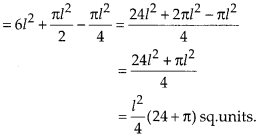
∴ Surface area of the remaining solid = [Total surface area of cube + C.S.A. of hemisphere – base area of hemisphere]
MP Board Class 10th Maths Solutions Chapter 13 Surface Areas and Volumes Ex 13.1 7

MP Board Class 10th Maths Solutions Chapter 13 Surface Areas and Volumes Ex 13.1

Question 6.
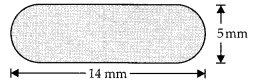
A medicine capsule is in the shape of a cylinder with two hemispheres stuck to each of its ends (see figure). The length of the entire capsule is 14 mm and the diameter of the capsule is 5 mm. Find its surface area.
MP Board Class 10th Maths Solutions Chapter 13 Surface Areas and Volumes Ex 13.1 8
Solution:
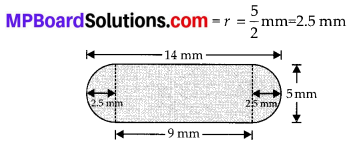
Radius of the hemispherical part
MP Board Class 10th Maths Solutions Chapter 13 Surface Areas and Volumes Ex 13.1 9
Curved surface area of one hemispherical part = 2πr2
∴ Surface area of both hemispherical parts
= 2(2πr2) = 4πr2 = [4 × \(\frac{22}{7} \times\left(\frac{25}{10}\right)^{2}\)] mm2
= \(\left(4 \times \frac{22}{7} \times \frac{25}{10} \times \frac{25}{10}\right)\) mm2
Entire length of capsule = 14 mm
∴ Length of cylindrical part = [Length of capsule – Radius of two hemispherical part]
= (14 – 2 × 2.5)mm = 9mm Area of cylindrical part = 2πrh
= (2 × \(\frac{22}{7}\) × 2.5 × 9 ]mm2 = (2 × \(\frac{22}{7} \times \frac{25}{10}\) × 9) mm2
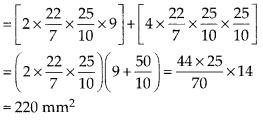
Total surface area
= [Surface area of cylindrical part + Surface area of both hemispherical parts]
MP Board Class 10th Maths Solutions Chapter 13 Surface Areas and Volumes Ex 13.1 10

Question 7.
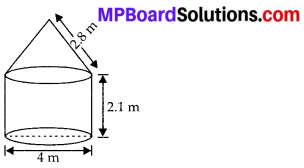
A tent is in the shape of a cylinder surmounted by a conical top. If the height and diameter of the cylindrical part are 2.1 m and 4 m respectively, and the slant height of the top is 2.8 m, find the area of the canvas used for making the tent. Also, find the cost of the canvas of the tent at the rate of ₹ 500 per m2. (Note that the base of the tent will not be covered with canvas.)
Solution:
MP Board Class 10th Maths Solutions Chapter 13 Surface Areas and Volumes Ex 13.1 11
For cylindrical part:
Radius (r) = \(\frac{4}{2}\) m = 2m and height (h) = 2.1 m
∴ Curved surface area = 2πrh = (2 × \(\frac{22}{7}\) × 2 × \(\frac{21}{10}\))m2
For conical part:
Slant height (l) = 2.8 m
and base radius (r) = 2 m
∴ Curved surface area
= πrl = (\(\frac{22}{7}\) × 2 × \(\frac{28}{10}\)) m2
∴ Total surface area = [Curved surface area of the cylindrical part] + [Curved surface area of conical part]
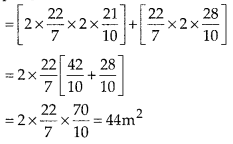
MP Board Class 10th Maths Solutions Chapter 13 Surface Areas and Volumes Ex 13.1 12
Cost of the canvas used :
Cost of 1 m2 of canvas = ₹ 500
∴ Cost of 44 m2 of canvas = ₹ (500 × 44)
= ₹ 22000.

Question 8.
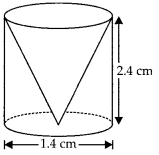
From a solid cylinder whose height is 2.4 cm and diameter 1.4 cm, a conical cavity of the same height and same diameter is hollowed out. Find the total surface area of the remaining solid to the nearest cm2.
Solution:
MP Board Class 10th Maths Solutions Chapter 13 Surface Areas and Volumes Ex 13.1 13
For cylindrical part :
Height (h) = 2.4 cm and diameter = 1.4 cm
⇒ Radius (r) = 0.7 cm
∴ Total surface area of the cylindrical part
= 2πrh + 2πr2 = 2πr [h + r]
= 2 × \(\frac{22}{7} \times \frac{7}{10}\) [2.4 + 0.7]
= \(\frac{44}{10}\) × 3.1 = \(\frac{44 \times 31}{100}\) = \(\frac{1364}{100}\) cm2
For conical part:
Base radius (r) = 0.7 cm and height (h) = 2.4 cm
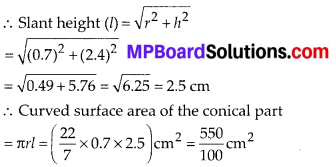
MP Board Class 10th Maths Solutions Chapter 13 Surface Areas and Volumes Ex 13.1 14
Base area of the conical part
= \(\pi r^{2}=\frac{22}{7} \times\left(\frac{7}{10}\right)^{2}=\frac{22 \times 7}{100} \mathrm{cm}^{2}=\frac{154}{100} \mathrm{cm}^{2}\)
Total surface area of the remaining solid = [(Total surface area of cylindrical part) + (Curved surface area of conical part) – (Base area of the conical part)]
= \(\left[\frac{1364}{100}+\frac{550}{100}-\frac{154}{100}\right] \mathrm{cm}^{2}=\frac{1760}{100} \mathrm{cm}^{2}\)
Hence, total surface area to the nearest cm2 is 18cm2.

MP Board Class 10th Maths Solutions Chapter 13 Surface Areas and Volumes Ex 13.1

Question 9.
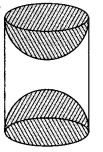
A wooden article was made by scooping out a hemisphere from each end of a solid cylinder, as shown in figure. If the height of the cylinder is 10 cm, and its base is of radius 3.5 cm, find the total surface area of the article.
MP Board Class 10th Maths Solutions Chapter 13 Surface Areas and Volumes Ex 13.1 15
Solution:
Radius of the cylinder (r) = 3.5 cm
Height of the cylinder (h) = 10 cm
∴ Curved surface area = 2πrh
= 2 × \(\frac{22}{7} \times \frac{35}{10}\) × 10cm2 = 220cm2
Curved surface area of a hemisphere = 2πr2
∴ Curved surface area of both hemispheres
= 2 × 2πr2 = 4πr2 = 4 × \(\frac{22}{7} \times \frac{35}{10} \times \frac{35}{10}\) cm2
= 154 cm2
Total surface area of the remaining solid = (220 + 154) cm2 = 374 cm2.

MP Board Class 10th Maths Solutions Chapter 3 Pair of Linear Equations in Two Variables Ex 3.3

In this article, we will share MP Board Class 10th Maths Book Solutions Pair of Linear Equations in Two Variables Ex 3.3 Pdf, These solutions are solved subject experts from the latest edition books.

MP Board Class 10th Maths Solutions Chapter 3 Pair of Linear Equations in Two Variables Ex 3.3

Question 1.
Solve the following pair of linear equations by the substitution method.
(i) x + y = 14; x – y = 4
(ii) s – f = 3; \(\frac{s}{3}+\frac{t}{2}\) = 6
(iii) 3x – y = 3; 9x – 3y = 9
(iv) 0.2x + 0.3y = 1.3; 0.4x + 0.5y = 2.3
(v) \(\sqrt{2} x+\sqrt{3} y\) = 0; \(\sqrt{3} x-\sqrt{8} y\) = 0
(vi) \(\frac{3 x}{2}-\frac{5 y}{3}\) = -2, \(\frac{x}{3}+\frac{y}{2}=\frac{13}{6}\)
Solution:
(i) x + y = 14 … (1),
x – y = 4 …. (2)
From (1) , we get x = (14 – y) …. (3)
Substituting value of x in (2) , we get
(14 – y) – y = 4 ⇒ 14 – 2y = 4 ⇒ -2y = -10 ⇒ y = 5
Substituting y = 5 in (3), we have
x = 14 – 5 ⇒ x = 9
Hence, x = 9, y = 5

(ii) s – t = 3 … (1)
MP Board Class 10th Maths Solutions Chapter 3 Pair of Linear Equations in Two Variables Ex 3.3 1
From (1), we have s = (3 + t) … (2)
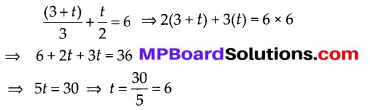
Substituting this value of s in (2), we get
MP Board Class 10th Maths Solutions Chapter 3 Pair of Linear Equations in Two Variables Ex 3.3 2
Substituting, t = 6 in (3) we get,
S = 3 + 6 = 9
Thus, S = 9, f = 6

(iii) 3x – y = 3 … (1),
9x – 3y = 9 … (2)
From (1) , y = (3x – 3)
Substituting this value of y in (2),
9x – 3(3x – 3) = 9
⇒ 9x – 9x + 9 = 9 ⇒ 9 = 9 which is true,
Eq. (1) and eq. (2) have infinitely many solutions.

(iv) 0.2x + 0.3y = 1.3 … (1)
0.4x + 0.5y = 2.3 …. (2)
From the equation (1),
MP Board Class 10th Maths Solutions Chapter 3 Pair of Linear Equations in Two Variables Ex 3.3 3
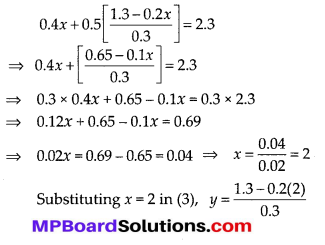
Substituting the value of y in (2), we have
MP Board Class 10th Maths Solutions Chapter 3 Pair of Linear Equations in Two Variables Ex 3.3 4
MP Board Class 10th Maths Solutions Chapter 3 Pair of Linear Equations in Two Variables Ex 3.3 5
Substituting the value of x in (1), we have
MP Board Class 10th Maths Solutions Chapter 3 Pair of Linear Equations in Two Variables Ex 3.3 6

MP Board Class 10th Maths Solutions Chapter 3 Pair of Linear Equations in Two Variables Ex 3.3

Question 2.
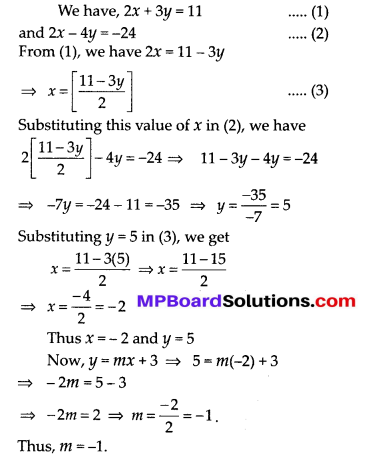
Solve 2x + 3y = 11 and 2x – 4y = -24 and hence find the value of ‘m’ for which y = mx + c
Solution:
MP Board Class 10th Maths Solutions Chapter 3 Pair of Linear Equations in Two Variables Ex 3.3 13

Question 3.
Form the pair of linear equations for the following problems and find their solution by
substitution method.
(i) The difference between two numbers is 26 and one number is three times the other. Find them.
(ii) The larger of two supplementary angles exceeds the smaller by 18 degrees. Find them.
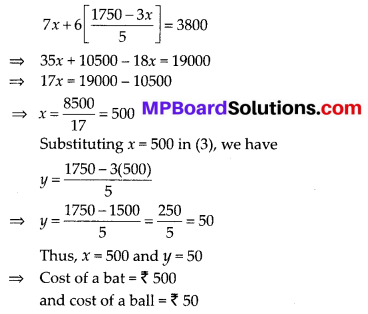
(iii) The coach of a cricket team buys 7 bats and 6 balls for 13800. Later, she buys 3 bats and 5 balls for ₹ 1750. Find the cost of each bat and each ball.
(iv) The taxi charges in a city consist of a fixed charge together with the charge for the distance covered. For a distance of 10 km, the charge paid is ₹ 105 and for a journey of 15 km, the charge paid is ₹ 155. What are the fixed charges and the charge per km? How much does a person have to pay for travelling a distance of 25 km?
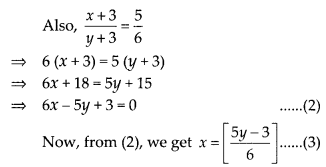
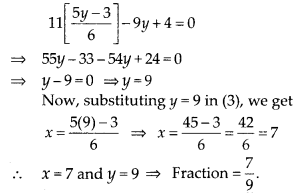
(v) A fraction becomes 9/11, if 2 is added to both the numerator and the denominator. If, 3 is added to both the numerator and the denominator it becomes 5/6. Find the fraction.
(vi) Five years hence, the age of Jacob will be three times that of his son. Five years ago, Jacob’s age was seven times that of his son. What are their present ages?
Solution:
(i) Let the two numbers be X and y such that x > y
It is given that
Difference between two numbers = 26
∴ x – y = 26 … (1)
Also one number = 3 [the other number]
⇒ x = 3y … (2)
Substituting x = 3y in (1) , we get 3y – y = 26 ⇒ 2y = 26
Now, substituting y = 13 in (2) , we have
x = 3(13) ⇒ x = 39
Thus, two numbers are 39 and 13.

(ii) Let the two angles be x and y such that x > y
∵ The larger angle exceeds the smaller by 18° (Given)
∴ x = y + 18°…. (1)
Also, sum of two supplementary angles = 180°
∴ x + y = 180° … (2)
Substituting the value of x from (1) in (2) , we get,
(18° + y) + y = 180°
MP Board Class 10th Maths Solutions Chapter 3 Pair of Linear Equations in Two Variables Ex 3.3 7
Substituting, y = 81° in (1) , we get
x = 18° + 81° = 99°
Thus, x = 99° and y = 81°

(iii) Let the cost of a bat = ₹ x
And the cost of a ball = ₹ y
∵ [cost of 7 bats] + [cost of 6 balls] = ₹ 3800
⇒ 7x + 6y = 3800 … (1)
Also, [cost of 3 bats] + [cost of 5 balls] = ₹ 1750
3x + 5y = 1750 …. (2)
MP Board Class 10th Maths Solutions Chapter 3 Pair of Linear Equations in Two Variables Ex 3.3 8
Substituting this value of y in (1) , we have
MP Board Class 10th Maths Solutions Chapter 3 Pair of Linear Equations in Two Variables Ex 3.3 9

(iv) Let fixed charges = ₹ x
and charges per km = ₹ y
∵ Charges for the journey of 10 km = ₹ 105 (Given)
∴ x + 10y = 105 … (1)
and charges for the journey of 15 km = ₹ 155
∴ x + 15y = 155 … (2)
From (1) , we have, x = 105 – 10y …. (3)
Putting the value of x in (2) , we get
(105 – 10y) + 15y = 155
⇒ 5y = 155 – 105 = 50 ⇒ y = 10
Substituting y = 10 in (3) , we get
x = 105 – 10(10) ⇒ x = 105 – 100 = 5
Thus, x = 5 and y = 10
⇒ Fixed charges = ₹ 5
and charges per km = ₹ 10
Now, charges for 25 km = x + 25y = 5 + 25(10) = 5 + 250 = ₹ 255
∴ The charges for 25 km journey = ₹ 255

MP Board Class 10th Maths Solutions Chapter 3 Pair of Linear Equations in Two Variables Ex 3.3

(v) Let the numerator = x
and the denominator = y
∴ Fraction = \(\frac{x}{y}\)
According to the given condition,
MP Board Class 10th Maths Solutions Chapter 3 Pair of Linear Equations in Two Variables Ex 3.3 10
⇒ 11(x + 2) = 9(y + 2)
⇒ 11x + 22 = 9y + 18
⇒ 11x – 9y + 4 = 0 … (1)
MP Board Class 10th Maths Solutions Chapter 3 Pair of Linear Equations in Two Variables Ex 3.3 11
Substituting this value of x in (1) , we have
MP Board Class 10th Maths Solutions Chapter 3 Pair of Linear Equations in Two Variables Ex 3.3 12

(vi) Let the present age of Jacob = x years
and the present age of his son = y years
∴ 5 years hence: Age of Jacob = (x + 5) years
Age of his son = (y + 5) years
According to given condition,
[Age of Jacob] = 3[Age of his son]
x + 5 = 3(y + 5) ⇒ x + 5 = 3y + 15
⇒ x – 3y -10 = 0 … (1)
5years ago : Age of Jacob = (x – 5) years,
Age of his son = (y – 5) years
According to given condition,
[Age of Jacob] = 7[Age of his son]
∴ (x – 5) = 7(y – 5) ⇒ x – 5 = 7y – 35
⇒ x – 7y + 30 = 0 … (2)
From (1) , x = [10 + 3y] … (3)
Substituting this value of x in (2) , we get
(10 + 3y) – 7y + 30 = 0
⇒ -4y = -40 ⇒ y = 10
Now, substituting y = 10 in (3) ,
we get x = 10 + 3(10)
⇒ x = 10 + 30 = 40
Thus, x = 40 and y = 10
⇒ Present age of Jacob = 40 years and present age of his son = 10 years

MP Board Class 10th Maths Solutions Chapter 7 Coordinate Geometry Ex 7.1

In this article, we will share MP Board Class 10th Maths Book Solutions Chapter 7 Coordinate Geometry Ex 7.1 Pdf, These solutions are solved subject experts from the latest edition books.

MP Board Class 10th Maths Solutions Chapter 7 Coordinate Geometry Ex 7.1

Question 1.
Find the distance between the following pairs of points:
(i) (2, 3), (4, 1)
(ii) (-5, 7), (-1, 3)
(iii) (a, b), (-a, -b)
Solution:
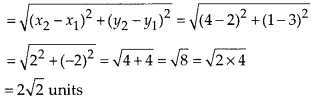
(i) Here x1 = 2, y1 = 3 and x2 = 4, y2 = 1
∴ The required distance
MP Board Class 10th Maths Solutions Chapter 7 Coordinate Geometry Ex 7.1 1

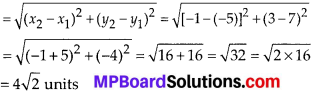
(ii) Here x1 = -5, y1 = 7 and x2 = -1, y2 = 3
∴ The required distance
MP Board Class 10th Maths Solutions Chapter 7 Coordinate Geometry Ex 7.1 2

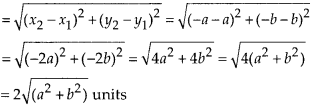
(iii) Here x1 = a, y1 = b and x2 = -a, y2 = -b
∴ The required distance
MP Board Class 10th Maths Solutions Chapter 7 Coordinate Geometry Ex 7.1 3

Question 2.
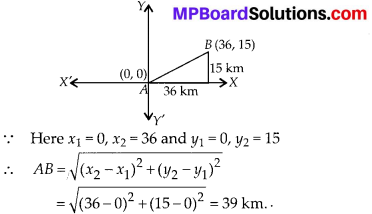
Find the distance between the points (0, 0) and (36, 15). Can you now find the distance between the two towns /I and B discussed below as following: ‘A town 6 is located 36 km east and 15 km north of the town A’.
Solution:
Part-I
Let the points be A(0, 0) and B(36, 15)
MP Board Class 10th Maths Solutions Chapter 7 Coordinate Geometry Ex 7.1 4
Part-II
We have A(0, 0) and B(36,15) as the positions of two towns.
MP Board Class 10th Maths Solutions Chapter 7 Coordinate Geometry Ex 7.1 5

MP Board Class 10th Maths Solutions Chapter 7 Coordinate Geometry Ex 7.1

Question 3.
Determine if the points (1, 5), (2, 3) and (-2, -11) are collinear.
Solution:
Let the points be A( 1, 5), B(2, 3) and C(-2, -11). A, B and C are collinear, if
AB + BC = AC or AC + CB = AB or BA + AC = BC
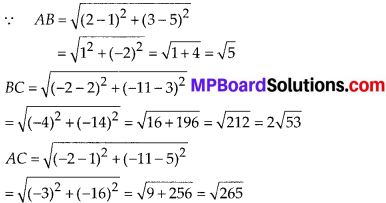
MP Board Class 10th Maths Solutions Chapter 7 Coordinate Geometry Ex 7.1 6
Here, AB + BC ≠ AC, AC + CB ≠ AB, BA + AC ≠ BC
∴ A, B and C are not collinear.

Question 4.
Check whether (5, -2), (6, 4) and (7, -2) are the vertices of an isosceles triangle.
Solution:
Let the points be A(5, -2), 6(6, 4) and C(7, -2).
MP Board Class 10th Maths Solutions Chapter 7 Coordinate Geometry Ex 7.1 7
We have AB = BC ≠ AC.
∴ ∆ABC is an isosceles triangle.

Question 5.
In a classroom, 4 friends are seated at the points A B, Cand D as shown in the figure. Champa and Chameli walk into the class and after observing for a few minutes Champa asks Chameli, “Don’t you think ABCD is a square?” Chameli disagrees. Using distance formula, find which of them is correct.
MP Board Class 10th Maths Solutions Chapter 7 Coordinate Geometry Ex 7.1 8
Solution:
Let the horizontal columns represent the x-coordinates whereas the vertical rows represent the y-coordinates.
∴ The points are A(3, 4), B(6, 7), C(9, 4) and D(6, 1)
MP Board Class 10th Maths Solutions Chapter 7 Coordinate Geometry Ex 7.1 9
MP Board Class 10th Maths Solutions Chapter 7 Coordinate Geometry Ex 7.1 10
i.e., BD = AC ⇒ Both the diagonals are also equal.
∴ ABCD is a square.
Thus, Champa is correct.

MP Board Class 10th Maths Solutions Chapter 7 Coordinate Geometry Ex 7.1

Question 6.
Name the type of quadrilateral formed if any, by the following points, and give reasons for your answer:
(i) (-1, -2), (1, 0), (-1, 2), (-3, 0)
(ii) (-3, 5), (3, 1), (0, 3), (-1, -4)
(iii) (4, 5), (7, 6), (4, 3), (1, 2)
Solution:
(i) Let the points be A(-1, -2), B(1, 0), C(-1, 2) and D(-3, 0) of a quadrilateral ABCD.
MP Board Class 10th Maths Solutions Chapter 7 Coordinate Geometry Ex 7.1 11
⇒ AB = BC = CD = AD i.e., all the sides are equal.
Also, AC and BD (the diagonals) are equal.
∴ ABCD is a square.

(ii) Let the points be A(-3, 5), B(3, 1), C(0, 3) and D(-1, -4).
MP Board Class 10th Maths Solutions Chapter 7 Coordinate Geometry Ex 7.1 12
MP Board Class 10th Maths Solutions Chapter 7 Coordinate Geometry Ex 7.1 13
We see that \(\sqrt{13}+\sqrt{13}=2 \sqrt{13}\)
i. e., AC + BC = AB
⇒ A, B and C are collinear. Thus, ABCD is not a quadrilateral.

(iii) Let the points be A(4, 5), B(7, 6), C(4, 3) and D(1, 2).
MP Board Class 10th Maths Solutions Chapter 7 Coordinate Geometry Ex 7.1 14
Since, AB = CD, BC = DA i.e., opposite sides of the quadrilateral are equal.
And AC ≠ BD ⇒ Diagonals are unequal.
∴ ABCD is a parallelogram.

Question 7.
Find the point on x-axis which is equidistant from (2, -5) and (-2, 9).
Solution:
We know that any point on x-axis has its ordinate = 0
Let the required point be P(x, 0)
Let the given points be A(2, -5) and B(-2, 9)
MP Board Class 10th Maths Solutions Chapter 7 Coordinate Geometry Ex 7.1 15
MP Board Class 10th Maths Solutions Chapter 7 Coordinate Geometry Ex 7.1 16
∴ The required point is (-7, 0)

Question 8.
Find the values of y for which the distance between the points P(2, -3) and Q(10, y) is 10 units.
Solution:
The given points are P(2, -3) and Q(10, y).
MP Board Class 10th Maths Solutions Chapter 7 Coordinate Geometry Ex 7.1 17
Squaring both sides, y2 + 6y + 73 = 100
⇒ y2 + 6y – 27 = 0
⇒ y2 – 3y + 9y – 27 = 0
⇒ (y – 3)(y + 9) = 0
Either y – 3 = 0 ⇒ y = 3
or y + 9 = 0 ⇒ y = -9
∴ The required value of y is 3 or -9.

MP Board Class 10th Maths Solutions Chapter 7 Coordinate Geometry Ex 7.1

Question 9.
If Q(0, 1) is equidistant from P(5, -3) and R(x, 6), find the values of x. Also find the distances QR and PR.
Solution:
MP Board Class 10th Maths Solutions Chapter 7 Coordinate Geometry Ex 7.1 18
Squaring both sides, we have x2 + 25 = 41
⇒ x2 + 25 – 41 = 0
⇒ x2 – 16 = 0 2 x = \(\pm \sqrt{16}\) = ±4
Thus, the point R is (4, 6) or (-4, 6)
Now,
MP Board Class 10th Maths Solutions Chapter 7 Coordinate Geometry Ex 7.1 19

Question 10.
Find a relation between x and y such that the point (x, y) is equidistant from the point (3, 6) and (-3, 4).
Solution:
Let the points be A(x, y), B(3, 6) and C(-3, 4).
∴ AB = \(\sqrt{(3-x)^{2}+(6-y)^{2}}\)
And AC = \(\sqrt{[(-3)-x]^{2}+(4-y)^{2}}\)
Since, the point (x, y) is equidistant from (3, 6) and (-3, 4).
∴ AB = AC
⇒ \(\sqrt{(3-x)^{2}+(6-y)^{2}}=\sqrt{(-3-x)^{2}+(4-y)^{2}}\)
Squaring both sides,
(3 – x)2 + (6 – y)2 = (-3 – x)2 + (4 – y)2
⇒ (9 + x2 – 6x) + (36 + y2 – 12y)
⇒ (9 + x2 + 6x) + (16 + y2 – 8y)
⇒ 9 + x2 – 6x + 36 + y2 – 12y – 9 – x2 – 6x – 16 – y2 + 8y = 0
⇒ – 6x – 6x + 36 – 12y – 16 + 8y = 0
⇒ – 12x – 4y + 20 = 0
⇒ -3x – y + 5 = 0
⇒ 3x + y – 5 = 0 which is the required relation between x and y.

MP Board Class 10th Maths Solutions Chapter 3 Pair of Linear Equations in Two Variables Ex 3.2

In this article, we will share MP Board Class 10th Maths Book Solutions Pair of Linear Equations in Two Variables Ex 3.2 Pdf, These solutions are solved subject experts from the latest edition books.

MP Board Class 10th Maths Solutions Chapter 3 Pair of Linear Equations in Two Variables Ex 3.2

Question 1.
Form the pair of linear equations in the following problems, and find their solutions graphically.
(i) 10 students of class X took part in a Mathematics quiz. If the number of girls is 4 more than the number of boys, find the number of boys and girls who took part in the quiz.
(ii) 5 pencils and 7 pens together cost ₹ 50, whereas 7 pencils and 5 pens together cost ₹ 46. Find the cost of one pencil and that of one pen.
Solution:
(i) Let the number of boys = x and Number of girls = y
∴ x + y = 10 …. (1)
Also, Number of girls = [Number of boys] + 4
∴ y = x + 4 ⇒ x – y = – 4 … (2)
Now, from the equation (1), we have :
l1 : x + y = 10 ⇒ y = 10 – x
MP Board Class 10th Maths Solutions Chapter 3 Pair of Linear Equations in Two Variables Ex 3.2 1
And from the equation (2), we have
l2 : x – y = -4 ⇒ y = x + 4
MP Board Class 10th Maths Solutions Chapter 3 Pair of Linear Equations in Two Variables Ex 3.2 2
The lines l1 and l2 intersects at the point (3, 7)
∴ The solution of the pair of linear equations is : x = 3, y = 7
⇒ Number of boys = 3
and number of girls = 7
Let the cost of a pencil = ₹ x
and cost of a pen = ₹ y
Since, cost of 5 pencils + Cost of 7 pens = ₹ 50
5 x + 7y = 50 … (1)
Also, cost of 7 pencils + cost of 5 pens = ₹ 46
7x + 5y = 46 …. (2)
Now, from equation (1), we have
MP Board Class 10th Maths Solutions Chapter 3 Pair of Linear Equations in Two Variables Ex 3.2 3
And from equation (2), we have
MP Board Class 10th Maths Solutions Chapter 3 Pair of Linear Equations in Two Variables Ex 3.2 4
Plotting the points (10, 0), (3, 5) and (-4, 10), we get a straight line l1 and plotting the points (8, -2), (3, 5) and (0, 9.2) we get a straight line l2.
MP Board Class 10th Maths Solutions Chapter 3 Pair of Linear Equations in Two Variables Ex 3.2 5
These two straight lines intersects at (3, 5).
∴ Cost of a pencil = ₹ 3 and cost of a pen = ₹ 5.

MP Board Class 10th Maths Solutions Chapter 3 Pair of Linear Equations in Two Variables Ex 3.2

Question 2.
On comparing the ratios \(\frac{a_{1}}{a_{2}}, \frac{b_{1}}{b_{2}}\) and \(\frac{c_{1}}{c_{2}}\) find out whether the lines representing the following pairs of linear equations intersect at a point, are parallel or coincident:
(i) 5x – 4y + 8 = 0; 7x + 6y – 9 = 0
(ii) 9x + 3y + 12 = 0; 18x + 6y + 24 = 0
(iii) 6x – 3y + 10 = 0; 2x – y + 9 = 0
Solution:
Comparing the given equations with
a1x + b1y + C1 = 0, a2x + b2y + c2 = 0, we have

(i) For, 5x – 4y + 8 = 0, 7x + 6y – 9 = 0,
a1 = 5, b1 = -4, C1 = 8; a2 = 7, b2 = 6, c2 = -9
MP Board Class 10th Maths Solutions Chapter 3 Pair of Linear Equations in Two Variables Ex 3.2 6
So, the lines are intersecting, i.e., they intersect at a point.

(ii) For, 9x + 3y + 12 = 0,18x + 6y + 24 = 0,
a1 = 9, b1 = 3, C1 = 12; a2 = 18, b2 = 6, c2 = 24
MP Board Class 10th Maths Solutions Chapter 3 Pair of Linear Equations in Two Variables Ex 3.2 7
So, the lines are coincident.

(iii) For, 6x – 3y +10 = 0, 2x – y + 9 = 0
MP Board Class 10th Maths Solutions Chapter 3 Pair of Linear Equations in Two Variables Ex 3.2 8
So, the lines are parallel.

MP Board Class 10th Maths Solutions Chapter 3 Pair of Linear Equations in Two Variables Ex 3.2

Question 3.
On comparing the ratios \(\frac{a_{1}}{a_{2}}, \frac{b_{1}}{b_{2}}\) and \(\frac{c_{1}}{c_{2}}\), find out whether the following pair of linear equations are consistent, or inconsistent.
(i) 3x + 2y = 5; 2x – 3y = 7
(ii) 2x – 3y = 8; 4x – 6y = 9
(iii) \(\frac{3}{2} x+\frac{5}{3} y\) = 7; 9x-10y = 14
(iv) 5x – 3y = 11; -10x + 6y = -22
Solution:
Comparing the given equations with
MP Board Class 10th Maths Solutions Chapter 3 Pair of Linear Equations in Two Variables Ex 3.2 9
So, lines are intersecting i.e., they intersect at a point.
∴ It is consistent pair of equations.

(ii) For 2x – 3y = 8, 4x – 6y = 9, 2x – 3y – 8 = 0 and 4x – 6y – 9 = 0
MP Board Class 10th Maths Solutions Chapter 3 Pair of Linear Equations in Two Variables Ex 3.2 10
So, lines are parallel i.e., the given pair of linear equations has no solution.
∴ It is inconsistent pair of equations.

(iii)
MP Board Class 10th Maths Solutions Chapter 3 Pair of Linear Equations in Two Variables Ex 3.2 11
⇒ The given pair of linear equations has exactly one solution.
∴ It is a consistent pair of equations.

(iv)
MP Board Class 10th Maths Solutions Chapter 3 Pair of Linear Equations in Two Variables Ex 3.2 12
So, lines are coincident.
⇒ The given pair of linear equations has infinitely many solutions.
Thus, it is consistent pair of equations

(v)
MP Board Class 10th Maths Solutions Chapter 3 Pair of Linear Equations in Two Variables Ex 3.2 13
So, the lines are coincident.
⇒ The given pair of linear equations have infinitely many solutions.
Thus it is consistent pair of equations.

MP Board Class 10th Maths Solutions Chapter 3 Pair of Linear Equations in Two Variables Ex 3.2

Question 4.
Which of the following pairs of linear equations are consistent / inconsistent? If consistent, obtain the solution graphically:
(i) x + y = 5; 2x + 2y = 10
(ii) x – y = 8; 3x – 3y = 16
(iii) 2x + y – 6 = 0; 4x – 2y – 4 = 0
(iv) 2x – 2y – 2 = 0; 4x – 4y – 5 = 0
Solution:
(i) For, x + y = 5, 2x + 2y = 10 ⇒ x + y – 5 = 0 and 2x + 2y – 10 = 0
MP Board Class 10th Maths Solutions Chapter 3 Pair of Linear Equations in Two Variables Ex 3.2 14
MP Board Class 10th Maths Solutions Chapter 3 Pair of Linear Equations in Two Variables Ex 3.2 15
So, lines l1 and l2 are coinciding. i.e., They have infinitely many solutions.

(ii) For, x – y = 8,
3x – 3y = 16
⇒ x – y – 8 = 0
and 3x – 3y = 16
MP Board Class 10th Maths Solutions Chapter 3 Pair of Linear Equations in Two Variables Ex 3.2 16
so, line are parallel
∴ The pair of linear equations are inconsistent

(iii) For 2x + y – 6 = 0, 4x – 2y – 4 = 0
MP Board Class 10th Maths Solutions Chapter 3 Pair of Linear Equations in Two Variables Ex 3.2 17
MP Board Class 10th Maths Solutions Chapter 3 Pair of Linear Equations in Two Variables Ex 3.2 18
The pair of linear equations are inconsistent

MP Board Class 10th Maths Solutions Chapter 3 Pair of Linear Equations in Two Variables Ex 3.2

Question 5.
Half the perimeter of a rectangular garden, whose length is 4 m more than its width, is 36 m. Find the dimensions of the garden.
Solution:
Let the width of the garden = x m
and the length of the garden = y m
According to question,
MP Board Class 10th Maths Solutions Chapter 3 Pair of Linear Equations in Two Variables Ex 3.2 19
MP Board Class 10th Maths Solutions Chapter 3 Pair of Linear Equations in Two Variables Ex 3.2 20
The lines l1 and l2 intersect at (16, 20).
∴ x = 16 and y = 20
So, Length = 20m, and Width = 16m

MP Board Class 10th Maths Solutions Chapter 3 Pair of Linear Equations in Two Variables Ex 3.2

Question 6.
Given the linear equation 2x + 3y – 8 = 0, write another linear equation in two variables such that the geometrical representation of the pair so formed is:
(i) intersecting lines
(ii) parallel lines
(iii) coincident lines
Solution:
Let the pair of linear equations be 2x + 3y – 8 = 0
⇒ a1 = 2, b1 = 3 and C1 = -8 and a2x + b2y + c2 = 0.

(i) For intersecting lines, we have:
MP Board Class 10th Maths Solutions Chapter 3 Pair of Linear Equations in Two Variables Ex 3.2 21
∴ We can have a2 = 3, b2 = 2 and c2 = – 7
∴ The required equation can be 3x + 2y – 7 = 0

(ii) For parallel lines, \(\frac{a_{1}}{a_{2}}=\frac{b_{1}}{b_{2}} \neq \frac{c_{1}}{c_{2}}\)
∴ Any line parallel to 2x + 3y – 8 = 0, can be taken as 2x + 3y -12 = 0

(iii) For coincident lines, \(\frac{a_{1}}{a_{2}}=\frac{b_{1}}{b_{2}}=\frac{c_{1}}{c_{2}}\)
∴ Any line parallel to 2x + 3y – 8 = 0 can be 2(2x + 3y – 8 = 0)
⇒ 4x + 6y – 16 = 0

MP Board Class 10th Maths Solutions Chapter 3 Pair of Linear Equations in Two Variables Ex 3.2

Question 7.
Draw the graphs of the equations x – y + 1 = 0 and 3x + 2y – 12 = 0. Determine the coordinates of the vertices of the triangle formed by these lines and the x-axis, and shade the triangular region.
Solution:
Since, we have
MP Board Class 10th Maths Solutions Chapter 3 Pair of Linear Equations in Two Variables Ex 3.2 22
The lines l1 and l2 intersect at (2, 3). Thus, co-ordinates of the vertices of the shaded triangular region are (4, 0), (-1, 0) and (2, 3).

MP Board Class 10th Maths Solutions Chapter 3 Pair of Linear Equations in Two Variables Ex 3.4

In this article, we will share MP Board Class 10th Maths Book Solutions Pair of Linear Equations in Two Variables Ex 3.4 Pdf, These solutions are solved subject experts from the latest edition books.

MP Board Class 10th Maths Solutions Chapter 3 Pair of Linear Equations in Two Variables Ex 3.4

Question 1.
Solve the following pair of linear equations by the elimination method and the substitution method:
(i) x + y = 5 and 2x – 3y = 4
(ii) 3x + 4y = 10 and 2x – 2y = 2
(iii) 3x – 5y – 4 = 0 and 9x = 2y + 7
(iv) \(\frac{x}{2}+\frac{2 y}{3}\) = -1 and \(x-\frac{y}{3}\) = 3
Solution:
(i) Elimination method :
x + y = 5 … (1)
2x – 3y = 4 …. (2)
Multiplying (1) by 3, we get
3x + 3y = 15 …. (3)
Adding (2) and (3) , we get
2x – 3y + 3x + 3y = 19
⇒ 5x = 19 ⇒ x = \(\frac{19}{5}\)
Now, putting x = \(\frac{19}{5}\) in (1) , we get
MP Board Class 10th Maths Solutions Chapter 3 Pair of Linear Equations in Two Variables Ex 3.4 1
Substitution Method :
x + y = 5 ⇒ y = 5 – x … (1)
2x – 3y = 4 … (2)
Put y = 5 – x in (2), we get
2x – 3(5 – x)= 4 ⇒ 2x – 15 + 3x = 4
MP Board Class 10th Maths Solutions Chapter 3 Pair of Linear Equations in Two Variables Ex 3.4 2

(ii) Elimination method :
3x + 4y = 10 … (1)
2x – 2y = 2 … (2)
Multiplying equation (2) by 2, we have
⇒ 4x – 4y = 4 … (3)
Adding (1)and (3) , we get
3x + 4y + 4x – 4y = 10 + 4
⇒ 7x = 14 ⇒x = \(\frac{14}{7}\) = 2
Putting x = 2 in (1) , we get,
3(2)+ 4y = 10
MP Board Class 10th Maths Solutions Chapter 3 Pair of Linear Equations in Two Variables Ex 3.4 3
MP Board Class 10th Maths Solutions Chapter 3 Pair of Linear Equations in Two Variables Ex 3.4 4

MP Board Class 10th Maths Solutions Chapter 3 Pair of Linear Equations in Two Variables Ex 3.4

(iii) Elimination method :
3x – 5y – 4 = 0 … (1)
9x = 2y + 7 ⇒ 9x – 2y – 7 = 0 …. (2)
Multiplying equation (1) by (3) , we get
⇒ 9x – 15y – 12 = 0(3)
Subtracting (2)from (3),
⇒ 9x – 15y – 12 – 9x + 2y + 7 = 0
MP Board Class 10th Maths Solutions Chapter 3 Pair of Linear Equations in Two Variables Ex 3.4 5

(iv) Elimination method :
MP Board Class 10th Maths Solutions Chapter 3 Pair of Linear Equations in Two Variables Ex 3.4 6

MP Board Class 10th Maths Solutions Chapter 3 Pair of Linear Equations in Two Variables Ex 3.4

Question 2.
Form the pair of linear equations in the following problems and find their solutions (if they exist) by the elimination method:
(i) If we add 1 to the numerator and subtract 1 from the denominator, a fraction reduces 1
to 1. It becomes \(\frac{1}{2}\) if we only add 1 to the denominator. What is the fraction?
(ii) Five years ago, Nuri was thrice as old as Sonu. Ten years later, Nuri will be twice as old as Sonu. How old are Nuri and Sonu?
(iii) The sum of the digits of a two-digit number is 9. Also, nine times this number is twice the number obtained by reversing the order of the digits. Find the number.
(iv) Meena went to a bank to withdraw ₹ 2000. She asked the cashier to give her ₹ 50 and ₹ 100 notes only. Meena got 25 notes in all. Find how many notes of ₹ 50 and ₹ 100 she received.
(v) A lending library has a fixed charge for the first three days and an additional charge for each day thereafter. Saritha paid ₹ 27 for a book kept for seven days, while Susy paid ₹ 21 for the book she kept for five days. Find the fixed charge and the charge for each extra day.
Solution:
(i)Let the numerator = x
and the denominator = y
MP Board Class 10th Maths Solutions Chapter 3 Pair of Linear Equations in Two Variables Ex 3.4 7

(ii) Let, present age of Nuri = x years
and the present age of Sonu = y years
Age of Nuri = (x – 5) years
Age of Sonu = (y – 5) years
According to question:
Age of Nuri = 3[Age of sonu]
⇒ x – 5 = 3[y – 5] ⇒ x – 5 = 3y – 15
⇒ x – 3y + 10 = 0 … (1)
10 years later :
Age of Nuri = (x + 10) years,
Age of Sonu = (y + 10) years,
According to question :
Age of Nuri = 2[Age of Sonu]
⇒ x + 10 = 2(y + 10) ⇒ x + 10 = 2y + 20
⇒ x – 2y -10 = 0 …. (2)
Subtracting (1) from (2),
x – 2y – 10 – x + 3y – 10 = 0 ⇒ y – 20 = 0 ⇒ y = 20
Putting y = 20 in (1), we get
x – 3(20) + 10 = 0 ⇒ x – 50 = 0 ⇒ x = 50
Thus, x = 50 and y = 20
∴ Age of Nuri = 50 years
and age of Sonu = 20 years

MP Board Class 10th Maths Solutions Chapter 3 Pair of Linear Equations in Two Variables Ex 3.4

(iii) Let the digit at unit’s place = x
and the digit at ten’s place = y
∴ The number = 10y + x
The number obtained by reversing the digits = 10x + y
According to question,
9[The number] = 2 [Number obtained by reversing the digits]
9[10y+ x] = 2[10x + y]
90y + 9x = 20x + 2y
x – 8y = 0 …. (1)
Also sum of the digits = 9
x + y = 9 …. (2)
Subtracting (1) from (2), we have
x + y – x + 8y = 9
⇒ 9y = 9 ⇒ y = 1
putting y = 1 in (2), we get
x + 1 = 9 ⇒ x = 8
Thus, x = 8 and y = 1
∴ The required number = 10y + x = (10 × 1) + 8 = 10 + 8 = 18

MP Board Class 10th Maths Solutions Chapter 3 Pair of Linear Equations in Two Variables Ex 3.4

(iv) Let the number of 50 rupees notes = x
and the number of 100 rupees notes = y
According to the condition,
Total number of notes = 25
∴ x + y = 25 …. (1)
Also, the value of all the notes = ₹ 2000
∴ 50x + 100y = 2000 ⇒ x + 2y = 40 …. (2)
Subtracting equation (1) from (2), we get
x + 2y – x – y = 40 – 25
⇒ y = 15
Putting y = 15 in (1),
x + 15 = 25
⇒ x = 25 – 15 = 10
Thus, x = 10 and y = 15
∴ Number of 50 rupees notes = 10
and number of 100 rupees notes = 15

(v) Let the fixed charge (for the three days) = ₹ x
and the additional charge for each extra day = ₹ y
According to question,
Charge for 7 days = ₹ 27
⇒ x + 4y = 27
[∵ Extra days = 7 – 3 = 4]
Also, charge of 5 days = ₹ 21
⇒ x + 2y = 21
[∵ Extra days = 5 – 3 = 2]
Subtracting (2) from (1), we get
x + 4y – x – 2y = 27 – 21
\(\Rightarrow \quad 2 y=6 \Rightarrow y=\frac{6}{2}=3\)
Putting y = 3 in (2), we have
x + 2(3) = 21
⇒ x = 21 – 6 = 15
So, x = 15 and y = 3
∴ Fixed charge = ₹ 15
and additional charge per day = ₹ 3