MP Board Class 11th English A Voyage Solutions Chapter 11 The Model Millionaire

Students who are studying 11th can get the free Madhya Pradesh Board Solutions for 11th English Chapter 11 The Model Millionaire Questions and Answers PDF here. You can download MP Board Class 11th English Solutions Questions and Answers PDF on this page. Practice questions of Mp Board Solutions of 11th English subject as many times as possible to get good marks.

MP Board Class 11th English A Voyage Solutions Chapter 11 The Model Millionaire (Oscar Wilde)

Gather chapter wise MP Board Solutions for 11th English Study Material to score the highest marks in the final exam. Various chapters and subtopics are given clearly in MP Board Class 11th English Solutions Chapter 11 The Model Millionaire Questions and Answers Material. All the MP Board Solutions for 11th English Questions with detailed answers are provided by subject experts. The step by step MP Board Class 11th English Chapter 11 The Model Millionaire Questions and Answers guide will help you to enhance your skills in English subject and grammar. Here, along with the subject knowledge, grammar knowledge also plays an important role. So, students should download MP Board Solutions 11th English and read it to attempt all the questions with 100% confidence.

The Model Millionaire Textual Exercise

Word Power

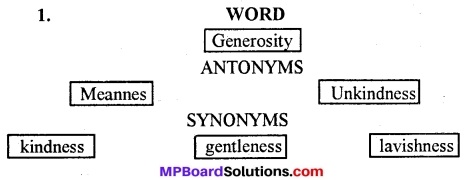
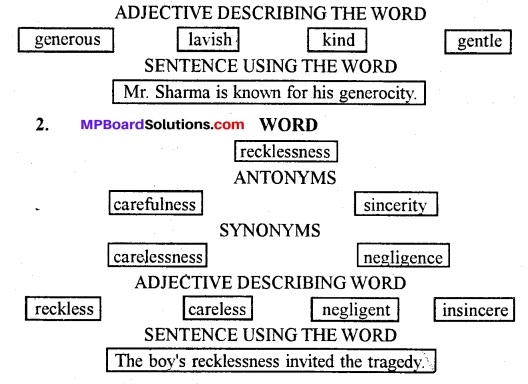
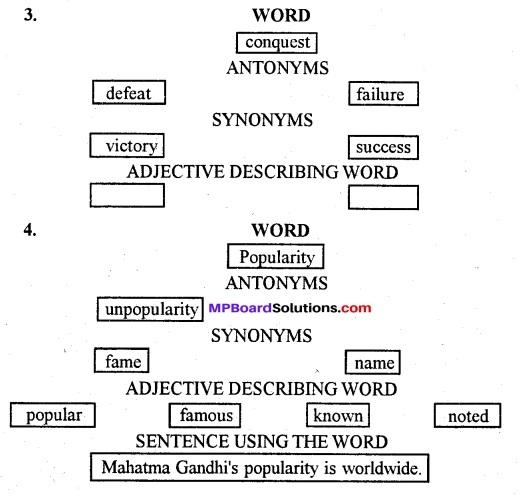
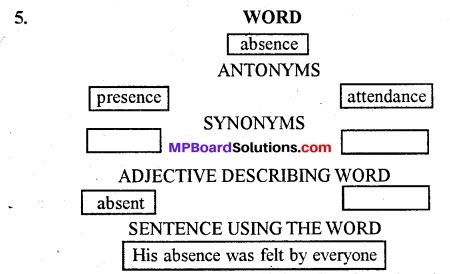
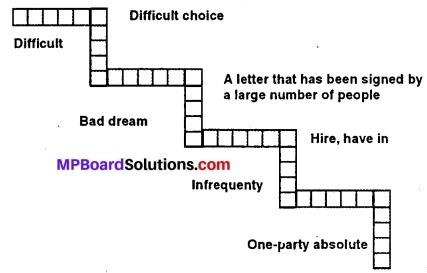
1. The word ‘dignity’ has been picked: up from the story and a word pyramid for the word has been construct as given below:
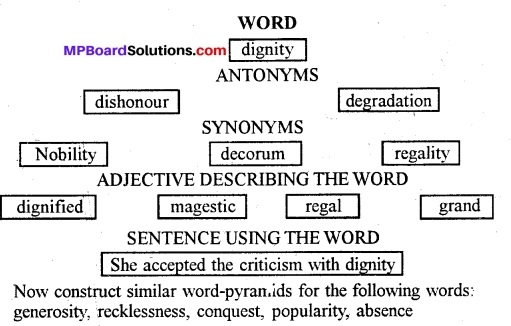
MP Board Class 11th English A Voyage Solutions Chapter 11 The Model Millionaire 1
Answer:
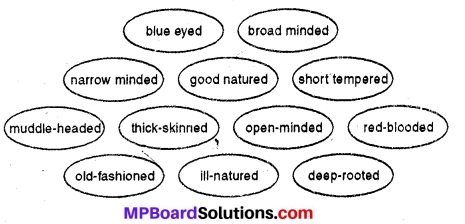
MP Board Class 11th English A Voyage Solutions Chapter 11 The Model Millionaire 2 MP Board Class 11th English A Voyage Solutions Chapter 11 The Model Millionaire 3 MP Board Class 11th English A Voyage Solutions Chapter 11 The Model Millionaire 4 MP Board Class 11th English A Voyage Solutions Chapter 11 The Model Millionaire 5

II. Complete the table by explaining the phrasal verbs from the story:

Phrasal VerbExplanation
Burst intoto start producing something suddenly with great force
Care forto look after something who is sick; very old, etc.
Crop in
Go aboutto go around
Take upto continue, especially starting after b/sth else has finished
Look up(of business, sb’s situation, etc) to become better
See aboutto attend to
Show upto make or to be clearly visible, to reveal a fault
Sink intoto go gradually into a less active or pleasant state.
On account ofbecause of
Hold outto put something in Land.

Comprehension

A. Complete the given flow chart with the proper sequence of events that take place in the story from the sentences given below:
1. Laura scolded him for his recklessness.
2. Alan Trevor was the best man at their wedding.
3. Hughie Erskine had tried every profession but ultimately he had to give up.
4. The Baron gave him ten thousand pounds as a wedding gift.
5. Taking pity on him, he gave the beggar the one pound he had in his pocket.
6. The Baron called Hughie a model millionaire.
7. He visited Alan’s studio and found him busy painting a portrait of beggar.
8. When Hughie found out the truth about the beggar, he felt very unhappy while Alan laughed at him.
9. He was in love with Laura Merton but he could not marry her because her father wanted him to earn ten thousand pounds.
10. The beggar was, in fact, Baron Hausberg, who was one of the richest men in the country.
Ans.
3. Hughie Erskine had tried every profession but ultimately he had to give up.
9. He was in love with Laura Merton but he could not marry her because her father wanted him to earn ten thousand pounds.
7. He visited Alan’s studio and found him busy painting a portrait of beggar,
5. Taking pity on him, he gave the beggar the one pound he had in
his pocket.
1. Laura scolded him for his recklessness. ,
10. The beggar was, in fact, Baron Hausberg, who was one of the richest men in the country.
8. When Hughie found out the truth about the beggar, he felt very unhappy while Alan laughed at him.
4. The Baron gave him ten thousand pounds as a wedding gift.
2. Alan Trevor was the best man at their wedding.
6. The Baron called Hughie a model millionaire.

B. Choose the correct alternative:

Question 1.
Which of the following is not a characteristic of Hughie Erskine’s face?
(a) good looks
(b) brown hairs
(c) grey eyes
(d) large ears.
Answer:
(d) large ears.

Question 2.
Which of the following works Hughie Erskine did not try to earn his living from?
(a) work as a professional jester.
(b)work at the stock exchange.
(c) work as a wine merchant
(d) work as a tea merchant.
Answer:
(a) work as a professional jester.

Question 3.
Which of the following is not an attribute of Trevor’s face?
(a) puckered face.
(b) blue eyes.
(c) rugged beard
(d) rough exterior
Answer:
(b) blue eyes.

Question 4.
Where was the beggar-man placed in the study of Alan Trevor when he was being painted?
(a) on a carpet.
(b) on a chair.
(c) in the comer.
(d) on the floor.
Answer:
(c) in the comer.

Question 5.
What was Hughie doing when Baron Hausberg’s messenger came to him with a letter?
(a) having lunch
(b) having a nap
(c) having dinner
(d) having breakfast
Answer:
(d) having breakfast

Question 6.
Who scolded Hughie for giving a sovereign to a beggar?
(a) Trevor
(b) Col. Merton
(c) Laura
(d) None of the above
Answer:
(c) Laura

C. Write answers to the following questions in two or three sentences:

Question 1.
Hughie Erskine remained poor. Why profession he adopted but could not succeed?
Answer:
Hughie Erskine was unemployed. He attempted all sorts of jobs. First he tried Stock Exchange for six months, then as tea-merchant for a little longer and then he attempted selling dry sherry.

Question 2.
Describe the appearance of the beggar-man as he stood in the studio of Alan Trevor?
Answer:
The beggar-man was standing on a raised platform in a comer of the room. He was a wizened old man. His face was like wrinkled parchment. He had the most piteous exposition.

Question 3.
Describe how and through whom Hughie got ten thousand pounds.
Answer:
In Trevor’s studio Hughie was very much sympathised with the old beggar and gave him the only sovereign he had in his pocket. The beggar was really Baron Hausberg, one of the richest men of Europe. Baron invested the sovereign of Hughie which earned an interest per month. Thus it could earn ten thousand pound which Baron presented to Hughie as his wedding gift.

D. Pick the sentences from the text which suggest the following:

Question 1.
Hughie’s father was a soldier.
Answer:
His father bequeathed him his cavalry sword, and a ‘History of the Peninsular War’ in fifteen volumes.

Question 2.
Hughie was allowed to come to Trevor’s studio whenever he liked?
Answer:
he liked him quite as much for his bright buoyant spirits and his generous reckless nature, and had given him the permanent entree to his studio.

Question 3.
Hausberg would invest Hughie’s sovereign in business?
Answer:
He’ll invest your sovereign for you, Hughie, pay you the interest every six months and have a capital story to tell after dinner.

Question 4.
Baron Hausberg was an ideal rich man?
Answer:
Despite being a rich man Baron was never haughty. He helped the needy. He did not show off. He was a simple and kind hearted man.

E. Write answers to the following questions in about 150-200 words each:

Question 1.
Write a character-sketch of Baron Hausberg highlighting
(a) his fortune as describe by Trevor
(b) his desire to be painted as a beggar
(c) his conduct as a model for a painter
(d) his compassion and help for Hughie Erskine
Answer:
Baran Hausberg is a very important character in the story ‘The Model Millionaire’. He is one of the richest person of Europe. He has the capacity to buy the whole of London without overdrawing his bank account. The greatness of his character lies in the fact that he is very much humble. He is a great friend of Trevor. He buys all the paintings of Trevor and gives him commission as advance. He does so to cooperate his friend.

Once Baron wishes to get himself as a beggar in rags. He asked Trevor to do so and pays the commission as advance a month ago. For this he wears the painters rags. He pays full attention and follows all instructions of the painter while being portrayed.

Despite being a millionaire he is in no way proud. When Hughie pities him and gives a sovereign to him as his token help thinking him to be a poor beggar he accepts it with all his nobility. After Hughie leaves the painter’s studio, Baron gets all personal details about Hughie and plans to repay his sovereign with great interest. He is sympathized with Hughie. He feels all compassion for him.

After a few days he sends his messenger to Hughie with a sealed envelop. On the envelop it is written, ‘A wedding present to Hughie Erskine and Laura Merton from a beggar’. Inside the envelop there is a cheque for ten thousand pound. It shows his greatness and generosity.

Question 2.
Write a character-sketch of Hughie Erskine highlighting
(a) his appearance
(b) his professional and monetary conditions
(c) his attitude to money
(d) his love for Laura
(e) his good luck
Answer:
Hughie Erskine is the central character in the story ‘The Model Millionaire’. He is wonderfully good-looking. He has crisp browft hair, clear-cut profile and grey eyes. He is equally popular among men and women.

Hughie has every accomplishment except that of making money. He has inherited a cavalry sword and a ‘History of the Peninsular War’ in fifteen volumes. He lives on two hundred a year which his old aunt has allowed. He has tried everything from Stock Exchange to tea-merchant and selling sherry. Ultimately he has no job. He,is a delightful, ineffectual young man with a perfect profile and no profession. Still he does not care for money.

The tragedy of his life becomes more intense when he falls in love with Laura Merton who is the daughter of a retired colonel. Laura also adores him and her father is also very’ fond of him. But he has a condition for allowing him to marry. He has asked Hughie to bring the thousand pound of his own. Only after that he would allow him to marry Laura.

Hughie’s luck takes a mysterious turn when he meets an.old beggar as model in the studio of his friend Alan Trevor who is a painter. The beggar is in his rags and looks pitious. Hughie offers him the only sovereign which he has in his pocket. Actually the beggar is not a beggar. He is one of the richest man of Europe. He is impressed with and thinks to repay his genersoijy. So he collects all information about Hughie from Trevor. He feels compassion for him. After a few day s he sends an envelop with a cheque for ten thousand pound as a wadding present to Hughie. Hughie gets married to Laura.

Question 3.
Imagining yourself to be Baron Hausberg, relate the story in the first person as a personal experience. Begin ‘I am Baron Hausberg ‘
Answer:
I am Baron Hausberg. I am counted as one of the richest men of Europe. A have-amassed a lot and have the capacity to purchase the city of London without overdrawing my account. But I am well aware of the reahties of life. Hence I feel compassion for those who fail to achieve. I have a painter friend Alan Trevor. Once I asked him to make my portrait as an old beggar in rags.

I offered him commission one month advance. He agreed. When I was being portrayed, a friend of Trevor came in the studio. He was a nice looking gentleman with kind heart. He was very much sympathized to see me. In fact he thought that I w;as really a poor, wretched beggar. He wanted to help me. He searched in his pocket. He had a sovereign there. But he didn’t hesitate even to give it me. I felt he was really a large hearted man without any source to cooperate others.

I was very much impressed with him. Later this feeling doubled when I knew the reality of his from Trevor. I thought to repay him more than he spent for me as a reward for greatness, I invested his sovereign which earned interest. After a few days I presented a cheque for ten thousand pounds as a wedding gift from my side. He got married. He was very happy. Good work must be rewarded.

F. Briefly explain the following statements from the text:

1. Romance is the privilege of the rich, not the profession of the unemployed.
2. It is better to have a permanent income than to be fascinating.
3. I assure you that there are moments when Art almost attains the dignity of manual labour.
4. He could buy all London tomorrow without overdrawing his account.
5. Millionaires are rare enough, but model millionaires are rare still.
Answer:
1. Through this line the writer presents the reality of life. Rich
man is capable of providing all comforts and privileges of life to his beloved. So, romance comes in his life automatically. But an unemployed person can never do so. He has to seek a job first. Only then he would get recognition.’It is clearly highlighted in the story.

2. Through this line the writer suggests that one cannot live in fascination. Life has some requirements which we have to fulfill. For this purpose one need to have a permanent and regular income. Otherwise he cannot live a comfortable life.

3. In this line Trevor, a painter, signifies human involvement in the work of art. He says that almost every’ time manual labour counts most and proves to be dignified.

4. This line highlights the character of Baron Hausberg. He is one of the richest men in Europe. He has the capacity to buy the city of London without overdrawing his account. Still he is very noble.

5. This line highlights the rare quality’ of Baron. Trevor, while speaking on the occasion of wedding breakfast tells that millionaires are very rare but still rarer are those who can become a model.

Speaking Activity

Work in pairs. You are a reporter from a News Channel in English. Your partner is a poor person who has won a one-crore lottery, Interview your partner. Then change roles. You can use the following clues for the interview:
This is …from…News reporting live from ………. With Mr./Ms ……….Who has become a multi-millionnaire overnight? Mr. /Ms……….. would you like to tell our viewers about how you came about to purchase the ticket……….So, you say you did not purchase it on the pavement? How lucky you are………. What were your thoughts when ………. How do you plan ……….
Answer:
This is Rakesh Awasthi from India Star News reporting from Panipat: I am sitting with Mr. Anup Gulati who has suddenly turned to be multi millionaire overnight. Mr. Gulati would you like to tell our ewers about how you came about to purchase the ticket?

  • Mr. Gulati : Actually I never intended to purchase a lottery ticket,
  • Myself : Then how did you get it.
  • Mr. Gulati : One of my well-wishers gave to me as a gift.
  • Myself : How lucky you are! Someone has gifted you his luck What do you feel?
  • Mr. Gulati : A feel delighted and thank him a lot.
  • Myself : What were your thoughts when you got the news of your lottery
  • Mr. Gulati : It is amazing. I have lived in a wretehed condition along with my wife. I didn’t belie It “as really a wonder of God.
  • Myself : How do you plan to spend your money?
  • Mr. Gulati : I think to spend money wisely. Problems arc a lot. I have my own needs. But before that I think to devote a considerable amount to an orphanage and an old age homes. Then I will do for myself
  • Myself : Thanks a lot to you for your great ideas. So, viewers, you sec Mr, Gulati has a great soul, I wish all the best for his future.

Writing Activity

I. Write a letter to your friend congratulating him on being selected for famous TV Quiz show. Give him tips on how to prepare for the quiz, how to overcome nervousness on facing the camera, and how to react on winning.
Answer:

639, Aakashdeep Enclave
Preet Vihar
Delhi 110092
5 July 2007

My dear Anubhav,
Thank you very much for your letter. I was delighted to know that you have been selected for famous TV Quiz show, I hope you would do good. Remember, it is a rare occasion, You should de wisely, Never loose your confidence. Prepare well. Some current topics must be at your tips. Don’t forget to remember some mystical points. Don’t get nervous. Be quick in your approach. Don’t think much on questions which confuse you. Time counts most. I am confident you will not miss.
With all my best wishes.

Yours
Alok

II. Hughie was wonderfully good looking ………..
What other characteristics of Hughie have been described in the story? Pick out the describing words and attribute them to Hughie, Alan and Baron: Magnificent, wealthy, forlorn, model, charming, real master,  duffer, wizened old man, clear-cut profile, unlucky devil, miserable, unemployed, grey eyes, popular, delightful, rough fellow, freckled face, reckless, piteous,

S. NoCharacterDescribing words
1.Hughie Erskine
2.Alan Trevor
3.Baron Hausberg

Answer:

  1. Hughie Erskine – forlorn, charming, duffer, clear-cut profile, unlucky devil, miserable, unemployed, grey eyes, popular, reckless, piteous,
  2. Alan Trevor – rough fellow, freckled face, real master.
  3. Baron Hausberg -magnificent, wealthy, model, wizened old man, delightful.

Think it Over

A. Imagine yourself to be a millionnaire. Complete the following chart with things you would buy, places you would visit, people you would like to help and other things you would like to do.
Answer:
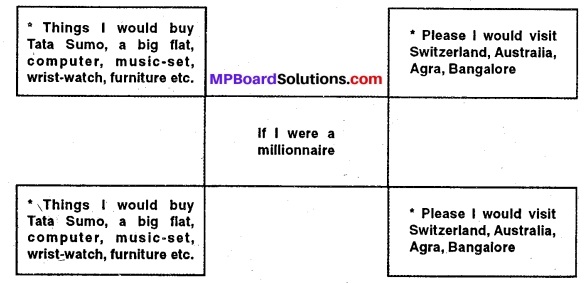
MP Board Class 11th English A Voyage Solutions Chapter 11 The Model Millionaire 6

B. Freedom fighter who laid down her life for her country,
She is known for her work as a missionary,
The lady known for her space expedition,
She was a messiah for the poor and the destitutes,
She lost her life on her way back to earth.
Classical singer of 20th century.
First lady to climb Mt. Everest,
A great exponent of classical music.
Answer:

1. Kalpna Chawla

  • The lady known for her space expedition
  • She lost her life on her way back to earth.

2. Mother Teresa

  • She is known for her work as a missionary.
  • She was a messiah for the poor and the destitutes

3. Bachendn Pal

  • First lady to climb Mt. Everest.

4. M.S. Subbalaxmi

  • Classical singer of 20th century.
  • A great exponent of classical music

5. Maharani Laxmi Bai:

  • Freedom fighter who laid down her life for her country

Question 2.
Write two sentences about any two of these to bring out their special endowments:
1. Sportsperson.
2. An artist /dancer/singer/painter .
Answer:

  1. Sportsperson arc the glory of nation. They are our true recognition of a nation.
  2. An artist is the replica of God. He enjoys true life and bliss of God

Let’s play the letters, Take a word ‘Lives’ on arranging the letters of this word get ‘Elvis’ which is called an anagram. An ANAGRAM is a word or a phrase that is made by arranging the letters of another word or phrase.

1. Dormitory – Dirty room
2. Microwave – Warm voice
3. Debit card – Bad Credit

A. Now think anagrous for the words given below:
1. Heavy rain …………..
2. Schoolmaster …………..
3. Mother-in-law …………..
4. Eleven plus two …………..
5. The country side …………..
6. Funeral …………..
7. The Morse Code …………..
8. The Eyes …………..
10. Volley ball …………..

We use a string of adjectives beginning with the first letter of the
name when writing cards.

For example
A- admirable
M- modest
R- radiant
I- intelligent
T- talented

Construct similar string of adjectives for your name, your father’s main’ your mother’s name, your friends name and name of the person you don like- Remember; there must be some truth about the qualities; the person possesses that you mention.
Answer:

Gandhi
T- Talented
G- Generous
A- Able
N- Nationalist
D- Devoted/dedicated
H- Honest
I- Ideal

The Model Millionaire Summary in English

This story by Oscar Wilde was written in the age when there was a big gap between the privileged and the deprived. It tells us how a poor yet fine young man gets the recognition he deserved.
The story begins with the writer’s witty remarks. He feels that it is of no use of being a charming fellow if one is not wealthy. Romance is not mend for the poor or unemployed. The poor needs to be practical and ordinary. It is essential for one to have a permanent income.

One cannot live with fascination Hughie Erskine. the main character in the story, had never realized such realities of modem life. He was really handsome person equally popular among men and women. His father had bequeathed in his cavalry sword and a ‘History of the Peninsular War’ in 15 volumes. Hughie tried a number of options but never succeeded. Finally he had no profession. The matter became worse with his love for Laura Merton, the daughter of a retired colonel. They were a wonderful pair but the colonel despite his liking for Hughie never approved their engagement. He told Hughie first to have ten thousand pound of his own and then colonel would think for his prospect of marriage.

One day while on his way to Holland Park he happened to meet with his great friend Alan Trevor, a painter by profession. The painter was very much fascinated to Hughie. Hughie had been allowed into the studio. When he entered the studio he found that Trevor was giving the final touches to a wonderful life-size picture of a beggar man. The beggar man himself was standing on a raised platform in a comer of the studio. He was wizened old man with a wrinkled face and tedious look.

A coarse brown cloak was falling from his shoulders and his shoes were patched and cobbled. Hughie was amazed to see such a wonderful model. Trevor told him that the beggar gets a skilling per hour for his job. But he himself gets two thousand pounds for his portrait. Hughie wanted to know whether the model got any share in the earning of the painter. The painter refused giving the plea that he took pains and materials for the work.

A frame maker came to the painter’s studio for some business dealings. In the meantime the beggar took the relaxation. Hughie was very much sympathise to see the wretched beggar and gave him a sovereign that he had in his pocket. After that he went to meet with his beloved Laura. He told her what he did. Laura scolded him for his extravagancy.

The next day Hughie again went to the painter friend. He asked him about the portrait of the beggar which was now complete. Hughie showed his concern and sympathy for the beggar. He also said that he wanted to donate his old suits to the beggar. Trevor burst into laughter. Hughie was amazed. He told him that the beggar needed it most. He also told him that he gave his only sovereign to the beggar, The painter then told Hughie that the beggar was Baron Hausberg, the richest man of Europe and had the capacity to buy the whole of the city’ of London without overdrawing his account.

He had offered a huge amount to the painter for making his portrait as a beggar. The tattered dress that he was wearing belonged to the painter. Anyway the painter now realized why the Baron was so much interested in the life of Hughie. However, the painter had told everything about Hughie to Baron-the beggar model-everything about Hughie’s love and ten thousand pound hurdle in his marriage. Hughie was amazed at all this and said that he was be fooled by himself. The painter assured him that his sovereign would do wonder and he may get it with all interest.

Hughie came back home and slept which he thought to get over his sense of foolishness. Next morning when he was having his breakfast a messenger from Baron came. He was an old gentleman with golden spectacles. He very respectfully handed over a beautifully sealed envelop to Hughie on which it was written ‘A wedding present to Hughie Erskine and Laura Merton, from an old beggar.” When Hughie opened it he found a cheque ft: ten thousand pound. Hughie married Laura and arranged a wedding breakfast. On the occasion Alan Trevor was the best-man and Baron made a speech. Alan made a very high remark, “Millionaire models are rare enough but model millionaires are rarer still.

The Model Millionaire Summary in Hindi

Oscar Wilde की यह कहानी उस युग में लिखी गई जब सुविधा संपन्न एवं – सुविधाहीन लोगों के बीच बड़ी दरार थी। यही कहानी हमें बताती है कि कैसे एक गरीब परन्तु अच्छा युवा पहचान पाता है जिसका वह हकदार था। कहानी की शुरुआत लेखक की पैनी टिप्पणी से होती है। वे सोचता है कि सुन्दर होने का कोई अर्थ नहीं रह जाता यदि कोई धनी नहीं है तो। प्रेम गरीबों और बेरोजगारों के लिए नहीं बना है। गरीबों को व्यवहारिक और सामान्य होना चाहिए। किसी के लिए भी एक नियमित आय होना आवश्यक है। कोई भी कल्पना के साथ नहीं जी सकता। Hughie Erskine, कहानी का प्रमुख चरित्र, ने कभी आधुनिक जीवन की सच्चाईयों को महसूस नहीं किया।

वह वास्तक में संजीदा व्यक्ति था और सभी पुरुषों और नारियों के बीच लोकप्रिय था। उसके पिता ने विरासत में उसके लिए एक फौजी तलवार और 15 भागों का History of Peniusular war छोड़ गया था। Hughie ने कई व्यवसायों में प्रयास किया परन्तु कभी सफल नहीं हुआ। अंतत: वह बेरोजगार ही रहा। बात और बिगड़ गई कि वह Laura Merton के प्यार में पड़ गया जो एक रिटायर्ड कर्नल की बेटी थी। वे एक अच्छे जोड़े थे परन्तु कर्नल उसके प्रति अपनी अच्छी भावनाओं के बावजूद उनके रिश्ते के लिए तैयार नहीं था। उसने Hughie से कहा कि पहले वह दस हजार पाउण्ड अपनी कमाई का लाकर उसे वे फिर कर्नल उसकी शादी पर विचार करेगा।

एक दिन हालैण्ड पार्क जाते समय रास्ते में वह अपने करीबी मित्र Alan Trevor, जो पेशे से एक चित्रकार था, से मिला। चित्रकार Hughie से बहुत प्रभावित था। Hughie स्टूडियों में आया। जब वह स्टुडियो के अंदर आया तो उसने देखा कि Trevor एक भिखारी के अद्भुत आदमकद तस्वीर को पूरा कर रहा था। भिखारी स्टुडियों के एक कोने में बने चबुतरे पर खड़ा था। वह गंभीर अनुभवी बुढा था, जिसके चेहरे पर झुर्रियां पडी थीं और देखने में सख्त था। एक रूखड़ा भूरे रंग का लबादा उसके कंधे से लटक रहा था और उसके जूतों पर धब्बे थे और वे मरम्मत किए हुए थे। Hughie ऐसे विचित्र मॉडल को देखकर चकित था। Trevor ने उसे बताया कि भिखाड़ी को इस काम के लिए प्रति घंटे एक सिलिंग, मिलता है। लेकिन वह खुद ऐसे चित्रों के लिए दो हजार पौंड कमाता है। Hughie ने जानना चाहा कि इस कमाई का कोई हिस्सा क्या भिखारी को भी मिलता है? चित्रकार ने इंकार करते हुए कहा कि वह स्वयं इसके लिए परेशानी उठाता है और उसमें साजो सामान पर खर्च करता है।

एक फ्रेम बनाने वाला कुछ पेशे संबंधी बातें करने के लिए चित्रकार के स्टुडियो में आया। इस बीच भिखारी आराम करने लगा। Hughie उस गरीब भिखाड़ी को देखकर सहानुभूति से भर आया और उसने अपनी जेब से एकमात्र बचा हुआ सिक्का उसे दे दिया। उसके बाद वह अपनी प्रेमिका Laura से मिलने चला गया। उसने Laura को वे सारी बातें बताई जो उसने किया था। Laura ने उसे उसकी फिजूलखर्ची के लिए फटकार लगाई।

अगले दिन Hughie फिर से चित्रकार मित्र के पास गया। उसने उससे उस भिखारी की तस्वीर के बारे में पूछा जो अब पूरी हो चुकी थी। Hughie ने भिखारी के प्रति अपनी रूचि और सहानुभूति जताई। उसने चित्रकार मित्र से यह भी कहा कि वह उसे अपने कुछ पुराने कपड़े देना चाहता था। Trevor जोरों से हँस पड़ा। Hughie चकित रह गया। उसने उसे बताया कि भिखारी को उसकी सख्त जरूरत थी। उसने उसे यह भी बताया कि उसने भिखारी को एकमात्र सिक्का दे दिया था। तब चित्रकार ने Hughie बताया कि भिखारी यूरोप का सबसे धनी आदमी Baro Hausberg था जिससे यह क्षमता थी कि बिना अपने बैंक खाते को खाली किए वह पूरे लंदन शहर को खरीद ले। उसने चित्रकार को भिखारी के रूप

में अपनी तस्वीर बनाने के लिए मोटी रकम दी थी। उसके फटे-चिथड़े कपड़े जो वह पहन रखा था, चित्रकार के थे। अब चित्रकार की समझ में आया कि Baron Huglue के जीवन में इतनी रुचि क्यों ले रहा था। चित्रकार ने Hughie के बारे में Baron, जो भिखारी मॉडल था, को सबकुछ Hughie के Laura से प्यार और उसकी शादी में दस हजार पाउण्ड की रूकावट के बारे में बता दिया। Hughie बिल्कुल चकित था। उसने कहा कि वह स्वयं बेवकूफ बन गया। चित्रकार ने उसे आश्वस्त किया कि उसका सिक्का चमत्कार करेगा और वह ब्याज सहित उसे वापस पाएगा।

Hughie घर आकर सो गया जो उसे अपनी बेवकूफी को भूलाने के लिए सबसे अच्छा उपाय था। अगली सुबह जब वह नाश्ता कर करा था तो Baron का एक संदेशवाहक आया। वह एक बूढ़ा भद्र पुरुष था जो सुनहला चश्मा लगाए हुए था। उसने आदरसहित Hughic को एक बंद लिफाफा भेंट किया जिसपर लिखा था-‘एक भिखारी की ओर से Hughie और Laura के लिए वैवाहिक उपहार’। जब Hughie ने इसे खोला, उसमें उसे दस हजार पाउण्ड का एक चेक मिला। Hughie और Laura की शादी हो गई जिसके उपरांत एक वैवाहिक भोज का आयोजन हुआ। इस अवसर पर Alan Trevor विशिष्ट अतिथि था। Baron ने भी भाषण दिया। Alan ने एक बहुत ऊँचा विचार रखा-करोड़पति मॉडलस दुर्लभ होते हैं। परन्तु उनसे भी दुर्लभ होते हैं मॉडल करोड़पति।

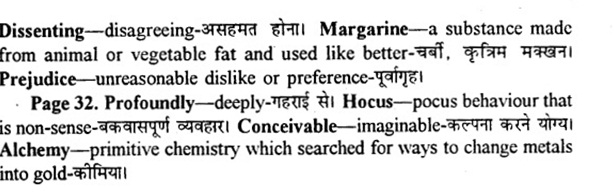
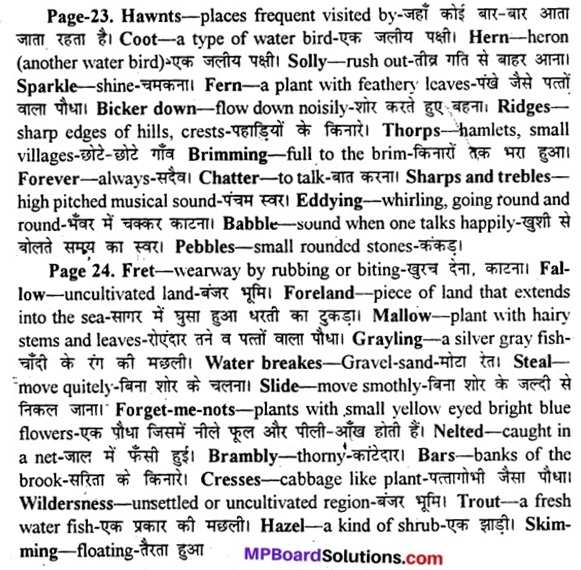
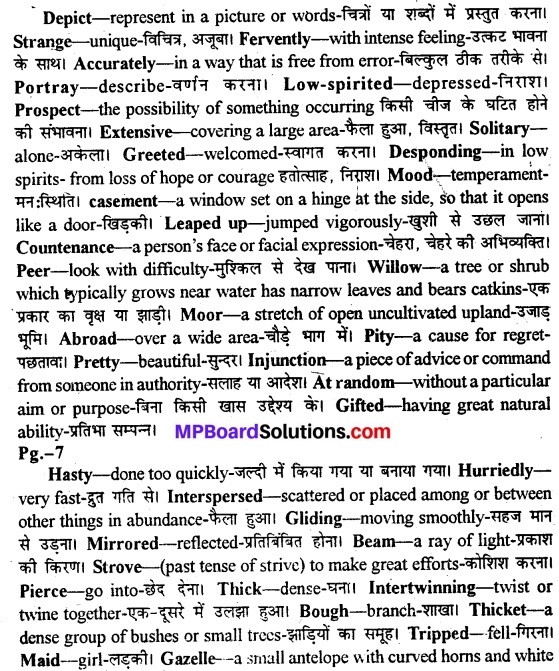
The Model Millionaire  Word Meaning
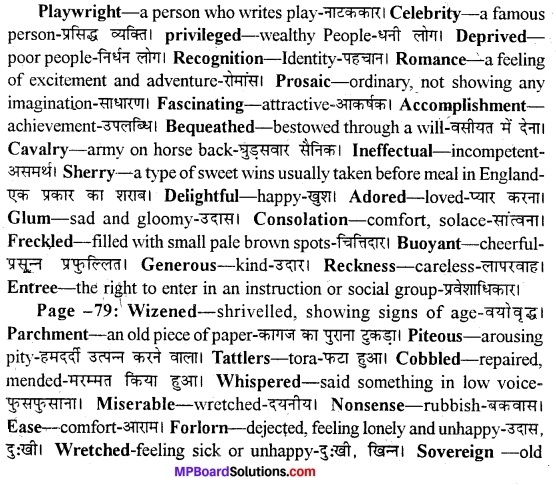
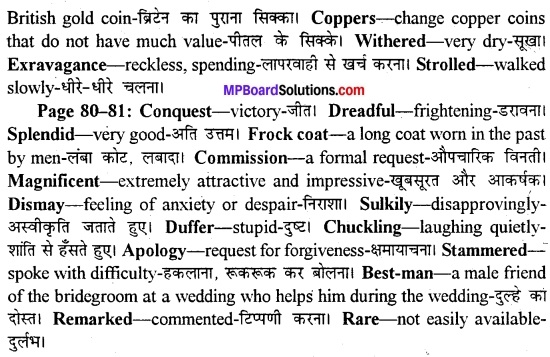
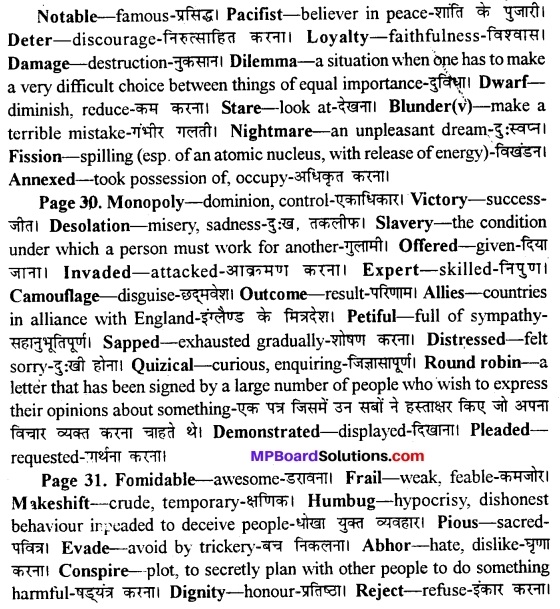
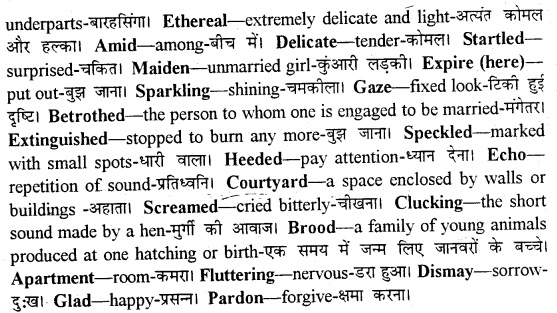
MP Board Class 11th English A Voyage Solutions Chapter 11 The Model Millionaire 7
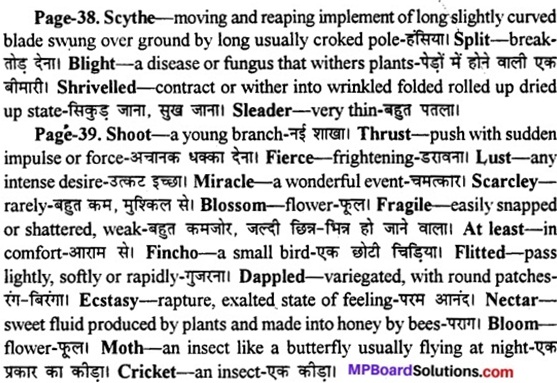
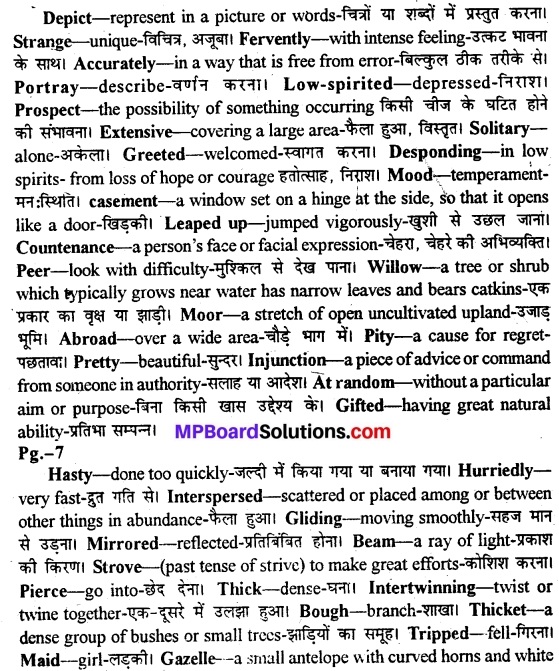
MP Board Class 11th English A Voyage Solutions Chapter 11 The Model Millionaire 8
The Model Millionaire Comprehension

Read the following passages carefully and answer the questions that follow:

1. One morning, as he was on his way to Holland Park, where the Mertons lived, he dropped in to see a great friend of his, Alan Trevor. Trevor was a painter. He was a strange rough fellow, with a frickled face and a red ragged beard. However, when he took up the brush he was real master, and his pictures were eagerly sought after. He had been very much attracted by Hughie at first on account of his personal charm. However, after he got to know Hughie better, he liked him quite as much for his bright buoyant spirits and his generous reckless nature, and had given him the permanent entree to his studio.

Questions:
(i) Who was on the way to Holland Park?
(it) Who lived at Holland Park?
(iii) Whom did he meet on his way?
(iv) What was the profession of his friend?
(v) Why was his friend attracted to Hughie?
Answers:
(i) Hughie was on the way to Holland Park.
(ii) The Mertons lived at Holland Park.
(iii) He met with Alan Trevor, his great friend, on his way.
(iv) His friend’s profession was painting.
(v) His friend was attracted to Hughie for his personal charm.

2. The old beggar-man took advantage of Trevor’s absence to rest for a moment on a wooden bench that was behind him. He looked so forlorn and wretched that Hughie could not help pitying him and felt in his pocket to see what money he had. All he could find was a sovereign and some coppers. ‘Poor old fellow,’ he thought to himself, he wants it more than I do,’ and he walked across the studio and slipped the sovereign into the beggar’s hand.

Questions:
(i) What advantage did the old beggar man take in Trevor’s absence?
(ii) How did he look?
(iii) What did Hughie feel about him?
(iv) How did Hughie help the beggar man?
Answers:
(i) The old beggar man relaxed himself for a moment resting on a wooden bench.
(ii) He looked forlorn and wretched.
(iii) Hughie felt pity for him.
(iv) Hughie gave the only sovereign to the beggar man.

3. ‘What I say,’ said Trevor. ‘The old man you saw today in the studio was Baron Hausberg. He is a great friend of mine, buys all my pictures and gave me a commission a month ago to paint him as a beggar. And I must say he made a magnificent figure in his rags, or perhaps I should say in my rays they are old suit I got in Spain’.

Questions:
(i) What amazing fact did Trevor reveal to Hughie?
(ii) What did Baron offer to Trevor for painting him as a beggar?
(iii) Whose rags did Baron wear while being portrayed?
(iv) Give a word from the passage similar in meaning to ‘excellent’?
Answers:
(i) Trevor revealed the old beggar man was Baron Hausberg.
(ii) Baron offered a commission, a month ago for being portrayed.
(iii) Baron wore the painter’s rags while being portrayed.
(iv) ‘magnificent’.

4. ‘The Baron,’ said the old gentleman, with a smile, ‘has commissioned me to bring you this letter,’ and he extended a sealed envelop. On the outside was written, ‘ A wedding present to Hugh Erskine and Laura Merton, from an old beggar, ’ and inside was a cheque for ten thousand pounds. When they were married Alan Trevor was the best-man and the Baron made a speech at the wedding-breakfast. ‘Millionnaire models,’ remarked Alan, ‘are rare enough but model millionnaires are rarer still.’

Questions:
(i) Who had sent the messenger?
(ii) What did the messenger bring?
(iii) What was written on it?
(iv) Who was the best-man at the wedding-breakfast?
(v) Give a word from the passage similar in meaning to ‘ordered.’
Answers:
(i) Baron had sent the messenger.
(iii) The messenger brought a sealed envelop.
(iii) On the outside of the envelop it was written, ‘A wedding present – to Hughie Erskine and Laura Merton, from an old beggar’
(iv) Alan Trevor was the best manj at the wedding-breakfast.
(v) ‘Commissioned’.

Above provided complete MP Board Solutions 11th English Study guide is useful for making your preparation effective. Students can frequently visit our page to get the latest updates on other subjects study materials.

MP Board Class 11th English A Voyage Solutions Chapter 10 Mahatma Gandhi

Students who are studying 11th can get the free Madhya Pradesh Board Solutions for 11th English Chapter 10 Mahatma Gandhi Questions and Answers PDF here. You can download MP Board Class 11th English Solutions Questions and Answers PDF on this page. Practice questions of Mp Board Solutions of 11th English subject as many times as possible to get good marks.

MP Board Class 11th English A Voyage Solutions Chapter 10 Mahatma Gandhi (V.S. Srivas Sastri)

Gather chapter wise MP Board Solutions for 11th English Study Material to score the highest marks in the final exam. Various chapters and subtopics are given clearly in MP Board Class 11th English Solutions Chapter 10 Mahatma Gandhi Questions and Answers Material. All the MP Board Solutions for 11th English Questions with detailed answers are provided by subject experts. The step by step MP Board Class 11th English Chapter 10 Mahatma Gandhi Questions and Answers guide will help you to enhance your skills in English subject and grammar. Here, along with the subject knowledge, grammar knowledge also plays an important role. So, students should download MP Board Solutions 11th English and read it to attempt all the questions with 100% confidence.

Mahatma Gandhi Textual Exercise

Word Power

(a) Now see how they are used:
1. Advise when needed is least heeded, (noun)
2. Advised him to be more careful, (a verb)
Note that advice (noun) does not take article ‘an’ and is not used in plural.
Use the following pairs of words in sentences to bring out the difference:
device/devise, practice/practices
Answer:

  • Device – Harvesting of rainwater is a water saving device. Devise – A new system has been devised to control traffic in city.
  • Practice – He has no practice of speaking English Practise – Practise hard to learn English.

(b) Some words are almost similar in sound but different in meaning or spelling. They are called ‘Homonyoush Example – accept, except He accepted my proposal. Except Mr. Singh, all the teachers attended the meeting.
Now give the meanings of the following words and use them in sentences of your own:
Course – coarse/cease – seize/rever – river.
Answer:

  • Course – way – Rivers often change their courses during floods in rainy seasons.
    Coarse – rough – He is putting on coarse clothes.
  • Cease – to stop – The factory has ceased to making bicycles.
    Seize – take possession of – He seized Mr. Sharma’s goods for payment of debt.
  • Rever – to respect – We should rever great men of the world.
    River – a large natural stream of water – The Ganga is a holy river.

(c) Synonyms is a word with similar meaning:
As common is a synonym of ‘ordinary’
Now find synonyms of the following words from the text of the lesson:
Elated, hard, polite, piousness, clear, continuously.
Answer:

  • Elated – exalted
  • Hard – rigorous
  • Polite – lofty
  • Piousness piety
  • Clear – evident
  • Continuously – constantly.

(d) Find the word from the text for the following expressions:

  • to bring the light something hidden
  • completely
  • find out something new
  • clearly visible
  • great respect and honour for somebody
  • to win over
  • to copy or follow some one
  • effort or hard work
  • to respect someone
  • to cause to change direction Ans.
  • absolutely
  • discover
  • transparent
  • earnest
  • overcome
  • emulate
  • rever
  • swerve.

Comprehension

I. Answer in one sentence each of the following questions:

Question 1.
What is the opposite word for Mahatma as Gandhi used to ascribe to himself?
Answer:
The opposite word for Mahatma as Gandhi used to ascribe to himself is Alpatma.

Question 2.
What did Gandhi subject himself to?
Answer:
Gandhi subjected himself to rigorous self examination.

Question 3.
Is it possible for human nature to reach to the height of Gandhi’s excellence of character? If yes, how?
Answer:
Yes, it is possible for human nature to reach to the height of Gandhi’s excellence of character by following the path shown by him.

Question 4.
What did Gandhi possess as property?
Answer:
Gandhi possessed nothing except the pair of a very coarse Khaddar which he used to put on his body.

Question 5.
What did Gandhi do of the property which he had acquired?
Answer:
All the property which Gandhi had acquired, had beep given away by him.

Question 6.
What did Gandhi and Christ preach equally?
Answer:
‘Forgive thine enemies’.

Question 7.
Do you think that Gandhi was a man of the courage of soul? Give reasons.
Answer:
If Gandhi stood alone in defense of truth, and the whole world were banded against him and against truth, he would still fight them all, no matter if they tire his limb from limb.

Question 8.
How was Gandhi regarded universally?
Answer:
Gandhi was regarded universally by dint of his high and sublime qualities.

Question 9.
What, according to the author, shall we be if we do not know of Gandhi?
Answer:
According to the author we shall be wretched if we do not know of Gandhi.

II. Answer in 30 -40 words each of the following questions:

Question 1.
How did Gandhi subject himself to self-examination?
Answer:
Gandhi subjected himself to rigorous self-examination. He would ask himself often during the day if he had said or done or thought anything which was unworthy. And if in course of that examination he discovered some failing, some lapse on his part, he prayed to the Almighty that he would be saved in future from similar failings and lapses.

Question 2.
Do you find some difference between self-examination and self-condemnation? If yes, how?
Answer:
There is a difference between self-examination and self- condemnation. Self-examination is the way to transformation through analysing one’s own character. It is a positive attitude. Self-condemnation is a negative altitude. One condemns oneself for what one does. It does not mean that it would bring any change in one’s character.

Question 3.
What kind of courage did Gandhi possess?
Answer:
Gandhi possessed a remarkable quality of courage. In Gandhi’s .. case courage doesn’t mean physical courage or strength. But it means the courage of the soul which helps one to defend one’s opinion in the face of overwhelming odds.

Question 4.
Write a short note on Gandhi’s universal significance?
Answer:
Gandhi was one of the rare personalities who achieved a unique universal significance. It was his virtue, courage, moral strength and other sublime qualities that made him universal regarded as a great soul.

Question 5.
Explain ‘piety’ who, according to the author, is a man of piety?
Answer:
‘Piety’ is a divine quality. It is not an outer quality but it dwells in the innermost recesses of our hearts. When one has troubles and difficulties and anxious questions appear in one’s mind and one doesn’t know to which way to turn, one becomes a man of piety because at this hour he finds solution in his prayer to god.

Question 6.
What are the words used for ‘forgiveness’ in the lesson?
Answer:
The words used for ‘forgiveness’ in the lesson are: kshama, tolerance, charitable dealing and charitable thought towards others.

III. Answer the following questions in 150 words each:

Question 1.
On what virtues does the greatness of Gandhi rest?
Answer:
Gandhi was given the name ‘Mahatma’ and h” really deserves it. His life was the life of an ordered man of high conduct and sacrifice. He was a rare personality. He subjected himself to rigorous self-examination. Every day he examined himself to see whether he had done or thought anything unworthy. Everyday he made a prayer to god asking him to keep him away from such lapses. This process of self-examination made him all perfect. He lived his life in a godly way. His perfect purity, his transparent honesty and his.evident sincerity were matchless.

Gandhi’s unselfishness was also rare. He owned nothing except the pair of a very coarse Khaddar which he used to put on his body. He had given away all the property which he acquired. He had immense courage. The courage which he practised was not physical but it was the courage of the soul. This courage of the soul helped him to defend his opinion in the face of overwhelming odds. The other remarkable feature of Gandhi was the quality of forgiveness which applies to tolerance, charitable dealing and charitable thought towards others. Gandhi preached, “Forgive their enemies.” The above mentioned virtues made Gandhi the rarest of the rare. He was really a man with a great soul. His greatness is matchless.

Question 2.
What is meant by self-examination? How did Gandhi practice it?
Answer:
Self-examination means to examine oneself to see whether one has done or thought anything unworthy. It is a rare quality which is found rarely in human beings. But Mahatma Gandhi was not a simple Human being. He was the rarest of the rare who subjected himself to rigorous selfexamination. Everyday he examined himself to see whether he had done or thought anything unworthy. Everyday he made a prayer to God asking him to keep him far away from such lapses. This process of self-examination left a tremendous effect on Gandhi. He made him an almost perfect man. He always lived in a godly way but always called himself a sinner. His perfect purity, his transparent honesty and his evident sincerity were really matchless. He always tried to save himself from stray tendencies, fleeting temptations because he always felt that these negative aspects of life lead to grievous sin.

Question 3.
‘Forgiveness is divine’ prove it on the basis of your study?
Answer:
The writer has explained the virtue of forgiveness in detail. Forgiveness i.e. ‘kshama,’ as called by our ancients stands for tolerance, charitable dealing and charitable thought towards others. If one contemplates other’s sins, their failings or their treacherous behaviour, one thinks of how to forget and forgive. Some of us do it, occasionally. Some do it once in a lifetime. Some make it a habit. Gandhi had a different opinion for it. He doesn’t mind this act with our kins or close relatives. He says to forgive our enemies, as Jesus Christ has preached, love their enemies, forgive their enemies.’ Though it appears to be very easy but it is so difficult that only a few succeed in this attempt. Gandhi was one of those rarest of the rare. It is a divine quality.

Question 4.
Differentiate between ‘physical courage’ and ‘courage of the soul’. What does Gandhi stands for?
Answer:
‘Physical courage’ and ‘courage of the soul’ are two different virtues. Physical courage means bodily strength, robustness which makes one able to fight, or resist against ones enemies. But a courageous man is not he who calls someone to fight, a courageous man is necessarily he who against two or three antagonists in the foot field field carries the ball through into the goal

It is physical courage. On the other hand courage of soul is one that helps one defend one’s opinion in the face of overwhelming odds. He must have the confidence to say that if he stands alone in defence of truth and the whole world were banded against him and against truth, he wanted still fight them all without caring any damage to himself. This is the real courage-courage of the soul rather than the physical courage. Gandhi had a tremendous kind of such courage.

Question 5.
In what way was Gandhi a man of piety?
Answer:
Piety is one of the most significant virtues that Gandhi possessed. In fact, a pious man is not he who merely goes to the temple and gives away large part of his wealth in charity. This is piety above and beyond these doctrines which does not need any outward expression. It is in our inner being. When ever Gandhi was in trouble, he closed himself in a quite room to retreat and seek the solitude of midnight. He sat there in the solemn silence of the moment.

God in the most earnest tones. The writer finds that no one can do such a thing unless he had the fullest and the strongest faith in the living presence of God and had always enjoyed his intimate relationship or companionship. Gandhi had felt for a number of times, as the writer says, the guidance of God.Due to that no amount of persuasion, no entreaty, no threat would make him swerve a hair’s breadth from his course. Gandhi was a real man of piety.

Question 6.
Enumerate in short the qualities of Gandhi as found in the lesson.
Answer:
In the lesson ‘Mahatma Gandhi’ the writer exposes Gandhi’s qualities as a man. Some of them are his qualities of self-examination, his complete selfishness, his forgiveness, his inner courage and his piety. While talking about his self-examination the writer says that Gandhi subjected himself to rigorous self-examination everyday by asking himself if he had said or done or thought anything which was unworthy.

If in the course of examination he discovered some failing, some lapse on his part, he prayed most humbly to God to save him in future from similar failings or lapses. In this sense, he was perfect man.Gandhi’s selflessness was known to all. He owned nothing except the pair of very coarse Khaddar which he used to put on his body. All the property which he acquired, he had given away.

Another remarkable virtue in him was the quality of forgiveness. He used to say, “forgive there enemies.” He was a rare personality who possessed the courage of the soul. In his opinion only this courage helps one to defend one’s opinion in the face of overwhelming odds.Gandhi was a man of piety. His rare qualities made him universally regarded as a great soul.

IV. Choose the correct alternative:

(a) Gandhi proved his title to be regarded as a Mahatma because:
(i) the people gave him the title of Mahatma.
(ii) he was a saint.
(iii) he gave up all what he had.
(iv) he called himself ‘Alpatma’ and begged his friends not to call him Mahatma.
Answer:
(iii) He gave up all what he had.

(b) A man should be judged by:
(i) the opinions he holds.
(ii) His conduct and character.
(iii) The doctrine he espouses.
(iv) The opinion people have of him.
Answer:
(ii) His conduct and character.

(c) Gandhi called himself a sinner because:
(i) he condemned outward lapses.
(ii) he condemned lapses of thought.
(iii) he used to test himself most severely.
(iv) he was a victim of fleeting temptations.
Answer:
(iii) he used to test himself most severely.

(d) People are great on account of their practice of:
(i) self consciousness
(ii) self assessment
(iii) self examination
(iv) self punishment.
Answer:
(iii) self examination

(e) Gandhi is called unselfish because:
(i) he devoted some time of his life to the welfare of the community.
(ii) he gave a part of his wealth to some objects of public charity.
(iii) in every matter and at every moment of his life he lived only for others, thought only for others and worked only for others.
(iv) he wore a very coarse Khaddar cloth on his body:
Answer:
(iii) in every matter and at every moment of his life he lived only for others, thought only for others and worked only for others.

Grammar

I. See Textbook pages 73 – 74
Now:
1. Write five words each beginning with the above negative prefixes.
2. Search from the text any other words (leaving aside the words already quoted) that have negative prefixes.
3. Use one of the above-mentioned prefixes to make negatives of the following words:
Honesty, approve, charitable, dote, truth, pious.
Answer:

  1. anti-anti-clockwise, anti-body, anti-social, anti-viral, anti-climax. De-decode, devalue, deform, defame, demoralize. Dis-dishonest, disrespect, dishonour, dislike, disappear, in-improper, immature, immortal, impolite, impossible. Non-non-sense, non-gazetted, non-vegetarian, non-violent, non-co¬operation.
    Un-unhappy, unlike, undo, unnatural, unable.
  2. Some other words that have negative prefixes:
    Unworthy, unselfish, unaware, unarmed, undefended, disarm.
  3. honesty-dishonesty approve-disapprove charitable-uncharitable
    dote-undote truth-untruth pious-impious.

II. Learning Modals:
(See Textbook pages 74 – 75)
Given below are sentences with would, must, should, ought to and needn’t it. Find the modality of each.
1. Would you please lend me your pen? .
2. I would rather have a jacket than a coat.
3. Mr. Gautam promised that he would do the work for me.
4. You must not walk in the middle of a road.
5. You need not pay income tax. You are a senior citizen now.
6. They must have caught the train.
7. One must not forget oneself.
8. People should not smoke in public places.
9. Mr. Shukla should have consulted a lawyer.
10. You forget to touch the feet of your grandfather. You ought to have done so.
11. Your neighbour ought to respect your feelings.
12. People ought to stand up when the national anthem is being sung.
13. She needn’t undergo the operation. I will cure her by oral therapy.
14. I didn’t need to wait for the guests. They arrived in time.
Answer:

  1. polite request.
  2. a liking, a wish (with or without‘like’) in sense of ‘want to’.
  3. indirect speech.
  4. negative command or order.
  5. advise in general with no external obligation.
  6. conjecture, strong possibility or certainty.
  7. negative command or order.
  8. speaker’s personal opinion regarding duty, general advice with on suggestion of actual or possible transgression, advisability, desirability. .
  9. unfulfilled obligation (an act which should have been done, but not done).
  10. non-fulfillment of a sensible action in the past.
  11. advisability, desirability in the matters of conscience.
  12. advice regarding duty or a sensible action.
  13. advice in general.
  14. advice in general.

Speaking Activity

Suppose you

A. Who ……… ?
B ……… our father of nation. Can you tell me when ?
A ……… on October 2, 1869.
A. ……… What father’s name?
B. His ………was Karam Chand Gandhi
B. What ………name?
A. Mohand as Gandhi.
A. ……… What gives us.
B ……… freedom from the British rule.
A ……… weapons did he fight against the British in India?
B. ……… of Truth, Ahimsa and Satyagrah.
Answer:
A. Who is our father of nation?
B. Mahatma Gandhi is our father of nation. Can you tell me when he was born?
A. He was born on October 2, 1869.
A. Wirat was his father’s name?
C. His father’s name was Karam Chand Gandhi.
B. What was his name?
A. His name was Mohandas Gandhi.
A – What did he gives us.
B. He gave us freedom from the British rule.
A. With which weapons did he fight against the British in India?
B. He fought against the British with weapons of Truth, Ahimsa and Satyagrah.

Writing Activity

I. Read the lesson ‘Sister Nivedita’ in the book. It is her biographical sketch. Can this lesson on Mahatma Gandhi be called a biographical sketch? If not, why? Write a brief biographical sketch ‘ of M.K. Gandhi (in about 150 words).
Answer:
No. it is not a biographical sketch. It is just an exposition of Gandhi’s qualities as a man. The writer nowhere gives any details or hints about his birth, percentage, education and career. Here, is a brief biographical sketch of M.K. Gandhi.

Mahatma Gandhi was born at Porbandar in Kathiawar (Gujarat) in the year of 1869 on 2nd October. His father, Kaba Gandhi was the Diwan of Rajkot State. His mother was a noble and pious lady. At the age of seven he was sent to school. At school he proved himself to be only an average boy. He was always regular and punctual in his class.

After passing his Matriculation Examination he studied at college. Then he went to England to study law.He started his practice at Bombay. But he did not do well. Then he went to Rajkot. He was not a successful lawyer.He went to Africa to conduct a big law suit in a court. There he saw the , bad condition of Indians. He put up are brave fight for their rights. He founded Natal Indian Congress. He was jailed with his friends. In, 1914 the Indian Relief Act was passed.

This bettered the lot of Indians. Gandhi returned to India. He joined the Congress. He became its leader. Under his leadership the congress started non-violence and the non-cooperation movements to oppose the unjust acts of the British Government. Side by side he did constructive work-the removal of untouchability and the Hindu-Muslim Unity. At last India became free on the 15th of August 1947. Gandhiji’s end came all of a sudden. He was shot dead by a thoughtless Youngman. He died on 30th January, 1948.

Think it Over

Question 1.
Study the influence of Mahatma Gandhi on the life of Nelson f Mandela.
Answer:
Attempt yourself.

Question 2.
Gather material about Gandhi’s life in South Africa.
Answer:
Do it yourself.

Question 3.
In a world beset with strife, Satyagraha has more relevance today than it had during Mahatma Gandhi’s time,” Kenneth Kaunda. Discuss the comment with your friends.
Answer:
Do it yourself.

Things To Do

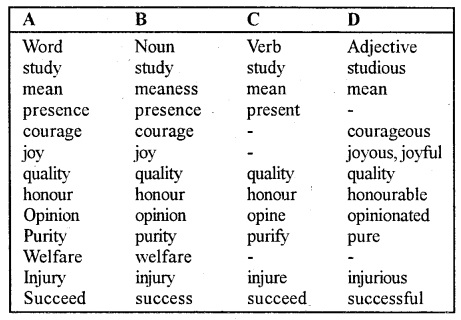
I. In the following table some words are given under column ‘A’. Now make noun, verb and adjective forms for each of them. Some of the words may not have all the forms.
MP Board Class 11th English A Voyage Solutions Chapter 10 Mahatma Gandhi 1

II. Write these incidents in chronological order:
1. The Dandi March was like a pilgrimage that, took twenty- four days to complete the 300 Km. long journey.
2. Jawaharlal Nehru, in his message to the nation said with his chocked voice, “The light has gone out of our life and there is darkness all around”.
3. Gandhiji stayed in South Africa for 21 years. During this period he incessantly worked for the right of the Indians there.
4. After he was shot dead, he was cremated on the banks of the river Yamuna in Delhi.
5. His fame will never die. His knowledge, his actions and his preachings will continue to guide us for centuries.
Answer:

  1. Gandhiji stayed in South Africa for 21 years. During this period he incessantly worked for the right of the Indians there.
  2. The Dandi March was like a pilgrimage that took twenty-four days to complete the 300 Km. long journey.
  3. After he was shot dead! he was cremated on the banks of the river Yamuna in Delhi.
  4. Jawaharlal Nehru, in his message to the nation said with his chocked voice, “The light has gone out of our life and there is darkness all around”.
  5. His fame will never die. His knowledge, his actions and his preachings will continue to guide us for centuries.

III. Events reflect the character. What incidents/events of- Gandhi’s life do you remember when you talk about these qualities.
1. dignity of labour.
2. faith in non-violence.
3. truthfulness.
4. concern for the poor.
5. belief in secularism.
6. belief in swadeshi.
Answer:
Do it yourself with the help of your teacher.

IV. Read the poem ‘Psalm of Life’ by W.H. Longfellow. The poem says how: ‘lives of all great men remind us to make our lives sublime”.
Answer:
Attempt yourself.

Mahatma Gandhi Summary in English

It is a pen portrait of Mahatma Gandhi who has called so far being a man with great soul. Though he never liked to be called so. He himself considered to be “Alpatma” not Mahatma. Still he was given this name. It was for the reason that he really deserves it. He has a life of an ordered man high conduct and sacrifice. Gandhi was a rare personality who constantly subjected himself to rigorous self examination. Everyday he examined himself to see whether hip had done or thought anything unworthy. Everyday he made a prayer to God asking him to save him from such lapses.

His process of self examination made him all perfect. He was very modest and lived his life constantly in a godly way, still he called himself a sinner which we just can’t believe for his perfect purity, his transparent honesty and his evident sincerity were superb. He believed in character as white and transparent as god. Stray tendencies, fleeting temptations, as he felt, always lead to grievous sin. Self-examination was his way of self condemnation.

Gandhi was absolutely without self. His unselfishness was not simply parting one’s interest, wealth or life for others. For Gandhi there was no self. From his point of view, no one is really unselfish unless he always put aside his life and in every matter and at every moment of his life lives for others, think only for others and exists himself of all his wealth.

Whatever Gandhi owned in this world was expect the pair of a very coarse Khaddar which he wore on his body. Everything he owned he sacrificed in the name of nation. He was a regular sanyasi. He never cared for himself. His real happiness was the joy and contentment of the mass. All the time he devoted in thinking for others. This was the true doctrine of unselfishness.

The other remarkable feature of Gandhi was the quality of forgiveness which appears to tolerance, charitable dealing and charitable thought towards others. Gandhi was of the view that it is not a difficult job to forgive someone who is very close to us or who is our kith and kin. But it is little bit difficult to forgive our enemies.

Mahatma Gandhi says, “Forgive there enemies” which is one of the teachings of Jesus-Christ. ‘Love there enemies, ‘forgive there enemies’ is the doctrine of forgiveness. There is no one not even one- in a million who succeeds in practicing it. It is a rare quality displayed only by a rare

Mahatma Gandhi Summary in Hindi

यह महात्मा गाँधी, जिन्हें महान आत्मा वाला व्यक्ति कहा जाता था, का शब्द चित्र है। उन्होंने कभी-भी स्वयं को महान आत्मा वाला व्यक्ति नहीं माना। उन्होंने हमेशा अपने को अल्पात्मा कहा। इसके बावजूद उन्हें यह नाम दिया गया। इसके पीछे कारण यह था कि वे वास्तव में इसके योग्य थे। उनका जीवन काफी संचत था। उनके जीवन में उच्च आचरण और त्याग का समावेश था। गाँधीजी दुर्लभ व्यक्तित्व वाले व्यक्ति थे। उन्होंने अपने जीवन को कड़ी आत्म-परीक्षण का विषय बना लिया था। वे प्रतिदिन स्वयं का परीक्षण करते यह जानने के लिए कि उन्होंने कहीं कुछ गलत तो नहीं किया या गलत-विचार तो मन में नहीं लाया। प्रतिदिन वे ईश्वर से प्रार्थना करते कि वे उन्हें ऐसी खामियों से बचाए रखे।

आत्म-परीक्षण के इस तरीके ने उन्हें पूर्ण व्यक्ति बना दिया था। वह बहुत सरल और विनीत थे और ईश्वरीय तरीके से अपने जीवन को जीने में विश्वास करते थे। इसके बावजूद वे स्वयं को पापी कहा करते थे। जिस पर हमें जरा भी विश्वास नहीं होता क्यों कि उनकी पवित्रता में जो पूर्णता थी, उनकी ईमानदारी में जो निश्छलता थी और उनकी कर्मठता में जो दृढ़ता थी, वे उत्तम कोटि की थी। वे वैसे चरित्र में विश्वास करते थे। जो ईश्वर के समान सफेद और पारदर्शक हो। भटकते विचारों, क्षणभंगूर लालच, जैसे कि वे महसूस करते थे, हमेशा मानव को गंभीर पाप की ओर उन्मुख करते हैं। आत्म-परीक्षण आत्मनिंदा का उनका तरीका था।

गाँधी जी स्वयं रहित थे। उनकी नि:स्वार्थता का मतलब अपना धन या जीवन दूसरे के हवाले करना नहीं था। गाँधी जी के लिए कोई ‘स्वयं’ नहीं था। उनके विचार में कोई भी तबतक नि:स्वार्थ नहीं है जबतक कि वह अपना ‘स्वयं’ अपने से दूर नहीं रखता है और प्रत्येक विषय में और जीवन के हर क्षण में दूसरों के लिए नहीं जीता है, दूसरों के लिए नहीं सोचता है और अपनी पूरी दौलत दूसरों के लिए नहीं खत्म करता है। गाँधी के पास अगर कुछ था तो वह था मोटा खद्दर का एक जोड़ा जिसे वे हमेशा अपने शरीर पर धारण किया करते थे। उन्होंने जो कुछ भी अर्जित किया राष्ट्र के नाम न्योछावर कर दिया। वे एक सन्यासी थे। उन्होंने कभी-भी अपनी परवाह नहीं की। उनकी वास्तविक खुशी तमाम लोगों की खुशी और संतुष्टि में निहित थी।

वे हमेशा दूसरों के बारे में सोचा करते थे। यही नि:स्वार्थता का सच्चा सिद्धांत था। गाँधी की दूसरी महत्वपूर्ण विशेषता यह थी कि उनमें क्षमाशीलता गुण-भरा हुआ था। क्षमाशीलता का मतलब होता है दूसरों के प्रति धैर्यवान होना तथा उदार व्यवहार और उदार विचार रखना। गाँधी के विचार में अपने सगे-संबंधी को क्षमा कर देना कोई मुश्किल काम नहीं है लेकिन अपने दुश्मनों को माफ करना थोड़ा मुश्किल काम अवश्य है। महात्मा गाँधी कहते हैं, “अपने दुश्मनों को माफ कर दो.” जो ईसा मसीह के उपदेशों में से एक हैं। ‘अपने दुश्मनों को प्यार करो, अपने दुश्मनों को माफ करो’ क्षमाशीलता का सिद्धांत है। कोई भी ऐसा नहीं है, शायद लाखों में से एक भी नहीं, जो क्षमाशीलता के इस सिद्धांत को अपनाता। यह एक दुर्लभ गुण है, जो गाँधी जैसे दुर्लभ व्यक्तित्व द्वारा ही प्रदर्शित हो सकता है।

गाँधी को अथाह साहस था। जिस साहस को उन्होंने अपनाया था वह शारीरिक साहस नहीं था, बल्कि यह आत्मा का साहस था। केवल यही साहस एक व्यक्ति को विपरीत परिस्थितियों में भी अपने विचारों पर अड़े रहने में मदद कर सकता है। गाँधीजी ने बहुत-सी विकट स्थितियों का सामना किया बिना किसी नुकसान के वे सही मायने में साहस की मूर्ति थे। उनमें मधुर शब्दों के सहारे घृणा को खत्म करने का गुण था। गाँधी की दूसरी विशेषता थी उनकी धर्मपरायणता! यह गुण उनके चरित्र का सबसे महत्वपूर्ण गुण था। यह हमेशा उनकी अंतरात्मा में विद्यमान रहती थी। जब कभी भी वे उलझनों और कठिनाइयों में फंसे. वे शांतचित होकर बैठ जाते थे और भगवान को बहुत ही विनीत स्वर में संबोधित करते थे।

ईश्वर की जीवंत उपस्थिति में उन्हें अगाध विश्वास था। उनके जीवन में ऐसे बहुत से मौके आए जब उन्होंने ईश्वर को अपने अंदर आहवान किया और उनसे (भगवान से) उनका मार्गदर्शन मांगा और उन्होंने (गाँधी को) भगवान से मार्गदर्शन मिला भी। उन्होंने स्वयं और भगवान के बीच किसी को आने की कभी अनुमति नहीं दी। गाँधी दुर्लभों में दुर्लभ थे। हम सभी अपना चरित्र ऊँचा उटाने के लिए गाँधी के सिद्धांतों का अनुकरण करने की कोशिश करते हैं। उन्हें केवल अपने देश में ही महान आत्मा वाला व्यक्ति नहीं माना जाता है वरन् जर्मनी और इंग्लैण्ड जैसे देशों में भी। आएँ गाँधी को आदर करें और उनके द्वारा दिखाए गए रास्ते पर चलने की कोशिश करें।

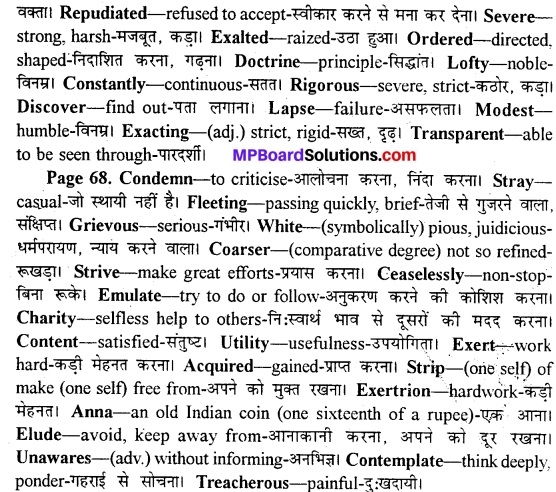
Mahatma Gandhi Word Meaning

MP Board Class 11th English A Voyage Solutions Chapter 10 Mahatma Gandhi 2 MP Board Class 11th English A Voyage Solutions Chapter 10 Mahatma Gandhi 3 MP Board Class 11th English A Voyage Solutions Chapter 10 Mahatma Gandhi 4

Mahatma Gandhi Comprehension

Read the following passages and answer the questions that follow:-
1. The term Mahatma great soul. So, the phrase Mahatma Gandhi means Gandhi, the great soul. At first he repudiated the title and begged his friends not to call him so. Sometimes, in the midst of severe disappointments, when people called him by that exalted title he said emphatically, ‘I do not wish that you should give me that honour any more. I am the opposite of Mahatma I am Alpatma’. But by this very act, he has became great by reason of the way in which he has ordered his life. A man is to be judged by his conduct and character, and not merely by the opinion he holds or even the doctrine to which he devotes his life, and the title of Mahatma rests on the greatness which he has won by his lofty character.’

Questions:
(i) What does the term ‘Mahatma’ mean? Who has been talked about as ‘Mahatma’?
(ii) What was Gandhi’s response when people called him ‘Mahatma’ ?
(iii) How is a man judged?
(iv) Pick out words from the above passage which are similar in meaning to
a. refused
b. noble
Answers:
(i) The term Mahatma means a great soul. Mahatrha Gandhi has been talked about as‘Mahatma’.
(ii) When people called him Mahatma, Gandhiji told that he was the opposite of Mahatma. He was Alpatma.
(iii) A man is judged by his conduct and character and not merely by the opinion he holds.
(iv) (a) repudiated
(b) lofty.

2. He owns nothing in this world except the pair of a very coarse Khaddar which he wears on his body. He has not even a store of these things at home. All the property amounting to several lakhs which he acquired, he has given away. Not an Anna now belong to him. He is a regular sanyasi going about only in the clothing that is on him. Mr. Gandhi does not care for himself but gives all his time for the saving of the souls of other people. That is to say, such happiness as he still wants, such joy, such satisfaction as he still needs in life he wants only through promoting the joy and the happiness of others about him. If through that exertion happiness»comes to him, let it come.

Questions:
(i) Whom does ‘he’ refer to in these lines? What did he own?
(ii) What did he do to all the property which he acquired?
(iii) What type of happiness did he want?
(iv) Pick out words from the above passage which are similar in meaning to
(a) rough
(b) earned
(c) contentment
(d) wealth.
Answer
(i) ‘He’ refers to Mahatma Gandhi in these lines. He owned nothing except the pair of coarse Khaddar which he used to put on his body.
(ii) He gave away all the property which he acquired.
(iii) He wanted to fill the life of others with joy and happiness: He strove for it throughout his life. He felt happy when he made others happy.
(iv) (a) coarse
(b) acquired
(c) satisfaction
(d) property.

3. ‘What is the good of forgiving those whom you love?’ Suppose your son misbehaves towards you, or your father one day in his anger is unduly severe to you, it is no great virtue to forgive them. Suppose a brother of you does you some harm, and you say, ‘Never mind, you are my brother, I let you go/ there is no great virtue in that. The difficulty is when you have to forget the son of your enemies. If your dayadhi who has always hated you, does you some fresh injury and you forgive that, it is a real act of forgiveness. It is that which the Mahatma preaches. He says, ‘Forgive thine enemies,’ which is one of the teachings of Jesus Christ. ‘Love thine enemies forgive thine enemies’ is the doctrine of forgiveness taken to its last point of development. It is very easy to say so, but I may tell you from long experience that it is one of the most difficult lessons to learn this lesson that you should love your enemies.

Questions:
(i) What is not a difficult job?
(ii) When does the difficulty arise?
(iii) What is a real act of forgiveness?
(iv) What did Mahatma Gandhi and Jesus Christ preach equally?
(v) What is one of the most difficult lessons to learn?
(vi) Pick out words from the above passage which are opposite in meaning to
(a) vice
(b) remember
(c) friends.
Answers:
(i) To forgive those whom we love is not a difficult job.
(ii) The difficulty arises whom we have to forget the sins of our enemies.
(iii) If one’s dayadhi who has always hated you, does one some fresh injury and one forgives that, it is a real act of forgiveness.
(iv) Both preached equally, forgive thine enemies.
(v) The lesson to love our enemies is one of the most difficult lessons to learn.
(vi)
(a) virtue
(b) forget
(c) enemies.

4. It is man of that kind whom you are asked now and then to think of, in order to raise the character of your own lives. It is good now and then for you, to have heard of his great name, to have heard praise of his high qualities, to have heard some description, however faint and indistinct, of the sublime qualities that make him universally regarded as a great soul. For it is not only in India we call him a great soul but also in Germany and England even in far away America, he has been described as one of the world’s greatest men alive. Are we not lucky to be his countrymen? How wretched we should be if we did not know of him and revere him even in a remote fashion, try to be like him!

Questions:
(i) What are we asked now and then and why?
(ii) What made Gandhi universally regarded as a great soul?
(iii) How are we lucky?
(iv) What shall we be if we do not know of Gandhi?
(v) Pick out words from the above passage which are similar in meaning to
(a) admire
(b) fortunate
(c) distant.
Answers:
(i) We are asked now and then to think of Gandhi in order to raise the character of our own lives.
(ii) Gandhi’s sublime qualities made him universally regarded as a great soul.
(iii) We are lucky because we belong to the country where Gandhi was born.
(iv) We shall be wretched if we do not know Of Gandhi.
(v) (a) praise
(b) lucky
(c) remote.

Above provided complete MP Board Solutions 11th English Study guide is useful for making your preparation effective. Students can frequently visit our page to get the latest updates on other subjects study materials.
MP Board Class 11th English A Voyage Solutions Chapter 9 To a Skylark

Students who are studying 11th can get the free Madhya Pradesh Board Solutions for 11th English Chapter 9 To a Skylark Questions and Answers PDF here. You can download MP Board Class 11th English Solutions Questions and Answers PDF on this page. Practice questions of Mp Board Solutions of 11th English subject as many times as possible to get good marks.

MP Board Class 11th English A Voyage Solutions Chapter 9 To a Skylark (P.B. Shelly)

Gather chapter wise MP Board Solutions for 11th English Study Material to score the highest marks in the final exam. Various chapters and subtopics are given clearly in MP Board Class 11th English Solutions Chapter 9 To a Skylark Questions and Answers Material. All the MP Board Solutions for 11th English Questions with detailed answers are provided by subject experts. The step by step MP Board Class 11th English Chapter 9 To a Skylark Questions and Answers guide will help you to enhance your skills in English subject and grammar. Here, along with the subject knowledge, grammar knowledge also plays an important role. So, students should download MP Board Solutions 11th English and read it to attempt all the questions with 100% confidence.

To a Skylark Textual Exercise

Word Power

(A) The poem has many adjectives which are images in themselves.
Here are some of them. Explain the images they portray and pick more from the poem as man as you can.
Write more expressions of ‘our own. blithe spirit, sunken sun, unbodied joy, highly born maiden, love-laden soul, heavy-winged thieves, vernal showers, tinkling grass,empty vaunt
Answer:

  • blithe spirit — carefree and light-hearted divine spirit.
  • sunken sun — the setting sun.
  • unbodied joy — joy that has no bodily existence
  • Highly born maiden – the maiden having born in a high class of family (princess).
  • Love-laden soul — soul which is full of love.
  • Heavy winged thieves – one who steals powerful object.
  • Vernal showers — showers which occur in the spring season
  • Twinkling grass — enlightened grass
  • Empty vaunt — boastful speech having no depth.

(B) Following words are used in different meanings in different contexts. See examples and use the given words in sentences of your own in as many contexts as possible.
1. hail — to greet
hail — hail storm
2. strain
3. sweet
4. pine
5. spirit
6. still
Answer:
1. Hail — to greet — She hailed me with a sweet voice.
Hail — hailstorm — We had to drive through hail and snow.

2. Strain — to make an effort to do something — I strained my neck to
take a glimpse of the actor.
Strain — worry anxient No-a-days I am facing great strain,

3. Sweet — tasting as if it contains a lot of sugar — This cup of tea is too seet for me.
Sweet — a small piece of sweet food — I always like to cat a sweetdish at the end of a meal.

4. Pine — a tall forest tree with leaves like needles — Pine crees are evergreen.
Pine — to become sad — I pined for weeks after may son had gone abroad.

5. Spirit — courage. determination or energy — The young boy showed a tremendous spirit.
Spirit — a strong alcoholic drink — I have never tasted any spirit

6. Still — continuing until a particular point in time and flot finishing – am still waiting for his arrival,
Still — calm and quiet — Children can not stay still.
Still — a photograph taken from a cinema film — That is a still from the latest movie

Comprehension

A. Write explanations of the following lines:

Question 1.
Pourest thy full heart
In profuse strains of unpremeditated art.
Answer:
The poet. in these lines, highlights the musical note of the skylark which it purs with its full heart, Its song is spontaneous overflow of its heart.

Question 2.
Singing hymns unbidden,
Till the world is wrought
To sympathy with hopes and fears it heeded not.
Answer:
In these lines Shelley compares the bird with a poet He says that it keeps on singing its prayer to God unbidden till the world in transformed to sympathy shedding all its hopes and fears, Here. the bird had been characterized as a high spirit.

Question 3.
Teach me half the gladness
That thy brain must know;
Such harmonious madness
From my lips would flow,
The world should listen then, as I am listening now.
Answer:
In these lines the poet asks the bird to teach him at least half of the gladness that its mind bears. The poet wishes to sing the harmonious madness of the bird from his own lips so that the whole of the world may listen and enjoy it as the poet is listening and enjoying now. The poet means to say that the world has no imaginative or poetic quality enough to understand has the birds sings so he wants to spread the bird’s joy in the world .

Question 4.
We look before and after,
And pine for what is not:
Our sincerest laughter With some pain is fraught;
Our sweetest songs are those that tell of saddest thought.

Read this Hindi verse:
वियोगी होगा पहला कवि, आह से उपजा होगा गान, आँख से निकल कविता बही होगी अनजान

Does this convey the same meaning as in the lines above? Find more examples of the same themes.
Answer:
The lines given above from the poem ‘To a Skylark’ and those from a Hindi poem convey the same meaning. Both of them reveal that pain in the source of real happiness because pain makes one feel the real meaning of life.
Note: Students should collect poems based on the same themes with the help of their teachers.

B. Answer the following questions briefly:

Question 1.
Why is Shelley not able to define the Skylark? How does the Skylark exceed the capacity of human language to describe its qualities or the qualities of its song?
Answer:
Shelley finds himself unable to define the skylark exactly. It is because the skylark is not seen. It is carefree and light-hearted bird without any physical frame. It has a tremendous and spontaneous overflow of its song which creates mysteries in the mind of the poet. Its song overpowers the whole universe. Unlike human being it is never sad. In this sense it surpasses us.

Question 2.
Why does the poet use the similes in place of direct definition? Do they adequately describe the skylark?
Answer:
In place of direct definition the poet uses the similes like ‘blithe spirit’, ‘unbodied joy’. These similes exactly suit the skylark. It is because it sings spontaneously. It is above all care and fear. It is hardly visible. Still is soothes the whole world.

Question 3.
What prevents the poet-from singing like the skylark? Why is the skylark’s song is better than even the best productions of human genius, language and emotion?
Answer:
The poet feels that he cannot sing like skylark because being a human, he is fill of vices like hate, pride and fear which prevent him to compete with skylark. It is human nature that we look back and forward and feel sad for what we have not. The bird is above all these feelings.

Question 4.
Why does the poet call the skylark’s song “unpremeditated art”?
Answer:
The poet calls the skylark’s song “unpremeditated art” because it flows spontaneously with varying mood. It has a tremendous kind of joy and freedom which is not possible with a pre-planned art.

Question 5.
Why does the poet compare the skylark’s flight to an unbodied joy?
Answer:
The Skylark’s melodious note resounds and echo in the whole earth and air. But the bird is not visible anywhere as it flies higher and higher. Still its presence is felt somewhere nearby. So the poet calls its flight as an ‘unbodied joy’.

Question 6.
Why does the poet compare the loud voice of the bird with rain? Why is the skylark’s song called “rain of melody”?
Answer:
As the musical notes of the bird seem to be falling direct from heaven spontaneously and soar in the whole atmosphere so the poet feels it is like rain. The melody of skylark pours joy and natural freedom. There is no shadow of sadness near it. So, the poet calls it ‘rain of melody’.

Question 7.
In lines 36 to 55 the poet compares the bird’s song with certain things. Name these things.
Answer:
From lines 36 to 55 the poet compares the skylark with the following

  1. a poet hidden in the light of thought.
  2. a high-born maiden.
  3. A glow-worm golden in a dell of dew.
  4. A rose embowerd in its own green leaves.

Question 8.
What does the poet ask the bird to teach him?
Answer:
The poet asks the bird to teach at least half of the gladness that the bird’s brain possesses. The poet has a wish to immortalize the bird’s song and make the world feel the joy that the bird pours as the poet imagines and enjoys.

Question 9.
What does the poet lament about the mortals?
Answer:
The poet in no way feels human beings to be near the greatness of the bird. It is because we have become a prey to vices like hate, pride and fear. We look forward and backward and feel sad for what we have not. The bird is free from all these vices and it is greater than us.

Question 10.
What does the poet wish for himself in the last stanza?
Answer:
In the last stanza of the poem the poet makes a request to the bird to teach even half of its gladness that its brain possesses. He wishes that the harmonious madness of the bird should ever flow from the poet’s lips so that the whole of the world would listen and enjoy it as the poet is listening and enjoying.

Speaking Activity

A. Read the following poem “To the Skylark” written by Wordsworth, and discuss the questions given after it. ( See Textbook pages 64 – 65)

Questions:
1. How does Shelley’s poem,differ from Wordsworth’s ‘To the Skylark”?
2. Shelley calls his bird “blithe spirit” whereas Wordsworth calls his bird “Ethereal minstrel.” Can you imagine why this difference is there
3. While Shelley’s skylark is the scomer of the ground, Wordsworth’s bird is “type of the wise who soar, but never roam.” Can you say why?
4. Discuss the central idea of both the poems.
5. Are there any similar expressions between the two poems? Point them out.

B. Wordsworth calls his poem on the Skylark an “ode” while Shelley’s is known to be a lyric. What is the difference between an ode and a lyric? Explain with reasons.
Answers:

  1. Shelley’s poem differs from that of Wordsworth’s ‘To the
    Skylark’, in the sense that Shelley’s Skylark is an unbodied spirit whereas Wordsworth’s Skylark is an ethereal minstrel.
  2. This difference is meant for showing two different ideas, one is heavenly and the other is earthly.
  3. It is so because Shelley’s bird differs from human being. It has no vices of human nature. But Wordsworth’s bird is an earthly creature who goes to visit the sky in imagination.
  4. The central idea of Shelley’s poem is to highlight the weaknesses of human being and the nature’s bliss. Wordsworth in his poem , highlights the high flight of the imagination of human beings. To some extent both the poems are similar.
  5. The similar expressions between the two poems are that they express poets attitude towards human weakness and its solution.
  6. Wordsworth’s poem is an ore while Shelly’s is a lyric. Ode is a poem that speaks to a person or thing or celebrates special events which while lyric is a poem which expression the poet’s personal feeling and thought.

Writing Activity

(A) Write out the most striking features of the poem ‘To a skylark’ by Shelly based on your discussions in the groups.
Answer:
“To a Skylark’ is one of the greatest poems of English literature. It is written by P.B.-Shellev. Welcoming the skylark the poet says that it is not simply a bird but a carefree light-hearted bird which has been never seen before. It pours its copious and plentiful natural spontaneous musical notes direct from heaven. It goes higher and higher springing from the earth like a cloud of fire. Its singing soars and soars all around as a wave. It is floating and running like an unbodied joy in the midst of golden lightening of the setting sun over which the clouds are brightening.

Everything pale or purple which signifies sadness melts around its flight. The skylark like the heaven star is invisible in day but still its joyful musical note is audible. It is keen like the arrows of the moon whose intense light comes closer in the while clear dawn. Though we see its hardly, we feel its presence somewhere around there. Its voice overpowers all over the earth and air in the lonely night from the lonely cloud. Its musical delight overflows.

The poet fails to define the bird in the actual sense. Never before such a bright drop has flown as its melody comes. The bird is like a poet hidden in the hilt of thought Ringing hymns unbidden until the whole world is wrought to sympathy wise hopes and fears. For the poet it appears to be a high-born maiden in the palace tower who soothes her love laden soul with her sweet music. Sometimes its looks like glow-worm which glitters among flowers and grass without being seen anywhere. It is like a rose surrounded by its green leaves. It gets deflowered by the warm winds spreading its fragrance overpowering its leaves which had stolen it from the sight. Its fresh music surpasses the spring sound which was till now joyous and clear.

The poet asks this spirit or bird whoever it is to teach him what sweet thoughts does it have. The poet has never heard of such a flood of rapture so divine. It is difficult to match it with any wedding chorus or triumphant song with its divine music. Still we feel there is a want hidden in its song.The poet fails to guess what does the bird pours through its musical strain.

There is a tremendous mystery behind it of love or ignorance of pain. No shadow of sadness does ever come near the joyance of its song for there is only love and love not its pangs. The bird’s song flows in such a crystal stream that it makes no difference whether it is walking or asleep. Even in this sense it surpasses human beings. It is the nature of human beings to look back and forward and be sad for what we have not.

Our sincerest laughter is mixed with pain. Our sweetest songs are those that tell of our saddest thoughts.
The poet in no way feels human being to be near the greatness of the bird even if we shed all our vices like hate, pride or fear.

Glorifying the bird the poet says that it is beyond all measures or delightful sound and available treasures written in the books by poets. The poet makes a request to the bird to teach even half of its gladness that its brain preserves. He wishes that the harmonious madness of the bird should ever flow from the poet’s lips so that the whole of the world would listen and enjoy it as the poet is listening and enjoying.

(B) Poet has used three figures of speech in the poem ‘personification’ ‘simile’ and ‘alliteration’ find examples of all the three from the poem and write about these explaining the meanings and figures of speech used by the poet.
Answer:
Personification though dost float and run.
Simile: like an unbodied joy.
Alliteration: And Singing Still dost Soar, and Soaning ever Singest,

Things To Do

(A) Read the following poem and compare it with lines 85-90.
(B) Write out the similar and different feelings in the poems.
Answer:
For self attempt.

To a Skylark  Summary in English

“To a Skylark’ is one of the greatest poems of English literature. It is written by P.B.-Shellev. Welcoming the skylark the poet says that it is not simply a bird but a carefree light-hearted bird which has been never seen before. It pours its copious and plentiful natural spontaneous musical notes direct from heaven. It goes higher and higher springing from the earth like a cloud of fire. Its singing soars and soars all around as a wave. It is floating and running like an unbodied joy in the midst of golden lightening of the setting sun over which the clouds are brightening.

Everything pale or purple which signifies sadness melts around its flight. The skylark like the heaven star is invisible in day but still its joyful musical note is audible. It is keen like the arrows of the moon whose intense light comes closer in the while clear dawn. Though we see its hardly, we feel its presence somewhere around there. Its voice overpowers all over the earth and air in the lonely night from the lonely cloud. Its musical delight overflows.

The poet fails to define the bird in the actual sense. Never before such a bright drop has flown as its melody comes. The bird is like a poet hidden in the hilt of thought Ringing hymns unbidden until the whole world is wrought to sympathy wise hopes and fears. For the poet it appears to be a high-born maiden in the palace tower who soothes her love laden soul with her sweet music. Sometimes its looks like glow-worm which glitters among flowers and grass without being seen anywhere. It is like a rose surrounded by its green leaves. It gets deflowered by the warm winds spreading its fragrance overpowering its leaves which had stolen it from the sight. Its fresh music surpasses the spring sound which was till now joyous and clear.

The poet asks this spirit or bird whoever it is to teach him what sweet thoughts does it have. The poet has never heard of such a flood of rapture so divine. It is difficult to match it with any wedding chorus or triumphant song with its divine music. Still we feel there is a want hidden in its song.The poet fails to guess what does the bird pours through its musical strain.

There is a tremendous mystery behind it of love or ignorance of pain. No shadow of sadness does ever come near the joyance of its song for there is only love and love not its pangs. The bird’s song flows in such a crystal stream that it makes no difference whether it is walking or asleep. Even in this sense it surpasses human beings. It is the nature of human beings to look back and forward and be sad for what we have not.

Our sincerest laughter is mixed with pain. Our sweetest songs are those that tell of our saddest thoughts.
The poet in no way feels human being to be near the greatness of the bird even if we shed all our vices like hate, pride or fear.

Glorifying the bird the poet says that it is beyond all measures or delightful sound and available treasures written in the books by poets. The poet makes a request to the bird to teach even half of its gladness that its brain preserves. He wishes that the harmonious madness of the bird should ever flow from the poet’s lips so that the whole of the world would listen and enjoy it as the poet is listening and enjoying.

To a Skylark Summary in Hindi

‘Toaskylark’ अंग्रेजी साहित्य की महान कविताओं में एक है। इसकी रचना पी. बी. शैली द्वारा की गई है। चातक पक्षी Skylark-a singing bird’ का स्वागत करते हुए कवि कहता है कि यह एक साधारण पक्षी नहीं है बल्कि एक स्वच्छंद, उन्मुक्त हदय वाला पक्षी है जो कभी दिखाई नहीं देता। यह अपनी मधुर और विविध प्राकृतिक सतत् संगीत को धुन सीधे आकाश से उड़ेलती है। यह आग के बादल की तरह धरती से उठकर ऊँचे से ऊँचा चली जाती है। इसका संगीत चारों ओर एक वेग की तरह गूंजता है।

यह एक अशारीरिक आनंद की तरह डूबते सूर्य के सुनहली रेखाओं के बीच जहां बादल चमकता होता है प्रवाहित होती है और दौड़ती है। हर पीलापन या बदरंग जो दु:ख का सूचक है वह इसकी उड़ान के साथ विलीन हो जाता है। चातक स्वर्गिक तारों की तरह दिन में अदृश्य रहता है लेकिन फिर भी इसका आनंददायक संगीत सुनाई देता है। यह चांद के तीर की तरह तेज है। जिसका तेज प्रकाश खेत संध्या के समय इसके करीब आ जाता है। यद्यपि हम इसे शायद ही देख पाते हैं, इसकी उपस्थिति कहीं न कहीं हमारे आसपास महसूस होती है। इसकी आवाज धरती और वायुमंडल में सुनसान रात के समय अकेले बादल से चारों ओर फैली होती है। इसका संगीतरूपी आनंद प्रवाहित होता रहता है।

कवि सही अर्थों में इस पक्षी को परिभाषित करने में अपने को असफल पाता है। इससे पहले कभी-भी ऐसा मधुर ध्वनि को बूंदै प्रवाहित नहीं हुआ। यह पक्षी विचारों के प्रकाश के पीछे छिपा हआ कवि है जो लगातार अपना गान तब तक गाए जा रहा है जबतक कि यह संसार सहानुभूति के साथ आशा और भय से ऊपर उठ न जाए। कवि के लिए यह एक उच्च कुलीन राजकुमारी है जो महल से अपने मधुर संगीत से अपने प्यार को सहलाती – की

मीच बिना दिखाई दिए चमकता है यह हरी पत्तियों के बीच छिपा हुआ गुलाब की तरह है। यह अपनी पंखुड़ियां तेज हवा के साथ बिखेरती है और अपनी सुगंध चारों और फैलाती है जिसे पत्तियों ने छिपा रखा था। इसकी ताजा संगीत वसंत के धुन को भी मात देता है जब अवतक स्वच्छ और आनंददायक था। कवि इस दैविक आत्मा या पक्षी-यह जो भी है, उससे अपने को यह शिक्षा देने को कहता है कि इसके अंदर कौन-सा मधुर विचार है। कवि आनंद का ऐसा दैविक प्रवाह इससे पहले कभी नहीं सुना। किस भी वैवाहिक संगीत या विजय गान से इस स्वर्गिक संगीत को तुलना करना मुश्किल है। फिर भी हमें महसूस होता है कि इसके पीछे एक चाहत छिपी है।

कवि यह अनुमान लगाने में असफल है कि यह पक्षी अपनी संगीतमयी धारा से क्या उडेलती है। इसमें प्यार और दर्द के अनजाने पन को एक अजीब-सा रहस्य है।। संगीत के आनंद के आसपास उदासी की छाया भी नहीं है क्योंकि वहाँ केवल प्यार है न कि प्यार का विद्रोह। पक्षी का संगीत एक स्वच्छ धारा के रूप में इस तरह बहती है जैसे इसके लय और शांति के बीच कोई अंतर ही नहीं लगता। इस अर्थ में भी यह मानव जाति से ऊपर है। मनुष्य का यह स्वभाव है कि वह आगे और पीछे देखता है और जो उसके पास नहीं है, उसके लिए दु:खी होता है।

हमारा सबसे बड़ा सुख दर्द से भरा है। हमारा सबसे मधुर संगीत है वह है जो हमारे सबसे अधिक दुःखी भावनाओं से उत्पन्न होता है। कवि किसी भी तरह पक्षी की महानता के आसपास भी मनुष्य को नहीं पाता यदि हम घृणा, अहंकार या भय जैसी बुराईयों को छोड़ भी दें तो। – कवि पक्षी के महानता को उजागर करते हुए कहता है कि यह किसी भी आनंदायक ध्वनि के पैमाने या कवियों द्वारा वर्णिन किसी भी खजाने से बहुत अंतर है। कवि पक्षी से यह अनुरोध करता है कि अपने दिमाग में आनन्द का आधा भी यह उसे सिखाए। वह यह उम्मीद कर है कि पक्षी के सुमधुर पागलपन को ध्वनि कवि के होठों से निकले जिससे कि जैसे कवि इसे सुनकर आनंदित होता है उसी तरह संपूर्ण संसार इसे सुने और आनंदित हो।

To a Skylark Word Meaning

MP Board Class 11th English A Voyage Solutions Chapter 9 To a Skylark 1 MP Board Class 11th English A Voyage Solutions Chapter 9 To a Skylark 2

To a Skylark Comprehension

1. Read the following stanzas carefully and answer the questions that follow:

I. Hail! to thee, blithe spirit!
Bird thou never wert
That from heaven or near it
Pourest thy full heart
In profuse strains of unpremeditated art.
Higher still and higher
From the earth thou springest,
Like a cloud of fire;
The blue deep thou wingest,
And singing still dost soar, and soaring ever singest.

Questions:
(î) Who is ‘the’ in these lines?
(ii) What does the poet mean by ‘blithe spirit’?
(iii) What does the bird do?
(iv) From where does the bird spring and where does it go?
(v) Find a word from the lines which means same as ‘unplanned’.
Answers:
(I) ‘Thee’ is the sky lark (a bird).
(ii) The poet means a carefree and light-hearted bird.
(iii) The bird pours its spontaneous note of music.
(iv) The bird springs from the earth and it goes higher and higher in the sky.
(v) ‘Premcditated.

2. Like a high-born maiden
In a palace tower,
Soothing her love-laden
Soul in secret hour
With music sweet as love, which overflows her bower:
Like a glow-worm golden
ma dell of dew,
Scattering unbeholden
Its aerial hue
Among the flowers and grass which screen it from the view:

Questions:
(i) Who does the poet compose with the bird in the first given stanza?
(ii) What does she do?
(iii) What is the effect of her music?
(iv) What is composed with in the second stanza given here?
(v) Find a word from the above stanzas which is similar in meaning to ‘invisible’.
Answers:
(i) The bird is compared with a high-born maiden.
(ii) She soothes her love-laden soul.
(iii) Her music overflows her bower.
(iv) Here, the bird is compared with glow worm.
(v) ‘Unbeholden’.

3: Teach us, sprite or bird,
What sweet thoughts are thine:
I have never heard Praise of love or wine
That panted forth a flood of rapture so divine.
Chorus hymeneal,
Or triumphal chant,
Match’d with thine would be all
But an empty vaunt
A thing wherein we feel there is some hidden want.

Questions:
(i) What does the poet ask the bird to teach him?
(ii) What has the poet never heard?
(iii) What is chorus?
(iv) What does the poet guess in the bird’s song?
(v) Give a word from the above stanzas which is similar in meaning to ‘victory’.
Answers:
(i) The poet asks the bird to teach him the secret of its song.
(ii) The poet has never heard a song as sweet and divine as that of the bird.
(iii) Chorus is group song.
(iv) The poet guesses that there is some hidden want in the bird’s song.
(v) ‘triumphal’.

4. We look before and after,
And pine for what is not:
Our sincerest laughter With some pain is fraught;
Our sweetest songs are those that tell of saddest thought.

Questions:
(i) What human weakness that the poet finds in these lines?
(ii) What does the poet mean by ‘sincerest laughter’?
(iii) What are our sweetest songs?
(iv) Give the opposite word from the above stanza for ‘enjoy’
Answers:
(i) The poet finds that human being looks before and after and feels sad for what is not.
(ii) By ‘sincerest laughter’ the poet means extreme happiness.
(iii) Our sweetest songs are those that express our saddest thought.
(iv) ‘pine’.

Above provided complete MP Board Solutions 11th English Study guide is useful for making your preparation effective. Students can frequently visit our page to get the latest updates on other subjects study materials.
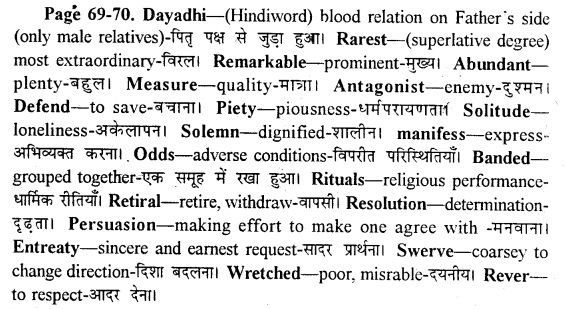
MP Board Class 11th English A Voyage Solutions Chapter 8 Of Studies

Students who are studying 11th can get the free Madhya Pradesh Board Solutions for 11th English Chapter 8 Of Studies Questions and Answers PDF here. You can download MP Board Class 11th English Solutions Questions and Answers PDF on this page. Practice questions of Mp Board Solutions of 11th English subject as many times as possible to get good marks.

MP Board Class 11th English A Voyage Solutions Chapter 8 Of Studies (Francis Bacon)

Gather chapter wise MP Board Solutions for 11th English Study Material to score the highest marks in the final exam. Various chapters and subtopics are given clearly in MP Board Class 11th English Solutions Chapter 8 Of Studies Questions and Answers Material. All the MP Board Solutions for 11th English Questions with detailed answers are provided by subject experts. The step by step MP Board Class 11th English Chapter 8 Of Studies Questions and Answers guide will help you to enhance your skills in English subject and grammar. Here, along with the subject knowledge, grammar knowledge also plays an important role. So, students should download MP Board Solutions 11th English and read it to attempt all the questions with 100% confidence.

Of Studies Textual Exercise

Word Power

I. Differentiate between the following pairs of words and use them in sentences of your own:
disease, decease
special, especial
deep, dip
moral, mural
except, accept
beat, beet
excess, access
cease, seize
Answer:

  • Disease – an illness – Mr. Sharma is suffering a chronical disease.
    Decease – the death of a person – Every one remained shocked at the decease of Mr. Jain.
  • Special – not ordinary or usual – There is something special about this place.
    Especial – better than usual – It is a matter of especial importance.
  • Deep – going or situated far down – The well is too deep to be measured.
    Dip – a quick swim – Several sadlius took a holy dip in the river Ganga.
  • Moral- concerned with principles of right and wrong behaviour – We should give due importance to our traditional moral values.
    Mural – a painting on a wall – Mural paintings can be seen on the outside wall of the ancient buildings.
  • Except- not including – .Everyone except Jatin has gone to see a movie.
    Accept – say yes – I accept your advice.
  • Beat – defeat – I beat my friend at chess.
    Beet – a plant with a root used as a vegetable.- Raddish is one of vegetable with a beet.
  • Excess – the exceeding of due limits – Excess of anything is bad.
    Access – approach – I have an easy access to the Principal.
  • Cease- come to an end – the factory had ceased making bicycles .
    Seize – take possession of by force or legal right – He seized Mr. Sin as goods for payment of debt.

II. Use the following words as Noun and as Verbs in sentences of your own:
Delight, judge, experience, stone, study, breast, head.
Answer:

  • Delight (Noun) – The students jumped with delight when they saw their favourite teacher standing in the class.
    Delight (verb) – The natural beauty of Shimla delighted.
  • Judge (Noun) – The judge gave his judgement on the case. Judge (verb) – We should judge ourselves.
  • Experience (Noun) – I have no experience in his field.
    Experience (verb) – One can easily experience the problems of these days.
  • Stone (Noun) – The wall is made of stone.
    Stone (verb) – The unruly mob stoned the police.
  • Study (Noun) – We should have good study skill.
    Study (verb) – I study for 10 to 12 hours a day.
  • Breast (Noun) – The lady put her baby to her breast.
    Breast (verb) – As I breasted the ridge. I saw the valley.
  • Head (Noun) – The king put the crown on his head.
    Head (verb) – I headed for the door.

III. Use the following words as noun and as Adjectives in sentences of your own:
common, ready, grave, beat, special
Answer:

  • Common (noun) – I go for a walk on the common every morning.
    Common (adjective) – Cancer has become a common disease nowadays.
  • Ready (noun) – I had put my camera at ready.
    Ready (adjective) – I like ready-made dresses.
  • Grave (noun) – I put flowers at my grand father’s grave on his death anniversary.
    Grave (adjective) – We have fallen into grave situation.
  • Beat (noun) – You can hear loud beats on the drum.
    Beat (adjective) – The Beating Retreat was marvellous.
  • Special (noun) – There are daily specials in our menu to choose from.
    Special (adjective) – Mr. Sharma is the special guest at the function

IV. Use the following phrases in sentences of your own: one by one, give forth, at large, call away, beat over, call up, bound in
Answer:

  • One by one – All the leaves fell from the tree one by one during autumn season.
  • Give forth – He gave forth some money to his friend.
  • At large – The criminals are still at large.
  • Call away – I was called away from the meeting to take an urgent phone call.
  • Beat over – Australia beat over the Indian cricket team.
  • Call up – He called up the doctor.
  • Bound in – The petitioner was bound in an agreement.

V. ‘Choose the word from the alternatives provided which does not mean the same as the main word:

Question 1.
delight
(a) pleasure
(b) transport
(c) enjoy
(d) rapture
Answer:
(b) transport

Question 2.
wise
(a) clever
(b) erudite
(c) receptive
(d) aspire
Answer:
(d) aspire

Question 3.
distinguish
(a) discern
(b) make out
(c) recognise
(d) clarify
Answer:
(b) make out

Comprehension

I. Choose the correct alternative from the given options:

Question 1.
‘Which of the following is not the proper use of studies?
(a) delight
(b) refinement
(c) ornament
(d) ability
Answer:
(b) refinement

Question 2.
Which types of people condemn studies?
(a) learned
(b) cunning
(c) well-bred
(d) careless
Answer:
(b) cunning

Question 3.
Which of the following is the proper use of studies?
(a) challenging the opinion of others
(b) take the written word as a Gospel truth.
(c) find the point for talking
(d) balancing conflicting opinions.
Answer:
(d) balancing conflicting opinions.

Question 4.
Which types of books can be read through extract?
(a) excellent books
(b) books concerning culture
(c) books concerning important arguments
(d) less important books
Answer:
(d) less important books

Question 5.
Which sort of books can make a person wise?
(a) books of poetry
(b) books of moral philosophy
(c) books of history
(d) books of natural philosophy
Answer:
(c) books of history

Question 6.
Who is School men?
(a) teachers of the school
(b) student of the school
(c) administrator of the school
(d) philosophers.
Answer:
(d) philosophers.

Question 7.
Which sort of exercise is suitable for the ailments of stomach?
(a) walking
(b) riding
(c) cycling
(d) bowling.
Answer:
(a) walking

II. Answer the following questions in one sentence each:

Question 1.
What are the three chief uses of studies?
Answer:
The three chief uses of studies delight, ornamentation, and ability.

Question 2.
What is affectation concerning books?
Answer:
Too much use of studies for ornamentation is affectation.

Question 3.
Which types of people admire books?
Answer:
Simple men admire books.

Question 4.
Which sort of books can be studied through extracts made by others?
Answer:
Meaner sorts of books can be studied through extracts made by others.

Question 5.
What makes a man ready?
Answer:
Conference makes a man ready.

Question 6.
What is the use of moral philosophy?
Answer:
The books of moral philosophy gives depth.

Question 7.
Which sport is proper for curing the diseases of lungs?
Answer:
Shooting is proper for curing the diseases of lungs.

Question 8.
What should a person, whose mind wanders, read to cure him of their, wandering?
Answer:
Such a person should study mathematics.

Question 9.
Why are schoolman called “hair splitters”?
Answer:
Schoolman are called “hair splitters” because they often discuss very uncommon questions like why fire is hot and water is wet; how plants and animals grow.

Question 10.
What sort of people should study the schoolmen?
Answer:
The persons whose wit is not apt to distinguish or find differences should study the schoolmen.

III. Answer the following questions in three-four sentences each:

Question 1.
Write about the rules Bacon advocates concerning the rules for study.
Answer:
Bacon advocates some rules for study. He says not to read to contradict and confute nor to believe and take for granted nor to talk and discourse but to weigh and consider.

Question 2.
How can studies cure mental deficiencies?
Answer:
Studies cure mental deficiencies. If a man’s wit is wandering, he should read mathematics. If his wit is not apt to distinguish and find differences, he should study the schoolmen. If he is more logical, he should study the lawyer’s cases. These are the proper cure for the mental possession.

Question 3.
Discuss the value of different types of studies?
Answer:
While talking about the value of studies. Bacon says that they serve for delight, for ornament and for ability. They perfect nature and are perfected by experience. They give forth directions too much at large. They make a full man. Histories make men wise where as poets make them witty. The mathematics subtitle and natural philosophy gives depth and logic and rhetoric make them able to contend.

Question 4.
What does Bacon mean by, “studies pass into and influence manners”?
Answer:
Bacon with their expression highlights the real character of studies. Studies become a talent and trait of a human being. They give perfection and depth. They change our behaviour and outlook.

IV. Answer the following question in a paragraph.

Question  1.
Write the summary of the essay ‘Of Studies in your own words.
Answer:
See the summary in English.

V. This essay of Bacon is full of balanced sentences. Balance means equal distribution of weight. In the essays of Bacon we find two or more parts that are grammatically equivalent or coordinate – balanced against each other. Here is one such sentence:
“To spend too much, time in studies is sloth; to use them too much for ornament is affectation; to make judgement wholly by their rules is the humour of a scholar.”
Search two more examples of such balanced sentences from the essay.
Answer:

  • Crafty men condemn studies, simple men admire them and wise- men use them; for they teach not their own use; but that is a wisdom without them, and above them, won by observation.
  • Reading maketh a full man; conference a ready man; and writing an exact man.

VII Bacon’s essays have been called aphoristic. An aphorism is a short witty remark, which contains a general truth or wise observation often in a clever way. Sometimes aphorisms rhyme, sometimes they have repeated words or phrases, and sometimes they have two parts that are of the same grammatical structure. Some examples are given here:
“Marry in haste: repent at leisure.” Scottish proverb “Better to light a candle than to curse the darkness.” Chinese proverb
Search from the essay “Of Studies” two such aphoristic remarks.
Answer:

  • Some books are to be tasted; others to be swallowed.
  • Histories make men wise, poets witty.

VIII. Here are given two statements. Locate the sentences in the essay, which mean the something as these sentences:

(a) It is mere laziness to spend too much time in studies. It is affectation to show off learning. It is only a scholar who is wholly guided by book learning.
(b) Read not to contradict, believe, nor find talk; but to consider.
Answer:
The similar statements for the above sentences in the essay are
(a) To spend too much time in studies is sloth; to use them too much for ornament, is affectation.
(b) Read not to contradict and confute; nor to believe and take for granted; nor to find talk and discourse; but to weigh and consider.

Grammar

(See Text book pages 56 – 57)

I. Complete the following sentences, being careful to choose the correct verb forms:

1. Raina will stay in London for three years if……….
2. She will work overtime if……….
3. She will another English Grammar book if………..
4. She will move to a better city if………..
5. She will buy another computer if……….
6. Raina would not get to her class if……….
7. You would not pass the examination if………..
8. You cannot get the right reply from the criminal if………..
9. You would not get any letters if……….
10. Raina would not make good friends if……….
11. Raina will invite Karan if……….
12. Raina will fail in English if……….
13. Raina will go back to America if……….
14. She would lose weight if……….
15 She would need more money than she gets if……….
Answer:

  1. ………. she gets admission there.
  2.  ………. she gets good wages.
  3. ………. it is not sufficient.
  4. …….. she gets a chance.
  5. ……… it does not work well.
  6. ……… she had got late.
  7. ……… you had not worked hard.
  8. ……… you inform the police.
  9. ……… there had been strike.
  10.  ………. she had not behaved well. .
  11. ………. there is a function.
  12. ……… she does not get good coaching.
  13.  ……… the weather does not suit her.
  14.  ……… she took proper exercise.
  15. ………. her father came.

Speaking Activity

Question 1.
The present essay tells you much about the importance of books in life. Now, on the basis of your own experiences discuss your own views about the importance of books and how you should study these. Express your views in at least five sentences about any aspects’of reading books in the class.
Answer:
I am very fond of reading books. They gave me delight. I get so much of knowledge. Books enrich our power of knowledge and give us confidence. They open our mind.

Writing Activity

Question 1.
Read the following passage and answer the questions that follow:
Our ancestors had great difficulty in procuring books. Ours is now what to select. We must be careful, what we read. There are, indeed, books and books and there are books, which, as Lamb said, “are not books at all.” There are many books; to which one may apply, in the sarcastic sense, The ambiguous remark, which Lord Beacons field, made to an unfortunate author, “I will lose no time in reading your book.” Others are more than useless, and poison the mind with the suggestions of evil. Few people realize how much the happiness of life, and the formation of character, depends on a w’ise selection of books we read.
1. What was difficult for our ancestors to do?
2. What difficulty concerning books is felt by us today?
3. On what the happiness of life depends?
4. Give a suitable title to the above passage?
5. Give synonyms of the following words:
Procure, Sarcastic, Ambiguous
6. Give antonyms of the following words:
Difficulty, Useless, Evil
Answer:

  1. Procuring books was difficult for our ancestors.
  2. Selection of books has become difficult for us today.
  3. Happiness of life depends on a wise selection of books we read.
  4. Value of books.
  5. get, witty, vague
  6. useful, good.

Think it Over

You have been reading and writing essays for a very long time. These can be written on any topic, though the length is usually not very much. Many essayists have written essays about the art of reading books. Try to make list of essays that deal with the art of reading books.
Answer:
Do yourself.

Things To Do

Question 1.
One such essay was written by Montaigne, which was translated from original French into English by john Florio. The title of the Essay is “Of Books.” Try to read the essay of Montaigne. Also read some other essays on this subject.
Answer:
Do yourself.

Of Studies Summary in English

It is an essay about the value of studies. Studies are meant for delight ornamentation and ability. Its real use is recognizable for delight in privateness and refining. It proves its value in discourse, in judgement and in business. Expert persons can execute and judge anything in particular while a general person can only counsel. The expertises only come out of the learned. It is sloth to spend too much time on studies. Its excess use also becomes odd and sticking to everything only through laws becomes ridiculous. Scholars make nature perfect and they themselves are perfected by experiences. Cunning people condemn studies while simple men praise them and wise men use them.

It is because wisdom is the super quality.Talking about reading Bacon says reading is not to create contradiction or confusion, nor to believe and take for granted, nor to find talk and discourse but to weigh and consider. These are a lot books around us. But all of them are not useful. Some of them are just to taste, some to be swallowed, some to be chewed and digested. One can read some of them only in past, some in full but without curiosity, and some with attention and diligence. We can read some books only by its cover and reviews made by others. But those are not of much importance.

They are meaner sorts of books. While talking about reading the author says that it makes a man full, conference makes a man ready and writing makes a man perfect. In the same way histories make men wise, poets witty. Mathematics makes men subtitle and books on natural philosophy gives depth of moral value to men whereas the books of logic and rhetoric provide ability to contend. Studies pass into and influence our manners. The essayist further says that there is no defect or hurdle in a wit but there may be distortion in studies as we get diseases in body if we not take proper exercise.

As bowling is good for disease of stone and reins, shooting for lungs and breast, gentle walking for the stomach, riding for the head so the writer says that a man with wondering wit should study mathematics. It will twist his wit. If his wit is not apt to distinguish, he should study the School men because they often ask uncommon questions. But if one is very logical he should study the lawyer’s cases. It is therefore, the author concludes that every defect of the mind may have a special receipt.

Of Studies Summary in Hindi

प्रस्तुत पाठ अध्ययन के महत्व के विषय में एक निबंध है। अध्ययन आनंद, सौंदीकरण और योग्यता के लिए होता है। इसकी सही पहचान अकेले में आनंद और परिष्कार के समय में की जाती है। अध्ययन का महत्व वार्तालाप, न्याय और कारोबार में सिद्ध होता है। कुशल मनुष्य निर्णय लेता है और न्याय करता है जबकि एक सामान्य मनुष्य केवल विचार देता है। दक्षता केवल ज्ञानी लोगों में होती है। अध्ययन पर बहुत अधिक समय देना आलस्य है। इसका बहुत अधिक उपयोग भी मद्यापन है और किसी भी मामले में नियम से दृढ होना भी मजाक का विषय होता है। ज्ञानी लोग अपनी प्रकृति को परिपक्व बनाते हैं और वे स्वयं अनुभव से परिपक्व होते हैं। धूर्त लोग अध्ययन की आलोचना करते हैं जबकि सामान्य लोग इसकी प्रशंसा करते हैं और ज्ञानी लोग इसका उपयोग करते हैं।

ऐसा इसलिए कि ज्ञान सर्वोच्य गुण है। पढ़ाई के बारे में चर्चा करते हुए बेकन कहता है कि पढ़ाई विवाद या संशय (भ्रम) पैदा करने के लिए नहीं होती न ही जेसा है वैसा मानने के लिए न ही सिर्फ बातें करने के लिए बल्कि सही आकलन और विचार करने के लिए होती है। हमारे चारों ओर बहुत-सी किताबें हैं लेकिन उनमें से सभी उपयोगी नहीं है। उनमें से कुछ सिर्फ चखने के लिए है, कुछ निगलने के लिए है और कुछ चबाने और पचाने के लिए है। कोई व्यक्ति उनमें से कुछ का केवल एक अंश पड़ सकता है, कुछ को पूरा पढ़ सकता है लेकिन बिना किसी जिज्ञासा के और कुछ को पढ़ने के लिए एकाग्रता और मेहनत या लगन की जरूरत है। हम कुछ किताबों को केवल उनके आवरण या दूसरे लोगों द्वारा उसके बारे में की गई टिप्पणियों से पढ़ सकते हैं।

लेकिन वे किसी विशेष महत्व के नहीं है। वे घटिया या निम्न स्तर की पुस्तकें हैं। अध्ययन के बारे में बात करते हुए लेखक कहता है कि यह मनुष्य को पूर्ण बनाता है। वाद-विवाद मनुष्य को विचार में तत्पर बनाता है और लेखन मनुष्य को दक्ष बनाता है। इसी तरफ इतिहास मनुष्य को ज्ञानी बनाता हे, कवि उसे तार्किक बनाता है। गणित मनुष्य को ठोस बनाता है और सामान्य दर्शशास्त्र की पुस्तकें मनुष्य को नैतिक मूल्यों की गहराई देती है जबकि तर्कशास्त्र और कविता की पस्तकें उसे सहने की योग्यता देता है। अध्ययन हमारे अंदर प्रवेश करता है और हमारे व्यवहार को प्रभावित करता है।

निबंधकार आगे कहता है कि तर्क के रास्ते में कोई कमी या व्यवधान नहीं है। लेकिन अध्ययन में कोई मटकाव हो सकता है जैसे हमारे शरीर में कोई बीमारी हो जाती है यदि हम सही व्यायाम न करें तो। जैसे गेंदबाजी पत्थर आर रीढ़ की बीमारी के लिए अच्छा, व्यायाम है, निशानेबाजी फेफडे और सीने के लिए, टहलना पेट के लिए और घुडसवारी अच्छा व्यायाम है, वैसे ही लेखक कहता है कि जिस मनुष्य की बुद्धि चंचल है, उसके लिए गणित का अध्ययन लाभकारी है यह उसकी बुद्धि को उलझाए रखता है। यदि उसका तर्क किसी चीज के अंतर को पहचानने योग्य नहीं है तो उसे विद्यालय प्रबंधकों को अध्ययन करना चाहिए क्योंकि वे प्राय: असामान्य प्रश्न पूछते हैं। लेकिन अगर कोई बहुत अधिक तार्किक है तो उसे वकीलों के मुकदमों का अध्ययन करना चाहिए। इस प्रकार लेखक निष्कर्ष निकालता है तो मस्तिष्क के हर गड़बड़ी का एक विशेष लक्षण है।

Of Studies Word Meaning

MP Board Class 11th English A Voyage Solutions Chapter 8 Of Studies 1 MP Board Class 11th English A Voyage Solutions Chapter 8 Of Studies 2

Of Studies Comprehension

Read the following stanzas carefully and answer the questions that follow:

1. Crafty men condemn studies, simple men admire them, and wise men use them; for they teach not their own use; but that is a wisdom without them, and above them, won by observation. Read not to contradict and confute; nor to believe and take for granted; nor to find falk and discourse; but to weigh and consider.

Questions:
(i) What do crafty men do to studies?
(ii) Who admire studies?
(iii) What do the wise men do?
(iv) Why should we read?
(v) Give a word opposite in meaning to ‘admire’.

Answers:
(i) Crafty men condemn studies.
(ii) Simple men admire studies.
(iii) The wise men use studies.
(iv) We should read to weigh and consider.
(v) ‘Condemn’.

2. Some books are to be tasted, others to be swallowed, and some few to be chewed and digested; that is, some books are to be read only in parts; others to be read, but not curiously; and some few to be read wholly, and with diligence and attention. Some books also may be read by deputy, and extracts made of them by others; but that would be only in the less important arguments, and the meaner sort of books, else distilled books are like common distilled waters, flashy things.

Questions:
(i) What type of books does Bacon fond?
(ii) Which type of books can be read by its cover or reviews?
(iii) What does Bacon mean by ‘diligence’ and ‘attention’ in the above lines?
(iv) What does Bacon mean by ‘meaner sorts of books’?
Answers:
(i) Bacon finds that there are some books which can be tasted, some others which can be swallowed and some few can be chewed and digested.
(ii) Meaner sorts of books can be read by its cover or reviews.
(iii) By ‘diligence’ and ‘attention’ Bacon means concentration and labour that we need while reading some books.
(iv) By ‘meaner sort of books’ Bacon means the books with less important arguments.

3. Reading make the a full man; conference a ready man; and writing an exact man. And therefore, if a man write little, he had need have a great memory; if he confer little, he had need have a present wit: and if he read little, he had need have much cunning, to seem to know, that he doth not.

Questions:
(i) What makes a man full?
(ii) What does conference do to man?
(iii) How can a man be exact?
(iv) What does a man require if he writes little?
(v) Give a word from the passage which is similar in meaning to ‘crafty’.
Answers:
(i) Reading makes a man full.
(ii) Conference makes a man ready.
(iii) A man can be exact by writing.
(iv) If a man writes little he requires a great memory.
(v) ‘Cunning’.

Above provided complete MP Board Solutions 11th English Study guide is useful for making your preparation effective. Students can frequently visit our page to get the latest updates on other subjects study materials.
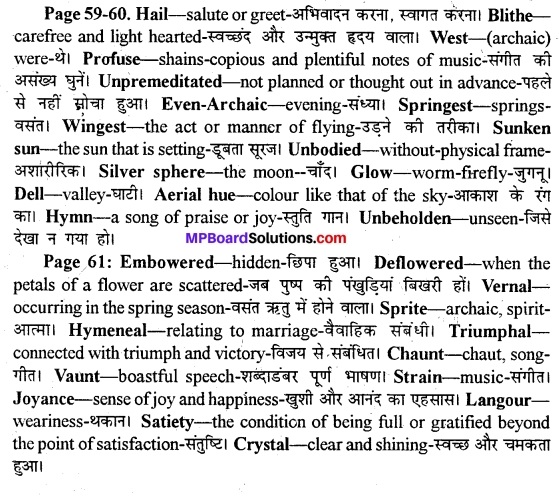
MP Board Class 11th English A Voyage Solutions Chapter 7 Mercy

Students who are studying 11th can get the free Madhya Pradesh Board Solutions for 11th English Chapter 7 Mercy Questions and Answers PDF here. You can download MP Board Class 11th English Solutions Questions and Answers PDF on this page. Practice questions of Mp Board Solutions of 11th English subject as many times as possible to get good marks.

MP Board Class 11th English A Voyage Solutions Chapter 7 Mercy (William Shakespeare)

Gather chapter wise MP Board Solutions for 11th English Study Material to score the highest marks in the final exam. Various chapters and subtopics are given clearly in MP Board Class 11th English Solutions Chapter 7 Mercy Questions and Answers Material. All the MP Board Solutions for 11th English Questions with detailed answers are provided by subject experts. The step by step MP Board Class 11th English Chapter 7 Mercy Questions and Answers guide will help you to enhance your skills in English subject and grammar. Here, along with the subject knowledge, grammar knowledge also plays an important role. So, students should download MP Board Solutions 11th English and read it to attempt all the questions with 100% confidence.

Mercy Textual Exercises

Work Power

(A) Choose the words from the text, which are opposite in meaning to the words given here:
cruelty, above, spiritual, injustice, courage, hell, curse.
Answer:

  • cruelty — mercy
  • above — beneath
  • spiritual – temporal
  • injuice — justice
  • courage — fear
  • hell — heaven
  • curse — bless

(B) Mark the use of the word, enthrone. It is verb-form, derived from the noun, throne, using the prefix,en-. Make a list of prefixes! suffixes and give verb forms of the following nouns:
power, place, heart, justice, force, quality
Answer:

  • prefixes — cm-, dis-, un-, in-, in-s dc..
  • suffixes — cd, -en, -ishy, -al, -tion, -ize, -ous, -ful, ly.
  • power — empower
  • place — displace
  • heart —hearten
  • justice —  justice
  • force — enforce
  • quality —  qualify

(C) In the 7th line, show has been used as a verb. It can also be used as noun:
The show passed off peacefully.
Make sentences using the following words as noun and verb:
season, attribute, sway, force, drop, crown
Answer:

  • Season (noun)- The advent of summer season has made me upset
  • Season (verb)- Season the meat with garlic.
  • Attribute (noun)- Tolerance is the most important attribute human being.
  • Attribute (verb)- I attribute my wonderful success to hard work.
  • Sway (noun)- The jamindars always exploited those who came under their say.
  • Sway (verb)- The branches are swaying in the strong mind.
  • Force (noun)- We can’t achieve anything by force.
  • Force (verb)- You can’t force me to do that work.
  • Drop (noun)- While walking, I saw several dew drops on the green grass.
  • Drop (verb)- I dropped my son at the bus stand.
  • Crown (noun)- The king put the crown on his bead.
  • Crown (verb)- The prince was crowned on the occasion of his birthday.

(D)Mark the of the worth, mightiest. It is an adjective in the superlative degree. The other two forms in the positive and comparative degrees are: mighty, mightier. Give the forms of ie following adjectives in the comparative and superlative degrees.
gentle, good, unlikely, quick, light, bad, far.
Answer:
MP Board Class 11th English A Voyage Solutions Chapter 7 Mercy 1

(E) Match the words in column A with those in column B.
Column A – Column B
(i) Renaissance – a. worldly
(ii) temporal – b. supreme authority
(iii) majesty – c. quality
(iv) attribute – d. power
(y) sway – e. fear
(vi) awe – f. rebirth.
Answer:
i—f,ii —a, iii— b, iv—c, v—d. vi — e

(F) Match words with their meaning, and use them in sentences of your own to bring out of the difference in their meanings. mercy the feeling of being sorry for somebody compassion used to show that you are disappointed about something pity the ability to understand another person’s feelings sympathy a kind or forgiving attitude towards somebody empathy the aim of giving money, food, help, etc. charity a strong feeling of sympathy for people.

For example,
(I) Mercy – (a kind or forgiving attitude towards somebody): The criminal pleaded for mercy from the judge
Answer:

  • Compassion ( a strong feeling of sympathy for people)—We must show compassion to those who arc in deep distress.
  • Pity (used to show that you arc disappointed about something)
    The man look pit on me and extended his hand to help me,
  • Sympathy (the feeling of being sorry for somebody)—I have no sympathy for the wrong doers.
  • Empathy (the ability to understand another person’s feeling)—We should develop empathy for other people’s situations.
  • Charity (the aim of giving money, food, help. etc)-The bollywood stars ogranised a charity concert last night.

Comprehension

(A) (i) But mercy is above this sceptred sway . Explain.
Answer:
It is above the sceptred sway because it is enthroncd in the hearts of the kings.

(ii) Why does the poet believe that ‘earthly power then show likest God’s when mercy seasons justice…’?
Answer:
The poet tells so because it appears to be God when it administers justice

(iii) His scepter shows the force of temporal power, The attribute to awe and majesty,
(a) What is an attribute to awe and majesty?
(b) What does show the force of temporal power?
Answer:
(a) An attribute to awe and majesty is force.
(b) The scepter shows the force of temporal powers.

(iv) It droppeth as the gentle rain from heaven.
Upon the place beneath. It is twice blest.
It blesseth him that gives, and him that takes.
(a) What is mercy compared above lines?
(b) How is mercy twice-blessed
Answer:
(a) Mercy is compared with the gentle rain that drops from heaven.
(b) Mercy is double blessings. On the one hand, it is a boon for the one who gives and a blessing for the other who takes.

(B) Write answer to the following questions in two or three sentences each.

Question 1.
What is the quality of mercy?
Answer:
Mercy is a super divine power.It is not forced.

Question 2.
What makes mercy twice-blessed?
Answer:
On the one hand mercy falls upon the giver as a gift of God and on the other it obliges the taker.

Question 3.
What does quality a monarch more-mercy or throne? Why?
Answer:
It is mercy that qualifies a monarch more. A monarch, by showing mercy, can win the hearts of his subjects.

Question 4.
What does the scepter show?
Answer:
It shows the force of temporal power.

Question 5.
What is an attribute of God himself?
Answer:
It is mercy itself.

Question 6.
What happens when mercy is tempered with justice?
Answer:
When mercy is tempered with justice, it becomes divine.

(C) Write answer to the following questions in about 150 words:

Question 1.
How does mercy bless the given and the take alike?
Answer:
Mercy is a poem which occurs in Shakespeare’s famous comedy’ The Merchant of Venice’. In these lines Shakespeare through his famous character Portia explains the value of mercy. It drops as a gentle rain from heaven. It is the mightest of all the powers. It is greater than the monarch’s crown. It is above all-fears. It is tribute to God himself.

As a human virtue mercy not only transcends the worldly power but also becomes divine grace when combined with justice.It is a bliss for the giver and the taker as well because the one who gives it is blessed by God and the one who takes it is blessed by the give. So it glorifies the giver and the taker alike.

Question 2.
Give the central idea of the poem.
Answer:
The poem ‘Mercy’ is an extract from a famous Shakespearean comedy. ‘The Merchant of Venice’. These lines highlight the value and characteristics of ‘mercy’. ‘Mercy’ is not forced. It drops as a gentle rain directly from heaven. It is double blessing. On the one hand, it is a boon for the one who gives and a blessings for the other who takes. It is a super divine power. It is throned monarch greater than the crown. There is the quality of fear of monarch But ‘mercy’ is above all a super quality which lives in the heart of kings. It is a godly quality and an earthly power parallel to God when it is demonstrated with justice.

Poetic Devices

Notice the comparison of mercy with rain. It is a poetic device, called simile. A simile is a comparison of two unlike things, using ‘like’ or ‘as’. Another important device is metaphor. The comparison is hidden in metaphor whereas it is obvious in simile.

For example,
(a) (i) The colonel roars like a lion, (simile)
(ii) The colonel is a lion, (metaphor)

(b) (i) He is cunning as a fox. (simile)
(ii) He is fox. (metaphor)

(c) (i) My friend is slow as a snail, (simile)
(ii) My friend is a snail, (metaphor)

(A) Frame three such pairs of sentences, showing the difference between simile and metaphor.
Answer:
Examples of similes and metaphors.

  • Kalidas was like Shakespeare of India. (Simile)
  • Kalidas was the Shakespeare of India, (metaphor)
  • Camel is like a ship of the desert. (Simile)
  • Camel is the ship of the desert (metaphor)
  • Toanay is like the sun of the family (Simile)
  • Toanay is the seen of the family, (metaphor)

(B) Notice the repetition of the same sound in the 10th line,’sceptred sway’. This is an example of alliteration. Alliteration is a figure of speech, in which the same sound or letter is repeated at the beginning of words that are close together.
For example,
Three thousands did I see at a glance ! (sound’t)
Every time the slide or sprang, (sound’s)
Answer:
Tis Mightiest in the Mightiest.
His Scepter Shows the force of temporal power But mercy is above this Sceptred Sway

Speaking Activity

(A) Read aloud parts of the poem in groups, observing the stress- pattern. (Consult and English Pronunciation Dictionary)
Answer:
Do yourself

(B) Under the Indian law, the President of India can show mercy and commute the death sentence to life imprisonment. Do you think this provision should be continued? Give your arguments (for, or against). .
Answer:
There is a provision in the Indian law that one who is convicted to
death sentence can make a plea for mercy to the President of India The President has been designated to annual the court’s judgment of death sentence convert into lesser punishment. But as I feel this is not a good practice. Recently we have seen that a person who has been convicted to death sentence for his terrorist activity, his plea for mercy on compassionate ground to the President.

The President handed over the case to the Ministry of Home Affairs. Still the case isn’t decoded. In this situation the fate of a convicted person hangs in uncertainty. The system of Indian law is so clumsy that the person dies before it is decoded by the law. So such provision should be stopped.

Writing Activity

(A) Develop a story on the moral of mercy with the help of the following outlines: there lived a saint-visitor to the river- a scorpion bit, him-he was asked to kill it-the saint refused-wisdom prevailed
Answer:
There was a saint. The was having his bath in a river He saw a scorpion drowning) He tried to save it. His other fellows asked him to kill it. But the saint refused to do so. Every time he took the scorpion on his palm to save it, it but him. But the saint did not leave his effort. Finally he held the scorpion and threw it out of water. It was saved. The wisdom prevailed. The saint said that as it was nature of scorpion to bite, so it bit him. In the same way the saint was to show mercy as per his nature. So he saved it.

(B) Write a letter to your friend, narrating one such event when your act of mercy was highly appreciated.
Answer:
For self attempt

Think Over

(A) Mercy ennobles mankind. Think of other values which contribute to the development of human personality.
Answer:
The other values which contribute to the development of human personality are:

  • Forebearance
  • tolerance
  • truthfulness
  • honesty
  • benevolence
  • generosity
  • kindness
  • sympathy

(B) Every religion insists on showing mercy to fellow creatures. Think of the other noble values fostered by religions.
Answer:
The other noble values fostered by religion are:

  • palience
  • berevalence
  • secularism
  • purity
  • devotion
  • sacrifice

Things To Do :

(A) Prepare a list of William Shakespeare’s comedies.
Answer:

  • The Merchant of Venice
  • Much Ado About Nothing
  • As You Like It
  • Twelfth Night
  • The Comedy of Errors
  • Love’s Labour’s Lost
  • A Midsummer Night’s Dream.

(B) Have you read any other 14-line poem in rhyme-scheme? It is known as sonnet. Shakespeare has written 154 sonnets in all, based on his own life. Read some of the sonnets and examine their rhyme-scheme.
Answer:
Do yourself.

(C) Read the following extract-from Shakespeare’s play, Hamlet and underline the lines that are well-known and out-quoted. (See Text book page-50)
Answer:
The well-known as out-quoted lines in the given form are:

  • Give thy thoughts no tongue
  • Give every man there ear; but few thy voice
  • Take each man’s censure: but reserve thy judgment
  • Costly thy habit as thy purse can buy
  • The apparel of proclaims the man
  • Neither a borrower nor a lender be
  • Loan oft loses both itself and friend.

(D) What do you understand by these lines explain in two to three sentences.
(a) Give every man thine ear; but few thy voice
(b) Costly thy habit as thy purse can buy
(c) Apparel off proclaims the man
(d) Neither a borrower nor a lender be
Answer:
(a) This line means we should listen to all but speak our view only to the resemble persons.
(b) Here the poet means to say that we should not cultivate costly habits which we can not fulfill by our means.
(c) This line means that we can recognise the character of a man through his dress what he wears.
(d) Here, the poet suggests as not to get a loan nor we should lend money to others.

Mercy Summary in English

The poem ‘Mercy’ is an extract from a famous Shakespearean comedy. ‘The Merchant of Venice’. These lines highlight the value and characteristics of ‘mercy’. ‘Mercy’ is not forced. It drops as a gentle rain directly from heaven. It is double blessing. On the one hand, it is a boon for the one who gives and a blessings for the other who takes. It is a super divine power. It is throned monarch greater than the crown. There is the quality of fear of monarch But ‘mercy’ is above all a super quality which lives in the heart of kings. It is a godly quality and an earthly power parallel to God when it is demonstrated with justice.

Mercy Summary in Hindi

प्रस्तुत कविता शेक्यपीयर के प्रसिद्ध कॉमेडी ‘दि मर्चेन्ट ऑफ वेनिस’ से लिया गया है। कविता की पंक्तियाँ ‘दया’ के मूल्य को दर्शाती हैं। कवि कहता है कि ‘दया’ किसी पर लादी नहीं जा सकती। यह स्वत: बारिश की तरह स्वर्ग से सीधी गिरती है। यह दोहरा आशीर्वाद है। एक तरफ यह दाता के लिए वरदान है, तो दूसरी तरफ लेने वाले के लिए आशीर्वाद है। यह अलौकिक शक्ति है। यह सिंहासन पर बैठे राजा के मुकुट से भी महान और बड़ा है। ‘दया’ डर और भय से ऊपर है। यह अलौकिक गुण है जो राजाओं के हृदय में वास करता है। यह ईश्वरीय गुण है। यह ईश्वर के समानांतर लौकिक शक्ति है लेकिन तब जब साथ न्याय का समावेश होता है।

Mercy Word Meanings
MP Board Class 11th English A Voyage Solutions Chapter 7 Mercy 2

Mercy Comprehension

Read the following stanzas carefully and answer the questions the follow:

1. The quality of mercy is not strained;
It droppeth as the gentle rain from heaven .
Upon the place beneath. It is twice blest
It blesseth him that gives, and him that takes.

Questions:
(i) What is talked about is these lines?
(ii) How does the poet qualify, mercy?
(iii) For whom is the mercya bliss?
(iv) rive a word from the stanza similar is meaning to ‘forced’?
Answers:
(i) Mercy is talked about here is these lines.
(ii) The poet qualifies mercy as gentle rain from heaven.
(iii) Mercy is a bliss both for the giver and the taker.
(iv) ‘Strained’

2. It is enthroned in the hearts of Kings,
It is an attribute to God himself.
And earthy power then show likest
God’s When mercy seasons justice.

Questions:
(i) What does mercy do with the king?
(ii) What is mercy?
(iii) When it becomes a divine grace?
(iv) Give a word from the above stanza which is opposite in meaning to ‘dethroned’.
Answers:
(i) Mercy is enthroned in the hearts of kings.
(ii) Mercy is an attribute to God. It is unearthly power.
(iii) It becomes divine grace when combined with justice.
(iv) ‘enthroned’.

Above provided complete MP Board Solutions 11th English Study guide is useful for making your preparation effective. Students can frequently visit our page to get the latest updates on other subjects study materials.

MP Board Class 11th English A Voyage Solutions Chapter 6 Cherry Tree

Students who are studying 11th can get the free Madhya Pradesh Board Solutions for 11th English Chapter 6 Cherry Tree Questions and Answers PDF here. You can download MP Board Class 11th English Solutions Questions and Answers PDF on this page. Practice questions of Mp Board Solutions of 11th English subject as many times as possible to get good marks.

MP Board Class 11th English A Voyage Solutions Chapter 6 Cherry Tree (Ruskin Bond)

Gather chapter wise MP Board Solutions for 11th English Study Material to score the highest marks in the final exam. Various chapters and subtopics are given clearly in MP Board Class 11th English Solutions Chapter 6 Cherry Tree Questions and Answers Material. All the MP Board Solutions for 11th English Questions with detailed answers are provided by subject experts. The step by step MP Board Class 11th English Chapter 6 Cherry Tree Questions and Answers guide will help you to enhance your skills in English subject and grammar. Here, along with the subject knowledge, grammar knowledge also plays an important role. So, students should download MP Board Solutions 11th English and read it to attempt all the questions with 100% confidence.

Cherry Tree Textual Exercises

Word Power

1. The poet has used words that are used as ‘nouns’ and verbs both like ‘watered’. Use the following from the poem as nouns and verbs both in two separate sentences of your own:
[summer, grass, sycthe, shoots, arms, light, air, watch, season, jewel, blossom. ]
Answer:

  • Summer (noun) – The summer has begun.
    Summer (verb) – He usually summers in Shimla
  • Grass (noun) – The dry grass caught fire
    Grass (verb) – The man grassed
  • Scythe (noun) – The woman is cutting the grass With a scythe
    Scythe (verb) – She scythed the grass quickly.
  • Shoots (noun) – I saw new green shoots in the plant.
    Shoots (verb) – The troop is shooting at the enemy.
  • Arms (noun) – We should keep an arm’s distance with our enemies.
    Arms (verb) – The man armed himself with sticks and stones.
  • Light (noun) – Light travels in a straight line.
    Light (verb) – Light the lamb, please.
  • Air (noun) – Air is the mixture of gases.
    Air (verb) – Air the bed sheets well.
  • Watch (noun) – I have purchase a new watch.
    Watch (verb) -1 don’t watch T.V. frequently.
  • Season (noun) – The season of monsoon has arrived.
    Season (verb) – Season the lamp with garlic.
  • Jewel (noun) – I have put all my jewels in a safe.
    Jewel (verb) – It was jewelled with pearls
  • Blossom (noun) – The trees are in blossom.
    Blossom (verb) – Our friendship blossomed into love.

Poetic Devices

(A) Following have been ‘personified’ in the poem

(1) ‘Cherries have a way of growing’
(2) a tree had come to stay
(3) a monsoon blight-shirvelled the slender stem.
Find more examples of personification from the poem and write explanation of the lines above (1, 2, 3) and the expressions selected by you.
Answer:

S.No. Examples of PersonificationExplanation
1.Cherries have a way of growing.They grow like human being naturally.
2.A tree had come to stay.It had grown full.
3. A monsoon blight shrivelled the – slender stem.Monsoon and other natural supports have made the tree strong.
4.The young tree struggle.The tree makes its growth at its own.
5.lime and the rain made miracleTime and the rain have acted like some miraculous power.

(B) Rhyming scheme: The poem has a rhyming scheme. Mark it and write out the details. Also find out where the poet deviates and say why.
Answer:
The rhyme scheme of the poem is a, a, b, b except a few places where the poet deviates in under to change the mood and his expression.

(C) In the beginning of the poem is talking of the Cherry tree and how it grew against all odds towards the end he expresses his own joy and action pick out the stanza and write its meanings.
Answer:
The growth of the cherry tree against all odds is expressed through these lines:
……. Even so,
next spring I watched three new shoots grow,
The young tree struggle, upward thrust,
Its arms in a fresh fierce lust
For light and air and sun.
The lines that express the poet’s joy- came back thinner, rather poor,
But richer by a cherry tree at my door.
Yes, I!-praised Night and Stars and tree.
That small, the cherry, grown by me.

(D) Alliteration is a figure of speech in which first sounds are repeated to give the poem a lyrical quality.
For example:
a monsoon blight
Shrivelled the slender stem …………..

Find other examples from the poem and write them in your note- book.
Answer:

  • Its arms in a Fresh Fierce lust
  • Who Watched, Wandering, While Time and the rain
  • Made a Miracle from green growing pain
  • Swiftly, and the Stars turned in the Sky,
  • And Moon Moths and singing crickets and I-

Comprehension

(A) On the basis of the reading of the poem, answer the questions:

Question 1.
What difficulties did the cherry tree face in growing up?
Answer:
The difficulties that the cherry tree faced in growing up were that-
It was not watered. It was suppressed by the tall, wild grass. Goats ate its leaves. Grass cutter scythe it and split it apart.

Question 2.
What is the miracle? How was it caused by time and rain?
Answer:
The miracle is something that is thought to be done by some divine or super-natural power. Here, time and rain caused the growth and bloom of the cherry tree despite all its difficulties.

Question 3.
What does the poet refer to in ‘five month’s child’?
Answer:
The poet refers to the cherry tree as ‘five month’s child.

Question 4.
The poet says, Its arms in fresh fierce lust’. What do ‘Its arms’stand for?
Answer:
Its are stand for the branches of the cherry tree.

Question 5.
Mention two things that the poet saw when he was trying to look at the sky through the leaves of the cheery tree.
Answer:
The two things that the poet saw when he was trying to look at the sky through the leaves of the cherry tree were:

  • the finches which flew and flitted
  • bees drinking nectar from each bloom of the cherry tree.

Question 6.
Pick out the lines from the poem that convey that the cherry blossoms are delicate.
Answer:
The following lines from the poem convey that the cherry bloosoms are delicate -there were blossoms small Pink, fragile, quick to fall At the merest breath, the sleepiest breeze

Question 7.
(A) What is the poet trying to say in the expression ‘cherries have a way of growing’?
Answer:
By the expression cherries have a way of growing’ the poet means to say that cherry’ is tree and hence a natural object. Nature has its own way to protect its world. So, despite all hurdles the cherry tree grows and blooms. There is no power which can stop the process of nature.

(B) What do you understand by the following expression? Write a
sentence for each expression to bring out its meaning:
1. grass running wild
2. monsoon blight
3. growing pains
4. sleepiest breeze
5 . dappled green
6. blue blind sky
7. fresh fiercest lust
Answer:

  1. Grass running wild-The cherry tree is covered with grass running wild.
  2. Monsoon blight-The monsson blight has marred the growth of the plant.
  3. Growing pains-I was very much depressed at the growing pains at every’ step.
  4. Sleepiest breeze-The sleepiest breeze comforted me geatly.
  5. Dappled green-It was strange to see the bees dunking nectar
    through dappled green.
  6. Blue blind sky-The blue blind sky failed all predictions of monsoon.
  7. Fresh fierest lust-No fresh fierest lust could affect his way.

(C) Complete the following summary of the poem by filling the gaps using the expressions from the poem:
The poet sowed a seed about ………. ago because he wanted a ………. own. Once in the month of May he found a tree that ………. and had survived the ………. grass cutter’s ………. and the monsoon ………. through it was it grew three new shoots ………. and ………. grew upward w hen he came back from Kashmir he could ………. believe that a Cherry tree had ………. and ………. in the sun.
Next year it bore pink………. that were ………. and ……….. As he was relaxing in his garden he saw the ………. as they and ………. through the green. He saw bees as they drank ………. the from each .
Answer:
The poet-sowed a seed about eight-years ago because he wanted a tree of his own. Once is die month of May he found a tree that grew and had survived the goat’s eating and grass-cutter’s scythe and the monsoon blight though it was shrivelled it grew three new shoots young and it grew up word when he came back from Kashmir he could hardly believe that a cherry tree had tipened and jeweled in the sum. Next year it bore pink blossoms that were fragile and quick to fall. As he was relaxing in his garden he saw the finches as they flew and flitted through the dappled green He saw beas as they drank nectar from each bloom.

Speaking Activity

A. The poem starts with a flash back where the poet recollects something from the past and then narrates about present. Talk to your friend about your childhood of something that you recollects as a pleasant memory which has borne fruits in your present life, (work in pairs) Share this with your class. Select two best narratives and put them in a poem form. Your can think of a friend a scene an incident a school happening
Answer:
Do it yourself.

B. Read out the poems in the class and hold discussions on their poetic qualities, use of language and figure of speech etc.
Answer:
Do it yourself.

Writing Activity

A. Read the following poem and write answer to the questions given after the poem.
Answer:
See the poem on the text book page (41-42).

Questions:
(i) Why does the poet call it April’s gift?
(ii) Why does the poet call it as Birthday ornament of spring?
(iii) What are the other flowers that the poet names in the poem?
(iv) What is the colour of almond blossoms?
(v) How does the poet tell us that there are no leaves on the tree?
(vi) What happens when the winter winds blow?
Answer:
(i) The poet calls it April’s gift because it (almond tree) blossoms in April.
(ii) The poet calls it as Birthday ornament of spring because it is like a gift of nature.
(iii) The poet names some other flowers like king-cup, blackthorn.
(iv) The colour of almond blossoms in crimson.
(v) The poet tells us that there are no leaves on the tree as follows- Lest. with longing over-tried
We die as the violet died.
(vi) When the writer winds blow, all the red bells of almond ring with a bee in every bell and almond bloom.

B. Use the following words from the poem in sentences of your own
trust – clouding
dare – bough
royal – greet
stridy
Answer:

  • trust – He has full time in me,
  • dare — I can’t dare to say about he incident.
  • royal — The king was in his royal suit.
  • sturdy – Amit is a boy of sturdy build.
  • clouding — Several doubts are clouding me.
  • bough – The boughs of the tree are all slender and weak.
  • greet — I greeted my friend warmly.

Think it Over

All trees have a different way of growing, some are delicate some are hardly plants; some are perinnial and some seasonal; some are fruit bearing and others are decorative with beautiful foliage and flowers; have you tried to grow plants of your.. own? Which were those? Express your view on pleasures is pains of growing tree, plant etc.
Answer:
Do yourself

Think To Do

A. You have read William Wordsworth’s poem Daffodils whose the poet says
“For oft, when on my couch I lie,
They flush upon that inward eye
which is bliss of solitude;
And then my heart with pleasure fills,
And dance with the daffodils.”
Compare the lines with Ruskin Bond’s following lines:
I by on grass, at ease
Looking up through leaves at the blue Blind sky”
Answer:

  • In both the poems, the poets enjoy the bliss of nature. While Wordsworth
  • Daffodils’ in sitting alone and is thinking about the scene of the daffodils in his imagination, Rusking Bond is enjoying nature’s beautiful scenes just now.

B. Read the following verses carefully and answer the questions that follow.
(See the poem on Textbook page-43)

Questions:
(i) Describe in your own words the effect on a slender brich tree of the snow fall.
(ii) What is the poet trying to say in the last line of the poem?
(iii) Describe the effect of the following on birch trees:
(a) ice-storms
(b) rising breeze
(c) warmth of the sun Answers
1. The slender birch tree has been bent down.
2. The poet is trying to say that the real bliss of nature seems to be over.
3.

  • The birch trees have been bent down.
  • They click upon themselves with rising breeze.
  • The warmth of the sun makes them shed crystal sheds.

(iv) Say whether the following statements are true or false.
(a) A child in the tree is swinging the birch tree.
(b) The tree is siwnging left and right due to the blowing of breeze.
(c) The birch trees are misshaped by the ice-storm.
(d) After the sun-rise, the branches begin to move gently left and right and look like a rainbow.
(e) After the sunrise, the trees loaded with ice become the inner
dome of heaven.
Answer:
(a) true, (b) true, (c) true, (d) false, (e) true.

Cherry Tree Summary in English

‘Chery Tree’ is a poem by Ruskin Bond. It tells us the poet’s ecstasy over a tree of his o\Vn which took eight year to grow.

Eight years have passed since the poet placed a cherry seed in the grass. He thought it to be his own tree. He watered it once. After that he forgot about it. But as cherries have a process of growing, so poet’s cherry also grew without any care. Suddenly in a summer season the poet found the growth of a tree of cherry. It was small like a five month old child lost in tall, wild grass. Goats ate its leaves and grass-cutter had snapped it with his syethe. Even after that the poet saw in the next spring three new shoots grown there. The young tree had struggled upward for fresh light and air and sun.

The poet had waited while time and the rain had done wonder by giving full growth to the tree. Next year the poet went to Kashmir to spend his holidays. When he came back he found a full grown cherry tree at his door. It was six feet high. He hardly believed its berries. They were ripened and jewelled in the seen hanging from a branch. The other year there were blossoms pf different colours giving comfort to the poet.  The poet while lying on the grass with comfort was looking up through leaves at the blue blind sky. He also enjoyed finches (small passorine birds) flying in the sky softly and rapidly.

The poet also felt the joy of looking at the bees sucking nectar from each bloom of the cherry tree. The sun was sinking softly and the stars turned in the sky. The singing of the crickets and shining of the moon were also very comfortable. The poet is thankful to the cherry tree which provided him with such a fine heavenly bliss.

Cherry Tree Summary in Hindi

‘Cherry Tree’ रस्किन बांड की कविता है। इसमें कवि के एक पेड़ के लिए, जिसे उसने आठ वर्ष पहले अपने लिए लगाया था, आनंद का वर्णन है। आठ वर्ष बीत गए जब कवि ने घास में चेरी के बीज को बोया था। वह इसे अपना पेड़ समझकर बोया था। उसने इसे एकबार सींचा। इसके बाद वह इसके बारे में भूल गया। परन्तु चेरी के बढ़ने की एक प्रक्रिया है, इसलिए कवि का चेरी भी बिना किसी देखभाल के बड़ा हो गया। अचानक एक गर्मी के मौसम में कवि ने चेरी के पेड़ की वृद्धि देखी। यह एक पांच महीने के बच्चे की तरह छोटा था जो लंबी जंगली घास में छिपा था। बकरियों ने इसके पत्ते खा लिए फिर एक घसियारे (घास काटने वाला) ने अपनी कैंची से उन्हें कतर डाला। इसके बावजूद कवि ने अगले वसंत ऋतु में इसमें से तीन नई छोटी-शाखाओं को उगा हुआ देखा। युवा पौधा प्रकाश, हवा और धूप से संघर्ष करते हुए ऊपर की ओर बढ़ा।

कवि प्रतीक्षा करता रहा जबकि समय और वर्षा ने चमत्कार करते हुए पेड़ को पूर्ण विश्वास दिया। अगले वर्ष कवि अपनी छुट्टियाँ बिताने कश्मीर गया। जब वह लौटकर आया तो उसने अपने दरवाजे पर एक पूर्ण विकसित चेरी का पेड़ देखा। यह छह फीट ऊँचा था। बड़ी-मुश्किल से वह इसके फलों पर विश्वास कर पाया। वे पक चुके थे और धूप के कारण डालियों पर सुशोभित थे। दूसरे वर्ष वे कई रंगों में खिल गए और कवि को सुखद अनुभूति देने लगे।

कवि घास में लेटे हुए बड़े आराम से पत्तियों के झुरमुट से नीले, काले आकाश में देखता है। वह आकाश में मृदुता और तेजी से उड़ते हुए छोटे पक्षियों को देखकर आनंदित होता है। कवि मधुमक्खियों को चेरी के फूलों से अमृत रस चूसते हुए देखकर आनंद अनुभव करता है। सूर्य धीरे-धीरे डूब रहा था और आकाश में तारे नजर आ रहे थे। झींगुरों का गाना और चांद का चमकना भी बड़ा आनंददायक था। कवि चेरी के पेड़ के प्रति शुक्रगुजार महसूस करता है जिसने उसे स्वर्ग-सी अनुभूति प्रदान की।

Cherry Tree Word Meanings

MP Board Class 11th English A Voyage Solutions Chapter 6 Cherry Tree 1

Cherry Tree Comprehension

Read the following stanzas carefully and answer the questions that follow:

1. Eight year have passed
Since I placed my cherry seed in the grass,
“Must have a tree of my own, I said,
And watered it once and went to bed And forgot.

Questions:
(i) Who is ‘I’ in these lines?
(ii) What did ‘I’ do eight years ago?
(iii) Why did ‘I’ do so?
(iv) What did ‘I’ do after that?
(v) Give a word from the stanza which is opposite to ‘remembered’.
Answers:
(i) T in these lines is the poet-the narrator.
(ii) ‘I’ placed a cherry seed in the grass eight years ago.
(iii) ‘I’ did so thinking it to be a tree of his own.
(iv) T watered it once and then forgot it.
(v) ‘forgot’.

2. Goats ate the leaves, the grass cutter’s sycthe
split it apart and a monsoon blight
Shrivelled the slender stem Even so.

Questions:
(i) What is being talked about her in these lines?
(ii) What did the goats do to it?
(iii) What did the monsoon blight do to the tree?
(iv) How was the tree split apart?
(v) Give a word from the above stanza similar in meaning to ‘thin’.
Answers:
(i) A little cherry tree is being talked about here.
(ii) The goats ate the leaves of the tree.
(iii) The monsoon blight made its stem shrivelled and slender.
(iv) The tree was split apart by the grass cutter’s scythe.
(v) ‘slender’.

3. I lay on the grass, at ease,
Looking up through leaves at the blue
Blind sky, at the finches as they flew
And flitted through the dappled green.

Questions:
(i) Where was the poet lying?
(ii) What was he doing there?
(iii) What did he see in the sky?
(iv) Explain the expression ‘the blue blind sky’.
(v) Explain the meaning of ‘dappled’.
Answers:
(i) The poet was lying on the grass.
(ii) He was enjoying the beauty of nature in the sky.
(iii) He saw finches flying in the sky.
(iv) The blue sky is sometimes covered with dark cloud.
(v) dappled-variegated with round patches.

Above provided complete MP Board Solutions 11th English Study guide is useful for making your preparation effective. Students can frequently visit our page to get the latest updates on other subjects study materials.
MP Board Class 11th English A Voyage Solutions Chapter 5 Dilemma of the Scientist

Students who are studying 11th can get the free Madhya Pradesh Board Solutions for 11th English Chapter 5 Dilemma of the Scientist Questions and Answers PDF here. You can download MP Board Class 11th English Solutions Questions and Answers PDF on this page. Practice questions of Mp Board Solutions of 11th English subject as many times as possible to get good marks.

MP Board Class 11th English A Voyage Solutions Chapter 5 Dilemma of the Scientist (J. Bronowski)

Gather chapter wise MP Board Solutions for 11th English Study Material to score the highest marks in the final exam. Various chapters and subtopics are given clearly in MP Board Class 11th English Solutions Chapter 5 Dilemma of the Scientist Questions and Answers Material. All the MP Board Solutions for 11th English Questions with detailed answers are provided by subject experts. The step by step MP Board Class 11th English Chapter 5 Dilemma of the Scientist Questions and Answers guide will help you to enhance your skills in English subject and grammar. Here, along with the subject knowledge, grammar knowledge also plays an important role. So, students should download MP Board Solutions 11th English and read it to attempt all the questions with 100% confidence.

Dilemma of the Scientist Textual Exercises

Word Power

Question 1.
Refer to a dictionary and find out the meaning of the words given below and use them in sentences of your own:
sympathy, practical, evade, miserable, dictate, dignity, dissent, impose, penetrate, achievement.
Answer:

  • Sympathy – pity towards a suffers – I expressed my sympathy in
    his distress.
  • Practical – suitable for use – We should be practical at every step.
  • Evade – avoid by trick)’ – The thief evaded the police.
  • Miserable – full of misery – Don’t look so miserable.
  • Dictate – say words aloud to be written or recorded – the teacher dictated the students.
  • Dignity – full of honour – Everyone likes to lead a life of dignity.
  • Dissent – disagree – Those who dissented with the organization formed another party.
  • Impose – introduces a new rule, law, tax, etc. to order that a rule be used – New tax is imposed on fuel.
  • Penetrate – make a way into or through – The Sun’s rays penetrated through the leaves to reach the earth.
  • Achievement – accomplishment – Amit’s parents are proud of his wonderful achievement.

Question 2.
For each of the words given below, find a word from the text that has the opposite meaning:
admirable, aggressor, construction, enemies, happiness, notice, overt, peace, permissible, repair
Answer:

  • admirable — miserable
  • aggressor — pacifist
  • construction — destruction
  • enemies — allies
  • happiness — distress
  • notice — ignore
  • overt — invert
  • peace — war
  • permissible — formidable
  • repair — damage.

Question 3.
Notice the use of the adjective ‘heavy’ in the phrase heavy heart’.
It is not the same as that in ‘heavy box’ or in ‘heavy metal’ The adjective changes the literal meaning so that the phrase means ‘sad’.

(a) Explain the use of adjectives in the following phrases:
quizzical eye, single handed,first baud, heavy handed, soft spoken.
(b) Write five such phrases and use them in sentences.
Answer:

  • quizzical eye — quizzical—enquiring
  • single handed— single—alone
  • first hand —first — experience something yourself
  • heavy handed — heavy:not showing a sympathetic understanding of the feelings of other people.
  • soft-spoken — soft — having a gentle and quiet voice.

Question 4.
Complete the ladder puzzle below with the help of the clues given.
The last letter of each word is the first letter of the next word:
MP Board Class 11th English A Voyage Solutions Chapter 5 Dilemma of the Scientist 1
Answer:

  • dislike – abhor
  • difficult – choice dilemma
  • A letter that has been signed by a large number of people – round robin
  • Bad dream – nightmare
  • Hire, have in – employs
  • Infrequently – seldom
  • Crude, temporary – makeshift
  • One-part absolute – totalitarian

Grammar

I. Look at the following sentences from the text:

(a) The atomic scientists who had made the bomb in America were therefore shocked and distressed to hear that it was still intended to use it, against the Japanese.

(b) I am, therefore, out of sympathy with the cry that the scientist ought not to discover formidable sources of power, or at least should not disclose them to his frail and destructive fellowmen. Clauses with ‘therefore’ have been used in these sentences. These are called clause of reason, as they denote reasons for there actions mentioned in the main clause. Now join the following pairs of sentences into complex sentences by using the conjunction ‘therefore’. One is done as an example.
Example: There was no petrol in the tank.
The car stopped during the journey.
There was no petrol in the tank therefore the car stopped during the journey.

1. The attendance in the class is poor.
It is raining.

2. Sweta is down with fever.
She has not come to school.

3. The captain has broken his finger while practicing.
He is not playing today.

4. Her father died and she had to take a job.
She could not complete her studies.

5. Mother is unwell today.
Sumer is cooking food in the kitchen.

6. Someone has broken the toy.
The child is crying.

7. She passed the examination.
She is very happy.

8. The teacher is on leave.
The children are making a lot of noice.

9. I am tired.
I want to have some rest.

10. The dog is hungry.
It is barking.
Answer:

  1. It is raining therefore the attendance in the class is poor.
  2. Sweta is down with fever therefore she has not come to school.
  3. The captain has broken his finger while practicing therefore he is not playing today.
  4. Her father died and she had to take a job therefore she could not complete her studies.
  5. Mother is unwell today therefore Sumer in cooking food in the kitchen.
  6. Someone has broken the toy therefore the child is crying.
  7. She passed the examination therefore she is very happy.
  8. The teacher is on leave therefore the children are making a lot of noise.
  9. lam tried therefore I want to have some rest.
  10.  The dog is hungry therefore it is barking.

Comprehension

(A) Briefly explain the following statements from the text:

1. “The scale of the damage at Nagasaki drained the blood from my heart then, and does so now when I speak of it.” ,
2. “Wars are neither made nor unmade by weapons, it is the other way about, the weapons grow out of the wars.”
3. “We do not change the world by what we wish but how we act.”
4. “The scientist in this work is the servant of the nation, and he must hot dictate to it, even about his own discoveries.”
5. “I believe that nations can choose wisely, and democracy can prove its powers, if scientists are willing to become teachers to them.”
Answer:

  1. The writer is extremely shocked to see the damage at Nagasaki. It is still haunting and tells the tale of its pain and suffering.
  2. The writer means to say that wars are not the result of weapons. There are, infact, the choice of the human being which put the nations at war. The wars create necessity of weapons.
  3. The writer tries to co-relate our responsibility in the making of the world. Merely wishes can’t change the world. We need to act for it.
  4. Here, the helplessness of the scientists have been highlighted Scientists are employed or hired to work for the nation by the government or other agencies. They have no right to dictate the government of their employees anything proper. They can’t even explain their own discoveries with all detail.
  5. Highlighting the intelligence and capability of the scientists the writer says that everything can be set properly, and democracy can prove to be real if scientists become teachers.

(B) Answer the following questions in brief (30 – 40 words)

Question 1.
What forced the Applied scientists to invent an atomic bomb?
Answer:
During the World War II it was believed that Germans were working to make hydrogen bomb. Scientists over the continent of England and America were aware of the devastating power of such bomb. So the allied scientists were forced to invent an atomic bomb to save their position otherwise the monopoly of Germans in this bomb would have made Germans a super power of the world.

Question 2.
Why, according to the writer, did the Nazis lose the race to invent the atomic bomb?
Answer:
As the writer thinks the Nazis lost the race to invent atomic bomb because they believed that the fast chain reaction of an atomic bomb was impossible. They had made fundamental science a poor eye and the questioning mind the urge to find the facts for oneself. Moreover, there were not enough unconventional ideas in the German atomic projects.

Question 3.
How did the Allied scientists react to the information that the atomic bomb they had invented to defeat Germany was still intended to be used?
Answer:
The Allied scientists were shocked and depressed when they learnt that the atomic bomb they had made to defeat Germany was skill intended to be used. They wrote a round robin to President Truman pleading against the decision. They tried to convince him that it was not simply a bigger bomb. It should be demonstrated to the world not on men and women but in desert place.

Question 4.
Why is the writer against the people who say that the scientists should not invent or discover sources of fearsome power?
Answer:
The writer thinks that if the scientists are employed they would do their work. It is the choice of the community or the government to decide whether they want in peace or war. The scientists are not to be blamed for making sources of fearsome power because they do only what they are asked for.

Question 5.
What freedom does the writer demand from the society for the scientist?
Answer:
The writer demands for the scientists the freedom to give their reason and to speak their mind. Community should not impose its own view on them. Society should not dictate them. A scientist should be free to follow his own conscience as any citizen should be free in peace or in war.

Question 6.
Trace the history of the invention of the atomic bomb and write in about 150 words. .
Answer:
It was a German scientist, named onto Habur, w ho was successful in making the atom bomb by splitting the atom. He got the Nobel Prize for 1944 – 45. It was America which first tested the atom bomb in the deserts of Mexico. Later on. to bring the Second World War to an end, America dropped two atom bombs on Japan. The first bomb was dropped on Hiroshima on August 6. 1945. After three days, on August 9, 1945, the second bomb was’ dropped on Nagasaki. The world was horrified. Both the cities of Japan were made deserted within seconds. Nothing was left there. America came out as the biggest and the mightiest country of the world.

Slowly and steadily a number of countries began to make the atom bomb with the break up of the former Soviet Union the nuclear race between the USA and the Russian states has ended. But China has also succeeded in making the atomic bomb. India has also successfully conducted underground nuclear explosions, though she is committed to use of nuclear energy for peaceful purposes only. Pakistan has also conducted underground nuclear” explosion. Thus, we see that several nations have involved in this nuclear race.

Speaking Activity

(work in groups of four/five)
The teacher will read aloud the statements given below. Each group will write reasons for agreeing or disagreeing with the statement. One student from each group will tell the class the point of view of their groups.

  1. Wars are neither made nor unmade by weapons.
  2. Let science help mankind and not rule it.

Answer:
1. It will be wrong to say that wars occurred because these are ‘weapons. The reality is that wars are not the result of weapons. There are, in fact, the choice of the human beings which put the nations at wars. Once a war is waged, it creates the necessity of weapons. Several destructive weapons are began to be used which make the war more horrible. It is also not right to ‘say that wars can be ended by weapons. Wars can be ended by holding peaceful talks among concerned nations. Mutual understanding among nations would also be helpful in creating peaceful environment.

2. Science has revolutionised our life. It has considerably altered the world by its wonderful discoveries and inventions. It has created mysteries. No aspect of our life remains untouched of science, whether at home or in school or in office. It is predominant in every walk of life. It has given us life saving drugs and test tube babies. But on the other hand it has given us atom bomb also. One symbolizes life and the other the doom. The risks of war have become so great that the continued existence of our species either has become or so will become incompatible with the new methods of scientific destruction. In this age of science we have forgotten clarity and tolerance and forbearance.

We have become so engrossed in the material things that we have ceased to think about the non-material matters. One thing we must keep in our mind that science is a boon when it acts like a servant, but a bane when it becomes our master. We must not let science act like our master. We must learn to use science for good purposes.

Writing Activity

1. The tragedy at Hiroshima and Nagasaki was man-made. Some -calamities are bought by nature. Tsunami was one such calamity. Suppose you are a journalist. You visited Tsunami-affected coastal areas of Tamil made a week after the calamity. Write a report for your newspaper describing the scene of disaster and the measures taken for rehabilitating the affected people. You can use information about the following.

  • Effects of Tsunami
  • People’s reaction about relief measures
  • People’s expectations
  • NGO’s work.

Answer:
On December 27. 2004 no newspaper of die world knew any data other than the Tsunami “Tsunami Strikes,” ‘Bolt From The Blue,” etc were the headlines that underlined each newspaper’s mast head. Yes, a deadly Tsunami had struck the Indian Ocean and the Bay of Bengal, on Dec. 26. It killed over 200000 people across all nations, like India, Sri Lanka, Maldives, Indonesia, Thailand, Malaysia, Somalia, Myanmar, etc. Many people said to be in thousands, are still missing, in India, Tamil Nadu and Andaman and Nicobar Islands are the most affected. Sri Lanka and Indonesia have lost many lives, a loss that can never be compensated. This Tsunami has also affected European countries, especially Sweden, whose tourists were enjoying Christmas at tourist places like Thailand mid Indonesia.

People from various comers come forward to with their helping hands to manage the disaster in the best possible manner. They also gave solace to the affected people. Help from various parts flood in for the Tsunami victims. Most of the government offices, employees, contributed a day’s or a month’s salary ’
People expected more and more support for the rehabilitation.

As they had lost every thing, they had begin and establish a new life. They also needed help from the government. NGO s played vers active and supportive role to give a new lease of life to tire affected people, A number of national and international NGO’s reached the affected areas. They provided them food and shelter, They helped them amenities to start their life afresh.

2. Write an article for a newspaper based on a WWF report, which says that the ecosystem is likely to collapse if, plunder of earth’s resources continues.
You can use the following information in your article:

  • we are using 25% more resources than are renewed naturally in a year.
  • if left unchecked, this mishalance would reach the mark of 100% by 2050.
  • there was a 30% decline in populations of land species between 1970 and 2003.
  • the same was found true for marine species.
  • Over-fishing is affecting die health of most oceans, The most dramatic decline is seen in India and South-East Asia.
  • The report proposes five ways to cut the global ecological deficit; people having smaller families; the affluent can cut consumption and still improve their quality of life;  resources used in production of goods can be greatly reduced; better management can reclaim land;  rigorous protection of soil, fisheries and forests will help the planet produce more resources.

Answer:
To
The Editor The Hindustan Times 17 July 2007 Sir,
Through your esteemed newspaper I would like to draw the attention of the people and the authorities towards the exhausting resources. In fact, it has created a crisis for our life. The crisis is going to be greater if we don’t work wisely.

As the population of our country is more than a billion. There is an unimaginable consumption of our resources which are very limited, We use 25% more resources than are renewed naturally in a year, as has been reported by WWF. If die tendency is not checked it would create a great imbalance to mark of 100% by 2050. There was 30% decline in population’s land species between 1970 and 2003. The same was found to true for marine species. Over-fishing is affecting the health of most oceans. The most dramatic decline has been observed in India and South-East Asia.

It is an alarming situation which is going to be even worse collapsing the whole eco-system. If we do not stop plundering die earth’s resources. Providing some of the measures to check this decline, The report proposes five ways. It says people should have smaller families and die affluent may cut consumption and still improve the quality of their life.

Resources used in production of goods can be greatly reduced. Better management can reclaim land. Rigorous protection of soil, fish and forests will help the earth produce more resources. Hence, highlighting the above facts I wish to arouse consciousness of the people not to be the enemy to their own life. They should act wisely and instantly. Otherwise, the whole eco-system would collapse and we would in no way be spared;I hope you would give place to my article in the interest of the people at large.
Thanking you
‘Yours sincerely
Amit Kumar.

Think it Over

(a) How could the quizzical eye and the questioning mind make a nation great? Think of at least five things and have a group discussion in the class and list out the points on the blackboard.
(b) War is the statesman’s game, the priest’s delight, the lawyer’s jest, the hired assassin’s trade.
…. Shelley Elaborate the statement by Shelley and list the answer on the blackboard.
Answer:
Do it yourself.

Think To Do

Find out what some of the great pacifist of all ages have to say against war and violence. Write down selected quotations and organize a debate in the class on at least two of the quotations.

Read the following passage and answer the questions:
India-Today,
February – 5, 2007
We had successfully put spacecraft into orbits. It is equally important to get them back from the orbit, and also more complex considering that the satellite is moving at a speed of 29,000 km per hour and there is tremendous heat generated by re-entry that needs to be taken care of. At one stroke, we were able to decipher the entire technology of breaking the orbit, re-entry, precise landing in the ocean and of course, subsequent retreival.

This can be a small step towards a man-mission for the future. The SRE-I weighed 500 kg but a manned capsule for the future will weigh about three tonnes. Scaling up is possible. But to make it habitable, we have to go a long way to develop the technology. Aspects like life-support system, shielding against radiation, conditions for the astronaut to live with in the capsule for at least a week all that will need lots more work.

(1) What is the significance of the space capsule recovery experiment, the SRE-I.
(2) Why is it more complicated to get it back from the orbit?
(3) Why is this success called “a small step towards a future-man- mission to put India on the moon.”
Answer:

  1. The space capsule recovery experiment, the SRE-I is very significant because it is a small step forwards a man’s mission for the future.
  2. As it moves at a speed of 29,000 km per hour and there is tremendous heat generated by re-entry, it is more complicated to get it back from the orbit.
  3. It is called so because it has made scaling up possible.
  4. Complete the following table by listing out all the areas mentioned in the paragraph:
Areas
1. What are the things to be considered to bring out the space craft from the orbit.The satellite is moving at a speed of 29,000 km per hour and there is tremendous heat generated by re-entry that needs to be taken care of.

2. What are the things that we are able to decipher at one stroke.

entire technology of breaking the orbit, re-entry,’ precise landing in ocean and of course, subsquent retreival.
3. What are the technology aspects that we need to take care of to make the space craft habitable.life-support system, shiel­ding against radiation.

II. Use the following words in sentences of your own.

1. habitable
2. at one stroke
3. decipher.
4. orbit
5. precise
Answer:

  1. Habitatle—The earth is the only habitable planet.
  2. At one stroke—He did the work at one stroke.
  3. Decipher—Nobody has yet deciphered the code of the existence of
  4. Orbit—The spacecraft is moving in its orbit.
  5. Precise-He put his views in precise manner.

Dilemma of the Scientist Summary in English

‘The Dilemma of the Scientist’ is a science fiction which explains the making of an atom bomb. The writer while narrating the super devastating weapon, says that it always haunted the scientist’s after its result in Nagasaki. Nagasaki was one of the victims which was devastated during the World War. Even the scientists think themselves how had they blundered. The writer puts this question before history which had witnessed the making of atomic bomb; The fission of Uranium was discovered by the two German scientists just a year before the War. Within a few months it was ready.

They were not sure whether it was atomic bomb. But one thing was sure that if the fission of Uranium could be used explosively it might in theory make an explosion a million times larger than the other. It was believed that the monopoly of such an atomic bomb would make Hitler. The Master of Europe and the world and slavey to the whole world. The Scientists were well aware of its devastating power. They alerted Albert Einstein w ho was a pacifist all his life. He never thought anything from one side. He thought it better to leave the nations, to use their conscience in making use of it. Before Hitler’s invasion in Poland Einstein alerted President Roosevelt about his apprehension of the use of the atomic bomb by the Germans.

Scientists in England, Canada and America also began making the atomic bomb. They did it thinking it to be their duty to use their skill in the interest of the nation. They were in the race against Germany. But the writer thinks that what the scientists did was pitiful. They created a series of devastation. However, the Germans failed but the allies succeeded in testing the first atomic bomb in July 1945. In the meantime Germany was defeated and Hitler was dead.

The scientists made a plea to President Truman against the decision of the use of the bomb. They were of the view that the demonstration of the bomb should be tested in deserted place but not on human habitation. However, it was ignored and Hiroshima and Nagasaki were made deserted.Scientists believed that the hydrogen bomb would change the scenario of the world. The nations would come to their senses about war. But the writer thinks, the wars are not made a unmade through weapons. The evil roots are the wars themselves.

There is no logical sense in saying that such weapons should have not been discovered. Actually in a democracy we people are responsible for what happens. We do not change the world, by what w’e wish but by how we act.There is no escape from the choice which the community make between a bomb or no bomb, between planning a war or peace. Scientists have been employed for doing reasonably. They are the hangmen who have no choice whether to kill or no. It is none of their business to take a decision. They can’t dictate any policy. Community is responsible for such consequences.

Scientist should also be allowed to think as a free man. He should have right to think freely by his own conscience. If he detests war or thinks his research against humanity, he should be allowed to choose another job. Above all the dissenting scientists should be allowed to put their reasons and to express their views. They also bear the responsibility in the making of the society. It is the world in which scientists penetrate every sphere of life. In a democracy every man has the ability to form a judgement on every issue. Scientists, if willingly teach the community, can change the whole scenario. They can give a new meaning to our lives.

In fact they know’ the method to teach by which one can assure promises against achievement.
But the irony is that the man who has worked on the issue of life and death, guided a missile or hydrogen bomb is seldom free to speak as he would like. It is a great loss on the part of the whole community. There is no conforming or totalitarian science. The dilemma persists whether there would ever be an educated democracy.

Dilemma of the Scientist Summary in Hindi

‘The Dilemma of the Scientist’ एक विज्ञान कथा है जो परमाणु बम के निर्माण की व्याख्या करता है। लेखक महाविनाशकारी हथियार की व्याख्या करते हुए कहता है कि नागासाकी में इसके दुष्परिणाम के बाद यह हमेशा वैज्ञानिकों को कचोरता रहा।

नागासाकी उन भुक्तभोगियों में एक था जो विश्वयुद्ध के दौरान नष्ट कर दिया गया था। वैज्ञानिक भी यह सोचते हैं कि उन्होंने यह कैसी भारी भूल की। लेखक इतिहास से यह प्रश्न करता है जिसने परमाणु बम निर्माण की प्रक्रिया को देखा था। यूरेनियम का विखंडन दो जर्मन वैज्ञानिकों ने महायुद्ध से ठीक एक वर्ष पहले किया था। कुछ ही महीनों में यह तैयार हो गया। वे इस बात से आश्वस्त नहीं थे कि यह परमाणु बम था। लेकिन सिद्धांत रूप में एक बात निश्चित थी कि अगर इस यूरेनियम के विखंडन को विस्फोट के रूप में किया जाता तो यह अन्य विस्फोटों की तुलना में करोड़ों गुणा ज्यादा विनाशक होता। यह माना गया कि ऐसे परमाणु बम पर एकाधिकार होने से हिटलर यूरोप और पूरी दुनिया का नियंत्रक बन जाएगा और संपूर्ण विश्व उसका गुलाम हो जाएगा। वैज्ञानिक इसकी विनाशकारी शक्ति से पूर्णत: विज्ञ थे। उन्होंने अल्बर्ट आइंस्टीन को इस बात के प्रति आगाह कराया जो अपने जीवन में शांति के पुजारी थे। वह किसी भी चीज को एकतरफा नहीं सोचते थे। उन्होंने राष्ट्र के आत्मनिर्णय पर यह छोड़ दिया कि वे इसका प्रयोग करें या न करें। हिटलर के पौलेंड पर आक्रमण से पहले राष्ट्रपति रूजवेल्ट को परमाणु बम के जर्मनों द्वारा प्रयोग के प्रति आगाह कराया।

इंग्लैंड, कनाडा और अमेरिका में भी वैज्ञानिकों ने परमाणु बम बनाना शुरू कर दिया ऐसा उन्होंने राष्ट्र हित में अपनी दक्षता और कर्तव्य सिद्ध करने के दृष्टिकोण से किया। वे जर्मनों की दौड़ में शामिल हो गए। लेकिन लेखक यह सोचता है कि वैज्ञानिकों ने जो किया वह दुखद था। उन्होंने विनाश की एक श्रृंखला तैयार कर दी। यद्यपि जर्मन असफल हो गए और मित्र देश जुलाई 1945 में परमाणु बम के परीक्षण में सफल हो गए। इसी बीच जर्मनी की हार हुई।  हिटलर मारा गया। वैज्ञानिकों ने राष्ट्रपति ट्रमैन को परमाणु बम के प्रयोग के विचार के विरोध में अपना ज्ञापन दिया। उनके विचार में बम का परीक्षण किसी मरूस्थल जैसी जगह पर किया जाए न कि मानवीय आबादी वाली जगह के आसपास। हालाँकि इस ज्ञापन की अनदेखी कर दी गई और हिरोशिमा और नागासाकी को मरूस्थल बना दिया गया।

वैज्ञानिकों का विश्वास था कि हाइड्रोजन बम संसार की तस्वीर बदल देगा। सभी राष्ट्र युद्ध के प्रति सचेत होंगे। लेकिन लेखक सोचता है कि युद्ध न तो हथियारों से शुरू होते हैं न ही समाप्त। खतरनाक जड़ युद्ध स्वयं हैं। यह कहना सही नहीं होगा कि हथियारों की खोज नहीं की गई। वस्तुतः प्रजातंत्र में जो कुछ होता है उसके लिए हम सभी जिम्मेदार है। हम अपनी सोच से दुनिया नहीं बदल सकते बल्कि अपने काम से इसे बदलते हैं। हथियार बनाने या न बनाने और युद्ध या शांति के बीच चुनाव से हम भाग नहीं सकते। वैज्ञानिकों को जरूरत के तौर पर बहाल किया गया है। ये ऐसे जल्लाद हैं जिनके लिए मारने या न मारने के बीच कोई अपनी चाहत या इच्छा नहीं रह जाती है। अपना कोई निर्णय लेना उनके वश में नहीं। वे किसी नीति का निर्धारण नहीं कर सकते। ऐसे दुष्परिणामों के लिए समाज जिम्मेदार है।

वैज्ञानिक को भी एक स्वतंत्र व्यक्ति की तरह सोचने का अधिकार होना चाहिए। इसे अपनी अंतरात्मा के अनुसार स्वतंत्र सोच रखनी चाहिए। अगर वह युद्ध से घृणा करता है या सोचता है कि उसका शोध मानवता के खिलाफ है तो उसे दूसरा काम चुनने की आजादी होनी चाहिए। निष्कर्ष के रूप में हम कह सकते हैं कि भिन्न विचार वाले वैज्ञानिकों को अपना तथ्य और विचार रखने का मौका देना चाहिए। समाज के निर्माण में उनकी जवाबदेही है। यह ऐसा संसार है जिसमें वैज्ञानिक जीवन के हर क्षेत्र को प्रभावित करते हैं। प्रजातंत्र में हर व्यक्ति हर निर्णय के लिए योग्य है। वैज्ञानिक यदि स्वेच्छा से समाज को शिक्षा दें तो संपूर्ण दृश्य बदल सकता है वे जीवन को नया अर्थ दे सकते हैं।

वास्तव में शिक्षा देने के तरीके जानते हैं, जिससे वायदों के परिणाम सुनिश्चित किए जा सकें। लेकिन विडंबना यह है कि वह व्यक्ति जो जीवन और मरण के तथ्यों पर काम करता है, मिसाइल या हाइड्रोजन बम बनाता है, उसे ही अपने ढंग से सोचने का या कहने का अधिकार नहीं दिया जाता। यह संपूर्ण समाज के हक में सबसे बड़ी कमी है। किसी संपूर्ण विज्ञान की कमी है। दुविधा यह है कि क्या कभी शिक्षित प्रजातंत्र होगा?

Dilemma of the Scientist Word Meaning

MP Board Class 11th English A Voyage Solutions Chapter 5 Dilemma of the Scientist 2 MP Board Class 11th English A Voyage Solutions Chapter 5 Dilemma of the Scientist 3

Dilemma of the Scientist Comprehension

Read the following passages carefully and answer the questions that follow:

1. Nearly nine years ago, on a warm autumn evening in 1945, I was driving over the mountains of southern Japan to the city of Nagasaki. The scale of the damage at Nagasaki-drained the blood from my heart then, and does so now when I speak of it. For three miles my road lay through a desert which man had made in a second. Now, nine years later, the hydrogen bomb is ready to dwarf this scale and to turn each mile of destruction into ten miles. And citizens and scientists stare at one another and ask: ‘how did we blunder into this nightmare?

Questions:
(i) Where was the narrator driving over?
(ii) What did he see? What was its effect on his mind?
(iii) What difference did he find in his two visits of this place?
(iv) Explain the meaning of the expression, ‘how did we blunder into this nightmare’?

Answers:
(i) The narrator was driving over the mountains of southern Japan to the city of Nagasaki.
(ii) He saw the damages at Nagasaki which was deserted in a few seconds by the atomic bomb during the World War.
(iii) There was no change in the deserted look of Nagasaki.
(iv) The writer means to say that the citizens and scientists might feed amazed at what they had done by creating the atomic bomb. They would ask themselves what a nightmarish blunder they had done.

2. Scientists on the continent, in England and America, asked themselves whether the secret weapon on which the Germans were said to be working was an atomic bomb. If the fission of uranium could be used explosively (and this already seemed possible in 1939) it might in theory make an explosion a million times larger than hitherto. The monopoly of such an atomic bomb would give Hitler instant victory, and make him master of Europe and the world. The scientists knew the scale of what they feared very well; they feared first desolation and then slavery.

Questions:
(i) What was the curiosity of the scientists on the continent in England and America?
(ii) What did they fear about?
(iii) What result did they apprehend of the use of new discovery?
(iv) What is the meaning of monopoly?

Answers:
(i) The scientists in the continent in England and America were curious about whether the secret weapon on which the Germans were working was an atomic bomb.
(ii) They feared about the large mass destruction if the bomb was used explosively.
(iii) They apprehended that the new discovery would make Hitler
master of Europe and the world and Germany would be the Superpower.
(iv) Monopoly-sole authority, control.

3. In short the Germans failed; it was the allies who tested the first atomic bomb in July of 1945. By this time Germany was defeated and Hitler was dead. The atomic scientists who had made the bomb in America were therefore shocked and distressed to hear that it was still intended to use it, against the Japanese. They wrote a round robin to President Truman in which they pleaded against this decision. This is not simply a bigger bomb, they said; it changes the every scale of war and of all power and it should be demonstrated to the world, not on men and women, but in some desert place. However, the protest of the scientists was ignored; and Hiroshima and Nagasaki were made desert places.

Questions:
(i) When was the first atomic bomb tested and by whom?
(ii) What had happened to Hitler by that time?
(iii) Why were the atomic scientists shocked?
(iv) What did the scientists do to convince the government.
(v) What was their plea?

Answers:
(i) The first atomic bomb was tested in July 1945 by the allies.
(ii) Hitler was dead by that time.
(iii) The atomic scientists were shocked because America was still intended to use the atomic bomb against Japan.
(iv) The scientists wrote a round robin to President Trumen to convince the government.
(v) Their plea was that as it was not simply a bigger bomb, it should not be demonstrated on men and women but in some desert place.

4. The scientist in society has no right to dictate to society; and this is the heart of the matter. In return society must not dictate his life to him. He must be free to follow his conscience, as any citizen should be free, in peace or in war. Like every man and woman, the scientist has a duty to himself, which demands that his work shall not only be useful, but shall conform to his sense of human fulfillment and dignity. If this prompts him to reject research for war, or atomic physics, or science itself, he must be free and able to find other work.

Questions:
(i) What is the reality real status of the scientists in society?
(ii) What does the writer want for the scientist?
(iii) What is the duty of a scientist?
(iv) Find a word from the passage similar in meaning to ‘order’.

Answers:
(i) The real status of the scientists in society is that he has no right to dictate to society.
(ii) The writer wants for the scientist freedom to follow his own consequence like any citizen in peace or in war.
(iii) The scientists has a duty to himself like every man and woman His duty demands that his work shall not be useful but shall conform to his sense of human fulfillment and dignity.
(iv) ‘dictate.

5. Above all, the dissenting scientist must be free to give his reasons and to speak his mind. This is his true responsibility in the blundering, warring world: not to impose his will on his fellows, but to help them to find their own wills. We live in a time when science penetrates every public issue, from a city plan to the fall in the death rate, from a fuel crisis to cigarette smoking or margarine. The faith of our democracy is that, at bottom, every man has the ability to form a judgment on every issue: and therefore the life of democracy hangs by his willingness to educate his judgment.

Questions:
(i) What sort of freedom should a scientists be given?
(ii) What is the responsibility of a scientist?
(iii) What is the role of science in our life today?
(iv) What is the faith of democracy?
(v) Find a word from the above passage which is opposite to ‘dictatorship’.

Answers:
(i) The scientist should be given freedom to dictate his reasons and to
speak his mind.
(ii) The responsibility of a scientist is not to impose his will on his fellows but to help them to find their own wills.
(iii) Science penetrates every public issue, from a city plan to the fall in the death rate, from a Field crisis to cigaratte smoking or magazine.
(iv) The faith of democracy is that at the bottom every man has the ability to form a judgement oh every issue.
(v) ‘democracy’.

Above provided complete MP Board Solutions 11th English Study guide is useful for making your preparation effective. Students can frequently visit our page to get the latest updates on other subjects study materials.
MP Board Class 11th English A Voyage Solutions Chapter 4 The Brook

Students who are studying 11th can get the free Madhya Pradesh Board Solutions for 11th English Chapter 4 The Brook Questions and Answers PDF here. You can download MP Board Class 11th English Solutions Questions and Answers PDF on this page. Practice questions of Mp Board Solutions of 11th English subject as many times as possible to get good marks.

MP Board Class 11th English A Voyage Solutions Chapter 4 The Brook (Alfred Tennyson)

Gather chapter wise MP Board Solutions for 11th English Study Material to score the highest marks in the final exam. Various chapters and subtopics are given clearly in MP Board Class 11th English Solutions Chapter 4 The Brook Questions and Answers Material. All the MP Board Solutions for 11th English Questions with detailed answers are provided by subject experts. The step by step MP Board Class 11th English Chapter 4 The Brook Questions and Answers guide will help you to enhance your skills in English subject and grammar. Here, along with the subject knowledge, grammar knowledge also plays an important role. So, students should download MP Board Solutions 11th English and read it to attempt all the questions with 100% confidence.

The Brook Textual Exercises

Word Power

Question 1.
Read the following words and phrases and rewrite them under the columns given below: fret, bicker, hurry, foamy flakes, chatter, sailing, wind about, skimming swallows, babble, slide, linger, murmur, loiter, brambly wilderness, steal by, sunbeam

Words connected with soundWords connected with movementWords connected with images
Chatterhurryfret
babblesailing, wind about,foamy
murmurskimmingflakes
bickerswallows, slode linger, loiter, steal bybrambly
wilderness, sunbeam

Now we use each of these words and phrases in sentences of your own
Answer:
Sentence formation:

  • fret — Her baby started fretting as soon as she went out the room.
  • bicker — The brook bickers down a valley.
  • hurry — He always seems to be in hurry.
  • foamy — several leaves were floating over foamy water.
  • flakes — I like dried onion flakes.
  • chatter — The children are chattering to each other about the days event.
  • wind about – He has wound about the long rope.
  • skimming – His paper boat ES skimming over the water.
  • swallow – The flood swallowed everything.
  • babble – The brook is babbling while passing through a stony ways.
  • slide – His chariot was sliding along the road-
  • linger – Why do you linger everything?
  • murmur – The teacher scolded the body for murmuring
  • loiter – He always loiters along the road like a mad.
  • brambly – The brambly ways damaged his feet
  • wilderness – Now our life has turned to the complete
  • steal by – He tried to steal by in the presence of his father
  • sunbeam – I couldn’t seeblm clearly due to bright sunbeam.

Question 2.
What is the rhyming scheme of the poem? Explain with examples
Answer:
The rhyming scheme of the poem is – a, b, a, b. The rhyming words are
bern – fern, sally – valley down – tom nodges – bridges.

Alliteration is a figure of speech used in poetry which brings together words which begin with the same consonant or vowel sound .

For example:
The Fair Breeze Blew, The ‘White Foam Flew .
The Furrow Followed Free
(Coleridge)

Question 3.
Find the examples of alliteration in the poem The Brook”.
Answer:
Examples of alliteration in the poem:

  • I make a Sudden Sally
  • And Half of a Hundred bridges
  • For Men May come and Men May go.
  • I Bubble into eddying Bays.
  • I babble on the pebbles
  • With Willow Weed and mallow
  • Above the Golden Gravel.

[Personification is a figure of speech in which in animal objects and abstract notions are spoken of as having life and intelligence.

For Example :
“Laughter holding both her sides”
“Death lays his icy hands on kings’

Question 4.
Now explain the use cf personification in this poem.
Answer:
The Brook is a poem of movement It has much paralleling with human life. The poet has used personification to establish this parallel in and to prove it he has used so many imagest Some the. examples are

Comprehension

I. Answer the following questions in two or three sentences each.

(a) Who is the ‘I’ in the poem and what does he do throughout the poem?
Answer:
The ‘I’ in the poem is the stream. He flows and flows through out the poem. He never stops.

(b) Identify the places that the brook travels through. Make a list of the items?
Answer:
A list of the items:

  • thirty hills
  • twenty hamlets
  • fifty bridges
  • Philip’s form
  • many fields and fallows
  • many lawns and grassy plots.

(c) Where does the brook flow to an what happens in the end?
Answer:
The brook flows to the river. Along with the river Water it continues its movement on forever.

II. Explain the following:

(a) For men may come and men may go,
But I go an forever
Answer:
Generation after generation of men come and die but the brook continues to flow forever. The movement of brook is a never ending process. It means that men may come and go but the world goes on as ever.

(b) I chatter over stony ways,
In little sharps and trebles
I bubble into eddying bays
I babble on the bays.
Answer:
The brook is a small stream. It creates heavy noise when it passes over the stony ways. When it flows in the spiral movement of water its noose is lost. But when it strikes in the pebble it produces a high pitched sound as if expressing its happiness.

(c) What is the poet referring to when he says:
And draw them all along, and flow
To join the brimming river,
Answer:
The poet explains the onward movement of the brook which moves on and on to join the brimming river. All over its way it crosses and meets with many foamy flakes, silver water break, golden gravel. It takes them all with its flow and gives them too a larger meaning to their existence.

(d) Explain the following stanza in your own words bringing out
the poet’s philosophy of life:
I wind about, and in and out,
with here a blossom sailing,
And here and there a lusty troutf
And here and there a grayling,
Answer:
The poet while explaining the movement of brook, says that it twists itself in and out with a blossom sailing and keeps itself approving on. Here and there it faces the lusty trout and grayling. Without caring them it goes on and on to meet the brimming river. Here the poet puts his philosophy of life. He means to say that there are many temptations and hurdles in life which may deviate us from our goals. We must concentrate on our goal without being affected from those temptations or hurdles.

Speaking Activity

I. Read the following poem by Wordsworth and compare it with “The Brook” in terms of concerning images used
1. The movement words in the poem, (at least four)
2. Figures of speech used in the two poem. Give examples.
3. The philosophy of life of the two poets.
4. The title of the two poems.
Answer:
‘The Brook’ by Alfred Tennyson and Daffodils’ by William Wordsworth are the two poems written in two different ages. Both of them have philosophies of life. Both of them have movements and flow of imagination. We can see the comparison between these two poems in the following terms:

S. No.The BrookDaffodils
1.Hurry down, flow,
chatter, bubble,
floats, fluttering tossing, dance.
2.Personification:
I come from………………
To join the brimming river
Personification:
Fluttering and dancing in the
breeze and twinkle on the milky way.
3.Immortality of naturePleasure of nature.
4.The Brook – a little flowing streamDaffodil – a beautiful flower.

Writing Activity

1. Based on your discussion in the class, write a critical appreciation of the poem bringing out its qualities, including the use of the Figures of Speech.
Answer:
The poem is an autobiography of a stream. The stream is a speaker. It tells the story of his life. The brook (stream) comes from the places where water-birds like coot and hem live. It suddenly rushes out and is seen flowing among fem. It makes a lot of noise as it flows hurriedly down a valley. During its journey it passes by thirty hills, twenty hamlets and fifty bridges. At last it flows to Philip’s farm and joins the overflowing river. Generation after generation of men come and die, but the brook continues to flow forever. There are so many curves on the bank of the brook.

He is coming across many fields and follows. He says that he will go on describing about the brook for the seasons an men may come and go. Now he describes a lusty trout (a big fresh water fish) and a grayling (fish). Be describes that when the brook flows smoothly it forms form. He come across many lawns and grassy plots as he slides by a dozen of tree covers. As he mores forward, he felt glanced.

He describes about sweet forget me not (flower) that grows for happy lovers. And at last he says that he will continue to express his feelings about the brook. He moves under moon and stars on its path it covers. Its path while covering small rounded pebbles. It joins the brimming rivers. He the brook the poet wants to emphasise that the brook never stops but it goes on and on. The movement of brook is a never ending process.

Think it Over:

Think about yourself as a ‘book’ and then rewrite about the experiences you have, as if you are :
(a) happy like the brook
(b) unhappy because of the problems of life.
Answer:
Do it yourself.

Think To Do

1. Collect as many poems as you can concerning brook, river, birds, etc. and share them with your class. (Use internet or library to: enrich your collection.)
Answer:
Do it yourself.

The Brook Summary in English

The poem is an autobiography of a stream. The stream is a speaker. It tells the story of his life. The brook (stream) comes from the places where water-birds like coot and hem live. It suddenly rushes out and is seen flowing among fem. It makes a lot of noise as it flows hurriedly down a valley. During its journey it passes by thirty hills, twenty hamlets and fifty bridges. At last it flows to Philip’s farm and joins the overflowing river. Generation after generation of men come and die, but the brook continues to flow forever. There are so many curves on the bank of the brook.

He is coming across many fields and follows. He says that he will go on describing about the brook for the seasons an men may come and go. Now he describes a lusty trout (a big fresh water fish) and a grayling (fish). Be describes that when the brook flows smoothly it forms form. He come across many lawns and grassy plots as he slides by a dozen of tree covers. As he mores forward, he felt glanced.

He describes about sweet forget me not (flower) that grows for happy lovers. And at last he says that he will continue to express his feelings about the brook. He moves under moon and stars on its path it covers. Its path while covering small rounded pebbles. It joins the brimming rivers. He the brook the poet wants to emphasise that the brook never stops but it goes on and on. The movement of brook is a never ending process.

The Brook Summary in Hindi

यह कविता एक स्रोत की उसके उद्गम से लेकर उस नदी तक का वर्णन ह जहा वह जाकर मिलता है। यह कविता एक आत्मचरित्र की भांति है जहाँ छोटी नदी या स्रोत बड़ी नदी की ओर बढ़ते हुए संबंधित अनुभवों का वर्णन करता है। कवि ने इस कविता में यह वर्णन किया है कि वह उस स्थान से आ रहा है जिसे यात्रियों या दर्शकों द्वारा बारम्बार घूमा जाता है। जहाँ कूट (एक प्रकार का जलीय पक्षी) और बगुला (सारस) जल के प्रतीकात्मक पक्षी के रूप में जाने जाते हैं। आगे उसने कहा है कि पर्वतमाला से उतरकर बीस छोटे गाँवों और लगभग पचार पुलों को पार कर नीचे उतर कर वह इस लबालब भरी नदी तक पहुँचने के उद्देश्य से आया है और जब तक वह इस उद्देश्य को प्राप्त नहीं कर लेता, तब तक अपनी यात्रा जारी रखेगा। वह पथरीले रास्तों से होकर आया है। इस छोटे स्रोत के किनारे के साथ-साथ बहुत से मोड़ हैं। वह बहुत से खेतों ओर बंजर भूमि को पार करता हुआ आया है। वह कहता है कि उस छोटी नदी व स्त्रोत के बारे में मौसम के लिए व आदमी जो संभवतः वहाँ आते व जाते हैं, वर्णन करेगा। अब वह एक मीठे जल वाली स्वस्थ मछली और एक ग्रेलाइन (एक मछली) के बारे में वर्णन करता है।

वह कहता है कि छोटी नदी या स्त्रोत बहते हुए अनेक आकृतियाँ बनाते हैं। वह अनेक बाग और घास युक्त स्थानों को पार करता है। वह पेड़ों को घेरते हुए चल कर आता है और जैसे ही वह आगे बढ़ता है वह बहुत जगमगाहट अनुभव करता है। वह एक प्यारे फूल मुझे मत भूलना (फूल) के बारे में वर्णन करता है। जो प्रसन्न प्रेमियों के लिए उगता है अंत में वह कहता है कि वह छोटी नदी या स्रोत के किनारे के विषय में अपने भावों को व्यक्त करता रहेगा। वह चांद व तारों के नीचे घूमता है और रास्ता तय करता है। उसका मार्ग छोटे व गोल पत्थरों से भरा हुआ है। वह लबालब भरी नदी से जाकर मिलता है। ‘बुक’ कविता में इस बात पर बल देता है कि वह छोटा स्रोत कभी नहीं रुकता बल्कि चलता रहता है। छोटी नदी या स्रोत की गति कभी न रूकने या खत्म होने वाली प्रक्रिया है।

The Brook Word Meaning

MP Board Class 11th English A Voyage Solutions Chapter 4 The Brook 1

The Brook Comprehension

Read the following stanzas carefully and answer the questions that follow:

1. I come from haunts of coot and hern;
I make a sudden sally
And sparkle out among the fern,
To bicker down a valley.

Questions:
(i) What is the birth place of the brook?
(ii) What type of poem is it?
(iii) What does the word bicker point out?
(iv) Name two water birds mentioned in the passage?
(v) How does the brook come out after its birth?
Answers:
(i) The birth place of the brook is actually the haunt of water birds like coot and hem.
(ii) It is an autobiographical poem.
(iii) The word bicker point out the noise created by the brook w hen it flows.
(iv) The two water birds mentioned are coot and hem.
(v) The brook gushes out in a sudden sally after its birth.

2. Till last by Philip’s farm I flow
To join the brimming river,
For men may come and men may go,
But I go on for ever.

Questions:
(i) What does it cross before reaching the Philip’s farm?
(ii) What does the expression ‘brimming river’ point out?
(iii) What parallelism does this poem have with man?
(iv) What lesson these lines teach you?
(v) Choose a word which means “full”?
Answers:
(i) Before reaching the Philip’s farms it crosses the hills, ridges, towns and bridges. .
(ii) This expression points out that the river is overflowing with water as the brook brings water in it.
(iii) It shows that as the men may come and go. But the brook keeps as flowing for ever.
(iv) These lines teach us a lesson that we should be strong and deter-mined.
(v) It means ‘brimming’.

3. I chatter over stony ways,
In little sharps and trebles,
I bubble into eddying bays,
I babble on the pebbles.

Questions:
(i) What does the word ‘chatter’ points out?
(ii) What difference do these two words ‘bubble’ and ‘babble’ point out?
(iii) Choose word which point outs movement and one word which points out sound?
(iv) Choose an alteration from the stanza?
(v) What figure of speech is used in the stanza?
Answers:
(i) The word ‘chatter’ points out that while passing over the stony ways it is creating heavy’ noise.
(ii) The word bubble points out that when the brook flows in the spiral movement of water its noise is lost. But when it strikes on the pebble it produces a high pitched sound as if expressing its happiness.
(iii) The word which points out movement is bubble and the word which points out sound is babble.
(iv) The alteration used is ‘bubble-bays’.
(v) In this poem brook has been personified. Brook has been indicated as a human being.

4. I wind about, and in and out,
With here a blossom sailing,
And here and there a lusty trout,
And here and there a grayling

Questions:
(i) What path has the brook just crossed?
(ii) Name two different things which can be found floating in the brook?
(iii) What does expression ‘in and out’ indicate?
(iv) What is sailing’on the brook?
(v) Choose the rhyming words?
Answers:
(i) The brook has just passed over the fields and fallow lands.
(ii) The two different things floating in the brook are lusty trout and grayling.
(iii) It points out that the brook does not rest and keeps on flowing constantly.
(iv) Blossoms are sailing on the brook.
(v) The rhyming scheme is a, b, ab.

5. I slip, I slide, I gloom, I glance,
Among my skimming swallows
1 make the netted sunbeam dance,
Against my sandy shallows.

Questions:
(i) Which words points out its carefree nature?
(ii) What does the word ‘netted’ point out?
(iii) How is ‘I responsible for making sunbeam dance?
(iv) Explain the picturesque view of the stanza in a sentence or two?
Answers:
(i) The carefree nature is pointed out by the words: slip, slide, gloom, glance.
(ii) The word ‘netted’ means captured.
(iii) The brook is making the rays of its sun to flicker light on its flowing water. It seems as if the sun rays are dancing on the book.
(iv) The brook passes along the shallow by filtering along the sun rays falling on it.

Above provided complete MP Board Solutions 11th English Study guide is useful for making your preparation effective. Students can frequently visit our page to get the latest updates on other subjects study materials.
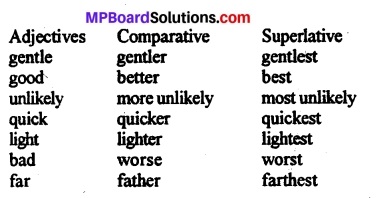
MP Board Class 11th English A Voyage Solutions Chapter 3 My Mother

Students who are studying 11th can get the free Madhya Pradesh Board Solutions for 11th English Chapter 3 My Mother Questions and Answers PDF here. You can download MP Board Class 11th English Solutions Questions and Answers PDF on this page. Practice questions of Mp Board Solutions of 11th English subject as many times as possible to get good marks.

MP Board Class 11th English A Voyage Solutions Chapter 3 My Mother (Nirad C. Chaudhuri)

Gather chapter wise MP Board Solutions for 11th English Study Material to score the highest marks in the final exam. Various chapters and subtopics are given clearly in MP Board Class 11th English Solutions Chapter 3 My Mother Questions and Answers Material. All the MP Board Solutions for 11th English Questions with detailed answers are provided by subject experts. The step by step MP Board Class 11th English Chapter 3 My Mother Questions and Answers guide will help you to enhance your skills in English subject and grammar. Here, along with the subject knowledge, grammar knowledge also plays an important role. So, students should download MP Board Solutions 11th English and read it to attempt all the questions with 100% confidence.

My Mother Textual Exercises

Word Power

(a) The first word in each pair below is used in the text. The second is almost similar in sound but different in meaning- for example: Complement – My parents are complementary to each other. Compliment (generally in plural) Pay my compliments to your parents, Now give the meanings of the following pairs of words and use them in sentences as above:
Plain – plane/dissent – decent/quite – quiet/access – excess/accept – except
Answer:

  • Plain – a large area of level country – We live in plains,,
  • Plane – aeroplane – I usually travel by plane.
  • Dissent – disagree – Those who dissented with the organisation formed another part}’
  • Decent – fine – nice – Her dress is always decent.
  • Quite – His character is quite good
  • Quiet – He is cool and quiet by nature.
  • Access – approach – I have an easy access to the principles.
  • Excess – more than – Excess of anything is bad.
  • Accept – agree – Accept my hearty congratulations. please.
  • Except – to leave out – All except Mohan were present.

(b) Many words are the same in noun and verb forms:

  • Cook (verb) – Mother is cooking food in the kitchen.
    Cook (noun) — Our cook has not come today.
  • Now use the following words as above:
    answer. change, love, display, ripple, glance. produce. face. groan. knock, smile
  • Answer (verb) — I answered all the questions.
    Answer (noun) — The teacher was pleased with my answer.
  • Change (verb) — I have changed my ways.
    Change (noun) — My mother does not like to bring an change in her life style.
  • Love (verb) — All the teachers love Aakash.
    Love (noun) — I have great love for my country.
  • Display (verb) — Several items were displayed in the exhibition.
    Display (noun) — 1 made a display of my art.
  • Ripple (verb) — Water rippled on the floor.
    Ripple (noun) — There were ripples of water.
  • Glance (verb) — I glanced at him with a smiling face.
    Glance (noun) — He gave a quick glance at me.
  • Produce (verb) — The factory produces several articles
    Produce (noun)— The produce of the land is not good.
  • Face (verb) — I have faced many difficult situations in my life.
    Face (noun) — The baby’s face is cute,
  • Groan (verb) — The patient is groaning.
    Groan (noun) — The groan of the patient awakened me.
  • Knock (verb) — Someone knocked at the door.
    Knock (noun) — He gave a massive knock at the door.
  • Smile (verb) — The child is smiling sweetly.
    Smile (noun) — He made everyone happy with his sweet smile

(c) Given below are some compound adjectives. Write them with their definitions. Match the words with their meanings.
MP Board Class 11th English A Voyage Solutions Chapter 3 My Mother 1
Answer:

  • someone ho gets angry very easily short tempered.
  • a very tolerant person broad — minded.
  • an intolerant person narrow — minded.
  • a person with a pleasant generous character good — natured.
  • a person treated with special favour blue — eyed.
  • a person who is confused muddle — headed.
  • someone who is willing to listen open — minded.
  • It belief s difficult to change deep — rooted.
  • someone ho does not behave well or politely ill — natured.
  • someone,something not modern old — fashioned.
  • someone full) of strength and energy red—blooded.
  • a person who does not easily get upset b criticism thick — skinned.

Now use the adjectives in sentences of your own.
Use the above adjectives in sentences

  • shorttem Pered: No one likes a short-tempered person
  • broad-minded: My uncle is a broad—minded person
  • blue-eyed: He is the principal’s blue eyed student.
  • good natured: My mother is a good—natured lady
  • narrow minded: We should keep a distance with narrow— minded people.
  • muddleheaded: I am totally muddle—headed.
  • open-minded; Every one loves and respect an open—minded person
  • deep-rooted: I can’t change the deep—rooted beliefs within me
  •  ill-natured: An ill—natured man can do nothing good to anyone.
  •  old-fashioned: My parents are old—fashioned about marriages.
  • red.blooded: Alway is a red—blood boy.
  • thick-skinned: M lather is a thick—skinned man

(A) Comprehension

(a) In temperament and outlook the writer’s parents were:
(i) similar
(ii) reverse
(iii) almost common
(iv) almost opposite.
Answer:
(ii) reverse

(b) How does the author describe his mother’s chin?
(i) as being attractive
(ii) as being repulsive
(iii) as being regular and prominent
(iv) as being proportionate to the upper part
Answer:
(iv) as being proportionate to the upper part

(c) The author’s mother was intolerant of demonstrativeness
(i) more than his father was
(ii) as much as his father was
(iii) as much as the writer was
(iv) not even in the least.
Answer:
(iv) not even in the least.

(d) The writer’s mother was
(i) like all Indian mothers
(ii) like a few Indian mothers
(iii) like most Indian mothers
(iv) unlike Indian mothers.
Answer:
(ii) like a few Indian mothers

(e) ‘Bad manners’, according to the sihor’s mother, were
(i) acceptable in children
(ii) against social behaviour and charity
(iii) tolerable to some extent
(iv) not acceptable in high society.
Answer:
(ii) against social behaviour and charity

(B) Answer the following questions in one sentence each:

Question 1.
In what way were the parents of the writer complement of each other?
Answer:
If one chooses to say the same thing in a different way, they were the complement of each other.

Question  2.
Which simile does the writer use for the ripping face of his mother?
Answer:
As responsive as?

Question 3.
Where were the two deep wrinkles formed in his mother’s face?
Answer:
There were the two deep wrinkles between her eyebrows.

Question 4.
What produced the wrinkles on her forehead?
Answer:
The frequent fits of introspective brooding into which she fell produced the wrinkles on her forehead.

Question 5.
How does the author describe his mother’s eyes and nose?
Answer:
As the author describes, his mother’s eyes were large and liquid and her nose was very regular and prominent.

Question 6.
What was the mother’s concept of ‘good manners’?
Answer:
Good manners were a matter of fundamental decencies and not of external polish.

(C) Answer the following questions in 30 to 40 words:

Question 1.
In what way were the parents of the writer reverse of each other?
Answer:
The writer’s mother was completely reverse to his father. Appearance, temperament and outlook-nothing was similar to that of each other. While the mother was slight and fragile, father was robust. Mother’s face was responsive whereas the father’s was impassive. Mother was more intolerant of demonstrativeness than father.

Question 2.
Describe the author’s mother’s face in your own words?
Answer:
As the writer says his mother’s appearance was not at all good and impressive. She had two deep vertical wrinkles between her eyebrows. Her forehead was very well-shaped without being high. Her face was oval and broad. Her eyes were large and nose was very regular and prominent.

Question 3.
How will an average Indian mother react to an accident with her child?
Answer:
An average Indian mother will react very quickly to an accident with her child. She would be very panicky. If a one year old baby falls down from, a height, the mother would give a hideous scream and begin to knock her head on the floor by way of mourning assuming that the child was already dead.

Question 4.
How did the writer’s mother react to a mishap with him?
Answer:
The writer’s mother had the capacity to restrain herself soon even if an accident happened with her child. Even in her worst panic she never went any where for help.

Question 5.
What faults of character did the mother dislike?
Answer:
The mother often disliked the faults of character like falsehood, dishonesty, moral cowardice and meanness. She always condemned vice and despised the tacit acceptance of an advantage.

Question 6.
What is meant by expression ‘a sharp and biting tongue’? How did author’s mother react to his sharp and biting tongue?
Answer:
‘A sharp and biting tongue’ means talking in an ill-mannered. It was against the code of social behaviour and charity also. The mother never allowed her children to be ill-mannered. She thought it to be a way of under dog.

(D) Answer ,the following questions in about 150 words:

Question 1.
Narrate in short the physical features of the writer’s mother.
Answer:
The writer explains the physical features of his mother in detail. The mother was not very handsome. She was slight and fragile with a responsive face. She had two wrinkles between her eyebrows. Her forehead was very well-shaped. It was not very high. Her face was oval. It was broad in its upper half but very quickly receding and tapering in the lower. She had large eyes Her nose was very regular and prominent. She had well cut lips which tended towards fullness in the lower one. Her chin was remarkable for being neatly shaped but not weighty enough for-the upper part. On the whole, the writer says, mother’s features reflected an impression of unsleeping alertness and in exhaustible animation.

Question 2.
How were the appearances of the mother deceptive?
Answer:
The mother’s appearance was deceptive. The first place she had two deep vertical wrinkles between her eyes which was normally believed to be a sign of a bent for thought. But the mother was not intellectual. But she was argumentative and devastatingly logical. She always appeared to be in a thoughtful mood. Secondly, her face never indicated the immense strength of her moral conviction. No one could ever guess from her face that she was almost fanatic over the questions of right and wrong. She was always intolerant of demonstrativeness but she was never too much emotional. Still she had motherly instinct and controlled the situation at her own.

Question 3.
Prove by giving an example how the mother hated tacit acceptance of advantage?
Answer:
The mother’s character has been dealt with all minute details. Mother was very strict in dealing with her children. She never liked false hood, dishonesty, moral cowardice and meanness. She always condemned vice and almost equally despised the tacit acceptance of an advantage. The writer gives instance from his life experience. He says if mother asked them to take a portion after dividing a sweet or some other dish, they always requested her to give them the piece herself. It was because, the writer says, if by any chance one of them took a piece thinking to be bigger, mother would look at him with a meaning smile or at times even angry contempt.

Question 4.
Write a short essay on ‘Good Manners’?
Answer:
Good manners make a man complete. They are very essential for human civilization. Without good manners, man is like a purse without money though it is very attractive from outside. They are the outcome of good breeding.A person who has been brought up in a good environment must have good manners. You may call them flowers of mankind’s garden.

One should be sympathetic towards weak and old. We should speak gently. Even if any one is harsh to us, we should not use harsh words at all costs. We should give up evil thoughts for all time to come. Harshness is a sign of smallness and shallowness. It makes a man unpopular.

We should be humble and polite. Politeness costs nothing. It can win us many friends. Sweet words are essential for success in life. We should neither brag or boast. We should be obedient to our parents and teachers. We should be industrious. We should be ready to help the needy. We should show courtesy to everyone. We should talk as much as is necessary. Thus, good manners are very important for the all round development.

Question 5.
Give a general impression of the writer’s mother as you gather from the lesson?
Answer:
The writer’s mother was a unique character. She Was a complete contrast from her husband. She differed with him in appearance, temperament and outlook. Her face was responsive .while that of the father was impassive. She was not at all handsome. Her face had some remarkable features which gave an impression of unsleeping alertness and inexhaustible animation. Nobody had ever called such a face as a face of simple and honest goodness.

She was intolerant of demonstrativeness but she had known how to control one’s emotion. She was never so panicky as usually as average Indian mother became. She never looked falsehood, dishonesty, moral cowardice and meanness. She always condemned vice and despised the tacit acceptance of an advantage. She never liked bad manners. She had disciplined her children perfectly.

Question 6.
Point out the likes and dislikes of Nirad C. Choudhury, as they emerge from the text.
Answer:
Nirad C. Choudhury was a prolific writer. The autobiography of ‘An Unknown India’ was his first English work. ‘My Mother’ is an excerpt from this famous autobiography. He, here, gives a pen-portrait about his mother. In the meantime he also gives some information about his likes and dislikes. He likes to be cared with motherly emotion. He also likes mother’s love. Though he loves his mother, he does not like the business like attendance on children in sickness by his mother. He likes his mother is strong character and strict discipline. But he does not like so much strictness at every step. He wants some liberality in his behaviour. He doesn’t like many traits of his mother still he loves her for she had given him a strong character and perfection of life.

Grammar

(i) Learning Modals
Look at the underlined portions in the following sentences from the text:
(a) No one could have inferred from her face that she was capable of such fanaticism.
(b) Being a high strung woman, she was capable of turning panicky.
(c) Yet we could not always chasten ourselves to take the most patently superior piece.
(d) The fault which my mother emphasized was the manners of behaving in a fashion which might wound the susceptibilities of those who had come to our house in friendliness.In the above sentences, “could” and “might” are not auxiliaries of tense. They are modals, which express certain modals of verb attached with them. In these sentences the phrase ‘was capable’ of shows a modality of ‘could’.

Modalities expressed by can, could, may, might, are given below:

Can:

(a) ability, capacity, power
Example: I can fly a kite now.
A manager can hire and fire his subordinates.

(b) permission to the subject.
She can now begin her work.

(c) expressing disbelief or impossibility (in interrogative or negative) Can it be! No, he cannot be defeated.

Could:

(a) past ability, capacity, power, not existing now’
I could speak French when I was in France.

(b) permission in the past with suggestion of charged condition.
He could order anybody when he was a collector.

(c) unreal past (non-fulfillment of an action)
I could have gone to England long ago.

May:

(a) seeking permission (through interrogative sentence)
May I attend your lecture?

(b) future possibility
The things may go wrong as you are not cautious about your business.

(c) expressing goodwill, blessing May all of you prosper well.

(d) expressing purpose (with conduction ‘so that’ with verb in the present tense. With a past tense verb in the principal clause, ‘may’ in the subordinate clause is replaced by ‘might’. She always takes precaution so that her boss may not chide her.

Might:

(a) doubtful possibility (may be or may not be) refers to present possibility.
He might be a foreigner, I believe.

(b) non-fulfillment of a possibility in the past (use might have +- verb past participle)
I might have became a millionnaire, if I had won the lottery.

Given below are sentences with can, could, may and might. Find the modality expressed in each case and write it in your notebook.
1. He could fly an aeroplane when be was young.
2. I cannot speak Marathi fluently.
3. Take a shorter route so that we may be in time.
4. May you have a happy journey!
5. It is chilling cold, you may catch cold.
6. Look! She might be your friend Rita.
7. The patient might have collapsed. Thank God, he survived the operation.
8. You can have all my books. Now 1 don’t need them.
9. Can he be such a liar! I don’t believe.
10. I could have passed the exam.
Answer:

  1. Past ability, not existing now.
  2. Expressing impossibility.
  3. Future possibility,
  4. Expressing goodwill, blessing
  5. Future possibility
  6. Doubtful possibility.
  7. Expressing goodwill, blessing
  8. Permission to the subject
  9. Expressing disbelief
  10.  Unreal past (non-fulfillment of an action).

Given below are some idiomatic expressions with their meanings. Learn their meanings and use them in sentences of your own. (The first one is from the text of the lesson).
1. wearing one’s heart on one’s sleeve-making known one’s feelings easily.
2. to have no heart-to have no capacity for feeling emotions
3. to take heart-to have courage or enthusiasm
4. change of heart-change of attitude towards something miking more friendly
5. heart of the matter-essence, innermost part of something
6. at heart-in one’s innermost feeling
7. to,break a person’s heart-overwhelm a person with sorrow
8. by heart-from memory
9. give one’s heart to/lose one’s heart to-to fall in love
10. not to have the heart to-to be insensitive
11. take to heart-be much affected by
12. to one’s heart’s content-as much as one wishes to have
13. with all one’s heart-sincerely, with all goodwill
14. heart-to heart-intimate conversation etc
15. after one’s own heart-according to one’s desire or feeling
16. heart burning-jealousy.
Answer:

  1. It is not a good sing to wear one’s heart on one’s sleeve.
  2. He had no heart to console the death of his friend’s mother.
  3. Netaji took heart to challenge the great British Empire.
  4.  A sudden change of heart transformed the situation.
  5. Tire heart of the matter is that today everything has turned to be a business
  6. My mother is a high devotional at heart.
  7. The student broke a teacher’s heart with bad performance.
  8. I learnt my by heart
  9. Don’t lose your heart to an undeserving person.
  10.  I have always suggested him not to have the heart to anyone.
  11. I was .taken to heart by my neighbour.
  12. Every one wants his son to be achieve the height of success of his heart’s content.
  13.  I have prepared for this exam with all my heart.
  14. Vajpayee held a heart to heart discussion with Mussaraf.
  15. One can get success after one’s own heart by working hard.
  16. My rise has always been a cause of heart burning for my neighbour.

Speaking Activity

Question 1.
Face is not the index of man. One may be high strung and following in the face but the heart may be full of milk of human kindness. The other may have captivating looks but there might be a sting behind them.

Divide the class in 5 groups and ask them to deliberate over the statement. Then the leader of each group will share the conclusions arrived at by his group with the class. Finally the teacher will conclude, the discussion.
Answer:
to be discussed at the class level.

Question 2.
Discuss the usefulness of good manners with h friend of yours and write out the conclusions;
Answer:
Good manners are the features that make one popular in society. If one applies them with a friend one will make a strong friendship. The friend will always stand with him at even step even in the bad days. He always proves a friend in need is a friend indeed Such a friendship will help each other solving any difficult situation with sincere cooperation Good manners can win friends and help one achieve all success.

Writing Activity

Question 1.
You are a student at Govt. Higher Secondary School, Narsinghpur and are living in the school’s hostel. your mother had given you a lot of advice regarding your behaviour with the inmates before you left for joining the school.Write down all the points of importance as guidelines for your class-mates.
Answer:
I am a student Govt Higher Secondary School. Narsinghpuri live in the schools hostel It joined this school just a few months ago. Today I am very popular among my classmates and other school children. I know the secret of this popularity when I was join this school, my mother gave me some advice I still remember them and work accordingly. Some of these, advices are

  • I Always behave politely
  • Don’t speak roughly
  • Help your friends
  • Regard your seniors
  • Love your juniors
  • Treat your teachers like your father
  •  Study sincerely
  • Be regular and punctual
  • Follow the school routine strictly
  • Always be neat and clean.

Think It Over

Ponder over the following and write down some points on each topic and share with your class.
1. An incident which shows your mother’s kind nature.
2. Your duty towards your mother
3. Things you would like to improve in your nature for her sake
Answer:
For self attempt . The lesson is an extract from the writer’s autobiography, published in 1951 under the title “The Autobiography of an Unknown Indian.” An autobiography is the story of a person’s life written by himself. It results from the writer’s pondering over his own ‘selfs, his thoughts and actions, his achievements and failings, in a word, his inner life as well as ‘ his public career.

Match the writer given under (A) with his/her autobiography given under(B)

AB

Jean Jacques Rousseau
Kamla Das
Mahatma Gandhi
A.P.J. Kalam
Jawaharlal Nehru
Maulana Abul Kalam Azad

My Experiments With Truth
Autobiography
India Wins Freedom
Confession
My Story
Wings of Fire

Answer:

A                   B
Jean Jacques Rousseasu
Kamla Das
Mahatma Gandhi
A.P.J. Kalam
Jawaharlal Nehru
Maulana Abul Kalam Azad
Confessions
My Story
My Experiment With Truth
Wings of Fire
Autobiography
India Wins Freedom

My Mother Summary in English

‘My mother” is an excerpt from the autobiography of Nirad C, Chaudhuri, Here he lays stress on the distinctive feature and convictions of his mother who is unlike average Indian mothers. She is in no way a suitable match for his father for being a complete contrast to appearance, temperament and outlook. On the one hand, mother is slight and fragile, on the other, father is robust. Similarly, mother’s face is as responsive as his father’s is impassive She is always vivid and highstrung. Her face appears to be thoughtful which she is not at all.

She is not handsome. Her forehead is well-shaped. Her face is oval and board. Her eyes are large and nose very’ regular and prominent, lips well-cut. Her chin is remarkable for being neatly shaped but not weighty enough for the upper part. On the whole, her features give an impression of unsleeping alertness and in exhaustible animation. Her appearance is always deceptive because it doesn’t show what she is. Her moral convictions are very strong.

She is almost fanatic over the questions of right and wrong. She is intolerant of demonstrativeness. She hardly conceals her emotions. She gets excited very soon. But she has the capacity unlike an average Indian mother to control herself with out being panicky. The luxury of self-pitys well as sympathy is severely at control in her house.

She doesn’t like the faults of character like-falsehood, dishonesty, moral cowardice and meanness. She condemn vice and despises the tacit acceptance of an advantage. The writer cities two examples to clarify it. He says if mother puts pieces of sweet before them, they would always ask her to give the piece to them by herself. It was because if anyone takes the bigger piece she would always be angry. The other instance of the writer’s hostel. In the hostel the boarders living nearer to the dining hall at the advantage of getting their meal earlier for the dining-hall was not large. The students living upstairs used to come down silently taking their shoes in hand in order to get their chance earlier silently. The writer says that it was the strict guidance of his mother that never allow him to take such advantage. He says that he always felt that wait for one’s turn was always justified.

The other thing that the writer has learned from his mother is that good manners are always a matter of fundamental decency and not of external polish. The children in his house never whispered or laughed in the presence of visitors. If anyone did it innocently even then he was severely dealt with after ward’s. Bad manners for her were a sin not merely against a code of social behaviour but against charily’. The writer concludes that his mother has always been a guiding force in his life.

My Mother Summary in Hindi

‘My Mother’ नीरद सी. चौधरी की जीवनी का एक अंश है। यहां वे अपनी माँ, जो सामान्य भारतीय माताओं से भिन्न है, की विशेषताओं और मान्यताओं का उल्लेख करते हैं। वह किसी भी तरह उसके पिता के लिए सटीक जोड़ा नहीं है क्योंकि हाव-भाव, मनोदशा एवं बाहरी दिखाया में वह उनके बिल्कुल विपरीत है। एकतरफ माँ बिल्कुल दुबली-पतली है, तो दूसरी ओर पिता काफी हट्टे-कट्टे हैं। उसी तरह माँ का चेहरा आतुर जैसा दिखता है, वहीं पिता का चेहरा बिल्कुल भावशून्य। यह हमेशा क्रियाशील एवं भावावेग में रहती है। उसका चेहरा हमेशा विचारमग्न लगता है जबकि वह ऐसा बिल्कुल ही नहीं है। ”

वह सुन्दर नहीं है। उसके ललाट सुगढ़ हैं। उसका चेहरा अंडाकार और चौड़ा है। उसकी आँखें बड़ी हैं और नाक बहुत ही उभरी हुई है। उसके ओठ अच्छे हैं। इसकी ठुड्डी अच्छी बनावट और. ज्यादा भारी न होने के कारण उल्लेखनीय है। कुल मिलाकर उसकी विशेषताएं एक ठनिंद चेतना और अथक जीवन का आभास देती हैं। उसके हाव-भाव हमेशा ही छलावायुक्त लगता है, क्योंकि यह वैसा नहीं दिखाता जैसी वह वास्तव में है। उसकी नैतिक बाध्यताएं काफी मजबूत है। सही और गलत के मुद्दे पर वह बिल्कुल कट्टर है। बाहरी दिखावा उसे बिल्कुल पसंद नहीं है। वह अपनी भावनाओं को मुश्किल से छिपा पाती है। वह शीघ्र ही उत्तेजित हो जाती है। लेकिन एक सामान्य भारतीय माँ के विपरीत उसमें अपने आप को बिना आतंक महसूस किए नियंत्रित करने की क्षमता है। निरीहता और सहानुभूति का सुख उसके घर में बिल्कुल नियंत्रित है।

वह झूठ, बेईमानी, नैतिक गिरावट तथा ओछापन जैसे चारित्रिक दुर्बलताओं को पसंद नहीं करती। वह दुष्टता को धिक्कारती है और अवसर का गलत उपयोग या फायदा उठाने का विरोध करती है। लेखक इसे स्पष्ट करने के लिए दो उदाहरण देता है। वह कहता है कि यदि माँ मिठाई के टुकड़े उनके सामने रखती है, तो वे उसे न उठाकर माँ से देने का अनुरोध करते हैं। ऐसा वे इसलिए करते है क्योंकि अगर कोई मिठाई का बड़ा टुकड़ा खुद ले लिया तो माँ नाराज हो जाएगी। दूसरा उदाहरण लेखक के छात्रावास के बारे में है। छात्रावास में भोजन-कक्ष के साथ रहने वाले छात्रों को यह सुविधा थी कि उन्हें भोजन जल्दी मिल जाता था क्योंकि भोजन-कक्ष बहुत बड़ा नहीं था। ऊपरी मंजिल पर रहने वाले छात्र अपने जूतं हाथ में लेकर चुपचाप नीचे आ जाते थे जिससे उन्हें भोजन जल्दी मिल जाए। लेखक कहता है कि यह उसकी माँ का सख्त निर्देश था जिसने उसे ऐसा फायदा उठाने की आज्ञा नहीं दी। वह कहता है कि उसे हमेशा महसूस हुआ कि अपनी बारी का इंतजार करना हमेशा न्यायसंगत होता है।

दूसरी चीज जो लेखक अपनी माँ से सीखा वह है कि अच्छा आचरण हमेशा मौलिक शालीनता है न कि बाहरी दिखावा। उसके घर के बच्चे कभी भी किसी अतिथि के सामने आपस में न कानाफूसी किए और न ही हँसे। यदि किसी ने अनजाने में भी ऐसा किया तो उसके साथ बाद में सख्त व्यवहार होता था। उसके (माँ) लिए बुरा आचरण एक पाप की तरह था जो न केवल सामाजिक आचरण के खिलाफ था बल्कि उदारता के भी विपरीत था। लेखक निष्कर्ष निकालता है कि उसकी माँ उसके पूरे जीवन में एक मार्गदर्शक की तरह रही।

My Mother Word Meaning

MP Board Class 11th English A Voyage Solutions Chapter 3 My Mother 2 MP Board Class 11th English A Voyage Solutions Chapter 3 My Mother 3

My Mother Comprehension

Read the following passages and answer the questions that follow:

1. My father and mother were bound to each other by certain common principles and standard of conduct, but otherwise, in appearance, temperament, and outlook, they were the reverse or, if one chooses to say the same thing in a different of each other. My mother was as slight and fragile as my father was robust, while her face was as responsive as my father’s was impassive.

Questions:

(i) Who is the narrator in these lines?
(ii) How was the narrator’s father bound to his mother?
(iii) Why does the narrator find his mother not a suitable
match for his father?
(iv) What does the face of the father a contrast to that of the mother?
(v) Give a word similar in meaning to the expression ‘lean and thin’?
Answers:
(i) The writer is the narrator of these lines.
(ii) The narrator s father was hound to the mother by certain common principles and standard of conduct.
(iii) The narrator finds his mother not a suitable match for his father because she is a complete contrast in appearance. temperament and outlook of the father.
(iv) The mothers face was responsive while the father’s was impassive.
(v) ‘slight and fragil

2. But here again the appearances were deceptive, for her face did not show. hardly indicated even, the immense strength of her mpral convictions. No one could have inferred from her face that she was capable of such fanaticism as she showed over questions of right and wrong. Even more than my father was she intolerant of demonstrativeness and the wearing of one’s heart on one’s sleeve.’

Questions:
(i) Whose face is deceptive?
(ii) Why does the writer say her face deceptive.
(iii) What fanaticism does the writer refer to here?
(iv) Find a word opposite in meaning to ‘liberallcm’?
Answers:
(i) The mother face is deceptive.
(ii) The writer calls the face deceptive because it does not show what she really is.
(iii) Fanaticism here refers to the strictness of mother towards the questions of might and wrong.
(iv) ‘Fanaticism.

3. The faults of character she disliked most were falsehood, dishonesty, moral cowardice and meanness.
A liar, a cheat, a coward, and a personith the tiny heart of a minnow” as she put it were the most contemptuous epithet we heard From her mouth. Not only did she condemn vice, she almost equally despised the tacit acceptance of an advantage.

Questions:
(i) What faults of character did the mother not like?
(ii) Whose heart is as tiny as that of a minnow?
(iii) hat did She condemn and despise?
(iv) Pick out words from the above stanza which are opposite in meaning in
(a) brave
(b) huge
(c) virtue
Answers:
(j) The mother did not like falsehood. dishonesty, moral cowardice and meanness.
(ii) The heart of a liar, a cheat and a board is as tiny as that of a minnow.
(iii) She condemned vice and she despised the tacit acceptance of an adantage.
(iv)
(a) coward
(b) tins
(c) vice

Above provided complete MP Board Solutions 11th English Study guide is useful for making your preparation effective. Students can frequently visit our page to get the latest updates on other subjects study materials.
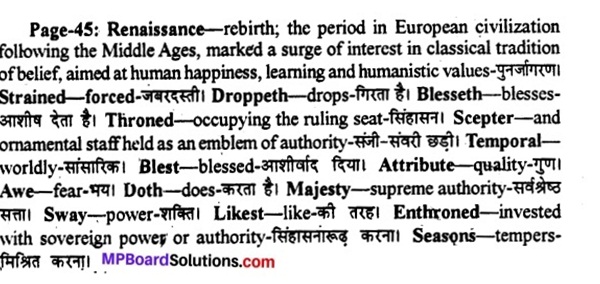
MP Board Class 11th English A Voyage Solutions Chapter 2 What the Moon Saw

Students who are studying 11th can get the free Madhya Pradesh Board Solutions for 11th English Chapter 2 What the Moon Saw Questions and Answers PDF here. You can download MP Board Class 11th English Solutions Questions and Answers PDF on this page. Practice questions of Mp Board Solutions of 11th English subject as many times as possible to get good marks.

MP Board Class 11th English A Voyage Solutions Chapter 2 What the Moon Saw (Hans Christian Anderson)

Gather chapter wise MP Board Solutions for 11th English Study Material to score the highest marks in the final exam. Various chapters and subtopics are given clearly in MP Board Class 11th English Solutions Chapter 2 What the Moon Saw Questions and Answers Material. All the MP Board Solutions for 11th English Questions with detailed answers are provided by subject experts. The step by step MP Board Class 11th English Chapter 2 What the Moon Saw Questions and Answers guide will help you to enhance your skills in English subject and grammar. Here, along with the subject knowledge, grammar knowledge also plays an important role. So, students should download MP Board Solutions 11th English and read it to attempt all the questions with 100% confidence.

What the Moon Saw Textual Exercises

Word Power:

1. Complete each of following sentences given below with a word from the passage which is equivalent to the word or given the brackets.
1. Tanmay …… his thoughts on his school nicely. (described)
2. The boy opened the ……….. and looked outside. (window)
3. There was an ……….. stretch of Land behind his house. (covering a Large area)
4. He sat at the window in a ………. mood. (in-low spirit)
5. The hen spread its wings over the ……….(young ones of a hen)
6. They, into all the corners for the missing ring. (look with difficulty)
7. The moonlight had to ………. to get through the thick bushes. (make great efforts)
8. He ………. admired his motherland. (very passionately)
9. The deer ………. out of the thick bushes. (walk with quick steps)
10.There was nothing in the field excepts ………. tree in the middle. (single, alone)
Answer:

  1. portrayed
  2. casement
  3. abroad
  4. responding
  5. chickens
  6. peer
  7. strive
  8. fervently
  9. trip
  10. solitary

II. Keeping the text in mind explain the following expressions:

1. My hands and my tongue seem alike tied.
2. I do not want for light.
3. Extensive prospect over the neighbouring roofs.
4. A forest of chimney-pots
5. Airy and ethereal as a vision.
6. A gaize of earnest intensity.
7. Boughs of the bananas, arching beneath me like the tortoises shell
Answer:

  1. Completely helpless.
  2. Itself lighted already.
  3. Openness of scope to view all over.
  4. A lot of chimney-pots in view.
  5. Open and clear view/ideas
  6. With all sincerity
  7. Suppressed position

III. Explain the meanings of the following phrases and idiomatic expressions, and use them in sentences of your own:
Over and over again
After all
Look in
To and fro
Glide away
At random
In sight
Answer:

  • Over and over again- repeatedly—He attempted to meet the Prime Minister over and over again but failed.
  • After all — finally — After all he is my guardian
  • Look in — search — He is trying to look in the matter deeply to find the mith.
  • To and fro — backwards and forwards — The lady is rocking the baby to and fro
  • Glide away — feeling excited — As he got his mission easily. he is gliding away.
  • At random — without a particular aim or purposes — happened to meet my old friend at random.
  • In sight — in view — There is nothing so remarkable in sight.

IV. In the following search the word that does not mean the something as the basic word.

Question 1.
Injunction
(a) command
(b) order
(c) opening
(d) direction
Answer:
(c) opening

Question 2.
Dismay
(a) discourage
(b) dishearten
(c) depress
(d) expel
Answer:
(d) expel

Question 3.
Quench
(a) satisfy
(b) shake
(c) slake
(d) satiate
Answer:
(b) shake

Comprehension

I. Say whether the following statements are true or false.

1. The moon describes the evenings to a painter.
2. On the first evening the moon was in the Indian sky.
3. A novelist is narrating the story.
4. The betrothed of the maid held a lamp in his hand.
5. The maid shouted, “He lives!’
6. The maid did not pay attention to the snake.
7. The hen had ten chicks.
8. The hen was frightened by the girl’s father.
9. The moon looked through a hole in the hen-house.
10. The moon kissed the little girl on the mouth and eyes.
Answer:

  1. True.
  2. True.
  3. False.
  4. False
  5. True
  6. True.
  7. False
  8. True.
  9.  True
  10. False.

II. Answer the questions in one sentence.

Question 1.
Where did the painter live?
Answer:
The painter lived in a high-up room in a very narrow lane

Question 2.
Why did the painter fell low-spirited in the town?
Answer:
The painter felt low spirited in the town because he had no friend nor anyone familiar.

Question 3.
Where appearance made the painter happy?
Answer:
The appearance of the moon made the painter happy.

Question 4.
Where was the moon gliding on the first evening?
Answer:
The moon was gliding in the sky on the first evening.

Question 5.
Who came out of the thick bushes?
Answer:
A Hindu maid come out of the thick bushes.

Question 6.
What thought had brought the maid to the river?
Answer:
The thought to wish for the long life of her betrothed had brought the maid to the river.

Question 7.
What did the maid believe in?
Answer:
The maid believed that the burning of the lamp keep her betrothed alive.

Question 8.
Why did the father scold the little girl?
Answer:
The father scolded the little girl because she had frightened the hen.

Question 9.
Why did the girl enter the apartment of the hen and chicks?
Answer:
The girl entered the apartment of the hen and chicks to beg her pardon from them.

Question 10.
What did the father do to the little girl, when she told him her intention?
Answer:
The father loved her and kissed her.

III. Answer the following questions in about 100-150 words.

Question 1.
Write the character sketch of the Hindu girl (“first evening”) highlighting
(a) her beauty
(b) her love, and
(c) her fears about the life of her betrothed.
Answer:
The narrator, through the Moon, presents a very charming picture of a Hindu girl. While wandering over the sky the Moon happens to see a Hindu girl from Hindustan. She trips forth from the thickets. She is extraordinarily beautiful. She is like a damsel an Eve. It means she is virgin and graceful. She appears with a flash. There is spontaneity in her expression and movements. She is airy and ethereal as a vision as the Moon describes her.

She is deeply in love with her betrothed. The intensity of love is very much distinct and obvious with her effort in protecting the flame of the burning lamp. Her fingers are badly burnt but she does not care for her. She does not take any notice of the speckled snake lying beside her. She. has nothing to worry except the long life of her betrothed.

As she is typical girl from Hindustan, she has all the fears and apprehension about the life-span. She also believes in some old Hindustani remedies and precautions against all evils. As per a belief one can wish and pray for the long life of one’s near and dear by keeping a lamp burning of afloat over flowing water. The burning of flame symbolizes the span of life. So in our land women do so to shed their fear of the early death their beloved ones. It is typical Indian character.

Question 2.
Write a character sketch of the little girl (“Second evening”) highlighting.
(a) her act of frightening the hen and the chickens;
(b) her entering stealthily in the hen-house again.
(c) her explanation that she did not want to frighten the birds, and
(d) her father’s change in attitude towards her.
Answer:
The narrator presents another tale told by the Moon which the Moon tells about the second evening. The girl is an innocent playful girl who enjoys everything with full intensity and love. The moon sees in the courtyard a clucking hen with her eleven chickens. A pretty little girl is running and jumping around. The hen feels frightened. She feels insecured. So she tries to protect the chickens by spreading her wings over them. The girls father comes there and scolds the girl.

The next evening the Moon sees the girl again entering into the hen’s apartment. Creeping silently she pushes the bolt back and slip into. The hen again becomes frightened. It begins to run with fear in order to save itself and its chickens. The father again comes and very roughly scolds the girl.
In fact the girl has no intention to disturb the hen. Instead she has come there to beg apology for the frightening act. She wants to love the hen.

She is sorry. The explanation of the girl puts a deep impact on father’s mind. He also feels sorry for his scolding the girl. She now feels the deep love of the girl who is very innocent. The father kisses the girl over her forehead and hugs her. Symbolically he also expresses his sorrow’ for his scolding.

Grammar

I. Read the following sentences:

I live in one of the narrowest lane.
I sat at the window.
The moon shone far into my little room.
My face was mirrored in the waters of the Gangas.
The boughs of the bananas arched beneath the moon like a tortoise’s shell.
There were a hen and eleven chickens in the courtyard.
The underlined words are prepositions.
The prepositions either show position (where something someone is) or movement
(where it is going). Now fill the blanks with the correct prepositions.

1. Ramesh was lying …. the sofa reading a book.
2. There was a big crowd the railway crossing.
3. There is a temple ……..the top of the mountain.
4. The man standing ……….. the courtyard.
5. I read about the rocket launchers ………… a magazine.
6. We saw the train arriving the platform.
7. His coat came down well ……….his knees.
8. I am going ……….. Bhopal next week.
9. The mechanic is standing ………… the car.
10. The bird is ………. .the cage.
Answer:
1, on 2. at 3. at 4. in 5. in 6. at 7. below 8. to 9. near 10. in

Speaking Activity

Discuss in pairs
(i) What the maid would do if the lamp was extinguished?
(ii) What would the girl do if the hen and the chickens did not cry out loudly?
Answer:
(i) The maid is a typical Hindustani girl. She believes in the old faith. She might have heard the stories of festivals which are celebrated for the long life of one’s near and dear. The belief behind putting burning lamp afloat over water is that its burning keeps the life of the near and dear one very long. So on many occasions it is done to wish for the long life of a dear one. In this story the girl does so with all her intense love for her betrothed. She tries to protect the flame of the lamp which bums on her palm. If the lamp is extinguished she would be sure that her betrothed is no more. I think, she would burst out of tears. She would cry and do like a mad. She may jump into the river to end her life also.

(ii) The girl on the first evening tries to play with the hen. But the hen becomes frightened and feels unsecured. The girl’s father scolds her. The girl feels sorry. The next evening she realizes her mistake and want to repent. So, she again goes to the hen’s apartment. She enters into it very silently. But again the hen is frightened. The father comes there and scolds her very roughly. The girl begins weeping. When the father asks why she was there, she replies that she wanted to say sorry to the hen and kiss her. Had the hen and the chickens not cried out loudly, she would have loved them with all her sincerity. She would have played with them and bagged her apology from them for frightening them.

Writing Activity

Question 1.
If you were set on a space mission, what would India look like from above? Describe.
Answer:
I love my country. It is a unique country. It has all the colours. Right from Kashmir to Kanyakumari. We have a number of festivals, varieties of land and people, multiple languages, colourful dresses – all giving a great vision of India. Still it is one nation, one people, one unit. There is unity besides all diversities. It is the only land where one can see the rough and sandy, wide-open-stretches of the Thar desert. On of the one hand and on the other there is Cherapunji in Meghalaya with the highest rainfall.

There is the Leh peak with about-20 °C of temperature and the land of Rajasthan about 50 °C of temperature. I mean to say that India is land of multiplicity with has the capacity to accommodate all the varieties of people and nature. I wish if I go on a space mission I would see my country glowing with all its multiplicity. Our heritage like the Red Fort, the Qutab Minar, the Taj Mahal etc. would be visible glorifying our country even in space. I would feel delighted if I see the great holy river Ganga from above. It would be a unique experience for me.

Think It Over

Question 1.
Imagine you are Moon. What would you. see above your residence? Share your imagination with your class.
Answer:
I wish I were a moon. I would look at my residence where I would find my family members talking among themselves. I would also see the beautiful flower-vases above my residence. I would see my little baby looking directly at me.

Think To Do

(a) The moon is the satellite of the earth. The other planets too have satellites. Find out which planets have satellites with their numbers and fill in the grid.

S. No.Name of the PlanetSatellite Yes/No.No. of Satellites
1.MercuryNo
2.VenusNo– –
3.EarthYes1
4.MarsYes2
5.JupiterYesover 60
6.SaturnYesover 30
7.UranusYes21
8.NeptuneYes8
9.PlutoYes1

Answer:


S. No.Name of the PlanetSatellite Yes/No.No. of Satellites
1.MercuryNo
2.VenusNo
3.EarthYes1
4.MarsYes2
5.JupiterYesover 60
6.SaturnYesover 30
7.UranusYes21
8.NeptuneYes8
9.PlutoYes1

(b) Complete the following statements by adding the name of the festival, these phrases, stories and songs are related to:
1. ……..is celebrated with great pomp and show including pageants
and parades all over the country.
2. Munshi Prem Chand’s story ‘Hamid ka Chimta’ is a touching story about the little boy’s sensitiveness, love and concern for his grand mother about ……..
3. …….. is a celebration of joy and happiness by Bent Baji (Kite flying) and the onset of spring season.
4. ………. is the harvest festival. Multi coloured floral decoration and boat races are its main features.
5. ‘Kar Sewa’ is part of the devotional offerings on
6. ‘Jingle Bells Jingle bell all the way…….. is a jingle during ………
7 …….. is the New Years day for people hailing from Sindh.
8……… is a festival of colours and merry making. It is an offering of new harvests and is also related with Prahalad and Holika. Now write a paragraph each about any two festivals you like most and share it with your class.
Answer:

  1. Republic Day
  2. Eidorld
  3. Baisakhi
  4. Onam
  5. Guru Pary
  6. Christmas
  7. Ozus
  8. Holi

Paragraph writing on two festivals:

1. Christmas: Christmas fall on the 25th December even’ year and is celebrated with great enthusiasm by our Christian community. It is the date on which Jesus Christ w as born. Hence this festival is like Janamashtami of the Hindus. Christmas is the day of mercy-making. The Christians clean them houses and decorate it with light, candles and banners, etc.

They have crosses made of wood or metal. They attend special prayers in the church. The churches are decorated with electric bulbs and candles. All the family members decorate Christmas tree with toys, decorative lights, balloons and candles. Children look very happy. They believe that Santa Claus will came in his sleigh pulled by reindeer and well give toys and gifts to them. Santa Claus, thus becomes the special attraction for the children. The Christians exchange gifts with their friends and relatives. They hold parties and dinners in the occasion of this auspicious day. They sing Christmas Hymns and Christmas carols. They wish ‘Merry christmas’ to each other and enjoy tasty cakes.

2. Holi: India is a land of colourful fairs and festivals. Some festivals are celebrated in the memory’ of great men and saints. Some festivals are celebrated at the change of season. Holi is the seasonal festival. It falls on the full moon, in the month of Phalgun which spans the end of February and the beginning of March on the Gregorian calendar. It marks the end of winter and the start of spring, a season which is loved by all. People celebrated Holi with a great joy. They sprinkle coloured water at one another. Small children look more enthusiastic.

They buy brass or plastic syringes (pichkaris) and enjoy in discharging coloured water from the pichkaris at the passers- by and at their friends. People wear new clothes and distribute sweets among friends and relatives. They smear coloured powder called ‘a beer’ or ‘gulal’ on the faces of all including rich and poor. Holi stands as a festival to remove evil and usher in the good. People forgetting their previous malice, meet witty one another and give good wishes Thus, Holi brings people closer and teaches them to live in harmony.

What the Moon Saw Summary in English

It is fairy tale told through a painter. It narrates description of two charming scenes that the Moon saw two successive evenings. The painter- narrator finds it difficult to describe his feelings exactly as he is a painter not a foctionist. Yet he tries. He is a poor lad living in a very’ narrow lane. As his room is high upstairs, he don’t lack light in his house. He has experiences of living in from where, he feels life was not at all comfortable and joyous. Here it is quite different.

One evening while sitting in his room he opens his window and finds the Moon in the sky. The Moon has always been very charming to him. The narrator feels whenever the Moon appears before him he tells him something strange. If he tries to narrate all of them, he would create another thousand and one right-the famous narrative classic. So he presents two of those tales told by the Moon.

Now the narrator is the Moon who one evening visits Indian sky. While wondering in the sky his face shines in the Ganga water. His reflection appears pierced through the thick intertwinning boughs of the bananas. It arches beneath the Moon like the tortoise’s shell In the midst of the thicket comes out a Hindu girl like a beautiful Eve. She is delicate and charming. Her sandals are tom due to thorny creeping plants. Still she comes rapidly. A deer comes there to quench its thirst. The maiden is holding a lighted lamp in her hand. She tries to protect its flame. It bums her fingers. She put the burning lamp upon water to float. The flame flickers away still it bums on. The girl looks at it with all intensity of emotion.

She wishes for the long life for her betrothed as she believes that burning lamp will keep her betrothed alive for long. She prays for the long life of her betrothed nothing else. Her brief and devotion appear to be very strong.

On the second evening, the Moon presents the scene of the previous evening. It looks down upon a small courtyard surrounded on all sides by houses. There is a chicking hen with eleven chickens. A Pretty girl is running after them. She makes the hen frightened. The girl’s father comes and scolds her. On the second evening the Moon again looks down upon the same courtyard. Everything is calm. The little girl comes again there quietly. Sire pushes the bolt back and slip into the hen’s apartment. She again makes the hen and the chickens frightened. Her father comes and scolds her more solvently jhan he did yesterday. He holds her roughly.

Tears start trickle down from her eyes. When the father asks what she is doing there, she replied that she wanted to love the hen and beg her pardon for what she did yesterday. She wanted to express her sorrow to the hen. It touches the heart of the father and he pacifies her by kissing at her forehead. It shows that he also feels sorry for his scolding the innocent girl.

What the Moon Saw Summary in Hindi

यह एक चित्रकार द्वारा कही गई परी कथा है। इसमें चाँद द्वारा लगातार दो शामों में देखे गए मनोहारी दृश्यों का वर्णन है। चित्रकार कथाकार को अपनी भावनाओं को सही-सही व्यक्त करने में कठिनाई हो रही है क्योंकि वह एक चित्रकार है न कि उपन्यासकार। फिर भी वह कोशिश करता है। वह एक गरीब लड़का है, जो एक बहुत ही संकीर्ण गली में रहता है। उसका कमरा ऊंची मंजिल पर है। उसे अपने कमरे में रोशनी का अभाव नहीं होता। उसे ऐसी जगह रहने का अनुभव है जहां उसे महसूस होता है कि जीवन बिल्कुल ही आरामदायक और आनंददायक नहीं था। अब का जीवन बिल्कुल भिन्न

एक शाम अपने कमरे में बैठे हुए वह अपनी खिड़की खोलता है और चांद को आकाश में पाता है। चाँद हमेशा ही उसके लिए प्यारा रहा है। कथाकार बो लगता है कि चांद जब भी उसके सामने आता है वह उससे कुछ अजीब-सी बातें करता है। अगर वह उन सभी को कहे तो वह एक दूसरा ही महान कथा संग्रह (Thousand and one night) रच देगा। इसीलिए वह चाँद की कही हुई कहानियों में से केवल दो को यहाँ प्रस्तुत करता अब कथावाचक चाँद है जो एक शाम भारतीय आकाश में घूमता है। आकाश में घूमते हुए उसका हर गंगा के पानी में चमकता है। उसका प्रतिबिंब घने चक्करदार केले के झुरमुट के कारण टुकड़े में बँट रहा है। यह चाँद के नीचे से कछुए के खोल की तरह एक स्वागत द्वार तैयार कर रहा है। इसी बीच में झाड़ी से एक हिन्दू लड़की जो ‘इव’ (Eve) की तरह सुन्दर है, निकलती है। वह कोमल और मनोहारी है। उसकी चप्पलें कंटीले झाड़ीदार पौधों के कारण फट गई हैं।

फिर भी वह तेजी से आती है। एक हिरण वहाँ अपनी प्यास बुझाने आता है। लड़की अपने हाथ में एक जलता हुआ दीया लिए हुई है। वह उसकी लौ को बचाने का प्रयास कर रही है इससे उसकी ऊँगलियों जल जाती हैं। वह जलते हुए दीपक को पानी के ऊपर तैरने के लिए छोड़ देती है। लौ टिमटिमता है। फिर भी यह जल रहा है। लड़की अपनी भावनाओं के आवेग से उसे देखती है। वह अपने मंगेतर के लिए लंबी आयु की कामना करती है क्योंकि उसे विश्वास है कि जलता हुआ दीया उसके मंगेतर को लंबी आयु देगा। वह केवल अपने मंगेतर के लिए लंबे जीवन के अलावा कुछ नहीं चाहती। उसका विश्वास और उसकी वृद्धा काफी मजबूत प्रतीत होते हैं।

दूसरी संध्या को चाँद पिछली संध्या को देखा गया एक दृश्य प्रस्तुत करता है। यह चारों ओर घरों से घिरा हुआ नीचे एक आंगन देखता है। वहां एक मुर्गी अपने ग्यारह बच्चों के साथ चहक रही है। एक प्यारी लड़की उनके पीछे दौड़ती है। उससे मुर्गी डर जाती है। लड़की का पिता उसे डांटता है। दूसरी शाम चाँद फिर से आंगन में देखता है। सबकुछ शांत है। छोटी लड़की फिर चुपचाप वहां आती है। वह दरवाजे को खोलती है और मुर्गी के दरवे में प्रवेश करती है। इससे फिर मुर्गी और उसके बच्चे डर जाते हैं। उसका पिता आता है और लड़की को बहुत निर्दयता से डांटता है। वह उसे बेरुखी से खींचता है। उसकी आँखों से आंसु निकल पड़ते हैं। जब पिता उससे पूछता है कि वह वहां क्या कर रही है थी।

तो उसने जवाब दिया कि वह मुर्गी को प्यार करना चाहती थी और अपनी कल की गलती के लिए, उससे क्षमा मांगना चाहती थी। वह मुर्गियों से अपना दुःख जताना चाहती थी। इससे पिता का दिल पिघल जाता है और वह उसके ललाट को चूमते हुए उसे सांत्वना देता है। इससे लगता है कि वह भी निर्दोष लइकी को डांटने के कारण पछता रहा है।

What the Moon Saw World Meaning

MP Board Class 11th English A Voyage Solutions Chapter 2 What the Moon Saw 1
MP Board Class 11th English A Voyage Solutions Chapter 2 What the Moon Saw 2

What the Moon Saw Comprehension.

Read the passages carefully and answer the questions that follow:

1. I am a poor lad, and live in one of the narrowest lanes; but I do not want for light, as my room is high up in the house, with an extensive prospect over the neighbouring roofs. During the first few days I went to live in the town, I felt low- spirited and solitary enough. Instead of the forest and the green hills of former days, I had here only a forest of chimney-pots to look upon. And then I had not a single friend; not one familiar face greeted me.

Questions:
(i) Who is ‘I’ referred in these lines?
(ii) Where does the narrator live?
(iii) What does the narrator feel when he goes to live in town?
(iv) Why does the narrator feel lonely?

Answers:
(i) T in these lines refers to the narrator.
(ii) The narrator lives in a very narrow lane.
(iii) The narrator feels low-spirited and solitary when he goes to live in town.
(iv) The narrator feel lonely because he has no friend nor any familiar face in the town.

2. Whenever he appears, he tells me of one thing or another that he has seen on the previous night, or on that same evening. “Just paint the scenes I describe to you” this is what he said to me “and you will have a pretty picture-book.” I have followed his injunction for many evenings. I could make up a new “Thousands and One Nights,” in my own way, out of these pictures, but the number might be too great, after all.

Questions:
(i) Who is ‘he’ in these lines?
(ii) What does ‘he’ do to the narrator every evening?
(iii) What does ‘he’ ask the narrator to do?
(iv) What is ‘Thousands and One Night’?
(v) Find words from the above passage which are similar in meaning of
(a) explain
(b) command.

Answers:
(i) ‘He’ in these lines refers to Moon.
(ii) ‘He’ tells the narrator about the scenes that he (Moon) has seen the previous night.
(iii) ‘He’ asks the narrator just to paint the scenes a\he describes to him.
(iv) It is a famous fain tale classic.
(v) (a) describe
(b) injunction.

3. She knew that if the lamp continued to burn so long as she could keep it in sight, her betrothed was still alive, but if the lamp was suddenly extinguished he was dead. And the lamp burned bravely on, and she fell on her knees, and prayed. Near her in the grass lay a speckled snake, but she heeded it not she thought only of Bramah and of her betrothed. ‘He lives!’ she shouted joyfully, he lives!’ And from the mountains the echo came back upon her, ‘he lives!”

Questions:
(i) Who is ‘she’ in these lines?
(ii) What is ‘she’ trying to do?
(iii) Why does ‘she’ do so?
(iv) What is lying near in the grass?
(v) Find words from the above passage for the following:
(a) put out
(b) the person to whom one is engaged to be marriage.

Answers:
(i) ‘She’ is a Hindu maid from Hindustan.
(ii) ‘She’ is trying to keep the lamp burning.
(iii) ‘She’ does so she believes that burning of the lamp symbolizes the
life of her betrothed. If it is extinguished, the life of her betrothed would also be finished.
(iv) A speckled snake is lying near her in the grass.
(v) (a) extinguished
(b) betrothed.

4. I was angry with the willful child, and felt glad, when her father came out and scolded her more violently than yesterday, holding her roughly by the arm; she held down her head, and her blue eyes were full of large tears. ‘What are you about here?’ he asked. She wept and said.’ I wanted to kiss the hen and beg her pardon for frightening her yesterday; but I was afraid to tell you.’

Questions
(i) Who is ‘I’ referred to in these lines?
(ii) Why does ‘I’ become angry with the girl?
(iii) What does the girl’s father do to her?
(iv) How does the girl respond?
(v) Pick out words from the above passage which are opposite in meaning of
(a) gently
(b) delicately.
Answers:
(i) ‘I’ refers to the Moon.
(ii) ‘I’ becomes angry with the girl because she has come to the hen’s apartment in spite of her father’s scolding.
(iii) The girl’s father again scolds her more violently than the previous 1 day.
(iv) The girl begins weeping and replies that she had come there to kiss the hen and beg her pardon for frightened her the previous day.
(v) (a) violently
(b) roughly brackets.
(i) Tanmay his thoughts on ………. his school nicely, (described)
(ii) The boy opened the …………. and looked outside, (window)
(iii) There was an ………. stretch of land behind his house, (covering a large area)

Above provided complete MP Board Solutions 11th English Study guide is useful for making your preparation effective. Students can frequently visit our page to get the latest updates on other subjects study materials.