MP Board Class 10th General English The Spring Blossom Solutions Chapter 18 The Tables Turned

Are you seeking for the Madhya Pradesh Board Solutions 10th General English The Spring Blossom Solutions Chapter 18 The Tables Turned Questions and Answers PDF? If yes, then read this entire page. Here, we are giving a direct link to download MP Board Class 10th English Solutions Questions and Answers PDF which contains the chapter wise questions, solutions, and grammar topics. You can also get the shortcuts to solve the grammar related questions on this page.

MP Board Class 10th General English The Spring Blossom Solutions Chapter 18 The Tables Turned

For the sake of students we have gathered the complete 10th General English The Spring Blossom Solutions Chapter 18 The Tables Turned Questions and Answers can provided in pdf Pattern. Refer the chapter wise MP Board Class 10th English Solutions Questions and Answers Topics and start the preparation. You can estimate the importance of each chapter, find important English grammar concepts which are having more weightage. Concentrate on the important grammar topics from Madhya Pradesh Board Solutions for 10th English Chapter 18 The Tables Turned Questions and Answers PDF, prepare well for the exam.

The Tables Turned Textual Exercises

Word Power

1. (a) Make a list of the describing words in the poem.
Answer:
The adjectives used in the poem are freshening, mellow, green, dull and endless, sweet, blithe, mean, ready, spontaneous, vernal, moral, meddling, beauteous, barren.

(b) Now change five adjectives, from the above list into nouns and use them in your sentences.
Answer:
Adjective             Noun
sweet                 sweetness
moral                 morality
green                 greenery
spontaneous     spontaneousness
ready                 readiness

Sentences :
1. The sweetness of music allures my mind.
2. Morality is absent in today’s youth.
3. The greenery in the village freshens my mood.
4. Spontaneousness of crimes these days is leading to a great crisis.
5. We prepared a room and meal in readiness for their arrival.

2. Match the words with their meanings.
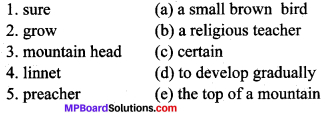
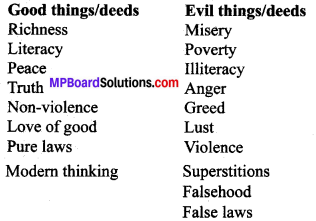
MP Board Class 10th General English The Spring Blossom Solutions Chapter 18 The Tables Turned 1
Answer:
1. → (c)
2. → (d)
3. → (e)
4. → (a)
5. → (b)

3. Express the idea contained in the following line.
Books! ’tis a dull and endless strife
Answer:
The poet talks about books in this line. He says that the journey with books is boring and at the same time it is continuous (i.e., never ending)

4. Find out action words in the first two stanzas of the poem.
Answer:
quit, grow, clear, spread.

5. Complete the following lines of the poem.
Answer:
Enough of science and of Art;
Close up those barren leaves;
Come forth, and bring with you a heart
That watches and receives.

How Mach I Understood?

A. Answer the following questions. (One or two sentences)
(निम्न प्रश्नों के उत्तर एक या दो वाक्यों में दीजिए।)

Question 1.
What does the poet say in the first stanza of the poem?
(व्हॉट डज़ द पोऍट से इन द फर्स्ट स्टैन्ज़ा ऑफ द पोऍम?)
कविता के प्रथम पद्यांश में कवि क्या कहता है?
Answer:
In the first stanza the poet says to leave books and stop reading too much as it would make one bent and tired. He asks to remove the expression of thought and perplexity that comes from reading.
(इन द फर्स्ट स्टैन्जा द पोऍट सेज़ टू लीव बुक्स एण्ड स्टॉप रीडिंग टू मच एज इट वुड मेक वन बेन्ट एण्ड टायर्ड। ही आस्कस् टू रिमूव एक्सप्रेशन ऑफ थॉट एण्ड पर्पलैक्सिटी दैट कम्स फ्रॉम रीडिंग।)
कविता के प्रथम पद्यांश में कवि किताबों को छोड़ने व ज्यादा न पढ़ने के लिए कहता है क्योंकि इससे व्यक्ति की देह झुक जायेगी और वह थक जायेगा। वह अपने चेहरे से पढ़ने के कारण उत्पन्न सोचनीय व जटिल भाव को हटाने के लिए कहता है।

Question 2.
Why does the poet want bis readers to leave their books?
(व्हायडज़ द पोऍट वॉन्ट हिज़ रीडर्सट्र लीव देयर बुक्स?)
कवि अपने पाठकों से किताबों को छोड़ने के लिए क्यों कहता है?
Answer:
The poet wants his readers to leave their books because they make one bent and appear tensed, troubled and perplexed due to thinking after reading.
(द पोऍट वॉन्ट्स हिज़ रीडर्स टू लीव देयर बुक्स बिकॉज़ दे मेक वन बेन्ट एण्ड अपीयर टेन्स्ड्, ट्रबल्ड् एण्ड पप्लैक्स्ड् ड्यू टू थिंकिंग आफ्टर रीडिंग।)
कवि चाहता है कि उसके पाठक किताबें पढ़ना छोड़ दें क्योंकि पढ़ने के बाद सोचने से उनकी देह झुक जायेगी तथा वे चिन्तित, परेशान व जटिल लगेंगे।

Question 3.
What does the poet say about books?
(व्हॉट डज़ द पोऍट से अबाऊट बुक्स?)
कवि किताबों के बारे में क्या कहता है?
Answer:
The poet says that books are dull and endless strife.
(द पोऍट सेज़ दैट बुक्स आर डल एण्ड ऍन्ड्ले स स्ट्राइफ।)
कवि कहता है कि किताबें नीरस व न खत्म होने वाला संघर्ष हैं।

Question 4.
Who should be our teacher according to the poet?
(हू शुड बी अवर टीचर एकॉर्डिंग टू द पोऍट?)
कवि के अनुसार हमारा शिक्षक कौन होना चाहिए?
Answer:
According to the poet nature should be our teacher.
(एकॉर्डिंग टू द पोऍट नेचर शुड बी अवर टीचर।)
कवि के अनुसार प्रकृति हमारी शिक्षक होनी चाहिए।

Question 5.
What can the forest teach us?
(व्हॉट कैन द फॉरेस्ट टीच अस)
वन हमें क्या सिखा सकता है?
Answer:
The forest can teach us about the difference between good and evil more than any sage.
(द फॉरेस्ट कैन टीच अस अबाऊट द डिफ्रेन्स बिटवीन गुड एण्ड ईविल मोर दैन एनी सेज।)
वन किसी भी साधु से ज्यादा हमें अच्छाई व बुराई के भेद को समझा सकते हैं।

Question 6.
What does Nature bring and man destroy?
(व्हॉट डज़ नेचर ब्रिग एण्ड मैन डिस्ट्रॉय)
प्रकृति क्या देती है व मानव क्या नष्ट करता है?
Answer:
Nature brings us wisdom, health and knowledge while a man destroys natural beings provided by nature.
(नेचर ब्रिग्स अस विज़डम, हैल्थ एण्ड नॉलेज व्हाइल अ मैन डिस्ट्रॉइज़ नेचुरल बीइंग्स प्रोवाइडेड बाइ नेचर।)
प्रकृति हमें विवेक, स्वास्थ्य व ज्ञान देती है व मनुष्य प्राकृतिक जीवों का नाश करता है।

Question 7.
What type of heart does the poet want?
(व्हॉट टाइप ऑफ हार्ट डज़ द पोऍट वॉन्ट?)
कवि किस प्रकार का दिल चाहता है?
Answer:
The poet wants the heart that watches or observes natural beauty and receives natural wealth.
(द पोऍट वॉन्ट्स द हार्ट दैट वॉचेज़ और ऑब्जर्व नैचुरल ब्यूटी एण्ड रिसीव्स नैचुरल वैल्थ।)
‘कवि वो दिल चाहता है जो प्राकृतिक सुन्दरता को देखे या उसका अवलोकन करे व प्राकृतिक सम्पदा को पाये।

B. Answer the following questions. (Three or four sentences.)
(निम्न प्रश्नों के उत्तर तीन या चार वाक्यों में दीजिए।)

Question 1.
Why does the poet urge the readers to leaves their books?
(व्हाय डज़ द पोऍट अर्ज द रीडर्स टू लीव देयर बुक्स?)
Answer:
The poet asks the readers to leave their books because it is better to know and enjoy nature than to seek learning and wisdom in books. Excessive reading of books provides tensed, perplexed and troublesome look and makes one bent while nature adds to one’s health.

(द पोऍट आस्कस् द रीडर्स टू लीव देयर बुक्स बिकॉज़ इट इज़ बैटर टू नो एण्ड एन्जॉय नेचर दैन टू सीक लर्निग एण्ड विज़डम इन बुक्स। एक्सेसिव रीडिंग ऑफ बुक्स प्रोवाइड्स् टेन्सड, पप्लैक्सड् एण्ड ट्रबलसम लुक एण्ड मेक्स वन बेन्ट व्हाइल नेचर ऐड्स टू वन्स हैल्थ।)

कवि पाठकों से किताबों को छोड़ने के लिए कहता है क्योंकि किताबों से ज्ञान व विवेक प्राप्त करने के बजाय प्रकृति का जानना व उसका आनन्द लेना ज्यादा बेहतर है। अत्यधिक किताबों को पढ़ने से व्यक्ति परेशान व जटिल नजर आता है। व उसकी देह झुक जाती है। जबकि प्रकृति उसके स्वास्थ्य का सुधार करती है।

Question 2.
What sort of lessons, according to the poet, can Nature teach us?
(व्हॉट सॉर्ट ऑफ लैसन्स एकार्डिंग टू द पोऍट, कैन नेचर टीच अस?)
कवि के अनुसार, प्रकृति हमें क्या सिखा सकती है?
Answer:
Nature teaches us to be happy and have wisdom. The sweet music of throstle and linnet is so enjoyable that it gives all happiness and wisdom. By observing and enjoying nature one can learn more than what he learns from books.

(नेचर, टीचेज़ अस टू बी हैप्पी एण्ड हैव विज़डम। द स्वीट म्यूजिक ऑफ थ्रॉस्ल एण्ड लिनेट इज़ सो एन्जॉयेबल दैट इट गिव्स ऑल हैप्पिनेस एण्ड विज़डम। बाइ ऑब्जविंग एण्ड एन्जॉइंग नेचर वन कैन लर्न मोर दैन व्हॉट ही लर्स फ्रॉम बुक्स।)

प्रकृति हमें खुश रहने व विवेकशील होने की शिक्षा देती है। चिड़ियों का मनोरम संगीत इतना आनन्दमय होता है कि वह सारी खुशी व विवेक दे देता है। प्रकृति का आनन्द लेने व उसको निहारने से एक व्यक्ति किताबों से कहीं ज्यादा ज्ञान अर्जित कर सकता है।

Question 3.
What sort of things does Nature have?
(व्हॉट सॉर्ट ऑफ थिंग्स डज़ नेचर हेव?)
प्रकृति के पास किस प्रकार की वस्तुएँ हैं?
Answer:
Nature has wealth of beauty that blesses our minds and hearts, wisdom that comes from good health, and truth that comes from cheerfulness.
(नेचर हैज़ वैल्थ ऑफ ब्यूटी दैट ब्लैसेस अवर माइन्ड्स एण्ड हार्टस्, विज़डम दैट कम्स फ्रॉम गुड हैल्थ एण्ड टूथ दैट कम्स फ्रॉम चीयरफुलनेस।)
प्रकृति के पास खूबसूरती का खजाना है जो हमारे दिलोदिमाग को प्रफुल्लित करता है, विवेक है जो अच्छे स्वास्थ्य से आता है व सच है जो प्रसन्नता से आता है।

Question 4.
What does our meddling intellect do?
(व्हॉट डज़ अवर मेडलिंग इन्टलेक्ट डू?)
हमारी हस्तक्षेप वाली प्रकृति क्या करती है?
Answer:
Our meddling intellect destroys the natural beauty. It kills natural beings.
(अवर मेडलिंग इन्टलेक्ट डिस्ट्रॉयज़ द नैचुरल ब्यूटी। इट किल्स नैचुरल बीइंग्स।)
हमारी हस्तक्षेप वाली प्रकृति प्राकृतिक सुन्दरता को नष्ट करती है। वह प्राकृतिक जीवों का नाश करती है।

Question 5.
Describe the advantages of being close to Nature than being busy reading books.
(डिस्क्राइब द एडवेन्टिजिज़ ऑफ बीइंग क्लोज़ टू नेचर दैन बीइंग बिज़ी रीडिंग बुक्स।)
किताबें पढ़ने में व्यस्त रहने के बजाय प्रकृति के करीब रहने से होने वाले फायदों का वर्णन करिए।
Answer:
Being close to nature gives peace and happiness to one’s mind and heart. Apart from giving health it also provides truth, cheerfulness and wisdom. Natural beauty soothes one’s mind, heart and adds to one’s beauty. Confinement to books makes one isolated and perplexed. It drives away health and freshness from one’s face.

(बीइंग क्लोज़ टू नेचर गिव्स पीस एण्ड हैप्पिनेस टू वन्स माइन्ड एण्ड हार्ट। अपार्ट फ्रॉम गिविंग हैल्थ इट ऑल्सो प्रोवाइड्स ट्रथ, चीयरफुलनेस एण्ड विज़डम। नैचुरल ब्यूटी सूदेज़ वन्स माइण्ड, हार्ट एण्ड ऐड्स टू वन्स ब्यूटी। कन्फाइनमेण्ट टू बुक्स मेक्स वन आइसोलेटिड एण्ड पर्पलैक्सड् इट ड्राइव्स अवे हैल्थ एण्ड फ्रेशनेस फ्रॉम वन्स फेस।)

प्रकृति के करीब रहने से व्यक्ति के दिलोदिमाग को शान्ति व सुकून मिलता है। यह व्यक्ति के स्वास्थ्य को सुधारने के अलावा उसे सच, प्रसन्नता व विवेक भी प्रदान करती है। प्राकृतिक सुन्दरता से व्यक्ति के दिलोदिमाग को सुकून मिलता है व उसकी स्वयं की सुन्दरता में बढ़ावा होता है। जबकि किताबों में सिमटकर रहने से व्यक्ति अकेला व जटिल हो जाता है। उसके स्वास्थ्य पर प्रतिकूल प्रभाव पड़ता है व उसके चेहरे की सुन्दरता चली जाती है।

Question 6.
How does Nature keep us healthy?
(हाउ डज़ नेचर कीप अस हैल्दी?)
प्रकृति हमें कैसे स्वस्थ रखती है?
Answer:
Nature keeps us healthy by soothing our mind and heart with its beauty. In the lap of nature one forgets all his tensions and troubles. The brightness of sun, the green fields, sweet songs of birds all give us peace and happiness adding to our health and beauty.

(नेचर कीप्स अस हैल्दी बाइ सूदिंग अवर माइन्ड एण्ड हार्ट विद इट्स् ब्यूटी। इन द लैप ऑफ नेचर वन फॉरगेट्स् ऑल हिज़ टेन्शन्स एण्ड ट्रबल्स। द ब्राइटनेस ऑफ सन, द ग्रीन फील्ड्स, स्वीट साँग्स ऑफ बर्ड्स ऑल गिव अस पीस एण्ड हैप्पिनेस ऐडिंग टू अवर हैल्थ एण्ड ब्यूटी।)

प्रकृति हमारे दिलोदिमाग को सुकून देकर हमें स्वस्थ रखती है। प्रकृति की गोद में व्यक्ति अपनी सारी चिन्ताएँ व परेशानियाँ भूल जाता है। सूर्य की चमक, हरे-भरे खेत, चिड़ियों का मीठा संगीत सब उसे शान्त व प्रसन्न करते हैं व उसके स्वास्थ्य व सुन्दरता को बढ़ाते हैं।

Question 7.
Write the central idea of the poem.
(राईट द सैण्ट्रल आइडिया ऑफ द पोऍम।)
कविता का केन्द्रीय भाव लिखिए।
Answer:
In this poem the poet says that it is better to know and enjoy Nature than to seek learning and wisdom in books. We should allow our minds and hearts to be shaped and formed by Nature than to try to analyse and reason out things. We kill beauty and life when we dissect other beings created by Nature.

Listening Time

The teacher will read the examples given in the book and students will repeat them.
(पुस्तक में दिये गये उदाहरणों को दोहराओ।)
Answer:
Sentences along with their pronunciations are given here as an aid to the students.

1. He’ll come at nine.
ही विल कम एट नाइन।

2. Come for coffee.
कम फॉर कॉफी।

3. Come for a game of chess.
कम फॉर अ गेम ऑफ चेस।

4. I’ve come from Delhi.
आई हैव कम फ्रॉम डेल्ही।

5. He is a friend of my brother.
ही इज़ अ फ्रेन्ड् ऑफ माइ ब्रदर।

6. He’s gone to market.
ही हैज़ गौन टू मार्केट।

7. Try to ask him.
ट्राइ टू आस्क् हिम।

Speaking Time

Which school subjects are you good at? Read the table given in the book and talk to your partner about these subjects.
(पुस्तक में दी गई तालिका को पढ़कर अपने सहपाठी से बात कशे)
Answer:
Students can do themselves.
(छात्र स्वयं करें।)

Writing Time

Write the poem in prose form in your own words.
(कविता को अपने शब्दों में लिखो।)
Answer:
It is better that one should leave the books and enjoy the beauty of nature. Reading of books makes one bent and adversely affects the physical beauty. Books provide dullness and perplexity while nature is freshening and beauteous. It soothes one’s mind and heart. The sunshine, song of birds, green fields, all are natural wealth which provide us comfort, cheerfulness and wisdom. Natural beauty can teach us more than books and saints. Nature provides us so much but humans intrude in it and destroy it by killing natural beings.

Things to do

Discuss with your friends your experience and joy that you got from watching the beauty of the sky, the rivers, the mountains etc. and share your experiences with your friends.
(अपने मित्रों के साथ अपने प्राकृतिक सौन्दर्य के आनन्द को बाँटें।)
Answer:
Students can share their experience of enjoying natural beauty with their friends themselves.
(छात्र अपने मित्रों के साथ अपने प्राकृतिक सौन्दर्य के आनन्द का अनुभव बाँटें।)

The Tables Turned Central Idea of the Poem

In this poem the poet says that it is better to know and enjoy Nature than to seek learning and wisdom in books. We should allow our minds and hearts to be shaped and formed by Nature than to try to analyse and reason out things. We kill beauty and life when we dissect other beings created by Nature.

The Tables Turned Difficult Word Meanings
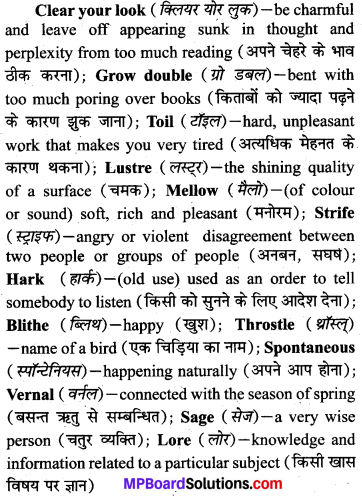
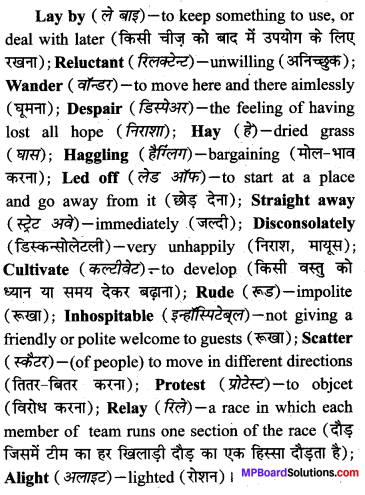
MP Board Class 10th General English The Spring Blossom Solutions Chapter 18 The Tables Turned 2

The Tables Turned Summary, Pronunciation & Translation

Up! up! my Friend, and quite your books;
Or surely you’ll grow double:
Up ! Up! my Friend and clear your looks;
Why all this toil and trouble?

(अप! अप! माई फ्रेण्ड, ऐण्ड क्विट यॉर बुक्सः
ऑर श्योरली यू विल ग्रो डबल:
अप! अप! माई फ्रेण्ड ऐण्ड क्लीयर यॉर लुक्स;
व्हाई ऑल दिस टॉएल ऐण्ड ट्रबल)

अनुवाद :
उठो!उठो !मेरे मित्र,और छोड़ोअपनीपुस्तकों को;
नहीं तो निश्चित रूप से दोहरे हो जाओगे (अत्यधिक पढ़ाई के कारण झुकी हुई काठी का हो जाना।)
उठो! उठो! मेरे मित्र और चेहरे पर हँसी लाओ (चेहरे से गम्भीरता के भाव हटाओ)
किसलिए इतना कठिन श्रम और परेशानी?

The sun, above the mountain’s head,
A freshening lustre mellow
Through all the long green fields has spread,
His first sweet evening yellow.

(द सन, अबव द माऊण्टेन्स हैड,
अ फ्रेशनिंग लस्टर मेलो
श्रू ऑल द लॉन्ग ग्रीन फील्ड्स हैज़ स्प्रेड,
हिज़ फर्स्ट स्वीट ईवनिंग यलो.)

अनुवाद :
पर्वत की चोटी के ऊपर दिख रहा सूर्य
ताज़गी भरी रंगीन आभा लिए
उसने दूर तक फैले खेतों-मैदानों में बिखरा दिया है
अपना साँझ का प्रथम मृदुल पीत रंग (पीला प्रकाश)

Books! ’tis a dull and endless strife:
Come, hear the woodland linnet,
How sweet his music! on my life,
There’s more wisdom in it.

(बुक्स! टिस अ डल ऐण्ड एण्डलेस स्ट्राईफ:
कम, हीयर द वुडलैण्ड लिनेट,
हाऊ स्वीट हिज़ म्यूजिक! ऑन माई लाईफ,
देयर्स मोर विज़डम इन इट.)

अनुवाद :
पुस्तकें! हैं एक नीरस, अन्तहीन संघर्ष
आओ, वन के लिनेट पक्षी को सुनो
कितना मधुर है उसका संगीत (गान)! कसम से,
कहीं ज़्यादा ज्ञान है उसके गान में।

And hark! how blithe the throstle sings!
He too, is no mean preacher:
Come forth into the light of things,
Let Nature be your teacher.

(ऐण्ड हार्क! हाऊ ब्लाईद द थ्रॉसल सिंग्ज़!
ही टू,’इज़ नो मीन प्रीचरः
कम फोर्थ इण्ट्र द लाईट ऑफ थिंग्ज़,
लेट नेचर बी यॉर टीचर.)

अनुवाद :
और सुनो ध्यान से! कैसे प्रफुल्लित हो कस्तूरी पक्षी गा रही है
वह भी कोई कमतर उपदेशक नहीं है:
आओ आगे चीज़ों की रोशनी में (जीवन को सरल बनाओ)
और प्रकृति को गुरु बनाओ।

She has a world of ready wealth,
Our minds and hearts to bless
Spontaneous wisdom breathed by health,
Truth breathed by cheerfulness.

(सी हैज़ अ वर्ल्ड ऑफ रेडी वेल्थ,
आवर माईण्ड्स ऐण्ड हार्स टू ब्लेस
स्पॉन्टेनिअस विजडम ब्रीद्ड बाई हैल्थ,
ट्रथ ब्रीड बाई चीयरफुलनेस.)

अनुवाद :
उसके (प्रकृति) के पास ज्ञान रूपी धन का भण्डार है,
है आशीर्वाद हमारे मन व हृदय के लिए
है स्वास्थ्य रूपी सहज स्वाभाविक ज्ञान,
और है प्रसन्नचित्तता।

One impulse from a vernal wood
May teach you more of man,
Of moral evil and of good,
Than all the sages can.

(वन इम्पल्स फ्रॉम अ वर्नल वुड
मे टीच यू मोर ऑफ मैन,
ऑफ मोरल ईविल ऐण्ड ऑफ गुड,
दैन ऑल द सेजिस कैन.)

अनुवाद :
बसन्ती वन का एक संवेग
तुम्हें मनुष्य के बारे में अधिक सिखा देगा,
नैतिकता, दुष्टता और अच्छाई के बारे में,
सभी ऋषि-मुनियों से अधिक।

Sweet is the lore which Nature brings
Our meddling intellect
Mis-shapes the beauteous forms of things:
We murder to dissect.

(स्वीट इज़ द लोर व्हिच नेचर ब्रिग्ज़;
आवर मेडलिंग इन्टलेक्ट
मिस-शेप्स द ब्यूटियस फॉर्स ऑफ थिंग्ज़:
वी मर्डर टू डिसेक्ट.)

अनुवाद :
मधुर है वो ज्ञान जो प्रकृति देती है;
हमारी हस्तक्षेप करने वाली अक्ल (समझ)
चीज़ों की खूबसूरत आकृतियों को बिगाड़ देती है;
जिनकी हम विच्छेदन हेतु हत्या करते हैं।
(जीव-जन्तुओं का विच्छेदन कर अन्दर के अंगों की जानकारी हासिल करना।)

Enough of Science and of Art;
Close up those barren leaves;
Come forth, and bring with you a heart
That watches and receives.

(एनफ ऑफ साईन्स ऐण्ड ऑफ आर्ट;
क्लोज़ अप दोज़ बैरन लीव्ज़;
कम फोर्थ, ऐण्ड ब्रिग विद यू अ हार्ट
दैट वॉचेस ऐण्ड रिसीव्ज़.)

अनुवाद :
विज्ञान और कला की पढ़ाई बहुत हुई;
बन्द करो पुस्तकों के उन सूखे ऊसर पन्नों को;
आगे जाओ, और साथ में लाओ अपना ऐसा हृदय
जो देखता भी है और ग्रहण भी करता है।

Hope that the above shaped information regarding the Madhya Pradesh Board Solutions for 10th English Chapter 18 The Tables Turned Questions and Answers is useful for making your preparation effective. View our website regularly to get other subjects solutions.
MP Board Class 10th General English The Spring Blossom Solutions Chapter 16 The Red Rice Granary

Are you seeking for the Madhya Pradesh Board Solutions 10th General English The Spring Blossom Solutions Chapter 16 The Red Rice Granary Questions and Answers PDF? If yes, then read this entire page. Here, we are giving a direct link to download MP Board Class 10th English Solutions Questions and Answers PDF which contains the chapter wise questions, solutions, and grammar topics. You can also get the shortcuts to solve the grammar related questions on this page.

MP Board Class 10th General English The Spring Blossom Solutions Chapter 16 The Red Rice Granary

For the sake of students we have gathered the complete 10th General English The Spring Blossom Solutions Chapter 16 The Red Rice Granary Questions and Answers can provided in pdf Pattern. Refer the chapter wise MP Board Class 10th English Solutions Questions and Answers Topics and start the preparation. You can estimate the importance of each chapter, find important English grammar concepts which are having more weightage. Concentrate on the important grammar topics from Madhya Pradesh Board Solutions for 10th English Chapter 16 The Red Rice Granary Questions and Answers PDF, prepare well for the exam.

The Red Rice Granary Textual Exercises

Word Power

Choose the correct option.
(सही विकल्प चुनिए)

1. Disaster means:
(a) a pleasing incident
(b) distantly situated
(c) which brings happiness
(d) an unexpected even that causes loss of lives or wealth
Answer:
(d) an unexpected even that causes loss of lives or wealth

2. Paddy fields are:
(a) fields where rice is grown
(b) big fields
(c) fields where wheat it grown
(d) fertile and big fields
Answer:
(a) fields where rice is grown

3. The bags that she got from the rich people were brimming over with:
(a) useful clothes
(b) junk
(c) precious ornaments
(d) food packets
Answer:
(b) junk

4. The writer of this article was invited to deliver a speech in a:
(a) company
(b) party
(c) village
(d) press conference
Answer:
(a) company

5. The ……….. used to be the superior one.
(a) polished rice
(b) white rice
(c) red rice
(d) yellow rice
Answer:
(b) white rice

How Much I have Understand?

A. Answer the following questions. (One or two sentences)
(निम्न प्रश्नों के उत्तर एक या दो वाक्यों में दीजिए।)।

Question 1.
Why was the writer invited to Bangalore?
(व्हाय वॉज़ द राईटर इनवाइटिड टू बैंग्लोर?)
लेखक को बैंगलौर आने के लिए न्यौता क्यों मिला?
Answer:
The write was invited to a reputed company in Bangalore to deliver a lecture on Corporate Social Responsibility.
(द राईटर वॉज़ इन्वाइटेड टू अ रेप्यूटिड कम्पनी इन बैंग्लोर टू डिलिवर अलैक्चर ऑन कॉर्पोरेट सोश्यल रिस्पॉन्सिबिलिटी।)
लेखक को बैंगलौर में एक ख्यातिप्राप्त कम्पनी में सामूहिक सामाजिक दायित्व पर भाषण देने के लिए न्यौता दिया गया था।

Question 2.
What was the reaction of the young girls and boys after the writer’s lecture?
(व्हॉट वॉज़ द रिएक्शन ऑफ द यंग गर्ल्स एण्ड बॉयज़ आफ्टर द राइटर्स लैक्चर?)
लेखक के भाषण का जवान लड़के व लड़कियों पर क्या प्रभाव हुआ?
Answer:
The young girls and boys were very emotional after the writer’s lecture. All of them became willing to offer something or the other for donation.
(द यंग गर्ल्स एण्ड बॉयज़ वर् वैरी इमोशनल आफ्टर द राईटर्स लैक्चर। ऑल ऑफ देम बिकेम विलिंग टू ऑफर समथिंग और द अदर फॉर डोनेशन।)
लेखक के भाषण के बाद जवान लड़के व लड़कियाँ भावुक हो गए। सभी दान के लए कुछ-न-कुछ देने के इच्छुक थे।

Question 3.
How did the writer assure the boys and girls?
(हाउ डिड द राईटर एश्योर द बॉयज़ एण्ड गर्ल्स?)
लेखक ने लड़के व लड़कियों को कैसे आश्वासित किया?
Answer:
The writer assured the boys and girls by asking them to send their bags of things to be donated to his office and saying that she would see that they reach the right persons.
(द राइटर एश्योर्ड द बॉयज़ एण्ड गर्ल्स बाइ आस्किंग देम टू सेण्ड देयर बैग्स ऑफ थिंक्स टू बी डोनेटिड टू हिज़ ऑफिस एण्ड सेइंग दैट शी वुड सी दैट दे रीच द राइट पर्सन्स।)
लेखिका ने लड़कों व लड़कियों को आश्वासन दिया कि वे अपने दान करने के लिए बनाये गये थैले उसके दफ्तर भेज दें। वह उन्हें सही व्यक्तियों तक पहुँचा देगी।

Question 4.
How did the grandparents of the writer live?
(हाउ डिड द ग्रैण्डपेरेन्ट्स ऑफ द राइटर लिव?)
लेखिका के दादा-दादी कैसे रहते थे?
Answer:
The grandparents of the writer lived like flowers with fragrance in the forest, enchanting everyone around them, but hardly noticed by the outside world. They did their work wholeheartedly without expecting anything from anybody in their life.

(द ग्रैण्डपेरेन्ट्स ऑफ द राइटर लिव्ड लाइक फ्लावर्स विद फ्रेग्रेन्स इन द फॉरेस्ट, एन्चेंण्टिंग एवीवन अराउण्उ देम, बट हार्डलि नोटिस्ड बाइ द आऊटसाइड वर्ल्ड। दे डिड देयर वर्क होलहार्टिडलि विदाऊट एक्सपेक्टिंग एनीथिंग फ्रॉम एनीबडी इन देयर लाइफ।)

लेखिका के दादा-दादी वन के सुगन्धित फूलों जैसा जीवन व्यतीत करते थे, वे अपने आस-पास हर किसी को आनन्दित रखते थे, मगर बाहर की दुनिया उनसे अनजान थी। वे अपना काम दिल से करते थे बिना किसी से भी किसी प्रकार की उम्मीद रखे।

Question 5.
What question had been bothering the author for a long time?
(व्हॉट क्वैश्चन हैड बीन बॉदरिंग द ऑथर फॉर अ लाँग टाइम?)
लेखिका को लम्बे समय से कौन-सा प्रश्न परेशान कर रहा था?
Answer:
The question that why she and her grandparents ate red rice always at night and give the better quality rice to the poor people bothered author for a long time.
(दे क्वैश्चन दैट व्हाय शी एण्ड हर ग्रॉण्डपेरेन्ट्स एट रेड राइस ऑल्वेज़ एट नाइट एण्ड गिव द बैटर क्वॉलिटी राइस टूद पूअर पीपल बॉदर्ड द ऑथर फॉर अ लाँग टाइम।)
लेखिका को यह प्रश्न कि वह और उसके दादा-दादी रात में लाल चावल खाते थे वह बढ़िया चावल गरीब लोगों को क्यों दान करते थे लम्बे समय से परेशान कर रहा था।

Question 6.
Why didn’t they eat white rice at night?
(व्हाय डिडन्ट दे ईट व्हाइट राइस एट नाइट?)
वे रात में सफेद चावल क्यों नहीं खाते थे?
Answer:
They didn’t eat white rice at night because they donated it to the poor as they thought that they should give anybody the best they have.
(दे डिडन्ट ईट व्हाइट राइस एट नाइट बिकॉज़ दे डोनेटिड इट टू द पूअर एज़ दे थॉट दैट शुड गिव एनीबडी द बेस्ट दे हैव।)
वे रात में सफेद चावल नहीं खाते थे क्योंकि वे उसे गरीबों को दान में दिया करते थे क्योंकि वे यह सोचते थे कि उन्हें किसी को भी अपनी उच्चतम वस्तु देनी चाहिए।

B. Answer the following questions. (Three or four sentences)
(निम्न प्रश्नों के उत्तर तीन या चार वाक्यों में दीजिए।)

Question 1.
How did squirrels help Shri Rama during the construction of the bridge between India and Lanka?
(हाउ डिड स्किवरल्स हैल्प श्री राम ड्युरिंग द कन्स्ट्रक्शन ऑफ द ब्रिज बिटवीन इण्डिया एण्ड लंका?)
गिलहरियों ने श्री राम की भारत व लंका के बीच सेतु बनाने में किस प्रकार मदद की?
Answer:
Squirrels helped Shri Rama during the construction of the bridge between India and Lanka by bringing a handful of sand.
(स्किवरलस् हैल्प्ड् श्री राम ड्यूरिंग द कंस्ट्रक्शन ऑफ द ब्रिज बिटवीन इण्डिया एण्ड लंका बाइ ब्रिगिंग अ हैण्डफुल ऑफ सैण्ड।)
गिलहरियों ने श्री राम को भारत व लंका के बीच सेतु निर्माण में एक मुट्ठी रेत लाकर मदद की।

Question 2.
Why did the writer’s initial feeling of pride on receiving the donations in kind turn in shock and surprise on opening the bags containing them?
(व्हाय डिंड द राइटर्स इनिशियल फीलिंग ऑफ प्राइड-ऑन् रिसीविंग द डोनेशन्स इन काइन्ड टर्न इन शॉक एण्ड सरप्राइज़ ऑन ओपनिंग द बैग्स कन्टेनिंग देम?)
लेखिका की गर्व की भावना दान में आये हुए थैलों को खोलने पर सदमे व आश्चर्य में क्यों बदल गई?
Answer:
The writer’s initial feeling of pride on receiving the donations in kind turned into shock and surprise on opening the bags because the bags were full of all kinds of junk. It was apparent that instead of sending the material to a garbage it was transferred to the writer’s office.

(द राईटर्स इनिशियल फीलिंग ऑफ प्राइड ऑन रिसीविंग द डोनेशन्स इन काइन्ड टर्ड इन्टू शॉक एण्ड सरप्राइज़ ऑन ओपनिंग द बैग्स बिकॉज़ द बैग्स वर् फुल ऑफ ऑल काइन्ड्स ऑफ जंक। इट वॉज़ एपरेन्ट दैट इन्स्टैड ऑफ सेन्डिंग द मैटीरियल टू अ गारबेज इट वॉज़ ट्रान्सफर्ड टू द राईटर्स ऑफिस।)

लेखिका को दान की वस्तुएँ पाने के बाद सदमा लगा व अचरज हुआ क्योंकि दान के थैलों में हर तरह का कचरा भरा था। यह स्पष्ट था कि लोगों ने सामान को कबाड़खाने भेजने के बजाय लेखिका के दफ्तर भेज दिया था।

Question 3.
How did people live in the villages during the writer’s childhood?
(हाउँ डिड पीपल लिव इन द विलेजेज़ ड्यूरिंग द राईटर्स चाइल्डहुड?)
लेखिका के बचपन के समय लोग गाँवों में किस प्रकार रहते थे?
Answer:
During writer’s childhood there was no communal divide in the village. People from different communities lived together in peace.
(ड्यूरिंग राईटर्स चाइल्डहुड देयर वॉज़ नो कम्यूनल डिवाइड इन द विलेज। पीपल फ्रॉम डिफ्रेन्ट कम्यूनिटीज़ लिव्ड टुगेदर इन पीस।)
लेखिका के बचपन के समय गाँवों में जातीय विभाजन नहीं था। अलग-अलग समुदायों के लोग एक साथ शान्तिपूर्वक रहते थे।

Question 4.
Write any four lines as quoted by the writer from the vedas.
(राईट एनी फोर लाइन्स एज़ कोटेड बाइ द राईटर फ्रॉम द वेदास।)
वेदों से लेखिका द्वारा लिखित पंक्तियों में से चार पंक्तियाँ लिखो।
Answer:
The four lines from the vedas are :
Donate with kind words.
Donate with happiness.
Donate with sincerity.
Donate only to the needy.

(द फोर लाइन्स फ्रॉम द वेदाज़ आर :
डोनेट विद काइन्ड वर्ड्स।
डोनेट विद हैप्पिनेस।
डोनेट विद सिन्सेरिटी।
डोनेट ओनलि ट्रद नीडी।)

वेदों से चार पंक्तियाँ हैं
मधुर शब्दों के साथ दान दो।
खुशी से दान दो।
ईमानदारी से दान दो।
सिर्फ जरूरतमन्दों को ही दान दो।

Question 5.
How did the writer’s grandparents help the poor people?
(हाउ डिड द राईटर्स ग्रैण्डपेरेन्ट्स हैल्प द.पूअर पीपल्?)
लेखिका के दादा-दादी गरीबों की मदद कैसे करते थे?
Answer:
Writer’s grandparents helped the poor by giving them white rice while they themselves ate poor quality red rice.
(राईटर्स ग्रैण्डपेरेन्ट्स हेल्प्ड् द पूअर बाइ गिविंग देम व्हाईट राईस व्हाइल दे देमसेल्वस् एट पूअर क्वॉलिटी रेड राईस।)
लेखिका के दादा-दादी गरीबों की सफेद चावल दान करके मदद करते थे व वे स्वयं निम्न श्रेणी के लाल चावल खाते थे।

Question 6.
What is the real service to God according to the writer’s grandmother?
(व्हॉट इज़ द रिअल सर्विस टू गॉड एकार्डिग टू द राइटर्स ग्रैण्डमदर?)
लेखिका की दादी के हिसाब से ईश्वर के प्रति असली सेवा क्या है?
Answer:
According to the writer’s grandmother, serving people is the real service to God because He is not there in temple, mosque or church, He is with the people.
(एकॉर्डिग टू द राइटर्स ग्रैण्डमदर, सविंग पीपल इज़ द रीयल सर्विस टू गॉड बिकॉज़ ही इज़ नॉट देयर इन द टैम्पल, मॉस्क और चर्च, ही इज़ विद पीपल्।)
लेखिका की दादी के हिसाब से, लोगों की सेवा ही ईश्वर की सच्ची सेवा है क्योंकि वो मन्दिर, मस्जिद या चर्च में नहीं बल्कि लोगों में है।

Language Practice

A. Make negatives and write them in your notebooks.
(नकारात्मक वाक्य बनाइए।)
1. He is very fat.
Answer:
He is not very fat.

2. I believe in God.
Answer:
I do not believe in God.

3. Kamla learns English.
Answer:
Kamla does not learn English.

4. I went to see the book-fair.
Answer:
I did not go to see the book-fair.

5. Rahim wrote a good article for the school magazine.
Answer:
Rahim did not write a good article for the school magazine.

6. I can speak English now.
Answer:
I can’t speak English now.

B. Make questions as indicated against each sentence.
(प्ररन बनाइए।)

1. The boy was playing (Y/N question)
Answer:
Was the boy playing?

2. Prakash plays tennis. (Wh question)
Answer:
What does Prakash play?

3. They learn English. (Y/N question)
Answer:
Do they learn English?

4. Girls sang sweet songs yesterday. (Wh question)
Answer:
When did girls sing sweet songs?

Listening Time

The teacher will read out the instructions given below and students will try to draw the picture according to the instructions. (Ask the students not to write anything except drawing.)
(सुनो व दिये गये निर्देशों के अनुसार चित्र बनाओ।)

  1. Take a fresh page of your notebook.
  2. Draw a line across the middle of the page.
  3. Draw some waves above the line.
  4. On the left hand corner draw a sailing boat.
  5. In the right hand corner draw a swimmer.
  6. Draw a dotted line from the swimmer to the shore.
  7.  Draw a man lying on the beach in the left hand corner.
  8. The swimmer is shouting help! help! Write help-help in speech bubbles.
  9. Show the quickest way from the man on the beach to reach the swimmer.

Answer:
Do yourself.

Speaking Time

Tell about yourself, when do you wear these things?
(बताइए कि आप निम्न वस्तुएँ कब पहनेंगे?)
(a tie, boots, sandals, gloves, jeans, make-up, a hat, shorts, trainers, glasses.)
Answer:
Students can talk as follows :
I wear a tie when I go to school. I wear boots in rainy season. I wear sandals when I go to a party. I wear jeans occasionally. I never wear make-up. I wear a hat when it’s too hot or raining. I wear shorts and trainers when I go for jogging. I wear glasses when I read newspapers.

Writing Time

Describe the scenes in not more than 50 words.
(50 शब्दों में निम्न दृश्यों का वर्णन करिए)

1. A flood scene
2. A scene after an earthquake.
Answer:
1. A Flood Scene :
Last year, flood occurred in our village. The whole village drowned in water. The villagers took shelter on the high mountain peaks. Many were drowned. There were household utensils and articles seen floating in the water. There was great loss of life and property. There was chaos all around. Relief packets of food were being thrown down from the aeroplanes sent by the Government.

2. A Scene after an Earthquake :
Last year there was an earthquake in Gujarat. It caused a great loss of life and property. Several high buildings and houses had tumbled down, and several people were burried under them. Only in a few seconds a havoc was created. Several children had become orphan and many had lost their families. Government crew was trying to take out those who were alive from the heap and relief programme was going on.

Things to do

Discuss with your teachers, parents/elders and find out about the natural calamities. Fill up the charts with the information required and write in your project notebook.
(अपने शिक्षकों, माता-पिता/बड़ों से चर्चा कर प्राकृतिक आपदाओं के बारे में जानें। प्राप्त जानकारी को पुस्तक में दिये गये चार्ट में भरें।
Answer:
Students should discuss with their teachers, parents/elders and fill in the information about natural calamities themselves.
(छात्र स्वयं करें।)

The Red Rice Granary Difficult Word Meanings

Havoc (हैवॉक)-situation in which there is a lot of damage, destruction or disorder (बरबादी, तबाही); Affluent (एफ्लूएन्ट)-having a lot of money and good standard of living (धनाढ्य); Vessel (वैसल)-a container used for holding liquids such as a bowl, cup etc. (बर्तन); Brimming (ब्रिमिंग)to be full of something, to fill something (भरा हुआ); Granary (ग्रेनेरी)-a building where grain is stored (a store room for grain) (भण्डारगृह); Alms (आम्ज)-money, clothes and food that are given to poor people (भिक्षा दान)

The Red Rice Granary Summary, Pronunciation & Translation

Every year, our country has to face natural disasters in some form. It may be an earthquake in Gujarat, floods in Orissa or a drought in Karnataka. In a poor country, these calamities create havoc.

In the course of my work, I have found that after such calamities, many people like to donate money or materials to relief funds. We assume that most donations come from rich people, but that is not true. On the contrary, people from the middle class and lower middle class help more. Rarely do rich people participate wholeheartedly.

(एवरी यीअर, आवर कंट्री हैज़ टू फेस नैचुरल डिज़ास्टर्स इन सम फॉर्म. इट मे बी ऐन अर्थक्वेक इन गुजरात, फ्लड्स इन उड़ीसा ऑर अ ड्रॉट इन कर्नाटका. इन अ पूअर कंट्री, दीज़ कलैमिटीज क्रीयेट हैवक.

इन द कोर्स ऑफ माई वर्क, आई हैव फाऊण्ड दैट आफ्टर सच कलैमिटीज़ मैनी पीपल लाईक टू डोनेट मनी ऑर मैटेरियल्स टू रिलीफ फण्ड्स. वी अज्यूम दैट मोस्ट डोनेशन्स कम फ्रॉम रिच पीपल, बट दैट इज़ नॉट ट्र. ऑन द कॉन्ट्ररी, पीपल फ्रॉम द मिडल क्लास ऐण्ड लोअर मिडल क्लास हैल्प मोर. रेयरली डू रिच पीपल पार्टिसिपेट होलहार्टिली.)

अनुवाद :
प्रत्येक वर्ष हमारे देश को किसी न किसी प्रकार की प्राकृतिक आपदा का सामना करना पड़ता है। चाहे वो गुजरात में भूकम्प हो, उड़ीसा में बाढ़ हो या फिर कर्नाटक में सूखा। एक गरीब देश में यह आपदाएँ तबाही मचा देती हैं।

अपने कार्य के दौरान, मैंने पाया कि ऐसी आपदाओं के पश्चात् बहुत से लोग धन व अन्य सामग्रियाँ राहत कोषों को दान देना पसन्द करते हैं। हम यह समझते हैं कि ज्यादातर दान अमीर लोगों से आता है, परन्तु यह सत्य नहीं है। इसके विपरीत मध्यम वर्ग और निम्न मध्यम वर्ग के लोग ज्यादा.मदद करते हैं। यदा-कदा ही अमीर लोग पूरे दिल से ऐसे कार्यों में भाग लेते हैं।

A few years back, I was invited to a reputed company in Bangalore to deliver a lecture on Corporate Social Responsibility. Giving a speech is easy. But I was not sure how many people in the audience would really understand the speech and change themselves.

After my talk was over, I met many young girls and boys. It was an affluent company and the employees were well off and well-dressed. They were all very emotional after the lecture.

(अ फ्यू ईअर्स बैंक, आई वॉज इन्वाईटिड टू अ रेप्यूटिड कम्पनी इन बैंगलोर टू डेलिवर अ लेक्चर ऑन कॉरपोरेट सोशल रिस्पॉन्सिबिलिटी. गिविंग अ स्पीच इज़ ईजी. बट आई वॉज़ नॉट श्योर हाऊ मैनी पीपल इन द ऑडियन्स वुड रीयली अण्डरस्टैण्ड द स्पीच ऐण्ड चेन्ज देम्सेल्ब्ज.

आफ्टर माई टॉक वॉज़ ओवर, आई मेट मैनी यंग गर्ल्स एण्ड बॉयज़. इट वॉज़ ऐन एफ्लूएण्ट कम्पनी ऐण्ड द एम्प्लॉयीज़ वर वैल-ऑफ ऐण्ड वैल-ड्रेस्ड. दे वर ऑल वेरी इमोशनल आफ्टर द लेक्चर.)

अनुवाद :
कुंछ वर्ष पूर्व, मुझे बैंगलोर (बंगलुरू) की एक प्रतिष्ठित कम्पनी में व्यावसायिक समूहों के सामाजिक उत्तरदायित्वों पर व्याख्यान देने हेतु आमंत्रित किया गया था। व्याख्यान अथवा भाषण देना आसान है। परन्तु मैं इस बात के प्रति आश्वस्त नहीं था कि श्रोताओं में से कितने लोग मेरे व्याख्यान को वास्तव में समझेंगे और स्वयं को बदलेंगे।

मेरा व्याख्यान खत्म होने के बाद, मैं बहुत सारे लड़के-लड़कियों से मिला। वह एक समृद्ध कम्पनी थी और उसके कर्मचारी संपन्न थे वह कपड़े भी अच्छे पहने हुए थे। वे सभी मेरे भाषण के बाद बेहद भावुक हो गए थे।

‘Madam, we buy so many clothes every month. Can we donate our old clothes to those people who are affected by the earthquake? Can you co-ordinate and send them?’

Some of them offered other things-
‘We have grown-up children, we would like to give their old toys and some vessels.’

I was very pleased at the reaction. It reminded me of the incident in Ramayana where during the construction of the bridge between India and Lanka, every squirrel helped Shri Rama by bringing a handful of sand.

Please send your bags to my office. I will see that they reach the right persons.”

(‘मैडम, वी बाय सो मैनी क्लोद्स एवरी मंथ. कैन वी डोनेट आवर ओल्ड क्लोद्स टू दोज़ पीपल हू आर अफेक्टिड बाय द अर्थक्वेक? कैन यू को-ऑर्डिनेट ऐण्ड सेण्ड देम?’

सम ऑफ देम ऑफर्ड अदर थिंग्स-
‘वी हैव ग्रोन-अप चिल्ड्रन, वी वुड लाइक टू गिव देयर ओल्ड टॉयज़ ऐण्ड सम वेसल्स.

आई वॉज़ वेरी प्लीज्ड ऐट द रियेक्शन. इट रिमाईण्डिड मी ऑफ द इन्सिडेण्ट इन रामायना व्हेअर ड्यूरिंग द कन्सट्रक्शन ऑफ द ब्रिज बिटवीन इण्डिया ऐण्ड लंका, एवरी स्क्विरल हैल्प्ड श्री रामा बाय ब्रिगिंग अ हैण्डफुल ऑफ सैण्ड.

‘प्लीज़ सेण्ड यॉर बैग्ज़ टू माई ऑफिस. आई विल सी दैट दे रीच द राईट पर्सन्स.’)

अनुवाद :
मैडम, हम हर महीने इतने सारे वस्त्र खरीदते हैं। क्या हम अपने पुराने वस्त्रों को भूकम्प पीड़ितों को दान कर सकते हैं? क्या आप समन्वयक बन उनको भिजवा सकती हैं?’

उनमें से कुछ ने दूसरी चीज़ों की पेशकश की। ‘हमारे बच्चे बड़े हो चुके हैं, हम उनके पुराने खिलौने व कुछ बर्तन देना चाहेंगे।’

मैं उन सब की प्रतिक्रिया पर बेहद खुश थी। मुझे रामायण की वह घटना याद आ गई जब भारत व लंका के बीच समुद्र पर सेतु बन रहा था तब हर एक गिलहरी ने एक मुट्ठी रेत लाकर श्री राम की मदद की थीं।

‘कृपया अपना बैग मेरे दफ्तर भिजवा दीजिएगा। मैं यह सुनिश्चित करूँगी कि आपका दिया सामान सही व्यक्तियों तक पहुँचे।’

Within a week, my office was flooded with hundreds of bags. I was proud that my lecture had proven so effective.

One Sunday, along with my assistants, I opened the bags. What we saw left us amazed and shocked. The bags were brimming over with all kinds of junk! Piles of high heeled slippers (some of them without the pair), torn undergarments, unwashed shirts, transparent, cheap saris, toys which had neither shape nor colour, unusable bed sheets, aluminium vessels, broken cassettes were soon heaped in front of us like a mountain. There were only a few good shirts, saris and usable materials.

(विदिन अ वीक, माई ऑफिस वॉज़ फ्लडिड विद हन्ड्रेड्स ऑफ बैग्ज़. आई वॉज प्राऊड दैट माई लेक्चर हैड प्रूवन सो इफैक्टिव.

वन सण्डे, अलॉन्ग विद माई असिस्टैण्ट्स, आई ओपन्ड द बैग्ज. व्हॉट वी सॉ लेफ्ट अस अमेज्ड ऐण्ड शॉक्ड. द बैग्ज़ वर ब्रिमिंग ओवर विद ऑल काईण्ड्स ऑफ जंक! पाईल्स ऑफ हाईहील्ड स्लिपर्स (सम ऑफ देम विदाऊट द पेअर), टॉर्न अंडरगारमेण्ट्स, अनवाश्ड शर्ट्स, ट्रास्पेरेण्ट, चीप साड़ीज़, टॉयज़ व्हेिंच हैड नीदर शेप नॉर कलर, अनयूज़ेबल बेडशीट्स, अल्यूमीनियम वेसल्स, ब्रोकन कैसेट्स वर सून हीप्ड इन फ्रण्ट ऑफ अस लाईक अ माऊण्टेन. देयर वर ओन्ली अ फ्यू गुड शर्ट्स, साड़ीज़ ऐण्ड यूज़ेबल मैटेरियल्स.)

अनुवाद :
एक सप्ताह के भीतर मेरा दफ्तर सैकड़ों बैगों से भर गया। मुझे गर्व था कि मेरा व्याख्यान इतना असरकारक सिद्ध हुआ।

एक रविवार, अपने सहायकों के साथ मैंने उन बैगों को खोला जो हमने देखा उससे हम हैरान व स्तंभित हो गए। वो बैग ऊपर तक सभी प्रकार की रद्दी कबाड़ से भरे हुए थे। ऊँची एड़ी की चप्पलों के ढेर (कुछ तो एक ही पैर के थे) फटे हुए अन्तः वस्त्र, बिना धुली कमीजें, पारदर्शी सस्ती घटिया साड़ियाँ, आकार व रंगहीन खिलौने, अप्रयोज्य चादरें, एलुमिनियम के बर्तन, टूटे-फूटे कैसटों का शीघ्र ही पहाड़ जैसा ढेर लग गया हमारे सामने। केवल कुछ ही अच्छी कमीजें, साड़ियाँ व प्रयोग योग्य चीजे थीं।

It was apparent that, instead of sending the material to a garbage or the kabariwala, these people had transferred them to my office in the name of donation. The men and women I had met that day were bright, well travelled, well-off people. If educated people like them behaved like this, what would uneducated people do?

But then I was reminded of an incident from my childhood. I was born and brought up in a village in Karnataka’s Haveri district, called Shiggaon. My grandfather was a retired school teacher and my grandmother Krishtakka never went to school. Both of them had hardly travelled and had never stepped out of Karnataka. Yet they were hardworking people, who did their work wholeheartedly without expecting anything from anybody in their life. Their photographs never appeared in any paper, nor did they go up on a stage to receive a prize for the work they did. They lived like flowers with fragrance in the forest, enchanting everyone around them, but hardly noticed by the outside world.

इट वॉज़ अपेअरेण्ट दैट, इन्स्टेड ऑफ सेण्डिंग द मैटेरियल टू अ गारबेज ऑर द कबाडीवाला, दीज पीपल हैड ट्रांस्फर्ड देम ट्र माई ऑफिस इन द नेम ऑफ डोनेशन. द मेन ऐण्ड विमेन आई हैड मेट दैट डे वर ब्राईट, वैल-ट्रेवल्ड, वैल-ऑफ पीपल, इफ एजुकेटिड पीपल लाईक देम विहेव्ड लाईक दिस, व्हॉट वुड अनएजुकेटिड पीपल डू?

देन आई वॉज़ रिमाईण्डिड ऑफ ऐन इन्सिडेण्ट फ्रॉम माई चाईल्डहुड. आई वॉज़ बॉर्न ऐण्ड ब्रॉट अप इन अ विलेज इन कर्नाटकाज़ हवेरी डिस्ट्रिक्ट, कॉल्ड शिग्गाँव. माई ग्रैण्डफादर वॉज़ अ रिटायर्ड स्कूल टीचर ऐण्ड माई ग्रैण्डमदर क्रिश्टक्का नेवर वेण्ट टू स्कूल. बोथ ऑफ देम हैड हार्डली ट्रैवल्ड ऐण्ड हैड नेवर स्टेप्पड आऊट ऑफ कर्नाटका. यट दे वर हार्डवर्किंग पीपल, हू डिड देयर वर्क होलहार्टिडली विदाऊट एक्स्पेक्टिंग एनीथिंग फ्रॉम एनीबडी इन देयर लाईफ. देयर फोटोग्राफ्स नेवर अपीयर्ड इन एनी पेपर, नॉर डिड दे गो अप ऑन अ स्टेज टू रिसीव अ प्राईज़ फॉर द वर्क दे डिड. दे लिव्ड लाईक फ्लावर्स विद फ्रेगरेन्स इन द फॉरेस्ट, एन्चैण्टिंग एवरीवन अराऊण्ड देम, बट हार्डली नोटिस्ड बाई द आऊटसाईड वर्ल्ड.

अनुवाद :
यह स्पष्ट था कि इन सामानों को कूड़े में फेंकने या कबाड़ी वाले को देने के बजाए इन लोगों ने दान के नाम पर मेरे दफ्तर में भिजवा दिया था। जिन पुरुषों और महिलाओं से मैं उस दिन मिली थी वे सब बड़े सभ्रांत, दुनिया घूमे हुए व संपन्न लोग थे। यदि उनके जैसे पढ़े-लिखे लोग ऐसा बर्ताव करेंगे तो फिर अनपढ़ लोग क्या करेंगे?

परन्तु तभी मुझे बचपन की एक घटना याद आ गई। मैं कर्नाटक राज्य के हवेरी जिले के एक गाँव शिग्गाँव में जन्मी व पली-बढ़ी। मेरे दादाजी एक सेवानिवृत्त विद्यालय के अध्यापक थे और मेरी दादी क्रिश्टक्का कभी विद्यालय नहीं गईं। दोनों ने ही न के बराबर यात्राएँ की थी और उन्होंने कभी कर्नाटक से बाहर कदम नहीं रखा। फिर भी वे कठोर परिश्रमी लोग थे जो अपना कार्य पूरे दिल से करते थे, जीवन में किसी से किसी भी चीज़ की आशा किए बिना। उनके चित्र कभी किसी समाचार पत्र में नहीं छपे, न ही वे कभी किसी मंच पर अपने किए गए कार्य का पुरस्कार लेने के लिए चढ़े। वे जंगल के सुगंधित पुष्पों की भाँति जिए, अपने आस-पास के सभी लोगों को मोहित करते परन्तु बाहरी दुनिया जिनके बारे में अनभिज्ञ रही।

In the village we had paddy fields and we used to store the paddy in granaries. There were two granaries. One was in the front and the other at the back of our house. The better quality rice, which was white, was always stored in the front granary and the inferior quality, which was little thick and red, was stored in the granary at the back.

In those days, there was no communal divide in the village. People from different communities lived together in peace. Many would come to our house to ask for alms. There were Muslim Fakirs, Hindu Dasalahs who roamed the countryside singing devotional songs, Yellamma Jogathis who appeared holding the image of Goddess Yellamma over their heads, poor students and invalid people.

(इन द विलेज वी हैड पैडी फील्ड्स ऐण्ड वी यूज्ड टू स्टोर द पैडी इन ग्रैनरीज़. देयर वर टू ग्रैनरीज़. वन वॉज़ इन द फ्रण्ट ऐण्ड द अदर ऐट द बैक ऑफ आवर हाऊज़. द बैटर क्वालिटी राईस, व्हिच वॉज व्हाईट, वॉज़ आल्वेज़ स्टोर्ड इन द फ्रण्ट ग्रैनरी ऐण्ड द इन्फीरियर क्वालिटी, व्हिच वॉज़ लिटिल थिक ऐण्ड रेड, वॉज़ स्टोर्ड इन द ग्रैनरी ऐट द बैंक.

इन दोज़ डेज़, देयर वॉज़ नो कम्यूनल डिवाईड इन द विलेज. पीपल फ्रॉम डिफरण्ट कम्यूनिटीज़ लिव्ड टुगेदर इन पीस. मैनी वुड कम टू आवर हाऊज़ टू आस्क फॉर आम्स. देयर वर मुस्लिम फकीर्स, हिंदु दसालाहज़ हू रोम्ड द कंट्रीसाईड सिंगिंग डिवोशनल सॉनस, यलम्मा जोगथीज़ हू अपीयर्ड होल्डिंग द इमेज ऑफ गॉडेस यलम्मा ओवर देयर हेड्स, पूअर स्टुडेण्ट्स ऐण्ड इन्वैलिड पीपल.)

अनुवाद :
गाँव में हमारे धान के खेत थे और हम धान को धान्यागार में रखते थे। दो धान्यागार थे। एक सामने की ओर था और दूसरा हमारे घर के पीछे। अच्छी किस्म का चावल जो सफेद होता था हमेशा सामने वाले धान्यागार में रखा जाता था और निम्न किस्म का चावल जो थोड़ा मोटा व लाल होता था पीछे वाले धान्यागार में।

उन दिनों गाँव में किसी प्रकार का साम्प्रदायिक भेद-भाव नहीं था। सभी धर्मों के लोग मिल-जुलकर शान्ति के साथ रहते थे। बहुत से लोग हमारे यहाँ भीख मांगने आते थे। वहाँ मुसलमान फकीर थे, हिंदु दसलाह थे जो भक्ति गीत गाते हुए गाँव-गाँव घूमते थे और यलम्मा जागथी समुदाय के लोग जो देवी यलम्मा की मूर्ति अपने सिर के ऊपर पकड़े दिख जाते थे, गरीब विद्यार्थी एवं अपंग लोग।

We never had too much cash in the house and the only help my grandfather could give these people was in the form of rice. People who receive help do not talk too much. They would receive the rice, smile and raise their right hand to bless us. Irrespective of their religion, the blessing was always “May God bless you.” My grandfather always looked happy after giving them alms.

I was a little girl then and not too tall. Since the entrance to the front granary was low, it was difficult for grown-ups to enter. So I would be given a small bucket and sent inside. There I used to fill up the bucket with rice and give it to them. They would tell me how many measures they wanted.

(वी नेवर हैड टू मच कैश इन द हाऊज़ ऐण्ड द ओन्ली हैल्प माई ग्रैण्डफादर कुड गिव दीज़ पीपल वॉज़ इन द फॉर्म ऑफ राईस. पीपल हू रिसीव हैल्प डू नॉट टॉकट टू मच. दे वुड रिसीव द राईस, स्माईल ऐण्ड रेज़ देयर राईट हैण्ड टू ब्लैस अस. इररेस्पेक्टिव ऑफ देयर रिलीजन, द ब्लैसिंग वॉज़ आल्वेज़ “मे गॉड ब्लैस यू.” माई ग्रैण्डफादर आल्वेज़ लुक्ड हैप्पी आफ्टर गिविंग देम आम्स.

आई वॉज़ अ लिटल गर्ल देन ऐण्ड नॉट टू टॉल. सिन्स द एन्ट्रेन्स टू द फ्रण्ट ग्रैनरी वॉज़ लो, इट वॉज़ डिफिकल्ट फॉर ग्रोन-अप्स टू एन्टर. सो आई वुड बी गिवन अ स्मॉल बकिट ऐण्ड सेण्ट इनसाईड. देयर आई यूज्ड टू फिल अप द बकिट विद राईस ऐण्ड गिव इट टू देम. दे वुड टेल मी हाऊ मैनी मेज़र्स दे वाण्टिड.)

अनुवाद :
हमारे पास कभी भी बहुत अधिक नकद रुपए नहीं हुआ करते थे घर में और एकमात्र मदद जो मेरे दादाजी इन लोगों को दे पाते थे तो चावल के रूप में होती थी जिन लोगों को मदद मिलती है वे अधिक नहीं बोलते। वे लोग चावल लेते, मुस्कराते और अपना दाहिना हाथ उठाते आशीर्वाद देने के लिए। चाहे वे किसी भी धर्म के हों आशीर्वाद हमेशा “ईश्वर तुम्हारा भला करे।” मेरे दादाजी हमेशा ही बड़े प्रसन्न दिखते थे उनको दान देने के बाद।

मैं उस वक्त एक छोटी लड़की थी और लम्बाई भी अधिक न थी। क्योंकि सामने वाले धान्यागार का द्वार बेहद छोटा व नीचा था, इसलिए बड़े लोगों को उसमें घुसने में दिक्कत होती थी। इसलिए मुझे एक छोटी सी बाल्टी पकड़ा कर अन्दर भेजा जाता। मैं उस छोटी बाल्टी को चावल से भरती और उनको पकड़ा देती। वे मुझे बताते कि कितनी मात्रा उन्हें चाहिए।

In the evening, my grandmother used to cook for everybody. That time she would send me to the granary at the back of the house where the red rice was stored. I would again fill up the bucket with as much rice as she wanted and get it for her to cook our dinner.

This went on for many years. When I was a little older, I asked my grandparents a question that had been bothering me for long.

‘Why should we eat the red rice always at the night when it is not so good, and give those poor – people the better quality rice?’

My grandmother Krishtakka smiled and told me something I will never forget in my life.

(इन द ईवनिंग, माई ग्रैण्डमदर यूज्ड टू कुक फॉर एवरीबडी. दैट टाईम शी वुड सेण्ड मी टू द ग्रैनरी ऐट द बैक ऑफ द हाऊज़ व्हेअर द रेड राईस वॉज़ स्टोर्ड. आई वुड अगेन फिल अप द बकिट विद ऐज़ मच राईस ऐज़ शी वाण्टिड ऐण्ड गैट इट फॉर हर टू कुक आवर डिनर.

दिस वेण्ट ऑन फॉर मैनी यीअर्स. व्हेन आई वॉज़ अलिटल ओल्डर, आई आस्क्ड माई ग्रैण्डपेरेण्ट्स अक्वेश्चन दैट हैड बीन बॉदरिंग मी फॉर लॉन्ग.

‘व्हाई शुड वी ईट द रेड राईस ऑलवेज़ ऐट नाईट व्हेन इट इज़ नॉट सो गुड ऐण्ड गिव दोज़ पूअर पीपल द बैटर क्वालिटी राईस?’

माई ग्रैण्डमदर क्रिश्टक्का स्माईल्ड एण्ड टोल्ड मी समथिंग आई विल नेवर फॉरगेट इन माई लाईफ.)

अनुवाद :
शाम को मेरी दादी सबके लिए खाना बनाती थीं। उस समय वे मुझे घर के पीछे वाले धान्यागार में भेजती थीं जहाँ लाल वाले चावल रखे जाते थे। मैं फिर से उस छोटी बाल्टी को भरती थी जितना वे कहती थीं उतने चावलों से और उनको देती थी हमारे लिए खाना बनाने के लिए। ऐसा वर्षों तक चलता रहा। जब मैं थोड़ी बड़ी हुई तो मैंने अपने दादा-दादी से एक प्रश्न पूछा जो कि बहुत समय से मुझे परेशान कर रहा था।

‘हम लोग हमेशा लाल वाले चावल क्यों खाते हैं रात में जबकि वे कुछ खास अच्छे नहीं हैं, और उन गरीब लोगों को अच्छी किस्म वाले चावल देते हैं?’

मेरी दादी क्रिश्टक्का मुस्कराई और मुझे ऐसा कुछ कहा जिसे मैं अपने जीवन में कभी भूल नहीं सकती।

“Child, whenever you want to give something to somebody, give the best in you, never the second best. That is what I have learned from life. God is not there in the temple, mosque or church. He is with the people. If you serve them with whatever you have, you have served God.’

My grandfather answered my question in a different way.

Our ancestors have taught us in the Vedas that one should:
Donate with kind words.
Donate with happiness.
Donate with sincerity.
Donate only to the needy.

(चाईल्ड, व्हेनएवर यू वॉण्ट टू गिव समथिंग टू समबडी, गिव द बेस्ट इन यू, नेवर द सेकण्ड बेस्ट. दैट एज़ व्हॉट आई हैव लर्ड फ्रॉम लाईफ. गॉड इज़ नॉट देयर इन द टेम्पल, मॉस्क
ऑर चर्च. ही इज़ विद द पीपल. इफ यू सर्व देम विद व्हॉटएवर यू हैव, यू हैव सर्ल्ड गॉड.

माई ग्रैण्डफादर आन्सर्ड माई क्वेश्चन इन अ डिफरण्ट वे. आवर एन्सेस्टर्स हैव टॉट अस इन द वेदाज़ दैट वन शुडः

डोनेट विद काईण्ड वर्ड्स. डोनेट विद हैप्पीनेस. डोनेट विद सिन्सेयरिटी. डोनेट ओन्ली टू द नीडी.)

अनुवाद :
बेटी, जब भी तुम किसी को कुछ देना चाहो तो अपना सर्वश्रेष्ठ देना कभी भी उससे कम वाला नहीं। मैंने यही जीवन से सीखा है। ईश्वर मन्दिर, मस्जिद या गिरिजाघर में नहीं है। वे लोगों में है। यदि तुम लोगों की सेवा करो जो कुछ भी तुम्हारे पास है उससे, तो वो ईश्वर की सेवा होगी।’

मेरे दादाजी ने मेरे प्रश्न का उत्तर अलग प्रकार से दिया।

हमारे पूर्वजों ने वेदों में हमें सिखाया है कि हमें
नम्र सम्वेदनापूर्ण शब्दों के साथ दान देना चाहिए।
प्रसन्नता के साथ दान चाहिए।
नेकनीयती के साथ दान देना चाहिए।
केवल जरूरतमंदों को दान देना चाहिए।

Donate without expectation because it is not a gift. It is a duty.
Donate with your wife’s consent.
Donate to other people without making your dependents helpless.
Donate without caring for caste, creed and religion.
Donate so that the receiver prospers.

This lesson from my grandparents, told to me when I was just a little girl, has stayed with me ever since. If at all I am helping anyone today, it is because of the teachings by those simple souls; I did not learn them in any school or college.

(डोनेट विदआउट एक्स्पेक्टेशन बिकॉज़ इट इज नॉट अ गिफ्ट. इट इज अ ड्यूटी.
डोनेट विद यॉर वाईफ्स कान्सेण्ट
डोनेट टू अदर पीपल विदाऊट मेकिंग यॉर डिपेण्डेण्ट्स हैल्पलेस.
डोनेट विदाऊट केअरिंग फॉर कास्ट, क्रीड ऐण्ड रिलीजन.
डोनेट सो दैट द रिसीवर प्रॉस्पर्स.

दिस लैसन फ्रॉम माई ग्रैण्डपेरेण्ट्स, टोल्ड टू मी व्हेन आई वॉज़ जस्ट अ लिटल गर्ल, हैज़ स्टेड विद मी एवर सिन्स. इफ ऐट ऑल आई ऐम हैल्पिंग एनीवन टुडे, इट इज बिकॉज़ ऑफ द टीचिंग्स बाई दोज़ सिम्पल सोल्स; आई डिड नॉट लर्न देम इन एनी स्कूल और कॉलेज.)

अनुवाद :
हमें बिना किसी अपेक्षा के दान देना चाहिए क्योंकि यह कोई उपहार नहीं है। यह एक कर्त्तव्य है। हमें अपनी पत्नी की सहमति से दान देना चाहिए। हमें दूसरों को दान देना चाहिए परन्तु स्वयं पर आश्रित लोगों को असहाय स्थिति में लाए बिना। हमें जाति, धर्म, सम्प्रदाय की चिन्ता किए बिना दान देना चाहिए।

हमें दान देना चाहिए ताकि पाने वाले की तरक्की हो, ऊपर उठे। दादा-दादी से मिली यह शिक्षा जो मुझसे तब कही गई थी जब मैं एक छोटी सी लड़की थी मेरे साथ तभी से है। यदि आज मैं किसी की सहायता कर रही हूँ तो उन बेहद सीधी-साधी आत्माओं की शिक्षाओं के कारण। मैंने यह किसी विद्यालय या कॉलेज में नहीं सीखा।

Hope that the above shaped information regarding the Madhya Pradesh Board Solutions for 10th English Chapter 16 The Red Rice Granary Questions and Answers is useful for making your preparation effective. View our website regularly to get other subjects solutions.
MP Board Class 10th General English Grammar Tenses

Are you seeking for the Madhya Pradesh Board Solutions 10th General English Grammar Tenses Questions and Answers PDF? If yes, then read this entire page. Here, we are giving a direct link to download MP Board Class 10th English Solutions Questions and Answers PDF which contains the chapter wise questions, solutions, and grammar topics. You can also get the shortcuts to solve the grammar related questions on this page.

MP Board Class 10th General English Grammar Tenses

For the sake of students we have gathered the complete 10th General English Grammar Tenses Questions and Answers can provided in pdf Pattern. Refer the chapter wise MP Board Class 10th English Solutions Questions and Answers Topics and start the preparation. You can estimate the importance of each chapter, find important English grammar concepts which are having more weightage. Concentrate on the important grammar topics from Madhya Pradesh Board Solutions for 10th English Tenses Questions and Answers PDF, prepare well for the exam.

परिभाषा- The tense of a verb shows the time of an event or action of a verb.

Verb के tense से किसी घटना या कार्य के समय का ज्ञान होता है।

अंग्रेजी में Tense तीन प्रकार के होते हैं
(i) Present tense,
(ii) Past tense,
(iii) Future tense.

(i) Present Tense (वर्तमान काल)- इस Tense से यह पता चलता है कि कार्य अब या अभी हुआ है।

जैसे-
I go to school.
(मैं स्कूल जाता हूँ।)

(ii) Past Tense (भूतकाल)-इस Tense से यह पता चलता है कि कार्य बीते हुए समय में हुआ है।

जैसे-
I went to school.
(मैं स्कूल गया।) .

(iii) Future Tense (भविष्य काल)-इस Tense से यह पता चलता है कि कार्य आने वाले समय में होगा।

जैसे-
I shall go to school.
(मैं स्कूल जाऊँगा।)

प्रत्येक Tense निम्नलिखित चार प्रकार का होता है-
1. Indefinite,
2. Continuous,
3. Perfect,
4. Perfect Continuous.

आपके पाठ्यक्रम में Past tense (भूतकाल) है।

Past Tense (भूतकाल)

1. Past Indefinite Tense- इस Tense में Singular तथा Plural दोनों प्रकार के subject के बाद Second Form की Verb आतीहै जैसे-
I ran. (में भागा)
He ran. (वह भागा)
They ran. (वे भागो)

Past Indefinite Tense को Simple Past Tense भी कहते हे
Structure – Subjcet + Verb II + Object etc.
As – I wrote a letter yesterday.
It rained heavily the last night.

Exercise 1
Fill in the blanks with the correct form of verbs given in brackets :
1. You ……… (buy) wool yesterday.
2. The train ……. (arrive) at 6.00 p.m.
3. He ……… (meet) me last Saturday.
4. I ……. (bend) the stick.
5. She ……. (break) the glass.
6. You ……. (get) a prize.
Answer:
1. bought,
2. arrived,
3. met,
4. bent,
5. broke,
6. got

इस Tense में Verb की Emphatic या strong form ‘did + Verb I’ द्वारा बनाई जाती है
जैसे-
I caught the thief.
I did catch the thief.

Negative या Interrogative बनाना
इस Tense के साधारण वख्यों में सहायक क्रिया नहीं होती, अत: Emphatic form की सहायता से Negative तथा Interrogative बनाते हैं

जैसे-
Raja bought a mango. (Affirmative) Raja did not bring a mango. (Negative) He came here yesterday. (Assertive) Did he come here yesterday? (Interrogative)

Exercise 2
Change the following sentences into negative :
1. She got a prize.
2. I wish I went there.
3. The cloth shrank.
4. Dinesh learned French.
5. He tore my shirt.
Answer:
1. She did not get a prize.
2. I wish I did not go there.
3. The cloth did not shrink.
4. Dinesh did not learn French. 5. He did not tear my shirt.

Exercise 3
Change the following sentences into interrogative :
1. She ate bananas.
2. His son copied the lesson.
3. The driver did not drive the car fast.
4. The ship sank into the water.
5. The girl did not wear glasses.
Answer:
1. Did she eat bananas?
2. Did his son copy the lesson?
3. Did the driver not drive the car fast?
4. Did the ship sink into the water?
5. Did the girl not wear glasses?

2. Past Continuous Tense :

इस Tense on Singular subject और ‘I’ के साथ was तथा Plural subject और you के साथ were के बाद verb में ‘ing’ जोड़कर बनाते हैं जैसे-

He was reading.
They were playing.

Structure Subject + was/were + verb: + ing object + other words.

Exercise 4
Rewrite the following sentences using correct form of the verb given in the brackets :
1. One of the ministers (lie).
2. She (cut) vegetables.
3. You (manage) the bank well.
4. Prices (increase) repidly.
5. Students (talk), while the teacher (teach) the lesson.
Answer:
1. One of the ministers was lying.
2. She was cutting vegetables.
3. You were managing the bank well.
4. Prices were increasing rapidly.
5. Students were talking, while the teacher was teaching the lesson.

3. Past Perfect Tense-

इस Tense में had के साथ verb की Third Form का प्रयोग करते हैं जैसे-

I had done my work.
You had told me about it.

Structure-Subject + had + verb III + object.

Exercise 5
Fill in the blanks with past perfect form of the verb given in brackets :

1. I ……. (take) bath before the sun rose.
2. The cloth …….. (shrink).
3. The boy …….. (tear) his shirt.
4. When the father reached, the son ……….. (pay) the fees.
5. The thief ran away after he ……….. (see) the police.
Answer:
1. had taken,
2. had shrunk,
3. had torn,
4. had paid,
5. had seen.

4. Past Perfect Continuous Tense-

इस Tense में had been के साथ verb में ing जोड़ते हैं जैसे-

I had been reading for an hour.
She had been singing since evening.

Structure–had been + verb + ing + object.

Exercise 6
Fill in the blanks with the correct form of the verb given in brackets :
1. I ………. (read) the Gita for 3 hours.
2. The teacher ………. (sit) here since evening.
3. He ……… (tell) lies since his birth.
4. Boys ……… (fly) kites for a month.
5. The king …….. (smell) the flower since morning.
Answer:
1. had been reading,
2. had been sitting,
3. had been telling,
4. had been flying,
5. had been smelling.

Hope that the above shaped information regarding the Madhya Pradesh Board Solutions for 10th English Tenses Questions and Answers is useful for making your preparation effective. View our website regularly to get other subjects solutions.
MP Board Class 10th General English The Spring Blossom Solutions Chapter 17 Torch Bearers

Are you seeking for the Madhya Pradesh Board Solutions 10th General English The Spring Blossom Solutions Chapter 17 Torch Bearers Questions and Answers PDF? If yes, then read this entire page. Here, we are giving a direct link to download MP Board Class 10th English Solutions Questions and Answers PDF which contains the chapter wise questions, solutions, and grammar topics. You can also get the shortcuts to solve the grammar related questions on this page.

MP Board Class 10th General English The Spring Blossom Solutions Chapter 17 Torch Bearers

For the sake of students we have gathered the complete 10th General English The Spring Blossom Solutions Chapter 17 Torch Bearers Questions and Answers can provided in pdf Pattern. Refer the chapter wise MP Board Class 10th English Solutions Questions and Answers Topics and start the preparation. You can estimate the importance of each chapter, find important English grammar concepts which are having more weightage. Concentrate on the important grammar topics from Madhya Pradesh Board Solutions for 10th English Chapter 17 Torch Bearers Questions and Answers PDF, prepare well for the exam.

Torch Bearers Textual Exercises

Word Power

A. Match the words with their meanings.

MP Board Class 10th General English The Spring Blossom Solutions Chapter 17 Torch Bearers 1
Answer:
1. → (d)
2. → (c)
3. → (a)
4. → (e)
5. → (b)

B. Derive five new words by rearranging the letters of each new word given below.
(दिये गये शब्दों से पाँच नये शब्द बनाओ।)
Answer:

  1. inhospitable – hospital, table, pitiable, tin, shoe.
  2. flame – meal, male, leaf, lame, fame.
  3. disconsolate – consolate, late, console, cool, lost.
  4. straight – right, sight, trait, gait, tight.

How Much Have I Understood?

A. Answer the following questions. (One or two sentences)
(निम्न प्रश्नों के उत्तर एक या दो वाक्यों में दीजिए।)

Question 1.
What did the old merchant decide about his money?
(व्हॉट डिड द ओल्ड मर्चेन्ट डिसाईड अबाऊट हिज़ मनी?)
बूढे व्यापारी ने अपने धन के विषय में क्या निश्चय किया?
Answer:
The old merchant decided to give all his money to that son who proved himself to be cleverer of the two.
(द ओल्ड मर्चेन्ट डिसाइडेड टू गिव ऑल हिज़ मनी टू दैट सन हू प्रूव्ड हिमसेल्फ टू बी द क्लेवरर ऑफ द टू।)
बूढ़े व्यापारी ने निश्चय किया कि वह अपना सारा धन दोनों में से उस बेटे को देगा जो ज्यादा चतुर होगा।

Question 2.
Why did the old merchant give his sons a test?
(व्हाय डिड द ओल्ड मर्चेन्ट गिव हिज़ सन्स अ टेस्ट?)
बूढ़े व्यापारी ने अपने बेटों का इम्तिहान क्यों लिया?
Answer:
The old merchant gave his sons a test because he wanted to find out which of his two sons was cleverer.
(द ओल्ड मर्चेन्ट गेव हिज़ सन्स अ टेस्ट बिकॉज़ ही वॉन्टेड टू फाइन्ड आऊट व्हिच ऑफ हिज़ टू सन्स वॉज़ क्लैवरर।)
बूढ़े व्यापारी ने बेटों का इम्तिहान लिया क्योंकि वो यह जानना चाहता था कि उसके दोनों बेटों में से कौन ज्यादा चतुर है।

Question 3.
What was the test given to the two sons by the old merchant?
(व्हॉट वॉज़ द टेस्ट गिवन टू द टू सन्स बाइ द ओल्ड मर्चेन्ट?)
दोनों बेटों को बूढ़े व्यापारी ने परीक्षण के लिए क्या कार्य दिया?
Answer:
The old merchant gave one rupee to each son and asked them to go out separately and buy something which may fill the house.
(‘द ओल्ड मर्चेन्ट गेव वन रूपी टू ईच सन एण्ड आस्क्ड देम टू गो आऊट सेपरेट्लि एण्ड बाइ समथिंग व्हिच मे फिल द हाऊस।)
बूढ़े व्यापारी ने अपने दोनों बेटों को एक-एक रुपया दिया व उन्हें कहा कि वे उससे कुछ ऐसा खरीदकर लायें जिससे पूरा घर भर जाये।

Question 4.
How much time was given to the two sons by the old merchant?
(हाउ मच टाइम वॉज़ गिवन टू द टू सन्स बाइ द ओल्ड मर्चेन्ट?)
दोनों बेटों को बूढ़े व्यापारी ने कितना समय दिया?
Answer:
The old merchant gave the two sons a couple of days.
१द ओल्ड मर्चेन्ट गेव द टू सन्स अ कपल ऑफ डेज़।)
बूढ़े व्यापारी ने दोनों बेटों को दो दिनों का वक्त दिया।

Question 5.
What did the first son buy for a rupee?
(व्हॉट ड्डि द फर्स्ट सन बाइ फॉर अ रूपी?)
पहले बेटे ने एक रुपये से क्या खरीदा?
Answer:
The first son bought a load of hay for a rupee.
(द फर्स्ट सन बॉट अ लोड ऑफ हे फॉर अ रूपी।)
पहले बेटे ने एक रुपये में घास का गट्ठर खरीदा।

Question 6.
How did the second son spend his rupee?
(हाउ डिड द सैकण्ड सन स्पेन्ड हिज रूपी?)
दूसरे बेटे ने अपना रुपया कैसे खर्च किया?
Answer:
The second son spent his rupee in buying candles.
(द सैकण्ड सन स्पेन्ट हिज़ रूपी इन बाइंग कैण्डल्स।)
दूसरे बेटे ने अपने रुपये से मोमबत्तियाँ खरीदी।

Question 7.
What should we do if we love our country?
(व्हॉट शुड वी डू इफ वी लव आवर कन्ट्री?)
अगर हम अपने देश से प्यार करते हैं तो हमें क्या करना चाहिए?
Answer:
If we love our country we should try to be good citizens.
(इफ वी लव अवर कण्ट्री वी शुड ट्राइ. टू बी गुड सिटिजन्स।)
अगर हम अपने देश से प्यार करते हैं तो हमें अच्छा नागरिक बनाना चाहिए।

Question 8.
Why did Guru Nanak spend the night in the open?
(व्हाय डिड गुरु नानक स्पैण्ड द नाईट इन द ओपन?)
गुरु नानक ने रात खुले में क्यों बिताई?
Answer:
Guru Nanak spent the night in the open because the villagers were rude and inhospitable and did not let him stay anywhere in the village.
(गुरु नानक स्पेन्ट द नाईट इन द ओपन बिकॉज़ द विलेजर्स वर् रूड एण्ड इन्हॉस्पिटेबल एण्ड डिड नॉट लेट हिम स्टे एनीव्हेयर इन द विलेज।)
गुरु नानक ने रात खुले में बिताई क्योंकि गाँव वाले रूखे थे व आतिथ्य भाव वाले नहीं थे व उन्होंने उन्हें गाँव में रहने नहीं दिया।

Question 9.
How did the villagers of the first village treat Guru Nanak?
(हाउ डिड द विलेजर्स ऑफ द फर्स्ट विलेज ट्रीट गुरु नानक?)
पहले गाँव के लोगों ने गुरु नानक के साथ कैसा व्यवहार किया?
Answer:
The villagers of the first village were rude and inhospitable with Guru Nanak.
(द विलेजर्स ऑफ द फर्स्ट विलेज वर् रूड एण्ड इन्हॉस्पिटेबल विद गुरु नानक।)
पहले गाँव के लोगों का व्यवहार गुरु नानक के साथ रूखा व आतिथ्य भाव वाला नहीं था।

Question 10.
What is our responsibility towards our country?
(व्हॉट इज़ अवर रिस्पॉन्सिबिलिटी टुवर्ड्स अवर कण्ट्री?)
हमारा अपने देश के प्रति क्या दायित्व है?
Answer:
Each one of us has the responsibility towards our country of being a good citizen.
(ईच वन ऑफ अस हैज़ द रिस्पॉन्सिबिलिटी टुवर्ड्स अवर कण्ट्री ऑफ बीइंग अ गुड सिटीज़न।)
एक अच्छा नागरिक होना ही हम सबका अपने देश के प्रति दायित्व है।

B. Answer the following questions. (Three or four sentences)
(निम्न प्रश्नों के उत्तर तीन या चार वाक्यों में दीजिए।)

Question 1.
Why was the old merchant very pleased with his second son?
(व्हाय वॉज़ द ओल्ड मर्चेन्ट वेरी प्लीज़्ड विद हिज़ सेकण्ड सन?)
बूढ़ा व्यापारी अपने दूसरे बेटे से बहुत खुश क्यों था?
Answer:
The old merchant was very pleased with his second son because he had shown true wisdom. In one rupee he bought candles and lighted the whole house. He was therefore worthy for his wealth.
(द ओल्ड मर्चेन्ट वॉज़ वेरी प्लीज्ड विद हिज़ सेकण्ड सन बिकॉज़ ही हैड शोन टू विज़डम। इन वन रूपी ही बॉट कैण्डल्स एण्ड लाइटेड द होल हाऊस। ही वॉज़ देयरफोर वर्दी फॉर हिज़ वैल्थ।)
बूढ़ा व्यापारी दूसरे पुत्र से खुश था क्योंकि उसने अपने विवेक का प्रदर्शन किया था। एक रुपये में उसने मोमबत्तियाँ खरीदी जिसने पूरे घर को रोशन कर दिया। अतः वह ही उसकी जायदाद के लायक था।

Question 2.
Which type of citizens does a country need?
(व्हिच टाइप ऑफ सिटिजन्स डज़ अ कण्ट्री नीड?)
एक देश को किस प्रकार के नागरिक चाहिए?
Answer:
A country needs good citizens. Only good citizens can serve their country. The greater the number of good citizens in a country, the more enlightened is the country.
(अ कण्ट्री नीड्स गुड सिटीजन्स। ओनलि गुड सिटिजन्स कैन सर्व देयर कण्ट्री। द ग्रेटर द नम्बर ऑफ गुड सिटीजन्स इन अ कण्ट्री, द मोर एनलाइटिन्ड इज द कण्ट्री।)
एक देश को अच्छे नागरिकों की जरूरत है। सिर्फ अच्छे नागरिक ही देश की सेवा कर सकते हैं। किसी देश में जितने ज्यादा अच्छे नागरिक होंगे वो देश उतना ही प्रबुद्ध होगा।

Question 3.
What did Guru Nanak pray for people of the second village?
(व्हॉट डिड गुरु नानक प्रे फॉर पीपल ऑफ द सैकण्ड विलेज?)
गुरु नानक ने दूसरे गाँव के लोगों के लिए क्या प्रार्थना की?
Answer:
Guru Nanak prayed for the people of second village that they may not remain in their village, but may be scattered throughout the country.
(गुरु नानक प्रेड फॉर द पीपल ऑफ सैकण्ड विलेज दैट दे मे नॉट रिमेन इन देयर विलेज, बट में बी स्कैटर्ड श्रूआऊट द कण्ट्री।)
गुरु नानक ने दूसरे गाँव के लोगों के लिए प्रार्थना की कि वे उस गाँव में न रहें वरन् पूरे देश में बिखर जायें।

Question 4.
What is the responsibility of a student when he/she leaves the school?
(व्हॉट इज़ द रिस्पॉन्सिबिलिटी ऑफ अ स्टूडेण्ट व्हेन । ही/शी लीव्स द स्कूल?)
जब एक छात्र विद्यालय से बाहर निकलता है तो उसका क्या दायित्व होता है?
Answer:
The responsibility of a student when he/she leaves the school is to carry his flame of knowledge and skill and pass it on to others. These he passes on by using them in the service of his country.
(द रिस्पॉन्सिबिलिटी ऑफ अ स्टूडेन्ट व्हेन ही/शी लीव्स द स्कूल इज़ टू कैरी हिज़ फ्लेम ऑफ नॉलेज एण्ड स्किल एण्ड पास इट ऑन टू अदर्स। दीज़ ही पासेज़ ऑन बाइ यूजिंग देम इन द सर्विस ऑफ हिज़ कण्ट्री।)
जब एक विद्यार्थी विद्यालय से बाहर निकलता है तो उसका यह दायित्व होता है कि वह अपनी ज्ञान व क्षमता की ज्योति को दूसरों में बाँटे। यह वह अपने देश की सेवा में इस्तेमाल करके फैलाता है।

C. Answer these questions. (about 80-100 words)
(निम्न प्रश्नों के उत्तर 80-100 शब्दों में दीजिए।)

Question 1.
How did the old merchant come to know that his younger son was cleverer than the elder?
(हाउ डिड द ओल्ड मर्चेन्ट कम टू नो दैट हिज़ यंगर सन वॉज क्लेवर दैन द एल्डर?)
बूढ़े व्यापारी को यह कैसे पता चला कि उसका छोटा बेटा बड़े से ज्यादा चतुर है?
Answer:
The old merchant has asked his sons to buy such a thing in a rupee that may fill the whole house. The candles brought by the younger son lighted the whole house and removed its darkness while the hay bought by the elder son was not enough to cover even the floor of a room and was of no use. This made the old merchant understand that the younger son was cleverer than the elder.

(द ओल्ड मर्चेन्ट हैड आस्क्ड हिज़ सन्स टू बाय सच अ थिंग इन अ रूपी दैट मे फिल द होल हाऊस। द कैण्डल्स ब्रॉट बाइ द यंगर सन लाइटेड द होल हाऊस एण्ड रिमूव्ड इट्स डार्कनेस व्हाइल द हे बॉट बाइ द एल्डर सन वॉज़ नॉट इनफ टू कवर ईवन द फ्लोर ऑफ अ रूम एण्ड वॉज़ ऑफ नो यूज़। दिस मेड द ओल्ड मर्चेन्ट अण्डरस्टैण्ड दैट द यंगर सन वॉज़ क्लैवरर दैन द एल्डर।)

बूढ़े व्यापारी ने अपने बेटों से एक रुपये में ऐसी वस्तु खरीदने को कहा था जिससे कि पूरा घर भर जाये। छोटे बेटे द्वारा लाई गई मोमबत्तियों से पूरा घर रोशन हो गया जबकि बड़े बेटे द्वारा लायी गयी घास एक कमरे की जमीन पर भी पूरा न आ सकी व किसी काम की न रही। इससे बूढ़े व्यापारी ने यह समझ लिया कि छोटा बेटा बड़े से ज्यादा चतुर है।

Question 2.
‘A chain is as strong as its weakest link’. Explain.
(‘अ चेन इज़ एज़ स्ट्राँग एज़ इट्स वीकेस्ट लिंग।’ एक्स्प्ले न।)
‘एक चेन अपने कमजोर जोड़ की तरह ही प्रबल होती है।’ समझाइए।
Answer:
It means even the weakest link in the chain affects its strength. Each one of us is a link in the chain that is our country. If we are weak and poor then our country will suffer. So, each person makes a difference in a country.

(इट मीन्स ईवन द वीकेस्ट लिंक इन द चेन अफैक्ट्स् इट्स् स्ट्रेन्थ। ईच वन ऑफ अस इज़ अलिंक इन द चेन दैट इज़ अवर कण्ट्री। इफ वी आर वीक एण्ड पुअर् देन अवर कण्ट्री विल सफर। सो, ईच पर्सन मेक्स अ डिफ्रेन्स इन अ कण्ट्री।)

इसका अर्थ है कि एक चेन में एक कमजोर जोड़ भी उसकी प्रबलता को प्रभावित करता है। इसमें से हरएक एक चेन की तरह है जो कि हमारा देश है। अगर हम कमजोर व गरीब हैं तो हमारा देश भी उससे प्रभावित होगा। अतः हर व्यक्ति देश को प्रभावित करता है।

Language Practice

Punctuate the given paragraph with appropriate capitalization and rewrite:
Answer:
The children were happy during the month of August, especially when it began to get near the twenty-third. It was on this day that the great silver spaceship carrying Professor Hugos interplanetary zoo settled down for its annual six-hour visit to the Chicago area.

Listening Time

Each of the following sentences will be read out twice making use of only one of the options given. Listen carefully and put a tick mark (✓) against the word you hear :

(a) The farmer could not buy a mill/meal anywhere.
Answer:
The farmer could not buy a mill anywhere.

(b) The fisherman pulled/pooled the net.
Answer:
The fishermen pooled the net.

(c) They dried the nets/nuts in the sun.
Answer:
They dried the nuts in the sun.

(d) My uncle owns a big farm/firm.
Answer:
My uncle owns a big firm.

(e) He is fit/feet for the job.
Answer:
He is fit for the job.

(f) Sit/Seat on the chair.
Answer:
Sit on the chair.

(g) He is feeling pain/pen on his knee.
Answer:
He is feeling pain on his knee.

(h) Don’t try to fool/full me.
Answer:
Don’t try to fool me.

Speaking Time

Do it yourself.
(स्वयं करो।)

Writing Time

Write any two stories in your own words in not more than 80 words.
(कोई भी दो कहानियाँ अपने शब्दों में लिखो (80 शब्दों से ज्यादा नहीं।)
Answer:
1st Story :
Once there was a rich, old merchant. He decided to give his property to the cleverer of his two sons. He gave them a rupee each and asked to spend, it cleverly such that whole house gets filled. First son bought hay from it which could not cover even a floor while the second bought candles which enlightened the whole house. The merchant thus gave his money to the younger son who had proved his cleverness.

2nd Story :
Guru Nanak and his disciple Mardana went to a village. The villagers of the village were inhospitable and rude and did not allow them to stay there. Guru Nanak thus prayed that those villagers should always remain in the same village. The next night they reached another village where they were welcomed, given dinner and shelter. He now prayed that they should scatter throughout the country. He told his disciple that he prayed so, so that people of second village may spread their light to other places also.

Things to do

1. Collect pictures of some great men from magazines and newspapers and paste them in your project book. Preferably, these personages should have contributed to human betterment in diverse fields.
(कुछ महान् व्यक्तियों के चित्र अखबारों व किताबों में से काटो व अपनी पुस्तिका में चिपकाओ। इन व्यक्तियों ने विभिन्न क्षेत्रों में मनुष्यों के विकास में कार्य किया होगा।)
Answer:
Students can collect the pictures of some great men themselves.
(छात्र स्वयं करें।)

Torch Bearers Difficult Word Meanings

MP Board Class 10th General English The Spring Blossom Solutions Chapter 17 Torch Bearers 2

Torch Bearers Summary, Pronunciation & Translation

Part-I
(भाग-I)

Once upon a time, many centuries ago, there lived an old merchant. All his life he had toiled hard, buying and selling, with the result that he had made a lot of money. As the years went by, he laid by more and more riches. But the day came when he felt that he had not long to remain in this world. He began to wonder what he should do with his money.

Now, he had two sons. He made up his mind that he would not divide his money between them, but that he would give it all to the one who proved himself to be the cleverer of the two. The problem to be solved was that of finding out which of the two sons was the cleverer. He decided to solve this problem by giving them a test.

(वन्स अपॉन अ टाईम, मैनी सेन्चुरीज़ अगो, देयर लिब्ड ऐन ओल्ड मर्चेण्ट. ऑल हिज़ लाईफ ही हैड टॉयल्ड हार्ड, बाईंग ऐण्ड सेलिंग, विद द रिज़ल्ट दैट ही हैड मेड अलॉट ऑफ मनी. ऐज़ द यीअर्स वेण्ट बाई, ही लेड बाई मोर ऐण्ड मोर रिचस. बट द डे केम व्हेन ही फेल्ट दैट ही हैड नॉट लॉना द रिमेन इन दिस वर्ल्ड. ही बिगैन टू वण्डर व्हॉट ही शुड डू विद हिज़ मनी.

नाऊ, ही हैड टू सन्स. ही मेड अप हिज़ माईण्ड दैट ही वुड नॉट डिवाईड हिज़ मनी बिटवीन देम, बट दैट ही वुड गिव इट ऑल टू द वन हू प्रूव्ड हिमसेल्फ टू बी द क्लेवरर ऑफ द टू. द प्रॉब्लम टू वी सॉल्व्ड वॉज़ दैट ऑफ फाईण्डिंग आऊट व्हिच ऑफ द टू सन्स वॉज़ द क्लेवरर. ही डिसाईडिड टू सॉल्व दिस प्रॉब्लम बाई गिविंग देम अ टेस्ट.)

अनुवाद :
एक बार की बात है, कई शताब्दियों पूर्व एक व्यापारी था। अपना पूरा जीवन उसने क्रय-विक्रय में कठिन श्रम किया था जिसके फलस्वरूप उसने बहुत धन कमाया था। जैसे-जैसे वर्ष बीतते गए वह और धनी होता गया। परन्तु एक दिन आया जब उसे यह लगा कि अब वह इस दुनिया में और ज्यादा समय तक नहीं रहेगा। वह सोच में पड़ गया कि उसे अपने धन का क्या करना चाहिए।

अब, उसके दो पुत्र थे। वह यह निश्चय कर चुका था कि वह अपना धन दोनों पुत्रों में बाँटेगा नहीं, वरन् वह उन दोनों में से जो स्वयं को ज्यादा अक्लमंद सिद्ध करे उसको देगा। समस्या, जिसका समाधान होना था वो यह कि दोनों पुत्रों में से कौन ज्यादा अक्लमंद था। उसने इस समस्या का समाधान एक परीक्षा द्वारा करने का निर्णय लिया।

Calling the young men, he said to them, “Here are two rupees. I want you to take one rupee each, and then to go out separately and buy something which will fill this house. You are not to spend more than one rupee.”

The two sons looked at him as if he had taken leave of his senses. “How can we possibly buy enough of anything to fill the house with only one rupee?” They asked themselves. And they were reluctant to pick up the rupees. But the old man insisted on their doing as he told them. “Off you go,” he said, “and don’t take too long over the business. I expect you back in a couple of days.”

(कॉलिंग द यंग मेन, ही सेड टू देम, “हेयर ऑर टू रूपीज़. आई वॉण्ट यू टू टेक वन रूपी ईच, ऐण्ड देन गो आऊट सेपरेट्ली ऐण्ड बाय समथिंग व्हिच विल फिल दिस हाऊज़. यू आर नॉट टू स्पेण्ड मोर दैन वन रूपी.”

द टू सन्स लुक्ड ऐट हिम ऐज़ इफ ही हैड टेकन लीव ऑफ हिज़ सेन्सिस, “हाऊ कैन वी पॉसिबली बाय एनफ ऑफ एनीथिंग टू फिल द हाऊज़ विद ओन्ली वन रूपी ?”दे ऑस्क्ड देमसेल्ब्ज़. ऐण्ड दे वर रिलक्टैण्ट टू पिक अप द रूपीज़. बट द ओल्ड मैन इन्सिसटिड ऑन देयर डूईंग ऐज़ ही टोल्ड दैम. “ऑफ यू गो,” ही सेड, “ऐण्ड डोण्ट टेक टू लॉन्ग ओवर द बिज़नेस. आई एक्सपेक्ट यू बैक इन अ कपल ऑफ डेज़.’)

अनुवाद :
दोनों युवकों को बुलाकर उसने उनसे कहा, “यह दो रूपये हैं। मैं चाहता हूँ तुम दोनों एक-एक रूपया ले लो और फिर अलग-अलग बाहर जाओ और कुछ ऐसा खरीदकर लाओ जो पूरा घर भर दे। तुम्हें एक रुपये से ज्यादा नहीं खर्च करना है।”

दोनों पुत्रों ने उसकी तरफ ऐसे देखा मानों वह पागल हो चुका हो। “यह कैसे सम्भव है कि हम एक रुपये में कोई चीज़ खरीदें जिससे पूरा घर भर जाए?” दोनों ने अपने आप से पूछा। और वे लोग रुपया उठाने के लिए अनिच्छुक थे। परन्तु उनके पिता ने जैसा वह कह रहे हैं वैसा करने के लिए ज़ोर डाला “अब तुम जाओ,” उसने कहा, “और इस कार्य में बहुत ज्यादा समय नहीं लगाना। मैं दो दिनों के भीतर तुम्हारी वापसी की आशा करता हूँ।”

So each young man took up a rupee and went out. The first one wandered through the bazaar all day long. But nothing could he find which would, in any way, serve his purpose. He became more and more certain that something had gone wrong with his father. He was about to give up his search in despair when he saw a bullock cart with a load of hay. “That looks hopeful,” he thought, “I wonder how much hay I can get for a rupee.”

He went up to the driver of the cart and enquired about the price of the hay. There was a good deal of haggling over the price, but, in the end, he was able to buy the load of hay for a rupee. (In those days a rupee would buy a great deal more than it will buy now.)

(सो ईच यंग मैन टुक अप अ रूपी ऐण्ड वेण्ट आऊट. द फर्स्ट वन वॉण्डर्ड श्रू द बाज़ार ऑल डे लॉन्ग. बट नथिंग कुड ही फाईण्ड व्हिच वुड, इन ऐनी वे, सर्व हिज़ पर्पस, ही बिकेम मोर ऐण्ड मोर सर्टन दैट समथिंग हैड गॉन रॉन्ग विद हिज़ फादर. ही वॉज़ अबाऊट टू गिवं अप हिज़ सर्च इन डिस्पेयर व्हेन ही सॉ अ बुलक कार्ट विद अ लोड ऑफ हे, “दैट लुक्स होपफुल,” ही थॉट, “आई वण्डर हाऊ मच हे आई कैन गैट फॉर अ रूपी.”

ही वेण्ट अप टू द ड्राईवर ऑफ द कार्ट ऐण्ड एन्क्वायर्ड अबाऊट द प्राईस ऑफ द हे. देयर वॉज़ अ गुड डील ऑफ हैगलिंग ओवर द प्राईस, बट, इन द एण्ड, ही वॉज़ एबल टू बाय द लोड ऑफ हे फॉर अ रूपी. (इन दोज़ डेज़ अ रूपी वुड बाय अ ग्रेट डील मोर देन इट विल बाय नाऊ)

अनुवाद :
तब फिर दोनों युवक एक-एक रुपया उठाकर बाहर चले गए। पहला पत्र पूरा दिन बाजार में भटकता रहा। परन्तु वह कुछ भी ऐसा नहीं ढूँढ़ पाया जो किसी प्रकार भी उसका उद्देश्य पूरा करे। उसको और भी अधिक यह लगने लगा कि उसके पिताजी को कुछ हो गया है। वह पूर्णतया निराश होकर अपनी खोज बंद करने ही वाला था जब उसे एक भूसे से लदी बैलगाड़ी दिखाई दी। “यह कुछ आशाजनक है,” उसने सोचा, “पता नहीं एक रुपये में कितना भूसा मुझे मिल सकता है।”

वह बैलगाड़ी वाले के पास गया और भूसे का दाम पूछा। उसके बाद काफी देर तक मोल-भाव हुआ परन्तु अन्त में वह पूरा भूसा एक रूपये में खरीदने में सफल हुआ। (उन दिनों एक रूपये में बहुत सारा सामान खरीदा जा सकता था आज के मुकाबले।)

So the young man led off the cart with the hay to his father’s house. Hopefully he piled it into the house. But when it was all in, he found that there was not enough to cover even the floor, let alone fill the whole house.

When the second son went out with his rupee, he did not go straight away to the bazaar. Instead of doing that, he sat down and began to think. For a long time he sat thinking about what he could possibly buy. In the evening, an idea struck him. Taking his rupee, he walked quickly down the bazaar till he came to a shop where candles were sold. He spent his rupee on candles, of which he got quite a number. Then, taking his candles with him he made his way back to his father’s house. When he got there his brother was standing disconsolately looking at the hay spread out on the floor.

It was now getting dark. Quickly the second son stood two or three candles in each room. Then he lit them. At once the house was filled with light.

(सो द यंग मैन लेड ऑफ द कार्ट विद द हे टू हिज़ फादर्स हाऊज़ होपफुली ही पाईल्ड इट इण्टू द हाऊज़. बट व्हेन इट वॉज़ ऑल इन, ही फॉऊण्ड दैट देयर वॉज़ नॉट एनफ टू कवर ईवन द फ्लोर, लेट’अलोन फिल द होल हाऊज़.

व्हेन द सेकण्ड सन वेण्ट आउट विद हिज़ रूपी, ही डिड नॉट गो स्ट्रेट अवे टू द बाज़ार, इन्स्टेड ऑफ डूइँग दैट, ही सैट डाऊन ऐण्ड बिगैन टू थिंक. फॉर अ लॉन्ग टाईम ही सैट थिंकिंग अबाऊट व्हॉट ही कुड पॉसिबली बाय. इन द ईवनिंग, ऐन आईडिया स्ट्रक हिंम. टेकिंग हिज़ रूपी, ही वॉक्ड क्विक्ली डाऊन द बाज़ार टिल ही केम टू अ शॉप व्हेअर कैन्डल्स वर सोल्ड। ही स्पेण्ट हिज़ रूपी ऑन कैन्डल्स, ऑफ व्हिच ही गॉट क्वाईट अ नम्बर, देन, टेकिंग हिज़ कैन्डल्स विद हिम ही मेड हिज़ वे बैक टू हिज़ फादर्स हाऊज़. व्हेन ही गॉट देयर हिज़ ब्रदर वॉज़ स्टैण्डिंग डिसकॉन्सोलेटली लुकिंग ऐट द हे स्प्रेड आऊट ऑन द फ्लोर.

इट वॉज़ नाऊ गैटिंग डार्क. क्विक्ली द सेकण्ड सन स्टुड टू ऑर थ्री कैन्डल्स इन ईच रूम देन ही लिट देम. ऐट वन्स द हाऊज़ वॉज़ फिल्ड विद लाईट.)

अनुवाद :
तब फिर वह युवक (प्रथम पुत्र) भूसे वाली बैलगाड़ी को अपने पिता के घर ले गया। फिर आशान्वित होकर उसने भूसे को घर में भरा। परन्तु जब वह पूरा भूसा भर चुका तो उसने पाया कि वह इतना भी नहीं था कि फर्श को पूरी तरह से ढक सके, पूरा घर भरना तो बहुत दूर की बात थी।

जब द्वितीय पुत्र अपना रुपया लेकर निकला तो वह सीधे बाज़ार नहीं गया। ऐसा करने के बजाए वह एक स्थान पर बैठ गया वह सोचने लगा। बहुत देर तक वह बैठा सोचता रहा कि वह क्या खरीद सकता है। शाम को उसे एक विचार सूझा। अपना रुपया लेकर वह तेज़ कदमों से चलकर बाज़ार में उस दुकान पर पहुँचा जहाँ मोमबत्तियाँ मिलती थीं। उसने अपने एक रुपये से मोमबत्तियाँ खरीद ली जो कि उसे काफी संख्या में मिलीं। फिर मोमबत्तियाँ लेकर वह अपने पिता के घर की तरफ वापस चल दिया। जब वह वहाँ पहुँचा उसका भाई बड़े निराशापूर्ण ढंग से फर्श पर बिखरे भूसे को देख रहा था।

अंधेरा होने लगा था। शीघ्रता से द्वितीय पुत्र ने प्रत्येक कक्ष में दो या तीन मोमबत्तियाँ लगा दी। उसके पश्चात् उसने उन्हें जला दिया। पूरा घर एकदम प्रकाश से भर गया।

His father was very pleased with him and said, “My son, you have shown true wisdom. I am ready to hand over all my money to you.”

Now, we all live in a big house which we call our native country. We have each of us been given, some one rupee, some two rupees, some three and some four. These rupees are not rupees with which we can buy things, but they are different powers we have been given. Each of us has powers of body, powers of mind and powers of character. Each of us has strength, time and intelligence, which can be used. As we leave school and go out into the world, we are tested as to how we are going to use these talents which we possess. Are we going to use them to buy useless hay or are we going to use them to spread light throughout our house, that is, our country? If we are going to be good citizens, then we shall use our powers and abilities to try to spread light into all parts of our country, that is, we shall spend ourselves in the service of our country.

(हिज़ फादर वॉज़ वेरी प्लीज्ड विद हिम ऐण्ड सेड, “माई सन, यू हैव शोन ट्र विस्डम, आई ऐम रेडी टू हैण्ड ओवर ऑल माई मनी टू यू।”

नाऊ, वी ऑल लिव इन अ बिग हाऊज़ व्हिच वी कॉल आवर नेटिव कंट्री. वी हैव ईच ऑफ अस बीन गिवन, सम वन रूपी, सम टू रूपीज़, सम थ्री ऐण्ड सम फोर, दीज़ रूपीज़ आर नॉट रुपीज़ विद व्हिच वी कैन बाय थिंग्स, बट दे आर डिफरण्ट पावर्स वी हैव बीन गिवन. ईच ऑफ अस हैज पावर्स ऑफ बॉडी, पावर्स ऑफ माइन्ड ऐण्ड पावर्स ऑफ कैरेक्टर. ईच ऑफ अस हैज़ स्ट्रेन्थ, टाईम ऐण्ड इन्टेलिजेन्स, व्हिच कैन बी यूज्ड. ऐज़ वी लीव स्कूल ऐण्ड गो आऊट इण्टू द वर्ल्ड, वी आर टेस्टिड ऐज़ टू हाऊ वी आर गोईंग टू न्यूज़ दीज़ टैलेण्ट्स व्हिच वी पज़ेज. आर वी गोईंग टू यूज़ देम टू बाय यूज़लेस हे ऑर आर वी गोईंग टू। यूज़ देम वी। स्प्रेड लाईट श्रूआऊट आवर हाऊज़, दैट इज़, आवर कंट्री? इफ वी आर गोईंग टू वी गुड सिटीजन्स, देन वी शैल यूज़ आवर पावर्स ऐण्ड एबिलिटीज़ टू ट्राय टू स्प्रेड लाईट इण्टू ऑल पास ऑफ आवर कंट्री, दैट इज़, वी शैल. स्पेण्ड आवरसेल्व्ज़ इन द सर्विस ऑफ आवर कंट्री.)

अनुवाद :
उसके पिता उससे बेहद प्रसन्न हुए और कहा, “मेरे पुत्र, तुमने सच्चे ज्ञान का परिचय दिया है। मैं अपना पूरा धन तुम्हें देने को तैयार हूँ।”

अब हम सभी एक बड़े से घर में रहते हैं जिसे हम अपना देश कहते हैं। हम में से प्रत्येक को कुछ न कुछ मिला है, कुछ को एक रुपया, कुछ को दो रुपये, कुछ को तीन और कुछ को चार। ये रुपये ऐसे रुपये नहीं हैं जिनसे हम कुछ खरीद सकते हैं परन्तु यह भिन्न-भिन्न प्रकार की शक्तियाँ हैं जो हमें मिली हैं। हममें से प्रत्येक में शारीरिक, मानसिक एवं चारित्रिक शक्तियाँ हैं। हम में से प्रत्येक के पास बल, समय व बुद्धि है जिनका उपयोग किया जा सकता है। जब हम अपना अध्ययन समाप्त कर दुनिया में जाते है तो हमारी परीक्षा होती है कि हम अपनी प्रतिभाओं का किस प्रकार उपयोग करेंगे। क्या हम उनका प्रयोग व्यर्थ. बेकार भूसा खरीदने में करेंगे या फिर उनका उपयोग पूरे घर को (अर्थात् अपने देश को, रोशन करने में करेंगे? यदि हमें अच्छा नागरिक बनना है, तो हमें अपनी शक्तियों, क्षमताओं एवं प्रतिभाओं का प्रयोग पूरे देश को प्रकाशित करने में करना चाहिए, अर्थात्, हमें अपने देश की सेवा करनी चाहिए।)

Non country can progress unless it has good citizens. So, if we love our country and want to serve it, we should try to become good citizens. We will be training ourselves in citizenship and cultivating the characteristics of good citizens. We will be able to fill our country with the light of good citizenship when we leave our school and home, and go out into different parts of our country.

(नो कंट्री कैन प्रोग्रेस अनलेस इट हैज़ गुड सिटीजन्स. सो, इफ वी लव आवर कंट्री ऐण्ड वॉण्ट टू सर्व इट, वी शुड ट्राय टू बिकम गुड सिटीजन्स. वी विल बी ट्रेनिंग आवरसेल्ज़ इन सिटीज़नशिप ऐण्ड कल्टीवेटिंग द कैरेक्टरिस्टिक्स ऑफ गुड सिटीजन्स. वी विल बी एबल टू फिल आवर कंट्री विद द लाईट ऑफ गुड सिटीज़नशिप व्हेन वी लीव आवर स्कूल ऐण्ड होम, ऐण्ड गो आऊट इण्टू डिफरण्ट पार्ट्स ऑफ आवर कंट्री.)

अनुवाद :
कोई भी देश प्रगति नहीं कर सकता यदि उसके नागरिक अच्छे न हों। इसलिए, यदि हम अपने देश से प्रेम करते हैं तो हमें अच्छे नागरिक बनने का प्रयत्न करना चाहिए। हम स्वयं को नागरिकता में और अच्छे नागरिक के गुणों को विकसित करने हेतु प्रशिक्षित करेंगे। जब हम अपने विद्यालयों व घरों को छोड़कर देश के विभिन्न भागों में जाएँगे तो हम अपने देश को अच्छी नागरिकता के प्रकाश से भरने में सफल होंगे।

Part-II
(भाग-II)

A story is told of Guru Nanak that, in the course of his travels, he came to a village. Besides him, his disciple, Mardana also came to the village. They wanted to stay there for the night. But the villagers were rude and inhospitable and would not let them stay anywhere in the village. So Guru Nanak and Mardana were forced to spend the night in the open. “As they turned away from the village, Guru Nanak said, “I pray that the people of this village may always stay in this village.” Mardana was somewhat puzzled at this, but said nothing.

(अ स्टोरी इज़ टोल्ड ऑफ गुरु नानक दैट, इन द कोर्स ऑफ हिज़ ट्रैवल्स, ही केम टू अ विलेज. बिसाईड्स हिम, हिज़ डिसाईपल, मर्दाना ऑल्सो केम टू द विलेज. दे वॉण्टिड टू स्टे देयर फॉर द नाईट. बट द विलेजर्स वर रूड ऐण्ड इनहॉस्पिटेबल ऐण्ड वुड नॉट लेट देम स्टे एनीव्हेअर इन द विलेज. सो गुरु नानक ऐण्ड मर्दाना वर फोर्ल्ड टू स्पेण्ड द नाईट इन द ओपन. ऐज़ दे टर्ड अवे फ्रॉम द विलेज, गुरु नानरु सेड, “आई प्रे दैट द पीपल ऑफ दिस विलेज मे आल्वेज़ स्टे इन दिस विलेज.” मर्दाना वॉज़ समव्हॉट पज़ल्ड ऐट दिस, बट सेड नथिंग.)

अनुवाद :
गुरु नानक जी के बारे में एक कहानी कही जाती है। अपनी यात्राओं के दौरान वे एक गाँव में पहुँचे। उनके अलावा, उनका शिष्य मर्दाना भी साथ में आया। वे वहाँ रात में रुकना चाहते थे। परन्तु गाँव वाले बेहद असभ्य थे एवं अतिथि सत्कार करना नहीं जानते थे और गाँव वालों ने उन्हें गाँव में कहीं भी ठहरने नहीं दिया। इसलिए गुरु नानक जी व मर्दाना को रात खुले में काटनी पड़ी। जब वे वहाँ से जाने लगे तब गुरु नानक जी ने कहा, “मैं प्रार्थना करता हूँ कि इस गाँव के लोग हमेशा इसी गाँव में रहें।”। मर्दाना उनकी इस बात से थोड़े हैरान थे परन्तु उन्होंने कुछ नहीं कहा।

The next night they came to another village where they received a very different reception. The villagers welcomed them, treated them kindly, found them a place to stay for the night, and gave them food to eat. In the morning, as Guru Nanak and Mardana were leaving, the Guru said, “I pray that the people of this village may not remain in their village, but may be scattered throughout the country.”

But this was too much for Mardana. He protested. “Why”, he said to the Guru. “do you pray for good things for people who treat us badly, and for misfortunes for those who treat us well ? You should have prayed for those inhospitable villagers to be scattered over the country, and for these good people to remain comfortably where they are.”

(द नेक्स्ट नाईट दे केम टू अनदर विलेज व्हेअर दे रिसीव्ड अ वेरी डिफरण्ट रिसेप्शन. द विलेजर्स वैल्कम्ड देम, ट्रीटिड देम काईण्डली, फाऊण्ड देम अ प्लेस टू स्टे फॉर द नाइट, ऐण्ड गेव देम फूड टू ईट. इन द मॉर्निंग, ऐज़ गुरुनानक ऐण्ड मर्दाना वर लीविंग, द गुरु सेड, “आई प्रे दैट द पीपल ऑफं दिस विलेज मे नॉट रिमेन इन देयर विलेज, बट मे बी स्कैटर्ड श्रूआऊट द कंट्री.”

बट दिस वॉज़ टू मच फॉर मर्दाना. ही प्रोटेस्टेड, “व्हाई” ही, सेड टू द गुरु, “डू यू प्रे फॉर गुड थिंग्स फॉर पीपल हू ट्रीट अस बैडली, ऐण्ड फॉर मिसफॉरचून्स फॉर दोज़ हू ट्रीट अस वैल? यू शुड हैव प्रेड फॉर दोज़ हनहॉस्पिटेबल विलेजर्स टू बी स्कैटर्ड ओवर द कंट्री ऐण्ड फॉर दीज़ गुड पीपल टू रिमेन कम्फर्टेबली व्हेअर दे आर.”)

अनुवाद :
अगली रात वे एक दूसरे गाँव में पहुँचे जहाँ उनकी बहुत अलग प्रकार से अगवानी हुई। गाँववालों ने उनका स्वागत किया, बहुत प्रेम व सहृदयता से उनका सत्कार किया, उनके ठहरने के लिए स्थान का प्रबन्ध किया और भोजन भी दिया। सुबह जब गुरु नानक जी व मर्दाना चलने लगे तब गुरुजी ने कहा, “मैं प्रार्थना करता हूँ कि इस गाँव के लोग इस गाँव में न रहें वरन् पूरे देश में फैल जाएँ।”

परन्तु मर्दाना के लिए अब अति हो गई थी। उन्होंने विरोध किया, “क्यों” उन्होंने गुरुजी से कहा “जिन लोगों ने हमारा तिरस्कार किया आप उन लोगों के भले के लिए प्रार्थना करते हैं और जिन लोगों ने हमारा सत्कार व सम्मान किया आप उनके लिए दुर्भाग्य की कामना करते हैं? आपको उन अतिथियों का तिरस्कार करने वाले गाँववालों के पूरे देश में फैल जाने की प्रार्थना करनी चाहिए थी और इन अच्छे लोगों के लिए जहाँ हैं वहीं आराम से रहने की।”

“No,” replied Guru Nanak, “it is better for those inhospitable and selfish people to stay in one place where they can do harm in one place only. If they went to other places they would have an evil influence all through the country. Now these good people, with whom we put up last night, are too good to be left in one place. They have something which is needed everywhere. Their influence and their character will be of benefit to others, wherever they go. Hence they ought to be scattered so that they can take their light to other places.”

(“नो,” रिप्लाईड गुरु नानक, “इट इज़ बैटर फॉर दोज़ इन हॉस्पिटेबल ऐण्ड सेल्फिश पीपल टू स्टे इन वन प्लेस व्हेअर दे कैन डू हार्म इन वन प्लेस ओन्ली. इफ दे वेण्ट टू अदर प्लेसिस दे वुड हैव ऐन ईविल इन्फ्लूएन्स ऑल धूद कंट्री. नाऊ दीज़ गुड पीपल, विद हूम वी पुट अप लास्ट नाईट, आर टू गुड टू बी लेफ्ट इन वन प्लेस. दे हैव समथिंग व्हिच इज़ नीडेड एवरी व्हेअर. देयर इन्फ्लूएन्स ऐण्ड देयर कैरेक्टर विल बी ऑफ वेनिफिट टू अदर्स, व्हेअरएवर दे गो. हेन्स दे ऑट टू बी स्कैटर्ड सो दैट दे कैन टेक देयर लाईट टू अदर प्लेसिस.”

अनुवाद :
“नहीं”, गुरु नानक ने उत्तर दिया, “यही अच्छा है कि वे स्वार्थी और असत्कारी लोग एक ही स्थान पर रहें ताकि वह सिर्फ एक ही स्थान पर हानि कर सकें। यदि वे अन्य स्थानों पर जाएँगे तो उनका पूरे देश में दुष्प्रभाव होगा। और इस गाँव के जो यह अच्छे लोग हैं जहाँ हम रात में रुके अत्यधिक अच्छे हैं इसलिए उन्हें एक ही स्थान पर नहीं रहना चाहिए। इनके पास कुछ ऐसा है जिसकी हर स्थान पर आवश्यकता है। इनका प्रभाव एवं उनका चरित्र औरों के लिए अच्छा होगा जहाँ भी वे जाएँगे। इसलिए इनको सब तरफ फैल जाना चाहिए ताकि वे अपना प्रकाश अन्य स्थानों पर भी ले जा सकें।”

Now we have to see to it that we grow into such citizen that people will want the light of our character and our influence everywhere. We do not wish to have the sort of character that will make people want us to stay in one place, and not to mix with others, If we are to be good citizens, who will be able to serve their country. We must be carrying light with us wherever we go, and not darkness. Our influence on others must be for good, and not for bad. Our lives must be such that wherever we go, and wherever we live, other people should feel better for our having been with them. A good citizen is a centre of light wherever he lives, and whatever he does. The greater the number of good citizens in a country, the more enlightened will the country be as a whole.

(नाऊ वी हैव टू सी टू इट दैट वी ग्रो इण्टु सच सिटीजन्स दैट पीपल विल वॉण्ट द लाईट ऑफ आवर कैरेक्टर ऐण्ड आवर इन्फ्लूएन्स एवरीव्हेअर. वी डू नॉट विश टू हैव द सॉर्ट ऑफ कैरेक्टर दैट विल मेक पीपल वॉण्ट अस टू स्टे इन वन प्लेस, ऐण्ड नॉट टू मिक्स विद अदर्स, इफ वी आर टू बी गुड सिटीजन्स, हू विल बी एबल टू सर्व देयर कंट्री. वी मस्ट बी कैरीइिंग लाईट विद अस व्हेअरएवर वी गो, ऐण्ड नॉट डार्कनेस.आवर इन्फ्लूएन्स ऑन अदर्स मस्ट बी फॉर गुड. ऐण्ड नॉट फॉर बैड़ आवर लाईव्ज़ मस्ट बी सच दैट व्हेअरएवर वी गो, ऐण्ड व्हेअरएवर वी लिव, अदर पीपल शुड फील बैटर फॉर आवर हैविंग बीन विद देम. अ गुड सिटीज़न इज़ अ सेण्टर ऑफ लाईट व्हेअरएवर ही लिब्ज़, ऐण्ड व्हॉटएवर ही डज़. द ग्रेटर द नम्बर ऑफ गुड सिटीजन्स इन अ कंट्री, द मोर एनलाईटेन्ड विल द कंट्री बी ऐज़ अ होल.)

अनुवाद :
अब ये हमें देखना है कि हम बड़े होकर ऐसे नागरिक बनें कि लोग हमारे चरित्र का आलोक और हमारा प्रभाव हर ओर चाहें। हम ऐसा चरित्र नहीं चाहते कि लोग चाहें कि हम एक स्थान पर रहें एवं दूसरे से न घुले-मिलें। यदि हमें अच्छा नागरिक बनना है, जो अपने देश की सेवा कर सकें तो हमें जहाँ भी हम जाएँ अपने साथ प्रकाश लेकर चलना चाहिए (अच्छे चरित्र, ईमानदारी एवं सहृदयता का प्रकाश) न कि अन्धकार (दुश्चरित्रता, बेईमानी, दुष्टता आदि अन्धकार का प्रतीक)। औरों पर हमारा प्रभाव अच्छे के लिए होना चाहिए न कि बुरे के लिए। हमारा जीवन ऐसा होना चाहिए कि जहाँ भी हम जाएँ और जहाँ भी हम रहें अन्य लोगों को इस बात से प्रसन्नता होनी चाहिए कि हम उनके साथ हैं। एक अच्छा नागरिक प्रकाश का केन्द्र होता है जहाँ भी वह रहता है और जो भी वह करता है। किसी देश में अच्छे नागरिकों की संख्या जितनी अधिक होगी उतना ही अधिक वह देश प्रबुद्ध होगा सम्पूर्णता में।

A chain is as strong as is weakest link. Each one of us is a link in the chain that is our country. If we are weak and poor citizens, then our country will suffer, even though we may try to comfort ourselves with the false idea that it does not make any difference what one person does in such a large country where so many people live. But if one candle goes out then in that one place there is darkness instead of light. It is only when all the candles burn brightly that the whole house will be full of light.

(अ चेन इज़ ऐज़ स्ट्रॉन्ग ऐज़ इट्स वीकेस्ट लिंक. ईच वन ऑफ अस इज़ अ लिंक इन द चेन दैट इज़ आवर कंट्री. इफ वी आर पीक ऐण्ड पूअर सिटीजन्स, देन आवर कंट्री विल सफर, ईवन दो वी मे ट्राय टू कम्फर्ट आवरसेल्व्ज़ विद द फाल्स आईडिया देट इट डज़ नॉट मेक एनी डिफरेन्स व्हॉट वन पर्सन डज़ इन सच अ लार्ज कंट्री व्हेअर सो मैनी पीपल लिव. बट इफ वन कैण्डल गोज़ आऊट देन इन दैट वन प्लेस देयर इज़ डार्कनेस इन्स्टेड ऑफ लाईट. इट इज़ ओन्ली व्हेन ऑल द कैण्डल्स बर्न ब्राईटली दैट द होल हाऊज़ विल बी फुल ऑफ लाईट.)

अनुवाद :
एक जंजीर उतनी ही मज़बूत होती है जितनी उसकी सबसे कमज़ोर कड़ी। हम में से प्रत्येक देश रूपी जंजीर की एक कड़ी है। यदि हम कमज़ोर एवं घटिया नागरिक हैं तो हमारे देश को भुगतना पड़ेगा, हम चाहें जितना भी स्वयं को तसल्ली दें कि इतने बड़े देश में जहाँ इतने सारे लोग रहते हैं वहाँ एक व्यक्ति के कार्यों से कोई फर्क नहीं पड़ता। परन्तु यदि एक मोमबत्ती बुझ जाती है तो उस एक स्थान पर अंधेरा हो जाता है प्रकाश के स्थान पर। जब सभी मोमबत्तियाँ एक साथ तेज चमक के साथ जलती हैं तभी पूरा घर प्रकाशमय होता है।

Each of us, therefore, has the responsibility of being a good citizen. We must see that our particular link in the chain is not a weak one. When the Olympic Games were held in London in 1948, a flame was carried to London from Greece, where the Olympic Games used to be held in times long ago. This flame was carried by a long relay of runners right across Europe. Each runner, carrying a lighted torch, ran for a certain distance till he came to the place where a fresh runner was waiting for him. The new runner then lit his torch from the one that had been carried to him. As soon as he had done this he set out to run with his lighted torch to where the next runner was waiting. He had a fresh torch, which he, in his turn, lit from the one brought to him. And so from runner to runner the flame was carried till it reached London. From the last torch was lit the fire which burned all the time the games were going on.

(ईच ऑफ अस, देयरफोर, हैज़ द रिस्पॉन्सिबिलिटी ऑफ बीईंग अ गुड सिटीजन. वी मस्ट सी दैट आवर पर्टिकुलर लिंक इंन द चेन इज़ नॉट अ वीक वन. व्हेन द ओलम्पिक गेम्स वर हेल्ड इन लंदन इन नाईन्टीन फॉर्टी ऐट (1948), अ फ्लेम वॉज़ कैरिड टू लंदन फ्राम ग्रीस, व्हेअर द ओलम्पिक गेम्स यूज्ड टु बी हेल्ड इन टाईम्स लॉन्ग अगो. दिस फ्लेम वॉज़ कैरिड बाई, अ लॉन्ग रिले ऑफ रनर्स राईट अक्रॉस यूरोप. ईच रनर, कैरीईंग अ लाईटिड टॉर्च, रैन फॉर अ सर्टेन डिस्टेन्स टिल ही केम टु द प्लेस व्हेअर अ फ्रेश रनर वॉज़ वेटिंग फॉर हिम. द न्य रनर देन लिट हिज़ टॉर्च फ्रॉम द वन दैट हैड बीन कैरिड टू हिम. ऐज़ सून ऐज़ ही हैड डन दिस ही सेट आऊट टू रन विद हिज़ लाईटिड टॉर्च टु व्हेअर द नेक्स्ट रनर वॉज़ वेटिंग. ही हैड अ फ्रेश टॉर्च, व्हिच . ही, इन हिज़ टर्न, लिट फ्रॉम द वन ब्रॉट टू हिम. ऐण्ड सो फ्रॉम रनर टू रनर द फ्लेम वॉज़ कैरिड टिल इट रीच्ड लंदन. फ्रॉम द लास्ट टॉर्च वॉज़ लिट द फायर व्हिच बर्ड आल द टाईम द गेम्स वर गोईंग ऑन.)

अनुवाद :
इसलिए एक अच्छा नागरिक बनना हम में से प्रत्येक की ज़िम्मेदारी है। हमें स्वयं यह देखना चाहिए कि हम जंजीर की कमज़ोर कड़ी न हों। जब लंदन में आधुनिक . ओलम्पिक खेलों का आयोजन हुआ उन्नीस सौ अड़तालीस में (1948) एक मशाल लंदन से ग्रीस ले जाई गई, जहाँ बहुत पहले ओलम्पिक खेल हुआ करते थे। यह मशाल बहुत सारे धावकों द्वारा यूरोप के एक कोने से दूसरे कोने तक ले जाई गई। हर एक धावक हाथ में जलती हुई मशाल लेकर थोड़ी दूरी तक दौड़ता था और वहाँ पहुँचता था जहाँ एक दूसरा धावक उसका इंतज़ार कर रहा होता था। नया धावक फिर अपनी मशाल को पहले वाले धावक की मशाल से जलाता था। जैसे ही उसकी मशाल जल उठती वह दौड़ना शुरू कर देता वहाँ के लिए जहाँ अगला धावक उसका इंतज़ार कर रहा होता था। जिसके पास अपनी एक मशाल होती थी और जिसे वो अपनी बारी आने पर उसके पास लाई गई मशाल से जलाता था और इसी प्रकार लंदन तक मशाल एक धावक से दूसरे धावक तक ले जाई जाती रही। अन्तिम धावक के मशाल से ओलम्पिक खेलों की ज्योति प्रज्वलित की गई जो पूरे खेलों के दौरान जलती रही।

Although nothing was said about it, and no names were mentioned, at one place there was an accident. One runner, when handing over his torch to a fresh runner, let it go out. How ashamed he must have been! He had let the flame go out. He had broken the chain.

Each one of us, as we leave school, has a flame to carry which we have to pass on to others. We have been given knowledge and skill. These we pass on by using them in the service of our country. If we do not use them, it means that we are letting the flame go out, and none of us wants to do that. But if we are going to be able to keep alight the torch that has been given to us, we have to know how to look after it, and we have to know how to hold it as we run. In other words, we have to train ourselves for citizenship, and for service of our country.

(ऑल्दो नथिंग वॉज़ अबाऊट इट, ऐण्ड नो नेम्स वर मेन्शन्ड, ऐट वन प्लेस देयर वॉज़ ऐन एक्सिडेण्ट. वन रनर, व्हेन हैण्डिंग ओवर हिज़ टॉर्च टू अ फ्रेश रनर, लेट इट गो आऊट. हाऊ अशेम्ड ही मस्ट हैव बीन! ही हैड लेट द फ्लेम गो आऊट. ही हैड ब्रोकन द चेन.

ईच वन ऑफ अस, ऐज़ वी लीव स्कूल, हैज़ अ फ्लेम टू कैरी व्हिच वी हैव टू पास ऑन टू अदर्स. वी हैव बीन गिवन नॉलिज ऐण्ड स्किल. दीज़ वी पास ऑन बाय यूजिंग देम इन द सर्विस ऑफ आवर कंट्री. इफ वी डू नॉट यूज़ देम, इट मीन्स दैटवी आर लेटिंग द फ्लेम गो आऊट, ऐण्ड नन ऑफ अस वॉण्ट्स टू डू दैट. बट इफ वी आर गोईंग टू बी एबल टू कीप अलाईट द टॉर्च दैट हैज़ बीन गिवन टू अस, वी हैव टू नो हाऊ टू लुक आफ्टर इट, ऐण्ड वी हैव टू नो हाऊ टू होल्ड इट ऐज़ वी रन. इन अदर वर्ड्स, वी हैव टू ट्रेन आवरसेल्ब्ज़ फॉर सिटीज़नशिप, ऐण्ड फॉर सर्विस ऑफ आवर कंट्री.)

अनुवाद :
हालांकि इस बारे में कभी कुछ कहा नहीं गया, और नाम भी नहीं बताए गए, एक स्थान पर एक हादसा हो गया था। एक धावक जब अपनी मशाल अगले धावक को दे रहा था तो पहले धावक की मशाल बुझ गई। कितनी शर्मिन्दगी हुई होगी उस धावक को! उसने मशाल की ज्योति को बुझने दिया। उसने जंजीर (कड़ी) तोड़ दी थी।

जब हम अध्ययन समाप्त कर जाते हैं तो हम में से हर एक के पास एक मशाल होती है जिसे हमें दूसरे को देना होता है। हमें ज्ञान और कौशल दिया गया है। देश की सेवा में इनका उपयोग कर हम इन्हें आगे बढ़ाते हैं। यदि हम इनका उपयोग नहीं करते तो इसका अर्थ हुआ कि हम मशाल की ज्योति को बुझने दे रहे हैं और हम में से कोई भी यह नहीं करना चाहता। परन्तु यदि हमें मशाल की ज्योति को प्रज्वलित रखना है जो हमें दी गई है तो हमें यह जानना होगा कि उसकी देखभाल कैसे करें और दौड़ते समय उसे कैसे पकड़ें। दूसरे शब्दों में कहें तो हमें स्वयं को नागरिकता व देश की सेवा हेतु प्रशिक्षित करना है।

Hope that the above shaped information regarding the Madhya Pradesh Board Solutions for 10th English Chapter 17 Torch Bearers Questions and Answers is useful for making your preparation effective. View our website regularly to get other subjects solutions.
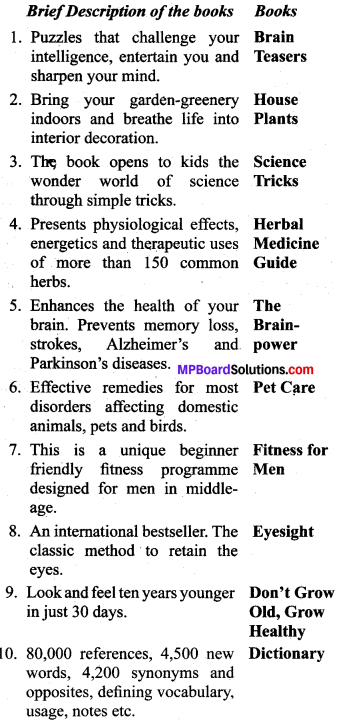
MP Board Class 10th General English The Spring Blossom Solutions Chapter 15 In Memoriam

Are you seeking for the Madhya Pradesh Board Solutions 10th General English The Spring Blossom Solutions Chapter 15 In Memoriam Questions and Answers PDF? If yes, then read this entire page. Here, we are giving a direct link to download MP Board Class 10th English Solutions Questions and Answers PDF which contains the chapter wise questions, solutions, and grammar topics. You can also get the shortcuts to solve the grammar related questions on this page.

MP Board Class 10th General English The Spring Blossom Solutions Chapter 15 In Memoriam

For the sake of students we have gathered the complete 10th General English The Spring Blossom Solutions Chapter 15 In Memoriam Questions and Answers can provided in pdf Pattern. Refer the chapter wise MP Board Class 10th English Solutions Questions and Answers Topics and start the preparation. You can estimate the importance of each chapter, find important English grammar concepts which are having more weightage. Concentrate on the important grammar topics from Madhya Pradesh Board Solutions for 10th English Chapter 15 In Memoriam Questions and Answers PDF, prepare well for the exam.

In Memoriam Textual Exercises

Word Power

1. ‘Ring out’ is a phrasal verb that is made of a verb and preposition. Make some other phrasal verb idioms with the help of the verb ‘ring’.
Answer:
ring round, ring a’round, ring back, ring in, ring off, ring through, ring up.

2. List the things that the poet wants to bring in and the things that should be left out.
Answer:
The things that the poet wants to bring in are truth, people’s well being, noble ways of life, pure laws, love of truth, right and good and everlasting world peace. The things that should be thrown out are falsehood, sad memories of past, misery, poverty, harmful old traditions, cornal desires, sins and greed.

3. Find out the rhyming words for the following words and write them in your notebooks:
gold, cause, peace, rhymes, spite
Answer:
gold – old
cause – laws
peace – disease
rhymes – times
spite – right.

How Much Have I Understand?

A. Answer the following questions. (One or two sentences)
(निम्न प्रश्नों के उत्तर एक या दो वाक्यों में दीजिए।)

Question 1.
What does the poet want us to give up in the first stanza of the poem?
(व्हॉट डज द पोऍट वॉन्ट अस टू गिव अप इन द फर्स्ट स्टैन्जा ऑफ द पोएम?)
कवि कविता के प्रथम पद्यांश में हमें क्या छोड़ने को कहता
Answer:
The poet wants us to give up everything that is old. We should also give up falsehood and the memories of the year that is going.
(द पोऍट वॉन्ट्स अस टू गिव अप एव्रीथिंग दैट इज ओल्ड। वी शुड ऑल्सो गिव अप फॉल्सहुड एण्ड मैमोरीज़ ऑफ द ईयर दैट इज़ गोइंग।)
कवि चाहता है कि हम वो सब कुछ छोड़ दें जो पुराना है। हमें झूठ का त्याग करना चाहिए व बीते हुए वर्ष की यादों का भी।

Question 2.
What does the poet say about the memories of the dead people?
(व्हॉट डज़ द पोऍट से अबाऊट द मैमोरीज़ ऑफ द डैड पीपल्?)
कवि मृत व्यक्तियों से जुड़ी यादों के विषय में क्या कहता
Answer:
The poet says that we should gradually drive away or weaken the memories of those who are dead. We should come out of the grief and sorrow.
(ए पोऍट सेज़ दैट वी शुड ग्रैज्युअली ड्राइव अवे और वीकन् द मैमोरीज़ ऑफ दोज़ हू आर डेड। वी शुड कम आऊट ऑफ द ग्रीफ एण्ड सॉरो।)
कवि कहता है कि हमें धीरे-धीरे मृत व्यक्तियों की यादों से व दुःख व विलाप से उबर जाना चाहिए।

Question 3.
What should a proper replacement for old traditions be?
(व्हॉट शुड व प्रॉपर रिप्लेसमेन्ट फॉर ओल्ड ट्रेडिशन्स बी)
पुराने रीति-रिवाजों की जगह सही बदलाव क्या होना चाहिए?
Answer:
There should be new ways of life, better manners and pure laws instead of old traditions.
(देयर शुड बी न्यू वेज़ ऑफ लाइफ, बैटर मैनर्स एण्ड प्योर लॉज़ इन्स्टैड ऑफ ओल्ड ट्रेडिशन्स।)
पुराने रीति-रिवाजों की जगह जीने के नये तरीके, बेहतर ढंग व सही नियम होने चाहिए।

Question 4.
What does the poet say about his sad songs?
(व्हॉट डज़ द पोऍट से अबाऊट हिज़ सैड साँग्स?)
कवि अपने दुःख के गीतों के विषय में क्या कहता है?
Answer:
The poet says to drive away his sad songs and become a complete poet instead.
(द पोऍट सेज़ टू ड्राइव अवे हिज़ सैड साँग्स एण्ड बिकम अ कम्पलीट पोऍट इन्स्टैड।)
कवि अपने दुःख भरे गीत त्यागकर एक सम्पूर्ण कवि बनना चाहता है।

Question 5.
What does the poet want in place of greed for wealth?
(व्हॉट डज़ द पोऍट वॉन्ट इन प्लेस ऑफ ग्रीड फॉर वैल्थ?)
कवि पैसे के लालच के बजाय क्या चाहता है?
Answer:
The poet wants peace instead of greed for wealth.
(द पोऍट वॉन्ट्स पीस इन्स्टैड ऑफ ग्रीड फॉर वैल्थ।)
कवि पैसे के लालच के बजाय शान्ति चाहता है।

Question 6.
What would a proper replacement for war culture be?
(व्हॉट वुड अ प्रॉपर रिप्लेसमेण्ट फॉर वॉर कल्चर बी?)
युद्ध संस्कृति की जगह किसको लेनी चाहिए?
Answer:
Everlasting world peace should be a proper replacement for war culture.
(एबरलास्टिंग वर्ल्ड पीस शुड बी अ प्रॉपर रिप्लेसमेण्ट फॉर वॉर कल्चर।)
दुनिया में स्थायी शान्ति को युद्ध संस्कृति की जगह लेनी चाहिए।

B. Answer these questions in three or four sentences
(निम्न प्रश्नों के उत्तर तीन या चार वाक्यों में दीजिए।)

Question 1.
What are the things suggested by the poet that we should leave?
(व्हॉट आर द थिंग्स सजेस्टिड बाइ द पोऍट दैट वी शुड लीव?)
कवि के अनुसार हमें कौन-सी वस्तुओं का त्याग करना चाहिए?
Answer:
The poet wants that we should give up all the bad things and adopt new good things. We should leave falsehood, sad memories of past, misery and poverty, harmful old traditions, material desires, sins, greed and war.
(द पोऍट वॉन्ट्स दैट वी शुड गिव अप ऑल द बैड थिंग्स एण्ड एडॉप्ट न्यू गुड थिंग्स। वी शुड लीव फॉल्सहुड, सैड मैमोरीज़ ऑफ पास्ट, माइज़री एण्ड पावर्टी, हार्मफुल ओल्ड ट्रेडिशन्स, मेटेरियल डिजायर्स, सिन्स, ग्रीड एण्ड वॉर।)
कवि चाहता है कि हम सब बुरी वस्तुएँ छोड़ दें व नयी अच्छी वस्तुएँ अपनाएँ। हमें झूठ, अतीत की दुःख देने वाली यादें, कन्जूसी व गरीबी, पुराने हानिकारक रीति-रिवाज, सांसारिक इच्छाएँ, पाप, लालच व युद्ध का त्याग करना चाहिए।

Question 2.
What things should be adopted in our life according to the poet?
(व्हॉट थिंग्स शुड बी एडॉप्टेड इन अवर लाइफ एकॉर्डिंग टू द पोऍट?)
कवि के अनुसार हमें कौन-सी वस्तुएँ अपनानी चाहिए?
Answer:
According to the poet we should adopt new things that are good. We should welcome truth, people’s well-being, noble ways of life, pure laws, love of truth, right and good and above all, everlasting world peace.
(एकॉर्डिंग टू द पोऍट वी शुड एडॉप्ट न्यू थिंग्स दैट आर गुड। वी शुड वैलकम टूथ, पीपल्स वेल बीइंग, नोबल वेज़ ऑफ लाइफ, प्योर लॉज़, लव ऑफ टूथ, राईट एण्ड गुड एण्ड अबव ऑल, एवरलास्टिंग वर्ल्ड पीस।)
कवि के अनुसार हमें नयी अच्छी वस्तुएँ अपनानी चाहिए। हमें सत्य, लोगों के भले, जीवन के उत्कृष्ट तरीकों, सच्चे नियमों, सच्चाई से प्रेम, सही व दुनिया में स्थायी शान्ति का स्वागत करना चाहिए।

Question 3.
Which line shows the poet’s concern for poor destitute people, and what is responsible for their plight?
(व्हिच लाइन शोज़ द पोऍट्स कन्सर्न फॉर पूअर डेस्टिट्यूट पीपल, एण्ड व्हॉट इज़ रिस्पॉन्सिबल फॉर देयर प्लाइट?)
कौन-सी पंक्ति कवि की गरीब व हीन व्यक्तियों के प्रति चिन्ता को व्यक्त करती है? उनकी इस दुखद दशा के लिए कौन जिम्मेदार है?
Answer:
The poet’s concern for poor and destitute people is shown by the line:
Ring in redress to all mankind’.
The feud or conflict between the rich and poor is responsible for their plight.

(द पोऍट्स कन्सर्न फॉर पूअर एण्ड डेस्टिट्यूट पीपल् इज शोन बाइ द लाइन
‘रिंग इन रिड्रेस टू ऑल मैनकाइण्ड।’
द फ्यूड और कॉन्फ्लिक्ट बिटवीन द रिच एण्ड पूअर इज रिस्पॉन्सिबल फॉर देयर प्लाइट।)

पंक्ति ‘सारी मानवजाति का सुधार करो’ कवि की गरीब व परेशान लोगों के प्रति चिन्ता को व्यक्त करती है। अमीर व गरीब के बीच का पुश्तैनी झगड़ा उनकी इस दुर्दशा का कारण है।

Question 4.
Explain in your own words-
(i) Ring in the nobler modes of life, with sweeter manners, purer laws.
(ii) Ring out the grief that saps the mind.
(एक्सप्लेन इन योर ओन वर्ड्स-
(i) रिंग इन द नोबलर मोड्स ऑफ लाइफ, विद स्वीटर मैनर्स, प्योरर लॉज़।)
(ii) रिंग आऊट द ग्रीफ दैट सैप्स द माइण्ड।) ऊपर दी गई पंक्तियों का अपने शब्दों में वर्णन कीजिए।
Answer:
(i) Ring in the nobler modes of life, with sweeter manners, purer laws :
The poet wants us to discard old traditions and adopt noble ways of life. He wishes us to follow manners that are better than before and laws that are pure.
(द पोऍट वॉन्ट्स अस टू डिस्कार्ड ओल्ड ट्रेडिशन्स एण्ड एडॉप्ट नोबल वेज़ ऑफ लाइफ ही विशेज़ अस टू फॉलो मैनर्स दैट आर बैटर दैन बिफोर एण्ड लॉज़ दैट आर प्योर।)
कवि चाहता है कि हम पुराने रीति-रिवाजों को छोड़कर जीने के श्रेष्ठ तरीकों को अपनाएँ। वह चाहता है कि हम पहले से अच्छे तौर-तरीके व पवित्र नियम अपनाएँ।

(ii) Ring out the grief that saps the.mind :
The poet wants us to say that we should remove the sorrow from our mind gradually. We should not repent over those whom we have lost always but try to overcome our grief and loss.
(द पोऍट वॉन्ट्स अस टू से दैट वी शुड रिमूव द सॉरी फ्रॉम अवर माइन्ड ग्रैजुअली। वी शुड नॉट रिपेन्ट ओवर दोज़ हूम वी हैव लॉस्ट ऑल्वेज़ बट ट्राइ टू ओवरकम अवर ग्रीफ एण्ड लॉस।)
कवि चाहता है कि हमें अपने दिमाग से अपने दुःख को धीरे-धीरे हटा देना चाहिए। जिन्हें हमने खो दिया है उनके शोक में हमें हरदम शोकाकुल न रहकर अपने दुख व हानि से उबरना चाहिए।

Listening Time

Say whether the following statements are True or False according to the story given in the text.
(सही अथवा गलत बताओ।)

  1. The baker was a kind and generous man.
  2. The poor man used to buy bread from the baker everyday.
  3. The poor man used to stand outside the bakery and enjoy the smell of baking bread.
  4. The baker was angry with the poor man because the poor man would not buy his bread.
  5. The baker wanted the poor man to pay him for enjoying the nice smell coming from his bakery.
  6. The poor man took the baker to court.
  7. The poor man had a lot of money in his pockets.
  8. The baker thought that the judge would give the poor man’s money to him.
  9. The judge thought that the poor man had not done anything wrong.
  10. The judge returned the poor man’s money to him.
  11. The baker won the case against the poor man.
  12. The judge was a clever and wise man.

Answer:

  1. False
  2. False
  3. True
  4. False
  5. True
  6. False
  7. False
  8. True
  9. True
  10. True
  11. False
  12. True.

Speaking Time

Do yourself.
(स्वयं करे।)

Writing Time

Imagine a scene from a play, film, movie, serial or a show you have seen. Describe the scene in your own words in not more than 50 words in your notebook.
(किसी नाटक अथवा सिनेमा का दृश्य याद करो व उसे 50 शब्दों में लिखो।).
Answer:
Students can do themselves.
(छात्र स्वयं करें।)

Things to do

1. Make a list of good and evil things or deeds.
Write down the possible results before them.
(अच्छी व बुरी चीजों अथवा कर्मों की सूची बनाओ।)
Answer:
MP Board Class 10th General English The Spring Blossom Solutions Chapter 15 In Memoriam 1

2. Find any other poem conveying the same moral either in English or Hindi. Write it in your project file and recite it in the class.
(ऐसी ही एक और कविता हिन्दी या अंग्रेजी में लिखो व कक्षा में पढ़ो।)
Answer:
Students can do themselves.
(छात्र स्वयं करें।)

In Memoriam Central Idea of the Poem

The poem tries to bring in reformation. It conveys the message of adopting new good things and giving up the bad things. Evils such as falsehood, sad memories of past, misery, poverty, harmful old traditions, cornal desires, sins, greed etc. should be discarded. The new things such as truth, people’s well being, noble ways of life, pure laws, love of truth, right and good and world peace should be welcomed.

In Memoriam Difficult Word Meanings

Sap (सैप)-to make something weaker to destroy. something gradually (धीरे-धीरे नष्ट या दुर्बल करण); Feud (फ्यूड) an angry and bitter argument between two people or groups that continues over a long period of time (पुश्तैनी दुश्मनी); Redress (रिड्रेस)-compensation (सुधारना); Mournful (मोर्नफुल)-very sad (अत्यधिक दुःखी); Minstrel (मिन्स्ट्रेल) a musician or singer in the middle ages, here it means ‘poet’ (कवि); Slander (स्लैण्डर) a false spoken statement intended to change the good opinion people have of somebody (झूठी निन्दा); Spite (स्पाईट) a feeling of wanting to hurt or upset somebody (दुर्भावना, हानि पहुँचाने की भावना।)

In Memoriam Summary, Pronunciation & Translation

Ring out the old, ring in the new,
Ring, happy bells, across the snow;
The year is going, let him go;
Ring out the false, ring in the true.

(रिंग आउट द ओल्ड, रिंग इन द न्यू,
रिंग, हैप्पी बैल्स, अक्रॉस द स्नो;
द यीअर इज गोईंग, लेट हिम गो;
रिंग आऊट द फॉल्स, रिंग इन द ट्र.)

अनुवाद-पुराने को त्याग दो, नए को अपनाओ,
खुशियों की घंटियाँ बजाओ, बर्फ में सभी तरफ;
वर्ष जा रहा है, उसे जाने दो;
झूठ को त्याग दो, सत्य को अपनाओ।

Ring out the grief that saps the mind,
For those that here we see no more:
Ring out the feud of rich and poor,
Ring in redress to all mankind.

(रिंग आऊट द ग्रीफ दैट सैप्स द माइण्ड,
फॉर दोज़ दैट हेयर वी सी नो मोर;
रिंग आऊट द फ्यूड ऑफ रिच ऐण्ड पूअर,
रिंग इन रीड्रेस टु ऑल मैनकाइण्ड।)

अनुवाद :
उन दुःखों को त्याग दो जो मन को कमजोर करते हैं।
उन लोगों के लिए जो अब हमें यहाँ नहीं दिखते (जो नहीं रहे);
त्याग दो अमीर और गरीब के बीच के बैर को,
सम्पूर्ण मानव जाति के कष्ट निवारण का उपाय अपनाओ।

Ring out a slowly dying cause,
And ancient forms of party strife;
Ring in the nobler modes of life,
With sweeter manners, purer laws.

(रिंग आऊट अ स्लोली डाईंग कॉज़,
ऐण्ड एन्शियण्ट फॉर्मस ऑफ पार्टी स्ट्राईफ;
रिंग इन द नोबलर मोड्स ऑफ लाइफ,
विद स्वीटर मैनर्स, प्योरर लॉज.)

अनुवाद :
धीरे-धीरे मृत्यु की ओर बढ़ते सिद्धान्त को त्यागो,
(अप्रासंगिक हो चुके सिद्धान्त को त्यागो)
और प्राचीन तरह के दलगत विवाद;
श्रेष्ठ जीवन के ढंग अपनाओ,
बेहतर आचार-विचार और विशुद्ध (प्रासंगिक) सिद्धान्तों के साथ।

Ring out the want, the care, the sin,
The faithless coldness of the times.
Ring out, ring out my mournful rhymes,
But ring the fuller minstrel in.

(रिंग आऊट द वॉण्ट, द केयर, द सिन,
द फेथलस कोल्डनेस ऑफ द टाईम्स;
रिंग आऊट, रिंग आऊट माई मोर्नफल राईम्स,
बट रिंग द फुलर मिन्स्ट्रेल इन।)

अनुवाद :
अपनी इच्छाओं, चिन्ताओं, पापों को और
इस दौर की अविश्वसनीय भाव शून्यता को त्यागो;
त्यागो, त्यागो मेरी विषादपूर्ण कविताओं को,
परन्तु अपनाओ उस कवि हृदय लोक गायक को।

Ring out false pride in place and blood,
The civic slander and the spite;
Ring in the love of truth and right,
Ring in the common love of good.

(रिंग आऊट फॉल्स प्राइड इन प्लेस ऐण्ड ब्लड,
द सिविक स्लैण्डर ऐण्ड द स्पाईट;
रिंग इन द लव ऑफ टुथ एण्ड राईट,
रिंग इन द कॉमन लव ऑफ गुड।)

अनुवाद :
स्थान और वंश के झूठे गर्व को त्यागो
कलंक मढ़ना व द्वेष करना त्यागो;
सत्य और न्याय के प्रेम को अपनाओ,
भलाई के सर्वनिष्ठ प्रेम को अपनाओ।

Ring out old shapes of foul disease;
Ring out old narrowing lust of gold;
Ring out the thousand wars of old,
Ring in the thousand years of peace.

(रिंग आऊट ओल्ड शेप्स ऑफ फाऊल डिज़ीज़;
रिंग आऊट द नैरोईंग लस्ट ऑफ गोल्ड;
रिंग आऊट द थाऊसैण्ड वार्स ऑफ ओल्ड,
रिंग इन द थाऊसैण्ड ईयर्स ऑफ पीस.)

अनुवाद :
पुरातन सामाजिक बुराई रूपी रोगों को त्यागो;
धन की क्षुद्र कामनाओं को त्यागो;
त्यागो हज़ारों पूर्व युद्धों को,
अपनाओ हजार वर्षों की शान्ति को।

Hope that the above shaped information regarding the Madhya Pradesh Board Solutions for 10th English Chapter 15 In Memoriam Questions and Answers is useful for making your preparation effective. View our website regularly to get other subjects solutions.
MP Board Class 10th General English The Spring Blossom Solutions Chapter 14 The Pot of Gold

Are you seeking for the Madhya Pradesh Board Solutions 10th General English The Spring Blossom Solutions Chapter 14 The Pot of Gold Questions and Answers PDF? If yes, then read this entire page. Here, we are giving a direct link to download MP Board Class 10th English Solutions Questions and Answers PDF which contains the chapter wise questions, solutions, and grammar topics. You can also get the shortcuts to solve the grammar related questions on this page.

MP Board Class 10th General English The Spring Blossom Solutions Chapter 14 The Pot of Gold

For the sake of students we have gathered the complete 10th General English The Spring Blossom Solutions Chapter 14 The Pot of Gold Questions and Answers can provided in pdf Pattern. Refer the chapter wise MP Board Class 10th English Solutions Questions and Answers Topics and start the preparation. You can estimate the importance of each chapter, find important English grammar concepts which are having more weightage. Concentrate on the important grammar topics from Madhya Pradesh Board Solutions for 10th English Chapter 14 The Pot of Gold Questions and Answers PDF, prepare well for the exam.

The Pot of Gold Textual Exercises

Word Power

A. Fill in the blanks with suitable words from brackets.
(कोष्ठक में दियें गये शब्दों से रिक्त स्थान भरिए)
(greedy, buried, squandered, reluctant, drive out.)

  1. Sarthak ………… his money.
  2. The dog had ………… the bone in the garden.
  3. New fashions ………… old ones.
  4. Neha was …………. to admit that she was wrong.
  5. Manoj stared at the diamonds with ……… eyes.

Answer:

  1. buried
  2. squandered
  3. drive out
  4. reluctant
  5. greedy

B. Select the synonyms for the words inside boxes from the brackets and write in front.
(समानार्थी शब्द लिखो।)
(lend, unwise, wicked, hide, greedy)
Answer:

  1. evil, naughty, sinful, immoral – wicked
  2. ravenous, gluttonous, intense, desirous – greedy
  3. injudicious, imprudent, not wise – unwise
  4. to grant, to bestow, to give on loan – lend
  5. to keep out of sight, to conceal, to keep secret – hide

How Much Have I Understood?

A. Answer the following questions. (One or two sentences)
(निम्न प्रश्नों के उत्तर एक या दो वाक्यों में दीजिए।)

Question 1.
Who were Subuddhi and Kubuddhi?
(हु वर सुबुद्धि एण्ड कुबुद्धि?)
सुबुद्धि व कुबुद्धि कौन थे?
Answer:
Subuddhi and Kubuddhi were two friends.
(सुबुद्धि एण्ड कुबुद्धि वर् टू फ्रेन्ड्स।)
सुबुद्धि व कुबुद्धि दो दोस्त थे।

Question 2.
What were the qualities of Subuddhi and Kubuddhi?
(व्हॉट वर् द क्वॉलिटीज ऑफ सुबुद्धि एण्ड कुबुद्धि?)
सुबुद्धि व कुबुद्धि के क्या गुण थे?
Answer:
Subuddhi was an honest and holy man and led a good life while Kubuddhi was a wicked man and led a life of drinking and gambling.
(सुबुद्धि वॉज़ एन ऑनेस्ट एण्ड होली मैन एण्ड लैड अगुड लाइफ व्हाइल कुबुद्धि वॉज़ अ विकिड मैन एण्ड लैड अ लाइफ ऑफ ड्रिंकिंग एण्ड गैम्बलिंग।)
सुबुद्धि एक ईमानदार व सात्विक व्यक्ति था व एक अच्छी जिन्दगी व्यतीत करता था जबकि कुबुद्धि एक दुष्ट आदमी था व शराब पीकर व जुआ खेलकर अपनी जिन्दगी व्यतीत करता था।

Question 3.
What did Kubuddhi propose to Subuddhi?
(व्हॉट डिड कुबुद्धि प्रपोज़ टू सुबुद्धि?)
कुबुद्धि ने सुबुद्धि को क्या प्रस्ताव दिया?
Answer:
Kubuddhi proposed Subuddhi to leave the city and go to another country for getting money.
(कुबुद्धि प्रपोज्ड सुबुद्धि टू लीव द सिटी एण्ड गो टू एनदर। कण्ट्री फॉर गेटिंग मनी।)
कुबुद्धि ने सुबुद्धि के आगे शहर छोड़कर दूसरे देश जाकर। पैसा पाने का प्रस्ताव रखा।

Question 4.
What did Kubuddhi and Subuddhi find?
(व्हॉट डिड कुबुद्धि एण्ड सुबुद्धि फाइण्ड?)
‘कुबुद्धि व सुबुद्धि ने क्या ढूँढ़ा?
Answer:
Kubuddhi and Subuddhi found a pot containing a thousand gold coins.
(कुबुद्धि एण्ड सुबुद्धि फाउण्ड अ पॉट कन्टेनिंग अ थाऊसेण्ड गोल्ड कॉइन्स।)
कुबुद्धि व सुबुद्धि ने एक घड़ा जिसमें एक हजार सोने के सिक्के थे, पाया।

Question 5.
What was the problem before the judge?
(व्हॉट वॉज़ द प्रॉब्लम बिफोर द जज?)
न्यायाधीश के समक्ष क्या परेशानी आई?
Answer:
The problem before the judge was that he was unable to understand what to do since there were no witnesses.
(द प्रॉब्लम बिफोर द जज वॉज़ दैट ही वॉज़ अनेबल टू अण्डरसैण्ड व्हॉट टू डू सिन्स देअर वर नो विटनेसस।)
न्यायाधीश के सामने यह समस्या थी कि वे समझ नहीं पा रहे थे कि क्या करें क्योंकि उनके सामने कोई गवाह नहीं थे।

Question 6.
Why was the judge surprised when he heard the voice of the goddess of the forest?
(व्हाय वॉज़ द जज सरप्राइज्ड व्हेन ही हर्ड द वॉइस ऑफ द गॉडेस ऑफ द फॉरेस्ट?)
जब न्यायाधीश ने वनदेवी की आवाज सुनी तो वे आश्चर्यचकित क्यों हो गये?
Answer:
The judge was surprised to hear from the goddess of the forest that an honest man like Subuddhi could steal his friend’s gold.
(द जज वॉज़ सरप्राइज्ड टू हिअर फ्रॉम द गॉडेस ऑफ द फॉरेस्ट दैट एन ऑनेस्ट मैन लाइक सुबुद्धि कुड स्टील हिज़ फ्रेन्ड्स गोल्ड।)
न्यायाधीश वनदेवी से यह सुनकर आश्चर्यचकित हो गये कि सुबुद्धि जैसा ईमानदार व्यक्ति अपने मित्र का सोना चुरा सकता है।

Question 7.
What was the decision in the case of Kubuddhi and Subuddhi?
(व्हॉट वॉज़ द डिसीजन इन द केस ऑफ कुबुद्धि एण्ड सुबुद्धि?)
कुबुद्धि व सुबुद्धि के मुकदमे में क्या फैसला हुआ?
Answer:
In the case of Kubuddhi and Subuddhi, Kubuddhi was proved wicked and was ordered to give all eight hundred gold coins to Subuddhi and sentenced to prison for his wickedness.
(इन द केस ऑफ कुबुद्धि एण्ड सुबुद्धि, कुबुद्धि वॉज़ प्रूव्ड विकिड एण्ड वॉज़ ऑर्डर्ड टू गिव ऑल द ऍट हण्ड्रेड गोल्ड कॉइन्स टू सुबुद्धि एण्ड सेन्टेन्स्ट् टू प्रिज़न फॉर हिज़ विकिडेनस।)
कुबुद्धि व सुबुद्धि के मुकदमे में, कुबुद्धि दुष्ट साबित हुआ व उसे पूरे आठ सौ सोने के सिक्के सुबुद्धि को देने का आदेश हुआ व उसकी दुष्टता के लिए सजा हुई।

B. Answer the following questions. (Three or four sentences)
(निम्न प्रश्नों के उत्तर तीन या चार वाक्यों में दीजिए।)

Question 1.
Subuddhi and Kubuddhi found a pot of gold. What did Subuddhi propose to Kubuddhi?
(सुबुद्धि एण्ड कुबुद्धि फाउण्ड अ पॉट ऑफ गोल्ड। व्हॉट डिड सुबुद्धि प्रपोज टू कुबुद्धि?)
सुबुद्धि व कुबुद्धि ने सोने का घड़ा पाया। सुबुद्धि ने कुबुद्धि को क्या प्रस्ताव दिया?
Answer:
On finding a pot of gold Subuddhi proposed Kubuddhi to return back home as they had got enough money to become rich. He asked him to divide the gold and take the share and while rețurning home give fine dinners to their friends.

(ऑन फाइण्डिग अ पॉट ऑफ गोल्ड सुबुद्धि प्रपोज्ड् टू रिटर्न बैक होम एज़ दे हैड गॉट इनफ मनी टू बिकम रिच। ही आस्क्ड् हिम टू डिवाइड द गोल्ड एण्ड टेक दे शेयर एण्ड व्हाइल रिटर्निंग होम गिव फाइन डिनर्स टू देयर फ्रेण्ड्स।)

सोने का घड़ा पाने के पश्चात सुबुद्धि ने कुबुद्धि के समक्ष घर लौटने का प्रस्ताव रखा क्योंकि उनके पास अमीर बनने के लिए पर्याप्त धन था। उसने कुबुद्धि से कहा कि वे सोने का बँटवारा कर लेते हैं व अपना हिस्सा लेकर घर लौटते समय अपने मित्रों को शानदार दावत देते हैं।

Question 2.
What was Kubuddhi’s plan to cheat his friend?
(व्हॉट वॉज कुबुद्धिज़ प्लैन टू चीट हिज़ फ्रेन्ड?)
कुबुद्धि की अपने मित्र को धोखा देने की क्या योजना थी?
Answer:
Kubuddhi planned to cheat his friend’s share of gold coins by convincing him that they will take one hundred coins each and bury the remaining in the forest so that their friends may not ask them to lend some money or may steal it. He said that they would come back and take the money whenever they needed it. He said so, so that he may come back and steal his friend’s share.

(कुबुद्धि प्लैन्ड टू चीट हिज़ फ्रेन्ड्स शेयर ऑफ गोल्ड कॉइन्स बाइ कन्विसिंग हिम दैट दे विल टेक वन हण्ड्रेड कॉइन्स ईच एण्ड बरी द रिमेनिंग इन द फॉरेस्ट सो दैट देयर फ्रेन्ड्स मे नॉट आस्क देम लेण्ड सम मनी और मे स्टील इट। ही सेड दैट दे वुड कम बैक एण्ड टेक द मनी व्हेनवेर नीडेड इट। ही सेड सो, सो दैट ही मे कम बैक एण्ड स्टील हिज फ्रेन्ड्स शेयर।)

कुबुद्धि ने अपने मित्र के सोने का हिस्सा हड़पने की योजना बनायी। उसने उसे सोने के हिस्से में से सौ सिक्कों को छोड़कर बाकी सोना जंगल में दबाने के लिए कहा जिससे कि उनके दोस्त उनसे न तो पैसा उधार माँग सकें और न ही चुरा सकें। उसने कहा कि वे वापस आकर जरूरत पड़ने पर पैसा ले लेंगे। उसने ऐसा इसीलिए कहा जिससे कि वापस आकर अपने दोस्त का धन चुरा सके।

Question 3.
How did Kubuddhi take the help of his father in cheating Subuddhi?
(हाउ डिड कुबुद्धि टेक द हैल्प ऑफ हिज फादर इन चीटिंग सुबुद्धि?)
कुबुद्धि ने अपने पिता की सुबुद्धि को धोखा देने में किस प्रकार मदद ली?
Answer:
Kubuddhi made his father hide in the trunk of the banyan tree and asked him say that it was Subuddhi who had stolen the gold when the judge asks the goddess of forest. His father did so and in this way he helped him in cheating Subuddhi.

(कुबुद्धि मेड हिज़ फादर हाइड इन द ट्रंक ऑफ द बैनयन ट्री एण्ड आस्क्ड् हिम टू से दैट इट वॉज़ सुबुद्धि हू हैड स्टोलन द गोल्ड व्हेन द जज आस्क्स द गॉडेस ऑफ फॉरेस्ट। हिज़ फादर डिड सो एण्ड इन दिस वे ही हैल्य्ड् हिम इन चीटिंग सुबुद्धि।)

कुबुद्धि ने अपने पिता को बरगद के पेड़ के तने में छुपा दिया व उनसे कहा कि जब न्यायाधीश वन देवी से पूछे तब वे यह कहें कि सुबुद्धि ने सोना चुराया है। उसके पिता ने ऐसा ही किया और इस तरह कुबुद्धि को सुबुद्धि को धोखा देने में मदद की।

Question 4.
How did Subuddhi prove himself innocent at last?
(हाउ डिड सुबुद्धि प्रूव हिमसेल्फ इनोसेन्ट एट लास्ट?)
सुबुद्धि ने अन्त में स्वयं को निर्दोष किस प्रकार सिद्ध किया?
Answer:
Subuddhi told the judge that he had hid the stolen gold in the trunk of the banyan tree, in which Kubuddhi’s father was hiding. He said that since there was snake in it so he was unable to take out the gold and asked him to let him light a fire to drive out the snake and take out the gold. He did so and hence Kubuddhi’s father had to come out of the tree trunk thus proving that Subuddhi was innocent.

(सुबुद्धि टोल्ड द जज दैट ही हैड हिड द स्टोलन गोल्ड इन द ट्रंक ऑफ द बैनयन ट्री, इन व्हिच कुबुद्धिज़ फादर वॉज़ हाइडिंग। ही सेड दैट सिन्स देयर वॉज़ स्नेक इन इट सो ही वॉज़ अनेबल टू टेक आऊट द गोल्ड एण्ड आस्क्ड् हिम टू लेट हिम लाइट अ फायर टू ड्राइव आऊट द स्नेक एण्ड टेक आउट द गोल्ड। ही डिड सो एण्ड हेन्स कुबुद्धिज़ फादर हैड टू कम आऊट ऑफ द ट्री ट्रंक दस पूविंग दैट सुबुद्धि वॉज़ इनोसेन्ट।)

सुबुद्धि ने न्यायाधीश को बताया कि उसने चुराया हुआ सोना बरगद के पेड़ के तने में रखा है। उसी में कुबुद्धि के पिता छुपे हुए थे। उसने कहा कि वहाँ साँप होने की वजह से वह सोना निकाल नहीं पाया। उसने उनसे पेड़ में आग लगाकर साँप को भगाने व सोना निकालने की आज्ञा माँगी। उसके ऐसा करने पर कुबुद्धि के पिता को बाहर आना ही पड़ा व सुबुद्धि निर्दोश सिद्ध हुआ।

Language Practice

Combine these pairs using suitable connectors who, what, which, since. and write them in your notebooks.
(निम्न वाक्यों को who, what, which, since से जोडिए।)
1. (a) Subuddhi and Kubuddhi were friends.
(b) They lived in a village. (who)
Answer:
Subuddhi and Kubuddhi were friends who lived in village.

2. (a) The two friends found a pot.
(b) The pot contained a thousand gold coins. (which/that)
Answer:
The two friends found a pot which contained a thousand gold coins.

3. (a) He finished his money.
(b) He went back to the banyan tree. (when)
Answer:
He went back to the banyan tree when he finished his money.

4. (a) They dug up the place.
(b) They had buried their pot of gold. (where)
Answer:
They dug up the place where they had buried their pot of gold.

5. (a) Subuddhi was shocked to see the pot.
(b) There were no gold coins in it. (because)
Answer:
Subuddhi was shocked to see the pot because there were no gold coins in it.

6. (a) Someone has taken away all the gold.
(b) It is you. (who)
Answer:
It is you who has taken away all the gold.

7. (a) There were no witnesses.
(b) The judge did not know what to do. (since)
Answer:
Since there were no witnesses the judge did not know what to do.

8. (a) Tell your partner.
(b) How did Kubuddhi cheat his friend? (how)
Answer:
Tell your partner how Kubuddhi cheat his friend.

Listening Time

A. The teacher will read aloud the following words with proper stress and the students will repeat them.
(निम्न शब्दों को दोहशओ।)
Answer:
MP Board Class 10th General English The Spring Blossom Solutions Chapter 14 The Pot of Gold 1

B. Select any one book from the given list and write its name on a piece of paper. Your teacher will read out a brief general description of each book. Show your paper to the class when you hear the description of your book.
(किताब के वर्णन के आगे सम्बन्धित पुस्तक का नाम लिखिए)

Book List : (1) Herbal Medicine Guide, (2) Fitness for Men, (3) Eyesight, (4) The Brainpower, (5) Pet Care, (6) Science Tricks, (7) House Plants, (8) Brain Teasers, (9) Dictionary, (10) Dont Grow Old, Crow Healthy.
Answer:
MP Board Class 10th General English The Spring Blossom Solutions Chapter 14 The Pot of Gold 2

Speaking Time

Looking at the pictures given in the textbook ask the questions from your partner.

Question 1.
Who has a long thin face?
Answer:
Pinky has a long thin face.

Question 2.
Who has a square face?
Answer:
David has a square face.

Question 3.
Who has a round face?
Answer:
Rekha has a round face.

Question 4.
Who has thick eyebrows?
Answer:
David has thick eyebrows.

Question 5.
Who has a pointed nose?
Answer:
Pinky has a pointed nose.

Question 6.
Who has moustaches?
Answer:
David has moustaches.

Question 7.
Who has a hooked nose?
Answer:
David has a hooked nose.

Question 8.
Who has long straight hair?
Answer:
Pinky has long straight hair.

Question 9.
Who has dark curly hair?
Answer:
Rekha has dark curly hair.

Question 10.
Who has wavy fair hair?
Answer:
David has wavy fair hair.

Question 11.
Who is wearing a necklace?
Answer:
Rekha is wearing a necklace.

Writing Time

Write a short speech to be delivered on :
1. Gandhi Jayanti
2. Bal Divas
3. Republic Day.
Answer:
1. Gandhi Jayanti

Birthday of Mahatma Gandhi, the Father of the Nation is celebrated as Gandhi Jayanti. He was born on 2nd October at Porbandar in Gujarat. He is a symbol of peace and non-violence. He gave India freedom without any violence. On this day we remember him for his contributions done to our nation. We should try to follow his principles of truth and non-violence.

2. Bal Divas

Bal Divas is celebrated on the 14th of November. On this day we celebrate the birthday of Pt. Jawaharlal Nehru, the first Prime Minister of free India. He liked children and loved them. Therefore children called him Chacha Nehru. Because of his love for children his birthday is celebrated as Bal Divas or Children’s Day every year.

3. Republic Day

Republic Day is celebrated on 26th January every year. It is on this day that the constitution of free India came into force, i.e., on 26 January, 1950. Our thoughts on this day go back to the founding fathers of our constitution whose far-sighted vision and ardour labours gave us a constitution which enshrined the traditional concepts of liberty, equality and fraternity adding to them the concept of Justice social, economic and political and declaring our nation a sovereign democratic Republic. The word ‘Republic’ signifies that in our state supreme power is not exercised by some remote monarch but by the people. This is a day when we take pride in our achievements, but it is most surely also a day of honest self-analysis and self-questioning about where we, as a people and a society, are headed.

Things to do

1. Make a list of currencies used in different countries.
(विभिन्न देशों की मुद्रा लिखिए)
Answer:
The currencies used in some of the countries are
MP Board Class 10th General English The Spring Blossom Solutions Chapter 14 The Pot of Gold 3

2. Ask your parents/grandparents to tell a story. Write the story in English and narrate it in the class next day.
(अपने माता-पिता/दादा-दादीसे एक कहानी सुनिए। उसे अंग्रेजी में लिखिए व अपनी कक्षा में सुनाइए।)
Answer:
Students can do themselves.
(छात्र स्वयं करों)

The Pot of Gold Difficult Word Meanings

MP Board Class 10th General English The Spring Blossom Solutions Chapter 14 The Pot of Gold 4

The Pot of Gold Summary, Pronunciation & Translation

Subuddhi and Kubuddhi were two friends who lived in a certain village. Subuddhi was an honest and holy man and led a good life. Kubuddhi was a wicked man and led a life of drinking and gambling. In a little while Kubuddhi had finished all his money and was penniless. He went to Subuddhi and said, “Friend, we are both poor and do not have any money. Let us leave this city and go to another country.”

Subuddhi agreed. The two set out on a journey and travelled to many countries. They enjoyed looking at the new cities and their people and their way of life. Many years passed by but they could not make much money because they were always travelling.

(सुबुद्धि ऐण्ड कुबुद्धि वर टू फ्रेण्ड्स हू लिव्ड इन अ सर्टेन विलेज। सुबुद्धि वॉज ऐन ऑनेस्ट ऐण्ड होली मैन ऐण्ड लेड अ गुड लाइफ. कुबुद्धि वॉज़ अ विक्ड मैन एण्ड लेड अ लाइफ ऑफ ड्रिंकिंग ऐण्ड गैम्बलिंग. इन अ लिटल व्हाइल कुबुद्धि हैड फिनिश्ड ऑल हिज़ मनी एण्ड वॉज़ पेनिलैस. ही वेण्ट टू सुबुद्धि ऐण्ड सेड, “फ्रैण्ड, वी आर बोथ पूअर ऐण्ड डू नॉट हैव एनी मनी. लेट अस लीव दिस सिटी ऐण्ड गो टू अनदर कंट्री.”

सुबुद्धि अग्रीड. द टू सेट आउट ऑन अ जर्नी ऐण्ड ट्रैवल्ड टू मैनी कंट्रीज. दे एन्जॉइड लुकिंग एट द न्यू सिटीज ऐण्ड देयर पीपल ऐण्ड देयर वे ऑफ लाइफ. मैनी ईअर्स पास्ड बाई बट दे कुड नॉट मेक मच मनी बिकॉज़ दे वर ऑलवेज ट्रैवलिंग.)

अनुवाद :
सुबुद्धि व कुबुद्धि दो मित्र थे जो एक गाँव में रहते थे। सुबुद्धि एक ईमानदार, भला व धार्मिक व्यक्ति था और सदाचार का जीवन जीता था। कुबुद्धि दुष्ट प्रवृत्ति का था और शराब व जुए में अपना जीवन व्यतीत कर रहा था। कुछ ही समय में कुबुद्धि का सारा धन समाप्त हो गया और वह धनहीन हो गया। वह सुबुद्धि के पास गया और बोला, “मित्र, हम दोनों ही गरीब हैं और हमारे पास धन नहीं है। चलो हम यह शहर छोड़कर अन्य किसी देश में चलते हैं।

सुबुद्धि मान गया। दोनों यात्रा पर निकल पड़े और बहुत से देशों में गए। उनको नए-नए शहर, वहाँ के लोग व उनकी जीवन शैली देखने में बड़ा आनन्द आता था। बहुत से वर्ष बीत गए परन्तु वे अधिक धन न कमा सके क्योंकि वे एक स्थान पर अधिक। समय टिक कर नहीं रहते थे और यात्राएँ करते रहते थे।

Then, one day, suddenly their luck changed. While travelling through the forest the two friends discovered a pot containing a thousand gold coins. The friends were very happy about their discovery and danced with joy.

“Let us now return home,” said Subuddhi, “We have got what we have been looking for. This is enough to make both of us rich. There is no use of travelling any further. Let us divide the gold between us. You take your share. I shall take mine. On returning home we shall treat our friends to fine dinners. We are rich now.”

(देन, वनडे, सडन्ली देयर लक चेन्ज्ड. व्हाईल ट्रैवलिंग धू द फॉरेस्ट द टू फ्रण्ड्स डिस्कवर्ड अ पॉट कन्टेनिंग अ थाऊजेण्ड गोल्ड कॉइन्स. द फ्रेण्ड्स वर वेरी हैप्पी अबाऊट देयर डिस्कवरी ऐण्ड डान्सड विद जॉय.

“लेट अस नाऊ रिटर्न होम,” सेड सुबुद्धि “वी हैव गॉट व्हॉट वी हैव बीन लुकिंग फॉर. दिस इज़ एनफ्ट्र मेक बोथ ऑफ अस रिच. देयर इज़ नो यूज़ ऑफ ट्रैवलिंग एनी फर्दर. लेट अस डिवाईड द गोल्ड बिटवीन अस. यू टेक यॉर शेयर, आई शैल टेक माईन. ऑन रिटर्निंग होम वी शैल ट्रीट आवर फ्रण्ड्स टू फाइन। डिनर्स. वी आर रिच नाऊ.’)

अनुवाद :
फिर एक दिन, अचानक उनका भाग्य बदल गया। जंगल से गुजरते समय उन्हें एक घड़ा मिला जिसमें एक हजार सोने की मोहरें थीं। घड़ा पाकर दोनों मित्र बेहद खुश हुए और खुशी से नाचने लगे।

सुबुद्धि ने कहा, “चलो अब घर वापस चलते हैं। हम जो ढूँढ रहे थे वो हमें मिल गया। यह धन काफी है हम दोनों को धनी बनाने के लिए। अब और दूर जाना व्यर्थ है। हम यह सोना आपस में बाँट लेते हैं। तुम अपना भाग रखो मैं अपना। घर लौटकर हम लोग अपने मित्रों को शानदार दावत देंगे। हम अब धनी हैं।”

Kubuddhi was greedy and had a plan to cheat his friends of his share of the gold coins. He said, “It is unwise to take all the gold to the city. When the friends see so much money, they will ask us to lend some to them, or they may even steal it. Let’s take one hundred coins each and bury the remaining in the forests. We can always come back and take the money whenever we need it.”

Subuddhi agreed with Kubuddhi. Together they buried the money under an old banyan tree and returned to their homes with a part of their new found wealth.

(कुबुद्धि वॉज़ ग्रीडी ऐण्ड हैड अ प्लान टू चीट हिज़ फ्रेण्ड ऑफ हिज़ शेयर ऑफ द गोल्ड कॉइन्स. ही सेड, “इट इज़ अनवाइज़ टू टेक ऑल द गोल्ड टू द सिटी. व्हेन द फ्रेण्ड्स सी सो मच मनी, दे विल आस्क अस टू लेण्ड सम टू द, ऑर दे मे ईवन स्टील इट. लैट अस टेक वन हन्ड्रेड कॉइन्स ईच ऐण्ड बरी द रिमेनिंग इन द फॉरेस्ट. वी कैन ऑलवेज़ कम बैक ऐण्ड टेक द मनी व्हेनएवर वी नीड इट.”

सुबुद्धि अग्रीड विद कुबुद्धि. टुगेदर दे बरीड द मनी अण्डर एन ओल्ड बैन्यन ट्री ऐण्ड रिटन्ड टू देयर होम्स विद अ पार्ट ऑफ देयर न्यू फाउण्ड वेल्थ.)

अनुवाद :
कुबुद्धी लालची था और उसके मन में अपने मित्र को धोखा देकर उसके हिस्से के सोने के सिक्के हड़पने की योजना थी। उसने कहा, “सारा सोना लेकर घर लौटना अक्लमंदी नहीं है। जब मित्र लोग इतना धन देखेंगे तो वे लोग उधार माँगेगे और चुरा भी सकते हैं। ऐसा करते हैं कि हम सिर्फ सौ-सौ स्वर्ण मुद्राएँ लेते हैं और बाकी को जंगल में ही गाड़ देते हैं। हम कभी भी आकर यह धन ले सकते हैं जब भी जरूरत हो।”

सुबुद्धि मान गया। दोनों ने मिलकर धन को एक पुराने बरगद के वृक्ष के नीचे गाड़ दिया और अपने नए प्राप्त धन के साथ घर लौट गए।

Kubuddhi squandered his money in a very short time. When he had finished all his money he quickly went back to the banyan tree one dark night, dug up the pot of gold coins and returned home with the eight hundred gold coins. He buried the empty pot in its original place and returned home.

After a month, Kubuddhi went to Subuddhi and asked him to come along to the forest to take an equal amount of gold coins.

(कुबुद्धि स्क्वान्डर्ड हिज़ मनी इन अ वेरी शॉर्ट टाईम. व्हेन ही हैड फिनिश्ड ऑल हिज़ मनी ही क्विकली वेण्ट बैक टू द बैन्यन ट्री वन डार्क नाईट, डग अप द पॉट ऑफ गोल्ड कॉइन्स एण्ड रिटर्ड होम विद द ऐट हन्ड्रेड गोल्ड कॉइन्स. ही बरीड द एम्प्टी पॉट इन इट्स ओरिजनल प्लेस ऐण्ड रिटर्ड होम।

आफ्टर अ मंथ, कुबुद्धि वेण्ट टु सुबुद्धि ऐण्ड आस्क्ड हिम टू कम अलॉन्ग टू द फॉरेस्ट टू टेक ऐन ईक्वल अमाउण्ट ऑफ गोल्ड कॉइन्स।)

अनुवाद :
बहुत अल्प समय में ही कुबुद्धि ने अपना सारा धन उड़ा दिया। जब उसका धन खत्म हो गया तो वह अतिशीघ्र एक अँधेरी रात जंगल पहुँचा और बरगद के वृक्ष के नीचे खोदकर स्वर्ण मुद्राओं से भरा घड़ा निकालकर आठ सौ स्वर्ण मुद्राओं के साथ घर लौट आया और खाली घड़े को वापस वहीं गाड़ दिया।

एक महीने बाद कुबुद्धि सुबुद्धि के पास गया और उसे अपने साथ जंगल चलने के लिए कहा बराबर मात्रा में स्वर्ण मुद्राएँ लाने के लिए।

The two friends went together and dug up the place where they had buried their pot of gold coins. There were no gold coins in the pot. Subuddhi was shocked.

(द टू फ्रेण्ड्स वेण्ट टुगेदर ऐण्ड डग अप द प्लेस व्हेअर दे हैड बुरीड देयर पॉट ऑफ गोल्ड कॉइन्स. देयर वर नो गोल्ड कॉइन्स इन द पॉट. सुबुद्धि वॉज शॉक्ड.)

अनुवाद :
दोनों मित्रों ने मिलकर उस स्थान को खोद डाला जहाँ उन्होंने अपना स्वर्ण मुद्राओं से भरा घड़ा गाड़ा था। घड़े में स्वर्ण मुद्राएँ नहीं थीं। सुबुद्धि स्तंभित हो गया।

The wicked Kubuddhi then said, “Subuddhi, it is you who have taken away all that gold. If you do not agree to give me my share of four hundred gold coins, I will take the matter to the court.”

(द विकिड कुबुद्धि देन सेड, “सुबुद्धि इट इज़ यू हू हैव टेकन अवे ऑल दैट गोल्ड, इफ यू डू नॉट अग्री टू गिव मी माई शेयर ऑफ फोर हन्ड्रेड गोल्ड कॉइन्स. आई विल टेक द मैटर टू द कोर्ट।)

अनुवाद :
तब धूर्त कपटी कुबुद्धि ने कहा, “सुबुद्धि तुम ही हो जो सारा सोना ले गया है। यदि तुम मेरे हिस्से की चार सौ स्वर्ण मुद्राएँ देने को तैयार नहीं होते हो तो मैं इस मामले को न्यायालय में ले जाऊँगा।”

Subuddhi was angry and said, “How dare you speak to me like that, you scoundrel? I’m not a thief.” A quarrel arose between the two friends and the matter was brought before the judge. Upon hearing the whole story, the judge did not know what to do since there were no witnesses. Subuddhi had no witnesses but Kubuddhi said he had one the goddess of the forest. “If we go and ask her, she will be able to tell us which one of us stole the gold,” he suggested.

Kubuddhi went home and asked his father to help in his plan. “You have to hide in the trunk of the banyan tree and when the judge asks the goddess of the forest to say who stole the gold, you must say it as Subuddhi”.

(सुबुद्धि वॉज़ ऐंग्री ऐण्ड सेड “हाऊ डेयर यू स्पीक टू मी लाईक दैट, यू स्काउण्ड्रल? आई एम नॉट अ थीफ।” अ क्वारल अरोज़ बिटवीन द टू फ्रेण्ड्स ऐण्ड द मैटर वॉज़ ब्रॉट बिफोर द जज़। अपॉन हीयरिंग द होल स्टोरी, द जज डिड नॉट नो व्हॉट टू डू सिन्स देयर वर नो विटनेसिस. सुबुद्धि हैड नो विटनेसिस बट कुबुद्धि सेड ही हैड वन-द गॉडेस ऑफ द फॉरेस्ट “इफ वी गो ऐण्ड आस्क हर, शी विल बी एबल टु टैल अस व्हिच वन ऑफ अस स्टोल द गोल्ड,” ही सजस्टेड. कुबुद्धि वेण्ट होम ऐण्ड आस्क्ड हिज़ फादर टू हैल्प हिम इन हिज़ प्लान, “यू हैव टू हाइड इन द ट्रंक ऑफ द बैन्यन ट्री ऐण्ड व्हेन द जज आस्क्स द गॉर्डस ऑफ द फॉरेस्ट टू से हू स्टोल द गोल्ड, यू मस्ट से इट वॉज सुबुद्धि.”)

अनुवाद :
सुबुद्धि बेहद क्रोधित हुआ और कहा, “तुम्हारी हिम्मत कैसे हुई मुझसे इस प्रकार बात करने की दुष्ट? मैं कोई चोर नहीं हूँ।” दोनों मित्रों के बीच झगड़ा शुरू हो गया और फिर मामला न्यायाधीश के सामने लाया गया। पूरी कहानी सुनने के बाद न्यायाधीश को समझ नहीं आया कि क्या करना चाहिए क्योंकि कोई भी साक्षी (गवाह) नहीं था। सुबुद्धि के पास कोई गवाह नहीं था परन्तु कुबुद्धि ने कहा कि उसके पास एक गवाह है-जंगल की देवी। “यदि हम जाकर उनसे पूछे तो वह यह बता पाएँगी कि हममें से किसने सोना चुराया,” उसने सुझाव दिया।

कुबुद्धि घर गया और अपने पिता से अपनी योजना में मदद करने के लिए कहा, “आपको बरगद के वृक्ष के तने में छुपना है और जब जंगल की देवी से पूछे कि सोना किसने चुराया, आपको कहना होगा सुबुद्धि।”

The father was reluctant, but Kubuddhi forcefully took him to the banyan tree in the night and made him hide in the trunk.

The early next morning Subuddhi, the judge and Kubuddhi came to the banyan tree. The judge then called out in a loud voice “Oh! goddess of the forest, tell us which one of the two has taken the gold. Speak!” In a deep voice the father of Kubuddhi replied, “It is Subuddhi who has stolen the gold!”

The judge was surprised to hear that an honest man like Subuddhi could steal his friends gold. However, thinking that it was the goddess of the forest who had really spoken to them, he said to Subuddhi, “Tell me what your punishment for robbing friend should be”.

(द फादर वॉज रिलक्टैण्ट, बट कुबुद्धि फोर्सफुली टुक हिम टू द बैन्यन ट्री इन द नाईट एण्ड मेड हिम हाईड इन द ट्रंक.

द अर्ली नेक्स्ट मॉर्निंग सुबुद्धि, द जज ऐण्ड कुबुद्धि केम टू द बेन्यन ट्री. द जज देन कॉल्ड आऊट इन अ लाऊड वॉईस-“ओह! गॉडेस ऑफ द फॉरेस्ट, टैल अस व्हिच वन ऑफ द टू हैज़ टेकिन द गोल्ड स्पीक.” इन अ डीप वॉइस द फॉदर ऑफ कुबुद्धि रिप्लाईड, “इट इज़ सुबुद्धि हू हैज़ स्टोलन द गोल्ड.”

द जज वॉज़ सरप्राइज्ड टू हीयर दैट ऐन ऑनेस्ट न लाइक सुबुद्धि कुड स्टील हिज़ फ्रेण्ड्स गोल्ड. हाऊएवर, थिंकिंग दैट – इट वॉज़ द गॉडेस ऑफ द फॉरेस्ट हू हैड रीयली स्पोकन टू दैम, ही सेड टू सुबुद्धि, “टैल मी व्हॉट यॉर पनिश्मैण्ट फॉर रॉबिंग फ्रेण्ड शुड बी.”)

अनुवाद :
पिता अनिच्छुक थे परन्तु कुबुद्धि जबरदस्ती उन्हें रात को उस बरगद के वृक्ष के पास ले गया और उन्हें उसके तने में छुपा दिया।

अगले दिन भोर में ही सुबुद्धि, न्यायाधीश और कुबुद्धि बरगद के वृक्ष के पास पहुँचे। न्यायाधीश ने तब तेज़ आवाज में पुकारा-“ओ जंगल की देवी, बताइए इन दोनों में से कौन सोना ले गया। बोलिए!” कुबुद्धि के पिता ने गहरी, गम्भीर वाणी में उत्तर दिया।” सुबुद्धि है जिसने सोना चुराया।”

न्यायाधीश यह सुनकर बहुत हैरान थे कि सुबुद्धि जैसे ईमानदार आदमी ने अपने मित्र का सोना चुराया। तब भी यह सोचकर कि वह वास्तव में जंगल की देवी थी जिसने उन लोगों से बात की उन्होंने सुबुद्धि से कहा, “बताओ मित्र को लूटने के लिए तुम्हारी क्या सज़ा होनी चाहिए।”

Subuddhi knew that the goddess would never lie, which meant that somebody was hiding in the tree. He thought for a moment and then said, “My lord, it is true that I stole the gold like the goddess says. I hid it in the hollow trunk of this tree. After hiding it I was about to return when I saw a great black snake enter into the trunk. I was afraid to come and take the gold. It is all safe in there. Permit me to light a fire to drive out the snake. Thus we will be able to take out the gold. You can thereafter punish me in any way you feel fit.” The judge saw no reason to disagree with Subuddhi’s request. He granted it. Subuddhi instantly lit a big fire around the tree. Kubuddhi was afraid. He knew that his father was hiding within but he could not say anything in the presence of the judge.

(सुबुद्धि न्यू दैट द गॉडेस वुड नेवर लाई, व्हिच मैन्ट दैट सम्बडी वॉज़ हाईडिंग इन द ट्री. ही थॉट फॉर अ मोमेण्ट एण्ड देन सेड, “माई लॉर्ड, इट इज़ टू दैट आई स्टोल द गोल्ड लाइक द गॉडेस सेज़. आई हिड इट इन द हॉलो ट्रंक ऑफ दिस ट्री. आफ्टर हाईडिंग इट आई वॉज़ अबाऊट टू रिटर्न व्हेन आई साँ अ ग्रेट ब्लैक स्नेक एण्टर इण्टू द ट्रंक. आई वॉज़ अफ्रेड टू कम ऐण्ड टेक द गोल्ड. इट इज ऑल सेफ इन देयर. परमिट मी टू लाईट अ फायर टू ड्राइव आऊट द स्नेक. दस वी विल बी एबल टू टेक आऊट द गोल्ड. यू कैन देयरआफ्टर पनिश मी इन एनी वे यू फील फिट.” द जज सॉ नो रीज़न टु डिसअग्री विद सुबुद्धिज़ रिक्वेस्ट. ही ग्राण्टिड इट. सुबुद्धि इन्स्टैण्टली लिट अ बिग फायर अराऊण्ड द ट्री. कुबुद्धि वॉज़ अफ्रेड. ही न्यू दैट हिज फादर वॉज़ हाईडिंग विदिन बट ही कुड नॉट से एनीथिंग इन द प्रजेन्स ऑफ द जज.)

अनुवाद :
सुबुद्धि जानता था कि देवी झूठ नहीं बोल सकती, इसका अर्थ था कि कोई वृक्ष में छुपा हुआ है। उसने कुछ पल के लिए सोचा फिर बोला, “मेरे हुजूर, यह सत्य है कि मैंने ही सोना चुराया जैसा कि देवी कह रही हैं। मैंने सोने को वृक्ष के खोखले तने में छुपा दिया था। जब मैं सोना छुपाकर वापिस लौट रहा था तो मैंने एक विशालकाय काले सर्प को वृक्ष की खोह में प्रवेश करते देखा। वापस आकर सोना निकालने में मुझे डर लग रहा था। सोना वहाँ सुरक्षित है। मुझे उस सर्प को भगाने के लिए आग जलाने की आज्ञा दें। फिर हम वह सोना निकाल पाएँगे। फिर उसके बाद आप मुझे सज़ा दे सकते हैं जो भी आप उचित समझें।” न्यायाधीश को सुबुद्धि की प्रार्थना ठुकराने का कोई कारण दिखाई नहीं दिया। उन्होंने आज्ञा दे दी। सुबुद्धि ने तुरन्त वृक्ष के चारों तरफ आग लगा दी। कुबुद्धि भयभीत था। वह जानता था कि उसके पिताजी वृक्ष में छुपे हुए हैं परन्तु न्यायाधीश के मौजूद होने के कारण वह कुछ न बोल सका।

Soon the dry leaves began to burn brightly. The smoke and the fire made it difficult for Kubuddhi’s father to remain within any longer. He began shouting for help and jumped out of the hollow in the trunk, in the presence of the judge and Subuddhi.

It took no time for the judge to understand that it was all part of Kubuddhi’s plan. The judge ordered Kubuddhi to give all the eight hundred gold coins to Subuddhi and sentenced him to prison for his wickedness.

(सून द ड्राई लीव्ज़ बिगैन टू बर्न ब्राईटली. द स्मोक ऐण्ड द फायर मेड इट डिफिकल्ट फॉर कुबुद्धीज़ फादर टू रिमेन विदिन एनी लॉन्गर. ही बिगैन शाऊटिंग फॉर हेल्प ऐण्ड जम्प्ड् आऊट ऑफ द हॉलो इन द ट्रक, इन द प्रजेन्स ऑफ द जज ऐण्ड सुबुद्धि.

इट टुक नो टाइम फॉर द जज टू अण्डरस्टैण्ड दैट इट वॉज ऑल पार्ट ऑफ कुबुद्धीज़ प्लान. द जज ऑडर्ड कुबुद्धि टू गिव ऑल द ऐट हन्ड्रेड गोल्ड कॉइन्स टू सुबुद्धि एण्ड सेन्टेन्स्ड हिम टु प्रिजन फॉर हिज़ विकिडनैस.)

अनुवाद :
शीघ्र ही सूखी पत्तियाँ तेजी से जलने लगीं। आग और धुएँ ने कुबुद्धि के पिता के लिए और छुपे रहना मुश्किल कर दिया। वे मदद के लिए चिल्लाने लगे और वृक्ष के खोखले तने से कूदकर बाहर आ गए न्यायाधीश व सुबुद्धि के सामने।

न्यायाधीश को यह समझने में जरा भी देर नहीं लगी कि यह सब कुबुद्धि की योजना का हिस्सा है। न्यायाधीश ने कुबुद्धि को पूरी आठ सौ स्वर्ण मुद्राएँ सुबुद्धि को देने का आदेश दिया और – उसे उसकी दुष्टता के लिए कारागार में डाल दिया।

Hope that the above shaped information regarding the Madhya Pradesh Board Solutions for 10th English Chapter 14 The Pot of Gold Questions and Answers is useful for making your preparation effective. View our website regularly to get other subjects solutions.
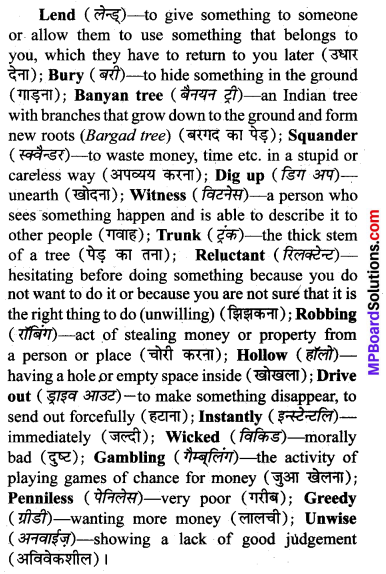
MP Board Class 10th General English The Spring Blossom Solutions Chapter 13 Opportunity for Youth

Are you seeking for the Madhya Pradesh Board Solutions 10th General English The Spring Blossom Solutions Chapter 13 Opportunity for Youth Questions and Answers PDF? If yes, then read this entire page. Here, we are giving a direct link to download MP Board Class 10th English Solutions Questions and Answers PDF which contains the chapter wise questions, solutions, and grammar topics. You can also get the shortcuts to solve the grammar related questions on this page.

MP Board Class 10th General English The Spring Blossom Solutions Chapter 13 Opportunity for Youth

For the sake of students we have gathered the complete 10th General English The Spring Blossom Solutions Chapter 13 Opportunity for Youth Questions and Answers can provided in pdf Pattern. Refer the chapter wise MP Board Class 10th English Solutions Questions and Answers Topics and start the preparation. You can estimate the importance of each chapter, find important English grammar concepts which are having more weightage. Concentrate on the important grammar topics from Madhya Pradesh Board Solutions for 10th English Chapter 13 Opportunity for Youth Questions and Answers PDF, prepare well for the exam.

Opportunity for Youth Textual Exercises

Word Power

A. Match the words with their meanings.
(सुमेलित की जिए।)
MP Board Class 10th General English The Spring Blossom Solutions Chapter 13 Opportunity for Youth 1
Answer:
1. → (b)
2. → (C)
3. → (d)
4. → (a)

B. Use the following words in sentences of your own.
(निम्न शब्दों को वाक्यों में उपयोग कीजिए)
Answer:
dependent – They hate being dependent on their parents.
refuge – It was raining too heavily so I took refuge under the nearby shade.
credit – Your account has been credited with the amount owed.
invention – Invention of electricity changed our way of living.
setback – Falling share prices are a setback for the troubled economy.

C. Use the suffix ‘graphy’ and make five words.
(प्रत्यय ‘graphy’ से पाँच नये शब्द बनाओ)
Answer:

  1. Geography
  2. Autobiography
  3. Histography
  4. Pictography
  5. Cryptography.

D. Fill in the blanks using the suitable words from brackets.
[protect, instinctive, autobiography, inner, integration]

  1. An ………. is the story of a person’s life written by himself.
  2. People have the right to ……… themselves, if somebody attacks them.
  3. The actions which happen automatically in order to protect ourselves, are known as ……… actions.
  4. Happiness is an …….. state of mind.
  5. ……… of personality can be achieved through co-ordination of thoughts.

Answer:

  1. autobiography
  2. protect
  3. instinctive
  4. inner
  5. Integration.

How Much Have I Understood?

Answer these questions. (One or two sentences)
(निम्न प्रश्नों के उत्तर एक या दो वाक्यों में दीजिए।)

Question 1.
Why did Pt. Nehru write ‘The Discovery of India’?
(व्हाय डिड पं. नेहरू राईट ‘द डिस्कवरी ऑफ इण्डिया’?)
पण्डित नेहरू ने ‘डिस्कवरी ऑफ इण्डिया’ क्यों लिखी?
Answer:
Pt. Nehru wrote ‘Discovery of India’ because he wanted a proper reconciliation between his activity and his thought. He was engaged in the quest long before he wrote the book.
(पण्डित नेहरू रोट ‘डिस्कवरी ऑफ इण्डिया’ बिकॉज ही वॉण्टेड अ प्रॉपर रिकन्सिलिएशन बिटवीन हिज़ एक्टिविटी एण्ड हिज थॉट। ही वॉज़ एंगेज्ड् इन द क्वैस्ट लाँग बिफोर ही रोट द बुक।)
पण्डित नेहरू ने ‘डिस्कवरी ऑफ इण्डिया’ पुस्तक लिखी क्योंकि वे अपने कार्यों व विचारों में सामंजस्य लाना चाहते थे। वे पुस्तक लिखने से बहुत पहले उसकी खोज में लगे थे व उसका विचार कर चुके थे।

Question 2.
What is the role of action and thoughts in our happiness?
(व्हॉट इज़ द रोल ऑफ एक्शन एण्ड थॉट्स इन अवर हैप्पिनेस?)
हमारी खुशी में हमारे कार्यों व विचारों की क्या भूमिका है?
Answer:
Happiness is achieved when thought and action are co-ordinated. Then there is no inner conflict between wish to do something and inability to act, or between thinking one way and acting in another.
(हैप्पिनेस इज़ अचीव्ड् व्हेन थॉट एण्ड एक्शन आर कोऑर्डिनेटिड। देन देयर इज नो इनर कॉन्फ्लिक्ट बिटवीन विश टू डू समथिंग एण्ड इनेबिलिटी टू एक्ट, और बिटवीन थिंकिंग वन वे एण्ड एक्टिंग इन अनअदर।)
खुशी विचार व कर्म के सामंजस्य से मिलती है। तब किसी कार्य को करने की इच्छा व उसे न कर पाने का अन्तर्द्वन्द्व नहीं होता, या एक प्रकार की सोच व दूसरे प्रकार का कार्य नहीं होता।

Question 3.
Who is the happiest man according to Pt. Nehru?
(हू इज द हैप्पिएस्ट मैन एकॉर्डिंग टू पं. नेहरू?)
पं. नेहरू के हिसाब से सबसे खुश व्यक्ति कौन है?
Answer:
According to Pt. Nehru, the happiest man is he whose thinking and action are co-ordinated.
(एकॉर्डिंग टू पं. नेहरू, द हैप्पिएस्ट मैन इज़ ही हूज थिंकिंग एण्ड एक्शन आर को-ऑर्डिनेटिड।)
पं. नेहरू के हिसाब से सबसे खुश व्यक्ति वह है जिसकी सोच व कार्य में सामंजस्य है।

Question 4.
What is needed to achieve the integration of personality?
(व्हॉट इज़ नीडेड टू अचीवद इन्टिग्रेशन ऑफ पर्सनैलिटी?)
व्यक्ति के समन्वय के लिए क्या आवश्यक है?
Answer:
Co-ordination of one’s thought and action is needed to achieve the integration of personality.
(को-ऑर्डिनेशन ऑफ वन्स थॉट एण्ड एक्शन इज़ नीडेड टू अचीव द इन्टिग्रेशन ऑफ पर्सनैलिटी।)
व्यक्ति के विचारों व कार्यों का सामंजस्य उसके व्यक्तित्व के समन्वय के लिए आवश्यक है।

Question 5.
What is the folly in which the people of every country indulge?
(व्हॉट इज़ द फॉली इन व्हिच द पीपल ऑफ एवी कण्ट्री इन्डल्ज?)
सभी देशों के लोग क्या मूर्खता करते हैं?
Answer:
People in every country indulge in the folly that their country is the greatest because they are born there.
(पीपल इन एव्री कण्ट्री इन्डल्ज इन द फॉली दैट देयर कण्ट्री इज द ग्रेटेस्ट बिकॉज़ दे आर बॉर्न देयर।)
हर देश के लोग यह सोचने की मूर्खता करते हैं कि उनका देश महान् है क्योंकि वे वहाँ जन्मे हैं।

Question 6.
What is appropriate, to seek evil in others or to find good in them? Why?
(व्हॉट इज़ एप्रॉप्रिएट, टू सीक इविल इन अदर्स और टू फाइण्ड गुड इन देम? व्हाय?)
क्या सही है, दूसरों में बुराई या अच्छाई देखना? क्यों?
Answer:
It is appropriate to find good in people rather than seeking evil in them because by this the other people would try to be good and they would feel ashamed in doing something wrong. It would therefore be profitable to ourselves as well as others.
(इट इज़ एप्रोप्रिएट टू फाइण्ड गुड इन पीपल रादर दैन सीकिंग ईविल इन दैम बिकॉज़ बाइ दिस द अदर पीपल वुड ट्राइ हूं बी गुड एण्ड दे वुड फील अशेम्ड् इन डूइंग समथिंग राँग। इट वुड देयरफोर बी प्रॉफिटेब्ल् टू अवरसेल्व्स एज़ वेल एज अदर्स।)
दूसरे व्यक्तियों में अच्छाई देखना ज्यादा अच्छा है क्योंकि इससे वे अच्छे होने का प्रयास करेंगे और कुछ बुरा करने में शर्मिन्दगी महसूस करेंगे। अतः यह हमारे व दूसरे दोनों के लिए फायदेमन्द होगा।

Question 7.
What is reading?
(व्हॉट इज़ रीडिंग?)
पढ़ना क्या है?
Answer:
Reading is getting other people’s thought. Any reading that makes one to think is useful reading.
(रीडिंग इज गेटिंग अदर पीपल्स थॉट। एनी रीडिंग दैट मेक्स वन टू थिंक इज़ यूज़फुल रीडिंग।)
पढ़ना दूसरों के विचारों का लेना है। जो पढ़ने से व्यक्ति सोचने पर मजबूर हो जाये वह ही उपयोगी है।

Question 8.
Which type of people were not liked by Pt. Nehru?
(व्हिच टाइप ऑफ पीपल वर नॉट लाइक्ड बाइ पं. नेहरू?)
किस प्रकार के लोग पं. नेहरू को पसन्द नहीं थे?
Answer:
Pt. Nehru did not like people who have no pride and ambition and are just sloppy people.
(पं. नेहरू डिड नॉट लाइक पीपल हू हैव नो प्राईड एण्ड एम्बिशन एण्ड आर जस्ट स्लॉपी पीपल्।)
पं. नेहरू को वे लोग पसन्द नहीं थे जिनमें गौरव व महत्वाकांक्षा नहीं होती तंथा वे सिर्फ लापरवाह व्यक्ति होते हैं।

Question 9.
What is the silliest pride?
(व्हॉट इज द सिलिएस्ट प्राईड?)
सबसे मूर्खतापूर्ण गर्व कौन-सा है?
Answer:
Pride of getting money is the silliest pride.
(प्राइड ऑफ गेटिंग मनी इज़ द सिलिएस्ट प्राईड।)
पैसा पाने का गर्व सबसे मूर्खतापूर्ण गर्व है।

Question 10.
What makes us great?
(व्हॉट मेक्स अस ग्रेट?)
हमें क्या महान् बनाता है?
Answer:
The mere act of aiming at something great makes one great.
(द मिअर एक्ट ऑफ एमिंग एट समथिंग ग्रेट मेक्स वन ग्रेट।)
सिर्फ महान् बनने का लक्ष्य ही व्यक्ति को महान् बनाता है।

B. Answer these questions. (Three or four sentences)
(निम्न प्रश्नों के उत्तर तीन या चार वाक्यों में दीजिए।)

Question 1.
Describe the views of Pt. Nehru about calling a country good or bad?
‘(डिस्क्राइब द व्यूज ऑफ पं. नेहरू अबाऊट कॉलिंग अ कण्ट्री गुड और बैड।)
पं. नेहरू के किसी देश को अच्छा या बुरा कहने के विषय में विचारों का वर्णन कीजिए।
Answer:
Pt. Nehru thought that everybody likes one’s own country but it is wrong to imagine that one’s country is the best in the world. Every country and every people have something admirable in them. They have great achievements and also have bad periods so nobody is perfect.

(पं. नेहरू थॉट दैट एवीबडी लाइक्स वन्स ओन कण्ट्री बट इट इज़ राँग टू इमैजिन दैट वन्स कण्ट्री इज द बेस्ट इन द वर्ल्ड। एव्री कण्ट्री एण्ड एव्री पीपल् हैव समथिंग एडमिरेबल इन देम। दे हैव ग्रेट अचीवमेन्ट्स एण्ड ऑल्सो हैव बैड पीरिअड्स सो नोबडी इज़ परफेक्ट।)

पं. नेहरू सोचते थे कि हर व्यक्ति अपने देश को पसन्द करता है। मगर यह सोचना गलत है कि व्यक्ति का अपना देश दुनिया में सबसे अच्छा है। हर देश व उसके नागरिकों में कुछ-न-कुछ सराहनीय होता है। उनकी महान् उपलब्धियाँ होती हैं व बुरा समय भी होता है। अतः कोई भी सबसे अच्छा नहीं है।

Question 2.
Which quality of Mahatma Gandhi is described by Pt. Nehru? What did Mahatma Gandhi do?
(व्हिच क्वालिटी ऑफ महात्मा गाँधी इज़ डिस्क्राइब्ड बाइ पं. नेहरू? व्हॉट डिड महात्मा गाँधी डू?)
पं. नेहरू ने महात्मा गाँधी के कौन-से गुण का वर्णन किया है? महात्मा गाँधी ने क्या किया?
Answer:
Pt. Nehru described that Mahatma Gandhi had the quality of drawing out the good in another person. He somehow spotted the good in a person and laid emphasis on it. The result was that the man would try to be good and would feel ashemed on doing wrong.

(पं. नेहरू डिस्क्राइब्ड दैट महात्मा गाँधी हैड द क्वॉलिटी ऑफ ड्राइंग आऊट द गुड इन अनअदर पर्सन। ही समहाउ स्पॉटेड द गुड इन अ पर्सन एण्ड लेड एम्फसिस ऑन इट। द रिजल्ट वॉज दैट द मैन वुड ट्राइ टू बी गुड एण्ड वुड फील अशेम्ड् ऑन डूइंग राँग।)

पं. नेहरू ने महात्मा गाँधी के दूसरे में अच्छाई जाग्रत करने के गुण का वर्णन किया। वे किसी तरह एक व्यक्ति में अच्छाई ढूँढ लेते थे व उस पर जोर देते थे। परिणामतः व्यक्ति अच्छा बनने की कोशिश करता था व कुछ बुरा करने में शर्मिन्दगी महसूस करता था।

Question 3.
What should we think about according to Pt. Nehru?
(व्हॉट शुड वी थिंक अबाऊट एकॉर्डिंग टू पं. नेहरू?)
पं. नेहरू के हिसाब से हमें किस विषय पर विचार करना चाहिए?
Answer:
According to Pt. Nehru we should think of the vast opportunities that the world offers to those who are keen of mind, strong of character and fleet of foot. We should also think of the opportunities that India offers.
(एकॉर्डिंग टू पं. नेहरू वी शुड थिंक ऑफ द वास्ट अपॉर्च्युनिटीज दैट द वर्ल्ड ऑफर्स टु दोज़ हू आर कीन ऑफ माइन्ड, स्ट्राँग ऑफ कैरेक्टर एण्ड फ्लीट ऑफ फुट। वी शुड ऑल्सो थिंक ऑफ द अपॉर्च्युनिटीज़ दैट इण्डिया ऑफर्स।)
पं. नेहरू के हिसाब से हमें विश्व के उन विशाल अवसरों के बारे में सोचना चाहिए जो उन लोगों को उपलब्ध हैं जो दिमाग से तेज हैं, चरित्रवान तथा द्रुतगामी हैं। हमें उन अवसरों के विषय में भी सोचना चाहिए जो भारत हमें प्रदान करता है।

Question 4.
How should our engineers and other technicians be trained?
(हाउ शुड अवर एन्जिनियर्स एण्ड अदर टेक्निशियन्स बी ट्रेन्ड?)
हमारे अभियान्त्रिकों व तकनीकी विशेषज्ञों को किस प्रकार प्रशिक्षित किया जाना चाहिए?
Answer:
Our engineers and technicians need to be trained in two ways. They must be trained in mind, and have some vision and understanding of the world picture. Then they must be trained in particular jobs which they can do well, whether it be science or engineering or medicine or education.

(आवर एन्जिनियर्स एण्ड टेक्निशियन्स नीड टू बी ट्रेन्ड इन टू वेज़। दे मस्ट बी ट्रेन्ड इन माइन्ड, एण्ड हैव सम विज़न एण्ड अण्डरस्टैण्डिंग ऑफ द वर्ल्ड पिक्चर। देन दे मस्ट बी ट्रेन्ड् इन पर्टिक्यूलर जॉब्स व्हिच दे कैन डू वेल, वैदर इट बी साइन्स और एन्जिनियरिंग और मेडिसिन और एजुकेशन।)

हमारे अभियान्त्रिकों व तकनीकी विशेषज्ञों को दो प्रकार से प्रशिक्षित किया जाना चाहिए। उन्हें मानसिक रूप से प्रशिक्षित किया जाना चाहिए व उनमें दुनिया की समझ होनी चाहिए। उसके पश्चात उन्हें किसी कार्य विशेष में प्रशिक्षित करना चाहिए जिसमें कि वे निपुण हो सकें चाहे वह विज्ञान हो, अभियान्त्रिकी हो, चिकित्सा हो अथवा शिक्षा हो।

Question 5.
Discuss the importance of pride and ambition in youth.
(डिसकस द इम्पॉर्टेन्स ऑफ प्राइड एण्ड एम्बिशन इन यूथ।)
जवानों में गर्व व महत्वाकांक्षा के महत्व की चर्चा कीजिए।
Answer:
Pride and ambition in youth is important to do something worthwhile and big. Pride should consist in doing a job in the best possible manner and one can become great if he has great ambition. Aiming at something big makes one big.

(प्राईड एण्ड एम्बिशन इन यूथ इज इम्पॉर्टेन्ट टू डू समथिंग वर्थव्हाइल एण्ड बिग। प्राईड शुड कन्सिस्ट इन डूइंग अ जॉब इन द बेस्ट पॉसिब्ल मैनर एण्ड वन कैन बिकम ग्रेट इफ ही हैज़ ग्रेट एम्बिशन। एमिंग एट समथिंग बिग मेक्स वन बिग।)

गर्व व महत्वाकांक्षा जवानों के लिए महत्वपूर्ण है। उसी के कारण वे कुछ बड़ा व महत्वपूर्ण कार्य कर सकते हैं। अपने कार्य को सबसे बेहतर तरीके से करना ही गर्व को दर्शाता है व कोई व्यक्ति महान् तभी बन सकता है जब उसकी वैसी ही महत्वाकांक्षा हो। कोई बड़ी महत्वाकांक्षा ही बड़ा बना सकती है।

Question 6.
How have the people who have achieved greatness become so? Explain.
(हाउ हैव द पीपल हू हैव अचीव्ड ग्रेटनेस बिकम सो? एक्सप्लेन?)
जो व्यक्ति महान् हैं वे वहाँ कैसे पहुंचे हैं? समझाइए।
Answer:
The people who have achieved greatness became so because apart from having some virtue and ability they had some ambition and pride. They had high ambition and tried to do big things.
(द पीपल हू हैव अचीव्ड् ग्रेटनेस बिकेम सो बिकॉज़ अपार्ट फ्रॉम हैविंग सम वर्दू एण्ड एबिलिटी दे हैड सम एम्बिशन एण्ड प्राइड। दे हैड हाइ एम्बिशन एण्ड ट्राइड टू डू बिग थिंग्स।)
जिन व्यक्तियों ने महानता हासिल की है वह इसीलिए क्योंकि उनमें काबिलियत के अलावा महत्वाकांक्षा व गर्व भी था। उनमें उच्च महत्वाकांक्षा थी और उन्होंने बड़े कार्य करने की कोशिश की।

Language Practice

Put the verbs in present perfect or past simple as required.
(रिस्त स्थान भरो।)

  1. I was very tired, so I ………. down on the bed and went to sleep. (lie)
  2. Anuj ………. me his address but I’m afraid 1 ……… it. (give, lose).
  3. Is Abhilasha still here? No, she ……… out. (just go)
  4. (a)Look! somebody ……… (spill) coffee on the carpert.
    (b) Well, it ……….(not/be) me. I ………. it. (not/do)
  5. What do you think of my English? Do you think I ……? (improve)
  6. I wanted to phone Pallav last night but I ……… (forget).

Answer:

  1. lied
  2. gave, lost
  3. just went
  4. (a) has spilled, (b) is not, have not done
  5. have improved
  6. forgot

Listening Time

The teacher will read aloud the following words with proper pronunciation and the students will repeat them
(निम्न शब्दों को दोहशओ।)
Answer:
MP Board Class 10th General English The Spring Blossom Solutions Chapter 13 Opportunity for Youth 2

The teacher will read the given passage and students will listen to it. There are two columns under the passage. Students will tick (✓) the words that they listen.
(गद्यांश में आये शब्द चिह्नित करे।)
Answer:
MP Board Class 10th General English The Spring Blossom Solutions Chapter 13 Opportunity for Youth 3

Speaking Time

You visited a fair last month. Describe to the class.
Answer:
I visited my village fair last month. My village is near Indore. I visited there during my summer holidays in June. There were a great variety of shops of toys, clothes, sports etc. All kinds of toys were available. There were also showrooms of electrical and electronics items. There were also shops of vehicles at discount rates and modern variety of furniture was also available. There were a large number of swings and merry-go-rounds. Children were enjoying there a lot. We also sat on a swing. It was an enjoyable ride. There was also a magic show by a renowned magician. There was large crowd in it. Children were clapping and shouting on his magic tricks. There were many stalls of snacks and various other eatables. They were quite clean, covered and hygienic. Also, the taste of the eatables was too good. I liked the fruit chat and bhelpuri a lot. The fruits were too fresh and the chat was spicy. I really enjoyed the fair and didn’t want to come home.

Writing Time

Read the given passage and make notes in your notebook.
(दिये गये गद्यांश को पढ़ो व नोट्स बनाओ।)
Answer:
Law-making in Britain
1. Proposal of Laws :

  1. Start in House of Lord or Commons
  2. Proposed by Govt.

2. Passing of Bill :

  1. Proposal of bill
  2. Act of Parliament
  3. Bill rejected govt. resigns
  4. No Vote-Committee stage
  5. Reported to the House
  6. Report stage
  7. Passed Bill to Other House

3. Royal Assent of passed Bill
4. Becomes law

Things to do

Find out how Bills are introduced in the Indian Parliament and finally become law. Write all the stages in your project file and develop a flow chart. Take the help of your teacher of social studies.
Answer:
Law-making in India

The basic function of Parliament is to make laws. All legislative proposals have to be brought in the form of Bills before Parliament. A Bill is a statute in draft and cannot become law unless it has received the approval of both the Houses of Parliament and the assent of the President of India.

The process of law making begins with the introduction of a bill in either House of Parliament. A bill can be introduced either by a minister or a member other than a minister. In the former case, it is called a government bill and in the latter case, it is known as a private member’s bill.

A bill undergoes three readings in each House, i.e., the Lok Sabha and the Rajya Sabha before it is submitted to the President for assent.

After a bill has been finally passed by the Houses of Parliament, it is submitted to the President for his assent. After a bill has received the assent of the President, it becomes the law.

Flow Chart :
MP Board Class 10th General English The Spring Blossom Solutions Chapter 13 Opportunity for Youth 4

Opportunity for Youth Difficult Word Meanings

MP Board Class 10th General English The Spring Blossom Solutions Chapter 13 Opportunity for Youth 5

Opportunity for Youth Summary, Pronunciation & Translation

You know that I once wrote a book called The Discovery of India. I was engaged in that quest long before I wrote that book. It was not mere curiosity that led me to that quest. I was engaged in many activities and I wanted a proper reconciliation between my activity and my thought. Thought without action is abortion. Action without thought is folly.

Of course, we sometimes act on some impulse or irrepressible urge. If suddenly you throw a brick at me and my hand goes up to protect myself, it is an automatic, instinctive action and not a result of deliberate thought. Our living is conditioned by a series of automatic actions from morning till night. Anything we do outside that common range of actions, however, has to be preceded by some measure of thinking. The more action and thought are allied and integrated, the more effective they become and the happier you grow. There will then be no inner conflict between wish to do something and inability to act, or between thinking one way and acting in another. The happiest man is he whose thinking and action are co-ordinated.

(यू नो दैट आई वन्स रोट अ बुक कॉल्ड द डिस्कवरी ऑफ इण्डिया. आई वॉज एन्गेज्ड इन दैट क्वेस्ट लॉन्ग बिफोर आई रोट दैट बुक. इट वॉज़ नॉट मेअर क्यूरिऑसिटी दैट लेड मी टू दैट क्वेस्ट. आई वॉज एन्गेज्ड इन मैनी एक्टिविटीज़ ऐण्ड आई वाण्टिड अ प्रॉपर रीकन्सिलिएशन बिटवीन माई एक्टिविटी ऐण्ड माई थॉट. थॉट विदाऊट ऐक्शन इज़ अबॉरशन. ऐक्शन विदआऊट थॉट इज फॉली.

ऑफ कोर्स, वी समटाईम्स ऐक्ट ऑन सम इम्पल्स ऑर इरेप्रिसिबल अर्ज. इफ सडन्ली यू थ्रो अब्रिक ऐट मी ऐण्ड माई हैण्ड गोज अप टू प्रोटेक्ट माईसेल्फ, इट इज ऐन ऑटोमेटिक, इन्सटिंक्टिव ऐक्शन ऐण्ड नॉट अ रिजल्ट ऑफ डेलिबरेट थॉट. आवर लिविंग इज कन्डीशन्ड बाई ऐक्शन्स फ्रॉम मॉर्निंग टिल नाईट. एनीथिंग वी डू आऊटसाइड दैट कॉमन रेंज ऑफ ऐक्शन्स, हाऊएवर, हैज टू बी प्रिसीडिड बाई सम मैजर ऑफ थिंकिंग. द मोर ऐक्शन ऐण्ड थॉट आर एलाईड ऐण्ड इंटिग्रेटिड, द मोर इफेक्टिव दे बिकम ऐण्ड द हैप्पियर यू ग्रो. देयर बिल देन बी नो इनर कन्फ्लिक्ट बिटवीन विश टू डू समथिंग ऐण्ड इन्ऐबिलिटी टू ऐक्ट, और बिटवीन थिंकिंग वन वे ऐण्ड ऐक्टिंग इन अनदर. द हैप्पियस्ट मैन इज़ ही हूज थिंकिंग ऐण्ड ऐक्शन ऑफ कोऑर्डिनेटिड।

अनुवाद :
तुम्हें मालूम होगा कि मैंने एक पुस्तक लिखी थी ‘भारत की खोज’. वो पुस्तक लिखने से काफी पहले से मैं इस खोज में लगा था। और इस खोज का कारण केवल जिज्ञासा नहीं थी। मैं कई प्रकार के क्रियाकलापों में व्यस्त था और मैं : अपने क्रियाकलापों एवं विचारों में एक उचित सामंजस्य चाहता था। बिना क्रिया के विचार निष्फल होता है और विचार के बिना क्रिया मूर्खता।

यह सत्य है कि हम कभी-कभी क्षणिक आवेग में या किसी तीव्र न दबाए जा सकने वाले इच्छा के अनुसार कार्य करते हैं। यदि अचानक तुम मेरी तरफ कोई पत्थर फेंको तो मेरा हाथ स्वतः ही स्वयं को बचाने से लिए उठेगा। यह एक स्वाभाविक सहज-ज्ञान प्रेरित क्रिया है, किसी सोचे-समझे विचार का परिणाम नहीं। सुबह से रात तक प्रतिदिन हम कितनी ही ऐसी स्वाभाविक क्रियाएँ करते हैं। इन साधारण स्वाभाविक क्रियाओं से इतर यदि हम कुछ भी करते हैं तो उससे पूर्व उसमें कुछ मात्रा में सोच-विचार अवश्य होता है। जितना अधिक कार्य एवं विचार सम्बद्ध व एकीकृत होंगे उतना ही अधिक असरकारक होंगे और आप उतने ही खुश। तब किसी प्रकार का अन्तर-विरोध नहीं होगा किया कार्य को करने की आपकी इच्छा में और उसको कार्य रूप में परिणत करने की अक्षमता में या फिर सोच और क्रिया में अन्तर होने पर। सबसे प्रसन्न व्यक्ति वो है जिसके विचार एवं क्रियाएँ समन्वित हैं।

Happiness, after all, is an inner state of mind. It is little dependent on outside environment. Happiness has very little to do, for instance, with whether you are rich or not rich. Some of the most miserable persons I have come across in my life are the rich people. It is true that poverty makes one miserable in a very acute way. But my point is that it is not wealth but co-ordination of one’s thought and action which removes inner conflicts. It is in that way that integration of personality is achieved.

(हैप्पिनेस, आफ्टर ऑल, इज ऐन इनर स्टेट ऑफ माईण्ड., इट. इज लिटल डिपेण्डेण्ट ऑन आऊटसाइड एन्वायरमेण्ट. हैप्पिनेस हैज़ वेरी लिटल टू डू, फॉर इन्स्टेन्स, विद वेदर यू आर रिच ऑर नॉट रिच. सम ऑफ द मोस्ट मिजरेबल पर्सन्स आई। हैव कम अक्रॉस इन माई लाईफ ऑर द रिच पीपल. इट इज ट्र दैट पॉवर्टी मेक्स वन मिज़रेबल इन अ वेरी एक्यूट वे. बट माई पॉईण्ट इज दैट इट इज़ नॉट वेल्थ बट कोऑर्डिनेशन ऑफ वन्स थॉट ऐण्ड ऐक्शन व्हिच रिमूव्ज़ इनर कन्फ्लिक्ट्स इट इज़ इन दैट वे दैट इण्टिग्रेशन ऑफ पर्सनैलिटी इज़ अचीव्ड.)

अनुवाद :
प्रसन्नता आखिर हमारे मन की एक आन्तरिक स्थिति है। यह बाहर के हालात पर निर्भर नहीं है। उदाहरण के लिए प्रसन्नता इस बात पर निर्भर नहीं करती कि आप धनी हैं या नहीं। कुछ सबसे ज्यादा दयनीय दुखी व्यक्ति जो मेरे सामने मेरे जीवन में आए वे धनी लोग थे। यह सत्य है कि गरीबी किसी को बहुत ही ज्यादा दयनीय, दीन स्थिति में ला देती है। परन्तु मेरा आशय है कि धन नहीं वरन विचारों एवं क्रियाओं का समन्वय हमारे अन्तर विरोधों को दूर करता है। इस तरह से ही हमारे व्यक्तित्व का एकीकरण हो पाता है।

We were engaged, as you know, in a very great movement in India. Because that movement was intimately concerned with the freedom of India, I was led to wonder what exactly India is. I knew, of course, the geography of India. I knew many other odd facts about India, too. I was not prepared to accept it on faith that because I was born in India, therefore India was the greatest country in the world. That is the kind of folly in which the people of every country indulge.

There are quite enough people in India who think that India is obviously the greatest country. In the days when we were politically subject and could not take much pride in our political condition, we prided ourselves on our spiritual greatness. Having nothing else to get hold of we took refuge in spirituality.

(वी वर एन्गेज्ड, ऐज़ यू नो, इन अ वेरी ग्रेट मूवमेण्ट इन इण्डिया. बिकॉज दैट मूवमेंट वॉज़ इंटिमेटली कन्सर्ट्स विद द फ्रीडम ऑफ इण्डिया, आई वॉज़ लेड टू वण्डर व्हॉट एक्जैक्टली इण्डिया इज. आई न्यू, ऑफ कोर्स, द ज्यॉग्राफी ऑफ इण्डिया. आई न्यू मैनी अदर ऑड फैक्ट्स अबाउट इण्डिया, टू. आई वॉज़ नॉट प्रिपेअर्ड टू एक्सेप्ट इट ऑन फेथ दैट बिकॉज़ आई वॉज़ बॉर्न इन इण्डिया, देयरफोर इण्डिया वॉज़ द ग्रेटेस्ट कंट्री इन द वर्ल्ड. दैट इज़ द काईण्ड ऑफ फॉली इन व्हिच द पीपल ऑफ एवरी कंट्री इन्डल्ज।

देयर आर क्वाईट एनफ पीपल इन इण्डिया हू थिंक दैट इण्डिया इज़ ऑबविअसली द ग्रेटेस्ट कंट्री. इन द डेज़ व्हेन वी वर पॉलिटिकली सब्जेक्ट ऐण्ड कुड नॉट टेक मच प्राइड इन आवर पॉलिटिकल कन्डीशन, वी प्राइडिड आवरसेल्व्स ऑन आवर स्पिरिचुअल ग्रेटनेस. हैविंग नथिंग एल्स टू गैट होल्ड ऑफ वी टुक रिफ्यूज इन स्पिरिटुएलिटी.)

अनुवाद :
हम लोग बहुत महान आंदोलन में व्यस्त थे। क्योंकि वह आंदोलन भारत की आजादी से बहुत घनिष्ठ रूप से संबंधित था, इससे मैं इस सोच में पड़ गया कि भारत आखिर है क्या। मैं भारत का भूगोल तो जानता था। इसके अतिरिक्त मैं और भी बहुत से तथ्य जानता था भारत के बारे में। मैं केवल आस्था के आधार पर यह स्वीकार करने को तैयार नहीं था कि क्योंकि मैं भारत में जन्मा हूँ इसलिए भारत दुनिया का महानतम देश है। इस प्रकार की गलती या मूर्खता सभी देशों के लोग करते हैं। भारत में काफी सारे लोग हैं जो यह सोचते हैं कि भारत निश्चित रूप से दुनिया का महानतम देश है। जिन दिनों हम राजनैतिक रूप से पराधीन थे और अपनी राजनैतिक दशा पर गर्व नहीं कर पाते थे, उन दिनों में हम अपनी आध्यात्मिक श्रेष्ठता पर गर्व करते थे। कुछ और न होने पर हमने आध्यात्मिकता में आश्रय ढूँढ़ा।

If you go to other countries. I shall not name them as I do not wish to cause offence-you will find the people there think that their country is the chosen country, the torch bearer of civilization, the most advanced country, the most revolutionary country, the country with the biggest buildings, the country with something unique, some mission or the other. It is natural for one to like one’s own country and one’s own people. It would be unnatural not to do so. It is good to be a little proud of one’s own country. But it is wrong to start imagining that we are the highest and the best in the world. The fact is that every country and every people have admirable points about them; they have great achievements to their credit, and they have also bad periods in their history. This applies not to countries only but to individuals also. Nobody is perfect; he has weaknesses and failings. Nobody is thoroughly bad either. We are all mixtures of good and evil. But we should try to further the good in ourselves and in others.

(इफ यू गो टू अदर कन्ट्रीज-आई शैल नॉट नेम देम ऐज़ आई डू नॉट विश टू कॉज ऑफेन्स-यू विल फाइण्ड द पीपल देयर थिंक दैट देयर कंट्री इज द चोज़न कंट्री, ट टॉर्च बीयरर ऑफ सिविलाइजेशन, द मोस्ट एडवान्स्ड कंट्री, द मोस्ट रिवोल्यूशनरी कंट्री, द कंट्री विद द बिगेस्ट बिल्डिंग्स, द कंट्री विद समथिंग यूनीक, सम मिशन और द अदर। इट इज़ नैचुरल फॉर वन टू लाइक वन्स ओन कंट्री ऐण्ड वन्स ओन पीपल. इट वुड बी अननैचुरल नॉट टू डू सो. इट इज़ गुड टू बी अ लिटल प्राउड ऑफ वन्स ओन कंट्री। बट इट इज़ रॉन्ग टू स्टार्ट इमैजिनिंग दैट वी आर द हाईएस्ट एण्ड द बेस्ट इन द वर्ल्ड. द फैक्ट इज दैट एवरी कंट्री ऐण्ड एवरी पीपल हैव एडमिरेबल पॉईण्ट्स अबाउट दैम, दे हैव ग्रेट अचीवमेण्ट्स टू देयर क्रेडिट एण्ड दे हैव ऑल्सो बैड पीरियड्स इन देयर हिस्ट्री. दिस अप्लाईज़ नॉट टु कंट्रीज़ ओनली बट टू इंडिविजुअल्स ऑल्सो. नोबडी इज़ परफैक्ट; ही हैज वीकनेसेस एण्ड फेलिंग. नोबडी इज थॉरोली बैड आईदर. वी आर ऑल मिक्सचर्स ऑफ गुड एण्ड ईविल. बट वी शुड ट्राय टू फर्दर द गुड इन आवरसेल्व्ज ऐण्ड इन अदर्स.)

अनुवाद :
यदि आप अन्य देशों में जाएँ-मैं उन देशों का नाम नहीं लूंगा। क्योंकि उनका अपमान करना मेरा उद्देश्य नहीं है-आप वहाँ पाएँगे कि लोग सोचते हैं कि उनका देश है चुना हुआ (ईश्वर द्वारा या प्रकृति द्वारा), सभ्यता के ध्वज वाहक या पथ प्रदर्शक सबसे प्रगतिशील देश, सबसे क्रान्तिकारी बदलावों का देश, सबसे बड़ी, ऊँची इमारतों का देश, ऐसा देश जिसमें कुछ विशेष बात है जिसका कुछ ध्येय या मिशन है। किसी के लिए भी अपने देश और उसके लोगों को पसन्द करना स्वाभाविक है। परन्तु यह सोचना कि हम सबसे उच्च, सबसे श्रेष्ठ हैं, गलत है। सच्चाई यह है कि सभी देशों में सभी लोगों में कुछ न कुछ प्रशंसनीय बात होती है, महान उपलब्धियाँ होती हैं एवं बुरा समय भी होता है उनके इतिहास में। और यह सिर्फ देशों पर ही लागू नहीं होता वरन व्यक्तियों पर भी। कोई भी दोषहीन परिपूर्ण नहीं होता। उसमें कमजोरियों एवं कमियाँ होती हैं। कोई भी पूरी तरह से बुरा भी नहीं होता। हम सभी अच्छाई व बुराई का मिश्रण है। परन्तु हमारी कोशिश अपनी व और लोगों की अच्छाइयों को बढ़ाने की होनी चाहिए।

Most of you probably did not see Gandhiji at close quarters. He had amazing qualities. One of these qualities was that he managed to draw out the good in another person, The other person may have had plenty of evil in him. But he some how spotted the good and laid emphasis on that good. The result was that the poor man had to try to be good. He could not help it. He would feel a little ashamed when he did something wrong.

(मोस्ट ऑफ यू प्रोबैबली डिड नॉट सी गाँधीजी ऐट क्लोज क्वॉटर्स. ही हैड अमेजिंग क्वालिटीज़. वन ऑफ दीज़ क्वालिटीज़ वॉज़ दैट ही मैनेज्ड टू ड्रॉ आउट द गुड इन अनदर पर्सन. द अदर पर्सन मे हैव हैड प्लेण्टी ऑफ ईविल इन हिम. बट ही समहाऊ स्पॉटिड द गुड ऐण्ड लेड एम्फैसिस ऑन दैट गुड. द रिज़ल्ट वॉज़ देट द पूअर मैन हैड टू ट्राई टू बी गुड. ही कुड नॉट हैल्प इट. ही वुड फील अ लिटल अशेम्ड व्हेन ही डिड समथिंग रॉन्ग.)

अनुवाद :
आप में से ज्यादातर लोगों ने गाँधीजी को पास से नहीं देखा उनमें गजब की खूबियाँ थीं। ऐसी ही एक उनकी खूबी थी कि वे किसी दूसरे के भीतर से उसकी अच्छाई को बाहर निकाल लाते थे। दूसरे में बेशक बहुत-सी बुराईयाँ होंगी। परन्तु गाँधीजी किसी-न-किसी प्रकार उसकी अच्छाई को पहचान लेते गे थे और फिर उसी को महत्व देते थे। परिणाम यह होता था कि दूसरे को अच्छा होने का प्रयत्न करना ही पड़ता था। उसके पास और कोई चारा नहीं होता था। कुछ गलत कर देने पर शर्मिन्दा भी होता था।

People who always seek evil in others find it. This applies to nations as well as individuals. Go to a foreign country. You are likely to find many things that you do not like. Are you going to spend your time finding out the evil in other countries, or rather in finding out the good in them, and profiting yourself and others by your contact?

We are all much too apt to look at the evil in other individuals and countries rather than the good. Perhaps some of you know the saying in the Bible about the person who could not see the beam in his own eye and saw the mote in the other’s eye. I am sorry if you think I am rambling. But this is, I might inform you in secret, a very clever attempt to get behind your mind. I am at least being frank with you.

(पीपल हू ऑलवेज़ सीक ईविल इन अदर्स फाइण्ड इट. दिस अलाईज टू नेशन्स ऐज़ वैल ऐज़ इंडिविजुअल्स. गो टू अ फॉरन कंट्री. यू आर लाइक्ली टू फाइण्ड मैनी थिंग्स दैट यू डू नॉट लाइक. आर यू गोइंग टू स्पेन्ड यॉर टाईम फाइण्डिंग आऊट द ईविल इन अदर कंट्रीज, ऑर रादर इन फाइण्डिंग आउट द गुड इन दैम, एण्ड प्रॉफिटिंग यॉरसेल्फ ऐण्ड अदर्स बाई यॉर कॉण्टेक्ट?

वी आर ऑल मच टू एप्ट टू लुक ऐट द ईविल इन अदर इंडिविजुअल्स ऐण्ड कंट्रीज रादर दैन द गुड. परहैप्स सम ऑफ यू नो द सेइंग इन द बाईबल अबाऊट द पर्सन हू कुड नॉट सी द बीम इन हिज़ ओन आई ऐण्ड सॉ द मोट इन द अदर्स आई. आई ऐम सॉरी इफ यू थिंक आई ऐम रैम्बलिंग बट दिस इज़, आई माईट इन्फॉर्म यू इन सीक्रेट, अ वेरी क्लेवर अटेम्प्ट टु गैट बिहाइण्ड यॉर माईण्ड. आई ऐम ऐट लीस्ट बीईंग फ्रेंक विद यू.)

अनुवाद :
जो लोग हमेशा दूसरों में बुराइयाँ ढूँढ़ते रहते हैं उन्हें बुराई मिल जाती है। यह देशों व व्यक्तियों दोनों पर लागू होता है। किसी दूसरे देश में जाइए। आपको वहाँ अनेक ऐसी चीजें मिलने की सम्भावना है जो आपको पसन्द नहीं होंगी। क्या आप अपना समय यह जानने में लगाएंगे वहाँ की बुराइयाँ क्या हैं अथवा यह पता लगाने में वहाँ अच्छाइयाँ क्या हैं, और स्वयं भी लाभान्वित हों और अन्य को भी लाभ पहुँचाएँ जो आपके सम्पर्क में आएँ?

हम दूसरे व्यक्तियों और देशों की बुराइयाँ ढूँढ़ने में कुछ अधिक ही योग्य हैं बजाए उनकी अच्छाइयों के। शायद आप में से कुछ बाइबल की उस उक्ति के बारे में जानते होंगे उस व्यक्ति के बारे में जो अपने नेत्रों में सहतीर नहीं देख पाता था परन्तु दूसरे की आँख में पड़ा धूल का कण उसे दिखाई दे जाता था। मुझे क्षमा करना यदि आपको लगे कि मैं अनर्गल प्रलाप कर रहा हूँ। परन्तु मैं आपको गुप्त रूप से जानकारी दे दूँ कि यह आपके मन में झाँकने का एक चतुर प्रयास है। मैं कम से कम आपसे स्पष्ट कह रहा हूँ।

Having got the larger frame, I looked more closely at my own country and wrote The Discovery of India. In it I concentrated on my country’s past and the story of its development.

I am trying to explain to you how my thinking developed in these matters. The more I thought and the more I learnt the more I saw how little I knew and how much more there was to learn. One of my regrets today is that I have no time to pursue these studies properly by reading or thinking or writing, because writing for me is essentially an aid to thinking. In trying to write, one has to think more concisely than otherwise.

(हैविंग गॉट द लार्जर फ्रेम, आई लुक्ड मोर क्लोज़ली ऐट माई ओन कंट्री ऐण्ड रोट द डिस्कवरी ऑफ इण्डिया. इन इट आई कन्सनेट्रैटिड ऑन माई कंट्रीज पास्ट ऐण्ड द स्टोरी ऑफ इट्स डेवलपमेंट।

आई एम ट्राईंग टू एक्स्प्ले न टू यू हाउ माई थिंकिंग डेवलप्ड इन दीज़ मैटर्स. द मोर आई थॉट ऐण्ड द मोर आई लर्ट द मोर आई सॉ हाऊ लिटल आई न्यू ऐण्ड हाऊ मच मोर देयर वॉज़ टु लन. वन ऑफ माई रीग्रेट्स टुडे इज़ दैट आई हैव नो टाईम टु परस्यू दीज़ स्टडीज़ प्रॉपर्ली बाई रीडिंग ऑर थिंकिंग ऑर राइटिंग, बिकॉज़ राईटिंग फॉर मी इज़ एसेन्शियली ऐन एड टू थिंकिंग. इन ट्राईंग टू राईट, वन हैज़ टू थिंक मोर कन्साईज़ली दैन अदरवाईज.)

अनुवाद :
वृहद सोच रखने के कारण मैंने अपने देश का ही बहुत बारीकी से अध्ययन किया और ‘भारत की खोज’ पुस्तक लिखी। इसमें मैंने अपनी लेखनी को अपने देश के इतिहास एवं उसके विकास की कहानी पर केन्द्रित किया है।

मैं आपको यह समझाने का प्रयास कर रहा हूँ कि इन मामलों में मेरी सोच कैसे विकसित हुई। जितना अधिक मैंने सोचा उतना ही अधिक मैंने जाना और उतना ही अधिक मैंने देखा कि मैं कितना कम जानता था और कितना कुछ है जानने के लिए। आज मेरा एक खेद इस बात को लेकर है कि मेरे पास अब समय नहीं है इन खोजों को ठीक से जारी रखने का पठन, मनन एवं लेखन द्वारा क्योंकि मेरे लिए लेखन असल में मनन की सहायक हैं। लिखते समय व्यक्ति को कहीं अधिक स्पष्ट रूप से सोचना पड़ता है।

I suppose I must not complain of my present lot. What I would like you to do first of all is to think. Thinking is something which does not come automatically to a person. Gossiping with a neighbour is not thought. If you repeat something which somebody else has said, it is not thought. I do not expect all of you to become mighty thinkers, though some of you may. But I would like all of you to think and to develope the art of thinking.

Nothing is more helpful to thinking than reading, that is, reading intelligently, because thereby you get other people’s thoughts, and by weighing them you can think yourself. I have often said that it is very unfortunate that people think and read so little nowadays, especially in India. I do not call newspaper-reading · But any reading which makes you think is useful reading, even if it is a very good novel. Great novels always make one think, because they are pictures of life painted by great minds.

(आई सपोज़ आई मस्ट नॉट कम्प्लेन ऑफ माई प्रेजेण्ट लॉट. व्हॉट आई वुड लाइक यू टू डू फर्स्ट ऑफ ऑल इज़ टू थिंक. थिंकिंग इज़ समथिंग व्हिच डज़ नॉट कम ऑटोमैटिकली टु अ पर्सन, गॉसिपिंग विद अ नेबर इज नॉट थॉट. इफ यू रिपीट समथिंग व्हिच समबडी एल्स हैज सेड, इट इज़ नॉट थॉट आई डू नॉट एक्सपेक्ट ऑल ऑफ यू टू बिकम माईटी थिंकर्स, दो सम ऑफ यू मे. बट आई वुड लाइक ऑल ऑफ यू टू थिंक ऐण्ड टू डेवलप द आर्ट ऑफ थिंकिंग.

नथिंग इज़ मोर हैल्पफुल ट्र थिंकिंग दैन रीडिंग, दैट इज़, रीडिंग इन्टेलिजेण्टली, बिकॉज़ देयरबाई थू गैट अदर पीपल्ज़ थॉट्स, ऐण्ड बाई वेईंग दैम यू कैन थिंक यॉरसेल्फ. आई हैव ऑफन सेड दैट इट इज़ वेरी अनफॉरचुनेट दैट पीपल थिंक ऐण्ड रीड सो लिटल नाओअडेज़, एस्पेशियली इन इण्डिया. आई डू नॉट कॉल न्यूज़पेपर रीडिंग. बट एनी रीडिंग व्हिच मेक्स यू थिंक इज़ यूज़फुल रीडिंग, ईवन इफ इट इज़ उन वेरी गुड नॉवल. ग्रेट नॉवल्स ऑलवेज मेक वन थिंक, बिकॉज दे आर पिक्चर्स ऑफ लाइफ पेण्टिड बाई ग्रेट माईण्ड्स.)

अनुवाद :
मुझे लगता है कि अपने भाग्य पर शिकायत नहीं करनी चाहिए। मैं सर्वप्रथम आप सब लोगों से यह अपेक्षा करता हूँ कि आप विचार करें, मनन करें। विचार करने, मनन करने की कला किसी में स्वाभाविक रूप से विद्यमान नहीं होती। पड़ोसी से गपशप सोचना-विचारना नहीं है। यदि आप किसी की कही हुई बात दोहराते हैं तो यह विचार नहीं है। मैं आप सब लोगों से प्रकाण्ड विचारक बनने की अपेक्षा नहीं करता, हालांकि आप में से कुछ हो भी जाएँगे। परन्तु मैं यह चाहूँगा कि आप सब सोचे-विचारें और विचार करने की कला विकसित करें।

इस कार्य में पठन से अधिक कुछ भी सहायक नहीं है अर्थात् बुद्धिमतापूर्ण पठन, क्योंकि पढ़ने से ही आपको दूसरों के विचार पता चलते हैं और उनको तोलकर आप स्वयं सोच सकते हैं। मैंने यह अक्सर कहा है कि यह बेहद दुर्भाग्यपूर्ण है कि आजकल लोग इतना कम सोचते हैं और पढ़ते हैं विशेषकर भारत में। मैं अखबार पढ़ने को पढ़ना नहीं मानता। परन्तु कोई भी पठन जो आपको सोचने पर मजबूर करे उपयोगी पढ़ाई है यहाँ तक कि कोई अच्छा उपन्यास भी। श्रेष्ठ उपन्यास हमेशा व्यक्ति को सोचने पर मजबूर करते हैं क्योंकि वे श्रेष्ठ मस्तिष्कों द्वारा चित्रित जीवन के चित्र हैं।

If you think about the Five-Year Plans, you will find what a vital part the engineer plays in them. We shall require tens of thousands of engineers and hundreds of thousands of overseers, mechanics, and other technicians for our Plans. The whole world is becoming more and more a world of trained people. They need to be trained in two ways. They must be trained in mind, and have some vision and understanding of the world picture. Then they must be trained in particular jobs which they can do well, whether it be science or engineering or medicine or education. Such are the skills which will build India.

ड्रफ यू थिंक अबाऊट द फाइव-यीअर प्लान्स, यू विल फाइण्ड व्हॉट अ वाईटल पार्ट द इंजीनियर प्लेज़ इन दैम. वी शैल रिक्वायर टैंन्स ऑफ थाऊजेण्ड्स ऑफ इंजीनियर्स एण्ड हन्ड्रेड्स ऑफ थाऊजेण्ड्स ऑफ ओवरसीअर्स, मैकेनिक्स, ऐण्ड अदर टेक्निशियन्स फॉर आवर प्लान्स. द होल वर्ल्ड इज़ बिकमिंग मोर एण्ड मोर अ वर्ल्ड ऑफ ट्रेण्ड पीपल. दे नीड टू बी ट्रेण्ड इन टू वेज़. दे मस्ट बी ट्रेण्ड इन माइण्ड, ऐण्ड हैव सम विजन ऐण्ड अण्डरस्टैण्डिंग ऑफ द वर्ल्ड पिक्चर. देन दे मस्ट बी ट्रेण्ड इन पर्टिकुलर जॉब्स, व्हिच दे कैन डू वैल, वेदर इट बी साइंस और इंजीनियरिंग और मेडिसिन ऑर एजुकेशन. सच आर द स्किल्स व्हिच विल बिल्ड इण्डिया.)

अनुवाद :
यदि आप पंचवर्षीय योजनाओं के बारे में सोचें, आप पायेंगे कि अभियंता (इंजीनियर) इनमें कितना महत्वपूर्ण कार्य करते हैं। हमें हजारों की संख्या में अभियन्ताओं की आवश्यकता होगी, लाखों में निरीक्षकों की, मिस्त्रियों (मैकेनिक) एवं तकनीशियनों की हमारी इन योजनाओं के लिए। पूरा विश्व अधिक से अधिक प्रशिक्षित लोगों का विश्व बनता जा रहा है। उनको दो प्रकार से प्रशिक्षित किये जाने की आवश्यकता है। उन्हें मानसिक रूप से प्रशिक्षित किया जाना चाहिए ताकि उनमें दूरदर्शिता का विकास हो एवं बदलते विश्व परिदृश्य के प्रति सचेत हों। फिर उनको कार्य विशेष के लिए प्रशिक्षित किया जाना चाहिए जो वे बेहतर कर सकते हों मसलन विज्ञान या अभियांत्रिकी या चिकित्सा या शिक्षा। इसी प्रकार के कौशलों से भारत का निर्माण होगा।

Frankly, the job of the politician will not build India, although I speak as a politician. A politician is a useful person in his own way, though it is conceivable that in a perfect society the politician will fade away. But it is not conceivable that the experts will fade away. There will always be need for the engineer and the scientist. They cannot fade away even if the politician may fade away. However, I do not think the time is near when the politician will fade away.

You are young. I should like you to have the pride of youth and the ambition of youth to do something worthwhile and big. All of you may not be geniuses, but some of you might yet do worthwhile things in some department of human activity or the other. I do not like people who have no pride and ambition and are just sloppy people.

(फ्रक्ली, द जॉब ऑफ द पॉलिटीशिन्यस विल नॉट बिल्ड इण्डिया, ऑल्दो, आई स्पीक ऐज़ अ पॉलिटीशियन्स. अ पॉलिटीशियन इज़ अ यूज़फुल पर्सन इन हिज़ ओन वे, दो इट इज़ कन्सीवेबल दैट इन अ पर्फेक्ट सोसायटी द पॉलिटीशियन विल फेड अवे. बट इज नॉट कन्सीवेबल दैट द एक्सपर्ट्स विल फेड अवे. देयर विल आलवेज़ बी नीड फॉर द इंजीनियर ऐण्ड द साइन्टिस्ट. दे कैननॉट फेड अवे ईवन इफ द पॉलिटीशियन मे फेड अवे, हाउएवर आई डू नॉट थिंक द टाईम इज नीयर व्हेन दे पॉलिटीशियन विल फेड अवे।

यू आर यंग. आई शुड लाइक यू टू हैव द प्राइड ऑफ यूथ एण्ड द ऐम्बिशन ऑफ यूथ टू डू समथिंग वर्थव्हाइल ऐण्ड बिग. ऑल ऑफ यू मे नॉट बी जीनियसिस, बट सम ऑफ यू माईट यट डू वर्थव्हाईल थिंग्स इन सम डिपार्टमेण्ट ऑफ ह्यूमन ऐक्टिविटी ऑर द अदर, आई डू नॉट लाइक पीपल हू हैव नो प्राइड ऐण्ड ऐम्बिशन एण्ड आर जस्ट स्लॉपी पीपल.)

अनुवाद :
स्पष्ट रूप से कहूँ तो राजनीतिज्ञों के कार्यों से भारत का निर्माण नहीं होगा। हालांकि मैं स्वयं यह बात एक राजनीतिज्ञ के रूप में कह रहा हूँ। राजनीतिज्ञ अपने आप में एक उपयोगी व्यक्ति होता है हालांकि यह भी कल्पनीय है कि एक परिपूर्ण समाज में राजनीतिज्ञ लुप्त हो जाएगा। परन्तु यह कल्पनीय नहीं है कि अलग-अलग विधाओं के विशेषज्ञ लुप्त हो जायेंगे। अभियन्ताओं और वैज्ञानिकों की आवश्यकता हमेशा रहेगी। वे लुप्त नहीं होंगे चाहे राजनीतिज्ञ एक बार को लुप्त हो जाएँ। फिर भी, मैं नहीं सोचता कि राजनीतिज्ञों के लुप्त होने का समय निकट है।

तुम युवा हो। मैं यह चाहता हूँ कि तुम में युवावस्था का अभिमान हो और महत्वाकांक्षा हो कुछ बड़ा कुछ महत्वपूर्ण करने की। तुम में से सभी अपूर्व प्रतिभाशाली तो शायद नहीं हो, परन्तु तुम में से कुछ लोग ऐसा कुछ कर सकते हैं किसी क्षेत्र में जो महत्वपूर्ण हो। मुझे ऐसे लोग पसन्द नहीं हैं जिनमें न अभिमान हो न महत्वाकांक्षा एवं आलसी हों।

I am not using the words ‘pride’ and ‘ambition’ in small personal sense. I do not mean the pride of getting money, which is the silliest of all types of pride. Pride should consist in doing your job in the best possible manner. If you are a scientist, think of becoming an Einstein, not merely a reader in your university. If you are a medical man, think of some discovery which will bring healing to the human race. If you are an engineer, aim at some new invention. The mere act of aiming at something big makes you big.

If my colleagues and I and others who function on the public stage today appear big leaders to you, look back on how we became so. We may have had some virtue and some ability, but essentially we became what we were because we had some ambition and pride, because we hitched our wagon to a star, because we tried to do big things and in so trying our stature increased a little.

(आई एम नॉट यूजिंग द वर्ड्स ‘प्राईड’ एण्ड ‘ऐम्बिशन’ इन अ स्मॉल पर्सनल सेन्स. आई डू नॉट मीन द प्राइड ऑफ गैटिंग मनी, व्हिच इज़ द सिलिएस्ट ऑफ ऑल टाईप्स ऑफ प्राइड. प्राइड शुड कन्सिस्ट इन डूइंग यॉर जॉब इन द बेस्ट पॉसिबल मैनर. इफ यू आर अ साइन्टिस्ट, थिंक ऑफ बिकमिंग ऐन आईन्स्टीन, नॉट मेअरली अ रीडर इन यॉर यूनिवर्सिटी. इफ यू आर अ मेडिकल मैन, थिंक ऑफ सम डिस्कवरी व्हिच विल ब्रिग हीलिंग टू द ह्यूमन रेस. इफ यू आर ऐन इंजीनियर, एम ऐट सम न्यू इन्वेन्शन. द मिअर ऐक्ट ऑफ एमिंग ऐट समथिंग बिग मेक्स यू बिग.

इफ माई कलीग्ज़ एण्ड आई एण्ड अदर्स हू फंक्शन ऑन द पब्लिक स्टेज टुडे अपीयर बिग लीडर्स टू यू, लुक बैक ऑन हाऊ वी बिकेम सो. वी मे हैव हैड सम वयूं ऐण्ड सम एबिलिटी, बट एसेन्शियली वी बिकेम व्हॉट वी वर बिकॉज़ वी हैड सम ऐम्बिशन ऐण्ड प्राइड, बिकॉज वी हिच्ड आवर वैगन टू अ स्टार, बिकॉज वी ट्राईड टू डू बिग थिंग्स ऐण्ड इन सो ट्राईंग आवर स्टेचर इन्क्रीस्ड अ लिटिल.)

अनुवाद :
मैं इन शब्दों ‘अभिमान’ एवं ‘महत्वाकांक्षा’ का प्रयोग किसी क्षुद्र निजी इच्छा के संदर्भ में नहीं कर रहा हूँ। मैं धन। के अभिमान की बात नहीं कर रहा हूँ जो कि सबसे मूर्खतापूर्ण अभिमान है। अभिमान अपने कार्य को सबसे अच्छे ढंग से निष्पादित करने का होना चाहिए। यदि तुम एक वैज्ञानिक हो। तो अल्बर्ट आइन्स्टीन जैसा बनने की सोचो न कि केवल अपने विश्वविद्यालय के प्रवक्ता भर। यदि तुम चिकित्सा के क्षेत्र में हो तो ऐसी कोई खोज करने की सोचो जिससे मनुष्य जाति का भला हो, रोग या रोगों का उपचार हो। यदि तुम अभियंता (इंजीनियर) हो तो किसी नए आविष्कार को अपना लक्ष्य बनाओ। सिर्फ अपना लक्ष्य बड़ा करने की क्रिया मात्र ही तुम्हें बड़ा बना देती है।

यदि मेरे सहयोगी, सहकर्मी और मैं व अन्यं जो आज सार्वजनिक मंच पर कार्य कर रहे हैं तुम्हें बड़े नेता प्रतीत होते हैं तो थोड़ा पीछे नजर डालो कि हम ऐसे कैसे बने। हम सब में कुछ गुण एवं क्षमताएँ रही होंगी परन्तु हकीकत में हम ऐसे बन पाए क्योंकि हमारे भीतर कुछ अभिमान था कुछ महत्वाकांक्षाएँ थी, क्योंकि हम सफलता प्राप्त करने हेतु सफल लोगों के सम्पर्क में रहे, क्योंकि हमने बड़े कार्य करने के प्रयास किये और इस कोशिश में हमारा कद थोड़ा बढ़ गया।

It is not what you say that matters, but what you do. Think therefore of the vast opportunities that the world offers to those who are keen of mind, strong of character and fleet of foot. Think of the opportunities that India offers. I know better than you of the difficult problems of India, the suffering and misery of numberless people. We are trying to meet those problems and solve them, not by magic but by strong will and hard work.

There is no magic in this world except the occasional magic of human personality and the human mind. It takes time and perseverance to do big things. It will not do to be faint-hearted. One meets with failure occasionally, but one has yet to go on. Success does not come suddenly or without setbacks. So you have these great opportunities in India. Prepare yourself for them; grow strong in mind and body. Have that inner urge to do big things and I have no doubt that you will do big things. (Abridged)

(इट इज नॉट व्हॉट यू से दैट मैटर्स, बट व्हॉट यू डू. थिंक देयरफोर ऑफ द वास्ट ऑपरचुनिटीज़ दैट द वर्ल्ड ऑफर्स टू दोज़ हू आर कीन ऑफ माइण्ड, स्ट्रॉन्ग ऑफ कैरेक्टर ऐण्ड फ्लीट ऑफ फुट. थिंक ऑफ द ऑपरचुनिटीज दैट इण्डिया ऑफर्स. आई नो बैटर दैन यू ऑफ द डिफिकल्ट प्रॉब्लम्स ऑफ इण्डिया, द सफरिंग ऐण्ड मिज़री ऑफ नम्बरलैस पीपल. वी आर ट्राईंग टु मीट दोज़ प्रॉब्लम्स ऐण्ड सॉल्व दैम, नॉट बाई मैजिक बट बाई स्ट्रॉन्ग विल एण्ड हार्ड वर्क.

देयर इज़ नो मैजिक इन दिस वर्ल्ड एक्सेप्ट द अकेज़नल मैजिक ऑफ ह्यूमन पर्सनैलिटी ऐण्ड द ह्यूमन माइण्ड. इट टेक्स टाइम एण्ड परसिवरेन्स टू डू बिग थिंग्स. इट विल नॉट डू टू बी फेण्ट-हार्टिड. वन मीट्स विद फेल्यर अकेज़नली, बट वन हैज़ यह टू गो ऑन। सक्सेस डज़ नॉट कम सडन्ली ऑर विदाऊट सैटबैक्स. सो यू हैव दीज़ ग्रेट ऑपरचुनिटीज़ इन इण्डिया. प्रिपेयर यॉरसेल्फ फॉर दैम; ग्रो स्ट्रॉन्ग इन माइण्ड एण्ड बॉडी. हैव दैट इनर अर्ज टू डू बिग थिंग्स ऐण्ड आई हैव नो डाऊट दैट यू विल डू बिग थिंग्स (एब्रिज्ड)।

अनुवाद :
महत्व तुम जो कहते हो उसका नहीं वरन तुम जो करते हो उसका है। इसलिए उन असंख्य अवसरों के बारे में सोचो जो यह दुनिया प्रदान करती है उनको जो तीव्र बुद्धि के हैं, दृढ़ चरित्र के हैं और चपल हैं। भारत में जो अवसर हैं उनके बारे में सोचो। मैं भारत की मुश्किल समस्याओं और अनगिनत लोगों की पीड़ाओं व दुर्भाग्य को तुमसे बेहतर जानता हूँ। हम लोग उन समस्याओं का सामना करने की व उनका निदान करने की कोशिश कर रहे हैं, जादू से नहीं वरन् दृढ़ इच्छाशक्ति व कठोर श्रम से।

यदा-कदा दिखने वाले मानव व्यक्तित्व और मानव मस्तिष्क के जादू के अलावा अन्य कोई जादू नहीं है दुनिया में। बड़े कार्य करने में समय, धीरज व दृढ़ता की जरूरत होती है। कमजोर-दिल व इच्छाशक्ति होने से काम नहीं चलता। बीच-बीच में असफलता भी मिलती है परन्तु हमें निरन्तर आगे बढ़ना होता है। सफलता अचानक नहीं मिल जाती न बिना बाधाओं के। तो तुम्हारे पास यह महान अवसर है भारत में। स्वयं को इनके लिए तैयार करो, मन व शरीर से मजबूत बनो। अपने भीतर बड़े. कार्य करने की तीव्र इच्छा रखो और मुझे कोई सन्देह नहीं है कि तुम बड़े-बड़े कार्य करोगे। (संक्षिप्त रूप)।

Hope that the above shaped information regarding the Madhya Pradesh Board Solutions for 10th English Chapter 13 Opportunity for Youth Questions and Answers is useful for making your preparation effective. View our website regularly to get other subjects solutions.
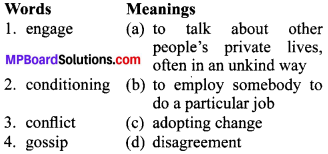
MP Board Class 10th General English Essay Writing

Are you seeking for the Madhya Pradesh Board Solutions 10th General English Writing Skills Essay Writing Questions and Answers PDF? If yes, then read this entire page. Here, we are giving a direct link to download MP Board Class 10th English Solutions Questions and Answers PDF which contains the chapter wise questions, solutions, and grammar topics. You can also get the shortcuts to solve the grammar related questions on this page.

MP Board Class 10th General English Essay Writing

For the sake of students we have gathered the complete 10th General English Writing Skills Essay Writing Questions and Answers can provided in pdf Pattern. Refer the chapter wise MP Board Class 10th English Solutions Questions and Answers Topics and start the preparation. You can estimate the importance of each chapter, find important English grammar concepts which are having more weightage. Concentrate on the important grammar topics from Madhya Pradesh Board Solutions for 10th English Essay Writing Questions and Answers PDF, prepare well for the exam.

1. My Ambition in Life

Introduction : Every person has some ambition 1 or the other in his life. ‘Where there is a will, there is a way’—so goes the saying.ust to have an ambition is not enough—there must be a strong effort to fulfil the ambition. Some may have an ambition to become a rich businessman, some an engineer, some a farmer ! and so on.

My Ambition : My ambition is to become a doctor. In my opinion it is a noble profession. It is the most challenging of all the professions. It is a twenty-four hourob. A doctor may have to attend ; an emergency call at 2 a. m. For this he may have to sacrifice his sleep and sometimes his food and rest too.

Reasons for My Ambition : I have a sensitive heart to feel other people’s sufferings. This inspires me to try to become a doctor. An inner voice directs me to serve the poor and the sick like Mother Teresa. I Thousands of people die in our villagesust because ! there are no doctors and medicines there. I prefer to work in a small villager rather than in a big city. I will not take any fee from the poor patients. Giving some service to a needy person brings satisfaction which is more precious than all the wealth of the world. I have experienced this when I gave my blood to a sick i child last year. His mother gave me the blessings that still keeps my heart warm.

My Efforts : To become a doctor I have opted ! science and biology. I study books on physiology and human anatomy which are not in my present 1 syllabus. I try to solve C.P.M.T. question papers. I have some scientific apparatus, dissection box etc. I do some experiments and dissect frogs etc. at home.

Conclusion : I feel that I have at least some qualities that are necessary for becoming a doctor. I hope to acquire other qualities soon. Moreover the blessings of my parents and good wishes of my teachers and friends will fulfil my ambition.

2. A Visit to a Historical Place

Introduction : Books give us only second and third-hand knowledge. It is said ‘Seeing is believing’. So to have a good knowledge of a thing, it is necessary to see it. Our school organized a historical tour of Agra last year.

We reached Agra at 7 p.m. by the express. Our history teacher had booked six rooms in the Govt. Tourist Bungalow in advance. We took dinner. Our teacher told us the programme of the next day. He also told us about the historical monuments of Agra.

Visit to the TaMahal etc : Next day first of all we visited the TaMahal. It was built by a Mughal emperor Shahahan in memory of his beloved queen Mumtaz Mahal. It is made of white marble. People say that it is beautiful but I see cruelty in its so-called beauty. The cruel Shahahan had cut the hands of the craftsmen who built the TaMahal. A famous Urdu poet has rightly said—Ek Shahanshah ne banwa ke hansi TaMahal, ham Garibon ki muhabbat ka udyaya hai majak.

Then we visited the Red Fort, Sikandara and Soamibagh, Dayalbagh. The magnificent Red Fort was built by Akbar the Great. Soamibagh is the Samadhi of Soamiji Maharaj, the founder-guru of Radhasoami Faith.

Conclusion : Next day we visited the Fatehpur Sikri. It is also built by Akbar. The two-day visit to Agra gave us real knowledge of the historical monuments.

3. My Favourite Leader

Introduction : A country is great because of her great leaders. We are fortunate that our motherland has given birth to hundreds of great leaders—Gautam Buddha, Ashoka the Great, Akbar the Great, Rani Laxmi Bai, Mahatma Gandhi, Subhash Chandra Bose, Nehru, Indira Gandhi etc. My Favourite leader is Indira Gandhi.

Indira’s Childhood : Indira was bom on November 19, 1917 at Anand Bhawan in Allahabad. Politics, patriotism, bravery and leadership were in her blood as she was the daughter of Jawaharlal Nehru. She had guidance of Gandhiji. She had formed a children’s brigade ‘Vanarsena’. It helped the Satyagrahis by giving them important messages, food etc. She was educated at Poona, Shanti Niketan, Oxford etc. But her education was often interrupted by her mother’s illness. At Anand Bhawan important political meetings were held. So she was brought up in a political and patriotic environment.

Her Informal Training in Leadership : Indira married Feroz Gandhi in 1942. Both took active part in the freedom movement. After the independence, her father Jawaharlal Nehru became the first Prime Minister of free India. She used to accompany her father to international conferences and meetings. She had an opportunity to meet the world leaders. Thus she had an informal training in leadership.

Her Political Career : She was elected President of the Indian National Congress in 1959. In Lai Bahadur Shastri’s Cabinet she became a Union Cabinet Minister. After Lai Bahadur Shastri’s death she became the first woman Prime Minister of India onanuary 24, 1966. She remained the Prime Minister till her death on October 31,1984 except for three years from 1977 to 1980. She was awarded the Bharat Ratna for her patriotism.

4. My Favourite Teacher
Or
The Person I Like Most

Introduction : The place of a teacher is very high in Indian culture—higher than God. The Saint poet Kabir has placed him higher than God in this famous couplet—‘Guru Gobind Dou Khare But real teachers are very rare. am fortunate that I have been a student of Sri Govind Sharma, our English Teacher and I like him the most.

His Personality : He is about thirty years. He is quite handsome and smart. He is our class teacher too. He has been teaching me for last four years. He has simple living but high thinking.

Teaching Method : His teaching method is so interesting that even a weak student understands his lessons. He uses audio-visual aids like Linguaphone, films, charts etc. in teaching English.

His Qualities : He is very punctual. He never comes late to school. Sometimes he takes extra classes on our request. He is always ready to help the students. Mr. Sharma treats us as his younger brothers. We also love and respect him. He plays football and cricket with us. He is very good at batting. He writes Hindi poems and stories. Last year he was honoured with State Award for his excellent teaching.

Conclusion : He says that real education is notust learning the value of money and reading books, but it is a good behaviour. One should become a real man full of human qualities. He does what he says. He is a real human being, full of love and sympathy for others. I wish him a long and happy life.

5. Pollution

Introduction: Albert Einstein once said, “There are two things that have no limit—first is God’s universe and second is man’s follies.” Pollution comes in the second thing, i.e., in man’s follies. It is a byproduct of scientific and industrial progress. Man went on racing blindly and thoughtlessly towards materialistic progress. He did not care to pause for a while whether his mad rat race might lead him to self-destruction. Most of the so-called boons of science proved to be curses in disguise, vehicles, roaring machines, disposable things—all have caused air, noise and water pollution. As a bad result of several inventions, the hole in the ozone sphere is growing bigger and bigger. It is feared that the earth temperature will increase causing terrible floods.

Causes : Today the scientists and the statesman of developed nations are worried about the pollution problem. There are several causes of pollution problem. Cars, buses and trucks release poisonous gases which cause air pollution. They are responsible for noise pollution too. The smoke of factories makes air polluted.

Noise Pollution: Loudspeakers, shriekinghoms of vehicles, aeroplanes—all fill the environment with deafening noise. Social and religious ceremonies like birthday parties, marriages, Akhand Kirtans— all are bound to create loud music, which has less music and more noise.
Water Pollution : Industrial refuse of textile industries and chemical industries are dumped into rivers. This makes water dirty and many fishes die. Death of fish further pollutes water. Many ships loaded with refuse are floating on seaust because they can neither be emptied nor the refuse can be destroyed without polluting air and water.

Effects : Pollution results in fatal diseases like cancer, high blood pressure, sleeplessness, asthma, deafness etc. Due to noise pollution students find it difficult to concentrate on studies. The old and the sick cannot have sould sleep because of loud noise. Water pollution causes water-borne diseases like cholera.

Remedy : It is high time to check pollution. Vehicles must be checked for pollution. More pollution causing old vehicles must be totally banned. Pollution Control Board Laws must be strictly implemented. Greed and desire for more wealth and material comforts are the real villain. Perhaps our ancient philosophy of witlessness is the real remedy.

6. My Hobby

Introduction : Hobby means some work done in free time. When a man gets time after doing his routine work, he wants to enjoy. At this time if he does some different work, it is called his hobby. Hobbies are many such as painting, playing on some instruments, photography, stamp-collecting, gardening etc.

My Hobby—My hobby is gardening. I think it is the best hobby. Plants and trees are very useful for our life. They not only provide us food to eat, but also serve us in many ways. They make the air fresh and cool for us. They check the air pollution also. Plants give us flowers. Trees give us fruits to eat and wood to bum. So I like trees and plants very much.

My Garden : There is no ground around our house. So I have planted several kinds of flowers in flower pots. I love flowers very much. I water the plants and care for them. I bring small plants from the nursery. I prepare the flower pots and then cultivate the plants. I give fertilizer to them. When buds appear, it gives me great pleasure. I wait for their blossoming into beautiful flowers. Sometimes when I get up in the morning and see the flowers myoy knows no bounds. My parents and other family members too become very happy to see them. Guests coming to our home appreciate my hobby.

Conclusion : Sometimes we sit in our small garden and do our home work or take tea and breakfast. It gives us greatoy. My mind becomes sharp and my memory is increased in the company of flowers. Sometimes I see flowers in my dream and my heart is filled with pleasure.

7. My Mother

Introduction : ‘A hand that rocks the cradle rules the world.’ The above saying holds true as a child is only a mother’s reflection. ‘Mother’ or ‘mama’ the first word spoken by a child holds in itself the essence of love and care.

We can’t compare the relation of a mother with any other relation. Mother not only gives us birth but she brings us up as well, looks after us and gives all her attention to our well-being. She does many sacrifices for us.

My mother : My mother Mrs. Pramila Devi is an ideal mother. She is a symbol of love and sacrifice. She gets up early in the morning and works late till night. She keeps the home neat and clean. When I get up she gives me warm water to wash my mouth. She gives me hot tea to drink. She prepares food with keen interest. The food is tasty to eat. She pays attention to all my needs.

Education and Other qualities : My mother is B.A. She has a good knowledge of several subjects especially of Hindi and English. She possesses a great experience of many arts. She knows knitting and sewing well. She instructs us in other fields too. My mother is religious. She worships God daily without fail.

Social side of my mother: My mother has good ; relations with our neighbours. She helps them at the time of their troubles. My mother helps the poor and the needy. She takes part in various social activities. She is a member of the Woman Organisation for helping the weaker sections of the society.

8. An Indian Festival
Or
Diwali

Introduction : Diwali is an important festival of Hindus. It often comes in the month of October or ; November every year. It is celebrated in the memory i of Lord Ram’s return to Ayodhya after 14 years of I exile. The people of Ayodhya welcomed Lord Ram graciously. They decorated their homes with flowers ; and lighted earthen lamps before their houses. Diwali is a rememberance of that day.

Preparations : Several days before people start preparing for this festival. They clean their houses and whitewash them. The merchants paint their shops and set them. The market gets a new look.

How Celebrated : People buy new clothes and new dresses. They buy many things for this festival. Children buy crackers. Ladies buy sarees and material for preparing sweets. People give presents to friends and relatives. Main days of celebration of Diwali are three—‘Dhan Teras’, ‘Roop Chaudas’ and ‘Diwali’ on Amavasya day. In the evening ladies and children bum candle and lamps. Many electric bulbs of several colours are also lighted.

Worship of Goddess Laxmi : On Diwali day people worship Goddess Laxmi. They pray her for health, wealth and happiness for the whole year. The rich and poor enjoy Diwali. Diwali also marks the end of the year.

Importance : Diwali is an all India festival. People of all parts of India and all communities celebrate it. It is a festival of national importance. It promotes national unity also.

For All People : All age groups of people enjoy the celebration of Diwali. The rich and the poor all celebrate it as per their capacity.

Conclusion : Some people gamble and drink wine. Some are injured at the time of bursting crackers due to carelessness. However, Diwali brings happiness to every home in India.

9. ’ Importance of Newspapers
Newspapers are the world’s mirrors.

—James Ellis

Introduction : The word News is made up of four letters N, E, W, and S. Each letter symbolises one direction. N stands for North, E for East, W for West and S for South. Hence, a newspaper is a paper that contains news of all directions—North, South, East and West.

A newspaper collects information about happenings in the world through news agencies and prints them on paper.

Contents of a Newspaper : A newspaper contains political, social, economical, religious and several other kinds of news. Everybody finds something of his/her interest in it. Children, young persons as well as old persons find newspaper interesting. There is a column for market report exhibiting wholesale prices of a lot of articles of daily use and quoting market value of shares and stocks of leading concerns. So a man of business is also interested in it. Art, music, entertainment, games, general knowledge and all such things are there in a newspaper.

There are advertisement of various kinds in the newspapers. They inform us about new and useful inventions. They are a source of income for the newspapers. Advertisements concerning matrimonial alliance provide immense relief to parents in choosing consorts for their sons or daughters. Assorted advertisements provide a deep relief to people of different sorts. Only because of these advertisments we get a newspaper within our reach price.

Importance of Newspapers : Newspapers guide and teach us. They try to educate and shape public opinion. They are necessary for a democratic society. They express the views of the public in a free and fearless manner. Most of us are too busy to think of the great problems of our country, so we rely upon the newspaper and accept the view they present to us. We can also express our views under the column ‘Letters to the Editor’.

Conclusion : Newspaper is a powerful weapon. It is a measuring rod to determine the length of democracy in a country. And as such it should be handled carefully. Rumours and sensational news create a nasty atmosphere. Newspapers must present constructive and objective .matter before their readers. They should not misuse freedom given to the press. Their criticism should not be biased. They should be impartial in their news and views.

10. Wonders of Science
Or
Science is a Good Servant
But a Bad Master

Introduction : It is the age of science. Science plays an important role in our life. It has made our life easier and comfortable. Science is a systematic way of knowledge and living.

Scientific Wonders : Science has given us many wonderful gifts. The various inventions of science are its wonders. We cannot imagine our life without science.

Various Inventions : Electricity is the most useful gift of science. It gives us light. Heaters, fans, coolers, refrigerators, computers etc., all work by electricity. It also runs machines and trains.

Medicines and Surgery : Science has given wonderful medicines. Vaccination helps us in preventing diseases like polio, cholera, small pox etc. It has brought down the death rate. Modem surgical equipment have made operations less painful.

Means of Communication : Today we amuse ourselves by watching television and listening to music on radio and tape recorder. Television has become a powerful medium of education and knowledge. UGC and IGNOU lessons on televisions are very useful. Fast means of transport and communication help us to reach distant places in a short time.

Computers: Scientists have invented computer. It is a wonderful invention. Computers can do complex calculations and work quickly. They have solved a lot of problems of man.

Disadvantages of Science : Everything has two sides. Science too has a dark side. The invention and production of atom bombs and other dangerous weapons are a great threat to the existence of humanity. They can destroy the world in seconds. Secondly, big factories, mills and other machines have polluted the atmosphere.

Conclusion : Science is a great help to modem man. If properly used it can make the life of man healthier and happier.

Hope that the above shaped information regarding the Madhya Pradesh Board Solutions for 10th English Essay Writing Questions and Answers is useful for making your preparation effective. View our website regularly to get other subjects solutions.
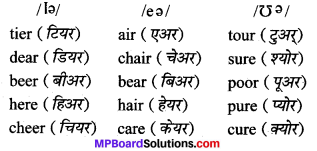
MP Board Class 10th General English Writing Task

Are you seeking for the Madhya Pradesh Board Solutions 10th General English Writing Skills Writing Task Questions and Answers PDF? If yes, then read this entire page. Here, we are giving a direct link to download MP Board Class 10th English Solutions Questions and Answers PDF which contains the chapter wise questions, solutions, and grammar topics. You can also get the shortcuts to solve the grammar related questions on this page.

MP Board Class 10th General English Writing Task (Based on Verbal / Visual Stimulus)

For the sake of students we have gathered the complete 10th General English Writing Skills Writing Task Questions and Answers can provided in pdf Pattern. Refer the chapter wise MP Board Class 10th English Solutions Questions and Answers Topics and start the preparation. You can estimate the importance of each chapter, find important English grammar concepts which are having more weightage. Concentrate on the important grammar topics from Madhya Pradesh Board Solutions for 10th English Writing Task Questions and Answers PDF, prepare well for the exam.

You will be given some points (verbal stimulus) or a-picture (visual stimulus) and will be asked to compose a short report, an article, a speech or description of about 80 words.

Verbal Stimulus

On the basis of the points given write para-graphs of about 80 words on the given topics.

1. God helps those who help themselves
A true saying ‘God helps those who help themselves’, expects to use our powers, given power to improve our lives, of community and country, more active are more successful, one should be independent for the country to progress.
Answer:
There is a saying which has a great deal of truth in it. It is “God helps those who help themselves.” And it is very true that God expects us to use all our powers. He has given us the power to improve our own lives, the life of the community and the life of our country. The more active we are in using our powers and talents the more likely we are to be successful in accomplishing our aims. We .should stand on our own legs and be independent if we really wish our country to progress.

2. Beware of False Friends
Forest, two travellers, meet bear, one climbs a tree, the other lies down as if dead, bear smells his head, goes away, first traveller ask what bear said, “Beware of friends who run away in danger. ”
Answer:
Ram and Shyam were once going through a forest. Shyam said to Ram, “Never fear ! No beast can harm you as long as I am with you”.

Just then they saw a bear coming towards them. Shyam climbed the nearest tree without caring for Ram. Ram (ay down on the ground as if dead. The bear smelt his head and went away.

Coming down Shyam asked Ram what the bear had said. Ram said, “Beware of false friends.”

3. Work and Play
Work and play-complements, each incomplete without other, sayings all works and nb play and all working days, holidays to play difficult like work, suitable admixture to be aimed in school, play also important part in education.
Answer:
Work and play are the complements of each other. In fact each is incomplete without the other. ‘Alt work and no play makesack a dull boy’ is true to the core, but the contrary, “if all working days had beeh holidays to play would have been as difficult as to work” holds equally good. Hence a suitable admixture, a due proportion of both is what should be aimed at in a school. For there is no denying the fact that play plays no less important a part in a child’s education than work.

4. Unemployment Problem
Unemployment problem-problem of providing work to the willing, capable people roam about for work, its involuntary joblessness, problem acute in our country, lives of unemployed are miserable, country cannot be a welfare state if the problem is unsolved.
Answer:
The problem of unemployment means the problem of providing work to those who are willing to work. A large number of educated and uneducated people, who are capable of work and are also willing to do it, roam here and there without anyone. So the problem of unemployment is involuntary joblessness. In our country this problem has assumed a large and acute form. There are a large number of pepole who are either partly employed or’ by holly unemployed. The lives of such people as weft as of their families are extremely miserable. India cannot claim to be a welfare state as long as this problem remains unsolved.

5. Cleanliness
Cleanliness consists in keeping everything clean, practised by all civilized nations, indispensable for 1 health, clean clothes and food save from diseases, next to godliness.
Answer:
Cleanliness consists in keeping our bodies, our clothes, our food and articles of daily use and the surroundings of our house clean and free from filth and impurities. Cleanliness is practised not by this nation or that, but by all civilized nations of the world. For the preservation of health, cleanliness is indispensable. Clean clothes and pure and clean food save a man from the attack of diseases which dirty clothes and impure food bring about. Cleanliness is next to godliness.

Visual Stimulus

1. See the following picture and write a passage on it.
MP Board Class 10th General English Writing Task 1
Answer:
Once a man saw a pigeon whose excreta turned into gold. He thought of capturing it and became successful in it. But then he thought that if the king came to know about it he would punish him. Therefore he decided to present it to the king. He told the king about its quality and gave it to him. The king was first surprised and then pleased to have it. He rewarded the man for giving him this special gift.

2. See the following picture and write a passage on it.
MP Board Class 10th General English Writing Task 2
Answer:
A rich merchant had four sons. When the merchant became old his three elder sons took over his business and thinking him to be useless threw him out of their house. The youngest son took care of him and started a small business by selling his father’s gold chain. By the help of his father’s experience, he became rich very soon while the other three sons being inexperienced had great losses. They, therefore, came back to take their father with them and joined hands before him. But the merchant disagreed to go with them.

3. Write a short paragraph on the table given below :

RiverLength (km)
Sindhu2,900
Brahmaputra2,900
Ganga2,510
Godavari1,450
Narmada1,290
Krishna1,290
Mahanadi890
Kaveri760

Answer:
Some Major Rivers of India
India is a country full of natural wealth. There are a lot of rivers in India. Hardly there is any other nation in the world that can boast of having so many rivers.

In the above table, the name of main rivers of India along with their lengths in kilometre are given. There are eight major rivers in India among which the length of three exceeds two thousand kilometres while the length of other three is above one thousand kilometres. From the table it is also clear that the rivers Sindhu and Brahmaputra are longest rives of India with a length of2,900 km and river Kaveri with a length of 760 km is the smallest river. Also, the famous holy river Ganga is the second-longest river of India with a length of 2,510 km.

4. Read the following flow chart describing the preparation of tea. Write a suitable paragraph with its help.
MP Board Class 10th General English Writing Task 3
Answer:
Preparation of Tea
Take some water in a pan. Switch on the gas by opening its knob and light it. Heat the pan. Now add some tea to water and boil it. Now add some milk to it. Add sugar to Laste while letting it boil. Finally. switch off the gas and serve.

5. See the following picture and write a paragraph on it.
MP Board Class 10th General English Writing Task 4
Answer:
Mahatma Gandhi or Mohandas Karam Chand Gandhi was born on 2nd October, 1869 at Porbandar in Gujarat. He fought for India’s independence using principles of non-violence and Ahimsa. Apart from making India free he worked for the. unity of Hindus and Muslims. He was against untouchability and loved Harijans and the poor. He helped all. So was called Mahatma Gandhi. He was also called ‘Bapu’ and ‘Father of the Nation.’ He was shot dead by Nathuram Godse on 30anuary, 1948.

6. Given below is a graph showing time spent on watching T.V. and on reading in an Indian family. Write a short paragraph emphasizing the need to promote reading.
MP Board Class 10th General English Writing Task 5
Answer:
Declining Trend in Book Reading
Reading of books is very useful and important work. It is a life-long source of pleasure, instruction and inspiration. Before the coming of T.V. people spent a great part of their time in reading. Since T.V. started, hours spent in reading has declined. The graph depicts these facts. Before 1980 there was no countrywide T.V. Hence people devoted in an average about 8 hours on reading. In 1985 watching of T.V. took about 3 hours while reading declined to 6 hours. In 1990, people spent about 12 hours in watching T.V. and reading came down to 5 hours. In 1995, reading further declined to 3 hours and I watching T.V took about 14 hours. In the year 2000, I people spent an average of more than 18 hours on watching T.V. while reading has almost come down to 2 hours. It is a sad phenomenon because watching T.V. only entertains us, it instructs less while reading provides, both “instruction and delight.”

Hope that the above shaped information regarding the Madhya Pradesh Board Solutions for 10th English Writing Task Questions and Answers is useful for making your preparation effective. View our website regularly to get other subjects solutions.
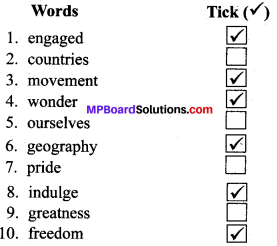
MP Board Class 10th General English The Spring Blossom Solutions Chapter 12 Maharana Pratap

Are you seeking for the Madhya Pradesh Board Solutions 10th General English The Spring Blossom Solutions Chapter 12 Maharana Pratap Questions and Answers PDF? If yes, then read this entire page. Here, we are giving a direct link to download MP Board Class 10th English Solutions Questions and Answers PDF which contains the chapter wise questions, solutions, and grammar topics. You can also get the shortcuts to solve the grammar related questions on this page.

MP Board Class 10th General English The Spring Blossom Solutions Chapter 12 Maharana Pratap

For the sake of students we have gathered the complete 10th General English The Spring Blossom Solutions Chapter 12 Maharana Pratap Questions and Answers can provided in pdf Pattern. Refer the chapter wise MP Board Class 10th English Solutions Questions and Answers Topics and start the preparation. You can estimate the importance of each chapter, find important English grammar concepts which are having more weightage. Concentrate on the important grammar topics from Madhya Pradesh Board Solutions for 10th English Chapter 12 Maharana Pratap Questions and Answers PDF, prepare well for the exam.

Maharana Pratap Textual Exercises

Word Power

A. Pick out the correct meanings of the given words.
1. vehement
(a) possessing strong ideas
(b) showing very strong feelings
(c) fearless and dashing
(d) innocent and lovable.
Answer:
(b) showing very strong feelings

2. shepherd
(a) a person whose job is to take care of sheep
(b) a farmer who works in the fields
(c) one who works on a ship
(d) one, who supplies milk to others
Answer:
(a) a person whose job is to take care of sheep

3. noble
(a) very kind and polite
(b) a very famous drug
(c) having fine personal qualities the people admire
(d) the prestigious prize for literature and other areas
Answer:
(c) having fine personal qualities the people admire

4. pilgrimage
(a) a journey to a holy place for religious reasons
(b) a building with many pillars
(c) a voyage to the world
(d) a long drive
Answer:
(a) a journey to a holy place for religious reasons

5. ancestor
(a) a very ancient building
(b) a ruler in the past time
(c) one who studies the history of ancient heroes
(d) a person in your family who lived a long time ago
Answer:
(d) a person in your family who lived a long time ago

B. Use the following words in your own sentences.
Answer:

  1. rally – Members took out a larger rally in their party’s support.
  2. generous – We should be generous with our friends.
  3. ruin – Untimely rain has ruined the crops.
  4. emblem – Indian currency contains its national emblem.
  5. shrewd – Rohan had a shrewd look.

How Much Have I Understood?

A. Answer these questions. (One or two sentences)
(निम्न प्रश्नों के उत्तर एक या दो वाक्यों में दीजिए।)

Question 1.
Where did Pratap Singh encamp?
(व्हेयर डिड प्रताप सिंह एनकैम्प?)
प्रताप सिंह ने कहाँ पड़ाव डाला?
Answer:
Pratap Singh encamped at the foot of the Aravallis.
(प्रताप सिंह एन्कैम्प्ट एट द फुट ऑफ द अरावलीज़।)
प्रतापसिंह ने अरावली पर्वत के नीचे पड़ाव डाला।

Question 2.
What did Pratap Singh say to his son about Mewar?
(व्हॉट डिड प्रताप सिंह से टू हिज़ सन अबाऊट मेवाड़?)
प्रताप सिंह ने अपने बेटे से मेवाड़ के बारे में क्या कहा?
Answer:
Pratap Singh said to his son Prince Amar about Mewar to see his land for the last time and then turn his eyes towards exile.
(प्रताप सिंह सेड डू हिज़ सन प्रिन्स अमर अबाऊट मेवाड़ टू सी हिज़ लैण्ड फॉर द लास्ट टाइम एण्ड देन टर्न हिज़ आईज़ टुवर्ड्स एग्ज़ाइल।)
प्रताप सिंह ने अपने पुत्र राजकुमार अमर से कहा कि वह अपनी भूमि मेवाड़ को आखिरी बार देख लें व फिर निर्वासित हो जायें।

Question 3.
Who came to meet Pratap Singh in the disguise of Brahmins?
(हू केम टू मीट प्रताप सिंह इन द डिसगाइज़ ऑफ ब्रैहमिन्स?)
प्रताप सिंह से ब्राह्मण के वेश में कौन मिलने आया?
Answer:
Bhama Sah came to meet Pratap Singh in the disguise of Brahmins.
(भामा साह केम टू मीट प्रताप सिंह इन द डिस्माईज़ ऑफ ब्रैहमिन्स।)
भामा साह प्रताप सिंह से ब्राह्मण के वेश में मिलने आये।

Question 4.
Who was Bhama Sah?
(हू वॉज़ भामा साह?)
भामा साह कौन थे?
Answer:
Bhama Sah was the chief advisor and the Chief Minister of Rana Pratap. He was a very rich man.
(भामा साह वॉज़ द चीफ एडवाइज़र एण्ड द चीफ मिनिस्टर ऑफ राणा प्रताप। ही वॉज़ अ वेरी रिच मैन।)
भामा साह राणा प्रताप के मुख्य सलाहकार व मुख्यमन्त्री थे। वे काफी अमीर व्यक्ति थे।

Question 5.
What did Bhama Sah bring?
(व्हॉट डिड भामा साह ब्रिग?)
भामा साह क्या लाये?
Answer:
Bhama Sah had brought all his wealth in the form of gold that he had hoarded for many years.
(भामा साह हैड ब्रॉट ऑल हिज़ वेल्थ इन द फॉर्म ऑफ गोल्ड दैट ही हैड होर्डेड फॉर मैनी ईयर्स।)
भामा साह अपनी सारी दौलत सोने के रूप में जो कि उन्होंने कई वर्षों में इकट्ठा की थी, लाये थे।

Question 6.
Why did Bhama Sah travel as a pilgrim?
(व्हाय डिड भामा साह ट्रैवल एज़ अ पिलग्रिम?)
भामा साह तीर्थयात्री की तरह क्यों सफर कर रहे थे?
Answer:
Bhama Sah travelled as a pilgrim to prevent his identity from the Moghuls on the way.
(भामा साह ट्रेवल्ड एज अ पिलग्रिम टू प्रिवेन्ट हिज़ आइडेन्टिटी फ्रॉम द मुगल्स ऑन द वे।)
भामा साह तीर्थयात्री की तरह मुगलों से बचने के लिए सफर कर रहे थे।

Question 7.
What was Pratap Singh’s reaction after listening to Bhama Sah’s views?
(व्हॉट वॉज़ प्रताप सिंहज़ रिएक्शन आफ्टर लिसनिंग टू भामा साहज़ व्यूज?)
भामा साह के विचार जानने के बाद प्रताप सिंह की क्या प्रतिक्रिया थी?
Answer:
Pratap Singh was delighted to hear Bhama Sah’s views. He said that he had not felt that much joy since he became Mewar’s ruler.
(प्रताप सिंह वॉज़ डिलाइटेड टू हिअर् भामा साहज़ व्यूज़। ही सेड दैट ही हैड नॉट फेल्ट दैट मच जॉय सिन्स ही बिकेम मेवाड्ज़ रूलर।)
प्रताप सिंह भामा साह के विचारों को जानकर बहुत खुश हुए। उन्होंने कहा कि उन्हें इतनी खुशी मेवाड़ का राजा बनने के बाद पहली बार हुई है।

Question 8.
What title did Pratap Singh give to Bhama Sah?
(व्हॉट टाइट्ल् डिड प्रताप सिंह गिव टू भामा साह?)
प्रताप सिंह ने भामा साह को कौन-सा खिताब दिया?
Answer:
Pratap Singh called Bhama Sah as saviour of Mewar.
(प्रताप सिंह कॉल्ड् भामा साह एज सेविअर ऑफ मेवाड़।)
प्रताप सिंह ने भामा साह को मेवाड़ का रक्षक कहा।

B. Answer these questions. (Three or four sentences)
(निम्न प्रश्नों के उत्तर तीन या चार वाक्यों में दीजिए।)

Question 1.
Describe the thoughts of Bhama Sah about his motherland.
(डिस्क्राइब द थॉट्स् ऑफ भामा साह अबाऊट हिज़ मदरलैण्ड।)
भामा साह के अपनी माँ के बारे में विचारों का वर्णन कीजिए।
Answer:
Bhama Sah said that in Mewar there was grand and generous rule of Rajputs. There was great prosperity and tax was not levied by Rana over them in any case of need or hardship.
(भामा साह सेड दैट इन मेवाड़ देयर वॉज़ ग्रैण्ड एण्ड जेनरस रूल ऑफ राजपूत्स। देयर वॉज़ ग्रेट प्रॉस्पेरिटी एण्ड टैक्स वॉज़ नॉट लेवीड बाइ राणा ओवर देम इन एनी केस ऑफ नीड और हार्डशिप।)
भामा साह ने कहा कि मेवाड़ में राजपूतों का भव्य व उदार शासन था। वहाँ बहुत समृद्धता थी व राणा ने उन पर किसी भी जरूरत व परेशानी के समय कर नहीं लगाया।

Question 2.
Why did Pratap Singh call Bhama Sah the ‘Saviour of Mewar’?
(व्हाय डिड प्रताप सिंह कॉल भामा साह द ‘सेवियर ऑफ मेवाड़’?)
प्रताप सिंह ने भामा साह को मेवाड़ का रक्षक’ क्यों कहां?
Answer:
Pratap Singh called Bhama Sah the Saviour of Mewar’ because he had offered all his wealth to him for feeding and arming his army, so that he may not go into exile and retain Mewar. It would, therefore, be because of him that Mewar would be saved from Moguls.

(प्रताप सिंह कॉल्ड भामा साह द ‘सेवियर ऑफ मेवाड़’ बिकॉज़ ही हैड ऑफर्ड ऑल हिज़ वैल्थ टू हिम फॉर फीडिंग एण्ड आर्मिंग हिज़ आर्मी, सो दैट ही मे नॉट गो इन्टू एग्ज़ाइल एण्ड रिटेन मेवाड़। इट वुड, देयरफोर बी बिकॉज़ ऑफ हिम दैट मेवाड़ वुड बी सेव्ड फ्रॉम मुगल्स।)

प्रताप सिंह ने भामा साह को ‘मेवाड़ का रक्षक’ कहा क्योंकि उसने अपनी सारी दौलत उसे अपनी सेना को पालने व शस्त्रित करने में लगा दी थी जिससे कि वह निष्कासित न होकर मेवाड़ को वापस ले। अतः उसी की वजह से मेवाड़ की मुगलों से रक्षा होगी।

Question 3.
How did Rao Sakta react for Bhama Sah?
(हाउ डिड राउ सक्ता रिएक्ट फॉर भामा साह?)
भामा साह के लिए राउ सक्ता की क्या प्रतिक्रिया थी?)
Answer:
Rao Sakta on seeing Bhama Sah’s contribution for Mewar said that if Akbar knew it he would have bartered half on his captains for getting one Bhama Sah. A renowned person such as Raja Birbal was just a shadow of shrewd Bhama Sah.

(राउ सक्ता ऑन सीइंग भामा साहज़ कॉन्ट्रिब्यूशन फॉर मेवाड़ सेड दैट इफ अकबर न्यू इट ही वुड हैव बार्टर्ड हाफ ऑफ हिज़ कैप्टेन्स फॉर गेटिंग वन भामा साह। अ रिनाउन्ड पर्सन सच एज राजा बीरबल वॉज़ जस्ट अ शैडो ऑफ श्रूड भामा साह।)

‘राव सक्ता ने भामा साह का मेवाड़ के लिए योगदान देखकर कहा कि अगर अकबर यह जानता तो वो अपने आधे सिपाही एक भामा साह को पाने के लिए दे देता। राजा बीरबल जैसा लोकप्रिय व्यक्ति भी चतुर भामा साह की बस परछाईं है।

Question 4.
Describe the qualities of Maharana Pratap.
(डिस्क्राइब द क्वॉलिटीज़ ऑफ महाराणा प्रताप।)
महाराणा प्रताप के गुणों का वर्णन कीजिए।
Answer:
Maharana Pratap was a brave and patriotic Rajput with love for his motherland. He was an egoistic but responsible person. He could have finished himself instead of going into exile but for the sake of his family’s responsibility he struggles and survives.

(महाराणा प्रताप वॉज़ अ ब्रेव एण्ड पेट्रिऑटिक राजपूत विद लव फॉर हिज़ मदरलैण्ड। ही वॉज़ इन ईगोइस्टिक बट रिस्पॉन्सिबल पर्सन। ही कड हैव फिनिश्ड हिमसेल्फ इन्स्टैड ऑफ गोइंग इन्टू एग्ज़ाइल बट फॉर द सेक ऑफ हिज़ फैमिलीज़ रिस्पॉन्सिबिलिटी ही स्ट्रगल्स एण्ड सरवाइव्स।)

महाराणा प्रताप एक बहादुर व देशभक्त राजपूत थे जो अपनी मातृभूमि से प्रेम करते थे। वे स्वामिभानी मगर जिम्मेदार व्यक्ति थे। उन्होंने निष्कासन में जाने के बजाय आत्महत्या कर ली होती मगर अपने परिवार के लिए वे जीवित रहते हैं व संघर्ष करते हैं।

Language Practice

A. Underline the Noun Clauses in the following sentences.
(Noun Clauses को रेखांकित करिए।)
Answer:

  1. A teacher always thinks how his students are preparing for the examination.
  2. I do not know what she will sing at the annual function.
  3. The postman knows everybody where he/she lives.
  4. Harish told me that he would come late.
  5. Do you know when Mahatma Gandhi was born?

B. Combine the pairs of sentences using a suitable conjunction.
(निम्न वाक्यों को जोड़िए)

Question 1.
Razia wants to know:
What did Sheela want?
Answer:
Razia wants to know what Sheela wanted.

Question 2.
I believed.
He was a true friend.
Answer:
I believed that he was a true friend.

Question 3.
Rajesh does not know.
He can solve the problems.
Answer:
Rajesh does not know that he can solve the problems.

Question 4.
Do you know?
When will the bus arrive here?
Answer:
Do you know when the bus will arrive here?

Question 5.
Can you tell me?
What was the result of the match?
Answer:
Can you tell me what was the result of the match?

Question 6.
It is a mystery.
Why did she leave the hall?
Answer:
It is a mystery why she left the hall

Listening Time

The teacher will read aloud the following words with proper pronunciation and students will repeat them.
(निम्न लिखित को पूरा कीजिए।)
Answer:
MP Board Class 10th General English The Spring Blossom Solutions Chapter 12 Maharana Pratap 1

Speaking Time

Talk to your friends about the given calendar. Students should ask some questions based upon the calendar.
(पुस्तक में दी गई समय सारणी देखकर छात्र आपस में एक- दूसरे से सवाल करें।)
Answer:
Students can talk among themselves seeing the given calendar.
(छात्र आपस में स्वयं बात करें।)

Writing Time

Question 1.
Write the character sketch of Rana Pratap in not more than 100 words.
(राणा प्रताप का चरित्र-चरित्र 100 शब्दों में लिखिए)
Answer:
Rana Pratap was a brave Rajput with great patriotic feeling for his kingdom Mewar. He was an egoistic but responsible person. He knew his responsibility towards his family. That is why instead of ending his life he thinks of becoming even a shepherd. He was generous and humble even when a ruler. He was also full of gratitude for the contribution of Bhama Sah. He agreed to take money from him because he wanted to free his land from the Moghuls otherwise he was not greedy of money as he never imposed any tax on him during his rule.

Question 2.
Write a paragraph about Bhama Sah in not more than 50 words.
(भामा सह के में 50 शब्दों में एक गधांश लिखिए)
Answer:
Bhama Sah, the Chief Minister and chief advisor of Rana Pratap was a symbol of sacrifice and love for one’s motherland. He willingly gave away all the wealth that he had earned throughout his life for the sake of freedom of Mewar and for struggling Rana Pratap in exile. He was a brave and intelligent person as he reached Rana Pratap in disguise of a pilgrim taking the risk of his life and passes the Moghuls on the way without getting caught.

Things to do

Make a list of some Indian freedom fighters.
(भारतीय स्वतन्त्रता सेनानियों की सूची बनाओ।)
Answer:
Bhagat Singh, Sukhdev, Rajguru, Mahatma Gandhi, Subhash Chandra Bose, Jawaharlal Nehru, Chandrashekhar.

Maharana Pratap Difficult Word Meanings

MP Board Class 10th General English The Spring Blossom Solutions Chapter 12 Maharana Pratap 2

Maharana Pratap Summary, Pronunciation & Translation

Characters :

Pratap Singh : Ruler of Mewar
Rawat Krishna : Rawat Krishna of Salumbar, one of the loyal followers of Rana Pratap
Rao Sakta : One of the faithful followers of Rana Pratap. He was the chief of the Saktawats.
Bhama Sah : The chief advisor and the Chief Minister of Rana Pratap. He was a very rich man.
Amar Singh : The son of Rana Pratap

[Pratap Singh with the remnants of his followers, his family and their attendants, is encamped at the foot of the Aravallis. It is dark, and the chain of mountain fortresses looms like an impregnable black wall above them. The Royal Ladies are resting after the fatigues of the march, and the Rana and his son, Prince Amar stand together, withdrawn a little from the rest of the warriors.]

कैरेक्टर्स
(प्रताप सिंह: रूलर ऑफ मेवाड़.
रावत कृष्णा : रावत कृष्णा ऑफ सालुम्बर, वन ऑफ द लॉयल फॉलोअर्स ऑफ राणा प्रताप.
राव सक्ता : वन ऑफ द फेथफुल फॉलोअर्स ऑफ राणा प्रताप. ही वॉज़ द चीफ ऑफ द सक्तावत्स.
भामाशाह : द चीफ एडवाईज़र ऐण्ड द चीफ मिनिस्टर ऑफ राणा प्रताप. ही वॉज़ अ वेरी रिच मैन.
अमर सिंह : द सन ऑफ राणा प्रताप.

(प्रताप सिंह विद द रेम्नेण्ट्स ऑफ हिज़ फॉलोअर्स, हिज़ फैमिली ऐण्ड देयर अटेण्डेण्ट्स, इज़ एन्कैम्प्ड ऐट द फुट ऑफ द अरावलीज़. इट इज़ डार्क, ऐण्ड द चेन ऑफ माऊण्टेन फॉरट्रेसिस लूम्स लाईक ऐन इम्प्रेग्नेबल ब्लैक वाल अबव दैम. द रॉयल लेडीज़ आर रेस्टिंग आफ्टर द फैटीग्स ऑफ द मार्च, ऐण्ड द राणा ऐण्ड हिज़ सन, प्रिंस अमर स्टैण्ड टुगेदर, विथड्रॉन अ लिटल फ्रॉम द रेस्ट ऑफ द वॉरियर्स.)

अनुवाद :
पात्र
प्रताप सिंह : मेवाड़ के राजा (राणा प्रताप)
रावत कृष्णा : ‘राणा प्रताप के विश्वस्त निष्ठावान अनुयायियों में से एक सालुम्बर के रावत कृष्णा।
राव सक्ता : राणा प्रताप के एक भरोसेमन्द अनुयायी। वे शाक्तों के प्रधान थे।
भामा शाह : राणा प्रताप के मुख्य सलाहकार एवं मुख्यमंत्री। वे बहुत धनवान थे।
अमर सिंह : राणा प्रताप का बेटा।

प्रताप सिंह अपने बचे-खुचे अनुयायियों, अपने परिवार के सदस्यों एवं उनके अनुचरों के साथ अरावली पर्वतों की तलहटी में डेरा डाले हुए हैं। अंधेरा हो चुका है और अरावली की पर्वत श्रृंखला ऐसी प्रतीत हो रही है जैसे किसी अभेद्य किले की दीवारें उन्हें घेरे हैं। राजपरिवार की महिलाएँ लम्बी पैदल यात्रा के बाद थकान उतारने के लिए आराम कर रही हैं और राणा और उनका पुत्र राजकुमार अमर अन्य योद्धाओं से थोड़ा अलग हटकर खड़े

Pratap Singh : (Speaking with calm bitterness) Come, Amar, look your last upon the land where you were born. It was meant for your inheritance, long have I striven for it and you. Look once again, then turn your eyes towards exile. This is the last phase of Pratap Singh of Mewar.
Prince Amar : (vehemently) Father, I would have fought until my sword was broken at the hilt, or I had fallen dead, rather than leave our country.
Pratap Singh : And so would I, my son, for what is life when exiled and stripped of all which made each day a fresh and fine adventure? (waves a hand towards where the ladies are placed.) But what of those poor women, the queen, and your new-wed wife, a gallant child but tender?

(प्रताप सिंह : (स्पीकिंग विद काम बिटरनैस) कम, अमर लुक यॉर लास्ट अपॉन द लैण्ड व्हेअर यू वर बॉर्न. इट वॉज़ मेण्ट फॉर यॉर इन्हेरिटेन्स, लॉन्ग हैव आई स्ट्रिवन फॉर इट ऐण्ड यू. लुक वन्स अगेन, देन टर्न यॉर आईज़ टुवर्ड्स एक्जाईल. दिस इज़ द लास्ट फेज़ ऑफ प्रताप सिंह ऑफ मेवाड़.)
प्रिंस अमर : (वेहमेण्टली) फादर, आई वुड हैव फॉट अन्टिल माई स्वोर्ड वॉज़ ब्रोकिन ऐट द हिल्ट ऑर आई हैड फालन डैड, रादर दैन लीव आवर कंट्री.
प्रताप सिंह : ऐण्ड सो वुड आई, माई सन् फॉर व्हॉट इज़ लाईफ व्हेन ऐक्जाईल्ड ऐण्ड स्ट्रिप्ड ऑफ ऑल व्हिच मेड ईच डे अ फ्रेश ऐण्ड फाईन ऐडवेन्चर? (वेव्ज़ अ हैण्ड टुवर्ड्स व्हेअर द लेडीज़ आर प्लेस्ड.) बट व्हॉट ऑफ दोज़ पूअर विमन. द क्वीन ऐण्ड यॉर न्यू-वेड वाईफ, अ गैलैण्ट चाईल्ड बट टेण्डर?)

अनुवाद :
प्रताप सिंह : (कटुता लिए स्वर में) आओ अमर और उस धरती को अन्तिम बार देख लो जहाँ तुम्हारा जन्म हुआ था। यह तुम्हें विरासत में मिलनी थी। मैंने लम्बे समय तक इसके लिए प्रयत्न किया। एक बार पुनः इसे देख लो फिर उसके बाद अपनी आँखें निर्वासन की तरफ फेर लो। यह मेवाड़ के प्रताप सिंह का आखिरी दौर है।
राजकुमार अमर : (ज़ोरदार ढंग से) पिताजी देश छोड़ने के बजाए मैं तब तक लड़ता जब तक कि मेरी तलवार मूठ से नहीं टूट जाती या फिर मैं वीरगति को प्राप्त हो जाता।
प्रताप सिंह : मैं भी मेरे पुत्र, क्योंकि जीवन ही क्या जब निर्वासित हों और उन सभी चीज़ों से वंचित कर दिए गए हों जो हर एक दिन का एक नूतन चित्ताकर्षक अपूर्व अनुभव बनाते हैं? (अपने एक हाथ से महिलाओं को इंगित करते हुए) परन्तु इन बेचारी महिलाओं का क्या, रानी अभी हाल ही में शादी करके आई तुम्हारी पत्नी जो एक बहादुर बच्ची है परन्तु कोमल है?

Prince Amar : Mira! If I had died for Mewar, we had long decided that this good sword of mine should have set her free.
Pratap Singh : (Shocked) That lovely maidenyou would have killed her, Amar?
Prince Amar : (Very proudly) Yes, killed her so that no rough hand should touch her robe. She wished it, being a Rajput woman, and begged me with many tears never to leave her.
Pratap Singh : (with a sigh almost of relief) Well, she at least is safe, and my dear queen, the noblest woman ever given to man. Come, look your last, dear Prince, the light is failing: then break your sword and lay it shattered as a last offering upon the tomb of your lost Mewar.

(प्रिंस अमर : मीरा! इफ आई हैड डाईड फॉर मेवाड़, वी हैड लॉन्ग डिसाईडिड दैट दिस गुड स्वोर्ड ऑफ माईन शुड हैव सेट हर फ्री.
प्रताप सिंह : (शॉक्ड) दैट लवली मेडन-यू वुड हैव किल्ड हर, अमर?
प्रिंस अमर : (वेरी प्राऊडली) यस, किल्ड हर सो दैट नो रफ हैण्ड शुड टच हर रोब, शी विश्ड इट, बीईंग अ-राजपूत वुमन, ऐण्ड वेग्ड मी विद मैनी टीयर्स नेवर टू लीव हर.
प्रताप सिंह : (विद अ साय ऑलमोस्ट ऑफ रिलीफ) वैल, शी ऐट लीस्ट इज सेफ. ऐण्ड माई डीयर क्वीन, द नोबलेस्ट वुमन, एवर गिवन टू मैन. कम, लुक यॉर लास्ट, डीयर प्रिंस, द लाईट इज़ फेलिंग: देन ब्रेक यॉर स्वोर्ड ऐण्ड ले इट शैटर्ड ऐज़ अ लास्ट ऑफरिंग अपॉन द टूम्ब ऑफ यॉर लॉस्ट मेवाड़.)

अनुवाद :
राजकुमार अमर : मीरा! यदि मैं मेवाड़ की खातिर मर गया होता तो हमने बहुत पहले ही यह तय कर लिया था कि यह मेरी प्यारी तलवार उसको आज़ाद कर देती।
प्रताप सिंह : (स्तंभित होकर) वो प्यारी लड़की-तुम उसे मार देते अमर?
राजकुमार अमर : (शान से) हाँ मार देता ताकि किसी के गन्दे हाथ उसके वस्त्रों तक न पहँचे। एक राजपूत महिला होने के नाते यही उसकी इच्छा थी और अश्रुपूरित नेत्रों से मुझसे उसने अकेला छोड़कर न जाने की विनती की थी।
प्रताप सिंह : (राहत भरी दीर्घ निश्वास के साथ) चलो अच्छा हुआ। वह कम से कम जीवित और सुरक्षित तो है, और मेरी प्रिय रानी, सबसे शरीफ, कुलीन महिला जो कि किसी पुरुष को पत्नी रूप में मिली। आओ प्यारे राजकुमार अन्तिम बार देख लो क्योंकि रोशनी अब जाने ही वाली है: फिर तलवार को तोड़ दो और इस धरती पर डाल दो हार चुके मेवाड़ की समाधि पर अपने अन्तिम भेंट स्वरूप।

Prince Amar : (in great distress) What! Break my sword, Maharanaji! Do not ask me. It is the very one that Rawat Krishna gave me, bidding me be the first knight of the great Rana, Pratap Singh.
Pratap Singh : (brokenly) Good, noble, brave Salumbar! If he spoke so, then Amar, keep your sword, and I’ll keep mine. I had intended to live the life of any private man, even turn shepherd and watch goats as the great Sanga did. .
Prince Amar : (cheerfully) and very badly, getting a cuff from his rough master.

(प्रिंस अमर : (इन ग्रेट डिस्ट्रेस) व्हॉट! ब्रेक माई स्वोर्ड, महाराणाजी! डू नॉट ऑस्क मी। इट इज़ द वेरी वन दैट रावत कृष्णा गेव मी, बिडिंग मी द फर्स्ट नाईट ऑफ द ग्रेट राणा, प्रताप सिंह
प्रताप सिंह : (ब्रोकनली) गुड, नोबल, ब्रेव सालुम्बर! इफ ही स्पोक सो, देन अमर, कीप यॉर स्वोर्ड, ऐण्ड आई विल कीप माईन. आई हैड इन्टेन्डिड टू लिव द लाईफ ऑफ एनी प्राईवेट मैन, ईवन टर्न शेपहर्ड ऐण्ड वॉच गोट्स ऐज़ द ग्रेट सांगा डिड.
प्रिंस अमर : (चीयरफुली) ऐण्ड वेरी बैडली, गेटिंग अ कफ फ्रॉम हिज़ रफ मास्टर.)

अनुवाद :
राजकुमार अमर : (अत्यधिक परेशानी में) क्या! अपनी तलवार तोड़ दूं महाराणाजी! ऐसा मत कहिए। यह वही तलवार है जो मुझे रावत कृष्णा ने दी थी यह कहते हुए कि मैं महान राणा प्रताप सिंह का प्रथम सामंत हूँ।)
प्रताप सिंह : (टूटे हुए स्वर में) नेक, प्रशंसनीय, बहादर सालुम्बर! यदि उसने ऐसा कहा था तो अमर अपनी तलवार रख लो और मैं अपनी। मैंने एक आम आदमी का जीवन जीने का निश्चय किया है, यहाँ तक कि चरवाहा बनकर बकरियाँ निहारूँगा जैसे महान सांगा (राणा सांगा) करते थे।
राजकुमार अमर : (प्रसन्नतापूर्वक) हाँ और वो भी बड़े खराब ढंग से जिस कारण उन्हें अपने अशिष्ट असभ्य मालिक से तमाचा भी पड़ा था।

Pratap Singh : Kings are not suited to a shepherd’s staff, though even they may learn. Well, Amar, your high spirit has helped my own, fallen so low that the vast desert stretching out before us might well have been my bier.
Prince Amar : (shyly) I’m glad you’re comforted. But who is this approaching? An old, old man; a Brahman from his dress, and all his company are Brahmans too, no warrior among them.
Pratap Singh : Strange, in these warlike times, an unarmed band. Perhaps they carry daggers beneath their robes. It seems they’re friendly.

(प्रताप सिंह : किंग्ज़ आर नॉट सूटिड टू अ शेपहर्ड स्टाफ, दो ईवन दे मे लन. वैल, अमर, यॉर हाई स्पिरिट हैज़ हैल्प्ड माई ओन, फॉलन सो लो दैट द वास्ट डेज़र्ट स्ट्रेचिंग आऊट बिफोर अस माईट वैल हैव बीन माई बायर.
प्रिंस अमर : (शाईली) आई ऐम ग्लैड यू आर कम्फर्टिड. बट हू इज़ दिस अप्रोचिंग? ऐन ओल्ड, ओल्ड मैन; अ ब्राह्मण फ्रॉम हिज़ ड्रैस, ऐण्ड ऑल हिज़ कम्पनी आर ब्राह्मन्स टू, नो वॉरियर अमंग दैम.
प्रताप सिंह : स्ट्रेन्ज, इन दीज़ वॉरलाईक टाईम्स, एन अनआर्मड बैण्ड. परहैप्स दे कैरी डैगर्स बिनीथ देयर रोब्स. इट सीम्स दे और फ्रण्डली.)

अनुवाद :
प्रताप सिंह : चरवाहे की लाठी के लिए राजा लोग उपयुक्त नहीं हैं परन्तु वे भी सीख सकते हैं। अमर तुम्हारे उत्साह से मेरा भी उत्साहवर्द्धन हुआ है जो इतना कम हो चुका था कि हमारे सामने फैली यह विशाल मरुभूमि मेरी अर्थी ही बन जाती।
राजकुमार अमर : (झेंपते हुए) मुझे खुशी है कि आपको तसल्ली मिली। परन्तु यह कौन आ रहा है? एक बेहद वृद्ध व्यक्ति: भेषभूषा से ब्राह्मण प्रतीत हो रहा है, और उसके सभी संगी साथी भी ब्राह्मण ही लग रहे हैं, उनमें से कोई भी सैनिक नहीं है।
प्रताप सिंह : हैरानी की बात है, इन युद्ध जैसे हालातों में कोई हथियार विहीन टोली। शायद वे अपने वस्त्रों के अन्दर खन्जर छिपाए हैं। ऐसा प्रतीत हो रहा है कि वे काफी मित्रवत हैं.

Prince Amar : Shall I ask their business? Here comes Rao Sakta. (moves forward quickly to meet Rao Sakta, the Chief of the Saktawats, who is accompanying the Rana into exile.) Uncle, who are these Brahmans, by their dress? It’s very strange that they should seek the Rana at this late hour.
Rao Sakta : (gaily) Who, who are these? Why? Nephew, pilgrims surely, who seek the safety of our armed escorts. Even the desert might conceal a band of thieves or some sharp spy of Akbar’s.
Prince Amar : (laughing too) To steal from you ! That would be clever! (earnestly.) it’s not for myself I want good tidings.

(प्रिंस अमर : शैल आई आस्क देयर बिज़नस? हेयर कम्स राव सक्ता. (मूज़ फॉरवर्ड क्विक्ली टू मीट राव सक्ता, द चीफ ऑफ द सक्तावत्स, हू इज़ अकम्पनीईंग द राना इण्टू एक्ज़र्ज़ाइल) अंकल, हू आर दीज़ ब्राह्मन्स, बाई देयर ड्रेस? इट इज् वेरी स्ट्रेन्ज दैट दे शुड सीक द राना ऐट दिस लेट आवर.
राव साक्ता : (गेली) हू, हू आर दीज? वाई? नेफ्यू, पिल्यिम्स श्योरली, हू सीक द सेफ्टी ऑफ ऑवर आम्र्ड एस्कॉर्ट्स, ईवन द डेज़र्ट माईट कन्सील अ बैण्ड ऑफ थीव्ज़ ऑर सम शार्प स्पाई ऑफ अकबर्स.)
प्रिंस अमर : (लाफिंग ट्र) टू स्टील फ्रॉम यू! दैट वुड बी क्लेवर! (अर्नेस्ट्ली) इट इज़ नॉट फॉर माईसेल्फ आई वॉण्ट गुड टाईडिंग्स.

अनुवाद :
राजकुमार अमर-क्या मैं उनसे पूछू उनके आने का कारण? लो राव सक्ता आ रहे हैं (सक्तावतों के मुखिया राव सक्ता जो राणा प्रताप के निर्वासित जीवन में उनके साथ हैं से मिलने को तेजी से आगे बढ़े) चाचा यह वेशभूषा से ब्राह्मण प्रतीत होने वाले लोग कौन हैं ? आश्चर्य की बात है कि इतनी रात में यह लोग राणा के पास आए हैं।
राव सक्ता : (प्रसन्नचित्त होकर) कौन, कौन हैं यह? क्यों? भतीजे, निश्चित रूप से तीर्थयात्री, जो हमारे हथियारबन्द रक्षकों की सुरक्षा चाहते हैं। मरुभूमि में भी लुटेरे हो सकते हैं या फिर अकबर के चतुर गुप्तचर।
राजकुमार अमर : (हंसी में साथ देते हुए) आपसे चुराने के लिए! यह बहुत अक्लमंदी का काम होगा! (गम्भीरता से) अपने लिए नहीं मैं अच्छा समाचार सुनना चाहता हूँ।

Rao Sakta : Ha!
Prince Amar : (laughing again) How good it is to laugh once more!
Rao Sakta : Sssh! you will awake the Queen. She’ll thinkyou crazy, for mirth has long been absent from our thoughts.
Prince Amar : But have you good news?
Rao Sakta : Well, middling good.
Prince Amar : Then share it with the Rana.

(राव सक्ता : हा!
प्रिंस अमर : (लाफिंग अगेन) हाऊ गुड इट इज़ टू लाफ वन्स मोर!
राव सक्ता : शsssh! यू विल अवेक द क्वीन. शी विल थिंक यू क्रेजी, फॉर मर्थ हैज़ लॉन्ग बीन ऐबसेण्ट फ्रॉम आवर थाट्स.. प्रिंस अमर : बट हैव यू गुड न्यूज़ ?
राव सक्ता : वैल, मिडलिंग गुड. प्रिंस अमर : देन शेयर इट विद द राना.)

अनुवाद :
राव सक्ता : हा!
राजकुमार अमर : (पुनः हँसते हुए) कितना अच्छा है एक बार फिर से हँसना!
राव सक्ता : शsss! तुम रानी साहिबा को जगा दोगे। वह समझेंगी तुम पागल हो गए हो क्योंकि आनन्द तो हमारी सोच में. बहुत समय से नहीं है।
राजकुमार अमर : परन्तु क्या आपके पास अच्छी खबर
राव सक्ता : ज्यादा तो नहीं परन्तु थोड़ी अच्छी खबर है।
राजकुमार अमर : फिर आप राणा जी को भी बताएँ।

Rao Sakta : It is all his. The Chief Minister, Bhama Sah, has come to say farewell, to wish the Rana happy days and all good fortune.
Prince Amar : (disappointed) ‘Good fortunehappy days?’ When far from Mewar! So that’s your news. Good Bhama Sah meant well, but yet another parting will make it harder for my father. See how he stands there, Uncle, Quite, quite alone.

Rao Sakta : (quickly) His back is not towards Mewar. (crosses over the grass to where the Rana is standing still gazing at the dim outline of the peaks of the Arawallis. He seems to have forgotten the arrivals. Rao Sakta touches him on the arm.) Patta! Patta! I have news for you. Bhama Sah wishes to pay his respect to you: significantly some great benevolent purpose brings him after us.

(राव सक्ता : इट इज़ ऑल हिज़. द चीफ मिनिस्टर, भामा शाह, हैज़ कम टू से फेयरवैल, टू विश द राना हैप्पी डेज़ ऐण्ड ऑल गुड फॉरचून.
प्रिंस अमर : (डिस्अपॉईन्टिड) ‘गुड फॉरचून-हैप्पी डेज़?’ व्हेन फार फ्रॉम मेवाड़! सो दैट्स यॉर न्यूज़, गुड भामा शाह मेण्ट वैल, बट यट अनदर पार्टिंग विल मेक इट हार्डर फॉर माई फादर. सी हाऊ ही स्टैण्ड्स देयर, अंकल, क्वाईट अलोन.

राव सक्ता : (क्विकली) हिज़ बैक इज नॉट टुवर्ड्स मेवाड़. (क्रॉसिस ओवर द ग्रास टू व्हेअर द राना इज़ स्टैण्डिग स्टिल गेजिंग ऐट द डिम आऊटलाईन ऑफ द पीक्स ऑफ द अरावलीज. ही सीम्स टू हैव फॉरगॉटन द अराईवल्स. राव सक्ता टचिस हिम ऑन द आर्म.) पट्टा! पट्टा! आई हैव न्यूज़ फॉर यू. भामा शाह विशस टू पे हिज़ रिस्पेक्ट टू यू : सिग्निफिकेण्ट्ली सम ग्रेट बेनिवलेण्ट पर्पस ब्रिग्स हिम आफ्टर अस.)

अनुवाद :
राव सक्ता : सब कुछ उन्हीं के लिए है। मुख्यमन्त्री भामा शाह आए हैं उनको विदा करने और आनन्द भरे दिनों की व सौभाग्य की कामना करने।
राजकुमार अमर : (निराशा से) ‘सौभाग्य-आनन्द भरे दिन’? जबकि मेवाड़ से दूर हैं! तो यह है आपकी खबर। नेक भामा शाह की सोच अच्छी है परन्तु एक और विदाई मेरे पिताजी को और दुखी करेगी। चाचा देखिए कैसे खड़े हैं वे अकेले, नितान्त अकेले।

राव सक्ता : (जल्दी से) उनकी पीठ मेवाड़ की तरफ नहीं है। (घास पर से चलकर वहाँ पहुँचते हैं जहाँ राणा खड़े होकर अभी भी अरावली की चोटियों की धुंधली आकृतियाँ निहार रहे थे। वे आगन्तुकों के बारे में शायद भूल चुके हैं। राव सक्ता उनकी बाँह छूकर.) पट्टा! पट्टा! मेरे पास आपके लिए सूचना है। भामा शाह आपसे मिलने के इच्छुक हैं-ऐसा प्रतीत होता है कि कुछ विशेष सद्भावपूर्ण उद्देश्य उन्हें हमारे पीछे लाया है।

Pratap Singh : Good, kind old man. For generations his family has served the state. Well, bring him to me, this grassy plot must be my hall of audience. (Sakta hurries off and returns with the venerable figure of Bhama Sah, whom he leaves alone with the Rana. The Minister prostrates himself at the feet of Pratap Singh). Rise, my good friend. No longer am I Lord of Mewar; only a poor wanderer. (bitterly.) My caravan, it would disgrace a gipsy.

Bhama Sah : (rises to his feet and stands with folded hands and bent head in front of his master) Maharanaji ! long ago my ancestors found favour with the Lords of Mewar. Since then, thanks to a grand and generous rule, great prosperity has attended all our family. No need, no hardship, has ever: caused the Rana to levy a tax upon our private fund. And so we find ourselves rich in a land of ruin. While Princes have hungered, we have hoarded gold.

(प्रताप सिंह : गुड, काईण्ड ओल्ड मैन. फॉर जनरेशन्स हिज़ फैमिली हैज़ सर्ल्ड द स्टेट. वैल, बिंग हिम टू मी, दिस ग्रासी प्लॉट मस्ट बी माई हॉल ऑफ ऑडियन्स. (सक्ता हरीज़ ऑफ ऐण्ड रिटर्स विद द वेनरेबल फिगर ऑफ भामा शाह, हूम ही लीव्ज़ अलोन विद द राना. द मिनिस्टर प्रॉस्ट्रेट्स हिमसेल्फ ऐट द फीट ऑफ प्रताप सिंह). राईज़ माई गुड फ्रैण्ड. नो लॉन्गर ऐम आई लॉर्ड ऑफ मेवाड़; ओनली अ पूअर वॉन्डरर. (बिटरली) माई कैरावान, इट वुड डिस्प्रेस अ जिप्सी.

भामा शाह : (राईज़िज टू हिज़ फीट ऐण्ट स्टैण्ड्स विद फोल्डिड हैण्ड्स ऐण्ड बेण्ट हैड इन फ्रण्ट ऑफ हिज् मास्टर) महारानाजी! लॉन्ग अगो माई एन्सेस्टर्स फाऊण्ड फेवर विद द लॉर्ड्स ऑफ मेवाड़, सिन्स दैन, थैक्स टू अ ग्रैण्ड ऐण्ड जेनरस रूल, ग्रेट प्रॉस्परिटी हैज़ अटेण्डिड ऑल आवर फैमिली. नो नीड, नो हार्डशिप, हैज़ एवर कॉज्ड द राना टू लेवी अ टैक्स अपॉन आवर प्राईवेट फण्ड. ऐण्ड सो वी फाईण्ड आवरसेल्व्स रिच इन अ लैण्ड ऑफ रूइन. व्हाईल प्रिन्सिस हैव हंगर्ड, वी हैव होर्डिड गोल्ड.)

अनुवाद :
प्रताप सिंह : नेक, दयालु वृद्ध मित्र। पीड़ियों से उनके परिवार ने राज्य की सेवा की है। ठीक है, उन्हें यहाँ ले आओ, यह घासयुक्त भूमि का भाग मेरा सभागृह होगा। (सक्ता जल्दी से जाते हैं और श्रद्धेय भामा शाह के साथ लौटते हैं, जिन्हें वे राणा के पास अकेले छोड़ जाते हैं। मन्त्री भामा शाह राणा के चरणों में दण्डवत प्रणाम करते हैं)। उठो मेरे प्रिय मित्र। अब मैं मेवाड़ का राजा नहीं; एक गरीब पथिक हूँ। (कटुता से) मेरा कारवाँ किसी बंजारे के कारवाँ से भी गया-गुज़रा है।

भामा शाह : (खड़े होते हैं और हाथ जोड़कर एवं सिर को झुकाकर अपने स्वामी के सामने खड़े होते हैं) महाराणाजी। बहुत समय पहले मेरे पूर्वजों पर मेवाड़ राजवंश की कृपा हुई थी। तब से एक बेहद शानदार, उदार शासन की बदौलत हमारे परिवार को बहुत समृद्धि मिली। राज्य की किसी भी परेशानी में कभी भी राणा ने हमारी पारिवारिक सम्पत्ति पर कोई कर नहीं लगाया। इन सब कारणों से हम इस बर्बाद प्रदेश स्वयं को बेहद धनी पाते हैं। जहाँ राजकुमारों ने फाके किये (भूखे रहे), हमने स्वर्ण इकट्ठा किया।

Pratap Singh : (wearily) Why not the gold? No stain has ever touched your honour, my good Bhama Sah. But what of this? I’m glad to feel there’s one my conflict has not ruined. So, go your way and take your Rana’s blessing, even if he calls himself so far the last time.
Bhama Sah : The hoarded wealth of many years, I’ve brought for your acceptance.
Pratap Singh : (in amazement) For mine?

(प्रतापसिंह : (वीयरिली) व्हाई नॉट द गोल्ड? नो स्टेन हैज़ एवर टच्ड यॉर ऑनर, माई गुड भामा शाह. बट व्हॉट ऑफ दिस? आई ऐम ग्लैड टू फील देयर्स वन माई कन्फ्लिक्ट हैज़ नॉट रूइन्ड सो, गो यॉर वे ऐण्ड टेक यॉर रानाज़ ब्लेसिंग, ईवन इफ ही काल्स, हिमसेल्फ सो फॉर द लास्ट टाईम.
भामा शाह : द होर्डिड वेल्थ ऑफ मैनी यीअर्स, आई हैव ब्रॉट फॉर यॉर एक्सेप्टेन्स.
प्रताप सिंह : (इन अमेजमेण्ट) फॉर माईन?)

अनुवाद :
प्रतापसिंह : (थके हुए अंदाज़ में) सोना क्यों नहीं? मेरे अच्छे भामा शाह तुम्हारे सम्मान तुम्हारी प्रतिष्ठा पर कभी कोई दाग नहीं लगा। परन्तु इसका क्या। मैं खुश हूँ कि मेरे युद्ध के कारण कम-से-कम एक तो है जो बर्बाद नहीं हुआ। तो प्यारे मित्र अपनी राह जाओ, और अपने राणा की दुआएँ ले जाओ जबकि वह अन्तिम बार स्वयं के लिए यह सम्बोधन प्रयोग कर रहा है।
भामाशाह : इतने वर्षों का जमा किया गया धन, मैं आपकी सेवा में लाया हूँ स्वीकार हेतु।
प्रताप सिंह : (आश्चर्य से) मेरे लिए?

Bhama Sah : I’ve not kept one golden coin, nor anything I thought could swell the fund. Dear Lord, my kindest noblest master, I have lived to greet the day when I might bring my service to one full and splendid close. I’ve wealth enough to feed and arm your warriors for twelve or fifteen years. Not just a few brave men, but twenty, thirty thousand lusty Rajputs. Come, how’s that for Akbar? We’ll soon show him, and his Moguls, too, how Mewar men may rally. Up, upon the hill side, I passed a Mogul camp.

A merry crew, all drinking good riddance to the Rana, the flying Rana Pratap. We stole so quietly by them, they little knew how near them a band of well picked swordsmen, looking like humble pilgrims, passed. They little knew our purpose or how, below Kumbhalmer, we’d saddled sixty horses, who had descended the rocky paths each moving as quietly as a leopard on its padded paws.

(भामा शाह : आई हैव नॉट केप्ट वन गोल्डन कॉईन, नॉर एनीथिंग आई थॉट कुड स्वेल द फंड. डीयर लॉर्ड, माई काईन्डेस्ट नोबलेस्टं मास्टर, आई हैव लिव्ड टू ग्रीट द डे व्हेन आई माईट बिंग माई सर्विस टू वन फुल ऐण्ड स्प्लेण्डिड क्लोज. आई हैव वेल्थ एनफ टू फीड ऐण्ड आर्म यॉर वॉरियर्स फॉर ट्वेल्व और फिफ्टीन यीअर्स. नॉट जस्ट अ फ्यू ब्रेव मेन, बट ट्वेण्टी. थर्टी थाऊजेण्ड लस्टी राजपूट्स. कम, हाउज़ दैट फॉर अकबर? वी विल सून शो हिम, ऐण्ड हिज् मोगल्स, टू, हाऊ मेवाड़ मेन मे रैली. अप, अपॉन द हिल साईड, आई पास्ड अ मोगल कैम्प.

अ मेरी क्रू, ऑल ड्रिन्किंग गुड रिडेन्स टू द राना, द फ्लाईंग राना प्रताप. वी स्टोल सो क्वाईट्ली बाई दैम, दे लिटल न्यू हाऊ नीयर देम अ बैण्ड ऑफ वेल पिक्ड स्वोसमेन, लुकिंग लाईक हम्बल पिल्ग्रिम्स, पास्ड. दे लिटल न्यू आवर पर्पस ऑर हाऊ, बिलो कुम्भलमेर, वी हैड सैडल्ड सिक्स्टी हार्सिस, हू हैड डिसेन्डिड द रॉकी पाथ्स ईच मूविंग ऐज़ क्वाईट्ली ऐज़ अ लेपर्ड ऑन इट्स पैडेड पॉज़.)

अनुवाद :
भामा शाह : मैंने एक भी सोने का सिक्का नहीं रखा, न ही कोई भी ऐसी चीज़ जो मेरे विचार से मेरी सम्पत्ति में वृद्धि कर सकती थी। प्रिय स्वामी मेरे सबसे दयालु और महान स्वामी, मैं इस दिन के लिए जिया हूँ कि मैं एक बेहद शानदार ढंग से अन्तिम बार आपकी सेवा कर सकूँ। मेरे पास इतना धन है कि आपके सैनिकों के लिए बारह से पन्द्रह वर्षों तक भोजन व हथियारों की व्यवस्था हो सकती है और सिर्फ मुट्ठी भर वीर पुरुष नहीं बल्कि पूरे बीस हज़ार, तीस हज़ार हष्ट-पुष्ट राजपूत। कहिए कैसा होगा यह अकबर के लिए? हम बहुत ही जल्द उसे दिखा देंगे और उसके मुगलों को भी कि कैसे मेवाड़ के लोग वापसी करते हैं। वहाँ ऊपर पर्वत के किनारे हम एक मुगल डेरे के पास से गुज़रे।

प्रसन्नचित्त सैनिकों की टोली में सभी राना से छुटकारा मिलने की खुशी में शराब पी रहे थे, युद्ध छोड़कर भागने वाले राणा प्रताप की। हम वहाँ से इतनी शान्ति के साथ निकले कि उनको बिल्कुल भी यह पता नहीं चल पाया कि उनके कितनी पास से बेहतरीन तलवारबाज़ों का दल, तीर्थयात्रियों की वेशभूषा में गुज़र गया। उन्हें हमारे इरादों का बिल्कुल भी पता नहीं था न ही कि नीचे कुम्भलमेर में हमने साठ घोड़ों पर जीन कसी थी जो पथरीले मार्गों से ऐसे उतर गए जैसे कि कोई तेंदुआ अपने गद्देदार पाँव पर।

Pratap Singh : Your tidings almost take away my power of speech. Am I awake? I fear that this is all a dream.

Bhama Sah : (delighted) A dream, my Rana? Look, is that a dream? (points to body of horsemen who are approaching the camp cautiously.) We muffled all the trappings, tricked out the men like mummies. A Mogul, straying from his camp and meeting such a party, would have gone mad with fear thinking he saw the ghosts of Rana Pratap’s band, believing you far away across the sandy desert, with every faithful Rajput following your blood red flag.

Pratap Singh : And you, brave Bhama Sah, came all unarmed to bring me joy, the like I have not felt since the grand day when, hailed as Mewar’s ruler, I led the hunt.

(प्रताप सिंह : यॉर टाईडिंग्स ऑलमोस्ट टेक अवे माई पावर ऑफ स्पीच. ऐम आई अवेक? आई फीचर दैट दिस इज़ ऑल अ ड्रीम.

भामा शाह : (डिलार्डटिड) अ ड्रीम, माई राना? लुक, इज़ दैट अ ड्रीम? (पॉईण्ट्स टू बॉडी ऑफ हॉर्समेन हू आर अप्रोचिंग द कैम्प कॉशियसली.) वी मफल्ड ऑल द ट्रैपिंग्स, ट्रिक्ड आऊट द मेन लाईक ममीज़. अ मोगल, स्ट्रेईंग फ्रॉम हिज़ कैम्प ऐण्ड मीटिंग सच अ पार्टी, वुड हैव गॉन मैड विद फीयर थिंकिंग ही सॉ द घोस्ट्स ऑफ राना प्रताप्स बैण्ड, बिलीविंग यू फार अवे अक्रॉस द सैण्डी डेज़र्ट, विद एवरी फेथफुल राजपूत फॉलोईंग यॉर ब्लड रेड फ्लेग.

प्रताप सिंह : ऐण्ड यू, ब्रेव भामा शाह, केम ऑल अनआर्मड टू बिंग मी जॉए, द लाईक आई हैव नॉट फेल्ट सिन्स द ग्रैण्ड डे व्हेन, हेल्ड ऐज़ मेवाड्स रूलर, आई लेड द हण्ट.)

अनुवाद :
प्रताप सिंह : तुम्हारी सूचना ने मेरी बोलने की शक्ति छीन ली है। क्या मैं जागृतावस्था में हूँ? मुझे तो ऐसा लग रहा है कि यह कोई सपना है।

भामा शाह : (खुशी से) सपना, मेरे राणा? देखिए, क्या यह सपना है? (घुड़सवारों के एक दल की ओर इशारा करते हुए जो कि बेहद सावधानी से डेरे की तरफ आ रहे थे।) हमने घोड़ों की झूलों को लपेट दिया था और घुड़सवार ऐसी वेशभूषा में थे मानो कफन में लिपटे मुर्दे। अपने डेरे से भटक कर आया हुआ कोई मुगल सैनिक का सामना यदि ऐसे दल से हो जाता तो वह यह सोच कर पागल हो जाता कि उसने राणा प्रताप के दल के भूत देखे हैं, क्योंकि वे यही मानते हैं कि आप इस रेतीले रेगिस्तान के पार जा चुके हैं, अपने सभी निष्ठावान राजपूत अनुयायियों के साथ आपके खूनी लाल झण्डे के पीछे।

प्रताप सिंह : और तुम मेरे बहादुर भामा शाह पूर्णतया निहत्थे आए हो मुझे खुशी प्रदान करने, ऐसी खुशी जो मुझे उस दिन मिली थी जिस दिन मैं मेवाड़ का राजा बना था और फिर उसके बाद आज मैंने शिकार का नेतृत्व किया था।

Bhama Sah : That was a day.! But do not prize my valour quite so highly. Beneath my pilgrim’s robe, I wear light mail. My sword lies snug inside. Once, in the days of Sanga, that sword saw service. I’ve never drawn it since, but spent my life toiling for this great moment.
Pratap Singh : If good days come, and the Sisodias plant once again the emblem of the Sun about Chittor, your family shall be still further honoured. I hail you, Bhama Sah, as Saviour of Mewar.
Bhama Sah : (very simply) I love you, Maharanaji, you and all your race. I ask for no reward but still to serve you. The moon is rising : What a night to take the Mogul outpost unawares and then press on to Dawer? Shabez Khan himself is making merry, thinking you are toiling across the desert with your face turned towards forgetfulness.

(भामाशाह : दैट वॉज़ अ डे! बट डू नॉट प्राईज़ माई वैलर क्वाईट सो हाईली. बिनीथ माई पिल्यिम्स रोब, आई वीयर लाईट मेल. माई स्वोर्ड लाईज स्नग इन्साईड. वन्स, इन द डेज ऑफ सांगा, दैट स्वोर्ड सॉ सर्विस. आई हैव नेवर ड्रॉन इट सिन्स, बट स्पेण्ट माई लाईफ टॉएलिंग फॉर दिस ग्रेट मोमण्ट.

प्रताप सिंह : इफ गुड डेज़ कम, ऐण्ड द सिसोदिया प्लाण्ट वन्स अगेन द एम्बलम ऑफ सन अबाऊट चित्तौड़, यॉर फैमिली शैल बी फर्दर ऑनर्ड. आई हेल यू. भामा शाह, ऐज़ सेवियर ऑफ मेवाड़.
भामा शाह : (वेरी सिम्प्ली) आई लव यू, महारानाजी, यू ऐण्ड ऑल यॉर रेस. आई आस्क फॉर नो रिवार्ड बट स्टिल टू सर्व यू. द मून इज़ राईजिंग : व्हॉट अ नाईट टू टैक द मोगल आउटपोस्ट अनअवेर्स ऐण्ड देन प्रेस ऑन टू दावेर? शाहबाज़ खान हिमसेल्फ इज़ मेकिंग मेरी, थिंकिंग यू आर टॉयलिंग अक्रॉस द डेज़र्ट विद यॉर फेस टर्ड टुवर्ड्स फॉरगेटफुलनेस.)

अनुवाद :
भामा शाह : वो भी एक दिन था! परन्तु मेरी वीरता को इतना ज्यादा न ऑकिए। अपने तीर्थयात्री के लिबास के नीचे मैं हल्के कपड़े पहने हूँ। मेरी तलवार कपड़ों के भीतर है। एक बार सांगा के दिनों में उस तलवार का प्रयोग किया था। तब से आज तक मैंने तलवार नहीं निकाली, अपितु पूरा जीवन इस महान क्षण के लिए इन्तज़ार करता रहा।
प्रताप सिंह : यदि अच्छे दिन वापिस आते हैं और सिसोदिया लोग चितौड़ पर पुनः सूर्य (मेवाड़ राज्य का प्रतीक चिह्न) का राज्य स्थापित करते हैं तो आपके परिवार का और भी अधिक सम्मान किया जाएगा। मैं आपको मेवाड़ को बचाने वाले के रूप में नमन करता हूँ।
भामा शाह : (बड़े साधारण तरीके से) मैं आपसे प्रेम करता हूँ महाराणाजी आपको और आपके सम्पूर्ण वंश को। मुझे किसी पुरस्कार की इच्छा नहीं है मैं केवल आपकी सेवा करना चाहता हूँ। चाँद निकलने वाला है: कितनी अच्छी रात है मुगलों की सीमांत चौकी पर अचानक हमला करते हैं और फिर डावेर की तरफ कूच करते हैं ? शाहबाज खाँ खुद आनन्द लेने में लगा है यह सोचकर कि आप अभी रेगिस्तान में भटक रहे होंगे और यहाँ के बारे में भूलने लगे होंगे।

Pratap Singh : You are a counsellor as golden as the money you give so freely for our country. I feel my sword like some live thing, pricking me on to action. Come, let us rejoin the Chiefs. This is grand news for them. (He moves towards the camp where Rao Sakta and Prince Amar are waiting anxiously for news of the interview. Bama Sah follows the Rana, still mindfull of his royal rank. But Pratap Singh waits for him and, taking him by the arm, leads him to Prince Amar). My son, salute the noblest man that ever Mewar reared.

Prince Amar : (puzzled but willing to believe his father) My thanks and greeting, Bhama Sah.
Rao Sakta : And mine, if it was you who mounted the sixty horsemen who have joined us.’
Bhama Sah : And sixty more for every mile between this camp and Dawer.

(प्रताप सिंहः यू आर अ काऊन्सेलर ऐज़ गोल्डन ऐज़ द मनी यू गिव सो फ्रीली फॉर आवर कन्ट्री. आई फील माई स्वोर्ड लाईक सम लाईव थिंग, प्रिकिंग मी ऑन टू एक्शन. कम, लेट अस रिजॉइन द चीफ्स. दिस इज ग्रैण्ड न्यूज़ फॉर देमः (ही मूज टुवर्ड्स द कैम्प व्हेअर राव सक्ता ऐण्ड प्रिंस अमर आर वेटिंग एंगशियसली फॉर न्यूज ऑफ द इण्टरव्यू. भामा शाह फौलोज़ द राना, स्टिल माईन्डफुल ऑफ हिज़ रॉयल रैंक. बट प्रताप सिंह वेट्स फॉर हिम ऐण्ड, टेकिंग हिम बाई द आर्म, लीड्स हिम टु प्रिंस अमर). माई सन, सल्यूट द नोबलेस्ट मैन दैट एवर मेवाड़ रीअर्ड.

प्रिंस अमर : (पज़ल्ड बट विलिंग टू बिलीव हिज़ फादर) माई बैंक्स ऐण्ड ग्रीटिंग, भामा शाह.
राव सक्ता : ऐण्ड माईन, इफ इट वॉज़ यू हू माऊण्टिड द सिक्स्टी हॉर्समेन हू हैव जॉइन्ड अस.
भामा शाह : ऐण्ड सिक्स्टी मोर फॉर एवरी माईल बिटवीन दिस कैम्प ऐण्ड डावेर.)

अनुवाद :
प्रताप सिंह : आप ऐसे मंत्री है जो उसी स्वर्ण के समान हैं जो आप इतनी उदारता से हमारे देश के लिए दे रहे हैं। मुझे ऐसा महसूस हो रहा है कि मेरी तलवार कोई जीवंत चीज़ है और मुझे युद्ध के लिए कोंच रही है। आइए बाकी मुखियाओं के पास चलें। यह उनके लिए बहुत अच्छी खबर है। (राणा डेरे की तरफ बढ़ते हैं जहाँ राव सक्ता और राजकुमार अमर बड़ी बेसब्री से राणा और भामा शाह के बीच हुई बातों के बारे में जानने का इंतजार कर रहे हैं। भामा शाह राणा के पीछे-पीछे चलते हैं अभी भी अपने और राणा के पद की गरिमा के अनुकूल व्यवहार करते हुए परन्तु प्रताप सिंह उनके लिए इंतज़ार करते हैं फिर उनकी बाँह में हाथ डालकर उन्हें राजकुमार अमर के सामने ले जाते हैं) मेरे पुत्र मेवाड़ की धरती पर जन्मे सबसे श्रेष्ठ सबसे महान व्यक्ति को नमन करो।

राजकुमार अमर : (उलझन में परन्तु पिता की बात पर विश्वास को तत्पर) मेरा धन्यवाद और अभिनन्दन भामा शाह।
राव सेक्ता : और मेरा भी यदि वे आप हैं जो इन साठ घुड़सवारों को लाए हैं जो अभी-अभी हमारे दल में शामिल हुए हैं।
भामा शाह : और यहाँ से दावेर के बीच हर एक मील E पर साठ।

Rao Sakta : (uproariously) What a man! If Akbar knew, he’d barter half his captains for such a one. Why Rają Birbal whom there’s so much talk about, is but a shadow of our shrewed Bhama Sah.
Bhama Sah : (drily) We’ll see when this night’s work is over. Maharanaji, I ask leave of you to depart. You too have much to think of. At every mile are posted well-armed men. They know the signal. Farewell, and heaven be with you in your most noble purpose.

(With a fresh prostration, Bhama Sah takes leave of the Rana, and collecting his innocent-looking guard, returns the way he has come. As he passes the sixty horsemen, there is a clash of steel, and sixty swords flash out in the moonlight. Bhama Sah raises his hand as if blessing the swords, and then moves into the shadow of the rocks that overhang the mountain track, and is lost to sight.]

राव सक्ता : (अपरोरिअसली) व्हॉट अ मैन! इफ अकबर न्यू, ही हैड बार्टर हाफ हिज़ कैप्टेन्स फॉर सच अ वन. व्हाई राजा बीरबल हूम देयर्स सो मच टॉक अबाऊट, इज़ बट अ शैडो ऑफ आवर थूड भामा शाह.
भामा शाह : (ड्राईली) वी विल सी व्हेन दिस नाईट्स वर्क इज ओवर. महारानाजी, आई आस्क लीव ऑफ यू टू डिपार्ट. यू टू हैव मच टू थिंक ऑफ. ऐट एवरी माईल आर पोस्टिड वैल-आम्र्ड मेन. दे नो द सिग्नल. फेयरवेल, ऐण्ड हेवन बी विद यू इन यॉर मोस्ट नोबल पर्पस.

[विद अ फ्रेश प्रॉस्ट्रेशन, भामा शाह टेक्स लीव ऑफ द राना, ऐण्ड कलेक्टिग हिज़ इनोसेण्ट-लुकिंग गार्ड, रिटर्न्स द वे दी हैज़ कम. ऐज़ ही पासिस द सिक्स्टी हॉर्समेन, देयर इज् अ क्लैश ऑफ स्टील, ऐण्ड सिक्स्टी स्वोर्ड्स फ्लैश आऊट इन द मूनलाईट. भामा शाह रेज़िज हिज़ हैण्ड ऐज़ इफ ब्लेसिंग द स्वोर्ड्स, ऐण्ड देन मूव्ज़ इण्टू द शैडो ऑफ द रॉक्स दैट ओवरहँग द माऊण्टेन ट्रैक, ऐण्ड इज़ लॉस्ट टू साईट.]

अनुवाद :
रावसक्ता : (खुशी से लगभग चीखते हुए) क्या व्यक्ति है! यदि अकबर जानता तो वह अपने आधे सिपहसालार दे देता एक के बदले और राजा बीरबल जिनके बारे में इतनी बातें कही जाती हैं वे भी हमारे चतुर भामाशाह की परछाईं मात्र
भामा शाह : (शुष्कता से) हम देखेंगे जब आज रात का कार्य पूरा होगा। महाराणा जी अब मैं आपसे आज्ञा लेना चाहता हूँ। आपके पास भी सोचने के लिए बहुत कुछ है। हर एक मील पर आपको हथियार बन्द आदमी मिलेंगे। वे संकेत जानते हैं। अच्छा नमस्कार ईश्वर आपके साथ हों आपके सबसे महान मकसद में।

[एक बार और दण्डवत प्रणाम करते हुए भामा शाह राणा से विदा लेते हैं और अपने सीधे-साधे लगने वाले अंगरक्षकों को लेकर जिस राह आए थे उसी राह लौटने लगे। जब वे साठ घुड़सवारों के पास से गुज़रे तो एकदम लोहे की टंकार के साथ साठ तलवारें चाँद की रोशनी में चमकी। भामा शाह ने अपना हाथ ऊपर उठाया जैसे तलवारों को आर्शीवाद दे रहे हों फिर चट्टानों की परछाई में जो पहाड़ी मार्ग को घेरे हुए हैं में जाकर आँखों से ओझल हो गए।]

Hope that the above shaped information regarding the Madhya Pradesh Board Solutions for 10th English Chapter 12 Maharana Pratap Questions and Answers is useful for making your preparation effective. View our website regularly to get other subjects solutions.