MP Board Class 8th Maths Solutions Chapter 11 Mensuration Ex 11.4

MP Board Class 8th Maths Solutions Chapter 11 Mensuration Ex 11.4

Question 1.
Given a cylindrical tank, in which situation will you find surface area and in which situation volume.
(a) To find how much it can hold.
(b) Number of cement bags required to plaster it.
(c) To find the number of smaller tanks that can be filled with water from it.
Solution:
(a) To find how much a cylinder can hold, we need to find the volume of the cylindrical tank.
(b) To find the number of cement bags required to plaster the tank, we need to find the surface area of the cylindrical tank.
(c) To find the number of smaller tanks that can be filled with water from the bigger tank, we need to find the volume of the big cylindrical tank and one small tank.

MP Board Solutions

Question 2.
Diameter of cylinder A is 7 cm, and the height is 14 cm. Diameter of cylinder B is 14 cm and height is 7 cm. Without doing any calculations can you suggest whose volume is greater ? Verify it by finding the volume of both the cylinder. Check whether the cylinder with greater volume also has greater surface area?
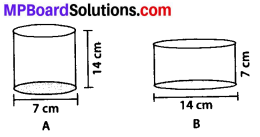
MP Board Class 8th Maths Solutions Chapter 11 Mensuration Ex 11.4 1
Solution:
∵ Volume of cylinder = πr2h
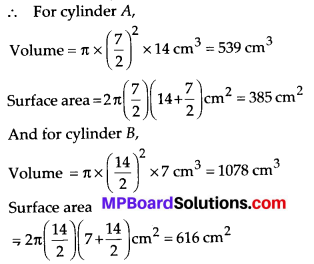
Now, radius of cylinder B is double the radius of cylinder A and height of cylinder B is half the height of A. Due to the square of radius, the radius will assert greater impact in the volume of cylinder than the height. So, volume of cylinder B will be greater.
MP Board Class 8th Maths Solutions Chapter 11 Mensuration Ex 11.4 3
Hence, cylinder B has both, greater volume and greater surface area.

MP Board Solutions

Question 3.
Find the height of a cuboid whose base area is 180 cm2 and volume is 900 cm3 ?
Solution:
We have, base area = 180 cm2,
Volume = 900 cm3
To find, height of a cuboid = h cm, say
We know, Volume = Base area × Height of a cuboid
⇒ 900 = 180 × h ⇒ h = 5 cm.

Question 4.
A cuboid is of dimensions 60 cm × 54 cm × 30 cm. How many small cubes with side 6 cm can be placed in the given cuboid?
Solution:
We have,
Big cuboid dimensions = 60 cm × 54 cm × 30 cm
Side of a small cube = 6 cm
Number of cubes that can be placed in the given cuboid
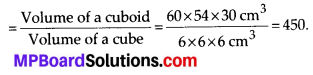
MP Board Class 8th Maths Solutions Chapter 11 Mensuration Ex 11.4 4

MP Board Solutions

Question 5.
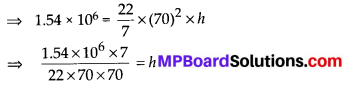
Find the height of the cylinder whose volume is 1.54 m3 and diameter of the base is 140 cm?
Solution:
We have, volume of the cylinder = 1.54 m3 = 1.54 × 106 cm3
Diameter = 140 cm,
Radius = 140 ÷ 2 = 70 cm
∵ volume of the cylinder = πr2h
MP Board Class 8th Maths Solutions Chapter 11 Mensuration Ex 11.4 5
⇒ 100 cm = h
∴ Height of the cylinder is 100 cm.

MP Board Solutions

Question 6.
A milk tank is in the form of cylinder whose radius is 1.5 m and length is 7 m. Find the quantity of milk in litres that can be stored in the tank?
Solution:
We have, radius of the cylindrical tank = 1.5 m and length = 7 m
∴ Volume of tank = πr2h = π(1 .5)2 × 7
= 49.5 m3 = 49500 litres. [∵ 1 m3 = 1000 L]

Question 7.
If each edge of a cube is doubled,
(i) how many times will its surface area increase?
(ii) how many times will its volume increase?
Solution:
Let the edge of the cube be a cm.
After doubling the length, the edge becomes 2a cm.
Surface area of old cube = 6a2 and volume of old cube = a3
Surface area of new cube = 6(2a)2 = 24 a2 and volume of new cube = (2a)3 = 8a3
Hence, surface area increases 4 times and volume increases 8 times if the edge of a cube is doubled.

MP Board Solutions

Question 8.
Water is pouring into a cuboidal reservoir at the rate of 60 litres per minute. If the volume of reservoir is 108 m3, find the number of hours it will take to fill the reservoir.
Solution:
We have,
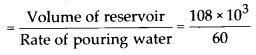
volume of reservoir = 108 m3 = 108 × 103 L
[∵ 1 m3 = 103 L]
Rate of pouring water = 60 L/minute
Time to fill the reservoir
MP Board Class 8th Maths Solutions Chapter 11 Mensuration Ex 11.4 6
= 1.8 × 10³ min. = 1800 min.= 30 hrs.
MP Board Class 8th Maths Solutions

MP Board Class 8th Maths Solutions Chapter 16 संख्याओं के साथ खेलना Ex 16.2

MP Board Class 8th Maths Solutions Chapter 16 संख्याओं के साथ खेलना Ex 16.2

प्रश्न 1.
यदि 21y5, 9 का एक गुणज है, जहाँ y एक अंक है, तोy का मान क्या है?
हल:
क्योंकि 21y5, 9 का एक गुणज है।
इसलिए अंकों का योग = 2 + 1 + y + 5 = 8 + y, 9 का गुणज है।
∴ (8 + y), 0, 9, 18, 27 में से कोई एक संख्या होगी।
परन्तु y एक अंक है, इसलिए y + 8 = 9
या y = 9 – 8 = 1

MP Board Solutions

प्रश्न 2.
यदि 3155, 9 का एक गुणज है, जहाँ : एक अंक है, तो का मान क्या है? आप देखेंगे कि इसके दो उत्तर हैं। ऐसा क्यों है?
हल:
क्योंकि 31z5, 9 का एक गुणज है।
इसलिए अंकों का योग = 3 + 1 + z + 5 = 9 + z, 9 का गुणज है।
∴ (9 + z), 0, 9, 18, 27 में से कोई एक संख्या होगी।
परन्तु z एक अंक है, इसलिए 9 + z = 9, 18, …
अर्थात् 9 + z = 9 या z = 0, 9 + z = 18 या z = 9
इसलिए, z = 0 और = 9
उत्तर यहाँ अंक 0 और 9 दोनों ही अंक क्रमशः संख्या 3105 तथा 3195 बनाते हैं, ये संख्याएँ 9 से विभाज्य हैं।

प्रश्न 3.
यदि 24x, 3 का एक गुणज है, जहाँ x एक अंक है, तोx का मान क्या है?
हल:
क्योंकि 24x, 3 का गुणज है, इसलिए इसके अंकों का योग 6 + x, 3 का एक गुणज है। अर्थात् 6 + x निम्नलिखित में से कोई एक संख्या होगी –
0, 3, 6, 9, 12, 15, 18, …..
परन्तु चूँकि x एक अंक है, इसलिए 6 + x = 6 या 6 + x = 9 या 6 + x = 12 या 6 + x = 15 हो सकता है। अतः x = 0 या 3 या 6 या 9 हो सकता है। इसलिए x का मान इन चारों विभिन्न मानों में से कोई एक हो सकता है।
इसलिए x = 0, 3, 6 या 9

MP Board Solutions

प्रश्न 4.
31:5, 3 का एक गुणज है, जहाँ : एक अंक है, तो का मान क्या हो सकता है?
हल:
क्योंकि 3125, 3 का गुणज है, इसलिए इसके अंकों का योग 9 + z, 3 का एक गुणज है। अर्थात् 6 + x निम्नलिखित में से कोई एक संख्या होगी –
0, 3, 6, 9, 12, 15, 18,…
परन्तु चूँकि x एक अंक है, इसलिए 9 + z = 9 या 9 + z = 12 या 9+ z = 15 या 9 + z = 18 हो सकता है। अतः z = 0 या 3 या 6 या 9 हो सकता है। इसलिए z का मान इन चारों विभिन्न मानों में से कोई एक हो सकता है।
इसलिए 2 = 0, 3, 6 या 9

MP Board Class 8th Maths Solutions

MP Board Class 8th Maths Solutions Chapter 11 Mensuration Ex 11.3

MP Board Class 8th Maths Solutions Chapter 11 Mensuration Ex 11.3

Question 1.
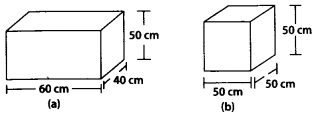
There are two cuboidal boxes as shown in the adjoining figure. Which box requires the lesser amount of material to make?
MP Board Class 8th Maths Solutions Chapter 11 Mensuration Ex 11.3 1
Solution:
Surface area of box (a) = 2(lb + bh + hl)
= 2(60 × 40 + 40 × 50 + 50 × 60)
= 2(2400 + 2000 + 3000)
= 2 × 7400 = 14800 cm2
Surface area of box (b) = 6 × (side)2 = 6 × 502 = 15000 cm2
Hence, box (a) required less amount of material than box (b) to make.

MP Board Solutions

Question 2.
A suitcase with measures 80 cm × 48 cm × 24 cm is to be covered with a trapaulin cloth. How many metres of trapaulin of width 96 cm is required to cover 100 such suitcases?
Solution:
Let l, b and h be the length and breadth and height of the suitcase respectively.
⇒ l = 80 cm, b = 48 cm, h = 24 cm
Total surface area of suitcase = 2(lb + bh + hl)
= 2(80 × 48 + 48 × 24 + 24 × 80)
= 2(3840 + 1152 + 1920) cm2 = 2(6912) cm2 = 13824 cm2
Area of cloth required for 1 suitcase = Area of 1 suitcase
⇒ l × 96 = 13824
MP Board Class 8th Maths Solutions Chapter 11 Mensuration Ex 11.3 2
Length required for 100 suitcases
MP Board Class 8th Maths Solutions Chapter 11 Mensuration Ex 11.3 3

Question 3.
Find the side of a cube whose surface area is 600 cm2.
Solution:
Surface area of cube = 6 × (side)2
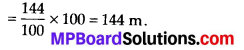
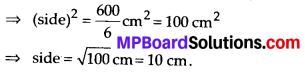
MP Board Class 8th Maths Solutions Chapter 11 Mensuration Ex 11.3 4

MP Board Solutions

Question 4.
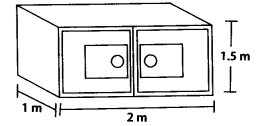
Rukhsar painted the outside of the cabinet of measure 1 m × 2 m × 1.5 m. How much surface area did she cover if she painted all except the bottom of the cabinet.
MP Board Class 8th Maths Solutions Chapter 11 Mensuration Ex 11.3 5
Solution:
Rukhsar painted all the cabinet except the bottom means she painted 4 walls and 1 top. Let l = 1 m, b = 2 m, h = 1.5 m be the length, breadth and height of cabinet respectively.
Area of painted cabinet
= (lb + bh + bh + lh + lh)
= [l × 2 + 2 × 1.5 + 2 × 1.5 + l × 1.5 + l × 1.5]m2
= [2 + 3.0 + 3.0 +1.5 +1.5] m2 = 11 m2.

MP Board Solutions

Question 5.
Daniel is painting the walls and ceiling of a cuboidal hall with length, breadth and height of 15 m, 10 m and 7 m respectively. From each can of paint 100 m2 of area is painted. How many cans of paint will she need to paint the room?
SOlution:
Daniel is painting 4 walls and 1 ceiling.
∴ Total painted area = Area of 4 walls + Area of ceiling
Let l = 15, b = 10 and h = 7 be the length, breadth and height of the hall respectively. = 2 × h(l + b) + lb = {2 × 7 (15 +10) + (15 × 10)} m2
= {14 (25) +150} m2 = {350 +150} m2 = 500 m2
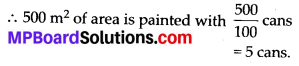
If 100 m2 of area is painted with one can
MP Board Class 8th Maths Solutions Chapter 11 Mensuration Ex 11.3 6

Question 6.
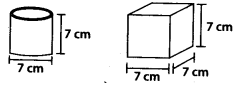
Describe how the two figures given below are alike and how they are different. Which box has larger lateral surface area?
MP Board Class 8th Maths Solutions Chapter 11 Mensuration Ex 11.3 7
Solution:
Alike: They both have same height. Different: Their shapes are different one is cylinderical and other is cubical box.
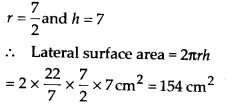
Let r and h be the radius and height of the cylinder.
MP Board Class 8th Maths Solutions Chapter 11 Mensuration Ex 11.3 8
Let the side of cube be a = 7 cm
⇒ Lateral surface area = 4(a)2 = 4(7)2 cm2 = 196 cm2
∴ Cubical box has larger lateral surface area.

Question 7.
A closed cylindrical tank of radius 7 m and height 3 m is made from a sheet of metal. How much sheet of metal is required ?
Solution:
Let r and h be the radius and height of the closed cylinder.
Total surface area = 2πr(r + h)
MP Board Class 8th Maths Solutions Chapter 11 Mensuration Ex 11.3 9

MP Board Solutions

Question 8.
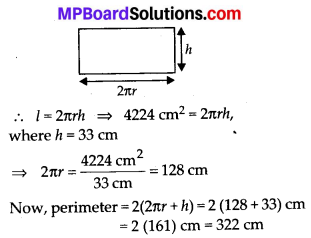
The lateral surface area of a hollow cylinder is 4224 cm2. It is cut along its height and formed a rectangular sheet of width 33 cm. Find the perimeter of rectangular sheet ?
Solution:
Let r and h be the radius and height of the hollow cylinder and l be its lateral surface area.
MP Board Class 8th Maths Solutions Chapter 11 Mensuration Ex 11.3 10

Question 9.
A road roller takes 750 complete revolutions to move once over to level a road. Find the area of the road if the diameter of a road roller is 84 cm and length is 1 m.
Solution:
Area covered in 1 revolution = curved surface area of cylinder
MP Board Class 8th Maths Solutions Chapter 11 Mensuration Ex 11.3 11
∴ Area covered in 750 revolutions = 2.64 × 750 m2 = 1980 m2

MP Board Solutions

Question 10.
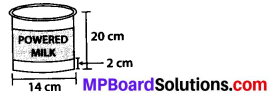
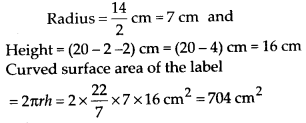
A company packages its milk powder in cylindrical container whose base has a diameter of 14 cm and height 20 cm. Company places a label around the surface of the container (as shown in figure). If the label is placed 2 cm from top and bottom, what is the area of the label.
MP Board Class 8th Maths Solutions Chapter 11 Mensuration Ex 11.3 12
Solution:
MP Board Class 8th Maths Solutions Chapter 11 Mensuration Ex 11.3 13

MP Board Class 8th Maths Solutions

MP Board Class 8th Maths Solutions Chapter 16 संख्याओं के साथ खेलना Intext Questions

MP Board Class 8th Maths Solutions Chapter 16 संख्याओं के साथ खेलना Intext Questions

MP Board Class 8th Maths Chapter 16 पाठान्तर्गत प्रश्नोत्तर

पाठ्य-पुस्तक पृष्ठ संख्या # 260

प्रयास कीजिए (क्रमांक 16.1)

प्रश्न 1.
निम्नलिखित संख्याओं को व्यापक रूप में लिखिए –

  1. 25
  2. 73
  3. 129
  4. 302

हल:

  1. 25 = 20 + 5 = 10 x 2 + 1 x 5
  2. 73 = 70 + 3 = 10 x 7 + 1 x 3
  3. 129 = 100 + 20 + 9 = 100 x 1 + 10 x 2 +1 x 9
  4. 302 = 300 + 00 + 2 = 100 x 3 + 10 x 0 + 1 x 2

MP Board Solutions

प्रश्न 2.
निम्नलिखित को सामान्य रूप में लिखिए –

  1. 10 x 5 + 6
  2. 100 x 7 + 10 x 1 + 8
  3. 100a + 10c + b.

उत्तर:

  1. 10 x 5 + 6 = 50 + 6 = 56
  2. 100 x 7 + 10 x 1 + 8 = 700 + 10 + 8 = 718
  3. 100a + 10c + b = acb

पाठ्य-पुस्तक पृष्ठ संख्या # 261

प्रयास कीजिए (क्रमांक 16.2)

प्रश्न 1.
जाँच कीजिए कि सुन्दरम ने निम्नलिखित संख्याएँ चुनी होतीं, तो परिणाम क्या प्राप्त होते –

  1. 27
  2. 39
  3. 64
  4. 17

उत्तर:

1. संख्या = 27
अंक पलटने पर संख्या = 72
दोनों संख्याओं को जोड़ने पर = 27 + 72 = 99
इस संख्या को 11 से भाग देने पर, 99 ÷ 11 = 9, शेषफल शून्य के साथ।
अतः भागफल = 9 = संख्या के अंकों का योग (∴ 2 + 7 = 9)

2. संख्या = 39
अंक पलटने पर संख्या = 93
दोनों संख्याओं का योग = 39 + 93 = 132
इस संख्या को 11 से भाग देने पर, 132 ∴ 11 = 12, शेषफल शून्य के साथ
अतः भागफल = 12 = संख्या के अंकों का योग
(∴ 3 + 9 = 12)

3. संख्या = 64
अंक पलटने पर संख्या = 46
दोनों संख्याओं का योग = 64 + 46 = 110
इस संख्या को 11 से भाग देने पर, 110 ÷ 11 = 10, शेषफल शून्य के साथ
अतः भागफल = 10 = संख्या के अंकों का योग
(∴ 6 + 4 = 10)

4. संख्या = 17
अंक पलटने पर संख्या = 71
दोनों संख्याओं का योग = 17 + 71 = 88
इस संख्या को 11 से भाग देने पर, 88 ÷ 11 = 8, शेषफल शून्य के साथ।
अतः भागफल = 8 = संख्या के अंकों का योग
(∴ 1 + 7 = 8)

प्रयास कीजिए (क्रमांक 16.3)

MP Board Solutions

प्रश्न 1.
जाँच कीजिए कि यदि सुन्दरम ने उपर्युक्त के लिए निम्नलिखित संख्याएँ चुनी होतीं, तो क्या परिणाम प्राप्त होते –

  1. 17
  2. 21
  3. 96
  4. 37

हल:
1. सोची हुई संख्या = 17
अंक पलटने पर संख्या = 71
संख्याओं का अन्तर = 71 – 17 = 54
9 से विभाजन 54 ÷ 9 = 6, शेषफल शून्य के साथ
अतः भागफल = 8 = संख्या के अंकों का अन्तर
(∴ 7 – 1 = 6)

2. सोची हुई संख्या = 21
अंक पलटने पर संख्या = 12
संख्याओं का अन्तर = 21 – 12 = 9
9 से विभाजन 9 ÷ 9 = 1, शेषफल शून्य के साथ
अतः भागफल = 1 = संख्या के अंकों का अन्तर
(∴ 2 – 1 = 1)

3. सोची हुई संख्या = 96
अंक पलटने पर संख्या = 69
संख्याओं का अन्तर = 96 – 69 = 27
9 से विभाजन = 27 ÷ 9 = 3, शेषफल शून्य के साथ
अतः भागफल = 3 = संख्याओं के अंकों का अन्तर
(∴ 9 – 6 = 3)

4. सोची हुई संख्या = 37
अंक पलटने पर संख्या = 73
संख्याओं का अन्तर = 73 – 37 = 36
9 से विभाजन = 36 ÷ 9 = 4, शेषफल शून्य के साथ
अतः भागफल = 4 = संख्याओं के अंकों का अन्तर
(∴ 7 – 3 = 4)

पाठ्य-पुस्तक पृष्ठ संख्या # 262

MP Board Solutions

प्रयास कीजिए (क्रमांक 16.4)

प्रश्न 1.
जाँच कीजिए कि यदि मीनाक्षी ने निम्नलिखित संख्याएँ चुनी होती, तो परिणाम क्या प्राप्त होता ? प्रत्येक स्थिति में, अन्त में प्राप्त हुए भागफल का एक रिकार्ड (record) रखिए।

  1. 132
  2. 469
  3. 737
  4. 901

हल:
1. संख्या = 132
अंक पलटने पर संख्या = 231
अन्तर = 231 – 132 = 99
99 से विभाजन = 99 ÷ 99 = 1, शेषफल शून्य के साथ।
अतः भागफल = 1 = संख्या के इकाई और सैकड़े के अंकों का अन्तर
(∴ 2 – 1 = 1)

2. संख्या = 469
अंक पलटने पर संख्या = 964
99 से विभाजन = 495 ÷ 99 = 5, शेषफल शून्य के साथ,
अतः भागफल = 5 = संख्या के इकाई और सैकड़े के अंकों का अन्तर
(∴ 9 – 4 = 5)

3. संख्या = 737
अंक पलटने पर संख्या = 737
अन्तर = 737 – 737 = 0
99 से विभाजन = 0 ÷ 99 = 0, शेषफल शून्य के साथ,
अतः भागफल = 0 = संख्या के इकाई और सैकड़े के अंकों का अन्तर
(∴ 7 – 7 = 0)

4. संख्या = 901
अंक पलटने पर संख्या = 109
अन्तर = 901 – 109 = 792
99 से विभाजन = 792 ÷ 99 = 8, शेषफल शून्य के साथ,
अत: भागफल = 8 = संख्या के इकाई और सैकड़े के अंकों का अन्तर
(∴ 9 – 1 = 8)

पाठ्य-पुस्तक पृष्ठ संख्या # 263

प्रयास कीजिए (क्रमांक 16.5)

प्रश्न 1.
जाँच कीजिए कि यदि सुन्दरम ने निम्नलिखित संख्याएँ सोची होती, तो परिणाम क्या प्राप्त होता –

  1. 417
  2. 632
  3. 117
  4. 937

हल:
1. संख्या = 417
4, 1, 7 से बनने वाली 3 अंकों की दो और संख्याएँ 741 और 174 है।
संख्याओं को जोड़ने पर
MP Board Class 8th Maths Solutions Chapter 16 संख्याओं के साथ खेलना Intext Questions img-1
37 से विभाजन = 1332 ÷ 37 = 36, शेषफल शून्य के साथ

2. संख्या = 632
6, 3, 2 से बनने वाली 3 अंकों की दो अन्य संख्याएँ: 263, 326
संख्याओं के जोड़ने पर,
MP Board Class 8th Maths Solutions Chapter 16 संख्याओं के साथ खेलना Intext Questions img-2
37 से विभाजन = 1221 ÷ 37 = 33, शेषफल शून्य के साथ।

3. संख्या = 117
1, 1, 7 से बनने वाली 3 अंकों की दो अन्य संख्याएँ: 711, 171
संख्याओं के जोड़ने पर,
MP Board Class 8th Maths Solutions Chapter 16 संख्याओं के साथ खेलना Intext Questions img-3
37 से विभाजन = 99937=27, शेषफल शून्य के साथ।

4. संख्या = 937
9, 3, 7 से बनने वाली 3 अंकों की दो अन्य संख्याएँ: 793, 379
संख्याओं को जोड़ने पर,
MP Board Class 8th Maths Solutions Chapter 16 संख्याओं के साथ खेलना Intext Questions img-4
37 से विभाजन = 2109 + 37 = 57, शेषफल शून्य के साथ।

पाठ्य-पुस्तक पृष्ठ संख्या # 266

MP Board Solutions

इन्हें कीजिए

प्रश्न 1.
दो अंकों की एक संख्या ab लिखिए तथा इसके अंकों को पलटने पर संख्या ba लिखिए। इसका योग ज्ञात कीजिए। मान लीजिए कि यह योग एक तीन अंकों की संख्या dad है।
अर्थात् ab + ba = dad
(10a + b) + (10b + a) = dad
11 (a + b) = dad
योग (a + b) संख्या 18 से अधिक नहीं हो सकता (क्यों ?)। क्या dad, 11 का एक गुणज है? क्या dad, 198 E से कम है ? 198 तक तीन अंकों की ऐसी संख्याएँ लिखिए, जो 11 की गुणज हैं। a और d के मान ज्ञात कीजिए।
हल:
माना कि दो अंकों की संख्या = ab है।
अंक पलटने पर संख्या = ba
इनका योग, 3 अंकों की संख्या = dad
अर्थात् ab + ba = dad
या (10a + b) + (10b + a) = dad
11 (a + b) = dad (a + b) का योग 18 से अधिक नहीं हो सकता, क्योंकि 2 अंकों की बड़ी से बड़ी संख्या = 99 है।
तथा 99 + 99 = 198
अतः संख्या dad, 11 से विभाज्य होगी।
अतः 11 से विभाज्य 198 तक 3- अंकों की संख्याएँ: 110, 121, 132, 143, 154, 165, 176, 187 और 198 हैं।
अतः dad = 121
या d = 1, a = 2

MP Board Class 8th Maths Solutions

MP Board Class 8th Maths Solutions Chapter 11 Mensuration Ex 11.2

MP Board Class 8th Maths Solutions Chapter 11 Mensuration Ex 11.2

Question 1.
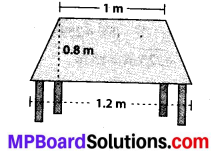
The shape of the top surface of a table is a trapezium. Find its area if its parallel sides are 1 m and 1.2 m and perpendicular distance between them is 0.8 m.
MP Board Class 8th Maths Solutions Chapter 11 Mensuration Ex 11.2 1
Solution:
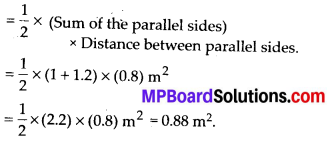
Area of trapezium
MP Board Class 8th Maths Solutions Chapter 11 Mensuration Ex 11.2 2

MP Board Solutions

Question 2.
The area of a trapezium is 34 cm2 and the length of one of the parallel sides is 10 cm and its height is 4 cm. Find the length of the other parallel side.
Solution:
Let x be the length of other parallel side.
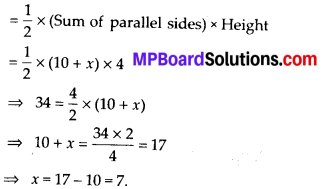
Area of trapezium
MP Board Class 8th Maths Solutions Chapter 11 Mensuration Ex 11.2 3
∴ The length of the other parallel side is 7 cm.

MP Board Solutions

Question 3.
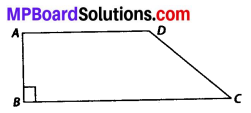
Length of the fence of a trapezium shaped field ABCD is 120 m. If BC = 48 m, CD = 17 m and AD = 40 m, find the area of this field. Side AS is perpendicular to the parallel sicles AD and BC.
MP Board Class 8th Maths Solutions Chapter 11 Mensuration Ex 11.2 4
Solution:
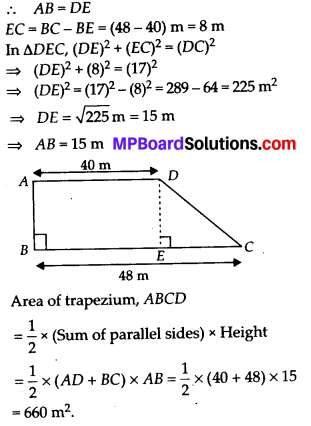
Draw a perpendicular DE from a point D which meets BC at E.
MP Board Class 8th Maths Solutions Chapter 11 Mensuration Ex 11.2 5

MP Board Solutions

Question 4.
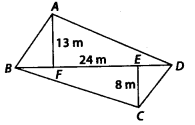
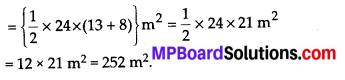
The diagonal of a quadrilateral shaped field is 24 m and the perpendiculars dropped on it from the remaining opposite vertices are 8 m and 13 m. Find the area of the field.
MP Board Class 8th Maths Solutions Chapter 11 Mensuration Ex 11.2 6
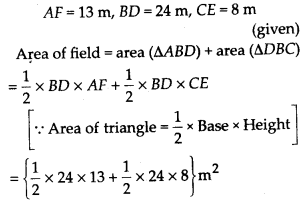
Solution:
MP Board Class 8th Maths Solutions Chapter 11 Mensuration Ex 11.2 7
MP Board Class 8th Maths Solutions Chapter 11 Mensuration Ex 11.2 8

Question 5.
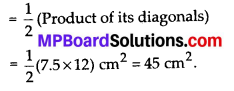
The diagonal of a Rhombus shaped field is 7.5 cm and 12 cm. Find its area.
Solution:
We know that,
The area of a Rhombus
MP Board Class 8th Maths Solutions Chapter 11 Mensuration Ex 11.2 9

MP Board Solutions

Question 6.
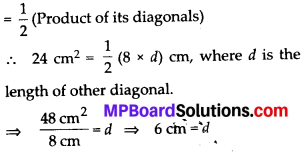
Find the area of a rhombus whose side is 6 cm and whose altitude is 4 cm. If one of its diagonals is 8 cm long, find the length of the other diagonal.
Solution:
Since, rhombus is a parallelogram whose all sides are equal.
So, area of a rhombus = area of a parallelogram
= side × altitude = (6 × 4) cm2 = 24 cm2
Also, area of a rhombus
MP Board Class 8th Maths Solutions Chapter 11 Mensuration Ex 11.2 10
∴ The length of the other diagonal be 6 cm.

MP Board Solutions

Question 7.
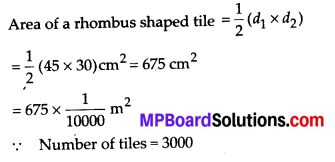
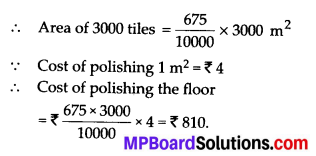
The floor of a building consists of 3000 tiles which are rhombus shaped and each of its diagonals are 45 cm and 30 cm in length. Find the total cost of polishing the floor, if the cost per m2 is ₹ 4.
Solution:
Let d1 and d2 be the diagonals of a rhombus, where d1 = 45 cm and d2 = 30 cm
MP Board Class 8th Maths Solutions Chapter 11 Mensuration Ex 11.2 50
MP Board Class 8th Maths Solutions Chapter 11 Mensuration Ex 11.2 60

Question 8.
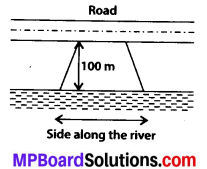
Mohan wants to buy a trapezium shaped field. Its side along the river is parallel to and twice the side along the road. If the area of this field is 10500 m2 and the perpendicular distance between the two parallel sides is 100 m, find the length of the side along the river.
MP Board Class 8th Maths Solutions Chapter 11 Mensuration Ex 11.2 61
Solution:
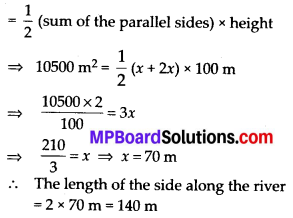
Let the opposite parallel sides of a trapezium be x and 2x.
∵ We know that,
Area of trapezium
MP Board Class 8th Maths Solutions Chapter 11 Mensuration Ex 11.2 62

MP Board Solutions

Question 9.
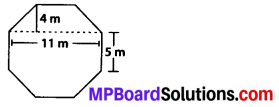
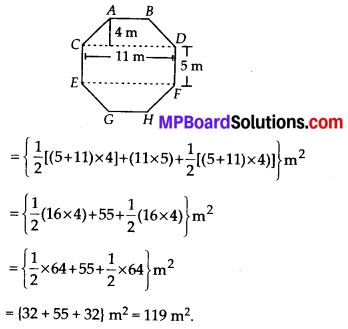
Top surface of a raised platform is in the shape of a regular octagon as shown in the figure. Find the area of the octagonal surface.
MP Board Class 8th Maths Solutions Chapter 11 Mensuration Ex 11.2 80
Solution:
MP Board Class 8th Maths Solutions Chapter 11 Mensuration Ex 11.2 90
MP Board Class 8th Maths Solutions Chapter 11 Mensuration Ex 11.2 100

MP Board Solutions

Question 10.
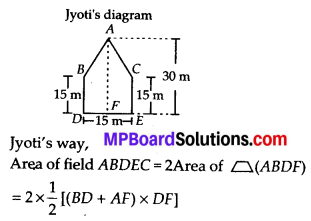
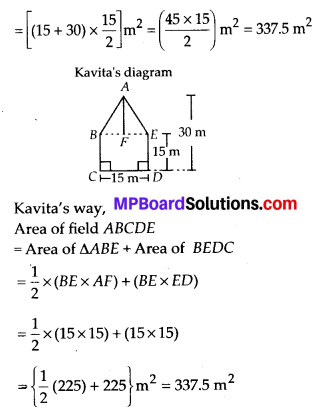
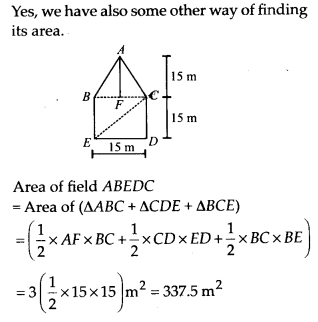
There is a pentagonal shaped park as shown in the figure. For finding its area Jyoti and Kavita divided it in two different ways. Find the area of this park using both ways. Can you suggest some other way of finding its area ?
11-Mensuration-Ex-11.2-63.png” alt=”MP Board Class 8th Maths Solutions Chapter 11 Mensuration Ex 11.2 63″ width=”338″ height=”295″ class=”alignnone size-full wp-image-36626″ />
Solution:
MP Board Class 8th Maths Solutions Chapter 11 Mensuration Ex 11.2 64
MP Board Class 8th Maths Solutions Chapter 11 Mensuration Ex 11.2 65
MP Board Class 8th Maths Solutions Chapter 11 Mensuration Ex 11.2 66

MP Board Solutions

Question 11.
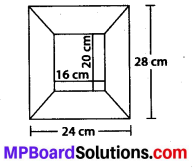
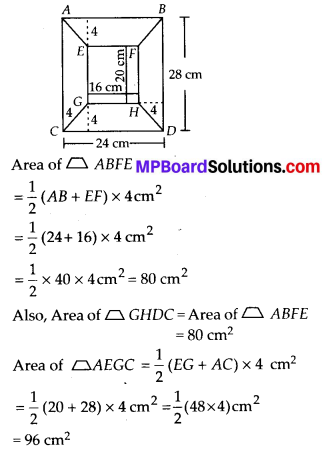
Diagram of the adjacent picture frame has outer dimensions = 24 cm × 28 cm and inner dimensions 16 cm × 20 cm. Find the area of each section of the frame, if the width of each section is same.
MP Board Class 8th Maths Solutions Chapter 11 Mensuration Ex 11.2 67
Solution:
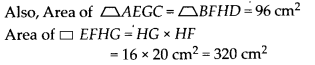
MP Board Class 8th Maths Solutions Chapter 11 Mensuration Ex 11.2 68
MP Board Class 8th Maths Solutions Chapter 11 Mensuration Ex 11.2 69

MP Board Class 8th Maths Solutions

MP Board Class 8th Maths Solutions Chapter 15 आलेखों से परिचय Ex 15.3

MP Board Class 8th Maths Solutions Chapter 15 आलेखों से परिचय Ex 15.3

प्रश्न 1.
उपयुक्त पैमाने का प्रयोग करते हुए, निम्न तालिकाओं में दी गई राशियों के लिए आलेख बनाइए –
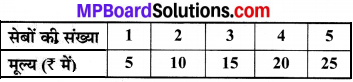
(a) सेबों का मूल्य
MP Board Class 8th Maths Solutions Chapter 15 आलेखों से परिचय Ex 15.3 img-1

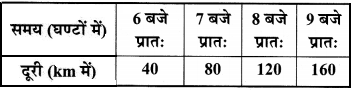
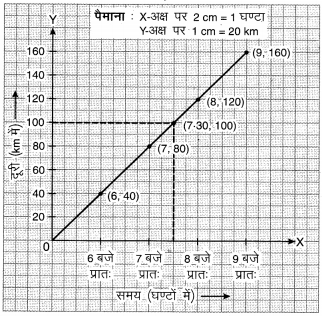
(b) कार द्वारा तय की गई दूरी
MP Board Class 8th Maths Solutions Chapter 15 आलेखों से परिचय Ex 15.3 img-2

  1. 7:30 बजे प्रातः व 8 बजे प्रातः के अन्तराल में कार द्वारा कितनी दूरी तय की गई?
  2. कार के 100 km दूरी तय कर लेने पर समय क्या था?

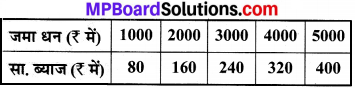
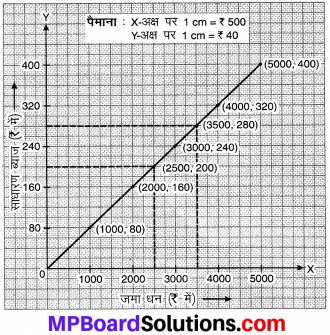
(c) जमा धन पर वार्षिक ब्याज
MP Board Class 8th Maths Solutions Chapter 15 आलेखों से परिचय Ex 15.3 img-3

  1. क्या आलेख मूलबिन्दु से गुजरता है?
  2. आलेख से ₹ 2,500 का वार्षिक ब्याज ज्ञात कीजिए।
  3. ₹ 280 ब्याज प्राप्त करने के लिए कितना धन जमा करना होगा?

हल:
(a)
MP Board Class 8th Maths Solutions Chapter 15 आलेखों से परिचय Ex 15.3 img-4
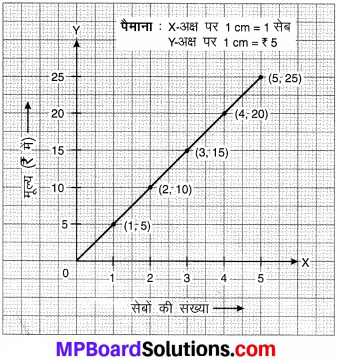
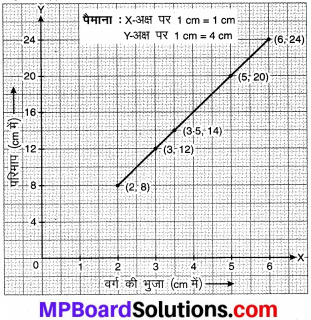
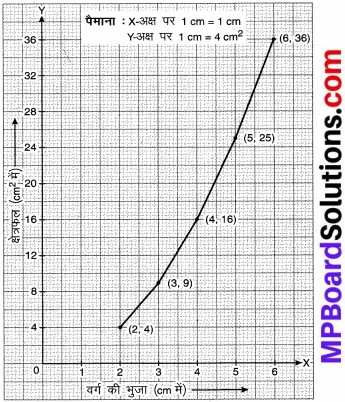
सर्वप्रथम ग्राफ पेपर पर X – अक्ष और Y – अक्ष निर्धारित करते हैं। X – अक्ष पर पैमाना 1 cm = 1 सेब तथा Y – अक्ष पैमाना 1 cm = ₹ 5 लेकर X – अक्ष पर सेबों की संख्या तथा Y – अक्ष पर सेबों का मूल्य अंकित किया।
अब दिये हुए बिन्दु क्रमशः (1, 5), (2, 10), (3, 15), । (4, 20) और (5, 25) अंकित किए।
अंकित किए गए इन बिन्दुओं को पैमाने की सहायता से मिलाया। इस प्रकार प्राप्त आलेख एक सरल रेखा है।

(b)
MP Board Class 8th Maths Solutions Chapter 15 आलेखों से परिचय Ex 15.3 img-5
ग्राफ से:

  1. 7.30 बजे प्रातः व 8 बजे प्रातः के अन्तराल में तय की गई दूरी = 120 km – 100 km = 20 km
  2. कार द्वारा 100 km दूरी तय कर लेने पर समय 7:30 बजे प्रातः था।

(c)
MP Board Class 8th Maths Solutions Chapter 15 आलेखों से परिचय Ex 15.3 img-6
ग्राफ से:

  1. हाँ, आलेख मूल बिन्दु से गुजरता है।
  2. आलेख से ₹ 2,500 का ब्याज = ₹ 200
  3. ₹ 280 ब्याज प्राप्त करने के लिए ₹ 3,500 जमा करना होगा।

MP Board Solutions

प्रश्न 2.
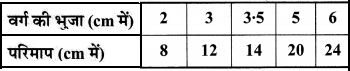
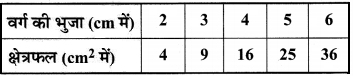
निम्न तालिकाओं के लिए आलेख खींचिए –
1.
MP Board Class 8th Maths Solutions Chapter 15 आलेखों से परिचय Ex 15.3 img-7
क्या यह रैखिक आलेख है?

2.
MP Board Class 8th Maths Solutions Chapter 15 आलेखों से परिचय Ex 15.3 img-8
क्या यह रैखिक आलेख है?
हल:
1.
MP Board Class 8th Maths Solutions Chapter 15 आलेखों से परिचय Ex 15.3 img-9
हाँ, यह रैखिक आलेख है।

2.
MP Board Class 8th Maths Solutions Chapter 15 आलेखों से परिचय Ex 15.3 img-10
नहीं, यह रैखिक आलेख नहीं है।

MP Board Class 8th Maths Solutions

MP Board Class 8th Maths Solutions Chapter 11 Mensuration Ex 11.1

MP Board Class 8th Maths Solutions Chapter 11 Mensuration Ex 11.1

Question 1.
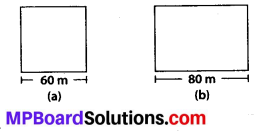
A square and a rectangular field with measurements as given in the figure have the same perimeter. Which field has a larger area?
MP Board Class 8th Maths Solutions Chapter 11 Mensuration Ex 11.1 1
Solution:
We have, a square of side 60 m
i. e., s = 60 m and a rectangle of length a = 80 m
Perimeter of square = 4 × s = 4 × 60m = 240 m
As given, the perimeter of square and rectangle are equal.
Let, b be the other side of a rectangle.
∴ 2 × a + 2 × b = 240 m
⇒ 2 × 80 + 2 × 6 = 240
⇒ 2 × b = 240 – 160 ⇒ 2 × b = 80 m
⇒ b = 40 m
Hence, area of a square = s2 = 60 m × 60 m
= 3600 sq. m
Area of rectangle = a × 6 = 80m × 40m
= 3200 sq. m .
Hence, area of a square is larger than that of the rectangle.

MP Board Solutions

Question 2.
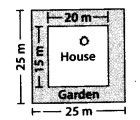
Mrs. Kaushik has a square plot with the measurement as shown in figure. She wants to construct a house in the middle of the plot. A garden is developed around the house. Find the total cost of developing a garden around the house at the rate of ₹ 55 per m2.
MP Board Class 8th Maths Solutions Chapter 11 Mensuration Ex 11.1 50
Solution:
The dimensions of the plot and house are as shown
∴ The area of plot = 25 × 25 = 625 sq. m
and the area of house = 20 × 15 = 300 sq. m
We know, Area of plot = Area of house + Area of garden
∴ Area of garden = Area of plot – Area of house
= 625 – 300 = 325 sq. m
We also know,
Rate of developing 1 sq. m garden = 55
∴ Amount for developing 325 sq. m garden = 325 × 55= 17875.

MP Board Solutions

Question 3.
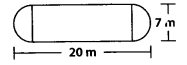
The shape of a garden is rectangular in the middle and semi circular at the ends as shown in the diagram. Find the area and the perimeter of this garden (Length of rectangle is 20 – (3.5 + 3.5) metres).
MP Board Class 8th Maths Solutions Chapter 11 Mensuration Ex 11.1 2
Solution:
1 Length of rectangle = 20 – radii of semicircles (20 – (3.5 + 3.5)) m = 13 m.
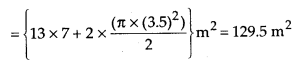
Hence area of garden = Area of rectangle + Area of 2 semi circles
MP Board Class 8th Maths Solutions Chapter 11 Mensuration Ex 11.1 3
Perimeter of garden = πr +2 × (l) + πr
= 2(l + πr)
=2(13 + π × 3.5)m = 48m.

Question 4.
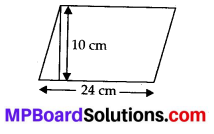
A flooring tile has the shape of a parallelogram whose base is 24 cm and the corresponding height is 10 cm. How many such tiles are required to cover a floor of area 1080 m2?
(If required you can split the tiles in whatever way you want to fill up the corners).
Solution:
The base of tile (b) = 24 cm and height h = 10 cm
∴ Area of 1 tile = 24 × 10 sq. cm
= 240 sq. cm.
MP Board Class 8th Maths Solutions Chapter 11 Mensuration Ex 11.1 4
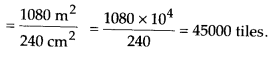
Thus, to cover an area of 1080 m2, we need number of tiles
MP Board Class 8th Maths Solutions Chapter 11 Mensuration Ex 11.1 5

MP Board Solutions

Question 5.
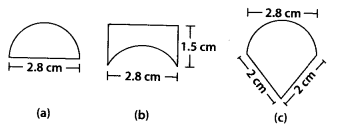
An ant is moving around a few food pieces of different shapes scattered on the floor. For which food-piece would the ant have to take a longer round? Remember, circumference of a circle can be obtained by using the expression c = 2πr, where r is the radius of the circle.
MP Board Class 8th Maths Solutions Chapter 11 Mensuration Ex 11.1 6
Solution:
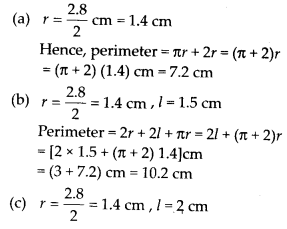
The circumference of a circle is given by 2πr and perimeter of a semicircle is given by πr + 2r
MP Board Class 8th Maths Solutions Chapter 11 Mensuration Ex 11.1 7
Perimeter = πr + 2l
= [π × 1.4 + 2 × 2] cm = 8.4 cm
Hence, the ant has to take the longest round around the piece of figure (b).

MP Board Class 8th Maths Solutions

MP Board Class 8th Maths Solutions Chapter 15 आलेखों से परिचय Intext Questions

MP Board Class 8th Maths Solutions Chapter 15 आलेखों से परिचय Intext Questions

MP Board Class 8th Maths Chapter 15 पाठान्तर्गत प्रश्नोत्तर

पाठ्य-पुस्तक पृष्ठ संख्या # 253

सोचिए, चर्चा कीजिए और लिखिए

प्रश्न 1.
एक कार की पेट्रोल टंकी को भरने के लिए दी गई राशि खरीदे गए पेट्रोल की मात्रा (लीटर में) द्वारा निश्चित होती है। यहाँ पर कौन-सा चर स्वतन्त्र है? चर्चा कीजिए?
उत्तर:
क्योंकि पेट्रोल टंकी को भरने के लिए दी गई राशि पेट्रोल की मात्रा पर निर्भर करती है। अत: पेट्रोल की मात्रा स्वतन्त्र चर है।

पाठ्य-पुस्तक पृष्ठ संख्या # 254

प्रयास कीजिए (क्रमांक 15.1)

प्रश्न 1.
ऊपर के उदाहरण (उदाहरण 6) में, आलेख से ज्ञात कीजिए कि ₹ 800 में कितना पेट्रोल खरीदा जा सकता है?
उत्तर:
₹ 800 में 16 लीटर पेट्रोल खरीदा जा सकता है।

पाठ्य-पुस्तक पृष्ठ संख्या # 255

MP Board Solutions

प्रयास कीजिए (क्रमांक 15.2)

प्रश्न 1.
क्या उदाहरण 7 एक समानुपात का उदाहरण है?
उत्तर:
हाँ, यह एक समानुपात का उदाहरण है।

MP Board Class 8th Maths Solutions

MP Board Class 8th Maths Solutions Chapter 15 आलेखों से परिचय Ex 15.2

MP Board Class 8th Maths Solutions Chapter 15 आलेखों से परिचय Ex 15.2

प्रश्न 1.
निम्न बिन्दुओं को एक वर्गांकित कागज (Graph sheet) or sifona ariffiny zit Hilferu fata QRIT वे सभी एक सरल रेखा पर स्थित हैं?

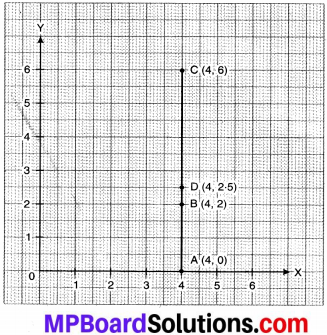
  1. A (4, 0), B (4, 2), C (4, 6), D (4, 2.5)
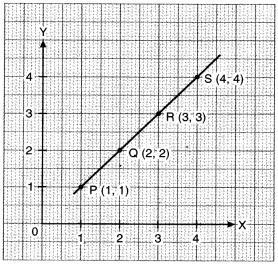
  2. P(1, 1), Q (2, 2), R (3, 3), S (4, 4)
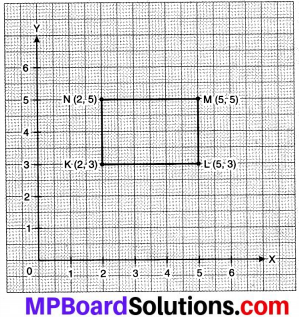
  3. K (2, 3), L (5, 3), M (5, 5), N (2, 5)

हल:
1.
MP Board Class 8th Maths Solutions Chapter 15 आलेखों से परिचय Ex 15.2 img-1
यहाँ सभी बिन्दु एक सरल रेखा पर स्थित हैं।

हल:
2.
MP Board Class 8th Maths Solutions Chapter 15 आलेखों से परिचय Ex 15.2 img-2
यहाँ सभी बिन्दु एक सरल रेखा पर स्थित हैं।

हल:
3.
MP Board Class 8th Maths Solutions Chapter 15 आलेखों से परिचय Ex 15.2 img-3
यहाँ सभी बिन्दु एक सरल रेखा पर स्थित नहीं हैं।

प्रश्न 2.
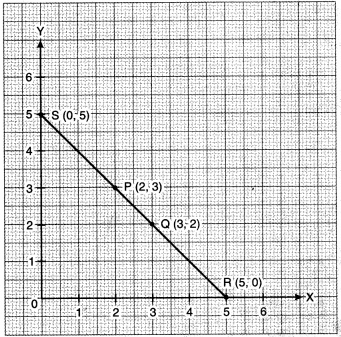
बिन्दुओं (2, 3) तथा (3, 2) में से गुजरती हुई एक सरल रेखा खींचिए। उन बिन्दुओं के निर्देशांक लिखिए जिन पर यह रेखा X – अक्ष तथा Y – अक्ष को प्रतिच्छेद करती हैं।
हल:
MP Board Class 8th Maths Solutions Chapter 15 आलेखों से परिचय Ex 15.2 img-4
यहाँ, सरल रेखा X – अक्ष को R (5, 0) और Y – अक्ष को S (0, 5) पर प्रतिच्छेद करती है।

प्रश्न 3.
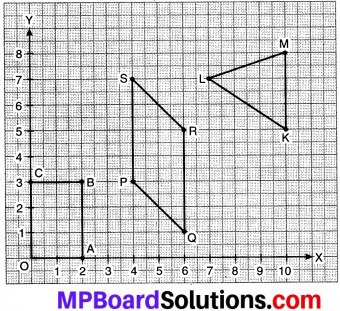
आलेख में बनाई गई आकृतियों में प्रत्येक के शीर्षों के निर्देशांक लिखिए –
MP Board Class 8th Maths Solutions Chapter 15 आलेखों से परिचय Ex 15.2 img-5
हल:
बिन्दुओं के निर्देशांक:

  1. O (0,0), A (2,0), B (2, 3),C (0, 3)
  2. P (4, 3), Q (6, 1), R (6, 5), S (4, 7)
  3. K (10,5), L (7, 7), M (10,8)

प्रश्न 4.
निम्न कथनों में कौन-सा सत्य है तथा कौन-सा असत्य? असत्य को ठीक कीजिए।

  1. कोई बिन्दु जिसका X – निर्देशांक शून्य है तथा Y – निर्देशांक शून्येतर है, Y – अक्ष पर स्थित होगा।
  2. कोई बिन्दु जिसका Y – निर्देशांक शून्य है तथा X – निर्देशांक 5 है, Y – अक्ष पर स्थित होगा।
  3. मूलबिन्दु के निर्देशांक (0, 0) हैं।

उत्तर:

  1. सत्य
  2. असत्य, X-अक्ष पर स्थित होगा।
  3. सत्य।

MP Board Class 8th Maths Solutions

MP Board Class 8th Maths Solutions Chapter 13 Direct and Inverse Proportion Ex 13.2

MP Board Class 8th Maths Solutions Chapter 13 Direct and Inverse Proportion Ex 13.2

Question 1.
Which of the following are in inverse proportion?
(i) The number of workers on a job and the time to complete the job.
(ii) The time taken for a journey and the distance travelled in a uniform speed.
(iii) Area of cultivated land and the crop harvested.
(iv) The time taken for a fixed journey and the speed of the vehicle.
(v) The population of a country and the area of land per person.
Solution:
(i) If the number of workers on a job increases (decreases), then the time to complete the job will decrease (increase).
∴ The given statement is in inverse proportion.
(ii) If the time taken for a journey increases (decreases), then the distance travelled in uniform speed will also increase (decrease).
∴The given statement is in direct proportion.
(iii) If the area of cultivated land increases (decreases), then the crop harvested will also increase (decrease).
∴ The given statement is in direct proportion.
(iv) For a fixed journey, if the speed of the vehicle increases (decreases), then the time taken for journey will decrease (increase).
∴ The given statement is in inverse proportion.
(v) If the population of a country increases, then the area of land per person will decrease. But if the population of a country decreases, then the area of land per person will increase.
∴ The given statement is in inverse proportion.

MP Board Solutions

Question 2.
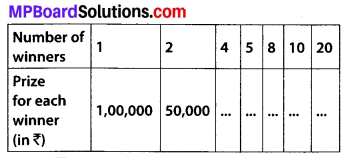
In a Television game show, the prize money of ₹ 1,00,000 is to be divided equally amongst the winners. Complete the following table and find whether the prize money given to an individual winner is directly or inversely proportional to the number of winners?
MP Board Class 8th Maths Solutions Chapter 13 Direct and Inverse Proportion Ex 13.2 1
Solution:
Since, we know that if the money is to be distributed in more and more people, then the amount of money given to an individual will decrease i.e., the given problem is in inverse proportion.
MP Board Class 8th Maths Solutions Chapter 13 Direct and Inverse Proportion Ex 13.2 2
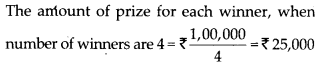
The amount of prize for each winner, when
MP Board Class 8th Maths Solutions Chapter 13 Direct and Inverse Proportion Ex 13.2 3
The amount of prize for each winner, when
MP Board Class 8th Maths Solutions Chapter 13 Direct and Inverse Proportion Ex 13.2 4
The amount of prize for each winner, when
MP Board Class 8th Maths Solutions Chapter 13 Direct and Inverse Proportion Ex 13.2 5
The amount of prize for each winner, when
MP Board Class 8th Maths Solutions Chapter 13 Direct and Inverse Proportion Ex 13.2 6

Question 3.
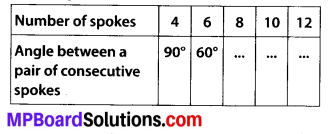
Rehman is making a wheel using spokes. He wants to fix equal spokes in such a way that the angles between any pair of consecutive spokes are equal. Help him by completing the following table.
MP Board Class 8th Maths Solutions Chapter 13 Direct and Inverse Proportion Ex 13.2 7
(i) Are the number of spokes and the angles formed between the pairs of consecutive spokes in inverse proportion?
(ii) Calculate the angle between a pair of consecutive spokes on a wheel with 15 spokes.
(iii) How many spokes would be needed, if the angle between a pair of consecutive spokes is 40°?
Solution:
If the number of spokes increases, then the angle between them will decrease.
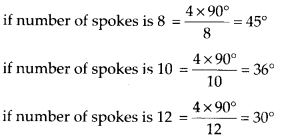
∴ The given problem is in inverse proportion. Then angle between a pair of consecutive spokes,
MP Board Class 8th Maths Solutions Chapter 13 Direct and Inverse Proportion Ex 13.2 8
(i) Yes, they are in inverse proportion.
(ii) The angle between a pair of consecutive spokes on a wheel with 15 spokes \(=\frac{4 \times 90^{\circ}}{15}=24^{\circ}\)
(iii) Number of spokes, if the angle between a pair of consecutive spokes is 40°
\(=\frac{4 \times 90^{\circ}}{40^{\circ}}=9\)

MP Board Solutions

Question 4.
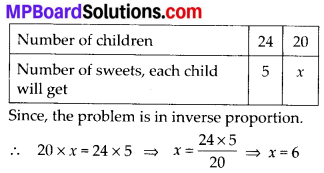
If a box of sweets is divided among 24 children, they will get 5 sweets each. How many would each get, if the number of the children is reduced by 4?
Solution:
Let the number of sweets, each child would get be x.
According to question,
MP Board Class 8th Maths Solutions Chapter 13 Direct and Inverse Proportion Ex 13.2 9
Therefore, each child would get 6 sweets.

MP Board Solutions

Question 5.
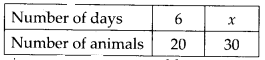
A farmer has enough food to feed 20 animals in his cattle for 6 days. How long would the food last if there were 10 more animals in his cattle?
Solution:
Let the food would last for x days.
According to question,
MP Board Class 8th Maths Solutions Chapter 13 Direct and Inverse Proportion Ex 13.2 10
Since, the given problem is in inverse proportion.
MP Board Class 8th Maths Solutions Chapter 13 Direct and Inverse Proportion Ex 13.2 11
Therefore, the required number of days is 4.

MP Board Solutions

Question 6.
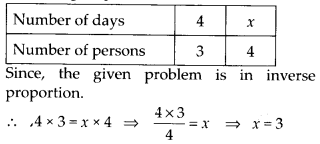
A contractor estimates that 3 persons could rewire Jasminder’s house in 4 days. If he uses 4 persons instead of three, how long should they take to complete the job?
Solution:
Let the number of days = x
According to question,
MP Board Class 8th Maths Solutions Chapter 13 Direct and Inverse Proportion Ex 13.2 12
Therefore, 4 persons will take 3 days to complete the job.

Question 7.
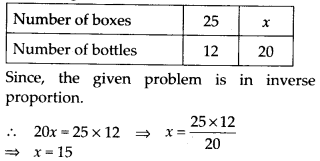
A batch of bottles were packed in 25 boxes with 12 bottles in each box. If the same batch is packed using 20 bottles in each box, how many boxes would be filled?
Solution:
Let the number of boxes to be filled = x
According to question,
MP Board Class 8th Maths Solutions Chapter 13 Direct and Inverse Proportion Ex 13.2 13
Therefore, the required number of boxes to be filled would be 15.

MP Board Solutions

Question 8.
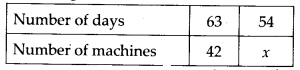
A factory requires 42 machines to produce a given number of articles in 63 days. How many machines would be required to produce the same number of articles in 54 days?
Solution:
Let the number of machines required to produce the articles in 54 days = x
According to question,
MP Board Class 8th Maths Solutions Chapter 13 Direct and Inverse Proportion Ex 13.2 14
If number of days are decreasing, number of machines must be increasing.
∴ The given problem is in inverse proportion.
MP Board Class 8th Maths Solutions Chapter 13 Direct and Inverse Proportion Ex 13.2 15
Therefore, the number of machines required to produce the same number of articles in 54 days = 49

Question 9.
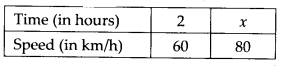
A car takes 2 hours to reach a destination by travelling at the speed of 60 km/h. How long will it take when the car travels at the speed of 80 km/h?
Solution:
Let the time taken by car at the speed of 80 km/h = x hours
According to question,
MP Board Class 8th Maths Solutions Chapter 13 Direct and Inverse Proportion Ex 13.2 16
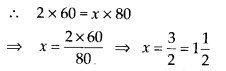
If the speed of a car increases, then the time taken by the car will decrease.
∴ The given problem is in inverse proportion.
MP Board Class 8th Maths Solutions Chapter 13 Direct and Inverse Proportion Ex 13.2 17
Therefore, time taken by car is 1\(\frac{1}{2}\) hours.

MP Board Solutions

Question 10.
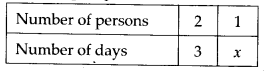
Two persons could fit new windows in a house in 3 days.
(i) One of the persons fell ill before the work started. How long would the job take now?
(ii) How many persons would be needed to fit the window in one day?
Solution:
(i) Suppose 1 person finishes the work in x days.
According to question,
MP Board Class 8th Maths Solutions Chapter 13 Direct and Inverse Proportion Ex 13.2 18
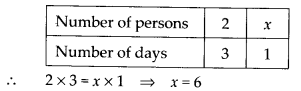
If the number of workers/persons will decrease, then present workers/persons will take more time to finish the job.
∴ The given problem is in inverse proportion.
∴ 2 × 3 = 1 × x ⇒ x = 6
Therefore, one person will take 6 days to finish the job.

(ii) Let the number of persons required to fit the window in one day = x
According to question,
MP Board Class 8th Maths Solutions Chapter 13 Direct and Inverse Proportion Ex 13.2 19
Therefore, 6 persons are needed to finish the work in one day.

MP Board Solutions

Question 11.
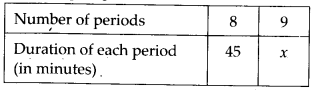
A school has 8 periods a day each of 45 minutes duration. How long would each period be, if the school has 9 periods a day, assuming the number of school hours to be the same?
Solution:
Let the duration of each period be x minutes.
According to question,
MP Board Class 8th Maths Solutions Chapter 13 Direct and Inverse Proportion Ex 13.2 20
If the number of periods increases, then the time duration of each period will decrease.
∴ The problem is in inverse proportion.
MP Board Class 8th Maths Solutions Chapter 13 Direct and Inverse Proportion Ex 13.2 21
Therefore, each period would be 40 minutes long.

MP Board Class 8th Maths Solutions